
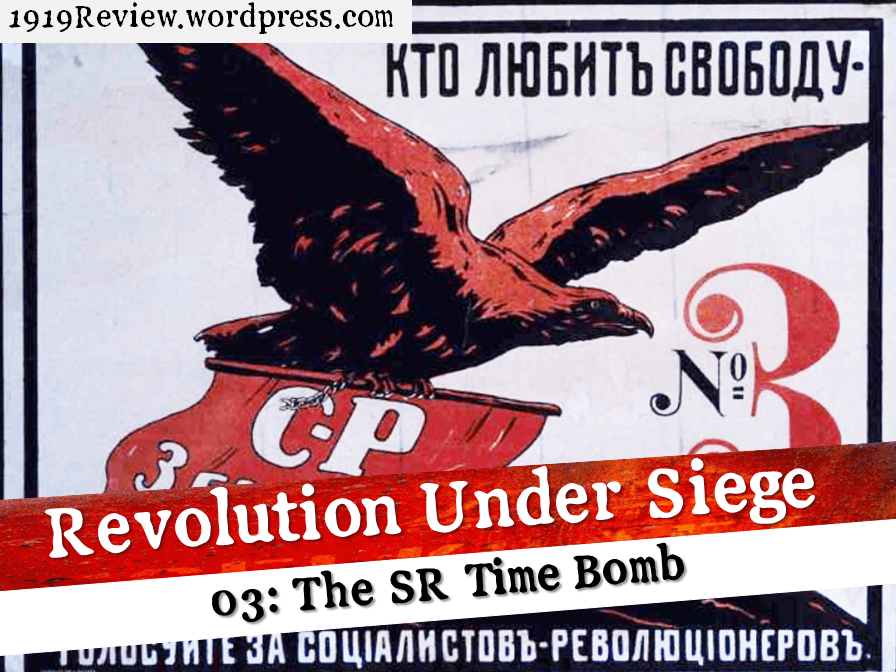
Listen to this post on Youtube or in podcast form
In May 1918 the simmering civil war in Russia went suddenly to boiling point. The working class was looking west to the danger of German imperialism, not south to the Cossacks or east to Siberia. But in May twin explosions of revolt occurred in the South and in the East. In a few months, the Soviets lost control over two-thirds of the territory of Russia.
These revolts were brought about by three major forces. The first is familiar to us, their motivations obvious: the officers and the Cossacks, who were involved both in the south and in the east. The second is the foreign interventionists; German invasion in the south triggered the revolt there, and Allied intervention played a key role in the explosion in the east. The third, active in the east but not in the south, was the Socialist Revolutionary Party. This surprising new addition to the White cast of characters will receive the most attention from us in the coming episodes.
But to understand the motivation of the SRs, we have to back-track to a profound humiliation they suffered in January of 1918.
Down at the Depot
At this moment, in the early days of the year, the calendar had not yet been changed and the struggles in Kyiv and on the Don were not yet concluded.
By a quiet canalside in Petrograd stood a naval depot, and inside the sailor Raskolnikov was arguing until he was hoarse. His real name was Ilyin – his alias ‘Raskolnikov’ suggests the Russian word for ‘heretic’ and is also the name of the killer in Dostoevsky’s Crime and Punishment. Raskolnikov was in his late 20s, an ‘Old Bolshevik’ by the standards of his comrades. He had known the inside of Tsarist prisons, and was a respected leader among the Kronstadt sailors.
The scene inside the depot club was one familiar to those who had lived through the revolutions of 1917: a mass meeting of sailors in the dim light of electric lamps, orators on the low platform inciting them to revolt against the government. But the speakers on the platform were not Bolsheviks. They were leaders of the Socialist Revolutionary party.
A parliament called the Constituent Assembly was due to open in a few days’ time, and in that assembly would sit a decisive majority of right SR deputies. They planned to wrest control from the Bolsheviks and from the Soviets, and they would need a few thousand armed sailors and soldiers to give physical force to whatever moral force their parliamentary majority could command.
‘You Bolsheviks have blood on your hands,’ an SR speaker growled from the platform of the sailors’ club, shaking his finger.
But Raskolnikov was there to answer their arguments. His memoirs do not record what exactly he said, but it worked. The SRs were defeated in the depot, as they were in every unit of the garrison.
They settled for calling a street demonstration on January 4th, the day the Constituent Assembly was due to meet. Also, they still had their majority in the Constituent Assembly. How had they managed to win this majority in the first place?

THE SOCIALIST REVOLUTIONARY PARTY
Before 1917, the Socialist Revolutionary party were a presence in the revolutionary milieu. Their members took pride in their roots in the terrorist movement which had claimed the lives of Tsars and ministers. But the party was changing. In 1904 the SR Maximalists, a group of around a thousand members, split away. They were dissatisfied that the party was becoming moderate, respectable, middle-of-the-road. But as we will see, the SR tradition never really let go of terrorism.
During the year 1917, the Socialist Revolutionaries were a key force in the Provisional Government. Along with the Mensheviks, they were the ‘moderate socialists’ who continued the war, dragged their feet on the land question, insisted on coalition with the right, and presided over an economic crisis that threatened the cities with mass unemployment and famine.
There was trouble in the ranks of the party. In the words of Smith, ‘From May [1917] left-wingers in the SRs began to crystallize as an embryonic party, by virtue of their support for the peasants’ seizure of landowners’ estates, their hostility to the ‘imperialist’ war, and their backing for a pan-socialist government.’ The party now had 700,000 members, and ‘by autumn most party organizations in the provinces had come out in favour of power to the soviets.’[i]
The leader of the Left SRs was Maria Spiridonova whom we met in Part 1, whose brutal treatment in prison had shocked the world.
Bryant writes: ‘An All-Russian Peasants’ Conference was held in Petrograd shortly after the [October Revolution]. The majority of the delegates came right Socialist Revolutionists–in three days they had joined the left wing; had elected Spirodonova president and gone over to the Soviets, marching in a body to [the Soviet headquarters]. There were two All-Russian Peasants’ assemblies–both did the same thing.’[ii]

Unlike Lenin and the Bolsheviks, the SRs had a severe aversion to splits. As late as the October Revolution itself, the Left and Right SRs were still formally in one party, even though they were on opposite sides of the barricades. Kerensky, the last leader of the Provisional Government, was a Right SR; he sent Krasnov and his Cossacks to attack Petrograd a few days after the October Revolution. An officer named Murav’ev defeated the Cossacks and captured Krasnov – and this Murav’ev was a Left SR. The Left and Right SRs were literally shooting each other in the streets. But they were doing so under the same banner and with the same party membership card in their pockets. The split did not happen until December 1917.
ELECTIONS
Elections to the Constituent Assembly were held in the weeks after the October Revolution. The Constituent Assembly Elections were yet another thing the Provisional Government had promised but had kept delaying, and which the Bolsheviks delivered a few weeks after taking power. The irony was that Bolsheviks believed that the Soviets were a superior form of democracy to any parliament.
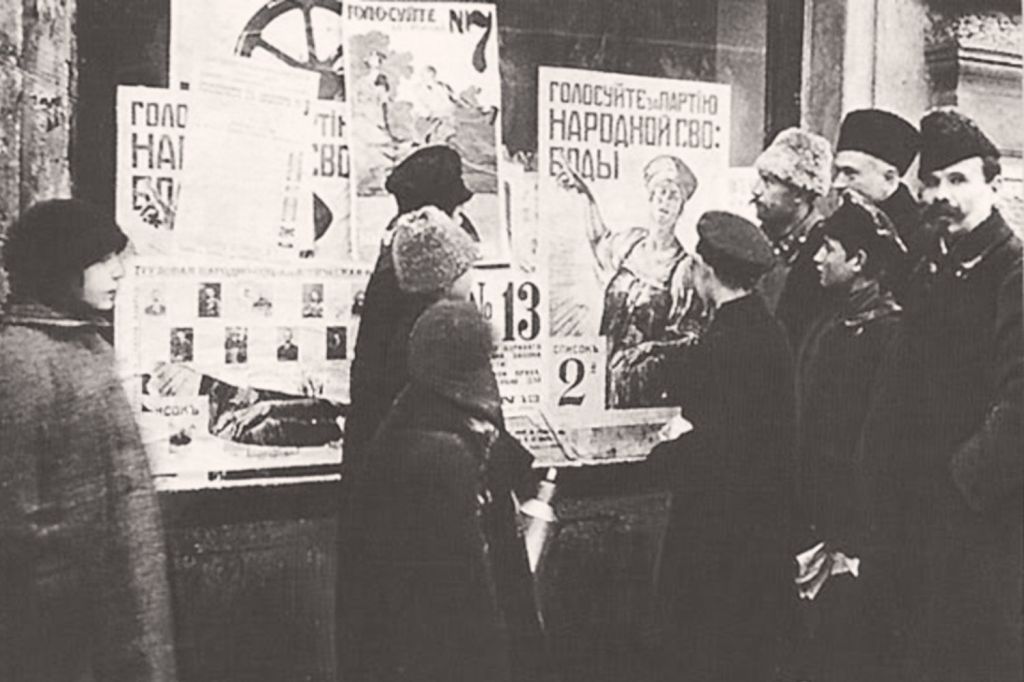
They won a very impressive vote in the cities and the armies. But the SRs were the hands-down winners of the election. Here are the results by percentage of votes cast.
- SRs: 39.5 per cent
- Bolsheviks: 22.5 per cent
- Constitutional Democrats: 4.5 per cent
- Mensheviks: 3.2 per cent
- Minority nationalist parties (including Ukrainian SRs & Ukrainian social democrats): 3.3 per cent[iii]
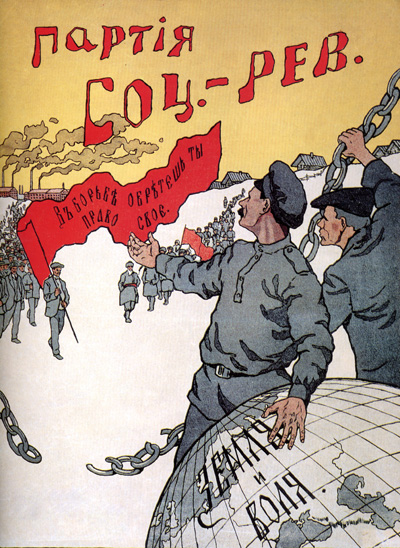


The SRs had by now finally split into Left and Right. But in a time of poor literacy and terrible communications – there was a shortage of paper for ballots, never mind leaflets – the split was not widely understood. Even those electors who fully understood it faced a head-scratching question of who to vote for, because in the vast majority of electoral districts the Left and Right SRs, who were shooting each other in the streets, were still on the same electoral list!
The system of voting for a party list as opposed to an individual candidate operates today in many countries, such as Sweden. It places the emphasis on programme rather than individuals (Note the appeal to vote for “list 3” on the SR election poster above). But because the Left SRs had been so reluctant to split, they had walked into a terrible trap. The electoral lists had been drawn up by the leadership of the SRs back in September, and favoured candidates of the right.
If the Left SRs had split much earlier and had time to develop their profile as an independent party, they might have won the Constituent Assembly election. In the few areas they did stand independently they performed badly. The SR party had a reputation as fighters for the peasantry, a reputation mostly earned by Left SRs. As it was, votes cast for the Left SRs’ programme and record went to elect people diametrically opposed to them.
The Right SRs’ majority did not impress the Bolsheviks or the Left SRs They saw the whole thing as basically a re-run of the Provisional Government, the same tired bankrupts seizing the chance to impose themselves on the country all over again. The farce of the electoral lists was an additional proof of the superiority of Soviet democracy.
‘THE GUARD IS TIRED’
On the day when the Constituent Assembly met, deputies from left and right alike arrived with pistols in their pockets. The Right SRs dominated the proceedings numerically. There were 230-240 on the right of the Assembly, against 130-140 on the left – a hundred or so Bolsheviks, and only 40 Left SRs.
It was an ugly day, marked by booing and heckling and tense manoeuvres. The Bolsheviks and Left SRs initiated ‘Whistling, uproar, shouts of ‘Get down!’, rattling and banging of desks… a fearful, inhuman roar and din […] a frenzied racket and loud, piercing whistles.’[iv]
Meanwhile a demonstration organised by the Right SRs filled the streets outside. During the day tensions would mount, and at one point sailors opened fire on the crowd, killing several. The crowd melted away.
The left put forward Spiridonova as their candidate for president, but she was easily defeated by the candidate of the right, Viktor Chernov, former agriculture minister.
Next the Bolsheviks proposed their position: that the Constituent Assembly could assume some authority on the condition that it recognised the supremacy of the Soviet. This was the mirror image of the Right SR position: that the Soviet could assume some authority as long as it recognised the supremacy of the Constituent Assembly.
The Bolsheviks’ proposal was defeated by a wide margin, and they and the Left SRs walked out.
The meeting went on without the left. For a few hours, the Right SR deputies in the hall could fantasise that they were governing and shaping the new Russia, laying the foundations for an orderly constitutional capitalist republic. They elected as president Viktor Chernov who was a Right SR, but who had a ‘left-ish’ profile because he had criticised coalition during 1917.
But as 5am approached a sailor walked up to the podium and asked them to close the meeting, ‘Because the guard is tired.’
On the surface the remark seemed trivial, but it was rich in possible meanings. The Right SRs for their part took it as a veiled threat (it probably was) and quit the building without uttering a word of protest.
The Constituent Assembly never met again. It sank like a stone into murky water and the ripples appeared to settle at once. Workers, peasants, soldiers and sailors – those who, throughout 1917, had answered any undemocratic moves with mass resistance – did not lift a finger. They did not give a damn about the Constituent Assembly, did not accept its right to rule. If it demanded they choose between it and the Soviet, it was no contest. Tens of millions had voted for a party with ‘socialism’ and ‘revolution’ in the name, and socialist revolution it would be.
But the Right SRs and their supporters never forgot the humiliation of that day. Parliamentary democracy had been brushed aside with contempt by Soviet democracy, which got on with its work as if the Constituent Assembly elections had never taken place.
The chaos that began in May 1918 would give the Right SRs an opportunity to take revenge for this humiliation, and to make another bid for power. In this, the aid of the western Allies would prove to be of more practical use than their dubious parliamentary majority. But as we will see, the name of the Constituent Assembly would be quite literally inscribed on their banners.
[i] Smith, S. A. Russia in Revolution, p. 110
[ii] Bryant, Louise, Six Red Months in Revolutionary Russia, https://www.marxists.org/archive/bryant/works/russia/ch09.htm
[iii] Smith, 155
[iv] Raskolnikov, FF, Tales of Sub-Lieutenant Ilyin, https://www.marxists.org/history/ussr/government/red-army/1918/raskolnikov/ilyin/ch01.htm
 The 1919 Review
2 thoughts on “03: The SR Time Bomb”