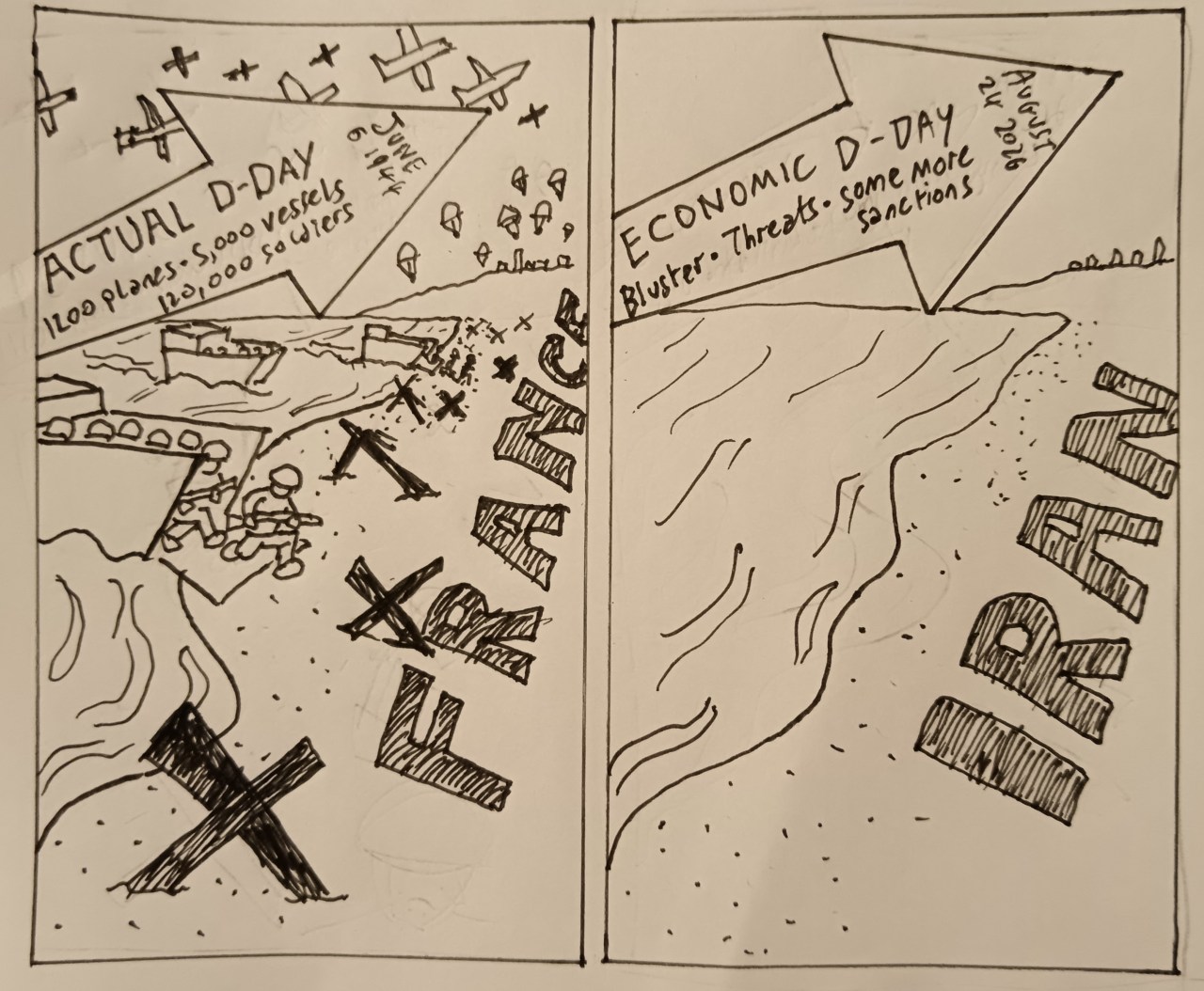
US/Israel war on Iran: Economic Dien Bien Phu

I wrote a few posts about Iran back in March, just after the war began, but I haven’t returned to the subject since. A draft post titled ‘Groundhog War’ did rattle around in my head but never made it to the screen. Other titles in contention included ‘The Ross and Rachel War.’ But I haven’t actually seen Groundhog Day and I’m not a big fan of Friends.

More importantly, this war is hard to write about because MAGA is flooding the zone with shit in the usual way. One day Trump is saying he has already destroyed practically everything in Iran, the next he threatens that he’s held back so far but he’s about to take the gloves off, and the day after that he says they are about to sign a deal. Whenever he says he’s ‘in full control of the Strait of Hormuz,’ you should swap out ‘Strait of Hormuz’ and swap in ‘my mental faculties.’ But he’s not in control of either – because a few days later he’ll be demanding that the mullahs open the strait, or else. It’s like bad reality TV: you can be carried along by the fake emotion on display in a scene – if you have the memory of a goldfish.

For example, as recently as August 1st there were apparently going to be ‘World War Two-level strikes’ on Iran; by August 7th, a deal on the Straits of Hormuz was close, and by August 11th Trump was claiming that the straits were open, whatever that means. At the time of writing the US and Iran have traded airstrikes again and Trump is threatening to ‘smack Iran to see what happens.’ The media reported on all these statements in their main daily headlines, as if a syllable of it had any real meaning.

For some reason journalists feel the need to report, in front-page headlines, where we are at in the cycle as if it’s the first time we’ve gone through this ritual. I go onto Al Jazeera or The Guardian and it’s TRUMP THREATENS TO “BURY TEHRAN, REGRETTABLY, UNDER A PILE OF HUMAN SKULLS”, then the next time I log in I learn that Iranian officials have denied a claim by Trump that the signing of a peace treaty is “just waiting for a new pen because the pen we had, what are you going to do, it ran out of… there was no more ink, you know the trouble with pens is… Gotta have ink! Gotta have it… so we had to send Steve and Jared out with the White House credit card to buy a new pen, and they’re not back yet…”

But at the six-month mark I feel an urge to follow up on the posts I wrote at the start of this war. So when you’re finished imagining Jared Kushner and Steve Witkoff running around Washington DC with someone else’s credit card, here’s what I think about Iran.

In the rubble of the MoU

The biggest developments recently were the Memorandum of Understanding and then its collapse. The MoU was basically a surrender by the US but it also represented a way out of the strategic mess. It was a sensible cutting of losses. It was not scuppered by Israel like I expected, though they gave it their best shot. I guess it fell apart through the sheer lack of integrity of Trump and the people around him. Having the integrity of an adult or even a teenager or older child means that you keep your commitments and feel shame when you fail to do so. The MAGA leaders either don’t feel shame, or feel such ubiquitous self-loathing that one more faithless act makes no difference. Even when they want to make a deal (I think they genuinely wanted the MoU), there is such a fundamental lack of integrity there that they can’t stick to it.

In the rubble of the MoU, we have governments in the region hurrying to make new deals with one another: the Egypt-Turkey-Pakistan alliance and the talks between Oman and Iran which have resulted in a deal. Also not to be overlooked is the visit of Ghalibaf, the Iranian house speaker, to Iraq where he spoke on the site of the 2020 assassination of General Suleimani. These things all reflect the diminishing of US authority in the region – first because of the inability of its leaders to make a deal and stick to it, but also because its bases and its radar and air defence apparatus have taken a hammering from Iranian missiles and drones.

I think that the US will continue this holding pattern, this tedious news cycle, this shameless display of impotence, this phony reality TV tedium, for the rest of Trump’s term.

(Then if there is an election and if the Dems win – it’s an if, because the Dems can always find a way to lose, even in a situation as favourable as this – they will disappoint everyone by making only glacial progress toward a deal, because they want to keep their options open and, secondarily, not upset the Israeli government.)

Ground War?

The thing I’ve gotten more skeptical about since the start of the war is the prospect of a US ground invasion of Iran. Around April you could notice a series of ominous reports about so many thousand marines here and so many thousand there being shipped into the region. But the thousands would need to ramp up to hundreds of thousands before we’d have to worry about an invasion. Even ‘just’ an occupation of the coasts around the Strait of Hormuz would require such numbers. Take into account also the fact that the US bases which would be used to stage such an invasion have been damaged to a <redacted> extent.

The Iranian top leaders appear, by contrast with their US counterparts, dignified and professional. But they talk about the prospect of US ground invasion with unseemly eagerness. They were at it again in July, when the pattern of US strikes appeared to be clearing the way for coastal landings. But the US just doesn’t have the numbers in the region, and is not making the kind of colossal movements that would be necessary.

What about a smaller incursion? The threatened Kharg Island operation was far too ambitious and dangerous. The idea of landing an army in the mountains to dig up ‘the nuclear dust’ was even sillier. But if an opportunity presents itself for a quick and relatively painless raid that would at least appear to do some damage to Iran, I reckon Trump and co will go for it. Several days of news reports about some little Call of Duty level would help drum up a measure support for the war. And then two years later they could make a movie about it. Better yet. So I’m surprised they haven’t done this already. I think we can expect by year’s end either A) some ‘daring’ but actually very safe raid or B) a failed attempt at same, an embarrassing fiasco. Maybe the fear of B has made the US afraid to try A. Or it could be the simple fear of escalation, which despite Trump’s brash presentation and lack of integrity, does in fact bracket his options.

Regional War

A brief overview of the war so far would be as follows: two major bouts of fighting between the US/Israel and Iran, one around March and a second, smaller one around July. In the process thousands have been killed in Iran and thousands in Lebanon. On the other side the picture of fatalities and casualties is not clear, but several hundred have been killed. Serious ground wars have taken place in Lebanon and more recently in Yemen.

Note the entry of the Houthis in Yemen into the war, with the closure of the Bab-el-Mandab Strait, raising the economic pressure another notch or two. The Houthis gave an impression of reluctance and presented a case for war that had nothing to do with Iran or Israel. The effects so far do not appear to be as significant as I would have expected. Perhaps they will take time to filter through into politics in a way that bears on the central struggle between the US and Iran. Maybe, against the backdrop of all that’s going on, in a region already in a state of high tension, it represents only an incremental change.

One of the main reasons I’m interested in what is happening around Iran is because of the possibility that developments could force Israel onto the back foot and slow down or stop the genocide in Gaza, the ethnic cleansing in the West Bank and the aggression in Lebanon. I say this without harbouring illusions that the obscurantist Iranian government can be relied on as a consistent ally of the masses in Palestine. Anyway, that’s not happening. Israel behaved as it pleased in Lebanon, killing thousands and entrenching a new occupation. The settler rampage in the West Bank is worse than ever before. Daily murder continues in Gaza. The erosion of the US missile defence and radar system in West Asia, and the development of new alliances and deals outside the US orbit, must end up having serious impacts on Israel. But, for now, the aggression is unchecked.

Blockade

The US policy appears to be to hold on and wait for something to change. The US blockade of the Strait of Hormuz might devastate Iran’s economy sufficient to force a new deal unfavourable to Iran. The US naval blockade of the Strait of Hormuz is a simple and effective measure, separate from the ‘Economic D-Day’ measures to extend the sanctions regime, discussed below.

But here too the outlook is not good for the US. Leaving aside the fact that Trump and co would be entirely capable of messing up even up a deal which is entirely favourable to them, the question is whether the US military has the capacity to… Well, let’s break this down:

  1. To maintain a sufficiently damaging blockade
  2. For long enough
  3. Against a large country
  4. With two long sea borders and many land borders
  5. On the far side of the world
  6. In a situation where US authority has diminished.

In any scenario, Iran is suffering a terrible blow to its key export, oil. But the Iranian government signed up for this the moment they closed the Strait, and preparation for this has been an integral part of their strategy. Meanwhile, just as the rest of the world is scrambling to work out ways around Hormuz, so is Iran. If some of the Saudi oil can be sent across Arabia in a new pipeline, Iran too can establish new lifelines for itself that bypass the Strait and US sanctions. What little shipping can get through is another lifeline; this grows in a scenario where the US blockade loses its effectiveness due to some of the problems we have seen – bad morale among naval personnel, technical issues on the aircraft carriers, the massive financial cost. Geography is inescapable. Iran can blockade Hormuz much more easily and cheaply than the US can.
‘Economic D-Day’

I have to be very careful not to sound like I’m saying anything good about Bush, Cheney, Rumsfeld and co who were responsible for the 2003 US invasion and occupation of Iraq. But I will say that their cynicism, dishonesty, recklessness, and contempt for human life stand out more sharply against their slick PR and the undeniable fact that this invasion was a thing of imposing dimensions and ambition. There was seriousness and commitment in their depraved villainy. Bush and friends did their own soldiers and public the honour of making fools out of them; in those quaint days governments had to manufacture consent. The Trump administration does not see any need for consent. The justifications it puts out are shoddy, half-arsed, contradictory things.

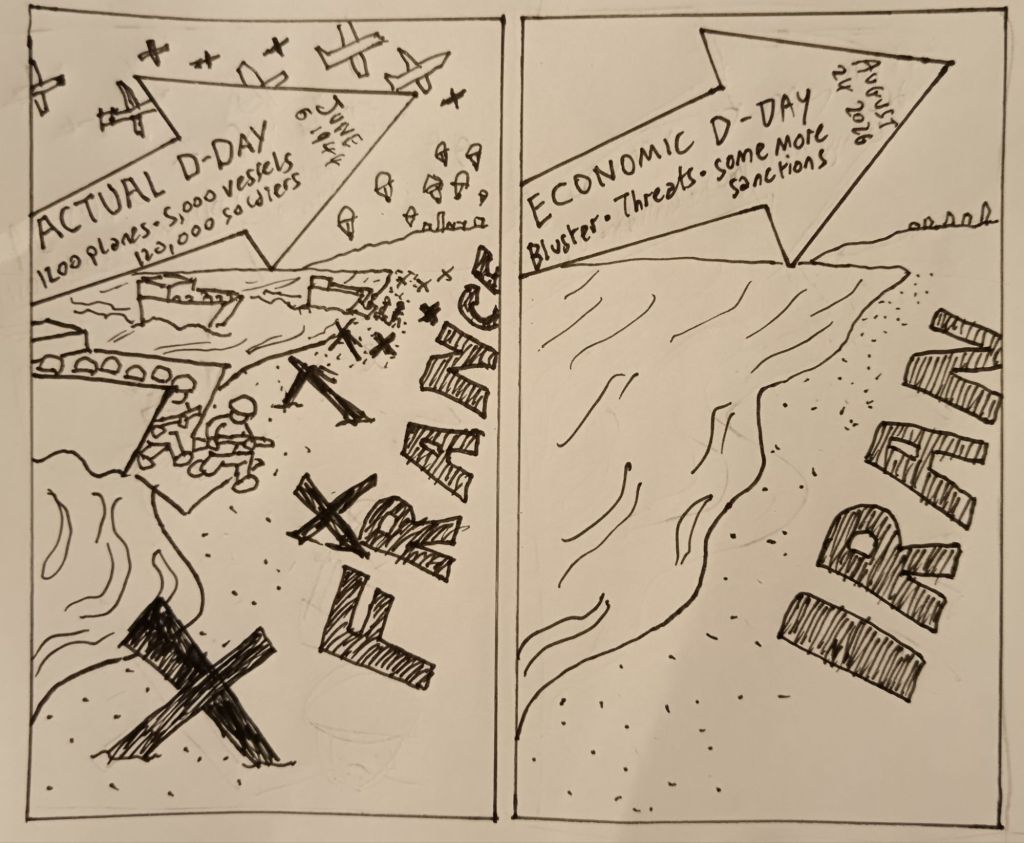
The latest catchphrase is ‘Economic D-Day.’ Will this economic offensive prove to be, as is implied, as consequential as Actual D-Day was in World War Two? In essence the US government are extending a long-standing sanction regime and also threatening to punish countries that trade with Iran. No doubt Iranian people are going to suffer. No doubt the extended sanctions represent a difficulty for the Iranian government and military. But like the blockade of the Bab-el-Mandab Strait on the other side, this is a quantitative and not a qualitative change. Those countries which will probably comply with the sanctions, such as the United Arab Emirates, had already cut trade ties with Iran anyway. Will it bring an end to the war, to the standoff over Hormuz? No chance.

But what all these blockades and sanctions mean for the world is another step towards the decoupling of the global economy from the US economy. Sanctions are enforced more by financial soft power than by military force. This soft power is diminished when it’s used in this way. The benefits of cooperating with the US are less when the US behaves as a fickle, impulsive power, possessed by a fragile need to project strength at all times, at all costs. Who would really expect China to bend the knee in this situation? Obviously they have not, instead deepening the geopolitical rift between them and the US.

The choice each third country has to make, faced with US sanctions on Iran, is not a simple one. They’re not all just immediately going to pick the US side in the dispute. Countries which do not comply with the sanctions would be making a rational choice to align with states that are less powerful but more stable and local. Countries which comply would be wise to try and hedge as much as they can get away with. The UAE (where Iran, prior to this war, procured many products which it otherwise had no access to), have cut off trade with Iran – but… How would we put this politely? Lax financial regulation is one of the UAE’s unique selling points. This is one example of the grey areas which the US can’t erase just by declaring Economic D-Day. In 2026 it makes more sense for a third country to push the boundaries, to test how far the US is really willing to go, rather than to comply and still risk arbitrary punishment.

Here I have to level with you and say that I have no special expertise in financial or military affairs, and am looking at these events with the eyes of a scholar of history and literature. What I can say about ‘Economic D-Day’ is that there is no magical formula where the US can hit Iran’s economy as hard as they need to, without burning bridges that they can’t afford to. What they will end up doing is not hitting hard enough, but still burning plenty bridges.

‘Economic D-Day’ will not change the course of the war, but will accelerate a longer-term shift away from US hegemony and toward a multipolar world order. To call it ‘Economic Dien Bien Phu‘ would be more accurate – sure, an exaggeration in the other direction, but not such a big one. Instead of making a deal along the lines of the MoU, the MAGA administration is holding on to a position that’s ultimately untenable, throwing good money after bad in the hopes that something, somewhere, gives, and the sunk costs can be recouped or at least justified.

Meanwhile, watch Trump flail around. If it’s senility, it’s not just senility. He really doesn’t know what to do when they fight back.
Review: Tainted Grail: The Fall of Avalon (10h in)

You wake up in a prison, are freed, and learn you are the proud owner a world-changing destiny. You’re playing a first-person free-roaming RPG set in a lavish world full of side quests and monsters. What is the name of this game?
The Elder Scrolls V: Skyrim? Wrong.
Oblivion? Wrong.
Morrowind? Wrong.
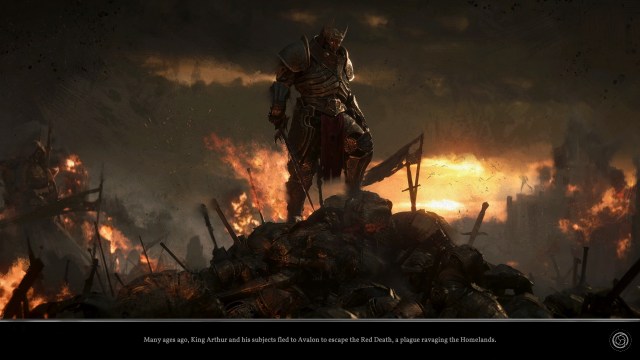
One thing’s for sure, right from the character creation screen: you can’t say Tainted Grail: The Fall of Avalon is hiding its influences. Starting the game as a prisoner feels like a deliberate homage. But this is not Elder Scrolls, not Bethesda. This is a different developer with a new story. So what is the background here? As this loading screen explains, we are in a darker sequel to Arthurian legend, where Camelot was destroyed by a plague called the Red Death.

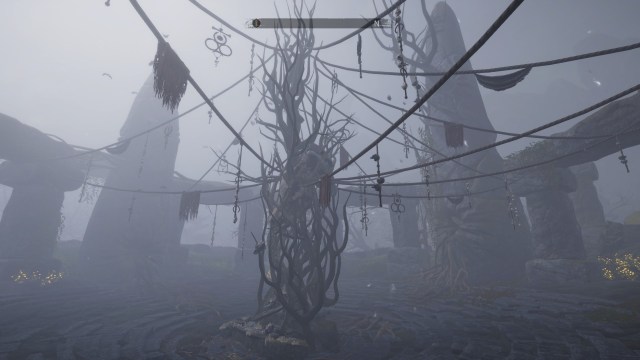
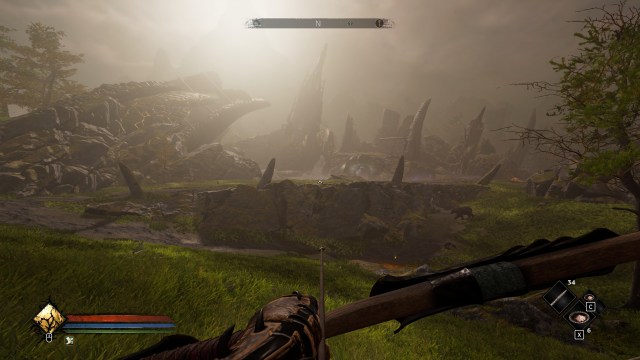
All images in this post are screenshots taken via Steam from Tainted Grail: The Fall of Avalon (dev Questline, pub Awaken Realms)

So Arthur and co fled to the mystical isle of Avalon, but that turned out to be even worse. A few hundred years on, the kingdom of Avalon is falling apart. That’s where the player character comes in.

Skyrim was the first thing I thought of, and the similarities still strike me sometimes. But as I played Tainted Grail I started to see more and more of what makes it distinct. I’m aware that it’s got a suite of smaller open worlds rather than one big Elder Scrolls monster map; so far, I’ve only been roaming in the first one, so this has not been a factor in my experience yet. No, the first thing to jump out at me was a difference in spirit. Without taking a moment to Wikipedia it, I’m going to guess that the developers are British. There’s something of the dark cheekiness of 2000AD. For example, slain enemies sometimes carry erotic fiction – a joyous anachronism given it’s written on parchment. Did monks copy it by hand in scriptoria? It’s a little moment of ‘Don’t worry, we can have a laugh here too.’

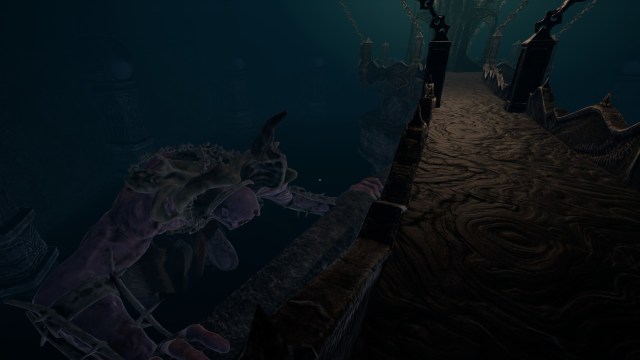
A terrifying grotesque giant, deep underground, pushing a lever as you do

That’s welcome because on the other hand Tainted Grail ramps up the ruin and slaughter. The dungeon where you begin is a refuge run by an order of priests who are trying to cure the Red Death. But things have gone horribly wrong. There aren’t just a few corpses here and there – there are bodies in cells, bodies on racks, bodies in cages, parts of bodies in cages and parts outside, and many, many torture chambers and blood-drenched laboratories. At one stage you fall through a hole in the floor into a cavern beneath, and you land on a gigantic heap of corpses.

When you go on out of the cave to a rocky beach there’s three shipwrecks. And a little way on, two or three more. Around the corner, five or six more shipwrecks. It’s not aiming for subtlety. But it goes deeper than tone: the combat feels less rudimentary than in Elder Scrolls, but not in that action-adventure console-port way that I often find annoying. It’s very intuitive. UI and inventory are noticeably easier to use.

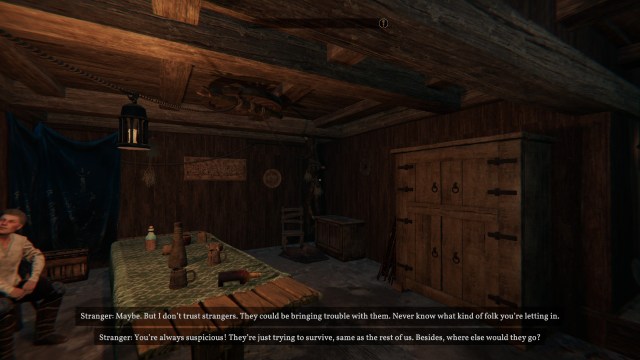
Two men in a pub chatting about the issues of the day. Every detail of this moment could be happening in Sean’s Bar in Athlone

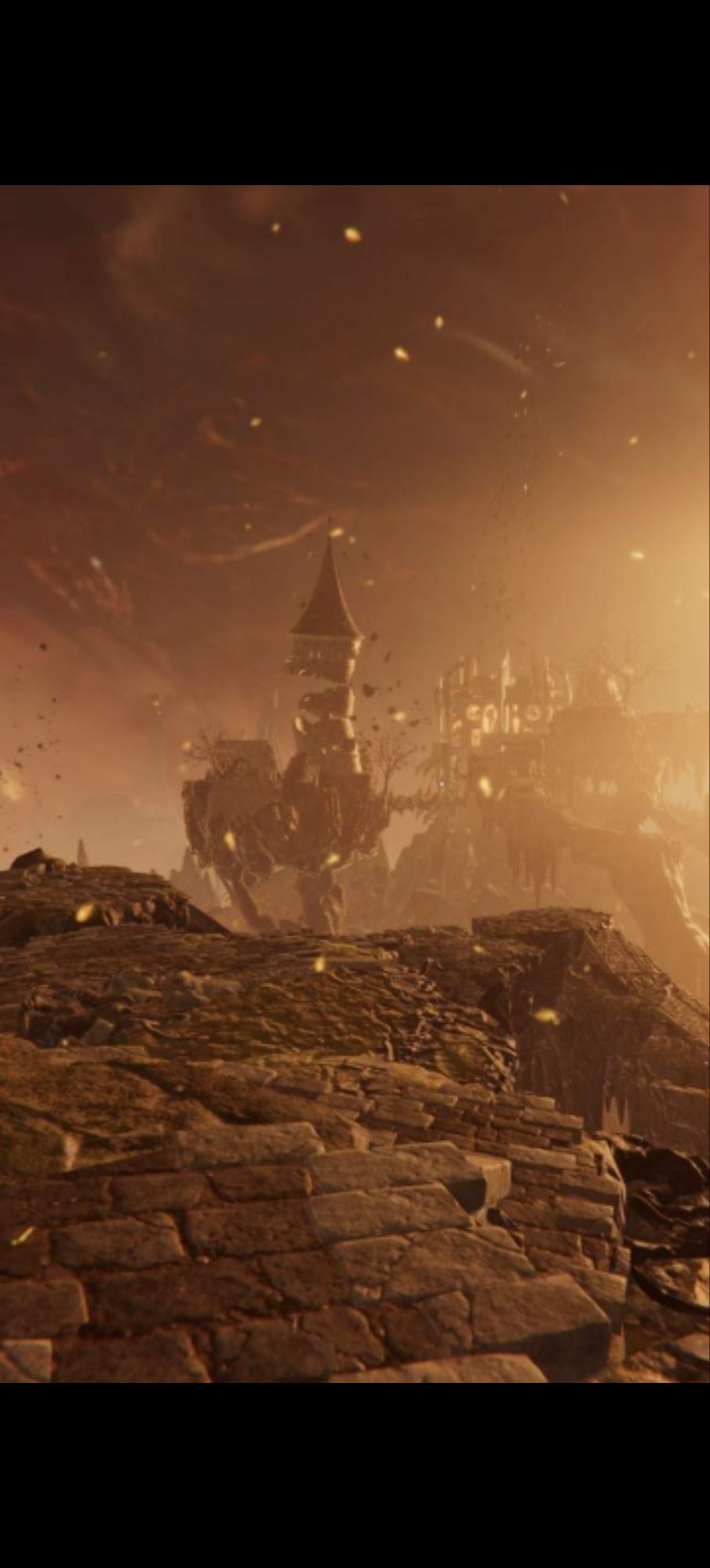
By this point in the game we have also encountered some terrifying grotesque giants, majestic statues, a strange, intense cutscene and a sojourn in a parallel universe of impossible topography and towers suspended at the moment of collapse. We also find ourselves in a blood-filled chamber where the emaciated body of King Arthur lies in a gothic sarcophagus, and we have been kinda-possessed by his spirit.

To be clear, all this in the starter area – the ‘Helgen’ of Tainted Grail.

The strange otherworld/ afterlife into which we wander to explore the dark history of Avalon

After that, I sail to the first open-world area. I have been told I have to steal Excalibur (by two different characters with different agendas), but I am free to roam at will, trade, loot, chat, do side-quests, and fight monsters and bandits. Here I started enjoying myself even more. The open world stuff strikes a good balance between freedom and direction.

The world is Celtic and Arthurian in its influences. The first merchant I met was coy about his true nature, but would not buy or sell anything made of iron. Demons roar at you in modern Irish. Cyclopean sword-in-stone monuments seem to float on the misty horizon. The characters often have Irish-language names, whose pronunciation the voice actors blithely butcher. But no matter.

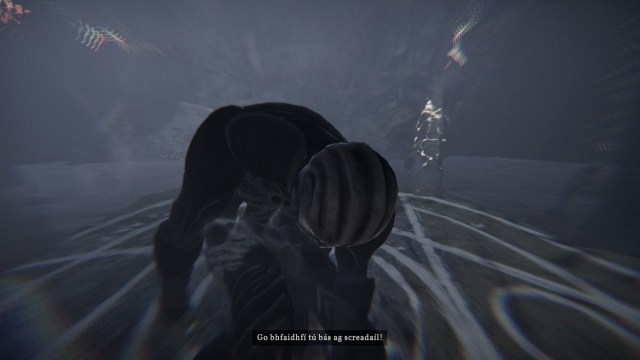
‘May you die screaming!’ translated correctly into Irish and, in this case, pronounced correctly too

The world is smaller and tighter than in many open world games. You can still pick a direction and walk and see what you find, but you won’t go thirty seconds without finding something that an artist had some fun designing and that will try to kill you. This is a trade-off; we have a pacier experience, but less of the Skyrim or Red Dead Redemption sense of being in a real landscape. On the contrary, this place seems more like the magical kingdom it is, with everything amped up to the extreme. Everywhere, marred spectacle and broken monuments pose implicit riddles. 

The side-quests sometimes leave you with some bleak humour at the end. A necromancer has been raising the troublesome dead at a local graveyard, as they are wont to do in games like this. The solution is to convince the necromancer that the only way he can make a breakthrough in his research is by experiencing death himself.

Other times it’s just grim. The red priests tried to cure a plague only to turn their haven into a vast cave complex of death. There’s a strong sense, underlined by the melancholy theme music, that King Arthur, too, tried to build something great and noble but has only wrought ruin and madness. 

Ten hours in, I’ve explored three-quarters of this first zone, which is called the Shadow of the Horns. I’m starting to itch for the next area but I’m not ready to leave this one behind. I could probably walk to the main quest marker at this point, though I don’t know what kind of horrors and villains I’ll find on that road. There are a few side-quests I want to do but I will have to either level up or fight smart before I can tackle them.

Playing to your build is encouraged. For a long time I carried a sword because that’s what I’m used to doing from other games. It took me an embarrassing length of time to figure out how to read the stats fully, and to realise that I was carrying a weapon that was too heavy for me, and suffering huge penalties because of it. I switched to a kind of magical staff called an essence channeler, and because I have assigned my level-up points to Spirituality, I can use this weapon to full effect. I am now dealing several times more damage than before. Still, if I approach a fight lazily I’m going to end up dead.

Maybe I like Tainted Grail so much because it’s a welcome contrast to some of my recent gaming. In my search for an open-world experience I have strayed into the consoley realms of action-adventure. I’m thinking especially of Assassin’s Creed: Valhalla. I really liked many aspects of it, but it frontloaded some terrible sins so that I never got through to the parts of the game I really wanted to play. The player spends the first 30-40 minutes in cutscenes (or thinly-disguised cutscenes). It does not let me save and load the game. I have to play through the same challenges again and again from the same checkpoint.

I don’t know how developers think they can reconcile checkpoints with open worlds. Is it a file size issue? This is especially bad when it comes to boss fights or other challenges that you might have to play through five or ten times. It’s not repeating the challenge that I mind. It’s repeating the five tedious minutes of filler between the checkpoint and the challenge.

Another recent one was Red Dead Redemption 2. I’ve played a lot more of RDR2 than I have of Valhalla and will definitely go back to it. I liked it. But I didn’t love it, because there were some of the same problems. You start the game wintering in the mountains and robbing a train. For me, in more than one sense, it was glacial and I was on rails. There were hours of linear hand-holding prologue. Hours! After that you have more freedom, but the missions maintain the same pace as the prologue. You have to commit to sitting down and playing for a long time if you want to make progress. And again, if developers want player freedom, they should let the player save their game.

How nice to pick up Tainted Grail and find a game that has depth and breadth but that gives me freedom. There’s a shorter prologue, within which you can design your character, hone your play style, explore a non-linear space, and make some consequential choices (as opposed to, shuffle around and listen to dialogue). Then you’re off the leash and wandering free within the hour. Of course, I’m not entirely comparing like with like. These are all free-roaming more-or-less open-world games. Assassins’ Creed is its own thing and Red Dead is its own thing, and maybe it comes across here like I’m criticising them for not being something they were never intended to be. I’m not, though – I’m just giving my own reaction to approaching Tainted Grail after playing them.

That’s my reaction after clocking up ten hours of play time, anyway: this is fun, this is engrossing, and I’m definitely going to give it another ten, at least.

Review: Thunder City by Philip Reeve

For the benefit of those who have never been exposed to the spectacular world of Philip Reeve’s Mortal Engines series, it’s about a post-apocalyptic future Earth where cities have been put up on wheels and scuttle around eating each other. Municipal Darwinism provides the backdrop to piratey adventure, salvagepunk and steampunk, epic journeys, Young Adult comings-of-age, civic-scale armageddons, and wars and power struggles with an edge of satire.

Thunder City marks the start of a third series, in between the original four and the prequel trilogy. You can pick up Thunder City without having read any of the others.

It delivers on steam, salvage and satire, within that fun type of story where a crew of colourful and diverse characters comes together to pull off a daring mission. The crew consists of a gladiator, a painter, a schoolteacher, a mercenary, an exiled prince and a – well, to describe the last one would be a spoiler, but the cover might be a giveaway. Their mission is to seize back the traction city of Thorbury, which has been taken over by a ruthless new mayor. This type of story lends itself perfectly to Reeve’s style, which is somehow breezy and substantial at the same time. These stories are epic and rich, but unlike his ponderous cities, Reeve never, ever gets bogged down. It looks effortless but he must really sweat over it.

The first chapter is capably written and engaging though it didn’t set me on fire; we follow Tamzin Pook, a young gladiator who fights robots in ‘the amusements’ in a mobile floating version of Margate. The first sentence of the second chapter was the point where I smiled and settled in for a good story: Miss Torpenhow, a teacher on Thorbury, feels a shudder in the deck and knows that her city has eaten something that disagreed with it. This is a warning for the characters and a promise to the reader that big trouble has just arrived. The chapter that follows is a good exemplar of the whole book: big events clip along, with the action always clear and crisp.

The prequels and original series dealt, respectively, with the beginning and the end of the era of traction cities. Those grand story arcs are heavy with the sense that the whole world is about to change in a fundamental way. In Thunder City, the fate of the world never hangs in the balance. For me that’s neither better nor worse, but suffice to say there are different stakes here. Instead of a sense of revolution, there is a sense of a status quo that will be restored.

Posh, hierarchical, olde-worlde Thorbury is disrupted by the ruthless technocratic regime of the self-made man, Gabriel Strega. Like some of the later villains in the original series, he wants to take Municipal Darwinism to its city-eat-city extreme. For him, art, aristos and ‘lovely old buildings’ are all items on the long list of things that can be torn down to feed the furnaces of the techno-accelerationist death drive. He’s a great villain to root against, but this sense of a return to the status quo is underlined by the fact that our crew of misfits is engaged in the conservative project of restoring an overthrown royal family. If this is a problem, the ending fixes it.

We see more of the Anti-Traction League – this time its more western component, the old and fading Zagwan Empire, who preside over the floating pubs of Gibraltar and super-intelligent octopuses. We get our first good look at Paris, whose central square features a statue of two deities who might be Asterix and Obelix.

I got more laugh-out-loud moments from this book than I expected. A showdown in a floating spa city ends with a character slamming a bowl of green and fragrant balm into a baddie’s face and growling the one-liner, ‘Consider yourself exfoliated.’

I had a mild worry, as the novel thundered on to its last hundred pages, that the final showdown on Thorbury would be deferred to a sequel. That would be a let-down – the stakes are right for this novel, but not high enough to sustain a sense of urgency across a series. It’s no spoiler to reassure you that Reeve is smarter than that: the story’s climax is a suitably pacy, exciting and satisfying struggle for the Thunder City of the title. But this crew are clearly set up for future adventures.

If I’d read less of Reeve, I would have worried that this novel would feel strained the way great stories sometimes do when the author – or another author – returns to them after a delay. Maybe the characters don’t click, the world doesn’t feel like it operates according to the same rules, the themes are muddled. But again with Thunder City the word ‘effortless’ comes to mind. I don’t know what he puts in the engine, but this thing runs smooth as a dream.

A final note on what Mortal Engines means in the 2020s – because earlier I used the word ‘accelerationist’ and had to pause and think about whether it was a metaphor. In the 2000s when London first chased a small mining town across the bed of the old North Sea, traction cities worked as a clever dig at neoliberal capitalism. Today you don’t have to read Philip Reeve to get the feeling that you live on a machine that’s ploughing a swathe of destruction across the world, that is tormented by eternal hunger, that is its own end and means; or to encounter a priesthood of powerful engineers who ask how but not why. Good thing the Gen X tech bros haven’t read a single book between them since well back into the twentieth century – if they’d read Mortal Engines they would by now be promising traction cities to hordes of eager investors. And we’d all be looking at the horizon saying, ‘It’s coming. It’s so scary. It’s going to change everything.’

Red Rising and The Expanse: two visions of our Solar System in the future

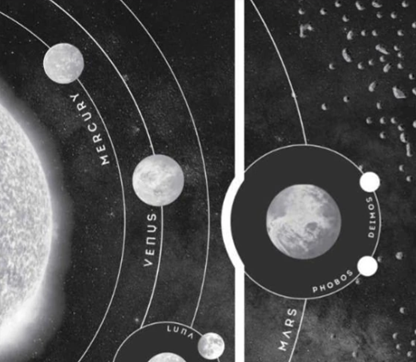
What would the maps of our Solar System look like in a future where humanity spreads out beyond Earth? The arena of human activity would be a vast and mostly empty space whose few and small physical presences – moons, planets and asteroids – are in constant motion relative to each other. I don’t have a good answer to the question of how to map this arena on a flat plane, or even a globe or a hologram. But some novels I’ve read in the last few years have challenged me to imagine how people would live, struggle, and wage war over this arena.

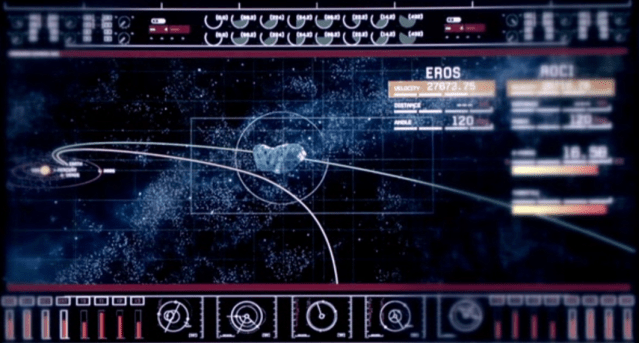
Mapping the Solar System in The Expanse, Series 2. Syfy Network, Showrunners Mark Fergus, Hawk Ostby, Naren Shankar.

These are interplanetary, not interstellar, scenarios. Since interstellar travel is just a fantasy at this point, the idea of a human diaspora confined to a single stellar system is a more practical and immediate proposition. Also, we know of thousands of exoplanets, but we know very little about them beyond what spectrography can tell us. When it comes to the planets whose names you learned in school, and the many moons, asteroids and dwarf planets, we have a mass of information from probes, including awe-inspiring photographs. If we want to populate worlds with imaginary human colonies, our neighbours in the Solar System leave less to the imagination. Even this more modest prospect is so distant, science-fiction authors are as good a bunch of people to ask as anyone else.

Here I will look at two works of fiction from the 2010s that set out to imagine a human race living, toiling and fighting across, but not yet beyond, our Solar System.

These works are:

Red Rising by Pierce Brown, and its sequels Golden Son and Morning Star (the Red Rising Trilogy, not to be confused with the Red Riding Trilogy by David Peace, whose action, confined to Yorkshire, is less ambitious in geographical scope);

and Leviathan Wakes by James SA Corey, the first book in the series called, and adapted for TV as, The Expanse.

A map of part of the Solar System, from Golden Son (Pierce Brown, Del Rey Books, 2015)

What about the other three Pierce Brown books, and the other seven or eight Expanse books? I haven’t read them yet (I’m one-third of the way through Caliban’s War and at about the same point in the TV show; Iron Gold is on my list). Anyway, for our purposes, these four novels give us plenty to chew on. But comments relating to the later books are welcome as long as people are tactful about spoilers.

The Condition of the Working Classes on Neptune

Darrow, hero of the Red Rising trilogy, begins his story as a 16-year-old living and working deep beneath the surface of Mars, mining Helium-3. He narrowly avoids death at the fangs of a pit viper, drinks and dances with his community, and shows us that he loves his wife (his people marry early). He knows, and knows of, no other life. As members of the Red caste, his people are the lowest, most downtrodden part of society. The author gives them some trappings of Irish culture, a light seasoning which is explained in-universe. Two other castes make a bloody entrance, the military Greys who keep the Reds down, and the aristocratic Golds who run the show. The Reds have hints of Irishness to suggest hunger and oppression; the Golds have lavish helpings of the language and culture of Ancient Rome to show power, glory and arrogance. The Greys have no culture, to show that they have no culture.

While the social order in Red Rising is a near-caricature of hierarchical societies from history, technology has advanced to a level not far short of godlike. Expensive devices allow the wearer to fly, turn invisible, etc, which makes the many battles and intrigues of the trilogy very interesting. This solar system is a canvas on which the Gold ruling caste (and Pierce Brown) can paint at will. Earth’s moon is covered by one great mega-city, Mars has been terraformed into a second Earth, with a lush and verdant Valles Marineris and many great cities, Jupiter’s icy moon Europa has become a rich ocean world, and so forth. Travel between these worlds can take weeks or months, and requires a large workforce of Blues, the spacefaring technical caste.

The 18th Brumaire of Nero Augustus

As the book and series go on we encounter more of the castes (such as Pinks, condemned to sexual slavery, and Obsidians, genetically-modified supersoldiers) and gain a broader view of how people live in this future. This is an ultra-extreme hierarchy, with castes not only defined by birth but through strict caste-apartheid and genetic modification. The Golds’ vendettas and repressions are truly monstrous. Rhea, a moon of Saturn, has been obliterated as the ultimate punishment of its rebellious lord. Rebellions by the lower castes are treated with even greater harshness, and as Darrow sets out on a mission to infiltrate and destroy the Golds (in the process humanising them for us without making their social order any more sympathetic), the threat of hideous tortures and certain death hang over him at all times.

The Golds are formally part of one polity, under the rule of Octavia au Lune whose power base is Earth’s moon. But they are a proud and resentful bunch. The Martian ruling class, led by Nero au Augustus,  chafe under the au Lune dynasty. The Golds of the far-flung gas giants are rugged frontier people who have an identity distinct from that of the Core.

In the second novel, Golden Sun, an Iron Rain comes to Mars – that is, an enormous invasion from space consisting of elite soldiers in drop suits and a large number of massive ships. Golds are at the forefront of combat here, and again in Morning Star when we see space battles and boarding actions. These are sublime massive-scale spectacles. Victory requires a fairly complex coordination between the skillsets of different castes.

Material interests don’t appear to be the direct cause of their bloody wars. Rather, power struggles and personal vendettas are a predictable outcome of having an aristocracy bred and raised for conflict and domination. Grudges that go back to the Academy (the Hunger Games-esque agoge which is at the heart of the first book) have a real effect on who picks what side when civil wars break out.

But this is not only true of the Golds. In Brown’s stories, for Red as well as Gold, betrayal, loyalty, sacrifice and struggle are personal. Several characters in the ragtag rebel alliance are identified as socialists, but it’s as human beings with reciprocal personal obligations that Darrow relates to them as to everyone. Even within the rebellion, factional struggles are more about ‘You betrayed my friend three chapters ago’ than ‘You favour an alliance with the Silver bourgeois caste.’ The question of cross-class alliances does come up in Morning Star, but it is simply not a point of contention as it usually is in real revolutions.

Down and Out on Eros and Ceres

Turning to our other vision of the future Solar System, working conditions as imagined in Leviathan Wakes still might not pass muster with your union rep, but at least you have a union rep. The world of Leviathan Wakes is not as elaborately obscene as that of Red Rising but it doesn’t have much of the glory or glamour of that setting either. In spite of flashes of horror, this is a more gritty and blue-collar vision.

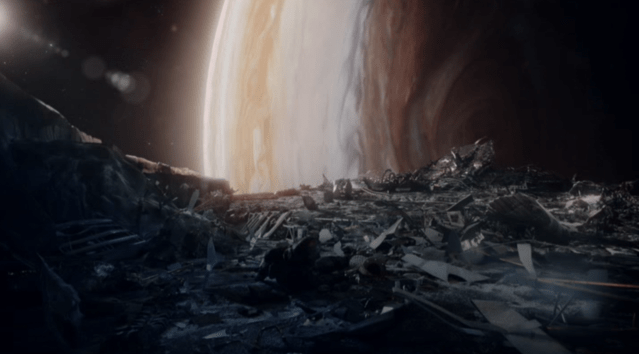
Jupiter, viewed from Ganymede. The Expanse S2

Mentions of a massacre of insurgent workers on Anderson Station imply that such events are rare. In the foreground of the book we have an atrocity of immense dimensions, the destruction of the main belt asteroid Eros and its million inhabitants. This is done not by a vindictive and repressive ruling caste but by a shady private corporation, Protogen, for purposes of R&D. The cover-up is only possible because there is a very distracting system-wide war raging at that time.

Forty billion people live on Earth, several billion on Mars, and only 50-100 million in the Belt and outer planets – the population of, say, Iran. This makes sense as, contrary to the fantasy of Earth’s ‘surplus population’ leaving for other worlds, moving people and stuff up the gravity well is difficult and expensive. This solar system is still very Earth-centric and that phrase, ‘up the gravity well’ is in common use, like ‘across the pond’ in our time. But space trade is lively. The dwarf planet Ceres, a focus of Leviathan Wakes, receives platinum, iron and titanium from the Belt, water from Saturn, vegetables and beef from Ganymede and Europa, ‘organics’ from Earth and Mars, power cells from Io, Helium-3 from the refineries on Rhea and Iapetus (like in Red Rising, Helium-3 is assumed to be very important). On Mars, terraforming is under way but at a glacial pace. Elsewhere, life beyond Earth means life in a habitat of some kind – ship, station, tunnel. This is very good for the TV series as much of the action can take place in cramped interiors.

Our two heroes are Holden, an officer on a water-hauler, and Miller, a rentacop on Ceres. Holden’s life on board ship, on journeys that can last weeks or months, is companionable but (until the inciting incidents of the novel) probably dull. Miller works for a private security company that maintains law and order on a world that consists of tens of thousands of kilometres of tunnels which are home to six million people and haven to a thousand ships on any given day. Miller’s perspective gives us a cross-section of the seedier parts of life on Ceres. The crime, chaos and paramilitarism that he encounters are, essentially, nothing that could not happen on Earth in our time.

Space travel is more challenging than in Red Rising. This is one of the only space novels I have read that doesn’t dismiss, by one means or another, the problem of inertia. There is a type of engine that can make spacecraft go extremely fast (still way, way sub-lightspeed), but it causes burst blood vessels, pressure bruising, joint pain, and ultimately permanent injury and death. This world works according to unforgiving rules.

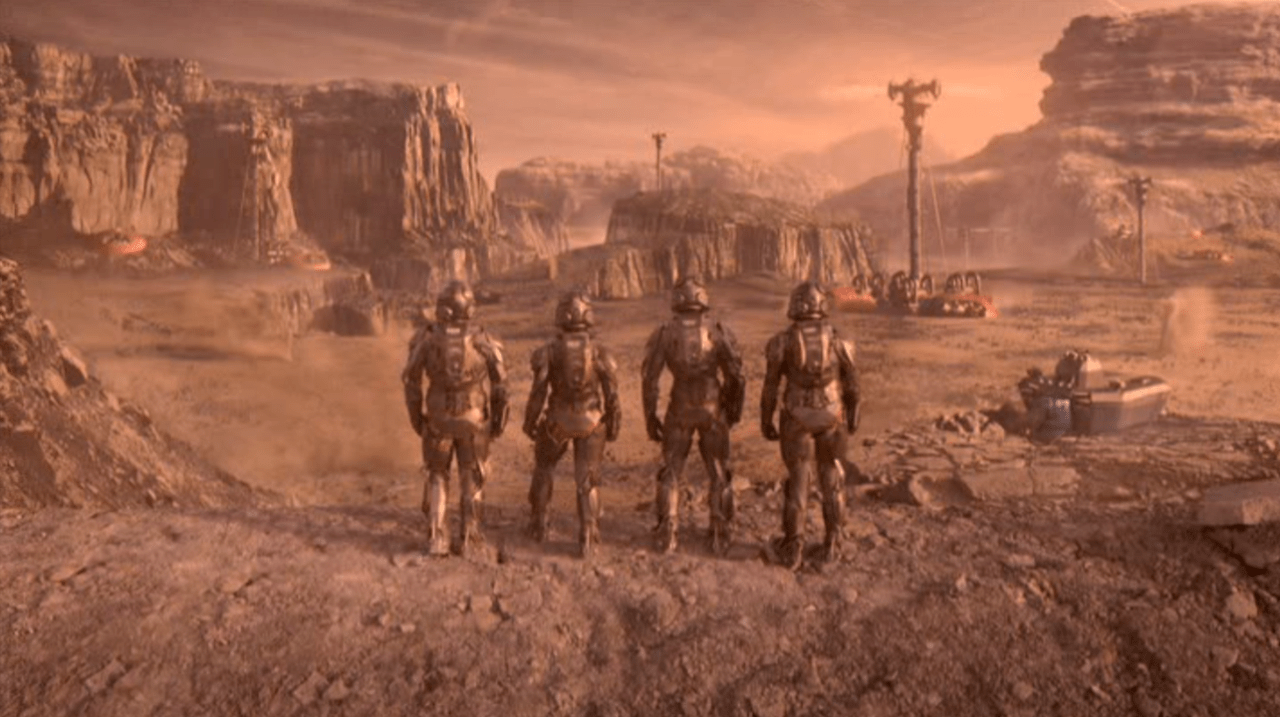
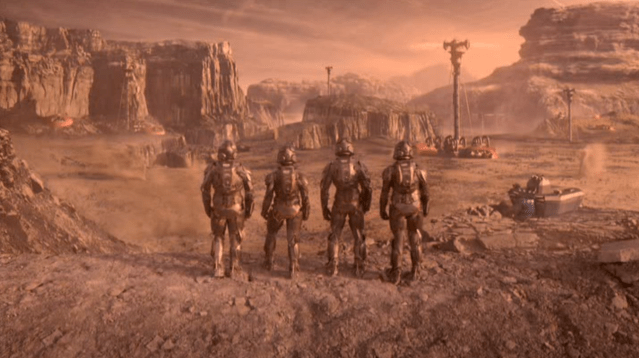
Mars in The Expanse S2. Terraforming is a work-in-progress.

The Belter Manifesto

The powers-that-be in The Expanse are corporations and state bureaucracies. There is no swaggering dictator, little room for charisma. But neither is there any sense that popular masses exercise any democratic control. We have a capitalist technocratic set-up which is entrenched and stable. There are no castes, but the Belters’ height and physiques are the outer manifestations of a deep difference between them and the humans of the Inner Planets.

Earth is a distant presence in the novel, but a few of our major characters came from there. Martians can be menacing but are humanised. This is a story about the Belt. And inseparable from the Belt is its major political/paramilitary movement, the Outer Planets Alliance (OPA).

The OPA are sympathetic both in terms of their cause (better conditions for the oppressed Belters) and in terms of their general presentation (they are cool and fun, speak a colourful dialect, do interesting things). We also see that they commit atrocities, as when anger at the Inner Planets is taken out on random individuals. And while our main characters end up as allies of a particular faction of the OPA, they are also in conflict with them at various times. The authors give us a complex picture here, with positive and negative aspects that form a cohesive whole.

But The Expanse is not all grey. Good can be hard to parse, but evil means something. The destruction of Eros is carried out by a team of specialists whose brains have been engineered so as to remove their sense of empathy. Their leader, Dresden, gives an alarmingly coherent case for murdering a million people. The picture of evil that emerges here is scary because it is banal and grounded.

View from inside a Martian marine’s helmet, in combat on Ganymede. The Expanse, S2

Conclusion

Which of these works presents a more compelling vision of a human future in the Solar System? First I want to set down the kind of scenarios I would see for our spacefaring future, with the caveat that I’ve read little enough relevant non-fiction: mostly Carl Sagan and A City on Mars.

We can forget about the idea of escaping from climate change by going to another planet. It’s the other way around: we need to sort our shit out down here before we are going to be able to build the kind of technological and social base we will need to keep alive our early tentative presences on other worlds. Earth ten degrees warmer is still a far better place to live than Mars, and Mars is far better than anywhere else, and still terrible. Similar points go for anything else people might want to leave Earth to escape, such as war or class conflict. Space settlement on any great scale (accepting for the sake of argument that it’s even desirable) would require technological and social leaps forward of a kind that would take us beyond capitalism, to a higher level of productivity and technique, a higher level of economic equality and harmony with nature.

From the point of view of private profit, limited rewards would accrue from space settlement, especially weighed against the financial cost of sending people, supplies and equipment up the gravity well. If it proceeds at all, it will stagger and lurch through hectic and wasteful boom-bust cycles. The kind of irresponsible hype that we see around crypto and chatbots could help space capitalism to advance a little way in our lifetimes. But by the same token space capitalism, due to cost-cutting and the demand for investor returns, would bring about the kinds of situations where dozens or hundreds of settlers die in terrible catastrophes. Such scandals would tank popular support and investor confidence, and the snakes would cancel out the ladders.

So I don’t really see either Leviathan Wakes or Red Rising as presenting the most likely scenarios, simply because I don’t think space capitalism can pull it off, never mind space classical antiquity. But these visions both have important truths in them. The Expanse is the capitalist world order circa 2010 projected into space, so on the surface, it’s a simple enough call to say that it’s a more realistic and grounded vision of a human future in the Solar System. But reality often fails to be grounded or even ‘realistic.’ We have various hooting cannibals in power in some of the most powerful countries on Earth in the 2010s and 2020s, and we have seen the descent of the world’s foremost space-settlement advocate into fascist delirium. If Musk is calling the shots, the human future in the Solar System would probably look more like the world of Red Rising than that of Leviathan Wakes, with eugenics, hierarchy, and constant illiterate references to Ancient Rome. If I’m wrong, and we end up bringing capitalism with us when we go to other worlds, then there’s a good argument for projecting into the spaceborne future the feverish politics of our time.

News Comment: Fuel Blockades in Ireland (Sat 11 April 2026)

I’ve been focused on the war on Iran for the last while. This post is a note on one of its distant but direct consequences. In protest at an extreme spike in fuel costs, a large number of men and women who own large vehicles have used them to blockade key infrastructure across Ireland. One third of petrol stations were empty this morning. The Guards are all out, rest days cancelled.

From my townie perspective, these fuel protests came out of nowhere. There are aspects I’d criticize, aspects I’d be uneasy about, and it’s taken me a while to think it all through. But behind all the noise, this is the cost-of-living revolt that many in both countryside and town have been waiting for. Right now it’s led by businesspeople (small and large) rather than by unions, the left or working-class communities. But here it is, and it has a really surprising amount of popular support,  more than I would have thought any highly disruptive protest could have.

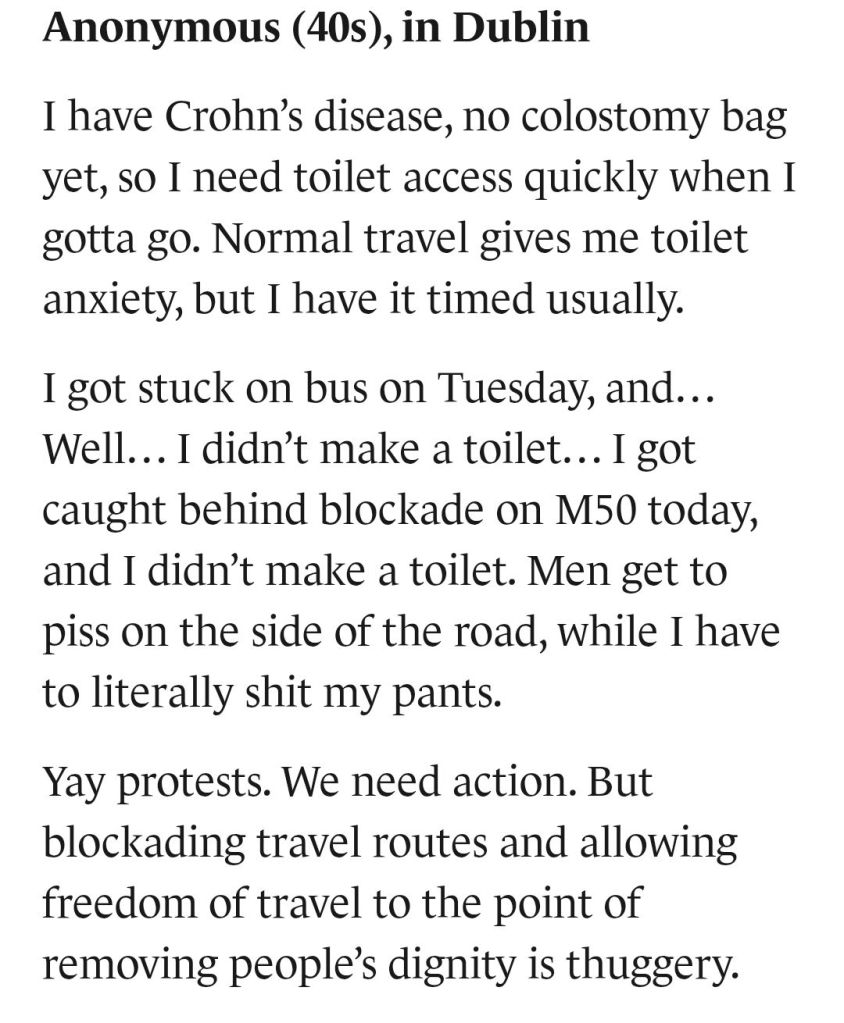
And just so we’re not hiding the miserable reality behind the vague word “disruption”, this is a message to thejournal.ie:

Source: https://www.thejournal.ie/your-stories-fuel-protests-7008178-Apr2026/

Of course, protest is supposed to be disruptive. But that disruption can be judged and calibrated. There is a whole spectrum of disruption short of “indefinite blockade of the whole country with no warning.” I say no warning, because maybe notice was given online, but most of us are not up to speed with what’s happening on haulierTok. If this thing wins, it will be in spite of the strategy of a sudden indefinite blockade, not because of it.

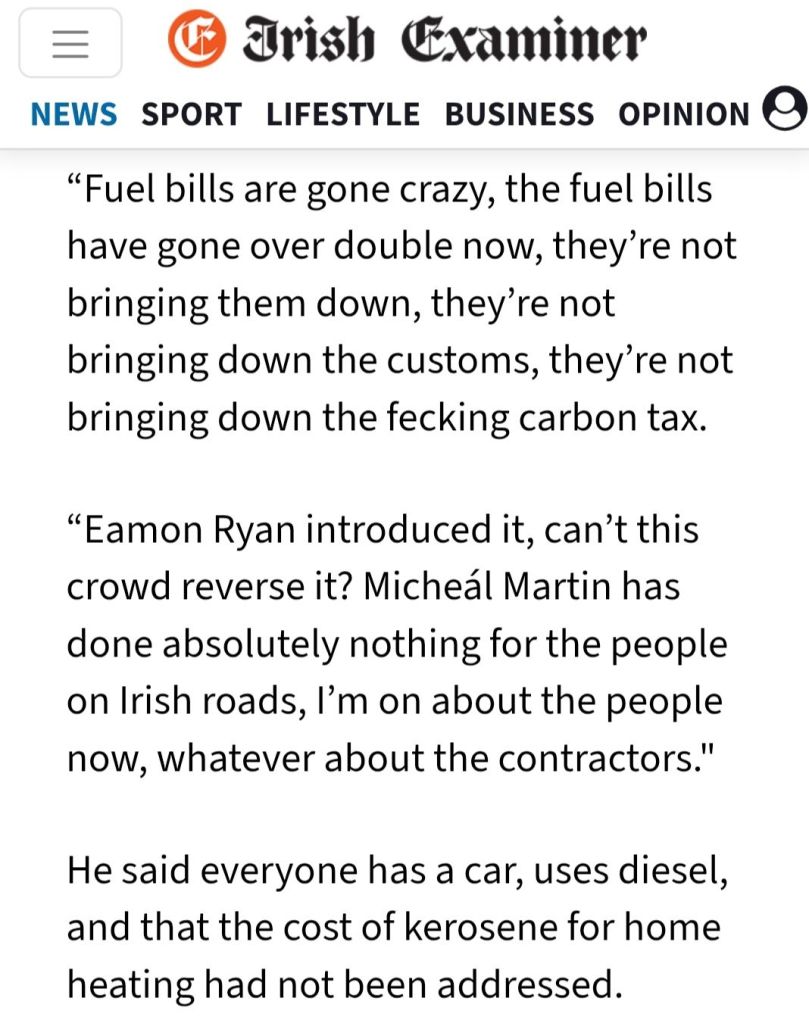
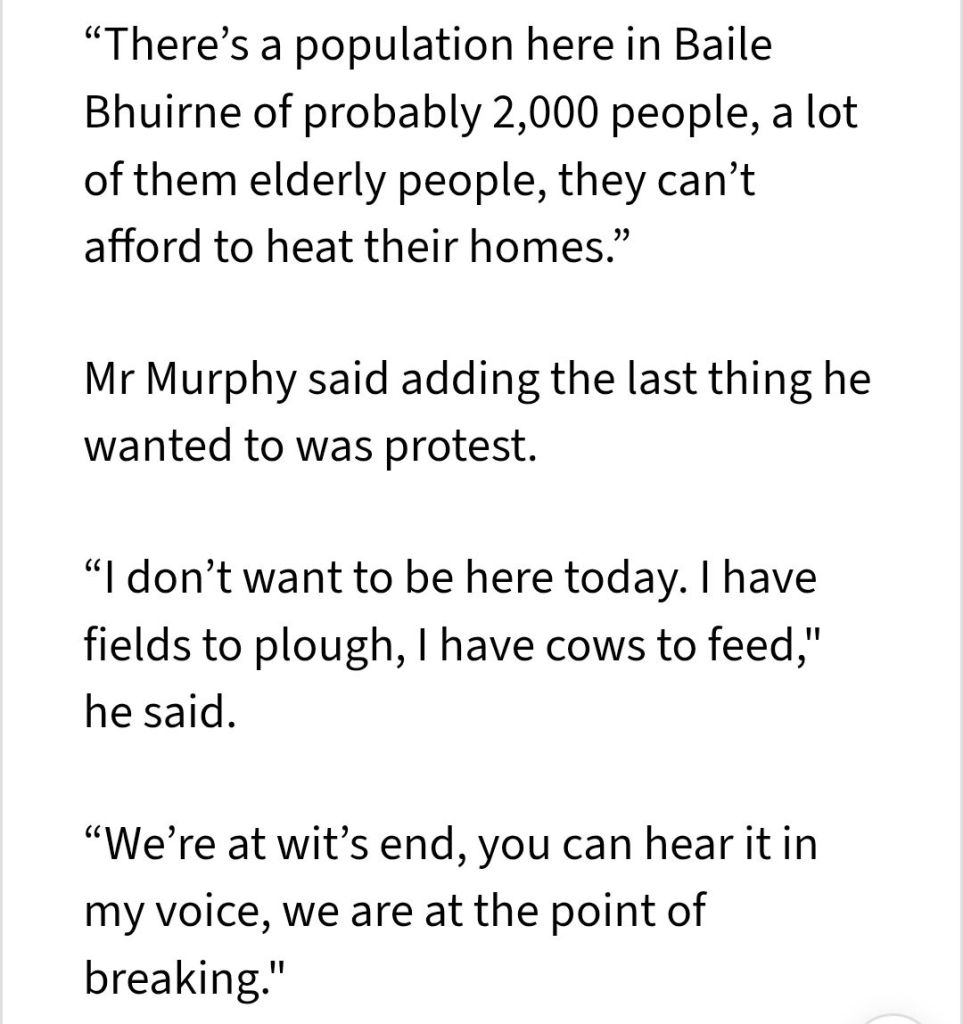
This criticism is serious but it doesn’t change my basic attitude. Complaints about disruption sometimes miss the point that the status quo, against which people are protesting, is unbearably disruptive.

See below, from the Irish Examiner:

https://www.irishexaminer.com/news/munster/arid-41824577.html

Finally I want to address something that’s really annoyed me. Calling this protest far right is not just unfair, it’s undeserved advertising for the actual far right. They wish they had a monopoly on anger over the cost of living.

I’ve seen anecdotes and screenshots that show individual spokespersons of the movement in a very bad light. Other stuff I’ve seen is surprisingly mixed:  https://www.thejournal.ie/ireland-protests-7008346-Apr2026/.

Reactionary ideas are widespread in society especially in the last few years. Even in what would be ideal from my perspective, a union-led, left-led or worker-led movement, we would see at least traces of this. The actually-existing movement is made up of older business-owning men. Enough said! It’s not conceding anything to any opinions that some resentful small business owner may or may not hold, to support the just and popular demands that he raises.

The government’s response has been dreadful: “give up all your leverage and then we’ll tell you what’s on offer.” It feels like we’re back where this post started, with Trump and Iran.

The war of the crazy bastards (US/Israeli War on Iran, Day 39, April 7th 2026)

As I write, the US president is threatening to kill Iranian civilisation, ‘never to be brought back again.’ The craziest thing is not the business of threatening genocide on impulse. It’s the fact that we won’t even remember this in a week. There will be some other flashpoint, some other deadline. I’m laying my cards on the table: Trump is bluffing again, just like two weeks ago when he extended a 48-hour deadline to 5 days and then appeared to forget about it altogether.

Sooner or later, the bluffs will spill over into escalating horrors, because the terrifying logic of this situation means there is an ‘up’ button but no ‘down’ button. And yes, this might be the time it spills over. So if I’m wrong and Trump abides by his deadline in some more-than-token way, it will do more than add a few more pages to the catalogue of sordid and pointless war crimes. It will provoke an escalation that will make the blowback so far seem mild. So I don’t make this prediction lightly. But I am sick of how Trump keeps saying nonsense that he doesn’t follow up on, and we still hang on his every grotesque word.

To get some sense of order out of all this chaos, and as we wait for Trump either to fulfil his threat or forget about it, let’s run through the various facets of this war in turn: what I’ll capitalise as the (1) Machine War, (2) the Oil War, (3) the Regional War and (4) the potential for a Ground War. The latter two I will hold back for a separate post to go up in a few days.

Khosro Heyratnegari. Kharg Island in 2015. From Wikimedia Commons

The Machine War

Fatalities on the US/Israel side have stayed strikingly low through 39 days of war (from what we can gather through the screen of wartime censorship) while, by contrast, the death and destruction in Iran and Lebanon have been appalling. But don’t be fooled by that. The basic idea I laid out back on March 3rd was: the US has walked into a situation which only their adversary, Iran, actually has the power to end. The war is not over while Iran is still hitting US assets with drones and missiles, still saying who passes through the straits. In my post from Day 12 of the war I placed importance on the idea of a ‘missile-interceptor gap;’ weeks later, I’m not sure if this was right: Iran is still bombing away due to its bottleneck of launching capacity while on the other side it’s not clear if their woes are due to “running out of interceptors” as such.

A lot of the questions I posed were answered on March 21st when Iranian strikes hit Arad and Dimona in Israel. Footage showed massive destruction, and 180 injuries were reported in a single evening. We are still seeing near-daily reports of successful strikes on Israel in particular but also on facilities across the Gulf. Is this the missile-interceptor gap, the effect of cluster munitions, or the sooner-or-later outcome of a numbers game where if there are enough missiles no so-called “iron dome” can catch em all?

On March 21st, Israel’s health ministry stated that over 4,292 people in Israel had been injured since the start of the war, a number that has surged since then. As of today, officially 39 people including soldiers have been killed. The disproportion between injuries and fatalities generally strikes me as odd. The idea that no-one lost their lives in Arad or Dimona seems strange to me as the pictures showed buildings really flattened.

Another straw in the wind is a report on US personnel in the Gulf being forced to ‘work remotely.’ This puts an image in my head of Napoleon explaining that his army has to ‘work remotely’ from Moscow. This places the “fatalities are so low” argument in a different light. They are low because the US facilities have been abandoned (and the naval vessels are anchored thousands of miles away). The low fatalities on the US side (taking them at face value) are not in this case a measure of success. There’s nothing new about running away as a means of reducing fatalities.

Hegseth brags about ‘lethality’ as if killing people were an end in itself. (Maybe it is, for him and for his church. And he calls Iran a death cult!) But the really crazy thing about this war is that the US bombardment is many times greater than the Iranian bombardment in ‘lethality’ – but so much less effective. In the future it will be difficult for history teachers to explain this. But the strategic reality is what it is. Speaking very broadly, the Iranians are fighting for survival and are ready to endure suffering. The Americans are ‘like the poor cat i’ the adage’ who want to catch fish without wetting their paws.

Oil War

The conflict over the oil fields is a warning. On March 18 Israel bombed the South Pars oil field, which is shared by Qatar and Iran. The US government were angry at Israel for escalating the war, so angry that they threatened to punish… Iran. Iran escalated in response with more attacks on oil facilities, then the US threatened an astronomical escalation, then extended the deadline, then extended it again, and again… What interested me about this episode was that it pushed the world to the brink of a far greater escalation. And a few weeks later we are again on the brink. It’s a measure of how wild the situation is: the US government has blown up tens of thousands of targets in Iran, and the Iranian government has closed the Strait of Hormuz. You’d think that was extreme, but there’s a lot of room left to escalate. Things can still get a lot worse and it’s easy to see how.

On the other hand it’s very difficult to see how things could get better, how the oil could flow again: even if Trump changes his meds and declares victory, Netanyahu could kick things off again with some unilateral action that would spoil a deal. The US have now essentially established a set of rules where negotiating is just a cover for the next act of aggression, which means that even if Trump and Netanyahu are both visited by seasonal ghosts who scare them into changing their ways, the Iranians will not come to the table for fear that the table will be blown up.

The Oil War is really having an effect. At the start of this war the countries of Western Europe came out very much on the US/Israel side. This was surprising given they had been mad at Trump over Greenland only weeks before. The way the war is dragging on, and the way things have gone with Hormuz especially, has pushed the US-Europe relationship back to where it was over Greenland. The anger from world leaders toward Trump for choosing to create this situation is very obvious. The Gulf countries are in a far more desperate situation. There are hints that Saudi Arabia and the UAE would support a broadened US war. I doubt Qatar and Oman are pushing the same agenda.

The US cannot replace the Iranian government. The US cannot collapse Iran as a state. The US cannot spirit away a huge quantity of highly enriched Uranium. The US cannot disarm Iran. The US cannot make the Strait of Hormuz safe on US terms (see my post from Day 20). You can’t make predictions so early in a conflict that could last years. But right now the US has no way to achieve any of its stated goals.

A pattern we see in many wars – arguably in Ukraine – is that the weaker side, intoxicated by early wins, overplays its hand and misses an opportunity to cut a deal before the tide turns. Trump is threatening to carry out massive-scale war crimes against Iran. But from the Iranian point of view, I would imagine there is little the US and Israel can do that would make the situation significantly more serious than it is, short of a nuclear attack or a ground invasion. I think that right now the Iranian leaders would only be ‘crazy bastards’ if they reopened the ‘fuckin’ straits’ and sat down with the Americans for another game of negotiate/assassinate. Trump’s speeches and posts read like a man who is trying, with mounting desperation, to scare people who are already beyond fear. The threats fail to hide a deep fear of further escalation.

Often over these last ten years it has felt like the entire human race was being forced to live inside the brain of Donald Trump. But reality is asserting itself and it now feels like we are on an interface between Trump’s grey matter and a real world that has ceased to cooperate with him solipsism. The mullahs are more formidable opponents than Joe Biden, Chuck Schumer and Nancy Pelosi. It is even clearer now than it was a month ago: the US-Israel alliance can cause a lot of pain and suffering, but they can’t win this war.

Stay tuned. In a few days I will post a follow-up looking at the various frontlines of this war across the region, and assessing the potential for a ground invasion of Iran.

[Update, 3AM GMT, April 8th. There is a ceasefire. The devil is in the details and in the execution. But there is after all a down button on this thing, and someone has pressed it.]

Strait to hell, boys (US/Israeli War on Iran, Day 20, March 19th 2026)

Since this war started I’ve been paying attention to news reports with a few key questions in my mind. ‘Will the Iranian people rise up in support of the people bombing them?’ was never one of those questions. The first hours of the conflict, when the Iranians fired back forcefully, settled in my mind the question, ‘Will the Iranian government fold?’ They didn’t, and now they won’t. But I’ve been wondering: will Iran reach a point where it can’t launch missiles and drones to significant military effect anymore? The Iranian government would not surrender at that point, so what then? Will the US reach a point where they are not making progress anymore with the bombing, where the costs threaten to pass a tipping point? Would Trump call it off? Or what other means would the US pursue, probably alongside continued bombing? Some of these questions are being answered as we speak as the war transitions to a new phase.

Previous posts in this series: What advantages does Iran have in this war? (US/Israeli War on Iran, Day 4, March 3, 2026) and The Machine War (US/Israeli War on Iran, Day 12 – March 11th 2026)

Battle of Hormuz?

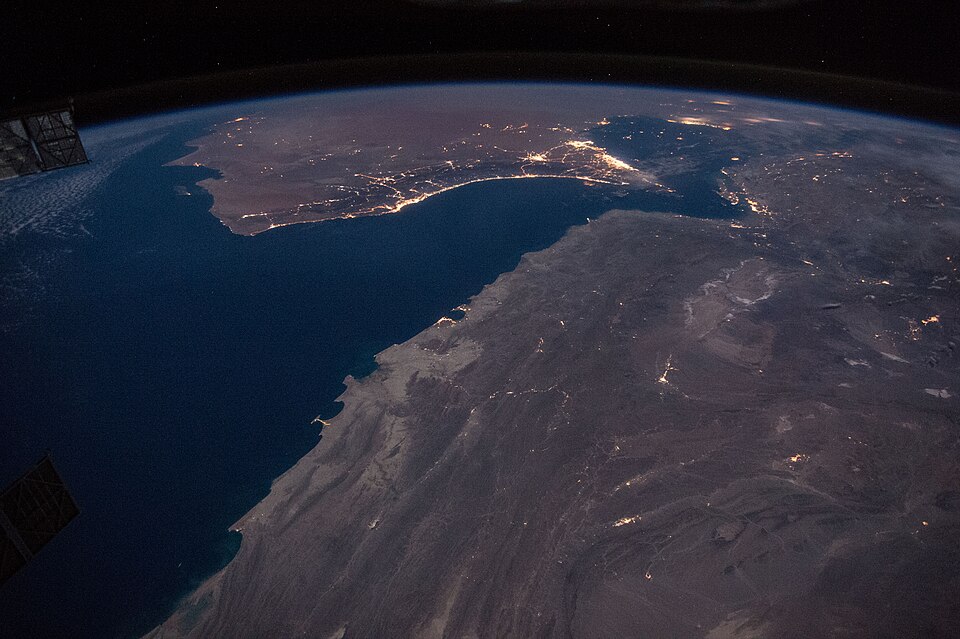
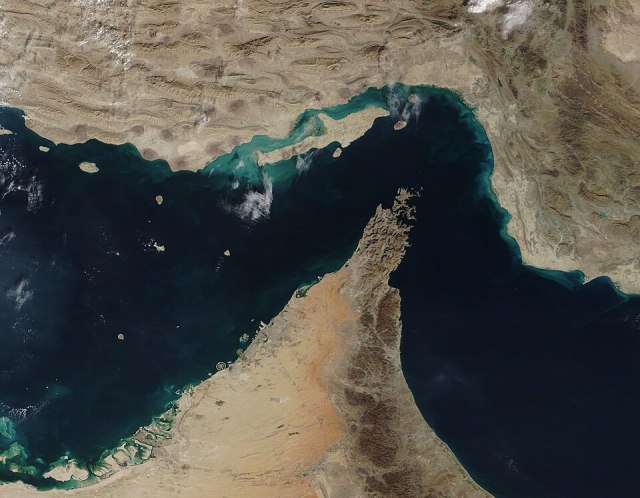
An image of the Strait of Hormuz from Wikimedia Commons, courtesy of NASA. Iranian countryside in the foreground, Arabia across the strait.

As far as this war goes, the Strait of Hormuz is now the primary focus of the world’s attention. I see potential for a pitched battle to develop in the straits of Hormuz. In other words the US may try to force the straits using naval and air power. To what end?  Not only for economic reasons, but for reasons of prestige, power projection etc. Such a battle would be difficult for Iran as they don’t have air superiority. But US vessels would be vulnerable to attacks from the shore and from drones, including naval drones. Could the US force a way through? Most likely yes, but at serious cost. Could it guarantee the safety of civilian shipping for even, say, one week following the end of such a battle? Let alone for years to come? They would have to control the entire shoreline at all times, requiring a massive commitment of resources and personnel. Actually making the strait safe means occupying a decent chunk of Iran. Occupying part of Iran means fighting a ground war.

I wrote the above days ago. Today I read this:

The US operations being contemplated include securing safe passage for oil tankers through the ⁠Strait of Hormuz, a mission that would be accomplished primarily through air and naval forces, the sources said.

But securing the strait could also mean deploying US troops to Iran’s shoreline, said four sources, including two US officials. Reuters granted the sources anonymity to speak about military planning.

Jesus Christ.

A ‘Battle of Hormuz’ scenario would draw the US into a painful trap. In a battle like that, Iran could bring its strength to bear much more so than in the current air war, because it would be a question of military power in coastal waters and on the ground. The war would move from air, the favoured element of the US, to water and then to earth. Specifically Iranian soil, where the Iranians would have a massive advantage in terms of numbers, personnel, local support and knowledge. The US would not be able to defeat an Iranian insurgency, and I have my doubts about them even winning a conventional war in this situation.

If the US does not attempt to force the Strait of Hormuz, and just watches as more and more countries cut deals with Iran to get their shipping through, they will be accepting a defeat on the global stage. They may well sit back and try to wait Iran out. I’m not alone in half-expcting this; on March 13th we had Elliot Abrams, former high-ranking diplomat, weighing in with the opinion that Trump will ‘call off’ the war in ‘probably a week or two.’ That does not strike me as implausible. Or, in the circumstances, unwise.

Attempting to force the straits would be a wild thing to do. But launching this war was a wild thing to do. US leaders, given their volatile public profiles, could well go for crazy plans as a way to salvage wounded pride, but only end up committing more and ultimately losing more. They have already blustered their way into a strategic dilemma.

The other depressing fact to remember, though, is that US military power is so huge that these volatile leaders could make every imaginable blunder and still be cushioned from defeat. One fifth of the world’s oil might just have to move through a warzone for a few decades while Iran is torn apart and its people suffer. Stupider things have happened.

I’m throwing in a second Strait of Hormuz image simply because you can make out Dubai’s Jumeirah palm in this image. Image from Wikimedia Commons, courtesy of NASA.

Missiles and drones

Another key feature of the last few weeks has been that Iranian projectile and drone launches have fallen to a low but consistent plateau.

I want to draw attention to this article by Muhanad Seloom which makes an argument that the US and Israel are winning the present war. He points out how badly the US/Israeli air campaign has damaged Iran’s capacity:

‘Iranian ballistic missile launches have fallen by more than 90 percent from 350 on February 28 to roughly 25 by March 14, according to publicly available data. Drone launches tell the same story: from more than 800 on Day 1 to about 75 on Day 15.’

The weak spot in his argument comes at the end. We can all agree that the bombing campaign has been vast in scale, hitting many thousands of targets in Iran and seriously damaging its military production. But then Seloom asks, ‘What prevents Iran from restarting production? The answer requires a post-conflict framework that does not yet exist in practise.’ I simply don’t see what post-conflict framework, short of military occupation, would prevent the Iranian state from rearming.

The article also acknowledges that communication from the Trump regime has been ‘poor’, a reference to the mishmash of strategic aims that have been declared to the world. I don’t think it’s just communication. The real problem lies in what is being communicated. There was no strategy beyond the assumption that the Iranian government would immediately collapse or surrender. Maybe the Trump administration will move the goalposts and declare victory. But as I’ve said before, the Iranian government is in a position where it can say when the war ends.

The other point is that Iran, even with a diminished capacity, is still launching enough missiles and drones. Just today they hit a power plant in Haifa. The censorship regime prevents us from seeing much. We have to extrapolate from the limited data we can see. The New York Times found 17 damaged US facilities in the region using satellite data. Daily news reports bring us news of mounting horrors in Lebanon and further bombings across Iran, but there are also still regular reports of Iranian missiles striking targets in Israel and across the Gulf.

The US leadership with their sadistic and bombastic speeches are signposting their own untrustworthiness. So I don’t believe their boasts about how much of Iran’s military capabilities they have destroyed. And it seems plausible to me that their air campaign passed a point of diminishing returns a week or two ago. There is a part of the Iranian military capacity which the US cannot hit. Iran is big; there are sites the bombers cannot find or reach. In spite of boasts that they have destroyed all air defences in the country, I would bet there are heavily-defended areas that the Americans are shying away from. Meanwhile a part of what has been destroyed can be restored.

I assumed for a while that Iranian missiles and drones would run out. What’s actually happened is that a massive supply is stuck in a bottleneck of launching capacity. Their machine war has plateaued to a level that is low relative to February 28th. But it’s still going and it’s not going to stop for a long time.

Proxies/Allies

We should consider a scenario where the US, while continuing to bomb Iran, also arms and funds various opposition forces within Iran.

In the first week of the war the question of Kurdish and Baloch insurgents was more to the fore than it is now. With various Iranian Kurdish parties declaring an alliance and with autonomous Kurdish regions now in existence in Iraq and Syria, it’s likely that, at the very least, some Kurdish forces in the northwest of Iran will make some moves. The Balochs in southeast Iran are another national group who might be willing to join the fight. Showing the Iranian leaders’ alarm at such a prospect, they carried out drone strikes in the early days of the war against Kurdish-held outposts.

On March 5th interesting remarks from a Baloch leader were quoted in The Guardian: “I think [everyone] who is against the brutal cleric regime would accept support from the US but it should be a consistent support that resolves the issues of minorities – unlike, for example, when the US gave support for Syrian Kurds and then betrayed Kurds.”

The US lacks moral authority and trust due to its (bipartisan) fickle treatment of proxies in the past. Of course, a tenet of Trumpism seems to be that a great empire doesn’t need trust or moral authority. As a result, these groups within Iran are reluctant to fight in spite of their aspiration for independence. Hard to blame them! Joining the US and Israel wholeheartedly would be very unwise, given Trump could hang them out to dry “probably in a week or two.” There is reluctance on the US side too, because Erdogan does not like the sight of Kurdish people with guns. The same goes for Balochs and Pakistan.

Also, to what end? The purpose of promoting insurgencies would be to distract Iranian ground forces. But unless the US actually tries to occupy the Iranian coast, there is nothing to distract them from. It’s a waste.

The developments toward a regional war, especially in Lebanon where the civilian death toll is now approaching that of Iran, and the continuing ethnic cleansing in the West Bank and genocide in Gaza, deserve more attention than I have been able to give them in this post. So there we have it for Day 20 of the war, as I see it: potential for a pitched battle around the straits, Iranian barrages continuing at the same rate while the far greater US/Israeli bombardment sees diminishing returns, and mixed signals re the development of insurgent movements on the borders of Iran.

Want to read more? Browse my full archive at the Home Page

The Machine War (US/Israeli War on Iran, Day 12 – March 11th 2026)

Following on from last week’s post, I want to thrash out from uncertain evidence where things stand in the war as of today. Day 12 is a landmark because twelve days was the length of last year’s June conflict between the same antagonists. The day has come and gone with only the most unconvincing signals from the US president that there might be some dim prospect of a peace deal. But as I said last time, the basic strategic situation is: it’s the Iranian side who get to say when the war ends.

But it may be the end of the beginning. I think we are getting on towards the end of the first phase of the war, a machine war mostly of missiles, bombs and drones. The main questions in this first phase of the war are: what do the Iranians do when they run out of missiles? What do the US and Israelis do when they run out of interceptors? And who runs out first? A missile-interceptor gap in favour of Iran would mean a sudden ramping-up of damage to Israel, Gulf oil infrastructure and US bases. A gap in favour of the US means Iran’s chief offensive weapon is spent.

Where are we now?

Where do things stand right now in relation to this question? Almost nobody who knows anything valuable has any incentive to tell the truth. Here I will sum up the contradictory stuff I’ve read from various more or less non-credible sources.

  • That there are x5 fewer missiles than expected because Iran has lost so many launchers to air strikes.
  • That the US is pulling military hardware out of places like Korea and Ukraine to throw it into the Iran situation.
  • That the rate of Iranian missile fire has slowed a great deal since the start of the war.
  • That in comparison with last year’s 12-day war, fewer Iranian missiles are being launched – but they are causing more damage with the population of Tel Aviv being forced to run in and out of bunkers all the time.
  • That the Iranians are tricking enemy pilots by literally painting warplanes on runways.
  • That Tel Aviv is being hit really hard in the last four days, that the “Iron Dome” is breaking.
  • That US/Israeli planes are swarming the exits to Iranian bunkers, blowing up anything that pokes its head outside.
  • That civilian life in the Gulf has returned a good deal of the way to normal.
  • That Iran has pivoted to blowing up oil facilities in the Gulf.
  • That these attacks on oil facilities are not Iranian at all, but Israeli false flag operations (If the Gulf countries choose to do a deal with Iran in the future, they can all pretend to believe this).
  • That Iran is still holding back its biggest missiles.
  • That Iran can churn out Shahed drones at several times the rate that they are destroyed, and that these drones can do enough damage to make a big difference in the war.
  • That Iran can fight on at a fraction of the financial cost that the war is imposing on the US.
  • That the US side are not actually worried about running out of interceptors, only about leaving Ukraine exposed by overcommitting to Israel and the Gulf.
  • The US has not lost vessels. But that could be because their navy is hanging back and not committing itself to combat.
  • That the entire Iranian navy and air force have been destroyed, and 80% of air defences destroyed.
  • That 17 US installations in the Middle East have been damaged.
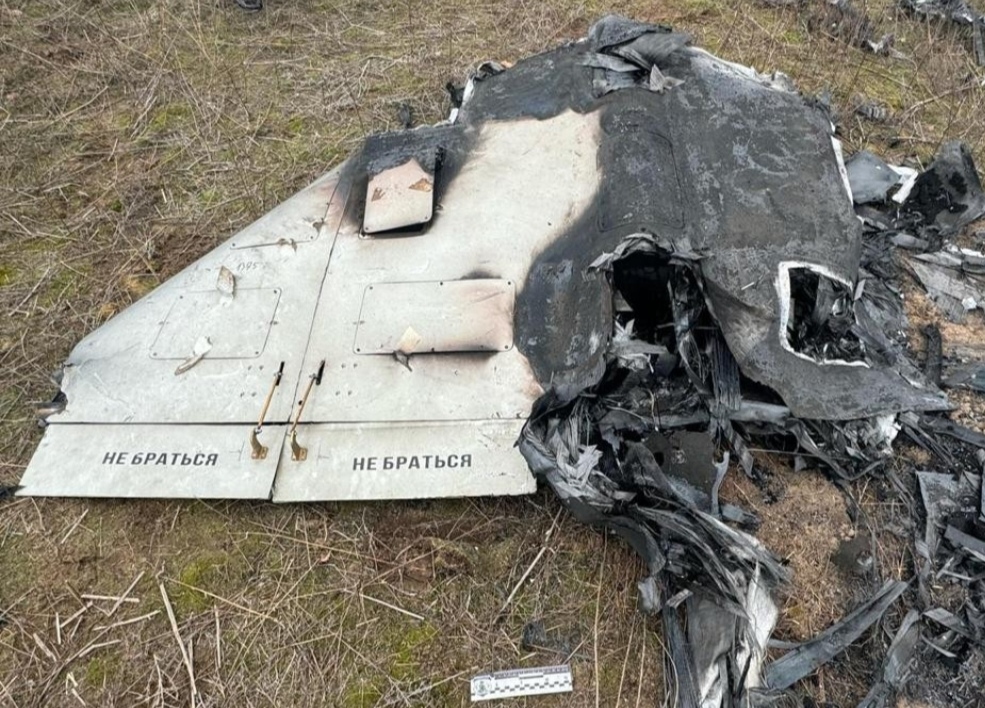
A Shahed drone shot down in Ukraine. Image courtesy of Npu.gov.ua

All of the above cannot be true. But some of it is. We have to use our own judgement. It appears to me that while the balance of fatalities is massively against Iran, the war is proving to be a massive logistical, political and economic challenge for the US.

What do we know for sure?

The outstanding fact of the war is that there has been a slaughter of civilians in Iran and Lebanon. Next in significance is the blockade of the Straits of Hormuz, the mere warning of which has led to economic turmoil around the world. Moving on from warnings, today three ships were hit by Iranian weapons in the straits.

Incentives to de-escalate are not there. An initiative by the Iranian president to mend fences with the Gulf States was blocked by the military, with strikes continuing, for example on a desalination plant in Bahrain the very next day. Yesterday I saw multiple headlines about Trump saying peace was coming very soon, and I just find it both funny and irritating that there are still journalists hanging on every word out of Trump, as if this is a man who weighs his words for even a second before vomiting them up, or stays true to them afterwards.

The US/Israeli bombardment, with its toll in civilian lives, can carry on for, in effect, as long as the US population will continue to pay for it and to tolerate it morally. But Iran will run out of missiles or of launching capacity sooner than it runs out of resolve. From a two-sided air war it will become a one-sided bombing campaign like what the US did in Korea and Vietnam (without unseating a regime). The 12-day duration of last year’s war could indicate that this first phase, this machine war, might be reaching its limits. But assuming the two sides are better-prepared this time, it could go on for another week or two.

At the end of that period, a missile-interceptor gap in Iran’s favour would mean an episode of more serious damage being inflicted on US bases and on Israel. Such a ‘Tet Offensive’ moment, especially so soon after the outbreak of war, could have a huge effect on public opinion and mood. A missile-interceptor gap in favour of the US would, on the other hand, settle the air war into a one-sided conflict until such time as the Iranians can restore capacity – if they can restore capacity at all under such pressure.

Next post I intend to explore what a second phase of this war might look like, assuming that the first is coming to an end. To finish today, a note on the Iranian regime.

Iran: strengths and weaknesses of the regime

I said last week that Trump, Hegseth, Miller et al are fools. The Iranian leadership, on the other hand, are reactionary and ruthless, but they are not fools. Unlike the American and the Israeli leaders, they cannot afford to be fools. The Islamic Republic is deeply imbedded in society through a nearly fifty-year history. Iran’s strategic doctrine of distributed “mosaic” resistance and multiple designated successors for every position is an impressive response to the last quarter-century of a US and Israeli doctrine of blitzkrieg and assassination. In the future, the current war could be written up as an epic of resistance that could supply the clerical regime with a whole new legitimizing narrative that it can spin decades of mileage out of.

For what it’s worth, I don’t support the Islamic Republic regime – and I think any regime that Trump might install (or Biden, Obama, Bush or Lincoln, while we’re at it) would be a lot worse. A new regime emerging in a genuine way, from a popular uprising such as the Women, Life, Freedom movement, or from Iranian labour, would be a different story. To me this is a very simple point. It’s not complicated at all. Some people insist that any criticism of Trump’s idiotic war is a defence of the clerics. On the other hand I’ve noticed a semi-ironic identification with the Iranian regime from people who are simply relieved to see some powerful entity standing up to the US and Israel at long last.

Even taking into account the rounding effects of irony, I think this is unwise. Already the clerical regime is directing its propaganda appeal to the anti-Israel layers of MAGA more so than the progressive anti-war left.

Anyway, I don’t feel any need to wring my hands, accompanying any remarks with a token condemnation of the Iranian government for the sole purpose of covering my arse. That’s not why I’m writing this. But a relevant point, for my purposes, is to look at how the nature of the Islamic Republic might inhibit its ability to fight imperialism. On Drop Site News a week ago I heard an Iranian official using this war as a retrospective justification for the killing of thousands of protesters by the government in January in operations that were extraordinary in scale and ferocity. On the contrary, there must be severe confusion and demoralisation in the armed forces and among the public following the winter bloodshed. This kind of war demands the full mobilisation not only of the armed forces but of all of society.

I’m going to leave that point very general because of weaknesses in my knowledge of Iranian culture and politics. But as a general rule the nature of a regime has profound effects on how it fights a war. We can’t put the clerical authoritarian regime in a box and forget about it for military purposes. It will tell.

What advantages does Iran have in this war? (US/Israeli War on Iran, Day 4, March 3, 2026)

The long-predicted US/Israeli war against Iran has begun. I will be at the anti-war rallies, just so you know where I’m coming from. But this post is going to address a simple question in a factual way with as little rhetoric and moral judgements as I can manage. So I regret that I’m going to be mentioning various reactionary chancers as if they are serious people whose words mean anything.

That question: What advantages does Iran have in the current war?

I don’t know who’s going to win this war. The advantages enjoyed by the US are obvious, and include a military organisation of peerless strength, practically unlimited material resources and the vocal support of governments around the world. But it strikes me that Iran enjoys many advantages that are not as immediately obvious but that carry great weight.

1: Home turf

This is not a war between peers of equal strength. But it is not ‘superpower versus dysfunctional geopolitical minnow’ either. This is a global empire versus a regional power.

It is obvious which side is stronger. But the stronger power still has to apply its strength effectively. Here, the aggressor’s supply lines are stretched while the defender has its resources and its population right there, to hand. The US has to bring its personnel half-way across the world and keep them supplied. An important regional power, with a well-educated population of 92 million and a strong military, can leverage this advantage.

On the other hand, the US has a vast apparatus of bases half-encircling Iran. There are 40,000-50,000 US personnel under Central Command (Centcom, covering the ‘Middle East’, Central Asia and Egypt). Centcom has existed since the early 1980s and has fought several wars. Bases housing up to 10,000 personnel have histories going back decades. So the war is not ‘US versus Iran, on Iran’s home turf’. It is Centcom (and tiny but heavily-armed Israel) versus Iran. This diminishes Iran’s ‘home turf’ advantage but not entirely. This apparatus of US bases has to be sustained from outside at great expense. If it expends a lot of munitions or loses a lot of soldiers or machines, these have to be made good across those long supply lines.

2: US military assets can become political liabilities

It’s not, in every situation, a good thing for the US to have a wealth of targets within range of Iranian strength. From his statements about the war possibly being over in two to three days, it’s clear Trump wanted another ‘one and done’ spectacle in Iran: strike hard, receive capitulation, declare victory, pick another country to shake down next. Hegseth’s remarks today acknowledge it will be a longer affair but insist that it won’t be Iraq.

If we can say that there is a ‘Trump doctrine’ of quick wars – one-night stands or weekend flings with no strings attached – then that doctrine has been exposed for its serious weaknesses. It demands that Trump pick his battles carefully, which he has not done on this occasion. And that goes back to those US bases.

On Day Two of the war I wrote the following note for this post: ‘It’s going to be the US asking for peace, this week or next – and Iran saying no, we won’t stop hitting Israel, hitting your bases, until we are convinced we are secure.‘ That’s in essence what has happened since I wrote that note. Trump made tentative peace overtures, the Iranians said no and kept shooting, and Trump and co started making different noises, saying the war would be four or five weeks, not three days.

Those US bases, to be clear, are a net negative for Iran. But in this situation, they are hostages. They mean that Iran can hit back, with no shortage of targets. The war ends when Iran says so, or when it has nothing left to throw at those bases. This is not a weekend fling. The US is committed, even though it didn’t want to be.

3: Iran’s back is to the wall

The US struck Iran without warning, in the middle of negotiations that appeared to be going well. Negotiating in bad faith and assassinating a leader who enjoyed considerable authority and prestige in his country and beyond – these things come at a cost. The twelve-day war last year (when Israel and Iran traded missile strikes until the US waded into the fray and bombed Fordow) saw Iran’s government take a moderate and cautious posture. This time Iran has retaliated, apparently without holding back.

I don’t know enough about Iran to advance a sweeping thesis about how its people will rally behind the government. The lack of military mutinies during the recent protests is an important sign that though the regime is widely hated it is not on the brink of being overthrown. Based on historical examples, I’d say that even many who hate the government would temporarily set aside their differences and get behind the war effort.

4: The US does not know what it is doing

The strategic aim of Israel is clear enough: destroy Iran as a regional power so as to institute US/Israeli hegemony unchallenged over southwest Asia. For this aim, regime change is not necessary. Chaos will suffice. Civil war will suffice. But Israel does not have a hope of achieving these aims without strong, active US backing.

So, does the US share Israel’s strategic aim, or is it in this for different ends? My impression would be that most of the US ruling class, beyond Trump, even beyond the Republican Party and into the Democratic leadership, supports this basic strategic aim. But unlike the Israeli population, the US population emphatically does not support this. Open pursuit of such sweeping war aims would lead to political crisis at home. Hence fake war aims concerning the protests which were crushed months ago and a non-existent nuclear weapons programme (which Trump apparently destroyed last year anyway, if anyone can remember that far back). There is a lazy conflation of conventional missiles and nuclear missiles. Even at that, nobody is fooled. The half-arsedness of the case for war is striking in comparison to the elaborate efforts made in 2002-3 to win public consent for the invasion of Iraq.

The US is in a longer war, like it or not. Iran has rejected peace overtures and escalated, because the Trump regime made a sham of diplomacy. Trump will escalate in turn, because he is not ready to make concessions and appear weak. Both sides have an incentive to escalate well beyond where we are now. But the Iranians know what they are fighting for. The Americans don’t.

And what are the US options for escalation? As I see it:

  • Bomb Iran on the scale that they bombed North Korea or North Vietnam
  • Foment civil war
  • Use nuclear weapons
  • Invade and occupy the country

The first two probably won’t work, but they will try them more likely than not. The third and fourth are obviously more than the US public will accept. That’s not to say I rule them out. Neither Trump, Rubio nor Hegseth has ruled out ‘boots on the ground.’ They would be fools to try and occupy the country, even with the aid of hypothetical Iranian allies (who have not yet materialized). The mountains of Iran would be the tomb of Trumpism. Then again, they are in fact fools.

5: US allies may not be as steadfast as they appear

The Gulf States and Jordan have adopted a public posture condemning Iran. But privately there must be fury toward Trump. They wanted the talks to result in lasting peace because peace is conducive to tourism and commerce, which are existentially important especially to the UAE. So will we see these Arab states kick out the US military bases? I doubt that. But I don’t think they’ll join in the war either.

At the same time, many will want to keep on good terms with the United States. There is widespread hostility to Iran in these countries. There is a basis for a perspective of staying in with the Americans and enduring several years of war in order to see Iran defeated. But then what? A collapsed Iran would be a source of endless instability and violence. Right now it’s all condemnations of Iran, but I’d say there’s a ‘Wait and see’ approach in terms of practical actions. If Iran doesn’t fold quickly, and I don’t think it will, the Arab governments might push the US for peace.

Open questions

This is a new and strange kind of war, an air and naval war, very technical on one end (ballistics, trajectories, etc) and very visceral on the other (devastating explosions, death, terror, destruction). It hinges on technical questions about the capabilities of missiles and drones and of the systems designed to intercept them. There are key questions here which only people with specialist knowledge can answer (I don’t have specialist knowledge). A good place to start for that: Military Realism has written on the limits of missile defence as well as about some of the technical questions relevant here. Meanwhile vital statistics and facts on Iran can be found in this detailed profile by Joseph Shupac at the Geographic Investor.

There’s a remarkable story about 2002 wargames conducted by the US military simulating a war with Iran. Retired Marine Lieutenant General Paul Van Riper, playing as the Iranians, defeated the American side using, crucially, motorcycle messengers and small boats. It was partly with this in mind that I asked here on January 31st ‘how would things go in the US if some hundreds or thousands of naval and air personnel died in a couple of days?’ We are four days into the war, and US fatalities are in single digits while 500+ Iranian civilians have been killed according to the Red Crescent. It is unclear to what extent US facilities and materiel have been damaged. The advantages I have listed here will count for little if Iran is simply unable to impose sufficient costs on the US in particular. But there are costs other than human lives: in buildings destroyed, supplies spent, trade disrupted.

I have questions that the next few weeks will probably answer, but in the meantime I’d appreciate any comments that can address them. Can Iran sink US vessels? Can Iran withstand the economic cost of war? China and Russia joining the war seems very unlikely, but will they throw lifelines to Iran? What is the size of Iran’s arsenal, how much of it can be destroyed by air strikes, and how quickly can it be replenished? How much of that arsenal can the US and its allies absorb with interception systems – can they hold out for a few more days, or is it weeks or months?

Here is, not a prediction, but a scenario: three years from now the price of everything is through the roof. 50 Iranian refugees are being moved into a disused hotel down the road from your house. All the Trump admirers in your town are calling this an invasion.

Here’s another scenario: within the next couple of months, spooked by damaged bases, spent munitions, economic shocks and an anti-war mood, and with the Iranian state failing to collapse, the US backs down instead of escalating. The world is spared the many terrible consequences of the collapse of Iran into civil war and chaos, or of another long war on the scale of the Russia-Ukraine conflict. Trump shakes hands with the new Ayatollah and declares that he’s a wonderful guy.

The “AI” Bubble (News comment, March 2026)

What explains the scale of the hype around Generative AI? Why the massive construction of infrastructure, the feverish promotion, and the vast amounts of wealth invested? Why are layoffs, the proliferation of child sex abuse material, and environmental destruction all tolerated? What does all this mean, when three-plus years into this bizarre cultural experiment, Open AI and similar companies have not turned a profit, and when the end product is so underwhelming?

They still can’t do hands

The answer is: Steve Jobs. Around 2010 the whole world was told a very persuasive story about Steve Jobs. The story goes that this genius came along and invented the iPod, iPad and smartphone, transformed everyday life and opened up vast new frontiers for investment and profit.

Capitalism needs a new Steve Jobs every ten years or so to keep the show on the road. It’s not just that there’s a million tech entrepreneurs out there who all want to be hailed as geniuses and to get uber-wealthy. It’s not just that the public is primed to expect this story to unfold again and again. That’s all in our heads (which is not to say it doesn’t matter). The biggest part of this is that capital needs a place to go.

All those rich people, all those funds, need to have a new Steve Jobs that they can throw money at. They don’t want to invest in unexciting, low-profit, bread-and-butter things, even if they might actually improve the world and empower their fellow human beings. They want tech things that sound exciting and radical but that don’t challenge capitalism in any way.

The Great Irish Famine according to Generative AI

For a while it was crypto. E-vehicles and space travel, which unlike crypto and AI are actually worthwhile things, have been hyped and inflated in the same way in recent years (the gall and illiteracy of SpaceX when they called a basic orbital rocket “Starship”!). Now it’s AI and they are going much harder. 

Hype to an extent creates its own reality. This thing has enormous momentum. But the rules have changed. It’s not the 2000s or the 2010s. The low-hanging fruit that you can grab, the digital commons that you can enclose, are scant now. People who have bought into the AI hype are not convinced by the product itself (how could anyone be?). They are convinced because they believe they are in a familiar story, a story about genius, enterprise, tech innovation, changing the world, getting rich. So did (do) the crypto people. When the reckoning comes their first reaction will be “That wasn’t in the script.”