
You wake up in a prison, are freed, and learn you are the proud owner a world-changing destiny. You’re playing a first-person free-roaming RPG set in a lavish world full of side quests and monsters. What is the name of this game?
The Elder Scrolls V: Skyrim? Wrong.
Oblivion? Wrong.
Morrowind? Wrong.
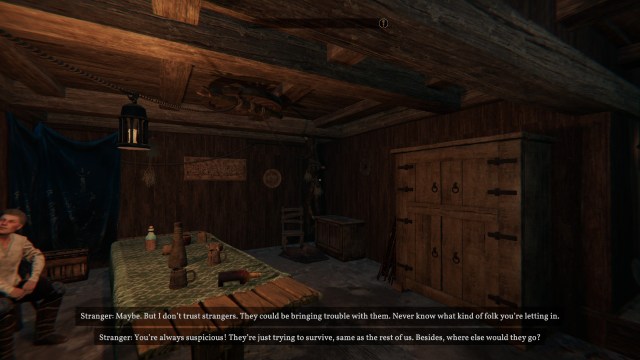
One thing’s for sure, right from the character creation screen: you can’t say Tainted Grail: The Fall of Avalon is hiding its influences. Starting the game as a prisoner feels like a deliberate homage. But this is not Elder Scrolls, not Bethesda. This is a different developer with a new story. So what is the background here? As this loading screen explains, we are in a darker sequel to Arthurian legend, where Camelot was destroyed by a plague called the Red Death.
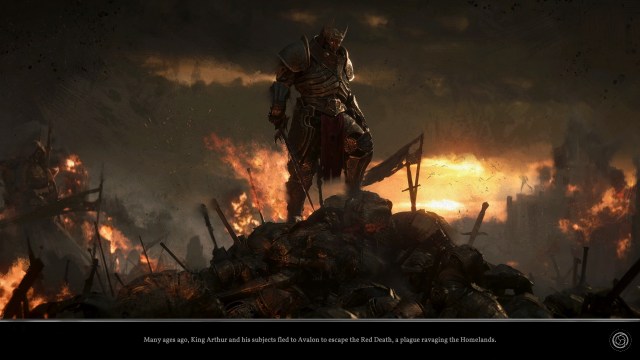
So Arthur and co fled to the mystical isle of Avalon, but that turned out to be even worse. A few hundred years on, the kingdom of Avalon is falling apart. That’s where the player character comes in.
Skyrim was the first thing I thought of, and the similarities still strike me sometimes. But as I played Tainted Grail I started to see more and more of what makes it distinct. I’m aware that it’s got a suite of smaller open worlds rather than one big Elder Scrolls monster map; so far, I’ve only been roaming in the first one, so this has not been a factor in my experience yet. No, the first thing to jump out at me was a difference in spirit. Without taking a moment to Wikipedia it, I’m going to guess that the developers are British. There’s something of the dark cheekiness of 2000AD. For example, slain enemies sometimes carry erotic fiction – a joyous anachronism given it’s written on parchment. Did monks copy it by hand in scriptoria? It’s a little moment of ‘Don’t worry, we can have a laugh here too.’
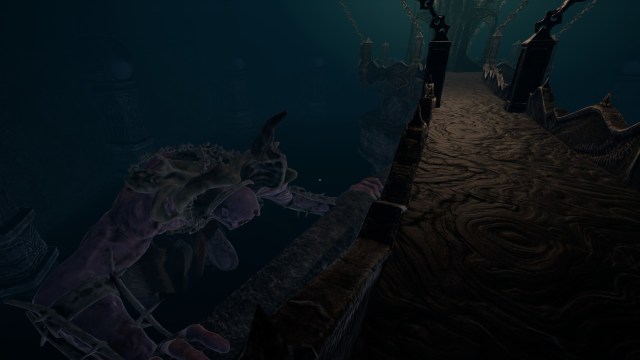
That’s welcome because on the other hand Tainted Grail ramps up the ruin and slaughter. The dungeon where you begin is a refuge run by an order of priests who are trying to cure the Red Death. But things have gone horribly wrong. There aren’t just a few corpses here and there – there are bodies in cells, bodies on racks, bodies in cages, parts of bodies in cages and parts outside, and many, many torture chambers and blood-drenched laboratories. At one stage you fall through a hole in the floor into a cavern beneath, and you land on a gigantic heap of corpses.
When you go on out of the cave to a rocky beach there’s three shipwrecks. And a little way on, two or three more. Around the corner, five or six more shipwrecks. It’s not aiming for subtlety. But it goes deeper than tone: the combat feels less rudimentary than in Elder Scrolls, but not in that action-adventure console-port way that I often find annoying. It’s very intuitive. UI and inventory are noticeably easier to use.
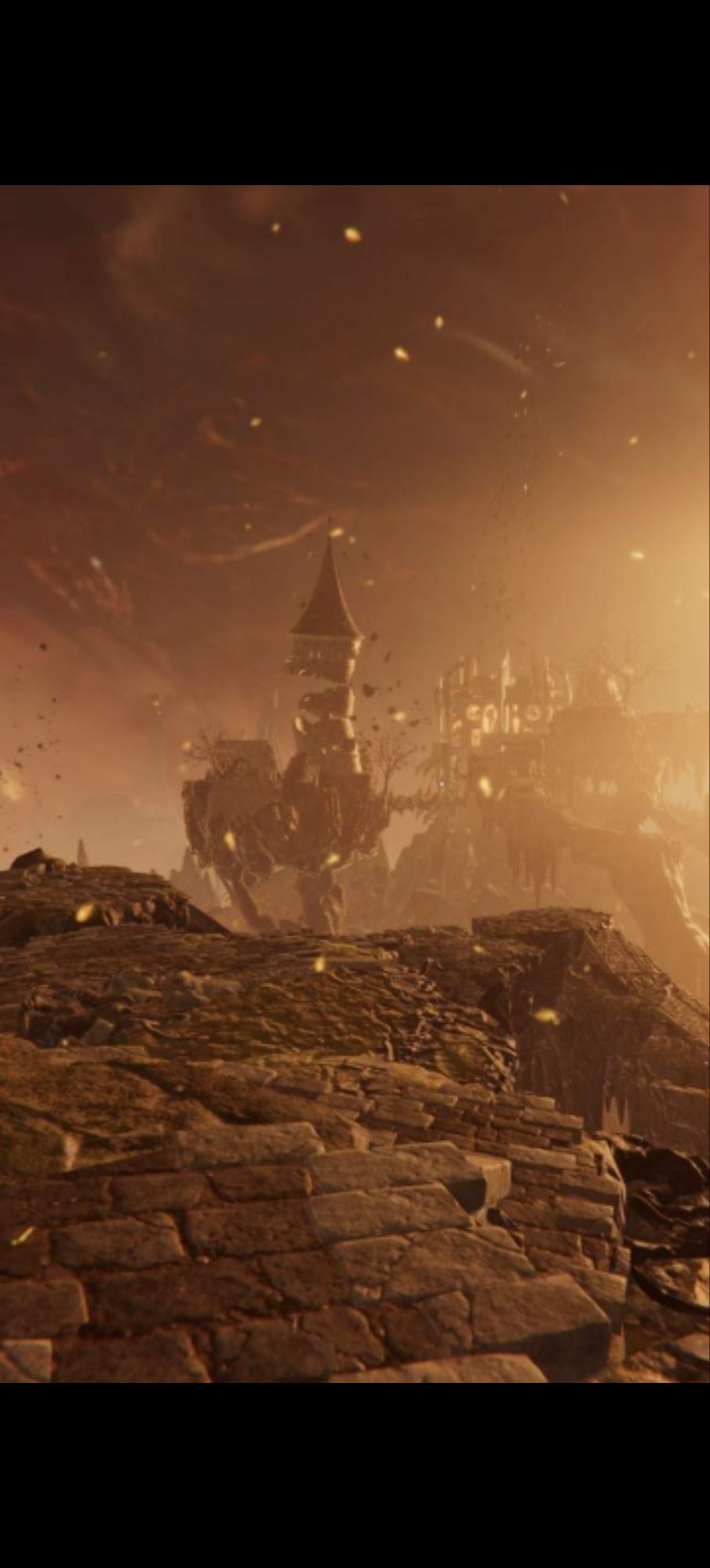
By this point in the game we have also encountered some terrifying grotesque giants, majestic statues, a strange, intense cutscene and a sojourn in a parallel universe of impossible topography and towers suspended at the moment of collapse. We also find ourselves in a blood-filled chamber where the emaciated body of King Arthur lies in a gothic sarcophagus, and we have been kinda-possessed by his spirit.
To be clear, all this in the starter area – the ‘Helgen’ of Tainted Grail.
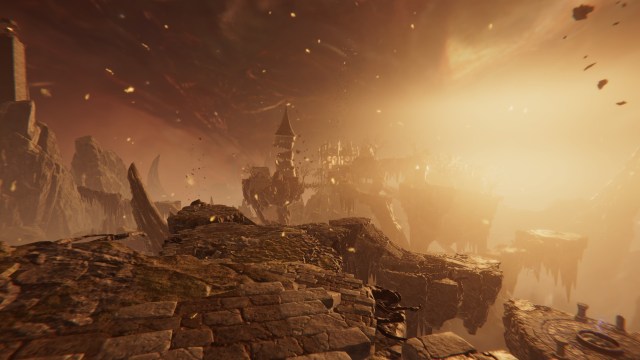
After that, I sail to the first open-world area. I have been told I have to steal Excalibur (by two different characters with different agendas), but I am free to roam at will, trade, loot, chat, do side-quests, and fight monsters and bandits. Here I started enjoying myself even more. The open world stuff strikes a good balance between freedom and direction.
The world is Celtic and Arthurian in its influences. The first merchant I met was coy about his true nature, but would not buy or sell anything made of iron. Demons roar at you in modern Irish. Cyclopean sword-in-stone monuments seem to float on the misty horizon. The characters often have Irish-language names, whose pronunciation the voice actors blithely butcher. But no matter.
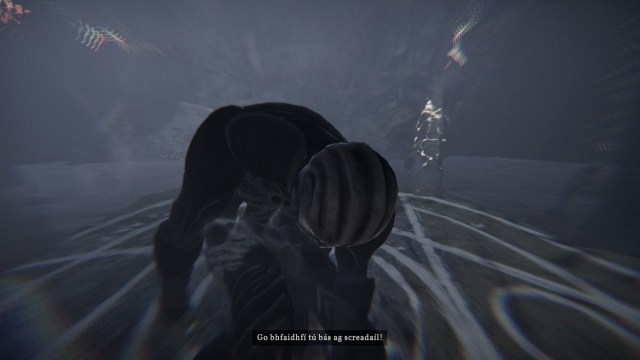
The world is smaller and tighter than in many open world games. You can still pick a direction and walk and see what you find, but you won’t go thirty seconds without finding something that an artist had some fun designing and that will try to kill you. This is a trade-off; we have a pacier experience, but less of the Skyrim or Red Dead Redemption sense of being in a real landscape. On the contrary, this place seems more like the magical kingdom it is, with everything amped up to the extreme. Everywhere, marred spectacle and broken monuments pose implicit riddles.
The side-quests sometimes leave you with some bleak humour at the end. A necromancer has been raising the troublesome dead at a local graveyard, as they are wont to do in games like this. The solution is to convince the necromancer that the only way he can make a breakthrough in his research is by experiencing death himself.
Other times it’s just grim. The red priests tried to cure a plague only to turn their haven into a vast cave complex of death. There’s a strong sense, underlined by the melancholy theme music, that King Arthur, too, tried to build something great and noble but has only wrought ruin and madness.
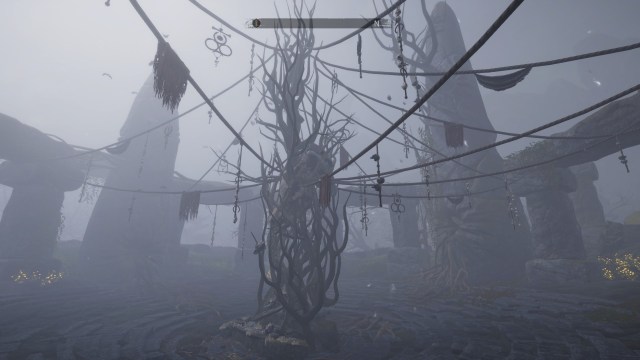
Ten hours in, I’ve explored three-quarters of this first zone, which is called the Shadow of the Horns. I’m starting to itch for the next area but I’m not ready to leave this one behind. I could probably walk to the main quest marker at this point, though I don’t know what kind of horrors and villains I’ll find on that road. There are a few side-quests I want to do but I will have to either level up or fight smart before I can tackle them.
Playing to your build is encouraged. For a long time I carried a sword because that’s what I’m used to doing from other games. It took me an embarrassing length of time to figure out how to read the stats fully, and to realise that I was carrying a weapon that was too heavy for me, and suffering huge penalties because of it. I switched to a kind of magical staff called an essence channeler, and because I have assigned my level-up points to Spirituality, I can use this weapon to full effect. I am now dealing several times more damage than before. Still, if I approach a fight lazily I’m going to end up dead.
Maybe I like Tainted Grail so much because it’s a welcome contrast to some of my recent gaming. In my search for an open-world experience I have strayed into the consoley realms of action-adventure. I’m thinking especially of Assassin’s Creed: Valhalla. I really liked many aspects of it, but it frontloaded some terrible sins so that I never got through to the parts of the game I really wanted to play. The player spends the first 30-40 minutes in cutscenes (or thinly-disguised cutscenes). It does not let me save and load the game. I have to play through the same challenges again and again from the same checkpoint.
I don’t know how developers think they can reconcile checkpoints with open worlds. Is it a file size issue? This is especially bad when it comes to boss fights or other challenges that you might have to play through five or ten times. It’s not repeating the challenge that I mind. It’s repeating the five tedious minutes of filler between the checkpoint and the challenge.
Another recent one was Red Dead Redemption 2. I’ve played a lot more of RDR2 than I have of Valhalla and will definitely go back to it. I liked it. But I didn’t love it, because there were some of the same problems. You start the game wintering in the mountains and robbing a train. For me, in more than one sense, it was glacial and I was on rails. There were hours of linear hand-holding prologue. Hours! After that you have more freedom, but the missions maintain the same pace as the prologue. You have to commit to sitting down and playing for a long time if you want to make progress. And again, if developers want player freedom, they should let the player save their game.
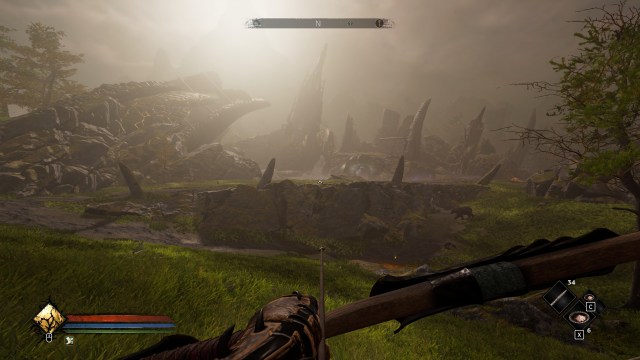
How nice to pick up Tainted Grail and find a game that has depth and breadth but that gives me freedom. There’s a shorter prologue, within which you can design your character, hone your play style, explore a non-linear space, and make some consequential choices (as opposed to, shuffle around and listen to dialogue). Then you’re off the leash and wandering free within the hour. Of course, I’m not entirely comparing like with like. These are all free-roaming more-or-less open-world games. Assassins’ Creed is its own thing and Red Dead is its own thing, and maybe it comes across here like I’m criticising them for not being something they were never intended to be. I’m not, though – I’m just giving my own reaction to approaching Tainted Grail after playing them.
That’s my reaction after clocking up ten hours of play time, anyway: this is fun, this is engrossing, and I’m definitely going to give it another ten, at least.

