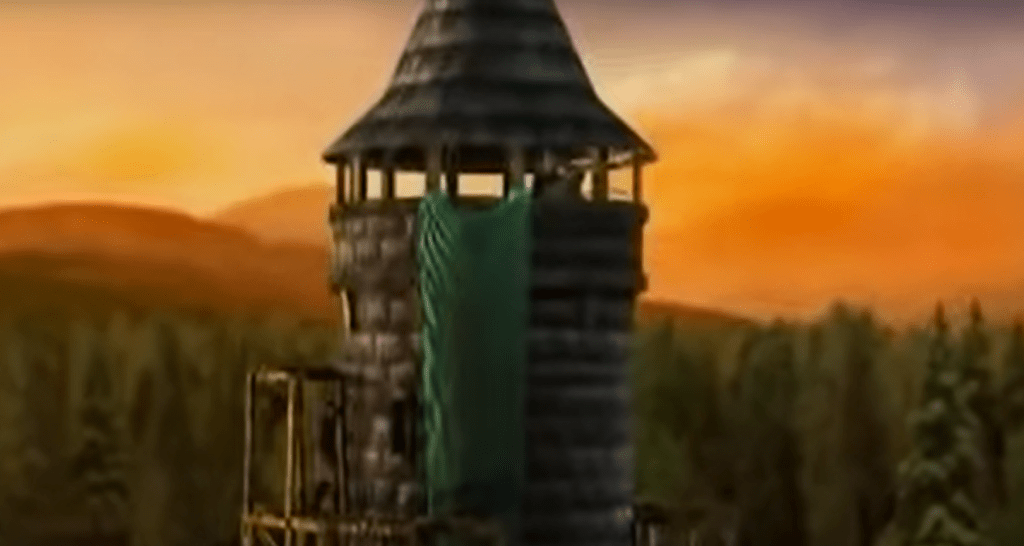
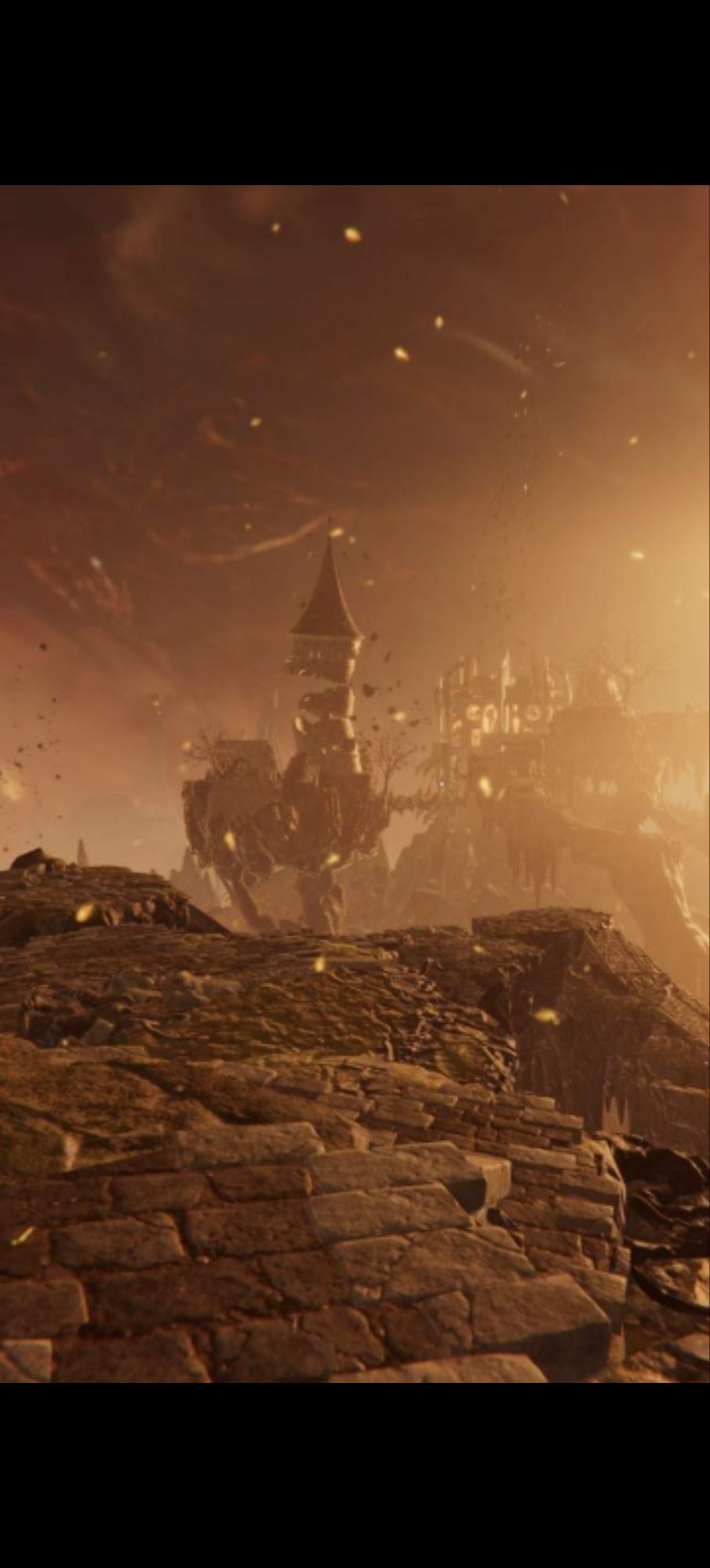
Review: Tainted Grail: The Fall of Avalon (10h in)

You wake up in a prison, are freed, and learn you are the proud owner a world-changing destiny. You’re playing a first-person free-roaming RPG set in a lavish world full of side quests and monsters. What is the name of this game?
The Elder Scrolls V: Skyrim? Wrong.
Oblivion? Wrong.
Morrowind? Wrong.
One thing’s for sure, right from the character creation screen: you can’t say Tainted Grail: The Fall of Avalon is hiding its influences. Starting the game as a prisoner feels like a deliberate homage. But this is not Elder Scrolls, not Bethesda. This is a different developer with a new story. So what is the background here? As this loading screen explains, we are in a darker sequel to Arthurian legend, where Camelot was destroyed by a plague called the Red Death.
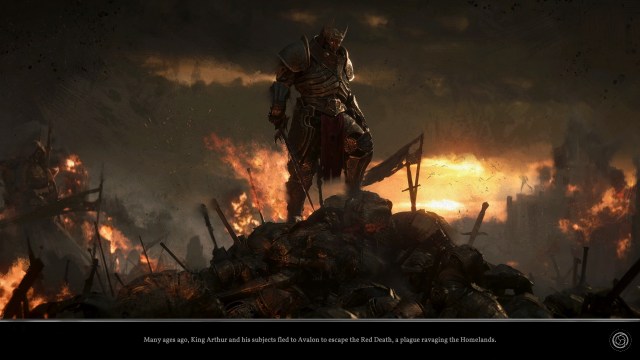
All images in this post are screenshots taken via Steam from Tainted Grail: The Fall of Avalon (dev Questline, pub Awaken Realms)

So Arthur and co fled to the mystical isle of Avalon, but that turned out to be even worse. A few hundred years on, the kingdom of Avalon is falling apart. That’s where the player character comes in.

Skyrim was the first thing I thought of, and the similarities still strike me sometimes. But as I played Tainted Grail I started to see more and more of what makes it distinct. I’m aware that it’s got a suite of smaller open worlds rather than one big Elder Scrolls monster map; so far, I’ve only been roaming in the first one, so this has not been a factor in my experience yet. No, the first thing to jump out at me was a difference in spirit. Without taking a moment to Wikipedia it, I’m going to guess that the developers are British. There’s something of the dark cheekiness of 2000AD. For example, slain enemies sometimes carry erotic fiction – a joyous anachronism given it’s written on parchment. Did monks copy it by hand in scriptoria? It’s a little moment of ‘Don’t worry, we can have a laugh here too.’
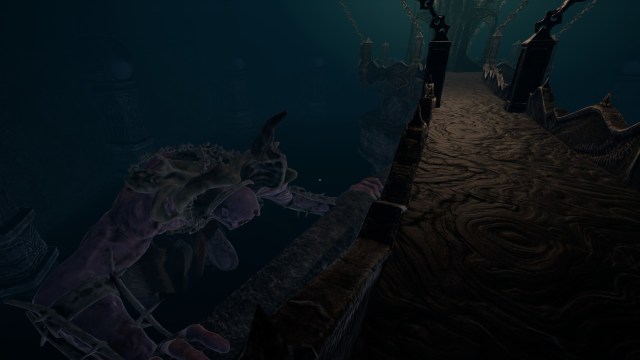
A terrifying grotesque giant, deep underground, pushing a lever as you do

That’s welcome because on the other hand Tainted Grail ramps up the ruin and slaughter. The dungeon where you begin is a refuge run by an order of priests who are trying to cure the Red Death. But things have gone horribly wrong. There aren’t just a few corpses here and there – there are bodies in cells, bodies on racks, bodies in cages, parts of bodies in cages and parts outside, and many, many torture chambers and blood-drenched laboratories. At one stage you fall through a hole in the floor into a cavern beneath, and you land on a gigantic heap of corpses.

When you go on out of the cave to a rocky beach there’s three shipwrecks. And a little way on, two or three more. Around the corner, five or six more shipwrecks. It’s not aiming for subtlety. But it goes deeper than tone: the combat feels less rudimentary than in Elder Scrolls, but not in that action-adventure console-port way that I often find annoying. It’s very intuitive. UI and inventory are noticeably easier to use.
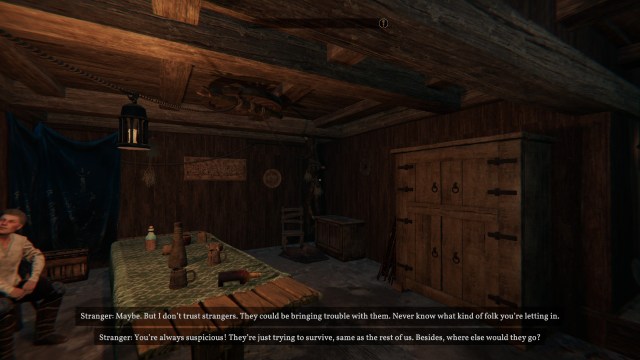
Two men in a pub chatting about the issues of the day. Every detail of this moment could be happening in Sean’s Bar in Athlone

By this point in the game we have also encountered some terrifying grotesque giants, majestic statues, a strange, intense cutscene and a sojourn in a parallel universe of impossible topography and towers suspended at the moment of collapse. We also find ourselves in a blood-filled chamber where the emaciated body of King Arthur lies in a gothic sarcophagus, and we have been kinda-possessed by his spirit.

To be clear, all this in the starter area – the ‘Helgen’ of Tainted Grail.
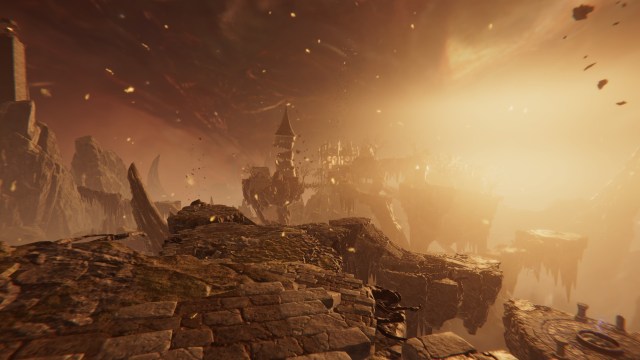
The strange otherworld/ afterlife into which we wander to explore the dark history of Avalon

After that, I sail to the first open-world area. I have been told I have to steal Excalibur (by two different characters with different agendas), but I am free to roam at will, trade, loot, chat, do side-quests, and fight monsters and bandits. Here I started enjoying myself even more. The open world stuff strikes a good balance between freedom and direction.

The world is Celtic and Arthurian in its influences. The first merchant I met was coy about his true nature, but would not buy or sell anything made of iron. Demons roar at you in modern Irish. Cyclopean sword-in-stone monuments seem to float on the misty horizon. The characters often have Irish-language names, whose pronunciation the voice actors blithely butcher. But no matter.
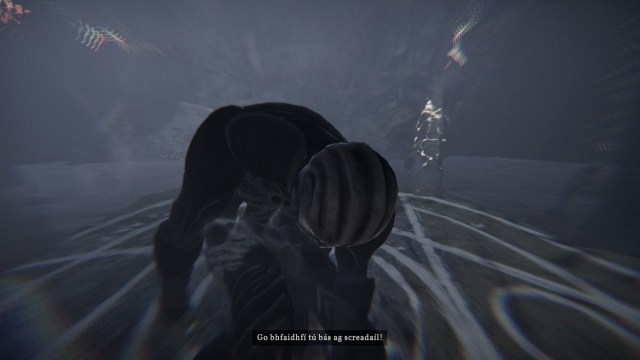
‘May you die screaming!’ translated correctly into Irish and, in this case, pronounced correctly too

The world is smaller and tighter than in many open world games. You can still pick a direction and walk and see what you find, but you won’t go thirty seconds without finding something that an artist had some fun designing and that will try to kill you. This is a trade-off; we have a pacier experience, but less of the Skyrim or Red Dead Redemption sense of being in a real landscape. On the contrary, this place seems more like the magical kingdom it is, with everything amped up to the extreme. Everywhere, marred spectacle and broken monuments pose implicit riddles. 

The side-quests sometimes leave you with some bleak humour at the end. A necromancer has been raising the troublesome dead at a local graveyard, as they are wont to do in games like this. The solution is to convince the necromancer that the only way he can make a breakthrough in his research is by experiencing death himself.

Other times it’s just grim. The red priests tried to cure a plague only to turn their haven into a vast cave complex of death. There’s a strong sense, underlined by the melancholy theme music, that King Arthur, too, tried to build something great and noble but has only wrought ruin and madness. 
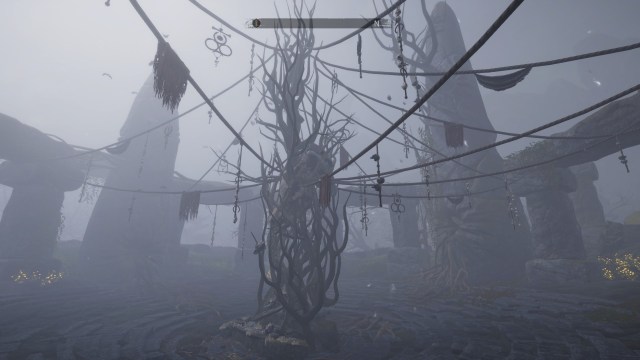
Ten hours in, I’ve explored three-quarters of this first zone, which is called the Shadow of the Horns. I’m starting to itch for the next area but I’m not ready to leave this one behind. I could probably walk to the main quest marker at this point, though I don’t know what kind of horrors and villains I’ll find on that road. There are a few side-quests I want to do but I will have to either level up or fight smart before I can tackle them.

Playing to your build is encouraged. For a long time I carried a sword because that’s what I’m used to doing from other games. It took me an embarrassing length of time to figure out how to read the stats fully, and to realise that I was carrying a weapon that was too heavy for me, and suffering huge penalties because of it. I switched to a kind of magical staff called an essence channeler, and because I have assigned my level-up points to Spirituality, I can use this weapon to full effect. I am now dealing several times more damage than before. Still, if I approach a fight lazily I’m going to end up dead.

Maybe I like Tainted Grail so much because it’s a welcome contrast to some of my recent gaming. In my search for an open-world experience I have strayed into the consoley realms of action-adventure. I’m thinking especially of Assassin’s Creed: Valhalla. I really liked many aspects of it, but it frontloaded some terrible sins so that I never got through to the parts of the game I really wanted to play. The player spends the first 30-40 minutes in cutscenes (or thinly-disguised cutscenes). It does not let me save and load the game. I have to play through the same challenges again and again from the same checkpoint.

I don’t know how developers think they can reconcile checkpoints with open worlds. Is it a file size issue? This is especially bad when it comes to boss fights or other challenges that you might have to play through five or ten times. It’s not repeating the challenge that I mind. It’s repeating the five tedious minutes of filler between the checkpoint and the challenge.

Another recent one was Red Dead Redemption 2. I’ve played a lot more of RDR2 than I have of Valhalla and will definitely go back to it. I liked it. But I didn’t love it, because there were some of the same problems. You start the game wintering in the mountains and robbing a train. For me, in more than one sense, it was glacial and I was on rails. There were hours of linear hand-holding prologue. Hours! After that you have more freedom, but the missions maintain the same pace as the prologue. You have to commit to sitting down and playing for a long time if you want to make progress. And again, if developers want player freedom, they should let the player save their game.
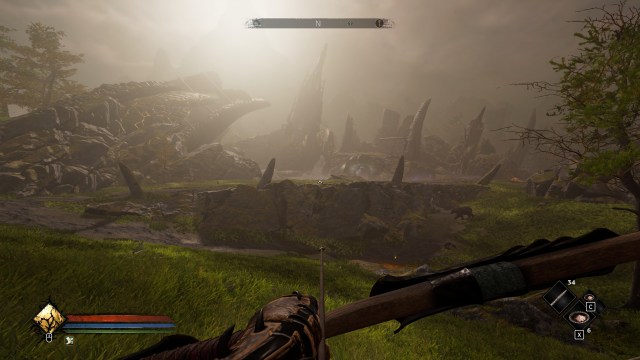
How nice to pick up Tainted Grail and find a game that has depth and breadth but that gives me freedom. There’s a shorter prologue, within which you can design your character, hone your play style, explore a non-linear space, and make some consequential choices (as opposed to, shuffle around and listen to dialogue). Then you’re off the leash and wandering free within the hour. Of course, I’m not entirely comparing like with like. These are all free-roaming more-or-less open-world games. Assassins’ Creed is its own thing and Red Dead is its own thing, and maybe it comes across here like I’m criticising them for not being something they were never intended to be. I’m not, though – I’m just giving my own reaction to approaching Tainted Grail after playing them.

That’s my reaction after clocking up ten hours of play time, anyway: this is fun, this is engrossing, and I’m definitely going to give it another ten, at least.
Games that warped my young mind: Age of Empires 2

Click here for my previous entry in ‘Games that warped my young mind,’ discussing Red Alert 2.

Around the start of this millennium, the adults were worried about how Grand Theft Auto would turn my generation into serial killers. The ultra-violence of GTA was probably too outrageous and obvious to have much effect. Meanwhile, far less controversial games were warping the way we thought about the world. Today I’m going to take a critical look at a classic that is still widely-played today: Age of Empires 2. AoE2 is a strategy game from 1999 that purports to be set in the Middle Ages. But it gives a totally wrong impression of how the Middle Ages worked.

What’s my angle here? Do I think Age of Empires and Command and Conquer should have been banned? No, the world would be a less fun place without them. But all the ink spilled condemning GTA would have been better spent making an informed, sympathetic criticism of a game like AoE2. People who liked and enjoyed the game, but also had read a few books about the actual Middle Ages, should have had a platform to tell us what it got wrong.

Strengths

First, the strengths of AoE2. You don’t need me to tell you it’s a satisfying and addictive game. Take that as read. As for how it depicts the Middle Ages, there are good points. The campaigns strike a balance between compelling narrative, satisfying challenges and historical fidelity. The William Wallace campaign is a perfectly-ramped-up tutorial with a good story, and to this day ‘Falkirk’ and ‘Stirling’ are taking up space in my memory banks. Also, there are paragraphs of proper historical information on offer, if you care to pause the game and do some reading.

The gameplay itself has its strengths. It conveys one important lesson about history: before you can put armies in the field, you need to have a lot of people working hard producing stuff. And unlike in C&C where there’s one all-purpose resource (ore or tiberium), AoE and AOE2 demand that you build a relatively complex and diverse economy. Twenty minutes into a game, you have built a busy little town: your villagers are mining, farming, hunting and gathering, slaughtering sheep, cutting down trees; little boats are bringing in nets full of fish to your docks; little carts and trade cogs are moving between settlements. It’s diverse and interdependent, and as you play, human activity gradually consumes the forests and the wildlife, and the grass is turned into neat rows of crops. It’s not just satisfying to play and nice to look at; this basic rhythm of gameplay is authentic.

Genocide

So here are my criticisms of AoE2 from a historical perspective. I’m not going to talk about how the Elite Long Swordsman has the wrong type of sword or the Frankish blacksmith model is inaccurate. I am going to talk about its overall concept of society and warfare in the Middle Ages, and how it gave a whole generation fundamentally the wrong idea.

AoE2 still depends on the C&C formula in its basic structure: build a base, build an army, destroy the enemy. That’s OK in a game where you play as a military commander and your task is to destroy a military base. But in the AoE variant, you are not destroying a military base. You are destroying a whole society. You have to exterminate the ‘enemy.’ You have to level his city and his infrastructure. Not take it over – demolish it.

I won’t labour this point as it was expressed well in this post from acoup.blog. But while the grown-ups were worried about us jacking a car and doing hit and runs, we were meanwhile playing a supposedly more wholesome and educational game, in which we were required to do genocide. And 100% anachronistic and unnecessary genocide, at that. The fact that so many who grew up playing AoE have stood by while their countries killed vast numbers of people with bombs and guns has broader roots than one videogame, of course. But games like this are part of the tapestry. 

The intro video is clever. The game of chess is a nod to the fact that we are playing a game. Blunting the edge of many of the criticisms I will make here, the video suggests that like chess, the game you are about to play is only supposed to be an approximation of real life.

Society

Let’s return to that pretty medieval town you have built. How many farms have you got? Five, six, seven? And how many other buildings have you got – a monastery, a barracks, a castle, a market, a blacksmith, a stable, an archery range, a town centre…? You’ve got at least as many other building types as you have farms. You might easily have twice as many.

Throughout most of human history, and certainly in the Middle Ages in Europe, the overwhelming mass of the population worked in agriculture. In AoE2, the heavy toil which defined the lives of 95% of the population is represented by five villagers hoeing little plots of land. The farms, little patches on the margins of the base, are like gardening allotments on the edge of a housing estate.

Why does this matter? Because a lot of guys are walking around out there with the vague idea that if they had lived back in the middle ages they would have been knights. White people are actually the worst offenders with the ‘We used to be kings’ meme. In reality, most of us don’t have to go back as far as the Middle Ages to discover that our direct ancestors were super-exploited peasants with no freedom. It took the labour of a whole village to arm and mount a single knight. Again, AoE2 is only one artefact of the culture that produces these wrong ideas, but it is under-examined.

Sometimes you can see how shallowly the C&C formula is buried. Your attractive medieval settlement can stand in for a military camp, a city or an entire civilisation, depending on the scenario. But it is what it is: a base. Likewise the game treats the player as a commander in a modern military, with life-and-death control over the entire faction.

As soon as you read any real medieval history, it becomes clear how absurd this is. Medieval history is mostly about the church revolting against the king and/or the secular nobles, the nobles revolting against the king or feuding with one another, the peasants revolting against the nobility, and the town people revolting against all of the above. AoE2 is about players (human or AI) who have absolute control over an entire society, waging war on another equally monolithic society.

A real medieval polity was not united but feudal. A king had to negotiate through layers of autonomous lords and knights to get anything done. Its settlement pattern was very much dispersed, not nucleated like the AoE/C&C base. A ‘knight’ was not just a cavalry fighter who was good against archers and weak against pikes. For your medieval ancestor, the knight was the equivalent of your mayor, your boss in work, a military officer, and a made guy in the mafia.

There is a ‘Feudal Age’ in AoE2. But the game does not simulate feudalism – it simulates a caricature of a totalitarian communist state.

For those who haven’t played it, this is what actual gameplay looks like.

Ages

Speaking of ‘ages’ – in AoE2, the player progresses through four: the Dark Age, the Feudal Age, the Castle Age and the Imperial Age. Each age unlocks new buildings, units, technologies, etc. But these ages do not correspond to anything in real life. In the first AoE they roughly did. But not here. The game covers the period from around 500CE to around 1500CE. The ‘Dark Age’ does not correspond even roughly to 500-750, nor the ‘Feudal Age’ to 750-1000, etc. There is too little in the early ages by way of buildings, tech and unit types, then all of a sudden too much in the later ages. No, the Catholic church was not ‘unlocked’ a hundred or two hundred years after the First Crusade. Stuff from the ‘Castle Age’ was 100% around throughout this whole millennium.

All in all, the game does a particularly poor job of depicting the early Middle Ages. A battle in the ‘Dark Age’ is limited to guys with clubs hitting each other. But there was a bit more than that going on during the age of Al-Andalus, the Merovingians and the Tang Dynasty.

In the real middle ages, The Catholic Church pretty much had a monopoly on literacy, education, social services and bureaucracy across most of Europe for most of a millennium. In AoE2, the clergy don’t show up until the third ‘age’ of four.

The Marxist idea of a mode of production offers a better template for social development than the idea of a linear progression of ‘ages.’ (Here, I went off on a tangent proposing how this could actually work in a game, but to spare the reader I have moved it to an appendix which I will post next week.)

All I’ll say now is, instead of different ages, I wish we could see different social orders. Returning to the Marxist criterion: sure, the mercantilist and feudal social orders have a greater productivity of labour than the nomadic society or the trans-egalitarian clan society. But depending on the situation, the former were still capable of losing wars to the latter.

Factions

In a way, there’s a refreshing universality in AoE2, an ethos of common humanity. Beneath the different models, every faction is essentially the same (barring a special unit which is often only unlocked late in the game – the Vikings only get Berserkers after, historically, the Norse and Danes had long since settled down and ceased to Vike). It is really laudable, too, that AoE2 even before the recent DLCs had a more diverse roster of factions and cultures than most of the Total War series. This balance and symmetry is also good for playability.

It’s certainly less problematic than the approach of Rise of Nations (2004), which presented a roster of ‘Nations’ such as the British, the Japanese and the Bantu, each of which had the same essential features from the Stone Age right through to the Information Age (‘The Russians have the power of the motherland, giving them plus 3 attrition damage…’) Though I should mention that I’ve spent many enjoyable hours on Rise of Nations, including recently.

The Middle Ages saw clashes not just of class or religion or people, but of different types of society, as we can see when the Anglo-Normans confronted the Irish (check out my series Celtic Communism), or when the Norse and the Danes came to Britain.

Warfare

This brings us to the nature of warfare in the Middle Ages. Here AoE2 not only does a bad job of being historically accurate – it’s an area which I’ve always found weak in terms of gameplay.

Consider the historical battles which occur in the campaigns – the aforementioned Falkirk and Stirling, or the Battle of Hastings in the expansion pack. In real life, these were distinct battles that happened in specific places. In AoE2, they are about building a base, gradually wearing down the enemy bases, then finally destroying them. Actual battles rarely happen in AoE2. Every war is a war of attrition.

Here’s something I noticed at the moment I decided to abandon the hitherto-promising Bari campaign in one of the recent DLCs: AoE2 is supposed to be set in the Middle Ages, but actually what it simulates is closer to 20th Century warfare. In some scenarios you have limited forces and have to use them cleverly; that’s both better fun and more accurate. But in most scenarios, and in the vanilla game, your task is to churn out soldiers and rush them to the front, where each wave will gain a little ground before its complete destruction. Tactics are rudimentary.

That is why a scenario like Vinlandsaga works so well: AoE2 is better at simulating a drawn-out process of development, exploration, conquest and settlement than at simulating an individual battle. But even in Vinlandsaga, you somehow find yourself besieging and demolishing stone castles in the early Middle Ages in Greenland.

The violent part of the game is actually not much fun. Since tactics barely matter and there are no set-piece field battles, winning a war is reduced to producing soldiers in greater diversity and quantity than the enemy. You spend a fortune on them only to watch them, usually, die for minimal gains. It’s not very satisfying.

Conclusion

Like a lot of people, there are large chunks of human history that first entered my ken through the medium of videogames. This stuff is really influential on how millions of people think about the past. So there needs to be a culture of friendly historical critiques. I’ll still play a historically inaccurate but fun game over one that’s more accurate but less fun – I’ve spent a lot more time playing Creative Assembly games than Paradox games. Fair enough if developers generally allow gameplay to trump authenticity. But let’s be aware of the choices they have made.

Instead of such a culture of friendly criticism, I think strategy videogames have functioned as a transmission belt for a mechanistic and essentialist understanding of societies, nations and conflict. For example, I once came across a Youtube video which justified the genocide of indigenous peoples in the Americas with reference to their ‘spawn points’ and ‘tech tree’ – evidently a conscious shorthand, but un-ironic. The idea of societies composed of antagonistic classes is quite incomprehensible to people brought up to assume that each given faction or nation was a monolithic and totalitarian entity.

I’ve read more than one recent novel with a pre-modern setting in which the characters use terms like ‘subconscious’ (coined by Freud in the 1890s, right?) ‘genocide’, (coined in 1947) and ‘the military.’ It’s that last one that concerns us here. AoE2 is part of a culture that reifies the state, that tells us that the standing army and the modern nation have always existed. But the real Middle Ages were much stranger and much more interesting.

Games that warped my young mind: Red Alert 2

Home Page/ Archives

Appendix: Ages and Ages

What I’m playing at: Disco Elysium

Disco Elysium is a point-and-click RPG which is at once easy to fall into and unlike anything I’ve played before. I heard about it on Chapo Trap House a few years back and saw it in a sale, so I bought it and now I’m 8 hours into it, according to Steam.

The game starts with the player character in a booze coma, in a dialogue with his Limbic System and his Ancient Reptile Brain – ie with aspects of himself. The player’s first task is to summon up the will to awaken.

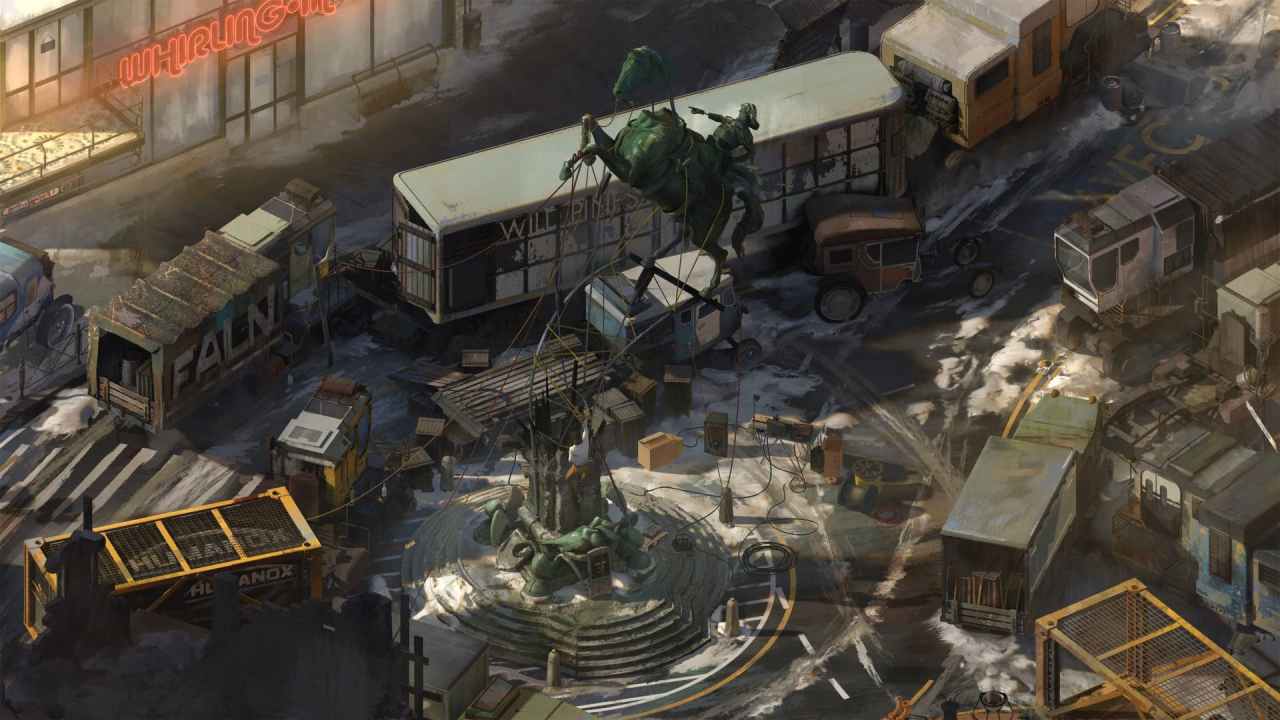
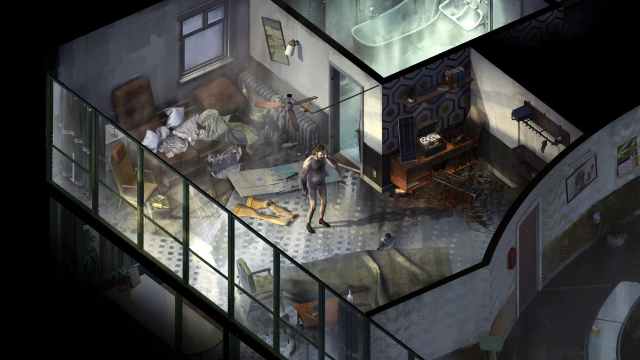
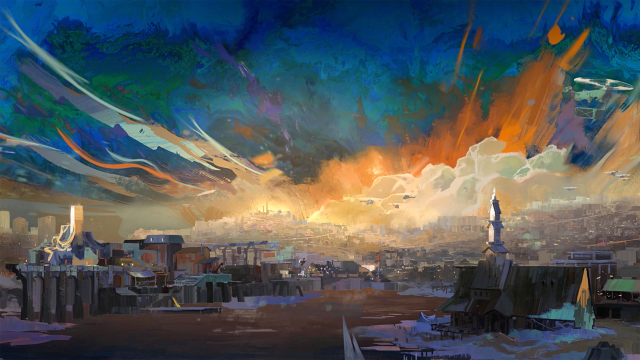
You wake up in a hotel room you don’t remember trashing last night. The world is strange. It’s modern times, but where are we? Haiti? Finland? It emerges that the game is set not only in a fictional country but in a fictional world, brilliantly realised and compelling.

All screenshots are from https://discoelysium.com/

The player character is a bumbling fuck-up with something desperate and sad under the surface, and possibly a ‘vast soul’ under that again. Characters give you pretty normal RPG quests: Solve the murder; convince X person to let you into Y location; etc. But your own internal voices give you strange quests which emanate from inscrutable inner drives: ‘Find some alcohol and drink it,’ or ‘Sing karaoke.’ You spend as much time in dialogue with your gut feelings and intellect as you do with the characters. These internal dialogues have real consequences for your character’s skills, politics, etc. With names like Empathy, Volition, Inland Empire, Shivers and Half-Light, the internal voices interject, inform and misinform, help and sabotage. They provide dialogue options such as bumming a cigarette, asking for money or blurting out something ridiculous.

At times, they describe a breath of wind, a bleak vista or a distant sound. In these moments, you feel what the character feels. I know nothing about the development team but I can tell it includes poets and novelists.

So far the game has been completely non-violent for me, though I’m aware there are combat dynamics. I did punch a door one time. For some reason I am surprised that a game can be non-violent but still so compelling. I found a ghostly voice trapped on an apartment building intercom and the experience was haunting. It made me entertain the theory that my character was in purgatory, or some such thing, a theory I later rejected.

The game is very funny. More often than not, you are the butt of the joke. It’s a bleak world, lived-in and tired. Every other RPG I’ve ever played has a world from which the class struggle has been mysteriously exorcised. But in Disco Elysium, the politics are right there in front of you, and you can delve deep if you wish.

The graphics are beautiful, but not technically advanced by today’s standards. I’ve been thinking along these lines for a while, that more games need to make this trade-off: invest in good writing and clever mechanics, not in making a game so graphically and technically advanced that it will force me to buy a new machine. If we’re going to talk about graphics, let’s talk about more about art and style, less about a mad quest for photorealism and textures and lighting and crashing my laptop. Disco Elysium is a positive example of what I’m talking about.

So eight hours in, I’m still in a starting area called Martinaise and have not found my missing gun, much less solved the murder. It’s not an easy game, but I feel it half-expects me to be as incompetent as I am, and forgives me with a shrug of the shoulders. And I have a lot of time for a game that rewards me for investing skill points in Empathy.