
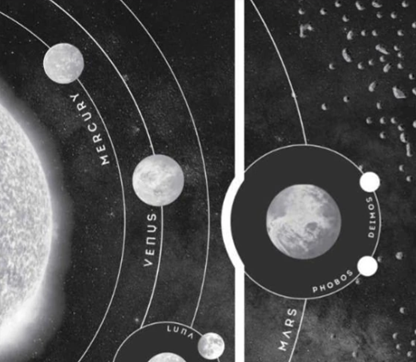
What would the maps of our Solar System look like in a future where humanity spreads out beyond Earth? The arena of human activity would be a vast and mostly empty space whose few and small physical presences – moons, planets and asteroids – are in constant motion relative to each other. I don’t have a good answer to the question of how to map this arena on a flat plane, or even a globe or a hologram. But some novels I’ve read in the last few years have challenged me to imagine how people would live, struggle, and wage war over this arena.
These are interplanetary, not interstellar, scenarios. Since interstellar travel is just a fantasy at this point, the idea of a human diaspora confined to a single stellar system is a more practical and immediate proposition. Also, we know of thousands of exoplanets, but we know very little about them beyond what spectrography can tell us. When it comes to the planets whose names you learned in school, and the many moons, asteroids and dwarf planets, we have a mass of information from probes, including awe-inspiring photographs. If we want to populate worlds with imaginary human colonies, our neighbours in the Solar System leave less to the imagination. Even this more modest prospect is so distant, science-fiction authors are as good a bunch of people to ask as anyone else.
Here I will look at two works of fiction from the 2010s that set out to imagine a human race living, toiling and fighting across, but not yet beyond, our Solar System.
These works are:
Red Rising by Pierce Brown, and its sequels Golden Son and Morning Star (the Red Rising Trilogy, not to be confused with the Red Riding Trilogy by David Peace, whose action, confined to Yorkshire, is less ambitious in geographical scope);
and Leviathan Wakes by James SA Corey, the first book in the series called, and adapted for TV as, The Expanse.
What about the other three Pierce Brown books, and the other seven or eight Expanse books? I haven’t read them yet (I’m one-third of the way through Caliban’s War and at about the same point in the TV show; Iron Gold is on my list). Anyway, for our purposes, these four novels give us plenty to chew on. But comments relating to the later books are welcome as long as people are tactful about spoilers.
The Condition of the Working Classes on Neptune
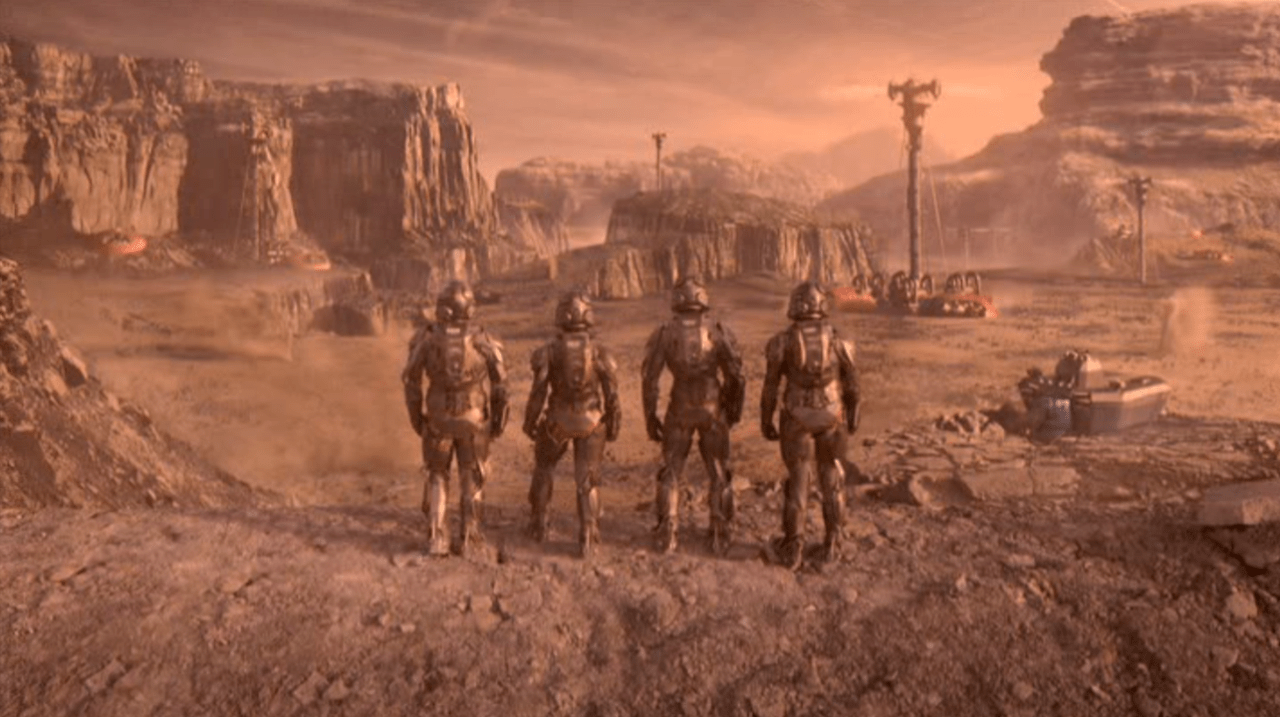
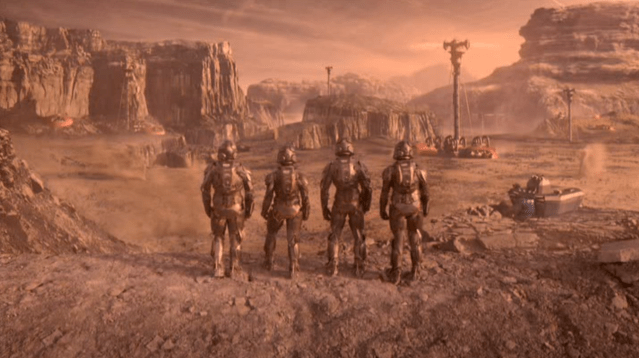
Darrow, hero of the Red Rising trilogy, begins his story as a 16-year-old living and working deep beneath the surface of Mars, mining Helium-3. He narrowly avoids death at the fangs of a pit viper, drinks and dances with his community, and shows us that he loves his wife (his people marry early). He knows, and knows of, no other life. As members of the Red caste, his people are the lowest, most downtrodden part of society. The author gives them some trappings of Irish culture, a light seasoning which is explained in-universe. Two other castes make a bloody entrance, the military Greys who keep the Reds down, and the aristocratic Golds who run the show. The Reds have hints of Irishness to suggest hunger and oppression; the Golds have lavish helpings of the language and culture of Ancient Rome to show power, glory and arrogance. The Greys have no culture, to show that they have no culture.
While the social order in Red Rising is a near-caricature of hierarchical societies from history, technology has advanced to a level not far short of godlike. Expensive devices allow the wearer to fly, turn invisible, etc, which makes the many battles and intrigues of the trilogy very interesting. This solar system is a canvas on which the Gold ruling caste (and Pierce Brown) can paint at will. Earth’s moon is covered by one great mega-city, Mars has been terraformed into a second Earth, with a lush and verdant Valles Marineris and many great cities, Jupiter’s icy moon Europa has become a rich ocean world, and so forth. Travel between these worlds can take weeks or months, and requires a large workforce of Blues, the spacefaring technical caste.
The 18th Brumaire of Nero Augustus
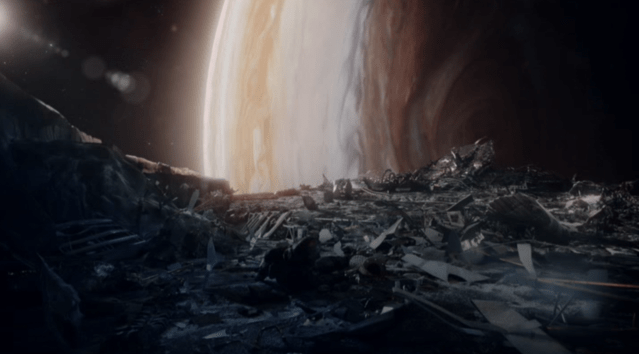
As the book and series go on we encounter more of the castes (such as Pinks, condemned to sexual slavery, and Obsidians, genetically-modified supersoldiers) and gain a broader view of how people live in this future. This is an ultra-extreme hierarchy, with castes not only defined by birth but through strict caste-apartheid and genetic modification. The Golds’ vendettas and repressions are truly monstrous. Rhea, a moon of Saturn, has been obliterated as the ultimate punishment of its rebellious lord. Rebellions by the lower castes are treated with even greater harshness, and as Darrow sets out on a mission to infiltrate and destroy the Golds (in the process humanising them for us without making their social order any more sympathetic), the threat of hideous tortures and certain death hang over him at all times.
The Golds are formally part of one polity, under the rule of Octavia au Lune whose power base is Earth’s moon. But they are a proud and resentful bunch. The Martian ruling class, led by Nero au Augustus, chafe under the au Lune dynasty. The Golds of the far-flung gas giants are rugged frontier people who have an identity distinct from that of the Core.
In the second novel, Golden Sun, an Iron Rain comes to Mars – that is, an enormous invasion from space consisting of elite soldiers in drop suits and a large number of massive ships. Golds are at the forefront of combat here, and again in Morning Star when we see space battles and boarding actions. These are sublime massive-scale spectacles. Victory requires a fairly complex coordination between the skillsets of different castes.
Material interests don’t appear to be the direct cause of their bloody wars. Rather, power struggles and personal vendettas are a predictable outcome of having an aristocracy bred and raised for conflict and domination. Grudges that go back to the Academy (the Hunger Games-esque agoge which is at the heart of the first book) have a real effect on who picks what side when civil wars break out.
But this is not only true of the Golds. In Brown’s stories, for Red as well as Gold, betrayal, loyalty, sacrifice and struggle are personal. Several characters in the ragtag rebel alliance are identified as socialists, but it’s as human beings with reciprocal personal obligations that Darrow relates to them as to everyone. Even within the rebellion, factional struggles are more about ‘You betrayed my friend three chapters ago’ than ‘You favour an alliance with the Silver bourgeois caste.’ The question of cross-class alliances does come up in Morning Star, but it is simply not a point of contention as it usually is in real revolutions.
Down and Out on Eros and Ceres
Turning to our other vision of the future Solar System, working conditions as imagined in Leviathan Wakes still might not pass muster with your union rep, but at least you have a union rep. The world of Leviathan Wakes is not as elaborately obscene as that of Red Rising but it doesn’t have much of the glory or glamour of that setting either. In spite of flashes of horror, this is a more gritty and blue-collar vision.
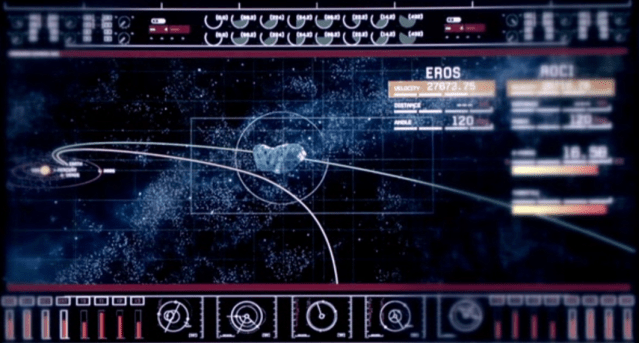
Mentions of a massacre of insurgent workers on Anderson Station imply that such events are rare. In the foreground of the book we have an atrocity of immense dimensions, the destruction of the main belt asteroid Eros and its million inhabitants. This is done not by a vindictive and repressive ruling caste but by a shady private corporation, Protogen, for purposes of R&D. The cover-up is only possible because there is a very distracting system-wide war raging at that time.
Forty billion people live on Earth, several billion on Mars, and only 50-100 million in the Belt and outer planets – the population of, say, Iran. This makes sense as, contrary to the fantasy of Earth’s ‘surplus population’ leaving for other worlds, moving people and stuff up the gravity well is difficult and expensive. This solar system is still very Earth-centric and that phrase, ‘up the gravity well’ is in common use, like ‘across the pond’ in our time. But space trade is lively. The dwarf planet Ceres, a focus of Leviathan Wakes, receives platinum, iron and titanium from the Belt, water from Saturn, vegetables and beef from Ganymede and Europa, ‘organics’ from Earth and Mars, power cells from Io, Helium-3 from the refineries on Rhea and Iapetus (like in Red Rising, Helium-3 is assumed to be very important). On Mars, terraforming is under way but at a glacial pace. Elsewhere, life beyond Earth means life in a habitat of some kind – ship, station, tunnel. This is very good for the TV series as much of the action can take place in cramped interiors.
Our two heroes are Holden, an officer on a water-hauler, and Miller, a rentacop on Ceres. Holden’s life on board ship, on journeys that can last weeks or months, is companionable but (until the inciting incidents of the novel) probably dull. Miller works for a private security company that maintains law and order on a world that consists of tens of thousands of kilometres of tunnels which are home to six million people and haven to a thousand ships on any given day. Miller’s perspective gives us a cross-section of the seedier parts of life on Ceres. The crime, chaos and paramilitarism that he encounters are, essentially, nothing that could not happen on Earth in our time.
Space travel is more challenging than in Red Rising. This is one of the only space novels I have read that doesn’t dismiss, by one means or another, the problem of inertia. There is a type of engine that can make spacecraft go extremely fast (still way, way sub-lightspeed), but it causes burst blood vessels, pressure bruising, joint pain, and ultimately permanent injury and death. This world works according to unforgiving rules.
The Belter Manifesto
The powers-that-be in The Expanse are corporations and state bureaucracies. There is no swaggering dictator, little room for charisma. But neither is there any sense that popular masses exercise any democratic control. We have a capitalist technocratic set-up which is entrenched and stable. There are no castes, but the Belters’ height and physiques are the outer manifestations of a deep difference between them and the humans of the Inner Planets.
Earth is a distant presence in the novel, but a few of our major characters came from there. Martians can be menacing but are humanised. This is a story about the Belt. And inseparable from the Belt is its major political/paramilitary movement, the Outer Planets Alliance (OPA).
The OPA are sympathetic both in terms of their cause (better conditions for the oppressed Belters) and in terms of their general presentation (they are cool and fun, speak a colourful dialect, do interesting things). We also see that they commit atrocities, as when anger at the Inner Planets is taken out on random individuals. And while our main characters end up as allies of a particular faction of the OPA, they are also in conflict with them at various times. The authors give us a complex picture here, with positive and negative aspects that form a cohesive whole.
But The Expanse is not all grey. Good can be hard to parse, but evil means something. The destruction of Eros is carried out by a team of specialists whose brains have been engineered so as to remove their sense of empathy. Their leader, Dresden, gives an alarmingly coherent case for murdering a million people. The picture of evil that emerges here is scary because it is banal and grounded.
Conclusion
Which of these works presents a more compelling vision of a human future in the Solar System? First I want to set down the kind of scenarios I would see for our spacefaring future, with the caveat that I’ve read little enough relevant non-fiction: mostly Carl Sagan and A City on Mars.
We can forget about the idea of escaping from climate change by going to another planet. It’s the other way around: we need to sort our shit out down here before we are going to be able to build the kind of technological and social base we will need to keep alive our early tentative presences on other worlds. Earth ten degrees warmer is still a far better place to live than Mars, and Mars is far better than anywhere else, and still terrible. Similar points go for anything else people might want to leave Earth to escape, such as war or class conflict. Space settlement on any great scale (accepting for the sake of argument that it’s even desirable) would require technological and social leaps forward of a kind that would take us beyond capitalism, to a higher level of productivity and technique, a higher level of economic equality and harmony with nature.
From the point of view of private profit, limited rewards would accrue from space settlement, especially weighed against the financial cost of sending people, supplies and equipment up the gravity well. If it proceeds at all, it will stagger and lurch through hectic and wasteful boom-bust cycles. The kind of irresponsible hype that we see around crypto and chatbots could help space capitalism to advance a little way in our lifetimes. But by the same token space capitalism, due to cost-cutting and the demand for investor returns, would bring about the kinds of situations where dozens or hundreds of settlers die in terrible catastrophes. Such scandals would tank popular support and investor confidence, and the snakes would cancel out the ladders.
So I don’t really see either Leviathan Wakes or Red Rising as presenting the most likely scenarios, simply because I don’t think space capitalism can pull it off, never mind space classical antiquity. But these visions both have important truths in them. The Expanse is the capitalist world order circa 2010 projected into space, so on the surface, it’s a simple enough call to say that it’s a more realistic and grounded vision of a human future in the Solar System. But reality often fails to be grounded or even ‘realistic.’ We have various hooting cannibals in power in some of the most powerful countries on Earth in the 2010s and 2020s, and we have seen the descent of the world’s foremost space-settlement advocate into fascist delirium. If Musk is calling the shots, the human future in the Solar System would probably look more like the world of Red Rising than that of Leviathan Wakes, with eugenics, hierarchy, and constant illiterate references to Ancient Rome. If I’m wrong, and we end up bringing capitalism with us when we go to other worlds, then there’s a good argument for projecting into the spaceborne future the feverish politics of our time.
 The 1919 Review