I wrote a few posts about Iran back in March, just after the war began, but I haven’t returned to the subject since. A draft post titled ‘Groundhog War’ did rattle around in my head but never made it to the screen. Other titles in contention included ‘The Ross and Rachel War.’ But I haven’t actually seen Groundhog Day and I’m not a big fan of Friends.
More importantly, this war is hard to write about because MAGA is flooding the zone with shit in the usual way. One day Trump is saying he has already destroyed practically everything in Iran, the next he threatens that he’s held back so far but he’s about to take the gloves off, and the day after that he says they are about to sign a deal. Whenever he says he’s ‘in full control of the Strait of Hormuz,’ you should swap out ‘Strait of Hormuz’ and swap in ‘my mental faculties.’ But he’s not in control of either – because a few days later he’ll be demanding that the mullahs open the strait, or else. It’s like bad reality TV: you can be carried along by the fake emotion on display in a scene – if you have the memory of a goldfish.
For example, as recently as August 1st there were apparently going to be ‘World War Two-level strikes’ on Iran; by August 7th, a deal on the Straits of Hormuz was close, and by August 11th Trump was claiming that the straits were open, whatever that means. At the time of writing the US and Iran have traded airstrikes again and Trump is threatening to ‘smack Iran to see what happens.’ The media reported on all these statements in their main daily headlines, as if a syllable of it had any real meaning.
For some reason journalists feel the need to report, in front-page headlines, where we are at in the cycle as if it’s the first time we’ve gone through this ritual. I go onto Al Jazeera or The Guardian and it’s TRUMP THREATENS TO “BURY TEHRAN, REGRETTABLY, UNDER A PILE OF HUMAN SKULLS”, then the next time I log in I learn that Iranian officials have denied a claim by Trump that the signing of a peace treaty is “just waiting for a new pen because the pen we had, what are you going to do, it ran out of… there was no more ink, you know the trouble with pens is… Gotta have ink! Gotta have it… so we had to send Steve and Jared out with the White House credit card to buy a new pen, and they’re not back yet…”
But at the six-month mark I feel an urge to follow up on the posts I wrote at the start of this war. So when you’re finished imagining Jared Kushner and Steve Witkoff running around Washington DC with someone else’s credit card, here’s what I think about Iran.
In the rubble of the MoU
The biggest developments recently were the Memorandum of Understanding and then its collapse. The MoU was basically a surrender by the US but it also represented a way out of the strategic mess. It was a sensible cutting of losses. It was not scuppered by Israel like I expected, though they gave it their best shot. I guess it fell apart through the sheer lack of integrity of Trump and the people around him. Having the integrity of an adult or even a teenager or older child means that you keep your commitments and feel shame when you fail to do so. The MAGA leaders either don’t feel shame, or feel such ubiquitous self-loathing that one more faithless act makes no difference. Even when they want to make a deal (I think they genuinely wanted the MoU), there is such a fundamental lack of integrity there that they can’t stick to it.
In the rubble of the MoU, we have governments in the region hurrying to make new deals with one another: the Egypt-Turkey-Pakistan alliance and the talks between Oman and Iran which have resulted in a deal. Also not to be overlooked is the visit of Ghalibaf, the Iranian house speaker, to Iraq where he spoke on the site of the 2020 assassination of General Suleimani. These things all reflect the diminishing of US authority in the region – first because of the inability of its leaders to make a deal and stick to it, but also because its bases and its radar and air defence apparatus have taken a hammering from Iranian missiles and drones.
I think that the US will continue this holding pattern, this tedious news cycle, this shameless display of impotence, this phony reality TV tedium, for the rest of Trump’s term.
(Then if there is an election and if the Dems win – it’s an if, because the Dems can always find a way to lose, even in a situation as favourable as this – they will disappoint everyone by making only glacial progress toward a deal, because they want to keep their options open and, secondarily, not upset the Israeli government.)
Ground War?
The thing I’ve gotten more skeptical about since the start of the war is the prospect of a US ground invasion of Iran. Around April you could notice a series of ominous reports about so many thousand marines here and so many thousand there being shipped into the region. But the thousands would need to ramp up to hundreds of thousands before we’d have to worry about an invasion. Even ‘just’ an occupation of the coasts around the Strait of Hormuz would require such numbers. Take into account also the fact that the US bases which would be used to stage such an invasion have been damaged to a <redacted> extent.
The Iranian top leaders appear, by contrast with their US counterparts, dignified and professional. But they talk about the prospect of US ground invasion with unseemly eagerness. They were at it again in July, when the pattern of US strikes appeared to be clearing the way for coastal landings. But the US just doesn’t have the numbers in the region, and is not making the kind of colossal movements that would be necessary.
What about a smaller incursion? The threatened Kharg Island operation was far too ambitious and dangerous. The idea of landing an army in the mountains to dig up ‘the nuclear dust’ was even sillier. But if an opportunity presents itself for a quick and relatively painless raid that would at least appear to do some damage to Iran, I reckon Trump and co will go for it. Several days of news reports about some little Call of Duty level would help drum up a measure support for the war. And then two years later they could make a movie about it. Better yet. So I’m surprised they haven’t done this already. I think we can expect by year’s end either A) some ‘daring’ but actually very safe raid or B) a failed attempt at same, an embarrassing fiasco. Maybe the fear of B has made the US afraid to try A. Or it could be the simple fear of escalation, which despite Trump’s brash presentation and lack of integrity, does in fact bracket his options.
Regional War
A brief overview of the war so far would be as follows: two major bouts of fighting between the US/Israel and Iran, one around March and a second, smaller one around July. In the process thousands have been killed in Iran and thousands in Lebanon. On the other side the picture of fatalities and casualties is not clear, but several hundred have been killed. Serious ground wars have taken place in Lebanon and more recently in Yemen.
Note the entry of the Houthis in Yemen into the war, with the closure of the Bab-el-Mandab Strait, raising the economic pressure another notch or two. The Houthis gave an impression of reluctance and presented a case for war that had nothing to do with Iran or Israel. The effects so far do not appear to be as significant as I would have expected. Perhaps they will take time to filter through into politics in a way that bears on the central struggle between the US and Iran. Maybe, against the backdrop of all that’s going on, in a region already in a state of high tension, it represents only an incremental change.
One of the main reasons I’m interested in what is happening around Iran is because of the possibility that developments could force Israel onto the back foot and slow down or stop the genocide in Gaza, the ethnic cleansing in the West Bank and the aggression in Lebanon. I say this without harbouring illusions that the obscurantist Iranian government can be relied on as a consistent ally of the masses in Palestine. Anyway, that’s not happening. Israel behaved as it pleased in Lebanon, killing thousands and entrenching a new occupation. The settler rampage in the West Bank is worse than ever before. Daily murder continues in Gaza. The erosion of the US missile defence and radar system in West Asia, and the development of new alliances and deals outside the US orbit, must end up having serious impacts on Israel. But, for now, the aggression is unchecked.
Blockade
The US policy appears to be to hold on and wait for something to change. The US blockade of the Strait of Hormuz might devastate Iran’s economy sufficient to force a new deal unfavourable to Iran. The US naval blockade of the Strait of Hormuz is a simple and effective measure, separate from the ‘Economic D-Day’ measures to extend the sanctions regime, discussed below.
But here too the outlook is not good for the US. Leaving aside the fact that Trump and co would be entirely capable of messing up even up a deal which is entirely favourable to them, the question is whether the US military has the capacity to… Well, let’s break this down:
- To maintain a sufficiently damaging blockade
- For long enough
- Against a large country
- With two long sea borders and many land borders
- On the far side of the world
- In a situation where US authority has diminished.
In any scenario, Iran is suffering a terrible blow to its key export, oil. But the Iranian government signed up for this the moment they closed the Strait, and preparation for this has been an integral part of their strategy. Meanwhile, just as the rest of the world is scrambling to work out ways around Hormuz, so is Iran. If some of the Saudi oil can be sent across Arabia in a new pipeline, Iran too can establish new lifelines for itself that bypass the Strait and US sanctions. What little shipping can get through is another lifeline; this grows in a scenario where the US blockade loses its effectiveness due to some of the problems we have seen – bad morale among naval personnel, technical issues on the aircraft carriers, the massive financial cost. Geography is inescapable. Iran can blockade Hormuz much more easily and cheaply than the US can.
‘Economic D-Day’
I have to be very careful not to sound like I’m saying anything good about Bush, Cheney, Rumsfeld and co who were responsible for the 2003 US invasion and occupation of Iraq. But I will say that their cynicism, dishonesty, recklessness, and contempt for human life stand out more sharply against their slick PR and the undeniable fact that this invasion was a thing of imposing dimensions and ambition. There was seriousness and commitment in their depraved villainy. Bush and friends did their own soldiers and public the honour of making fools out of them; in those quaint days governments had to manufacture consent. The Trump administration does not see any need for consent. The justifications it puts out are shoddy, half-arsed, contradictory things.
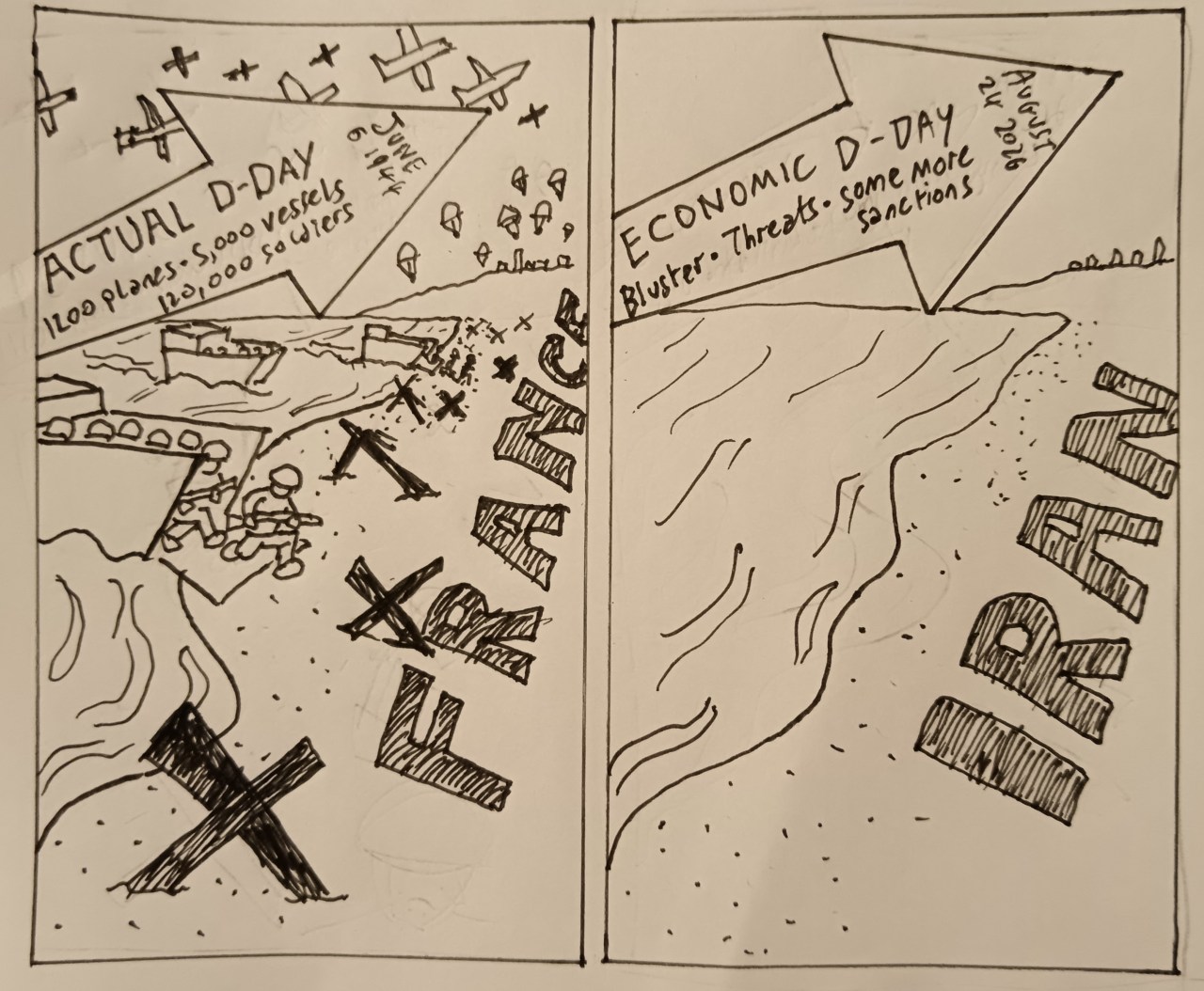
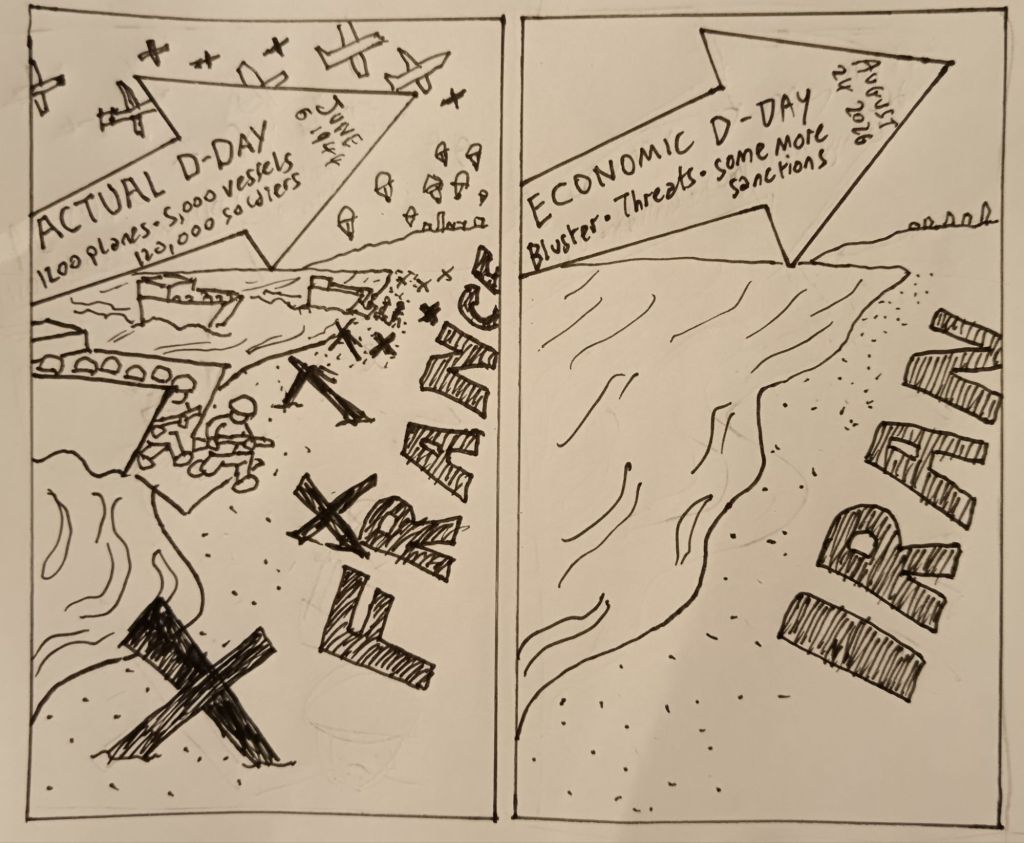
The latest catchphrase is ‘Economic D-Day.’ Will this economic offensive prove to be, as is implied, as consequential as Actual D-Day was in World War Two? In essence the US government are extending a long-standing sanction regime and also threatening to punish countries that trade with Iran. No doubt Iranian people are going to suffer. No doubt the extended sanctions represent a difficulty for the Iranian government and military. But like the blockade of the Bab-el-Mandab Strait on the other side, this is a quantitative and not a qualitative change. Those countries which will probably comply with the sanctions, such as the United Arab Emirates, had already cut trade ties with Iran anyway. Will it bring an end to the war, to the standoff over Hormuz? No chance.
But what all these blockades and sanctions mean for the world is another step towards the decoupling of the global economy from the US economy. Sanctions are enforced more by financial soft power than by military force. This soft power is diminished when it’s used in this way. The benefits of cooperating with the US are less when the US behaves as a fickle, impulsive power, possessed by a fragile need to project strength at all times, at all costs. Who would really expect China to bend the knee in this situation? Obviously they have not, instead deepening the geopolitical rift between them and the US.
The choice each third country has to make, faced with US sanctions on Iran, is not a simple one. They’re not all just immediately going to pick the US side in the dispute. Countries which do not comply with the sanctions would be making a rational choice to align with states that are less powerful but more stable and local. Countries which comply would be wise to try and hedge as much as they can get away with. The UAE (where Iran, prior to this war, procured many products which it otherwise had no access to), have cut off trade with Iran – but… How would we put this politely? Lax financial regulation is one of the UAE’s unique selling points. This is one example of the grey areas which the US can’t erase just by declaring Economic D-Day. In 2026 it makes more sense for a third country to push the boundaries, to test how far the US is really willing to go, rather than to comply and still risk arbitrary punishment.
Here I have to level with you and say that I have no special expertise in financial or military affairs, and am looking at these events with the eyes of a scholar of history and literature. What I can say about ‘Economic D-Day’ is that there is no magical formula where the US can hit Iran’s economy as hard as they need to, without burning bridges that they can’t afford to. What they will end up doing is not hitting hard enough, but still burning plenty bridges.
‘Economic D-Day’ will not change the course of the war, but will accelerate a longer-term shift away from US hegemony and toward a multipolar world order. To call it ‘Economic Dien Bien Phu‘ would be more accurate – sure, an exaggeration in the other direction, but not such a big one. Instead of making a deal along the lines of the MoU, the MAGA administration is holding on to a position that’s ultimately untenable, throwing good money after bad in the hopes that something, somewhere, gives, and the sunk costs can be recouped or at least justified.
Meanwhile, watch Trump flail around. If it’s senility, it’s not just senility. He really doesn’t know what to do when they fight back.
 The 1919 Review