
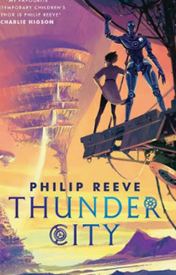
For the benefit of those who have never been exposed to the spectacular world of Philip Reeve’s Mortal Engines series, it’s about a post-apocalyptic future Earth where cities have been put up on wheels and scuttle around eating each other. Municipal Darwinism provides the backdrop to piratey adventure, salvagepunk and steampunk, epic journeys, Young Adult comings-of-age, civic-scale armageddons, and wars and power struggles with an edge of satire.
Thunder City marks the start of a third series, in between the original four and the prequel trilogy. You can pick up Thunder City without having read any of the others.
It delivers on steam, salvage and satire, within that fun type of story where a crew of colourful and diverse characters comes together to pull off a daring mission. The crew consists of a gladiator, a painter, a schoolteacher, a mercenary, an exiled prince and a – well, to describe the last one would be a spoiler, but the cover might be a giveaway. Their mission is to seize back the traction city of Thorbury, which has been taken over by a ruthless new mayor. This type of story lends itself perfectly to Reeve’s style, which is somehow breezy and substantial at the same time. These stories are epic and rich, but unlike his ponderous cities, Reeve never, ever gets bogged down. It looks effortless but he must really sweat over it.
The first chapter is capably written and engaging though it didn’t set me on fire; we follow Tamzin Pook, a young gladiator who fights robots in ‘the amusements’ in a mobile floating version of Margate. The first sentence of the second chapter was the point where I smiled and settled in for a good story: Miss Torpenhow, a teacher on Thorbury, feels a shudder in the deck and knows that her city has eaten something that disagreed with it. This is a warning for the characters and a promise to the reader that big trouble has just arrived. The chapter that follows is a good exemplar of the whole book: big events clip along, with the action always clear and crisp.
The prequels and original series dealt, respectively, with the beginning and the end of the era of traction cities. Those grand story arcs are heavy with the sense that the whole world is about to change in a fundamental way. In Thunder City, the fate of the world never hangs in the balance. For me that’s neither better nor worse, but suffice to say there are different stakes here. Instead of a sense of revolution, there is a sense of a status quo that will be restored.
Posh, hierarchical, olde-worlde Thorbury is disrupted by the ruthless technocratic regime of the self-made man, Gabriel Strega. Like some of the later villains in the original series, he wants to take Municipal Darwinism to its city-eat-city extreme. For him, art, aristos and ‘lovely old buildings’ are all items on the long list of things that can be torn down to feed the furnaces of the techno-accelerationist death drive. He’s a great villain to root against, but this sense of a return to the status quo is underlined by the fact that our crew of misfits is engaged in the conservative project of restoring an overthrown royal family. If this is a problem, the ending fixes it.
We see more of the Anti-Traction League – this time its more western component, the old and fading Zagwan Empire, who preside over the floating pubs of Gibraltar and super-intelligent octopuses. We get our first good look at Paris, whose central square features a statue of two deities who might be Asterix and Obelix.
I got more laugh-out-loud moments from this book than I expected. A showdown in a floating spa city ends with a character slamming a bowl of green and fragrant balm into a baddie’s face and growling the one-liner, ‘Consider yourself exfoliated.’
I had a mild worry, as the novel thundered on to its last hundred pages, that the final showdown on Thorbury would be deferred to a sequel. That would be a let-down – the stakes are right for this novel, but not high enough to sustain a sense of urgency across a series. It’s no spoiler to reassure you that Reeve is smarter than that: the story’s climax is a suitably pacy, exciting and satisfying struggle for the Thunder City of the title. But this crew are clearly set up for future adventures.
If I’d read less of Reeve, I would have worried that this novel would feel strained the way great stories sometimes do when the author – or another author – returns to them after a delay. Maybe the characters don’t click, the world doesn’t feel like it operates according to the same rules, the themes are muddled. But again with Thunder City the word ‘effortless’ comes to mind. I don’t know what he puts in the engine, but this thing runs smooth as a dream.
A final note on what Mortal Engines means in the 2020s – because earlier I used the word ‘accelerationist’ and had to pause and think about whether it was a metaphor. In the 2000s when London first chased a small mining town across the bed of the old North Sea, traction cities worked as a clever dig at neoliberal capitalism. Today you don’t have to read Philip Reeve to get the feeling that you live on a machine that’s ploughing a swathe of destruction across the world, that is tormented by eternal hunger, that is its own end and means; or to encounter a priesthood of powerful engineers who ask how but not why. Good thing the Gen X tech bros haven’t read a single book between them since well back into the twentieth century – if they’d read Mortal Engines they would by now be promising traction cities to hordes of eager investors. And we’d all be looking at the horizon saying, ‘It’s coming. It’s so scary. It’s going to change everything.’

