
Indulge me for a minute and imagine the Russian Civil War superimposed on the United States of America. For the sake of a thought experiment whose purpose will be clear by the end of this post, let’s brush aside the obvious objections and perform whatever mental gymnastics are required. This is the first of several “Controversies” posts on the theme of foreign intervention in the Russian Civil War. I’ll return to the main narrative of the war next week but at some point I’ll follow up on Foreign Intervention.
Let’s get the mental gymnastics out of the way first. Maybe it’s 1968 in an alternate history in which the US has emerged as one of several losers in a nuclear war. Maybe it’s 2038 and the US has been defeated in, we’ll say, Taiwan. The defeat is devastating. The vast US military is in a state of collapse. An alliance of South and Central American states (we’ll call them ASCAS) is invading the south-west.
In this defeated country, a rebellion takes place, led by the military top brass and law enforcement. We can leave aside politics for the purposes of this experiment. If you are a liberal, you can assume the rebels are a cabal of right-wingers with ties to foreign powers. If you are a conservative, you can assume they are deep-state liberal coastal elites. If like me you are a socialist, you can assume that a US revolution has taken place and that the rebels represent the last-ditch resistance of capital and the old state machinery.
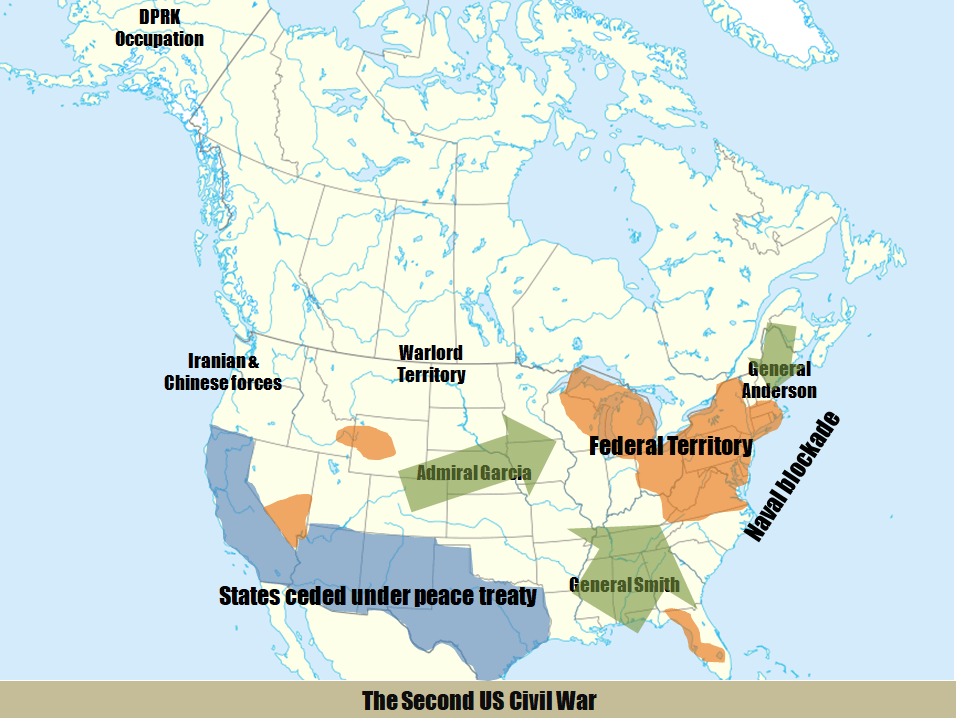
Let’s run through a timeline of the first year and a half of this Second US Civil War.
Year One
- March: US is forced to sign a peace treaty with the ASCAS, handing over control of Texas, New Mexico, Arizona and California.
- May: The states of Louisiana, Mississippi and Arkansas secede from the union. They are in an uneasy alliance with the neighbouring ASCAS occupation forces.
- A rogue army made up of officers and led by General Smith takes control over Alabama and Georgia. Smith claims to be the head of the legitimate US government.
- North Korean forces land in Alaska, and begin taking over the whole state.
- An army of Kurdish fighters has been serving in the US military in exchange for the promise of an independent Kurdish state. They are currently in transit across the Midwestern United States. They are approached by Iranian intelligence. The Iranian government promises support for an independent Kurdistan if the Kurdish Corps will rise in revolt against the US federal government. Tens of thousands of Kurdish fighters seize control over St Louis, Kansas City and Omaha.
- June: thousands of Russian soldiers land in Maine and set up a puppet government there. Thousands of Chinese soldiers land in California and Oregon. Iranian forces take control of Seattle.
- Half-a-dozen new governments seize control in various parts of the United States, some declaring independence, others claiming that they are the legitimate government of the US.
- Warlords cross the border from Canada and seize control over Montana and North Dakota.
- July: A series of armed revolts erupt in cities within Federal Government territory, including Washington DC. All are defeated due to lack of popular support but cause destruction and suffering. Foreign intelligence agencies are linked to most of the revolts.
- Chicago falls to the rebels.
- By this time, the following states are still fully controlled by the US federal government: Michigan, Ohio, Pennsylvania, the Virginias, North Carolina, Maryland, Delaware, New York, Rhode Island, Connecticut and Massachusetts. All other states are controlled, in whole or in part, by rebels or by foreign armies. The East Coast is under a blockade by the Russian and Chinese navies.
- September: the federal government seizes back control over Chicago.
- September-November: the rebel governments in the Midwest are consolidated in a series of coups. Admiral Garcia, in control of the Midwest and the Rocky Mountains, declares himself supreme ruler of the United States.
- November: revolution sweeps Latin Anerica. The ASCAS is no longer a factor. The occupation of California, Texas, New Mexico and Arizona ends. For the next two years, rebels and the federal government will vie for control of these states in a series of bloody conventional and guerrilla wars. Dallas, Texas will by the end of Year Three have changed hands nine times in three years.
Year Two
- The various rebel forces go on the offensive.
- General Smith, having spent many months crushing the resistance of federal forces in the south-eastern United States and taking control over rival rebel factions, now controls more or less the old territory of the 1860s Confederacy. His armies march on Washington DC. They reach as far as Norfolk, Virginia, roughly 400 kilometres from the capital.
- General Anderson, in control of Maine, Vermont and New Hampshire, advances on New York City. They reach the outskirts of the city proper, supported by the Russian Navy.
- The rebel forces in the Midwest, led by Admiral Garcia, invade the Rust Belt.
- 14 foreign governments at this point have troops on US soil, controlling key port cities and securing the rebels’ rear. In places, they fight directly against US federal troops. Their total forces may add up to as many as 300,000 pairs of boots on the ground, including 70,000 North Korean troops in Alaska battling a pro-Federal guerilla movement and the 30,000-70,000 Kurdish fighters in the Midwest.
- The offensives of Williams, Anderson and Garcia are bankrolled by the foreign powers. The three rebel leaders receive weapons and ammunition adding up to the total output of munitions for that year in the areas still controlled by Washington DC.
- General Anderson’s forces in New England literally wear Russian uniforms, and every bullet fired from the rifles of Admiral Garcia is of Chinese manufacture. Russian, Chinese, Iranian and Korean officers and agents are a ubiquitous presence in the rebel zones. In short, this offensive would be impossible without their support.
We have now reached the most intense point of the Second US Civil War. It is unnecessary for our purposes to pursue these imagined events any further, though readers are free to do so in the comments below. Readers are also free to tease out all the various improbabilities in the above scenario. I’m well aware of them but they may be interesting to discuss.
(Of course, the US entertainment industry has imagined such scenarios many times: off the top of my head I can think of Red Dawn, Homefront, Red Alert 2 and 3, the Call of Duty franchise and Chuck Norris’ Invasion USA. The US has never suffered such an onslaught in reality. But it is a fascinating case of projection. The US has inflicted such onslaughts against other countries too many times to count, often right down to the specific tactics depicted, without irony, in movies and games.)

We have not touched on the horrible human suffering that this war would entail. How would a military-law enforcement alliance in control of the Deep South treat minorities in the areas it controlled? What kind of humanitarian disasters would unfold in a war-torn and blockaded United States? What kind of severe police state would exist in the territories of all the contending forces, including that of the Federal Government?
I’ll ask you to imagine one more thing: that one hundred years after the events just described, Chinese, Russian and Iranian historians are busy ignoring, denying, downplaying and minimizing the significance of foreign intervention during the Second US Civil War.
 The 1919 Review
One thought on “Controversies: Foreign Intervention (1)”