
A few weeks ago we looked at the Red Terror. This post picks up directly where that post left off.
One of the greatest myths about the Civil War is that White Terror was not as significant as Red Terror.
A book by Donald Rayfield titled Stalin and his Hangmen is one example.[i] I stumbled on this book while looking for other information, and as it happened I read and took notes on only about 10 or 15 pages, on which the following points are based. But those 10 or 15 pages were bad enough.
Rayfield, after an account of some of the most gruesome episodes of Red Terror, goes on to call the Russian Revolution a ‘holocaust’ and to claim that it was as bad as Hitler’s genocide. One outrageous statement follows another.
As for the White Terror, Rayfield has this to say: ‘Such lapses [killings] were infrequent in the White Army, which was staffed with many principled officers and backed up by an administration which had not completely discarded its ethics.’ Supposedly, only the anarchists under Makhno and ‘some Cossacks’ ‘systematically employed terror on a scale comparable to the Red Terror.’[ii]
How does one even begin to respond to this?
‘Some cossacks!’ A neat trick. #NotAllCossacks! Just ‘some.’ Like Krasnov, Semyonov… you know, the main ones who were in charge. You can’t silo off the cossacks like they’re some separate thing There would have been no White movement without the cosacks; only one in five fought with the Reds.
Even if we leave aside the cossacks, where were the principles and ethics of the officers during the years of slaughter in 1914-1917? The Tsarist military during the war was absolutely infamous for brutality and corruption.
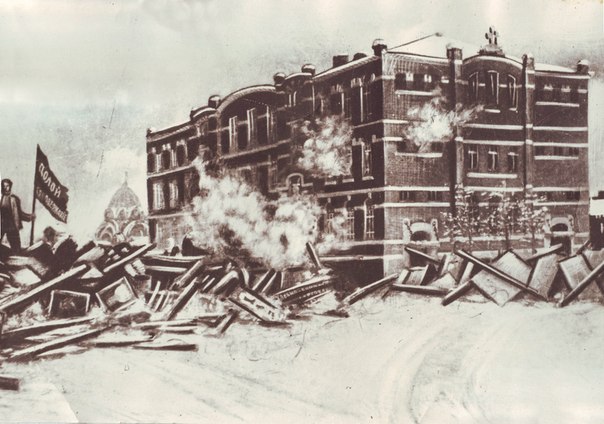
The Tsarist military was no stranger to terror. In 1918, the failed 1905 Revolution was a recent memory. Between October 1905 and April 1906, the Tsarist military ‘are believed to have executed some 15,000 people, shot or wounded at least 20,000 and deported or exiled another 45,000.’[vii] Denikin, a moderate leader by White standards, casually admits in his memoirs that he took part in this repression.
But words fail me; none of this is sufficient.
So let’s say it loud and clear: White Terror preceded Red Terror. Unlike with the Spanish Civil War, we have nothing close to reliable numbers. But all the indications are that it was as bad, if not worse.
- Krasnov (who by September 1918 had forces at the gates of Tsaritsyn) had threatened the workers of Petrograd with a massacre in November 1917, echoing Kornilov’s threats of several months before. Thankfully, both were defeated.
- But White Guard threats turned to reality in Moscow during the October Revolution, with the massacre in the Kremlin arsenal of several hundred workers.
- The executions carried out by the Left SR Muraviev in Kiev in January 1918, a strikingly early outlier of Red Terror, were directly preceded by executions carried out by the Ukrainian Rada before the fall of Kiev.
- Kornilov, as we have seen, declared ‘the greater the terror, the greater will be our victory’ during the First Kuban campaign. He was not alive to witness the Second Kuban campaign, in which this slogan was put into action and proved correct. The Second Kuban Campaign was absolutely characterized by terror. Yes, these were ‘principled officers.’ But their principles were hierarchy, tradition, property and order. And these principles told them to crush the revolution by any means necessary.
- The German forces and their puppet Skoropadsky in Ukraine carried out mass executions.
- The rising of the Kuban Cossacks in summer 1918 was accompanied by mass killings of the ‘outsiders’ and all perceived ‘Bolsheviks.’
- We have seen how the Czech Legion and Komuch were responsible for ‘an epidemic of lynchings.’ The Reds amnestied any Czech who surrendered; the Czechs shot any of their countrymen captured alongside the Reds.
- In Part 8 we looked at the fall of Kazan in August 1918, and the White Terror that followed.
- And then there is Finland: ‘According to figures produced by the Finnish National Archives, during the course of [the Finnish Civil War, January to May 1918] 5,199 Reds and 3,414 Whites were killed in action, 7,370 Reds and 1,424 Whites were executed, and 11,652 Reds and four Whites died in prison camps.’[iii] This, in a country of two million people in the space of four months, is absolutely horrifying.
- The Don Cossack Host which besieged Tsaritsyn had a record for brutality that made Stalin look like an amateur. Between May 1918 and February 1919, its leader Krasnov is estimated to have killed between 25,000 and 45,000 of his own people. The scale of White Terror under one White general in just ten months was in the tens of thousands. In spite of all this, the Reds made an appeal to Krasnovite officers which promised not only pardons but new appointments if they surrendered to the Reds.[iv]
- Out in the far east, Cossack warlords and the sadistic Ungern-Sternberg were in control. Rayfield tries to argue that Ungern-Sternberg was not representative of the White cause. We have an article on Ungern right here on this blog which argues that the depravity and insanity of Urgern were in fact rooted in the aristocracy, the coubter-revolution and the military.
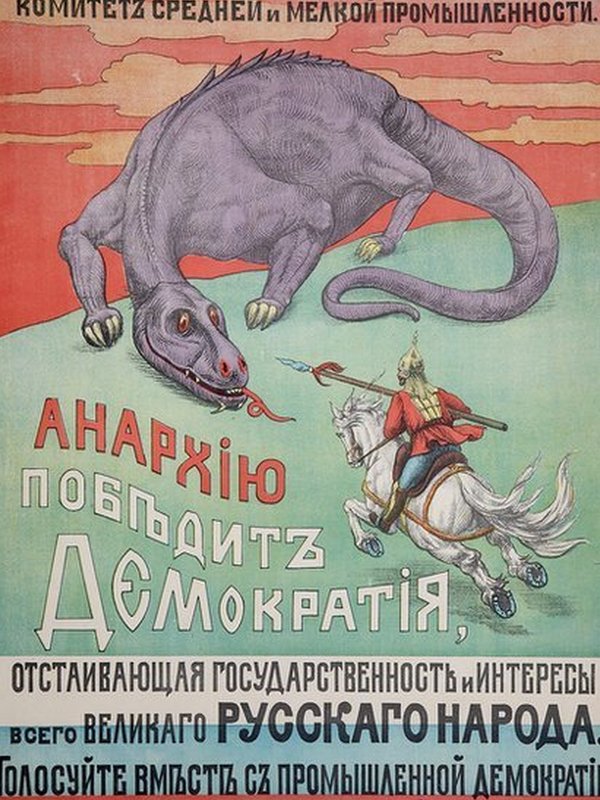
In other words, Rayfield is making another outrageous claim, which we have above disproved simply in relation to the period before September 1st 1918. It would be time-consuming, but not at all difficult, to hammer home the point with a survey of White Terror over the course of the entire war. But that would be getting ahead of the main narrative of the series, and besides the facts above should suffice.
When a Petrograd Communist newspaper called for ‘more blood, as much as possible’ in September 1918, that was an extreme and unjustifiable statement. But we need also to understand that all the things listed above had unfolded in the months leading up to that statement.
The Left SR Latsis complained: ‘They are killing our people in their hundreds and thousands. We are executing their people one by one, after long negotiations in front of commissars and courts.’[v] That is an exaggeration. But it was the perception of many on the Red side in mid-1918.
SA Smith in particular is an antidote to Rayfield. He emphasises how different forces, not just the Reds and the Whites, used terror. ‘All protagonists in the civil war practised extreme violence… Peasants disembowelled members of the food detachments and local communities wreaked havoc on neighbours they believed to have appropriated their land or resources. Violence could thus be predatory or a desperate reaction by a community facing threat.’[vi] Nationalist movements, for example in the Caucusus, used terror and carried out ethnic cleansing.
Taking a step back, what we’re talking about here is a vast and rotten empire falling apart, and different factions contending for the vacated power, all using violence. This was in the broader context of the bloodiest and most large-scale war in human history to date, the First World War.
White Terror preceded Red Terror in another sense that we have already considered – the bloodshed of the 1905 Revolution. 15,000 dead – this was the toll of White Terror in a revolution that never escalated to the same level as that of 1917. People on the Red side had vivid memories of this, and they extrapolated from it to imagine what a counter-revolution would have led to in the more intense and escalated situation of 1918-1920.
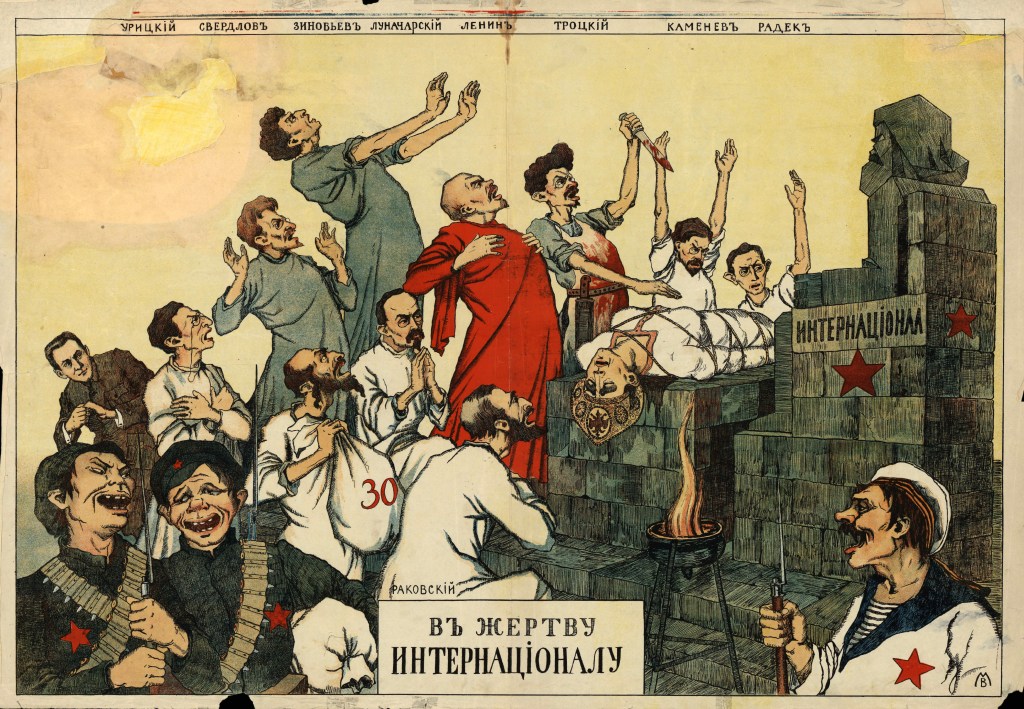
A key fact of the Civil War is that the Reds had mass support and the Whites didn’t. The Whites had money, skilled personnel, connections, important remnants of the military apparatus, and foerign support. But neither the peasants nor the workers supported them, and their relationship with the intelligentsia was only a little better.
This means that to achieve victory in the Civil War, the Whites would have had to inflict an unimaginable level of violence. To drive the peasants off the land they had seized, to disarm and ‘pacify’ every working-class district in every city, would have required a very bloody dictatorship. The virulent racism and chauvinism of White propaganda (where ‘Jew’ and ‘communist’ were one and the same) raises the question of what brutal excesses the minorities and nationalities would have suffered under the iron heel of White dictatorship. It is a good thing that human eyes never had to witness the ethics and principles of the reactionary White soldiers on full display after a bloody conquest of Moscow or Petrograd.
[i] Rayfield, Donald, Stalin and his Hangmen, Viking, 2004. P 85-87.
[ii] Rayfield, Donald, Stalin and his Hangmen, Viking, 2004. P 85-87.
[iii] Smele, 60
[iv] Serge, Year One, 269
[v] Westerlund, 65
[vi] Smith, S. A., Russia in Revolution, p 164
[vii] Read, Anthony, The World on Fire: 1919 and the Battle with Bolshevism, Pimlico, 2008, p 5
 The 1919 Review
4 thoughts on “Controversies: White Terror”