Nearly three years have passed since groans of disappointment met the final season of Game of Thrones. A lot has been said and written about how it was badly-written, incoherent and rushed, about how it let down its characters, about how the story’s themes, once promising, descended into cynical platitudes. In particular I recommend and largely agree with this and this and this.
On the other hand there have been some attempts to say that it deserved a better reception. I’m not fully convinced by any of the defences I’ve happened across. But enough dust has settled now that we can start pushing back with a revisionist history against the consensus. The final season was not actually bad.
Did you really expect it to be brilliant?
My expectations for Season 8 were low.
Seasons 5 and 6 were solid, but there were obvious problems with the writing. For example, there was Arya doing effectively nothing for twenty episodes; there was Jaime’s half-baked and clumsy sojourn in Dorne. Plot armour and Elder Scrolls Fast Travel sped up the plot but wore down the friction and texture of the world.
Season 7 was a carnival of the silly and the unsatisfying. Problems evident in sub-plots and isolated moments of 5 and 6 came to dominate the main storyline in 7.
By the way, the first episode of Season 8 (‘Winterfell’) was the worst-written of the whole show. Not a single line landed. Everyone was just milling about awkwardly in the castle. Critics and audiences said it was great at the time. They would flip to hyper-criticism a few episodes later.
Thankfully every other episode in the season had more narrative momentum and better dialogue than this lifeless opener. But the first episode was another warning to temper expectations.
I guess people withheld their impatience at 7, hoping 8 would salvage the situation, then vented their anger on 8 when it didn’t. The hype around GOT was such that people believed the showrunners were playing 12-dimensional chess when in fact they were flying by the seat of their pants. There was a widespread expectation that Season 8 would be a sublime revelation rather than a crash-landing.
And it was a crash-landing – not a crash. All in all, it was better than Season 7. Things were messy but it hit the ground intact and held itself together until it came to a shuddering halt, and that was the best we could have hoped for.
Writing isn’t everything
An interesting feature of the Game of Thrones phenomenon is how every viewer became a critic. What emerged around the show was the kind of commentary you’d expect to surround a mass movement or a charismatic leader. Early on, fans debated the story’s conflicts as if they were real; later, they turned from debating the internal politics of the story to debating the merits of the writing itself.
Something held me back from commenting at the time; the clamour surrounding the show was too much. The GOT-commentary industrial complex had grown dangerously vast and all-consuming. I wanted to enjoy it as a TV show, and not feel obliged to have developed opinions and to defend those opinions.
William Goldman’s 1983 book Adventures in the Screen Trade laments the fact that the contribution of writers is underrated in Hollywood. But things have changed; our generation posts hour-long videos on Youtube about character arcs and themes.
But writing is not the only element in film. With GOT we have focused on it to the exclusion of all else.
Season 8 was poorly written. But TV is not prose. What about the other aspects of the production?
The cast carried the whole thing along convincingly, delivering lines that should have felt like golf balls in their mouths. The sound, music, set and costume design were great. Nobody really noticed that silly thing with the coffee cup. The Battle of Winterfell, once you adjusted the brightness on your TV, was awesome to look at and compelling to experience.
The attack on King’s Landing was powerful. There was real visual storytelling here (shame about the verbal storytelling). Arya’s struggle for survival in the burning city was harrowing and original, like a hybrid of The Lord of the Rings with Come and See or Children of Men.
Of course, this was the very episode that was so controversial. But it was so well-done visually, it packed such a punch, that I believed it in spite of my misgivings. I was carried along. And in the moment, so were you, most likely. For a time you felt what the show wanted you to feel: dismay that Dany would do this, rather than dismay that the writers would do this.
The writers without a doubt committed an atrocity far worse than anything Danaerys did to the people of King’s Landing. But the real atrocity was not in that episode. That penultimate episode is open to different interpretations – such as this which makes some very good points.
The real atrocity came in the final episode – when the writing battered us over the head with trite moral lessons, when Dany was ‘put down like Old Yeller,’ when the city was magically rebuilt, right down to the Small Council chamber now staffed with an audience-pandering collection of fan faves.
If George RR Martin is planning to end it in a similar way, I shudder to think what that might look like on the page.
‘I murdered my intimate partner,’ said Jon Snow gravely, ‘as the prophecy foretold.’
Tyrion laid a hand on his shoulder. ‘You had no choice. The whole story bent over backwards to contrive a situation where you had to do it.’
For a moment they were silent as the winds of winter howled outside.
Jon sighed heavily. ‘I still don’t understand. What does it all mean?’
Tyrion began to pace the floor, his hands clasped behind his back. ‘All liberation movements end in totalitarianism. Freeing slaves is a slippery slope. And at the bottom of that slope – genocide. And before you ask, yes,’ he added with a pained smile, gesturing toward the Martin Niemoller and Leni Riefenstahl references scattered about. ‘This story is implying that Dany was, at the end of the day, as bad as Hitler, and by extension that Hitler started out like Dany.’
‘I’m not sure which of those two claims is worse.’ Troubled lines creased Jon Snow’s face. ‘But these references make no sense. Not in our medieval-esque setting. Sam Tarly would say they’re… Uh, anachronisms.’
Tyrion smiled again, this time wryly. ‘So are dragons.’
Jon frowned. The dragons had been easier to swallow than the reactionary platitudes.
The tragedy of it all was that the writing let down the other aspects. But those other aspects deserve to be appreciated. A small army of people worked on them, and their work was not in vain. The production convinced me in key places where the writing failed.
It ended badly. But it ended.
The great virtue of Season 8 – even of that final episode – was that loads of stuff was happening. The Mountain and the Hound batter the crap out of each other, then plunge to fiery deaths! Marvellous! A dragon melted the Iron Throne. Jon is going with the wildlings back to their homeland, and spring is coming.
Everyone talks about how this season would have been so challenging to write. I don’t agree at all. Everything had been set up for seven seasons; all the showrunners had to do was knock down the dominoes in a reasonably competent manner.
Sometimes the writing was more than just competent. The second episode (‘A Knight of the Seven Kingdoms’) was by far the best of Season 8 – as doom approaches, the main characters have a lot of talky but heartfelt scenes. This was great writing.
True, there wasn’t much great writing. But even basic competence went a long way. Big, dramatic stuff was happening, and things were being resolved – this was the rocket-fuel that kept Season 8 moving forward in spite of its big problems. For stretches, it was easy to be carried along – as long as your focus was ‘Am I enjoying this?’ not ‘What will I say about this on the internet?’
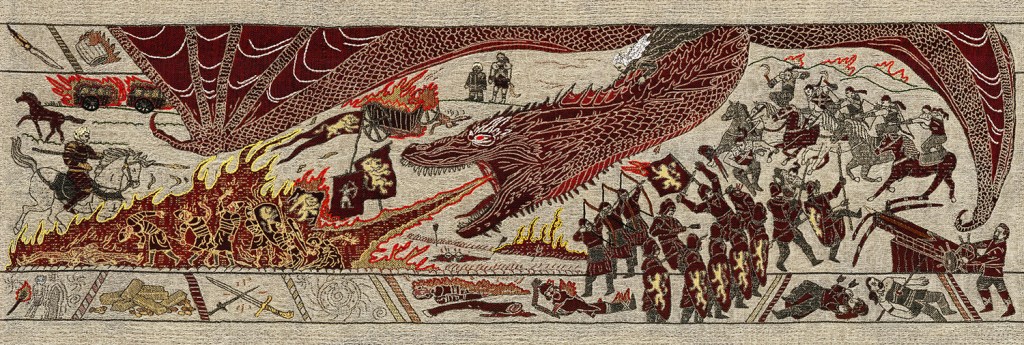
Let’s take a moment to reflect on how great and how rare it is to see stuff happening on a TV show. The usual practise with TV is to drag things out, to tease, to defer gratification; to leave things unresolved just in case there’s another season; to forcibly jump-start a broken-down story just to get the punters back on their couches. The general rule is: you keep making the show until it stops making money.
Some critics say that Season 8 was too rushed and that they should have made two, three, four more seasons. I don’t agree. If we’d got more seasons, we’d have got more rushed and unsatisfying seasons.
For most of its run, my main worry with Game of Thrones was not the possibility that it would end badly, but that it would not end at all. I worried that GOT would taper out in a dragon’s tail of dismal seasons, an endless winter of exhausted characters shambling through the long night of lifeless plots.
But that is not what happened. Game of Thrones ended with a bang, when we all still cared enough to criticise it.
When the show is no longer a recent memory it will be rediscovered. The quality of those early seasons was real, but it was far from a perfect, sublime, unproblematic show. In the future, viewers will appreciate the show in a critical and balanced way. They will groan good-naturedly at the ending but they will not feel betrayed.
Next week I’m going to post my alternate ending for GOT – to illustrate that even as late as the final episode, all was not lost.
But that’s kind of an appendix to this post. For now, that’s all. Game of Thrones Season 8 was an enjoyable few hours of TV. It was fine, it was OK, it was grand. The problem is, with Game of Thrones fine, OK and grand couldn’t cut it. Its own hype was its own worst enemy.
 The 1919 Review

‘it was a crash-landing – not a crash’ That about says it Sorry to hear about your mug. I look forward to your thoughts on Dune
LikeLike