
A few weeks ago I wrote about Dune. As I mentioned, its underlying concept isn’t actually that great. I wrote, ‘It’s about a teenager who […] becomes emperor of the galaxy by convincing native people that he’s their god,’ and then I added something about phallic monsters.
Stated so baldly, the concept would actually put a lot of people off. The real brilliance of Dune, I argued, is in the delivery.
Here are ten Science Fiction novels which are not as well-known as Dune but which have it all: great concept and great execution.
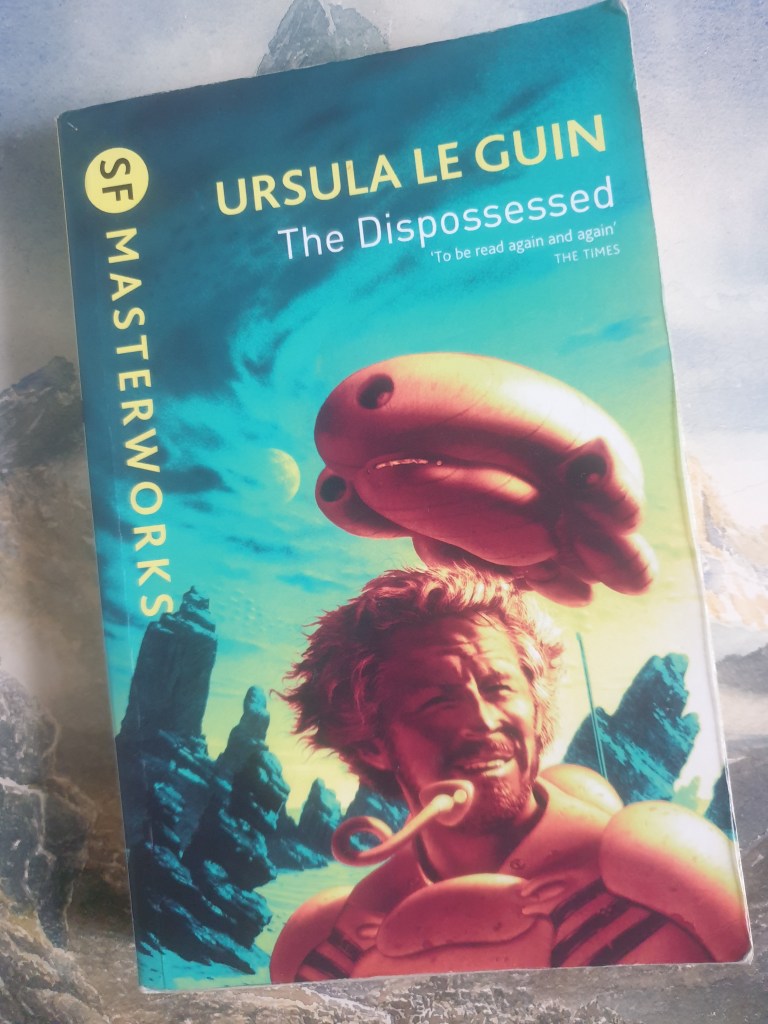
1. The Dispossessed by Ursula K Le Guin (1974)
In The Dispossessed, the great Ursula K Le Guin sets herself the task of describing an anarcho-communist society. An inventor named Shevek has lived all his life on the arid moon of Anarres. On Anarres, all property is public and the state has ‘withered away’ – there are no police, courts or prisons, there is no money and no large-scale private property. On the basis of voluntary cooperation, this society is highly-organised and industrialised. It provides housing, food, healthcare and education to all.
But this is not one of those novels where the story is just window-dressing for a political lecture (a valid genre – The Iron Heel is very good on its own terms – but unpopular today). Anarres is not a utopia. This moon is poor in resources, so the common standard of living is not luxury. The dissolution of the family means that child-rearing can be left to institutions. Now, these institutions do a perfectly good job, but it’s obvious that Shevek has unresolved pain caused by his mother’s abdication of responsibility for him. Academic rivalry can get vicious. Political controversies still lead to violence, as we see in the first pages.
The story is about Shevek growing fed up with Anarres – though as he explores other worlds and societies, capitalist and sort-of Stalinist, he sees that they are far worse.
2. Rosewater by Tade Thompson (2016)
An alien lands in rural Nigeria. But this is not a slightly funny-looking humanoid in a flying saucer or tripod. It’s a vast biological presence, a kind of dome. Once a year it heals those afflicted by mutilation and disease, attracting a pilgrimage. But the real agenda of this alien presence is unclear.
Thompson shows how, decades later, a whole society has been reshaped by the alien presence, and we witness a shadow struggle of psychics and intelligence agencies.
3. Iron Council by China Miéville (2004)
In a time when steampunk and fantasy Victoriana were cutting-edge, Miéville posed a very relevant question: in all these gears and goggles, where’s the steampunk Karl Marx? Where’s the steampunk Paris Commune?
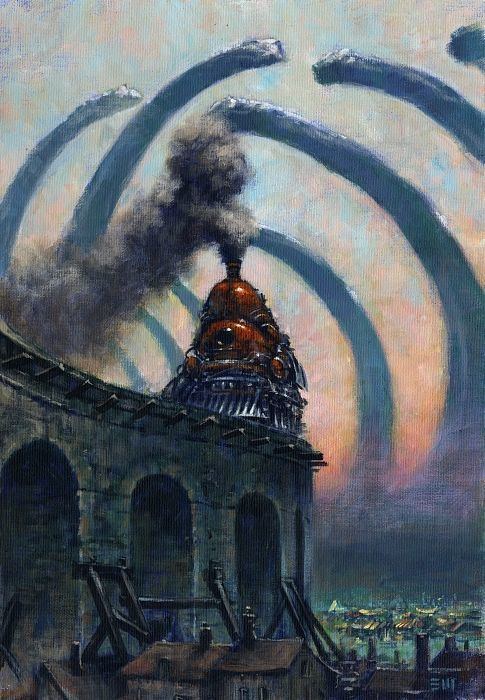
That suggests the premise of Iron Council, the last part of the Bas-Lag trilogy (each can be read as a standalone). Civil war engulfs the city of New Crobuzon as the old regime clings to power in the face of a workers’ uprising. All this in a dark and floridly bizarre steampunk fantasy world where convicts are punished by being turned into semi-machines, and spirals can be magical weapons of mass destruction.
In Iron Council, Miéville also asked a question that nobody else would have thought of: what if a frontier railway-builders’ strike led to the creation of a nomadic railway-borne communist republic? What if this train had to rush half-way across the world to aid the New Crobuzon Revolution?
4. American War by Omar El-Akkad (2017)
In the near future, the southern states of the US start a civil war over a fossil fuel ban. In this novel’s bleak vision, war is a matter of misguided desperate people being crushed physically by high-tech weaponry, and crushed mentally and spiritually by prisons.
As the war settles down to a guerrilla struggle, a federation of Arab states sends agents into the sprawling refugee camps. They groom a generation of suicide terrorists to carry on what everyone knows is a doomed struggle. And that’s not even the worst part.
This bleak story draws you in with a well-drawn world and characters. It all feels painfully real. The foreign agents are prolonging this war for their own selfish geopolitical purposes – but that’s exactly what US agencies have been doing for decades, all over the world and especially in Arab countries. This parallel seems to emerge naturally from the story and world. It is not one-to-one and it is not immediately obvious. The world and story work on its own terms – though for me the ending was bit too extravagant to be credible.
5. The Three-Body Problem by Cixin Liu (2008, trans 2014)
How would aliens communicate with humanity? Imagine intelligent life that has evolved on a world whose rules and dangers we can barely comprehend. In Liu’s novel, these aliens explain their history to us through an incredibly trippy cult videogame that they infiltrate into our cyberspace. Our characters discover and play this game. At first it seems totally bizarre, but meaning gradually emerges from it. This is how the aliens communicate with the humans, and how the novel communicates with us. We come to grasp the mind-bending cosmic reality of an alien world.
What’s with the searing flashbacks to Mao’s Cultural Revolution? This ties in thematically with the alien story. There emerges a political movement of humans, fanatics who support the aliens and hate their own species. The moral of the story, implicitly, is as follows: all hail bloody state repression, the only force that can save us from dangerous fanatics, be they Maoists or alien proxies. It’s a horrible message but implicit, not explicit, and one that is unfortunately pretty common in cutural texts from all parts of the world, the US or Britain every bit as much as China.
6. The Forever War by Joe Haldeman (1974)
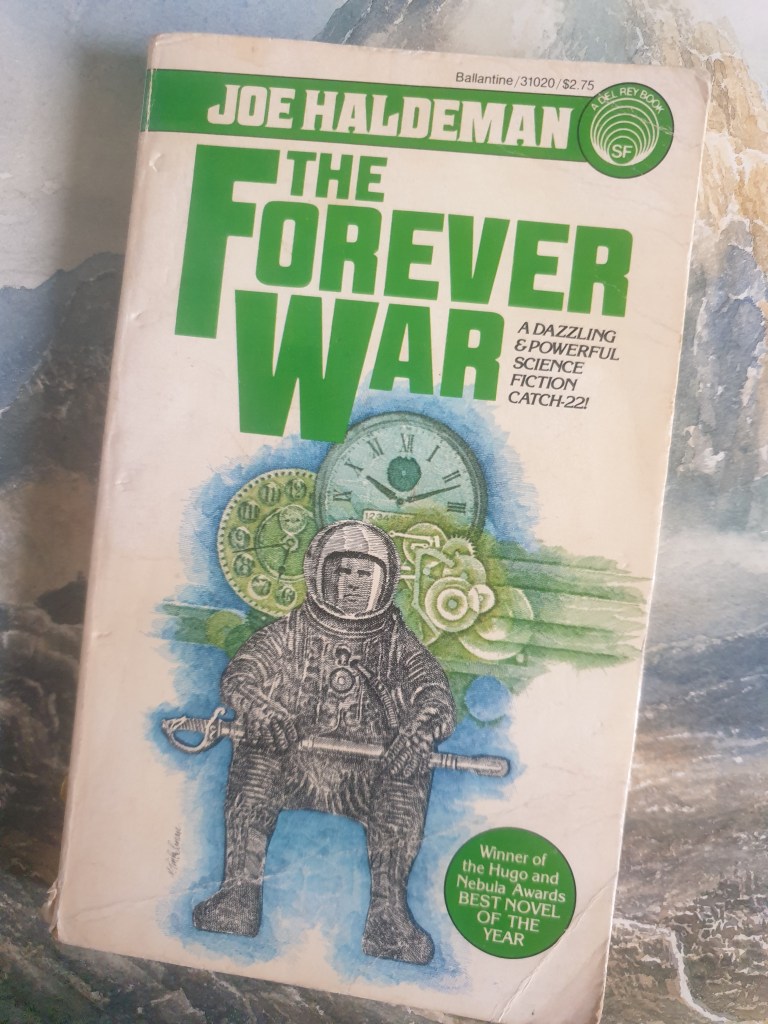
A young soldier is sent to war on a distant planet. Our main character jets back and forth across the galaxy at light speed, from earth to the battlefields and back again; he ages a few months, but meanwhile on earth centuries pass.
The military sci-fi aspects are really well-realised, but the heart and soul of the book is the very literal ‘future shock’ experienced by Private William Mandella as he fights for a society he no longer understands.
7. Parable of the Sower by Octavia E Butler (1993)
In Parable of the Sower we watch a near-apocalyptic California descend into a post-apocalyptic California. But this is not Mad Max or Fallout. Violence is all around, but it is not the answer. The answer is to band together and help one another selflessly, and that is what we see happening, in spite of suspicion and scarcity.
The main character is a visionary young woman who is making up her own religion. Certain other Science Fiction prophets have used religion to wage intergalactic jihad. But in Parable of the Sower, it is a creed of compassion and mutual aid, with obvious relevance for the tasks which face our band of survivors.
Meanwhile, the causes of the collapse of society are not singular or simple. There is no alien invasion, zombie virus or nuclear strike. It’s simply that corporate power has grown to a terrible scale and has destroyed society, the economy and the environment. The start of the novel is not too distant from the reality today.
8. The Stone Sky by NK Jemisin (2017)
On the Broken Earth, devastating earthquakes are a regular occurrence. Enter the orogones, humans who can control geology with their minds. This makes them saviours but also potential destroyers; an orogene in a fit of rage can cause a whole town to collapse into an abyss.
The Stone Sky (2017) is the third part of the Broken Earth trilogy. (Yes, you have to read them in order). The Fifth Season (2015)and The Obelisk Gate (2016) are great in their own ways, but in The Stone Sky the brilliant concepts are fully-developed and the mysteries are revealed. Most importantly our characters, who have often seemed like shadowy sketches, emerge fully into the light. The relationship between the main character and her daughter define the novel, and at the climax of the story everything comes together in a single moment, a single decision. Yes, after all the horror we get a happy ending.
9. Judge Dredd: Complete Case Files 2 (1977-1979)
credits from 2000AD.com:
WRITERS CHRIS LOWDER, JOHN WAGNER & PAT MILLS
ARTISTS BRENDAN MCCARTHY, BRETT EWINS, BRIAN BOLLAND, DAVE GIBBONS, GARRY LEACH, MIKE MCMAHON & RON SMITH
LETTERERS TOM FRAME, TOM KNIGHT & JACK POTTER
Judge Dredd and a punk biker have to cross a nuclear-wasteland USA on motorbikes. Crazy adventures ensue. This is the Cursed Earth Saga. Dredd and co are attacked by a tiny but fierce robot general, free a captive alien king, and come face to face with the cryogenically frozen president who caused the nuclear war. It’s wacky, fast-paced, gruesome and sometimes disarmingly tender.
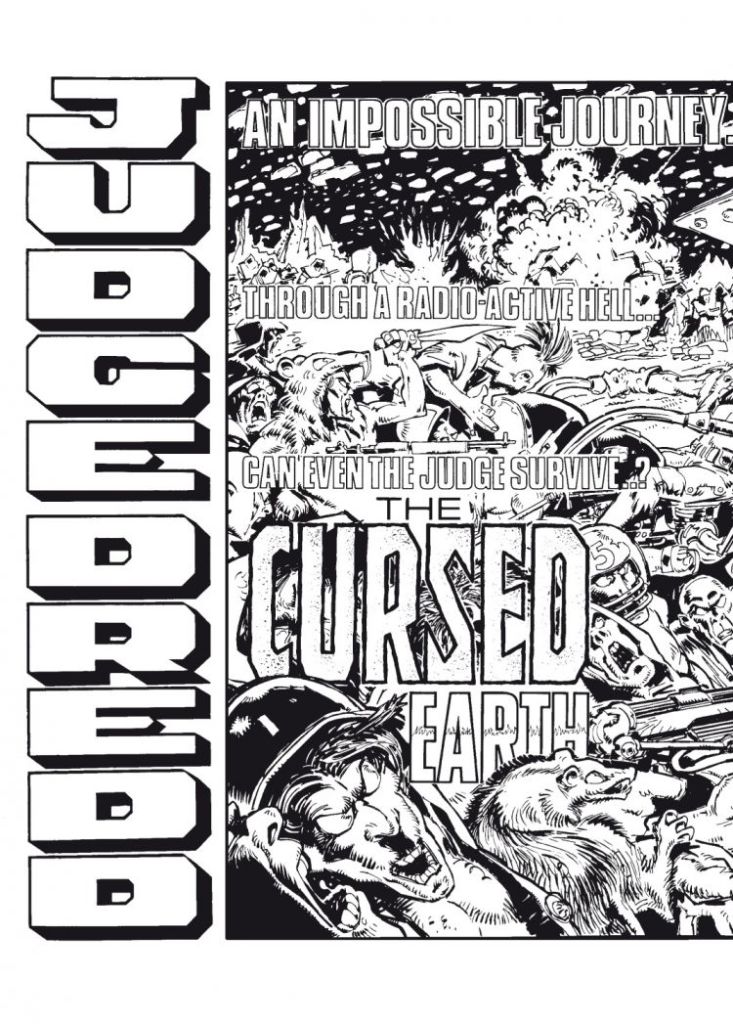
Dredd returns to his futuristic mega-city. He’s not there five minutes before the insane Judge Cal seizes control of the city. Inspired by the reign of Caligula, the story traces a very satisfying back-and-forth struggle between Dredd and Cal. Cal descends into ever-more ridiculous and evil excesses until finally he sentences the entire population to death and lines them up to be eaten by alien mercenaries; Dredd raises a revolution, arms the people, and links up with unlikely allies such as the sewer-dwelling mutant Fergie.
In the decades since these stories came out, Dredd has had many satirical and epic and memorable adventures. But to my mind they has never quite equalled the Cursed Earth and Judge Cal.
10. The Water Knife by Paolo Bacigalupi (2015)
Rounding off the list, an all-too-topical premise. In The Water Knife, the whole south-eastern United States have dried up. The cities are dying. Bloody struggles and intrigues unfold as leaders try everything short of all-out war to seize control of the water supplies. The ‘Water Knife’ of the title is Angel, a tough guy who secures water supplies for Las Vegas.
Something like this is going to happen. I happened to see online just the other day that the water levels in Lake Mead, Nevada, are frighteningly low. Bacigalupi brings to life what it could to mean for politics, culture and the dark underworld of organised crime and the secret state.
 The 1919 Review
The Le Guin and Haldeman are the definition of brilliant — but definitely not underrated… they won both the Hugo and Nebula and are constantly on ever best of list and always in print…
LikeLike
Fair point Joachim!
LikeLike