
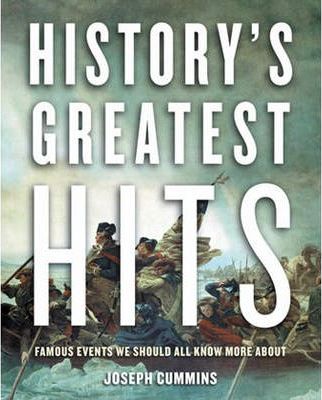
I have come across a large illustrated book titled History’s Greatest Hits.
I have a big problem with this book.
The simplest way to explain it is, imagine you came across Metallica’s Greatest Hits only to realise that all 36 tracks were songs on which Jason Newsted played bass. If you don’t know Metallica, substitute any other band and any other musician who only appears on three of their albums. There’s nothing wrong with Jason Newsted (Some people think the Black Album is their best). But most of Metallica’s greatest hits would not be on that list.
The blurb to History’s Greatest Hits promises an easy-going tour of ‘history’ via a range of episodes which ‘we should all know more about.’ The introduction says that we will meet a wild variety of historical figures – ‘From Queen Elizabeth I and Christopher Columbus to George Washington and Winston Churchill.’ Three of those people spoke the same language, three were from the same continent, two were from the same small island, and all of them had the same skin colour.
I skim-read a few of the chapters and found them fine. I’ll assume it’s well-written and well-researched. I don’t know anything about the author, and for all I know the publisher called the shots. But the contents page reveals a staggering bias:
- Of the 36 chapters, 30 are set in Europe or in post-1492 North America (including the one about Americans on the moon).
- Of the remaining 5, 4 are not set in Europe or North America, but are focused on people from those places: the Crusades, the bombing of Hiroshima, the Cuban Missile Crisis and the Tet Offensive. The other is the 6-Day War of 1967. This is an episode in which the protagonist, the state of Israel, is today closely aligned with the US politically.
- 2 involve protagonists from other parts of the world – Hannibal crosses the Alps, 9/11 – but the focus is on the menace they posed to Ancient Rome and modern New York, respectively.
- 16 specifically and directly involve England, and 13 the United States (We’re up to 29 out of 36).
- The section on ‘The Ancient World’ consists of three chapters, all of them about Rome.
- So that’s 32 out of 36 chapters focused on Rome, England and the US!
- For World War One there are two chapters (Both about Britain), and for World War Two, four (all about the US). None on the Eastern Front or China! So we get D-Day and the Battle of the Bulge, which happened six months and a few hours’ drive from each other, but not Shanghai or Stalingrad, Egypt or Burma.
Here you may point out my hypocrisy. My own little blog has so far been largely Eurocentric. In my defence, if you look at my ‘About’ page, this blog never made any claim to encompass all of human history, or to present its most interesting and significant episodes. The criterion is my own eccentric preoccupations and I never presented it any other way.
This book suggests that all the most important and interesting things in history happened in limited parts of the world and involved only a small slice of the human race. The suggestion is that everyone else was sitting around not doing much for thousands of years (except, from time to time, producing a Hannibal, a Bin Laden or a Tet Offensive to present a challenge).
Readers assume that the writer and publisher know what they’re talking about, and accept, consciously or unconsciously, that that the baton of ‘civilisation’ has been passed from Rome to England to the US, and that history consists of what they were doing.
And the bias in this one book is reflected in a thousand other places.
History’s Greatest Hits was published in 2003, nearly 20 years ago. Could such a book be published today? Absolutely. The book’s bias is very easy to demonstrate, which makes it easy enough to prove a point, which is why I’ve decided to write about it. But it’s not an extreme example. Keep an eye out and you will notice a ton of similar stuff.
But, you might argue, the book is written for English-speaking audiences and needs to pander to them. ‘Play the hits’ – tell us the stuff we already know!
In response to that I’d say: let’s look at another book, by coincidence also published in 2003. This is The Horrible History of the World, by Terry Deary and Martin Brown. Opening pages: Australia (30,000 BC), Egypt, Nubia. Skip on a bit. Babylon, Greece, India, China. A large picture of Shaka Zulu looking grumpy. A closer look would probably reveal a Euro and Anglo bias. But at least some effort has been made.
This kids’ book gives a better overview of ‘history’s greatest hits’ than the adults’ book, for the simple reason that it’s actually global in scope.
To end on a positive note, what would a balanced playlist of ‘History’s Greatest Hits’ look like?
Here is a list of 36 alternative topics, in no particular order of relevance or chronology. Its purpose is to illustrate that even a blogger like me can come up with more than enough interesting and important topics from the history of Africa, Asia and South America.
Ancient World:
1 The Reign of Hammurabi (Babylon)
2 Cyrus the Great liberates the Hebrews (Persia)
3 Polynesian migrations (Pacific Ocean)
4 The Terracotta Army (China)
The Middle Ages and Renaissance
5 The birth of Islam
6 The ‘Divine Wind’ prevents a Mongolian invasion of Japan
7 The glory of Benin City (Nigeria)
8 Georgia’s Golden Age
9 The Chola conquest of Sri Lanka
10 Buddhism comes to Tibet
11 The Iroquis ‘Great Peace’ (North America)
12 The Ming dynasty treasure voyages (China)
The Early Modern Era
13 Russian settlement of Siberia
14 The Sengoku Jidai (Japan)
15 Native Americans adopt the horse and firearms
16 Revolution in Haiti
17 Reunification of Ethiopia, 1855
18 Shaka Zulu (South Africa)
19 Dungan Revolt
20 The Opium Wars
21 The Trail of Tears
A World at War:
22 The Colombian Civil War
23 The Armenian Genocide
24 The Women’s War in Nigeria
25 The Arab Revolt
26 China: the Long March
27 Unit 731 in Manchuria
28 Indian famine of 1943
The Cold War and Beyond:
29 Nasser seizes the Suez Canal
30 Ghana achieves independence
31 The overthrow of Salvador Allende (Chile)
32 Suharto’s Coup in Indonesia
33 The Killing Fields (Cambodia)
34 The Angolan Civil War
35 Overthrow of Apartheid in South Africa
36 Bolivia’s Water War
 The 1919 Review