
[Author’s note, May 2023: I wrote this piece nearly ten years ago on my old blog. Looking back, I’m happy with how I put my finger on how some shockingly crappy writing found its way into massive TV shows and movies of the time.
[In paticular I anticipated the well-deserved Sherlock backlash…]
I’ve just watched the first two seasons of the BBC’s very enjoyable modern take on Sherlock Holmes. Moriarty, the villain (Andrew Scott), was admirably written and acted, with his posh Irish accent, his “absolute psycho” character (writer Stephen Moffat) and his insatiable mania.
But there was a problem. This was a problem with the whole conception of the character and the mysteries he sits at the centre of. I first recognised this problem when Moriarty did something that has become compulsory for every 21st-century villain: the Joker in The Dark Knight, Bane in its sequel, Loki in Avengers, the baddie Silva in Skyfall…

He deliberately got himself captured so as to engineer a fiendishly complex, far-fetched escape, all for some negligible purpose that was clearly not worth the risk or the trouble.
Then I started to think about this a little more. The 19th-century Professor Moriarty went after Sherlock Holmes because the great detective was threatening to uncover his secret criminal organisation. The 21st-century Moriarty went after Sherlock Holmes for his own amusement.

It’s effective and scary, once in a while, to see a villain who is motivated only by some inner sadistic drive, who is a psychopath, whose powers of planning and organisation are almost supernatural. Now, I’m not a massive watcher of films and TV shows, but I think I can discern a trend towards this kind of villain becoming the rule, not the exception.
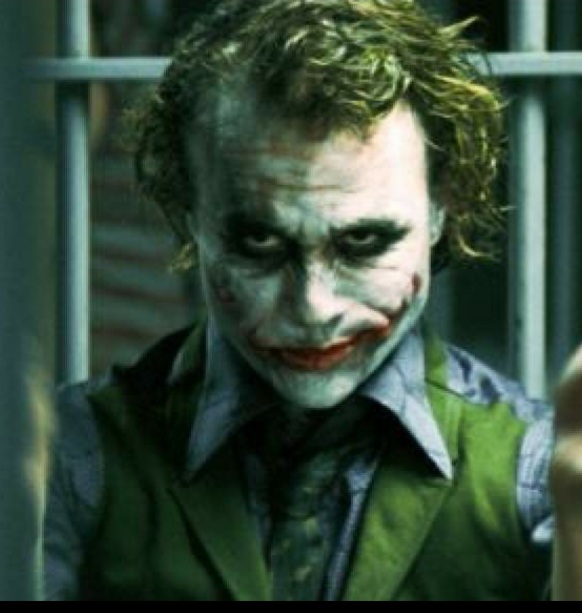
It’s a shame, because Scott, Moffat and Gatiss’ Moriarty is so brilliantly acted and written. But his underlying motivation and nature is becoming a cliché. His prototype, to my mind, is Heath ledger’s equally brilliant performance as the Joker. The only explanation of his desires and motives is that he is like a “dog chasing cars”. He does it all for fun. He’s evil because he’s evil. Holmes and Moriarty have more or less the same conversation as the Joker and Batman: “You complete me.” says the Joker. “Without me, you’re nothing,” says Moriarty.

This is interesting the first time, but boring when it becomes a rule. Rather than being real characters, formed by and a part of the world around them, the villain becomes an essential, cosmic, metaphysical force of evil. Instead of applying a Sherlock-Holmes-like brain to the problem of understanding this villain, we are asked to bow down before a profane mystery that is beyond the grasp of our feeble human minds.
It’s pre-enlightenment stuff. Good versus Evil. Eternal battle between irreducible forces. Fair enough in The Lord of the Rings, which you know is set in a fantasy world. Not fair enough in a “gritty, realistic, modern” reboot of Batman or of James Bond. It fits in even worse in Sherlock Holmes, which is supposed to be all about the application of scientific thought to apparently baffling crimes. “I have been tempted to look into the problems furnished by nature,” says Sherlock Holmes in “The Last Problem”, “Rather than those more superficial ones for which our artificial state of society is responsible.”

And don’t get me started on the crimes themselves. Villains these days have thinly-disguised supernatural powers. The Joker can manufacture huge numbers of bombs secretly, then go on a rampage setting them off in all manner of bizarre places he could not possibly have planted them. He even times his one-liners precisely to the moment before the explosion. He times his bank robberies perfectly to coincide with the line of yellow school buses.
The absurd far-fetchedness of Silva’s plan in Skyfall is perfectly summed up half-way through this video and in this older post. It’s just stupid and impossible. The precision and logistical effort required would strain the most powerful intelligence agencies on the planet, and the rewards are so trifling for this huge effort.
Of course, if the villain’s motivations need not be explained, then why should we think we have a right to understand his logistics? Cosmic forces of evil go hand-in-hand with supernatural powers.
Batman Begins impressed me because there was an internal consistency to it all, everything was explained within the rules of the game, no logistical leaps were made, and everyone’s motivations were made clear. Not bad for a superhero movie. Bane was a much better villain than the Joker as well, but again at the start of the film we were subjected to effectively supernatural powers and a pointless get-captured-and-escape stunt.

When the villain can do anything, there is no awe, surprise or dramatic tension. Internal consistency breaks down, and nothing is beyond possibility. When the villain can do anything, what stops him killing the hero? Screenwriters have solved this problem in a very unsatisfying way: often, the hero is cornered and defeated and the villain could kill them, but chooses not to, just to play some complicated and far-fetched game for their own satisfaction. The characters’ motivations can be twisted any way that suits the writers. A real conflict does not take place. Anything goes.
Is this all down to laziness? Like when Charles Dickens had a character die due to “spontaneous combustion” in Bleak House? I think it’s partly down to laziness. But only partly.
There’s no simple explanation but if you forced me to advance a theory, I’d say that villains with supernatural powers and/or no motivation beyond a desire to do evil reflect the stories we are told in the media.
George W Bush at one point stood up and said of Al-Quaida, “They hate freedom. They love terror.” The dead, bloodied face of Gaddafi was on every front page, as was Bin Laden’s. Remember the capture of Saddam Hussein and his dental exam? It has now become acceptable to be horrifically racist against people from North Korea, just because of the crimes of their government, crimes which some government allied to the US would get away with. Mass shootings in the US are written off as being due to insanity and evil, when actually there’s a lot more going on.

More shockingly, the 2011 riots in the UK were publicly blamed by the Prime Minister himself on “gang culture”. Idealistic explanations are preferred to material ones: young men not rooted firmly in the holy and sacred institution of the traditional family listened to too much hip-hop and got ideas. People who move country to flee violence or to find a job are presented as scroungers, or worse, as an invading army. Tube workers, air traffic controllers and waste collectors apparently go on strike because they’re greedy.

In the media, “enemies” of every kind have become cruder caricatures than the crudest Hollywood villains. It’s no surprise that even accomplished screenwriters have taken the liberty of making their villains cruder still.
We are dealing with a middle-class culture and media that has lost its patience with the demands of science. Sociological explanation is out of fashion. Attempts at linking outrages to the society that produced them are shouted down with utmost impatience as so much naive whingeing and dodging of personal responsibility.
But making these kinds of dumb, individual explanations for terrible events is dodging the responsibility of using your brain. The purpose of the decline of the villain in fiction is to shield writers and viewers from a world that is difficult to understand without asking questions that are considered radical, and to explain the problems of that world by reference to embodiments of absolute evil. It’s unsatisfying as entertainment, unless the satisfaction you’re looking for is nothing more than a confirmation of lazy prejudices, and freedom from the responsibility of using your brain.
[Author’s note, May 2023: One question remains. Has this trend continued? Well, Sherlock got worse, to the point where the shortcomings which earlier seasons had got away with became glaring. I haven’t watched the last two James Bond movies, the last two Batmen (Affleck, Pattinson) or (at a rough estimate) the last 15 Marvel movies. So I can’t make direct comparisons.
[There will always be badly-written villains but in the last 5 years we’ve had damn good ones in Andor, Joaquin Phoenix’s Joker and even a cartoon with an absurd premise like Enter the Spidey-Verse. Overall, I think the worst of this trend has receded into the past. Fingers crossed. The more common problem today is Black Panther syndrome: villains are given 100% sympathetic goals but then shown pursuing those goals with pointlessly evil methods.]
Go to Home Page/Archives
 The 1919 Review
That is so true about villains and their motivations. It’s a bit like the writer Dean Koontz – who wrote a brilliant, scary novel about the ethics of the international organ trade (and I’m not talking about musical instruments in churches) – called Your Heart Belongs To Me, and a few other similar novels that had realistic villains. I really want to like Koontz because his good characters are very likeable and because he spins a good yarn, but his villains are always represented as loving chaos and destruction for their own sake. That’s also true of Sherlock in the Benedict Cumberbatch incarnation, and it explains why it is so unsatisfactory to watch.
LikeLiked by 1 person