
Become a paying supporter to get access
Access to this article is limited to paying supporters. If you already subscribe by email, thank you. But if you want to become a paying supporter, please hit ‘Subscribe’ below.
Donate less than the price of a coffee, and you can access everything on this blog for one year.
If you don’t feel like donating, most of my posts are still 100% free, so browse away, and thanks for visiting.
 The 1919 Review
The formal legal question of the guilt or innocence of one individual is not that interesting to me…. I’m far more interested in the context.. ‘
Yes but what context exactly? It is not always that easy let us take Cromwell at Drogheda. Military historians write a lot of nonsense about it being acceptable to massacre civilian inhabitants during the sack of a city It was always at that time believed to be wrong to kill women children and old men. Accepting that there was a massacre that included civilians some/ many /:most of the inhabitants the question of how do you judge one man’s actions remains Do jyou udge him by the standard of the hypothetical ordinary Englishman of that day? Who was. To judge from public rhetoric and publicly available printed sources strongly anti-Catholic. So how can you judge him at all? Is it impertinent for us nowadays to even pass judgement? Your colonial adventurer? was he that different from say Lawrence of Arabia who admitted to shooting Turkish prisoners who had he claimed perpetrators atrocities and mass rapes?
LikeLike
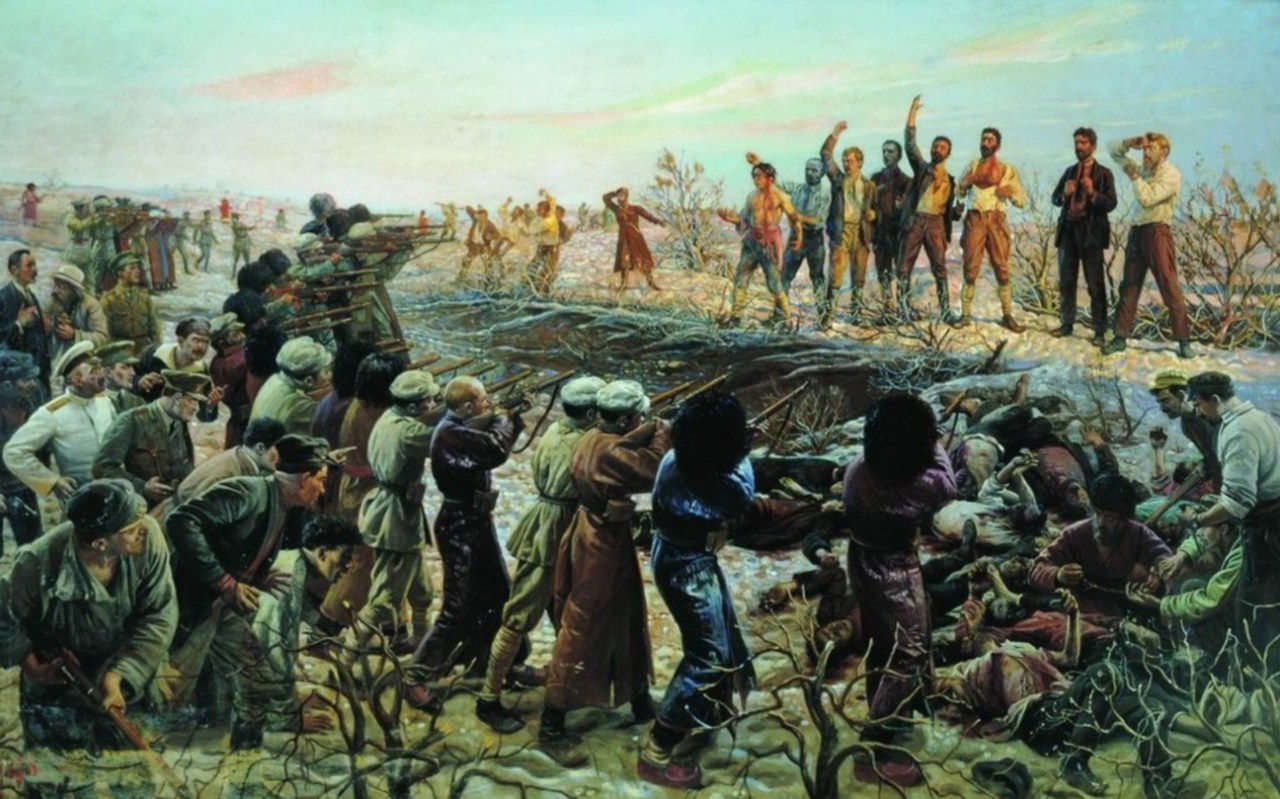
What I’m reacting to here is that British historians have sought to absolve Teague-Jones (and by extension the British Empire) in a very narrow sense. Meanwhile Soviet figures played into their hands by over-emphasizing his role (for example the Brodsky painting, or contemporary statements by Trotsky). Teague-Jones’ version of events is plausible enough, but the British role in the whole affair is still very bad even if we accept everything he says.
The documentary record is ambiguous regarding who ordered what. It’s always necessary to take in the broader context, but in a case like this it’s even more important.
It seems in the case of Cromwell there have been attempts to absolve him by making an ill informed appeal to ‘the broader context’. With Teague-Jones it’s the opposite – ignoring the context to absolve him! Though the respectove cromes are obviously of different orders of magnitude.
I think you can make a judgement on historic figures provided you first make your criteria clear. Modern rules of war, contemporary rules of war, his personal moral code, or from the perspective of the victims – these would all be valid approaches provided the writer says in advance “here are my criteria”
LikeLike