
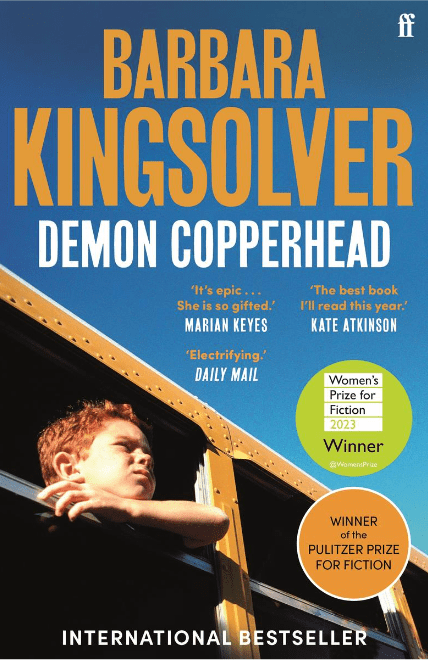
Audiobook performed by Charlie Thurston
After I finished Demon Copperhead I read a couple of reviews and had a strange moment. Just for an instant, I felt surprised that this reviewer in the Guardian also knew Demon. I had approached the novel as an Award-Winning Book That People Should Read; then I started it and I was in Demon’s world, and prestigious literary awards were the last thing on my mind. When I finished it – or maybe emerged from it – a part of me was surprised to remember that it was a book after all.
Demon’s voice
The feature of the book which best explains this is there right from the start: the narrative voice.
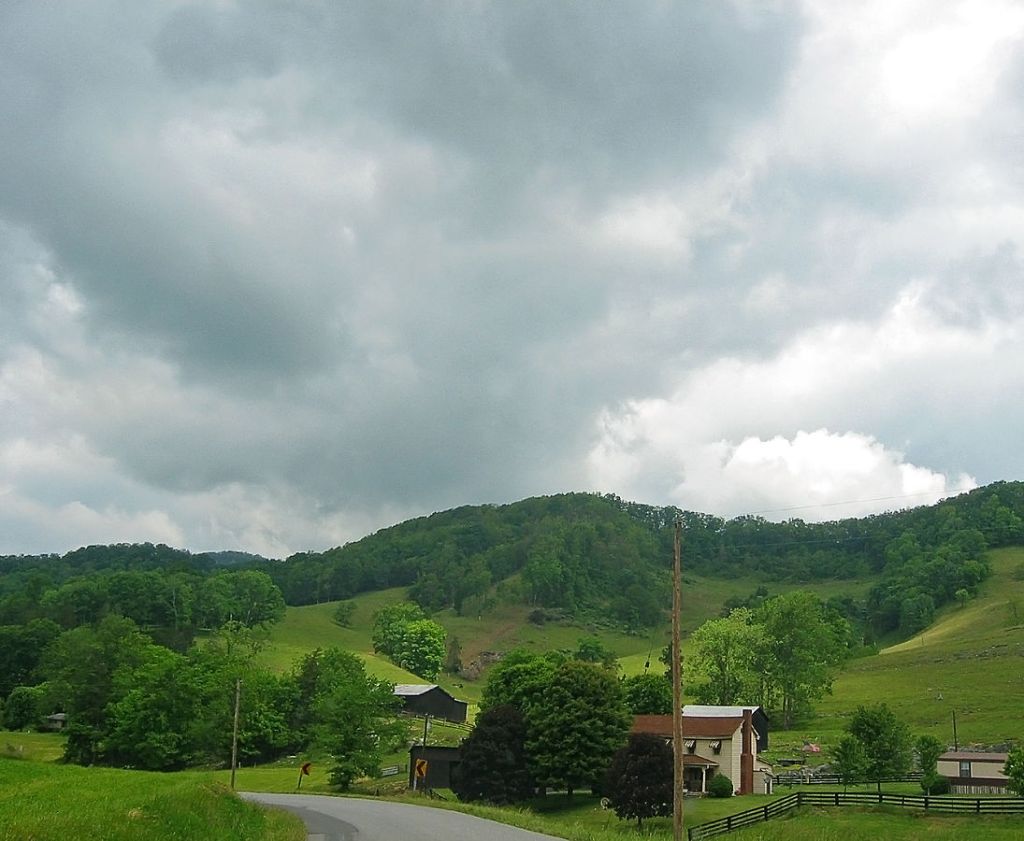
The narrator and main character is Damon Fields, who has a nickname, like everyone on his home turf of Lee County, Virginia. He is dubbed Demon Copperhead – the echoes of David Copperfield by Charles Dickens are there if you want them, but you can enjoy this book all on its own. The book follows Demon from birth through his first two decades in this world. His community is shambling through a half-life of mass unemployment; his young single mother struggles with addiction; the opioid epidemic hits like a war when he is around 10 to 15 years old.
The great strength of this book is the gloss of humour that comes with having Demon as a narrator. When I say that it’s easy to read despite the heavy themes, maybe readers will think that means the book takes a flippant or mocking approach. But it’s compassionate and humane all the way through. When I say that Demon interrogates head-on the issue of how the media portray ‘hillbillies’ and ‘rednecks,’ you might think the narrative is weighed down with lectures. It has didactic parts, but they don’t weigh down the story at all. They drive it on. Real people lecture, and lectures can be compelling.
I don’t have personal experience of the setting or of most of the heavy themes in this book. I assume Kingsolver must know the locale and its people – it rings true. But it’s about a kid growing up at the same time as I was. From the tone of the narrative voice to the pop culture references, and even the particular flavour of juvenile humour, Barbara Kingsolver got Demon right. He seems like some kid I might have known growing up.
The literal voice of Charlie Thurston was strong in the audiobook. Again, I just can’t comment on the accuracy of the accent, but the performance was more than good enough. If I ever hear that voice on another book, or on TV, my first reaction will be, ‘Hey, that’s Demon.’
Characters
Demon usually has at least a medium-sized list of things going on in his life, pulling him this way and that. He also has a satisfyingly large cast of characters coming and going. They are all well-developed so that I never had moments of ‘Who’s he again?’ You know you are dealing with good writing when you find yourself a little excited to see two characters together for the first time. ‘Huh,’ I said to myself, ‘so young Maggot and Swapout are doing break-ins together,’ or ‘Well, wouldn’t you know it, U-Haul and McCobb are in on the same pyramid scheme.’ On the other hand you feel genuinely relieved and pleased to see, for example, Tommy Waddles doing well in life.
In its world, ‘doing well’ is relative. When the adolescent Demon is sent to work at a dump beside a meth lab, it’s a great improvement in his fortunes because the owner of the adjacent garage lets him eat free hot dogs whenever he likes. Relief washes over you. Come to think of it, relief is the main feeling I associate with this book.
This book has great villains. It’s fair to say that U-Haul’s characterization lacks subtlety – he’s just a grotesque person. The McCobbs are a terrible foster family, in all kinds of fascinating ways, but they are not monsters. In a different and even worse foster home, Demon runs into an older boy known as Fast Forward. Fast Forward gets the younger boys to line up like soldiers for inspection each night. He shakes them down for money and snacks. He makes them take the fall for his mistakes. But he also gives them flattering nicknames, an identity, a sense of purpose and dignity in this hellhole. This is the source of his power, and that power makes him scary.
Then we have a moderate-sized pantheon of adults who just let Demon down. There’s those who, to paraphrase Demon, can’t see any more in young men like him than what can be wrung out of them by the end of the week on the battlefield, the farm field or the football field. Then there’s those who, out of misguided ‘tough love’ or in the heat of an argument, cut off support to young people just when they need them most of all. Then there’s the one who let Demon into his home, but also let in the monstrous U-Haul.
Then there are the social workers – the one who stays in the job but just doesn’t care, and the one who cares in her naïve way but quits the job as soon as she can. Demon understands why one doesn’t care, and the other quits – they get paid very poorly. Their work is a life-or-death question for him, but it is simply not valued by the state.
On the summit we have a cast of characters who are just solid gold, such as Angus/Agnes, a couple of teachers, June Peggott, and in his more limited sphere, Mr Dick.
Addiction
Kingsolver gets past the bullshit of judging addicts for their ‘personal choices’ to show why people fall into drug abuse. ‘This was done to you,’ June Peggott insists.
There is a moment early-ish in Demon Copperhead when Fast Forward throws a ‘pharm party’ for Demon and the other foster boys. They sit around on the floor eating hash brownies and taking pills. This should be an ominous moment – Demon’s first introduction to something that will later cause him a lot of suffering. But it isn’t. In this filthy and cheerless house, the boys are regarded as farm labour and nothing more. They are insulted and sometimes beaten, and not provided with clothes or proper meals. When it enters the story, the ‘pharm party’ does not present itself as something immediately dangerous. It’s a respite. The story tells us to face it: there’s nothing better on offer from their fosterer or from the Department of Social Services. Drug abuse is not the worst thing happening in this house. It doesn’t even rank in the top ten worst things.
But of course it is the beginning of something very bad. Later, when Demon is a teenager and is doing better, an injury puts him out of action and a doctor puts him on oxycontin. By now the opioid epidemic is raging. He descends into addiction – not all at once, and not putting everything else on hold. Life goes on around the addiction, but we see how it creeps in. His first experience with drugs was intimately bound up with his relationship with Fast Forward, and as he grows up relationships continue to be central to addiction. When Demon describes an incident of falling off the wagon as an act of love, and when he tells us that addiction is not for the lazy, we see what he means. We are dismayed to see him ruining his life, but his actions make sense in the situation he’s in. Sometimes his actions are even perversely admirable.

Dickensian
Several times, Demon descends into the depths of hell – in his lone quest to find his dad’s family; his forays to Atlanta and Richmond; and his fateful hike to the place known as Devil’s Bathtub.
But hell isn’t where Demon ends up. Plenty of other elements are in the mix: Demon’s artistic talents, plus a budding consciousness about the history of his area – the Whisky Wars, the Battle of Blair Mountain, the tension between urban and rural. As the story goes on, Demon learns how much the odds were stacked against him before he was even born. In a previous generation, his people organised in unions and took on the mining companies. Today they are cannon fodder for the drug companies. ‘This was done to you.’ These things come together organically in the final part of the novel.
Where does Charles Dickens come into it? No Dickens narrator ever talked like Demon, and I don’t think Dickens ever wrote much about sex or drugs. But like those narrators, Demon is incisive and funny, and he talks about the neglect and abuse of children, and tells stories of the lumpen adventures of orphans. He builds a world of scarcity and callousness so that the acts of generosity and friendship can stand out bright and clear. Also bright and clear is the impression that, in most essentials, nothing has changed in the intervening miles and years between David Copperfield and Demon Copperhead. The author’s decision to write the latter as a tribute to the former is not a gimmick; it carries real meaning. Capitalism means constant disorienting change but the underlying callousness stays the same, and we can recognise it in the 19th Century and in the 21st.
 The 1919 Review