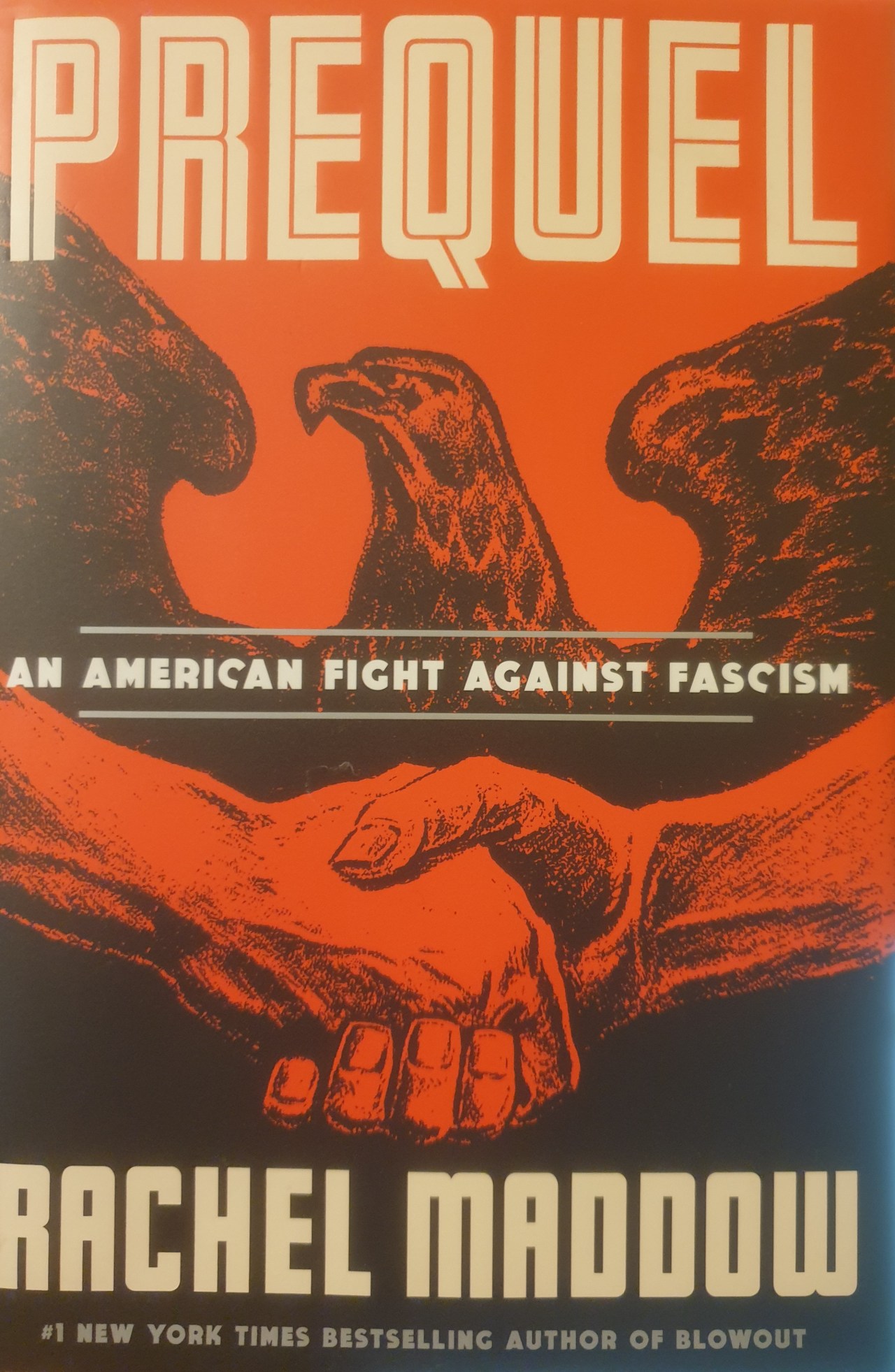
A review of Prequel: An American Fight Against Fascism by Rachel Maddow (Crown, 2023)
You may have heard of Father Coughlin, the pro-Nazi Catholic priest whose radio broadcasts went out to tens of millions of Americans in the 1930s. You may have read in Jacobin that Philip Johnson, one of the most successful architects of the 20th Century United States, spent the pre-World War Two years promoting fascism in the USA and trying to keep the country out of the war. You may have heard of the Silver Shirts, the US equivalent of Mussolini’s Blackshirts and Hitler’s Brownshirts. You may have known that the famous aviator Charles Lindbergh was pro-Hitler and led an organisation called America First.
I’d heard of the above, but most of my understanding of fascism in the pre-war US came from alternative history fiction: The Plot Against America by Philip Roth and K is for Killing by Daniel Easterman.
But Rachel Maddow’s 2023 book Prequel opened my eyes to much crazier stuff. I remember that at one point in Easterman’s novel we encounter a federal employee whose job it is to figure out legal loopholes so that mass internment and concentration camps don’t break US laws. Well, it turns out the Nazis actually sent legal experts over to the US to study how the Jim Crow laws worked, so that they could bring in similar racist laws back in Germany. It’s a reminder that the USA was already a bizarre race-obsessed oppressive dystopia.
I didn’t know that at least 24 elected members of the US Congress abused their free mail privileges to send out millions of copies of pro-Nazi speeches bearing their own signatures but written by Nazi agents. I hadn’t heard of General George Van Horn Moseley. I didn’t know that in California a coalition of fascist and far-right groups planned a mass lynching of famous Jewish people from Hollywood, to be followed by a spree of random gun and gas attacks on Jewish homes. This Helter Skelter-like plan was supposed to trigger a race war. I didn’t know that Coughlin followers in New York organised militias, armed with weapons stolen from the National Guard by sympathetic military officers.
Maddow also tells the stories of various private citizens who campaigned to expose and thwart the Nazis: the LA private investigator Leon Lewis, the assistant Attorney General O. John Rogge (After the war, he tried to reveal to the public the extent of Nazi penetration into the US; he was fired and his report quashed) and a cast of other brave individuals.
But they are merely individuals. An important episode in the fight against fascism in the US in the 1930s was the counter-protest at the America First rally in Madison Square Garden. But Maddow dismisses this protest in one passing sentence. The only mentions of the labour movement, as far as I can recall, are negative. She correctly emphasises that the US Communist Party was by no means the seditious threat it was portrayed as. But the role of communists, socialists and trade unions in opposing fascism is skated over entirely. Pelley and the Silver Shirts were based in Minneapolis – but Maddow does not look at the labour movement and the socialist left in that city, which confronted and organised against the Silver Shirts.
The focus is instead on the judicial system journalists, Hollywood, etc. To be fair, Maddow does not neglect to show how the state, from beat cops to the Attorney General, enabled the fascist agitation.
Maddow’s style is very engaging. She brings a laugh-out-loud quality to some of the farcical scenes from the Dies Committee. She does not write coyly or piously or with any false neutrality. That gives the narrative plenty of energy but it has overheads. I’m not from the United States and I found the self-righteous nationalism a bit weird (And I’m sure there are plenty of people from the US who would find it equally weird). For example, on page 195 we are supposed to be shocked at a politician refusing to show sufficient uncritical jingoism in the context of the First World War. The First.
I know of Maddow only by reputation as a liberal national security hawk who was very into the Trump-Russia stuff. This story, as the title implies, is supposed to be taken as a parallel to more recent events. And the strange constellation of far right thugs we see here do offer many parallels to the MAGA right today.
In spite of my criticisms I read through this book quickly and with great interest. Many parts of it were truly fascinating and horrifying. Not only does it recover a hidden history, it invites us to ponder alternative – and far worse – ways things could have turned out.
It’s New Year’s Eve so I want to thank all my readers. It’s been a fantastic year for the blog and I have big plans for 2024.
 The 1919 Review