(Don’t worry, no spoilers)
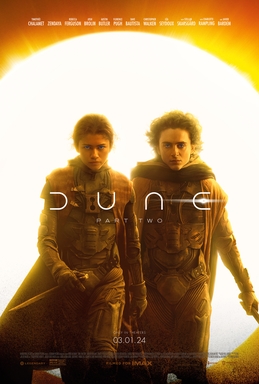
We live in an age of excess – excess of consumer products, of information, of outrageous and unbearable things happening in the world. Maybe that’s why Denis Villeneuve and co, in Dune: Part Two, endeavour to overload the brains of the audience with images grotesque and surreal but also solid and tangible, and on occasion, too, to contrast this excess with stark desert simplicity.
I’ve been blogging about adaptations of Dune. What is this movie like as an adaptation of the latter part of Frank Herbert’s Dune?
Most of the major landmarks in the story are there, such as Jessica, then later Paul, taking the water of life; Paul riding a sandworm; Feyd-Rautha in the arena; and the final climactic battle (the family atomics, ‘a great-grandmother of a storm’…) The film interprets these landmark moments with extraordinary technique and inspiration. When Paul mounts a worm for the first time it’s truly scary and intense. I’ve seen this moment on film twice before, but I never got anything close to a sense of how viscerally terrifying it would be to really do this. The Harkonnen planet Giedi Prime is not just ugly, but an unsettling, distressing place to spend 20-30 minutes. The filmmakers have taken the time to show us how the spice drug is taken from a drowned worm, how moisture is sucked out of the dead (and sometimes the still-living!), and what a palanquin mounted on a worm looks like.
The landmarks are there, and rendered with power and intensity. But the routes between them are changed. It’s that type of adaptation.
For example, the first action scene is completely new; mst of Paul and Chani’s dialogue is not from the book (though it fits right in); Paul learns to ride a sandworm a lot earlier; Paul receiving the name ‘Mu’ad Dib’ comes a lot later.
(By the way, a line uttered by Paul when he comes face to face with Baron Vladimir Harkonnen suggests that this adaptation is set in one of the alternate timelines foreseen by Paul in the novel.)
But it goes beyond that. Things are not changed only for the sake of economy or clarity. The biggest changes are in the service of tackling the defects of the book – the stress placed on bloodlines and eugenics; the white saviour enlisting the credulous natives; Chani, the most obliging of this very obliging bunch of natives, consenting to being Don Paul’s goomah while he marries someone else. In the novel the Fremen, for all their pride and ferocity, never call bullshit on the ridiculous aristocratic institutions to which Paul expects them to bow down, or on the Bene Gesserit’s shameless manipulation of faith in the service of their insane agenda.
In the movie, each major character (Stilgar, Jessica, Chani, Gurney) is aligned to an agenda, and exerts an influence on Paul; it’s a laser focus as regards character that pares things right down, renders conflicts more extreme and dramatic.
This film rejects space feudalism and eugenics; look at Chani’s reaction when Gurney Halleck speaks of Paul’s ‘bloodline,’ in the context of her earlier statement about how all Fremen are equal.
If you’ve seen the film, you know what I’m talking about, and if you haven’t I won’t spoil it. But in this movie the Fremen are not extras who wandered off the set of The Life of Brian ready to fall for the first messiah who climbs up on a soap box. In this movie Chani’s pride and self-respect do not allow her to be such a pushover as she is in the novel (‘History will call us wives’). Paul’s political choices have consequences for him and others. He really hurts Chani.
1984’s Dune ended on a note of triumph; 2000’s TV version is true to the novel in that it mostly leaves you with good feelings. This movie takes the book’s undercurrent of tragedy and drags it to centre stage. The jihad is not a foggy prediction; it’s kicking off right before our eyes. Paul’s victory has come at a terrible cost, personified in a specific character who, in this adaptation, serves as his conscience.
This ending meant that I left the cinema not with a sense of ‘all’s well that ends well’ but with a strange feeling, something rich and contradictory between triumph, relief and sadness.
High praise so far. What do I not like about the adaptation?
I felt that the script relied too heavily on named Harkonnen characters brutally assaulting and killing their underlings; it’s repetitive, ugly and unsubtle.
There was one thing I couldn’t get out of my mind. Every time I saw Jessica after the first hour or so my reaction was, ‘Jesus, is she still pregnant?’ Speaking of Jesus, it’s written that he was three years preaching before his crucifixion. Now imagine a movie where Jesus dethrones Tiberius Caesar just three months after he begins his ministry. Just ask anyone who has ever been involved in a pregnancy or, I assume, in a jihad: a guerrilla war takes longer than a trimester. In the book we cut away for two years, then return to find Paul at last ready to ride a sandworm. Even two years was cutting it fine. How do Paul and Jessica get millions of Fremen eating out of their hands in just six months? The movie works hard to get us away from the white saviour narrative stuff, but this telescoping of the timeline sends us back a large part of the way.
Linked to this, I missed a certain omniscient syringe-wielding toddler who didn’t make the cut.
[Edit, 8 mar 2024.] Here’s another problem. Would it kill Hollywood directors to give speaking roles to actors from the Middle East? What’s the terrible thing that would happen if you gave roles to people from the country you filmed in (or countries where they speak the same language, or practise the same religion)? I didn’t want to raise it at first, because with Dune it’s always going to be a fine line between accusing authors of erasure and accusing them of appropriation. But it occurs to me that just hiring some Arab or Muslim talent is neither erasure nor appropriation. Ridley Scott hired Ghassan Massoud to play Salah ad-Din (Saladin) in Kingdom of Heaven – and the sky did not fall on our heads. Dune borrows so heavily from the Muslim world. It should start paying back.
To see this movie on the big screen was to be put through a succession of intense and unexpected experiences. Sometimes you’ll see a movie that has some great moments, images or scenes, but just isn’t great overall. But in Dune: Part Two, it all adds up to something powerful and brilliant. And as an adaptation, it favours the things I like in Frank Herbert’s novel, and militates against the things I find embarrassing. In particular it leans hard into the tragedy and dread that make the ending of the novel Dune so different.
 The 1919 Review
One thought on “Dune: Part Two – a bold, brilliant adaptation”