
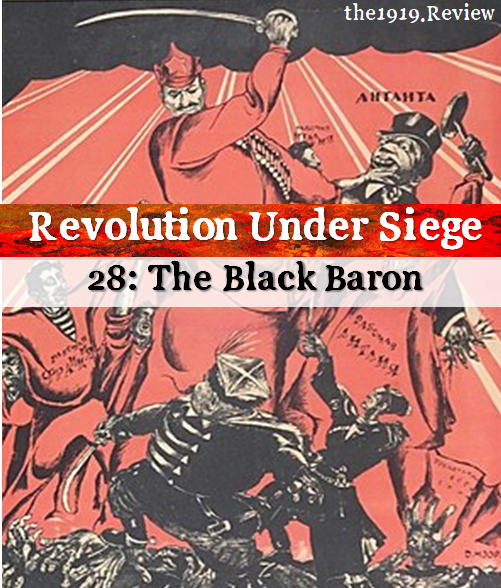
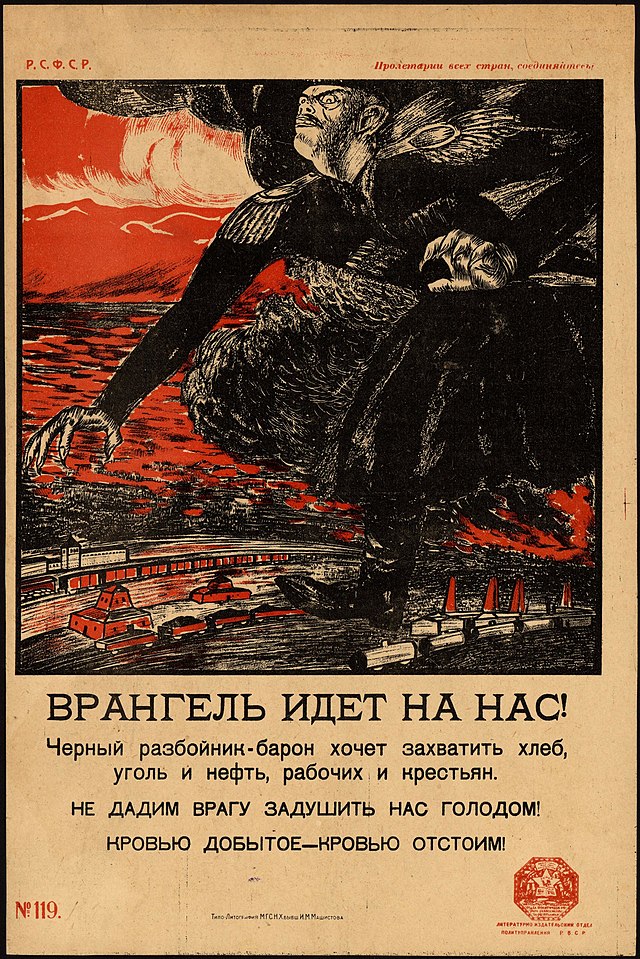
This is Episode 28 of Revolution Under Siege, my series on the Russian Civil War. In this post, we look at the invasion of Ukraine by the ‘Black Baron’ Wrangel.
By the time the Soviets signed a ceasefire with Poland, another serious war had been raging for months in the south of Ukraine: the struggle with the forces of Baron Wrangel.
White Crimea
Wrangel’s Crimea, to which the survivors of Denikin’s army had fled, was a strange place. The only parallel would be Taiwan soon after the Chinese Revolution. Imagine if the top politicians, billionaires and military officers got chased out of the mainland United States and washed up in the hotels and resorts of Hawaii or in Puerto Rico. People today talk about a ‘refugee crisis’ when a few hundred thousand people seek refuge on a continent home to hundreds of millions. Imagine being Crimean – one of fewer than a million – and seeing tens of thousands of Russian counter-revolutionaries and their dependents descending on your little peninsula. To people from that part of the world, Crimea was and is associated with holidays, beaches, cypress trees and nightingales, the mosques and masjids of the Tatar villages.
In 1920 this idyllic holiday destination was a refuge for Don Cossacks still mourning the horses they shot at Novorossisyk; women who had married conservative and strong-willed army officers, only to see them humbled by soldiers’ committees; children cast out of the homes they grew up in; business owners and aristocrats who have nightmares about the sailors and the Cheka; famous ministers under the Tsar; the agents of half-a-dozen foreign powers, selling information; speculators turned refugees turned speculators again; former bloodhounds of the Tsarist secret police who have found a new employer in Wrangel; people who cheered on February but saw October as a kind of apocalypse; people who saw February as an apocalypse; infants of the Civil War who have known crowded billets, refuges and train carriages during headlong typhus-haunted flights; elderly dependents; girlfriends. Between the price of bread and the low pay of a soldier (even of a junior officer) most of these people must have lived in a state of desperation.
The father, husband, or son, the ally, pawn or constituent who stands at the centre of all these figures, whom they all have in common, is the White officer. This character has changed little since we first introduced him back in Episode 2, in spite of ordeals, triumphs, humiliations, allies gained and lost along the way.
Many of the White officers remember the Russo-Japanese War, and most the Great War. Some go back to the very start of the White movement: the Kornilov Affair, imprisonment in Bykhov Monastery, Rostov and the Kuban Ice March; some rode across the seething Ukraine of 1919, drunk and high under wolf talismans.
Some of these individuals crack under the pressure of the war. General Slashchev was fired after the stern Wrangel found him passed out from drugs and alcohol, dressed in a gold-trimmed Turkish robe, surrounded by his collection of birds. [1] But let’s speak of them as a collective. The White officer will fight on to the end, because to accept the egalitarian order promised by communism would be, to his mind, to accept the downfall of civilisation and the obliteration of his personal dignity.

Circumstances dictate an offensive
Speaking with journalists, Wrangel outlined a cautious strategy. ‘I don’t make big plans. I think I need to gain time.’ Here in Crimea, he explained, one can live, free of hunger and terror; more will join us, and we will expand gradually at the expense of the Soviet territory [2]. But circumstances dictated a bolder strategy.
First, there was the Polish-Soviet War. The Whites had hardly settled in Crimea when Piłsudski marched into Kyiv. A better opportunity for a breakout would not come along. Immediately they began to make plans for an attack on the mainland.
Second, there was the crowded Crimea and the looming winter. Wrangel’s people would not have enough food to stay alive, let alone provide an instructive contrast to the hungry Soviet territory. The price of food in Crimea rose at least 16-fold between April and October 1920. [3] The Allies might be so kind as to keep them all alive for a while, but now less than ever before could the White officer take foreign aid for granted. Nutrition, never mind strategy, dictated that they must seize the harvests from other parts of Ukraine and Russia.
It was necessary to make a move.
The British government heard of plans for the coming offensive and tried to dissuade Wrangel. They had been through all this before with Denikin and Kolchak. But they could not dissuade Wrangel: in June the ‘Russian Army’ broke out in all directions.
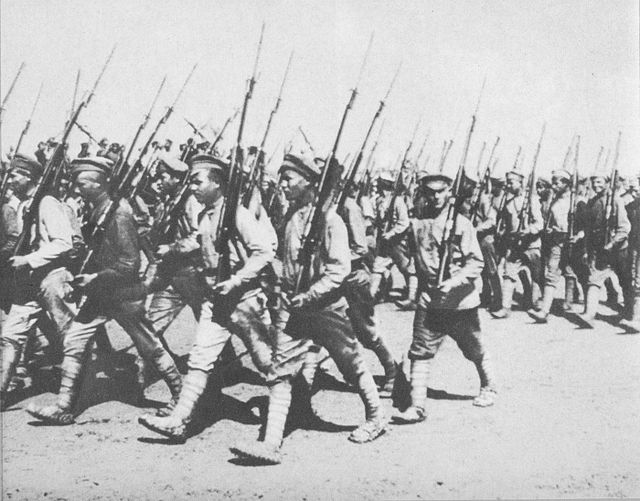
History is being helpful for once: the main frontline of that war is very similar to one of the main frontlines in today’s war in Ukraine, following the course of the Dnipro River. Like Putin’s in 2022, Wrangel’s forces burst out of Crimea in April 1920 and seized the neighbouring chunk of the mainland, an area known as the Northern Tauride. It was the ‘colourful’ units, named after dead White generals like Markov and Kornilov and composed of the most professional, determined and experienced soldiers, which broke out from Crimea to the river Dnipro in just one week. His forces numbered somewhere between 40,000 and 70,000, an imposing number concentrated in such a small area. They advanced westward as far as the Dnipro and east as far as Mariupol (site of a terrible battle in 2022). They also landed forces by sea in the Don and Kuban regions in Russia.
The Allies draw back
Now something unprecedented happened: the British really did cut them off. It turned out there was after all a limit to the number of rifles they were willing to pour into the Soviet Union (That limit was somewhere in the millions, but it did exist). British trade unionists had protested and gone on strike under the slogan ‘Hands off Russia,’ and this was a key part of the context in which the sceptical Prime Minister Lloyd George at last won out over the pro-war Churchill.
The French government, on the other hand, gave massive aid to Wrangel. This mostly arrived from Romania in August and September [4]. Other foreign aid included from Poland and from the Menshevik government in Georgia; Whites who had been interned in those countries were sent to further boost Wrangel’s numbers. But the French took the opportunity to wring heavy economic concessions out of Wrangel, and in the French agenda, Wrangel was only a distraction to help the Polish war effort.
But…
Here are two qualifiers: first, this White Army would not have come into existence, and would not have escaped destruction in the Kuban, without Allied aid. So Wrangel’s regime was a legacy of intervention. Second, if Wrangel were to defeat a few Red Armies, were to take over large parts of Ukraine, were to ignite the Kuban and the Don in revolt again, the British and the French would surely get over their scepticism and part with another few million rifles. It would be 1919 all over again: ‘To Moscow!’
But as it stood, the Whites were on their own – or as close to ‘on their own’ as they had ever been. The British had cut them off, and the French were obviously using them toward limited ends.
The Cossacks draw back
The Allied spigot had waned to a trickle. So had the Cossack spigot.
There was still a large Don Cossack contingent in Wrangel’s ‘Russian Army.’ And there was a White guerrilla army, independent of Wrangel, surviving in the remote parts of the Kuban. Wrangel made strenuous efforts to raise the Don and Kuban in revolt again, through landing his forces in those regions by ship. But the population failed to rise. In the Kuban, the beachhead was surrounded by an amphibious counter-strike by the Red Army.
The Cossacks had seen war, revolution and counter-revolution pass over them so many times they were sick of it. This, along with a ‘more conciliatory Bolshevik policy’ and a ‘more effective occupation force’ meant they would not be enlisted in another adventure this time. [5]
The peasants draw back
With his old friends abandoning him, the White officer had to find new ones. He tried to win over the peasants. Wrangel’s government, as it advanced in June, announced a new land law. The estates of the nobility would be given to the peasants, and the nobility compensated. A more direct hearts-and-minds campaign was waged by General Dragomirov. He would roll into a Crimean village and (instead of embarking on a pogrom as he had done in Kyiv) would set up some tables, roast a few lambs, share out barrels of booze, and raise a toast: ‘the day will soon come when we will hear the bells of Moscow.’ [6]
But the land law was more than a day late and more than a rouble short. The Soviets had already shared out the land – without compensation. So there was no popular upsurge for Wrangel on account of this land law.
Reds on the back foot
Their list of friends was not getting any longer. But the White officers held the Northern Tauride all through the summer and into autumn despite determined counter-attacks. One time a whole Red Cavalry unit was surrounded and ‘practically wiped out.’ Communists and commissars would have been executed on the spot; [7] others would have been propositioned for recruitment. Thousands of horses would have been captured – to the delight of every Don Cossack who found himself back in the saddle.
Things went badly for the Reds here for a long time. The war with Poland was the biggest and most intense campaign of the Civil War, and large parts of Ukraine were still unfriendly. The Anarchists wished to retake Dnipo, which had served for some weeks in 1919 as the centre of their utopian experiment. Beevor describes how they entered the town in the guise of farmers with carts piled high with hay. Once in the city, they revealed machine-guns under the hay and started blasting. They were driven out of the city, but they left ten captive Red soldiers behind, their guts torn out and grain stuffed into the cavities.
Bridgehead
Despite these setbacks and troubles, the Reds managed to make headway even before the end of the Polish-Soviet War.
Like today, the river Dnipro formed the most important front line. Here the Reds forced a few bridgeheads in the face of stiff White resistance; the high right bank commands the low left bank. Most of the bridgeheads were lost again, but at the town of Khakovka they held out. (Today Kakhovka is in Russian hands. Nova Kakhovka, ten kilometres down the river, was where that dam got blown up in June 2023.) Around Khakovka there was an intense, dug-in battle lasting months. Contrary to Beevor’s claim that Wrangel ‘never presented a serious threat to the Red Army’s rear,’ (p 479) this seems to have been one of the most intense battles Red and White ever fought.
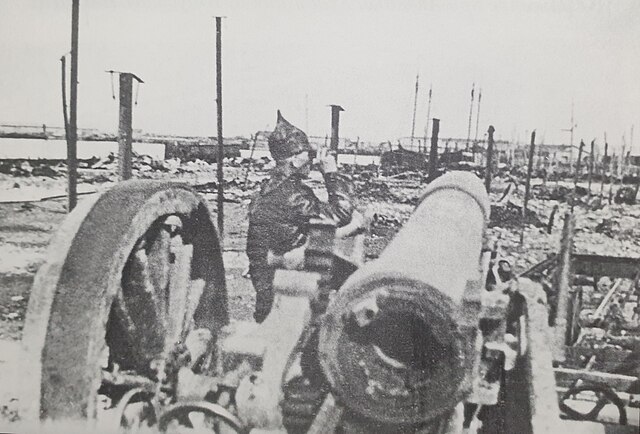
The White general Slashchev (soon to be dismissed after the Turkish robe incident) sent repeated cavalry charges against Red trenches and barbed wire. The Whites also sent in twelve British Mark V tanks. They had a dozen aircraft, 60 artillery pieces and 14 armoured cars. These would seem like pathetic numbers today but this represented a concentration of machine force not hitherto seen in the Civil War [8]. Each tank was named, like a ship, after some general of the White cause or of the old empire.
But soon the Whites could feel keenly the effects of the withdrawal of Allied support. At the height of the battle they were down to twenty artillery shells a day. [9] When Poland and the Soviet Union signed a peace treaty in October, the tide turned instantly against the Whites. Their isolation was now as complete as it had ever been. With the war in the west over, there began a vast concentration of forces against Wrangel.
Meanwhile on October 14th the Whites made a great assault on the Khakovka bridgehead. The Reds defended the small town with three lines of trenches and barbed wire. There wasn’t enough time to dig the tank traps, and White scouts spotted where the Reds put their mines, so it looked like the Reds would have no effective counter to the tanks. 6,000 Whites went into the attack against 10,000 dug-in Reds. The Whites were confident in spite of their smaller numbers; they had beaten far worse odds in 1918 and 1919.
But the great White attack ran into a level of Red resistance the Whites had never seen before. The tank ‘Generalissimo Suvorov’ was destroyed by a Red armoured car bearing the name ‘Antichrist.’ Another tank (‘Ataman Ermak’) ended up crashing into a regimental bathhouse, where it kept up fire until a Red cannon blasted six shells into it from a distance of ninety metres. A White horse battery ran into the shock troops of the veterans from Siberia, who showed them an unexpected and terrible weapon: two volleys from flamethrowers, which sent them fleeing in panic, dropping their weapons. [10]
The Red Worker
The White officer has changed little, but he has just discovered that his opponent, the Red worker, is almost unrecognisable. When the Red Guards first came down to the Don Country in pursuit of Kornilov at the start of 1918, they patrolled trains and verbally asked the passengers to give up any concealed weapoms – basically operating on the honour system. In that, there was as much nervousness as humanity. In summer 1918 some Red units would abandon the front line en masse to have a nap. The unit from one town would refuse to share its horses with that from the next.
See them now massing for the attack on the Northern Tauride. They are in long overcoats with red trimming and spiked bogatyrka hats which give them a distinctive appearance redolent of the steppe. They have rifles and are well-accustomed to using them. The lads at Khakovka have 200 rounds each. Amphibious landings, bridgeheads, cavalry assaults, digging and holding trenches, knocking out tanks and aircraft, fighting on when outflanked – none are beyond them.
But first, try to make out the familiar figure of the Red Guard of 1917-18 amid 133,000 armed and uniformed fighters, amid the tachanki, armoured cars and armoured trains, their old allies the Latvian Rifles, and the mass of conscripts from the farming population. Budennyi’s Red Cavalry are here. There is even a detachment of long-haired Anarchists with their black banners; in August, the Soviets and Makhno signed up to a temporary alliance against Wrangel.
This description of the aspect of the Red soldiers in the neighbouring Kuban region probably applies to the Reds in Ukraine:
In every battalion now there were as many Communists as used to be found in a whole regiment. The political section of the division grew into a huge institution with dozens of organizers, agitators, and instructors. We published our own newspaper, we had our own printing press. For illiterates or those who could barely read we organized schools in the regiments with a corps of teachers. [11]
Communists make up 8% of this massed force, probably a higher proportion than you would have seen at Kazan, Perm or Petrograd [12]. Many of the Red Guards of the 1917-18 vintage have been promoted or died in battle or from epidemics. Still there is a politicised core of working-class recruits which holds the army together: many would have joined from the great wave of communist, worker and trade unionist volunteers that signed up around the time of Kazan in the summer of 1918; or those called up to resist Kolchak; or the wave recruited to resist the Polish invasion.
This picture of the Red Army in 1920 is significant for our assessment of the whole war and the whole revolution. Smith and others argue that the Soviet power basically lost its support base in the first half of 1918. I don’t subscribe to this view. Laura Engelstein, who is far more critical of the Reds than I am, would also be sceptical. [13] Historians recognise an implicit popular endorsement of the Polish government in the massive upsurge of volunteers during the Red advance on Warsaw. It’s long past time to see the significance of these successive waves that entered the Red Army. Even this late, after the dissolution of a large part of the working class, the defeat of revolutions abroad, and the emergence of a Soviet state which, under pressure of war, showed increasingly its severe aspects, another wave of genuine enthusiasm was conjured in response to Wrangel. Where did they keep coming from?
And that army was increasingly professional and formidable. The White General Dostovalov would later write that the Reds had developed even since Novorossiysk earlier that year. There were now ‘excellent Russian divisions’ alongside the stereotypical image of Latvians and Chinese. ‘The Kakhovka bridgehead was fortified in an exemplary manner’ with well-built trenches, marked firing distances and consideration given to crossfire. ‘The Red Army grew before our eyes and surpassed us in its growth.’ [14]
Breakthrough
The challenge facing this army was an unusual one. Their aim was not to make Wrangel retreat, but to trap and destroy his army. If Wrangel managed to withdraw to Crimea, it would be extremely difficult to follow him. The peninsula was a natural fortress.
After the defence of Khakovka, the Reds attacked from several directions. From Khakovka the Red Cavalry raced southward to try and cut off retreat to Crimea.
The Red commander Frunze was impressed by the Whites: ‘I am amazed at the enormous energy of the enemy’s resistance.’ [15] Wrangel’s men had tried to hold on until they could grab the harvest and bring it back to Crimea. But a large part of the harvest had to be left in the fields. Wrangel saw the writing on the wall for the Northern Tauride, and given the natural fortress behind him he had an incentive to retreat. At the end of October his fighters fell back to Crimea. 20,000 of them had to surrender to the Reds with 100 artillery pieces and 7 armoured trains. Another 20,000 – the hardcore ‘colourful’ units and the Don Cossacks – made it back to Crimea.
The stage was set for the last struggle between Red and White in European Russia. The Reds had an overwhelming superiority in numbers, but the Whites had a great advantage in geography. The Revolution was no longer a besieged fortress. Now the remnants of the besieging forces were making a stand in a fortress of their own.
Revolution Under Siege Archive
References
[1] Beevor, 479
[2] Beevor,444
[3] Smith, Russia in Revolution, 177
[4] Jackson, 188-9
[5] Mawdsley, 367
[6] Mawdsley, 363; Beevor,444
[7] Smith, 200; Mawdsley, 371
[8] Smele, 169
[9] Beevor, 480
[10] Belash, Evganiy. ‘Defence of the Khakovka Bridgehead,’ https://warspot.ru/4163-oborona-kahovskogo-platsdarma, translated by Google. Written October 14th 2015. Accessed Feb 29 2024 10pm GMT
[11] Dune, 207-208
[12] Smele, 169
[13] Engelstein, Laura. Russia in Flames, Oxford University Press, 2017. P 592. Writing of examples of worker protest against the Soviet state she says: ‘The fact that workers resisted the regime acting in their name did not, however, mean that most or all of them wished to overthrow it, that the Bolsheviks had “lost their base.” It was a sign above all that laboring people needed to survive no matter who was in power.’ I have not yet read much of this book but I am interested in delving further into it. I think its author is very much against the Reds but she appears to be more conscientious and basically more serious than, say, Beevor.
[14] Belash
[15] Mawdsley, 377
 The 1919 Review