
‘Seldon crises are not solved by individuals but by historic forces. Hari Seldon, when he planned our course of future history, did not count on brilliant heroics but on the broad sweep of economics and sociology. So the solutions to the various crises must be achieved by the forces that become available to us at the time.’
– Hober Mallow, ‘The Merchant Princes,’ Foundation by Isaac Asimov
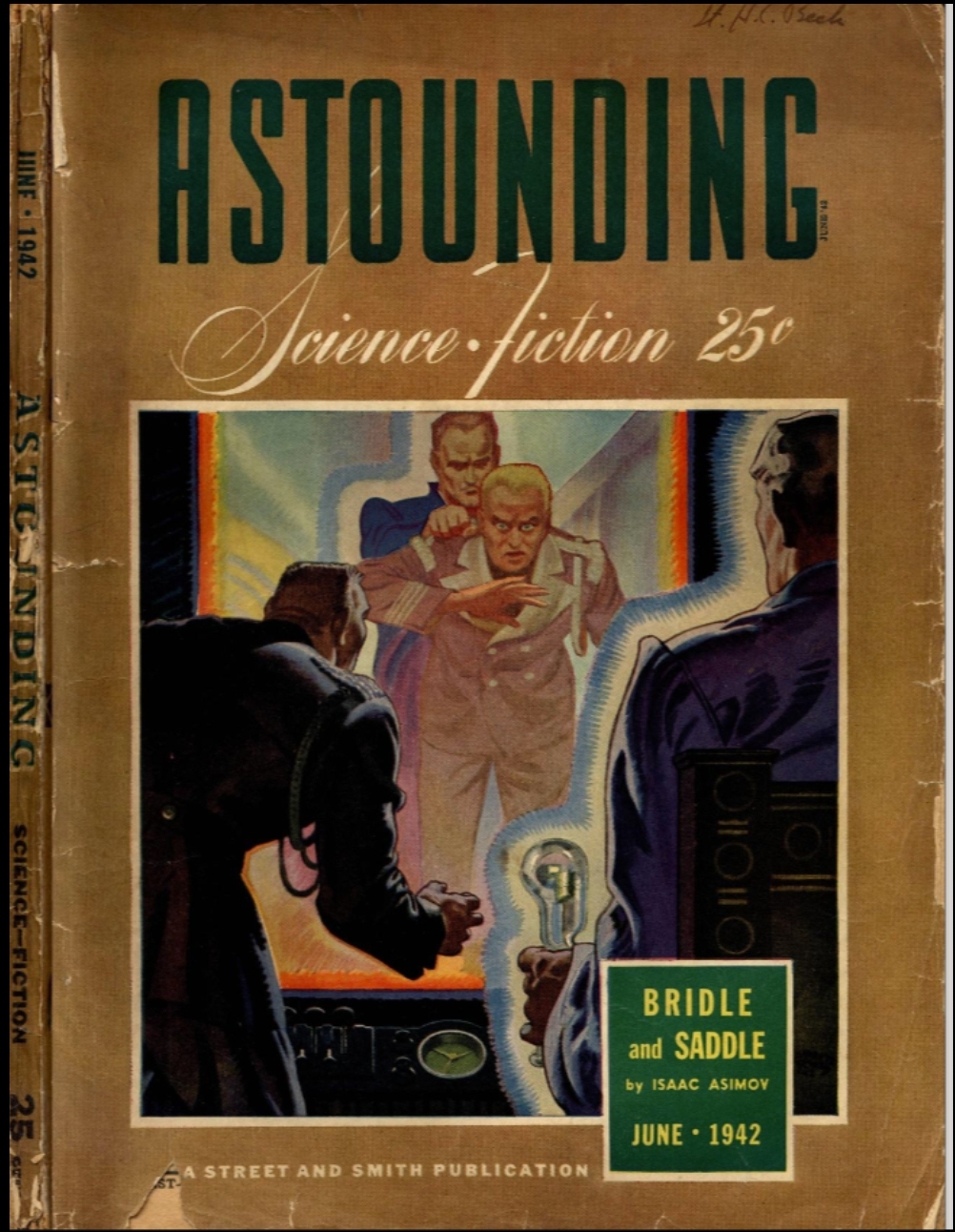
A lot of what’s fresh and brilliant in Isaac Asimov’s Foundation, written as long ago as World War Two, have since become so common in the genre that they almost escape notice when you encounter them in these pages.
We have travel by hyperspace (‘hyper-space, that unimaginable region that was neither space nor time, matter nor energy, something nor nothing’); weapons called blasters; roguish but ultimately moral traders; cities which cover entire planets; galactic empires with a civilised core and a wild outer rim. We even have a planet called ‘Korellia’ which reappears as the shipbuilding world of Corellia in Star Wars.
A galaxy without women
The first thing that strikes the reader is that the characters are all male. From a Galactic population numbering – what did he say, a quadrillion? A quintillion? – there are almost no women the author believes are interesting enough for us to meet.
Here follows a list of female characters in Foundation:
- A telephone operator (!)
- A servant who tries on a gizmo
- The Commdora of Corellia
And, if we really want to be generous:
- Hober Mallow’s hypothetical mistress (Maybe I’m pushing it now)
- Housewives are key to Mallow’s scheme to bring down the Korellian Republic (…That’s pushing it.)
The next thing that strikes you is that this book was apparently written as if Isaac Asimov had a very limited special effects budget. The first part contains compelling descriptions of space travel and the city-planet Trantor, but the rest is almost like a stage play: largely a series of conversations in rooms, mostly between seated men.
Discussing this with friends, I thought of radio dramas, a popular medium in the 1940s when Asimov was writing. He wasn’t writing with an eye to radio adaptation, as far as I know, but maybe he listened to a lot of them and they influenced his style. The 1970s BBC radio play of the Foundation series proves how well it translates to the medium.
A galaxy without ‘great men’
The lack of a balanced representation of humanity in the cast of characters is pretty awful. But I like the morality and the philosophy of history this story expresses – that it is not ‘great men’ but great impersonal forces that shape history. True greatness lies in predicting and adapting to the currents of history – not holding back the tide, but riding the wave. Real material relations are more important than ideas and words. Don’t be fooled by pomp and regalia; the empire is losing crucial technical skills. Don’t be intimidated by military thugs and their death machines; those machines must be operated by human beings, who can be influenced in clever ways.
The ‘greatest’ figures in Foundation history are not strutting macho types. Hardin and Mallow alike embrace a kind of humility and acceptance, as well as cunning and unscrupulousness.
Both Hardin and Mallow embark on too-clever-by-half plans that would, in reality, totally demoralise their own people long before they bear fruit. This is a common failing in fiction: the illusion that conflicts have to be solved by clever tricks in order to be narratively satisfying.
In fairness, the climaxes to ‘The Mayors’ and ‘The Merchant Princes’ are very satisfying. Defeat turns to victory in a matter of moments. These eukatastrophes are seamless and well-plotted.
Cynicism
They use religion to harness the Four Kingdoms to the chariot of the Foundation. But religion is superseded – by the time of Mallow, it is necessary to realise that trade is the new superweapon of Terminus. And trade itself will one day be superseded, become an obstacle:
‘So, then,’ said Jael. ‘You’re establishing a plutocracy. You’re making us a land of traders and merchant princes. Then what of the future?’
Mallow lifted his gloomy face, and exclaimed fiercely, ‘What business of mine is the future? No doubt Seldon has foreseen it and prepared against it. There will be other crises in the time to come when money power has become as dead a force as religion is now. Let my successors solve those new problems, as I have solved the one of today.’
The flip side of the novel’s cleverness is the smug attitude that comes through. You read this book and feel like you, Isaac Asimov and Salvor Hardin are the three smartest people in the universe, and all these trillions of people are stupid. It celebrates cynicism and manipulation. Hardin controls the press behind the scenes and takes power in a coup. This is to say nothing of the invented religion and how it brainwashes people. This is not moral, of course, but we are supposed to accept that it’s an example of ‘doing what’s right’ in spite of any silly ‘morality.’
A galaxy without violence?
We are told that ‘violence is the last refuge of the incompetent.’ The author’s distaste for violence is rare and refreshing. He’s just not interested in it. The novel is better because of this. But the novel’s philosophy does not renounce violence; it just puts violence in its place, as the enforcer and copper-fastener of things already established by culture, economics and politics. It is not the last refuge of the incompetent; it is a necessary, though subordinate, stage of conquest.
Consider the following exchange of dialogue:
Jorane Sutt: You’re a Smyrnian, born in Smyrno, one of the former Four Kingdoms. You’re a Foundation man by education only. By birth, you’re an Outlander and a foreigner. No doubt your grandfather was a baron at the time of the wars with Anacreon and Loris, and no doubt your family estates were taken away when Sef Sermak redistributed the land.
Hober Mallow: No, by Black Space, no! My grandfather was a blood-poor son-of-a-spacer who died heaving coal at starving wages before the Foundation.
This passage tells us a lot:
- That the Foundation made war on Anacreon and Loris (two of the Four Kingdoms) some time in between the events of ‘The Mayors’ and ‘The Merchant Princes.’
- That the Foundation has brought about a land revolution in the Four Kingdoms through the dispossession of the nobility. In other words, not just a war but a revolutionary war has taken place between two episodes. To cement in place and enforce the outcome of ‘The Mayors,’ war and revolution were still necessary.
- That the resolution of the second Seldon Crisis was not the end of Sermak’s political career (Sermak was the leader of the pro-war party in ‘The Mayors’). In fact, Sermak was heavily involved in the subjugation of the Four Kingdoms, to the extent that the land revolution is attributed to him. The pro-war Actionist Party have their day after all.
- People like Hober Mallow come from a background where before the Foundation they were denied any opportunities in life. The coming of the Foundation has been revolutionary, opening new opportunities for them.
All of this is between the lines. Foundation is short and well-paced, but in places there’s a depth and density to it. These lines remind us that even though the novel leaves violence to one side, the universe in which the novel is set is just as violent as ours. The worst ‘barbarism’ in the novel is that which the Empire carries out on Siwenna – atom-blasting the population in revenge for a rebellion which that population didn’t even support.
This brings us back to the points about how it’s written like a radio play. Of course, it was written for magazines and presumably each instalment had to be kept fairly short. Most of what happens in the novel happens through dialogue, but Asimov puts that dialogue to work. The dialogue is good as drama, but it really shines as worldbuilding. It’s nutritious stuff around which your imagination can sketch in the galaxy outside the four walls of the room where, inevitably, men are talking.
 The 1919 Review
The Foundation series was my introduction to SF, and it set a very high bar. Classic. Psychohistory is a brilliant concept. Agree with you about the author’s treatment of violence: we can sense it without being shown it.
LikeLiked by 1 person