
Re-reading HP Lovecaft’s work over the last year, I was struck by how he uses a complicated apparatus of nested narratives in his landmark short story “The Call of Cthulhu.”
Here they are:
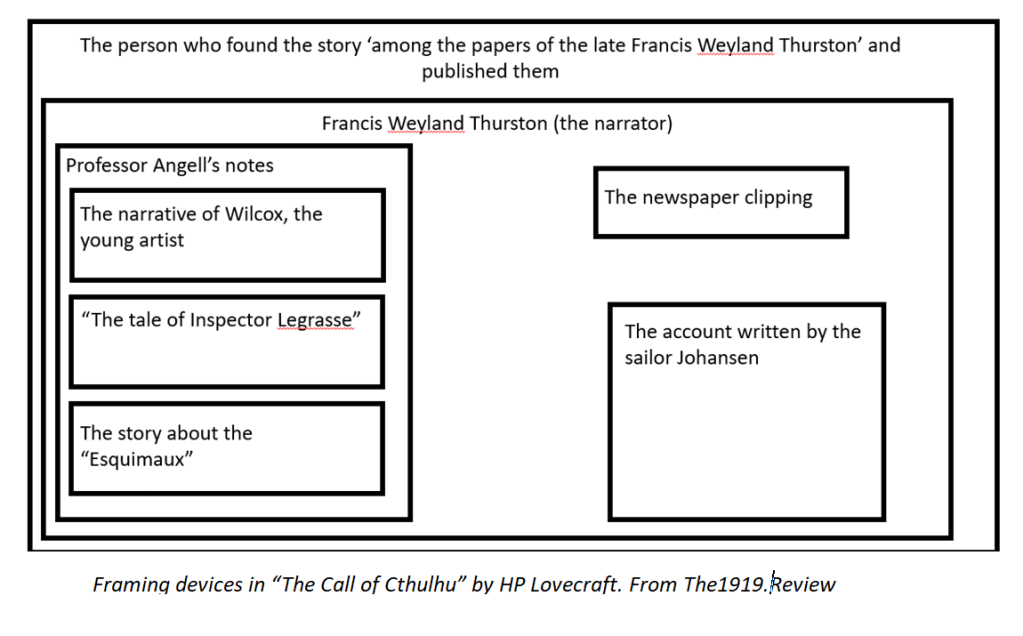
This elaborate framing has several effects:
- It adds to the verisimilitude of the story; the various pieces of the puzzle pseudo-corroborate each other. As with all the best Lovecraft stories, the movement from the sober and uptight New England puritan to the flailing and slobbering tentacle monster is stately enough that we accept the transition.
- It makes for a good mystery story, with the central horror only gradually revealed and the reader’s imagination given plenty of room to play in the meantime.
- It reinforces the theme, stated in the opening paragraph, about how the ‘piecing together of dissociated knowledge’ will reveal terrifying truths about reality and ‘our frightful position therein.’ Each of the stories is a rip in the fabric of reality as we know it through which we glimpse a sliver of what lies beyond.
Lovecraft’s cosmic horror was rooted in North American racism but it resonates with people who don’t share these ideas because it transcends this base and reaches toward a more universal and – to me, at least – cathartic doomerism.
 The 1919 Review