

When you get familiar with 1970s John le Carré, you start to realise (and you don’t mind) that many of his novels fall into a comfortable pattern. It goes like this: Smiley (usually it’s Smiley) goes to a place and talks to a person, and the person is compelled to reveal some of the mystery; Smiley goes to another place and talks to another person, and some more of the mystery is revealed, from another angle so that these revelations only barely overlap with those of the last interview; Smiley goes to another place… and so on. Generally the person reveals to Smiley more than they wished, without Smiley resorting to torture or even threats. You begin to realise that the spy story is only a narrative vehicle to bring us to these places and to meet these people. The real story is the unique personality of Connie Sachs and the eccentric shabbiness of her home, or the paranoia of a mercenary pilot hiding in the Southeast Asian jungle, or the domestic life and peculiar speech patterns of an Estonian émigré activist, or the physical and mental scars which a teacher living in his caravan is barely able to hide.
Ostensibly Tinker, Tailor, Soldier, Spy, The Honourable Schoolboy and Smiley’s People are a trilogy about an epic duel between two spymasters: the ‘flabby liberal’ Smiley, redeeming a western world that surely doesn’t deserve him, and the ‘fanatic’ Karla, Smiley’s perfect foil, the dark lord of Moscow Centre. Actually le Carré does not milk this set-up. Like the xenomorph in Alien, Karla looms large but we barely see him and we do not hear him speak. If le Carré had tried to deliver on this set-up, the battle of the great arch-spooks, he would have faltered. Moral certainty is not what fuels his stories. This loose trilogy ends up being something quite different from what we might expect.
Tinker, Tailor, Soldier, Spy (1974)
In Tinker, Tailor, Soldier, Spy, Smiley and his allies are outside the Circus, waging a secret war against its leadership. The story opens with Smiley in the wilderness and his ally Control fallen from power and deceased. The old guard have been ousted by a clique of four senior spies. Smiley is summoned back from retirement and told that one of the four is a Soviet undercover agent, and he is tasked with discovering which one.
Compared to those tight thrillers of the 1960s, this one is deeper and wider. The places to which we follow Smiley and the people he meets tell a story of their own, not a spy story, but one of cowardly and foolish apparatchiks pursuing their own prestige at the expense of the organisation. The traitor in the leadership is only a part of a broader context where those around him are willing to buy what he’s selling and not look too closely. This corrupt operation is called Witchcraft, and that’s fitting because like the witches in Shakespeare’s Macbeth, the enemy agent works to ‘win us with honest trifles and betray us in deepest consequence.’ Our apparatchiks hope that the honest trifles will impress the Americans. Meanwhile their real operations are being foiled, their real networks broken up, their real agents and officers eliminated.

So why should I personally care if there’s a Soviet mole in British intelligence? That sounds like their problem. Smiley bypasses my cynicism. I care about this bad institution because he cares about it. He is faithful to an unfaithful wife and to a ruling class whose bankruptcy is known to few better than him. He is broad-minded, melancholy and conscientious. His lack of cynicism must not be mistaken for innocence. No criticism I could make of the institution and the cause that he serves (MI6 and liberal-democratic capitalism) would really shake him, or cause him to hate me.
When I read this: c 2013
Locations: England, Hong Kong, Czechoslovakia
Why read it? George Smiley takes down a traitor in the very highest ranks of the Circus, in the process waging a secret struggle against its leadership.
Memorable moments: There are parts with action and danger, but the most memorable are the most understated: the encounters between a young schoolboy and the wounded Jim Prideaux, a victim of the traitor.
The Honourable Schoolboy (1977)

The Honourable Schoolboy is a radical departure for a le Carré book. Most of his novels are heavy on office politics and upper-class angst and light on exciting adventures in the field. If an agent leaves Britain at all, he will go to nowhere that wasn’t once ruled by a Habsburg or a Hohenzollern. Smiley is either retired or in a humble position.
But in The Honourable Schoolboy, Smiley is now unchallenged in the top job in the Circus, with his allies in the top positions around him. He sends an agent abroad – for once, not to Mitteleuropa but to Southeast Asia. What follows, over a long page-count, is a panorama of violent conflict and imperial collapse in Vietnam, Cambodia, Laos and Thailand, plus intelligence skullduggery in and around Hong Kong.
Don’t worry: as well as dull fare such as car bombs and peasant revolutions, we have plenty of exciting office politics. The Honourable Schoolboy has the distinction of being the only novel where Smiley occupies the top job in the Circus, and we get to see how him and his allies run things.
It’s a gripping and exciting read that I flew through in spite of its length. Unfortunately I remember it far less well than others I read around that time.
When I read this: c 2014
Locations: England, Hong Kong, Vietnam, Cambodia, Laos, China
Why read it? A more action-oriented and exotic take on le Carré’s formula. The only novel where Smiley controls the Circus.
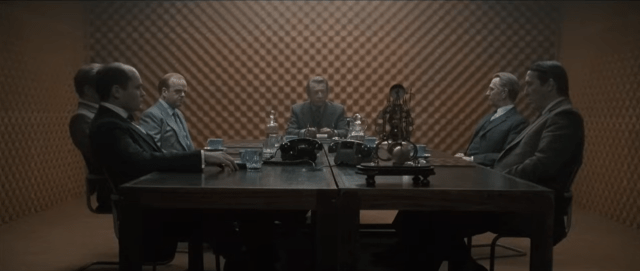
Memorable moments: Connie Sachs at the top table formerly occupied by Alleline, Haydon and co. being her eccentric self, complete with a dog which, because she is a communist train-spotter, she has named Trot.
Smiley’s People (1979)
This novel opens with Smiley once more on the outside, once more abandoned by his wife, and this time drunk and more depressed than usual. He is called back in to investigate the murder of an Estonian émigré general, and he discovers that the murder is linked to an intrigue which might be exploited to bring about the downfall and defection of his arch-enemy Karla.
The is classic le Carré and classic Smiley: we follow his waddling progress through interview after interview, distinct character after distinct character, the parts building up to our understanding of the whole. The promise of a final reckoning with Karla keeps us turning the pages, and the texture and humanity of le Carré’s world rewards us for doing so. If you’re here for the rankings, take note: this is my favourite of these three novels.
The basic moral conflict doesn’t quite stand up to scrutiny, though. Smiley has to defeat Karla by using his own methods against him – how tragic. Only he doesn’t, does he? We don’t see Smiley pulling out anyone’s fingernails. Karla’s agents do terrible things in this novel but the worst thing Smiley does is a little blackmail. Using Karla’s love for his daughter against him doesn’t seem that bad, actually, because the daughter is not harmed in any way.
This ties into what I had to say about the 1960s le Carré books: the moral equivalence between East and West, sometimes hinted at, is never confirmed and often denied.
When I read this: c 2022
Locations: England, Germany, Switzerland
Why read it? The final reckoning between Smiley and Karla. Smiley himself goes overseas on a dangerous mission to trap the Soviet spymaster.
Memorable moments: The climax of the operation revolves around a scene in which Smiley and co corner a Soviet diplomat, Grigoriev, and convince him to hand over the information crucial to trapping Karla.
In the previous post I talked about James Bond. Comparisons between Smiley and Bond decline in relevance past a certain point because Ian Fleming abandoned the Cold War pretty early in the series, and the movies abandoned it even earlier. Before the 1960s are out, Bond is doing collabs with his Soviet counterparts to take down the international crime agency Spectre.
Le Carré and his Circus stuck grimly with the Cold War right to the end. But they moved with the times. Le Carré’s novels from the 1980s are, I’ve come to think, his best. The Gorbachev period brings out more moral uncertainty and soul-searching than ever before. Next post I’ll talk about three of these brilliant Glasnost-era books.
Then again, season 2 of Andor is coming. If I have things to say about that, I’ll have to clear the decks here and return to le Carré in a few weeks.
 The 1919 Review