

The most obvious fact about the stories of John le Carré is the one that goes unaddressed explicitly until The Secret Pilgrim (1990): these are stories primarily about what the British call ‘the officer class’. We do not entirely neglect the ones who are actually doing the spying (lamplighters, scalphunters, etc) and we are quite interested in the agents and assets (the Joes). But the figure around whom the typical story revolves is the British (often half-British) upper-class male intelligence officer. His job is to groom and cultivate spies, which involves exploiting the vulnerabilities of people, getting them to risk being tortured and shot, and generally treating human beings as a means to an end.
Another feature of le Carré’s work, very apparent in the 1980s, is that many of his characters are stark mad. In order to be attracted to this work, it helps if the intelligence officer is one of the psychological walking wounded, and by doing it he gets even worse. The le Carré character is not usually motivated by his political convictions but by his neuroses.
This is not as cynical as it might seem (John Le Carré is never as cynical as he might seem) because the neuroses themselves are not always entirely ignoble.

The novels I’m about to talk about involve a new level of introspection compared to what went before. But ‘optimism’ is the other word that springs to mind. Even though it’s a weary and qualified optimism, and it turned out to be wrong, it’s still genuine and it really animates these books.
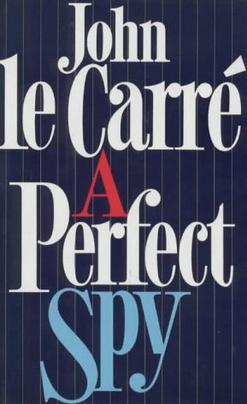
A Perfect Spy (1986)
The 1980s marked a personal milestone for le Carré: he wrote A Perfect Spy, a great semi-autobiographical novel that we can file under ‘things men do sooner than go to therapy.’ I’m not just being glib there, he pretty much admitted it in this interview. A Perfect Spy is not even a little bit optimistic, but I think that once le Carré got it out of his system he felt a lot better about everything.
A British diplomat and intelligence officer named Magnus Pym disappears. Is he in mourning for his late father, or going through a personal crisis, or defecting across the Iron Curtain? While his wife and his boss and the whole Anglo-American spook apparatus are running around trying to find him, we flash back to before his birth, to a Baptist church in rural England in the 1930s, where a teenage boy named Rick Pym is brazenly conning his entire community out of their money.
The novel really comes to life from this point on. Rick (father of the present-day missing diplomat Magnus) is a shameless cliché-spewing con artist whose act encompasses his entire being and sucks in all those around him. He is a kind of king to a nomad tribe of fellow crooks and their ‘lovelies’ who travel all around Britain blackmailing, cheating and partying. He goes to people’s deathbeds to talk them out of their life savings and leave their families with nothing; he sends his son abroad on a mission to find some chimerical treasure; he’s a black marketeer during World War Two; he runs for parliament; he aspires to stay one step ahead of his ‘temporary problems of liquidity’ and take his place among ‘the highest in the land.’
Superficially Magnus is not like Rick. On a deeper level, it’s a different story. To those who know the grown-up Magnus, he seems to be a charismatic, capable person. Like his father, lying is as easy as breathing to him. But the lie is true for him, in the moment. The flashbacks take us from Magnus’ second trimester to the present day, and from the moment he is old enough to talk we see him giving himself fully to whoever happens to be standing in front of him, whether it’s a Catholic priest, a student communist leader, an MI5 officer, a Czechoslovak spy, or a long succession of unfortunate women. Figuring out just where he is in the middle of all his bizarre words and actions is what’s so engrossing about the novel.
How easy it is for the morally disoriented child of the criminal underworld to find a niche in the world of espionage. How comfortable he finds it there, how much like home. Until all his mutually irreconcilable commitments begin to catch up with him.
I’m a bad liar and anyway it rarely occurs to me to lie. I have great alternative weapons in my arsenal such as fudging, saying nothing, and hiding behind irony. So outright liars are intriguing to me. Their customs and ways and motivations are to me as remote as those of ancient peoples or uncontacted indigenous tribes. Though he’s strange, Magnus is also sympathetic. Our sympathy comes from understanding the gap between his public persona and what a deeply vulnerable person he is inside.
I think I was supposed to disapprove mightily of his great transgression of British patriotism but it seemed to me no worse than anything else anyone else does in any le Carré novel. I thought he was a much better human being than his father. I felt let down by the ending, but I can’t see where else it could have gone. This is a powerful story, better than anything else of le Carré’s that I’ve read.
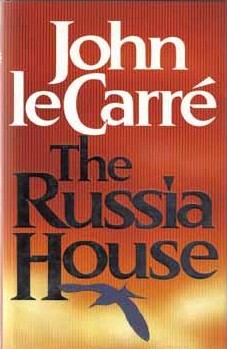
The Russia House (1989)
Barley Blair is a good man with a straightforward, wholesome psychology. How did he find his way into a le Carré novel? Ah – maybe he’s another innocent who’s about to be chewed up and spat out by the spook world. Then again, maybe not; could go either way. Which is what kept me reading to the end.
Blair runs a small publishing company that he inherited from his father. The father was a pre-1956 communist, but of this Blair only inherited an affection for all things Russian. Well, most things Russian; not the secret police or the nuclear missiles. The new period of glasnost and perestroika – reform and openness – under Gorbachev has allowed Blair to visit book fairs in Moscow and make friends in Soviet literary circles. When he gets drunk after a visit to Boris Pasternak’s dacha, an intense (and also drunk) Russian man approaches him with an enigmatic request.
The meaning of this encounter only becomes clear much later. Katya, a young single mother who works in Soviet publishing, gives Blair a strange manuscript which he takes home. It turns out to be full of secrets about Soviet superweapons. Not the kind of secrets you might usually find in a spy thriller, such as how terrifying the Soviet nuclear arsenal is, but secrets about how useless their targeting systems are, how badly the tests are going. Strangely enough, when Blair brings the information to the western spy agencies, they seem a lot more threatened to find out their enemy has feet of clay.
The dissident rocket scientist sees himself as a doomed revolutionary. He meets Blair on the grounds of the Smolny Institute in St Petersburg, a suggestion, backed up by dialogue cues, that in their mission he hopes to channel the spirit of the October Revolution.
The Russia House has a lot of the staples of le Carré – dismal office politics that are somehow compelling, hypocrisy, tension, danger and darkness. But it stands out. The main character is a white male Briton, but he’s not an intelligence officer. He’s a poor ‘Joe.’ Most importantly, it is not about exploring this man’s neurosis. Blair is not a saint, but his motivations are straightforward and good: he wants his country to have a friendly partnership with the Soviet Union, to which end he wants to expose how fake the threat of nuclear war is; and meanwhile he is falling in love with Katya. This is a book about following a decent character who’s taken on himself a dangerous mission, and watching how he holds up under terrible pressure.
Soviet Russia has been this shadowy threat for decades in le Carré’s writing. Finally he takes us there in this book. What’s it like? There is a memorable scene set in a dysfunctional hospital; we see through Katya’s eyes a culture of informal and unedifying trade in goods and favours; fear of surveillance and arrest hangs over our characters. Blair secretly thinks Pasternak was over-praised and he is beginning to doubt that the great dissident writers he has been seeking actually exist. A complex and human Soviet Union emerges from this book.
The Secret Pilgrim (1990)
When I read the blurb of The Secret Pilgrim I thought it sounded self-indulgent and inessential, so I didn’t bother to read it for years. That was a mistake, because once I started it I was gripped, and flew through it.
The novel begins in the then-present day, with the end of the Cold War. Our old friend George Smiley has retired for real this time (I promise) and has been absent from le Carré novels for over a decade. (In A Perfect Spy and The Russia House there is not so much as a reference to him or, as far as I can make out, to anyone mentioned in his previous stories). But he returns to give a talk to a class graduating from some kind of spy school. The narrator is their teacher Ned, an aging former intelligence officer (and a secondary character from The Russia House – so there it is) whose career spanned the Cold War. Smiley’s talk turns into a very late night of slightly boozy reminiscences and reflections.
Smiley will say something like, ‘But of course, one mustn’t think we spies are in the business of protecting the country. The basic immorality of what we do is an acid gnawing at our souls and at the heart of democracy.’ At which point Ned will describe Smiley looking apologetically into his glass of brandy before adding, ‘But of course, as long as human nature is what it is, we must always have spies. To deal with situations like…’ He will glance at Ned – ‘…that business in Cluj-Napoca in 1976.’
At this point, narrator Ned will cut in. ‘But I hardly heard what he said. I was already back in Cluj, and I was staring into Elena’s eyes. To this day I don’t know whether she betrayed us, or we her. I suppose it hardly matters…’
There will follow a self-contained novella, fifty or a hundred pages long, describing some tragicomic bungle or ambiguous triumph. There are nine or ten of these episodes all told, spanning a period from the 1960s to the 90s, each one a cracking read in its own right, but each one adding a little to the portrait of Ned himself, and each one addressing itself to the question of Ned’s own journey in life, his search for a sense of purpose. The cause which seemed purposeful and defined at the dawn of the Cold War has by the 1980s dropped him into a reeling, disorientating world where he is surrounded by mental illness.

The framing narrative with Smiley is very strong too. I’ve poked fun, but Smiley’s reflections make for very good reading. And for the Smileyologists out there, Ned’s little episodes feature many characters from Tinker, Tailor, Soldier, Spy – Esterhase, Haydon, etc.
Some episodes are more serious, some less so. There is a heartwarming story about a strange favour Smiley did for someone back in the day, and an absolutely harrowing account of an ex-priest and child abuser who spied for Nixon’s bombing campaigns against Cambodian villages, then got tortured by the Khmer Rouge. My favourites are some of the lower-stakes stories. There is one about a con artist from the Eastern Bloc who convinces the west that he is a patriot and martyr.
I must mention that there is a run-in with a character named Britta, who is eerily similar to her namesake in the sitcom Community (2009-2015). Is this where they got the name? Dan Harmon doesn’t seem like a John le Carré guy. I never felt this way about Britta in Community, but this Britta really is the worst. OK, second-worst after the Cambodia guy.
The second-last episode shows Ned interviewing Frewin, an eccentric civil servant who has been anonymously denounced as a spy. Despite Frewin’s extravagant delusions, he is astute enough to see that he and the spiritually lost Ned have a lot in common, such as a growing disgust with capitalism, the very system Ned set out to defend all those years ago. The final episode hammers the point home. Ned meets a posh and utterly amoral arms dealer. Ned has to ask himself whether this evil man represents everything he has spent his life protecting. Smiley in his after-dinner remarks takes up this theme as well – for example he suggests that the new recruits should spy on the Ozone Layer.
The Night Manager (1993)
Honourable mention here for The Night Manager, which I did not finish. This one is about a hotel worker who sets out on a mission to take down an evil arms dealer. I found the opening compelling and wanted to see how it would all turn out, but the main character set about making a ‘legend’ for himself (ie, living out a fake life to create a verifiable cover story), and he took too long at it.
Conclusion
Communism is defeated, le Carré suggests, so now it’s time to turn our fire on the excesses of capitalism: on environmental destruction, labour exploitation, imperialism and war profiteering. He didn’t want to destroy capitalism (more’s the pity), just tame its excesses. His hope that people in Europe and North America would take on capitalism en masse anticipated the anti-globalisation movements and the Occupy protests. But like his hopes for Russia, his vision of a kinder and fairer capitalism has definitely not been realised.
Le Carré took his own advice, even if too few others did. In his last few books he took on capitalism and empire with increasing sharpness. That’s what I’m going to write about in the next post.
 The 1919 Review
Thanks for this series, I’m really enjoying it, and it makes me realise how much I need to read le Carré. The point about Western spy agencies not wanting to hear about Soviet weakness was a real thing during the Cold War too. I also never realised The Night Manager was John le Carré. The mini-series has Hugh Laurie as a very sinister baddy. Highly recommend.
LikeLike
‘dismal office politics that are somehow compelling, hypocrisy, tension, danger and darkness’ You put so succinctly what I find so compelling about Le Carre at his best. ‘Little Drummer Girl’ failed the ‘make me care test’ but usually he creates relatable if damaged characters
LikeLike