
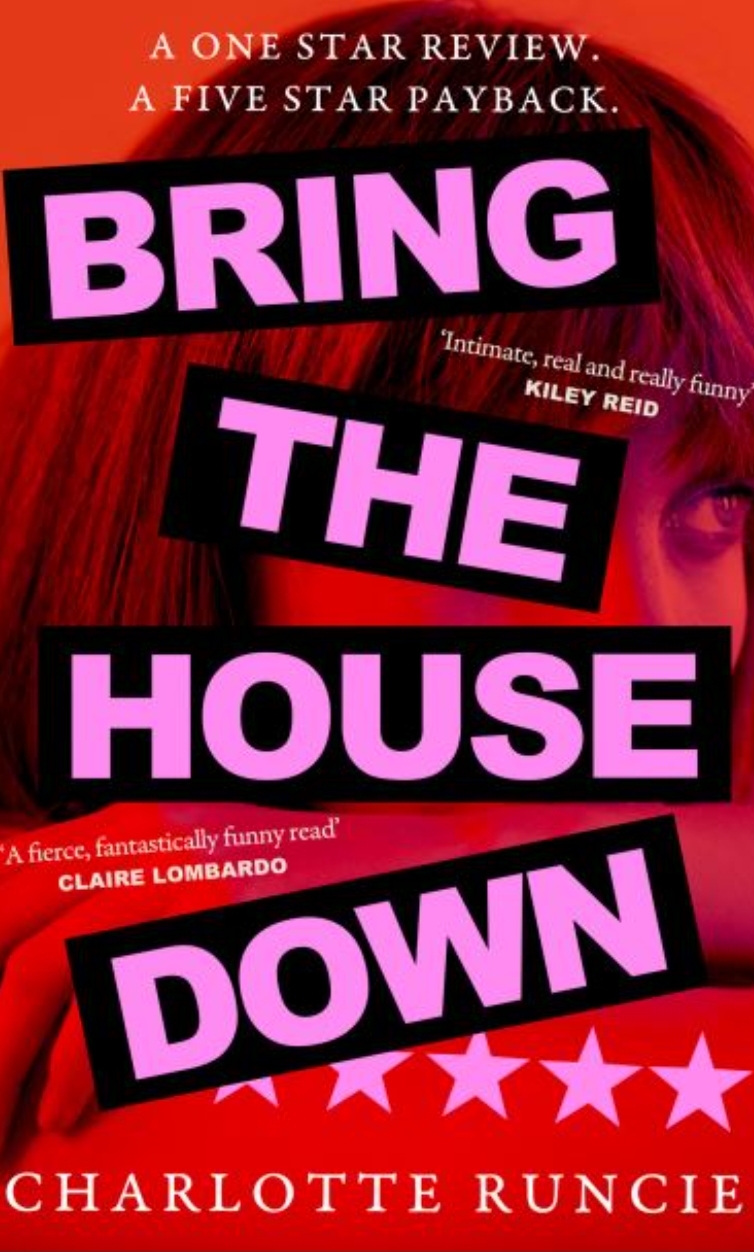
Bring the House Down by Charlotte Runcie
The Borough Press, 2025
Bring the House Down has a killer set-up, a ‘WTF’ moment that grabs the reader. At the Edinburgh Fringe Festival an earnest young woman, Hayley Sinclair, performs a solo spoken-word show about the climate crisis. Theatre critic Alex Lyons writes a gratuitously cruel one-star review within a few minutes of walking out of the show, sends it to his editor – then goes to a bar and meets the performer whose work he has just savaged. Alex and Hayley go back to his place, but he has meanwhile neglected to tell her that he attended her show, or that he has just humiliated her in a major national newspaper and probably crushed her dreams forever. Don’t worry, she finds out the next day when she looks at the morning paper in his flat. Her revenge is swift, merciless and very public.
After this explosive set-up the pace settles down but never slackens. What really makes this story is its narrator Sophie, Alex’s colleague, who is understated, cautious and quietly troubled in contrast to the outspoken and self-righteous confidence we see from other characters. She gives us a rounded view of Alex, which is not necessarily to say she makes him any more sympathetic. Nobody knows his bad sides better than she does by the end of the book, but she is disinclined to give him the kind of one-star review he freely dispenses. Her voice carries us through the novel with a tone of awkward discomfort mounting to a sense of personal crisis.
At one stage Sophie has to review a twelve-hour long historical drama (titled An Uncivil Peace) whose events she can’t follow and whose characters she can’t tell apart. But she gives it five stars and a gushing review (‘…blistering…’), because she feels that a lot of people put a lot of effort into it. Later, in a different mood, she attends a play about refugees staged and set inside a shipping container. The clever staging gimmick and the important topic fail to distract her from the clichéd dialogue, bad plot, and the offensive nature of a bunch of mostly white students portraying refugees. After scrupling and hesitating, she gives it a brutally honest review and a single solitary star. Soon after, she passes a poster advertising An Uncivil Peace which proudly boasts her five-star rating. She hurries past it, cringing.
The ratings she gave these two texts were pretty much arbitrary, related more to what was going on in her head at the time than to experience or quality. The one-star review was at least honest.

I was interested in how this novel explored criticism. I review stuff here on this blog, but you’ll notice I don’t give out ratings. If people want to know if they should watch some movie or read some book, I say: read what I’ve written about it; get a sense of what it’s like; get a sense from my words of what I, the critic, am like. You should be able to triangulate from that if a book is worth your time and money.
For example, how about this book? It doesn’t have orcs, spaceships or Bolsheviks in it, and yet I read it cover-to-cover and have nothing bad and plenty good to say about it. If you’ve been in Edinburgh during the Fringe, which I have, it probably helps. If you’re interested in art, journalism and the creative process, and like the narrator you are thirty-four and a parent of small kids, that will help too.
This book explores what is problematically called “cancel culture” and lets us make up our own minds about the characters. Victims who call out shitty behaviour are usually portrayed in the media as a mindless puritanical mob but this novel is generous and understanding, while allowing us to decide for ourselves how much of the reaction is going too far or missing the point.
Of course we need criticism that’s useful and not just PR; people have taken time off work and spent money to go to the Fringe, and they need to know if a performance is worth their while. But Bring the House Down makes you think about how critics who are in steady jobs are at a massive advantage in relation to artists, almost none of whom are making any money. The critic is in a reserved, defensive posture and the artist is making themselves vulnerable. No, that’s not fair.
Notice as well how our narrator Sophie becomes Alex’s only confidante. When he’s ostracized as a result of his fucking over women, he selects the nearest woman to be his emotional support. It seems perfectly natural to both of them.
See? I wrote some sentences and paragraphs that took you a few minutes to read. Wasn’t that more useful than the fake objectivity of a star rating?
And should you accept my judgement? Who am I? I wrote thousands of words about how much I love Tiberian Sun. I wrote a good review of Rebel Moon and I stand over it. I’m not pretending to be the fount of universal good taste and wisdom. I’m just telling you what I thought and how I felt. My liking something might be a sign that you won’t like it – but that’s also useful for you.
I would say to critics, if you have to rate texts, get granular and let us see under the hood – the way blogger vacuouswastrel.wordpress.com does. He breaks it down into categories like adrenaline, likeability and emotion, and explains every step of the assessment process, finally sorting his reviews into a hierarchy that ranges from ‘Brilliant’ through ‘Outstanding,’ ‘Good,’ ‘Not Bad,’ ‘Bad, but with redeeming features’ and ‘Just plain bad,’ to ‘Eye-gougingly, excrecently terrible.’
Here is his fantastic blog: https://vacuouswastrel.wordpress.com/
Even this kind of rating is not for me. In my opinion, the Vacuous Wastrel got jaded and overly-critical a little way into his Terry Pratchett read-through (although I love Pratchett, I would certainly get jaded if I was reading a heap of his books back-to-back). But it’s a lot better than giving us five points on a scale and leaving it at that. His judgements are transparent and useful and generally fair.
Maybe a certain text just isn’t for you, and your one- or two-star review will stop someone who it is for from experiencing it. Maybe you were having a bad day and weren’t receptive. Maybe you were twenty-five and loved it, but would have hated it an thirty-four, or vice versa. Maybe you’ll feel one way in the hour after seeing it, and another way a month later.
The other thing about my criticism is that I write when I have something to say, not necessarily when I love or hate something. I loved season 2 of Andor and took notes on it. But I never used those notes. That’s not a negative judgement on the best TV show I’ve seen in years.
These have been some of the meditations that Bring the House Down inspired and provoked in me. In light of them, you will easily understand why I don’t assign a star rating.
 The 1919 Review
Well, I’m a fan of your site and of the vacuous wastrel’s, and it’s always good to read one of your reviews. I’ll have to give Andor another shot..
LikeLiked by 1 person
Thank you Joseph! I am a fan of your site too. Imo, Andor starts just good, but ramps up steadily better and better
LikeLike