

Last year I wrote about Isaac Asimov’s novel Foundation (1951), in which a small community struggles to preserve culture and technology on the fringe of a collapsing galaxy-wide empire. Hari Seldon, the man whose command of the science of psychohistory allowed him to predict the collapse, has laid out a plan for this community, the Foundation, to unite the Galaxy in ‘only’ a thousand years or so. Foundation is episodic, as every 50-100 years the Foundation is presented with a new existential threat and the question is ‘How will the immortal science of Marxism-Seldonism get them out of this one?’
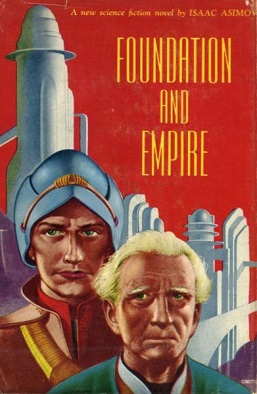
The sequel Foundation and Empire consists of just two longer episodes, ‘The General’ and ‘The Mule.’ They’re both good and they’re both set in the same world, one after the other. But in tone, theme and style they are two completely different novels. With ‘The Mule,’ we can see Asimov completely throwing out the old formula and introducing a new one. His story about interstellar socio-economics becomes a boisterous space opera about psychics and mind control.
The General
The first part of the book is peak ‘old-formula’ Foundation. I unambiguously love it. General Bel Riose, the most capable military leader in the decaying rump of the Empire, sets out to conquer the Foundation. His will, his ability and the forces at his disposal are all more than sufficient to the task. How can he possibly fail?
The main characters are two captives of Bel Riose: the old Imperial aristocrat Ducem Barr and a Foundation trader named Lathan Devers, who are trying to spoil the General’s design. Their mission centres on an apparent contradiction: they must pursue this task with urgency and initiative even as they maintain their faith in the inevitability of a Foundation victory through the Seldon Plan.
A part of my pleasure in this story came from the way our two main characters speak with very distinct voices. Here’s Lathan Devers on page 37 (2016 HarperCollins edition), faking indifference but with some measure of genuine conviction:
Listen […] what’s defeat? I’ve seen wars and I’ve seen defeats. What if the winner takes over? Who’s bothered? Me? Guys like me? […] Get this […] there are five or six fat slobs who usually run an average planet. They get the rabbit punch, but I’m not losing peace of mind over them. See. The people? The ordinary run of guys? Sure, some get killed, and the rest pay extra taxes for a while. But it settles itself out; it runs itself down. And then it’s the old situation again with a different five or six.
I’ve gone into Foundation’s influences on Star Wars before, but it’s so clear in this book, right down to the characters’ voices and attitudes. There are whole pages where we might as well be in the company of Obi-Wan Kenobi and Han Solo; Ducem Barr does a good line in traumatised reminiscences and holding forth about psychohistory the way old Ben does about the Force, and Lathan Devers would have you believe that he’s in it for the money, doesn’t give a damn about your struggle for freedom, and doesn’t have any time for far-fetched ancient belief systems.
Devers, however, is in it for the revolution. He tells the leaders of the Foundation that he wants to ‘spread the wealth a bit, and keep it from concentrating too much out of the hands that work for it.’ (78) And in the next episode we learn that ‘Devers died in the slave-mines […] because he lacked wisdom but didn’t lack heart.’ (89) This is part of a satisfying pattern where each episode by the way refers back to the characters in the previous one.
Compared with the earlier Foundation stories, this one has more detail, more drama, more interstellar travel, and more character. It even has some action. We get a few scenes with the Galactic Emperor himself. It’s still a very talky piece, as if Asimov wrote it with an eye to royalties from a radio play adaptation. But it’s a development.
The contradiction between individual initiative and historical inevitability is resolved very well. Without getting into spoilers, maybe the actions of our main characters were just part of a more general movement which could be predicted mathematically, or maybe they are there only to illustrate the broader trend. They didn’t solve the problem by their own actions – Ducem Barr remarks after the event that ‘through all this wild threshing up of tiny ripples, the Seldon tidal wave continued onward, quietly – but quite irresistibly.’ (76) But that doesn’t mean their actions didn’t matter.
The Mule
I grumbled about Foundation being very dry, talky and un-visual, and having almost zero women in it. The second half of Foundation and Empire blows all these complaints out of the water. The lead character, Bayta Darrell, is a strong and smart woman; there is more humour, travelogue, spectacle, more set-pieces. The narrator becomes sassy and sardonic.
At the same time it might be a case of “be careful what you wish for.”
There are things that would have been impossible in previous Foundation stories, not all of it good. Asimov moves from the version of sexism where you pretend there are no women in the entire Galaxy to the version of sexism where you describe women’s appearances more than you really need to, or have supposedly sympathetic men say patronizing shit to them. There is hack stuff, whimsical stuff, clichés: a silly clown who talks Shakespearian; a scene which is just making fun of the way women in a typing pool talk to each other; a psychedelic bit where a special musical instrument triggers hallucinations; an episode in which a villainous nobleman captures all the main characters because he wants to have sex with Bayta.
All in all, this story is written more like a traditional novel of its time. So on the one hand it’s better-crafted and easier to get into. On the other hand, it’s less distinctive. It becomes less about the things Foundation is about.
It starts very good, with all the strengths of the new formula on display. Asimov does a neat job of showing us how the Foundation has grown authoritarian and how its outside colonies of traders chafe under its rule and long for independence (as predicted by Hober Mallow and Lathan Devers). ‘Every vice of the Empire has been repeated in the Foundation. Inertia! Our ruling class knows one law; no change. Despotism! They know one rule; force. Maldistribution! They know one desire; to hold what is theirs.’ (89) Instead of giving us a page from the Encyclopedia Galactica explaining it all, the author conveys it through a sequence where a newlywed couple, one from the Foundation and one a trader, go on a family visit and end up being recruited by the Traders’ resistance movement.
So far, so good: we have a Foundation story but told in a more balanced and engaging way. It is setting us up for a story of class warfare and social revolution. Then all of a sudden it ceases to be a story about sociology or economics or politics and becomes a story about mind control. The Seldon plan is thrown into disarray by the appearance of a man who can hypnotize people. Haha! You didn’t consider that possibility, did you Hari Seldon? You dumbass.
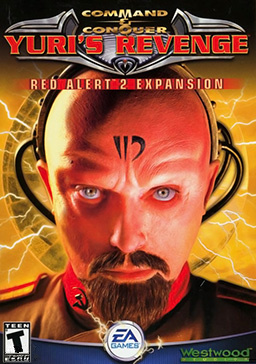
Before I get into criticism of the Yuri’s Revenge turn, let’s just clarify that the story is good and fun and intelligent. The mysteries and twists are one step ahead of the reader. But it’s not a spoiler to say that for the rest of the trilogy the mind control never really takes a back seat. And I just didn’t get as much out of this series from here on out.
What’s my problem with the mind control? Science fiction stories are generally based on “what ifs.” In this case: what if we could predict (and subtly shape) the future development of society through psychology and mathematics? But half-way through the trilogy Asimov suddenly asks, ‘And what if, also, there was a magical guy who could permanently control the emotions of everyone he met?’ It complicates and obscures the original ‘what if’ question.
A defence of Asimov here would be to say that psychohistory deals only with masses of humans, so the mind control stuff is relevant because it’s something happening on the individual level that psychohistory can’t predict. This is stated explicitly a few times. But I just don’t buy it. There’s got to be a more subtle way of interrogating the role of the individual in history and the potential weaknesses of the Seldon Plan. Say, introduce a guy who’s really charismatic, or a small organisation that’s really disciplined. There’s a lot that can happen on a level lower than the actions of billions. Introducing magical mind control, no matter how much Asimov labours to explain it and tie it into psychohistory, doesn’t further explore the concept. It just takes the story somewhere else entirely.
The mysteries are no longer like “how will the Foundation exploit atomic gadgets to control their stronger neighbours?” and more like “Which of these characters is the big baddie in disguise?” and “Which of these planets is the secret base of the Second Foundation?”
I want to re-emphasize that this story is better on a craft level than what came before. My friends who read Foundation at the same time as me didn’t like it, because of the very shortcomings that are addressed in Foundation and Empire. But from my point of view Asimov threw out the baby with the bathwater here. My enjoyment of ‘The Mule’ was tinged with disappointment.
I’ve also read the third novel in the series, Second Foundation, and I will be sharing my thoughts some day soon. Stay tuned.
 The 1919 Review
One thought on “What I’m reading: Foundation and Empire by Isaac Asimov”