
News comment: Minneapolis; Iran (30 Jan 2026)

A few days ago I was pondering whether events in Minneapolis were (a) Trump and Co doing their usual kind of half-arsed, cruel, careless, brutish, incoherent spectacle and getting people killed as a predictable side effect, or (b), Trump and Co actually setting out to murder people as a terror campaign, with the ICE goons told in advance they would be backed up no matter what they did.

Given the way MAGA spokespeople defended the murderers wholeheartedly, I lean toward option (b) which means the situation is extremely dangerous. But the development of a mass, determined and tactically astute resistance movement on the streets of Minneapolis means that whichever it was, Trump and Co have failed at least for now.

While the Trump regime has only made tactical retreats so far, recalling Obersturmbahnführer Bovino, I feel a change in the wind. It looks different from the 2020 uprising, more disciplined and targeted, but it is an uprising, and the first big one the Trump gang has run into in its second term.

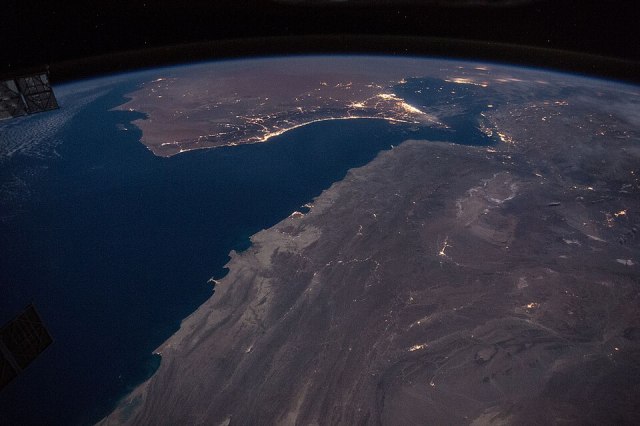
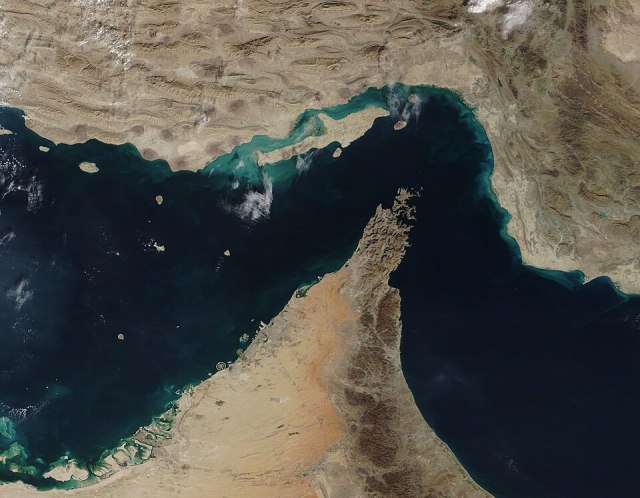
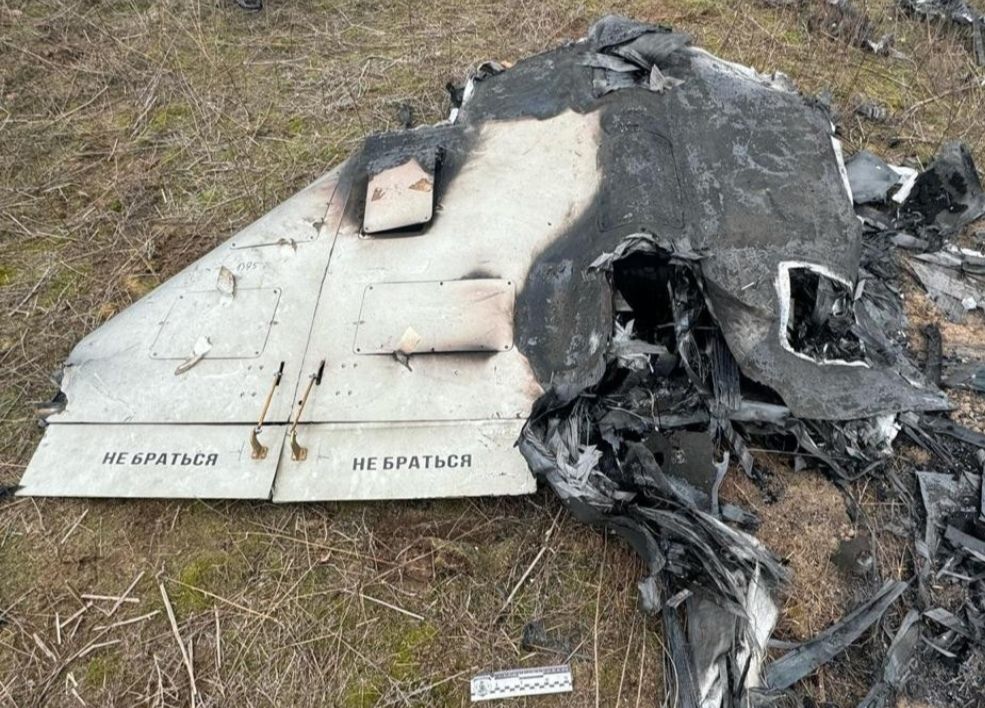
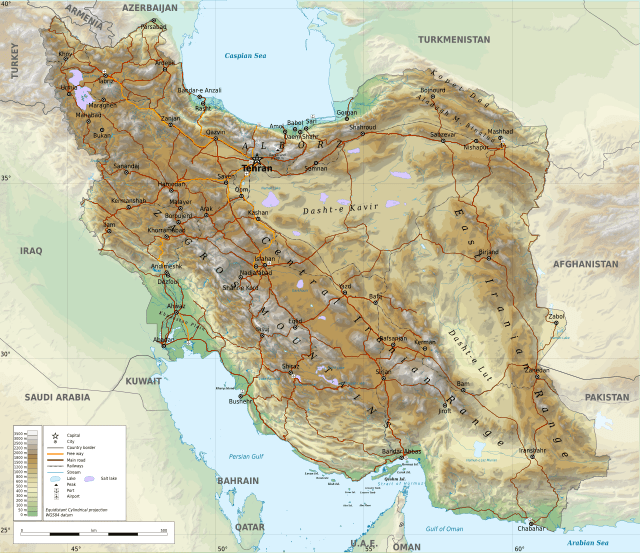
But it now looks like the Minneapolis battle could be overshadowed within a few days by a massive US attack on Iran.

If I read the patterns of Trumpism right, we are probably looking at the prospect something more limited, confused and cosmetic than all-out war. The much-hyped naval build-up is not sufficient to wage an actual war.

But maybe the pattern is that there is no pattern. It’s not a mad man strategy, just a mad man. The last month alone has seen a year or two’s worth of drama even by Trump standards – Iran, Venezuela, Greenland, the Gaza “Board of Peace”, Minnesota, Iran again. Maybe it’s the fear of the midterm elections, maybe it’s senility, maybe it’s “flooding the zone with shit…” or maybe it’s all just sound and fury, signifying nothing. But Trump has been getting Trumpier to the point where things could go critical.

The US military vessels conducting the attack would be sitting ducks for Iranian retaliation, even to a more limited strike. Heavy blows could fall on the human personnel, trillion-dollar war machines, and prestige of US imperialism.

What would the consequences in Iran be if, say, a lot of military facilities were bombed and a lot of political leaders assassinated? I don’t see how that  would bring about any kind of democratic revolution. People have already stopped protesting, and fear of US bombs and atrocities would smother any desire to return to the streets. I think the US state apparatus generally, not just Trump, are pretty comfortable with an outcome where Iran simply collapses into decades of senseless violence. The heads of zero powerful people in the US rolled after they spent untold lives and money procuring that outcome in Iraq. I can see that scenario for Iran if the US attacks. But the more likely scenario is that US attacks cut across what’s left of the mood of protest, and the regime survives.

And how would things go in the US if some hundreds or thousands of naval and air personnel died in a couple of days? A vengeful response, rallying around the government to take revenge, a 9/11 or Beirut truck bomb response, is not what I think would happen in this case. It’s widely perceived that Trump pursues gratuitous conflict, that he pushes things to the brink of carnage just for his own ego. The stated goal of helping the Iranian protesters is the kind of neocon hypocrisy that just stopped convincing most people a long time ago. There would be massive cynicism toward any attack on Iran, even a successful one.

I’m skeptical about the prospect of a massive US attack disarming and decapitating the Iranian state apparatus without losing a ton of ships and planes in the process and in the retaliation.

It might not come to that. This is Trump. He could be photo-opping and grinning with the Ayatollah within weeks. More likely, he will cut some unimpressive deal with the surviving portion of the Iranian state apparatus and once again declare himself the greatest peacemaker in history.

Fatima Masumeh shrine, Qom, Iran. Amir Pashaei, Wikipedia Commons

What I’m Reading: Second Foundation by Isaac Asimov

Second Foundation is the third volume of the original Foundation trilogy so before I get into it I’ll sum up what I wrote here on this blog about volumes 1 and 2, Foundation and Foundation and Empire.

I liked the deterministic mid-century materialism of Foundation. On the other hand, it could be smug and cynical and it was extremely of its time (imagine, someone probably died in combat on Iwo Jima knowing what the Seldon Plan was). It was quite dry, to-the-point, talky and minimalist.though it got more flashy and dramatic as it went on. Then at the midpoint of Foundation and Empire Asimov threw the old formula out the window. So long, mid-century determinist fable – don’t let the vast socio-economic forces hit you in the arse on the way out – it’s time for a fun swashbuckling adventure about a villain who can do mind control. This new formula boasted better characterisation and pacing, but overall I missed the tweedy old Foundation.

Second Foundation, like Foundation and Empire, contains two stories separated by a few decades. The first story concludes the story of the Mule, the psychic warlord introduced in the previous volume. He searches for and struggles with the Second Foundation. At last towards the end we get a glimpse of this mysterious institution.

Skirting around spoilers, we don’t see any more of the Mule in the next story. ‘Good,’ I said to myself. ‘We’re back on track. No more Space Yuri. We’re back to the Seldon Plan. Amoral characters as unwitting agents of vast historical forces. Empires hobbled by their own overextension. Kingdoms brought low by atomic hairdryers.’ But I ended up disappointed; this too was a story about psychic powers and mind control. We are focused on the Second Foundation in this story, and they just so happen to be a bunch of psychics like the Mule. Asimov labours to tie it in with the whole idea of psychohistory.

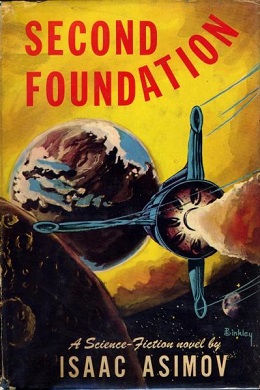
Dust jacket of 1953 edition

The Magneto in the High Castle

To get a sense of how I feel about this, imagine if half-way through The Man in the High Castle Philip K Dick had suddenly introduced Magneto from the X-Men. For the uninitiated, Magneto is, like the Mule, a mutant with special powers; he can control metal with his mind. So imagine if a good chunk of The Man in the High Castle is about Magneto picking up panzers and flinging them around squishing prominent Nazi leaders. Dick’s counterfactual 1960s Nazis are developing plastics, so I suppose they  finally build a plastic tank and squish Magneto in turn. After Magneto is vanquished, there is one final episode in the story, concerning the Japanese Emperor, who it is revealed also has magnetic powers. Dick goes out of his way to explain this, somehow, with reference to the I Ching, in order to tie this absolute nonsense back into the original ideas of the story.

However fun this scenario would be, it would kind of distract from the fascinating questions that Dick uses his alternate history to ponder. To take another example, just for fun, imagine if half-way through The Dark Forest by Cixin Liu, when we are invested in wondering how humanity is going to hold off an alien invasion, the clouds part and Jesus descends, turns a lot of water into wine, and dies on a cross somewhere half-way through Death’s End.

This is kind of what happens with the original Foundation trilogy. Its second half is fun and not by any means devoid of the interesting ideas we find in the first half. The mysteries – where is the Second Foundation? Who are its secret agents? Who is its mysterious leader, the First Speaker? – are solid with good development and payoffs. But they are mechanical. They have more to do with the craft of storytelling than with the science of psychohistory.

And, I mean… no doubt Dick would have written Magneto pretty well too, and would have found some time to ponder the nature of reality itself in between the scene where Bormann gets squashed by a panzer and the scene where Goebbels gets boa constricted by a lamp-post. But it would still have been a wild and irrelevant departure from a promising story.

The spiral galaxy Messier 83. Credit: NASA, ESA, and the Hubble Heritage Team (STScI/AURA)
Acknowledgement: William Blair (Johns Hopkins University)

Motivations

The second half of this volume presented some problems for me, even aside from all that. In this story a group of private citizens from the Foundation are hunting for the Second Foundation, because some people’s brainwaves have started to show up a little strange on the mind-reading machines, and it is suspected that the Second Foundation is interfering.

The motivations of this group of private citizens don’t make much sense. The Second Foundation saved them and it is part of the Seldon Plan, which is their secular religion. And then during the story, agents of the Second Foundation save their arses again and again.  The two Foundations have no basis for conflict at all. In spite of all this, our Foundation characters remain determined to root out the Second Foundation and its agents with extreme prejudice. Not only does it seem perverse, it doesn’t seem urgent at all. There is no existential threat to the Foundation here. The story lacks urgency, unless it is our desire to see how the Second Foundation will stop these gobshites, but the author doesn’t really commit to that either.

It gets worse (and spoilers follow). When the Foundationers identify one Second Foundation agent in their own circle, they immediately torture and restrain him (p. 229, 1994 HarperCollins Voyager edition). When the Foundation crowd believe they have found fifty agents of the Second Foundation, they do not take long to decide on their narrow range of options:

‘What will we do with all of them… these Second Foundation fellas?’

‘I don’t know,’ said Darell, sadly. ‘We could exile them, I suppose. There’s Zoranel, for instance. They can be placed there and the planet saturated with Mind Static. The sexes can be separated or, better still, they can be sterilized – and in fifty years, the Second Foundation will be a thing of the past. Or perhaps a quiet death for al of them would be kinder.’ (p 232)

A subsequent scene confirms that one of these fates has indeed befallen the fifty agents. Though we are not told which one, it hardly makes a difference!

The early-1950s viewpoint of the author offers some sources of interest and amusement, and, occasionally for me, mild disgust. But I was struck in a nice way by this description of an automatic ticket machine as a futuristic wonder:

‘You put a high denomination bill into the clipper which sank out of sight. You pressed a button below your destination and a ticket came out with your ticket and the correct change as determined by an electronic scanning machine that never made a mistake. It is a very ordinary thing[…]’ (p 169-170)

We have that now, and the only abnormal thing there is using cash instead of card. My knee-jerk reaction is to think, ‘how quaint.’ But on reflection, what prescience.

Conclusion

So that’s how I felt about Second Foundation: enjoyed it, recommend it, but expected more and felt it could have been more.

My verdict on the whole Foundation trilogy (I haven’t read the prequels and sequels written forty years later, so for me it is still a trilogy): “The General” in Foundation and Empire and the first few dozen pages of “The Mule” in the same volume represent a kind of peak Foundation for me. It’s lost some of the excessive dryness of the first volume without yet taking on all the extraneous psychic stuff. After this point, it never stops being entertaining or having good ideas; to its credit, it never retcons; and in some ways the writing improves… But it loses touch with its basic theme. The author seems to have lost interest in the question of predicting and planning the future through mathematics and psychology.

No wonder it ends unfinished, only half-way through Seldon’s thousand-year interregnum. Maybe that’s for the best. The rise of the Foundation into a new Galaxy-wide empire would not have been half as interesting as its early struggles for survival. Let’s remember the assumptions the series is built on: that empires are good and interregna are bad. Later stories would have had to go back and deconstruct a lot of that, if they wanted to remain thoughtful and interesting.

Home Page/ Archives

What I’m reading: Foundation and Empire by Isaac Asimov

Last year I wrote about Isaac Asimov’s novel Foundation (1951), in which a small community struggles to preserve culture and technology on the fringe of a collapsing galaxy-wide empire. Hari Seldon, the man whose command of the science of psychohistory allowed him to predict the collapse, has laid out a plan for this community, the Foundation, to unite the Galaxy in ‘only’ a thousand years or so. Foundation is episodic, as every 50-100 years the Foundation is presented with a new existential threat and the question is ‘How will the immortal science of Marxism-Seldonism get them out of this one?’

The sequel Foundation and Empire consists of just two longer episodes, ‘The General’ and ‘The Mule.’ They’re both good and they’re both set in the same world, one after the other. But in tone, theme and style they are two completely different novels. With ‘The Mule,’ we can see Asimov completely throwing out the old formula and introducing a new one. His story about interstellar socio-economics becomes a boisterous space opera about psychics and mind control.

Featured image: ‘Laser Towards Milky Way’s Centre’ by Yuri Beletsky. From Wikimedia Commons. https://apod.nasa.gov/apod/ap100906.html

The General

The first part of the book is peak ‘old-formula’ Foundation. I unambiguously love it. General Bel Riose, the most capable military leader in the decaying rump of the Empire, sets out to conquer the Foundation. His will, his ability and the forces at his disposal are all more than sufficient to the task. How can he possibly fail? 

The main characters are two captives of Bel Riose: the old Imperial aristocrat Ducem Barr and a Foundation trader named Lathan Devers, who are trying to spoil the General’s design. Their mission centres on an apparent contradiction: they must pursue this task with urgency and initiative even as they maintain their faith in the inevitability of a Foundation victory through the Seldon Plan.

A part of my pleasure in this story came from the way our two main characters speak with very distinct voices. Here’s Lathan Devers on page 37 (2016 HarperCollins edition), faking indifference but with some measure of genuine conviction:

Listen […] what’s defeat? I’ve seen wars and I’ve seen defeats. What if the winner takes over? Who’s bothered? Me? Guys like me? […] Get this […] there are five or six fat slobs who usually run an average planet. They get the rabbit punch, but I’m not losing peace of mind over them. See. The people? The ordinary run of guys? Sure, some get killed, and the rest pay extra taxes for a while. But it settles itself out; it runs itself down. And then it’s the old situation again with a different five or six.

I’ve gone into Foundation’s influences on Star Wars before, but it’s so clear in this book, right down to the characters’ voices and attitudes. There are whole pages where we might as well be in the company of Obi-Wan Kenobi and Han Solo; Ducem Barr does a good line in traumatised reminiscences and holding forth about psychohistory the way old Ben does about the Force, and Lathan Devers would have you believe that he’s in it for the money, doesn’t give a damn about your struggle for freedom, and doesn’t have any time for far-fetched ancient belief systems.

Devers, however, is in it for the revolution. He tells the leaders of the Foundation that he wants to ‘spread the wealth a bit, and keep it from concentrating too much out of the hands that work for it.’ (78) And in the next episode we learn that ‘Devers died in the slave-mines […] because he lacked wisdom but didn’t lack heart.’ (89) This is part of a satisfying pattern where each episode by the way refers back to the characters in the previous one.

Compared with the earlier Foundation stories, this one has more detail, more drama, more interstellar travel, and more character. It even has some action. We get a few scenes with the Galactic Emperor himself. It’s still a very talky piece, as if Asimov wrote it with an eye to royalties from a radio play adaptation. But it’s a development.

The contradiction between individual initiative and historical inevitability is resolved very well. Without getting into spoilers, maybe the actions of our main characters were just part of a more general movement which could be predicted mathematically, or maybe they are there only to illustrate the broader trend. They didn’t solve the problem by their own actions – Ducem Barr remarks after the event that ‘through all this wild threshing up of tiny ripples, the Seldon tidal wave continued onward, quietly – but quite irresistibly.’ (76) But that doesn’t mean their actions didn’t matter.

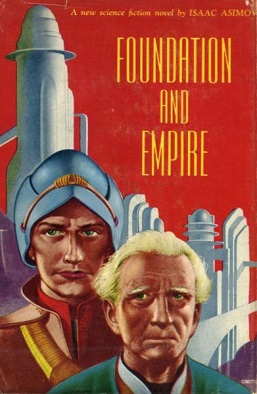
First edition cover. From Wikipedia.org

The Mule

I grumbled about Foundation being very dry, talky and un-visual, and having almost zero women in it. The second half of Foundation and Empire blows all these complaints out of the water. The lead character, Bayta Darrell, is a strong and smart woman; there is more humour, travelogue, spectacle, more set-pieces. The narrator becomes sassy and sardonic.

At the same time it might be a case of “be careful what you wish for.”

There are things that would have been impossible in previous Foundation stories, not all of it good. Asimov moves from the version of sexism where you pretend there are no women in the entire Galaxy to the version of sexism where you describe women’s appearances more than you really need to, or have supposedly sympathetic men say patronizing shit to them. There is hack stuff, whimsical stuff, clichés: a silly clown who talks Shakespearian; a scene which is just making fun of the way women in a typing pool talk to each other; a psychedelic bit where a special musical instrument triggers hallucinations; an episode in which a villainous nobleman captures all the main characters because he wants to have sex with Bayta.

All in all, this story is written more like a traditional novel of its time. So on the one hand it’s better-crafted and easier to get into. On the other hand, it’s less distinctive. It becomes less about the things Foundation is about.

It starts very good, with all the strengths of the new formula on display. Asimov does a neat job of showing us how the Foundation has grown authoritarian and how its outside colonies of traders chafe under its rule and long for independence (as predicted by Hober Mallow and Lathan Devers). ‘Every vice of the Empire has been repeated in the Foundation. Inertia! Our ruling class knows one law; no change. Despotism! They know one rule; force. Maldistribution! They know one desire; to hold what is theirs.’ (89) Instead of giving us a page from the Encyclopedia Galactica explaining it all, the author conveys it through a sequence where a newlywed couple, one from the Foundation and one a trader, go on a family visit and end up being recruited by the Traders’ resistance movement.

So far, so good: we have a Foundation story but told in a more balanced and engaging way. It is setting us up for a story of class warfare and social revolution. Then all of a sudden it ceases to be a story about sociology or economics or politics and becomes a story about mind control. The Seldon plan is thrown into disarray by the appearance of a man who can hypnotize people. Haha! You didn’t consider that possibility, did you Hari Seldon? You dumbass.

Before I get into criticism of the Yuri’s Revenge turn, let’s just clarify that the story is good and fun and intelligent. The mysteries and twists are one step ahead of the reader. But it’s not a spoiler to say that for the rest of the trilogy the mind control never really takes a back seat. And I just didn’t get as much out of this series from here on out.

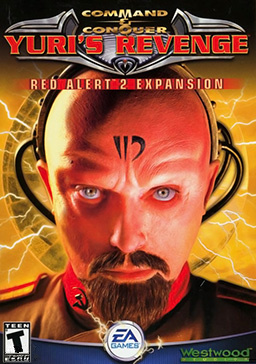
Suddenly it all gets a bit ‘Your command is my wish.’ Cover art for Command and Conquer Red Alert 2 Yuri’s Revenge (2001) featuring Udo Kier, a great German actor who passed away this year. Was the Mule a model for Yuri?

What’s my problem with the mind control? Science fiction stories are generally based on “what ifs.” In this case: what if we could predict (and subtly shape) the future development of society through psychology and mathematics? But half-way through the trilogy Asimov suddenly asks, ‘And what if, also, there was a magical guy who could permanently control the emotions of everyone he met?’ It complicates and obscures the original ‘what if’ question.

A defence of Asimov here would be to say that psychohistory deals only with masses of humans, so the mind control stuff is relevant because it’s something happening on the individual level that psychohistory can’t predict. This is stated explicitly a few times. But I just don’t buy it. There’s got to be a more subtle way of interrogating the role of the individual in history and the potential weaknesses of the Seldon Plan. Say, introduce a guy who’s really charismatic, or a small organisation that’s really disciplined. There’s a lot that can happen on a level lower than the actions of billions. Introducing magical mind control, no matter how much Asimov labours to explain it and tie it into psychohistory, doesn’t further explore the concept. It just takes the story somewhere else entirely.

The mysteries are no longer like “how will the Foundation exploit atomic gadgets to control their stronger neighbours?” and more like “Which of these characters is the big baddie in disguise?” and “Which of these planets is the secret base of the Second Foundation?”

I want to re-emphasize that this story is better on a craft level than what came before. My friends who read Foundation at the same time as me didn’t like it, because of the very shortcomings that are addressed in Foundation and Empire. But from my point of view Asimov threw out the baby with the bathwater here. My enjoyment of ‘The Mule’ was tinged with disappointment.

I’ve also read the third novel in the series, Second Foundation, and I will be sharing my thoughts some day soon. Stay tuned.

Necropolis (Gaunt’s Ghosts) by Dan Abnett

Dan Abnett, Necropolis, Black Library, 2000

In a vast hive-city on a distant world, an alarm sounds. It blares all throughout the city, and we see in rapid succession the reactions of a miner beneath the alien soil, a housewife at a market, a soldier on the walls, a factory foreman, a ruthless trader and a young noblewoman. In this way, the first few pages of Necropolis by Dan Abnett give us a sweeping but economical cross-section of the city of Vervunhive in the moment when its tens of millions of inhabitants receive the first sign of the unimaginable destruction that is coming.

A vast Chaos-corrupted army descends on Vervunhive, and over the following days and weeks the poor souls we’ve just been introduced to are put through hell. One is killed in the first savage bombardment; another develops from his pre-war existence to heroic status as a resistance fighter; another endangers the defense of the city in the interests of war profiteering. Meanwhile all around them, the city collapses by degrees into a ruin and, as the novel’s title suggests, there is a whole lot of mortality.

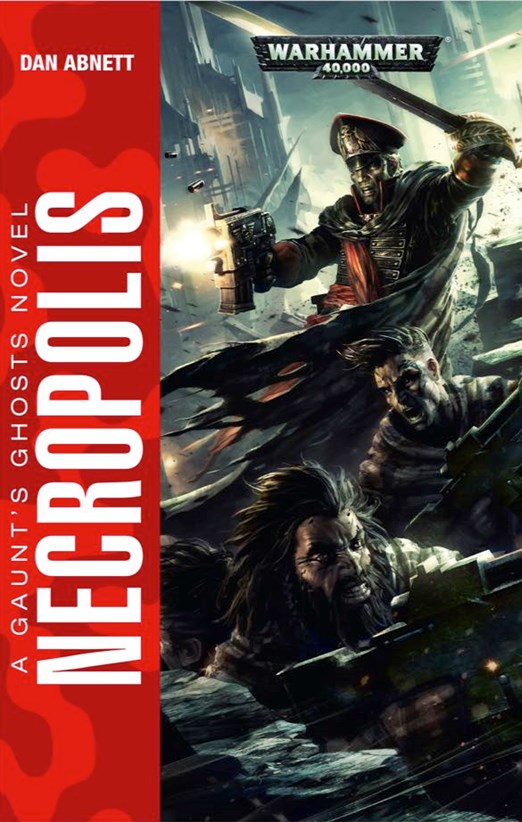
The cover of the ebook edition. I found this image on lexicanum (https://wh40k.lexicanum.com/wiki/File:Necropolis-cover.jpg#filehistory) where the artist is uncredited.

Gaunt’s Ghosts

Friendly forces arrive from offworld to help defend the city, including the Tanith First Regiment led by the heroic Colonel-Commissar Ibram Gaunt. This is the third novel starring Gaunt and his Ghosts, a regiment of scrappy light infantry fighters from a world lost to Chaos. First and Only and Ghostmaker flesh out the regiment’s characters in a way that Necropolis is too busy to do. But Necropolis is still bigger and better, and it can be read on its own. And, like most Black Library novels, it can be enjoyed as a military sci-fi epic, without any knowledge of the tabletop wargame hobby on which it is based.

Still, it has some of the familiar features of those other stories: Gaunt’s most difficult battles are against cynical, cruel and complacent people on his own side; the Tanith Ghosts are underestimated by snobbish other regiments recruited from wealthier and, well, not-dead planets; in spite of all this, Gaunt and the Ghosts save the day and win their internal and external battles. If more high-ranking servants of the Imperium of Man were like Comissar Gaunt, maybe it wouldn’t be such a dystopian nightmare of a society – which makes it kind of tragic that he serves it.

Unlike the previous novels, Necropolis has a fairly reasonable gender balance, because of the focus on various women from Vervunhive and the role they play in the resistance, often in the face of condescension from some of the less sympathetic Tanith Ghosts. Another departure from its predecessors is that it focuses on a single momentous battle, the Stalingrad of the Sabbat Worlds crusade, and tells the story from start to finish. For the first time, we see Gaunt commanding at a strategic level. Himself and Dan Abnett both are working with a bigger canvas, after finding their feet with two simpler novels, and that’s awesome.

We see refugees overrunning the police cordons that stand between them and safety, occupying factories and warehouses without permission, and organizing themselves into work teams. We see miners and women from textile mills, many of them permanently deafened from shellfire, forming guerrilla units behind enemy lines on their own initiative. These sub-plots are compassionate stories about the most downtrodden imperial subjects claiming some agency in terrible conditions. These stories also give an impression of Vervunhive as a place with lots of people and moving parts. It is a living, breathing place – for now.

Toby Longworth is great

I listened to this novel as an audiobook. I rarely re-read a book and it is rarer still with audiobooks; there are only two I’ve ever taken the time to give a re-listen, and Necropolis is one of them. Toby Longworth reads all the Gaunt’s Ghosts audiobooks, and he is just fantastic to listen to. He gets the tone of the ‘grim, dark future’ just right. I usually hate it when readers put on lots of elaborate accents, but Longworth gets away with it. Like the dwarves in Peter Jackson’s Hobbit movies, the Tanith Ghosts have an array of regional British and Irish accents, suggesting that their world of agriculture and forestry was home to a range of cultures, but not a particularly wide or exotic one. In Ghostmaker and Honour Guard, Longworth does a perfect impression of Alec Guinness for a couple of senior characters in Gaunt’s flashbacks. The officer class, you see. The regiment’s chief medical officer Dorden has a dreadful Irish accent, but somehow Longworth’s performance is still good, and I still believe him as a character. The very likeable Colonel Corbec has an Irish accent too, and his one is much better.

Why did I like this book, and who would not like it?

I was a Warhammer hobbyist for a few years around age 11-16, and Imperial Guard were my second choice after Orks. Hence the appeal of this book to me, even twenty years removed from the life of drybrushing, gluing and rolling meteor showers of dice. I’ve also always had a fascination with all things military, and with alien worlds and future civilisations, and with various episodes of human history that resonate in the visuals and language of Warhammer. But it’s not just the future or the past. For me, horror is catharsis. Appalling death and destruction, at a safely fantastical or science-fictional remove, and contained within the frame of a story, eases the mental pain one feels at the real horrors of the world.

There are parallels, there is applicability – but there is also the safe distance of several hundred lightyears and thirty-eight millennia. Without getting too dramatic (here I wisely deleted 500 words where I got too dramatic), fiction, including genre fiction based on an elaborate game involving toy soldiers, gives us a space to feel things safely. There is, however, the overhead cost that we risk fetishizing death and destruction. In our culture and in individual people, it becomes hard to tell where this search for catharsis ends and the simple glorification of war begins.

Abnett is prolific, and he might not even remember writing this quarter-century-old novel. But I hope he knows he did a skillful and spirited job here of depicting war: gore-splattered, dynamic, technical, kinetic, but at the same time sensitive to human suffering.

But to people who do not like to read about gore, cathartic destruction, war stuff, intense human suffering on an epic scale, or fantastical future settings, I’ll level with you: Necropolis is probably not your cup of tea.

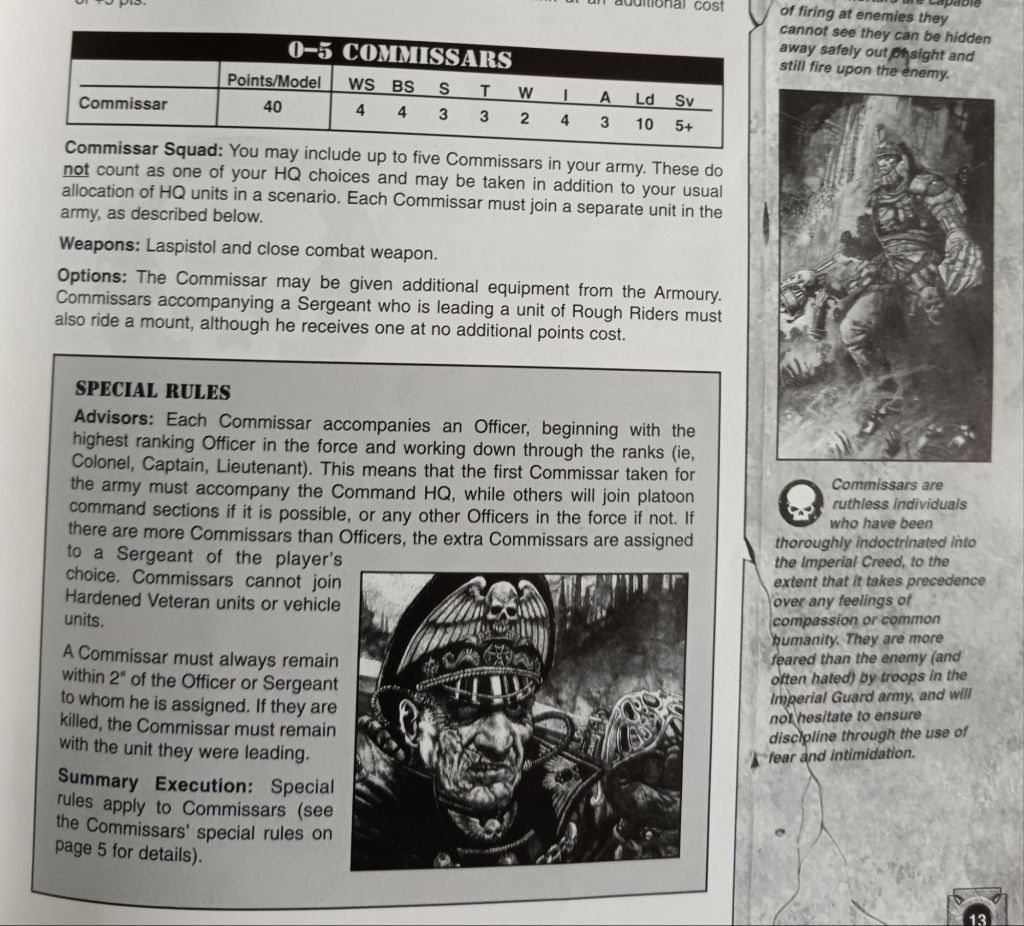
The section on Commissars from the Warhammer 40,000 3rd Edition Imperial Guard codex (1999), contemporary with Necropolis. Images and text belong to Games Workshop ltd

Necropolis should be on TV

I wrote in my most recent post that I was going to suggest a Black Library novel that ‘they’ should base the planned Warhammer 40K TV series on. ‘They’ being, I suppose, Henry Cavill and Amazon. Since these personages are not to my knowledge regular readers of The 1919 Review, it should be clear to the reader that the thoughts I am sharing are just a fun exercise. The corporate entertainment industry are gonna do what they’re gonna do. That’s bleak, but the alternative, that they would try to triangulate between posters, vloggers and maybe even bloggers and make a pathetic effort to please the most hyper-engaged people on the internet, would be pretty bad as well. So let us write and read this free of any illusion that we have any control over the outcome. This is not intense fandom. This is just fun and chill.

These caveats made, here’s why ‘they’ should make a Warhammer TV series based on Necropolis. Even though, to be clear, they will probably make eight dismal hours of 300 with boltguns.

Gaunt is the archetypal TV male lead character: stern, compassionate, imperfect but always fundamentally right, beset by challenges from people of lesser stature. He is Coach Taylor from Friday Night Lights, but instead of American Football it’s purging the heretic. He’s Edward James Olmos in Battlestar Galactica, only younger and more athletic: from time to time he revs up his chainsword and wades into a melée, chopping off limbs right and left. Walter White, Tony Soprano, forget about your petty rackets: the dubious cause which Gaunt serves makes him a classic TV antihero.

I noted above that Necropolis has a fair balance of men and women as characters, which would be a big advantage over a lot of other Black Library novels.

(Honourable mention here for Sandy Mitchell’s Ciaphas Cain novels, which have some ingredients of a good TV show – except that Commissar Cain’s narrative voice is so crucial to the irony at the heart of these stories.)

I also remarked that Necropolis is focused on a single location, which allows not just for savings on sets, props, costumes and effects, but for the kind of rich and dense environmental storytelling and set design that this kind of project absolutely needs. Necropolis gives us a cross-section of Imperial society, as opposed to a glimpse of the frontlines in various warzones. What better introduction to the grim darkness of the far future?

In Necropolis the Tanith are backed up by a heavy tank regiment, the Narmenians, who storm in to save the day at a crucial moment. For TV, I say, replace these guys with a hundred Space Marines. First, because the audience wants to see Space Marines. There can, and must, be Adeptus Astartes. Second, because they would serve the same purpose – as the heavy forces which wade in and make a right mess of the enemy. They would make a heavier visual impact than tanks, while probably being cheaper to put on the screen.

All in all, Necropolis is just a cracking good story, a simple situation and idea brilliantly executed. For a TV audience it would be a fantastic introduction to the 41st millennium.

300 with Boltguns – no thanks; Or, How Warhammer could be a good TV show

Warhammer 40,000 has surged in popularity in the 2020s. It has broken into the United States, and there has been a new proliferation of videogame adaptations. A couple of years ago Amazon bought the rights to make a TV show set in the grim, dark future in which this tabletop wargame is set, which has led to speculation and discussion about what such a show would look like. I decided to share my thoughts, and they ended up being a meditation on the unique appeal of this hobby and setting.

Don’t make it about the Space Marines…

We do not know if the Warhammer 40,000 TV series will actually be made. But I have a dreadful premonition that if it is made it will turn out to be mostly lads in power armour doing stilted dialogue in front of  fuzzy CGI landscapes.

The Space Marines are good for miniature wargaming: chunky, iconic and with cool abilities. But I can’t imagine them making up a good cast of characters on TV. If the camera has to linger on them for longer than a few minutes they will get really boring, really fast.

By definition they are all ultra-zealous supersoldiers, and I don’t see much dramatic potential there without really stretching the bounds of the setting.  I fear the screenwriters will stretch it and break it, resorting to the war movie clichés, and there will be a streetwise city Space Marine and a naive farm-boy Space Marine, a Space Marine who is a petty thief and pedlar, a fat clumsy Space Marine, a nerd Space Marine, a Space Marine who shows people a picture of his girlfriend back home, etc. There might be room, maybe, for one religious Space Marine. Stock characters are not necessarily a bad thing in general, but they won’t work as Space Marines.

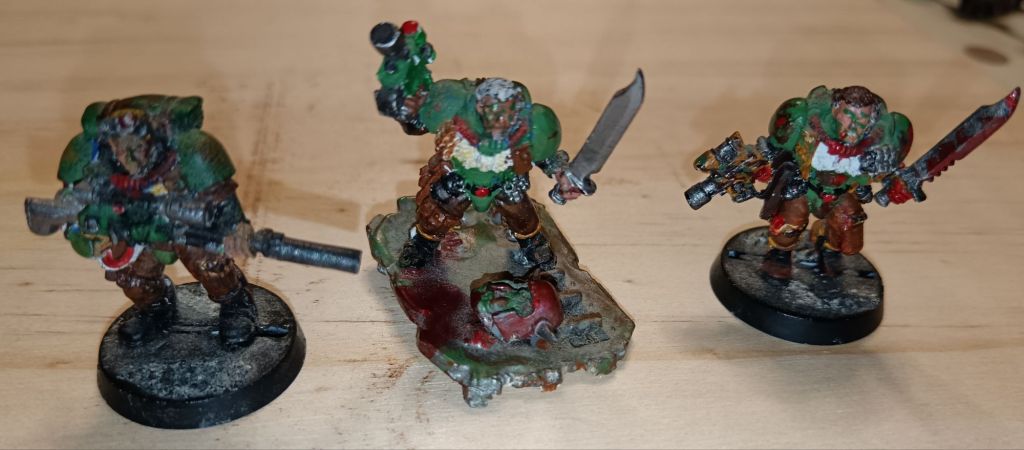
Three Space Marine scouts. These are metal miniatures from the 2000s painted by yours truly back in those days.

The other problem with the Adeptus Astartes is that they would cost an absolute bomb to put on the screen. How are they going to lumber around on set with any comfort or dignity in all that massive armour? If it’s light enough for them to wear, the weight of it won’t sit right, won’t look good; if it’s heavy enough to look convincing the actors just won’t be able to do it. CGI will have a lot of sins to cover up, and there goes your budget.

So who should the TV show be about? Easy: the Astra Militarum, aka Imperial Guard, because they are relatable and human but exist on a sliding scale of weirdness. They can be stock war movie characters, or they can be the Death Korps of Krieg, or anything in between. The writers have more freedom. Costumes and kit would be much cheaper: extras could be army reservists from whatever country they film in, maybe even, if we are really short of funds, wearing their actual uniforms, decorated of course with plenty of skulls and aquilas. They are canonically multi-racial and multi-gendered, so you could cast these characters pretty much any way.

The Tau would be another faction that could be interesting to show.  Avatar shows that it can work when you base a story around blue and heavily made-up and CGI’d aliens who are still humanoid and relatively sympathetic. Some similar points apply to the Aeldari. But the Astra Militarum would be so much more straightforward.

…but have Space Marines in it

But the Adeptus Astartes are iconic. They have to be in the show, or people will feel cheated. Here’s an easy solution: include them. Have a squad or a company of them, and make them secondary characters. We see them for 5-10 minutes in each episode, and in the finale they stomp in and help turn the tide. The less we see of them, the cooler they will be. Also, if they are not the main characters, you can make them as weird and fanatical as they should be. You can also spend plenty of money to get them right, because you would make savings based on their limited screen time.

Tell a (relatively) small story

Warhammer 40,000 is a famously baroque and extravagant setting. Aside from half a dozen human factions, we have Chaos, Aeldari, Drukhari, Orks, Tau, Necrons, Tyranids and Leagues of Votann. At that, I’ve probably missed a few. Each faction has its strengths and weaknesses and its aesthetic. Then within each faction, we have numerous sub-factions (Goffs, Bad Moons, etc for the Orks; Aeldari Craftworlds, cults of Chaos). And each sub-faction has its strengths and weaknesses, aesthetic, etc too. Even after all that, there are more than enough lacunas in the lore for players to make up their own craftworld, Space Marines chapter, Astra Militarum regiment, etc. Each faction has dozens of troop and vehicle types, each with its own set of stats and rules and its own intricate resin miniature; the hobbyist glues each miniature together from parts and then paints it according to their own creative vision.

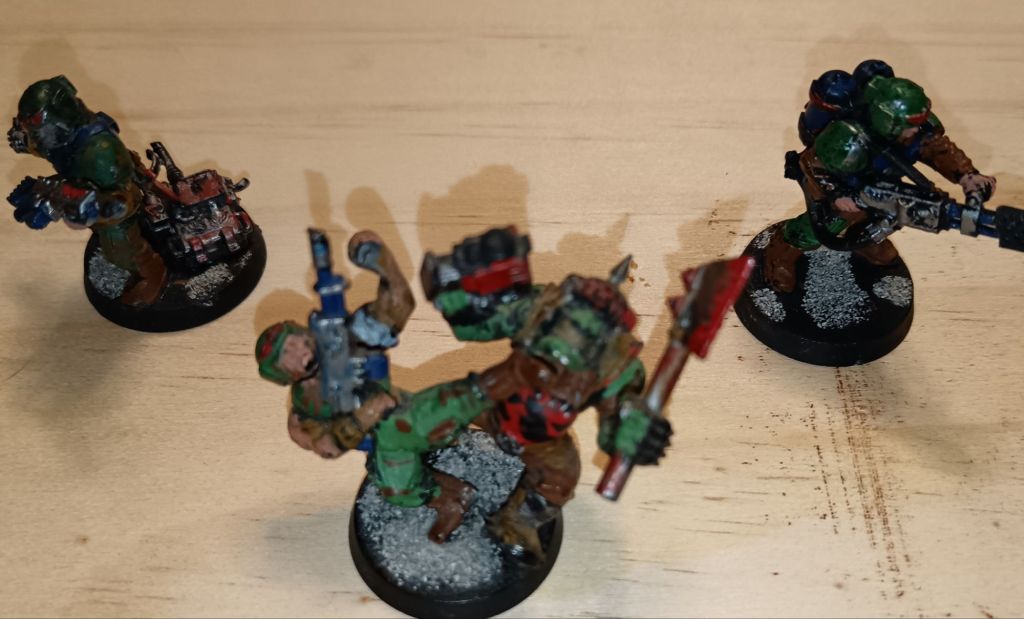
Another of my old miniatures that I was able to find. An Imperial soldier has just hijacked a bike from an Ork. This hobby is all too expensive and time-consuming for me now, so I haven’t painted an Ork for nearly 20 years. I still buy the odd copy of White Dwarf magazine and read Black Library novels. And I still appreciate the continuum from the smallest resin hip-flask to the galaxy-spanning civilisation.

I think it’s the medium of the tabletop wargame that gives it the freedom to get so weird and wide-ranging. Novels have to be focused on character and plot, TV shows more so, movies most of all. You might see elaborate worldbuilding in, say, a very long series consisting of very long books (George RR Martin), an open-world videogame (Fallout: New Vegas) or in a sprawling comic that runs for decades (Marvel, DC). But a tabletop wargame is even more freed from the constraints of character, plot and narrative focus.

A novelist has to think about how to work in some backstory or try to make the exposition more interesting. Warhammer hobbyists are happy to buy army books in which (alongside rules, tips, artwork, etc) platefuls of backstory and exposition are served up without any attempt at “working them in subtly.” It’s open-ended; it’s better if it doesn’t go anywhere. No hero is going to come along and fix this horrifying future. The point is that the setting is suitable to have a battle in.

What does all this mean for a TV show? Pitfalls. The writers will have to convey a sense of that breadth and depth while also telling a cohesive story. A lot of Black Library material is sprawling and epic in a way that would not translate to the small screen. There are over fifty books in the Horus Heresy series! So I hope they don’t try to tell *the* story of Warhammer 40k, with the Emperor and the primarchs as characters. The fall of Cadia would be another dangerous one to try. These kinds of stories would cost too much, and be too solemn and gargantuan to give new audiences a point of entry. 

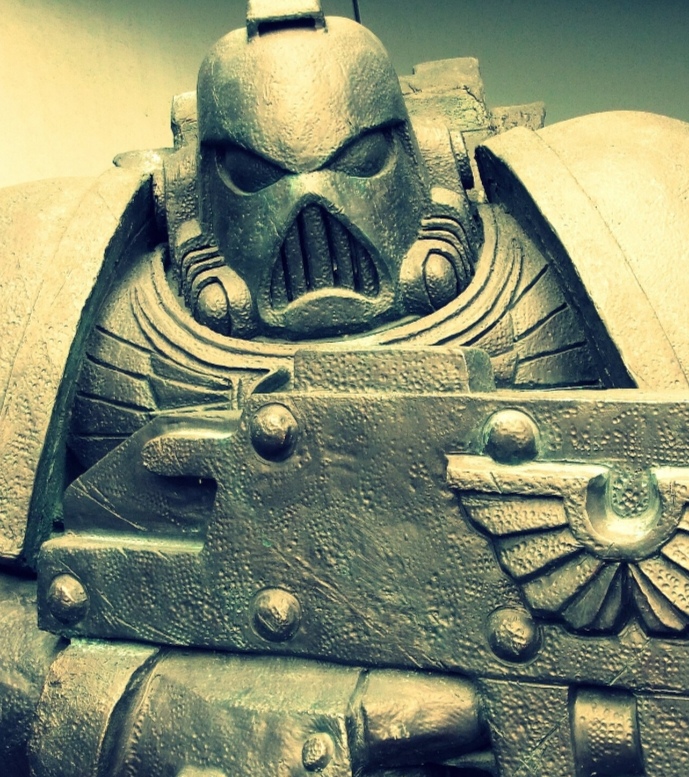
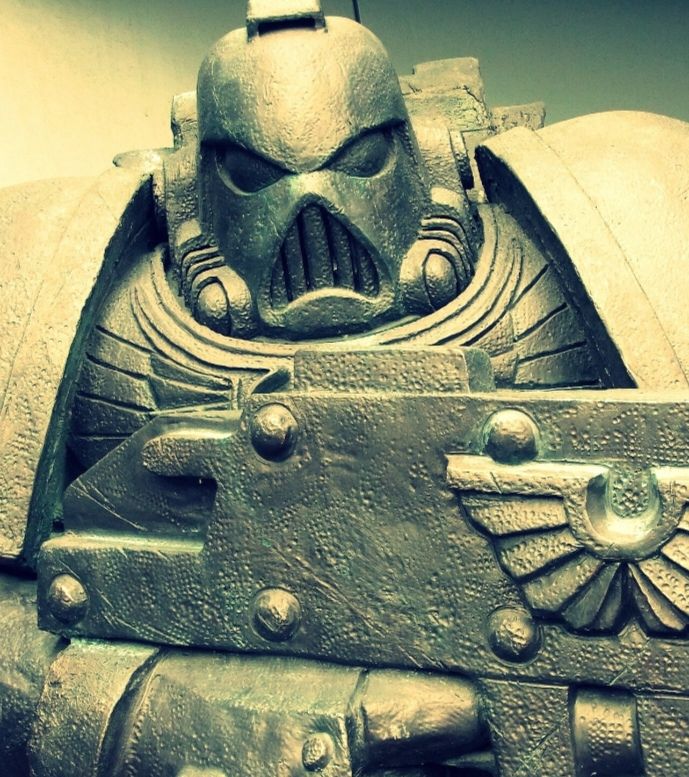
The featured image is an equally solemn and gargantuan statue of a Space Marine at Warhammer World. By Julie Gibbons, via Wikipedia Commons

Think smaller. Stick to one planet, or even one city or one battlefield. ‘Thinking small’ in the context of 40k could still encompass a gigantic city with lots of ecclesiastical mega-architecture, or an arsenal-moon with a gun cannon bigger than Australia. A hive city would allow for a good mix of studio interiors and miniature or CGI exteriors.

I was not a great painter, and as a commander I had a terrible habit of getting all my soldiers killed. But what I really loved was converting, ie, gluing miniatures together in interesting ways that, while lore-friendly, were not anticipated by the designers.

Here are ideas of the kind I think could work:

Inquisitors investigate a Genestealer cult. A full-scale Genestealer rebellion breaks out later in the season. After the Imperium forces win in the final episode, we strike a fatalistic note with the discovery of an approaching Tyranid hive fleet, of which our Genestealer cult was just a forward outpost.

A group of civilians and assorted imperial soldiers are trapped behind enemy lines by a sudden enemy advance and fight a partisan war.

Imperium and Eldar/ Tau/ Votann forces are forced to bury the hatchet and ally against a Chaos onslaught that threatens them all. The grim, dark, fatalistic note could sound when it ends with the trial and execution of our main character on charges of working too closely with xenos.

Use what you’ve got

A simple story set in a limited location allows for the more full building of a world. In a film like Children of Men, the most important things accumulate in the background or in brief glimpses. The visual and auditory richness of that movie shows what could be possible in a 40k series.

It is already such a visually rich world. A TV show would have an absolute wealth of material to draw on. No need to reinvent the wheel in terms of costumes, decor, set design, etc. Give us half-robotic flying cherubs and guys with pipes sticking out of their faces. Give us flying buttresses and computer terminals set into ornate pulpits, and skulls everywhere.

Get it right

I talked earlier about how 40K is open-ended, that there’s no real need for narrative focus as far as the tabletop wargame is concerned. But it would be a big mistake to think this means it’s shapeless or meaningless. What 40K does have is a distinct aesthetic and tone (maximalist, gothic, totalitarian, grotesque, with a hint of satire), plus rules that are (of necessity) pedantically exact. This provides a backbone to the sprawling lore. Its not that there’s ‘no point’ to the lore or backstory or that it ‘goes nowhere.’ If I’m building an army of Chaos Marines who worship the plague god Nurgle, I’m going to assemble them so as they look diseased and paint them in sickly greens. If I have an army of Orks I know they are very poor shots with ranged weapons but strong in hand-to-hand; my tactical challenge is to get them to close in on the enemy fast. Good thing I have some Stormboyz, ie, Orks with rockets on their backs.

So the lore is not arbitrary or pointless. It gives purpose to the hobbyist and clear rules to the gamer.

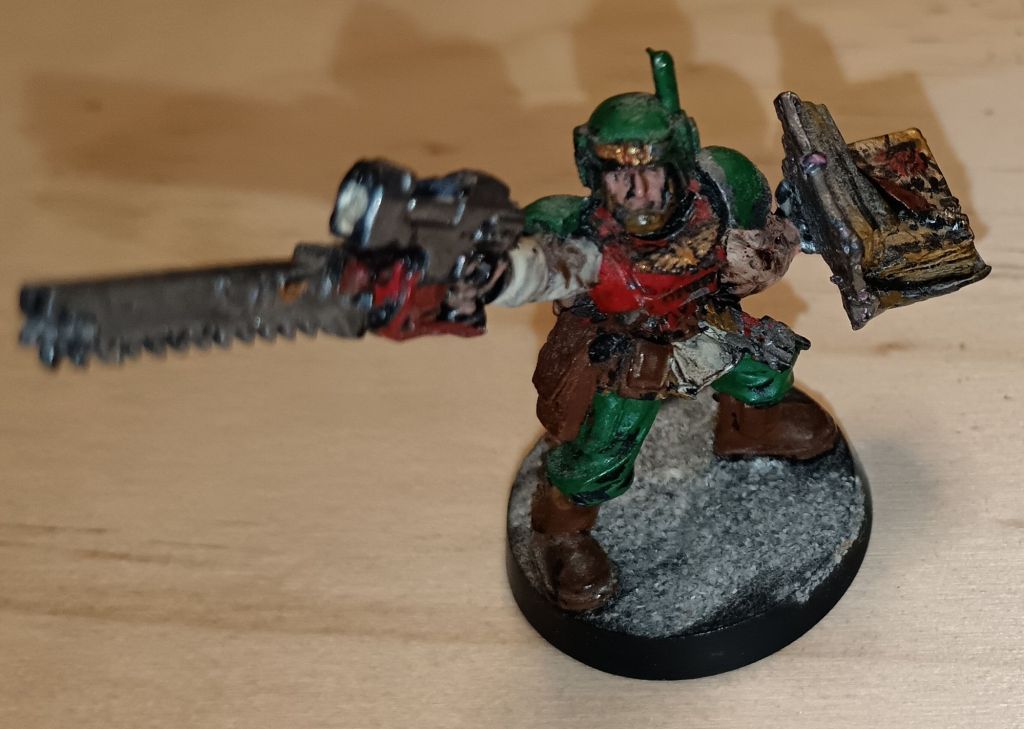
My Imperial Guard officer holds a holy book which I think I borrowed from an Inquisitor kit. Back then they were Imperial Guard, now they are called Astra Militarum. Most of my knowledge is from that earlier iteration of the game.

A TV show would have to get such details right. There is room for great variation in the 40k Galaxy, but if we see Orks who are crap at close quarters combat, or Nurgle Marines with a general air of good health, that will be a problem.

Imperial Guard sniper, adapted from plastic Cadian kit and metal Catachan heavy weapon loader, if memory serves

Another pitfall would be if the story and setting are played straight. The Imperium of man is a monstrous society, combining the 17th Century wars of religion with the height of Stalinism. Please understand before you begin that a Space Marine is not a US Marine in space. He is what it would look like if Buzz Lightyear joined ISIS.

We identify with the Imperium because we see in it something of ourselves, even though that something is a savage caricature of human history’s most repressive and fanatical tendencies.

And in turn, isn’t Chaos just a caricature of the Imperium? Maybe if imperial citizens weren’t primed and traumatized their whole lives by the grotesque imperial cults, they wouldn’t find the Chaos gods so appealing. If life wasn’t so miserable in the Imperium, maybe its people wouldn’t regularly see guys who look like Mad Max villains crossed with actual maggots and say, “Where do I sign up?”

A vein of fatalistic humour should run through this grim, dark story. For tone, think along the lines of Paul Verhoeven, Mortal Engines, Judge Dredd and Fallout (well, West Coast Fallout, not East Coast Fallout, which is an instructive example of inappropriately playing it straight). It’s not Star Wars. And on the other extreme, we don’t want ten hours of 300 with boltguns.

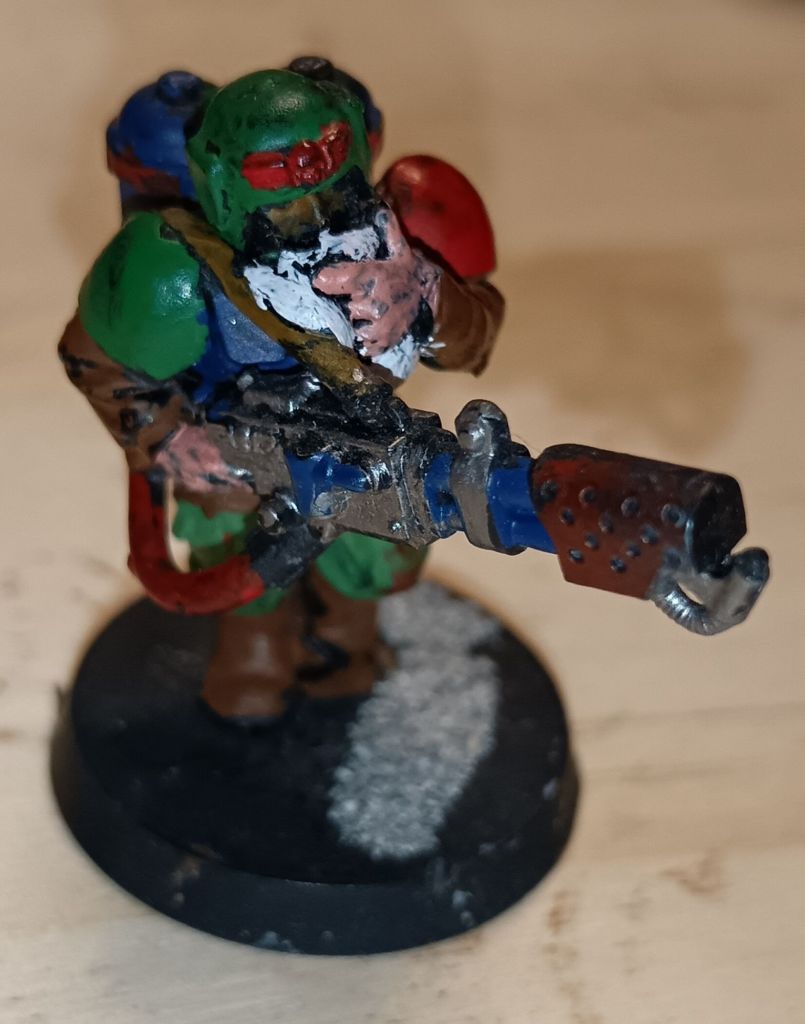
Another small conversion. An Imperial Guard soldier covers his airways while purging heretics with flamer.

A related idea: what if the series was a straight adaptation of an existing Black Library novel? I actually have a specific one in mind. But I’ll leave that for another post. Stay tuned. Meanwhile share your own thoughts in the comments. What faction should a TV show focus on? Is there any book you’d like to see adapted? Can you see a way small-screen Space Marines could work?

Bring the House Down by Charlotte Runcie (Review)

Bring the House Down by Charlotte Runcie

The Borough Press, 2025

Bring the House Down has a killer set-up, a ‘WTF’ moment that grabs the reader. At the Edinburgh Fringe Festival an earnest young woman, Hayley Sinclair, performs a solo spoken-word show about the climate crisis. Theatre critic Alex Lyons writes a gratuitously cruel one-star review within a few minutes of walking out of the show, sends it to his editor – then goes to a bar and meets the performer whose work he has just savaged. Alex and Hayley go back to his place, but he has meanwhile neglected to tell her that he attended her show, or that he has just humiliated her in a major national newspaper and probably crushed her dreams forever. Don’t worry, she finds out the next day when she looks at the morning paper in his flat. Her revenge is swift, merciless and very public.

After this explosive set-up the pace settles down but never slackens. What really makes this story is its narrator Sophie, Alex’s colleague, who is understated, cautious and quietly troubled in contrast to the outspoken and self-righteous confidence we see from other characters. She gives us a rounded view of Alex, which is not necessarily to say she makes him any more sympathetic. Nobody knows his bad sides better than she does by the end of the book, but she is disinclined to give him the kind of one-star review he freely dispenses. Her voice carries us through the novel with a tone of awkward discomfort mounting to a sense of personal crisis.

At one stage Sophie has to review a twelve-hour long historical drama (titled An Uncivil Peace) whose events she can’t follow and whose characters she can’t tell apart. But she gives it five stars and a gushing review (‘…blistering…’), because she feels that a lot of people put a lot of effort into it. Later, in a different mood, she attends a play about refugees staged and set inside a shipping container. The clever staging gimmick and the important topic fail to distract her from the clichéd dialogue, bad plot, and the offensive nature of a bunch of mostly white students portraying refugees. After scrupling and hesitating, she gives it a brutally honest review and a single solitary star. Soon after, she passes a poster advertising An Uncivil Peace which proudly boasts her five-star rating. She hurries past it, cringing.

The ratings she gave these two texts were pretty much arbitrary, related more to what was going on in her head at the time than to experience or quality. The one-star review was at least honest.

From Wikipedia Commons, a scene from the Edinburgh Fringe Festival in 2009 or 2010

I was interested in how this novel explored criticism. I review stuff here on this blog, but you’ll notice I don’t give out ratings. If people want to know if they should watch some movie or read some book, I say: read what I’ve written about it; get a sense of what it’s like; get a sense from my words of what I, the critic, am like. You should be able to triangulate from that if a book is worth your time and money.

For example, how about this book? It doesn’t have orcs, spaceships or Bolsheviks in it, and yet I read it cover-to-cover and have nothing bad and plenty good to say about it. If you’ve been in Edinburgh during the Fringe, which I have, it probably helps. If you’re interested in art, journalism and the creative process, and like the narrator you are thirty-four and a parent of small kids, that will help too.

This book explores what is problematically called “cancel culture” and lets us make up our own minds about the characters. Victims who call out shitty behaviour are usually portrayed in the media as a mindless puritanical mob but this novel is generous and understanding, while allowing us to decide for ourselves how much of the reaction is going too far or missing the point.

Of course we need criticism that’s useful and not just PR; people have taken time off work and spent money to go to the Fringe, and they need to know if a performance is worth their while. But Bring the House Down makes you think about how critics who are in steady jobs are at a massive advantage in relation to artists, almost none of whom are making any money. The critic is in a reserved, defensive posture and the artist is making themselves vulnerable. No, that’s not fair.

Notice as well how our narrator Sophie becomes Alex’s only confidante. When he’s ostracized as a result of his fucking over women, he selects the nearest woman to be his emotional support. It seems perfectly natural to both of them.

See? I wrote some sentences and paragraphs that took you a few minutes to read. Wasn’t that more useful than the fake objectivity of a star rating?

And should you accept my judgement? Who am I? I wrote thousands of words about how much I love Tiberian Sun. I wrote a good review of Rebel Moon and I stand over it. I’m not pretending to be the fount of universal good taste and wisdom. I’m just telling you what I thought and how  I felt. My liking something might be a sign that you won’t like it – but that’s also useful for you.

I would say to critics, if you have to rate texts, get granular and let us see under the hood – the way blogger vacuouswastrel.wordpress.com does. He breaks it down into categories like adrenaline, likeability and emotion, and explains every step of the assessment process, finally sorting his reviews into a hierarchy that ranges from ‘Brilliant’ through ‘Outstanding,’ ‘Good,’ ‘Not Bad,’ ‘Bad, but with redeeming features’ and ‘Just plain bad,’ to ‘Eye-gougingly, excrecently terrible.’

Here is his fantastic blog: https://vacuouswastrel.wordpress.com/

Even this kind of rating is not for me. In my opinion, the Vacuous Wastrel got jaded and overly-critical a little way into his Terry Pratchett read-through (although I love Pratchett, I would certainly get jaded if I was reading a heap of his books back-to-back). But it’s a lot better than giving us five points on a scale and leaving it at that. His judgements are transparent and useful and generally fair.

Maybe a certain text just isn’t for you, and your one- or two-star review will stop someone who it is for from experiencing it. Maybe you were having a bad day and weren’t receptive. Maybe you were twenty-five and loved it, but would have hated it an thirty-four, or vice versa. Maybe you’ll feel one way in the hour after seeing it, and another way a month later.

The other thing about my criticism is that I write when I have something to say, not necessarily when I love or hate something. I loved season 2 of Andor and took notes on it. But I never used those notes. That’s not a negative judgement on the best TV show I’ve seen in years.

These have been some of the meditations that Bring the House Down inspired and provoked in me. In light of them, you will easily understand why I don’t assign a star rating.

Some landmarks for The 1919 Review

Today happens to be the anniversary of nothing. At least in relation to this blog. But a few things are happening that I want to pause and acknowledge.

First, I expect the next two weeks to witness the birth of my third child. I composed the early posts in my head while rocking my eldest son, then a baby, to sleep. I would re-listen to Russia in Revolution by SA Smith while walking him around the house in a sling, pausing long enough to scribble notes for the blog, but not long enough to wake him. I mentioned the birth of my second son here two and a half years ago. While raising my wonderful boys, I have been tending this little blog on the side through the same period.

If you want to start some creative project like this but you think maybe you’re too busy, well, I’ve been busy and still got this done.

I’m grateful that each year thousands of people, spread across every continent on the planet, have been reading my words. Today marks my annual visitor count overtopping those of any previous year, with two and a half months left to go.

Today’s featured image is a wonderful piece of slop I found in the wild. An ad on a WordPress blog, no less. The man in the cloak, it would appear, got into Harvard by surrendering his sanity to an eldritch horror from abhorrent regions beyond space and time. Or maybe the eldritch horror represents Harvard.

Seeing where my readers are coming from is always fascinating. When the great Bob Dylan forum expectingrain.com brought a windfall of traffic my way, I noticed a wave of Germans and a wave of US Americans checking in 6-8 hours apart. The Irish are usually the biggest contingent but this year they are a modest third behind the US and Canada. The blog is in the English language so it’s no surprise that the UK and Australia make up the next largest parts of the readership.

But in the last 6 and especially the last 3 weeks something very interesting has happened: a massive spike in visitors from China. They are the fifth-largest national grouping among my readers this year, and the largest this month and last month. These readers do not seem to be looking at my few posts about China (William Hinton and Cixin Liu) any more than any other nationality.

It’s possible that the stats WordPress gives me are warped by strange internet anomalies beyond lay understanding. Maybe there are different rules in different jurisdictions for WordPress to read someone’s IP address; maybe minor tweaks to regulations in certain countries can produce an engagement mirage… I don’t know. But I really like the idea that I’m being read and shared by hundreds of people in China. I like it a lot more than I expected it.

The numbers are good and getting better, even though my regular readers will have noticed I’m not posting as much. Gradually in the last six months, after four years of weekly posts without fail, I have dropped down to, in effect, monthly posts. It’s going to stay that way for a while, not least because there’s a new baby on the way. One way or the other I feel it’s a necessary change of gears. But The 1919 Review has never gone dormant and I don’t foresee that it will. Readers, sharers, subscribers, paying supporters: thank you.

Revolution in a Chinese village: Notes on Fanshen by William Hinton

At 18 I visited China during an ambitious bit of backpacking. One day a Chinese woman working in a hostel held up a banknote with Mao’s likeness on it and assured my companions that if you placed your finger on his chest you could feel his heart beating. My friends reported this to me and I reacted with scorn. You see, I had read Mao: The Unknown Story by Jung Chang and John Halliday (not even all of it), and I knew everything. I could not explain by what mechanism Mao had managed personally to kill seventy million people, but I did not doubt that he had pulled it off, and that anyone who admired him for any reason was deluded, maybe even dangerous.

In fact I didn’t know all that much and I still don’t. But in the intervening years I’ve come to learn bits and pieces more.

We didn’t learn anything at all about China in school but we did learn about the Russian and French revolutions. The focus was on political leaders and the struggles between them. In real life, the social changes experienced by the masses were the central questions in the revolution, but they were an afterthought in the education system and on the history shelves of bookshops.

This western discourse might stop only long enough to note that the ‘ordinary person’ suffered before the revolution but, it is asserted, suffered worse after. So I knew about the nonsense with the sparrows and the backyard pig iron forges long before I knew about the greatest social change which the French, Russian and Chinese revolutions had in common: the land revolution.

Probably the most important development in global history in the Twentieth Century was the transfer of land from a small class of landlords to the majority, to the peasant farming population. This was not communism or socialism, just democracy. But in the last century, it mostly happened in communist-ruled countries such as the People’s Republic of China, although it was and is proverbially not a democratic state in the sense of electing the leaders, the right to free political activity, etc.

They didn’t teach me about this in school, or in the history book reviews in the Sunday papers, or in Mao: The Unknown Story. I’ve picked it up elsewhere, most of all in a book I’m currently reading called Fanshen by William Hinton.

This is the copy I own. This post’s cover image is from a different edition, courtesy of Wikipedia.


About the book

William Hinton is from the United States and he was in China in the late 1940s. He went to a village called Zhangzhuangcun[i] in Shanxi Province where, with the help of a translator, he took down a massive heap of notes recording the experiences of local peasants during the prior few years of war and revolution. 

Hinton came back to the United States, whose government confiscated his notes and kept them under lock and key for the better part of two decades. They figured that reading about the lived experiences of Chinese farmers would be extremely dangerous for the health and safety of US citizens. Hinton finally got his notes back and wrote and published Fanshen in the mid-1960s.[ii]

I’ve always been a bit confused as to what a ‘village’ is supposed to be, and Fanshen has added to my confusion, because Zhangzhuangcun was not an expanse of fields and scattered houses, or a built-up crossroads, but a dense collection of buildings, in and around which lived roughly a thousand people, surrounded by farmland. Early on we get a beautiful description of the place before we zoom in on the absolute misery in which so many of its people lived.

A handful of families around the village own most of the land and keep the rest in debt slavery and servitude. These landlords bring in rents and harvests, build big houses, buy more land, lend at extortionate rates, swindle their illiterate tenants and debtors, and buy the children of people they have reduced to absolute desperation. What do the landlords do with the proceeds of all this exploitation? Send their children to college; buy more land, make more loans; distil alcohol; buy silver and bury it in the ground.

But the social life of the village is complex and has many layers and moving parts. This is a big book because Hinton doesn’t try to con us with an overly-simple story. For example, the way these landlords live, I wouldn’t call it luxury. They lived on dirt floors. What they had was power over others.

Soldiers were occasionally present in town (harassing women, drinking) but mostly the landlords kept control through informal means. Religion and the supernatural feature heavily. There is the Confucian society, the Buddhist temple and the Catholic church. Each one is employed as a racket by the ruling layer in the village. But they also have plenty of sincere believers including many who take part in the revolution. The Catholics themselves enlist to challenge the parish priest.

One of the book’s very nice maps.

There is also, unrelated to landlordism but symbolic of it, a clay statue who must be appeased with sacrifices so that he will not inflict an illness on the villagers. I think it’s scrofula. During the revolution, some folks pluck up the courage to overthrow and destroy this deity. When no illness comes to afflict the iconoclasts, the villagers learn that the god has no power after all.

Other forces in the mix are bandits, the Nationalists, the Communists, and the Japanese and their local puppets. Hinton shows what each of these forces meant in the context of ordinary people’s lives and paints a picture that feels rich and alive. From the day the Japanese and the puppets are driven from the village, the land revolution proceeds: first as a reprisal against collaborators, then as a campaign against the most abusive of the landlords, then against the landlords and rich peasants generally. The picture is not rose-tinted: Hinton tells us how several landlords or their family members or allies were killed or tortured, sometimes in the pursuit of buried treasure that did not exist.

Land Revolution

The book is fundamentally about land revolution. We’re talking about the redistribution of the property of around 5 percent for the benefit of the rest. Objections to wealth redistribution are well-known: this would only be an ‘equal sharing-out of misery’; socialism fails when you ‘run out of other people’s money’; and people will have ‘no incentive to work.’ 

Having debated these things so many times it’s refreshing to see them answered on the comprehensible and relatable scale of one village.


‘Equal sharing-out of misery’

It turns out that, yes, sharing out the luxuries and household goods of the rich does benefit the community as a whole. Witness the memorable scene in Fanshen in which a strange kind of market takes place. All the confiscated goods of the landlords are laid out in the temple square, and the villagers come in groups, starting with the poorest, each to pick out one item.

An even nicer map. “Long Bow” village (Hinton’s nickname for Zhangzhuancun and its environs.

In the months and years of the revolution, a lot of other things get shared out or made collective property: the buried silver; the landlords’ open or covert control over religious and public institutions.

But the most important part is the sharing-out of the land, livestock, implements – the means of creating wealth. This is the real game-changer. This is fanshen – a phrase which Hinton explains as meaning something like ‘to turn over.’ For the Chinese farmer in the 1940s, eking out a miserable precarious existence through ceaseless toil while enriching a landlord, fanshen meant taking over a proportionate share of the landlord’s property and beginning to live with dignity and independence. In the background is the China-wide process of fanshen. This entity called the Border Region government will develop into the People’s Republic of China; the Eighth Route Army, which is idolised by poor peasants, will become the People’s Liberation Army.

‘Running out of other people’s money’

The windfalls from sharing out the landlords’ property were so intoxicating that the local activists tried to cast the net wider and ever-wider, usually in direct defiance of orders from the communist-led government, shaking down more and more of their well-to-do neighbours. This led to some violent abuses and excesses. The diminishing returns were apparent. In this sense, there’s a kernel of truth in the idea that socialism (or in this case democracy) works until you ‘run out of other people’s money.’ Of course, the villagers were reclaiming rent extorted and conned from them so it was their own wealth – but it was indeed finite, it could ‘run out.’ This was a secondary problem. The activists simply accepted that redistribution was as complete as it was ever going to be, and corrected their course. 

‘No incentive to work’

Wealth came from other sources. There was a new and impressive movement of cooperatives. More importantly,contrary to the idea that sharing destroys the ‘incentive to work,’ the farmers now had more land and implements and were freed from debts and rents, so they were willing and able to work harder and produce more.

Those whose wealth had been taken from them did indeed lose an incentive to work, and this was an economic problem, but again, it was one of secondary importance. For the majority of people, obviously, the land revolution meant a tremendous new incentive to work.

Soldiers of the Eighth Route Army during the Second World War

Conclusion

All these questions are played out in Fanshen in a compelling drama with a huge cast of characters. It throws a new light on other things I knew about. The ritual denunciations during the Cultural Revolution were self-conscious re-enactments by students of the revolution the previous generation made. But it’s much more sympathetic to read about a bunch of peasants finally ganging up on their landlord and denouncing him for starving their children than it is to read about a bunch of students, twenty years later, doing the same thing to a professor because he’s allegedly a ‘capitalist roader.’ The thing is, I was acquainted with the grotesque student re-enactment many years before I read about the dramatic village meetings they were trying to emulate. Completing this circle adds pathos to both.

I’m about half-way through the book and may follow this up with further notes as it enlightens me further.

I’m still not a fan of Mao Zedong for a variety of reasons to do with his disinterest in democratic rights, his treatment of his political rivals from the 1930s on and his calamitous mistakes with regard to the ‘Great Leap Forward’ and the later Cultural Revolution. So I’m not here to make you Mao-pilled. But for people in North America or Europe to understand and respect people from China, it’s important to understand the reasons why Mao, the PLA and the CCP have been held in such high regard for so long.

Going back to that woman in the hostel who said you could feel Chairman Mao’s heart beating in the paper of a banknote. I don’t know, but maybe her grandparents went through this fanshen, a process they associated, reasonably, with the man whose face was on that banknote. This doesn’t mean I can’t criticise him but it does mean I should try to understand where she was coming from. Maybe lots of Chinese people would also find that kind of thing very embarrassing. But my scorn was not authentically my own.


[i] In an uncharacteristic bit of pandering to the western reader, he takes the liberty of calling the village ‘Long Bow’ though he admits this is not a translation of its name. So why call it that..?

[ii] The edition I have is from the 1990s, withdrawn library stock that I found in a second-hand bookshop.

In Pictures: Welcome to the Interslop

Introducing a wailing Youtube therapist, my AI girlfriend and the serious social problem of bus theft.

People have been talking about this for a while but 2025 has been the first year that it really sank in for me: computers and the internet are getting worse, and you…

Hang on. What’s this now? I can’t see the words I’m typing. There’s a big charcoal-coloured box blocking my word processor.

I know I’m offline. I don’t want to see ‘my feed’, I want to see the words I’m writing.

It won’t go away. Does it go away when I click? No. Do I just have to wait?

I’ve figured out that mashing my keyboard keys makes it go away. But the point is, I don’t want to see ‘my feed’ when I’m trying to write. It’s very distra…

UFO CRASH-LANDS IN POLISH FIELD

KATE MIDDLETON’S HAIR IS A DIFFERENT COLOUR

BRUCE WILLIS HAS DEMENTIA

I’M 42 AND ONLY ATTRACTED TO MARRIED MEN

7 SIGNS THAT SOMEBODY LIKES YOU ACCORDING TO PSYCHOLOGIST

FLIGHT ATTENDANT WARNS PASSENGERS: THIS IS THE SEAT YOU SHOULD NEVER SIT IN

10 ACTORS WHO HAVE AGED TERRIBLY

6 THINGS YOU HAVE TO KNOW BEFORE YOU BUY SOLAR PANELS IN IRELAND

THESE 5 FOODS WILL KILL YOU INSTANTLY

Oh look, I’m online now. And ‘my feed’ has popped up again. Ugh. It’s a load of clickbait… Wait. Bruce Willis? No, poor guy…

Shit. What was I going to write again?

I guess I was going to talk about how the internet is shit, how we are descending further every day into the Interslop. And I was going to illustrate it with some screenshots.

Like this one. More AI slop from ‘history’ pages. Yes, that man has horns. And the text whitewashes what was probably mass sexual slavery. And AI layers this earth-toned grit all over everything that just makes it all the more creepy and uncanny.

But it’s not just AI. And not everything has gritty dirt tones. Now when I want to open a PDF document on my phone, I have to sit through a video ad that usually looks something like this:

Jesus. Hasn’t the internet gotten really tacky? Just vulgar. And when it’s not tacky, it’s weird.

For example: If I’m listening to something on Youtube these days, I get sudden interruptions from a man’s voice wailing at me. And before I show you the screenshots I want you to read the words he wails. Please keep in mind that these words below are sung as if they are song lyrics, in a way that’s anguished, high-pitched, melodramatic and breathless:

…procrastination is a trauma response, not laziness… warning signs of dopamine-chasing behaviour in men… how hypersexuality and procrastination are interconnected…

So many questions. First, is this really happening, or am I hallucinating? Well, I took some screenshots so I know it’s real. Next question: why is this apparition saying this to me? Why does the algorithm think I want this? Who thought it would be good to put these words to music? I don’t leave it play til the end because it’s too unsettling, so I don’t even know what it’s an ad for. But it appears to be for some mental health or counselling app. Let that sink in: this is supposed to be good for mental health!

While we’re on the subject of ‘why did Youtube think I wanted to see this’ – introducing my new AI girlfriend:

Well. She seems nice.

Youtube also thinks I want to see an ad for a new AI programme that can create songs.

If it’s ‘very scary’, why is she smiling? Even the most pro-AI people appear not to be sure how they are supposed to feel about it.

In other internet news, Facebook now has ad breaks, which I like because it encourages me not to be on Facebook. It’s a little speed-bump on the mindless scrolling. But like everything, Facebook also now has prompts to use AI at every turn.

So you don’t have to write Facebook comments anymore. You can just sit back and let the bot answer on your behalf. But, well, there never was any obligation to write Facebook comments. If you don’t like doing it, you could just not do it. So who is this for?

But bless you, chatbot. You’re here to reassure me if I get frightened about bus theft:

‘Is bus robbery common?’!! It’s good that on top of reading my friends’ funny posts, I get to read AI’s unintentionally funny attempts to assert its relevance.

And if we didn’t have AI, we wouldn’t be able to create awesome, educational, valuable stuff like this:

If you asked me, ‘Who are the Irish?’ the simplest and most straightforward answer would indeed be: ‘Niall of the Nine Hostages, Brian Boru, Bring Boru, Saint Patrick, Newfoundland, Buenos Aires, Newfoundland.’ Well done, chatbot You’ve named two Irish people, one typo, one Welsh person, and some place names in the Americas.

Is ‘Bring Boru’ distinct from ‘Brian Boru?’ He would seem to be, because they have different stone busts. FYI, in case you thought these were real stone busts done by 11th-century Irish masons, no, no they are not, they were just made up by the chatbot.

This preoccupation with nationalities and haplogroups points to another feature that is emerging as the Internet descends into the Interslop. Like so much of the internet in general and AI slop in particular (for example, the creepy horned Aryan Icelandic family), there’s a just-about deniable racialist edge to it.

Being on the Interslop is a strange experience that’s hard to put into words. The closest I can manage is this: it’s like looking at the ads page of an old-time newspaper full of quack remedies and crackpot inventions, but with bizarre, apparently meaningless letters and numbers scrawled on the paper, as if in cipher, filling every margin. While you are reading, the village idiots of a dozen villages you will never visit are yelling in your ear. Meanwhile you are experiencing intervals of auditory and visual hallucinations. But you can screenshot and preserve these hallucinations and pore over them.

You might say it serves us right for putting 40-60% of all social interaction on platforms run for profit by the weirdest and most hubristic North Americans. But we didn’t really get to make a rational choice about it. There was no big vote in 2009-2010; everyone who was twenty just went on Facebook because that’s where everybody else was, and stayed there so they could keep up with their friends who moved to Australia. Youtube was good because it was where all the videos were. If social media had been basically a schizophrenia simulator at the beginning, I doubt it would have taken off. But now that the ascendancy of the big platforms has choked all the competition, they can show their true face, and get as messy and nakedly profit-driven as they want. I’m still going to share this on Facebook. What else am I going to do?

Of course, I know the real reason why the therapy ads were wailing in my ear about procrastination and hypersexuality. It’s not that anyone thought it would be a good idea. Nobody had to think it was a good idea. The people paying to run these ads are rewarded for quantity, not quality. And quantity is no longer an obstacle. In the time it took me to write this post, I could have pumped out many Gigabytes of eerie slop with minimal effort, and I would have got a hundred times more engagement. So why do I bother writing? Well. We were pretty innocent fifteen years ago. If we thought maybe privately-owned, profit-driven tech and social media monopolies might be a bad thing, we couldn’t yet put into words why. But we have no excuse now. Now we know what the online world starts looking like when you base everything on the pursuit of ‘engagement’ for its own sake.

Home Page / Archives

What makes a good historical movie?

I’m folding my promised conclusion on Dr Zhivago into this broader post on history in movies, dealing with it along with Kingdom of Heaven, Platoon and A Complete Unknown.

There was a game called Commandos 2 (Pyro Studios, 2001), a stealth adventure set in the Second World War. The game’s own manual contained a long bullet-point list of its own inaccuracies, ranging from ‘the bridge on the River Kwai was made of metal, and it was never blown up’ to ‘there are no penguins at the North Pole.’ It has stuck in my mind because I’ve never seen anything like it since, not in movies or games or TV shows, though now and then the afterword of a novel will include one or two confessions. But what an excellent idea: for a text to own its inaccuracies, to be deliberate about them, to signal, “What you are about to experience is part fantasy.” It takes a lot of confidence and maturity for the authors to risk undermining their own authority like this.

I wonder why this isn’t standard practise, why no government has obliged producers of historical movies to release an ‘accuracy statement’ for me to pore over. Maybe the answer is that a lot of history is open to debate, so these statements would open a can of worms. In a recent series I asked of the 1965 epic movie Dr Zhivago, ‘is it accurate?’ I couldn’t answer that question without getting into my own opinions and understanding of the era.

It’s not as simple as asking ‘Did what happens in X movie actually happen?’ The answer is going to be ‘mostly, no.’ But here are some questions to which we can give more interesting answers: ‘What is this movie saying about history?’ ‘How well is it getting this message across?’ and ‘Is that message accurate and fair?’

From Dr Zhivago (1965, dir David Lean)

Dr Zhivago

Let’s ask these questions of Dr Zhivago.

Parts of it are very good – individual monologues, scenes and images convey significant historical events in a dramatic, emotional, visual way. For example, I like how the Moscow street changes over the course of the movie. I mentioned Yevgraf’s monologue. It’s good that we have armoured trains, even though they are in the wrong place and time. This film gives us a strong sense of place, especially in the haunting train journey sequence. It is lavish in supplying the sets, crowds and explosions that give a sense of mass participation in events, of sharp conflict. Its slow pace and the care it takes to root us in its spaces are refreshing in the context of a lot of today’s cinema, with its short scenes and rapid cuts (see Oppenheimer, which I’ll mention later too).

I think that historical movies have their value even when they are inaccurate. They furnish the public with reference points (oh yeah, Roosevelt, the president from Pearl Harbor), and even when these reference points are good only as punch bags for criticism (Gladiator makes a mess of Roman-era battles, but here’s what they really looked like) they are performing some service in that at least. If scholars of history don’t criticize these movies, especially movies we like, we are missing an opportunity to teach. So even as I criticize Doctor Zhivago I cut it plenty of slack. Compared to a lot of other movies that bill themselves as historical, it’s solid enough.

The screenwriter, Robert Bolt, was a former communist who maintained links with the British communist party until 1968. I think this helps explain a lot about the movie: the way it humanises the revolutionaries, the care and feeling in the writing. Maybe this script represents Bolt, through the avatar of Yuri, getting over (or at least coming to new terms with) his love affair with October (Ten years later he wrote a two-act play about Lenin which I am curious to read).

The film appears to advance a thesis about the Russian Revolution: that while it was a natural response to Tsarist tyranny and war, it was itself tyrannical and violent – worse, that the Revolution represented the antithesis to individuality. I don’t agree with this view (you can find a lot of my own views here) but I assume you didn’t ask; the interesting question is whether the movie adds up to a good argument for this view.

Partisans in the forest, from Dr Zhivago

The Squid Game Baby Civil War

I don’t think it does. The movie’s message impressed me more when I knew less about the real history. I’ve already noted how many times Yuri is confronted by a mean Bolshevik or Bolshevik-adjacent person who is contemptuous of his poetry. In these conversations (first with Kuril, then Yevgraf, then Antipov, Razin and finally Komarovsky) the movie’s case is stated explicitly: that Yuri himself, his private life and his creative output are not compatible with the revolution. The movie is here overplaying its hand because Yuri is actually an understated, inoffensive, decent person, not a wild man or a troublemaker. So what people say about him does not accord with what we see. The theme has to be stated so bluntly in dialogue, again and again, because we don’t see it organically.

The movie presents the Revolution and its supporters generally in a negative light. To do so it too often it relies on exaggerations or inventions, or a collapsing of the timeline that goes beyond reasonable limits. This is a common failing in historical movies: the writer (who is working to industry deadlines and specifications) puts in what they assume was there and what the producers and audience expect to be there. So within weeks of the October Revolution we see a poet exiled for ‘individualism.’ A few weeks later we have villages burned by an army which wasn’t there as a punishment for aiding another army which also wasn’t there.

As regards the Civil War, we get some striking images but little sense of the whole to which they belong. The war enters and exits the stage according to the needs of the narrative, not according to its own logic. This reminds me of something more recent: in the third season of Squid Game we have a miraculous baby who never cries or needs to be fed, or even opens its eyes; its function is to be cute and vulnerable, to add tension to the bloody contest. The Civil War as presented by Dr Zhivago is like the baby in Squid Game. The war adds tension, and we are periodically reminded that it’s there (even before it’s there) but when it isn’t immediately needed, it is docile.

The movie as a historic event

A movie is a big undertaking and, more so than a book, its production and reception constitute historical events in themselves, and you have to be clear on whether you’re talking about the movie as a movie or the movie as an event. Let’s illustrate what I mean by straying over that line in relation to Dr Zhivago. Here I’m far more critical.

What was courage on the part of Boris Pasternak – writing a novel about Russia’s revolutionary years that dissented from the enshrined narrative – is on the part of western filmmakers not courage but complacency, because they are promoting a narrative that’s not at all controversial in their own part of the world. Pasternak doesn’t need to remind his Soviet readers that the Whites were powerful and reactionary, that the Reds brought about popular reforms, or that intervention happened; Soviet readers have heard all that a hundred times before. But Dr Zhivago’s cinema audience in the west is unaware of these parts of the context. And the movie goes further: it treats the revolutionaries with far less sympathy than the novel and makes key changes, such as Yuri being exiled from Moscow and Lara being anti- instead of pro-Bolshevik.

The Russian Civil War, like Dr Zhivago, was an international affair. This film was a US-Italian co-production with an English director and writer, filmed in Spain, Finland and Canada. Why is that important? Because the United States, Italy, Britain and Canada all intervened in the Russian Civil War, all kept it going long after it should have settled down; because the White Finns committed a terrible slaughter against the Red Finns in 1918; and because Franco, a fascist dictator who killed several hundred thousand people with the explicit purpose of preventing an October Revolution in Spain, was still in power when this movie was made there. The apparent complacency of the western filmmakers is really something worse: they are throwing stones in glasshouses.

To me, this underscores the way the western powers intervened, escalated the war, armed a large cast of horrible characters, spread famine and disease, then walked away and forgot all about it. The oblivious moral comfort of it all strikes me as an injustice.

I don’t think you have to be from a group (say, the Russian people) to write about that group. But if you put yourself in this position, you do have a lot more work to do to get it right. This movie wasn’t made with such an understanding. Few movies were in 1965.

You could argue that Bolt as a former communist is in some way a member of the tribe he depicts. He has, I guess, some kind of vulnerability here. It does come across in the writing and to some degree mitigates the complacency, the obliviousness, that I’m complaining about.

Kingdom of Heaven

Scholars of history still only know about a few topics. For example, I thought Oppenheimer (2024) was very good but I wouldn’t be much help to someone who wanted to know if it was accurate.

Kingdom of Heaven (2005, dir Ridley Scott) is a good historical movie, as far as I can tell (I can’t remember what’s in the Director’s Cut and what isn’t). In the broad brush-strokes of the story it tells, it corresponds to the books I’ve read on the Crusades and some scenes follow the primary accounts very closely, such as the scene where Saladin (Ghassan Massoud) offers a refreshing drink before personally executing Reynald de Chatillon (Brendan Gleeson). Balian of Ibelin (Orlando Bloom) is changed from an older, well-established power-broker in the Crusader States to a newly-arrived and penitent young knight who has an affair with the king’s sister. This change is so obvious, and at the same time historically inessential, that there is no concealment going on there, no sense of dishonesty.

There is a good example of where it simplifies history within reasonable limits: when Saladin took Jerusalem in 1187 he enslaved that part of the population which was not ransomed in a complex process; Kingdom of Heaven does not get into the weeds but presents the essential point, that Saladin spared the population from a massacre and most of them walked away with their freedom and all with their lives.

But there are individual lines that are pretty ridiculous. David Thewlis’ character says, ‘I don’t place much stock in religion.’ Dude, you’re a Knight Hospitaller in the 12th Century. You’re half-monk, half-knight and the only reason you live in this part of the world is because the Bible happened there. All your stock is in religion. Also, he’s not a merchant so I feel ‘stock’ is an ill-fitting metaphor.

Let’s consider the theme and this movie as an event. Kingdom of Heaven, considered as a statement on the War on Terror, is interesting. Robert Fisk reported on a screening in Lebanon where the crowd performed a spontaneous standing ovation following a scene where Saladin reverently places upright a crucifix which fell over during the siege of Jerusalem. I don’t know if this Lebanese audience was mostly Muslim or mostly Christian, but either way the reception is moving.

I read the film as liberal imperialist (we can all get along within the status quo), and personally I’m anti-imperialist (we can’t get along so long as the colonisers remain in charge of this land). But the film makes its case well. It presents two political tendencies within the Crusader States that really did exist. The faction around Balian had a more diplomatic and pluralist vision for the future of the Kingdom of Jerusalem, as opposed to Reynald and Guy who were aggressive and chauvinist. The parallel it suggests with the liberal and conservative wings of the pro-war coalition in the US in the 2000s is reasonable. There’s a lot of invention here, but in a medieval setting where we have scant records this is necessary. Screenwriter William Monaghan did a good job.

Now, you’d want someone like acoup.blog to tell you if the armour and tactics in Kingdom of Heaven are right. I’m mostly talking broad strokes.

Platoon

Charlie Sheen as Taylor in Platoon (1986, dir. Oliver Stone)

Platoon (1986) is an interesting one. I’ve read a few memoirs of US soldiers in Vietnam (If I die in a combat zone by Tim O’Brien and Chickenhawk by Robert Mason) and this movie is really true to those firsthand accounts. Director Oliver Stone was, of course, basing the story on his own experiences. It’s a highly authentic reflection of the experiences of US soldiers in the Vietnam War.

That’s the problem, too. How fair a reflection of the real history is it if we get a lot of movies from the US side and almost none showing the Vietnamese side? Millions of Vietnamese died compared to 58,000 US personnel; the Vietnamese still have landmines and the effects of Agent Orange. There’s just no comparison. The Vietnamese are not really humanised in most of these movies either.

Credit here to Oliver Stone, who gave a Vietnamese perspective in other movies he made. Further, he had a valuable story to tell in Platoon, and someone else couldn’t have told it and he couldn’t have told some other story in the same way. He does put Vietnamese people front and centre in the terrifying scene in the village, where we come within a hair’s breadth of something like the My Lai massacre.

But the issue stands. There are a lot of great movies about the Vietnam War but this is a hard limit to how great they can be as historical movies given this major problem.

A Complete Unknown

I have some thoughts on the Bob Dylan biopic A Complete Unknown (2024, dir. James Mangold) that are relevant here.

This is another topic I’ve read about, and in my judgement A Complete Unknown is a very fine example of how to condense the messiness of recorded history (or in this case biography) into a dramatic and entertaining story. Dylan (Timothé Chalamet) gets a ‘composite girlfriend,’ Sylvie (Elle Fanning), who is mostly Suze Rotolo but also not; like with Balian, the movie is changing something without trying to fool us. The theme is well-grounded in real history and it lands powerfully. Dylan, like most of his generation, entered into the struggle for a better world but ultimately walked away. Those who tried to badger him into staying there against his will come across badly, but it’s left open for the viewer to make up their own mind what they think about Dylan.

I was mildly disappointed that we didn’t get to see Phil Ochs (except indirectly, when Joan Baez sings a cover of his song ‘There but for Fortune.’) We see a lot of Pete Seeger and a good bit of Johnny Cash and a couple of glimpses of Dave Van Ronk. If you ask me, Phil Ochs has far more business being in this movie than Johnny Cash does. He would be a powerful foil to Dylan, but I suppose that function in the story is carried out more than adequately by Joan Baez and Pete Seeger.

So Phil Ochs should be there, but the movie is busy enough as it is. The movie has simplified things within reasonable margins. *Huffs* I guess.

The above points suggest a few rules for historical movies, some positive, some negative:

  • If you find a good dramatic scene in the primary sources, absolutely use it (Saladin killing Reynald, Bob Dylan visiting Woody Guthrie).
  • If you want to change things, be obvious about it (Orlando Bloom, Suze Rotolo).
  • Simplify events within reasonable limits (Jerusalem 1187).
  • Ask if the world needs to hear this story (again) or if there’s a more valuable angle you can take.
  • You can tell other people’s stories, but only if you do the homework.
  • You probably shouldn’t make a moral judgement on a nationality which had basically no input in the production – but if you must, then find a way to make yourself and your audience vulnerable.
  • You can do parallels with today, if they actually fit and you do the work to show how they fit.
  • Your movie benefits from using a historical setting, but you have to pay the overheads. For example, if you want to have knights in your movie, don’t let any of them say ‘I don’t place much stock in religion.’
  • If you have to exaggerate and invent to make the theme land, you’d want to ask yourself if the theme is valid.

Home Page/ Archive