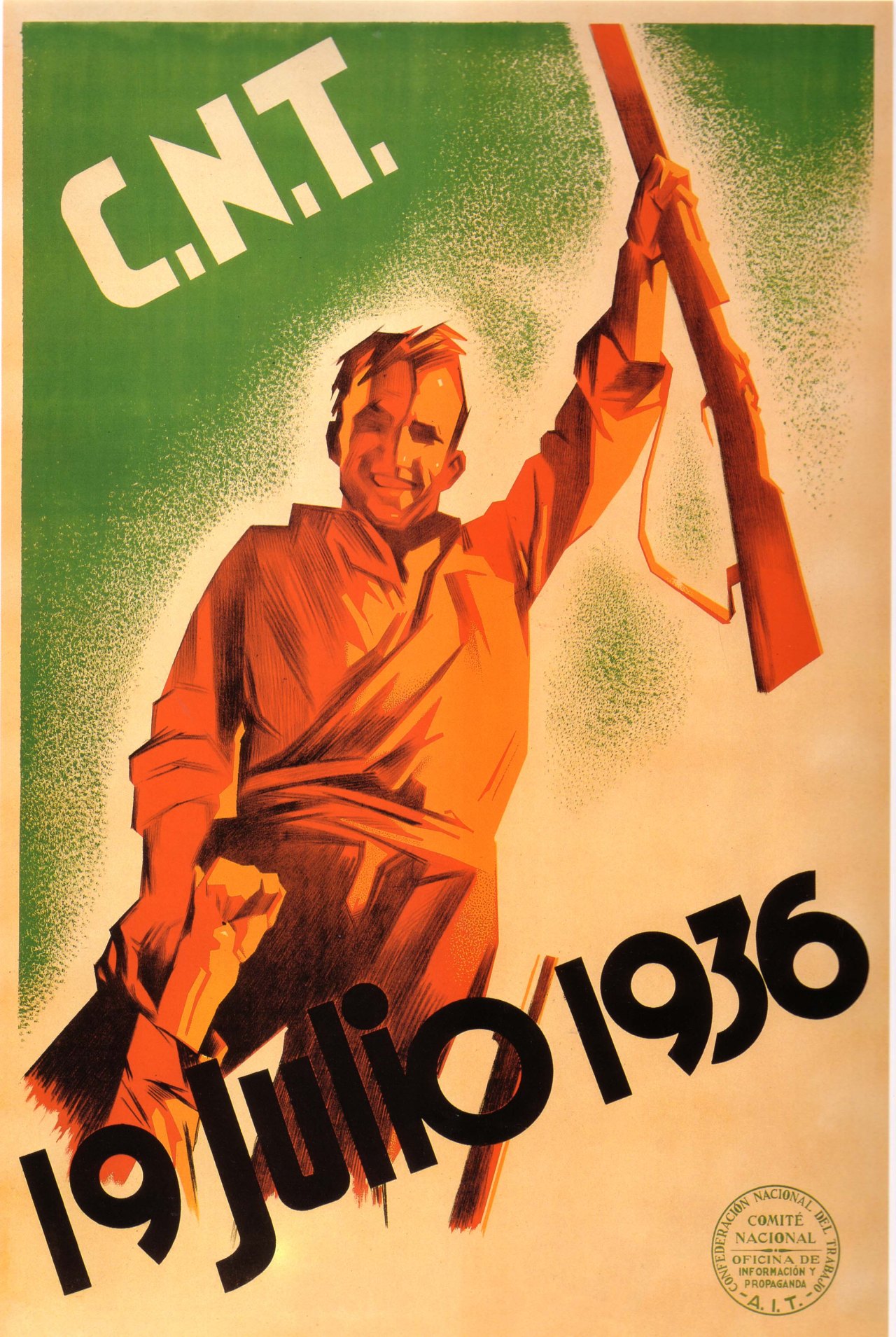
Sliocht as Revolution and Counter-Revolution in Spain le Felix Morrow – aistrithe agus curtha in eagar, le ceisteanna. Déanann sé cur síos ar éirí amach na hoibrithe i Barcelona
Building on last month’s resources on the Middle Ages, here are linked notes and presentation: Strongbow: A Story from Ireland in the Middle Ages.
The history of Strongbow and the Norman conquest of Ireland is a great case study for Junior Cycle students to get to grips with life and politics in Medieval Europe. It’s also a crucial episode in Irish history.
On March 17th Bono wrote a poem about the Ukraine war. Without even proofreading it, he sent it to a top US politician, and she read it out at a public gathering. Then he decided to post it on Twitter,
‘It wasn’t written to be published, but since it’s out, here it is,’ he tweeted. No, he didn’t want it to be out. He just sent it to a luncheon involving top political elites in the most powerful country in the world.
The poem was so bad it was a shock to the senses. But now that a few weeks have passed we should take a closer look. What are the specific features that make it so bad?
It’s on the nose
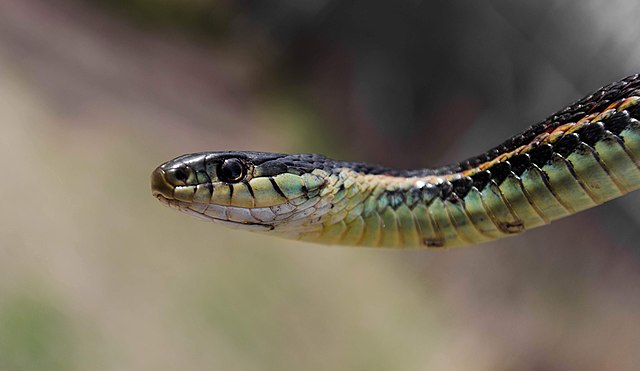
Usually poems weave in symbols and imagery and metaphors. For example, a poem about a vicious invasion might use snake imagery to signify evil. It might weave the metaphor into various vivid images.
Instead of doing that, Bono simply tells us what his poem’s symbol is: ‘For the snake symbolises/ An evil that rises…’
From this we can surmise that if Bono had written ‘The Road Not Taken’ he would have begun, ‘A fork in the road symbolises a major life choice…’
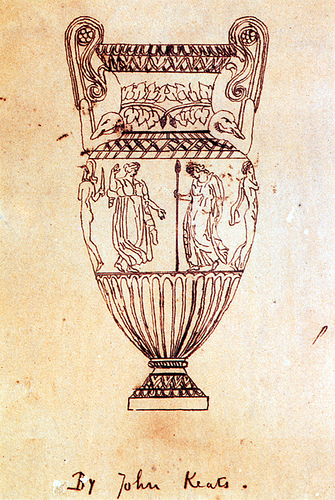
But that’s not quite it. We need more comparisons to really do it justice. If Bono had written ‘Ode on a Grecian Urn’ he would have begun, ‘This Greek vase is a symbol of stuff not getting old.’
Or ‘This Greek vase is like a wife who you’ve married but haven’t had sex with yet.’
It’s a textbook case of Irish narcissism
How are we to read the line ‘Ireland’s sorrow and pain/ Is now the Ukraine’? It seems that he’s saying Ireland had sorrow and pain in the past, and now Ukraine is getting a taste. As if Ukraine was some kind of bucolic hobbit village during the twentieth century – as opposed to a land ravaged by two world wars, famine, terror, the Nazi Holocaust, nuclear disaster and looting by oligarchs.
In this poem, Bono responds to the horror in Ukraine by talking about Ireland. There are grounds for empathy in our shared history of national oppression. But can’t Irish people engage with global events with a bit of taste, without making it all about us?
It’s largely babble
Let’s repeat that phrase; ‘Ireland’s sorrow and pain/ Is now the Ukraine.’ Sometimes in long complex sentences, we mistakenly switch between the singular and the plural. But what excuse does Bono have here, in a phrase eight words long?
Even if he had written ‘Ireland’s sorrow and pain/ ARE now the Ukraine,’ what would that phrase even mean? I struggle to put it into words. Our emotions have been transferred to another country? …have been transformed into another country?
An updated version of the poem reads ‘Ireland’s sorrow and pain/ Is now in Ukraine.’ Did we put our sorrow and pain on a container ship and send it over to the port of Odesa?
‘And they [saints] struggle for us to be free/ From the psycho in this human family.’ Us? But Bono is already free from Putin! Putin doesn’t control any territory in which Bono or his offshore money reside.
‘For the snake symbolises/ an evil that rises/ and hides in your heart/ as it breaks.’ What does this line mean? You, Nancy Pelosi and a bunch of US politicians, have got evil hiding in your heart. I’m not entirely sure that’s what Bono meant to say. And what’s this about hearts breaking?
All these musings are a waste of time, because later we are told that ‘the evil has risen my friends [sic, no comma] / From the darkness that lives in some men.’ All of a sudden, the evil is not something that rises in the hearts of Bono’s heartbroken friends in the US political elite. It is an outside force that threatens us. From context we can guess that it is Putin.
More examples of this incoherence are nailed down here.
It’s banal
When the poem is coherent, it is usually not saying anything worth saying.
What does itactually say about the war in Ukraine? Only that from time to time ‘sorrow and fear’ come along, because of evil. In this poem, evil is a category which includes (presumably amongst other things), paganism in Fifth Century Ireland and the Russian invasion of Ukraine. But evil no longer hides in Nancy Pelosi’s broken heart. The source of the evil is now ‘the darkness that lives in some men.’
How unfortunate that darkness lives in the hearts of some men. If only it had taken up lodgings in some more convenient place. Then this war wouldn’t have happened.
It’s absurd
When the poem is coherent and not banal, it’s absurd.
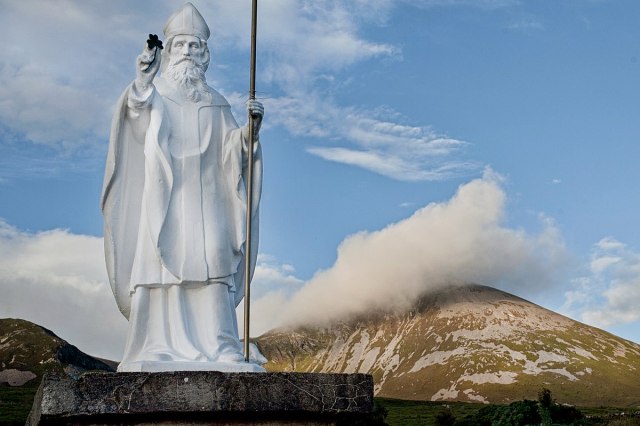
It is entirely possible to write a poem paying tribute to the armed resistance of the Ukrainian people and to the resilience of civilians and aid workers under the bombs. But Bono does not go down that route; instead he singles out the politician who happens to be in charge of Ukraine at this time, Volodymyr Zelenskyy. And not only does Bono praise this politician, and not only does Bono compare him to St Patrick. No, at the end of his poem Bono says that Zelenskyy is Saint Patrick.
Because this is the image that comes to mind whenever I hear the name ‘Volodymyr Zelenskyy.’
So St Patrick was personally brave. And yes, it appears Zelenskyy is also personally brave. But there the similarity ends, because (A) St Patrick was never an actor. And (B) he didn’t have a Neo-Nazi paramilitary group on his payroll.
But even if the comparison fit… So Putin is a snake and Zelenskyy is Saint Patrick. Zelenskyy is banishing Putin. But… why? Why say this?
It’s tasteless
In his tweet Bono explains that every year he sends a funny limerick to US politicians for their St Patrick’s Day luncheon. As you do.
This year, he explains, instead of sending a cheeky little rhyme, he felt compelled to send a serious and heavy limerick. Yes, a heavy limerick. Because this year things are different. There’s a war on. People are dying.
Not like all those other years, when there was no war on and nobody was dying. And if there were any wars happening, the US politicians who chuckled at Bono’s funny Irish limericks certainly had nothing to do with any of those wars.
But even leaving all that aside, maybe you shouldn’t write a limerick about a war. Maybe you shouldn’t try to discuss the nature of evil in a limerick. You see, the limerick genre has certain limits.
But as Bono admits, it’s an ‘irregular’ limerick. You can say that again. Limericks are disciplined, with a tight rhyming scheme and rhythm.
For example, ‘There once was a singer from Dublin/ Whose tax situation was troubling…’ etc.
Limericks have to scan well, or else they sound contrived. And they are short, like five lines.
It’s not a limerick
When I first read Bono’s poem, it scanned so poorly I didn’t even realise it was a limerick. There were words that I didn’t realise were supposed to rhyme with other words. I only learned that it was a limerick because Bono said so. Then I went back and read it in the sing-song jokey rhythm of a limerick. It sounded so much more tasteless and bizarre. In other words, it’s not an irregular limerick, it’s an atrocious limerick.
If Bono had written something like the following, it wouldn’t have been quite as bad:
A snakey old psycho named Putin
Escalated the bombing and shooting
But Zelensky had tactics
Because he is St Patrick
And so for Ukraine I am rooting.
It’s absurd, offensive, tasteless, baffling. But it’s brief, and it’s actually a limerick.
And it says everything Bono takes fifteen lines to say. That’s it. All the essential points are there. But to create the impression that he’s saying something deep and heartfelt, he ties the poem up in knots with vague phrases that mean nothing. He does not succeed in covering up his poem’s essential banality and absurdity, only in adding a layer of incoherence.
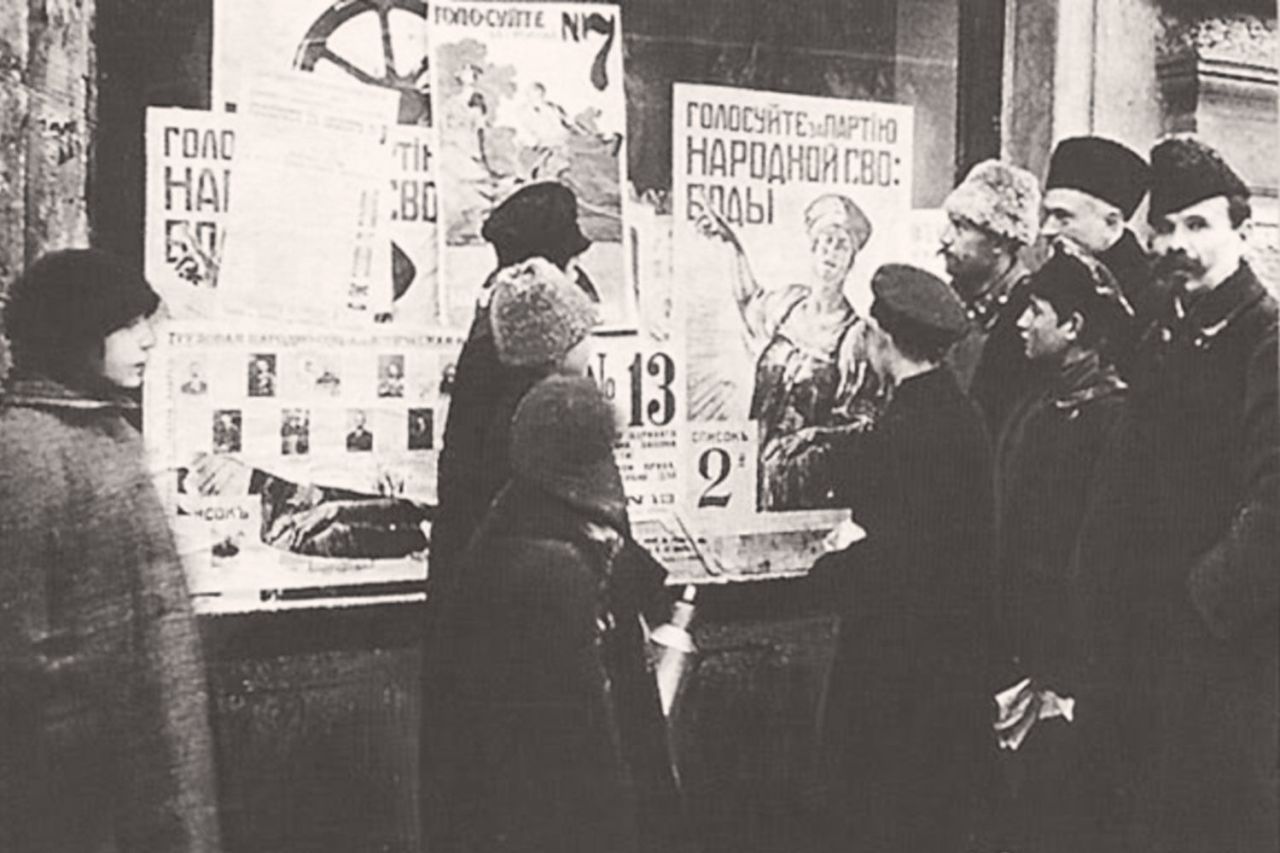
In January 1918, a few months after the October Revolution in Russia, a parliament called the Constituent Assembly met for one day before it was suppressed by the Soviets. This blog has dealt with the episode before. The incident suggests a ‘What if?’
In OTL (Original Timeline, ie, real life), the Soviets were willing to allow the Constituent Assembly (CA) to exist as a subordinate body. Likewise the CA was willing to let the Soviets exist as a subordinate body. But neither would tolerate the other attempting to assume state power.
But what if the Soviets were willing to bend the knee? What if the Constituent Assembly was allowed to assume control? How might the Russian Revolution and Civil War have developed from there? How might the Russian Twentieth Century have been different?
Posters for the Constituent Assembly elections
Element of Divergence
First we should explore plausible scenarios where this could take place. We should answer the question of why and how it might come about that the Soviets, having seized state power, would be willing to hand it over to the CA.
The Soviets were workers’ councils, a system of direct participatory democracy. The Bolsheviks Party had won a decisive majority in these councils in September 1917. They believed that the Soviet was a higher form of democracy than the CA. They hated the Right Social Revolutionary party (RSR), which over 1917 had made compromises to the right and enacted repression against the left. They believed that the split between the RSRs and the Left SRs rendered the election results meaningless.
In other words, the Bolsheviks (along with their allies the Left SRs) had strong reasons to suppress the CA.
In spite of these strong reasons, it is not that difficult to imagine the Soviets giving up power to the CA. In Germany and in Austria in this period, and in Spain in the 1930s, we see many examples of communists, socialists and anarchists giving up power to a bourgeois-democratic government in exactly this way. In fact, they were far more flagrant. The German Social Democrats assembled militias of far-right veterans to suppress the German Revolution. The Communists in Spain became the enthusiastic apologists of a liberal-republican government and preached that Spain was not ready for revolution. In short, the Bolsheviks are the outlier among social-democratic and even nominally communist parties in the Twentieth Century in that they were really willing to seize and hold power.
In our ATL (Alternative Timeline), the leadership of the Soviet is more in line with the mainstream of international social democracy – ie, more timid and cautious.
I do not propose a single ‘Point of Divergence’ – for example, Lenin is murdered by agents of the Provisional Government; Trotsky stays in a British concentration camp in Canada. Rather I propose an Element of Divergence, a factor which develops differently over a whole period of years and even decades. In this ATL, the Bolshevik Party as we know it simply do not develop. The more radical and militant trends within the Russian Social-Democratic and Labour Party (RSDLP) do not cohere into the Bolshevik party from 1903 to 1912; rather they remain loose and scattered and undefined. We will, for convenience, refer to them as the militant socialists.
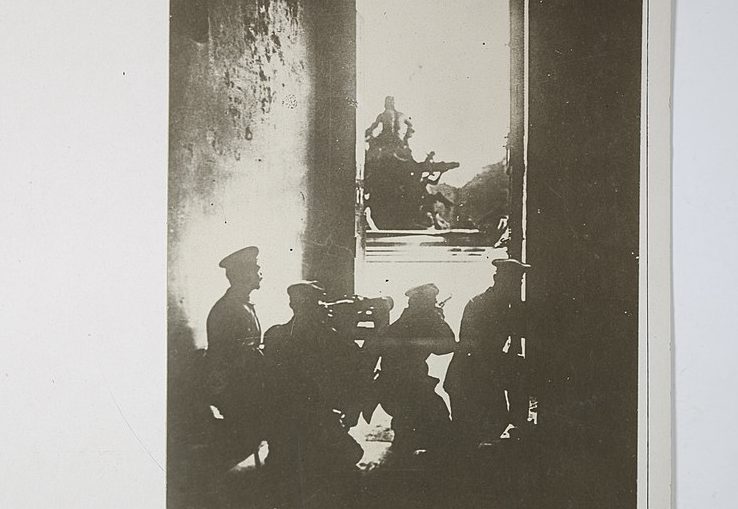
Fighting during the German Revolution, during which the equivalent of the Soviets did hand over power to the equivalent of the Constituent Assembly.
The Alternate Timeline
Pushed by a mass upsurge of workers, soldiers, sailors and peasants, the militant socialists end up in control of the Soviet by October 1917. They proceed to seize power in some incident corresponding to the October Revolution. But by January they are afraid of their own power and uncertain what to do with it. Their own base – workers and poor peasants – feel the hesitancy from above and demoralisation begins to set in. Meanwhile the militant socialist leaders feel pressure from the Russian ‘intelligentsia’ (professional middle classes) which supports the RSRs and the CA.
Instead of shutting down the CA after a single day, they remain in it, trying to negotiate a strong position for the Soviets within a new CA-dominated political regime. In other words, they turn back the clock and accept Provisional Government Mark 2. The discredited Provisional Government, attacked from right and left then finally overthrown in the October Revolution, has returned in a new guise with many of the same personnel.
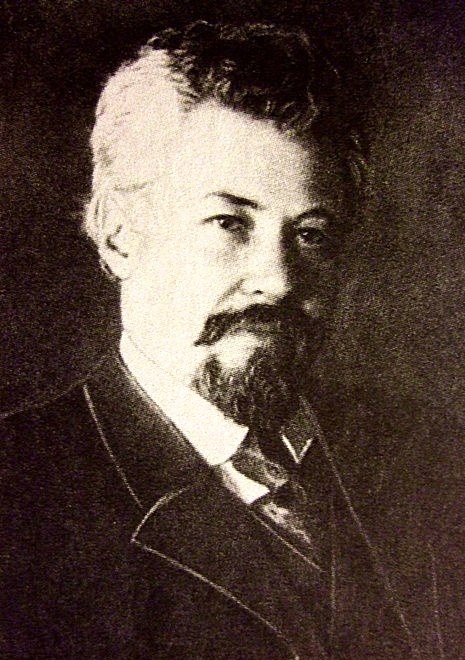
Thus begins the Chernovschina – the regime of Viktor Chernov, a firebrand within the RSRs who in OTL served for that one day as President of the Constituent Assembly.
Viktor Mikhailovich Chernov, president of Russia for one day in 1918. During 1917, though a Right SR, he had been critical of the doomed policy of coalition with the right-wing parties
Chernovschina
In OTL, the RSRs set up a government at Samara during the Civil War in the name of the Constituent Assembly. This government was called Komuch. It gives us valuable insights into the main features of the all-Russian Chernovschina which develops in this ATL.
The Chernovschina, like Komuch, would have a narrow base of support: a layer of the intelligentsia, and not much beyond that. Its decisive majority vote in the CA elections may seem to indicate that it had a mandate. But for Komuch, this mandate translated into precisely nothing. It was unable to raise an army. It suppressed the Soviets on its own territory and gave back the industries to their capitalist owners; still the wealthy refused to support it.
Komuch governed a population of 12 million people on the Volga. Chernov would govern all of Russia, including the central industrial region where the factory workers in their millions are enthusiastic supporters of the Soviet. In these central provinces and great cities, the Bolsheviks actually won a majority in the CA elections. Unlike Komuch, the Chernovschina would be able to present itself as having the support of the Soviet; this and this alone, the support (really the submission) of the Soviet, explains why it is in power.
It has a tense relationship with the Soviet, with the working class, with the poor peasants. But the militant socialists are forced to act as the enforcers of the Chernovschina. They try to whip their supporters into line, because to do otherwise would be to admit their own bankruptcy.
As in OTL, famine begins, striking the cities hardest. Chernov refuses to consider the kind of expropriations which the Bolsheviks practised in OTL; thus he retains the passive support of the peasant majority, but loses the active support of the cities.
Thus the working class, its hopes raised high by the October Revolution, feels a horrendous demoralisation set in as 1918 advances. Many still hold out hope that the Chernovschina will deliver for them, or that the Soviet might yet overthrow the CA. On that basis, Chernov is still able to mobilise some support.
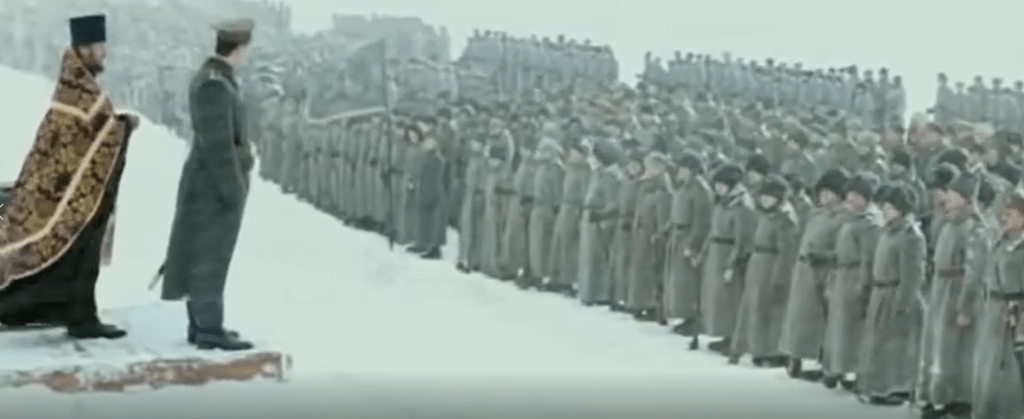
Still from the movie Admiral, dir Andrey Kravchuk, 2008. In ATL as in OTL, the White Guards, with the blessing of the church, rallies the troops for counter-revolution.
Civil War
And support he needs. The Russian armed forces, though in an advanced state of collapse, are fighting a desperate war against Germany. Meanwhile in ATL as in OTL, military officers, nobles, the bourgeoisie and the church organise counter-revolutionary armies. They see the RSRs as little better than the militant socialists; in any case, the militant-socialist bogeyman is an integral part of the Chernov coalition. Alongside the new Russian army which Chernov is trying to build, the Red Guards are the main armed force on which the CA can rely.
And Chernov himself, as in OTL, supports the seizure of noble land by peasants. The emergent White Guards have no reason to be less hostile to the RSRs than they were to the Bolsheviks in OTL.
It is frankly impossible to see how the Chernovschina can win the war against Germany, or even to hold out until Germany’s defeat in the West. But as in OTL, they are determined to continue the war. We must envisage an inexorable German advance to the gates of Moscow itself, even the fall of Petrograd, before the RSRs are forced to sign a peace treaty even more humiliating than the Treaty of Brest-Litovsk.
The Allies, meanwhile, look askance at the Chernovschina for the same reasons the Whites do: the communist bogeyman. Initially they support Chernov against Germany, but then turn against it when the peace treaty is signed.
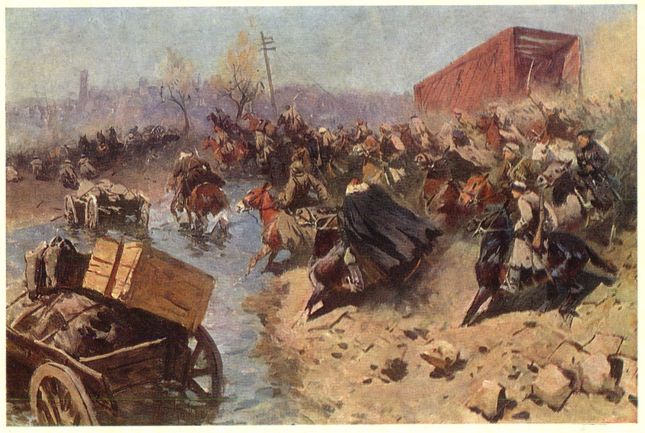
So we end up as in OTL: White armies, backed by the Allies, fighting against the ‘Red’ (perhaps the ‘Pink’) regime of Chernov. The Allies might be less enthusiastic about intervention because the Chernov regime is more amenable to them – paying the debts and not seizing the factories. It is possible the Allies, or at least some of the Allied countries, would remain neutral. But on the other hand the Allies would not be held back by their own people. In OTL, there was deep support for the October Revolution among working-class people in the western countries, resulting in the ‘Hands off Russia’ movement and the Black Sea mutiny. These factors tied the hands of Allied intervention. It is doubtful the western working class would be as sympathetic to the Chernov government, so the Allies’ hands would not be tied in the same way.
Painting on the Civil War by Mitrophan Grekov
The Fall of the Constituent Assembly
Increasing discontent in the ranks of militant socialists at some point breaks out into a mass uprising against Chernov in Moscow. Meanwhile Chernov and co have grown impatient with the Soviet; they see it as the main obstacle to Allied support. So the Chernovschina engage in the bloody suppression of the uprising of the Moscow proletariat. This results in the final liquidation of the Red Guards and the Soviets, and the final demoralisation of the working class. The Revolution is over.
The Chernovschina tries to fight on, but its people are utterly demoralised and it is beleaguered on all to sides. It succumbs to the onslaught of the White Armies. The death-blows are probably dealt in the campaigning seasons of Spring and Summer 1919.
So this ATL leads us to a White victory in the Russian Civil War. That is a ‘What If’ for another day and another post. But suffice it to say that a White military victory would only be the beginning of the violence. The White movement, in order to fulfil its aims, would terrorise the urban population into submission and seize the land back from the peasants. The scene would be set for decades of conflict as the White generals invade the newly-independent republics one after another, trying to restore their vision of ‘Russia one and indivisible.’
Conclusion
This alternate history is based on two main real-life analogues: Komuch (which I have written about here, here and here) and the Republican side during the Spanish Civil War.
For some, it is tempting to imagine that the CA might have led Russia to stable parliamentary democracy, averted civil war, etc. But an electoral majority does not invest a political party with magical powers. In terms of sheer numbers, the RSRs won an overwhelming vote. But the vote was confused and passive in character. They had a very narrow base of confident, active supporters. The CA could only have survived if the Soviets had made the terrible mistake of propping it up at their own expense – at their own very great expense.
More school resources here for you today: material on the poem ‘Questions from a worker who reads’ by the great Bertold Brecht.
This is a poem I’ve never seen in a school textbook but which I’ve found brilliant and thought-provoking for a group of 14-15-year-olds. But really this would work with any age group.
Below is the text of the poem itself plus a presentation that should occupy the class for an hour or so.
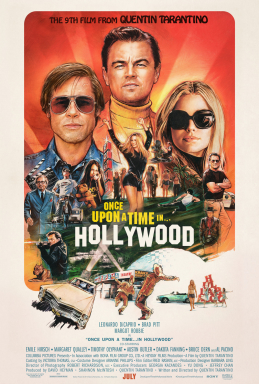
Review: Once Upon a Time in… Hollywood – dir Quentin Tarantino, 2019
Some movies have lines which are repeated and stressed so that they stick in your head for years after. Spiderman has ‘With great power comes great responsibility.’ Once Upon a Time in Hollywood has ‘Fuckin’ hippies.’ The phrase comes up again and again, right up to the moment when the last fuckin’ hippy is burned alive with a flamethrower. If you close your eyes, it’s like you’re watching South Park.
Another tic in this movie is the way the camera and script keep lingering on the titles and tropes of old racist westerns. In a lot of these movies the American Indians were an evil force, menacing the good (white) people of the frontier. Of course, director Quentin Tarantino is against racism and is highlighting this stuff in a mocking way. But he must be smart enough to realise that Once Upon a Time in Hollywood is a movie in exactly the same mould, where good people are threatened by an outside evil. The frontier is Hollywood in the 1960s, and the evil natives are the Manson family.
The film is compelling. We follow the travails of a washed-up actor and his stuntman buddy. At first we tag along with impatience as we want to get to the Manson bits, then we get drawn into the story of these two characters. But it remains in our minds that these guys are on a collision course with the Manson family, and we want to find out what Tarantino has to say about the Tate-LaBianca murders. Here’s a Hollywood movie made by big Hollywood names, directed by a Hollywood iconoclast. Surely these people have access to some folk memory, rumour or inside information. What will be revealed?
Meanwhile we get a warm nostalgic portrait of Hollywood in the 1960s: costumes, music, parties, and neon signs. This is just a wonderful place. Within this world, the worst thing that can happen is not so bad: an actor and a stuntman who kind-of deserve to be washed up are in danger of being washed up.
But lurking on the boundary of this world is a malicious presence which we know of as the Manson family but which the main characters simply see as (say it in your Eric Cartman voice) a bunch of fuckin’ hippies.
That’s it. That’s what Once Upon a Time in Hollywood has to say about the Tate-LaBianca murders: that Hollywood in the 1960s was great, until the Manson family came along; and wouldn’t it have been great if someone had been in the right place at the right time to stop the murders? So precisely nothing is revealed.
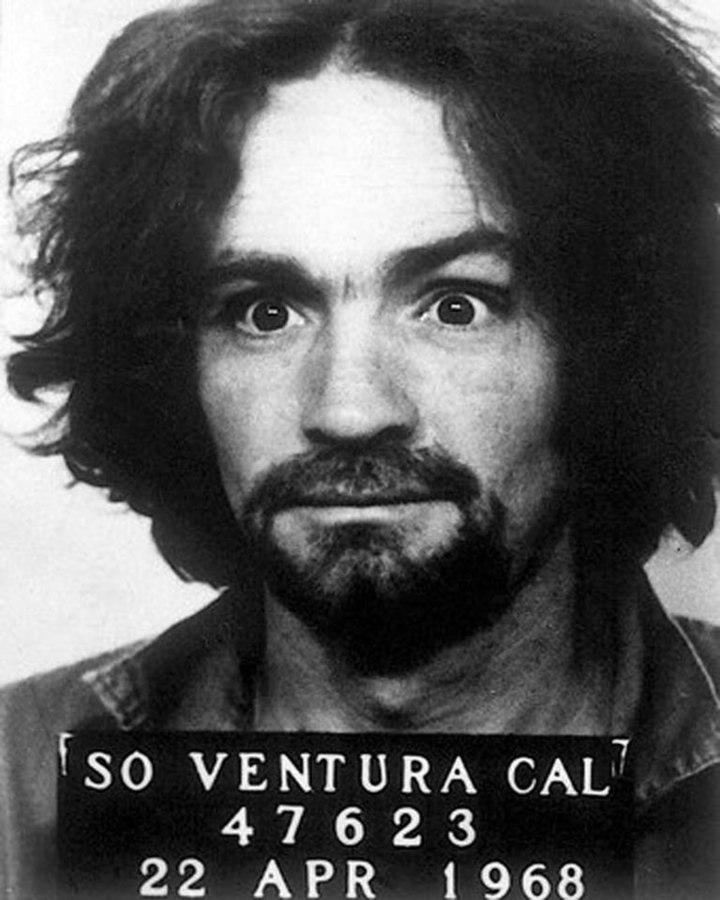
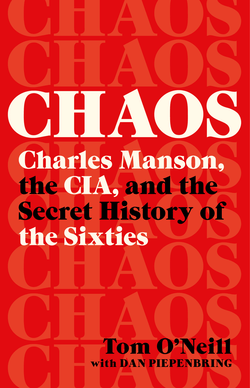
I watched this movie shortly after reading Chaos by Tom O’Brien. This extraordinary book charts a journalist’s attempt to follow up some of the many loose threads of the Tate-LaBianca murders. Bad shit was going on at the Polanski house. Manson knew big Hollywood names (which he gained by pimping teenage girls). The book explores a labyrinth of other strange connections and mysteries, driving at a point which contradicts Tarantino’s movie: that the Manson family were very much a part of the Hollywood ecosystem, and not an outside evil at all.
There is a gesture in this direction in the film. Near the end, one of the Manson family speculates that maybe the experience of growing up watching the violence of Hollywood is what made them violent. But we are expected to see this as pretentious studenty rambling. It is set up for us to dismiss it with self-righteous contempt.
Now, Chaos and Once Upon a Time in Hollywood came out in the same year and Tarantino could not possibly have read the book before making the film. But if you think about the Manson murders for ten minutes it should be clear that all is not as it seems. It’s probably not a coincidence that Manson, the guy who drugged and pimped out minors, showed up at the doorstep of Roman Polanski, the guy who later fled the United States after he drugged and raped a minor. Not only does the film fail to delve into any of the mysteries surrounding the case, it makes no reference to this elephant in the room.
If you’re looking for Hollyweird revelations about the dark underbelly of the movie industry, all Tarantino’s got to say to you is ‘Nothing to see here.’ This is not a film about the Manson murders. It is a western movie about an aging gunslinger and an outlaw who find redemption by defending a settler from the natives; only it happens to be set in1960s Hollywood. If you go in expecting an interesting pastiche along these lines, you will not be disappointed. Pitt and DiCaprio play an amusing pair of fuckups and antiheroes. It’s not necessarily a bad thing that the film mocks the Manson family instead of mythologizing them, for example when Brad Pitt mangles Tex Watson’s one-liner – ‘some devil shit.’ The ultra-violence of the ending could easily be interpreted as righteous fury.
I’ve usually enjoyed Tarantino’s movies but this was more of a mixed bag than usual. The journey was unexpectedly compelling; somehow the film got me to feel sorry for this blustering actor who’s had a successful career and has plenty of money. This journey has texture and verisimilitude. This movie knows Hollywood and cares about it and gets us to care. But the destination, when we finally get there, is disappointing. The ending just left me with screams of agony and the words ‘Fuckin’ hippies’ echoing in my head.
As a general rule, if you are reading about Russian history and you come across the words ‘rare blood condition’ and ‘Rasputin,’ more times than ‘Putilov’ or ‘Smolny,’ you are reading bad, derivative pop history. At the risk of sounding like a dick, I’d say if you don’t even know why the words ‘Putilov’ and ‘Smolny’ are relevant to the Russian Revolution, then you have never read anything half-decent on the subject.
‘History’ of this kind always portrays Tsar Nicholas II as a nice bloke who was dealt a bad hand by history.
The other day a great example of this popped up, as these things often do, on Facebook. A page with 1.7 million views titled Being Liberal shared a post from Rebel History. It was one of those ‘on this day x years ago’ posts, and it was on Tsar Nicholas.
It struck all the usual notes. The Tsar, it informed us, was beleagured on all sides by military disasters, angry ‘lower classes’ and terrorism.
Here are some relevant facts which the post did not mention and which these kinds of things never mention.
First, Nicholas was a massive anti-Semite. He sponsored the infamous pogroms which killed thousands of Jews and drove millions more into emigration. You know all those impoverished Jewish people on the Lower East Side of New York in the early 20th Century? They had fled there from the Russian Empire because Nicholas and his family had Nazi-style laws against the Jews, and every so often egged on mobs to burn their houses, rape, torture and kill them.
I was about to write that ‘other groups were persecuted too.’ But that doesn’t cover it even half way. A majority of the population of the Russian Empire was non-Russian, and were legally disciminated against as a result.
A page called Being Liberal shared the post in question. This page has almost hourly posts about the war in Ukraine. Did the admins of Being Liberal think that sharing a post lamenting the fall of the Tsar would be some kind of gesture of support to Ukrainians? It was the Tsars who suppressed the Ukrainian language and enforced ‘Russification’ policies.
Tsarism witnessed the genocide against the Circassians among numerous other sanguinary massacres. In 1916 Tsar Nicholas responded to a rebellion in Central Asia with a campaign of repression that killed 88,000 people.
Every Russian, meanwhile, was assigned a ‘social estate’ which circumscribed their rights and duties. The position of women was dire beyond description, especially in the rural areas.
That page, again, is titled ‘Being Liberal.’
The post did acknowledge that ‘the Czar’s government’ suppressed the 1905 revolution with violence.
That needs some elaboration, though. Workers living in severe overcrowding and hunger organised a union (which was against the law). They marched peacefully with a humble petition to the Tsar. The Tsar’s soldiers gunned them down, killing around a thousand on that day. The Tsar went on to kill around 15,000 over the course of crushing the 1905 revolution.
It took that near-miss revolution to convince Nicholas to allow the Russian people to have a parliament. By the way, the new parliament was rigged in the Tsar’s favour and had a restricted franchise.
To clarify, before 1905, no parliament, and Nice Bloke Nick killed all those workers on Bloody Sunday 1905 because he preferred it that way.
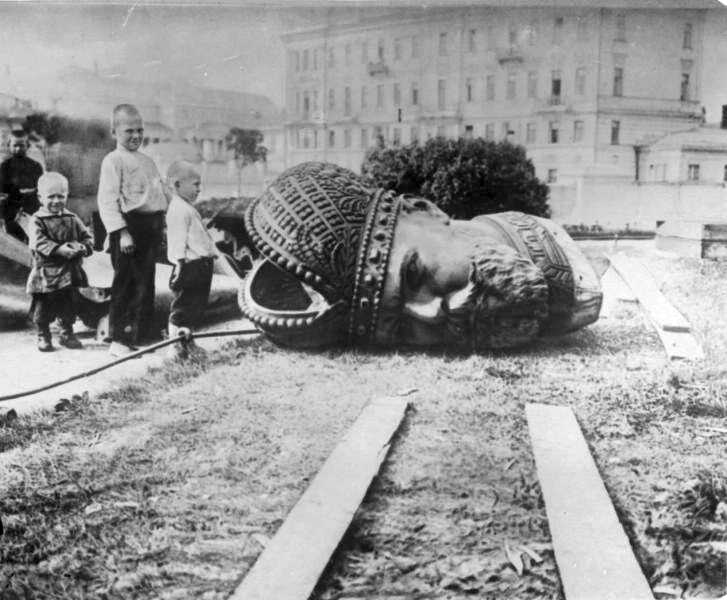
The cover image for this post shows a fragment of a Tsarist statue lying in the street after the February Revolution. I believe the Tsar in question is not Nicholas but Alexander. But the message of the photograph is clear: the kids either have the sun in their eyes, or like most Russians they were pleased to see the Tsar’s monuments beheaded.
One mistake pop history makes is to focus on individual personalities and to engage in fruitless debate over the moral responsibility of individual famous people. But around Tsar Nicholas this goes even deeper, because he had a terrible personality and he definitely had personal moral responsibility for the evils of his regime. He was stubborn and narrow-minded even for an absolute monarch.
‘By all accounts’ the post tells us, ‘Nicholas was happy to give up power and live a peaceful life in exile with his family.’
‘By all accounts’! Not by mine.
To get the Tsar to abdicate, it took five days of street fighting. It took thousands of deaths on the part of unarmed workers battling police and soldiers. It took a military mutiny and the burning of Petersburg’s police stations.
At the time, Nicholas II was dreaded and loathed across the world as a bloody dictator. Liberals celebrated his downfall, not just socialists. But liberals today, at least some of them, have had their knowledge of that history dulled. A part of it is that anti-communism makes for odd political bedfellows. This has taken the form of bad pop history. That is, decades of people hearing and repeating clichés about Rasputin and rare blood conditions.
March 26th will mark one year since i launched The 1919 Review. I want to mark the occasion by offering some advice for beginner bloggers.
1. Blogs Snowball
I had an old blog which I approached with zero plan or consistency, but on which I threw a lot of varied stuff over 5+ years. I have not posted on it since 2015. Somehow in spite of this complete neglect its View Count and Visotor Count coasted along with a combined 6,000 visitors in 2016, 2017 and 2018. It took years for engagement to fall away. Even now it’s a rare week the old blog doesn’t get 20+ views. For a lot of last year, the old blog was doing better than The 1919 Review!
There’s some good stuff on that blog and I’m happy people are still reading it. But my point is this: blogs snowball. Through some mysterious process, they develop a momentum of their own.
So…
2. Keep at it and be consistent
I launched The 1919 Review with a budget of zero but with a bit more planning and determination than I had put into previous projects.
For months, it got practically no views or visitors unless I shared something on social media. The base line default was zero.
One year on, the blog has organic reach. Social media shares generate a spike of views and visitors, of course, but now I have a steady base line of engagement between shares.
It might be the subscribers I’ve built up. It might be that, having built up a certain volume of posts, I’m casting the net wider on search engines. Unless it’s just some inscrutable trick of the algorithm that governs the WordPress Reader feed, it must come down to this: the blog has organic reach because I posted religiously once per week for a year.
3. Use social media
For me, this means Facebook; I don’t really use the others. I’m not a big fan of Facebook, for all the usual reasons, but I still use it every day, again, for all the usual reasons.
One good development over the last few years has been the culture of well-moderated and pleasant public and private groups. It is through sharing posts in such groups that I got some of my biggest spikes in engagement.
Be a member of the group for a while before posting your own stuff, and meanwhile contribute in other ways. Give more than you take. Before you self-promote, read the room and take a look at the rules.
4. Make a podcast
I linked in with Anchor and Youtube to make a very basic, rough-and-ready audio version of my series Revolution Under Siege. It’s not somewhere I expected to go, and it hasn’t brought massive traffic, but it was a lot of fun and it has potential.
5. Savour the little victories
Cut your cloth to measure. With no promotion budget and with many other commitments in my life, it was out of the question that I would be marking big victories and breakthroughs in the first year of The 1919 Review. But I hit every target I set myself, and that feels good. Celtic Communism and Sláine were the biggest hits of year one.
Rather than my usual rule of once per week, I’ve posted three times in the last few days. This is because I’ll be away from tomorrow until April.
Until then, thanks to all my readers, subscribers and sharers.
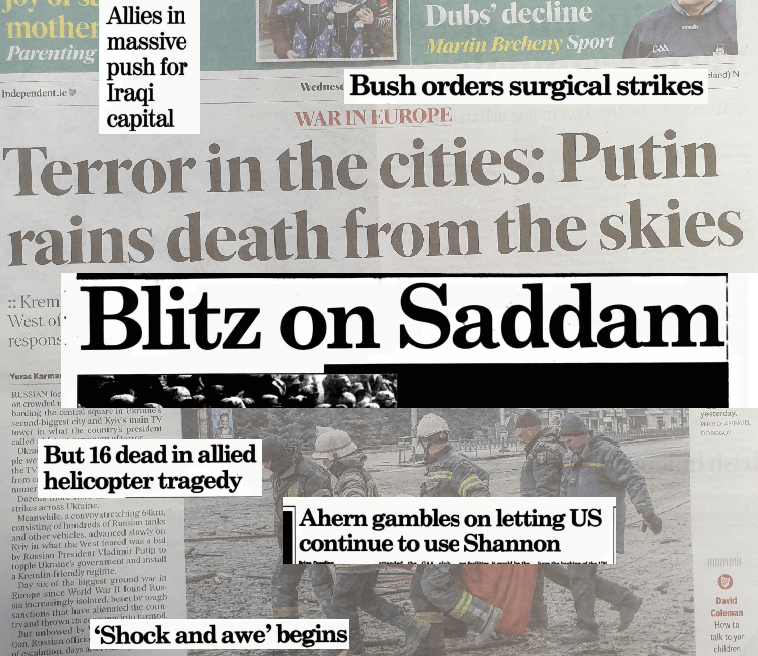
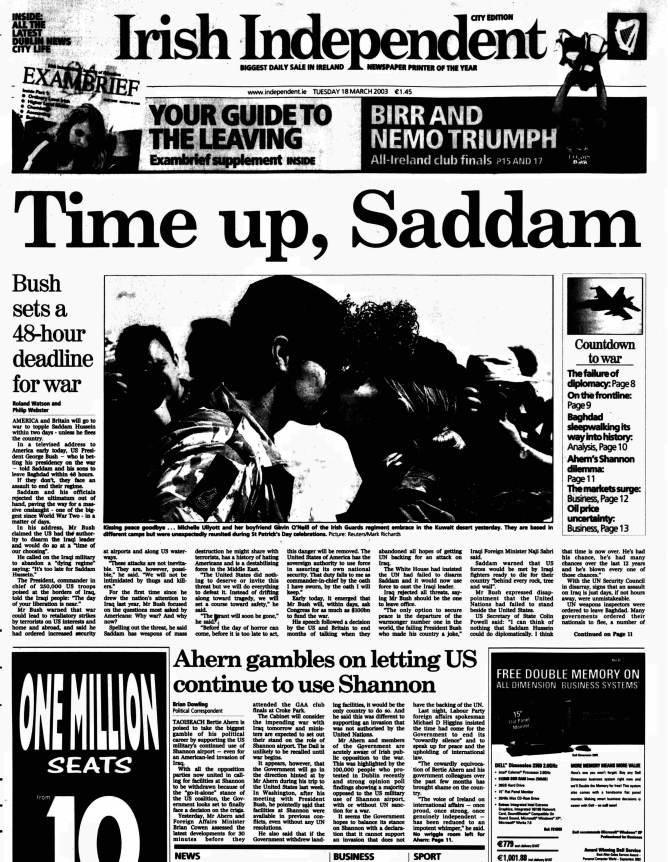
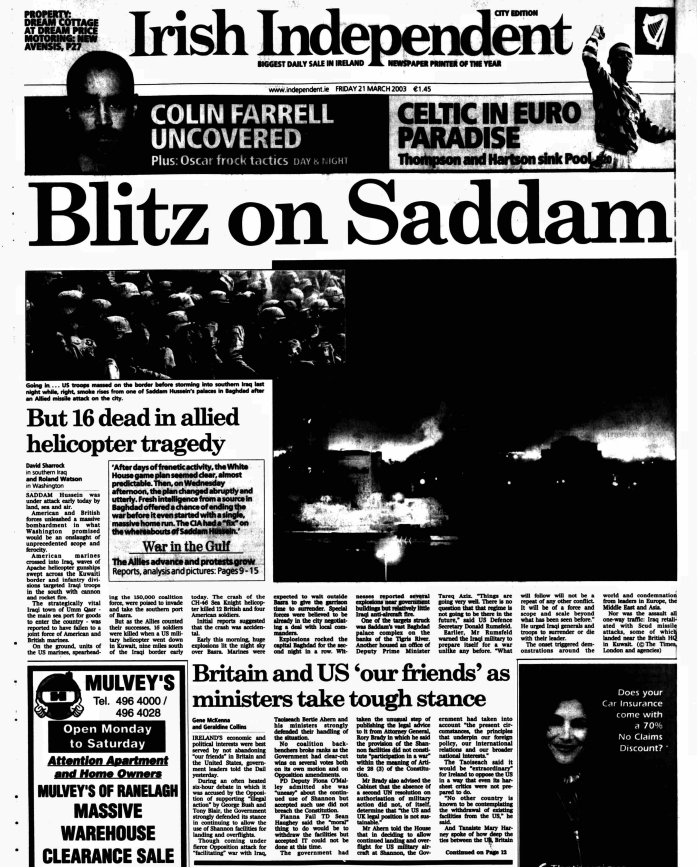
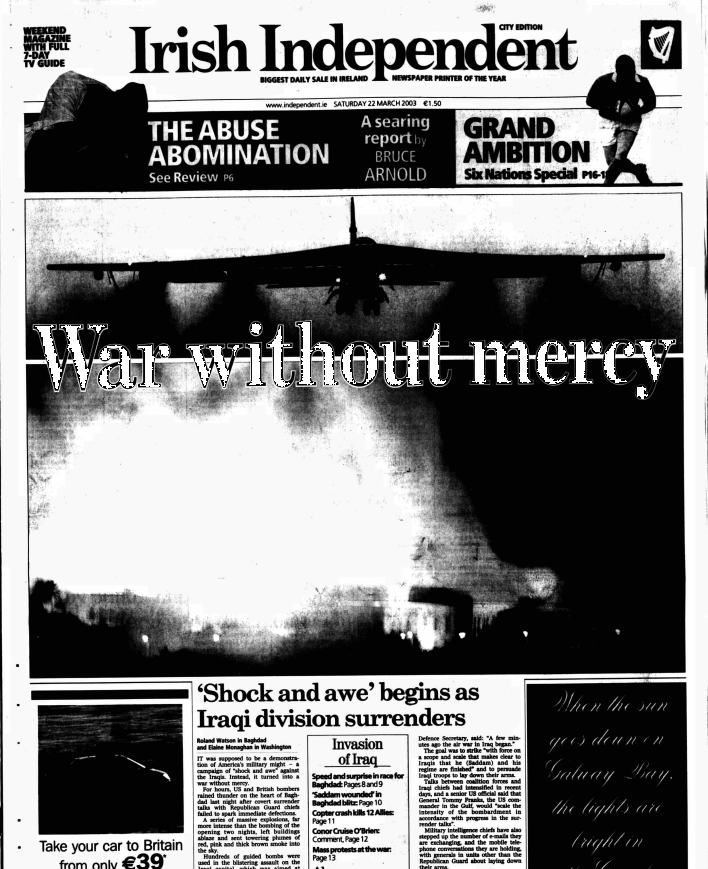
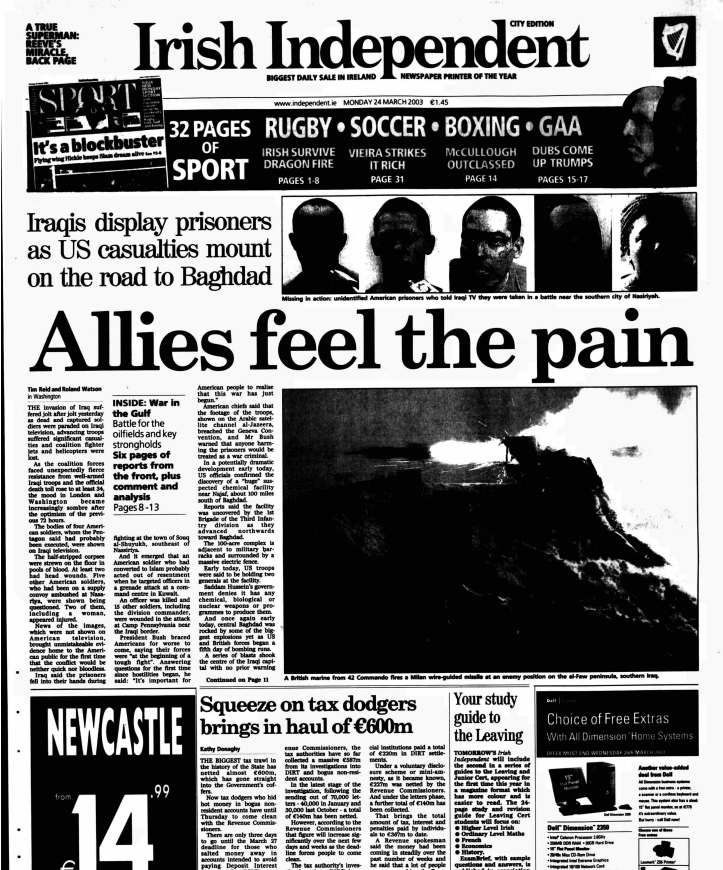
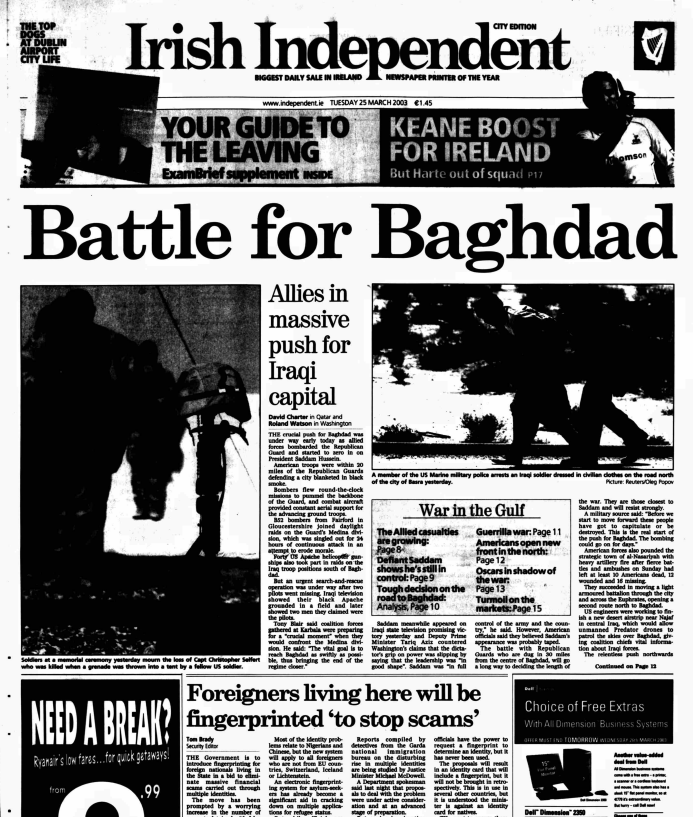
In 2003 the United States government and its allies invaded Iraq in a war of aggression. Within 3 weeks, over 3,000 civilians had died under the bombs, and twenty years later Iraq has not recovered and no US official has been held accountable.
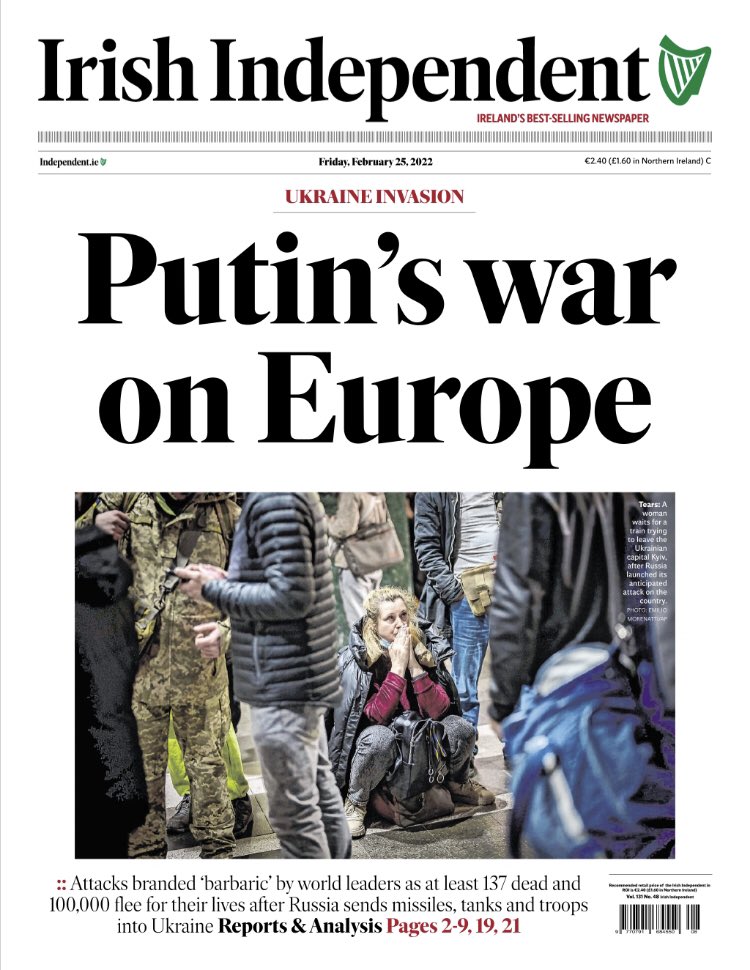
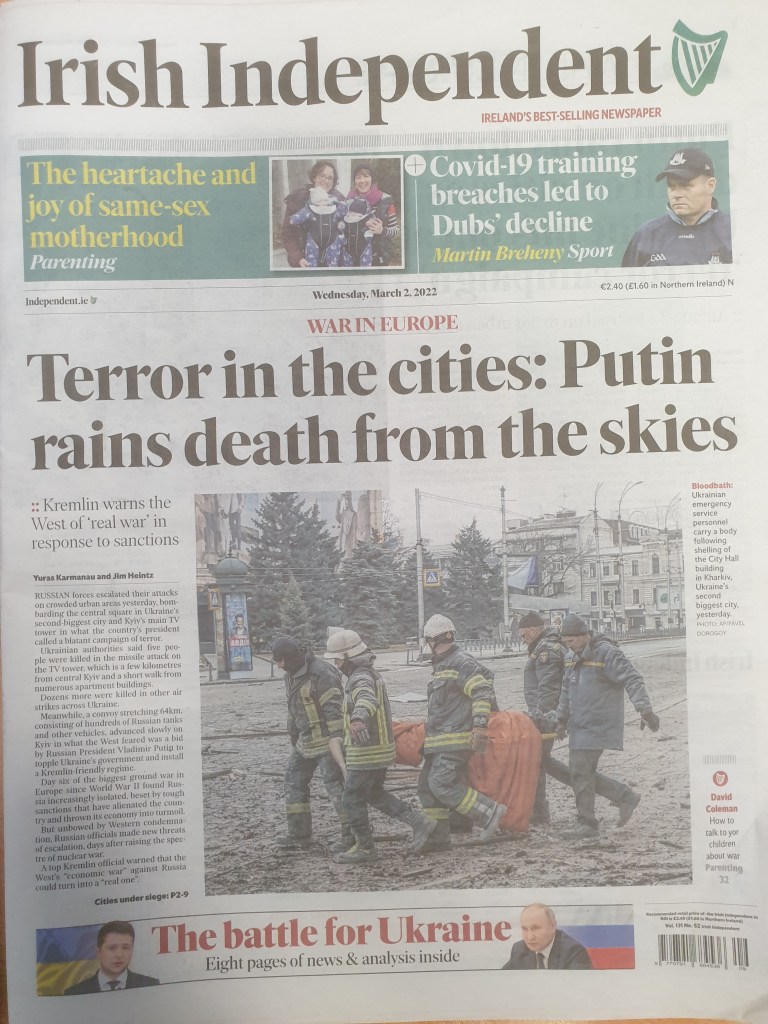
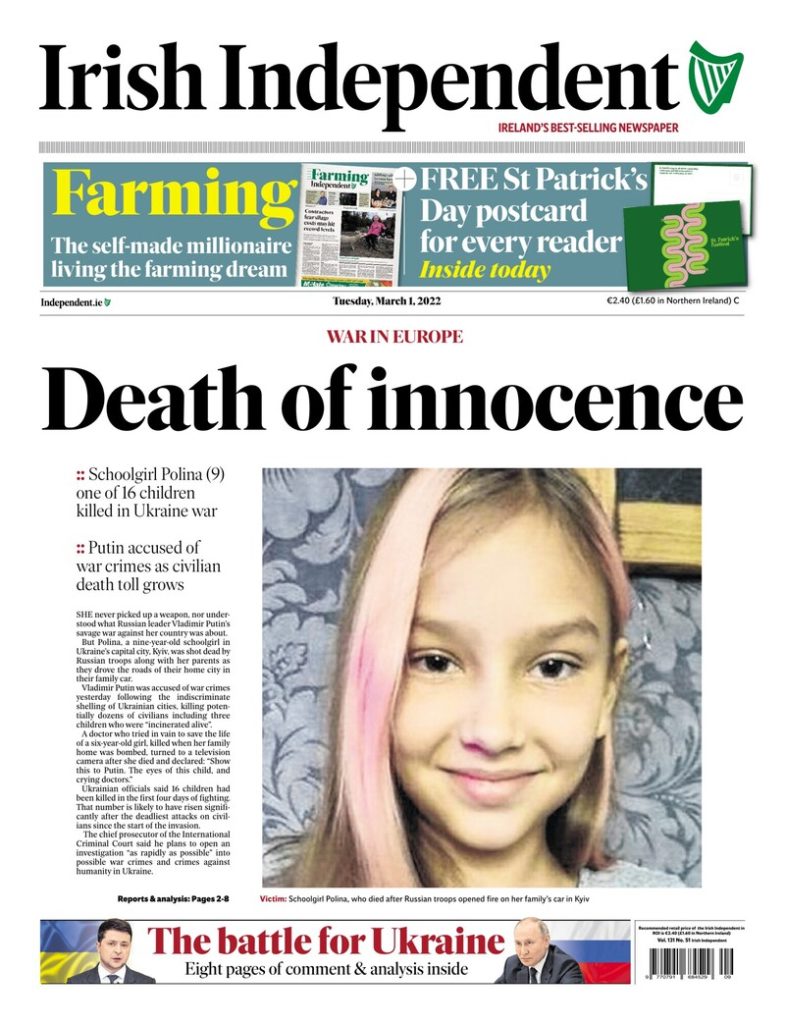
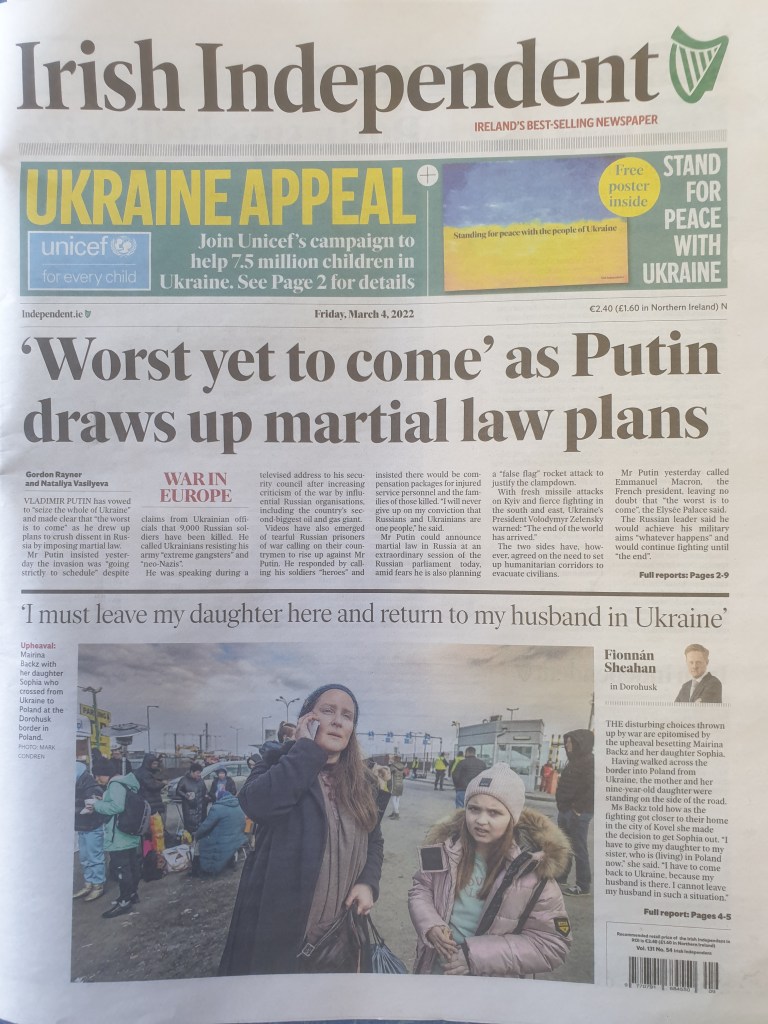
In 2022 the Russian government invaded Ukraine in a war of aggression. Currently the war is assuming the form of terrible sieges of Ukraine’s major cities. The death toll so far is unknown but around 1 million have already fled the country.
But newspapers did not cover the two events in quite the same way. That’s putting it mildly. I live in Ireland, so here are the headlines I’m seeing from our biggest newspaper. Here are five front pages each from the first week or so of the Iraq War (March 2003) and of the Ukraine War (Feb-March 2022). No further comment from me. The bias speaks for itself.
(You will notice this image is edited to make the headline easier to read)




 The 1919 Review