This fantastic poem was a lot of fun to teach as it provoked debate and discussion in the classroom. There are plenty of clips online to help fill in some of the background on the issues that come up in the poem – from Northern Ireland to nuclear war.
People are keen for ways to understand and explain the situation in Ukraine. You could do a lot worse than read the speech Putin made when he launched the war on February 24th.
Putin is at his most convincing when he is condemning the western leaders. He mentions Libya, Syria, Iraq:
We have to remind of these facts, as some Western colleagues do not like to remember those events, and when we talk about it, they prefer to point not to the norms of international law, but to the circumstances that they interpret as they see fit.
He is at his least convincing when justifying his own actions:
And for our country, this is ultimately a matter of life and death, a matter of our historical future as a people.
The destiny of the Russian people depended on a full-scale invasion and regime change of Ukraine? Yeah right.
Denazification?
At one moment he defends the operation as a means to defend the separatist ‘People’s Republics’ in the east. The next moment he speaks of demilitarising and ‘denazification’ of Ukraine.
Putin, if he is a sincere anti-fascist, might have started with ‘denazification’ of Russia’s war effort in Syria, where members of neo-Nazi organisation Rusich operate in the mercenary Wagner Group.
But the irony runs deeper. By reducing Ukraine to a warzone, Putin creates the possibility of Ukraine becoming a greenhouse for paramilitary, insurgent, mercenary and terrorist groups of all kinds. If the war is a long one, like in Syria, this is almost a certainty. This would offer new avenues of advance for Ukrainian fascism (which is a real and dangerous force).
In Iraq the chaos of invasion, war and insurgency led to the rise of Isis/Da’esh. We should consider what monsters could emerge from the ruins of Ukraine.
But the ‘denazification’ argument is window dressing in the speech. There is greater stress on the question of Russian security. This is a stronger argument, because NATO, with its bases in Eastern Europe, poses a potential threat to civilians in Russia. In this way the position is different from Iraq, where the ‘threat’ was completely fabricated.
Security
Though I was very young, I was in the anti-war movement at the time of the Iraq War. At the time we did not know for certain that the threat was fabricated. Speaking for myself, I opposed the invasion because – regardless of whether the intel was real or not – I rejected the idea behind it, that the US somehow had the right to bomb and invade Iraq just because there was some potential future threat to US security. The same toxic idea is at the heart of Putin’s speech on Ukraine. The ‘security’ of the stronger party is so important that it has the right to reduce its weaker neighbour to rubble just to head off potential threats.
On paper, a ‘neutral’ Ukrainian regime would be a guarantee of security for people in Russia.
In reality, by launching an obscene war of aggression the Russian state has made the situation far more dangerous, first and foremost for the people of Ukraine but in the long run for the people of Russia too.
There is a deep-seated anti-war sentiment in the US and Western Europe.[i] Since the disaster of the Iraq war, the US government has held back on launching anything on a similar scale. To attempt another war of that kind would create too much instability at home and in the ranks.
The best guarantee of security for people in Russia is not a ‘neutral’ regime planted at gunpoint in Kiev. It is the fact that working, poor and middle-income people in the west have absolutely no interest in going to war against working, poor and middle-income people in Russia.
But this invasion has done much to cut across that sentiment. Leo Varadkar, Tánaiste (deputy Prime Minister) of Ireland, has called Putin ‘the Hitler of the 21st Century.’ That is just as historically illiterate as Putin’s claim that he is ‘denazifying’ Ukraine.[ii] Of course, English-speaking politicians and columnists will bleat about appeasement and Neville Chamberlain literally every time there’s an international stand-off of any kind. Usually the vast majority of people will pay little attention to their grandstanding. But now people see on their screens and newspapers what’s happening in Ukraine. People will be more inclined to listen to the politicians and their pathetic Winston Churchill impressions.
In short, this invasion has made it more challenging to make the case against NATO aggression. People in Western Europe and the US will still, I predict, refuse to be dragged into war. But the mood is very different from a week ago. We cannot predict how the mood will be after months and possibly years of ruined cities, refugees and atrocities.
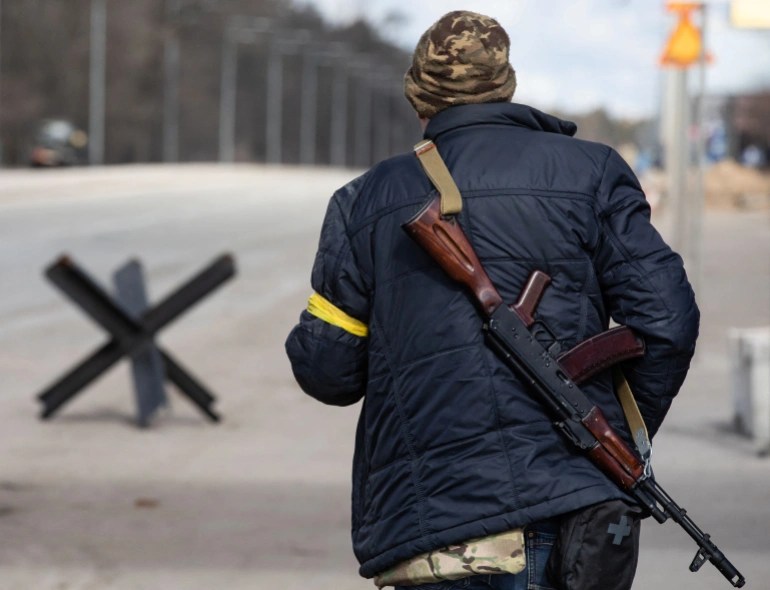
A member of the Ukrainian Territorial Defense. Photo from Al Jazeera
Strategy of Russian ruling class
But what is the rationale of the Russian ruling class? How does this wild, reckless move make any sense from a strategic point of view?
First off, Putin and his (apparently very small) circle of confidantes don’t care about the prospect for an anti-war movement in Western Europe or North America. They are cynical. This attack has got little to do with security and nothing to do with denazification. My understanding of it at this point is as follows.
Over the last year or so the Russian state has helped to defeat protest movements in Belarus and in Kazakhstan. It bailed out the tyrants in charge of those countries, and in return gained influence. The case of Belarus was significant because the Belarus front appears to have proved crucial for the advance on Kyiv. Victory in Syria is also a factor; the Russian military is much weaker than that of the US, but the Russian military has actually been winning wars. The Russian ruling class is at a relative peak in terms of power and influence.
While the actions of the NATO leaders are those of people who have time on their side, the actions of Putin suggest a desperate sense that whatever advantage he enjoys can only be temporary, and must be exploited to the full.[iii] Exploiting it at the negotiating table did not work, so he is exploiting it on the battlefield – with horrific consequences for the people of Ukraine.
To refer to Iraq again, when the US invaded that country I marched against the war. But it never entered my head to call for Russia, China or Iran to intervene – to send troops to Baghdad, to bomb New York, or anything of the kind. Obviously that would have made the situation far worse. Likewise any call for NATO ‘boots on the ground’ is dangerous.
On both sides, these are sick and cynical power games. The anti-war protestors in Russia have faced arrest in their thousands, just to show the world that their reactionary politicians do not represent them. A principled anti-war movement in Western Europe and North America, opposing the warmongers of all sides, must take inspiration from them.
[i] It may not always seem that way because western governments are always finding ways around the will of their own people to bomb and to engineer coups. They have used their vast resources and unaccountability to continue interfering in other countries in spite of the anti-war sentiment. But another war on the scale of Iraq or Afghanistan has been off the table for a long time.
[ii] In 1938 Britain and France gave Hitler everything he wanted, while in 2021 Putin’s enemies gave him absolutely nothing. Hitler was a fascist, a relative political outsider with dreams of world domination. Putin has been an apparatchik and politician within the Soviet then Russian state for many decades.
[iii] What about China? It is my assessment that, for the moment, the Chinese ruling class have more to gain from peace than from war, and will support the Russian regime economically while acting as a restraining influence. For example, they are helping the Russian leaders to weather the storm of sanctions. Note that I said ‘for the moment.’ If this war escalates and proves to be prolonged, the Chinese leaders might decide that war is upon them whether they like it or not, and that it is time to intervene.
Conversely, if it turns out to be a short war, the Chinese government have no reason to commit. It could be a short war if a) the Ukrainian ‘conventional’ resistance is crushed in a matter of weeks or b) if the Russian military suffers heavy casualties, makes slow progress, suffers from low morale. Recent indications favour B. It is almost certain that the Russian state has arrested more anti-war protestors at home (4,300 at the time of writing) than they have captured Ukrainian soldiers.
This is an Appendix post to Revolution Under Siege, my series on the Russian Civil War.
This post started life as a (terrible) idea for a drinking game. Read or listen to my blog and drink any time you come across
a) A White leader whose name starts with K
b) A Red leader who was later killed by Stalin
When you’re reading any account of the Civil War, the phrase “…who was later killed by Stalin…” is a repeating motif. On rare occasions, like the case of Semyonov, this refers to a White leader. But nearly all the time it refers to a Red.
Hence the title.
But instead of inventing the least funny drinking game ever, I went back through all the posts from Series 1 (covering 1918) and made a list of every named individual who supported the Red side. Some are people I spent a whole chapter talking about, others accidental mentions in the captions of photos, others still the authors of sources.
For each one I asked, ‘What happened to them? How did they die?’
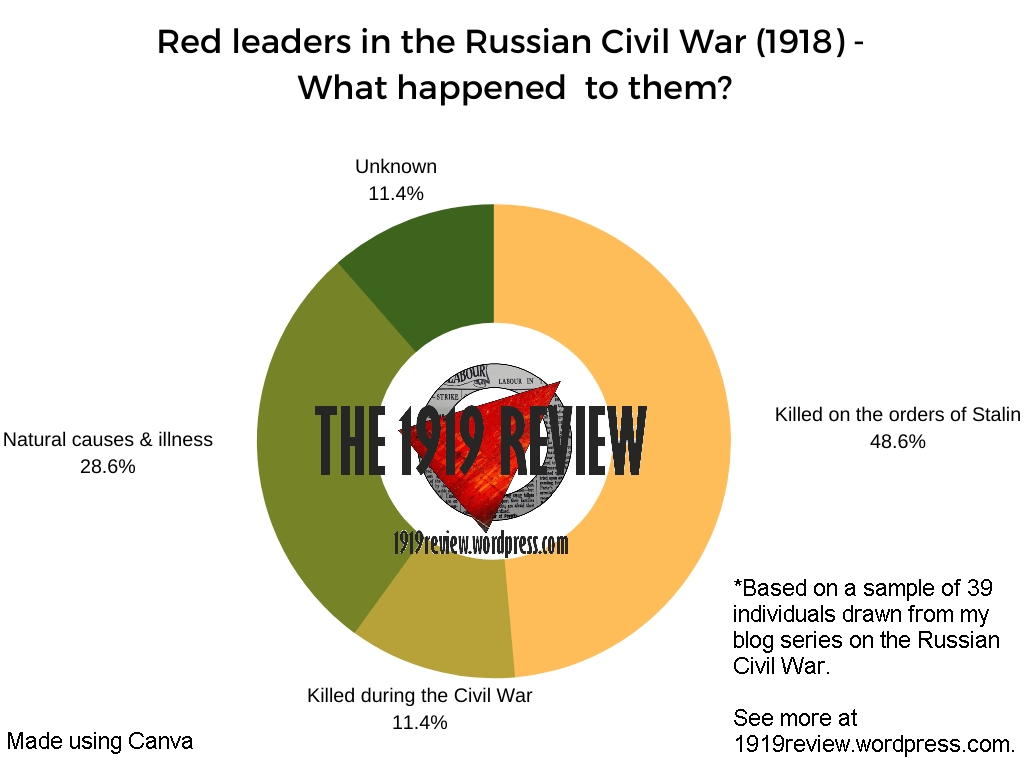
This graph was the result.
The graph is based on 39 people. It counts all Red supporters mentioned during Season 1 – so, Reds who were prominent during the year 1918, plus a scattering of accidental figures. There will be omissions, but it is broadly representative. I have in no sense deliberately weighted this sample so as to make Stalinism look bad. I could have weighted it far further in that direction without stretching credibility. For example, I have included Adolf Joffe under ‘Natural Causes or Illness’ even though his suicide was triggered by the persecution of the Left Opposition by the Stalin group.
So that you can see for yourself, here is the full list.
Natural Causes or Illness
1. Alexander Serafimovich (Author, The Iron Flood) – Natural causes, 1949
2. Kliment Voroshilov (Red commander in Southern Army Group in 1918) – Natural Causes, 1969
3. Klavdia Nikoaevna (Editor of Kommunistka) – Killed in a German bombing raid, 1944
4. Vasily Chuikov (Red Guard, later commander at Stalingrad in 1942-43) – Natural causes, 1982
5. Vladimir Lenin (Leading figure in Bolshevik Party) – Illness, 1924
6. Nikolai Andreyev (Assassin of Count Mirbach) – Illness (Typhus), 1919
7. Felix Dzerzhinsky (Founder and leader of the Cheka) – Illness (Heart attack), 1926
English translation (1934) by Stephen Garry. Penguin Classics, 2016
The other day, after several textual misadventures which I will mention in a footnote below, I finished Mikhail Sholokhov’s masterpiece And Quiet Flows the Don. This review will tie in with my series on the Russian Civil War, Revolution Under Siege, as the novel throws some sidelights on the things I wrote about there.
You can read this post – and many others on this website – for just €5.
Get access to this post – and the entire archive of The 1919 Review – for €5 per year.
This is one of my favourite films and teaching it to a class of 18-year-olds was a great experience. Here are some resources I did up to help my students study the film.
First, below is a long presentation intended to go over multiple class periods. It covers Cultural Context, General Vision & Viewpoint and Literary Genre (For the benefit of international visitors, these three headings are the three Comparative Modes in Ireland’s Leaving Certificate course).
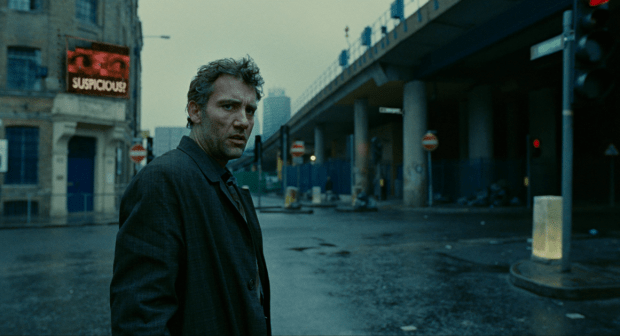
All images credited to Children of Men (2006) dir. Alfonso Cuarón – with the exception of the Blade Runner stills and a few from Wikimedia Commons.
Last, a brief exercise designed to help students learn off a few quotes from the movie that they can use in essays and exams (or in casual conversation if they want to confuse people)
Last week I presented a lukewarm defence of the controversial Game of Thrones Season 8. I argued that the final season was actually OK, and to add further support to my case here is an outline for an alternative final episode. The point here is to illustrate that even as late as the final hour, the show could have been rescued from some of the worst elements of that final season.
*
The second-last episode (‘The Bells’) ended with King’s Landing burned to the ground. The final episode (in my mind) begins fifteen or twenty years later. Middle-aged Danaerys rules from a rebuilt Harrenhall. The Unsullied and the Dothraki form her army, her retainers and some of the major lords of the kingdom – but they are in pimped-out new armour and uniforms. In them we see a new merging of the cultures of Westeros and Essos. The wild nomad riders have become complacent petulant knights. The eunuchs are now just an aging cadre within the Unsullied.
What is the impression we get of Dany’s regime? It is not a new world. The wheel has not been broken. Things look and feel different in the culture. Her regime is more just, stable and functional than the status quo back in Season 1 – but only by a modest margin. The ruins of King’s Landing and the visible presence of the maimed and the bereaved serve as a reminder of the price paid and pose the question of whether it was worth it. But like the Tiananmen Square events in China, the burning of King’s Landing is a taboo subject. Drogon is a fat, lazy creature but still powerful and fierce.
Danaerys has to tax everyone hard to pay for the upkeep of the Unsullied and to deal with the consequences whenever a Dothraki khal decides to go bandit. Her power keeps the nobles in check. All in all, she is no better and no worse a ruler than the usual run. No Triumph of the Will visuals, but no white saviour fantasies either. The exalted myths about her have come down to earth. The wheel is still turning, just with her on top.
A crisis threatens – it doesn’t matter what. Let’s say Lord Bronn of Highgarden has betrayed the kingdom and risen up in revolt (which is absolutely what would happen, probably a lot sooner, if he was given a position of power). Maybe he has even killed Drogon. Dany decides there is only one person who can deal with this challenge, who can lead an army against the rebels: Jon Snow.
Sansa is Queen in the North and middle-aged Jon is serving her regime. The kingdom consists of northerners and wildlings rebuilding and resettling the North after the apocalypse of the wight invasion. Some are talking about going beyond the wall.
Tyrion arrives as an emissary from Danaerys. Jon and Dany have not spoken in years; he departed right after the burning of King’s Landing, and took the Northern forces with him. Tyrion asks Jon to come south. Dany wants Jon to serve as Hand of the King and to lead her armies. There are powerful echoes of Season One, when Ned was summoned south by Robert.
Jon agonises over the decision. He has deep meaningful conversations with Tyrion and with whatever other fan faves the writers decide to give screen time to. Te main characters have still not addressed or mentally processed the horror of the burning of King’s Landing.
We cut away from Jon as he makes his decision – but we don’t know what it will be.
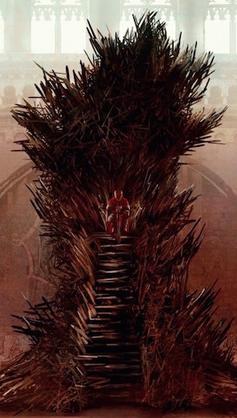
The Iron Throne, as imagined by Marc Simonetti in The World of Ice and Fire (2014)
Cut back to the South, to Harrenhal. Tyrion returns to Dany and tells her that no, Jon will not be coming South. He explains that Jon doesn’t want to get caught up in all this dirty politics and bloody warfare all over again. Dany is angry, and remarks that while Jon has a conscience to wrestle with, she has a kingdom to rule. The last we see of her, she is giving decisive commands to deal with the rebellion. But we get visual hints that behind her stern facade she is just as cut-up as Jon.
Cut back to the North. (As in the real-life version of the final episode) Jon is leading a crowd of people into the wild wastes beyond the wall, and spring is coming.
*
A brief comment on what I like about this ending.
It would be immensely satisfying to see these characters years later, even if their dialogue was only passably well-written. Just as Game of Thrones happened in the shadow of the events of Robert’s Rebellion all those years ago, now we get a glimpse of another era, one overshadowed by the events of Game of Thrones.
Within the framework of this episode, each secondary character can get a little ending of their own, as we see who is serving Sansa and who is serving Dany, and in what capacity, who has turned cynical and who is still trying to seek a better world, etc. For example I think a creepy adn inhuman Bran is serving her as a spymaster.
Martin is very good at showing us characters who have illusions, and then shattering those illusions. Think of the poor Dornish prince in A Dance With Dragons. The key theme of the whole story seems to be disillusionment. Characters set out with the ideologies of this society deeply-ingrained in their heads. These illusions come up against the friction of reality, are sanded down, rubbed raw, eventually break.
This alternative ending hits that theme hard. The myths about Dany are shattered, not by crudely portraying her as a Nazi, but by showing she’s not much better than the rest of them.
It’s still a fundamentally conservative message – if you take Jon’s point of view, stay out of politics, it’s too dirty, and don’t try to change the world; if you take Dany’s, be realistic, settle for incremental improvements, the sacrifices are worth it for the greater good. But at least there are different perspectives. We’re not being beaten over the head with the writers’ irrelevant opinions about 20th Century history.
This is not a perfect ending. A perfect ending would require a much better run-up from Seasons 7 and 8. But it’s a morally grey ending for a morally grey story. It’s an ending that suggests ‘the more things change, the more they stay the same,’ while also leaving space for this cynical conclusion to be refuted. It’s an ending in which Ice and Fire, instead of coming together in a contrived situation where one must destroy the other, are finally and forever parted.
Nearly three years have passed since groans of disappointment met the final season of Game of Thrones. A lot has been said and written about how it was badly-written, incoherent and rushed, about how it let down its characters, about how the story’s themes, once promising, descended into cynical platitudes. In particular I recommend and largely agree with this and this and this.
On the other hand there have been some attempts to say that it deserved a better reception. I’m not fully convinced by any of the defences I’ve happened across. But enough dust has settled now that we can start pushing back with a revisionist history against the consensus. The final season was not actually bad.
Seasons 5 and 6 were solid, but there were obvious problems with the writing. For example, there was Arya doing effectively nothing for twenty episodes; there was Jaime’s half-baked and clumsy sojourn in Dorne. Plot armour and Elder Scrolls Fast Travel sped up the plot but wore down the friction and texture of the world.
Season 7 was a carnival of the silly and the unsatisfying. Problems evident in sub-plots and isolated moments of 5 and 6 came to dominate the main storyline in 7.
By the way, the first episode of Season 8 (‘Winterfell’) was the worst-written of the whole show. Not a single line landed. Everyone was just milling about awkwardly in the castle. Critics and audiences said it was great at the time. They would flip to hyper-criticism a few episodes later.
Thankfully every other episode in the season had more narrative momentum and better dialogue than this lifeless opener. But the first episode was another warning to temper expectations.
I guess people withheld their impatience at 7, hoping 8 would salvage the situation, then vented their anger on 8 when it didn’t. The hype around GOT was such that people believed the showrunners were playing 12-dimensional chess when in fact they were flying by the seat of their pants. There was a widespread expectation that Season 8 would be a sublime revelation rather than a crash-landing.
And it was a crash-landing – not a crash. All in all, it was better than Season 7. Things were messy but it hit the ground intact and held itself together until it came to a shuddering halt, and that was the best we could have hoped for.
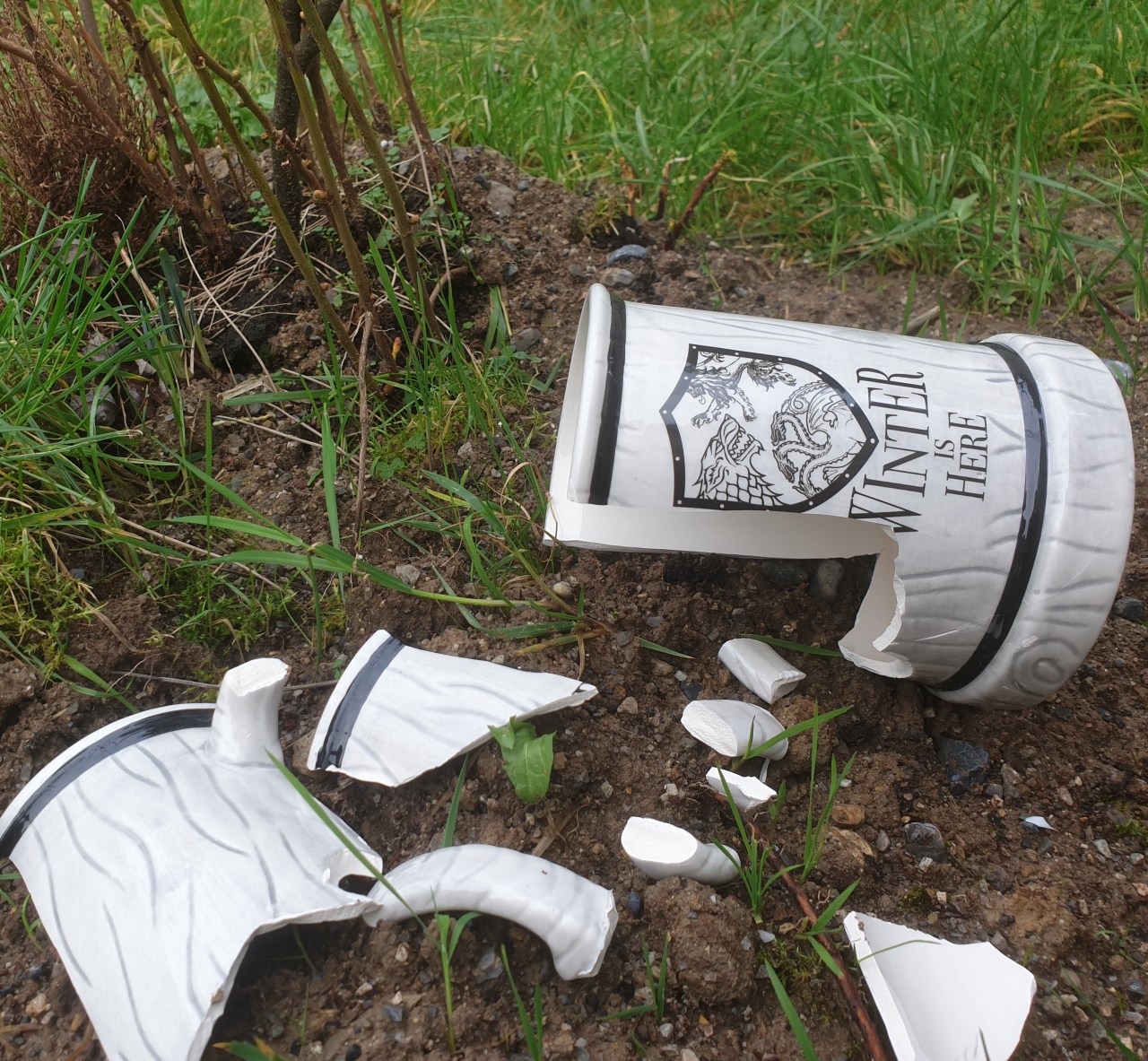
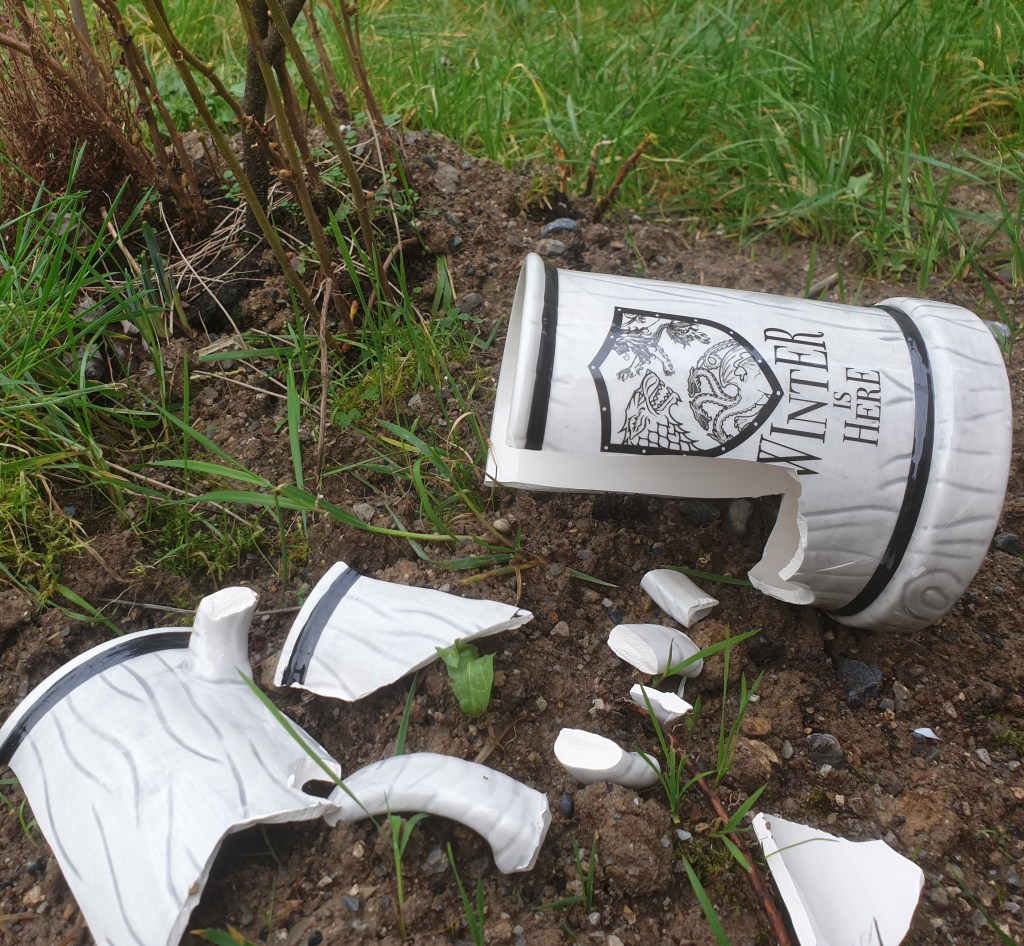
While I was writing this post my one-year-old son just happened to dig out my Game of Thrones tankard from the back of a drawer and accidentally smashed it into tiny pieces. By some miracle, he did not cut himself on the broken edges. Naturally, I took it as a sign from the Lord of Light, and used it to stage a cover image for this post.
Writing isn’t everything
An interesting feature of the Game of Thrones phenomenon is how every viewer became a critic. What emerged around the show was the kind of commentary you’d expect to surround a mass movement or a charismatic leader. Early on, fans debated the story’s conflicts as if they were real; later, they turned from debating the internal politics of the story to debating the merits of the writing itself.
Something held me back from commenting at the time; the clamour surrounding the show was too much. The GOT-commentary industrial complex had grown dangerously vast and all-consuming. I wanted to enjoy it as a TV show, and not feel obliged to have developed opinions and to defend those opinions.
William Goldman’s 1983 book Adventures in the Screen Trade laments the fact that the contribution of writers is underrated in Hollywood. But things have changed; our generation posts hour-long videos on Youtube about character arcs and themes.
But writing is not the only element in film. With GOT we have focused on it to the exclusion of all else.
Season 8 was poorly written. But TV is not prose. What about the other aspects of the production?
The cast carried the whole thing along convincingly, delivering lines that should have felt like golf balls in their mouths. The sound, music, set and costume design were great. Nobody really noticed that silly thing with the coffee cup. The Battle of Winterfell, once you adjusted the brightness on your TV, was awesome to look at and compelling to experience.
The attack on King’s Landing was powerful. There was real visual storytelling here (shame about the verbal storytelling). Arya’s struggle for survival in the burning city was harrowing and original, like a hybrid of The Lord of the Rings with Come and See or Children of Men.
Of course, this was the very episode that was so controversial. But it was so well-done visually, it packed such a punch, that I believed it in spite of my misgivings. I was carried along. And in the moment, so were you, most likely. For a time you felt what the show wanted you to feel: dismay that Dany would do this, rather than dismay that the writers would do this.
The writers without a doubt committed an atrocity far worse than anything Danaerys did to the people of King’s Landing. But the real atrocity was not in that episode. That penultimate episode is open to different interpretations – such as this which makes some very good points.
The real atrocity came in the final episode – when the writing battered us over the head with trite moral lessons, when Dany was ‘put down like Old Yeller,’ when the city was magically rebuilt, right down to the Small Council chamber now staffed with an audience-pandering collection of fan faves.
If George RR Martin is planning to end it in a similar way, I shudder to think what that might look like on the page.
‘I murdered my intimate partner,’ said Jon Snow gravely, ‘as the prophecy foretold.’
Tyrion laid a hand on his shoulder. ‘You had no choice. The whole story bent over backwards to contrive a situation where you had to do it.’
For a moment they were silent as the winds of winter howled outside.
Jon sighed heavily. ‘I still don’t understand. What does it all mean?’
Tyrion began to pace the floor, his hands clasped behind his back. ‘All liberation movements end in totalitarianism. Freeing slaves is a slippery slope. And at the bottom of that slope – genocide. And before you ask, yes,’ he added with a pained smile, gesturing toward the Martin Niemoller and Leni Riefenstahl references scattered about. ‘This story is implying that Dany was, at the end of the day, as bad as Hitler, and by extension that Hitler started out like Dany.’
‘I’m not sure which of those two claims is worse.’ Troubled lines creased Jon Snow’s face. ‘But these references make no sense. Not in our medieval-esque setting. Sam Tarly would say they’re… Uh, anachronisms.’
Tyrion smiled again, this time wryly. ‘So are dragons.’
Jon frowned. The dragons had been easier to swallow than the reactionary platitudes.
The tragedy of it all was that the writing let down the other aspects. But those other aspects deserve to be appreciated. A small army of people worked on them, and their work was not in vain. The production convinced me in key places where the writing failed.
It ended badly. But it ended.
The great virtue of Season 8 – even of that final episode – was that loads of stuff was happening. The Mountain and the Hound batter the crap out of each other, then plunge to fiery deaths! Marvellous! A dragon melted the Iron Throne. Jon is going with the wildlings back to their homeland, and spring is coming.
Everyone talks about how this season would have been so challenging to write. I don’t agree at all. Everything had been set up for seven seasons; all the showrunners had to do was knock down the dominoes in a reasonably competent manner.
Sometimes the writing was more than just competent. The second episode (‘A Knight of the Seven Kingdoms’) was by far the best of Season 8 – as doom approaches, the main characters have a lot of talky but heartfelt scenes. This was great writing.
True, there wasn’t much great writing. But even basic competence went a long way. Big, dramatic stuff was happening, and things were being resolved – this was the rocket-fuel that kept Season 8 moving forward in spite of its big problems. For stretches, it was easy to be carried along – as long as your focus was ‘Am I enjoying this?’ not ‘What will I say about this on the internet?’
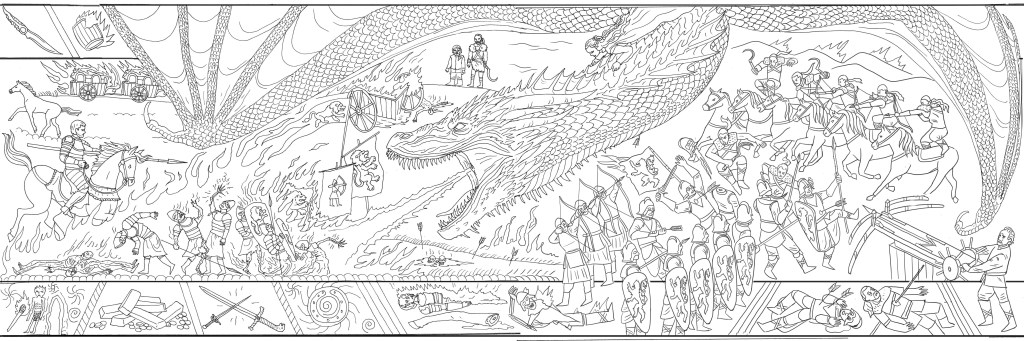
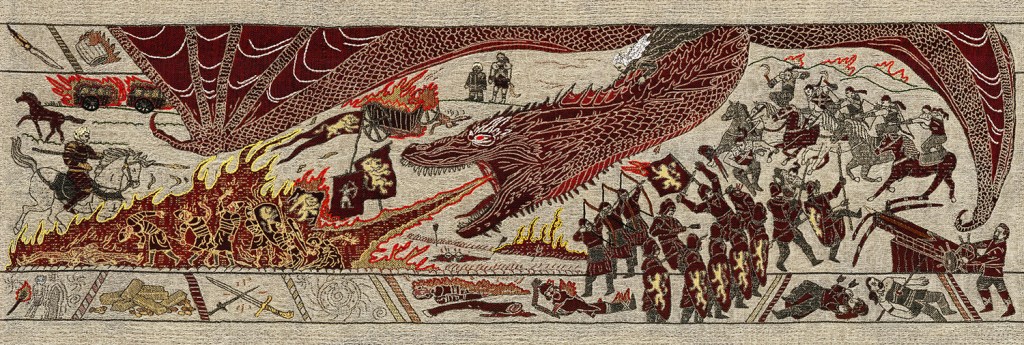
The same tapestry, now in colour
Let’s take a moment to reflect on how great and how rare it is to see stuff happening on a TV show. The usual practise with TV is to drag things out, to tease, to defer gratification; to leave things unresolved just in case there’s another season; to forcibly jump-start a broken-down story just to get the punters back on their couches. The general rule is: you keep making the show until it stops making money.
Some critics say that Season 8 was too rushed and that they should have made two, three, four more seasons. I don’t agree. If we’d got more seasons, we’d have got more rushed and unsatisfying seasons.
For most of its run, my main worry with Game of Thrones was not the possibility that it would end badly, but that it would not end at all. I worried that GOT would taper out in a dragon’s tail of dismal seasons, an endless winter of exhausted characters shambling through the long night of lifeless plots.
But that is not what happened. Game of Thrones ended with a bang, when we all still cared enough to criticise it.
When the show is no longer a recent memory it will be rediscovered. The quality of those early seasons was real, but it was far from a perfect, sublime, unproblematic show. In the future, viewers will appreciate the show in a critical and balanced way. They will groan good-naturedly at the ending but they will not feel betrayed.
Next week I’m going to post my alternate ending for GOT – to illustrate that even as late as the final episode, all was not lost.
But that’s kind of an appendix to this post. For now, that’s all. Game of Thrones Season 8 was an enjoyable few hours of TV. It was fine, it was OK, it was grand. The problem is, with Game of Thrones fine, OK and grand couldn’t cut it. Its own hype was its own worst enemy.
A presentation covering the history of Fascism in Italy, from the First World War to the fall of Mussolini. Below are three files of notes to be used alongside the presentation, along with a short quiz.
Smith, S.A. Russia in Revolution: An Empire in Crisis 1890 to 1928, Oxford University Press, 2017
Smith, S.A. The Russian Revolution and the Factories of Petrograd, February 1917 to June 1918. Unpublished dissertation, 1980. University of Birmingham Research Archive, e-theses depository.
*Taylor, A.J.P. The First World War: An Illustrated History. Penguin, 1963. (1982)
*Trapeznik, Alexander. The Revolutionary Career of Viktor Mikhailovich Chernov (1873-1952). Masters’ thesis, University of Tasmania, 1988
Hafner, Lutz, ‘The Assassination of Count Mirbach and the “July Uprising” of the Left Socialist Revolutionaries in Moscow, 1918,’ The Russian Review , Jul., 1991, Vol. 50, No. 3 (Jul., 1991), pp. 324-344
Pereira, NGO. ‘The Idea of Siberian Regionalism in late Imperial and Revolutionary Russia.’ Russian History, vol. 20, no. 1/4, Brill, 1993, pp. 163–78, http://www.jstor.org/stable/24657293.
Smirnov, M. I. “Admiral Kolchak.” The Slavonic and East European Review, vol. 11, no. 32, Modern Humanities Research Association, 1933, pp. 373–87, http://www.jstor.org/stable/4202781.


 The 1919 Review
