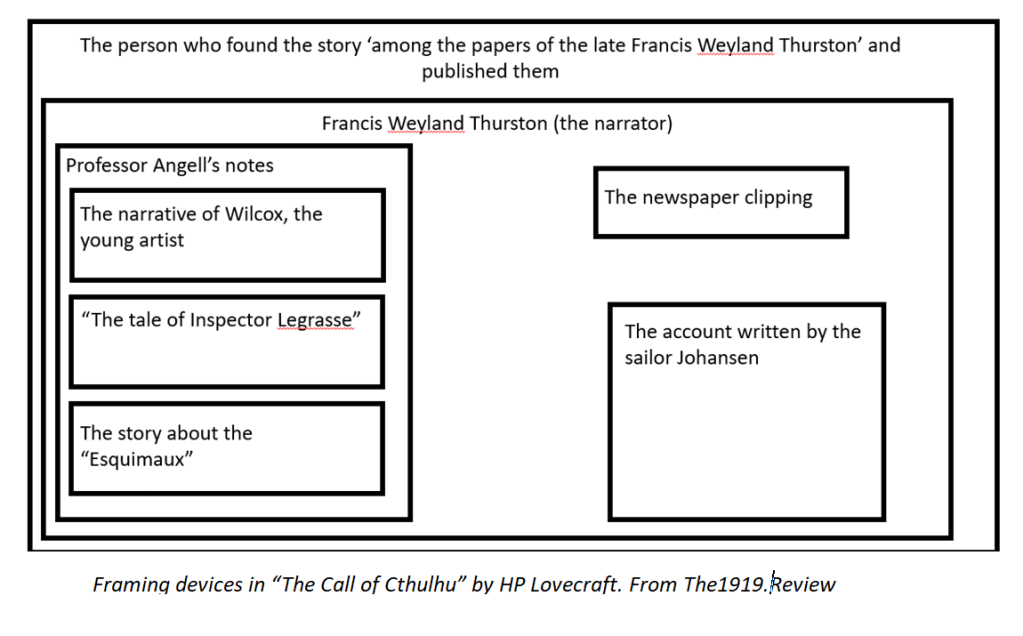
Re-reading HP Lovecaft’s work over the last year, I was struck by how he uses a complicated apparatus of nested narratives in his landmark short story “The Call of Cthulhu.”
Here they are:
This elaborate framing has several effects:
It adds to the verisimilitude of the story; the various pieces of the puzzle pseudo-corroborate each other. As with all the best Lovecraft stories, the movement from the sober and uptight New England puritan to the flailing and slobbering tentacle monster is stately enough that we accept the transition.
It makes for a good mystery story, with the central horror only gradually revealed and the reader’s imagination given plenty of room to play in the meantime.
It reinforces the theme, stated in the opening paragraph, about how the ‘piecing together of dissociated knowledge’ will reveal terrifying truths about reality and ‘our frightful position therein.’ Each of the stories is a rip in the fabric of reality as we know it through which we glimpse a sliver of what lies beyond.
Lovecraft’s cosmic horror was rooted in North American racism but it resonates with people who don’t share these ideas because it transcends this base and reaches toward a more universal and – to me, at least – cathartic doomerism.
A thing I’ve come to realise from writing this blog is that it’s not so easy to write about things that are really good. I wrote brief things on Andor and the new Dunemovies because brilliance speaks for itself and I don’t go in for gushing. It’s much easier to write about something you hate. Look how much I wrote on Antony Beevor’s Russia. It’s easier, and often it’s right and proper, but it’s negative and unhealthy.
The best thing is to talk about something of ambiguous quality. Something lots of people love, that you have big problems with, or something nobody gives a damn about but that you really like.
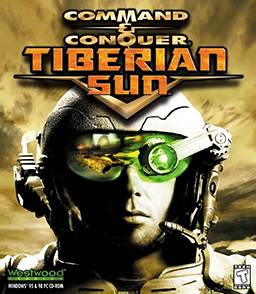
For example, Command & Conquer: Tiberian Sun.
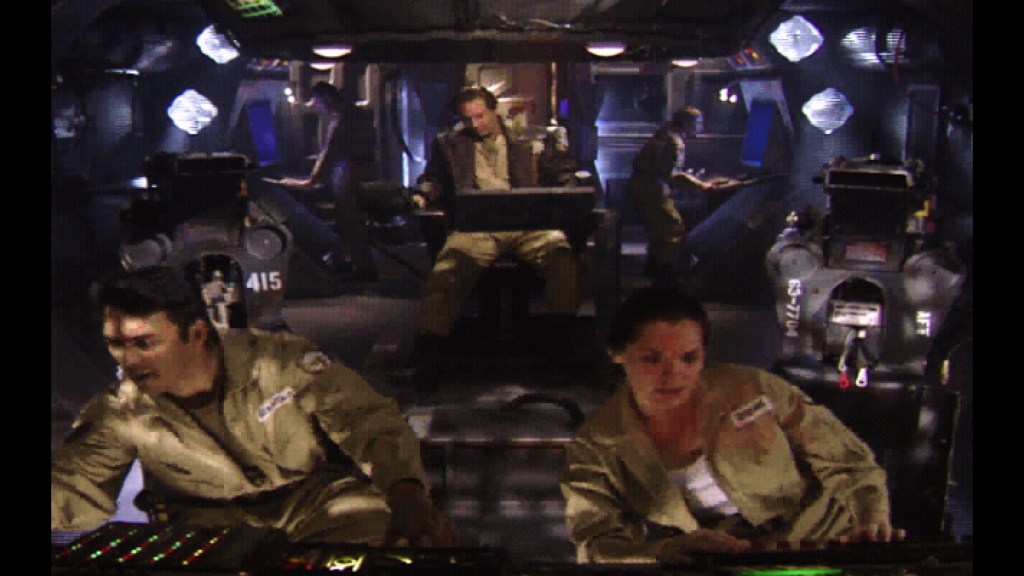
In Part 1 I talked about the themes of Tiberian Sun (TS): its semi-accidental relevance in terms of ecology, and the dead-end politics of its very literal “end of history”. But on its face it is a story about a struggle between two magnetic characters, Anton Slavik (Frank Zagarino) and Michael McNeil (Michael Biehn).
Slavik and McNeil
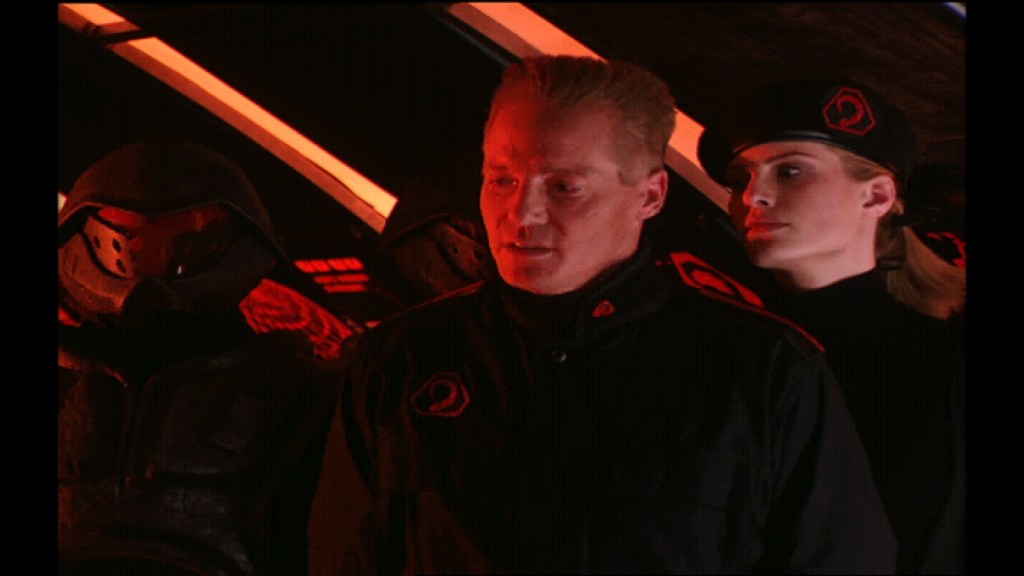
Most people find that playing as the villain leaves a bad taste in the mouth. TS gets around this in clever ways. Anton Slavik is a high-ranking officer in the service of a ruthless totalitarian cult. But when we first see him, he is about to be executed as a traitor. So when we first see him, he’s a victim, he’s vulnerable, and we side with him instinctually.
Our identification with Slavik deepens as the story gets into gear. He escapes in a tense action scene, and soon we realise that his accuser, General Hassan, is the real traitor. It doesn’t matter a damn that Nod are evil; we root for real Nod over fake Nod. Our instinct for lesser evilism runs that deep. And when we see a genuine injustice being done on a complete prick, we extend the prick a partial forgiveness.
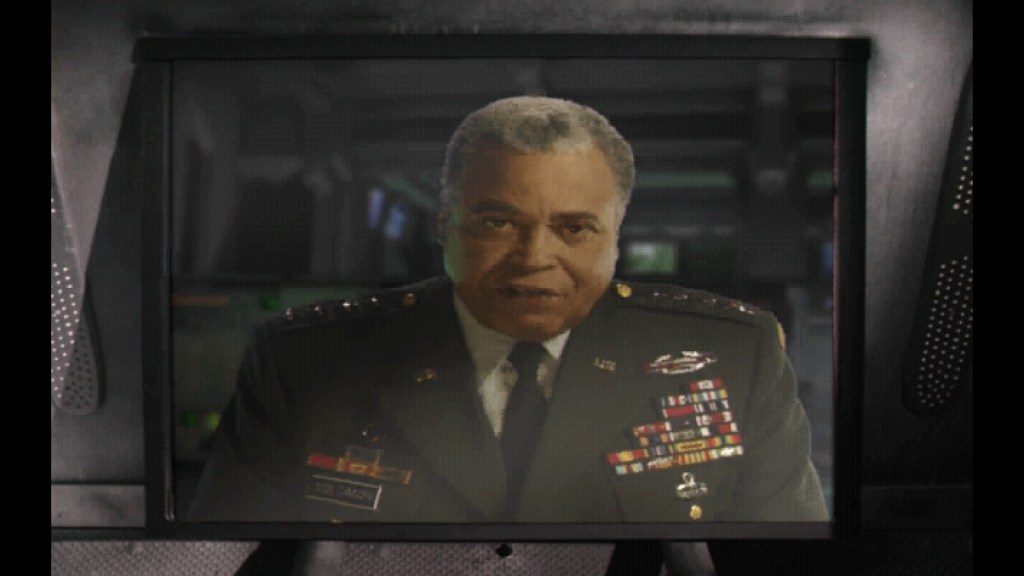
RIP James Earl JonesSlavik burrowing in the crust of the Earth……and McNeil soaring through the stratosphere.
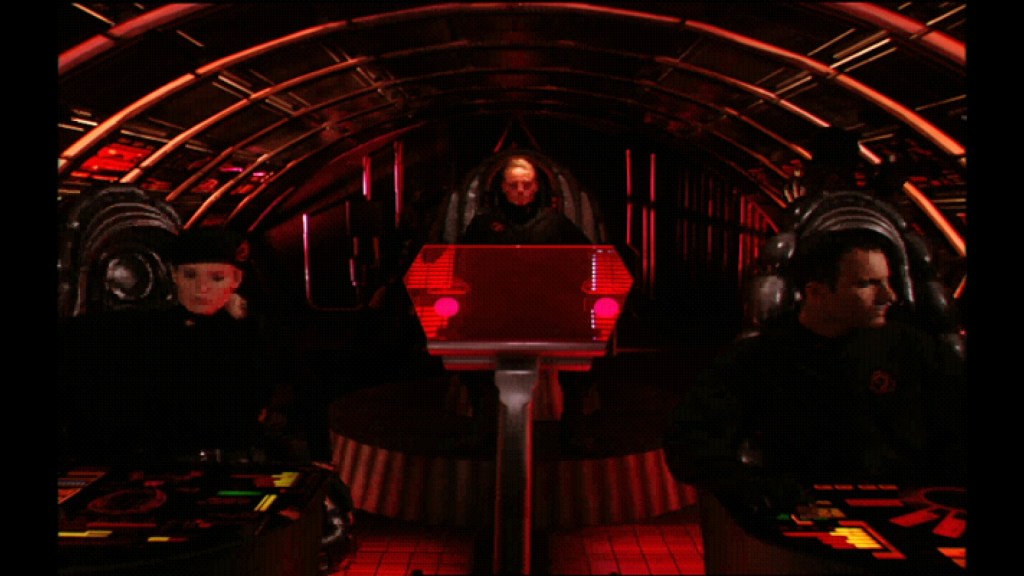
Slavik continues to command our respect, though not our affection, as his story unfolds. His overlord, the Nod prophet Kane (Joseph David Kucan), is a gloating and showboating kind of villain, video-calling his enemies just to mock them and quote Shakespeare at them before he blows things up. Slavik, by contrast, has a restrained and ultra-disciplined kind of fanaticism. He is ruthless, decisive, humourless.
Slavik and Oksana
His second-in-command is Oksana (Monika Schnarre). This is strictly a story for adolescents, and any intimate relationship between the two remains implicit. Oksana herself is a true believer, but allows her personal prejudice against “shiners” (mutants, AKA The Forgotten) to get her worked up. She serves as a foil to Slavik: in her light we can see more clearly that he does what Kane commands but without special rancour. This is not from lack of enthusiasm, but because such loss of control would be unbecoming. He only betrays emotion when we see in his eyes, to quote Liam O’Flaherty, “the cold gleam of the fanatic.”
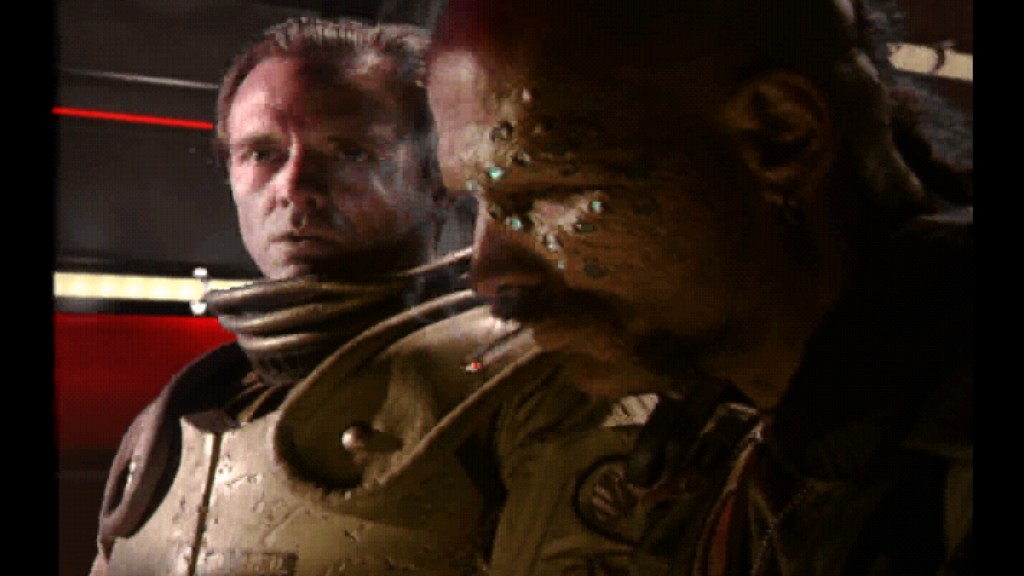
Slavik’s GDI counterpart McNeil is more of a standard game character. He’s cocky but easy to like in spite of this. He has enough humility that later he learns a grudging respect for the mutants. An embrace is as far as him and the mutant commando Umagon get with each other on screen. Umagon and co even get McNeil to entertain doubts about his superior officer General Solomon (the late and celebrated James Earl Jones), who also harbours prejudices against ‘shiners.’
McNeil learns a grudging respect for the mutants. This unnamed mutant commando has just helped him blow up a bunch of crucial Nod power plants.
Why am I going on about Slavik and McNeil? Because TS is different from every other C&C game in this respect: it actually has protagonists.
How every other C&C title works is, in between each mission, some great actor like Michael Ironside or Grace Park turns to the camera and explains the plot with a straight face. Like: “Well done, commander. Roderick Spode and his Blackshorts are on the run. But we’ve just received some troubling news. The Anarcho-Aztecs have launched a full-scale invasion of Andorra. Thankfully, we have a new prototype anti-gravity device that should prove useful. Come on through to the lab, commander. Allow me to introduce you to Sir Isaac Newton…”
(Incidentally, my phone autocorrected Michael Biehn’s surname to ‘Biden.’ Jesus wept. Imagine him giving you a C&C mission briefing: “Let me tell you something, Mack… You did a good job with the uh, the Presinald Trunt, on the little battle fella…”)
Out of all of C&C, only in TS is “the commander” of each faction given a name and a face. Now that’s a risky choice because in trying to make a movie rather than a set of briefings, TS’s developers risk being ‘cringe.’ It is visibly low-budget and Bowfinger-esque in places, but all in all it turns out much better. The player is a third-person observer of a drama. There are human stakes to the missions. TS doesn’t have an Oscar-winning screenplay by any means (I think it accidentally stole the line ‘Get me McNeil’ from a parody movie featured in The Simpsons) but it engaged me in the story far better than any other game in the series. That is because the expensive professional actors were talking to each other, not to me. Sparks fly when Kane and Jones’ General Solomon confront one another on video calls.
No other C&C title, before or since, did this. So once again, TS stands out. Before I actually replayed it, I had the vague impression that TS was guilty of ‘taking itself too seriously.’ Not a bit of it.
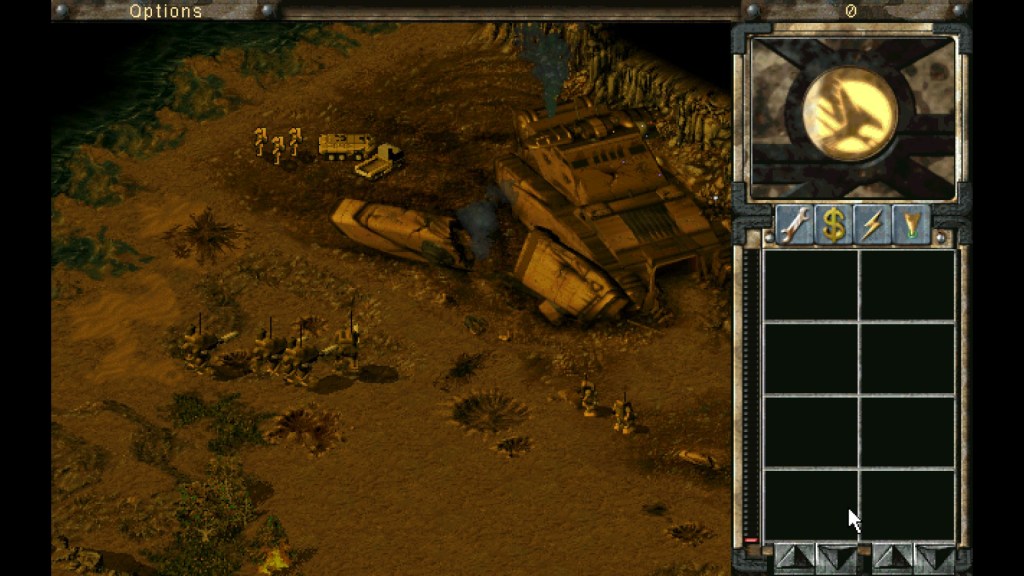
Nod troopers in a computer-animated cutscene
The story is told through three media:
Live action (or full motion) video – the bits with Michael Biehn and James Earl Jones, which we’ve just talked about.
Computer-animated videos, not in the game engine, showing 3d clips of the various weapons and unit types in action in the game world; victory and defeat cinematics.
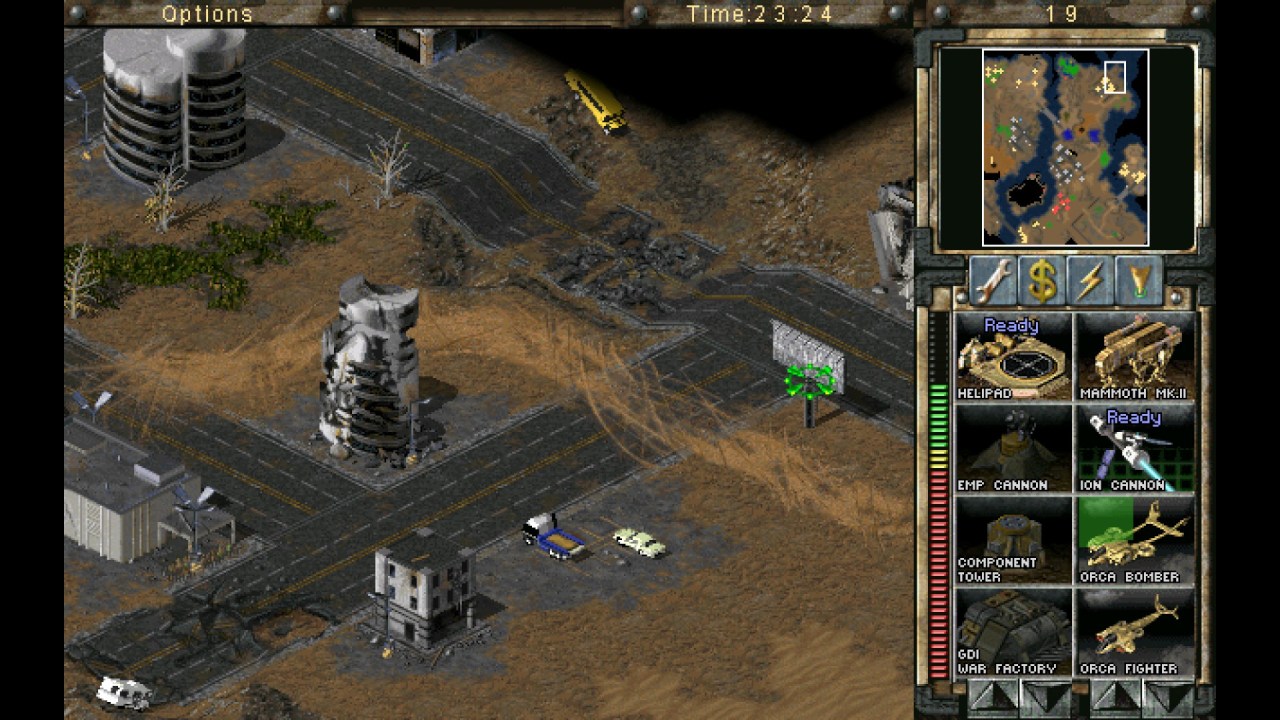
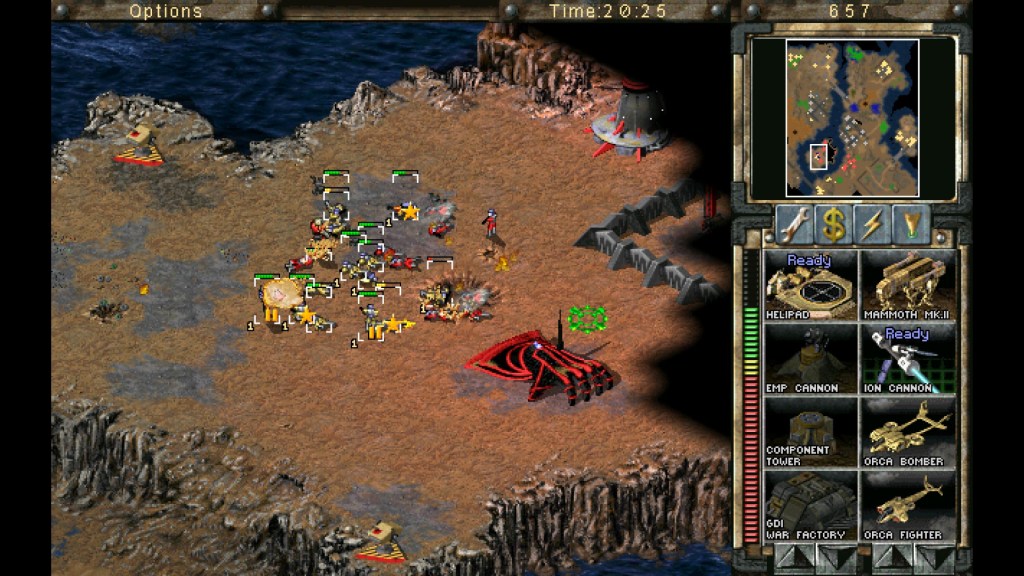
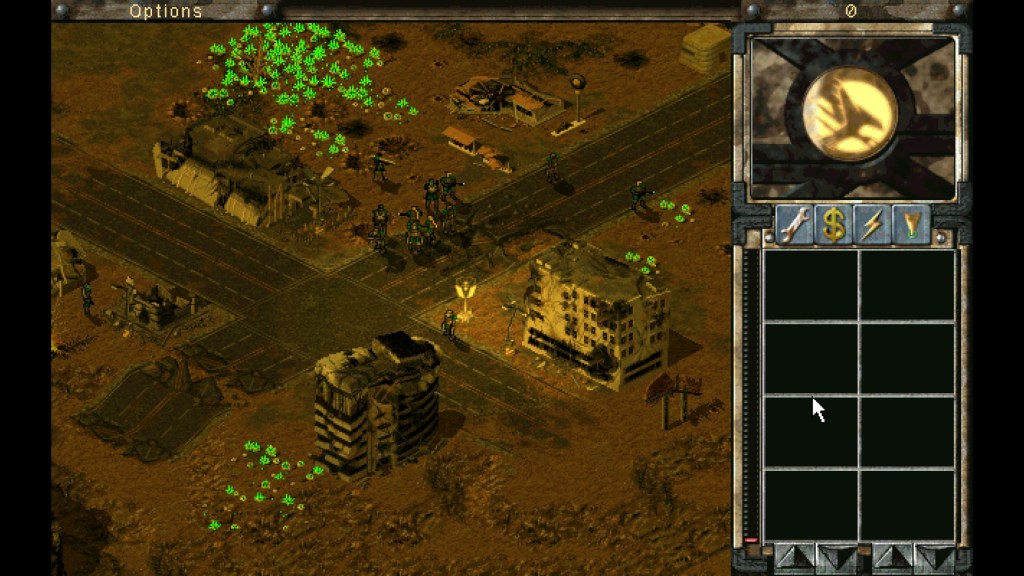
The game itself – little guys moving around a 2d isometric map studded with structures and canyons and Tiberium fields, and lots and lots of motorway overpasses. This is where we see the environmental storytelling we talked about last week.
These three levels tie in together really well. The 2d isometric world, we understand, is only a representation of the real world. We’re at one remove. The action and dialogue clips supply a taste of what it ‘really’ all looks like, how it feels to be in this world, and our imagination does the rest.
Tiberium Wars and Kane’s Wrath have better graphics. They look great. But they lose this power of suggestion, the way these three levels of storytelling stimulate the imagination in TS. We don’t just play on the screen. We play in our imaginations, in the gap between the game’s now-primitive graphics and what this world would really look like.
Gameplay: This land was not made for you and me
We haven’t talked about the experience of actually playing TS. Well, if you’ve played one C&C title you have a pretty good idea what all the others are like. But here as elsewhere this game just feels subtly different.
Tiberium Wars and Red Alert 3 are fast-paced games. Each map feels like an arena, even the bigger ones. Turtling is usually punished; momentum and initiative are key. If you spend five minutes exploring, if you take an eye off your production queues, then before you know it some tank is going to be smashing in the garage door of your con yard.
Fast-paced is what they were going for, and it’s well-executed. But TS has something else, which I like better. It has empty space.
It has deserted plains and desolate canyons that lead nowhere. It has space, free uncertain space that might or might not have enemies in, and you won’t know until you send in a couple of buggies. There are no bright objective markers on the map; you’d better just figure out where those enemy SAM sites are the old-fashioned way, by sending out some guys who might get killed. This land was, emphatically, not made for you and me, which underlines the theme of the environment being indifferent to humanity. It makes the factions and the war they are fighting seem small in the grand scheme of things. This is in harmony with the game’s general vibe of being less gung-ho and more reflective than the average run of C&C.
(Going back to the cutscenes for a moment, the Nod ones start with a horribly realistic-looking shot of a dead Nod soldier, his helmet and the face under it both smashed. See what I mean? Less gung-ho, more reflective.)
And what is more, it slows the game right down. Other C&C games have an element of frenzied button-mashing and horrible meat-grinder combat where you produce wave after wave and send them out to be slaughtered. In TS, defence systems are solid and turtling is as good a strategy as any. While you hold the line, you explore, probe, experiment with different unit types, advance through trial and error, and by degrees refine your strategy, which may be very different from someone else’s. The final Nod mission, which involves setting up three massive missile launchers in enemy territory, is a fine example. There are several approaches to the main enemy base. I went in a roundabout way, battering through with rocket motorbikes, flattening a quarter of the base and bypassing the rest. I could have done it in a range of other ways, but I felt proud of the plan which I figured out and executed. Another good example would be the GDI mission where the enemy is launching poison gas missiles at you every five minutes. You have to choose wisely where to set up your base – it has to be somewhere you can spread it out, or each missile strike will be devastating. The challenge is usually not to fight a meat-grinder war of attrition, but to crack some seemingly impregnable fortress. What develops is an engrossing game of twelve-dimensional rock, paper, scissors as you figure out just the right moment and location to send in your armour, your air force, your artillery, your infantry.
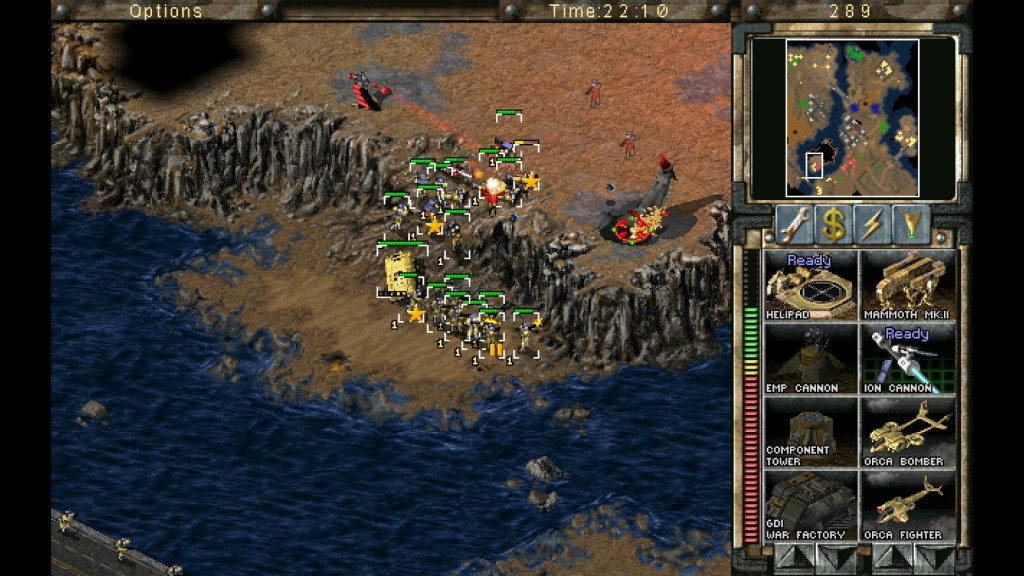
The final GDI mission requires you to land infantry on an island, without air or armoured support, to finish off the final Nod base
There are other neat little things. If you fight in woodland, the trees catch fire and the fire spreads and hurts nearby units. The Nod artillery makes craters that are actually depressions in the landscape, not just cosmetic scars. Careful where you put your flame tanks; they will incinerate your own guys if they are standing in the wrong place. These neat little things were abandoned in subsequent C&C titles.
It is annoying, of course, to be limited to a production queue of just five units. Until it isn’t. You get used to it, and you realize that it has freed you up to really think about what you’re building. Armies stick to a manageable size and you have an incentive to preserve them. The five-units thing is a limitation which in effect frees you up.
Conclusion
What I like best is writing about something that you both love and hate – or that you simply feel others have overpraised or over-criticised. It’s satisfying to identify where the good and bad sides of a thing fit together like yin and yang, when the great and the gammy mutually constitute each other, when you couldn’t have the one without the other. It’s equally satisfying to talk about excesses and excrescences, unforced errors and unexpected flashes of brilliance. Best of all when the thing you’re talking about is not ‘high culture’ by any definition, but a vulgar-arsed text that was consumed by tens of millions of people even as it went completely unnoticed in newspapers and academia.
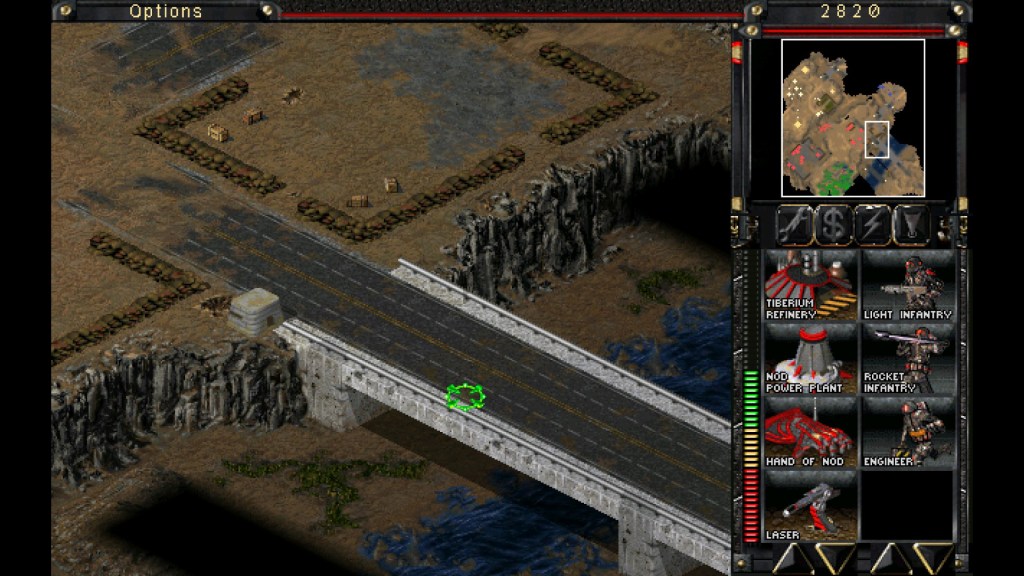
I haven’t done justice to the fact that TS is full of destructible bridges and overpasses. It was a new feature that they were excited about, and they milked it.
Such a text is Tiberian Sun. I wouldn’t be surprised to learn that it was experienced by more people in its day than many earnestly and widely reviewed Oscar-nominated movies of the same era. The kids playing it then, aged in or around thirteen, are in their thirties and forties now, voting and operating forklifts, approving loans and being approved for loans, or not, and having kids and colonoscopies. Grown-up stuff, far away from the visceroids and Tiberium fields. These posts on Tiberian Sun are for those people, and I hope it has given them the satisfaction of excavating long-neglected recesses of their own minds.
We’ve got a guest post for you today, a review of Netflix’s Gundam: Requiem for Vengeance by freelance writer Charlie Jean McKeown.
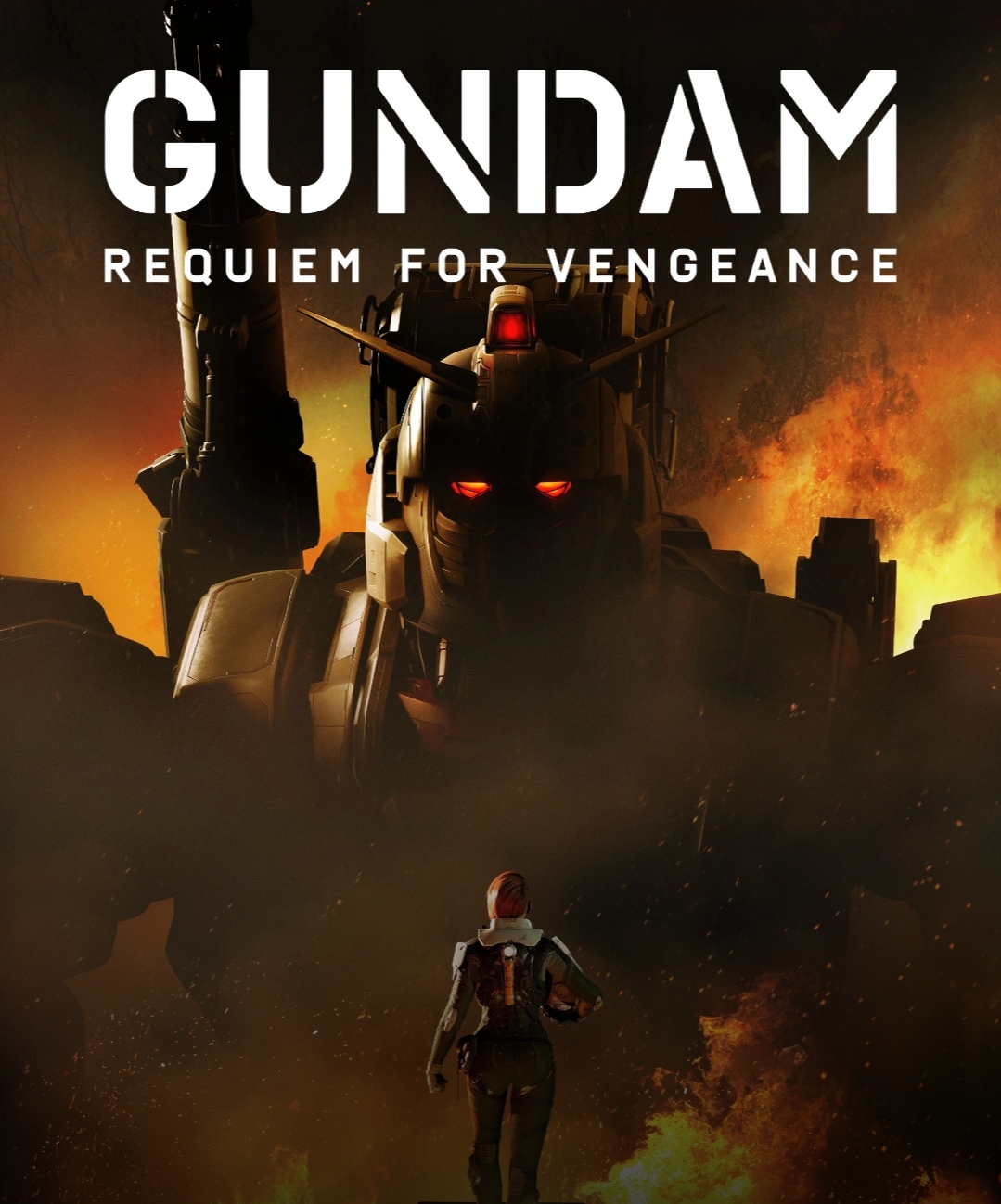
Stories and machines are ultimately driven by people, yet Gundam: Requiem for Vengeance lacks the personality needed for the gritty mecha war drama it tries to be. Since its 40th anniversary, the Gundam franchise has been boasting ambitious projects like SEED Freedom (2024) in theatres, Witch from Mercury (2023) on TV, and in gaming Gundam Evolution (2022). (i )
This new Netflix series follows Zeon soldiers- the usual antagonists- in the closing months of the ‘One Year War.’ It’s an attempted love letter for Gundam fans, with a touching homage to the original 1979 show in its opening titles and what must have been a laborious effort to give the classic mecha designs such glorious detail. However, Requiem has little identity of its own; it has little to offer old fans and nothing accessible for new ones. More disappointingly, it does open up genuinely interesting themes which could have given the show some life if they were navigated by decent characters.
Requiem actually inverts some of Gundam’s most central themes; empathy becomes vengeance, and our protagonist is an enlisted mother rather than the usual child soldier. ‘Time’ is not a new theme for the franchise but had never received the same attention it enjoys here albeit with some overly-obvious motifs. The survival element of other Gundam series is heightened in Requiem too, as we watch the losing side struggle against a war-winning weapon. These themes, though, are only minimally engaged with. While one could blame this on the many action scenes, Gundam has always used battles to deepen its narratives rather than merely embellish them. Furthermore, Requiem still has plenty of peaceful moments in its three-hour runtime. The fault is really found in the show’s repetitive exposition soaking up what should be time spent on challenging characters so that they may develop and investigate these concepts.
All of this culminates into the most disturbingly mishandled theme of Requiem: nationalism. Mirroring the Cold War narrative of Nazi Germany (ii), Zeon had always been presented as an evil fascist regime with ordinary soldiers fighting for their homes. Interestingly, the One Year War – the definitive conflict of the franchise – is renamed here as ‘the Revolutionary War.’ Is this how the fascist Principality of Zeon sees itself? Do they view the One Year War the way Confederates saw the American Civil War? It’s a fascinating angle to investigate. However, it feels like Requiem takes up a ‘both sides matter,’ approach, with no real discussion of Zeon’s war crimes (wiping out half the Earth’s population, for instance). Instead, our apolitical protagonist is “just following orders.” While her final monologue is clearly intended to convey a lesson she learnt, it gives us a rather warped justification for continuing to fight under a swastika-esque banner.
Banner of the Principality of Zeon
While the writing is poor, Requiem’s establishing shots want you to know money and effort went into making them. Requiem is Gundam’s first CG animated production since MS IGLOO (2004), and the improvement in quality is staggering. By tightening their dimensions, the old mecha designs remain credible in today’s science fiction scene while the body language of these giants conveys a surprising degree of emotion. The facial animations are unfortunately less expressive, and to come across they often rely on the wonderful new soundtrack provided by award-winning composer, Wilbert Roget II. Netflix’s first Gundam production does look lovely as a whole, but its writing encourages little confidence in the live action film they announced in 2018. I doubt Requiem will see a second season, which is a terrible shame given its potential; if the writers could make some course-corrections in a new season and rummage through those ideas they raised, then Gundam: Requiem for Vengeance could be forgiven for these first six dismal episodes and actualise its own distinct identity.
(i) While Evolution was closed down in a year, it gave Overwatch 2 a little competition in the hero-shooter market before collapsing under its embarrassing micro-transactions. (ii) A narrative, it should be noted, now being revised by historians who are acknowledging the Wehrmacht’s complicity in war crimes.
When I was 11 or 12 – or maybe it was some older and more embarrassing age – there was a field near my house that me and my friend called the Tiberium Field. You had to dash across it in twenty seconds flat, otherwise Tiberium poisoning would kill you and turn your body into a visceroid, an aggressive and indestructible blob of human tissues. In our heads, we were in Command and Conquer: Tiberian Sun.
So far, so nostalgic. This is a post where I talk about a 1999 strategy game, maybe to recapture the remembered leisure and innocence of the childhood that surrounded it.
But I never got past a few missions of Tiberian Sun, never owned my own copy, and I like it a lot more now than I did back then. If we’re talking nostalgia, I was always more of a Red Alert guy (who could have guessed?). At the time I thought Tiberian Sun was, in comparison to Red Alert 2, drab and self-serious, with a clumsy interface and confusing missions. Earlier this year when I bought the whole Command and Conquer back catalogue for a tenner, I didn’t expect that this would be the game I spent the most time on, the one where I actually finished both campaigns, the one that would haunt my imagination.
So this is not all nostalgia. Something else is going on here, and I’m going to try and find out what. And even within the nostaglia, there’s the question of how this game worked its way into my imagination in such a way as to turn the grass of that neighbourhood field into an expanse of deadly and valuable green crystals.
So how did this game warp my young (and not-so-young) mind?
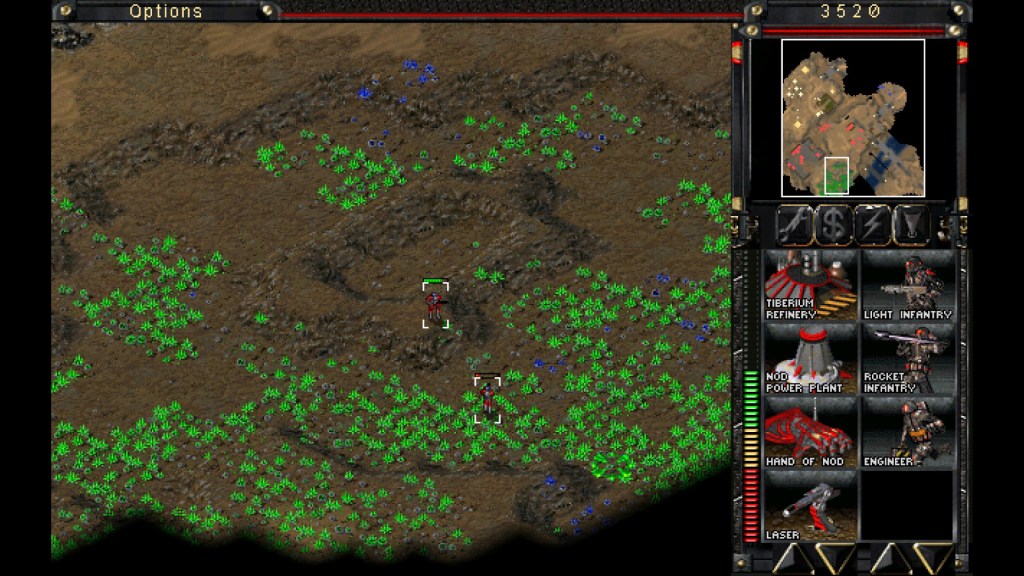
This screenshot is from the expansion pack, Firestorm
The Tiberium-haunted world
The first point in favour of Tiberian Sun (henceforth TS) is its setting. The world of the original Command and Conquer was sort of improvised. The developers said, let’s have something like the spice from Dune2 – it works so well as a resource-gathering feature – but transplanted to another setting. The result is Tiberium, a strange green crystal native to some alien world which has begun to spread over Earth’s surface. There are two factions: the Global Defence Initiative (GDI), a one-world military defending the status quo, and the Brotherhood of Nod, which is part-Tesla, part-ISIS, part Comintern, and obsessed with using the Tiberium for obscure ends. My impression, having played only a little of the original C&C, is that whatever worldbuilding there is starts to peter out around there. The setting is just an excuse to have a war game on the Dune 2 formula. (I’ve talked about the Red Alert spin-off elsewhere.)
Tiberian Sun takes the worldbuilding more seriously. A couple of decades after the first game, the Tiberium infestation has advanced, and Planet Earth is now terminally sick. GDI and Nod are still fighting over ruined cities and land choked with alien crystals and alien weeds, skies torn by ion storms, poisoned air, mutated genetics. For more on the setting and its applicability as a prophecy for our times, I recommend this article from Eurogamer by Robert Whitaker.
Tiberian Sun captured that late-1990s sense of some vague impending doom. But in 2024 it offers a strange kind of relief. You can retreat into the barren comfort of a world that is already destroyed, where there is little to save. There are unexpected inheritances from Dune: like in Herbert’s book, the ground beneath your feet is more than a setting, it’s an actor with powers of life and death over the fragile humans and machines crawling on its surface.
The applicability to climate change and global warming (which we all absolutely knew about in the 1990s even though those in power did nothing) are obvious. It’s a metaphor for our times in another way too. GDI are coded as “good” but we never see them actually doing, or even promising, anything good. They never help anybody or change anything, until the Forgotten twist their arms. We side with GDI only because Nod are obviously and extravagantly worse. Yes, GDI is Harris and Nod is Trump. Neither side offers a way out of war and ecological destruction. But Nod at least offers its supporters the shallow pantomime of its rituals and chanting and bloody spectacles.
Mutants, ruins and the glow of Tiberium. It’s a vibe
The setting itself tells a story: when we move our little men across the map, we see ruined high-rise buildings, contrasted with space-age-looking new settlements with solar panels and bunkers and greenhouses: the civilian world has retrenched into smaller and more resilient communities. Meanwhile war has advanced as a science. It’s all laser guns and visored helmets, giant walking battle mechs, cyborgs, explosive throwing discs, orbiting battle stations. Humanity is spending and innovating to fight more effectively, even as we have less and less to fight for. While the Red Alert setting just pits an evil faction against a good faction, Tiberian Sun (TS) takes place in a world that is messier and more ambiguous. In Red Alert, we don’t know why the Soviets are attacking the status quo. In TS, we don’t know why GDI are defending it.
Videogames then were violent, militaristic, imperialist – not in a the conscious and blatant way that Call of Duty is now, but as it were by default, by reflex. C&C is no exception. The GDI versus Nod struggle is at base the same old Imperialism versus Third World struggle, with the legitimate struggles of the global majority (“disenfranchised nations” seduced by Nod) packaged as evil fanaticism. In TS it is less explicit, filtered through layers of deniability in the worldbuilding, but we get signals, such as that the villains in Tiberian Sun have names that are Arabic, Latin and Slavic (he’s literally called ‘Slavik’). The Latino baddie is a drug smuggler who menaces the southwestern United States, playing into racist tropes. We see one South Asian guy in the ‘Global’ Defence Initiative, but the rest of the goodies are Americans.
The Forgotten
The music is not as conspicuously brilliant as that of Red Alert 2 but it has a greater range. There are moments of foreboding (‘Valves’) and loss (‘Approach’). If Red Alert 2 is a violent cartoon, Tib is a 1980s-90s action sci-fi movie – the vibe, to me, is sort of like Terminator 2, Aliens and Paul Verhoeven.
The melancholy themes probably belong to the third faction in Tib – unplayable and lightly sketched, but essential to the story (I suppose if GDI is Harris and Nod is Trump, they are Jill Stein or Cornel West). This is a loose confederation of clans who call themselves The Forgotten. They are people mutated by Tiberium exposure – insulted and belittled as ‘shiners’ by GDI and Nod alike, distrustful of GDI due to past atrocities, persecuted and imprisoned by Nod. They are few but they are pretty lethal in a fight.
The Forgotten are the conscience of this story. In the GDI campaign, it is only by overcoming prejudices and working with the mutants that GDI can defeat Nod. In the Nod campaign, you prevent any possibility of an alliance between GDI and mutants through a nasty trick. There’s more going on here than is usually the case in this series.
An actual Tiberium field
Tiberium Wars
In Part Two of this review I’m going to be looking at two other strengths of Tiberian Sun – the cutscenes (you heard me) and the gameplay. But before I move on I want to comment on the 2007 sequel, Tiberium Wars and its expansion Kane’s Wrath (I haven’t played Tiberium Twilight). What I have to say about Tiberium Wars (TW) underlines what I’ve just said about TS.
I’ve played a lot of TW and enjoyed it, but it doesn’t have the same grip on me as its 1999 predecessor. And I don’t think it’s just nostalgia.
The graphics and the smoother interface are a huge upgrade on TS, marking a rapid development in just 8 years. The story is solid, far less silly, and it’s all in all a lot of fun to play. But the setting doesn’t feel as real to me, and I think I know why.
Tiberium Wars leans with dispiriting heaviness into a ‘Global War on Terror’ framing. Magazine ads for the game talked about fighting terrorism. Technologically, GDI has been downgraded – no more stomping robots. This is explained in-game as being due to budget cutbacks, but the effect of it (and probably the intention) is to make everything look a few-score degrees more like Iraq or Afghanistan, or some near-future 9/11. The expansion Kane’s Wrath thankfully leans back the other way, and was clearly crafted by people who loved TS.
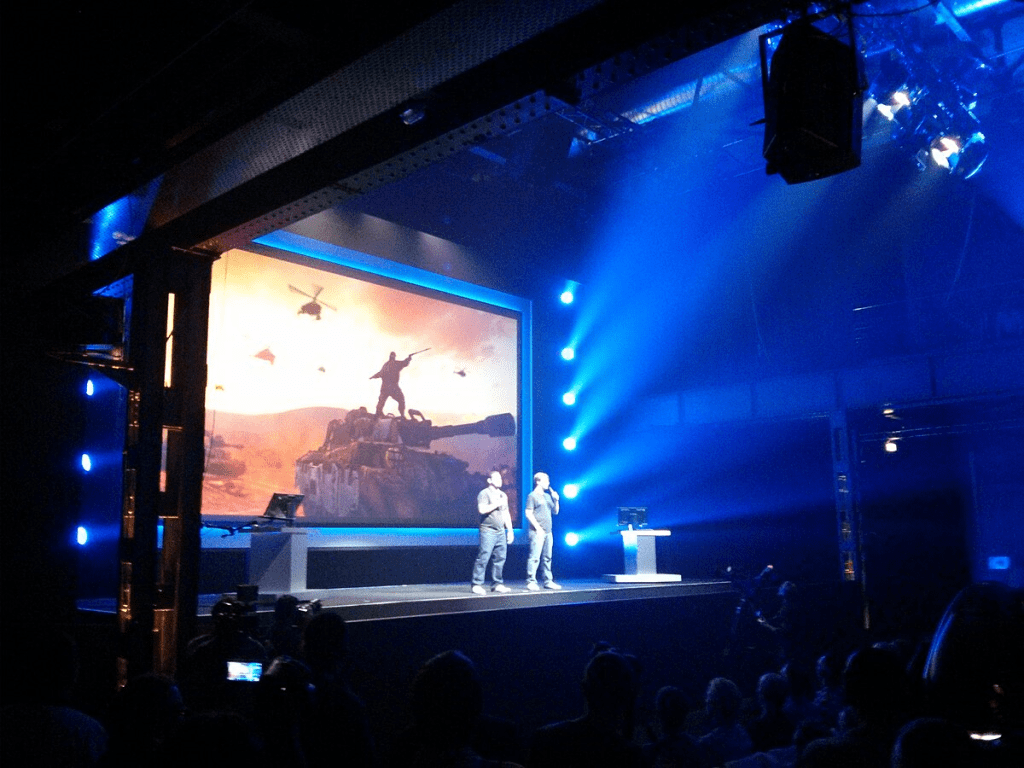
From a 2013 EA press conference about a new C&C title. If you have eyes, you can see the vibe they’re going for. And it’s not ‘morally dubious 1990s action sci-fi movie’
TW’s setting is retconned so that the Tiberium-infested world is divided up into uninhabitable Red Zones, Yellow Zones which are in a state of social collapse, and Blue Zones which are stable and prosperous. This is a marked contrast to Tiberian Sun, in which everywhere – Egypt, the USA, Norway, Germany, Britain, Mexico – was one of two things: a Yellow Zone or a snowy Yellow Zone. In TW, the Blue Zones we see are all either in the USA or in Germany. We always see them menaced and under assault. The first few missions are a bizarrely close remake of Red Alert 2, with the baddies invading hallowed American landmarks like the White House and the Pentagon (No! Please don’t destroy the White House or the Pentagon! Anything but them!). The Imperialism vs Third World framing is much more obvious and open. It’s no accident that the Forgotten are left out of the story of TW – they appear only as an Easter egg and they talk like super mutants from Fallout.
At base the reasons I don’t like it as much are political; I think it’s a shitty way to portray the majority of the human race, as if they have nothing better to be doing than besieging and menacing whatever dull place you live. But you don’t have to agree with that to see that these are two very different types of story and setting. Tiberium Wars is the same old C&C story about protecting the status quo. Tiberian Sun has more depth and ambition.
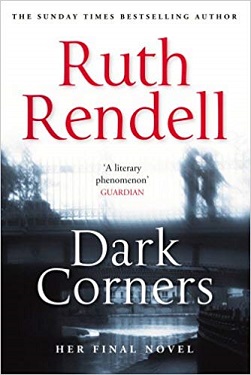
A Demon in my View (1976), The Face of Trespass (1974), Dark Corners (2015)
My first knowledge of Ruth Rendell was probably of seeing her name on library paperbacks around the house when I was a kid. I didn’t read her stuff until many years later after reading some glowing endorsements of her by authors I like. The only title of Rendell’s available that day on my library audiobook app was one called A Demon in My View. So I went ahead and downloaded it. That was back in March; by August I had read three out of her many dozens of novels published across nearly fifty years. I’ll give a run-down of each of the three, in the order in which I read them.
I should add that I listened to these novels as audiobooks, performed by Julian Glover (A Demon in my View) and Rick Jerrom (The Face of Trespass and Dark Corners), who both do a great job.
By the way, the reviews below contain some spoilers.
A Demon in My View
I was hooked on this story, right from the fucked-up start to the ironic and satisfying finish. A Demon in My View is about a man who once terrorised his fictional London suburb as a serial killer, but who has settled into a safer middle age by getting his kicks repeatedly ‘murdering’ a mannequin who lives in the neglected cellar of his shared, rented house.
The killer is a despicable sadist but Rendell manages to get us into his head, convinces us to feel an iota of sympathy for the wretch. He was raised by an aunt who judged him because he was born outside wedlock. There is something pitiable in his uptight, timid, neurotic narrative voice. But this timidity is the flip side of his murderous compulsions; he has a drive to feel power over others by causing fear and pain. The most horrifying example is the flashback scene involving the baby, which nobody who reads this book will ever forget until the day they die.
The whole story revolves around the tension between his hidden world and the intrusive realities of a shared housing arrangement. What we’ve got here is a story that’s fundamentally about housing, a theme that is important in all three books of Rendell’s that I have read.
The story is firmly rooted in its time and place, not in a way that dates it but in a way that enriches it. A new flatmate moves in; he has a very similar name to the secret serial killer, which provides all kinds of opportunities for confusion and subterfuge. In the 1970s, when this story is set, the post was crucial to people’s social lives and communications, and the only phone in a shared house word likewise be a shared one. The new arrival is really our main narrator and protagonist, but the long agony and final comeuppance he inflicts on our serial killer is unintentional and indirect.
Here is a writer, I thought, who can keep me in suspense, craft a believable social and cultural world, invest me in the practical limitations of comms in the 1970s, and horrify me with a rounded portrait of a human monster.
The Face of Trespass
The Face of Trespass is about a young writer living semi-feral in his friend’s cottage on the wooded margin of London while his girlfriend, a married woman, tries to convince him to murder someone. The story is bookended by a brilliant introduction and conclusion which involve a completely different cast of characters but which provide a resolution to the story. The day is not saved, but at least we get a significant consolation at the very end and from an unexpected source.
Murder is of course not relatable. But Rendell surrounds it, links it intimately, with things that are closer to our everyday lives. There’s lust, greed, envy. Again, housing. Scarcity of funds. An elderly mother living in another country and slowly dying; linked to this, a stepfather with emotional baggage and a language barrier. Aunts and old school friends. Pets. Obligations.
Apart from the aforementioned bookends, we stay in the point of view of the main character, the struggling young writer. Everyone reading The Face of Trespass will be able to see clear as day how our main character is being set up. I found this a little frustrating; we hate protagonists who are fools, who walk blithely into trouble. But in the end all was forgiven. Rendell’s playing a deeper game. The girlfriend is out to set him up – that’s obvious. What’s not so obvious (though all the clues are there) is (spoiler alert) how he will get out of it in the end.
Even more so than in A Demon in my View, seventies comms are central to the novel; much of it revolves around people waiting by phones.
One surprising highlight of this novel is the stepfather. I don’t know if I would pick up a book based on some blurb about a stepfather-stepson relationship. But the murder/mystery/thriller genre here serves as a vehicle for an amusing and, in the end, quietly moving sub-plot.
Dark Corners
Dark Corners was Rendell’s last novel, written decades after the other two above. It is still very good and gripping, but rougher around the edges.
At one point in the novel the main character, again a writer, laments that the characters in his work-in-progress all speak like they come from the middle of the century. This must be Rendell’s little dig at herself; the characters speak and often act like they just walked out of the much more affordable London of A Demon in my View. Modern things like the internet are mentioned a lot, but usually bracketed with some comment like, ‘Johnny supposed that this was the way things were these days’ – as opposed to thirty years ago, before Johnny was born.
Like The Face of Trespass, pets and vets come into it. But it’s housing that’s at the heart of the novel, in ways that highlight how the issue has changed radically since the 1970s. The landlord in A Demon in my View is a rather greasy and selfish character; the landlord here is a struggling writer renting out the upstairs of his late Dad’s house so that he can work full-time on his novel. But his tenant proves to be far more trouble than he’s worth. He refuses to pay the rent and refuses to move out.
Meanwhile a rudderless young woman finds her rich friend dead, and proceeds to occupy her apartment and wear her clothes. But impersonating a rich person, like taking in a tenant, proves to be more trouble than it’s worth. In this case, that’s putting it mildly: she is brutally abducted and held for ransom.
These two characters are a few degrees of separation from one another and only meet toward the end, in a very fateful encounter.
Again, the literal setting is London – and there’s a powerful sense of place – but on a deeper level the setting is the human mind struggling with fear and longing. Rendell’s home turf is psychology. As in A Demon in My View, we see the murderer from the inside out, and he is wretched and pitiful. Unfortunately, like The Face of Trespass but more so, we have a struggling writer who spends a chunk of the novel just frustrating us with his passivity and short-sightedness.
There is a third, and subordinate, storyline about a retired man who rides buses for fun (Yes, a third storyline. All three of these books are very slight, but it’s amazing how much is crammed into Dark Corners). This storyline is fun, but its culmination is the retiree very suddenly foiling a terrorist bomb plot. Rendell has this humane side that allows her to write stories where a modest older man becomes a hero thanks to his eccentric hobby, and that is satisfying. The problem is that the bombing has nothing to do with anything else in the novel, and has no impact on subsequent events.
This is one of many strange improbabilities and coincidences that, to my mind, constitute gaps in the fabric of the novel. It’s all the more obvious when compared to how tight-knit the other two books are. It appears the novel is kind of about coincidences – stories criss-crossing in a Pulp Fiction kind of a way. Coincidence played a role in the others, but to a lesser degree, and with more subtlety, and to better effect.
Dark Corners is readable and satisfying, but rough and flawed. In addition to its other virtues, it is rough and flawed in interesting ways.
First and foremost, these were gripping thrillers that passed the time for me while I did chores or drove. But the contrasts between the younger writer and the older, between the younger London and the older, added a great deal to the experience for me.
The point that this book has been hammering home is that hunter-gatherers were not ‘innocent’ or just roaming bands. Not only did foragers of the Stone Age have complex social structures and build great monuments, they were politically self-conscious and sophisticated.
Building on this, Chapter 5, ‘Many Seasons Ago,’ describes two very different cultures which lived along the Pacific coast of North America, drawing a series of fascinating comparisons and contrasts between the two. But the arguments and conclusions, this time, I found far less convincing than in previous chapters.
The argument is in essence: look at how radically different these two societies were, even though they had the same mode of production. So, isn’t the idea of a mode of production a bit useless?
The two North American ‘culture regions’ Graeber & Wengrow outline are the Californian Region and the North-West Coast Region. These were not pre-agricultural societies, the authors argue, but anti-agricultural – ie, they knew about farming but chose not to practise it.
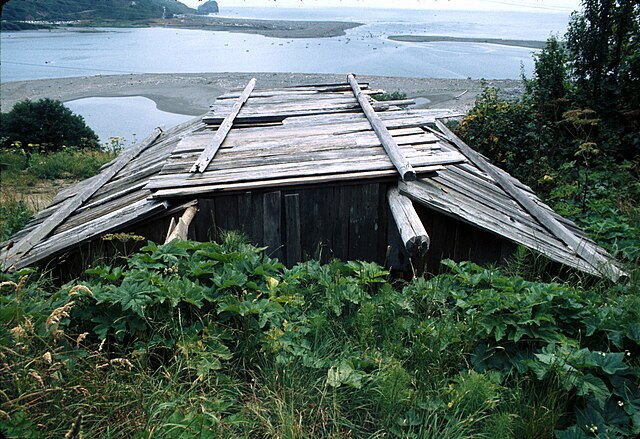
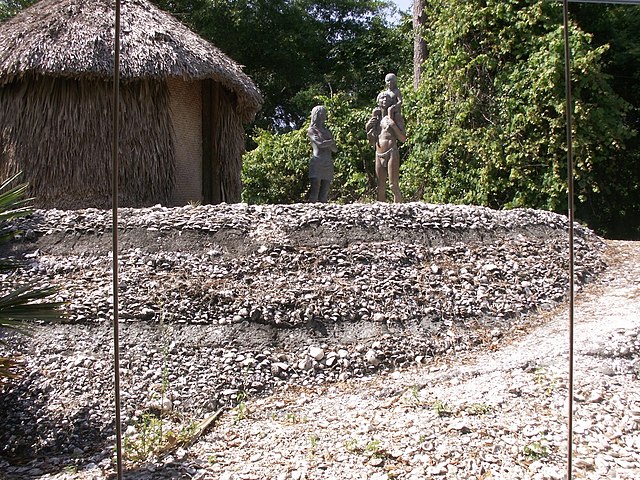
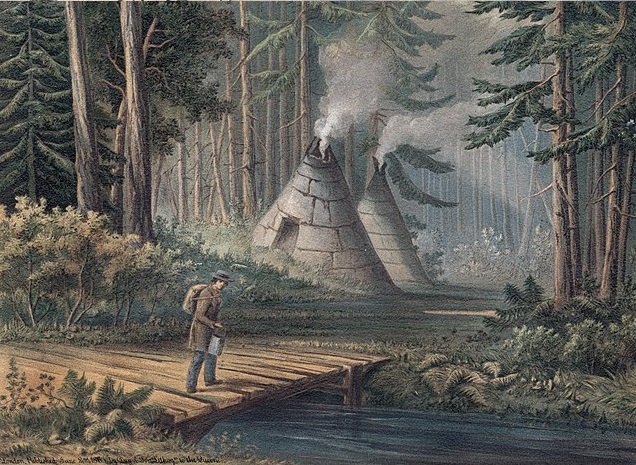
Reconstruction of a Californian Yurok plank house
Within this, as the most striking examples of the two regional cultures, they zoom in particularly on the Yurok (California) and the Kwakiutl (North-West).
Let’s try to sum up what Graeber and Wengrow put forward here.
They say that idea of a ‘culture region’ is not perfect but makes more sense than ranking and sorting societies based on ‘mode of production.’ In other words, let’s group different societies based on what games, foods, clothing and values they share, not on whether they are foragers, farmers or industrial workers.
They say that societies (or at least these societies) are ‘ultimately’ shaped by political and cultural dynamics, by human agency, and not by ecology or economics. Concretely, the Kwakiutl ate salmon and the Yurok ate nuts and acorns, but that had nothing to do with their respective social structures.
Societies define themselves against their neighbours – ‘dynamically interconnected [and] reciprocally constituted’ (Marshall Sahlins.) People traveled a lot in the Stone Age and were aware of neighbours’ customs and tech. What they consciously chose not to borrow is what defines each group: we are the people who don’t go in for slavery, who prefer a spartan aesthetic, etc.
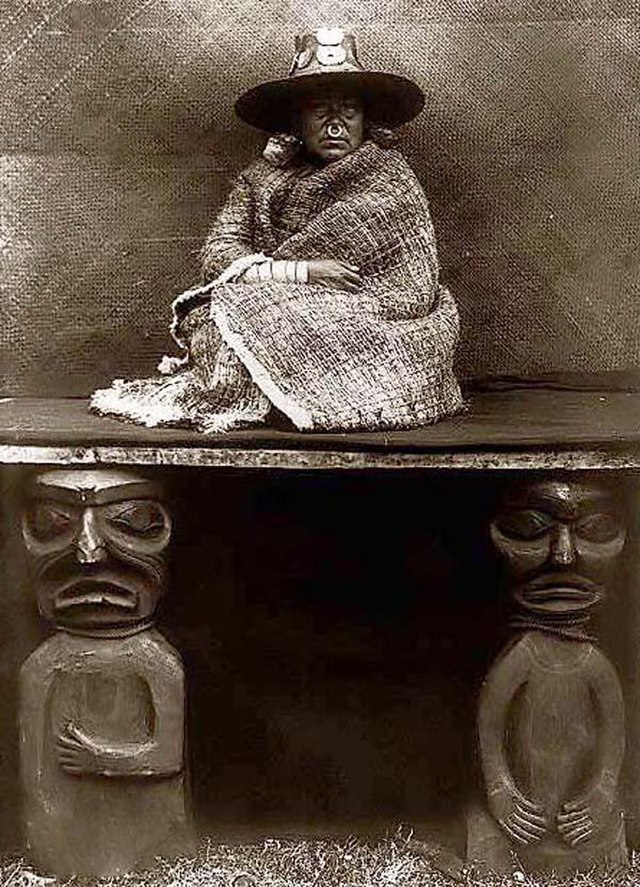
A Kwakiutl woman
So what do I think of all that?
I come to this without much prior knowledge, but it seems to me that the Yurok and Kwakiutl are bad examples for what the authors are trying to argue. Their means of subsistence could be crudely grouped together as ‘forager’ but were radically different. Culture and politics are weird and wonderful, so I’d agree that you can’t say that X climatic-economic input produces Y political-cultural result; if I say that the Kwakiutl eat fish, therefore they make colourful masks and enslave people, clearly there’s a missing link in the argument. But even though we can’t trace the causal relationship, I intuit strongly that there is one. It’s no coincidence that the people who lived on a diet of fatty, oily creatures made a virtue of amassing fat in their possession and in their own bodies. The people who hunted fish also hunted people. The people who ate dry, hard, austere nuts preferred not to hunt people, and themselves valued austere simplicity, hard work and physical thinness.
Between input X (the means of subsistence) and its many, practically untraceable outputs there is plenty of room for randomness and invention, and for the unique historical experiences of a given community, to interfere. It’s delightfully complicated.
Graeber and Wengrow’s thesis is appealing because it assigns the lion’s share of explanatory power to the political initiative of the people themselves. And it’s probably true that western Eurocentric writers are too keen to talk about their own history as a matter of political decisions, leadership, values and principles, while jumping to the most smug, glib, reductive, deterministic explanation they can think of when it comes to someone else’s history.
An idealistic, voluntarist philosophy lends itself well to judging certain communities for conditions forced upon them. But if we make our own choices, we make them from the set of choices available to us. Some people have more and better choices than others. This obvious enough to the authors that at one point they attempt to say, in essence, ‘No, not like that.’ Also, the limits of a given mode of production intrude when the authors acknowledge in passing that the population sizes in these communities were tiny. Neither fish nor nuts could support as large a population as settled agriculture. It’s fair to talk about ‘advance’ or ‘progress’ in relation to productivity of labour.
So they haven’t convinced me that there is a serious ‘problem with modes of production.’ But in the course of their argument they talk about a whole lot of great and interesting stuff. Once again, the journey is such a pleasure that you don’t mind if you never reached the promised destination.
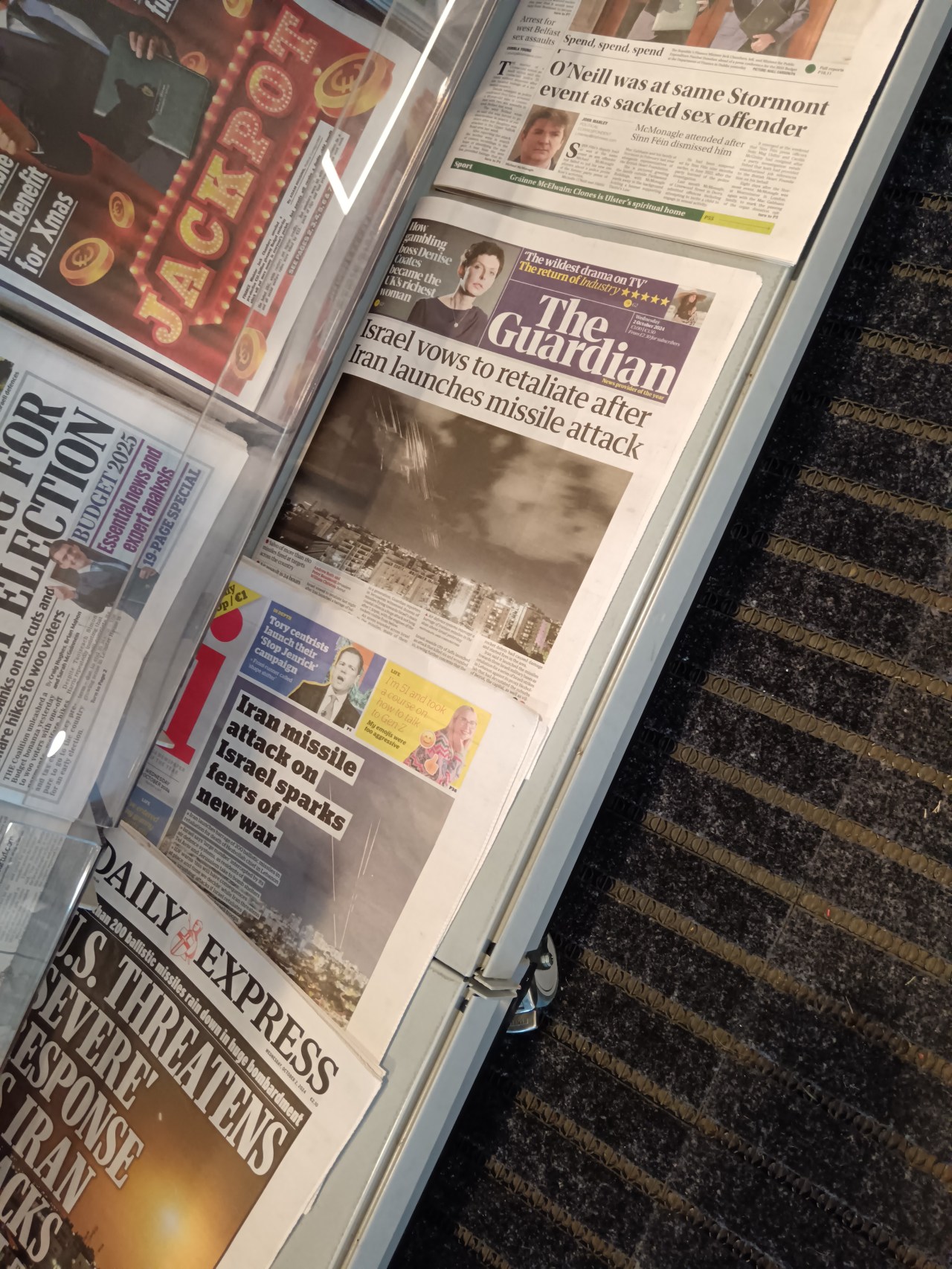
I love it when a news site makes their headline ten words longer than it needs to be, just to shoehorn in some way to frame the story in a politically agreeable way. Take this headline from the front page of the Guardian’s website:
Israel ‘will do whatever it takes to avoid 7 October-style attack’ as it launches Lebanon ground raids
Sunday September 30th
The Israeli leaders are stating their intention of invading Lebanon with sweeping war aims. But we are supposed to go along with the fiction that it’s just ‘ground raids,’ like it would be totally irresponsible to say any more than that for now. That armoured brigade and airborne division massing on the border might turn around and go home any minute now.
To really plumb the depths of that headline, imagine if the Guardian had framed the October 7th 2023 attacks as
Gaza ‘will do whatever it takes to avoid Cast Lead-style attack‘ as it launches Israel ground raids
Israel must be portrayed as the victim. That’s why even in a headline, which is supposed to be brief and to the point, the purely hypothetical attack is mentioned before the actual real attack.
So moving on two days and reading the headlines from October 2nd 2024, we can easily imagine western politicians and journalists sighing with relief and leaning back in their chairs.
US THREATENS ‘SEVERE’ RESPONSE AS IRAN ATTACKS ISRAEL
Daily Express, front page, 2 October 2024
We are back on safe territory. The Iranian government is doing a mostly symbolic and nearly ineffectual thing that it did before a few months ago. Now Israel can once again be portrayed as the victim without any need for suspicious convoluted headlines.
But what is ‘severe’ in this context? What could be more severe than what the US has been helping the Israeli state to do for the last year? 40,000 dead, at least. Millions forcibly displaced and the ‘safe zones’ bombed. Millions starved. Journalists and doctors and aid workers killed in their hundreds. Ambulances bombed and shelled. Every hospital and university in the Gaza strip, destroyed. Tens of thousands imprisoned without trial, many beaten, tortured and sexually assaulted. And this hellfire has been raging for a year now with no end in sight.
IRAN MISSILE ATTACK ON ISRAEL SPARKS FEARS OF NEW WAR
Independent (UK), front page, 2 October 2024
‘Fears of new war’ are prominent in my mind too right now. But you know, the pager attacks, the assassination of Nasrallah, the bombing and the invasion were the main cues there, just for me personally. Didn’t Israel bomb Yemen just the other day? How many people did they kill – was it more or less than the one poor soul who was killed by the Iranian missiles?
ISRAEL VOWS TO RETALIATE AFTER IRAN LAUNCHES MISSILE ATTACK
The Guardian, front page, 2 October 2024
It’s jarring to see these papers rewriting history in front of our eyes. Maybe they want Wikipedia in ten years time to say that Iran started the war by launching that missile attack.
Even after the slaughter in Gaza and onslaught on the West Bank over the last year, it is still somehow possible for me to be surprised and horrified at the actions of the Israeli government. After all it has done and is still doing in Gaza and the West Bank, the Israeli state is taking the show on the road. They want an all-out regional war. Until the pager attacks, I didn’t see it. Now I see it more clearly every day. They are hell-bent on raising the stakes.
Maybe they want to grab whatever land they can and kill whoever they want to kill while the going is good. Maybe they want to drag the US in even more than they already are. I don’t know. Usually I can assess the motivations behind why states do what they do. But this is just wild. The stated war aim (ending all capacity for Hezbollah to launch rockets into northern Israel) is not achievable. But it is a blank cheque for the IDF to go in and cause as much havoc as Netanyahu wants, for as long as Netanyahu wants.
By the way, I’m not going to take up 100 of these 1000 words issuing the mandatory disclaimers. You can assume I don’t support the state which killed Jina Amini and which executed hundreds for protesting her death. Let’s move on, without wasting any more of your time and mine, and look at another headline.
US would not support Israeli attack on Iran’s nuclear sites, says Biden
Well, that’s a relief. Because Iran doesn’t even have nuclear weapons. You know which country does? Israel. 88 of them. Even in the headlines about who they are not bombing yet, the unspoken assumption is that the country without nukes represents a greater nuclear threat than the one with them.
Evacuation
In these headlines there is not a hint of the horror of the war that is now starting in Lebanon, not a suggestion of the responsibility of the Israeli government. We hear of Israel evacuating villages. Phrases like ‘evacuation orders’ and ‘evacuation notices’ make it all seem formal and inevitable, as if they are helping people escape from a chemical spill or a flood. Telling people that if they don’t abandon their homes you will probably kill them is not an ‘evacuation.’ What these journalists are doing is like giving credit to a hurricane for the efforts of disaster relief workers.
And of course, Israel could have stopped waging a one-sided war on civilians in Gaza, and thereby stopped the Hezbollah rockets, any day out of the last 360+. That offer has been on the table the whole time.
Proxies
These articles go out of their way to remind us that Iran-backed Hezbollah, which is backed by Iran, is an Iran-controlled Iranian proxy in the region. They would do better to manage expectations about the coming war. Hezbollah is indeed backed by Iran, but it is also a massive political and military force with a lot of popular support in Lebanon. It’s difficult to see Israel winning. But just as the invasion is a ‘ground raid,’ Hezbollah is spoken of as if it’s just some guerrilla camp or terror network.
The right to defend itself
All my life we’ve been hearing that Israel has a right to defend itself, or even ‘herself.’ This was an infuriating and stupid line even before 2023, when somehow the balance of fatalities in the Israel-Palestine ‘conflict’ was always at least 10:1; when any visitor to the West Bank could see that an apartheid system is in force there; when, every four or five years, the IDF would ‘mow the lawn’ by killing a few thousand Gazans.
But the last year has been a horrible revelation. Somehow, things have gotten so much worse. And now Netanyahu wants to bring all this to Lebanon.
And Keir Starmer and Kemala Harris are standing up in front of the world and saying with straight faces that Israel has a right to defend itself. They’re still saying it, like nothing has happened, like that phrase has any meaning at all in this context.
Sometimes I wonder what atrocity Israel has to commit before the Americans feel obliged to stop giving them bombs. What would it take? But at moments like these I only wonder, what would it take before people like Starmer and Harris retire that self-defence line and think of some new hypocritical and stupid formula.
If there’s one thing to take away from this book, it’s that the Stone Age was way richer and more interesting than most of us would have thought. Moving from the Paleolithic (Old Stone Age) to the Mesolithic (Middle Stone Age, from about 12,000 BCE), us humans have not started working metal and a lot of us aren’t farming yet. Nonetheless even those who have not settled down to agriculture are still very busy:
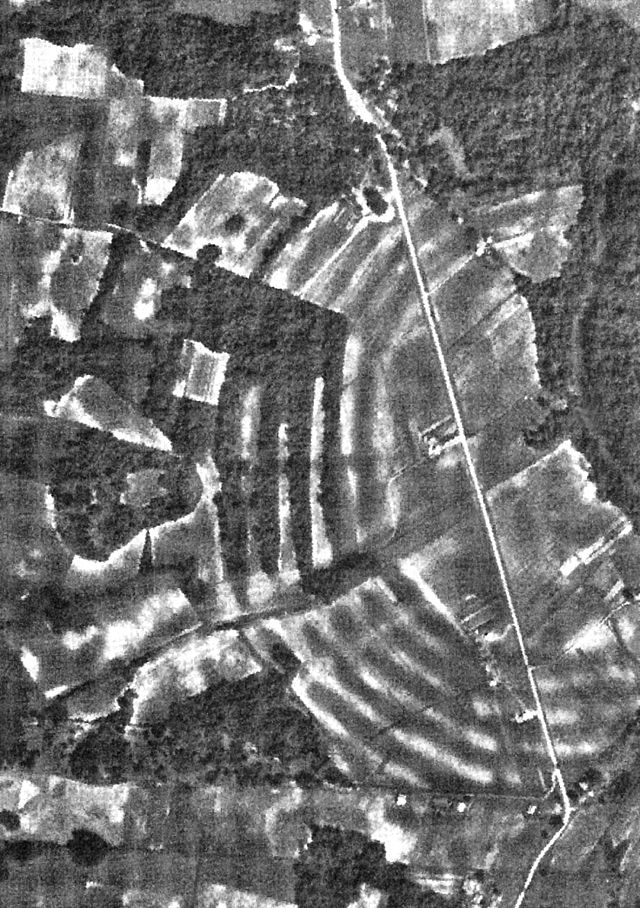
1930s aerial photograph of the Poverty Point site.
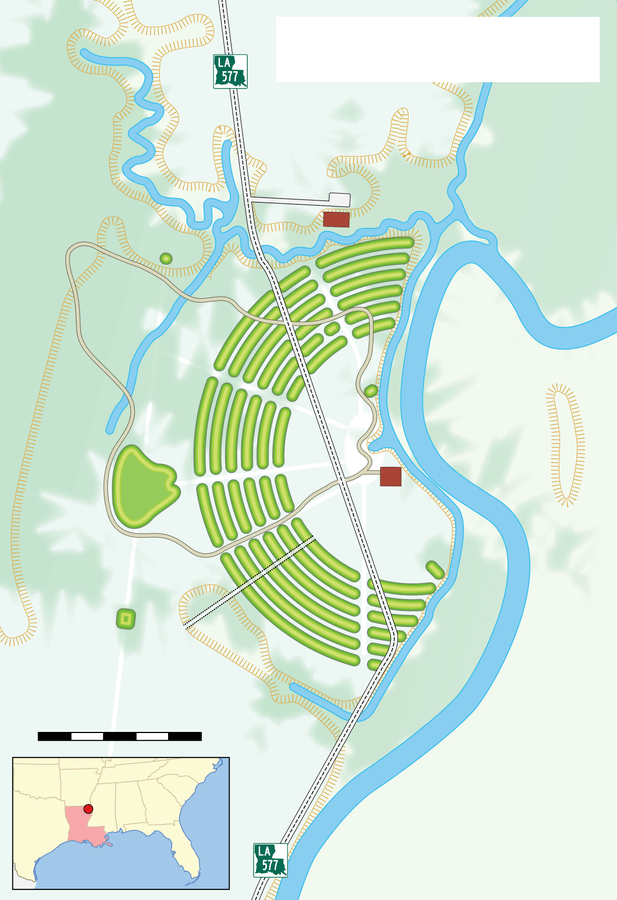
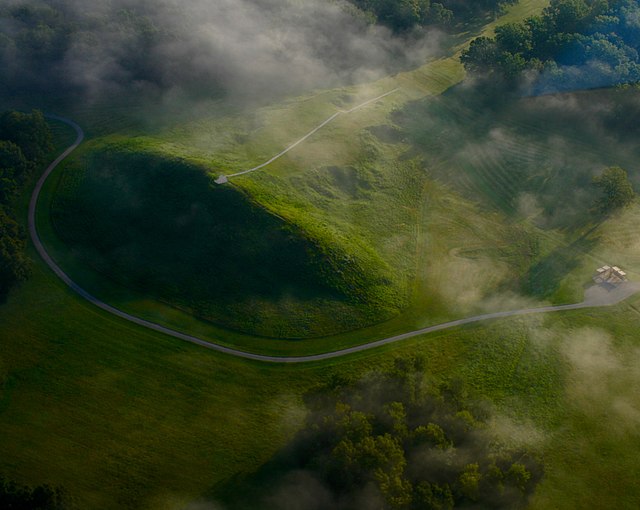
At Poverty Point, Louisiana, US, there are massive earthworks dating from 1200BCE and larger than the contemporary cities of Eurasia. Analysis of artefacts and of the apparent systems of measurement used by the builders links this site all the way up the Mississippi and to the Great Lakes, and down to the Gulf of Mexico and even Peru. The builders were hunters, fishers and foragers.
In Japan, we have a wealth of archaeological data showing a rich and complex social life passing through cycles of nucleated settlement and dispersal from 14,000-300 BCE. My notes get a bit scattershot here: OK, they had acorn-based economies, they stored a surplus, they smoked weed, and they left no evidence of aristocracy or a ruling elite.
In Finland around 2,000-3,000 BCE we have ‘Giant’s Churches,’ massive structures built by the collective labour of hunter-gatherers.
Drawing of a Finnish ‘Giants’ Church’
This makes intuitive sense to me. We have seen that hunter-gatherer life could involve seasonal or local superabundance. This allowed for specialisation (people to do the maths and the crafts, the planning, overseeing and mobilising) and collective projects, such as monument building. But since the superabundance was temporary, local or conditional, so was the specialisation, and so was the mobilisation of the people in collective goals. That’s why kings, hierarchies, inequalities tended not to arise. The way I’d see it, agriculture, on the other hand, creates the basis for a permanent surplus, and so a lot more societies start to turn hierarchical, and these hierarchies grow more permanent.
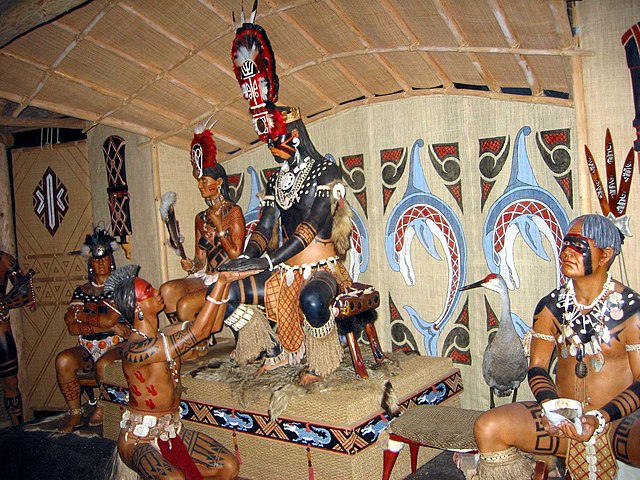
As with previous chapters, we then turn to anthropology, that is, to modern and early modern hunter-gatherers, and see a few examples of where they have had kings (returning to Louisiana and Florida). ‘The economic base of at least some foraging societies,’ the authors conclude, could sustain priests, royal courts and standing armies.
KONICA MINOLTA DIGITAL CAMERA
Swallows and summers
The authors make repeated claims that they are overturning conventional wisdom and rewriting history. In this chapter they are arguing that there is no causal link between the widespread adoption of agriculture and the widespread turn to hierarchy, inequality and subjugation, or if there is a link it’s too broad to have any meaning. The evidence they present in this chapter consists of the amazing social and physical structures that hunter-gatherers built – all without agriculture. But are ‘at least some foraging societies’ enough to prove such a big argument? I am very impressed, but not yet convinced. If the stale old ‘conventional wisdom’ still seems to hold for all but ‘at least some,’ then it holds. A dam designed to let through a trickle of water still holds back a massive volume in the reservoir.
Usually the tone is good-humoured, but sometimes it’s nearly a Hancocky tone of denouncing ‘traditional’ and ‘conventional’ scholars. The thing is, it’s not clear to me that this book contains a conceptual revolution, as opposed to merely synthesising, collating, bringing into relief, making informed and imaginative suggestions. So far, more the latter. The authors make bold claims and hedge them, or fail to carry through fully with the evidence. For example they scold us for assuming that pre-agricultural societies were all equal, and regularly caricature that position. Saying that pre-agricultural societies were generally more equal is apparently the same as saying they were childlike and innocent, all one identical blob, or animalistic – except when Graeber and Wengrow say it, as when they acknowledge ‘the flexibility and freedom that once characterised our social arrangements.’ (p140)
To be clear, the project of synthesising, bringing into relief, etc. is more than enough of a reason to read this book. I’m really enjoying it. And often its denunciations of ‘conventional wisdom’ are on point, for example when they describe the idea of writing off 7,000 years of American history as ‘the Archaic Period’ as ‘a chronological slap in the face.’ You don’t have to agree with everything these guys say to appreciate and enjoy the close-up tour of the messy interface between social systems in our deep past.
A reference to Marx surprised me. I assumed that the authors were squishing Marxism and its theory of primitive communism into their general critique of the Rousseau ideological tradition, and I criticised them for not mentioning it. But here they describe primitive communism as the collective ownership and control of the surplus, clearly distinguishing it from more romantic or pessimistic views where communism is only possible with no surplus at all.
‘Conventional Wisdom’
But I’m not done with ‘conventional wisdom’ yet. A lot of the things that are set up and scoffed at as ‘conventional wisdom’ are not really that. Here are a few of them as laid out on page 127:
‘…Rousseau’s argument that it was only the invention of agriculture that introduced genuine inequality…’
‘It’s also assumed that without productive assets […] and stockpiled surpluses […] made possible by farming, there was no real material basis for anyone to lord it over anyone else.’
‘Once a surplus arises, craft specialists, priests and warriors will arise to lay claim to it.’
Reading the above, you’d expect the authors to set about disproving these claims. They do nothing of the kind, at least in this chapter. As we’ve seen, they demonstrate that there are ‘at least some’ examples to the contrary. The built environment from the pre-agricultural age is impressive in absolute terms. As the reader, I have no way of judging whether this is a trickle or a torrent. OK, it’s useful to note that Poverty Point (more pictures below) has a bigger footprint than Uruk – but do all the sites built by foragers in that period have a bigger footprint than all the sites built by farmers?
‘The idea of ranking human societies according to their means of subsistence’ is described as a bad and weird idea that some eighteenth-century freaks thought up and that we have all accepted without question until now. I don’t believe in ‘ranking’ different societies, unless in relation to some specific and measurable quality. But I think that the way people put food in their bellies is actually foundational to how they organise their society. Those hunter-gatherers who changed their political structures every year? They did that because there were changes in how they could get food. It’s true that we look at prehistoric societies more than others through the lens of how they filled their bellies. But that’s entirely justified – because we know next-to-nothing about their politics or culture.
What is more, I’ve never had the above ideas presented to me as ‘conventional wisdom.’ Throughout my own formal education I never got an earful about the primacy of economics. At university we looked at Marxism as one topic of a dozen in Critical Theory, and one topic of a dozen in Historiography, plus Bloch and the Annales school. That’s it.
To be fair, I didn’t study Archaeology as such, or Anthropology – maybe it’s different in those fields. But in the broad public understanding of these fields, none of these claims in my experience constitute ‘conventional wisdom.’ On the contrary, the primacy of politics and warfare is asserted throughout popular history. In school, in the media and in popular culture, we compare societies not by their economic base but by their cultural and political ornamentation, through the prism of personalities and events. Economics gets only an indirect look-in, via inventors. Popular discourse evaluates societies according to the most arbitrary criteria (where for example Sparta somehow represents ‘democracy’) or with the aid of idiotic aphorisms like ‘Strong men create good times [etc]’ or even through the mostly-meaningless and deeply problematic lens of race. That’s where we’re at. We’re really not suffering from an excess of economic determinism.
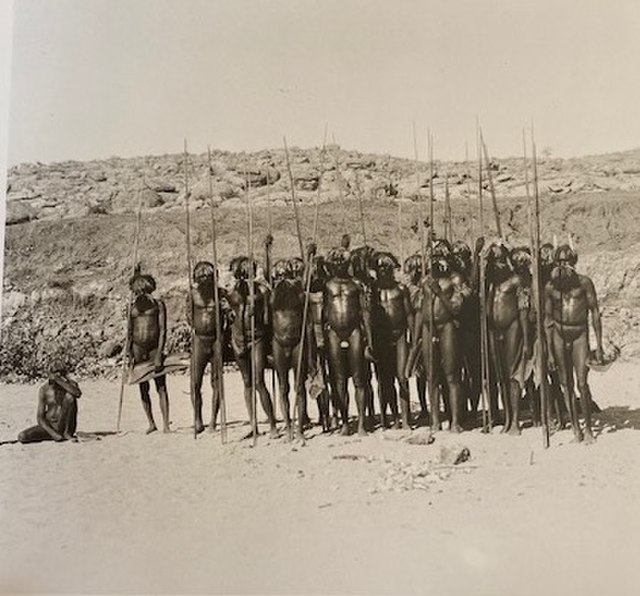
An armed band of Aranda in early-20th Century Australia
Work and leisure
There’s a lot more in the chapter. There’s the trope about how people in past ages had more free time than modern office or factory workers, which the authors take as read and don’t attempt to prove. As they note, it holds true for the !Kung people, but not for other foraging societies – the ones in what is now Canada appear to have been workaholics. One thing about the !Kung that I would definitely think is universal, though, is that they know about agriculture, could do it if they needed to, but have no pressing incentive to turn to it.
There’s some intriguing stuff about how the only thing close to private property or hierarchy in many forager societies was (is?) the concept of the sacred. The Aranda people in Australia treated their children with kindness but initiation into adulthood involved painful rituals; subjugation and violence was only present in a sacred context. Sites like Poverty Point were probably ‘sacred,’ the only place in the social life of the community where demands for absolute obedience were made.
Linked to this, the authors note about ‘kings’ of the Mesolithic: ‘It is possible for explicit hierarchies to arise, but to nonetheless remain largely theatrical, or to confine themselves to very limited aspects of social life.’ (P 131) This is food for thought for scholars of Gaelic Ireland who are struck by the pedantry of the seating and portioning arrangements which our sources prescribe for a feast. I have a feeling this is building toward a theory of where private property came from, a theory that relegates agriculture to background noise.
But this chapter has not, in my brain anyway, broken the causal link between agriculture and inequality. But the assumption that towns, specialisation, crafts and science are impossible without agriculture is completely wrong. Graeber & Wengrow have proved this hands-down. They have given us a fascinating picture of the real social and political lives of foraging societies and the monuments and social structures they can sustain.
Another powerful point here is that colonisers routinely claim that the land they are seizing is somehow fair game because the people who live there are not working it ‘properly,’ ie they are hunting and gathering rather than farming (And of course, even when they are farming, as in the case of Palestine, the colonisers still have the nerve to pretend they ‘made the desert bloom’). So the idea of foraging as not being a valid economic activity, of not being able to sustain ‘civilisation,’ however you define that, has a blood-soaked and disgusting legacy. This part is conventional (though it was never wisdom) and we can’t dispense with it quickly enough.
How was life in the Stone Age? Was it all people shooting arrows at one another and falling into glaciers, or was it one big hippy commune? In this chapter Graeber and Wengrow leave behind the Enlightenment and start a chronological study of the earliest human societies, focusing on society in the Upper Paleolithic period. That’s the final part of the early Stone Age.
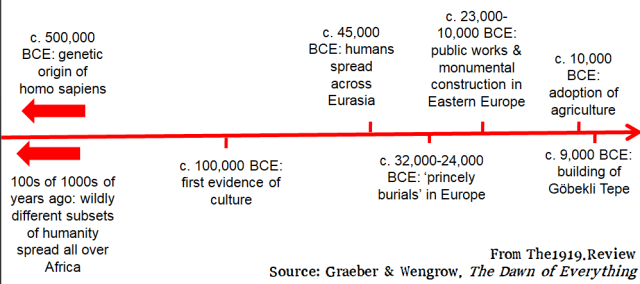
The first thing I learned here was pretty surprising: that humans lived spread out all over Africa for hundreds of thousands of years, with strong regional variations that meant they would have resembled giants, elves or hobbits to one another.
Then homo sapiens formed from a composite of all these very different sub-species, moved north into Eurasia, met the Denisovans and Neanderthals, and in time absorbed them.
The authors then perform the by-now familiar shuffle: thesis, antithesis, forget-about-either-thesis. Hobbes was wrong, Rousseau was wrong, here’s a better explanation.
A monument atGobekli Tepe, Turkiye. On which, more below…
Princely Burials
What about the Upper Paleolithic ‘princely burials’ in Europe? Are these richly-endowed graves (countless person-hours of labour would have gone into them) not evidence of a rigid social hierarchy like what Hobbes said?
Reading about ‘princely burials’ myself in other contexts, I’ve always been annoyed at the assumption that they necessarily indicate social hierarchy, aristocracy, etc. An individual might be honored in death for all kinds of reasons – for heroism in battle or skill in crafts, for being an inventor, for saving lives, for poetry, for metallurgy, for mystical visions. They might be honored for being great leaders, but this doesn’t mean they were aristocratic ones.
Graeber and Wengrow make an argument along similar lines to my guesses – that these were eccentric and visionary outsiders-turned-leaders, who were buried in riches (at a time when no-one was buried in death, with or without riches) as much to contain their potentially dangerous magic as to honour them. They construct a whole argument which takes in anthropology and archaeology, and which I found convincing.
So far they are at least living up to one promise: their version of history is interesting and rich. Our heads are full of capitalist and feudal assumptions, so we have to remember that just as objects which travel a long distance do not always indicate mere ‘trade’, elaborate burials do not always indicate ‘ruling class.’ The past is so much broader than the scopes of capitalism and feudalism through which we view it.
Monuments
We see the same pattern with the other type of artefact from the Stone Age which, like ‘princely burials’, are often taken up as proof of hierarchies and kings: grand, monumental buildings.
I’ve come across the fantasies of Graham Hancock and Ancient Apocalypse, in which Göbekli Tepe is evidence not just of kings but of an entire ancient empire which was more advanced than us and which left cryptic celestial warnings, and which colonized the world ‘teaching’ people how to do agriculture and masonry. A lot of the narrative hinges on the idea that Stone Age hunter-gatherers could not have built great stone monuments.
Even though they are so florid and fantastical, such arguments have always struck me as paradoxically boring. There is a more-than-open attitude to the possibility of Atlantis, aliens and giants, but dull pedantry when it comes to ancient societies. In unimaginably long stretches of time, tens of millennia, Graham Hancock cannot see any possibility that hunter-gatherers could have established a society which was, even temporarily, capable of building something like Göbekli Tepe.
Like with the burials, here Graeber and Wengrow give us a bit of archaeology (Stonehenge, Göbekli Tepe, Russian mammoth houses) and a bit of anthropology (such as the Inuits, the Nambikwara in Brazil and the Plains Indians in the United States) and paint a picture that is colourful and informative. I mean colourful not like atlanteans came along one day to teach us about seeds and the principle of the lever, but more like nomads and hunter-gatherers vary their social systems from season to season, sometimes gathering for great coordinated collective labour, sometimes dispersing to hunt and gather.
A small part of theGobekli Tepe site from around 9000 BCE
It’s satisfying to get a clearer idea of how these monuments were built. But the best part is the idea that these societies changed their whole social system regularly to meet their needs. In one part of the year, the modern Nambikwara roamed in small bands, all these bands being under the strict control of one chief. For the other part, they gathered in hilltop villages, became democratic and communist, and had chiefs who functioned more like a social welfare department than a monarchy. But across all the other examples, no single pattern prevails: among one people, there is a settled season of strict hierarchy and a roaming season of relative informality. Among another, police functions are strictly seasonal and rotate between clans on an annual basis.
The anthropological stuff gives an insight into how Stone Age peoples might have lived: gathering after a great hunt with a superabundance of food and other goods, feasting, processing materials, building great structures, then dispersing again when the seasons turn.
A reconstruction of a house built from mammoth bones, Japan, 2013
What’s the upshot of all this?
Prehistoric society was not a realm of innocence or animal instinct – our ancestors were politically sophisticated.
Prehistoric society was not all one thing. A grading of one political system alongside each economic mode (for example, claiming that hunter-gatherers live in ‘bands’, horticulturalists under ‘chiefdoms’) is too pedantic even as a general guideline.
And here I kind of get the ‘plague on both your houses’ approach to Rousseau and Hobbes, because it’s ultimately from Rousseau that we get the idea that people pre-state and pre-class were simple and innocent.
However, this wouldn’t have been my understanding, and I’m broadly in the Rousseau ideological legacy. So they’re only throwing out bathwater here. Fine by me.
They haven’t succeeded in turning me off the idea of an economic basis corresponding to a political regime. Hunter-gatherers never seem to get around to parliamentary democracy, fascism, Stalinism, the Paris Commune or the Petrograd Soviet – not because they were/are too innocent to think of them, but because these systems do not correspond to their needs or means. The above are political systems proper to our age. There is a wide range of them, and which one you end up with depends on the last analysis on the outcome of a political struggle. But a certain type of economy, one where things like factories and railways are central, is a necessary prerequisite.
Though it seems political systems are more broad and fluid the further back you go. Even what we file under ‘feudalism’ is by definition immensely varied and full of local peculiarities. And when I looked at Gaelic Ireland, I realised that under its legal constitution many different de facto regimes could exist, depending on hard factors like population and resources and soft factors like politics and culture.
But even that phrase ‘the further back you go’ is weighted with an assumption, isn’t it? An assumption about progress, development, advance. That economies actually do develop through stages, and do not slip backwards as easily as political systems do; it’s never actually happened that a country has been ‘bombed back to the Stone Age.’ I admit thermonuclear weapons do raise the possibility.
I guess Graeber and Wengrow wouldn’t agree, but it is possible to speak of progress and development and economic stages without being racist or reductive.
Our industrialized world has global warming, endemic and stark inequality, addiction, shanty towns, systematic cruelty to migrants, homelessness for the sole purpose of enriching landlords, debt bondage as a precondition for housing, widespread precarity,long hours and low pay, universal exploitation, and hysterical bigotry against anyone who’s different. It also has vaccines, washing machines, incubators, clean running water, and a super-abundant supply of manufactured goods. I think that second collection of things are more than mere creature comforts or mod cons – yes, even the manufactured goods that clutter my house and ‘do not spark joy’ – and what’s more I don’t see that they are predicated on the first set of things, the bad things, or dependent on them in any way.
The Marxist criterion at work here, as I’ve mentioned before, is the productivity of labour. In relation to that, we can speak of our society as being advanced or developed in relation to a society that lacks these things.
But the bad things listed above, and their absence in prehistoric societies, are a reminder that our society is still at an absolutely pitiful and contemptible level of development. The idle person who thinks it’s OK for him to be thousands of times wealthier than a nurse or cleaner, just because a piece of paper says that he owns this or that, is a victim of the greatest superstition that has ever held sway over the human mind. The 16th-century German had more reason when he bought indulgences off Johann Tetzel, and the Aztec priest had more practical common sense when he ripped the hearts out of war-captives to keep the sun in the sky.
The most valuable insight from this chapter – and it is a refutation of Rousseau whatever way you slice it – is that hierarchy is not a necessary overhead of (a) social complexity or (b) large population or (c) collective projects or (d) coordination over long distances. Sure, hierarchy is one way to do it, and indeed one way that it appears to have been done even in some pre-class societies. But this chapter tells a story of political sophistication and huge monuments, apparently without hereditary rulers or coercion.
I grew up with Gary Larson images of people living in caves and even coexisting with dinosaurs (Yabba dabba doo!). But even as a more well-read adult I still would have thought that before agriculture, people lived in small roaming groups of a few dozen people. This chapter has challenged this idea, but in a way that is actually very encouraging. These pre-agriculture, pre-state, pre-class societies could be large, complex and at least seasonally settled. Probably they had a wide variety of social structures, including hierarchies and castes, but these were not the rule.
Hi, this is Part Two of my run-down on The Dawn of Everything, a book that asks how unequal, hierarchical and class-ridden societies first arose. Here is Part One.
In this chapter Graeber and Wengrow ask:
What did indigenous Americans in the 17th Century think about Europeans?
To what extent did the Enlightenment draw on sources outside Europe?
What does ‘egalitarian’ even mean?
And they emphasize the urgency of these questions: ‘A very small percentage of [the world’s] population do control the fates of almost everyone else, and they are doing it in an increasingly disastrous fashion.’ (p 76) If we want a free society that is not careering toward ecological and social catastrophe, we need to figure out how it came to be that a small minority ended up in control.
Before starting their story of humanity from the beginning, the authors detain us for one chapter to argue that a lot of our ideas about that epic story are wrong to begin with, and to give an account of why. This involves rewriting the history of the Enlightenment. So that’s the fairly ambitious idea of the part we’re looking at today:
Chapter 2: The Indigenous Critique
Along the way, the book delivers a lot of what I expected and wanted. For example, we get a sketch of several indigenous American societies before their destruction by European settlers.
The Wendat (Huron) grew crops around inland fortified towns. They had formal political officers and a caste of war-captives with limited rights, whom the European observers assumed were slaves. Other tribes such as the Mi’qmak and Montagnais-Naskapi, meanwhile, were bands of hunter-gatherers.
The Europeans saw these people as eloquent and very good at reasoned debate, skills honed in near-daily discussions of communal affairs. The Europeans also noticed that they possessed individual liberty, and wholeheartedly disapproved. Laws were not enforced, fathers did not control children, captains had to rely on their own persuasive power to get people to fight.
Jesuit missionaries were shocked to observe the ‘equality of the sexes’ – women had sexual freedom and the right to divorce. But there was a gendered division of labour, with women owning and working the fields while men hunted and fought. This reminds me of Engels’ explanation of how gender inequality came about. His vision of the prior state of equality does not preclude a gendered division of labour.
Looking at the Wendat, I feel like I’m re-playing the greatest hits from Celtic Communism? In an exact parallel with Gaelic Ireland, the Wendat practised communal compensation rather than punishment. There were wealthy people among the Wendat – but, and we saw elements of this in Gaelic Ireland too, the main incentive in hoarding material things was to give them away and thus boost one’s own prestige.
Graeber and Wengrow say lots of clever and interesting things – such as, in relation to the Wendat, ‘insofar as we can speak of communism, it existed not in opposition to but in support of individual freedom’ (p 48) – but they miss one obvious point. The 17th-Century Wendat (I specify 17th Century because, as far as I know, they are still around) had richer and poorer individuals, and individuals who held political office (on the sufferance of those who did not). What they did not appear to have had was distinct classes in conflict with one another. Again, here we see some parallels with Ireland. The Wendat were equal and egalitarian and communist in the sense that they all belonged to a single class. Like with my previous Celtic ruminations, here we are troubled out of complacent identification with the people of the past by the spectre of the un-free, the layer or caste who existed within the community but with curtailed rights. But the authors here don’t seem at all interested in class, and are visibly aggrieved when the Enlightenment salons turn from discussions of political institutions to discussions of economics.
Indigenous people roasting Europeans
What’s equally fascinating is the low opinion these Indigenous people had of Europeans when the latter arrived in the sixteenth, seventeenth and eighteenth centuries. For some reason I tend to forget that European colonisers and indigenous people lived in proximity for centuries, had developed opinions and analyses about each other, and left records of same. What is more, these records were a very popular type of book in early modern Europe.
The Mi’kmaq, around 1608, saw their (overwhelmingly male) French neighbours as envious, slandering, lying, quarrelling, covetous and ungenerous. ‘They are saying these and the like things continually,’ writes the Jesuit missionary who recorded these opinions. To the missionary it was obvious that while the French had more material goods, the Mi’kmaq had more ease, comfort and time.
Twenty years later a missionary among the Wendat recorded that they had no lawsuits and were not covetous. There were no beggars ‘in their towns and villages’ (I admit, embarrassed, that I didn’t know they even had towns and villages before I read this). As for beggars the Wendat heard of existing in France, they ‘blamed us [the French] for it severely.’ While the Wendat had daily community gatherings and discussions, the French interrupted one another, quarrelled, competed to hog the limelight, and often resorted to weak arguments.
This chapter does great service to history by promoting knowledge of a Wendat political leader named Kondiaronk who actually visited France as a diplomat and, in lengthy salon discussions with Frenchmen back on his home turf, voiced a powerful critique of European society.
‘The whole apparatus of trying to force people to behave well would be unnecessary if France did not also maintain a contrary apparatus that encourages people to behave badly,’ declared Kondiaronk – that ‘contrary apparatus’ consisted of money, property rights and profit. If you want to learn more about Kondiaronk, I really recommend you read this book.
Stages
This brings us to the main focus of the chapter. The authors basically give an alternative history of the Enlightenment, arguing that this indigenous critique was of key importance. The idea of societies developing through stages is attributed to the economist Turgot, who developed the idea as a defence mechanism against the indigenous critique: in short, the indigenous people say that Europeans are un-free and miserable, but it doesn’t matter what they say, because they are on a lower level. Their freedom is ‘lower’ than our slavery.
Rousseau’s famous essay on the origin of social inequality appears here as a strange synthesis of the indigenous critique and of the ideas developed to counter it.
I have mixed feelings on this. Texts such as the main one cited here, Curious dialogues with a savage of good sense who has travelled (1703), are fascinating and valuable and it’s a shame they were dismissed so lightly as fabrications. And this narrative of the Enlightenment as a period when Europeans encountered and opened up to ideas from other parts of the world was fresh and interesting. It’s an ambitious argument, though, and the fact that it’s so much at odds with other accounts of the Enlightenment that I’ve read would give me at least pause for thought. Doesn’t the receptiveness of European minds to the indigenous critique say something about how developments within Europe were also driving the Enlightenment?
Whatever Turgot’s agenda was, the idea of societies ascending through stages of economic development is, in itself, a good one. Married to arbitrary criteria, or none at all, (sorry, Age of Empires), this idea leads to bad places. But you can attach it to valuable criteria (such as the productivity of labour) and thereby give some meaning to the concept of progress underlying it. I predict the authors are setting things up for an attack on Marxism in future chapters. They are emphasizing the conservative pedigree of the idea of stages of economic development as part of lining up those dominoes. We’ll see how that goes in the coming chapters.
I enjoyed this chapter in spite of reservations. I hope Kondiaronk and his opinions on early modern European society become a staple of school history courses.















 The 1919 Review