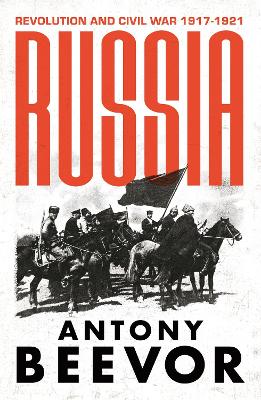
So far, Beevor’s new book is terrible

I learned a lot from Stalingrad and The Battle for Spain, so I was interested to learn that Antony Beevor was tackling the Russian Civil War in his latest book.

But judging from what I’ve read so far, Russia: Revolution and Civil War 1917-1921 is a crude offering. I’ll show what I mean by reference to a single chapter (which is more or less all I’ve read).

When I looked at the contents page, my eye was drawn to a chapter titled ‘The Infanticide of Democracy, November-December 1917.’

If you’re going to put an image of infanticide into my head, you’d better have a good reason. In this case, there is no good reason: during those two months, November and December, the Bolsheviks secured a majority in the Soviets, then received the blessing of a peasant soviet congress. They passed decrees on peace and land. They went into coalition with the Left SRs. They held the Constituent Assembly elections. The street fighting lasted only a few days, and the Whites involved were in general treated with magnanimity. Throughout, the Bolsheviks resisted the pressure to enter coalition with parties whose programme was diametrically opposed to theirs, and relied instead on the active support of millions of people.

All in all, I see this period as one during which, against challenging odds, the new soviet government lived up to its promise. But Beevor doesn’t see it that way.

Peace

He starts out talking about the war. Even though he dubs World War One ‘The Suicide of Europe’, he condemns the Soviets for trying to end the war. For him, the peace efforts were a bad thing because they encouraged rowdy and violent deserters (as if the rotten Tsarist army was not already collapsing due to mass desertion). If the Bolsheviks had broken their peace promise and forced everyone to fight on at gunpoint, no doubt Beevor would condemn that too. And he would be right!

Next in line for condemnation are the deserters themselves – because they ripped the upholstery out of first-class train carriages to wrap around their bare feet. Unmoved by the bare feet of the soldiers, Beevor is moved by the plight of the upholstery.

It must be fun for Beevor to come up with these taboo-busting chapter titles. ‘The Suicide of Europe,’ ‘The Infanticide of Democracy’… What’s next? ‘The Incest of Asia’? ‘The Opioid Addiction of Oligarchy’?

Plotting Civil War

Lenin, Beevor tells us, ‘welcomed destruction for its own sake.’ From there, he argues that Lenin wanted to start a civil war – ‘to achieve tabula rasa through violence,’ that he wanted all the horrendous destruction and inhumanity of 1918-1921 to happen so that he could ‘retain power’ and build communism on a clean slate.

So according to Beevor, Lenin’s plan was to hold power and to build communism in a context where the industries were devastated, where the areas which produced food and raw materials were occupied by enemy armies, where the urban working class – his support base! – were dying in huge numbers, where military spending made it impossible to pursue ambitious social programmes. Needless to say, this was not his plan.

By April, Lenin was happy (an unfortunately very wrong) to declare that the war was over. The idea that he wanted the Civil War at all is just as absurd as his alleged motivation.

But Beevor ‘proves’ his contention by cooking up the most negative and hostile interpretations of carefully-selected utterances by Lenin, then presenting these interpretations as fact.

You can feel Beevor’s fury and disgust every time he mentions Lenin. Whenever we see that name, it is accompanied by a bitterly hostile remark. He must have damaged his keyboard, angrily banging out L – E – N – I – N again and again. And yet to Lenin he keeps returning, as though the revolution revolved around one man.

Food

He ridicules Lenin’s claim that wealthy people were sabotaging food supplies. But this sabotage was taking place. First, there was speculation, or in other words the hoarding of food to drive up prices. Second, there was the strike of government employees, which was creating a humanitarian crisis, the sharpest edge of which was a food shortage. This strike was financed by rich people and big companies, and collapsed when they withdrew their support.

In a context of looming famine, when Lenin calls wealthy people ‘parasites’ and calls for a ‘war to the death’ against them, Beevor says this is ‘tantamount to a call to class genocide.’

The blind spots Beevor reveals are interesting. In this passage he talks about two things: 1) rich people starving poor people to death, and 2) Lenin making an inflammatory speech. If you asked me which of those two things could best be described as ‘class genocide,’ I know which one I’d pick. But for Beevor, it’s the first-class upholstery all over again. He gets upset about dangerous words and not about empty stomachs.

The food supply crisis, naturally, he blames on the Bolsheviks – even though the food crisis had been getting worse since 1915 and the Bolsheviks had been in power for all of five minutes.

Kornilov

The author turns his attention to the right-wing General Kornilov, who broke out of prison and rode across Russia to the Don Country where he met up with thousands of other officers and set up a rebel army to fight the Soviet government. His descriptions of Kornilov in this chapter make him sound like a fearless adventurer whose only fault is that maybe he’s too brave. There were ‘innumerable skirmishes.’ No doubt if it had been Lenin fighting his way across the country Beevor would pause to describe the blood and guts of his ruthlessly slaughtered victims. Instead of this, he compares the whole thing to Xenophon’s Anabasis (That’s The Warriors to you and me).

Lenin is portrayed as plotting to start a civil war. But Beevor never ventures to speculate that maybe Kornilov is plotting to start a civil war. Apparently Kornilov is fighting his way across the country and raising a rebel army for some other purpose.

Beevor’s version of Lenin can only retain power by achieving ‘tabula rasa through violence’ – as opposed to retaining power by democratic means. Meanwhile what was Kornilov doing, and why does it not come in for any scrutiny?

Lenin’s power rested on the active support of many millions of people through the Soviets, which were at this stage still a robust participatory-democratic system. Meanwhile Kornilov’s power rested on the support of several thousand men who gathered by the Don river at the end of 1917. They were united in the conviction that no elections were possible in Russia until the country was ‘purged’ and ‘cleansed’ of the soviets, along with nationalist movements and minorities.

In other words, they wanted to achieve tabula rasa through violence. But, at least in this chapter, it does not occur to Beevor to present them in this way.

Anti-Semitism

The most dishonest part of the chapter comes with Beevor’s remarks on anti-Semitism. He relates two local episodes in which soldiers and sailors attacked Jewish people. These incidents are supposed to prove that the Soviets tolerated or even encouraged anti-Semitism. We read: ‘Soviet authorities tacitly condoned violence against Jews’!

But just a few pages earlier, Beevor writes at length about the foundation of the Cheka. Somehow he fails to mention that one of the main purposes for which the Cheka was founded was to combat anti-Semitic pogroms. The very incidents he describes may have been those which the soviets responded to by setting up the Cheka.

Nor does he mention the outlawing of all racist discrimination, including anti-Semitism, by the new government.

The Cheka

The Cheka during November-December 1917 was a security organisation with only a few dozen full-time staff. But Beevor writes of it as if it were already the feared and controversial instrument of terror that it became over the year 1918. No, scratch that, he writes about it as if it were already the NKVD under Lavrentiy Beria.

For example, he quotes a poem which he says was ‘later’ published in a Cheka anthology. This is a disgusting, psychopathic little poem which celebrates killing. What Beevor doesn’t mention is that this poem was published a lot later, 1921 at the earliest. The entire Civil War took place between the point we’re at in the narrative and the date when the Cheka published this unhinged poem. Four years is an age in times of revolution and civil war. This poem was not written or published in December 1917 and could not possibly have been. The brutality it reflects was a product of the Civil War. Beevor presents it as if it were a cause of that war, part of the ‘infanticide’ of democracy, as if that mindset was there from the start, was in the DNA of the Cheka.

After the Civil War, by the way, the Cheka was radically downsized. Its role, under different names and big organisational changes, as Stalin’s executioner was yet another even later development.

By jumping around in time like this Beevor doesn’t just present a misleading account. He tells a dull story, a smooth and frictionless history of the Russian Revolution. Stalin’s totalitarian state is already there, fully-formed, in November 1917.

The Bolsheviks were initially humane and even magnanimous. Utterances from revolutionary leaders in which they speak in military metaphors can be easily found. But it is just as easy to find them expressing the hope that the Russian Revolution would be a lot less bloody than the French (so far, it had been). Krasnov was paroled after attacking Petrograd. Many Whites who fought in Moscow were let go and allowed to keep their weapons. Lunacharsky was so horrified by the fighting in Moscow he resigned as a minister. Lenin was the victim of an assassination attempt in January 1918, but it was hushed up at the time so as not to provoke reprisals. But 1918 saw Kornilov and his successors, along with foreign powers and the Right SRs, create a terrible military, political and humanitarian crisis in a bid to crush the soviets. This was the context for the development of the Cheka into what it became.

But in the monotonous world in which this chapter takes place, there is no change, no development of characters or institutions. A is always equal to A. The Cheka is always the Cheka. This way of looking at the world may pass muster in a book where, for example, Guderian’s Panzer Corps remains for a long period a dependable, solid and unchanging entity. But it is ill-suited to talking about revolutions and civil wars, in which institutions can pass through a lifetime of changes in a few months.

It’s not just that he gives a misleading, flattened account. It’s that he misses an opportunity to tell a far more interesting story.

The Left SRs

To minimise the significance of the coalition, Beevor treats the Left SRs as a bunch of ineffectual idiots and claims that the Bolsheviks always got their way. In fact, many of the key early leaders of the Red Army and Cheka were Left SRs; all Soviet institutions were shared between the two parties, for long after the coalition broke up in March 1918, and even after the Left SR Uprising of July 1918. But here Beevor treats the Left SRs just as he treats the Cheka: by jumping around in time as if context does not matter.

It’s real Doctor Manhattan territory. It is December 1917, and the Bolsheviks and Left SRs are making a coalition; it is March 1918, and they are breaking up over the Brest Treaty; it is July 1918, and they are shooting at each other in the streets of Moscow.

It gets worse. We are informed that ‘Leading Left SRs also fought for the distribution of land to the peasants, against what they now suspected was the Bolshevik plan of outright nationalisation.’

They ‘fought’, did they? Against whom?

Collectivisation, let alone ‘outright nationalisation,’ of land was not attempted, and it certainly was not an issue in the Bolshevik-Left SR split. Local experiments in state farms, and certain ultra-left policies in Ukraine and the Baltic States, are the only thing that comes close to what Beevor is suggesting. Stalin’s policy of forced complete collectivisation, meanwhile, was ten years away, and was never even contemplated by Lenin.

When Beevor writes that Lenin ‘had shamelessly copied’ Left SR policy on land, he is committing a double absurdity. First, because Lenin’s own position on the land question, consistent over twenty years or so, was broadly the same. Second, because the rules of plagiarism and copyright do not apply to policies. Adopting the policy of another party is a concession to that party.

But that wouldn’t do for Beevor. He cannot show Lenin being agreeable in any way. He insists that Lenin was like an icebreaking ship, that he was a worse autocrat than Nicholas II. Whenever Lenin’s actions contradict the extreme characterisations, Beevor cooks up a sinister motivation, rather than just reassessing his views, or admitting that politics and history are complex. The coalition with the Left SRs? A nasty trick. The Constituent Assembly elections? ‘Lip service.’ Soviet democracy? He claims it was ‘sidelined’ even though Soviet Congresses continued to meet and to decide key questions of policy well into the crisis of summer 1918.

Every narrative trick in the book is on display in this chapter. For example, Beevor describes the Left SRs getting in on the ground floor of the Cheka in a way that would leave an unattentive reader with the impression that they had been excluded. He describes up as down and black as white.

Persia

I’m disappointed. I was actually interested in reading Beevor’s account of the Civil War. I did not expect to agree with all or even most of what he said. But I thought he’d have something to say, and that it would enrich my own ongoing series on the Russian Civil War. Instead we get this monotonous, unbalanced condemnation that we’ve heard so many times before from so many sources: school, TV, and books with gushing quotes in their blurbs. The same old story is invariably described in these gushing blurbs as fresh and challenging.

Two-thirds of the way through, the chapter changes tack. It follows the critic Viktor Shklovsky as he runs off to Persia at around this time. This was horrifying reading, but at least I learned something I hadn’t already known. The Tsarist army was in occupation of a part of Persia, which was a major contributor to the fact that a third of Persia’s population died of famine and disease during the First World War. The Russian soldiers shot civilians for fun, abducted women and sold them in Crimea. Beevor notes that there was a different going rate for women who had already been raped and for those who had not.

Horrified, I read an article going deeper into this. Here – it seems by accident – the title ‘The Infanticide of Democracy’ earns its place. The Persians had a democratic revolution in 1909. Russia and Britain could not tolerate the possibility of an independent Persian Republic. They invaded, supported the reactionaries, and slaughtered thousands.

The horrors of the Tsarist occupation of Persia should give Beevor pause for thought. Was Lenin really ‘a worse autocrat than Nicholas,’ if this is what Nicholas did to Persia? These killers and slave-traffickers were many of the same officers and Cossacks who staffed the White Armies. If the Reds were fighting against such a heavy legacy of oppression, shouldn’t even a consistent liberal historian cut them some slack?

Beevor does not mention (at least in this chapter) that the Soviets renounced any Russian claim on Persian territory, and withdrew what was left of the Russian army. I had to learn that from the article linked above. But if he did mention it, no doubt he would find a way to twist it into something sinister and evil.

Conclusion

A lot of this chapter is taken up with abstract little sermons like the following: ‘This summed up the Bolsheviks’ idealised ruthlessness, elevating their cause above any humane concern such as natural justice or respect for life’ – or upholstery.

I don’t want the reader to think I have it in for Beevor just because I disagree with him. My shelf and my devices are full of titles whose authors I disagree with. Take the following remark by Laura Engelstein from her introduction to Russia in Flames: ‘there were no halcyon days of the Bolshevik Revolution. There was no primal moment of democratic purity that was later betrayed.’ I disagree with this statement, but at least there’s something there with which to disagree. It’s not a strident condemnation, let alone the third or fourth strident condemnation on a single page.

Evan Mawdsley’s book answers all kinds of fascinating questions about the Russian Civil War. It does so in a way that’s biased toward the Allies, but which leaves space for the reader to disagree, which often gives the other side the best lines, etc.

I have no problem, obviously, with polemical or agitational or partisan writing. But Beevor batters us over the head with his opinion and leaves us no space to interpret what he tells us. He writes in a ‘take it or leave it’ manner that does not invite debate. If he’s writing about 1917 and can’t find the evidence he needs to shock you into submitting to his point of view, he’ll go as far as 1921 to get it, then neglect to tell you where it came from.

I don’t know whether it’s complacency – he believes that he has a water-tight case, so he makes it with maximum force – or anxiety – he has serious doubts about what he’s writing, so he leaves no room for the reader to make up their own mind.

To sum up, the first part of the chapter was about a government that was trying to end World War One, share land with the peasants, and give power to workers’ councils. The author could hardly contain his rage and disgust. The end of the chapter was about a Tsarist army mass-murdering Persian people for eight long years. Here the author suddenly dropped the sermonising, the angry tone, the condemnations. Without his stranglehold on the narrative it was easier to read, in spite of the horrors he was describing. But the sudden shift in tone – oh man, it spoke volumes.

I have a sinking feeling that the whole book is going to be like this.
Go to Revolution Under Siege Archive

Go to Home Page/ Archive

How Dune gets away with it

When it was briefly mentioned on The Mindy Project, it was described as (something like) ‘That book that every guy loves for some reason.’ I read Dune at age 15. The years passed and I forgot some of the details of the story, but it held on in some remote sietch in the back of my mind, from which echoed phrases like Gom Jabbar, Muad’Dib, Kwisatz Haderach; mantras like ‘Fear is the mind-killer’ and ‘Who controls the spice controls the universe.’ The recent film captured some of that hypnotic power, and gave me an urge to visit that strange place again.

Re-reading it was a trip. Here are some things that struck me. In each case I was left wondering, ‘How does the novel get away with that?’

There is no scene of space travel in Dune. A chapter on planet Caladan ends; the next chapter begins with the characters literally unpacking their bags on planet Arrakis. The author Frank Herbert tells us that the Guild of Navigators have a monopoly on space travel, but he is not interested in exploring the technical details. He is more interested in the Guild as a political force. Therefore, unlike both of the movie versions, the space travel happens off-screen. It’s a bold move but it works. It brings focus to the story.

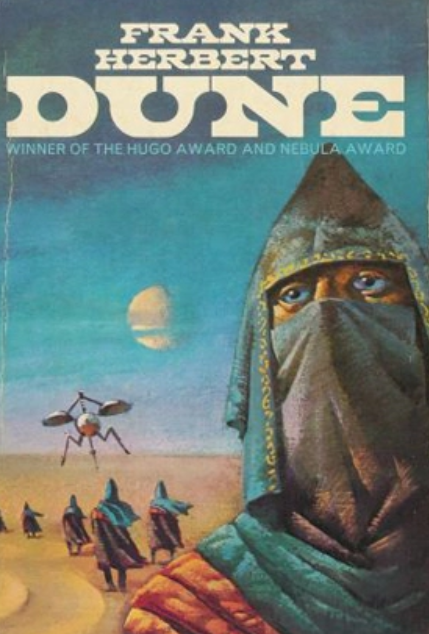
Below, a spice harvester. Above, one of many attempts to portray an ornithopter. From fontsinuse.com, as is the cover image.

Dune’s rich and strange world

In the early pages we are immersed in a kind of Renaissance space feudalism. It’s all nobles having conversations in palaces; it really shouldn’t be so interesting. I don’t think space capitalism, let alone space feudalism, is plausible. There are books I’ve abandoned because there were too many nobles, too many palaces. But somehow Dune gets away with it. It confronts us with a world that runs on its own rules, and doesn’t care what we think of it. Its people are medieval in outlook, and they don’t make any effort to relate to us on our terms. Not only do these people all do drugs, drugs are at the very the centre of their society. They have slaves, they hold entire planets as fiefs and some of them have psychic powers.

In short, Herbert doesn’t try to meet us half-way. We must either dismount from the great sandworm that is this book, and watch it slither away into the distance wondering to what fascinating places it might be going, or else cling to it stubbornly in spite of its efforts to shake us off.

By the way, I was converted to the idea of space feudalism being plausible. Humanity expanded across the stars, but suffered some kind of social and cultural catastrophe as a result. Their machines advanced to the point of being dangerous, so they waged war on the machines in the Butlerian Jihad. Feudalism didn’t bring humanity to the stars; humanity, having reached the stars through some advanced social system, reverted to feudalism, a feudalism modified with the remnants of the technology built up in ancient times.

Foreshadowing

But I wouldn’t have read on for long enough to care about the Butlerian Jihad unless the foreshadowing was laid on thick. The switches between different characters and their points of view, the dense undergrowth of exposition – these are not fashionable in sci-fi/ fantasy writing today. But  anyone who notices these unfashionable features and concludes that they are dealing with a clumsily-written book is mistaken.

When we ‘observe the plans within plans within plans’ we begin to wonder how these plans (within plans within plans) will work out. The story does not go from A to Z, from safety to danger. It goes from Y to Z, from less extreme danger to more extreme danger. We know the Harkonnens are going to attack. The Atreides know it. If they didn’t, the book and its sympathetic characters would be very irritating. We know Yueh is a traitor; if we didn’t, the revelation would be a pretty limp and predictable twist. We are not waiting to see if this Jenga tower will come down. We are waiting to see how.

While we are waiting for the Harkonnens to strike, we get sucked into the Duke’s administrative and political problems in a way that lulls and distracts us.

The writing and worldbuilding are open to criticism in places. I didn’t like how squeaky-clean and wholesome the Atreides were. ‘Good nobles’ vs ‘ bad nobles’ – come on. They’re an unelected ruling class who think they’re better than us. They’re all degrees of bad.

There’s a whole double-bluff intrigue where the Duke is pretending to be suspicious of Jessica. This is a tedious sub-plot, totally far-fetched. It’s just conflict for the sake of conflict. The book would be better without it. The mentat Thufeir Hawat is closely connected with this plot, but all in all I don’t see what he brings to the table. I think the book would pack a heavier punch if this sub-plot was gone and this character stripped back 90% or so.

Phallic sandworms

Paul is 15 but completely devoid of horniness or sexual neuroses; in the banquet scene, an attempt to seduce him falls flat. This is no doubt because of his Bene Gesserit training. But the repressed sexuality is central to the story. It’s more obvious to my grown-up mind that the sandworms are basically big dicks. And to paraphrase the book, who controls the big dicks controls the big dick energy. After Paul learns to harness and steer the big dicks, the climax of the story soon follows. Sorry for saying climax.

How does Frank Herbert get away with this insane sexual imagery? It’s even more obvious than King Solomon’s Mines. But it works because the sandworms work on their own terms. Arrakis without them wouldn’t be the same. Herbert doesn’t give a damn about space travel, but he cares about ecology. He reveals how this ecosystem works, and it is not a lecture we endure but a story mystery that is very satisfying to engage with and to solve.

Dune’s rich and strange hero

Speaking of Paul, even as a young reader I never quite liked him, and I never thought he was a good person. I rooted for him, and was invested in him. But I didn’t like him. He wrestles with his ‘terrible purpose’ and his visions of jihad for most of the story. As we read on, it becomes clear that is the story about the rise of a vast and terrible historical figure. It’s visible from the start, but the shock of the Harkonnen coup shakes something loose in him. As readers we come to respect the Fremen, but Paul is deceiving and manipulating them. Near the end (page 504) Gurney reproaches him when he reveals that he doesn’t really care about those killed in the final battle. He doesn’t care much about his murdered son either. And around the same time he finally embraces his ‘terrible purpose’ of galaxy-wide jihad; in his view there is no other way to cleanse the stagnant social order. The upheaval of the jihad will put a mixing spoon into the galactic gene pool and give it an almighty stir. This is the way he sees the world.

The unsettling presence of Paul’s little sister Alia is significant; he is only a little bit less weird than she is.

I haven’t read the sequels; I have been discouraged by some who have. What’s more, I consider the story complete and self-contained. It’s obvious to me that Paul is on track to become a genocidal god-emperor. There are no narrative questions left to answer.

The book suggests that Herbert does hold some beliefs that are repugnant to me: in the efficacy of eugenics, and in deep, inherent differences between men and women (‘takers’ and ‘givers’). He is cynical about humanity and believes that we will always be in thrall to religions and monarchs. But it seems clear enough that Frank Herbert doesn’t approve of Paul’s ‘terrible purpose’ or of the Bene Gesserit and their biological intrigues.

Atreides of Arabia

The ‘white saviour’ stuff is pretty blatant; Paul joins the Fremen and two years later has risen to be their messiah. This clearly takes inspiration from Lawrence of Arabia, and went on to inform Jon and the Wildlings, Dany and the Dothraki, etc.

With the Fremen, the Muslim coding is not just heavy but overwhelming. I didn’t see any problem with this when I was 15. But there was something more positive that I didn’t see either: that this is a text about the anti-colonial revolutions of the 1950s and 1960s. The Muslim stuff could be read as a tribute (perhaps a clumsy one) to the anti-colonial struggles of the Arabs, the Algerians, the Libyans. In fact the wikipedia page tells me it was also inspired by struggles of Caucasian Muslims against Tsarist Russia (hence, no doubt, the presence of a baddie named Baron Vladimir). The new film version appears to be leaning into this reading.

Conclusion

As an experiment, try to describe Dune in bald terms. It’s about a teenager who vanquishes his enemies and becomes emperor of the galaxy by convincing native people that he’s their god and by harnessing the power of huge phallic monsters.

When you put it like that, it actually sounds embarrassing.

What rescues Dune from being ‘That book that every guy loves for some reason?’ What raises Dune above the level of a basic power fantasy?

First, the world and the hero are so strange. Neither invites you in. You are forced to approach as a stranger. Paul is not the avatar for your fantasies; you end up walking many miles in his stillsuit, but you are never at all comfortable in it.  

Second, it’s primarily a story about ecology and religion, not violence. It’s a story that forces us to pay attention to things we take for granted in life, such as water and faith. The indigenous people, taken for granted above all others, turn out to be the key not just to Arrakis but to the universe. It’s a book that humbles the reader, that confronts the reader with vast superhuman forces.

Last, it forces to reader to consider the cost of power. The more Paul masters these forces, the more alienated we are from him as a character. The Fremen are liberated, so it’s a satisfying ending. The ‘plans within plans within plans’ produce the most terrible blowback – for the Emperor, for the Harkonnens, for the Bene Gesserit. But Paul has reached a place where he is both all-powerful and inhuman. The worst blowback might be for the billions of innocents who will die in his jihad.

Everything feels earned. It feels earned because the desert exacts a terrible price for every blessing it gives, and there are no happy endings in this social order.

Go to Home Page/ Archive

Appendix:

A note on Dune and videogames.

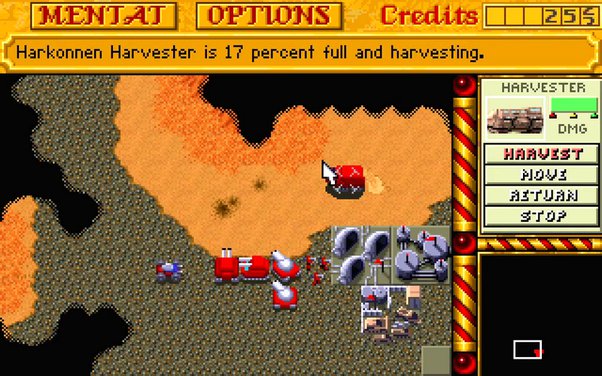
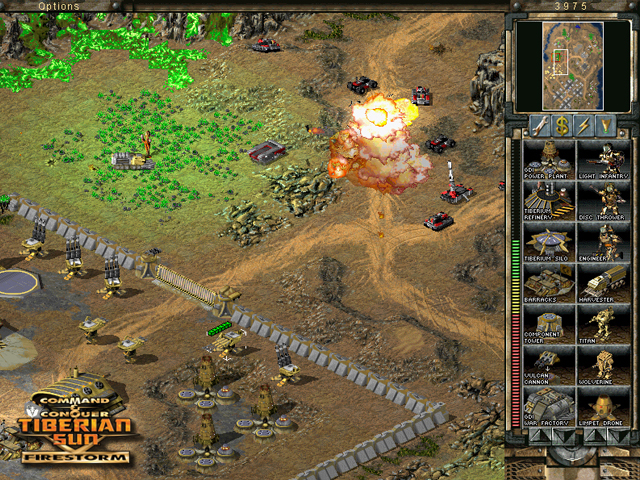
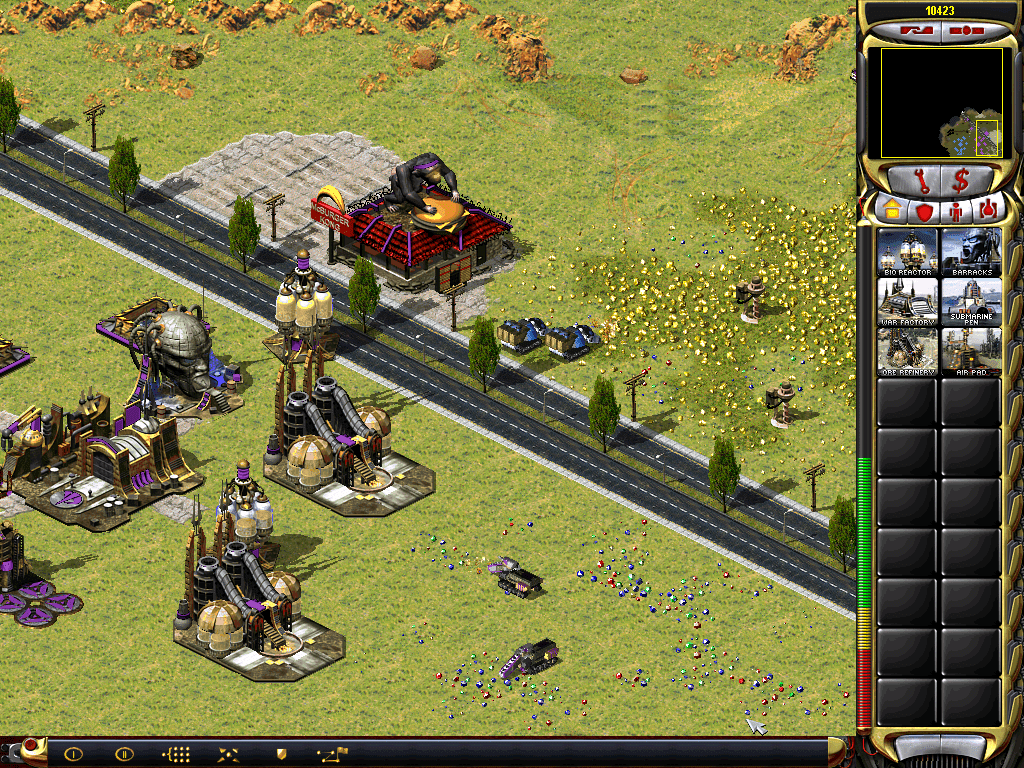
Dune 2 was the first strategy game, and it adapted straight from the novel a model of resource-collection that went on to exert a huge influence. There is a single resource, the spice, which lies on the surface of the ground. It is collected by huge harvesting vehicles. In Command and Conquer, the spice became tiberium, which has its own interesting back-story but is functionally identical, with the big harvesting vehicles and all. In the Red Alert spin-off, the spice appears in an alternate-history Cold War setting as Ore, a single one-stop-shop resource. Armies supply themselves by mining this resource on the battlefield. Helpfully, it is spread in pockets evenly across the surface of the earth from Manhattan to the Siberian taiga. 

So when Frank Herbert wrote about spice-harvesting in the early 1960s, he was creating a model which videogame developers would still be using in the 21st century. It was such a useful model for gaming that the plausibility of the game world of Red Alert was stretched to the limit just to accommodate it.

Review: The Don Flows Home to the Sea by Mikhail Sholokhov (Premium)

‘Cossack versus Red Army . . a war of unparalleled savagery […] A story of incredible brutality, well-larded with sexual adventures […] This book makes compulsive if horrifying reading; it is on a plane of human conduct as bestial as if it had occurred in the Dark Ages.’

From the blurb to The Don Flows Home to the Sea: Part One, 1960 Four Square Books edition

Become a paying supporter to get access

Access to this article is limited to paying supporters. If you already subscribe by email, thank you. But if you want to become a paying supporter, please hit ‘Subscribe’ below.

Donate less than the price of a coffee, and you can access everything on this blog for one year.

If you don’t feel like donating, most of my posts are still 100% free, so browse away, and thanks for visiting.

Go to Revolution Under Siege Archive

Go to Home Page/ Archive

Review: Cuba Libre by Tony Perrotet

Cuba Libre! Fidel, Che and the improbable revolution that changed world history

By Tony Perrotet

This account of the Cuban Revolution is rich in character and narrative, short on analysis. I was gripped all the way through, though near the end I grunted with surprised laughter at the boldness of one particular thing Perrotet left out.

This book sketches the background of Cuban history, introduces us to the dictator Batista and the revolutionary Fidel, then takes us through the Cuban Revolution from the failed attack on the Moncada Barracks to the extraordinary triumph of the rebels.

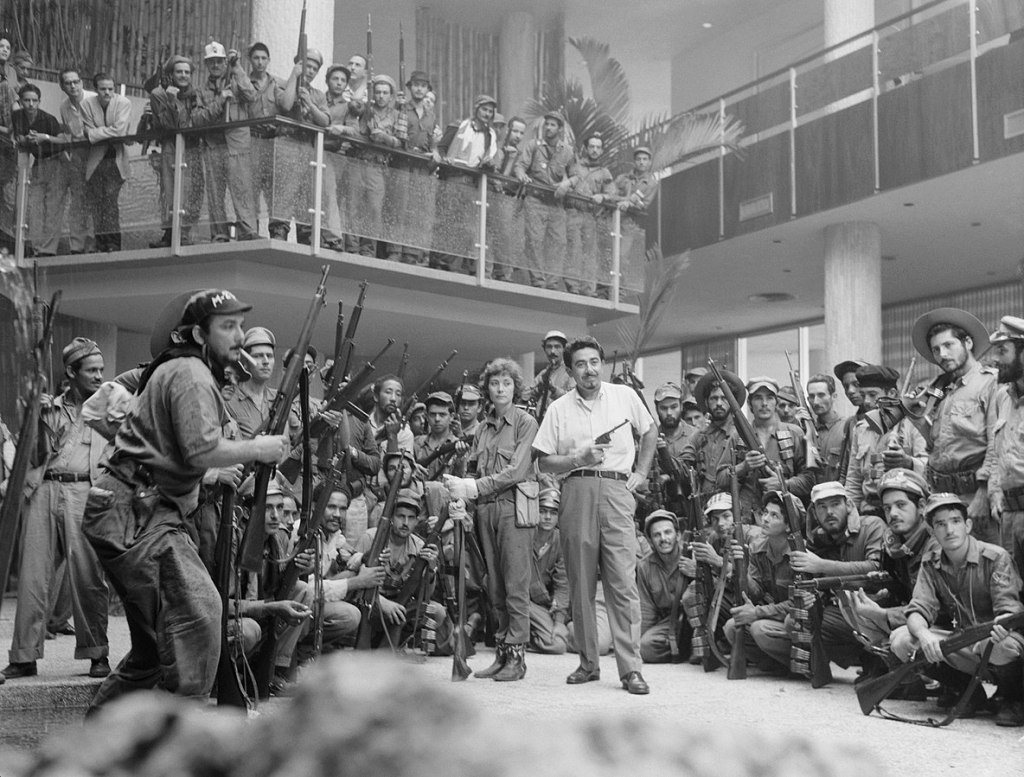
Guerrillas in the lobby of the Havana Hilton, 1959

I have read – and watched, and listened to – a fair amount on the Cuban Revolution, Che and Fidel. But I learned something new on practically every page of Cuba Libre. For example, all I had in my head about Celia Sanchez was her name and the vague understanding that she played some role in the Revolution; Perrotet takes the time to give her a full introduction, then he shows her in action – organising the Granma landing, escaping from cops, supplying the guerrillas, organising the underground.

The Batista regime, in its few years in power on the small island of Cuba, may have killed as many as 20,000 people. This is remarkable and horrifying (though somehow Batista comes across in the book almost as a vulnerable figure). The depravity of the Batista regime really comes across in Cuba Libre in harrowing stories from the prisons and barracks. But so does the courage and cunning of the guerrillas and of the urban underground. In addition, they must have been the most magnanimous revolutionaries in all of history – treating enemy wounded, freeing prisoners, treating their hostages like honoured guests.

Fulgencio Batista in 1957

In spite of the violence and the brutality of the Batista regime, and the harrowing conditions the guerrillas had to endure in the wilderness, Cuba Libre is not a heavy or dense read. It tells its story through anecdotes and characters. The events, locations and people are easy to follow because care is taken to make them vivid and memorable. When the writer mentions a name, the reader never has to scratch their head and ask, ‘Who’s that again?’

Another thing I like about the Cuban Revolution – and it may sound stupid – is this: the guerrilla movement in its early stages was operating with tens and twenties of fighters, at times even twos and threes. I like being able to grasp and visualise the numbers involved in a narrative. Once we are into the thousands, as we usually are with military history, it all becomes very abstract. This favours the intimate way Cuba Libre is written.

But as I said, it’s short on analysis. Towards the end, explaining why the Americans turned against Castro so suddenly, Perrotet writes that land reform angered US companies. I had to laugh, because this was the first mention of land reform in the entire book. It is also the last; he quickly moves on. You would not think it was a central question.

Lively and all as the narrative is, it does not explain why the rural population supported the guerrillas – which, of course, has to do with economics, class and land reform. The central condition of the guerillas’ success – the support of the rural population – simply falls from the sky. There’s nothing wrong with a narrative-driven, character-focused account – but there are ways of talking about economics and class within that kind of writing. The characters on whom Cuba Libre focuses tend to be middle-class professionals. There is no character giving us an insight into the land question.

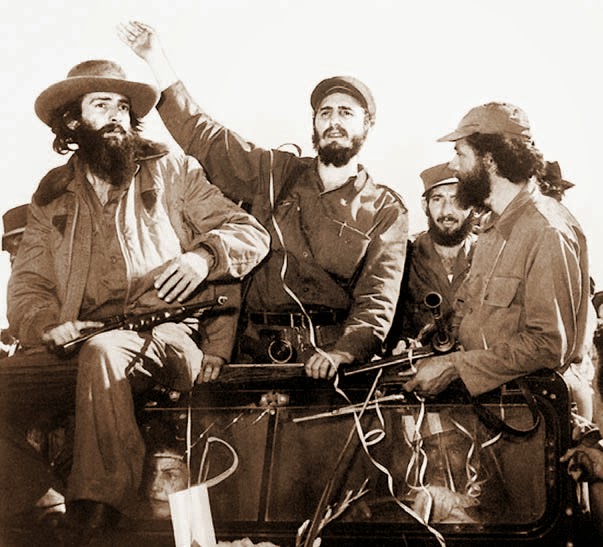
Camilo Cienfuegos and Fidel Castro enter Havana

Overall, Perrotet gives a very sympathetic account of the revolution. While he says Fidel had a tendency toward megalomania, his tone when writing about the guerrilla leader is usually one of mixed exasperation and awe. American public opinion, he says, liked Fidel playing the part of a glamorous revolutionary but didn’t want him to actually carry out any revolutionary measures. Perrotet lays the blame for the falling-out squarely at the feet of the US, while pointing out that thanks to the revolution Cubans have healthcare and education systems to rival anything in the advanced capitalist countries.

School Resources: The Spanish Civil War

This is not on the history course in Ireland but it’s a brilliant topic for Transition Year or for Leaving Cert projects.

I uploaded this in Irish over the last week or two. Here is the whole lot in English.

First off, a presentation going over the main events and issues of the war.

An exercise involving an element of role play. Instructions are on one of the slides in the presentation.

An extract with questions from https://www.marxists.org/archive/morrow-felix/1938/revolution-spain/

A questionnaire to give some structure to online or library research

Finally, an extract from Homage to Catalonia by George Orwell

Acmhainní Scoile: Cogadh Cathartha na Spáinne

Is ábhar íontach é seo don idirbhlian. Cruthaigh mé an Powerpoint seo nuair a bhí mé ag obair i gaelcholáiste.

Agus an gramadach? Bhuel, is fearr Gaeilge briste…

Powerpoint ar príomh-pointí an chogadh:

Billeog le dúshlán beag do daltaí.

Sliocht as Revolution and Counter-Revolution in Spain le Felix Morrow – aistrithe agus curtha in eagar, le ceisteanna. Déanann sé cur síos ar éirí amach na hoibrithe i Barcelona

Sliocht as Homage to Catalonia le George Orwell, aistrithe agus curtha in eagar. Déanann sé cur síos ar an saol i Barcelona i rith an réabhlóid

Tionscal beag taighde – ar líne nó sa leabharlann

School Resources: Strongbow

Building on last month’s resources on the Middle Ages, here are linked notes and presentation: Strongbow: A Story from Ireland in the Middle Ages.

The history of Strongbow and the Norman conquest of Ireland is a great case study for Junior Cycle students to get to grips with life and politics in Medieval Europe. It’s also a crucial episode in Irish history.

Bono’s Terrible Poem: An Autopsy

On March 17th Bono wrote a poem about the Ukraine war. Without even proofreading it, he sent it to a top US politician, and she read it out at a public gathering. Then he decided to post it on Twitter,

‘It wasn’t written to be published, but since it’s out, here it is,’ he tweeted. No, he didn’t want it to be out. He just sent it to a luncheon involving top political elites in the most powerful country in the world.

The poem was so bad it was a shock to the senses. But now that a few weeks have passed we should take a closer look. What are the specific features that make it so bad?

It’s on the nose

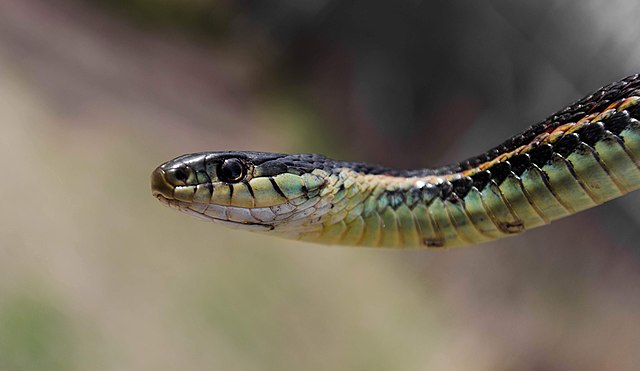
Usually poems weave in symbols and imagery and metaphors. For example, a poem about a vicious invasion might use snake imagery to signify evil. It might weave the metaphor into various vivid images.

Instead of doing that, Bono simply tells us what his poem’s symbol is: ‘For the snake symbolises/ An evil that rises…’

From this we can surmise that if Bono had written ‘The Road Not Taken’ he would have begun, ‘A fork in the road symbolises a major life choice…’

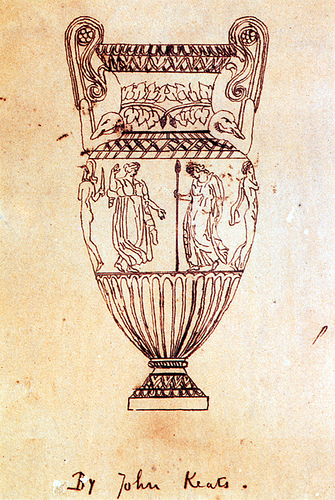
But that’s not quite it. We need more comparisons to really do it justice. If Bono had written ‘Ode on a Grecian Urn’ he would have begun, ‘This Greek vase is a symbol of stuff not getting old.’

Or ‘This Greek vase is like a wife who you’ve married but haven’t had sex with yet.’

It’s a textbook case of Irish narcissism

How are we to read the line ‘Ireland’s sorrow and pain/ Is now the Ukraine’? It seems that he’s saying Ireland had sorrow and pain in the past, and now Ukraine is getting a taste. As if Ukraine was some kind of bucolic hobbit village during the twentieth century – as opposed to a land ravaged by two world wars, famine, terror, the Nazi Holocaust, nuclear disaster and looting by oligarchs.

In this poem, Bono responds to the horror in Ukraine by talking about Ireland. There are grounds for empathy in our shared history of national oppression. But can’t Irish people engage with global events with a bit of taste, without making it all about us?

It’s largely babble

Let’s repeat that phrase; ‘Ireland’s sorrow and pain/ Is now the Ukraine.’ Sometimes in long complex sentences, we mistakenly switch between the singular and the plural. But what excuse does Bono have here, in a phrase eight words long?

Even if he had written ‘Ireland’s sorrow and pain/ ARE now the Ukraine,’ what would that phrase even mean? I struggle to put it into words. Our emotions have been transferred to another country? …have been transformed into another country?

An updated version of the poem reads ‘Ireland’s sorrow and pain/ Is now in Ukraine.’ Did we put our sorrow and pain on a container ship and send it over to the port of Odesa?

‘And they [saints] struggle for us to be free/ From the psycho in this human family.’ Us? But Bono is already free from Putin! Putin doesn’t control any territory in which Bono or his offshore money reside.

‘For the snake symbolises/ an evil that rises/ and hides in your heart/ as it breaks.’ What does this line mean? You, Nancy Pelosi and a bunch of US politicians, have got evil hiding in your heart. I’m not entirely sure that’s what Bono meant to say. And what’s this about hearts breaking?

All these musings are a waste of time, because later we are told that ‘the evil has risen my friends [sic, no comma] / From the darkness that lives in some men.’ All of a sudden, the evil is not something that rises in the hearts of Bono’s heartbroken friends in the US political elite. It is an outside force that threatens us. From context we can guess that it is Putin.

More examples of this incoherence are nailed down here.

It’s banal

When the poem is coherent, it is usually not saying anything worth saying.

What does itactually say about the war in Ukraine? Only that from time to time ‘sorrow and fear’ come along, because of evil. In this poem, evil is a category which includes (presumably amongst other things), paganism in Fifth Century Ireland and the Russian invasion of Ukraine. But evil no longer hides in Nancy Pelosi’s broken heart. The source of the evil is now ‘the darkness that lives in some men.’

How unfortunate that darkness lives in the hearts of some men. If only it had taken up lodgings in some more convenient place. Then this war wouldn’t have happened.

It’s absurd

When the poem is coherent and not banal, it’s absurd.

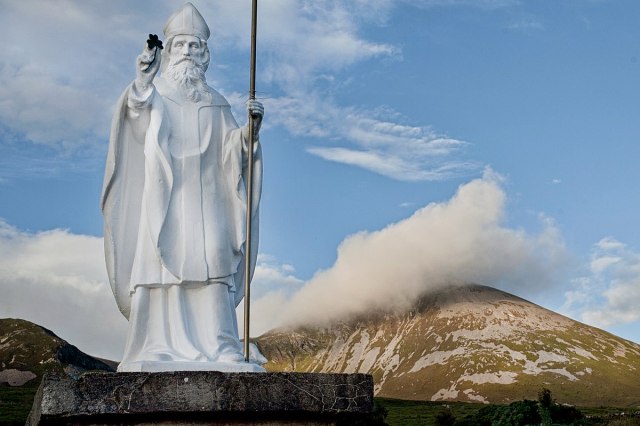
It is entirely possible to write a poem paying tribute to the armed resistance of the Ukrainian people and to the resilience of civilians and aid workers under the bombs. But Bono does not go down that route; instead he singles out the politician who happens to be in charge of Ukraine at this time, Volodymyr Zelenskyy. And not only does Bono praise this politician, and not only does Bono compare him to St Patrick. No, at the end of his poem Bono says that Zelenskyy is Saint Patrick.

Because this is the image that comes to mind whenever I hear the name ‘Volodymyr Zelenskyy.’

So St Patrick was personally brave. And yes, it appears Zelenskyy is also personally brave. But there the similarity ends, because (A) St Patrick was never an actor. And (B) he didn’t have a Neo-Nazi paramilitary group on his payroll.

But even if the comparison fit… So Putin is a snake and Zelenskyy is Saint Patrick. Zelenskyy is banishing Putin. But… why? Why say this?

It’s tasteless

In his tweet Bono explains that every year he sends a funny limerick to US politicians for their St Patrick’s Day luncheon. As you do.

This year, he explains, instead of sending a cheeky little rhyme, he felt compelled to send a serious and heavy limerick. Yes, a heavy limerick. Because this year things are different. There’s a war on. People are dying.

Not like all those other years, when there was no war on and nobody was dying. And if there were any wars happening, the US politicians who chuckled at Bono’s funny Irish limericks certainly had nothing to do with any of those wars.

But even leaving all that aside, maybe you shouldn’t write a limerick about a war. Maybe you shouldn’t try to discuss the nature of evil in a limerick. You see, the limerick genre has certain limits.

But as Bono admits, it’s an ‘irregular’ limerick. You can say that again. Limericks are disciplined, with a tight rhyming scheme and rhythm.

For example, ‘There once was a singer from Dublin/ Whose tax situation was troubling…’ etc.

Limericks have to scan well, or else they sound contrived. And they are short, like five lines.

It’s not a limerick

When I first read Bono’s poem, it scanned so poorly I didn’t even realise it was a limerick. There were words that I didn’t realise were supposed to rhyme with other words. I only learned that it was a limerick because Bono said so. Then I went back and read it in the sing-song jokey rhythm of a limerick. It sounded so much more tasteless and bizarre. In other words, it’s not an irregular limerick, it’s an atrocious limerick.

If Bono had written something like the following, it wouldn’t have been quite as bad:

A snakey old psycho named Putin

Escalated the bombing and shooting

But Zelensky had tactics

Because he is St Patrick

And so for Ukraine I am rooting.

It’s absurd, offensive, tasteless, baffling. But it’s brief, and it’s actually a limerick.

And it says everything Bono takes fifteen lines to say. That’s it. All the essential points are there. But to create the impression that he’s saying something deep and heartfelt, he ties the poem up in knots with vague phrases that mean nothing. He does not succeed in covering up his poem’s essential banality and absurdity, only in adding a layer of incoherence.

Russia 1918: What if the Constituent Assembly had taken power?

In January 1918, a few months after the October Revolution in Russia, a parliament called the Constituent Assembly met for one day before it was suppressed by the Soviets. This blog has dealt with the episode before. The incident suggests a ‘What if?’

In OTL (Original Timeline, ie, real life), the Soviets were willing to allow the Constituent Assembly (CA) to exist as a subordinate body. Likewise the CA was willing to let the Soviets exist as a subordinate body. But neither would tolerate the other attempting to assume state power.

But what if the Soviets were willing to bend the knee? What if the Constituent Assembly was allowed to assume control? How might the Russian Revolution and Civil War have developed from there? How might the Russian Twentieth Century have been different?

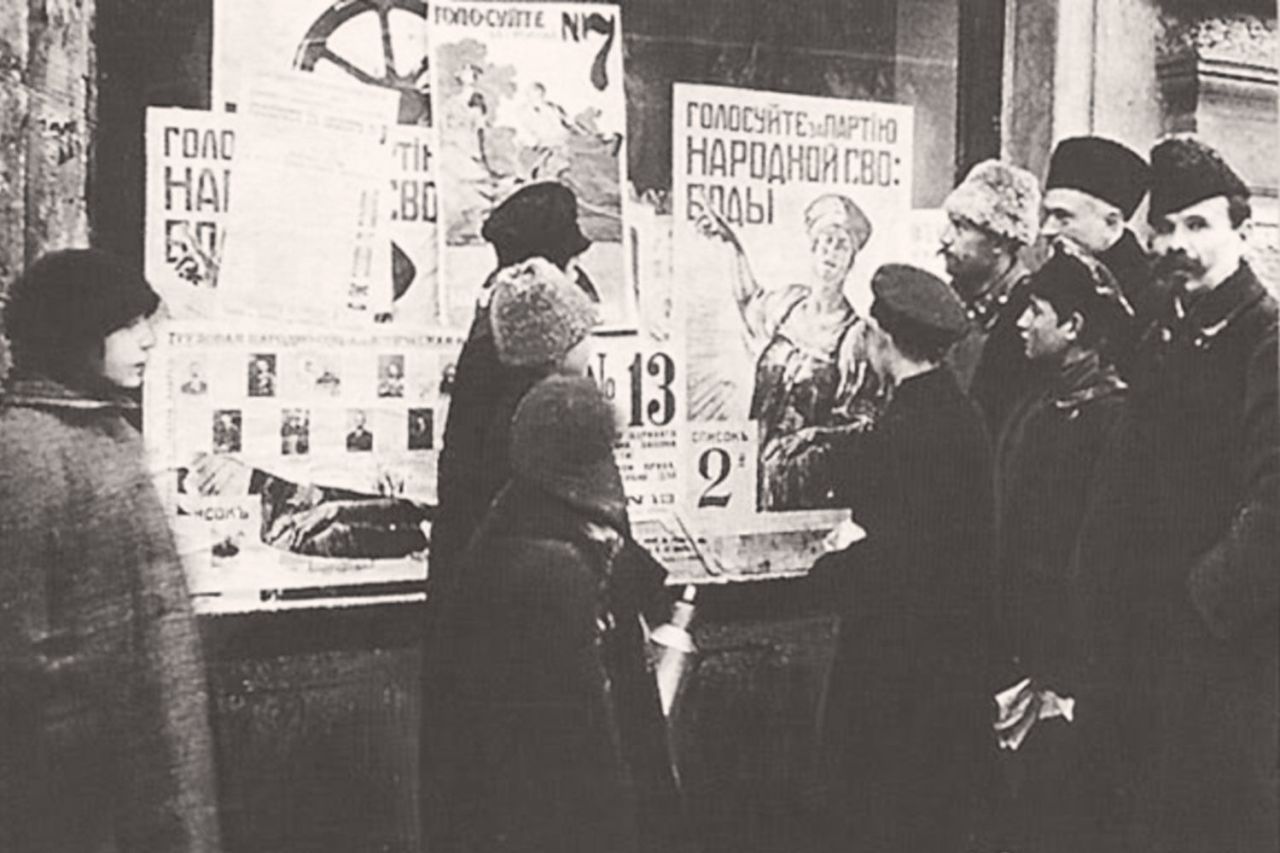
Posters for the Constituent Assembly elections

Element of Divergence

First we should explore plausible scenarios where this could take place. We should answer the question of why and how it might come about that the Soviets, having seized state power, would be willing to hand it over to the CA.

The Soviets were workers’ councils, a system of direct participatory democracy. The Bolsheviks Party had won a decisive majority in these councils in September 1917. They believed that the Soviet was a higher form of democracy than the CA. They hated the Right Social Revolutionary party (RSR), which over 1917 had made compromises to the right and enacted repression against the left. They believed that the split between the RSRs and the Left SRs rendered the election results meaningless.

In other words, the Bolsheviks (along with their allies the Left SRs) had strong reasons to suppress the CA.

In spite of these strong reasons, it is not that difficult to imagine the Soviets giving up power to the CA. In Germany and in Austria in this period, and in Spain in the 1930s, we see many examples of communists, socialists and anarchists giving up power to a bourgeois-democratic government in exactly this way. In fact, they were far more flagrant. The German Social Democrats assembled militias of far-right veterans to suppress the German Revolution. The Communists in Spain became the enthusiastic apologists of a liberal-republican government and preached that Spain was not ready for revolution. In short, the Bolsheviks are the outlier among social-democratic and even nominally communist parties in the Twentieth Century in that they were really willing to seize and hold power.

In our ATL (Alternative Timeline), the leadership of the Soviet is more in line with the mainstream of international social democracy – ie, more timid and cautious.

I do not propose a single ‘Point of Divergence’ – for example, Lenin is murdered by agents of the Provisional Government; Trotsky stays in a British concentration camp in Canada. Rather I propose an Element of Divergence, a factor which develops differently over a whole period of years and even decades. In this ATL, the Bolshevik Party as we know it simply do not develop. The more radical and militant trends within the Russian Social-Democratic and Labour Party (RSDLP) do not cohere into the Bolshevik party from 1903 to 1912; rather they remain loose and scattered and undefined. We will, for convenience, refer to them as the militant socialists.

Fighting during the German Revolution, during which the equivalent of the Soviets did hand over power to the equivalent of the Constituent Assembly.

The Alternate Timeline

Pushed by a mass upsurge of workers, soldiers, sailors and peasants, the militant socialists end up in control of the Soviet by October 1917. They proceed to seize power in some incident corresponding to the October Revolution. But by January they are afraid of their own power and uncertain what to do with it. Their own base – workers and poor peasants – feel the hesitancy from above and demoralisation begins to set in. Meanwhile the militant socialist leaders feel pressure from the Russian ‘intelligentsia’ (professional middle classes) which supports the RSRs and the CA.

Instead of shutting down the CA after a single day, they remain in it, trying to negotiate a strong position for the Soviets within a new CA-dominated political regime. In other words, they turn back the clock and accept Provisional Government Mark 2. The discredited Provisional Government, attacked from right and left then finally overthrown in the October Revolution, has returned in a new guise with many of the same personnel.

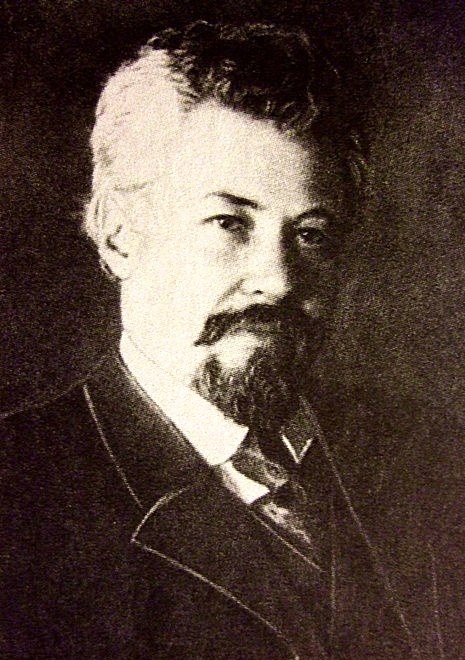
Thus begins the Chernovschina – the regime of Viktor Chernov, a firebrand within the RSRs who in OTL served for that one day as President of the Constituent Assembly.

Viktor Mikhailovich Chernov, president of Russia for one day in 1918. During 1917, though a Right SR, he had been critical of the doomed policy of coalition with the right-wing parties

Chernovschina

In OTL, the RSRs set up a government at Samara during the Civil War in the name of the Constituent Assembly. This government was called Komuch. It gives us valuable insights into the main features of the all-Russian Chernovschina which develops in this ATL.

The Chernovschina, like Komuch, would have a narrow base of support: a layer of the intelligentsia, and not much beyond that. Its decisive majority vote in the CA elections may seem to indicate that it had a mandate. But for Komuch, this mandate translated into precisely nothing. It was unable to raise an army. It suppressed the Soviets on its own territory and gave back the industries to their capitalist owners; still the wealthy refused to support it.

Komuch governed a population of 12 million people on the Volga. Chernov would govern all of Russia, including the central industrial region where the factory workers in their millions are enthusiastic supporters of the Soviet. In these central provinces and great cities, the Bolsheviks actually won a majority in the CA elections. Unlike Komuch, the Chernovschina would be able to present itself as having the support of the Soviet; this and this alone, the support (really the submission) of the Soviet, explains why it is in power.

It has a tense relationship with the Soviet, with the working class, with the poor peasants. But the militant socialists are forced to act as the enforcers of the Chernovschina. They try to whip their supporters into line, because to do otherwise would be to admit their own bankruptcy.

As in OTL, famine begins, striking the cities hardest. Chernov refuses to consider the kind of expropriations which the Bolsheviks practised in OTL; thus he retains the passive support of the peasant majority, but loses the active support of the cities.

Thus the working class, its hopes raised high by the October Revolution, feels a horrendous demoralisation set in as 1918 advances. Many still hold out hope that the Chernovschina will deliver for them, or that the Soviet might yet overthrow the CA. On that basis, Chernov is still able to mobilise some support.

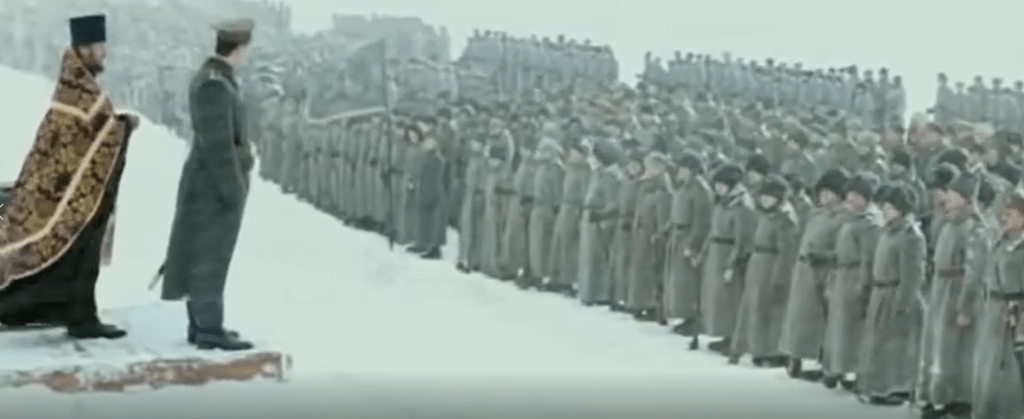
Still from the movie Admiral, dir Andrey Kravchuk, 2008. In ATL as in OTL, the White Guards, with the blessing of the church, rallies the troops for counter-revolution.

Civil War

And support he needs. The Russian armed forces, though in an advanced state of collapse, are fighting a desperate war against Germany. Meanwhile in ATL as in OTL, military officers, nobles, the bourgeoisie and the church organise counter-revolutionary armies. They see the RSRs as little better than the militant socialists; in any case, the militant-socialist bogeyman is an integral part of the Chernov coalition. Alongside the new Russian army which Chernov is trying to build, the Red Guards are the main armed force on which the CA can rely.

And Chernov himself, as in OTL, supports the seizure of noble land by peasants. The emergent White Guards have no reason to be less hostile to the RSRs than they were to the Bolsheviks in OTL.

It is frankly impossible to see how the Chernovschina can win the war against Germany, or even to hold out until Germany’s defeat in the West. But as in OTL, they are determined to continue the war. We must envisage an inexorable German advance to the gates of Moscow itself, even the fall of Petrograd, before the RSRs are forced to sign a peace treaty even more humiliating than the Treaty of Brest-Litovsk.

The Allies, meanwhile, look askance at the Chernovschina for the same reasons the Whites do: the communist bogeyman. Initially they support Chernov against Germany, but then turn against it when the peace treaty is signed.

So we end up as in OTL: White armies, backed by the Allies, fighting against the ‘Red’ (perhaps the ‘Pink’) regime of Chernov. The Allies might be less enthusiastic about intervention because the Chernov regime is more amenable to them – paying the debts and not seizing the factories. It is possible the Allies, or at least some of the Allied countries, would remain neutral. But on the other hand the Allies would not be held back by their own people. In OTL, there was deep support for the October Revolution among working-class people in the western countries, resulting in the ‘Hands off Russia’ movement and the Black Sea mutiny. These factors tied the hands of Allied intervention. It is doubtful the western working class would be as sympathetic to the Chernov government, so the Allies’ hands would not be tied in the same way. 

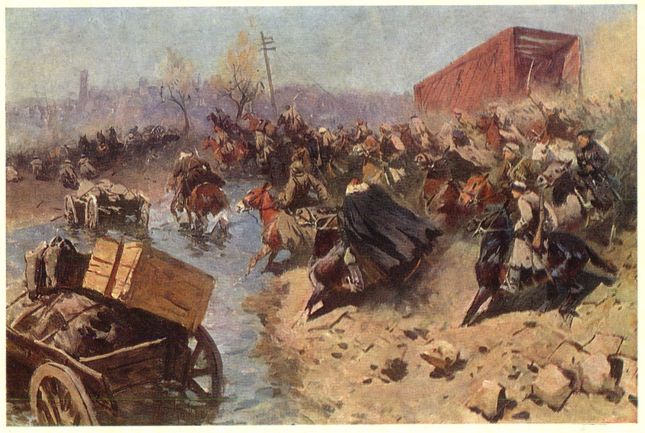
Painting on the Civil War by Mitrophan Grekov

The Fall of the Constituent Assembly

Increasing discontent in the ranks of militant socialists at some point breaks out into a mass uprising against Chernov in Moscow. Meanwhile Chernov and co have grown impatient with the Soviet; they see it as the main obstacle to Allied support. So the Chernovschina engage in the bloody suppression of the uprising of the Moscow proletariat. This results in the final liquidation of the Red Guards and the Soviets, and the final demoralisation of the working class. The Revolution is over.

The Chernovschina tries to fight on, but its people are utterly demoralised and it is beleaguered on all to sides. It succumbs to the onslaught of the White Armies. The death-blows are probably dealt in the campaigning seasons of Spring and Summer 1919.

So this ATL leads us to a White victory in the Russian Civil War. That is a ‘What If’ for another day and another post. But suffice it to say that a White military victory would only be the beginning of the violence. The White movement, in order to fulfil its aims, would terrorise the urban population into submission and seize the land back from the peasants. The scene would be set for decades of conflict as the White generals invade the newly-independent republics one after another, trying to restore their vision of ‘Russia one and indivisible.’

Conclusion

This alternate history is based on two main real-life analogues: Komuch (which I have written about here, here and here) and the Republican side during the Spanish Civil War.

For some, it is tempting to imagine that the CA might have led Russia to stable parliamentary democracy, averted civil war, etc. But an electoral majority does not invest a political party with magical powers. In terms of sheer numbers, the RSRs won an overwhelming vote. But the vote was confused and passive in character. They had a very narrow base of confident, active supporters. The CA could only have survived if the Soviets had made the terrible mistake of propping it up at their own expense – at their own very great expense.