Before the Fall: A Delayed Conclusion

Hi folks, this post represents me putting a rough-and-ready finish on a job I left half-done a while back. You’re reading a long-delayed conclusion to my series Before the Fall: Notes on The Dawn of Everything. I have now finally finished Graeber & Wengrow’s fascinating book and can offer my thoughts on the back half of it.

I had far fewer problems with the book as a whole than I had with the first few chapters. Experts who have criticised this book have generally thrown in a few nice comments as well, and it’s easy to see why. The Dawn of Everything, as the name suggests, is sweeping. I feel a wide range of people will find things in it that they really like even if they can identify places where they think the evidence is thin or where the reasoning invites a ‘well… not necessarily.’
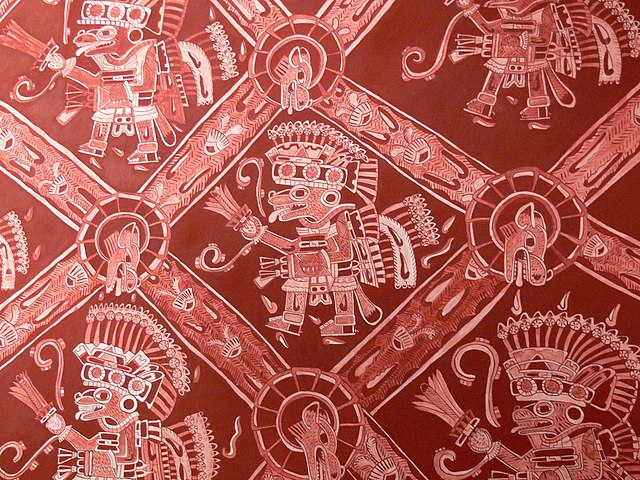
Via Wikimedia commons: ‘National Museum of Anthropology – Teotihuacán. Reconstruction of murals in a patio of the Palacio de Atetelco in Teotihuacán showing coyote warriors.’ Photograph by Wolfgang Sauber.

It’s often argued that inequality and power structures are necessary in any sufficiently large population; once you go past a few hundred people, the argument goes, you need governments, ruling classes and bureaucracies. Graeber & Wengrow disagree, and this is the strongest point in the back half of the book. It’s demonstrated most clearly in their survey of early cities around the world (such as Teotihuacán and Mohenjo-Daro) that had egalitarian features. Outside cities, it’s also obvious in the clan structures of indigenous North America, imagined communities as big as a city that linked disparate strangers across vast distances.

I agree with the authors on this point around scale and have for a long time, and it was satisfying to read their arguments and examples. I can exercise power through my membership in unions, campaign groups, political parties, and through my vote. The late David Graeber would scoff at how limited these powers are, but the point is that these are powers I exercise precisely as part of a large collective, not as an individual or in a small group (and better versions of my union and my democracy can be pointed to or imagined). People can be powerless in a small, intimate group – an abusive family, a house share under a controlling landlord, or a tyrannical workplace – and powerful in larger collectives of the kind I just mentioned. In fact larger workplaces tend to have more power than smaller ones. It’s a bit like blaming environmental devastation on ‘too many people’ – what really decides the question is how the people are organised, not how many there are.
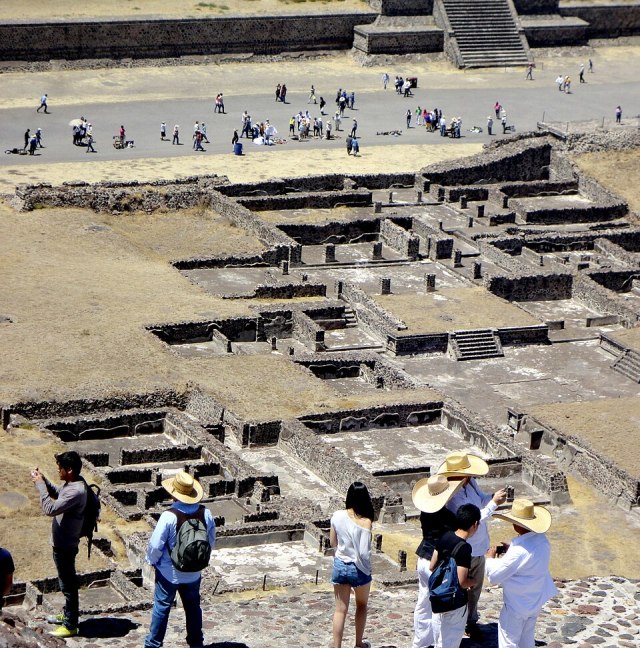
Via Wikimedia Commons: Español: Palacio del Sol visto desde la Pirámide del Sol, Teotihuacan, México. Photograph by Juan Carlos Fonseca Mata.

Another idea that comes under fire is what I call tech-tree thinking. This assumption is there in the architecture of videogames but a lot of writers also assume that societies ‘develop’ or ‘achieve’ certain upgrades like agriculture or democracy, which provide a buff to their stats, while some other societies ‘fail’ to do so. Humans dabbled in agriculture without committing to a full-on farming life for many thousands of years. Some took on farming then gave it up when it didn’t work out for them. Some never bothered with it. And we find examples of democratic institutions throughout the archaeological, anthropological and historical record. These are not thresholds that peoples pass through or fail to pass through. They are things we can choose to do or not to do.

Here’s a point that never would have occurred to me, but that I found compelling: Graeber & Wengrow see (at least some) early cities as cradles of democracy, and trace the origin of aristocracy to the ‘heroic societies’ of nomadic pastoralists. In the picture they paint, democracies are developing in cities, aristocracies in the hills nearby. They trade with each other, but develop in mutual opposition. Later the aristocratic nomads conquer the cities, but for long periods after that royal power is circumscribed by powerful urban councils.

The most interesting story unfortunately also struck me as the most tenuous in terms of evidence. The authors paint a picture of a powerful kingdom developing along the Ohio river in North America, imposing the will of its rulers through mass bloodshed; of this society collapsing as the population migrated to freer places; of a cultural memory of this experiment in hierarchy and empire digging itself deep into the traditions and instincts of the North American Indians, even vast distances away; of this memory informing the development of an anti-authoritarian political tradition. It’s a great story because it shows indigenous political institutions as something other than ancient traditions; they were informed by a particular experience in the not-too-distant past. It’s compelling and could well be true, but the evidence related here doesn’t prove it. It’s an example of how your mileage may vary with some of the material in this book. Speaking of material, they sometimes advance explanations for things that I can only see as second- or third-order explanations. We hear that large scale adoption of certain crops depended on that particular crop arbitrarily being used for (that most convenient of phrases) ritual purposes.
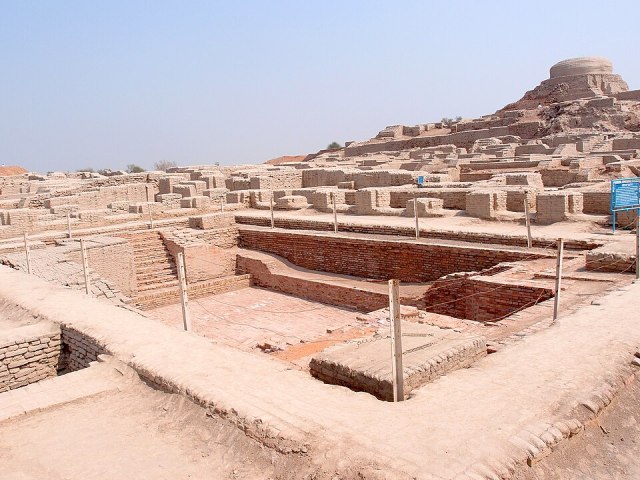
Excavated ruins of Mohenjo-daro, with the Great Bath in the foreground and the granary mound in the background.’ Photograph by Saqib Qayyum.

I still see a lot of value in categorising different societies using the rubric of production, in seeing economics as something that sets broad but hard limits on what can happen in politics and culture. While I don’t think the authors share these ideas, they didn’t go out of their way to attack them either, though I expected them to. The promised ‘plague on both your houses’ did not descend; Hobbes came out a lot worse than Rousseau.

I’ve had this book for at least three years, I shit you not. I wanted to read it very carefully and take loads of notes, so what I was doing with my little series here, 14 or 15 months ago (Jesus Christ), was reading, note-taking and writing a blog post on each chapter. This project, modest as it was, ground to a halt after just five chapters out of twelve, and so did my reading of The Dawn of Everything. My interest in the book had somehow become an obstacle to my actually getting it read. I made zero progress for a long time, then bit the bullet, bought the audiobook, and got the rest all listened to in a couple of weeks. No note-taking and no twelve-part blog series, just this capstone on the job I left unfinished.
Before the Fall (4): Notes on the Dawn of Everything

This is part 4 of my on-the-spot reactions to The Dawn of Everything by David Graber and David Wengrow. Here are the first three parts:

1

2

3

Stoned in the Stone Age

If there’s one thing to take away from this book, it’s that the Stone Age was way richer and more interesting than most of us would have thought. Moving from the Paleolithic (Old Stone Age) to the Mesolithic (Middle Stone Age, from about 12,000 BCE), us humans have not started working metal and a lot of us aren’t farming yet. Nonetheless even those who have not settled down to agriculture are still very busy:

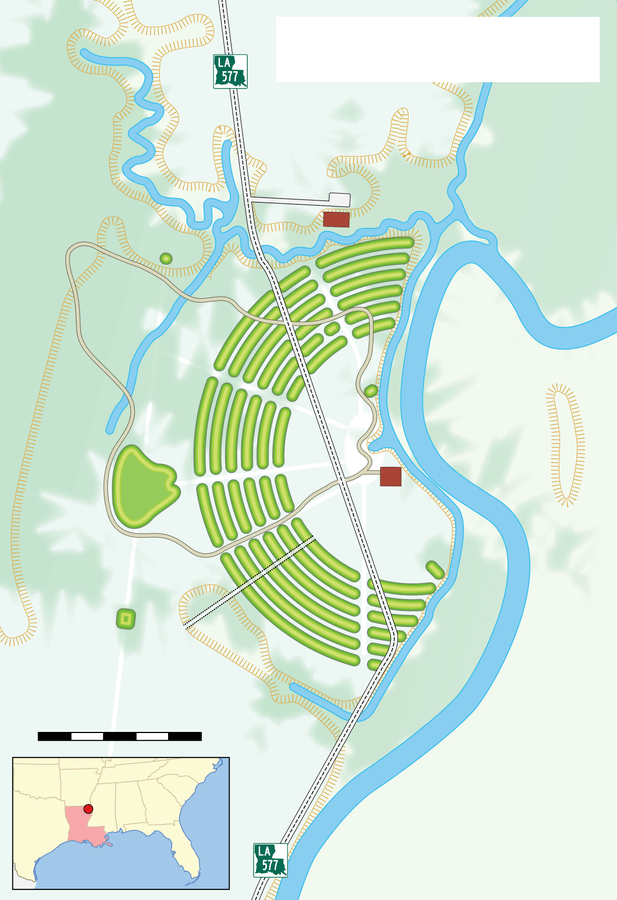
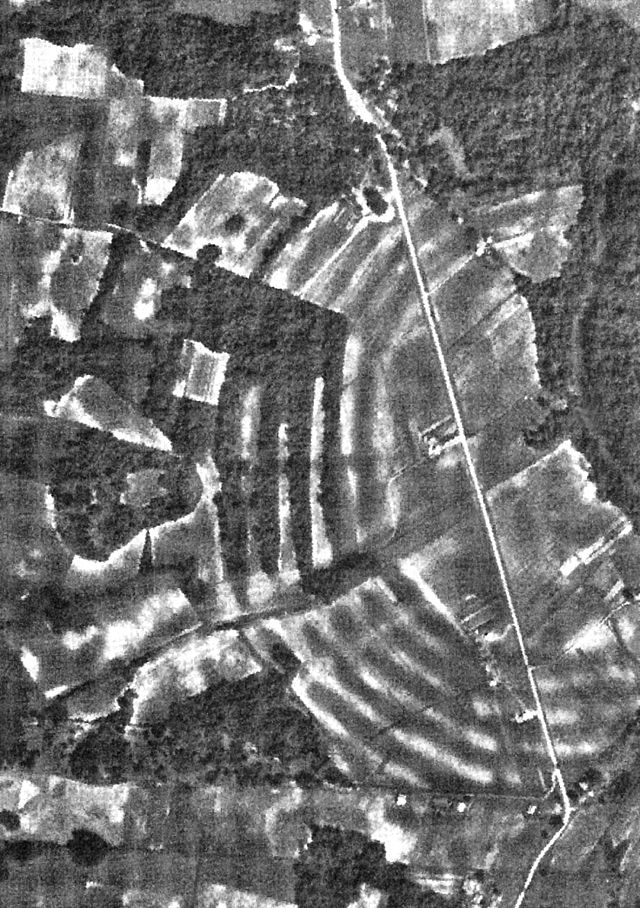
1930s aerial photograph of the Poverty Point site.
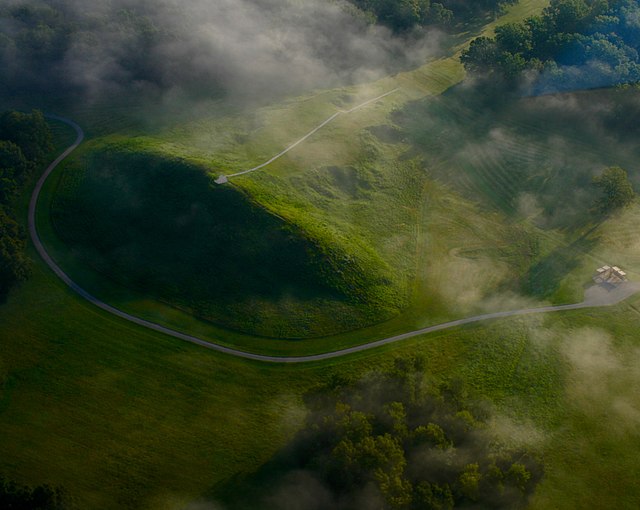
  • At Poverty Point, Louisiana, US, there are massive earthworks dating from 1200BCE and larger than the contemporary cities of Eurasia. Analysis of artefacts and of the apparent systems of measurement used by the builders links this site all the way up the Mississippi and to the Great Lakes, and down to the Gulf of Mexico and even Peru. The builders were hunters, fishers and foragers.
  • In Japan, we have a wealth of archaeological data showing a rich and complex social life passing through cycles of nucleated settlement and dispersal from 14,000-300 BCE. My notes get a bit scattershot here: OK, they had acorn-based economies, they stored a surplus, they smoked weed, and they left no evidence of aristocracy or a ruling elite.
  • In Finland around 2,000-3,000 BCE we have ‘Giant’s Churches,’ massive structures built by the collective labour of hunter-gatherers.
Drawing of a Finnish ‘Giants’ Church’

This makes intuitive sense to me. We have seen that hunter-gatherer life could involve seasonal or local superabundance. This allowed for specialisation (people to do the maths and the crafts, the planning, overseeing and mobilising) and collective projects, such as monument building. But since the superabundance was temporary, local or conditional, so was the specialisation, and so was the mobilisation of the people in collective goals. That’s why kings, hierarchies, inequalities tended not to arise. The way I’d see it, agriculture, on the other hand, creates the basis for a permanent surplus, and so a lot more societies start to turn hierarchical, and these hierarchies grow more permanent.

As with previous chapters, we then turn to anthropology, that is, to modern and early modern hunter-gatherers, and see a few examples of where they have had kings (returning to Louisiana and Florida). ‘The economic base of at least some foraging societies,’ the authors conclude, could sustain priests, royal courts and standing armies.

Swallows and summers

The authors make repeated claims that they are overturning conventional wisdom and rewriting history. In this chapter they are arguing that there is no causal link between the widespread adoption of agriculture and the widespread turn to hierarchy, inequality and subjugation, or if there is a link it’s too broad to have any meaning. The evidence they present in this chapter consists of the amazing social and physical structures that hunter-gatherers built – all without agriculture. But are ‘at least some foraging societies’ enough to prove such a big argument? I am very impressed, but not yet convinced. If the stale old ‘conventional wisdom’ still seems to hold for all but ‘at least some,’ then it holds. A dam designed to let through a trickle of water still holds back a massive volume in the reservoir.

Usually the tone is good-humoured, but sometimes it’s nearly a Hancocky tone of denouncing ‘traditional’ and ‘conventional’ scholars. The thing is, it’s not clear to me that this book contains a conceptual revolution, as opposed to merely synthesising, collating, bringing into relief, making informed and imaginative suggestions. So far, more the latter. The authors make bold claims and hedge them, or fail to carry through fully with the evidence. For example they scold us for assuming that pre-agricultural societies were all equal, and regularly caricature that position. Saying that pre-agricultural societies were generally more equal is apparently the same as saying they were childlike and innocent, all one identical blob, or animalistic – except when Graeber and Wengrow say it, as when they acknowledge ‘the flexibility and freedom that once characterised our social arrangements.’ (p140)

To be clear, the project of synthesising, bringing into relief, etc. is more than enough of a reason to read this book. I’m really enjoying it. And often its denunciations of ‘conventional wisdom’ are on point, for example when they describe the idea of writing off 7,000 years of American history as ‘the Archaic Period’ as ‘a chronological slap in the face.’ You don’t have to agree with everything these guys say to appreciate and enjoy the close-up tour of the messy interface between social systems in our deep past.

A reference to Marx surprised me. I assumed that the authors were squishing Marxism and its theory of primitive communism into their general critique of the Rousseau ideological tradition, and I criticised them for not mentioning it. But here they describe primitive communism as the collective ownership and control of the surplus, clearly distinguishing it from more romantic or pessimistic views where communism is only possible with no surplus at all.

‘Conventional Wisdom’

But I’m not done with ‘conventional wisdom’ yet. A lot of the things that are set up and scoffed at as ‘conventional wisdom’ are not really that. Here are a few of them as laid out on page 127:

  • ‘…Rousseau’s argument that it was only the invention of agriculture that introduced genuine inequality…’
  • ‘It’s also assumed that without productive assets […] and stockpiled surpluses […] made possible by farming, there was no real material basis for anyone to lord it over anyone else.’
  • ‘Once a surplus arises, craft specialists, priests and warriors will arise to lay claim to it.’

Reading the above, you’d expect the authors to set about disproving these claims. They do nothing of the kind, at least in this chapter. As we’ve seen, they demonstrate that there are ‘at least some’ examples to the contrary. The built environment from the pre-agricultural age is impressive in absolute terms. As the reader, I have no way of judging whether this is a trickle or a torrent. OK, it’s useful to note that Poverty Point (more pictures below) has a bigger footprint than Uruk – but do all the sites built by foragers in that period have a bigger footprint than all the sites built by farmers?

‘The idea of ranking human societies according to their means of subsistence’ is described as a bad and weird idea that some eighteenth-century freaks thought up and that we have all accepted without question until now. I don’t believe in ‘ranking’ different societies, unless in relation to some specific and measurable quality. But I think that the way people put food in their bellies is actually foundational to how they organise their society. Those hunter-gatherers who changed their political structures every year? They did that because there were changes in how they could get food. It’s true that we look at prehistoric societies more than others through the lens of how they filled their bellies. But that’s entirely justified – because we know next-to-nothing about their politics or culture.

What is more, I’ve never had the above ideas presented to me as ‘conventional wisdom.’ Throughout my own formal education I never got an earful about the primacy of economics. At university we looked at Marxism as one topic of a dozen in Critical Theory, and one topic of a dozen in Historiography, plus Bloch and the Annales school. That’s it.

To be fair, I didn’t study Archaeology as such, or Anthropology – maybe it’s different in those fields. But in the broad public understanding of these fields, none of these claims in my experience constitute ‘conventional wisdom.’ On the contrary, the primacy of politics and warfare is asserted throughout popular history. In school, in the media and in popular culture, we compare societies not by their economic base but by their cultural and political ornamentation, through the prism of personalities and events. Economics gets only an indirect look-in, via inventors. Popular discourse evaluates societies according to the most arbitrary criteria (where for example Sparta somehow represents ‘democracy’) or with the aid of idiotic aphorisms like ‘Strong men create good times [etc]’ or even through the mostly-meaningless and deeply problematic lens of race. That’s where we’re at. We’re really not suffering from an excess of economic determinism.

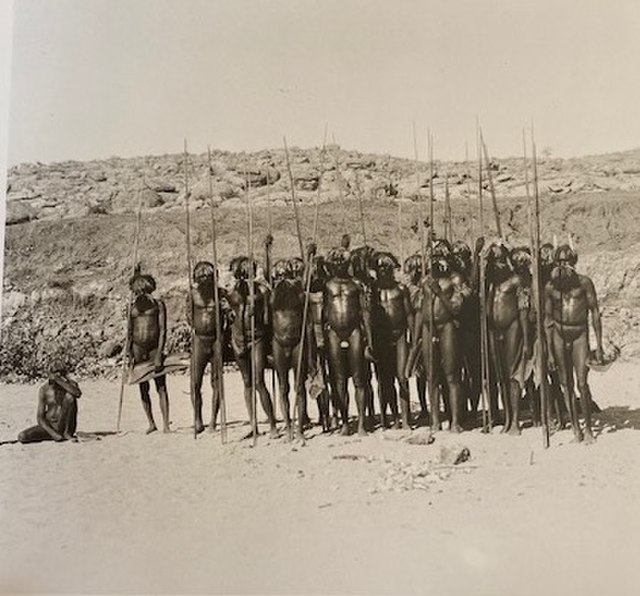
An armed band of Aranda in early-20th Century Australia

Work and leisure

There’s a lot more in the chapter. There’s the trope about how people in past ages had more free time than modern office or factory workers, which the authors take as read and don’t attempt to prove. As they note, it holds true for the !Kung people, but not for other foraging societies – the ones in what is now Canada appear to have been workaholics. One thing about the !Kung that I would definitely think is universal, though, is that they know about agriculture, could do it if they needed to, but have no pressing incentive to turn to it.

There’s some intriguing stuff about how the only thing close to private property or hierarchy in many forager societies was (is?) the concept of the sacred. The Aranda people in Australia treated their children with kindness but initiation into adulthood involved painful rituals; subjugation and violence was only present in a sacred context. Sites like Poverty Point were probably ‘sacred,’ the only place in the social life of the community where demands for absolute obedience were made.

Linked to this, the authors note about ‘kings’ of the Mesolithic: ‘It is possible for explicit hierarchies to arise, but to nonetheless remain largely theatrical, or to confine themselves to very limited aspects of social life.’ (P 131) This is food for thought for scholars of Gaelic Ireland who are struck by the pedantry of the seating and portioning arrangements which our sources prescribe for a feast. I have a feeling this is building toward a theory of where private property came from, a theory that relegates agriculture to background noise.

But this chapter has not, in my brain anyway, broken the causal link between agriculture and inequality. But the assumption that towns, specialisation, crafts and science are impossible without agriculture is completely wrong. Graeber & Wengrow have proved this hands-down. They have given us a fascinating picture of the real social and political lives of foraging societies and the monuments and social structures they can sustain.

Another powerful point here is that colonisers routinely claim that the land they are seizing is somehow fair game because the people who live there are not working it ‘properly,’ ie they are hunting and gathering rather than farming (And of course, even when they are farming, as in the case of Palestine, the colonisers still have the nerve to pretend they ‘made the desert bloom’). So the idea of foraging as not being a valid economic activity, of not being able to sustain ‘civilisation,’ however you define that, has a blood-soaked and disgusting legacy. This part is conventional (though it was never wisdom) and we can’t dispense with it quickly enough.

Home Page/ Archives

Leave your email below to subscribe…

Or…

Before the Fall (3): Notes on The Dawn of Everything

How was life in the Stone Age? Was it all people shooting arrows at one another and falling into glaciers, or was it one big hippy commune? In this chapter Graeber and Wengrow leave behind the Enlightenment and start a chronological study of the earliest human societies, focusing on society in the Upper Paleolithic period. That’s the final part of the early Stone Age.

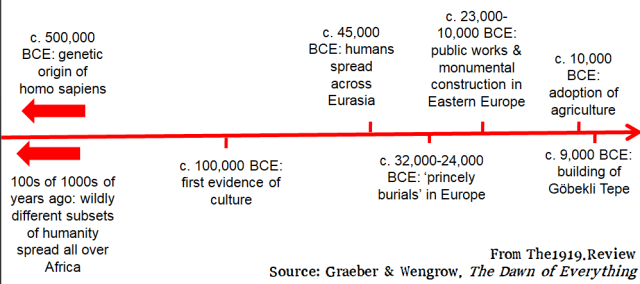
The first thing I learned here was pretty surprising: that humans lived spread out all over Africa for hundreds of thousands of years, with strong regional variations that meant they would have resembled giants, elves or hobbits to one another.

Then homo sapiens formed from a composite of all these very different sub-species, moved north into Eurasia, met the Denisovans and Neanderthals, and in time absorbed them.

The authors then perform the by-now familiar shuffle: thesis, antithesis, forget-about-either-thesis. Hobbes was wrong, Rousseau was wrong, here’s a better explanation.

A monument at Gobekli Tepe, Turkiye. On which, more below…

Princely Burials

What about the Upper Paleolithic ‘princely burials’ in Europe? Are these richly-endowed graves (countless person-hours of labour would have gone into them) not evidence of a rigid social hierarchy like what Hobbes said?

Reading about ‘princely burials’ myself in other contexts, I’ve always been annoyed at the assumption that they necessarily indicate social hierarchy, aristocracy, etc. An individual might be honored in death for all kinds of reasons – for heroism in battle or skill in crafts, for being an inventor, for saving lives, for poetry, for metallurgy, for mystical visions. They might be honored for being great leaders, but this doesn’t  mean they were aristocratic ones.

Graeber and Wengrow make an argument along similar lines to my guesses – that these were eccentric and visionary outsiders-turned-leaders, who were buried in riches (at a time when no-one was buried in death, with or without riches) as much to contain their potentially dangerous magic as to honour them. They construct a whole argument which takes in anthropology and archaeology, and which I found convincing.

So far they are at least living up to one promise: their version of history is interesting and rich. Our heads are full of capitalist and feudal assumptions, so we have to remember that just as objects which travel a long distance do not always indicate mere ‘trade’, elaborate burials do not always indicate ‘ruling class.’ The past is so much broader than the scopes of capitalism and feudalism through which we view it.

Monuments

We see the same pattern with the other type of artefact from the Stone Age which, like ‘princely burials’, are often taken up as proof of hierarchies and kings: grand, monumental buildings.

I’ve come across the fantasies of Graham Hancock and Ancient Apocalypse, in which Göbekli Tepe is evidence not just of kings but of an entire ancient empire which was more advanced than us and which left cryptic celestial warnings, and which colonized the world ‘teaching’ people how to do agriculture and masonry. A lot of the narrative hinges on the idea that Stone Age hunter-gatherers could not have built great stone monuments.

Even though they are so florid and fantastical, such arguments have always struck me as paradoxically boring. There is a more-than-open attitude to the possibility of Atlantis, aliens and giants, but dull pedantry when it comes to ancient societies. In unimaginably long stretches of time, tens of millennia, Graham Hancock cannot see any possibility that hunter-gatherers could have established a society which was, even temporarily, capable of building something like Göbekli Tepe.

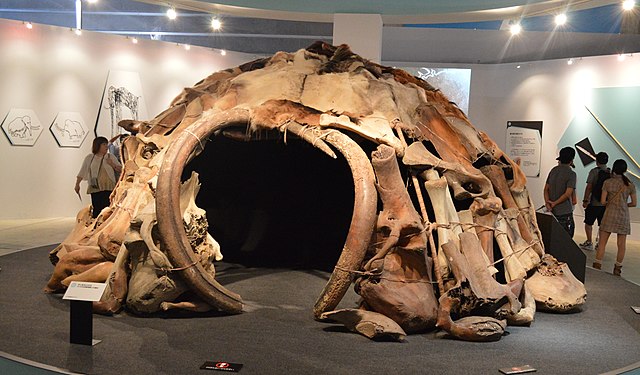
Like with the burials, here Graeber and Wengrow give us a bit of archaeology (Stonehenge, Göbekli Tepe, Russian mammoth houses) and a bit of anthropology (such as the Inuits, the Nambikwara in Brazil and the Plains Indians in the United States) and paint a picture that is colourful and informative. I mean colourful not like atlanteans came along one day to teach us about seeds and the principle of the lever, but more like nomads and hunter-gatherers vary their social systems from season to season, sometimes gathering for great coordinated collective labour, sometimes dispersing to hunt and gather.

A small part of the Gobekli Tepe site from around 9000 BCE

It’s satisfying to get a clearer idea of how these monuments were built. But the best part is the idea that these societies changed their whole social system regularly to meet their needs. In one part of the year, the modern Nambikwara roamed in small bands, all these bands being under the strict control of one chief. For the other part, they gathered in hilltop villages, became democratic and communist, and had chiefs who functioned more like a social welfare department than a monarchy. But across all the other examples, no single pattern prevails: among one people, there is a settled season of strict hierarchy and a roaming season of relative informality. Among another, police functions are strictly seasonal and rotate between clans on an annual basis.

The anthropological stuff gives an insight into how Stone Age peoples might have lived: gathering after a great hunt with a superabundance of food and other goods, feasting, processing materials, building great structures, then dispersing again when the seasons turn.

A reconstruction of a house built from mammoth bones, Japan, 2013

What’s the upshot of all this?

Prehistoric society was not a realm of innocence or animal instinct – our ancestors were politically sophisticated.

Prehistoric society was not all one thing. A grading of one political system alongside each economic mode (for example, claiming that hunter-gatherers live in ‘bands’, horticulturalists under ‘chiefdoms’) is too pedantic even as a general guideline.

And here I kind of get the ‘plague on both your houses’ approach to Rousseau and Hobbes, because it’s ultimately from Rousseau that we get the idea that people pre-state and pre-class were simple and innocent.

However, this wouldn’t have been my understanding, and I’m broadly in the Rousseau ideological legacy. So they’re only throwing out bathwater here. Fine by me.

They haven’t succeeded in turning me off the idea of an economic basis corresponding to a political regime. Hunter-gatherers never seem to get around to parliamentary democracy, fascism, Stalinism, the Paris Commune or the Petrograd Soviet – not because they were/are too innocent to think of them, but because these systems do not correspond to their needs or means. The above are political systems proper to our age. There is a wide range of them, and which one you end up with depends on the last analysis on the outcome of a political struggle. But a certain type of economy, one where things like factories and railways are central, is a necessary prerequisite.

Though it seems political systems are more broad and fluid the further back you go. Even what we file under ‘feudalism’ is by definition immensely varied and full of local peculiarities. And when I looked at Gaelic Ireland, I realised that under its legal constitution many different de facto regimes could exist, depending on hard factors like population and resources and soft factors like politics and culture.

But even that phrase ‘the further back you go’ is weighted with an assumption, isn’t it? An assumption about progress, development, advance. That economies actually do develop through stages, and do not slip backwards as easily as political systems do; it’s never actually happened that a country has been ‘bombed back to the Stone Age.’ I admit thermonuclear weapons do raise the possibility.

I guess Graeber and Wengrow wouldn’t agree, but it is possible to speak of progress and development and economic stages without being racist or reductive.

Our industrialized world has global warming, endemic and stark inequality, addiction, shanty towns, systematic cruelty to migrants, homelessness for the sole purpose of enriching landlords, debt bondage as a precondition for housing, widespread precarity,long hours and low pay, universal exploitation, and hysterical bigotry against anyone who’s different. It also has vaccines, washing machines, incubators, clean running water, and a super-abundant supply of manufactured goods. I think that second collection of things are more than mere creature comforts or mod cons – yes, even the manufactured goods that clutter my house and ‘do not spark joy’ – and what’s more I don’t see that they are predicated on the first set of things, the bad things, or dependent on them in any way.

The Marxist criterion at work here, as I’ve mentioned before, is the productivity of labour. In relation to that, we can speak of our society as being advanced or developed in relation to a society that lacks these things.

But the bad things listed above, and their absence in prehistoric societies, are a reminder that our society is still at an absolutely pitiful and contemptible level of development. The idle person who thinks it’s OK for him to be thousands of times wealthier than a nurse or cleaner, just because a piece of paper says that he owns this or that, is a victim of the greatest superstition that has ever held sway over the human mind. The 16th-century German had more reason when he bought indulgences off Johann Tetzel, and the Aztec priest had more practical common sense when he ripped the hearts out of war-captives to keep the sun in the sky.

The most valuable insight from this chapter – and it is a refutation of Rousseau whatever way you slice it – is that hierarchy is not a necessary overhead of (a) social complexity or (b) large population or (c) collective projects or (d) coordination over long distances. Sure, hierarchy is one way to do it, and indeed one way that it appears to have been done even in some pre-class societies. But this chapter tells a story of political sophistication and huge monuments, apparently without hereditary rulers or coercion.

I grew up with Gary Larson images of people living in caves and even coexisting with dinosaurs (Yabba dabba doo!). But even as a more well-read adult I still would have thought that before agriculture, people lived in small roaming groups of a few dozen people. This chapter has challenged this idea, but in a way that is actually very encouraging. These pre-agriculture, pre-state, pre-class societies could be large, complex and at least seasonally settled. Probably they had a wide variety of social structures, including hierarchies and castes, but these were not the rule.

Home Page/ Archives

Before the Fall (2): Notes on The Dawn of Everything

Hi, this is Part Two of my run-down on The Dawn of Everything, a book that asks how unequal, hierarchical and class-ridden societies first arose. Here is Part One.

In this chapter Graeber and Wengrow ask:

  • What did indigenous Americans in the 17th Century think about Europeans?
  • To what extent did the Enlightenment draw on sources outside Europe?
  • What does ‘egalitarian’ even mean?

And they emphasize the urgency of these questions: ‘A very small percentage of [the world’s] population do control the fates of almost everyone else, and they are doing it in an increasingly disastrous fashion.’ (p 76) If we want a free society that is not careering toward ecological and social catastrophe, we need to figure out how it came to be that a small minority ended up in control.

Before starting their story of humanity from the beginning, the authors detain us for one chapter to argue that a lot of our ideas about that epic story are wrong to begin with, and to give an account of why. This involves rewriting the history of the Enlightenment. So that’s the fairly ambitious idea of the part we’re looking at today:

Chapter 2: The Indigenous Critique

Along the way, the book delivers a lot of what I expected and wanted. For example, we get a sketch of several indigenous American societies before their destruction by European settlers.

The Wendat (Huron) grew crops around inland fortified towns. They had formal political officers and a caste of war-captives with limited rights, whom the European observers assumed were slaves. Other tribes such as the Mi’qmak and Montagnais-Naskapi, meanwhile, were bands of hunter-gatherers.

The Europeans saw these people as eloquent and very good at reasoned debate, skills honed in near-daily discussions of communal affairs. The Europeans also noticed that they possessed individual liberty, and wholeheartedly disapproved. Laws were not enforced, fathers did not control children, captains had to rely on their own persuasive power to get people to fight.

Jesuit missionaries were shocked to observe the ‘equality of the sexes’ – women had sexual freedom and the right to divorce. But there was a gendered division of labour, with women owning and working the fields while men hunted and fought. This reminds me of Engels’ explanation of how gender inequality came about. His vision of the prior state of equality does not preclude a gendered division of labour.

Looking at the Wendat, I feel like I’m re-playing the greatest hits from Celtic Communism? In an exact parallel with Gaelic Ireland, the Wendat practised communal compensation rather than punishment. There were wealthy people among the Wendat – but, and we saw elements of this in Gaelic Ireland too, the main incentive in hoarding material things was to give them away and thus boost one’s own prestige.

Graeber and Wengrow say lots of clever and interesting things – such as, in relation to the Wendat, ‘insofar as we can speak of communism, it existed not in opposition to but in support of individual freedom’ (p 48) – but they miss one obvious point. The 17th-Century Wendat (I specify 17th Century because, as far as I know, they are still around) had richer and poorer individuals, and individuals who held political office (on the sufferance of those who did not). What they did not appear to have had was distinct classes in conflict with one another. Again, here we see some parallels with Ireland. The Wendat were equal and egalitarian and communist in the sense that they all belonged to a single class. Like with my previous Celtic ruminations, here we are troubled out of complacent identification with the people of the past by the spectre of the un-free, the layer or caste who existed within the community but with curtailed rights. But the authors here don’t seem at all interested in class, and are visibly aggrieved when the Enlightenment salons turn from discussions of political institutions to discussions of economics.

Indigenous people roasting Europeans

What’s equally fascinating is the low opinion these Indigenous people had of Europeans when the latter arrived in the sixteenth, seventeenth and eighteenth centuries. For some reason I tend to forget that European colonisers and indigenous people lived in proximity for centuries, had developed opinions and analyses about each other, and left records of same. What is more, these records were a very popular type of book in early modern Europe.

The Mi’kmaq, around 1608, saw their (overwhelmingly male) French neighbours as envious, slandering, lying, quarrelling, covetous and ungenerous. ‘They are saying these and the like things continually,’ writes the Jesuit missionary who recorded these opinions. To the missionary it was obvious that while the French had more material goods, the Mi’kmaq had more ease, comfort and time.

Twenty years later a missionary among the Wendat recorded that they had no lawsuits and were not covetous. There were no beggars ‘in their towns and villages’ (I admit, embarrassed, that I didn’t know they even had towns and villages before I read this). As for beggars the Wendat heard of existing in France, they ‘blamed us [the French] for it severely.’ While the Wendat had daily community gatherings and discussions, the French interrupted one another, quarrelled, competed to hog the limelight, and often resorted to weak arguments.

This chapter does great service to history by promoting knowledge of a Wendat political leader named Kondiaronk who actually visited France as a diplomat and, in lengthy salon discussions with Frenchmen back on his home turf, voiced a powerful critique of European society.

‘The whole apparatus of trying to force people to behave well would be unnecessary if France did not also maintain a contrary apparatus that encourages people to behave badly,’ declared Kondiaronk – that ‘contrary apparatus’ consisted of money, property rights and profit. If you want to learn more about Kondiaronk, I really recommend you read this book.

Stages

This brings us to the main focus of the chapter. The authors basically give an alternative history of the Enlightenment, arguing that this indigenous critique was of key importance. The idea of societies developing through stages is attributed to the economist Turgot, who developed the idea as a defence mechanism against the indigenous critique: in short, the indigenous people say that Europeans are un-free and miserable, but it doesn’t matter what they say, because they are on a lower level. Their freedom is ‘lower’ than our slavery.

Rousseau’s famous essay on the origin of social inequality appears here as a strange synthesis of the indigenous critique and of the ideas developed to counter it.

I have mixed feelings on this. Texts such as the main one cited here, Curious dialogues with a savage of good sense who has travelled (1703), are fascinating and valuable and it’s a shame they were dismissed so lightly as fabrications. And this narrative of the Enlightenment as a period when Europeans encountered and opened up to ideas from other parts of the world was fresh and interesting. It’s an ambitious argument, though, and the fact that it’s so much at odds with other accounts of the Enlightenment that I’ve read would give me at least pause for thought. Doesn’t the receptiveness of European minds to the indigenous critique say something about how developments within Europe were also driving the Enlightenment?

Whatever Turgot’s agenda was, the idea of societies ascending through stages of economic development is, in itself, a good one. Married to arbitrary criteria, or none at all, (sorry, Age of Empires), this idea leads to bad places. But you can attach it to valuable criteria (such as the productivity of labour) and thereby give some meaning to the concept of progress underlying it. I predict the authors are setting things up for an attack on Marxism in future chapters. They are emphasizing the conservative pedigree of the idea of stages of economic development as part of lining up those dominoes. We’ll see how that goes in the coming chapters.

I enjoyed this chapter in spite of reservations. I hope Kondiaronk and his opinions on early modern European society become a staple of school history courses.

Home Page/Archive