At the start of our four-part series ‘Celtic Communism?’ we asked whether the claims of James Connolly with regard to Gaelic Ireland were ‘just one of those unfortunate examples of Connolly giving ground to romantic nationalism.’ It’s time to answer that question.
In the late 19th century in Ireland there was a revival of old Irish sports, language, history, music and legends. This movement rose up in defiance of British imperialism and fed into the 1916 Rising and War of Independence in the early 20th Century.
Most of the prominent Irish nationalists were bourgeois figures, including ruthless strike-breaking bosses like William Martin Murphy. There were Irish nationalists who felt aggrieved that poor old Ireland did not have any colonies in Africa. The first party which bore the name ‘Sinn Féin,’ founded in 1905, had the exceptionally cranky idea of ‘dual monarchy’ at the heart of its programme.
There were authors on both sides of the Irish Sea who read Anglo-Irish history as a struggle between “Saxon and Celt” – the Saxon coldly logical, the Celt emotional (An idea brutally satirised by Shaw in his play John Bull’s Other Island). To Connolly’s endless chagrin, certain authors liked to claim that one of the essential, eternal features of the ‘Celtic race’ was ‘veneration for aristocracy.’
The masses of Ireland wanted to fight British imperialism, and that aspiration was bound up with a desire not only to champion their suppressed culture but to seize the land, to end poverty, to unionise and struggle for a ‘Workers’ Republic.’ There was a gap, to put it mildly, between this and the programme of the bourgeois nationalists. This gap was papered over with nationalist and religious phrases that dripped with sentimentality and chauvinism.
In this context James Connolly was a breath of fresh air:
It’s unfair that he’s remembered by many as a garden variety Irish nationalist when in fact he spent most of his life skewering bourgeois nationalism without mercy.
It would be unfortunate but not incredible if in these struggles Connolly succumbed from time to time to some of the ideas and assumptions of his opponents.
What is romantic nationalism?
The Gaelic cultural revival was part of a global phenomenon in the 19th Century. In any country in Europe a cadre of town intellectuals could be found trying to convince several million peasants and industrial workers that they were all united in a common imagined community, intimately related down to the very fibre of their being with this or that 8th century steppe nomad people or Iron Age confederation of clans. A lot of our ‘knowledge’ of history even today is influenced by these assumptions and agendas.
In many cases this represented, as in Ireland, an oppressed people asserting themselves after centuries of oppression. But it was abused to give the poor a spurious common cause with the rich – and against the poor of other countries. The 19th Century obsession with race came from a desire to justify slavery and imperialism. But it found many other evil uses in the hands of the wealthy: it provided a convenient way to divert people from the fight against wealth inequality or for women’s rights.
James Connolly’s agenda was the opposite. He wanted to combine the struggle for liberation with the struggle for socialism. He always insisted that socio-economic and class conflicts were the true driving force behind uprisings for Irish freedom.
His key point about Gaelic Ireland was that it possessed a social order incompatible with feudalism and capitalism. The English conquest of Ireland was foremost a social struggle, not a racial one.
However he went too far and made claims that he didn’t need to make in order to prove this point. The language and tone were too strong and have aged poorly. See if you can read this without cringing: ‘It is a system evolved through centuries of development out of the genius of the Irish race, safeguarded by the swords of Irishmen, and treasured in the domestic affections of Irish women.’
Those who read Connolly often got the wrong impression about Gaelic Ireland. Aodh De Blácam was a fascinating and eclectic writer of the time who, in his book Towards the Republic, combined Bolshevism with Catholicism and the most romantic Irish nationalism imaginable. He appears to have taken Connolly at his word and believed that Gaelic Ireland was communist, no ifs or buts. I think De Blácam got the opposite impression to what Connolly intended – instead of providing an argument for seeing the Anglo-Irish question as a social rather than a racial one, Connolly had inadvertently provided the ingredients for an eclectic synthesis.
But De Blácam’s synthesis was a short-lived piece of accidental cultural wildlife. It could not have really come into being or thrived outside the years 1917-1923 or so, when ‘Soviet’ was a word to conjure with in Ireland. Just as you can’t hold Connolly responsible for those who obtusely read him as a Catholic and nationalist or as merely a left-leaning Republican, you can’t blame him for everyone who gives him a one-sided reading.
There is nuance and specificity in Connolly’s treatment of the Gaelic Irish. In The Re-Conquest of Ireland he writes of them
shaping their castes and conventions to permit of the closest approximation to their ideals of justice […] all were members having their definite place, and in which the highest could not infringe upon the rights of the lowest – those rights being as firmly fixed and assured as the powers of the highest, and fixed and assured by the same legal code and social convention.
Here Connolly acknowledges the existence of inequality – of people of ‘high’ and ‘low’ status with fixed rights. He even uses the term ‘caste.’ When he writes of ‘their ideals of justice’ he hints at the fact that ‘their’ ideals and ‘ours’ are not the same. This is a gesture of recognition toward the strange and alien nature of Gaelic Ireland to modern eyes.
They did not, indeed, regard all forms of productive property as rightfully belonging to the community; but when we remember that the land alone was at that time of importance, all other forms of property being insignificant by comparison […]
The chief, as Mill has justly observed, was but the managing member of the tribal association, although in the stress of constant warfare they usually limited their choice to the members of one or two families […]
In Labour in Irish History, regarding the destruction of the Irish social order by Cromwell and co, he says:
Such an event was, of course, inevitable in any case. Communal ownership of land would undoubtedly have given way to the privately owned system of capitalist-landlordism, even if Ireland had remained an independent country, but coming as it did in obedience to the pressure of armed force from without, instead of by the operation of economic forces within, the change has been bitterly and justly resented by the vast mass of the Irish people, many of whom still mix with their dreams of liberty [with] longings for a return to the ancient system of land tenure – now organically impossible.
That hard-headed passage is very far from national romanticism.
So Connolly was not surrendering to romantic nationalism. He’s not giving them ground. He’s giving them hell. He’s taking Gaelic Ireland away from them and saying, in effect, ‘You don’t get to make political hay from this. You don’t get to laud ancient Ireland in one breath and condemn socialism in the next.’ Or to use his own memorable phrase: Capitalism is the most foreign thing in Ireland.
Overall, many of his comments don’t really stand up to scrutiny. For example, it was not warfare which limited the pool of candidates in Gaelic Ireland, but the laws themselves. It was de jure not de facto. The essential political point he’s making is entirely correct, but he goes too far.
In the sense of ‘Battle not with monsters lest ye become a monster,’ ie, in the sense that romantic nationalism may have rubbed off on Connolly in the course of his struggles against it, you could say that he gave ground to it. If we return to the question with which we began, we come to a different answer. Overall, this is not an example of Connolly surrendering to nationalism but of Connolly fighting nationalism on its home turf and, against the odds, coming out of the scrap with his honour intact.
Access to this article is limited to paying supporters. If you already subscribe by email, thank you. But if you want to become a paying supporter, please hit ‘Subscribe’ below.
Donate less than the price of a coffee, and you can access everything on this blog for one year.
If you don’t feel like donating, most of my posts are still 100% free, so browse away, and thanks for visiting.
We started this series by looking at what James Connolly had to say about early Irish history and asking, ‘Was Gaelic Irish society in any meaningful sense socialist? Or was this just one of those unfortunate examples of Connolly giving ground to romantic nationalism?’
In parts 1 and 2 we looked mostly at customs around kingship in the years 800-1200 CE, drawing out examples of the democratic and egalitarian features of Gaelic Ireland. As one of my readers summed it up:
Become a paying supporter to get access
Access to this article is limited to paying supporters. If you already subscribe by email, thank you. But if you want to become a paying supporter, please hit ‘Subscribe’ below.
Donate less than the price of a coffee, and you can access everything on this blog for one year.
If you don’t feel like donating, most of my posts are still 100% free, so browse away, and thanks for visiting.
In Part One we began a critical look at James Connolly’s claim that Gaelic Irish society was basically socialist. We focused on the period from about 800 to the late 12th Century, and in particular on the question of kingship.
We have seen that Irish kings were elected from a wide pool of candidates and by a wide electorate; that they were neither sacred nor above the law, and that the people were their clients and electors, not their subjects. In short, they don’t look much like our traditional idea of kings and appear more like elected officials or public servants.
Today we’re going to look at warfare and hospitality, two very different subjects that both tell us a lot about kingship and Irish society in the early Middle Ages.
So far, so wholesome. But before we begin….
A word of warning
We are not here to romanticise Gaelic Ireland. I have little patience for ‘noble savage’ or ‘Fremen mirage’ tropes. No pre-modern society presents us with a tradition which modern people can or should attempt to copy. I’m also impatient with claims that the way X or Y people lived two hundred or even two thousand years ago was a more ‘authentic’ or ‘organic’ way of life than modernity. A lot of commentators like to put nationalities or religions (or even points of the compass like ‘The West’) in separate boxes, as if they were or factions in a videogame. For centuries every scholar pretended that there was some essential continuity between the Germans of Tacitus and modern German people.
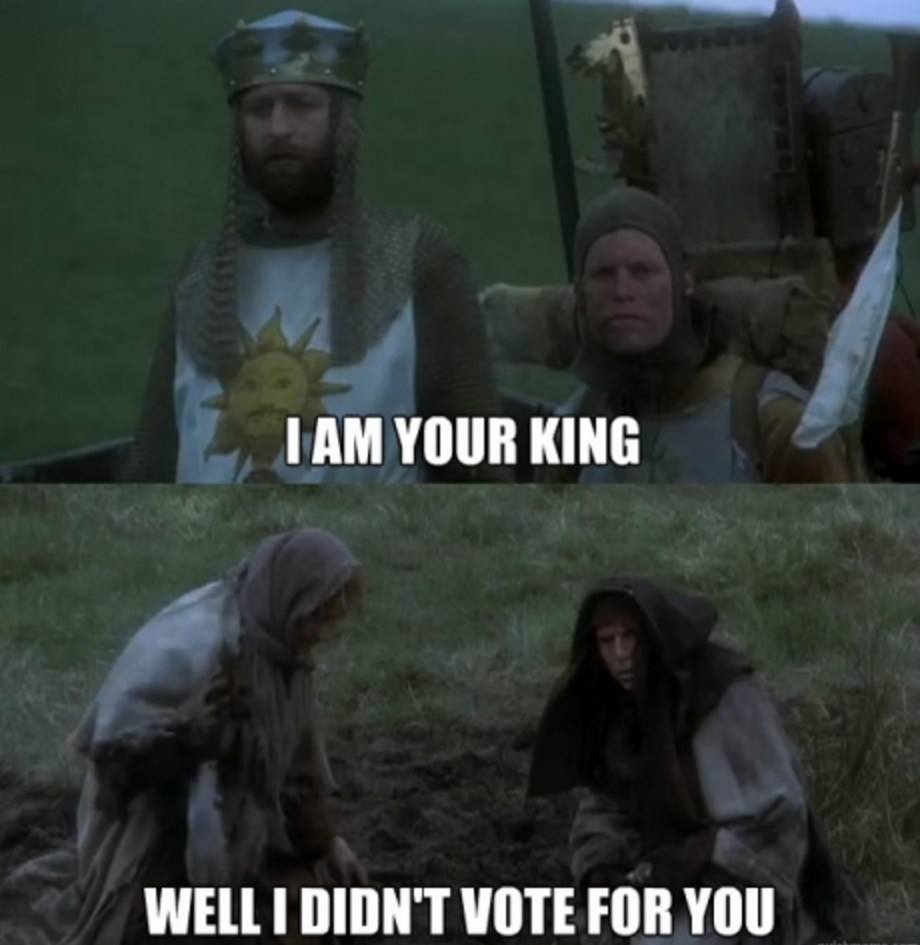
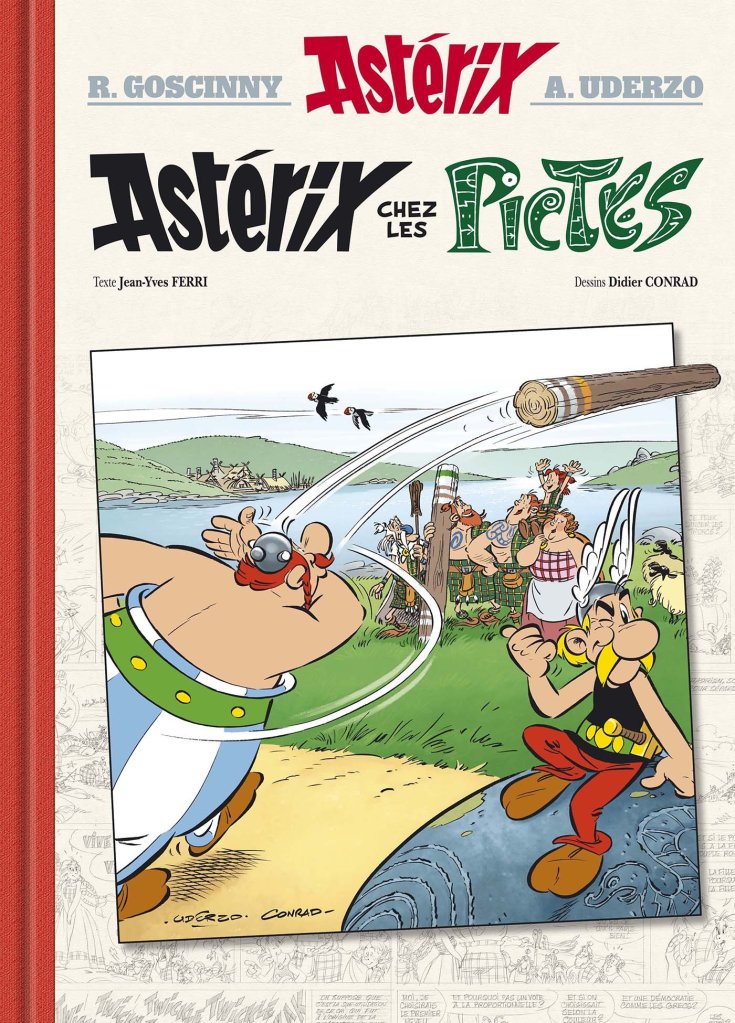
Except when it’s done as a joke in a children’s comic… in fact, I like this trope when it’s just a joke
So let’s not come at Gaelic Ireland from that kind of angle.
In most countries, go back even three hundred years and 90%+ of the folks you’d meet would be illiterate toiling people confined to small rural communities. In their daily lives, ambitions and morality they would be very different from any modern person. If the past is another country, then the pre-industrial, pre-Enlightenment past is another planet.
Even if, somehow, there existed some utopia in amid all the scarcity and violence and narrow horizons of the pre-industrial past, we couldn’t bring it back. And if modern people could dismantle modernity and return to that past, they would find they don’t like having to make every stitch of clothing by hand, or sleeping in a dim close hall with ten other people and a few cows and dogs, able to hear every fart and snore; or toiling away at crops and livestock for your entire life, never more than a few steps away from ruin.
It’s important to start with these sobering thoughts, because last week and again this week the focus is on the more egalitarian features of Gaelic Ireland. A lot of people, me included, find this stuff appealing. But as we touched on last week, Gaelic Irish society also had features that modern eyes would find hideous – features which challenge Connolly’s assertion that this society was ‘as Socialistic as the industrial development of their time required.’ Part 3 will deal with this sinister stuff more fully, and draw some conclusions from it.
If you want to get an email update when Part 3 goes up, subscribe – drop your email into the box below.
‘Those who make war’
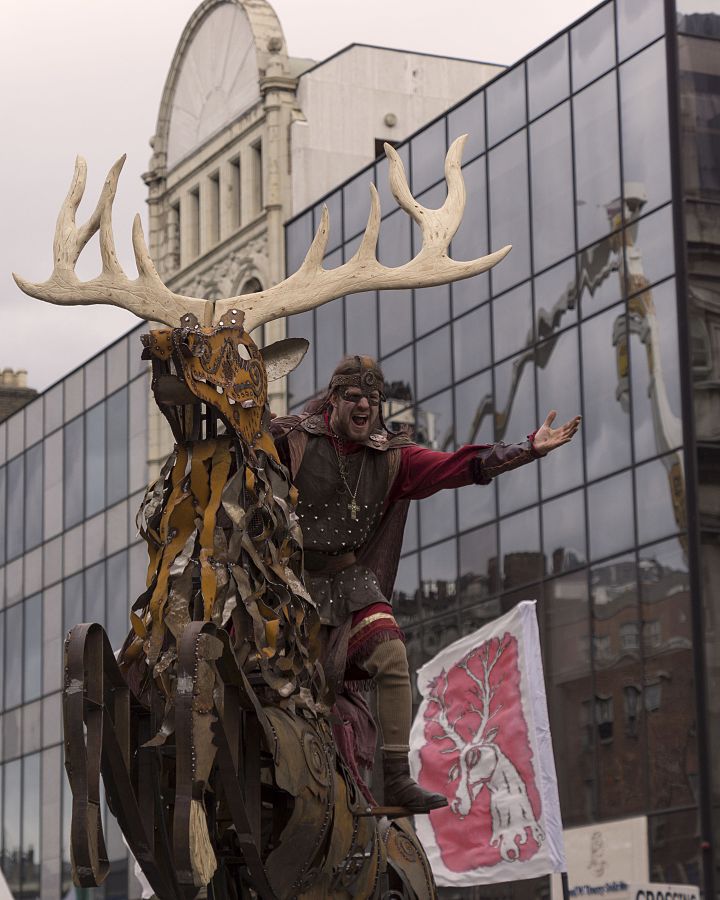
From a St Patrick’s Day parade in Dublin, 2014, part of an imaginative depiction of the Battle of Clontarf 1000 years before. No, the medieval Irish did not ride on stags, but it’s a cool image
Warfare was generally of a low intensity in Gaelic Ireland – raids, skirmishes, cattle theft. There was no warrior class and there were no housecarles or king’s bodyguards. There was no fyrd or militia, no custom of holding land in exchange for military service and no landless professional warriors.[i] A king did not have the means to maintain armed forces at his own expense, and billeting them on his people or on allies was politically fraught; he could do it, but it was a great way to lose friends and resources.[ii]
The only armed forces he could call upon were his electors. It was the duty of all free and able members of the tuath (people, territory or petty kingdom) to carry arms, and they assembled and fought only for limited periods.[iii]
By contrast, the nobles of medieval Europe had war at the heart of their identity. Knights were a special class elevated above the others. They held their land in exchange for an oath that they would fight. When contemporary writers chose just one word to describe the nobility, bellatores was the word they used – ‘those who make war.’[iv] But the Irish flaith (nobles/officials) were not a warrior class. In fact, I’m not sure they were even a class full stop.
The Irish king had no armed force loyal to himself. His armed forces were the same people who had a duty to depose him if he should fail in his duties. Military leadership was only one criterion, and not the foremost, on which contemporary sources judged kings; it was more important that they be wise, generous, cheerful, sound judges of disputes, etc.
War… War actually does change
Like a lot of things, this changed later in the period under discussion.
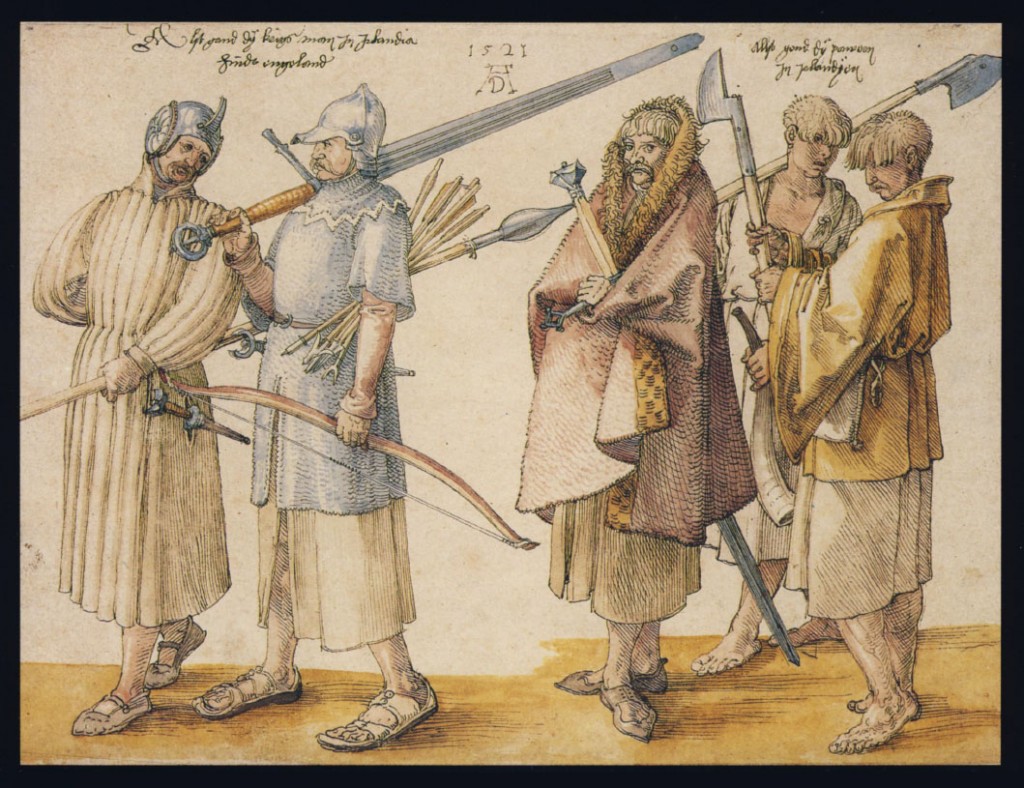
The Normans arrived from 1169 or so, with their ruthless hierarchies of knights and lords and their castles and their armies of knights and archers. Then came the gallóglaigh (foreign soldiers, often anglicised as ‘gallowglasses’), heavy infantry fighters from the Isles of Scotland who came to Ireland from the 13th Century on and revolutionised warfare.
Gallóglaigh and peasants in a 16th Century image by Albrecht Durer
From this point on Gaelic Irish kings tended to become more like lords and less like elected chiefs. As Simms writes in From Kings to Warlords: ‘A leader whose military strength was based on a professional army rather than on a hosting of his own free subjects had little need to consult the wishes of those subjects, except the half-dozen or so chief vassals who, like himself, controlled hired troops.’ Elections became a formality.[v]
This is why I chose the late 12th Century as a cut-off point. From here on Ireland is a country under conquest. Those natives who do not bend the knee adapt to the presence of the conquerors.
But even before the Normans and gallóglaigh, things were changing. My intuitive guess would be that the gallóglaigh came as a response to changes in Ireland; suddenly there was a market for mercenaries in Ireland. Why? Because from around 1000, beginning with Brian Boru, provincial kings arrogated more power from the rí tuaithe to themselves. As we noted last week, they fielded greater armies for longer periods, built fleets and fortresses, and placed heavier burdens on the people to pay for it all. They enjoyed the revenues of Scandinavian ports like Dublin and Limerick (which means they made a mint on the slave trade – of which, more next week). They billeted troops on their ‘allies,’ who no longer dared to resist or to complain. From around this time, people tended to start calling the rí tuath (petty king) a taoiseach (chief), reflecting a loss of status and sovereignty.
The social order in Ireland was changing even before the conquest. The kings and flaiths were developing into an unaccountable ruling class with a monopoly on violence. But they were still a long way off. These changes had not yet added up to a total transformation.
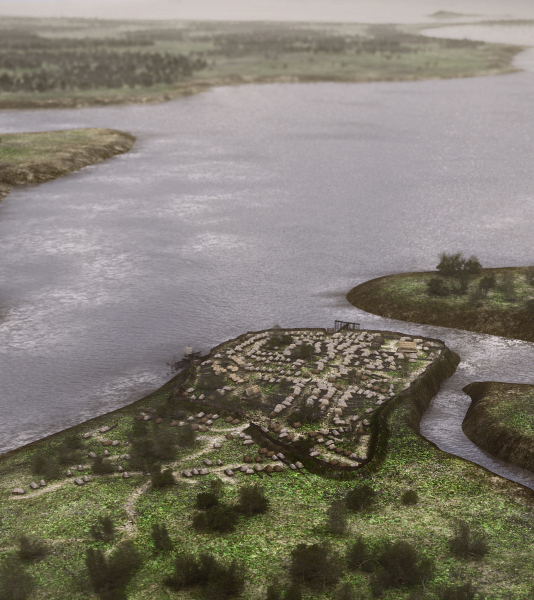
From Noho.ie – the Viking port of Dublin (The area occupied today by the space between Dame Street and Hawkins Street, I think). A slave trading centre which shaped Irish development – more on that next week.
Hospitality
O’Sullivan’s Hospitality in Medieval Ireland is a fascinating read. All pre-modern societies placed an emphasis on hospitality but Gaelic Ireland went further. Every ‘free law-abiding Irishman’ was entitled to entertainment and a night’s lodging.[vi] Everyone above the rank of ócaire (a humble farmer) was obliged to host. ‘Expulsion’ or ‘Refusal’ of a guest was a civil crime. To provide uncomfortable lodgings or bad food left the host open to the dreaded satire of the poets. Generosity was a solemn precondition for kingship: ‘the Old Irish gnomic text Tecosca Cormac maintains that the most shameful thing a king could do was give a banquet without brewing beer.’[vii]
I believe this custom was an extension of the king’s obligation to redistribute wealth. Each farmer or artisan having their own specialisation and limited means of exchange, the role of the king or flaith, the reason such official positions existed, was to receive and redistribute the various products.[viii]
Receiving and redistributing could take many forms, including tributes, gifts and the king’s many obligations to his tuath: maintenance of roads, bridges, ferries, common mills and common fishing-nets; and the cumal senorba, the portion of the common property that was set aside for the elderly, the disabled and the sick.
Remains of a fortified household or rath. These dot the landscape in Ireland
One of the key signs that kings and chiefs were getting more arrogant later in this period, and more decisively after the Norman conquest, is that their demands in terms of billeting and the annual ‘coshering circuit’ grew heavy – less of the redistribution, more of the extraction. These demands were necessary to keep up the kind of relentless military campaigns, year after year, that the 11th and 12th century provincial kings engaged in.
Hospitality was a natural extension of a king’s obligations. A satire on an inhospitable king was not simply a condemnation of his personal stinginess. It was a political attack; the king in question had neglected his duties as surely as if he had fled from battle or allowed a bridge to fall into disrepair.
Brett Devereux’s blog explains the role of nobles or ‘big men’ in agrarian societies the world over and how they helped to redistribute the surplus (although on terms that benefited themselves more than anyone else). So this is by no means confined to Ireland. But my argument is that the Irish king did a hell of a lot more of the redistributing and a lot less of the fighting compared to nobles in England and further afield. Redistribution was so central to the role of Irish kings that flaithiúl, ‘lordly,’ remains the modern Irish word for ‘generous’ – which is a long way from bellatores.
Gods without notions
To round off this week’s post, let’s look at two Irish legends that were popular around this period and that shed some more light on the question of hospitality. Of course, these are fictional stories told in a culture that took delight in the most extravagant exaggeration. But these are the stories that the people (or more cynically, the powerful patrons of culture) wanted to hear. They tell us a lot about people’s expectations and values.
Dagda was a god; people sometimes say that he was the Irish equivalent of Zeus or Odin but I don’t buy that (for reasons I’ll touch on below).
Cridenbel, ‘an idle blind man,’ used to ask for part of Dagda’s food every day:
‘For the sake of your good name let the three best bits of your share be given to me.’
It would have been dishonourable for Dagda to refuse, so every day he parted with most of his dinner. At this time Dagda was working at digging ditches and building raths (fortified households) so he had quite an appetite. Deprived of one-third of his food every day, he began to starve. But there was no way out of this sticky situation; it was better to starve than to refuse a request. At last Dagda’s son Angus Óg came up with a clever plan. Dagda put three pieces of gold on his plate and, when Cridenbel asked for the ‘three best bits’ of the meal, Dagda gave him the pieces of gold to eat. ‘And no sooner had Cridenbel swallowed down the gold than he died.’[ix]
Another story, related in O’Sullivan’s book, told of a kind one-eyed king who would never refuse anyone anything. A poet who was his guest decided to test his kindness. He asked the king to give him his eye for a gift. The king had no choice but to hand it over, leaving the poet with three eyes and himself with a total of none.
These stories reflect social mores. In them, hospitality is an obligation, not a gift. It is less dishonourable for Dagda to murder Cridenbel (!) than to refuse any request he might make.
In a call-back to points in Part 1 about how Irish kings could be deposed, note that the incident with Cridenbel and Dagda occurs in a context of austerity, brought about by the stinginess of King Bres. Though Bres is not without merit as a king (he is easy on the eyes), his lack of generosity is not long tolerated; the people overthrow him and drive him out of Ireland.
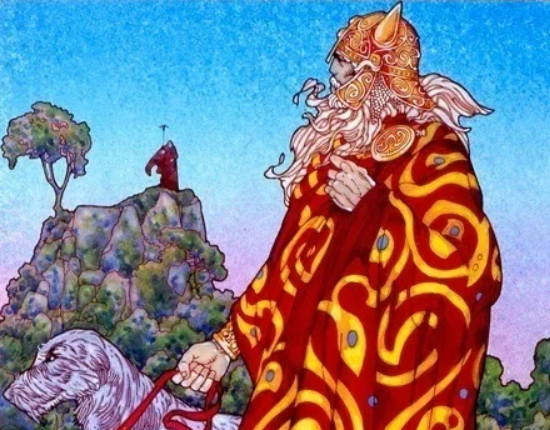
Bres imagined by, once again, the great Jim Fitzpatrick. Detail from Breas.Cú Brea
(While we’re at it, let’s take a slightly closer look at Dagda. In other stories we see him unable to restrain his appetites: eating and drinking until he vomits and passes out; going on an important mission only to be seduced by two different women; falling on his bare arse and staggering about with his ‘enormous penis’ trailing on the ground.[x] He’s more of a pintsman than a patriarch of Olympus. Irish kings were less exalted than kings elsewhere, and the same goes for Irish gods.)
Until next time…
Again, so far so wholesome, apart from the blinding, murder and binge drinking. When we look at the period between 800 and 1200, there’s actually a lot of evidence for the claim that an Irish king was something like a public servant.
However, we have only established that the king was a public servant in relation to the free heads of household – presumably men – of the tuath. What about women? What about the unfree, the slaves? Next week’s post will address these questions, adding plenty of darker shades to our picture of Gaelic society.
[i] Hayes-McCoy, GA. Irish Battles: A Military History of Ireland, Gill & Macmillan 1969 (1980), p 48
[ii] O’Sullivan, Catherine Marie. Hospitality in Medieval Ireland 900-1500, Four Courts Press, 2004, p 50-51
[iii] Jaski, Bart. Early Irish Kingship and Succession, Four Courts Press, 2000. p 99
[iv] Bishop Adalbero of Laon famously summed up the nobility, clergy and peasants as bellatores, oratores et laboratores -those who fight, those who pray and those who work. ‘Adelbero Ascelin’ in World Heritage Encyclopedia, Project Gutenberg, http://self.gutenberg.org/articles/Adalbero_Ascelin, accessed 17 May 2021
[v] Simms, Katharine, From Kings to Warlords, The Boydell Press, 1987 (2000), pp 19-20
[viii] Woolf sums this up as ‘the practise of redistributive chieftaincy that characterised the Irish political system.’ Woolf, Alex. ‘The Scandinavian Intervention’ in Smyth, Brendan (ed), The Cambridge History of Ireland, Cambridge University Press, 2018, p. 117.
[ix] Gregory, Augusta. Gods and Fighting Men, Colin Smythe Limited, 1904 (1970), 32-33
[x] The detail about Dagda’s member comes from The Silver Arm (Butler Sims (1981, 1983) written and illustrated by Jim Fitzpatrick, Ed. Pat Vincent. P 65. I don’t recall coming across that particular detail in Gregory’s book.
James Connolly is widely remembered for his heroic death in the 1916 Rising. Less well-known, tragically, is his main life’s work: the struggle for international socialism. More than once in his writings he argued that Gaelic Ireland before the English conquest was essentially a communist society.
The Irish rose in rebellion again and again throughout history because to them English rule represented
the system of feudalism and private ownership of land, as opposed to the Celtic system of clan or common ownership, which they regarded, and, I think, rightly, as the pledge at once of their political and social liberty […] The Irish system was thus on a par with those conceptions of social rights and duties which we find the ruling classes to-day denouncing so fiercely as “Socialistic.”
This is a conception of ‘liberty’ which the 21st-Century world should take note of – liberty based on democratic common ownership of wealth, rather than the ‘liberty’ of rich people to pollute, exploit and destroy without hindrance.
According to Connolly, Gaelic Ireland right up to its destruction by Cromwell in the 17th Century was
…a country in which the people of the island were owners of the land upon which they lived, masters of their own lives and liberties, freely electing their rulers, and shaping their castes and conventions […] the highest could not infringe upon the rights of the lowest – those rights being as firmly fixed and assured as the powers of the highest, and fixed and assured by the same legal code and social convention.
Connolly drew on the concept of primitive communism advanced by Friedrich Engels (who also, by the way, wrote a history of Ireland and learned Irish):
Recent scientific research by such eminent sociologists as Letourneau, Lewis Morgan, Sir Henry Maine, and others, has amply demonstrated the fact that common ownership of land formed the basis of primitive society in almost every country. But, whereas, in the majority of countries now called civilised, such primitive Communism had almost entirely disappeared before the dawn of history […] In Ireland the system formed part of the well defined social organisations of a nation of scholars and students […]
These historical points were part of Connolly’s political mission: to champion the movement for Irish independence, but to take it further, to fight for social as well as political liberty. This was his contribution to debates around the Gaelic cultural revival.
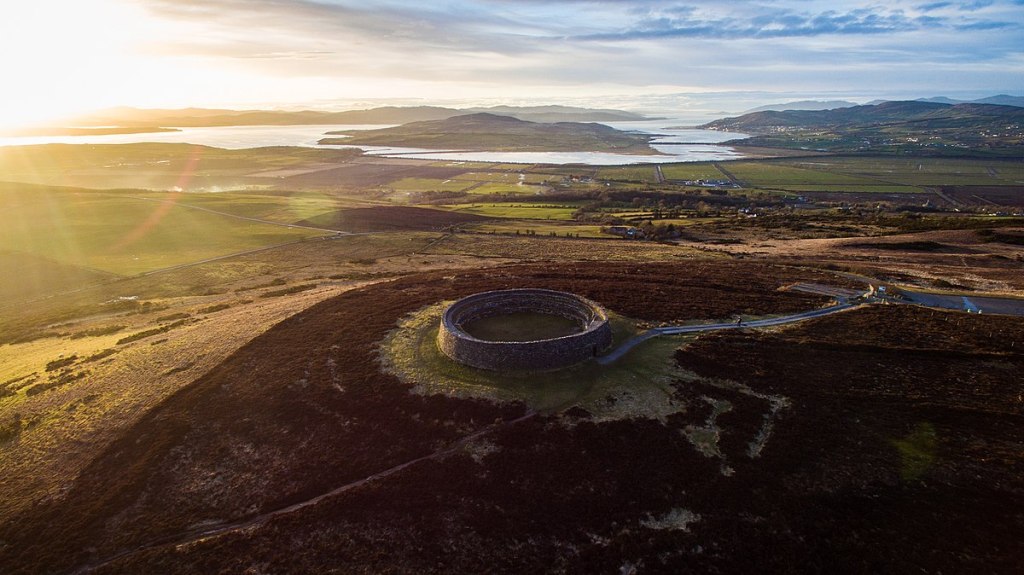
The Gaelic Irish fortress of Grianan Aileach, Co Donegal
But is it true?
Was Gaelic Irish society in any meaningful sense socialist? Or was this just one of those unfortunate examples of Connolly giving ground to romantic nationalism?
I want to test his claim against a range of historical sources. This is part 1 of a series that will be on-and-off; I will post three or four instalments over the next few weeks.
Want to get updates to your email address when I drop those posts? Subscribe here:
If Gaelic Ireland really was communist, it throws a new sidelight on the whole Celtic world.[i] It’s also very significant for those interested in the theory of primitive communism.
Connolly was not alone in believing that Gaelic Irish society possessed a democratic and communal social order. ‘Before the conquest the Irish people knew nothing of absolute property in land,’ wrote John Stuart Mill in 1868. ‘The land virtually belonged to the entire sept, the Chief was little more than the managing member of the association. The feudal idea which came in with the conquest was associated with foreign dominion, and has never to this day been recognised by the moral sentiment of the people.’[ii] Lawrence Ginnell in his impressive 1894 study of Brehon Law said that ‘the flaith [usually translated as ‘lord’ or ‘noble’] was properly an official, and the land he held official land, and not his private property at all.’[iii] In 1970 Peter Beresford Ellis painted a similar picture in the opening chapter of his History of the Irish Working Class.[iv]
By contrast, in much current writing on Gaelic Ireland we see heavy use of terms like ‘Lord and Subject,’ ‘Elite and Commoners’ ‘aristocracy’ and ‘hierarchy.’ This is an expression of a conflicting view, also of long standing, that ‘Irish society was rigidly stratified’[v] in the early medieval period. The same irreconcilable difference of opinion existed in Connolly’s day.
Gaelic Irish kings: Royalty or public servants?
In the first few posts of this series we’re going to take a look at one particular issue: the specific claim that a Gaelic Irish chief or king was ‘little more than the managing member of the association,’ ‘an official.’ If this is true he would be accountable and obliged to his people, relatively modest in status, something more akin to a public servant than to a member of a hereditary ruling warrior class.
For perspective, we should take a look at Ireland’s contemporary neighbours. An 11th-century Anglo-Saxon cleric remarked, ‘the people have the choice to choose as king the one who pleases them: but after he is consecrated as king, he then has power over the people, and they are not able to shake his yoke from their necks.’[vi] They could elect their kings; this could also be applied to Ireland at the time. But by contrast Irish people, if they thought their king was not doing a good job, were required by law to ‘to shake his yoke from their necks.’ The English King Alfred was seen as sacred and could not be deposed by his own people. He could appoint reeves (officials), muster a fyrd (an army) and levy burdensome taxes, unlike his Irish counterparts. This gap only widened later in the Anglo-Saxon period, and that is to say nothing of Norman customs like primogeniture and knight service.[vii]
Chronology
In this series, we will deal with Irish kingship in the period between the Eighth Century and the Norman conquest of the late Twelfth Century. This span of time encompasses thousands of kings who ruled over hundreds of diverse tuaithe (peoples or petty kingdoms, singular tuath). Within that period, profound changes occurred: lesser kings became known as dux or taoiseach (leader or chief) and the over-kings and provincial kings extended their powers and prestige, fielded larger armies for longer periods further afield,[viii] and began to levy a form of taxation.[ix] Any attempt to describe the Gaelic Irish social order must begin by stressing this diversity and by acknowledging this general pattern of change – in general, towards more centralised kingship, and away from customs we might see as democratic or communistic.
Under English conquest from the 12th Century on things changed – unevenly and see-sawing, but they definitely changed – in the direction of feudal institutions along the lines of what we see in England. Norman lords had inspired greedy Irish kings to copy them – to turn tributes into rents, to turn clients into tenants. Jaski bears out this general point: from the twelfth century on, ‘free clients’ grew closer in status to ‘base clients,’ and the position of base clients worsened as the power of kings and flaiths grew.
On the other hand, Gaelic Irish custom remained strong even after centuries under conquest. English observers like Spenser and Davies in the 16th Century describe elective kingship, tanistry, etc. When we talk of how the Normans became ‘more Irish than the Irish themselves’ it’s not just that they started playing hurling and stealing cattle and speaking Irish. It’s a commentary on how they were assimilated into the Gaelic Irish system of common land ownership. But it was a two-way street. The legal superstructure of Irish society didn’t change much between the Normans and Cromwell but he society underlying it changed a great deal. The old ways were not finally broken, however, until the Sixteenth and Seventeenth Centuries, when we see the Plantations – waves of violence that exterminated around a quarter of the people and overthrew the social order.[xii]
Feudal relations could grow up inside the framework of the communal, democratic system of the Gaelic Irish – but could only go so far, until the final shattering of that framework in the 17th century.
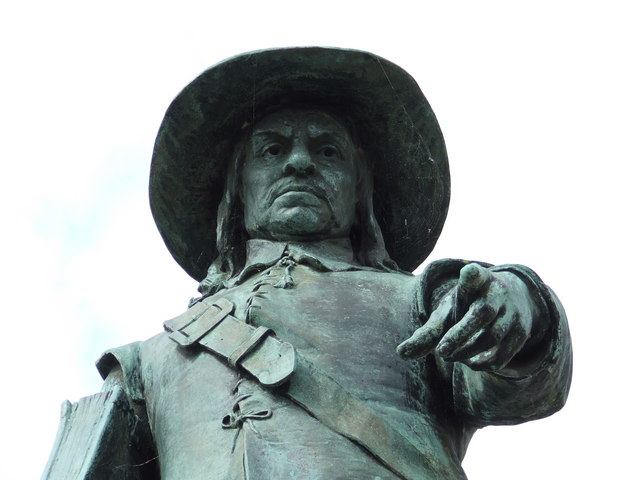
Oliver Cromwell, champion of the campaign of ‘primitive accumulation’ that destroyed what remained of Gaelic Ireland
Connolly lumped in all of pre-Cromwell Ireland into one description. But the further on we go in his chronology, the less Gaelic Irish society resembles what he describes. In his defense, this is political and not historical writing. He is making a political point – that common ownership of land prevailed until the Cromwellian rupture, that not just two nations but two social systems confronted one another in Ireland up to that point. This is true. But in the way he makes the point he drives a steamroller over Gaelic Ireland and flattens it out.
Everyone has to read Connolly. He’s brilliant. But don’t read him for a detailed and accurate history of Gaelic Ireland (or at least don’t begin and end with Connolly). He doesn’t offer one and, in fairness, he never pretended to.
Succession
How did a person get to be a king? In Norman England, kingship passed from father to eldest son. Gaelic Irish kings, on the other hand, were not born to rule but elected. Even the tánaiste (king’s deputy) was heir-apparent but not heir-designate. The electorate was narrow for the loftier kings but relatively broad for petty kings: provincial kings were elected by the titled persons of a province, while the king of a tuath was elected by all heads of households.[xiii]
Who could be a candidate? Family descent mattered a great deal, with scribes ‘pursuing endless genealogies to improbable beginnings’[xiv] in the interests of propaganda. ‘A non-kinsman does not take possession to the detriment of a kinsman,’ declared one law tract, to which a footnote by another legal scholar clarified that a candidate was entitled ‘if he be someone of the family [and] if he be right for the lordship.’[xv]
But hereditary claims were emphasised (even fabricated) by candidates precisely because succession could be contentious. The pool of candidates could be very wide; everyone who had the same great-grandfather. In addition, there was provision in the laws for illegitimate children and even non-relatives to contest the election. That a candidate must be ‘right for the lordship’ meant that it was at least as important for a candidate to possess febas (excellence or personal qualities).[xvi] Youth, old age, disability, incapacity or physical blemishes usually disqualified a candidate.[xvii]
(One legend tells of a king who had a lime-calcified brain thrown at him so that it stuck in his face. Because he was a really capable king, his people gave him a dispensation and let him rule.)
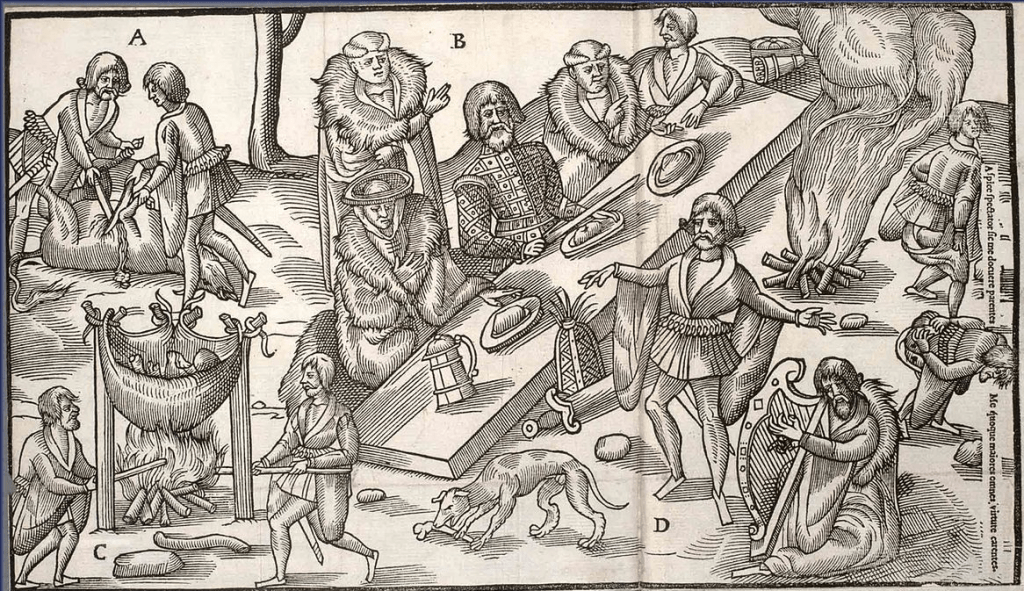
A woodcut by John Derricke from 1581, part of The Image of Irelande
People in a contractual relationship with a flaith were divided into free clients and base clients, the former enjoying better terms than the latter. Base clients, even those related to the king, were singled out for disqualification. This suggests three interesting conclusions:
that descent was secondary to social grade;
that a free client could be king;
and that it was known for a king to have base clients among his close male relatives.
These points challenge notions of a ‘rigidly stratified society’ and the last point suggests that we are dealing not with lofty family oligarchies but with broad kinship groups whose members were woven into the fabric of (often very small) tuaithe. The tuath was essentially a very big, broad family. Predictably enough, only a member could be the head of the family.
(As an aside, Fraser’s The Golden Bough mentions societies such as the Picts where the exact opposite custom held: the king of a community had to be an outsider.)
Inheritance did exist. Land and other property was divided between a king’s sons on his death. But that portion of his land which he only possessed through his title passed back to the community, to be given to whoever was next elected.
Heredity was a decisive advantage. But a candidate for kingship, whoever his ancestors were, had to demonstrate his own personal worth before the critical eyes of his peers.
The free member of the tuath was not a subject of any king or lord. Even an individual in a contractual relationship with a king was not a subject or a vassal but a céile, a word which carries connotations of ‘partner’ or ‘companion’ and is usually translated as ‘client.’ All in all, Irish kings did not enjoy the exalted status of their contemporaries in Anglo-Saxon or Norman England. They were neither sacred nor above the law. According to the Old Testament, a king could not be deposed. But in Ireland the people had a duty to depose a ‘defective’ king, or else calamities would befall them.[xviii] A defective king was one who failed to repair infrastructure, who was stingy, who ripped off his own people, or who got his wounds on his back in battle (unless, the laws stipulate, he got those wounds on his back by running through the enemy lines).
Irish law had no sense of sublime majesty. Different categories of king were divided up into grades and their ‘honour price’ set down in bald numbers. Some professions, such as poet, judge or hostel-keeper, could attain the same honour price as a king.[xix]
Here we enter more disturbing territory, because honour price was measured in a unit of value called the cumal. The same word was used for a female slave. We need to let the dehumanising implications of that fact sink in, and then think about the general question of slavery. Connolly doesn’t mention it. Ginnell and Ellis deal with the issue, in my opinion not satisfactorily. This is a serious challenge to the idea of Gaelic Irish society as an equal, democratic, communistic society. We will deal with this question more fully in a future post.
You will have noticed a lot of ‘he’ and a lot of ‘his’ in the above points; that is because women could not hold political office. This suggests another topic for a future post: the position of women in Gaelic society, which was in some respects better than their position in other contemporary societies, but still bad. We need to consider this also in our judgement on Gaelic Irish society.
Next week in Part 2 we’ll continue our focus on the strange nature of Irish kingship. We’ll look at Irish kings at war; at the crazy array of social grades into which Irish society was divided; and at the question of wealth redistribution.
[i] It is bold, to say the least, to draw conclusions about the Gauls in 100 BCE based on what some Irish monk wrote in 1000 CE, but people still do it; Ireland occupies a special place in Celtic studies because the Irish were the only Celtic people to produce a large amount of writing about themselves, as opposed to being written about by people like Julius Caesar when he could find time in between slaughtering them.
[ii] Mill, John Stuart. England and Ireland, Longman, Green, Read and Dyer, 1868, p 12
[v] Frame, Robin. ‘Contexts, Divisions and Unities: Perspectives from the Later Middle Ages,’ and Ní Maonaigh, Máire. ‘Perception and Reality: Ireland c. 980-1229’ both in Smyth, Brendan (ed), The Cambridge History of Ireland, Cambridge University Press, 2018, pp. 535, 150, 153. Byrne, FJ, ‘Early Irish Society,’ in TW Moody and FX Martin (eds). The Course of Irish History 1967 (2011), p 45
[vi] Quoted in Godden, MR. ‘Ælfric and Anglo-Saxon Kingship.’ The English Historical Review, Vol 102, No. 405 (Oct, 1987), pp. 911-915. JSTOR, http://www.jstor.org/stable/572001. Accessed 10 May 2021
[vii] Rosenthal, Joel T. ‘A Historiographical Survey: Anglo-Saxon Kings and Kingship since World War II.’ Journal of British Studies, vol. 24, no. 1, 1985, pp. 72–93. JSTOR, http://www.jstor.org/stable/175445. Accessed 10 May 2021.
[viii] Simms, Katharine. From Kings to Warlords, The Boydell Press, 1987 (2000), p 11




 The 1919 Review