Games that warped my young mind: Red Alert 2

When I was ten, eleven, twelve years old, a lot of adults were worried that games like Grand Theft Auto 3 would warp our young minds and turn us violent. But for me, while GTA was fun, the violence was so obviously out-there, so outrageous, I didn’t have any trouble distinguishing between it and reality.

GTA was set on normal city streets. The props were cars and pedestrians and buildings. But you were stealing a car, running people over and shooting down police helicopters. The familiar and normal environment acted as a foil to the crazy violence. You could walk home from your friend’s house after playing GTA and you knew that this was the real world in front of you, and that it didn’t operate by the same rules. There’s a car; but you can’t run up to it, press Triangle to break in and hotwire it, and accelerate.

What about a game with a more exotic setting? What about a game set in an alternate-history version of the Cold War? You’re young. You haven’t covered this in school, or read any books about it. Command and Conquer: Red Alert 2 is your first encounter with the Soviet Union. You know it’s a videogame, it’s at least to some extent fantasy, but you have no real-life counterpart to measure it up against.

Looking back after having read a lot and written a bit, I have a new perspective on Red Alert 2 (like a few months back when I revisited Orwell, except that in my age group, Red Alert probably had more influence than 1984). If we’re going to talk about warping minds, forget GTA. Here is a game that planted deep in my brain a funhouse-mirror perspective on history and geopolitics. Red Alert 2 is just extraordinary.

On the face of it, this might seem to be a finicky post where I nit-pick a fun game and lecture everyone about history. But really I have a secret agenda here. I’m writing this so that I have an excuse to talk length about a game from the early ‘000s about which I am incurably nostalgic to this day.

Sidebar: For those who don’t know, Command & Conquer: Red Alert 2 was a strategy game released in 2000 by Westwood Studios. The story, implausible at literally every turn, revolves around the Cold War, time travel and alternate histories. And it starts with the classic alternate history: in 1996’s Red Alert, Einstein invents time travel and goes back to the 1920s to kill Hitler. But he returns to a present where Stalin is conquering Europe in Hitler’s place (yes, an implicit endorsement of Hitler. And no, they never address this). In 2000’s Red Alert 2, the Soviets have another go at world conquest, launching a sudden surprise attack on the US. In Red Alert 3, the once-again defeated Soviets make their own time machine, but by defeating America they inadvertently end up creating a timeline where Japan is challenging them for world domination. In terms of tone, Red Alert tries to keep a straight face, and Red Alert 3 fully takes the piss. 2 is in the middle, ie, tongue-in-cheek.
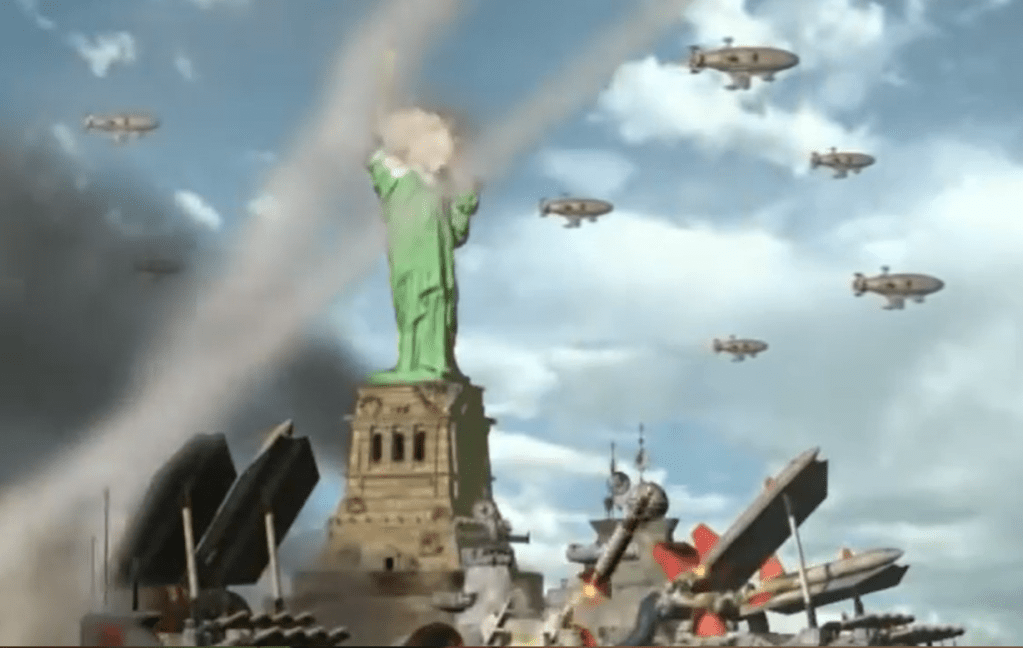
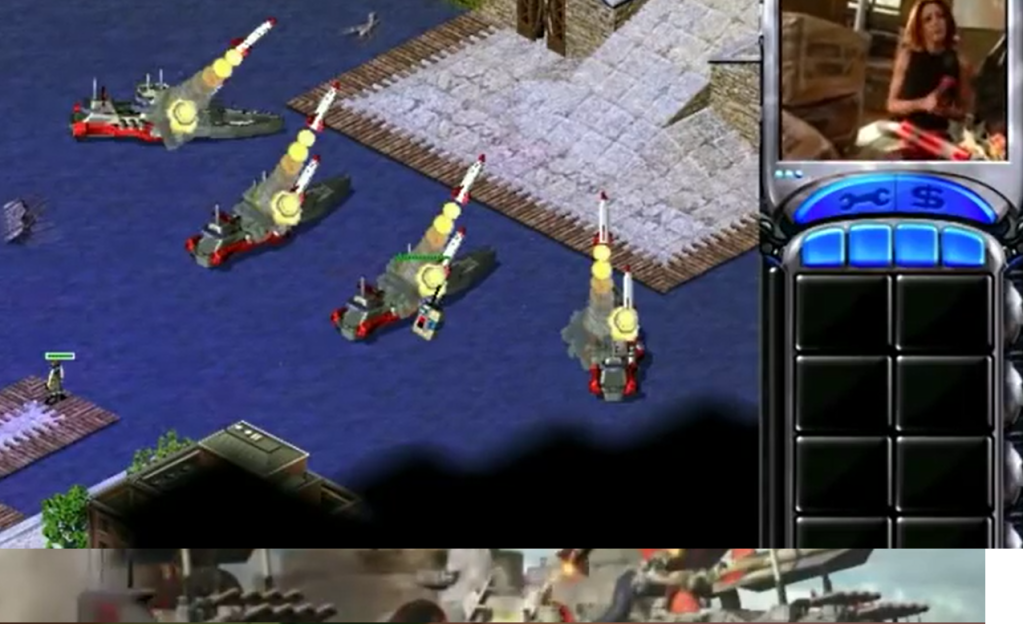
Red Alert 2 is a good game, for its time. It’s easy to pick up and play, but there is a certain versatility and depth in the range of units. The fact that the environments are just slightly interactive – put guys in buildings, blow up bridges – goes a long way. The colours are bright, the unit models visually distinct and full of character. The fast food restaurant is called ‘McBurger Kong.’ The campaigns hold up well for variety, challenge and playability. The score, composed by Frank Klepacki, is part industrial, part funk, part Red Army Choir, all brilliant.
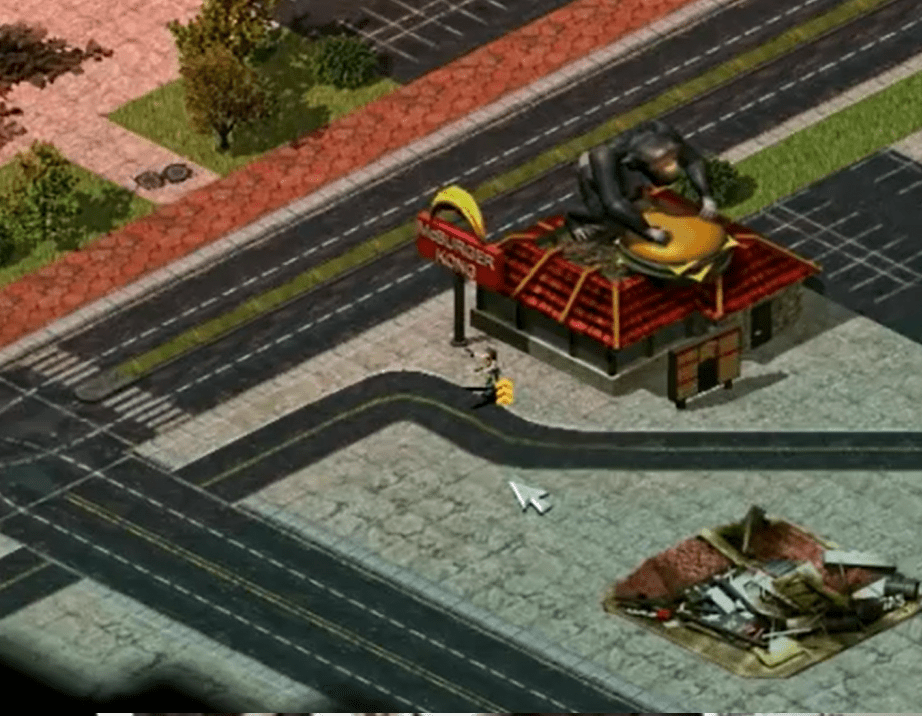
But the real strength of this game is its attitude. Unlike its predecessor Tiberian Sun, which is on paper a very similar game, Red Alert 2 doesn’t take itself seriously. To everything bad I’m going to say about it here, Red Alert 2 can mostly get away with shrugging its shoulders, grinning and claiming that it was only joking.  

The sexism in the live-action cut-scenes – all that creepy pandering to 13-year-old boys – was obvious to me even at the time, and I don’t think there’s much to dissect. It’s right there.

Instead, let’s talk about Iraqi desolators, Libyan demolition trucks and Cuban terrorists.

The Allies. Reagan, Thatcher and… De Gaulle?

There goes the neighbourhood!

In the game’s skirmish mode, the player can choose from a list of countries. One of the playable countries in the Soviet bloc is Iraq. Sure – Iraq is communist. Why not. The Iraqi soldiers are identical to the Soviet soldiers, right down to the cartoon Slavic accent. The only difference is that each country gets a special unit; in the case of Iraq, you get the Desolator. This charming little fellow shoots a green beam of radiation at people, zapping them instantly into writhing emerald goo. He also has a special move, where he contaminates a massive area around him, turning it green and killing everyone on it.

Years later I would learn that it was the United States which used depleted uranium munitions in Iraq (before and after this game was released) leading to cancers and birth defects. A few years after this game was made, the US would invade Iraq based on the lie that the country had chemical and nuclear weapons. When the Desolator shouts his cheeky catchphrase before turning the land around him a lethal green, it’s a little cultural artefact of this big lie, a lie which in real life covered a whole country in that green shroud and caused incalculable suffering for the Iraqi people. In real life, the US unleashed desolation on Iraq. In this game, it’s the other way around.
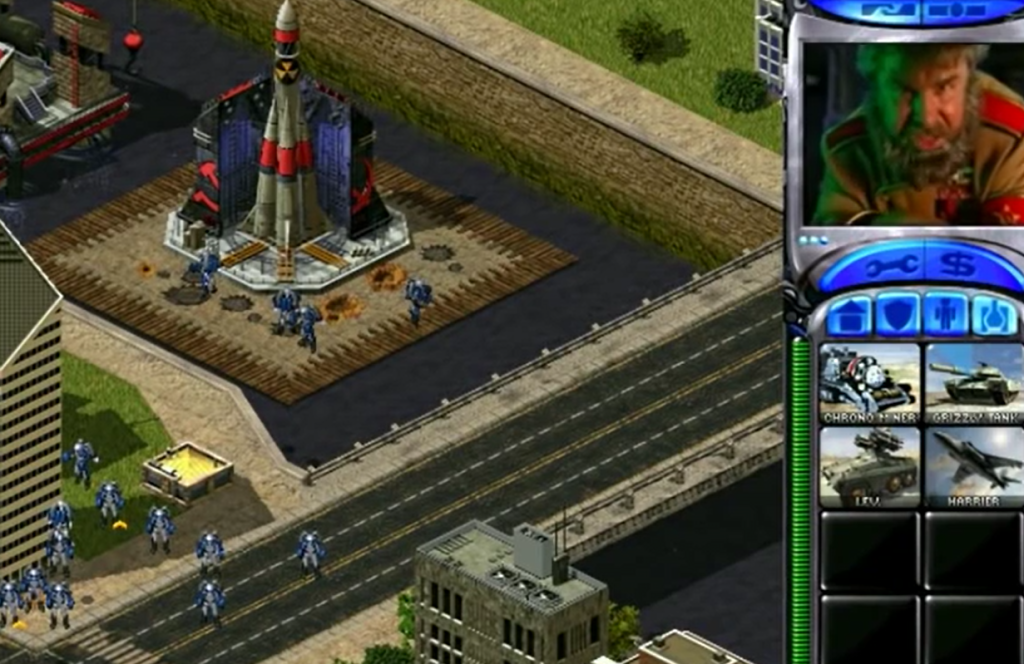
Allied jet pack troopers, Soviet nuclear missile

Vamos, Muchachos!

The various countries in the Soviet Bloc have one thing in common: they are all countries that were at odds with the United States in the late 1990s. So we’ve got Libya and Cuba in there as well. The Libyans have a Demolition Truck – ‘One way trip!’ – which blows itself up in a small nuclear explosion; the Cubans have a little guy called a Terrorist – ‘Vamos, muchachos!’ – who blows himself up along with anyone near him.

But it was Cuba that was targeted by terrorists funded and encouraged by the United States, not the other way around. Cuban suicide bombing is not and has never been a thing.

The Libya thing, in hindsight, just makes me sad, especially with the most recent disaster. Unlike with Iraq, I don’t even have anything slightly clever to say. Libya was once the country with the highest standard of living in all of Africa. Then came the US-backed overthrow of Gaddafi in 2011. They dragged him out of a ditch and killed him in a most brutal manner, and the remarks made for the occasion by then-Secretary of State Hilary Clinton (‘we came, we saw, he died’) make the bombastically cruel Soviet leaders in this videogame seem like sensitive souls by comparison. Since then Libya has been transformed into a conflict-ridden country. The EU gives them tons of money to lock up refugees in desperate conditions, just to appease the racists back home.

The Desolator and the Terrorist have one important thing in common: they are tiny cultural artefacts of imperial projection. What do I mean by projection? I’ll put it this way: if Westwood had decided to include Vietnam as a playable country, they would have been depicted burning down American homesteads with napalm, or withering the forests with Agent Orange. In the pop culture of the imperialist aggressor, its own historic crimes are pinned on its victims.

9/11

Adam Curtis’ documentary HyperNormalisation (01:39:35-01:43:00) includes a remarkable montage of scenes from movies that look exactly like footage from 9/11 – only these movies were all made before 9/11. Someone tell Adam Curtis about Red Alert 2. Released just a year before 9/11, the game’s advertising featured the twin towers prominently, meanced by, among other things, aeroplanes. The first mission in the Soviet campaign involves destroying the Pentagon, and a couple of missions later you are in New York, where you can occupy or destroy the World Trade Centre. The zeitgeist which Curtis identifies in HyperNormalisation is perfectly captured in Red Alert 2.
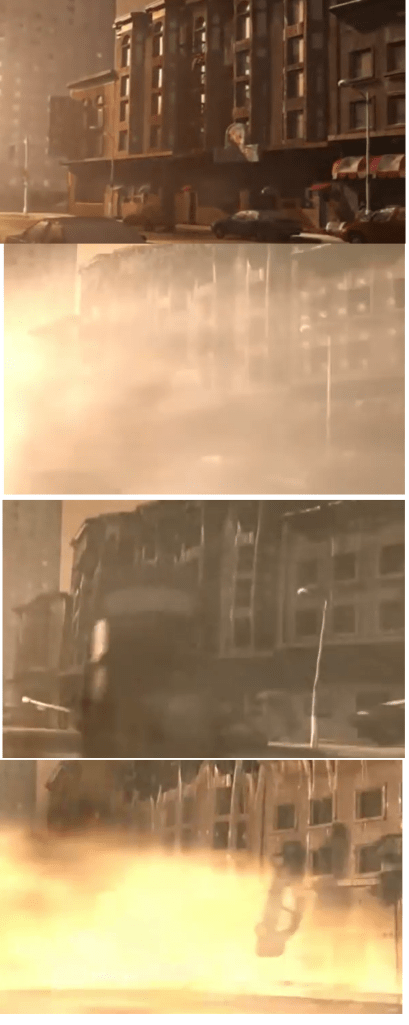
‘Oooooh… dream baby dream… dream baby dream…’

Coalition of the Willing V Axis of Evil

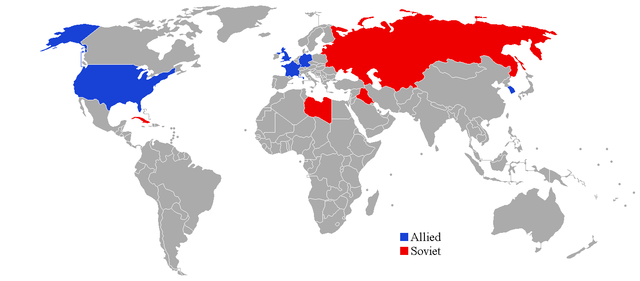
The USSR’s three playable allies are Iraq, Cuba and Libya, while the USA’s equivalent are Korea, Britain, Germany and France (see the map below from Wikimedia Commons). With the exception of Korea (reunified offscreen), this world war sees Africa, the Middle East and Latin America take on Europe and North America. It’s the former colonies against the colonisers (a massive piece of historical context which was missing from my 11-year-old head). It’s a fantasy where what really happened is reversed, ie, the masses of Africa, Asia and Latin America commit atrocities in the USA, a contrived scenario to justify the colonisers getting to slaughter the peoples of the colonies all over again.

Simply reversing the projection, of course, wouldn’t accurately reflect the Cold War. Why not include the Afghan Mujahideen among the ‘Allies’? What would their special unit be? Where is Nelson Mandela in the pro-USSR coalition?
Your command is my wish

This imperial projection is most obvious with an unforgettable character named Yuri (The Soviets are a surprisingly informal bunch. Top brass are simply addressed as Yuri, Vladimir and Natasha – no surnames, no patronymics). Yuri employs psychic powers and elaborate machines to control people’s minds. This is a developed part of the world and story, with mind-controlled communist giant squids terrorising the high seas and a US president taken over by a psychic beacon. Yuri’s acolytes are developed into a colourful and horrifying faction in their own right in the expansion, Yuri’s Revenge, which takes the irony up a few notches and gets the Allies and Soviets to join forces and have a joint moon landing.

Ten thousand volts, coming up!

Tesla, now the name of a company which is a bastion of US capitalism, features in Red Alert 2 as an alternative energy source favoured by the Soviets. We see the Soviets weaponise Tesla energy through ‘Tesla Coils’ and ‘Tesla Troopers’ who electrocute people and even turn the Eiffel Tower into a kind of pylon.

All this hits you differently after you’ve read about MKUltra, or The Shock Doctrine by Naomi Klein. Mind control experiments were actually the preserve of the United States. The fact that US prisoners in Korea were subjected to lectures aimed at recruiting them to the communist cause was interpreted by a hysterical US media and political class as ‘mind control.’ But the interest of US state forces such as the CIA was piqued; they experimented with electric shock therapy and LSD. These experiments failed to produce mind control, but left people dead or severely brain damaged.

In this game, the Soviets have nukes; the Americans do not. The Soviet nuclear reactor is a nod to the Chernobyl disaster – here we’re dealing with something from actual history, so okay. The Soviets had nuclear weapons, and tested them in very harmful and irresponsible ways. But the Allies did those things too, and also killed a quarter of a million innocent people in Hiroshima and Nagasaki. More projection.

Sometimes the cold war stereotyping is so obvious and crass it goes beyond offensive, and sometimes it flies under the radar because it’s larded in a protective wrapping of irony. Other times it is just bigoted, plain and simple. For example, there is another colourful unit type called Crazy Ivan, who cackles maniacally as he plants bombs on things. You don’t have to be a raving tankie to see the problem with this.

Jusht give me a plan

But it’s satire, right? Surely they make just as much fun of the Americans? No, not at all. General Carville has a bit of a hillbilly affect (‘his forces are rompin’ through the country like an angry bull at a Texas rodeo’). The Spy talks like a caricature of Sean Connery. But that’s as far as it goes.

The contrast is clear even if you never watch the cutscenes. The Soviets use nuclear and chemical weapons, electric shocks, cartoon dynamite, human cloning and mind control – evil, in other words. Meanwhile the Allies use high technology: weather control, time travel, jetpacks, and tanks that can disguise themselves as trees. The Soviets have things that are excessive, ugly and brutal, while the Allies have things that are ingenious, streamlined and attractive. In short: the Soviets have giant squids and the Allies have dolphins.
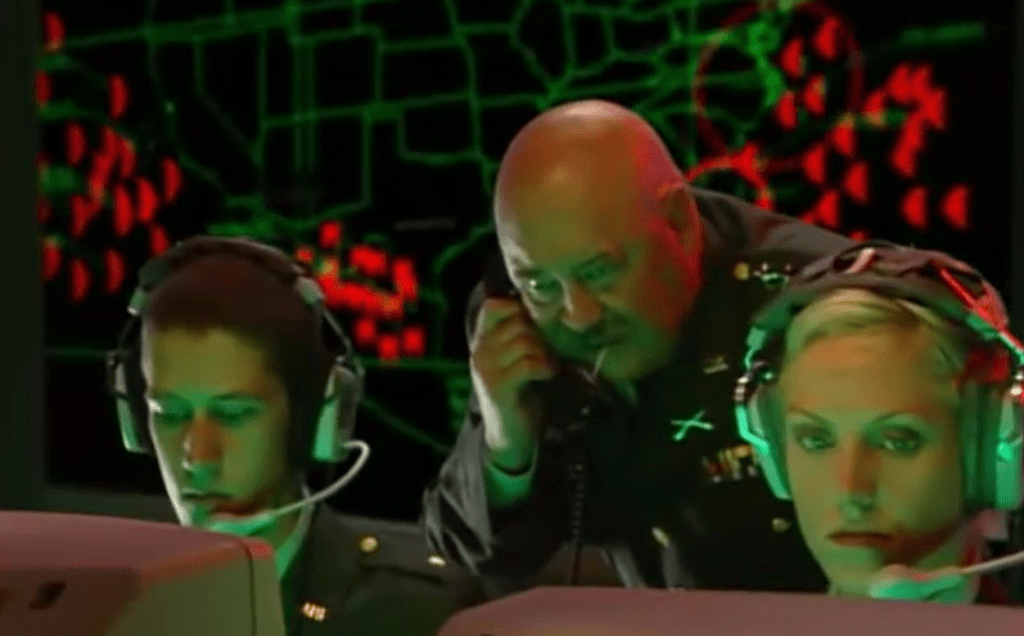
General Carville. The Americans, for the most part, have surnames

Mind forg’d manacles

Maybe this is the only blog on the internet where you’ll find references to Milton and Blake employed to analyse Westwood Studios and Red Alert 2. But here goes: in a note in The Marriage of Heaven and Hell (1793), William Blake made a famous observation about John Milton’s biblical epic Paradise Lost (1667): “The reason Milton wrote in fetters when he wrote of Angels and God, and at liberty when of Devils and Hell, is because he was a true poet and of the Devils’ party without knowing it.” The Soviets in Red Alert 2 (2000) are clearly “the Devils’ party.” But they are so much more interesting and fun than the Allies. The developers and the players are of their party without knowing it.

Part of this is that the audience in Western Europe and North America has some sympathy for the ‘devil.’ As the losers of the Cold War and as a vanished social system, they hold some fascination; it’s obvious even to an 11 year old who knows no history that they are being caricatured and demonised, which excites some grudging sympathy; meanwhile, they are yesterday’s enemy, not threatening today.  

The other part is projection. Yes, we’re back to projection. The audience in Western Europe and North America identifies with the ‘evil’ side because it knows, deep down, that neither side in the Cold War had a monopoly on evil. All the napalm and all the massacres, the coups and torture sites, the mountains bombed into valleys and the cities wiped off the map, the psychotic warlords and fascist dictators with American weapons in their hands – these things rarely feature in popular culture. But they are the means by which capitalism won the Cold War. Our governments and corporations inflicted unspeakable horrors on Africa, Asia and Latin America in the recent past. In Red Alert 2, we assign all that evil to the other side of the Cold War. And the West European or North American player delights in the extravagant, cartoon evil of the Soviets because, subconsciously, he sees in them the state and social system with which he identifies.

But the most remarkable thing about Red Alert 2 is not how it looked back at the Cold War, but how it looked forward, with what I can only describe as prescient hypocrisy, to the so-called ‘War on Terror.’ It was part of a chorus of pop culture texts fantasizing about an attack on Manhattan just before it happened; and it singled out Iraq and Libya, whom the US would soon target for ‘regime change,’ doing far more damage to those countries than the imaginary Soviet assault does on the United States.

So, do videogames warp young minds?

When you learn something new, you fit it in with what you already knew. And for my generation ‘what we already knew’ about the Cold War consisted of stuff like James Bond and Red Alert 2: crude pop culture propaganda.
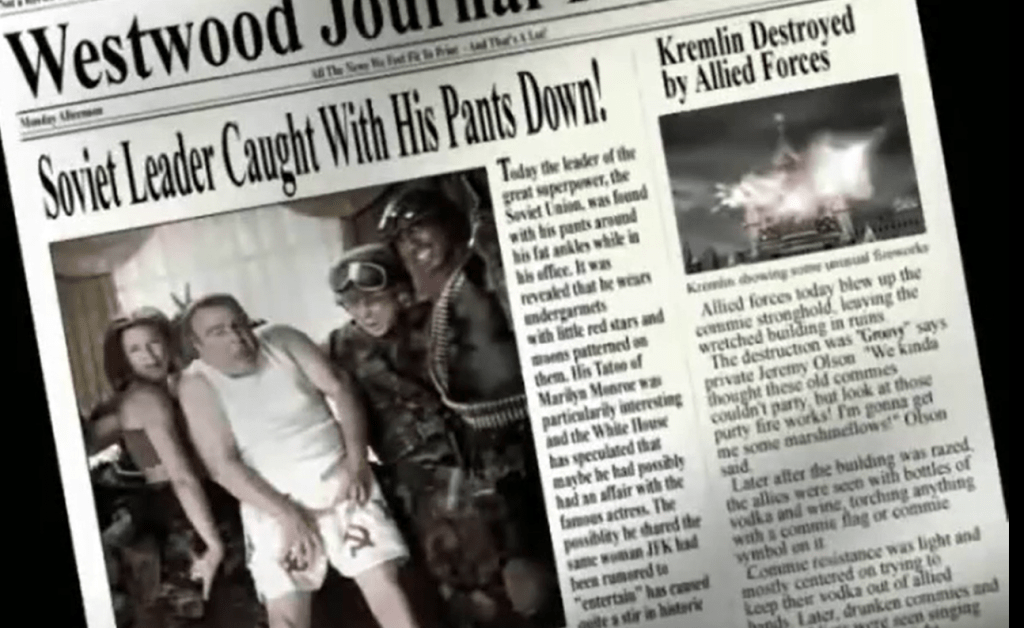
But is it even propaganda at this point?

As opposed to an intentional propaganda message, Red Alert 2 is a text in which there are assumptions baked in which transmit propaganda messages. But the game’s pure silliness defuses the propaganda, ridicules what it is transmitting, takes most of the sting out of it. If this game really did warp my mind, it was not that difficult to un-warp it again. In its anticommunism and Russophobia it was no worse than a lot of the books on the market, and a lot of the messaging in schools, at the time or today. This underlines another point about warped minds: it takes a whole culture, not just a single text, to change the way a person sees the world. In contrast to the broader culture, Red Alert 2 has this redeeming feature: that it is well aware of its own silliness.
Back to Home Page / Archives

Bob Dylan, Phil Ochs and the 1960s (2014)

Bob Dylan, Phil Ochs and the 1960s

[This is another essay I wrote around 2014, migrated over from my old blog…]

In 1965 Bob Dylan played a new song of his to Phil Ochs (according to different accounts, it was either “Sooner or later” or “Can you please crawl out your window”). The two were travelling in a taxi when Ochs gave his opinion of the song: “It’s OK, but it’s not going to be a hit.” Dylan told the driver to stop and said, “Get out, Ochs. You’re not a folk singer. You’re just a journalist.”[1] Relations between the two were not usually hostile, but the incident was a manifestation of inherent tensions and conflicts within the folk revival and the radical movements of the 1960s.

These two very different men, at one stage described as the King (Dylan) and President (Ochs) of the topical protest song,[2] reflected and were affected by different aspects of the culture and politics of the 1960s. With a focus on Dylan and Ochs we will firstly explore the different aspects of the folk revival of the early 1960s, in particular the conflict between image and reality. Then we will look at how Dylan, like many activists and artists in the 1960s, substituted radical form for radical content. Finally, we will describe how Ochs reacted to the political defeats of the left in the late 1960s. In this the differences and to some extent the conflicts between the different aspects of the movement that they represented were clear.

Different aspects of 1960s culture and politics were immediately audible in the early music and lyrics of the two musicians. Ochs was journalistic, satirical, overflowing with facts and information while Dylan conveyed images and feelings. Ochs reacted to the Cuban Missile Crisis with a mocking exposure of US politics:

…some Republicans was a-goin’ insane

(And they still are).

They said our plan was just too mild, Spare the rod and spoil the child,

Let’s sink Cuba into the sea,

And give ’em back democracy,

Under the water!

“Talkin’ Cuban Crisis”, I Ain’t Marching Anymore, Elektra (1964)

Ochs’ first album – Ochs the journalist

This was a folk song in the tradition of Guthrie’s “Talking Sailor” and “Talkin’ Dust Bowl Blues”, musically simple and lyrically conversational or journalistic. While Dylan too wrote some “Talkin’” songs, he reacted to the Cuban Missile Crisis with a song that stood in a different part of the folk tradition:

I saw a newborn baby with wild wolves all around it
I saw a highway of diamonds with nobody on it
I saw a black branch with blood that kept drippin’

[…]

“A Hard Rain’s A-Gonna Fall”, The Freewheelin’ Bob Dylan, Columbia (1962)

This was a metaphorical prophecy, standing closer to eerie old ballads like “Nottamun Town” and shading into later 1960s psychedilia rather than to Ochs’ style of sassy, ironic, witty satire. A similar pattern is repeated with the Vietnam War. Even in later songs that were more metaphorical and image-based, Ochs remained specific and clear in his critiques:

Blow them from the forest and burn them from your sight

Tie their hands behind their back and question through the night

But when the firing squad is ready they’ll be spitting where they stand

At the white boots marching in a yellow land

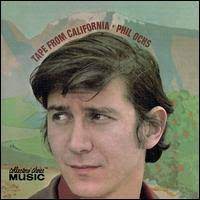
“White Boots Marching in a Yellow Land”, Tape From California, A&M, (1968)

Dylan never directly referenced the Vietnam War, let alone any specific aspect of it, in his songs:

How many times must the cannon balls fly

Before they are forever banned?

“Blowin’ In the Wind”, The Freewheelin’ Bob Dylan, Columbia (1963)

The King of the Philistines his soldiers to save

Puts jawbones on their tombstones and flatters their graves

Puts the pied pipers in prison and fattens the slaves

And sends them out to the jungle.

“Tombstone Blues”, Highway 61 Revisited, Columbia (1965)

By the time he released “Tombstone Blues”, of course, Dylan had somewhat moved away from traditional folk patterns and was more and more concerned with word-painting metaphorical landscapes as a means of satire along with increasing rock elements. However, a tendency away from the specific and towards the general was inherent in the folk revival from the start, and particularly in the tendencies represented by Bob Dylan as opposed to Phil Ochs.

Ochs the activist

“Masters of War”, for instance, in Ochs’ hands might have been a thorough and witty exposure of the military-industrial complex; in Dylan’s hands it was a simple but extremely heartfelt and bitter condemnation of war profiteers – “I hope that you die” is a line that was so intense that Joan Baez, when covering the song, would not sing it.[3] But Dylan, when he sang it, seemed to mean it. While Greil Marcus sees “Masters of War” as too simplistic to do Dylan’s talents justice,[4] the song is in fact characteristic of Dylan in that it substitutes emotion and strong, simple images for argument.

By comparison, Ochs represented those who were more concerned with information and argument. Compare Guthrie’s “The biggest thing that man has ever done” with Ochs’ “I Ain’t Marching Anymore”: in both the singer takes on an immortal persona and describes a journey through history. Guthrie is the spirit of the working-man who “fought a million battles and I never lost a-one” and will now “kick [Hitler] in the panzers and put ’im on the run.”[5] Ochs is the American soldier who has fought in every American war but after every experience of cruelty, injustice and dishonesty, “I knew that I was learning/ That I ain’t marching anymore”. Each song has a wealth of historical detail backing up a clear political statement.

“I Ain’t Marching Anymore” was Ochs’ most successful song, remembered as “the anthem” of the anti-war movement. Ochs playing it in public was enough to provoke a spate of draft-card burnings.[6] Its lyrics were incorrectly reported by FBI agents. As a witness at the trial of the Chicago Eight, Ochs was forced to recite the lyrics word-for-word to the judge and jury.[7] This song was no crude attempt to transplant the spirit of the 1930s or 1940s into the 1960s; it was an extremely successful song that inspired young protestors and alarmed their opponents.

While Ochs was heavily influenced by Guthrie’s form and content, Dylan was far more interested in Guthrie’s image. After listening to Guthrie’s “Ballad of Tom Joad” repeatedly and obsessively and reading his autobiography Bound for Glory, Dylan left Minneapolis in December 1960, hitch-hiking east to find Guthrie. He dressed and spoke like Guthrie, invented various hobo back-stories for himself, and imitated Guthrie on his early album covers.[8]

The attraction of Guthrie was the attraction of folk generally for middle-class young people like Dylan and Ochs. Cantwell explores this vital aspect of the folk revival, which he sees as “a form of social theatre” in which middle-class young people idolized and imitated the proletarian, rural and demotic folk singer. Hero-worship of rebel figures like Brando and Dean earlier in life gave way to an embrace of figures like Guthrie and Leadbelly, hobo rebels who were unlearned but had bitter life experience.[9] In hair and clothes 1960s radicals sought “to break with how successful people presented themselves in ‘straight’ society”[10]. Robes and flowers came later; the folk period was characterised by second-hand clothes associated with manual labour.

Dylan’s advice in “Subterranean Homesick Blues”, “don’t follow leaders”,[11] might have been very popular but he never sang anything like “don’t follow icons.” Ochs too understood the power of the icon in the contemporary US when in 1970 he joked (or perhaps seriously suggested) that “if there’s any hope for a revolution in America, it lies in getting Elvis Presley to become Che Guevara.”[12]

Hope for America: Elvis meets Che Guevara

Many 1960s activists believed that radical politics must be matched by radical means of representation. Students for a Democratic Society preferred “a kind of emotional and moral plain-speaking” to political theory,[13] and the folk revival which spoke lyrically in a proletarian voice and musically with great simplicity and a minimum of instruments. Though highly-educated, Yippies like Rubin and Hoffman thought they could only communicate their message through strong images and rhetoric. They revelled in state repression and police brutality, spoke in a “hip patois” punctuated with the inarticulate words “you know”, and made poetic statements such as “We demand the politics of ecstasy!” instead of concrete demands and arguments.[14] In embracing the image, therefore, Dylan was, in the context of the 1960s, making a kind of political statement, and was in tune with many political activists of the day.

Lasch believes that this emphasis on the image “imprisoned the left in a politics of theatre, of style without substance […] which it should have been the purpose of the left to unmask.” Farber argues that the Yippies’ emphasis on “facile slogans instead of careful explanation” meant that they “gave most Americans little chance to understand them.”[15] Ochs, though helping to found the Yippies, considered the idea of a “freak counterculture” to be “disastrous.” What was needed was “an organic connection to the working class.”[16] Radicalism in form and radicalism in content were two connected but at times antagonistic phenomena in the 1960s.

Even when Dylan was writing “protest” songs, their message was never clear. The line “How many roads must a man walk down/ Before you can call him a man?”[17] is a reference to the civil rights marches, but taken out of context it could just as easily be a reflection on maturity and coming of age, with metaphorical roads representing human experience. Dylan’s 1964 song “My Back Pages” seemed outright to disown many of his former beliefs, though he is characteristically unspecific here about what beliefs he is rejecting. He suggests that in even trying to define and express explicit politics “I would become my enemy/ In the instant that I preach.”[18] Dylan was not just embracing new forms of expression; he was identifying explicit and concrete means of representation and argument as inherently corrupt.

Generally over the next few years Dylan expressed politics only in terms that were general, surrealist and metaphorical. Employers “say sing while you slave and I just get bored”; Jack the Ripper “sits at the head of the chamber of commerce”. Alongside these metaphors there is a message of fatalism; Dylan says he wants to help the listener to “ease the pain/ of your useless and pointless knowledge.”[19] Joan Baez claimed that Dylan “ends up saying there is not a goddamned thing you can do about [social problems], so screw it.”[20] Dylan didn’t “need a weatherman to know which way the wind blows”; he gave the impression that he simply knew and understood the world instinctively and had no need for science or expert opinion. Meanwhile, there was nothing to do but “Look out, kid”; the best you can hope for is to “Keep a clean nose, put on some plain clothes”[21] and escape capture by the “agents”, “superhuman crew” and “insurance men” of Desolation Row.[22] Later Dylan was to encourage listeners to seek redemption in religion; before he turned to religion he pointed instead toward redemption in an image of street-wisdom, a “subterranean” lifestyle and an avoidance of futile conflict with the authorities.

Other lyrical subject matter included non-political romantic songs and evocations of a “subterranean” freak lifestyle. The most striking feature of Dylan’s mid-1960s material, however, was his increasing number of songs in the second person which were harsh, bitter personal judgements:

[…] you know as well as me
You’d rather see me paralyzed
Why don’t you just come out once
And scream it

“Positively 4th Street” (1965) Single, Columbia

Now you don’t talk so loud

Now you don’t seem so proud

About having to be scrounging your next meal

“Like a Rolling Stone” (1965) Single, Columbia

Well you walk into the room

Like a camel and then you frown

You put your eyes in your pocket and your nose on the ground

There oughta be a law against you comin’ around

You should be made to wear earphones

“Ballad of a Thin Man” (1964), Highway 61 Revisited, Columbia

Practically everyone Dylan knew from 4th Street in Greenwich Village and 4th Street in Minneapolis suspected that “Positively 4th Street” might be about them.[23] They need not have worried because these songs were primarily about Dylan himself. Ochs remembers how Dylan used to engage in verbal battles on nights out: it was “very clever, witty, barbed and very stimulating, too. But you really had to be on your toes. You’d walk into a threshing machine if you were just a regular guy, naive and open, you’d be ripped to pieces.”[24] Dylan was presenting himself as a kind of witch-hunter of phonies and bourgeois intruders who were, like the Thin Man, more comfortable discussing “lepers and crooks” with “great lawyers” and “professors” than they were mixing in Dylan’s culturally non-conformist milieu.[25]

It’s worth pointing out that in singing these songs Dylan had no qualms that he might tell any “lies that life is black and white” or become his own worst enemy “in the instant” that he preaches. Dylan’s judgemental songs are performances of his own streetwise image as well as portraits of uncool features for listeners to avoid unless they too wanted to be “ripped apart” by Dylan.

Music producer Paul Rothchild claimed that Ochs’ commitment to political causes was a cynical ploy along the same lines as this image-obsessed politics.[26] However, by all other accounts it is clear that Ochs’ commitment was genuine. He was the only musician who gave his word that he would come to the Chicago 1968 protests no matter what.[27] He would frequently turn down commercial gigs in favour of playing for free at political benefit gigs.[28] Abbie Hoffman remembers that “Phil never turned down anybody no matter what size the [political] group.”[29]

Ochs was, like the narrator of “The Biggest Thing the World had Ever Done” or “I Ain’t Marching Anymore”, a witness to more than his share of history. He was at the Newport folk festivals, the Berkeley Free Speech Movement and the first anti-war teach-in; he helped organise the Chicago ’68 protests; the “War is Over” rallies and “An Evening with Salvador Allende” were his brainchild; he visited Robert Kennedy in the White House and brought tears to his eyes singing “Crucifixion”; he was active in Mississippi when the bodies of three murdered civil rights activists were found. A great deal of Ochs’ person and career were deeply invested in the radical politics of his day.

At the Newport Folk Festival of 1966 Dylan performed songs with a backing rock band and an electric guitar, provoking outrage from many sections of the crowd.[30] During a tour of England he was called “Judas” by an audience member.[31] This was another manifestation of the inherent tensions and conflicts within radical politics and culture in the period. In the eyes of many on the folk scene, the modest, “authentic” and political folk genre was losing the prominent voice of Dylan to the corporate, egotistical, corrupted, apolitical world of rock.[32] Ochs believed that those who booed were engaging in “a most vulgar display of unthinking mob censorship. Meanwhile, life went on around them.”[33] Despite their differences in terms of content and form, Ochs in this period never abused Dylan, calling Highway 61 Revisited “the most important and revolutionary album ever made.”[34]

A large part of Ochs’ defence of Dylan must have been his own growing desire to try new musical styles. This resulted in his 1967 album Pleasures of the Harbor which was more poetic than political, incorporating orchestral arrangements rather than a simple guitar. The album received negative reviews but Ochs’ desire to find a new niche reflected changes that were taking place in the music business. Rothchild explains that though Ochs had been at home in “the pre-Beatle, pure folk era”, his producers were not convinced that he “was going to crack the pop world. He had the wrong image, the wrong voice” and his lyrics were not “relationship introspective.” The music business was no longer interested in folk, especially political folk with lyrics “of the intellect” rather than sex.[35] This shift was like a forewarning of even more significant changes afoot in politics.

Phil Ochs, not sure where to go

Former SDS leader Tom Hayden believes that there were, speaking very generally, two main halves to the 1960s from a radical point of view. The first half was characterised by innocence and optimism, with a basic belief in the possibility of the redemption of the American dream.[36] The second “half” represented reality reasserting itself; a “clarification of where we really stood.”[37] This basic schema helps us to understand the waning of the civil rights movement and the rise of the Black Panthers; the collapse of SDS and the activity of “urban guerrillas”; overall, the change from optimism to either resignation or a more determined and dangerous form of struggle.

For Dylan the Kennedy assassination, race riots and the Vietnam War “transformed his attitude from one of wanting a moral reform and the cleansing of his society to one of despairing that this society was reformable at all” as early as 1964.[38] There was obviously no “clean break” at which the civil rights movement ended and the Black Panthers began, and Malcolm X had already raised similar ideas years before his death in 1965. Despite these ambiguities and others, we can say with confidence that the key events which contributed most to the demoralisation of activists occurred in 1968.

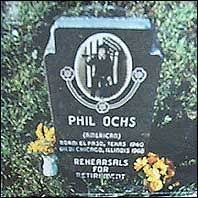
1968 in the US saw the assassination of Martin Luther King and the most widespread ghetto riots yet; the murder of Robert Kennedy; the repression of the Columbia University occupation; the Chicago Democratic National Convention protests; the strong vote for the ultra-conservative Wallace; and finally the victory of Republicans Nixon and Agnew in November.[39] Ochs was so closely integrated with the radical movements that to understand the significance of this year we need only look at the cover of his 1969 album “Rehearsals for Retirement”. It shows a gravestone which reads:

PHIL OCHS

(AMERICAN)

BORN EL PASO, TEXAS, 1940

DIED CHICAGO, ILLINOIS, 1968[40]

The album documented the changes that had taken place in that year in poetic, metaphorical terms:

I spied a fair young maiden and a flame was in her eyes

And on her face lay the steel blue skies […]

I’ll go back to the city where I can be alone

And tell my friends she lies in stone

In Lincoln Park the dark was turning

“William Butler Yeats Visits Lincoln Park and Escapes Unscathed” (1969) Rehearsals for Retirement, A&M

This expressed Ochs’ belief about Chicago that “something very extraordinary died there, which was America.”[41] Here idealized as a woman, the news Ochs brings back to Los Angeles is that illusions in a liberal, democratic USA are dead. Other songs illustrated this more violently:

And they’ll coach you in the classroom that it cannot happen here

But it has happened here […]

It’s the dawn of another age […]

We were born in a revolution and we died in a wasted war It’s gone that way before

“Another Age” (1969), Rehearsals for Retirement, A&M

Ochs expressed what this meant to him personally with the words “My life is now a death to me.”[42]

Ochs suffered from a long period of reduced output of songs and wild bouts of drinking and violent behaviour. The sudden, near-fatal attack on Ochs on a beach in Tanzania in 1973 caused his further deterioration. It is tempting to emphasize his father’s mental health problems and draw parallels with Ochs’ behaviour. However, we cannot separate Ochs’ mental health from the history and politics in which he had invested so much of himself, any more than we can separate his father’s mental health from his experiences in the Second World War.[43] The attack in Dar-Es-Salaam was simply a personal version of the kind of horrific and apparently meaningless event that had come to characterise the political world Ochs inhabited.

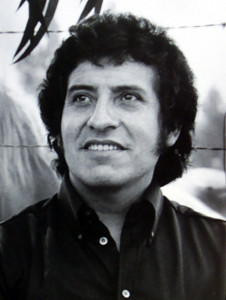
Victor Jara, Ochs’ friend and inspiration

It is an indication of his personal deterioration that he did not learn of the September 11 1973 coup in Chile until December. Ochs had visited Chile and made friends with fellow folk singer Victor Jara, who was tortured and killed along with thousands of others after the counter-revolutionary military coup. Ochs later confessed, “When that happened I said ‘All right, that’s the end of Phil Ochs.’”[44] Despite this he set about immediately and tirelessly organising a huge benefit gig, “An Evening with Salvador Allende”, which he managed to secure Dylan’s presence at by reciting to him the late Allende’s inauguration speech in full, from memory.[45]

He swung between intense periods of political activity, self-destructive idle depression and absurd business ventures until in 1975 he began to claim that Phil Ochs had been murdered by “John Butler Train”. For an individual who had always set so much store in icons and whose ambition it was to become one, and for a representative of a genre defined as “social theatre” and a movement that had invested so heavily in icons, images and theatrics, it is significant that the nadir of Ochs’ decline was his long, violent performance as John Train. A brief recovery preceded his suicide in April 1976.

The last sixteen years of Ochs’ 36-year life could be read as a history of the rise and fall of the radical movements of the “long 1960s.” As if to dramatise the death of the movement, Ochs as “Train” was a violent, cynical, misogynistic wreck. His drunken conspiracy-theory rants were like a dark, twisted parody of Ochs’ witty on-stage patter.[46] The “Train” stood for the boxcar-riding hoboes the young activists had once idolized[47] and so Train’s character seemed to be a dramatisation also of the fact that the working class, in whose image the folk revivalists had tried to construct themselves, had by and large not been won over by the radicals of the 1960s.[48] Ochs’ deterioration and suicide were a reflection of history and politics at least as much as they were personal.

A Melody Maker journalist was perceptive in describing Dylan and Ochs as the King and President, respectively, of the “topical song.”[49] If Dylan was a leader his style of leadership was ceremonial and symbolic like that of a modern monarch. From the start he neglected direct, specific protest lyrics in favour of radicalism in form and image. His travelling-hobo clothing and voice conveyed a radical message in and of themselves but this soon gave way to a rock-star image as his music turned increasingly toward experimentation, and his lyrics toward personal problems, definitions of coolness and fatalistic metaphorical depictions of the world around him. He rarely advised his listeners to take any action or condemned anything specific – instead he created in himself an ultra-cool radical image and icon capable of knowing and expressing intuitively what the world was like and who was cool and who was not. Accordingly the changes of the late 1960s did not detract from him significantly since he was invested in a politically uncommitted self-image rather than in politics itself.

Monarchs generally rule for life while Presidents only enjoy a limited term. In the US they are executive and military leaders. It is a fitting image for Ochs, who in his lyrics generally made it clear and specific what he stood for and what he opposed. His commitment to active politics was enthusiastic and generous. Ochs had been at home in Hayden’s optimistic and active “half” of the 1960s. With the onset of pessimism, retreat and demoralisation, especially after 1968, he characterised himself and the movement as powerful, but out of their element: “A whale is on the beach/ It’s dying.”[50]

Ochs, in his “Train” persona, believed that Dylan “in a cowardly fashion hid behind images – after his third album”. Dylan’s albums between 1967 and 1974 were widely perceived as weak[51] and “Train” imagined accosting Dylan with the words, “Listen, asshole, I can kill you as soon as look at you. You were Shakespeare at twenty-five, and now you’re dog shit.” This cannot be sincere because Ochs, along with most critics, was hugely impressed by 1975’s Blood on the Tracks.[52] Meanwhile Ochs’ defence of Dylan after Newport 1966 suggests that this resentment was not rooted in envy of Dylan’s success or talents. It seems instead that this was another manifestation of the inherent conflicts in the culture and politics of the 1960s. Ochs’ resentment stemmed from the fact that Dylan had at an early stage abandoned the political struggle to which Ochs had sacrificed his career, his sanity and most of his adult life. Rather than seeking social change Dylan, like the hippie movement, sought personal redemption; like the folk revival, he constructed an icon; like the Yippies and SDS he preferred intuition to analysis and images to politics.

Bibliography

Books

  1. Boucher, David and Browning, Gary (eds), The Political Art of Bob Dylan, Imprint Academic, 2009
  2. Cantwell, Robert, When We Were Good: The Folk Revival, Harvard University Press 1996
  3. Eliot, Marc, Phil Ochs: Death of a Rebel, Omnibus, 1990 (1978)
  4. Farber, David, The Age of Great Dreams: America in the 1960s, Hill & Wang, 1994
  5. Farber, David, Chicago ’68, University of Chicago Press, 1988
  6. Gill, Andy, The Stories Behind the Songs, 1962-1969, Carlton Books, 2011 (1998)
  7. Isserman, Maurice and Kazin, Michael, America Divided: The Civil War of the 1960s, New York, Oxford University Press, 2008
  8. Marcus, Greil, Bob Dylan by Greil Marcus, Writings 1968-2010, Faber & Faber, 2010

Albums

Bob Dylan:

  1. Bob Dylan, Columbia, 1962
  2. The Freewheelin’ Bob Dylan, Columbia, 1963
  3. The Times They are a-Changin’, Columbia, 1964
  4. Another Side of Bob Dylan, Columbia, 1964
  5. Bringing it All Back Home, Columbia, 1965
  6. Highway 61 Revisited, Columbia, 1965
  7. Blonde on Blonde, Columbia, 1966
  8. John Wesley Harding, Columbia, 1967
  9. Nashville Skyline, Columbia, 1969
  10. Blood on the Tracks, Columbia, 1975
  11. The Basement Tapes¸ Columbia, 1975

Phil Ochs:

  1. All the News That’s Fit to Sing, Elektra, 1963
  2. I Ain’t Marching Anymore, Elektra, 1964
  3. Pleasures of the Harbor¸ A&M, 1967
  4. Tape From California, A&M, 1968
  5. Rehearsals for Retirement, A&M, 1969
  6. Greatest Hits, A&M, 1970

Film

  1. Bowser, Kenneth, Phil Ochs: There But For Fortune, First Run Features, PBS American Masters, 2012

[1] Andy Gill, The Stories Behind the Songs 1962-1969, Carlton Books (1998, 2011), 128

[2] Marc Eliot, Phil Ochs: Death of a Rebel (1978), Omnibus (1990), 109

[3] Greil Marcus, Bob Dylan by Greil Marcus: Writings 1968-1010, Faber & Faber (2010), 410-12

[4] Marcus, 412

[5] Woody Guthrie, “The Biggest Thing That Man Has Ever Done”, The Columbia River Collection Smithsonian Folkways, (1941, 1988); Phil Ochs, “I Ain’t Marching Anymore”, I Ain’t Marching Anymore, Elektra (1965)

[6] Kenneth Bowser (writer and director), Phil Ochs: There But For Fortune, First Run Features (2012); 00:20:18, 00:46:30

[7] Eliot, 181

[8] Gill, 17-18, 32

[9] Robert Cantwell, When We Were Good: The Folk Revival, Harvard University Press (1996), 2, 17, 347

[10] Isserman and Kazin, America Divided: The Civil War of the 1960s, Oxford University Press (2008), 155

[11] Bob Dylan, “Subterranean Homesick Blues”, in Bringing it All Back Home, Columbia, (1965)

[12] Eliot, 97

[13] Isserman & Kazin, 180

[14] David Farber, Chicago ’68, University of Chicago Press (1988), 7, 20-23

[15] Christopher Lasch, The Culture of Narcissism: American Life in an Age of Diminishing Expectations, Abacus (1979), 81-82; Farber, Chicago, 225, 244-5

[16] Eliot, 163-4

[17] “Blowing in the Wind”

[18] Bob Dylan, “My Back Pages”, Another Side of Bob Dylan, Columbia (1964)

[19] Bob Dylan, “Maggie’s Farm”, Bringing it All Back Home, Columbia (1965); “Tombstone Blues”, Highway 61 Revisited, (1965)

[20] Gill, 94

[21] “Subterranean Homesick Blues”

[22] Bob Dylan, “Desolation Row”, Highway 61 Revisited, Columbia (1965)

[23] Gill, 126-7

[24] Gill, 127

[25] “Ballad of a Thin Man”

[26] Eliot, 76

[27] Farber, Chicago ‘68, 26

[28] Bowser, 00:09:04

[29] Bowser, 00.09:10

[30] Gill, 111

[31] Michael Jones, in The Political Art of Bob Dylan, ed. Boucher & Browning, Imprint Academic (2009), 75-80

[32] Jones, 82

[33] Eliot, 96

[34] Gill, 113

[35] Eliot, 119

[36] Bowser, 00:17:37

[37] Bowser, 00:38:05

[38] The Political Art of Bob Dylan, 38

[39] Isserman & Kazin, 319

[40] Phil Ochs, Rehearsals for Retirement, A&M (1969)

[41] “William Butler Yeats Visits Lincoln Park and Escapes Unscathed”, live performance in Vancouver, http://www.youtube.com/watch?v=VWEBlZ7C_lE&playnext=1&list=PLD33BBF4B10862910&feature=results_video, accessed 3/3/2013, 17:14

[42] Phil Ochs, “My Life”, Rehearsals for Retirement, A&M (1969)

[43] Eliot, 12

[44] Eliot, 256

[45] Bowser, 00:58:30 – 01:06:00

[46] Eliot, x-xv

[47] Eliot, 262. The following comes from the liner notes of a planned album written in 1975: “John stands for Kennedy, Butler stands for Yeats, Train stands for hobos at the missed silver gates.”

[48] Isserman & Kazin, 280

[49] Eliot, 109

[50] Phil Ochs, “No More Songs”, Greatest Hits, A&M, 1970

[51] Marcus, 7-27

[52] Eliot, 243, 255

Review: Nova by Samuel R Delany (1968)

In the 32nd Century, a crew of misfits blasts off from an obscure corner of our solar system on a quest to the heart of an exploding star.

Delany’s prose does justice to the awesome premise. Here is the moment of take-off: ‘And the moon fell into Neptune; Neptune fell into the sun. And the sun began to fall. Night exploded before them.’ (p 41)

Much later in the quest, the crew arrive at a sun known as the Dim, Dead Sister. It is described as follows: ‘the explorer who decided to name the outermost of the Dim, Dead Sister’s planets Elysium had indulged a poor joke. With all the planoforming devices available, it was still a frozen cinder ellipsing at trans-Plutonian distances from Her ghost-light, barren and uninhabited.’ (p 181)

It is no spoiler to throw in these two lines from the climax of the novel. A ship ‘received the shuttle boat like a cannon shot in reverse.’ (p 225) A while later, I won’t say what page, ‘the star went nova. The inevitable is that unexpected.’

Humanity has spread out across many stars and worlds, forming three distinct polities. A key contradiction of capitalism has been overcome by means of a technological innovation that makes labour fulfilling rather than alienating. But at the heart of the plot is a battle between corporations for an extremely rare fuel, Illyrion – so yeah, there are plenty of contradictions left in capitalism.

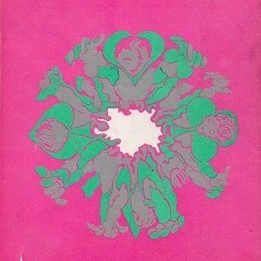
From the cover of the 1st edition

By attempting to harvest a massive quantity of Illyrion from the heart of a star as it goes nova (that is, explodes catastrophically!), ship’s captain Lorq Van Ray is not only risking his life and his senses, and not only attempting to settle a feud with some powerful enemies – he is also blasting wide open the economics and politics of interstellar humanity.

For the most part the novel follows through on its promise. Along the way, there’s a lot of food for thought, particularly in the discussions between two crew members, Katin and Mouse.

This is a novel set in a new interplanetary society, where people feel rootless – like the 20th Century with its urbanization. Someone complains (p 46) that ‘We live in an age when economic, political and technological change have shattered all cultural tradition.’ This is a platitude, but it’s deliberate; Delany is well aware that people in every age have said similar things. In this age as in others, people who say such things are mostly wrong, and the novel is quietly demonstrating this to us throughout.

This is a story about a sudden, revolutionary change, and that is offset by Delany’s focus on a deep human culture thousands of years old. The story blasts off, but the setting has a certain weight and grounding. Mouse, the artist, represents a cultural continuity. Before his mission across the stars, we get page after page about his adventures on Earth – an Earth that is not so different from our own.

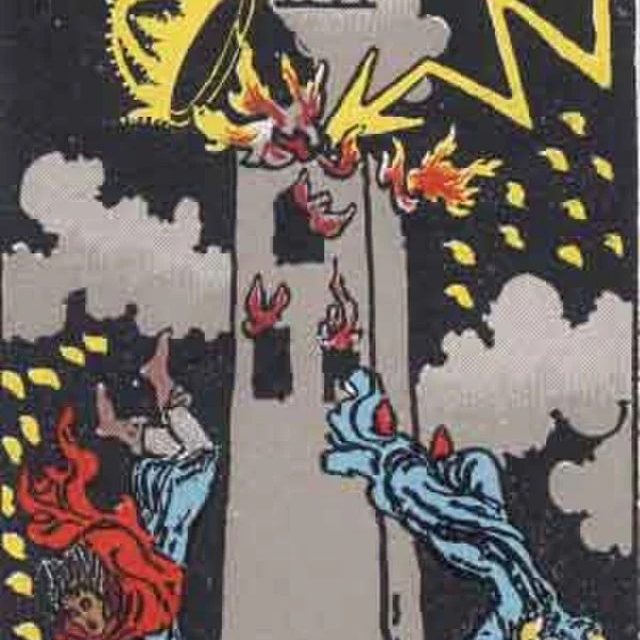
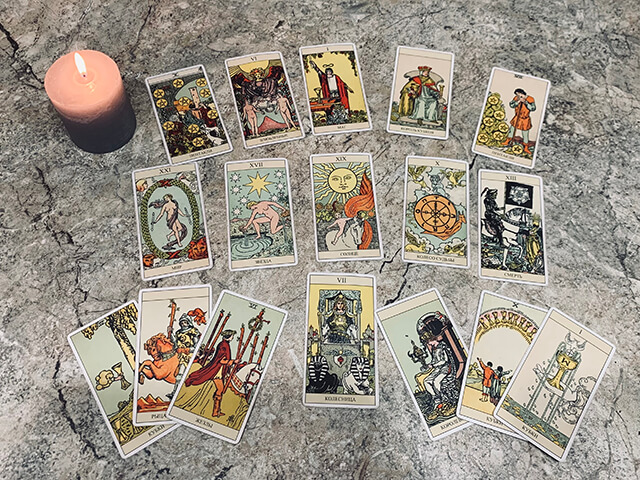
This is also where the tarot cards come in. Katin, the educated man, thinks that to be ‘skeptical about the Tarot’ is ‘a very romantic notion’, linked to ‘petrified ideas a thousand years out of date.’ (p 123) The people of this world believe in the scientific efficacy of tarot.

The flashback which explains Lorq Van Ray’s motivations is very strong. The climax of the story is exciting and really pays off. I love the syrinx, a musical instrument belonging to Mouse, an object which earns its keep in different and unexpected ways for the entire novel.

But Nova suffers from a slow middle – one of the most obvious cases I’ve seen in a while. Out of 240 pages, it meanders from about page 120 to page 200. There seems to be little purpose to the characters’ itinerary and activities. Katin’s lectures are interesting but not always relevant. My attention sagged when Delany began to dwell on the Tarot cards and picked up again when the bad guys suddenly showed up to crash the good guys’ hiding place.

I have a few other complaints. Sometimes the descriptions aren’t clear enough to do justice to an action scene – there was a fight involving nets and gas on a flight of steps which I just couldn’t visualize. On page 202 we are told, ‘a hand slapped Lorq’s sternum, slapped it again, again. The hand was inside.’ What does this phrase mean? Whose hand? It was inside his sternum? How?

Lorq, Katin and Mouse are good characters, and their rapport facilitates a lot of exposition, most of it neat. Katin seems confident and Mouse seems taciturn, shy. But Katin over-thinks and, beneath it all, he’s anxious. At one point Mouse has to reassure him, ‘Hey […] It’s all right. I like you. I was just busy, is all.’ (p 177) It’s rare for Mouse to speak, so it’s telling that when he chooses to speak his words are kind. But while the other members of the crew have their interesting quirks, they never really live up to their potential.

The slow middle didn’t put me off, and had enough interesting ideas, conversations and images to keep me reading. But it lacked that rocket fuel which powered the beginning and end. The premise, the beginning and the end are more than strong enough to compensate. In hindsight, too, there are motifs and undergirding ideas running through the structure of the story – the idea of sensory overload, and linked to it the image of a person walking into fire like a bug drawn to a light – that lend the story power and coherence.

Go to Home Page/ Archives

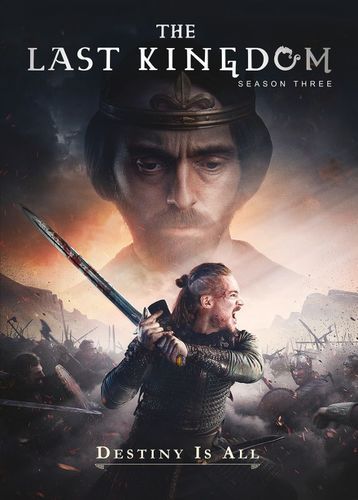
Goodbye Uhtred (Review: The Last Kingdom and Seven Kings Must Die)

The Last Kingdom has come to an end. I watched nearly all of it and enjoyed nearly all of what I watched. But by the third season I was already aware that it was a kind of modular story, constructed from parts that would show up again and again, reused in new configurations:

  • Danes invade Saxon lands
  • The Danish leader, like a James Bond villain’s henchman, has some eccentricity of costume or behaviour
  • Uhtred is tempted to join his Danish friends
  • A Saxon nobleman is scheming for his own benefit and to the detriment of the kingdom
  • The King of Wessex is being unreasonable and listening to bad advice
  • Uhtred expresses anti-clerical views, but there is a specific priest (or even several) whom he admires
  • Uhtred does something of which the Saxons disapprove
  • The King of Wessex banishes Uhtred
  • Uhtred, though an outlaw, resolves to save the Saxons
  • Uhtred convinces the King of Wessex to redeem himself
  • Uhtred, through clever tricks, wins a battle and saves the Saxons

Drop a comment if I missed any.

(Spoilers Below)

But The Last Kingdom was a good show. In between these reusable blocks there was much material that did not fit this repetitive pattern, such as Breda acting as a foil to Uhtred, diverging ever-further from him and from his Saxon friends. With each turn of the wheel her actions grew more extreme until suddenly she was up in Iceland doing throat-singing and human sacrifices.

We could make similar points about several other characters, such as Aethelfaed and Aelswith, real multi-dimensional personalities. The women characters in particular got to operate autonomously from the repeating story blocks and the elements of ‘stock character’ which this imposed on Uhtred, the King, the Scheming Nobleman, the Big Bad Dane, the Good Priest and the Bad Priest. And often the Stock Characters and modular blocks were executed so well it was difficult to be bothered by the repetition.

The Last Kingdom has come to an end with a movie, Seven Kings Must Die, in which most of these blocks of story got one last airing. I can’t deny I felt something stir in me when Uhtred finally saw Valhalla with his dying eyes. For five seasons and a movie he has been torn between Saxon and Danish worlds. He always came down on the Saxon side, but in death he finally gets to drink and boast with long-dead comrades and enemies. But of the faces laughing around the eternal mead-table, I could only definitively put a name to one (Breda, naturally).

I was struck, in Seven Kings, by the drabness of the world of this story. Maybe this is because I was watching The Last Kingdom at movie length, or maybe it’s because I recently saw the samurai epic Ran, which is awash in colour. Uhtred’s Anglo-Saxon England is all greys and browns in a murky filter. Some people on the internet who want to ‘RETVRN’ to back-breaking agricultural toil (of the feudal and not the gulag variety) think there’s a screen conspiracy to make the Middle Ages look bad by suppressing the colours. I don’t buy the conspiracy angle. Creators and audiences feel that bright colours are tacky and cheesy. Indeed, Ran is brilliant but some of the costumes do look synthetic. Organic colours and non-plasticky textures feel more authentic. Whether they are or not, I don’t know, but they are certainly a cheap and easy way to make things feel authentic. Maybe this shortcut to ‘authenticity’ has run its course culturally.

Seven Kings ended with a great battle scene, but some damage was done by the scenes immediately preceding the clash. It was not clear who was where, how many soldiers they had, or where those soldiers came from. A little more care here would have gone a long way.

The worst thing you could say about The Last Kingdom is that it was a bit boring at times, especially in the last two seasons. That’s where I skipped a few episodes. My loss of interest, I think, was due to the repetition. They filmed it all in a replica medieval village in Hungary, and it was obvious that one ‘town square’ location filled in for multiple towns. By about Season Four the viewer is too familiar with these interiors and exteriors – not the comfortable and evocative familiarity of a definite location which we know well, but the tiresome familiarity of the same kinds of places filling in for the same kinds of places. The interchangeableness of locations mirrored the interchangeableness of story elements, and both undercut the best efforts of writers, crew and cast to make each season fresh and exciting.

The first season was definitely the best – the set-up for the whole show is great, and early on the elements of repetition have not yet set in. The other seasons had great high points – the attack on Dunholm, or Uhtred’s first failed attempt to reclaim Bebbanburgh, or the time he and Breda tried to talk to their friend’s ghost. I am interested in this period because it’s not yet the Middle Ages, though you can see the outlines beginning to emerge; everything is DIY, rough and ready, down-to-earth, organic. I felt this story conveyed that sense of the period well.

The script for The Last Kingdom, like the visuals, never shone with brilliance. But it never made me groan or cringe either, and sometimes it moved me. The writing was never less than competent, and sometimes more than. I studied this historical period in college and, watching The Last Kingdom, I noticed very few of the anachronistic howlers one usually finds in these kinds of things.

There was a characteristic moment in Seven Kings: Uhtred makes a speech about how they must forge an English identity from diverse communities, and Finan pipes up ‘I don’t have to say I’m English, do I?’ It was a neat moment: the 21st-century Irish actor might be ad libbing, or the 10th-century character might be speaking from a point of view rooted in his own time. Uhtred has competently (not brilliantly) given the story a sense of theme and purpose; without undermining this, Finan has managed to cut across any danger of grandiosity or chauvinism. Somebody was paying close attention to what was being said, and I appreciated that.

The Darkest Timeline: Oceania, 1945-1984

This is an appendix to my series of posts looking at the plausibility of Orwell’s Oceania and the merits of the novel it features in, 1984. Here is a timeline I worked out for Orwell’s invented world, based on clues and cues in the novel itself.

But first, here are the links to the series:

1984 by George Orwell:

>Part One: Is 1984 plausible?

>Part Two: Is 1984 good?

>Part Three: Conclusion

The Darkest Timeline: Oceania 1945-1984

1945

  • End of Second World War
  • Birth of Winston Smith

c. 1945-1952

  • ‘a long interval of peace in [Winston Smith’s] childhood’
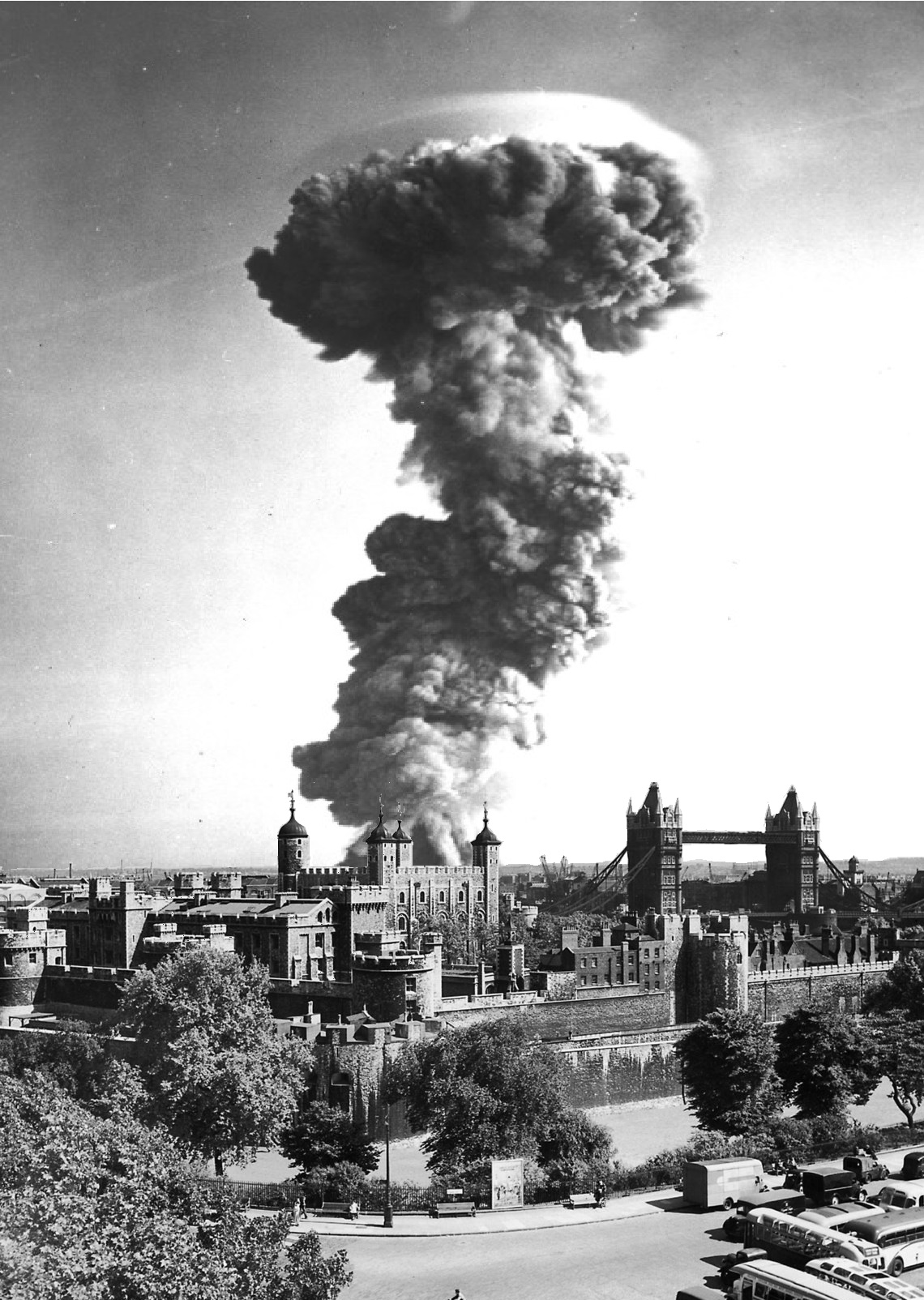
An atomic strike near London, early 1950s

c. 1950-1952

  • Surprise air raid alarm in London; this is likely a surprise attack by Eastasia, probably with atomic bombs
  • From this date, world war is continuous
  • 1950s: Atomic warfare causes huge destruction. Hundreds of cities, mostly in North America, European Russia and Western Europe destroyed (the only named city is Colchester)
  • By ‘the middle of the twentieth century’, Russia absorbs Europe, USA absorbs British Empire.

1950s:

  • In England, an underground struggle by socialist revolutionaries, a revolution and a civil war
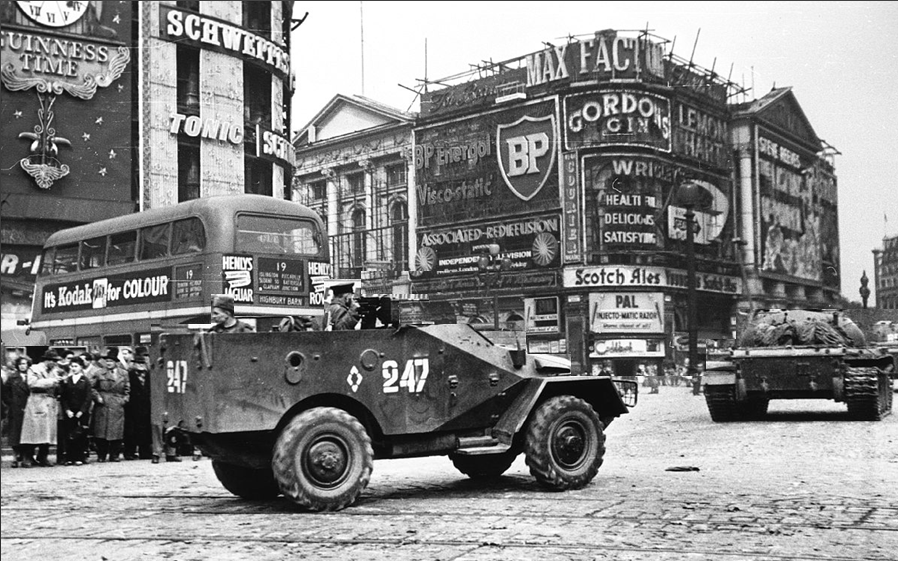
  • Street fighting in London for several months
  • ‘one of the first great purges’

1954:

  • Disappearance of Winston’s father

c. 1955-57:

  • A time of air raids and civil conflicts, of political youth gangs wearing shirts of the same colour, proclamations, severe food shortages
  • Political ‘disappearances’ are already commonplace
  • Disappearance of Winston’s mother and sister
  • Winston enters state institutions
  • Birth of Julia in 1957
Piccadilly Circus during street fighting in London, 1950s

By 1960:

  • Eastasia has emerged as a unified state from ‘a decade of confused fighting’

Around 1960:

  • Ingsoc becomes a widely-used term

1960s:

  • Big Brother becomes a household name

c. 1962-4

  • Revolutionary leaders Jones, Aaronson and Rutherford are photographed in prominent roles at some important Party function in New York

Around 1965:

  • Goldstein flees
  • ‘in the middle ‘sixties’, ‘the old, discredited leaders of the party’ were ‘purged’ – ‘wiped out once and for all.’

1965:

  • Oceania currently at war with Eurasia
  • Julia’s grandfather disappears
  • Jones, Aaronson, Rutherford disappear

1966 or 7:

  • Jones, Aaronson and Rutherford confess in a show trial and, around a year later, disappear

1970:

  • The older generation of Party leaders is wiped out. Only Big Brother remains

Around 1973:

  • Winston is married to Katharine for 15 months

1977:

  • Winston has a strange dream involving O’Brien
  • O’Brien later says that he has been working on Winston’s case since this date

1980:

  • Oceania is now at war with Eurasia

1981:

  • Winston seeks out a sex worker

1984:

  • Ninth Three-Year Plan under way
  • Oceania conquers large parts of India
  • From Hate Week on, Oceania is now at war with Eastasia
  • Winston and Julia are arrested

At least one year later:

  • Oceania, now at war with Eurasia, first suffers defeat in Africa then wins a significant victory

Go to Home Page/ Archives

1984 by George Orwell:

>Part One: Is 1984 plausible?

>Part Two: Is 1984 good?

>Part Three: Conclusion

1984: Conclusion (Premium)

Become a paying supporter to get access

Access to this article is limited to paying supporters. If you already subscribe by email, thank you. But if you want to become a paying supporter, please hit ‘Subscribe’ below.

Donate less than the price of a coffee, and you can access everything on this blog for one year.

If you don’t feel like donating, most of my posts are still 100% free, so browse away, and thanks for visiting.

1: Is 1984 plausible?

2: Is 1984 good?

Home Page/ Archives

Is 1984 good? (Premium)

This is the second part of my series on Orwell’s 1984. Here is Part One, where I argued that its world was not plausible. Here in Part 2, and in Part 3 which will follow next week, I’ll be addressing some more positive points about the book.

Become a paying supporter to get access

Access to this article is limited to paying supporters. If you already subscribe by email, thank you. But if you want to become a paying supporter, please hit ‘Subscribe’ below.

Donate less than the price of a coffee, and you can access everything on this blog for one year.

If you don’t feel like donating, most of my posts are still 100% free, so browse away, and thanks for visiting.

Is 1984 plausible?

Home Page/ Archives

Is 1984 plausible?

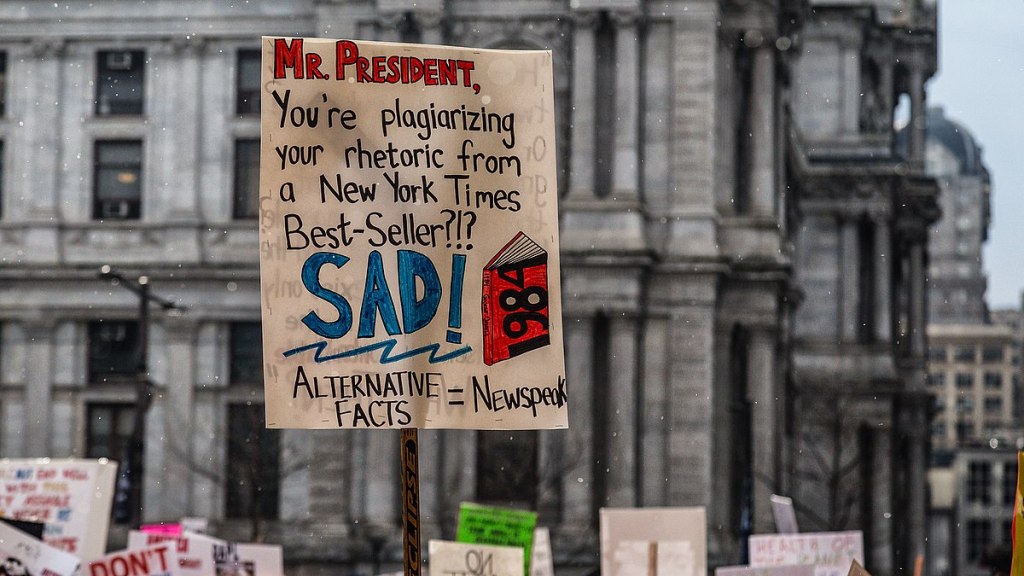
During the first year of the Covid pandemic, a spray-painted slogan appeared on a road sign near Galway in the west of Ireland. Above the words ‘Monivea 23km’ was sprayed ‘G ORWELL 1984.’ Either someone had a grudge against the village of Monivea, or someone was trying to say that we were living in 1984, presumably because of Covid restrictions. If we Google George Orwell’s dystopian classic 1984, we get the same message repeated a thousand times: ‘We are living in 1984.’

From the right, it’s 1984 because they are not allowed to say the ‘N’ word, they got banned from pre-Musk twitter, they had to give up some income in the interest of public health, and because trans people exist. For the left in the 2000s, it was 1984 because of the Patriot Act and because the hypocrisy of the so-called War on Terror seemed to be mirrored in 1984’s permanent warfare. Centre-left Robert Webb, as I’ve pointed out before, appeared to believe that 1984 was a real history book. For him, the correct response to ‘We should improve society somewhat’ was ‘Read some f***ing Orwell.’

I have recently re-read some f***ing Orwell, namely 1984. It’s a good story, if like me you have a high tolerance for relentless misery. But no, 1984 has not happened – anywhere, ever. Not in Galway in 2020, not on pre-Musk Twitter and no, not even in the Soviet Union at the height of the Stalinist terror.

This is the first post in a series about Orwell’s 1984. Future posts will look at why I think it’s a good novel even though it’s implausible, the timeline, and the enigmatic character of Goldstein. All page references are from the 2008 Penguin paperback.

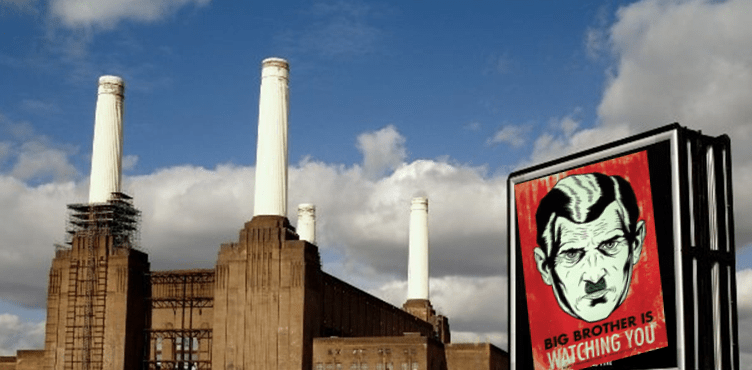
The dreary London of 1984. By Rhetos

Asimov gets it right and gets it wrong

In 1980 the Science Fiction writer Isaac Asimov wrote a caustic dismissal of 1984. He gets a few things wrong, and I suspect he only skimmed the novel on the re-read. Contrary to what he says, there is no way to tell if one is being spied on via telescreen at any given time (4). He claims that Britain is the seat of power in Oceania, but it’s pretty obvious that Britain has been reduced to a province of a US-based empire: it’s been renamed Airstrip One (which is funny satire but ridiculous worldbuilding), its anthem is ‘Oceania, ‘tis for thee,’ and its people use dollars (5, 8).

But Asimov is correct in his overall point that the real world has not developed in a 1984 direction. It has developed in the opposite direction. The coercive powers of states have grown, but it is not in some Stalinist way. It’s all in the service of corporate power and profits. We can be spied on through devices we carry around with us, but this technology is mostly used to sell us crap. In Oceania, there is no more racial division or religion, which is not the situation we face. The militarised cops and fedsbin the US don’t use their weapons to disappear anyone who commits ‘thoughtcrime.’ They use all that hardware to kill black people, to police the borders, or to infiltrate and entrap.

Multi-lithic world

In Oceania, the world has become nightmarishly uniform and monolithic. Anyone who is not ‘orthodox’ is liquidated. Our world is the opposite. What should we call it – multi-lithic? Everyone lives in their own extreme algorithm-curated bubble. Trump supporters and Q Anon types live in a different reality where they won the 2020 election. We now have cranks who run around filming themselves all day as they harass political opponents and tear up library books, all the while claiming that they live in a 1984 dystopia. In reality they would be the first to sign up for Ingsoc – they’d get to have cameras pointed at them all day.

The US political establishment have put the Iraq War in the memory hole, and most of the war’s architects have gone on to wealth and fortune. But it was not necessary for them to destroy or falsify any documents. They just brazened it out.

People are not coerced into morning calisthenics, evenings at the community centre or mass rallies. Such ‘horrors’ seem quaint. Instead people live in a world where the public and social spheres are withering away and all relationships are monetised.

We don’t all gather for ‘Two Minutes’ Hate’ or ‘Hate Week’ against a state-approved enemy. We line up and write vitriolic messages at each other’s thumbnails, usually over trivial stuff. We are not prohibited from debating; we are encouraged to debate endlessly, feeding the algorithm and muddying the waters. But we are prevented, as far as possible, from exercising any real power over events. We can think what we like. But we are not to organise.

All these trends predated the internet, and were certainly discernible by the real-life year 1984.

Oceania vs USSR

But we are not simply talking about whether 1984 resembles the present day. We are asking whether it is plausible. And doesn’t the world of 1984 resemble certain societies from history, such as the Soviet Union?

Actually it doesn’t.

When reading this book as a teenager I took Oceania as a ‘more extreme’ version of the Soviet Union. That seems to be what Orwell intended. But since then I’ve done a bit of reading, and now I can tell you that Oceania is actually something completely different.

It would not be difficult to list superficial similarities between Big Brother and Stalin, Goldstein and Trotsky, Oceania and Soviet Russia. But that’s actually where the problem lies. In the ways Oceania should be like the USSR, it isn’t. In the ways it shouldn’t be like the USSR, it is.

Contempt for ‘proles’

Let’s start with the ‘proles.’ The Party believe that ‘proles and animals are free.’ (53-55) There are separate uniforms and even separate drinks for ‘proles’ (beer) and Outer Party (gin). There is open contempt for the ‘proles.’ In the USSR there was never a rhetorical dehumanisation of working-class and poor people. Exactly the opposite: workers were idealised and put on a pedestal. It was often hypocrisy (as when they crushed a workers’ uprising in Budapest ‘in the name of the working class‘), but that’s beside the point. Such open contempt would have been unimaginable. Trotsky in 1936 was scandalised even to hear that a manager had used the wrong form of address with a worker.

Social engineering

The Soviet Union is associated with (we might say ‘notorious for’) social engineering. Ingsoc has no such ambitions, beyond the ranks of the Party. It basically leaves the ‘proles’ to their own devices. There is no attempt to change their culture, to improve their health and living conditions, no attempt to provide healthcare or education. We are explicitly told there is less social mobility and poorer education than before the Revolution. Ingsoc has left people to rot in buildings that have been standing since Victoria; the USSR built entire cities. Even if we take the Soviet Union at its very worst, this was the opposite of its approach. Access to education was widened a hundredfold and there was free healthcare.

A less benevolent example: in the late ’20s – early ’30s the Stalin regime set about forcibly collectivising all the farms in the country. This led to a terrible famine and a fierce campaign of repression. But such an ambitious project is unimaginable in Oceania, where the state leaves 85% of the population to be Del Boy and Rodney.

Culture

What about culture? Ingsoc destroys books, translates Shakespeare and Milton into horrible Newspeak, destroys words, disdains beauty. The Soviet Union invented new words by the dozen, but it did not destroy old ones. Literary classics were made far more widely available and affordable across the Soviet Union and Stalinist Eastern Europe. Not-for-profit publishing meant there was actually much more emphasis on acquainting the people with what isboften called ‘high culture.’ In Oceania, separate media are produced for ‘proles.’ Michael Parenti points out that it was in fact after the return of capitalism, in the 1990s, that books were destroyed in industrial quantities, and the standard of literacy plummeted.

Science

There is no scientific progress under Ingsoc. Even military research consists of white elephants. In relation to the real Soviet Union, I have two words for you: Sputnik, AK-47. The USSR promoted Marxism, which is a materialistic philosophy. Ingsoc openly rejects ’19th century ideas about the laws of nature’ (277-8) and embraces a totally relativistic ideology – matter only exists in the human mind.

Sex

There is no evidence whatsoever that there has been any advance for women under Ingsoc. Around page 15 we have the unintentionally amusing phrase ‘girl, of about twenty-seven.’ In Part 2 Chapter VIII O’Brien assumes that Winston speaks for Julia. Also, the party hates sex. But for the first 15 years after the revolution, the Soviet Union had the most socially liberal regime in the world when it came to sex and the liberation of women.

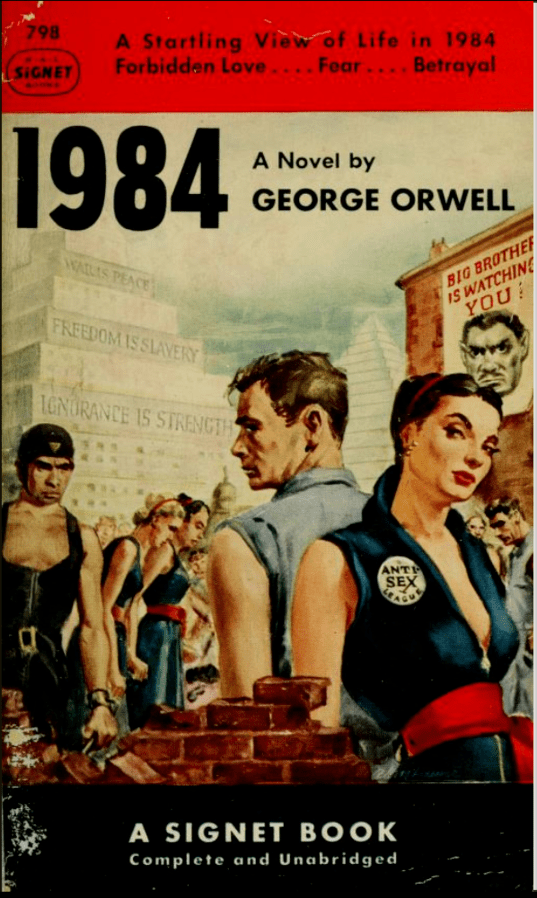
This paperback was obviously marketed in a certain way – spare a thought for the poor divil who bought this book expecting a lot of sex and, 50 pages in, was utterly traumatised

Permanent Warfare

The Soviet Union, like Oceania, was hampered by huge military expenses. But the Russian Revolution was born out of an anti-war movement. The Reds were far keener on peace proposals than the Whites during the Civil War. The Polish-Soviet War lasted less than a year. There were no external conflicts between 1921 and 1938. The consistent foreign policy from the Stalin period on was to seek stability, even to the point of hesitating to support the Spanish Republic and North Korea.

Oceania is not the USSR

All the above shows that Oceania and Stalinist Russia are actually very different places, not just in degree but in kind. Most of the creepy Stalinesque detail about censorship is drawn from Orwell’s own experience doing censorship for the British state during World War Two. Doublethink is a powerful concept, and I value Orwell’s description of it. It’s an example of how this book has contributed a useful political vocabulary. But doublethink is a satire on extreme political partisanship generally. The grisly history of Stalinism gives many compelling examples of doublethink, but you can find examples in a lot of other places too. In other words: what does apply to the USSR often doesn’t apply uniquely to it.

But the ways Oceania is similar to the specifics of Soviet Union are even worse.

Oceania is a massive state encompassing three continents plus swathes of Africa and Asia, including four of the most developed industrial countries on planet Earth: the UK, the US, Canada and Australia. It is not isolated. It is not poor.

And yet: ‘very likely no boots had been produced at all,’ and ‘perhaps half the population of Oceania went barefoot’(44). No boots at all! There are shortages of razor-blades, darning-wool, buttons and shoelaces (52). ‘Prole’ women fight one another for saucepans (73). The people of London live in ‘patched-up nineteenth-century houses.’ O’Brien gives Winston a mysterious drink he has never seen before and says, ‘It is called wine’ (178). According to Goldstein’s book, ‘The fields are cultivated with horse-ploughs.’ Winston works a 60-hour week and sometimes has to pull extra shifts on top of that (Part 2, Chapter III).

OK: the real Soviet Union was characterised by exactly these kinds of shortages and, yes, the fields were cultivated with horse-ploughs. With Stakhanovism and Subbotniks (‘voluntary’ Sunday work), Soviet people in the 1930s worked very long hours.

But Russia had horse-ploughs, long hours and shortages before the Revolution. It was in the decades after the Revolution that the horse was replaced with the tractor and consumer goods were made widely available for the first time. As for work – well, the stereotype of the Soviet worker in the 1980s was not that he was some overworked Stakhanovite, but that you’d see him drinking beer and playing cards next to the roadworks he was supposed to be doing.

The missing links in Orwell’s worldbuilding are clear from the novel’s treatment of two drinks: tea and coffee.

Julia is able to find tea on the black market because Oceania has conquered parts of South Asia. Good! That makes sense. But for some reason coffee and chocolate are always difficult to find, even though all of South and Central America have been core territories of Oceania for 35 years.

Underdevelopment

Unlike the USSR, Oceania is not a semi-feudal economy cut off from the markets and resources of the world. Unlike the USSR, it is not a country going through an industrial revolution in a decade. It has no business being so extravagantly poor. The ugly trappings of the ‘grimy landscape’ (5) of Oceania are out of their proper place. They belong to early-twentieth-century Russia – or, more precisely, to the underdeveloped parts of the world. They are not features of ‘communism’ but of underdeveloped countries, whether communist, capitalist or feudal.

The open brutality of the secret police, and the crudeness of government propaganda – these, too, are borrowed clothes which hang awkwardly on Oceania. They are features, again, not of ‘communism’ but of underdevelopment. They are not a sign of a regime with unshakeable foundations but of a precarious regime.

You might object that Spain, Italy and Germany all went totalitarian. So why not Britain? But Spain, Italy and Germany went fascist, and fascism has completely different origins which it’s not worth getting into here. Oceania very clearly follows the pattern of the USSR, not Spain, Italy or Germany. As Asimov points out, the trappings are all communist, the parallels all Soviet.

‘I do not understand why‘

Goldstein’s book-within-a-book finally explains this great mystery. Ingsoc spends all the money on war, so as to deliberately keep the people poor, so as to maintain control. But for 90% of readers, this explanation is not necessary. They already know (or think they know) why Oceania is poor: because of communism. And Orwell has done absolutely nothing to clear up the misunderstanding.

This explanation, by the way, is coherent on its own terms, but that doesn’t mean it’s plausible.

Winston writes, ‘I understand how [the system oppresses the people]. I do not understand why.’ Towards the end of the book he gets the following answer: humanity could have superabundance, equality and democracy; but 2% of the population, the Inner Party, have taken control, and are deliberately wasting all the wealth, just so that they can maintain poverty, and with it inequality, and with it their own power (216-217).

This explanation rests on certain important insights about the relationship between scarcity and tyranny, between economic equality and political equality. But it puts the cart before the horse. In the USSR, scarcity created the dictatorship. In Oceania, the dictatorship deliberately creates scarcity.

But how such a dictatorship was able to entrench itself in the first place is not clear. Britain after World War Two was an advanced capitalist country with a high level of education, an abundance of material goods and solid infrastructure (to say nothing of the huge empire). Moreover, this advanced country and empire are part of a federation with, well, the entire Western Hemisphere. Oceania is not poor and it is not isolated. You can’t copy-and-paste Stalin into this setting. He doesn’t belong there any more than does the horse-plough or shoelace rationing.

You might argue (as Orwell does) that all revolutionary leaders secretly want to be sadistic tyrants (275-276). I don’t think that’s true, but even if it was it wouldn’t matter. These crypto-dictators wouldn’t be able to take and hold power after a popular revolution unless the extraordinary conditions prevailing in Russia were somehow duplicated in Britain.

What to expect in the next post

Oceania is not a plausible setting. But there is one reading of the novel which makes it plausible. I’m going to go into that next week, along with some other positive things about 1984. Or i might decide to publish a timeline of Oceania. We’ll see.

But as a short answer to the question posed in this post – no, 1984 is not plausible. Thankfully, it has never happened anywhere, ever.

Go to Home Page/ Archive

Review: The Unspoken Name and The Thousand Eyes, by AK Larkwood

The Unspoken Name by AK Larkwood, Tor, 2020

The Unspoken Name begins with a description of a shrine in the mountains, and of the child sacrifice ritual practised there by a bunch of tusk-faced people. Our main character is Csorwe, who has been singled out as a future offering to the cave-dwelling god known as the Unspoken Name. The wizard Sethennai comes to visit – a charismatic fellow with purple skin and pointy ears – and saves her from her fate. She runs away with him to discover the world beyond the morbid religious order in which she was raised.

Yes, this is the story of that brilliant Le Guin novel The Tombs of Atuan. And like the Earthsea novels, the world conveyed here is clear and vivid. But in The Unspoken Name there are two major differences. First, all of that happens in the first few chapters; it’s only the set-up. Second, this pointy-eared wizard Sethennai is no Ged. Yes, he’s rescued Csorwe from death and hired her as his assistant. But she’s going to spend the rest of the novel figuring out that he is a bad person.

Sethennai is not malicious or sadistic; he doesn’t cackle when he hurts someone. Nor is he a ‘loveable rogue’ or anti-hero. Nor is he a torn, tormented character. He’s not for redeeming. He is simply a powerful, ambitious man who sees no wrong in using people and then discarding them.

This is bad enough for Csorwe, who hero-worships him even as he sends her into terrible danger for his own selfish reasons. His other assistant, Tal, is in love with him. Tal’s narrative voice is a perfectly-judged blend of pain and humour. 

Csorwe meets a young magician, Shuthmili, and the two young women gradually fall in love. Maybe, the reader hopes, this can drive a wedge between Csorwe and Sethennai. But Shuthmili has to break with her own corps/ cult of creepy psychics.

You may have noticed something: I’ve got this far without talking much about setting. Characters and relationships are the rocket fuel of this story. On paper, there’s too much plot. But the way it works out, it never feels heavy or dense. It’s very unlike Earthsea in a lot of ways – but like Earthsea, it feels light even when it really isn’t.  

The setting is distinct enough that it’s not easy to slot it in to some corresponding real world era, but it’s kind of early modern. It’s a vast number of worlds, linked through a maze and a system of portals, navigated by flying ships. Oshaar (Csorwe’s home), Tlaantothe (Sethennai’s domain) and Qarsazh (Shuthmili’s home) are all different worlds – maybe planets, maybe universes. But many or most of the worlds are old, decaying, succumbing to entropy, abandoned. So this is a diverse setting, rich in ancient magical ruins for the characters to explore and to have adventures in, with a deep past.

By the end, Csorwe is ready to dismiss the Unspoken Name, the god for whom she was going to be killed. There is a very creepy moment when she at last confronts him, but the way it turns out there is more pity than horror. The story has outgrown him.

Another interesting point: it is very gently suggested that the Oshaaru are orcs, the Tlaantothe people are elves and the Qarsazhi are humans. But they all behave as humans with tusks or pointy ears.

The Thousand Eyes by AK Larkwood, Tor, 2022

To begin with, I thought The Thousand Eyes trod on the edge of being boring. Not so much so that I put it down, but I didn’t have a sense of where it was going. The main characters from the first novel, minus Sethennai, have formed a mercenary gang. They are bantering and exploring ruins.

Then I was irritated when the story took a sudden turn. They revive an ancient god who wants to conquer the world, and this evil god possesses the body of one of our main characters. I was irritated because I don’t care for this ‘possession’ trope.

But before the dust settled on that, the story took another turn. And I was hooked. What Larkwood did with the story was simple and bold: she jumped forward in time twenty years. The ancient god, in the body of the main character we know and like (I won’t say which one), has carved out an empire. We meet older and more cynical versions of our other characters, plus one their optimistic offspring, as they conspire to resist and overthrow the evil empire.

Suddenly, it’s all gone a bit Star Wars, and I mean that as a good thing. It’s a story with momentum, full of cool concepts and images, driven along by strong characters who have a simple and awesome goal: to overthrow an empire.

Tal’s gallows-humour narrative voice gains extra pathos given the bitter years that have passed. Our characters come to realise that to overthrow the evil empire there’s one man they are going to need on their side: Sethennai. Damn! They’ve just got over that guy, and now they have to go back and beg him for help.

The map

This time, the plot is simpler and the story stronger; still, some of the twists and turns towards the end have gone fuzzy in my memory just a few months after I read it.

The Thousand Eyes is more about the fate of cities and religions and nations than was The Unspoken Name. For all that, the political world-building is not entirely to my taste. Political struggles are not moved by socio-economic forces or institutions. The destinies of leaders and empires are decided by a handful of characters, by their command of magic and not their command of the state apparatus; by their relationships with each other, not by their relationship with the means of production. The people, in theory, matter. But even the wealthy and powerful don’t have any real deciding power over the outcome of events.

And given the way the story is put together, it would be unsatisfying if they did; while there is an epic struggle at the heart of it, this remains a story about a small circle of friends and frenemies. The stakes are always first and foremost personal.

I’m really looking forward to the third book and I gladly recommend the first two.

Go to Home Page/ Archive

Sláine: Dragontamer – Review (Premium)

Is Sláine a primeval soul who poses challenging questions to us from the depths of Celtic myth or a knock-off Conan the Barbarian? This is the question I posed and struggled with in my three-part series looking at 40 years of Sláine.

Become a paying supporter to get access

Access to this article is limited to paying supporters. If you already subscribe by email, thank you. But if you want to become a paying supporter, please hit ‘Subscribe’ below.

Donate less than the price of a coffee, and you can access everything on this blog for one year.

If you don’t feel like donating, most of my posts are still 100% free, so browse away, and thanks for visiting.

Go to Home Page/ Archive