
Before the Fall (3): Notes on The Dawn of Everything

How was life in the Stone Age? Was it all people shooting arrows at one another and falling into glaciers, or was it one big hippy commune? In this chapter Graeber and Wengrow leave behind the Enlightenment and start a chronological study of the earliest human societies, focusing on society in the Upper Paleolithic period. That’s the final part of the early Stone Age.

The first thing I learned here was pretty surprising: that humans lived spread out all over Africa for hundreds of thousands of years, with strong regional variations that meant they would have resembled giants, elves or hobbits to one another.

Then homo sapiens formed from a composite of all these very different sub-species, moved north into Eurasia, met the Denisovans and Neanderthals, and in time absorbed them.

The authors then perform the by-now familiar shuffle: thesis, antithesis, forget-about-either-thesis. Hobbes was wrong, Rousseau was wrong, here’s a better explanation.

A monument at Gobekli Tepe, Turkiye. On which, more below…

Princely Burials

What about the Upper Paleolithic ‘princely burials’ in Europe? Are these richly-endowed graves (countless person-hours of labour would have gone into them) not evidence of a rigid social hierarchy like what Hobbes said?

Reading about ‘princely burials’ myself in other contexts, I’ve always been annoyed at the assumption that they necessarily indicate social hierarchy, aristocracy, etc. An individual might be honored in death for all kinds of reasons – for heroism in battle or skill in crafts, for being an inventor, for saving lives, for poetry, for metallurgy, for mystical visions. They might be honored for being great leaders, but this doesn’t  mean they were aristocratic ones.

Graeber and Wengrow make an argument along similar lines to my guesses – that these were eccentric and visionary outsiders-turned-leaders, who were buried in riches (at a time when no-one was buried in death, with or without riches) as much to contain their potentially dangerous magic as to honour them. They construct a whole argument which takes in anthropology and archaeology, and which I found convincing.

So far they are at least living up to one promise: their version of history is interesting and rich. Our heads are full of capitalist and feudal assumptions, so we have to remember that just as objects which travel a long distance do not always indicate mere ‘trade’, elaborate burials do not always indicate ‘ruling class.’ The past is so much broader than the scopes of capitalism and feudalism through which we view it.
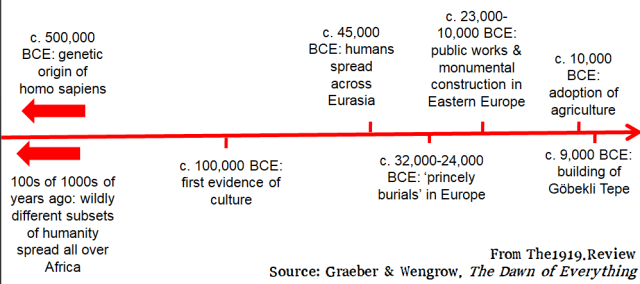
Monuments

We see the same pattern with the other type of artefact from the Stone Age which, like ‘princely burials’, are often taken up as proof of hierarchies and kings: grand, monumental buildings.

I’ve come across the fantasies of Graham Hancock and Ancient Apocalypse, in which Göbekli Tepe is evidence not just of kings but of an entire ancient empire which was more advanced than us and which left cryptic celestial warnings, and which colonized the world ‘teaching’ people how to do agriculture and masonry. A lot of the narrative hinges on the idea that Stone Age hunter-gatherers could not have built great stone monuments.

Even though they are so florid and fantastical, such arguments have always struck me as paradoxically boring. There is a more-than-open attitude to the possibility of Atlantis, aliens and giants, but dull pedantry when it comes to ancient societies. In unimaginably long stretches of time, tens of millennia, Graham Hancock cannot see any possibility that hunter-gatherers could have established a society which was, even temporarily, capable of building something like Göbekli Tepe.

Like with the burials, here Graeber and Wengrow give us a bit of archaeology (Stonehenge, Göbekli Tepe, Russian mammoth houses) and a bit of anthropology (such as the Inuits, the Nambikwara in Brazil and the Plains Indians in the United States) and paint a picture that is colourful and informative. I mean colourful not like atlanteans came along one day to teach us about seeds and the principle of the lever, but more like nomads and hunter-gatherers vary their social systems from season to season, sometimes gathering for great coordinated collective labour, sometimes dispersing to hunt and gather.

A small part of the Gobekli Tepe site from around 9000 BCE

It’s satisfying to get a clearer idea of how these monuments were built. But the best part is the idea that these societies changed their whole social system regularly to meet their needs. In one part of the year, the modern Nambikwara roamed in small bands, all these bands being under the strict control of one chief. For the other part, they gathered in hilltop villages, became democratic and communist, and had chiefs who functioned more like a social welfare department than a monarchy. But across all the other examples, no single pattern prevails: among one people, there is a settled season of strict hierarchy and a roaming season of relative informality. Among another, police functions are strictly seasonal and rotate between clans on an annual basis.

The anthropological stuff gives an insight into how Stone Age peoples might have lived: gathering after a great hunt with a superabundance of food and other goods, feasting, processing materials, building great structures, then dispersing again when the seasons turn.

A reconstruction of a house built from mammoth bones, Japan, 2013

What’s the upshot of all this?

Prehistoric society was not a realm of innocence or animal instinct – our ancestors were politically sophisticated.

Prehistoric society was not all one thing. A grading of one political system alongside each economic mode (for example, claiming that hunter-gatherers live in ‘bands’, horticulturalists under ‘chiefdoms’) is too pedantic even as a general guideline.

And here I kind of get the ‘plague on both your houses’ approach to Rousseau and Hobbes, because it’s ultimately from Rousseau that we get the idea that people pre-state and pre-class were simple and innocent.

However, this wouldn’t have been my understanding, and I’m broadly in the Rousseau ideological legacy. So they’re only throwing out bathwater here. Fine by me.

They haven’t succeeded in turning me off the idea of an economic basis corresponding to a political regime. Hunter-gatherers never seem to get around to parliamentary democracy, fascism, Stalinism, the Paris Commune or the Petrograd Soviet – not because they were/are too innocent to think of them, but because these systems do not correspond to their needs or means. The above are political systems proper to our age. There is a wide range of them, and which one you end up with depends on the last analysis on the outcome of a political struggle. But a certain type of economy, one where things like factories and railways are central, is a necessary prerequisite.

Though it seems political systems are more broad and fluid the further back you go. Even what we file under ‘feudalism’ is by definition immensely varied and full of local peculiarities. And when I looked at Gaelic Ireland, I realised that under its legal constitution many different de facto regimes could exist, depending on hard factors like population and resources and soft factors like politics and culture.

But even that phrase ‘the further back you go’ is weighted with an assumption, isn’t it? An assumption about progress, development, advance. That economies actually do develop through stages, and do not slip backwards as easily as political systems do; it’s never actually happened that a country has been ‘bombed back to the Stone Age.’ I admit thermonuclear weapons do raise the possibility.

I guess Graeber and Wengrow wouldn’t agree, but it is possible to speak of progress and development and economic stages without being racist or reductive.

Our industrialized world has global warming, endemic and stark inequality, addiction, shanty towns, systematic cruelty to migrants, homelessness for the sole purpose of enriching landlords, debt bondage as a precondition for housing, widespread precarity,long hours and low pay, universal exploitation, and hysterical bigotry against anyone who’s different. It also has vaccines, washing machines, incubators, clean running water, and a super-abundant supply of manufactured goods. I think that second collection of things are more than mere creature comforts or mod cons – yes, even the manufactured goods that clutter my house and ‘do not spark joy’ – and what’s more I don’t see that they are predicated on the first set of things, the bad things, or dependent on them in any way.

The Marxist criterion at work here, as I’ve mentioned before, is the productivity of labour. In relation to that, we can speak of our society as being advanced or developed in relation to a society that lacks these things.

But the bad things listed above, and their absence in prehistoric societies, are a reminder that our society is still at an absolutely pitiful and contemptible level of development. The idle person who thinks it’s OK for him to be thousands of times wealthier than a nurse or cleaner, just because a piece of paper says that he owns this or that, is a victim of the greatest superstition that has ever held sway over the human mind. The 16th-century German had more reason when he bought indulgences off Johann Tetzel, and the Aztec priest had more practical common sense when he ripped the hearts out of war-captives to keep the sun in the sky.

The most valuable insight from this chapter – and it is a refutation of Rousseau whatever way you slice it – is that hierarchy is not a necessary overhead of (a) social complexity or (b) large population or (c) collective projects or (d) coordination over long distances. Sure, hierarchy is one way to do it, and indeed one way that it appears to have been done even in some pre-class societies. But this chapter tells a story of political sophistication and huge monuments, apparently without hereditary rulers or coercion.
I grew up with Gary Larson images of people living in caves and even coexisting with dinosaurs (Yabba dabba doo!). But even as a more well-read adult I still would have thought that before agriculture, people lived in small roaming groups of a few dozen people. This chapter has challenged this idea, but in a way that is actually very encouraging. These pre-agriculture, pre-state, pre-class societies could be large, complex and at least seasonally settled. Probably they had a wide variety of social structures, including hierarchies and castes, but these were not the rule.

Home Page/ Archives

Miseducation Misadventures: 8 great things about teaching

This series has been very negative so far. But teaching can be a great job for a range of different kinds of people. I didn’t ultimately have the energy or patience to stick with it, but here are some things I loved about teaching.

(1) Knowing loads of people

Teaching is one of the most sociable jobs you can do. In every school you’re going to meet hundreds of kids and dozens of staff. I still meet former students regularly, sometimes after a gap of nearly a decade. It’s extraordinary, seeing them grown into adulthood but still seeing the 12 year old underneath.

The teaching profession is a great reservoir of personality and eccentricity. Some colleagues can be immensely likeable and admirable, others… not so much, but at least they’re interesting.

(2) Getting to know people who are not like you

As a teacher you get to pick up dialect, including rude dismissals (like the Midlands phrase, “go ‘way from around me”); get some insights into the current youth lore, in-jokes and vulgarity (eg, “chungus” c 2018); and learn about different cultures (for example, that twins from some parts of Nigeria have a special pair of names, or how gender works in Lithuanian surnames).

(3) Appreciation

I’ve gotten cards and emails from former students telling me how much they benefited from my teaching. Other times I’ve just run into students randomly and they have told me the same. Naturally this produces a great feeling, even years after I stopped teaching.

(4) My subjects

I loved teaching English and History. Personally I got a lot out of approaching a poem or a novel from a new angle, from the perspective of trying to figure out how best to introduce a diverse group of young people to it. You see new things in old favourites, or explore entirely new stories.

(5) Elaborate games

Sometimes this meant coming up with far-fetched but fun ways to teach. I was teaching a 2nd year group about World War Two and that involved funny hats, role playing and moving different-coloured pins around on a map of the world. Probably sounds chaotic. Actually I prepared well so it went smoothly.

(6) Planning and preparation

When I had time to do it properly, which was rarely, planning and preparing lessons could be a lot of fun. I enjoyed making up my own resources and figuring out how a lesson plan could approach a subject from several angles at once: verbal, visual, interactive, etc. This creative aspect is something no chatbot can do – and even if they could, it’s fun, so let’s make sure it remains our job and not theirs.

(7) Reading

With a fairly chill and well-behaved class group, reading through a novel or play together can be really enjoyable. I had one fifth year who read for Macbeth for the entire year. He spoke with gravitas and in rich tones and knew how to skim over words he couldn’t pronounce. He liked to speak but was not big-headed. The Shadow of a Gunman, suitably abridged, was a very fun one to act out in class in a more physical way, with props and swaggering, threatening soldiers.

(8) Being the centre of attention

Some people get scared of talking in front of groups, or leading activities with a room full of people. I can relate to shyness but when it’s expected of me that I will run the whole show, I don’t have that. It’s enjoyable to have it all on my shoulders and to deliver. There’s messing, but most of the time it works out fine. Everyone’s different, but for me, when it’s going half-way well, and when the inherent problems in the system are not grinding you down, it is great fun and very satisfying.

Miseducation Misadventures: Ambush

I sat down in the staffroom towards the end of a January day. It was quiet in there, a free period, and I probably had a pile of A4 hardback copies to read through, or a worksheet to finish off and print 25 copies of.

The principal stuck his head in the door and addressed me in a soft polite voice. ‘Can you come into the office for a second?’

I went to the principal’s office, wondering what it was all about, and sat on one of the sombre antique-looking armchairs. I hadn’t been in the place since before the old principal retired last year.

The new principal and deputy were younger men who went about their new jobs with a hurried, impatient air that suggested they thought the old principal had been too easygoing. I felt the new principal liked me. But from the deputy I’d always got a vibe that he didn’t quite understand the point of me. I can imagine him thinking: A male teacher who doesn’t do rugby or GAA? Why does he even get out of bed in the morning? 

I can’t remember if Roberto was already there or if he was summoned in after me, or if he arrived in the custody of the deputy. Roberto, not his real name, was a fifth-year Spanish Lad (Actually Catalan, but anyway, a member of that school’s numerous and anomalous Iberian tribe).

The deputy spoke to Roberto in an angry, impatient way. ‘Mr ______ here says that you wouldn’t take your jacket off. Do you have anything to say for yourself?’

I was more confused now. A couple of days before Roberto had refused to take his jacket off in class. That was such a trivial thing I’m not sure why I even wrote him up on VSware for it. It was January in Ireland and this kid was from the Mediterranean.

Winter in Ireland. ‘Why do you have your jacket on?’

Roberto said that it was true and he was sorry, but he was not sure why he was being singled out.

He turned to me. ‘Come on, sir. You know I don’t mess as bad as the other guys.’

I hope my voice didn’t come out as wheedling as I remember. ‘It’s true that we have problems in that class. And you’re not the worst. But if I ask you to do something, you need to do it and not argue with me.’

But he was right. The jacket thing was unusual. Roberto was one of the few kids in that English class who weren’t a constant headache to me. I was putting up stuff on VSWare every other day about that crowd. But Roberto was dozy and withdrawn – I mean withdrawn from the work, but also from the messing. In the context of that absolute urinal of a class, I’d take that trade-off.  

But in making the classic ‘Why are you singling me out?’ defence, Roberto had walked right into the trap.

The principal and deputy laid into him: ‘This is not acceptable.’ ‘What other people are or aren’t doing has nothing to do with it.’ ‘You need to take responsibility for your own actions.’

These are the things us educators always say. But this wasn’t a schoolmarmish telling-off. The tone was harsh, aggressive. In the army they’d call it a bollocking. Roberto withdrew into himself.

‘You can be sent back to Spain. Do you understand? If you don’t start behaving yourself, we’re going to send you back.’

Roberto listened to these ugly threats, looking sullen and upset, saying only ‘Yes… Yes…’ whenever it was demanded of him.

After Roberto was dismissed, the principal and deputy turned to me. ‘You shouldn’t have agreed with him. The way you said there were problems in the class. You can’t accept any of that.’

And I realised: this ambush was not for Roberto. It was for me.

I was too surprised to really argue. ‘OK, but it’s true, there are serious problems in that class. And Roberto is far from the worst…’

They shook their heads. ‘You can’t just accept a certain level of disruptive behaviour. You can’t let them get away with breaking the rules. You shouldn’t have let things get so bad with that class.’

I can’t remember which of them said what, and I’m only pulling together our words from memory as best I can a few years later; I think the principal did most of the talking. They weren’t quite as aggressive in tone as they were with the kid, but it was just as obvious that this wasn’t a discussion. So I pretended to accept what they were saying, just so I could get out of that room quickly and get back to work.

***

After school I had to cycle out to the suburbs on an errand. I pumped those pedals hard on that bike ride, ranting in my head about what I should have said.

I had barely seen the principal or deputy since September. They had not spoken to me about this challenging class or, as far as I know, spoken to any of the kids for whom I’d written long rap sheets. They hadn’t said a word to me about it right up until this weird encounter in the office.

In fact, they hadn’t wanted to know about it. A couple of months before, I’d brought four kids from that class straight up to that same office after some particularly bad incident. But the principal had dismissed us impatiently and hurried off somewhere. I remembered, too, that a couple of times the deputy had burst into my classroom. Paying no heed to me, he had laid into the students like an unusually rude drill sergeant – for wearing jackets in class.

Always with the jackets!

The kids could shout ‘f****t’ and ‘foreigner’, throw stuff around the room, interrupt me – but god help anyone who still had his jacket on at 9:05 on a winter morning.

Maybe it was ‘broken window theory’ or something. But I call it chickenshit.

That wasn’t the word I used to their faces. But I did challenge them (In the mild way I have when I’m not safely behind a keyboard). The next day I approached the deputy and principal together and asked to speak to them.

The three of us sat in that office again. ‘I had a big problem with our discussion yesterday.’ I gave chapter and verse on the ways I’d been following policy and teaching the curriculum in spite of challenges. ‘I don’t accept this idea that I haven’t been doing my job.’

The principal responded in a kind tone that I shouldn’t be trying to deal with these problems all by myself. He spoke with a confiding lean toward me, and the deputy backed him up with sympathetic nods. The principal said I should work alongside my colleagues more and communicate more to try to tackle these problems.

He’d shifted the goalposts. But I said that was fair enough and that maybe I hadn’t communicated enough and that this was something I had to work on. I stood up and most likely said some complete platitude, and we all thanked each other and got back to work.

***

And we never spoke of it again. Which contradicts the bit about communicating, right? But it was consistent with the real message I had received: that from now on I should deal with this crap by being tough and mean and zero-tolerance. They had blamed me for the students’ behaviour, so I knew it was not just pointless but dangerous to ask them for any help.

Roberto wasn’t packed off back to Iberia. Nothing else changed either. From then til summer I dragged that class kicking and screaming through a respectable quantity of great literature. The year head continued being helpful, but I had very little to do with management or they with me. We remained polite, and the principal did offer me a job supervising on exams in June.

As for their advice to get all mean and tough, I didn’t make the slightest effort to act on it. Partly because it’s not in me – and I wouldn’t accept the idea that teachers need to have that in them. Partly because I knew that even if it was in me, it wouldn’t salvage that class.

And partly because I knew that their advice was rubbish. ‘Communicate more with us’ – yes, us, the people who ignored you and then blindsided you. ‘Take a zero-tolerance approach with those kids’ – even though we’ll never, ever back you up (unless it’s a question of jackets).

My only real regret is that I didn’t tell Roberto that I thought it was bullshit, the way they treated him.

To this day I don’t really understand what the principal and deputy were trying to do that day in the office. But I understand that their advice was just an attempt to put all the responsibility back on the young and precarious teacher. Like the Spanish Lad, the bindle-stiff sub teacher is not going to be here next September.

A couple of years later in another school I encountered a principal and deputy who were helpful, sympathetic, kind, open and patient. It was all the more impressive because this school faced bigger problems. I was only there for 6 weeks or so, but that was when it really sank in, what a load of crap that previous principal and deputy had tried to put over.

I’m not writing this to be bitter, but to show the importance of good management in tackling messing, and what bad management looks like. Whoever needs to hear this: your boss may seem busy, important, experienced and confident. But don’t judge by appearances. Judge them on whether or not they are actually helping you to do your job. Sometimes you need to accept that you can’t do it on your own, and if management offer you bullshit instead of help then failure is not your fault.  

Home Page/Archives

Miseducation Misadventures: How to deal with messing (Premium)

Become a paying supporter to get access

Access to this article is limited to paying supporters. If you already subscribe by email, thank you. But if you want to become a paying supporter, please hit ‘Subscribe’ below.

Donate less than the price of a coffee, and you can access everything on this blog for one year.

If you don’t feel like donating, most of my posts are still 100% free, so browse away, and thanks for visiting.

Home Page/ Archives

Miseducation Misadventures: A Guide to Messing

You lose them in Second Year, around age 14-15.

At 12 or 13 they enter secondary school, where the older students look like adults to them; where far more of the teachers are men than in the primary school; where things seem at once more serious (the sackful of back-breaking textbooks, the timetable) and wilder (the smells of sweat and aftershave, the mass and velocity of the older kids when they mock-fight, the graffiti, the grossness of the graffiti, and the semi-secret places where smoking and vaping happen) and for a while the seriousness and the wildness hold the first year student in awe.

By the time they get into Second Year, the awe is mostly gone. What was serious is now a dull routine and what used to seem wild is now mostly normal. The kids have grown into this new world, have a sense of the pleasures and miseries it offers, what the rules are and which ones they can break. There has always been messing. Now it spreads, quickens.

Next post I’ll talk about what teachers can do to deal with messing. But for now, I’ll mention one of the least effective ways. I’ve caught myself responding to this messing with the same words my own teachers once said to me: ‘You’d better pay attention, because this will be on your Junior Cert.’

There is no appeal more meaningless to a second-year student. Junior Cert? If the second-year even has a clear idea of what that is, they know it’s nearly two years away. Their body will have changed by then. Their social life. Their brain chemistry. All their fantasies will surely have come true by then, elevating them to a state of happiness so perfect that they will not care about exams; or all their worst fears will have come true by then, and the exams will be the least of their worries. A year for a thirteen-year-old feels like a decade for a thirty-year-old.

(I think Classroom-Based Assessments are good, though I only overlapped with them for a few years. They don’t carry much weight in grades, but they do give kids something closer and more palpable to work towards than an exam.)

Second half of Third Year, maybe, you start to see the kids coming back around to you. A few get serious around exams, or just get more mature, or establish a rapport with at least some of their teachers. Through Transition Year, 5th Year and 6th Year, things tend to get better at an accelerating pace. I never had a sixth year class group that I didn’t enjoy teaching.

The most challenging type of student to have in front of you is a TY or a fifth-year who has only matured in the sense that they have gotten more sly, who has only been socialised into the school community in the sense that they know what they can get away with, who has only developed a relationship with teachers in the sense that they have developed a repertoire, an armoury, a tactical doctrine of doing shitty things and dodging the consequences.

Or they have gained immunity from prosecution (I suspect) due to being on a sports team, or (I was told by another staff member) due to secretly being a narc to management.

What is messing?

Let’s walk through some of the repertoire. Some of this is almost innocent and some of it is vile. I’ve thrown it all together to give you an idea of the range of the crap that comes flying at teachers.

Let’s start with second-year stuff: shouting, hooting, laughing weirdly loud; not working; singing; making sex noises; lying down on a row of chairs then ‘accidentally’ falling off; ignoring instructions; making repeated noises with a bottle, chair or pen; asking seven times ‘can we do a Kahoot?’; repeatedly dropping a book on the ground.

Then there’s what John Steinbeck described in Of Mice and Men as the ‘elaborate pantomime of innocence.’ Not content with doing an annoying thing, if the teacher tells the kid to knock it off the latter looks back with wide eyes – ‘Who? Me?’ – and tries to turn the class into a courtroom drama.

Let’s move on to stuff that some second-years will do, but which I associate more with older messers:

Using a watch to reflect a glare into someone’s eyes; saying the ‘F’ slur three times in one period; interrupting and making annoying noises; arriving 25 minutes late and waxing indignant at being asked why; chatting; messing with a phone; or messing with an empty phone cover to wind the teacher up into thinking there’s a phone.

That’s not all of it, I’m just pausing to breathe.

Giving a kid the finger, calling someone an asshole or a fat c*** (or that Polish word that everyone knows, or if you’re a Spanish Lad, hijo de p***); going to sleep or maybe passing out; throwing books; throwing water bottles; throwing a peach; damaging a computer mouse; saying ‘wank’ quietly, then louder, louder, louder; making eye contact with the teacher and silently miming oral sex; doing a racist imitation of another student; calling another student a ‘stupid foreigner’ twice in one class period; knocking over a table; standing up and shouting in the teacher’s face ‘I’ll break the head of ya’; speculating very loudly that a senior staff member is Jewish because of his facial features.

Then there are the various tag team routines – one kid loudly accusing, another loudly protesting innocence; one kid antagonising, another overreacting; sometimes both are in on it, usually only one is.

And there are the routines that come packaged in two halves, set-up and punchline: that one kid who ruins any fun activity you try to do with the class, then complains that the class is too boring; a kid who never does any work, but complains that the teacher is standing in front of the whiteboard (and has been standing there for all of three seconds); the kid who never pays any attention when the teacher introduces the class, then 20 minutes later demands in the most obnoxious tone, ‘what’s the point of this?’; the kid who takes a ‘toilet break’ and disappears for twenty minutes; next week he demands another ‘toilet break’ and when it is denied he thinks he’s Alexei Navalny; the kid who is constantly chatting, and complains that someone else is chatting, and demands that you punish them.

This is all stuff I’ve seen with my own eyes in TY and fifth-year classes. And some teachers will tell you ‘that’s nothing.’ But if you want to do something fun, you can selectively quote the above list, mentioning only the most trivial stuff, and make out teachers are whingers, etc.

The thing about some of the more trivial stuff is, the teacher doesn’t have to take any stern measures when it’s the odd isolated innocent thing. But there are students who will throw this stuff at you relentlessly. Most kids? Absolutely not. But enough that, I’d say in most classrooms, the atmosphere can be spoiled if the teacher isn’t working hard to counter it.

I have another fun suggestion for you: you can fantasise about the amazing, perfect and macho way you would have ‘put manners on those kids,’ implicitly judging me (and teachers generally) for ‘allowing’ any of this crap to happen in the first place. But what I did, and what worked and what didn’t, is a topic for the next post.  

Why do kids mess?

Why do some students disrupt classes and start rows with teachers?

A good place to start: why did you mess in school? Everyone did. I messed badly in the last year of primary school – not sure what that was all about, in hindsight – probably hormones. In secondary school, I messed in Maths class – not working, drawing pictures, chatting – because I was terrible at the subject. I messed when those around me were messing. I chatted and joked when the kid sitting beside me wanted to chat and joke – I didn’t want to be a dick to teachers, but it would be rude to blank your friend. I mitched a bit towards the end of Third Year, through a lot of TY, and towards the end of Sixth year, because I had a sense that I wasn’t hurting anyone and wouldn’t be caught.

Moving on to what I’ve observed as a teacher. Why do kids mess?

A working-class or poor student sometimes resents the teacher as a representative of a state they instinctively (and correctly) feel is the property of the rich. They might have a fundamental lack of trust in state institutions, and schools in particular, because of their own or their parents’ experiences.

And the school is not just the state. It’s also the church. Of the seven or eight schools I taught in, only two were secular. The rest all had elaborately Catholic names, statues of Mary, crucifixes on the walls, school masses. This wouldn’t be too shocking to Spanish Lads or to Polish or Lithuanian students. But for others, it’s got to be strange and alienating.

[As an aside, I’m pure disgusted with Enoch Burke, a worse messer than the most challenging kids I ever taught. I’m an atheist since age 20, but I went to school masses and paused lessons for prayers over the intercom. I didn’t confront school principals, loosing spittle in their faces as I ranted about the ways the school mass or the picture of Jesus at the back of every classroom troubled my conscience. I can be a secularist while picking my battles, respecting other people’s religion and not making everything all about me. And Burke can nurse his conspiracy theories about ‘gender ideology’ without turning a child’s personal journey and a school community into a circus.]

That was how I understood things at first – that students are alienated from education for very good reasons. There’s plenty of truth in that. But I haven’t observed that non-Catholic students are more prone to messing. Likewise it would be extremely unfair to working-class students to say they are behind more than their share of the messing.

On the contrary, I have encountered kids who picked up from their parents a feeling of superiority to mere civil servants. There are kids who view their teacher as a person of humble origins who has landed a cushy job, and who deserves to be tormented on that account.

‘Imagine being paid less than a binman,’ a kid of sixteen or seventeen once said in my class. He obviously intended me to hear. ‘Starting-out teachers get paid less than a binman.’ I don’t know if that’s true and I’ve never checked because I don’t care. If it’s true, good for the bin collectors. But that remark gives an insight into that kid’s disgusting attitudes, and helps explain why he was one of the most obnoxious students I’ve ever encountered.

Gender is another angle. I won’t comment on the sexism that (no doubt) women experience in teaching, because I want to stick to my own experiences.

I did come up against macho bullshit rooted in ‘traditional gender roles.’ There are boys who appear to believe that if they follow instructions from another male it’s basically a public humiliation. I have absolutely no interest in being the ‘alpha male’ or whatever . But when everything you do is interpreted through a worldview that reduces everything to dominance hierarchies, learning is the last thing on the agenda. 

Sometimes this helps produce kids who are on a hair-trigger. I imagine most of them end up expelled. But often it’s milder, taking the form of a skirmish with the male teacher. Let’s say the result is a draw. Honour is satisfied. The boy, having made it clear he can push back if he wants to, chooses now to co-operate. The teacher, who just wants to get on with the class, forgives even if he doesn’t forget.

Students who rebel against teachers are not all products of toxic masculinity. Sometimes teachers behave in unfair and cruel ways, and the kids are not wrong to push back. Sometimes a kid’s strong sense of justice can explain their behaviour.

I’m not qualified to say much about neuro divergence. But it appears to me that with some kids, their brains scream at them to seek attention, to move and make noise, to seek the dopamine rush triggered by transgression and conflict. Often kids are not diagnosed, or even if they have a diagnosis their teachers are not always told. You often find out about a diagnosis, whether it’s ASD, ADHD or a Learning Difficulty, randomly in staff room chat. 

Kids with a diagnosis do usually get resource hours and SNAs. In the classroom the teacher might have prior experience, but does not always have basic information and usually doesn’t have any training with regards to particular conditions. It goes without saying that the teacher doesn’t get any extra time or resources. No wonder so many kids, even plenty who don’t have any specific condition, fall behind.

Social problems from outside school invade it all the time. Crime, drug abuse, domestic violence. Some students have terrible lives outside school, and they come in and use their teachers as emotional punching bags.

Some students will annoy you one day, and be your best friend the next. Sometimes it’s pure manipulation. Usually it isn’t. This is because human beings are funny, and being a teenager is very difficult.

Kids mess because they are bored or resentful. This can be the teacher’s fault for preparing dull lessons, or not preparing at all. But it’s a vicious cycle sometimes. You have a class whose behaviour is very challenging, so you don’t try to do anything fun or easy-going. You know there are five or six kids who will take advantage and just plunge the whole classroom into chaos. This leads to more boredom, more alienation. But I don’t know what else one can do.

Likewise, kids mess if they feel their teacher is arbitrary and unfair. But when you’re dealing with a very challenging class group, you might come across as arbitrary and unfair without meaning to. The cycle continues.

A teacher feels vulnerable writing about this stuff, leaving themselves open to being judged for not ‘controlling the class,’ whatever that’s supposed to mean. But it’s a massive issue in secondary education.

The system largely creates ‘messing.’ Education has come a long way since the early 20th Century. But even though progressive ideas have been layered on top, the foundation is the same: there is an expectation that the teacher can make twenty-five young people behave in a strictly regimented way. The problem is the ridiculous idea that two dozen fifteen-year-olds can be made to not mess by a single adult who does not possess superpowers and who is – thankfully – not allowed to assault kids anymore. The basic set-up pits kids and teachers against each other right from the start.

So, confronted with behaviour that makes it very difficult to do our jobs, teachers have few good options. Next time we’ll look at what teachers can do under the status quo, and explore how things could be different and better.

Go to Home Page/ Archives

Did you enjoy this post? Please subscribe to get email updates:

Miseducation Misadventures: The Spanish Lads

This is the first instalment in Miseducation Misadventures, a series looking back the madness, craic and nonsense I encountered as a secondary school teacher in Ireland.

This article deals with the thing nobody tells you about in teacher training, the thing that nobody ever sits you down and explains to you: The Spanish Lads.

Maybe there’s an official name for this phenomenon. If so, I’ve never heard it. Because my experience is weighted toward boys schools, in my head this thing is simply called ‘The Spanish Lads.’

Who are The Spanish Lads?

The basic idea is this: sooner rather than later in your teaching career, you will walk into a new classroom to find among your twenty-five students one or two, maybe as many as three, four or more Spanish Lads. Nobody has told you they will be there, and nobody will ever tell you why they are there, or what you are supposed to do with them. They are a mysterious presence in schools; every staff member assumes that someone else knows what the story is with them. But you will notice that other staff members scold these students for talking to one another in Spanish.

How long does a Spanish Lad stay in Ireland? Not for a few weeks or a term but for an entire academic year, observing the strange rituals of the Irish education system like a latter-day Francisco de Cuellar stranded among the Gaels. Somebody somewhere has decided that this is the best way for them to learn English.

Staffroom chatter will soon reveal the other angle: schools that don’t have enough students have an incentive to take in a crowd of Spanish Lads so as to boost enrolment and get more funding. It’s possible that some of the jobs I had wouldn’t have existed if not for the Spanish Lads – so I owe them.

There is no one type of Spanish Lad. They have wildly varying standards of English and levels of homesickness. Some work hard, others are messers. One might be a class clown with cross-cultural and intergenerational appeal; another might burst into tears if you scold him. In short, they are every bit as varied as Irish Lads. I heard a second-hand story about one who ran some kind of online revenge porn racket. I knew of another who was not in a position to run any kind of online racket, because the woman who generously described herself as his host did not let him use her Wifi.

Maybe someone involved with the Hiberno-Iberian Student Placement Committee, or Armada 2000, or the Kinsale Project, or whatever is the official name for The Spanish Lads, will think this article is unfair. I haven’t reached out to them for comment – I haven’t even tried to google them – partly because I don’t know what they are called, but mainly because the point of this article is to show what this thing looks like on the ground for a teacher. My only obligation here is to be truthful with regards to what I encountered myself.

Two Juans

The Irish Lads often ignore the Spanish Lads due to the language barrier. Sometimes the Irish Lads will liven up a few tedious minutes by teasing the Spanish Lads: a class consisting of seven Dylans, five Jacks, three Haydens and seventeen Oisíns will find it hilarious that two of The Spanish Lads are called Juan.

In large parts of Ireland, Juan and one are pronounced almost the same. There was one Juan I knew who mostly dozed through class. An Irish Lad (the kind of Lad who is delighted with Of Mice and Men because he thinks it gives him a loophole to say racist words) used now and then to ask him, ‘Which Juan are you?’

Juan responded not with words but with a look of drowsy contempt which struck me as dignified and noble.

Where Spanish Lads exist in sufficient concentrations, they form a parallel school community across the wide 12-18 age range. When the Irish Lads push, they push back, and teachers get a headache trying to avoid being enlisted as a referee by the two Lad Factions while also making sure the school’s anti-bullying policy and code of behaviour are observed.

Sink or swim

For a while I worked as a resource teacher, giving extra help to some Russian and Georgian lads with their language barrier. It wasn’t nearly enough but it was a hell of a lot better than nothing. I don’t know if The Spanish Lads get this kind of support as a rule, though in another school I was very briefly assigned to help a small group of Spanish Lads with their English.

Leaving aside extra support, teachers are supposed to cater in their lesson plans for kids who don’t have much English. But that does not apply to the Spanish Lads. Teachers often get saddled with extra responsibilities but no extra resources or time. With the Spanish Lads, it’s different. We are not even given any responsibility. We are just supposed to pretend the language barrier isn’t there. If you think this makes things easier, then you’ve never been a teacher. The problem with a ‘sink or swim’ approach is that a certain number of kids just sink. Of those who sink, a few suffer in silence but most chat, bicker and mess, and that gets in the way of you doing your job.

The stupidest situation I ever encountered was with a 5th year English group. There were around 15 in the class, four of them Spanish Lads, (edit: no, there were actually 5) and around four other kids with English as an Additional Language. Bless my younger and more energetic self: we slogged through a novel, a movie and a heap of poetry. You can run a poem through Google Translate and come into class with printouts in five different languages so that the various nationalities can check the vocab, can have some kind of understanding  of what’s going on. But it’s not ideal, and a novel is a lot tougher. In that context, it’s not strange at all that the Spanish Lads’ attention wandered and that they often disrupted the class, driving me up the wall.

And all the pious scolding, warnings, write-ups and detentions I dealt out were based on a false premise: that there was some normal desirable situation from which this or that kid was deviating. In reality, things were a mess from the outset.

For the record, it was a handful of the Irish kids who gave the most grief in that class – the Spanish came a modest second, but they really didn’t help.

I know I would be sincerely happy if I ever somehow ran into any of my former Spanish Lads. The problem is rarely the kids themselves. And I think that 5th year group did benefit from my teaching. But any small benefit came at a stupidly high cost. It was a waste.

Why do we have schools?

The Spanish Lads are just one example of the things that are wrong with the education system – and here’s where I’ll get more general, and expose some of the themes I’ll probably be dealing with again in this series. What’s teaching all about? Why do we do all this?  

  • So that we can get paid.
  • So that those who are not yet old enough to work or to spend money are confined in institutions all day, out of danger and out of trouble.
  • So that parents can go to work.
  • So that industry and the state (and Canada and Australia and Switzerland) have a labour pool made up of people who can read and write and do sums.
  • So that all those responsible, from school management up to the Minister, can say without technically lying that they are meeting the state’s obligations to provide free secondary education to all.

…And if thousands of kids are just sitting there having their time absolutely wasted, it’s the fault of the kids, or the teachers, or the parents, or vaping, or the internet, or whoever banned teachers from assaulting kids.

If I was cynical I’d leave it at that – all those bad incentives and impulses built in, and the threat of authoritarian ‘solutions’ that would just be a burden of brutality and stupidity on top of all the dysfunction that’s already there.

But the less-bleak truth is that the system we have is the outcome of a compromise between all that crap and the good intentions of educators and our unions, of parents and students.

There’s also a powerful animating idea of universality and public service that’s always there underneath it all, even if it can get hidden under layers of rubbish. No teacher would phrase it like this, but in our modest way we bring liberation to young people – give them tools to reach their own understanding of the world, open the way for them to imagine and to achieve great things, provide them with a social environment that’s broader and more exciting than the home but kinder than the adult world. Some teachers get sick of it and quit (like I did) and some fossilize themselves in bitter cynicism. But for most, a sense of humour mediates between the good thing we’re trying to do and the crap conditions we have to do it in.  

Another less-bleak truth: there are probably thousands of former Spanish Lads and Girls walking around Iberia today thinking that beor, shift, shades and fuist are the Queen’s English. I guess I’m proud that I was part of whatever made that happen.

Do you want to read more like this? Subscribe here:

Or browse my full archive:

Go to Home Page/ Archive

Footnote

More than once, politics has come up with The Spanish Lads. Two little second-year students got really mad when I taught about the Conquistadors’ brutality toward the native Americans.

In that 5th Year class where I had four Spanish Lads, one day all the Irish lads were gone, maybe it was to do some project, or maybe for the ploughing festival. The Spanish Lads turned the chat to politics. I learned that I had a Francoist on my hands – thankfully just one. Two others were staunch Republicans and the fourth was a Catalan Nationalist. The brief but heated debate which followed brought the usually taciturn Georgian student out of his shell. He interjected to school the Francoist, telling him how communism meant free food, free electricity, free everything. Two Spanish factions fighting and a tough Georgian communist intervening – it was almost too much for my history-teacher brain.