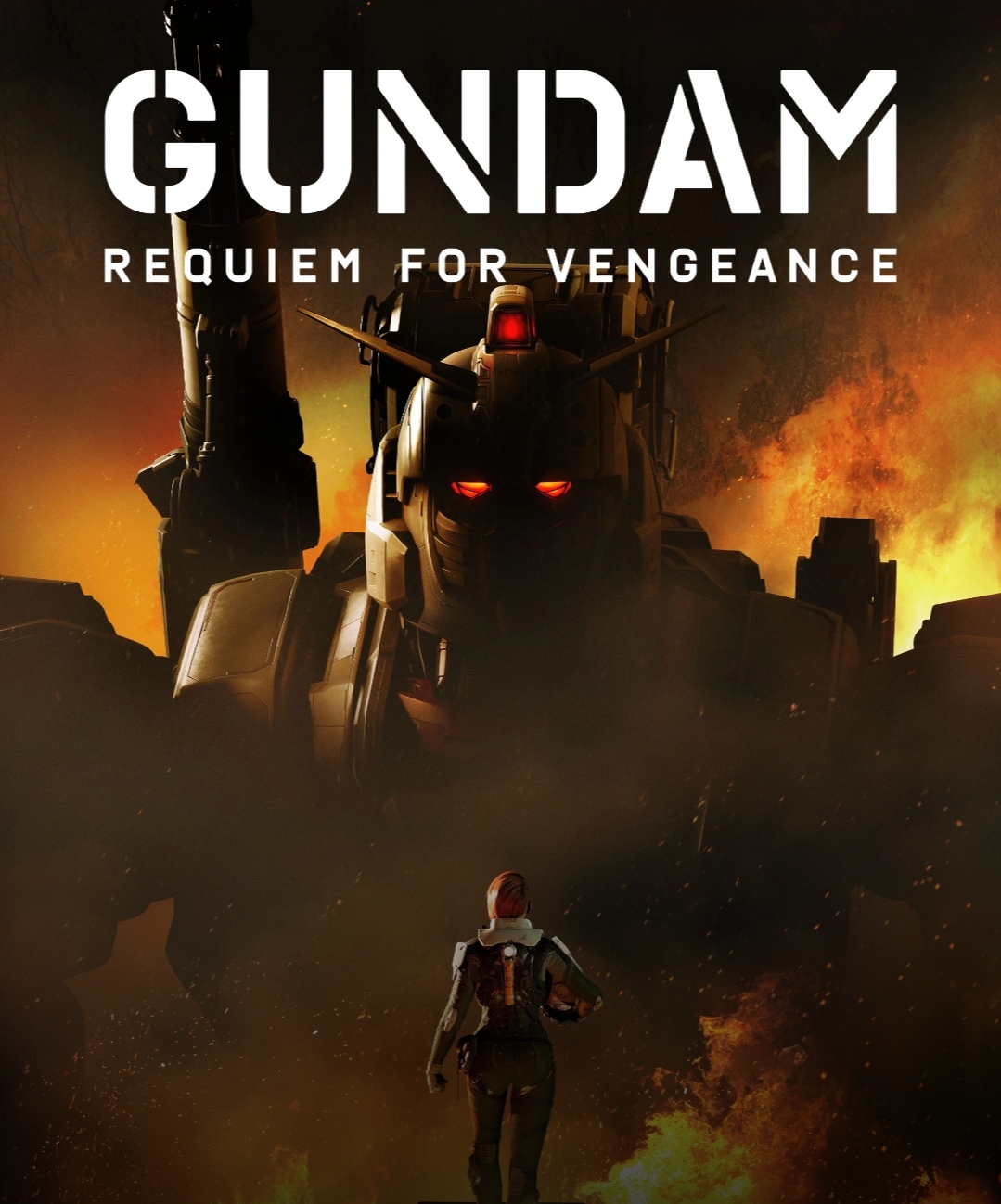
We’ve got a guest post for you today, a review of Netflix’s Gundam: Requiem for Vengeance by freelance writer Charlie Jean McKeown.
Stories and machines are ultimately driven by people, yet Gundam: Requiem for Vengeance lacks the personality needed for the gritty mecha war drama it tries to be. Since its 40th anniversary, the Gundam franchise has been boasting ambitious projects like SEED Freedom (2024) in theatres, Witch from Mercury (2023) on TV, and in gaming Gundam Evolution (2022). (i )
This new Netflix series follows Zeon soldiers- the usual antagonists- in the closing months of the ‘One Year War.’ It’s an attempted love letter for Gundam fans, with a touching homage to the original 1979 show in its opening titles and what must have been a laborious effort to give the classic mecha designs such glorious detail. However, Requiem has little identity of its own; it has little to offer old fans and nothing accessible for new ones. More disappointingly, it does open up genuinely interesting themes which could have given the show some life if they were navigated by decent characters.
Requiem actually inverts some of Gundam’s most central themes; empathy becomes vengeance, and our protagonist is an enlisted mother rather than the usual child soldier. ‘Time’ is not a new theme for the franchise but had never received the same attention it enjoys here albeit with some overly-obvious motifs. The survival element of other Gundam series is heightened in Requiem too, as we watch the losing side struggle against a war-winning weapon. These themes, though, are only minimally engaged with. While one could blame this on the many action scenes, Gundam has always used battles to deepen its narratives rather than merely embellish them. Furthermore, Requiem still has plenty of peaceful moments in its three-hour runtime. The fault is really found in the show’s repetitive exposition soaking up what should be time spent on challenging characters so that they may develop and investigate these concepts.
All of this culminates into the most disturbingly mishandled theme of Requiem: nationalism. Mirroring the Cold War narrative of Nazi Germany (ii), Zeon had always been presented as an evil fascist regime with ordinary soldiers fighting for their homes. Interestingly, the One Year War – the definitive conflict of the franchise – is renamed here as ‘the Revolutionary War.’ Is this how the fascist Principality of Zeon sees itself? Do they view the One Year War the way Confederates saw the American Civil War? It’s a fascinating angle to investigate. However, it feels like Requiem takes up a ‘both sides matter,’ approach, with no real discussion of Zeon’s war crimes (wiping out half the Earth’s population, for instance). Instead, our apolitical protagonist is “just following orders.” While her final monologue is clearly intended to convey a lesson she learnt, it gives us a rather warped justification for continuing to fight under a swastika-esque banner.
Banner of the Principality of Zeon
While the writing is poor, Requiem’s establishing shots want you to know money and effort went into making them. Requiem is Gundam’s first CG animated production since MS IGLOO (2004), and the improvement in quality is staggering. By tightening their dimensions, the old mecha designs remain credible in today’s science fiction scene while the body language of these giants conveys a surprising degree of emotion. The facial animations are unfortunately less expressive, and to come across they often rely on the wonderful new soundtrack provided by award-winning composer, Wilbert Roget II. Netflix’s first Gundam production does look lovely as a whole, but its writing encourages little confidence in the live action film they announced in 2018. I doubt Requiem will see a second season, which is a terrible shame given its potential; if the writers could make some course-corrections in a new season and rummage through those ideas they raised, then Gundam: Requiem for Vengeance could be forgiven for these first six dismal episodes and actualise its own distinct identity.
(i) While Evolution was closed down in a year, it gave Overwatch 2 a little competition in the hero-shooter market before collapsing under its embarrassing micro-transactions. (ii) A narrative, it should be noted, now being revised by historians who are acknowledging the Wehrmacht’s complicity in war crimes.
The first time I met Negritude Philosophy, I was still in high school. Then, I came across Léopold Sédar Senghor’s “I will pronounce your name”— a part of the WAEC literature syllabus for 2007. At that point, I was a little unclear about its historical fermentation. I had read it and rewrote it for a girl I admired— my first unconscious attempt at poetry. Senghor’s poem centred around a black female character “Naett”— a re-emphasis of the African identity as doting to any observer. Now, it is 2022— five years after. And, history has grown: there is my strive for clarity, consciousness, and the human voice in every piece I encounter. And having heard Brainy (Oluwatunmise Esther), for the first time, read her poem “Negritude”, that night at Sage Hassan’s reading birthday party, I was critically attached.
The cover image is from Wonderlane on Unsplash
Three things had happened: while she read, I was unclear about how she had thematically woven the god, woman, and identity questions in such a brief performance on such a broad title as Negritude. I needed a feel, so I asked for a hard copy, and here I am much concerned about how we push history and ideas through time: how do we reopen, define, or redefine the relevance of Negritude in the 21st Century of globalization and imperialism? The answer is barely linear— a cartography of debates. Something I hope to write about someday. However, Brainy’s title becomes the past, present, and future merged into a glance: “Negritude”— a movement towards reawakening black consciousness both in Africa and in the diaspora.
In stanza one, the reader meets an exposition— the link to the philosophical stance of the title itself: “let’s talk”. This expression, repeated at the beginning of the first three lines, is the foundation upon which the subject matters are raised: the experiences to be shared by two gender-unspecified poet personae “you” and “me”, towards the “dazzling skin colour seen as threat” and “about being black”. It is only from stanza 2 do we see the identities behind those unspecified pronouns: “black woman”— a resonance of Léopold Sédar Senghor’s “Black Woman”. Here, Brainy’s feminine metaphor may or may not necessarily be an address to a woman after all. It could encompass the gendered persona and make the subject African. But, gradually into line 6 of this stanza, we are left at a crossroad: “I know you’re clueless of what classic/creation of God you are, moulded from the finest clay”. Now, I was forced to pause and ponder:
If “God” there refers to the image of the woman, like the black woman not knowing she’s a classic creation, there won’t be a need for her to be moulded from clay as both God and Woman are one and creators. Thus, no one is clay— as a creator cannot be the clay: he/she/it is outside the subject of creation.
If “God” should be separate from the black woman, that is, the woman as a creature and the “God” as a creator, it becomes a little ambiguous. What God is creating what woman? Is it the Yoruba, Hausa, Igbo, Christian, or Islam God? That is, does it subtly deny the multiplicity of the
By Swarnavo Chakrabarti, Unsplash
African deities? Why does she have to be created when in the preceding lines, lines 3–5, we are told she should not see herself as less of a goddess: “black woman…/you’ve [been] told that being black makes you less of a woman, makes you less of a goddess.”
And 3: if the black woman is a goddess, created by a “God”, does that not make her less? A contradiction to the thematic relevance raised earlier about not being less of a woman or less of a goddess. And, if this is the case, the “black woman” is merely subjected to a patriarchal order where “God” or “Men” reign supreme— a devastating and biased history of things. A case, I am sure, Merlin Stone’s “When God was a Woman”, Christena Cleveland’s “God is a Black Woman”, and other radical feminists would not agree with. In fact, in prehistoric times, there were goddesses before the making of gods. In pre colonialism, in Igbo culture, for example, we had Ani, Ala— all of which are women and greater in all sense of the Igbo traditions. The appearance of a Chukwu, with no clearly defined altar, was an attempt at the unification of other personal or communal gods under a supreme being of the sky— a father figure, not a mother figure as Ani possesses— modelled after patriarchy, economic factors, and possibly, Christianisation. In Chinua Achebe’s Things Fall Apart, it is clear that the chief priestess was never undermined— despite the toxic masculinity of Okonkwo, he submits. Also, after the tragic death of Okonkwo, we notice how his impurities will not allow him to be buried under the Earth Goddess, Ani. Not Chukwu. Why? Every deity is placed or created within the cultural, occupational, and geographical nature of the people, which is mostly femininely defined— a byproduct of human’s inability to understand natural phenomena. Hence, the Igbos worshipped Ani or Ala as Earth Goddesses because the society tilts towards agriculture. In other places close to the river, where fishing is a major occupation, we see the worship of a Sea Goddess, not a God— the representation of fertility, protection, and a means through which its people survive like Olókun, Yemọja, Mami Wata, and so on. So, where do we or in what context do we place “I know you’re clueless of what classic creation of God you are/moulded from the finest clay”? Thus, it will be sad and a slap to African history if the “God”, here, refers subtly, unconsciously, or generally, to the Abrahamic religions— a defeat to the philosophical and ideological purpose of the title itself: Negritude.
However, before eurocentrism, the evolution of human societies has been classed between the oppressors and the oppressed— Africa is not exempted. This means that while Brainy celebrates womanhood, she fails to identify the class status of these women both in pre-colonial and post- colonial Africa. That is, the image of a ruling Goddess (or god) is or may be structured after the image, dominance, and ideology of the existing ruling class— women or men— in each epoch of time: matriarchal (or patriarchal), matrilineal, feudal or not — black or white. Such is the reason behind the birth of heaven or afterlife: the ruling class’s idea, both in the formation of customs, tradition, and rituals, to preserve their reign over the lower classes forever— like the Egyptian pyramids of preserved bodies of Kings and Queens; then, how Wole Soyinka, too, dramatically presented this cosmological narrative through his “Death and the King’s Horseman”, where the Eleshi was meant to die so he could accompany the king through the phases of the afterlife.
Aside from the God question, Brainy presents her women and Negritude from a point of skin— a product of her reconstruction of beauty and identity: “This is a poem for every black woman still cringing in her skin”, “Black woman/Tell everyone who cares to hear/ that your skin is a constellation for starry nights”; her reflections on the Transatlantic Slave Trade: “poem for those shipped across the seas/ whose offsprings still bear the harsh tags placed on them”; and the pathos of her past— a nostalgia: “They forget we are the wisp of air preceding the rise of a storm”, “We black women come from a race of fighters”.
John McArthur (Unsplash)
Beyond these revolutionary turns and eulogies, Brainy’s poem should be read with a critical eye:
“making love to a black woman is riding on some good life”— Here, we are forced to ask: does Brainy imply that good life is making love to a black woman? Is this relevant in the 21st- century global worldview of humanism— maybe in the science of love-making? In fact, who becomes the subject of that “making” in terms of her poem’s contextualisation? Does it not defile the literal or metaphoric essence of her “black woman”? Or, does it not indirectly support the exploitation of the black woman if making love with her is “riding on some good life”— that is, if black woman, throughout, had metaphorically meant Africa?
“We are not some gruesome paintings of God”— earlier, Brainy had told us that her “black woman” is a “classic creation of God, moulded from the finest clay”— this line, if we pay attention to her earlier premises, does not achieve any effect at all as the women cannot and will not be in, anyway, the “gruesome paintings” of God. Except, by “gruesome”, she challenges the racial stereotypes and gender discrimination of the black woman just as how Buchi Emecheta presented Adah in Second Class Citizen— women are humans, too. But, to accept this supposed interpretation is to defeat the essence and perfection of Brainy’s “God” as these “gruesome” paintings, wherever it comes or appears, are his— if the black women are not gruesome, who, then, is or are the “gruesome paintings of God”?
“Tell them if God had a begotten daughter, she would be black”. While these lines achieved a powerful plot effect, the “God” in Brainy’s “Negritude” is unveiled, defeated, and short-changed after a model of masculine, maybe patriarchal, Christian doctrine, not the African religions.
Oladimeji Odunsi (Unsplash)
In the end, Brainy’s poem and Negritude suffer from a post-colonial effect of indoctrination and cultural imperialism while maintaining a strong appraisal of the women’s struggles and movements in Africa and diaspora: “Black woman, I dare you to raise your heads and shoulders high like the Queen you are/The Queen of Negritude”.




 The 1919 Review