13: Warlords of Ukraine (Continued)

This post continues our explainer on the main factions contending for power in Ukraine in 1919. Note the factions we already looked at last week: the Ukrainian Rada and the White Guards. The German military and their puppet Hetman are already out of the game, and in the east the new Polish state is muscling in.

1.      The Reds

The Reds supported self-determination for Ukraine and said so before the world many times. Their preference was for Ukrainian autonomy within a federation, and language and cultural freedoms. This was no less than what the Rada had called for in 1917: ‘Long live autonomous Ukraine in a federated Russia.’[i] The difference between Rada and Soviet was one of class.

The Red Army entered German-occupied Ukraine in September 1918. After the German Revolution, intervention gathered pace. On 30 November a Ukrainian Red Army was officially founded.

In early December a 3-day general strike broke out in Kharkiv, in Eastern Ukraine, and a revolution from below installed Soviet power in the city. Note the contrast between 1919 and 2022: Kharkiv, which has a large Russian-speaking population, has held out against the Russian invasion up to the time of writing. In 1919 it went Red almost without a fight.

According to EH Carr, the fact that the Communists were unable to organise a revolution directly in Kyiv shows how little active support they had in Ukraine.[ii] But after the events in Kharkiv, the Reds took just two months to cover the distance to Kyiv. In February 5th the Ukrainian Red Army captured Kyiv from the Rada. In contrast to the bloody and destructive five-day struggle between Red Guards and Rada in February 1918, and in stark contrast to the fiasco which Putin presided over in 2022, in 1919 the Reds ‘were greeted by the population with every display of enthusiasm.’[iii]
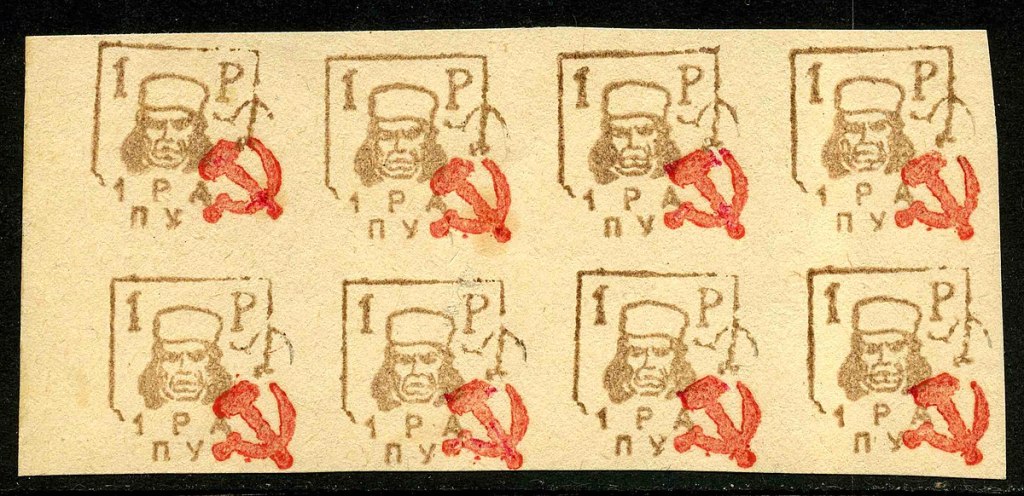
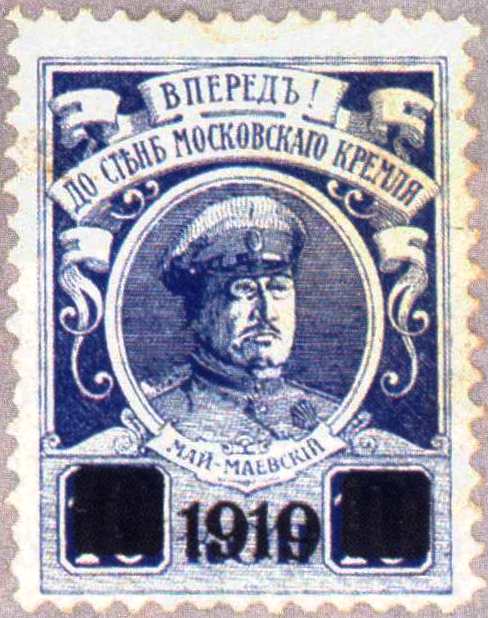
Ukrainian postage stamps from 1919. It is variously attributed to Soviet Ukraine or to the Anarchists. In spite of how much the guy there looks like Makhno, I’m more inclined to think this is a Communist than an Anarchist artefact

The Ukrainian Red Army was a horde of Red Guards and partisan units, a throwback to the freewheeling revolutionary days of early 1918. As if to underline this, the Red commander was Antonov-Ovseenko and one of his main officers was Dybenko; these two men had led the October 1917 insurrection in St Petersburg.

The war in Ukraine in 1919 was a war of loose ‘detachments’ and charismatic leaders, sudden spins of the wheel of fortune, and unstable alliances. ‘Being in an early phase of revolutionary ferment,’ according to Deutscher, it was ‘congenial ground’ to the left wing of the Communist Party.[iv]

The Red Ukrainian regime made rapid gains but it was soon overstretched. It was too aggressive on the land question, and dismissive on the national question. Instead of taking the land of the nobility and sharing it out, the Reds decided to turn this land over to state farms. The Ukrainian peasants might have just about tolerated the seizing of food, but this added insult to injury. Huge numbers of peasants rose up in rebellion.

‘In Ukraine today historians argue that Great Russian chauvinism coloured the whole of Bolshevik policy toward Ukraine in this period.’[v] Many Bolsheviks – especially, for some reason, Ukrainian Bolsheviks – were dismissive of the country’s national identity. But the general picture is of a movement with a real social base within Ukraine, in the cities especially but also among many peasants. The idea of the Reds as an imposition from outside is only tenable if we decide arbitrarily that Russian-speakers and Jews cannot be regarded as Ukrainian. The early missteps were later rectified thanks to intervention from Moscow – which goes against the impression that it was Russian imperial chauvinism. If we look back through the prism of later events, especially the famine and terror of the 1930s and the ongoing war, we will lose sight of this. Something very different was going on here.

Later in 1919 and into 1920, as noted above, the Ukrainian Reds, urged thereto by Moscow, adopted more sympathetic policies on land, food and the national question.[vi] But early 1919 was characterised by bold advances, impressive in the short term but storing up huge problems in the longer term.
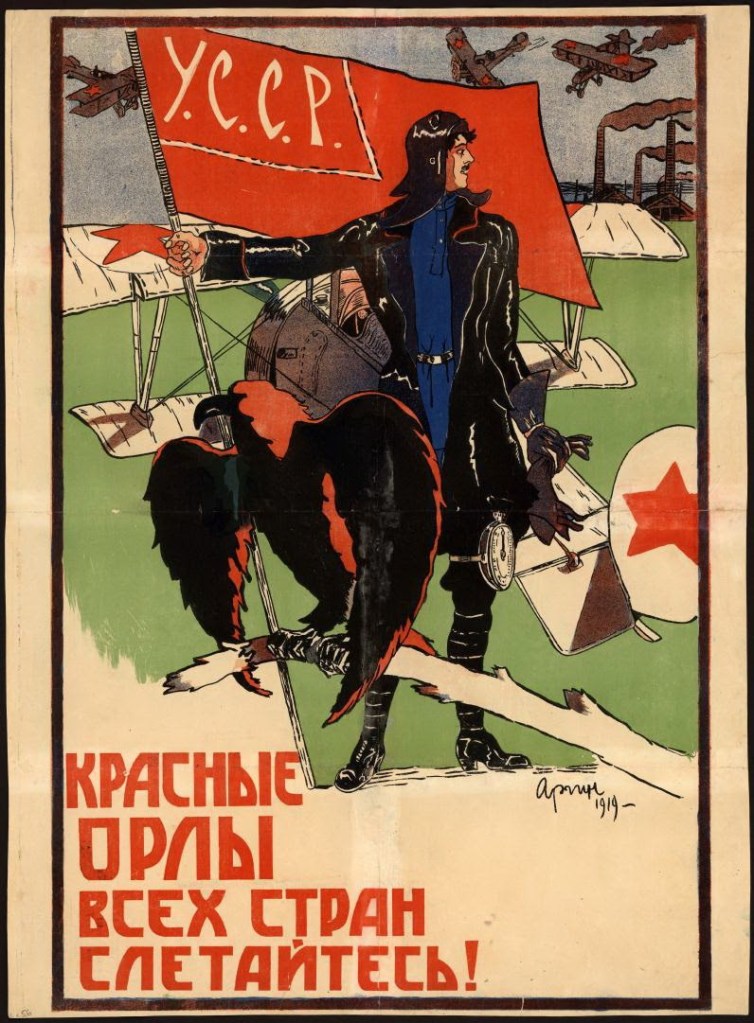
A Red poster from Ukraine, 1919

The civilian administration of Red Ukraine was threadbare. The military presence was more fleshed-out, but not by much. The Dniepr River runs roughly north-south through the middle of Ukraine – from Chernobyl by the Belarus border to Kherson on the Black Sea. The commander-in-chief of the Red forces, Vacietis, wanted this to be the line at which the Red forces stopped short and dug in. But Moscow could not control Antonov-Ovseenko, and in any case Antonov-Ovseenko could not control his Red Guards and partisans. As winter turned to spring they swept on into the western half of Ukraine, carried on their own momentum.

At first the Red advance appeared to be successful. But the overreach had terrible consequences. One was that the Reds ended up dependent on deeply unreliable allies.
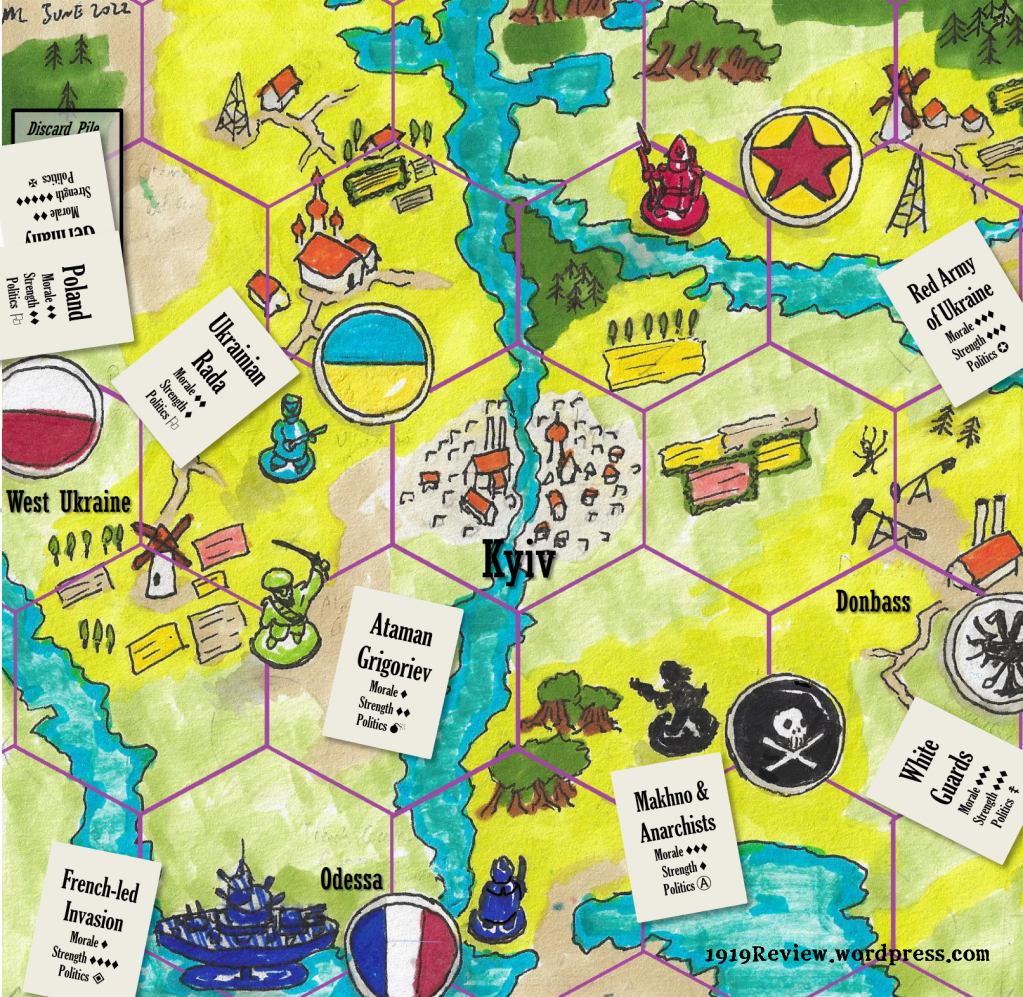
2.      The Warlord
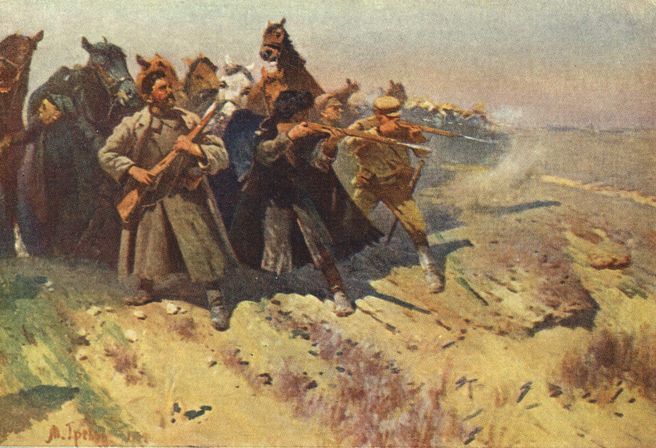
Painting by Mitrophan Grekov (probably showing South Russia rather than Ukraine)

The civil war in Ukraine, like that in Siberia, was a war of atamans. An ataman was a charismatic warlord who raised and led an army in wild pursuit of some quixotic, obscure or horrifying programme.

How would one go about becoming an ataman? What must you have on your CV? Below is a step-by-step guide for this career path, illustrated with reference to Nikifor Grigoriev, the foremost warlord of Ukraine. Grigoriev was a military officer who, by the hour of his death, had joined or tried to join almost every single one of the contending factions mentioned here.

Step One: Have murky origins

Grigoriev ‘constantly emphasized his Ukrainian origin, called for the destruction of Russians, but at the same time for some reason had a Russian surname’[viii] – the solution to the mystery is that he replaced his real name, Servetnik, with the more Russian-sounding ‘Grigoriev.’

And here we encounter another Lviv or Derry, because it is variously spelled Hryhoriiv and Hryhor’yev.

Step Two: Join the Tsar’s army

Apart from two years of elementary education, Grigoriev’s only school was the Tsarist military. Service as a Cossack cavalryman in the Russo-Japanese war taught him to fight and to lead. After the war followed eight years as either a tax official or a cop. Then in the Great War he returned to the cavalry, and won medals for his courage and skill.
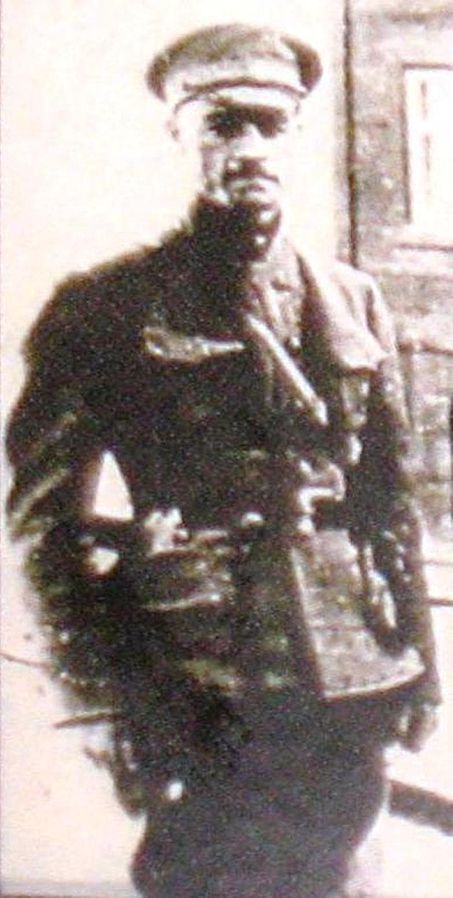
Ataman Grigoriev in 1919

Step Three: Make a lot of friends

He is described by contemporaries as a rude, ugly, heavy-handed man who spoke through his nose. But ‘the soldiers liked him for his recklessness, eternal drunkenness and simplicity in relations with the lower ranks. He was able to convince the rank and file to go into battle, often setting a personal example.’

Step Four: Find a political cause

Grigoriev took part in the soldiers’ committees during 1917. He eventually joined with Semion Petliura and the Rada (Ukrainian Nationalists), and became a Lieutenant-Colonel in its army in 1917-1918.

Step Five: Be fickle

When the Germans booted out the Rada and brought in their puppet Skoropadskii, Grigoriev sided with the Hetman and served in his forces. He may even have participated in the coup. But after a few months he joined the Rada again in their uprising against the Hetmanate.

Step Six: Raise hundreds of fighters, then thousands

He returned to his native Kherson region and convinced 200 middle peasants to fight alongside him. They attacked the Hetman’s police in order to lure out a German punitive detachment, which they defeated. Next they ambushed an Austrian train and made off with enough rifles, machine-guns and grenades to equip a force of 1,500.

This was all in the context of a developing revolution against the Hetman, which culminated in November 1918. In December, Grigoriev led 6,000 rebels into the town of Mikolayiv, seizing it from the Allies, the Germans and the Hetman’s troops.

He threatened the Germans: ‘I’m coming at you […] I will disarm you, and our women will drive you with clubs through the whole of Ukraine to Germany itself.’

Step Seven: Insist on your own independence

Soon, virtual dictator of a large swathe of southern Ukraine, Grigoriev began to turn against Kyiv, insisting on his own independence but also demanding to be made minister for war. He began to flirt with the left even while saying that ‘Communists must be slaughtered’ and threatening to attack striking workers. He joined the Borotbisti, the Left SRs of Ukraine, who were in alliance with the Communists.  

Then the French military landed at the Black Sea ports of Ukraine. Petliura was hoping for aid from the French, so he forbade Grigoriev from attacking them. Angered by this, the warlord changed sides once again. He went over to the Reds.  

This is not the last we’ll be hearing of ataman Grigoriev.
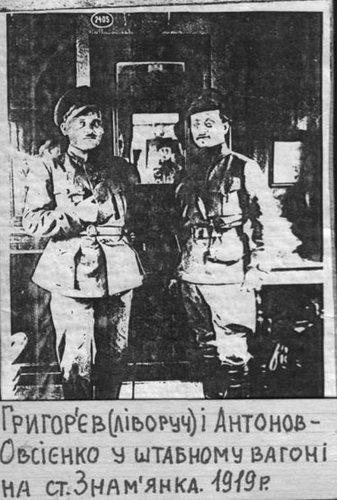
Grigoriev standing next to Antonov-Ovseenko, who co-led the October 1917 insurrection in Petrograd.

3.      The Black Army

The village of Huliaipole lies in south-east Ukraine, some way inland from Mariupol. There, in 1907, a local school teacher named Nestor Makhno led a peasant protest movement. Makhno was an anarchist-communist. He may have absorbed from his upbringing the Cossack tradition of fierce independence and self-government. The Bolsheviks looked to the working class, but Makhno looked to the peasants.
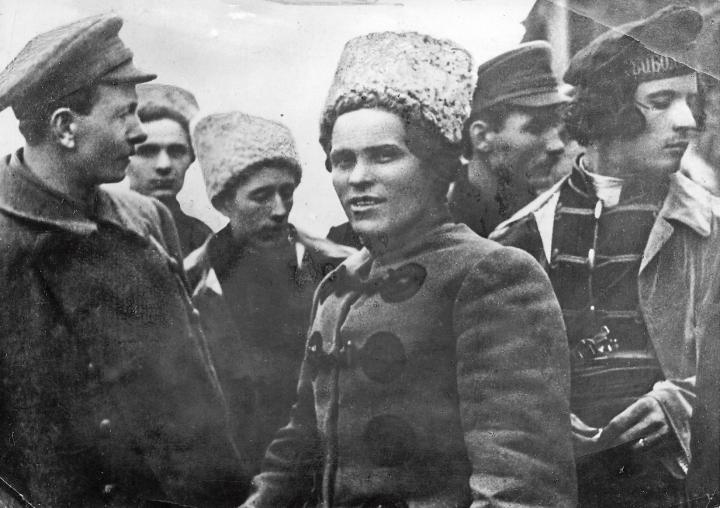
Nestor Makhno, known as ‘Batko’ or ‘father’ to his supporters. Note the sailor’s cap on the bloke beside him.

In 1907 he was arrested and exiled. But in the days of the Revolution he surfaced again. Ten years after his failed rising in Huliaipole, he was elected leader of its soviet.

Summer of 1918 found him in Moscow. He had friendly interviews there with Communist leaders such as Lenin and Sverdlov. But Makhno believed that all state authority was oppressive and counter-revolutionary. He was unimpressed by the anarchist groups which operated freely on Soviet territory.

He returned to Huliaipole in autumn 1918, leaving behind the ‘paper revolution’ of the urban anarchists in favour of rifles and guerrilla attacks. He organised a partisan band, displaying exceptional ability in battles with the forces of the German puppet Skoropadsky.

Then the German empire crumbled and Ukraine became a political vacuum overnight. He organised his partisan band into a stateless peasant commune centred around Huliaipole and defended by a force numbering in the thousands, the Revolutionary Insurrectionary Army of Ukraine.

Makhno and his lieutenants pose before a studio backdrop in 1919

The Anarchists travelled on horses and carts, loaded down with all kinds of weapons: ‘curved swords, naval cutlasses, silver handled daggers, revolvers, rifles and cartridge pouches made of oilskin. Enormous black and red ribbons flew from every kind of hat and sheepskin cap.’[ix]

The Whites were among the first to confront the Black Army. Mai-Maevsky warned his troops about Makhno: ‘I don’t doubt your ability, but it is not likely that you will manage to catch him. I am following his operations closely and I wouldn’t mind having such an experienced troop leader on my side.’[x] Makhno’s mode of warfare was mobile. For example, as early as November 1918 his troops captured Ekaterinoslav (today Dnipro) simply by boarding a train in disguise, pulling up to the main station, then drawing their weapons and charging out. But they abandoned the town just three days later and returned to guerrilla struggle.
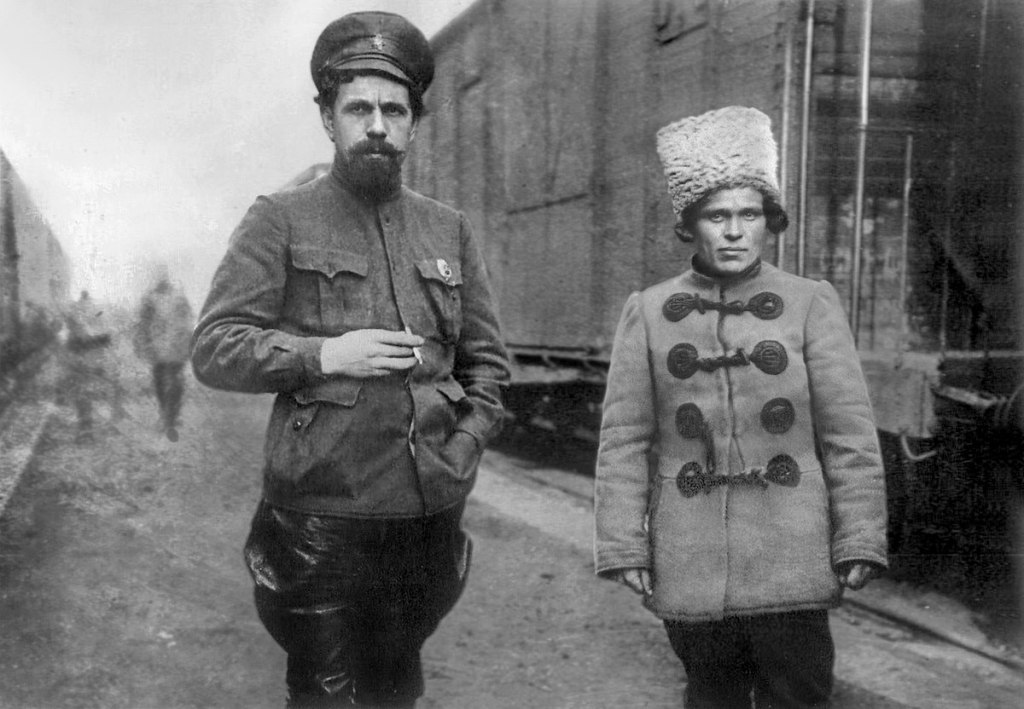
Makhno next to Pavel Dybenko, a Red commander and key leader of the October Revolution

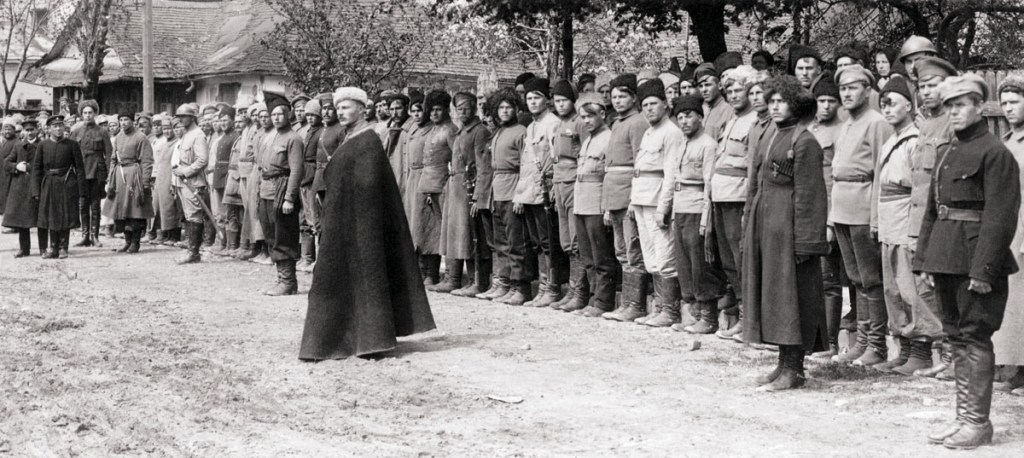
In early 1919 Makhno’s ‘Black Army’ joined the Red voluntarily. One Red Army division was co-led by Dubenko, Grigoriev and Makhno.

Conclusion

We leave it there in early 1919. The Reds are in control of a vast area but stretched thin, and things are about to go sour for them. Soon Ataman Grigoriev will change sides once again. In future posts in this series we will also look more closely at the Anarchists and the Ukrainian nationalists. Future posts will also explore what happened when the French military blundered into this mess with an invasion of Ukraine’s Black Sea coast. And keep an eye on those White Guards in the Donbass.

Go to Revolution Under Siege Archive

Go to Home Page/ Archive

Sources


[i] Smith, 128

[ii] Carr, 306

[iii] Again, Carr, 306

[iv] Deutscher, The Prophet Armed, 360

[v] Smith, 186

[vi] Smele, 102. Smith, p 186: ‘Thanks to Lenin’s intervention in December 1919, Russian chauvinists had been removed from the leadership of the Ukrainian party, and the absorbtion of the Borot’bisty, a left-wing splinter from the Ukrainian SRs, finally gave the party cadres who could speak Ukrainian and had some understanding of the needs of the peasants.’

[vii] Deutscher, 364

[viii] Most of my information on Grigoriev comes from this very informative essay: http://militera.lib.ru/bio/savchenko/04.html/index.html

[ix] Beevor, 261

[x] Beevor, 260
12: Warlords of Ukraine

This is Revolution Under Siege, a series about the Russian Civil War. In this post, we will contrast Ukraine in 1919 with 2022. Then we will begin a round-up of some of the array of factions which contended for power in Ukraine during the Civil War.  

From April to November 1918 the Ukrainian revolution was left to simmer under the heavy lid of Austro-German military occupation. With the end of the Great War the German and Austrian empires collapsed. Meanwhile the end of the Turkish Empire opened up Ukraine’s Black Sea coast.

The German soldiers cleared out. From the Taman peninsula at the eastern edge of Ukraine, the Germans vanished. ‘They disappeared in the night, quietly, as if they had never been there at all.’ Likewise one morning in Odessa citizens woke to find them gone.[i] It was not so sudden elsewhere; German soldiers would stay behind for a while, would join one faction or another or just try to keep out of it.

Within a few weeks, an array of diverse factions had appeared all over the country, and for a long time no force was able to hold the capital city, Kyiv, for longer than a few months. Nobody could count on their ‘allies’ and nobody was in full control of their ‘own’ soldiers. Suffice it to say that between 1917 and 1920 Kyiv changed hands sixteen times.

Ukraine in 1919 was as crucial as a theatre of war as the Don Country or Siberia. But civil war in Ukraine was even more complex than in Russia.

So this two-part episode takes the form of an explainer. First, we will go into the main ways in which Ukraine in 1919 was different from Ukraine in 2022.  Then we will give a run-down of each of the main contending factions.

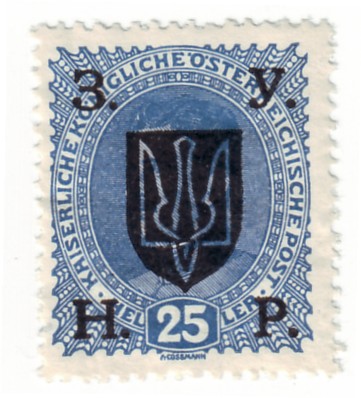
An Austrian postage stamp, with the arms of the Ukrainian nationalists superimposed

The current war in Ukraine lends immediacy to this topic. Then, like now, people were dying in terrible numbers in combat; masses of unarmed people were forced to leave their homes; civilians were murdered. The same place names feature, or the same cities under new names.

But if we look at 1919 through a prism of 2022, we will miss some essential points.

  1. This was a civil war between Ukrainians, with direct armed intervention from a range of other countries including Poland, France, Romania and Russia (both White and Red). It was not an invasion of Ukraine by the Russian state, as we see today.

But even to speak of Russian ‘intervention’ in 1919 on a par with French intervention is not fair, as we will go into below.

2. In 1919 the war was fought primarily on socio-economic questions – workers against bosses, peasants against landlords, peasants against the varicoloured armies which lived by pillaging them. But in 2022, the national question is in first place.

Ukraine, in 1919 as in 2022, is not a small nation. Its language, culture and people suffered vicious oppression under Tsarism. But one-fifth of the Empire’s population resided in Ukraine – 20 million people or even 32 million, depending on how you count them.[ii]

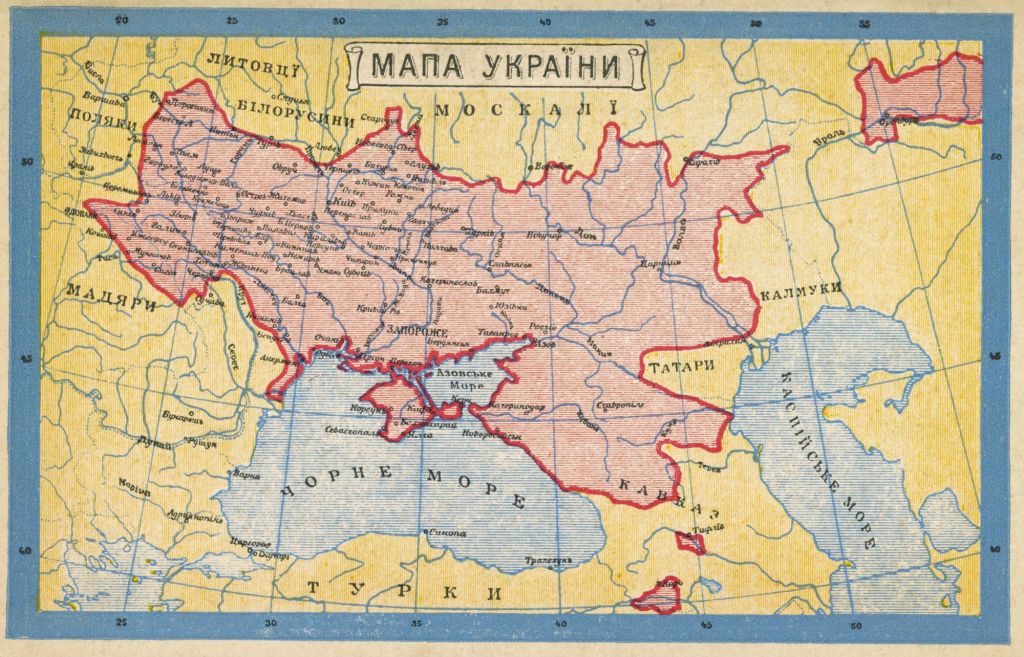
Some Ukrainian nationalists in 1919 had a very ambitious idea of what the borders of Ukraine should be

Here we come to another difference between now and then.

3. Ukrainian nationalism in 1919 was simply not the force it is today. In February 2022 when Putin’s regime invaded Ukraine, he probably counted on splits developing within the Ukrainian government, military and society. Over the six months between then amd the time of writing the Ukrainian people have not fragmented under the onslaught, but on the contrary cohered. They got behind the Zelensky government, even though most of them didn’t trust Zelensky before the war.

In 1919 the situation was very different:

[…] enervating to Ukrainian efforts toward statehood was the very weakly developed sense of nationalism in the territories it claimed as “Ukrainian.” Despite the inculcation of Ukrainian nationalism by successive generations of intellectuals during the nineteenth century, few of the region’s numerically predominant peasant population seem yet to have absorbed the notion of a distinct Ukrainian identity by the early twentieth century.

The cities were dominated by Russians and Poles in the civil service and the professions, and by Jewish people in commerce and intellectual life. The urban population was miniscule. Ukraine was a land of farmers and Ukrainian was a language spoken in villages.

In 21st-century Ukraine, 70% of the population lived in cities, and most of those city folk speak Ukrainian. It is a nation of workers and not of peasants. It is ruled not as in the early 20th century by Polish and Russian landlords but by Ukrainian capitalist oligarchs. The classes in Ukraine, the way people live and make a living, the national consciousness, have all changed utterly.

If today Kyiv was only 18% Ukrainian, and many of those 18% spoke Russian and considered themselves Russian, then Putin’s attack on that city would have turned out very differently. But those were the numbers in 1919. In the July 1917 local elections only 12.6% of the vote in small towns went to ‘overtly Ukrainian parties,’ and the corresponding figure for larger towns was 9.5%.[iii]

Unlike today, the idea that Ukraine should be an independent state did not have the support of a critical mass of the people. Among the urban and working-class population, this idea had very little support at all.

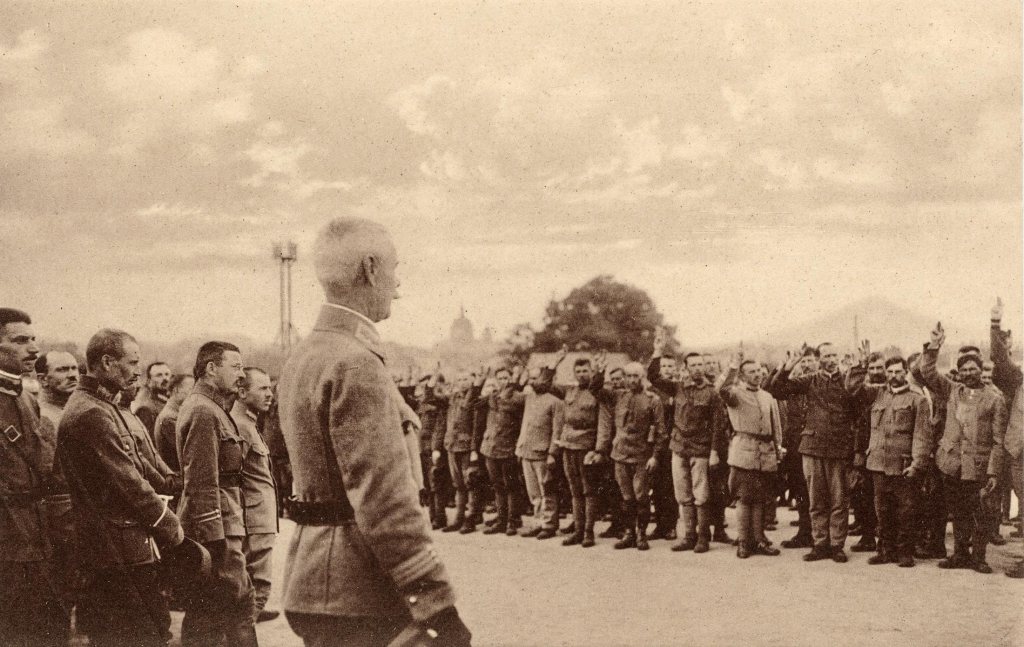
Released POWs from the Great War swear allegiance to the Ukrainian Rada, August 1919

4. In 1919 the Ukrainian nationalists did not have the support of the Allies. Today western leaders are effusive in their support for the Zelensky government, weapons have poured into the country, and blue and yellow flags are to be seen across Europe and North America. But in 1919 the Allies were suspicious of the idea of Ukraine being autonomous or independent of Russia. Remember, they hoped to see the White generals win the Civil War. These Whites spoke of Ukraine as ‘Little Russia’ and one of their key slogans was ‘Russia, one and indivisible.’ Why antagonise the White generals by ‘dismembering Russia’?

What was more, in February 1918 the Ukrainian nationalists signed a peace treaty with Germany. For this, the Allies never forgave the Ukrainian nationalists.

So there are some major differences between Ukraine a hundred years ago and now.

Below, our round-up of the various factions that contended for Ukraine in 1919 will further illustrate these points. It is divided into two parts, the second of which will follow next week.

1.      The Hetmanate

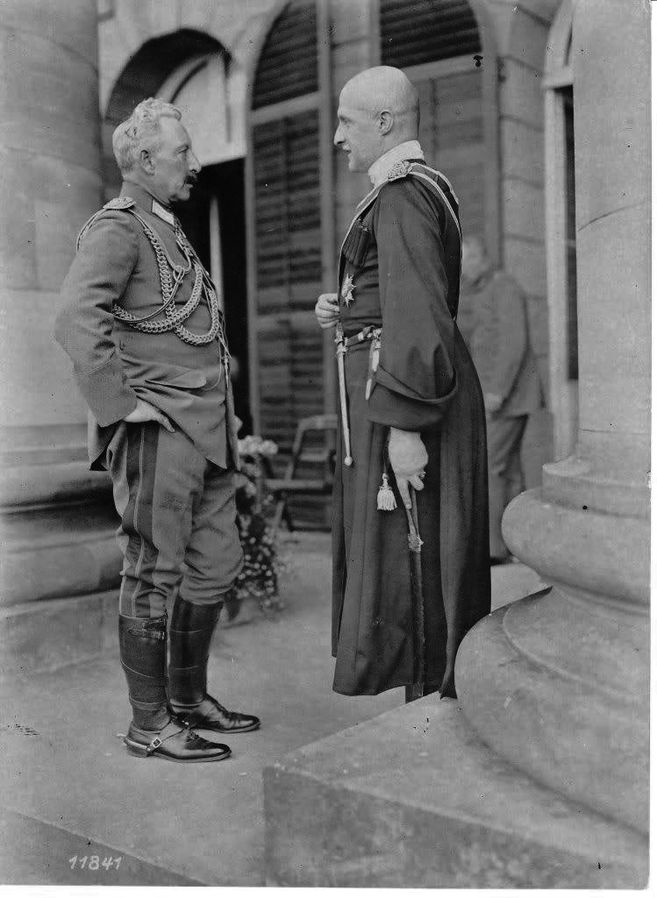
Skoropadskyi, Hetman of Ukraine, with his boss, Kaiser Wilhelm of Germany

As we have seen, in February and March 1918 the Germans advanced across Ukraine from the West, driving the Red Guards before them. The Ukrainian nationalists, led by Petliura and Vynnychenko, took Kyiv as the Reds cleared out, but soon surrendered to the advancing German military. The Germans tolerated Petliura and Vynnychenko for about five minutes before ousting them in a coup and setting up a puppet government. The leader of this government was Pavlo Skoropadskyi, a Russianised Ukrainian general and a former aide-de-camp to the Tsar, no less. His title was Hetman, which is a Ukrainian term for warlord.

In superficial trappings, the government of Hetman Skoropadskii, known as the Hetmanate, protested its Ukrainian-ness as if to compensate for its subservience to Germany.

The Hetman spoke only a little Ukrainian, and his ministers were from Russian political traditions hostile to Ukrainian liberation: the Costitutional Democrats and the Octobrists. They abolished all of the reforms that had been brought in before the coup, and they banned strikes.

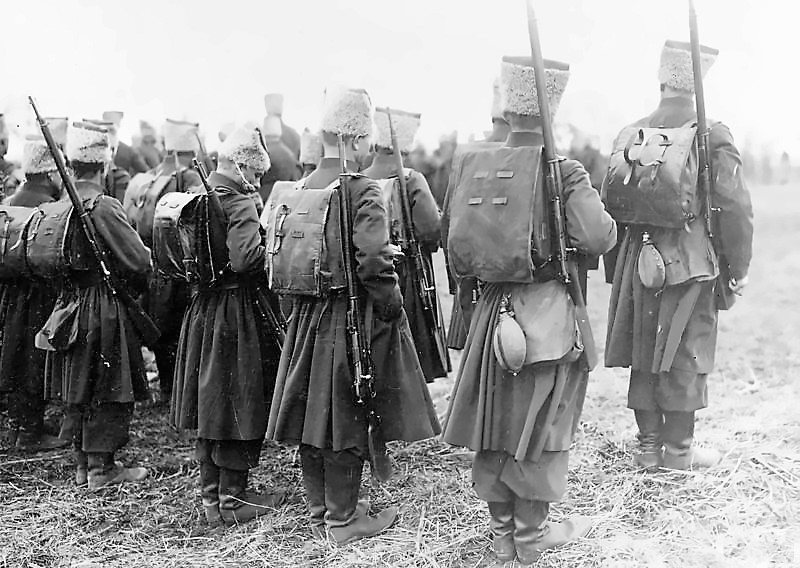
The Hetmanate ‘jarringly bedecked itself with the pseudo-Cossack trappings of a semi-mythologized Ukrainian national reawakening – uniforms, flags, titles and ranks not heard of since the seventeenth century (and some not even then) could be espied on the boulevards.’[iv] The rifleman of the 1st ‘Blue Coat’ Division of the Secheviye Streltsi wore a tall furry hat with a blue flamme, a long blue coat called a zhupan and baggy trousers of seventeenth-century fashion known as sharovari.[v]

But the reality of national oppression is summed up in one statistic: 51,428, the number of railway carriage-loads of grain and other goods which were, with the aid of the Hetman, stolen from the Ukrainian people and taken to Germany and Austria.[vi]

The Hetman’s soldiers, in traditional Ukrainian garb, October 1918

As we have seen, the German empire collapsed in revolution and surrender in November 1918. The pantomime was up, and Hetman Skoropadskii knew it. He cleared out on the next train to Berlin, dressed as a German officer. He made it to safety. Evidently this disguise was more convincing than his attempt to pass as a Ukrainian nationalist.

Most of my sources skim over the fact that there was a serious if brief war between the Hetman and the forces which replaced him, the Rada. In this war, the Allies promised to support the Hetman and even landed 5,000 British troops at Mikolayiv. But they were neutralised by the warlord Grigoriev, who we will look at next week.

2.      The Rada

We already saw how in 1917 a parliament took power in Kyiv, calling itself the Rada. It was dominated by liberal and social-democratic Ukrainian nationalists.

Though at first it appeared the Rada and the Soviets might tolerate one another (even after the Rada suppressed the Kyiv Soviet) they ended up at war. The Kyiv Arsenal workers were massacred by the Rada. The Left SR Muraviev (who would later mutiny on the Volga) led a horde of Red Guards into Kyiv with much bloodshed and shellfire.

Then, as we have seen, came the Germans, who first allowed the Rada to stay in power, then had them overthrown in a coup.

The Rada forces led a 30,000-strong rebellion against the Hetman during the summer. Revolts simmered. Partisan forces organised.

After the Hetman jumped on the train to Berlin, ‘a largely peasant army swept Petrliura to power.’[vii] The Rada forces seized Kyiv. This regime was known as the Ukrainian National Republic or the Directorate – but for the sake of clarity and continuity it will be referred to here as the Rada. The leading figures were Vynnychenko and Petliura, two former members of the Social-Democratic and Labour Party. They passed laws nationalising industry and seizing the great private estates of the landlords. But the regime did not have the time or the machinery to implement these reforms, and it was in fact dominated by local military officials.[viii]

Peliura and Ukrainian soldiers (Picture taken later, in 1920)

In one source we read that they nationalised industry, at least on paper. But in another we read that the Rada was a regime of the military and the bourgeois and professional classes which did nothing to win over the workers and did not espouse ‘social reform on any significant scale, thus failing to rally the peasants.’ These failures were ‘frankly and repeatedly admitted by Vinnichenko [sic]’ who also admitted that ‘So long as we fought the Russian Bolsheviks, the Muscovites, we were victorious everywhere, but as soon as we came into contact with our own Bolsheviks, we lost all our strength.’ Ukrainianisation aroused hostility. Vynnychenko also confessed that the Rada’s political appeal forced the Ukrainian people to choose between nation and class, and the Ukrainians chose class.[ix]

The Rada only remained in power a short time. Just like in 1918, the Rada barely got time to unpack its bags in Kyiv before it was chased out, this time by the Red Army. Petliura fled west to Vinnytsia, ‘where he formed a more right-wing regime purged of Social Democrats and Social Revolutionaries.’[x]

3.      The Poles

Ukrainians often have cause to explain to foreigners that there are two, three or more ways of pronouncing their name, or the name of their home town. In Irish terms, it’s like the Derry/Londonderry debate, or when a Seán is pointedly addressed as John, or when a member of the Ward family signs off as Mac an Bhaird. The different versions of names are statements rooted in a history of conflict.

Take one city which is today in Western Ukraine: ‘Lwów (Polish), L’vov (Russian), L’viv (Ukrainian), Lemberg (German) and Liov (Romanian) were all current during the revolutionary period.’[xi] In media reports today it is universally Lviv (no apostrophe).

Scenes of misery in Lviv in 1919

Let’s go with Lviv. In 1919 it was the chief city in what the Poles called East Galicia and the Ukrainians called West Ukraine. It had been for centuries a part of the Austro-Hungarian Empire. This empire had all-Ukrainian units in its army. In November 1918, at the war’s end, these Ukrainian soldiers rose up in revolt. They seized Lviv and declared a West Ukrainian People’s Republic (WUPR), allied to the Rada in Kyiv.

But the Polish state newly arisen to the west had designs on the same territory. The WUPR fought a bitter and bloody war for its survival against the new Polish army. The region was stricken by famine in these years as a result of the fighting.

Apparently, this is a shell still lodged in a wall in Lviv, left over from the 1918-9 Polish-Ukrainian war

After the Rada was chased out of Kyiv by the Reds in February 1919, they found refuge with the WUPR. But this refuge was worn down by constant attacks from the Reds to the east and the Poles to the west.

In April, Petliura signed away West Ukraine/ East Galicia to Poland in a peace treaty. For this, the WUPR elements never forgave him, and in émigré circles after the war they denounced the Rada as ‘rude, East Ukrainian peasant cousins.’[xii]

4.      The Whites

Ukraine bled seamlessly into the Southern Front of the Russian Civil War. Rostov-on-Don today is only a three-hour drive from Mariupol. The Volunteer Army was going from strength to strength in early 1919, and several thousand of these former officers and cadets occupied the Donbass region.

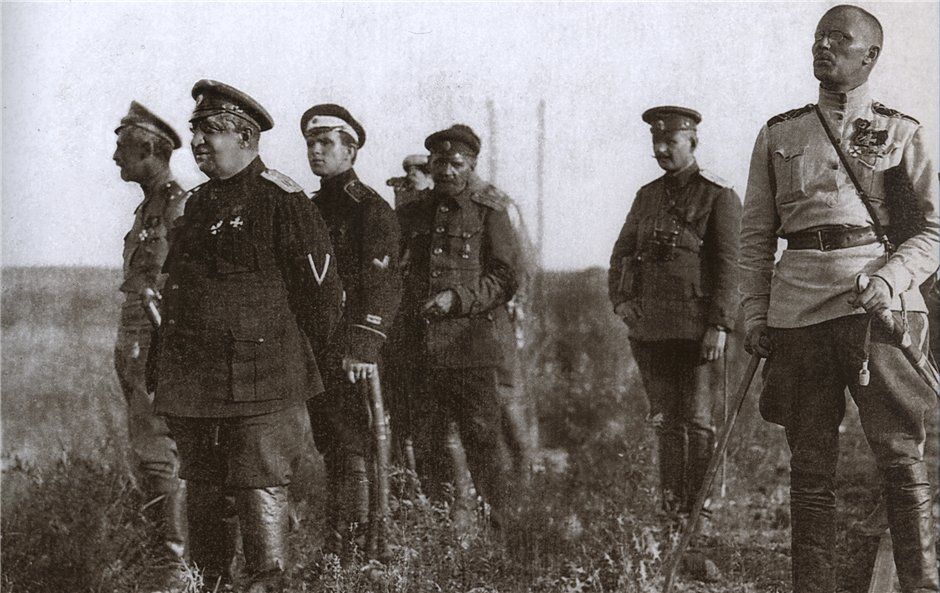
White officers, General Mai-Maevsky second from left.

The industrial, working-class Donbass region was not their natural habitat. Their numbers were not impressive. Their commander, General Mai-Maevsky, was a heavy drinker who looked ‘like a dissolute circus manager’ and brought with him a travelling brothel.[xiii]

Yet in the first half of 1919 they held the Donbass against three successive Red offensives. How? Professional soldiers are more mobile than militia, and steadier than partisans. They can wring the maximum out of whatever advantages they possess. In this case British aircraft scouted for the Volunteers, who made good use of the dense railway network of the Donbass. Under the leadership of Mai-Maevsky, who was courageous and brilliant in spite of first impressions, they were able to concentrate their forces at the decisive places whenever the Reds advanced.

General Vladimir Mai-Maevsky

The occupation of the Donbass, and the support of the British navy, meant the Whites were a factor in southern Ukraine.

Here we can compare 1919 and 2022. The White programme for Ukraine was broadly similar to Putin’s today: they did not want to loosen their grip on what they called ‘Little Russia.’ As for Lenin and the Bolsheviks, Putin today condemns them for their acknowledgement of Ukraine’s right to its own culture and to self-determination. For him, the prophecies of medieval saints carry more weight than the aspirations of 40 million people who want to live in peace.  

Join us again next week for ‘Warlords of Ukraine, continued,’ in which we will look at three more factions: the Reds, the warlord Grigoriev and the Anarchists.

Go to Revolution Under Siege Archive

Go to Home Page/ Archive

Sources


[i] Antony Beevor, Russia: Revolution and Civil War, p. 255 .

[ii] Smele, The ‘Russian’ Civil Wars, p 96 (20 million); Mawdsley, p 162 (32 million)

[iii] Smele, 98

[iv] Smele, 61

[v] Khvostov, White Armies, p 43

[vi] Smele, 62. When we factor in smuggling, the real number may be twice as high.

[vii] Smith, Russian in Revolution, 162

[viii] Smele, 62

[ix] Carr, The Bolshevik Revolution, Book One, 310

[x] Smith, 186

[xi] Smele xii

[xii] Smele, 152

[xiii] Beevor, 258

CLR James on Kwame Nkrumah

Nkrumah and the Ghana Revolution by CLR James

Motive Books, 1977 (1962)

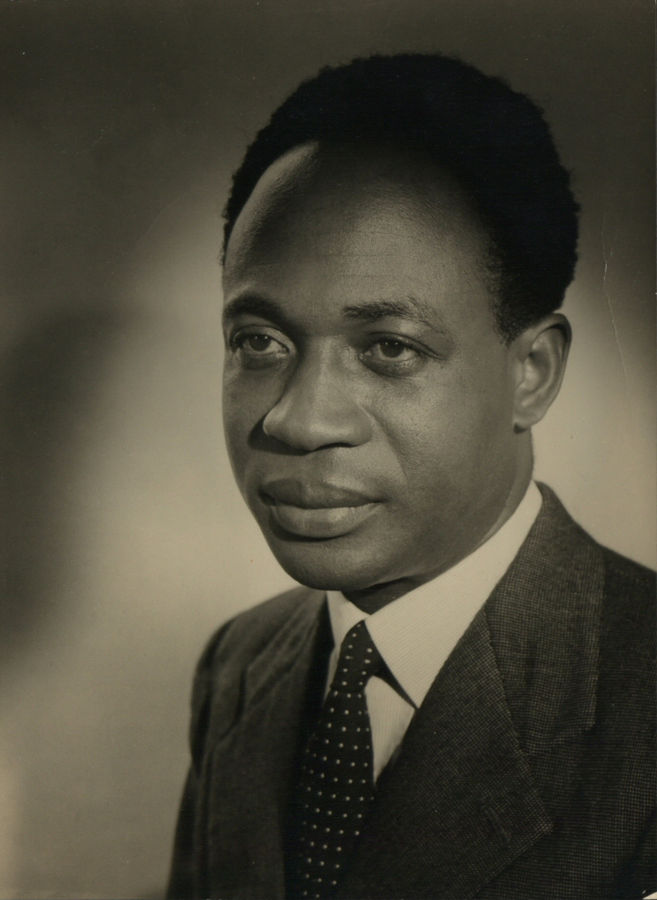
Kwame Nkrumah was the leader of the liberation movement in Ghana, formerly a British colony known as the Gold Coast. He was also its first leader as an independent state.

The book is made up of pieces: a shorter book, letters, an essay, a lecture. CLR James, a Marxist from the Caribbean who wrote The Black Jacobins in the 1930s, gives first an account of the revolution, then a hint of some of the problems encountered by the newly-independent state, and finally a developed meditation on problems of underdevelopment in former colonial nations.

The second of those three elements is the weakest. The brief parts of the book which hint at problems and criticisms of the independent Ghanaian state seem hand-wringing and uncertain.

The other two elements are strong, though all indications are that James’ politics have changed a great deal between the 1930s and the 1960s. The key criterion, class, is not absent but it is not in the first place. I know that in the 1930s James, Nkrumah, Kenyatta and George Padmore all moved in the same circles in London.

All in all, the book opened my eyes on the specifics of the Ghana Revolution, which I’d known nothing about, and on the problems of underdevelopment.

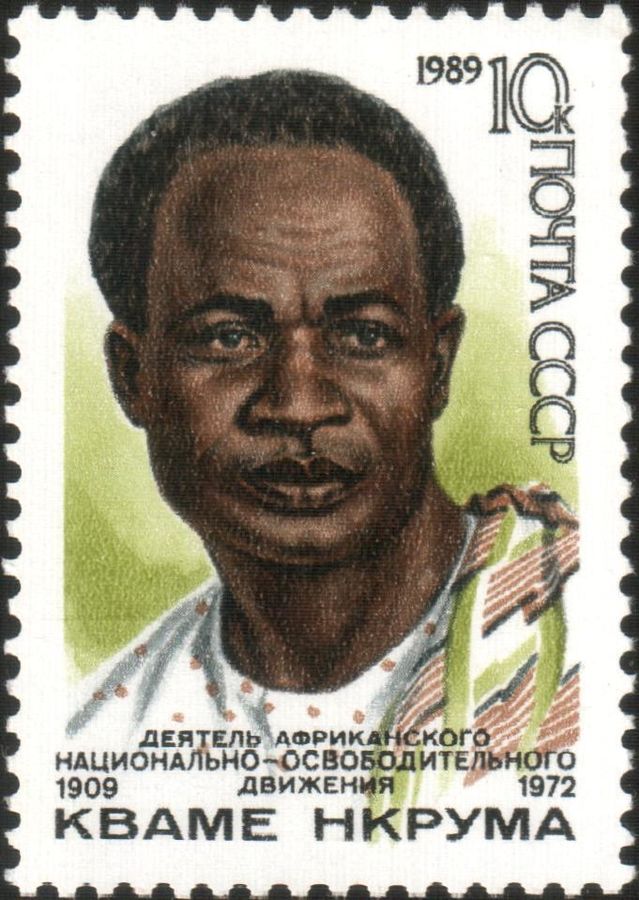
Nkrumah featured on a USSR postage stamp

I can’t comment in detail due to my lack of knowledge, but here are a few quotes that jumped off the page at me.

On the poet Césaire:

‘Césaire’s whole emphasis is upon the fact that the African way of life is not an anachronism, a primitive survival of history, even of prehistoric ages, which needs to be nursed by unlimited quantities of aid into the means and ways of the supersonic plane, television, the Beatles and accommodation to the nuclear peril. Césaire means exactly the opposite. It is the way of life which the African has not lost which will restore to a new humanity what has been lost by modern life with ‘its rebellious joints cracking under/ the pitiless stars/ its blue steel rigidities, cutting through the/ mysteries of the flesh.’ (23)

On European commentators:

‘they see themselves always as the givers, and Africans as the takers, themselves as teachers and Africans as the taught. In the thousands of reports, articles, speeches, that I have read about events in Ghana, I have never seen a single word, the slightest hint that anything which took place there could instruct or inspire the peoples of the advanced capitalist countries in their own management of their own affairs, and this is as true of the friends of Ghana as of its enemies.’ (38)

‘The reader will not understand these events or what is taking place all over Africa today unless he makes a complete reversal of traditional conceptions as to where is law and where is lawlessness. The disciplined community obeying its own laws was the masses of the people in Accra. The mob was the heterogeneous collection of chiefs, government officials, merchants and lawyers.’ (46)

On the people of Ghana:

‘[They were] governed by a long tradition of democracy in which the chief was no more than a representative of his people who could be, and often was, ruthlessly removed if his actions did not accord with their wishes. This was the condition of some seventy-five percent of the population.’ (53)

On women in Ghana:

‘The traders for generations have been the women (Nkrumah’s mother was a petty trader)… Thus in Accra there are thousands of women in action in the market, meeting tens of thousands of their fellow citizens every day. European visitors and officials up to 1947 saw in these markets a primitive and quaint survival in the modern towns. In reality here was, ready formed, a social organisation of immense power, radiating from the centre into every corner and room of the town.’ (55)

On protestors:

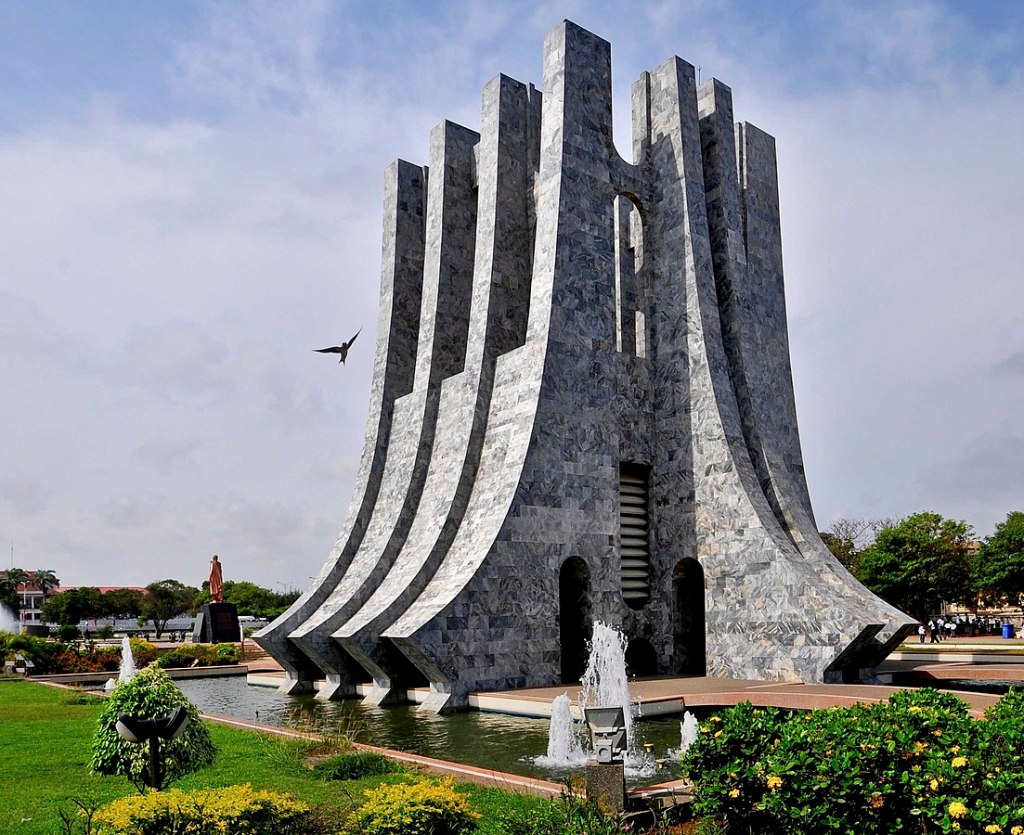
Memorial to Nkrumah in Accra, Ghana

‘They used the Lord’s Prayer:

O imperialism which are in Gold Coast

Disgrace is thy name…

‘The Apostles’ Creed:

I believe in the Convention People’s Party,

The opportune saviour of Ghana,

And in Kwame Nkrumah its founder and leader…

‘The Beatitudes:

Blessed are they who are imprisoned for self-government’s sake, for theirs is the freedom of this land.’ (108)

On Europeans who acknowledged Nkrumah’s power as an orator:

‘[They] added the sneering qualification “among Africans”. What mass oratory could Nkrumah practise among the Europeans? Or was he to go to China?’ (113)

Four quotes from Nkrumah himself:

  1. ‘We prefer self-government with danger to servitude in tranquillity.’
  2. ‘There come in all political struggles rare moments hard to distinguish but fatal to let slip, when even caution is dangerous. Then all must be on a hazard, and out of the simple man is ordained strength.’
  3. ‘We have the right to govern and even to misgovern ourselves.’ (117)
  4. ‘What other countries have taken three hundred years or more to achieve, a once dependent territory must try to accomplish in a generation if it is to survive. Unless it is, as it were, ‘jet-propelled’, it will lag behind and thus risk everything for which it has fought.’ ( 157)

Misc:

‘That this revolution was blood and bone of the twentieth century is shown not only by its planned character, but also by the role of the Trades Union Congress. Ten thousand workers organised in a union are ten times more effective than a hundred thousand individual citizens.’

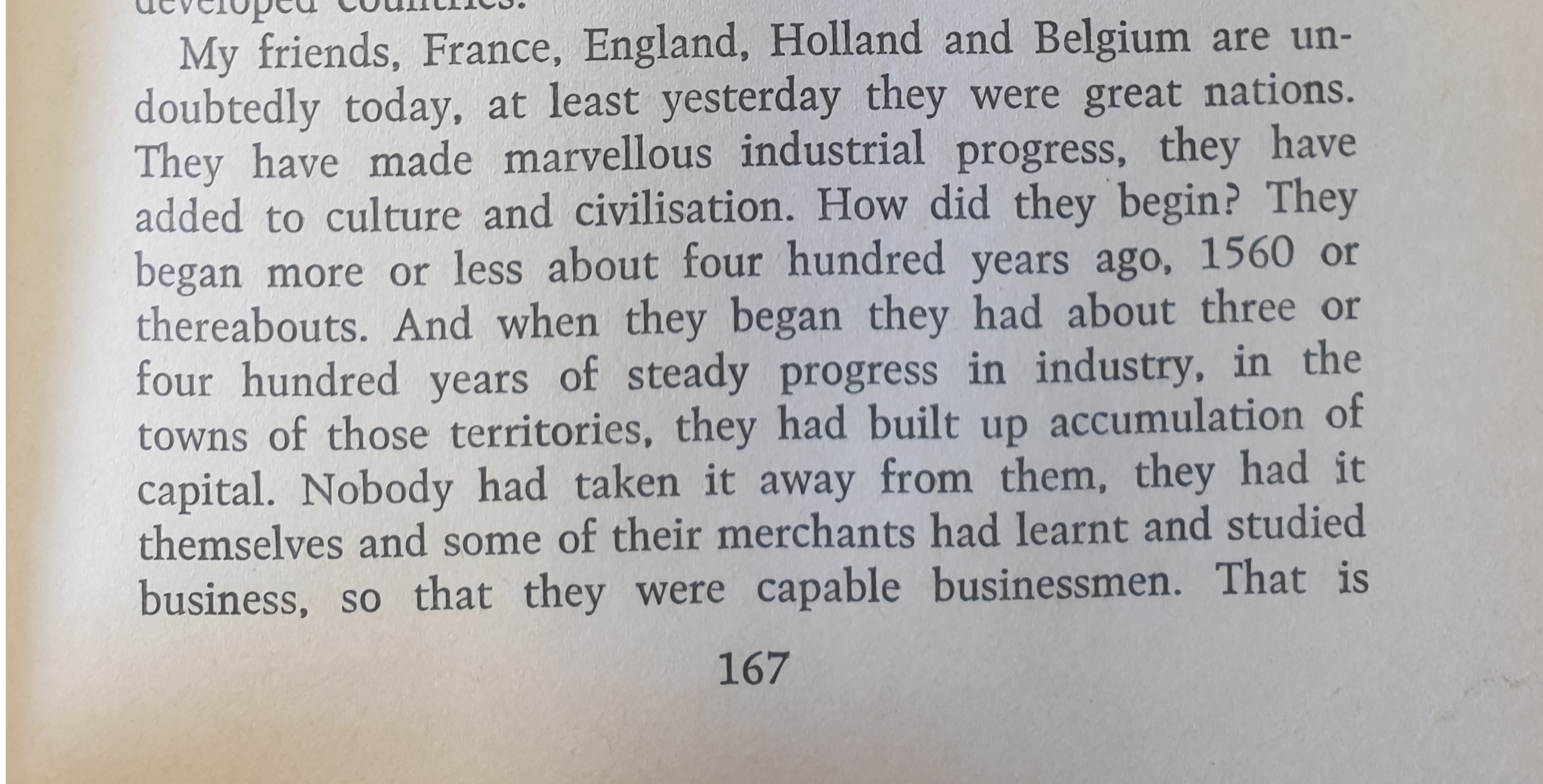
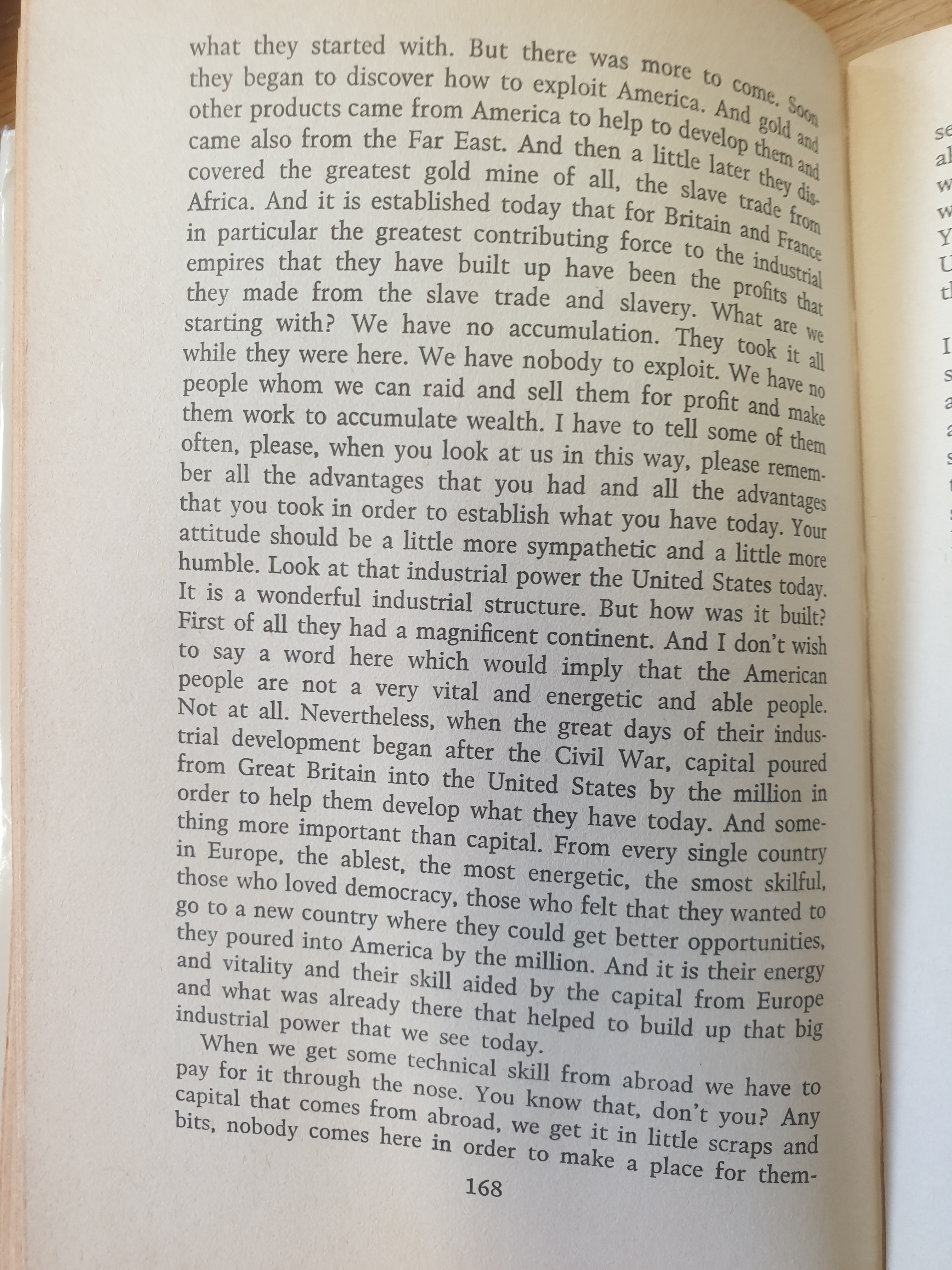
Here is a longer quote, photographed rather than transcribed because of its length:

Go to Home Page/ Archive

History’s Greatest (W)Hit(e)s

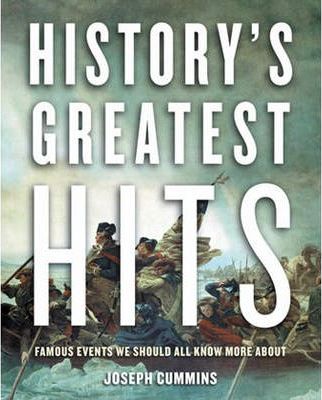
I have come across a large illustrated book titled History’s Greatest Hits.

I have a big problem with this book.

The simplest way to explain it is, imagine you came across Metallica’s Greatest Hits only to realise that all 36 tracks were songs on which Jason Newsted played bass. If you don’t know Metallica, substitute any other band and any other musician who only appears on three of their albums. There’s nothing wrong with Jason Newsted (Some people think the Black Album is their best). But most of Metallica’s greatest hits would not be on that list.

The blurb to History’s Greatest Hits promises an easy-going tour of ‘history’ via a range of episodes which ‘we should all know more about.’ The introduction says that we will meet a wild variety of historical figures – ‘From Queen Elizabeth I and Christopher Columbus to George Washington and Winston Churchill.’ Three of those people spoke the same language, three were from the same continent, two were from the same small island, and all of them had the same skin colour.

I skim-read a few of the chapters and found them fine. I’ll assume it’s well-written and well-researched. I don’t know anything about the author, and for all I know the publisher called the shots. But the contents page reveals a staggering bias:

  • Of the 36 chapters, 30 are set in Europe or in post-1492 North America (including the one about Americans on the moon).
  • Of the remaining 5, 4 are not set in Europe or North America, but are focused on people from those places: the Crusades, the bombing of Hiroshima, the Cuban Missile Crisis and the Tet Offensive. The other is the 6-Day War of 1967. This is an episode in which the protagonist, the state of Israel, is today closely aligned with the US politically.
  • 2 involve protagonists from other parts of the world – Hannibal crosses the Alps, 9/11 – but the focus is on the menace they posed to Ancient Rome and modern New York, respectively.
  • 16 specifically and directly involve England, and 13 the United States (We’re up to 29 out of 36).
  • The section on ‘The Ancient World’ consists of three chapters, all of them about Rome.
  • So that’s 32 out of 36 chapters focused on Rome, England and the US!
  • For World War One there are two chapters (Both about Britain), and for World War Two, four (all about the US). None on the Eastern Front or China! So we get D-Day and the Battle of the Bulge, which happened six months and a few hours’ drive from each other, but not Shanghai or Stalingrad, Egypt or Burma.

Here you may point out my hypocrisy. My own little blog has so far been largely Eurocentric. In my defence, if you look at my ‘About’ page, this blog never made any claim to encompass all of human history, or to present its most interesting and significant episodes. The criterion is my own eccentric preoccupations and I never presented it any other way.

This book suggests that all the most important and interesting things in history happened in limited parts of the world and involved only a small slice of the human race. The suggestion is that everyone else was sitting around not doing much for thousands of years (except, from time to time, producing a Hannibal, a Bin Laden or a Tet Offensive to present a challenge).

Readers assume that the writer and publisher know what they’re talking about, and accept, consciously or unconsciously, that that the baton of ‘civilisation’ has been passed from Rome to England to the US, and that history consists of what they were doing.

And the bias in this one book is reflected in a thousand other places.

History’s Greatest Hits was published in 2003, nearly 20 years ago. Could such a book be published today? Absolutely. The book’s bias is very easy to demonstrate, which makes it easy enough to prove a point, which is why I’ve decided to write about it. But it’s not an extreme example. Keep an eye out and you will notice a ton of similar stuff.

But, you might argue, the book is written for English-speaking audiences and needs to pander to them. ‘Play the hits’ – tell us the stuff we already know!

In response to that I’d say: let’s look at another book, by coincidence also published in 2003. This is The Horrible History of the World, by Terry Deary and Martin Brown. Opening pages: Australia (30,000 BC), Egypt, Nubia. Skip on a bit. Babylon, Greece, India, China. A large picture of Shaka Zulu looking grumpy. A closer look would probably reveal a Euro and Anglo bias. But at least some effort has been made.

This kids’ book gives a better overview of ‘history’s greatest hits’ than the adults’ book, for the simple reason that it’s actually global in scope.

To end on a positive note, what would a balanced playlist of ‘History’s Greatest Hits’ look like?

Here is a list of 36 alternative topics, in no particular order of relevance or chronology. Its purpose is to illustrate that even a blogger like me can come up with more than enough interesting and important topics from the history of Africa, Asia and South America.

Ancient World:

1 The Reign of Hammurabi (Babylon)

2 Cyrus the Great liberates the Hebrews (Persia)

3 Polynesian migrations (Pacific Ocean)

4 The Terracotta Army (China)

The Middle Ages and Renaissance

5 The birth of Islam

6 The ‘Divine Wind’ prevents a Mongolian invasion of Japan

7 The glory of Benin City (Nigeria)

8 Georgia’s Golden Age

9 The Chola conquest of Sri Lanka

10 Buddhism comes to Tibet

11 The Iroquis ‘Great Peace’ (North America)

12 The Ming dynasty treasure voyages (China)

The Early Modern Era

13 Russian settlement of Siberia

14 The Sengoku Jidai (Japan)

15 Native Americans adopt the horse and firearms

16 Revolution in Haiti

17 Reunification of Ethiopia, 1855

18 Shaka Zulu (South Africa)

19 Dungan Revolt

20 The Opium Wars

21 The Trail of Tears

A World at War:

22 The Colombian Civil War

23 The Armenian Genocide

24 The Women’s War in Nigeria

25 The Arab Revolt

26 China: the Long March

27 Unit 731 in Manchuria

28 Indian famine of 1943

The Cold War and Beyond:

29 Nasser seizes the Suez Canal

30 Ghana achieves independence

31 The overthrow of Salvador Allende (Chile)

32 Suharto’s Coup in Indonesia

33 The Killing Fields (Cambodia)

34 The Angolan Civil War

35 Overthrow of Apartheid in South Africa

36 Bolivia’s Water War

Go to Home Page/ Archive

The Real Macbeth

Based on Macbeth: High King of Scotland 1040-57 AD by Peter Berresford Ellis, Frederick Muller Limited, 1980

Peter Berresford Ellis’ Macbeth is a short biography that debunks the version of the medieval Scottish king that we see in the famous Shakespeare play.

But Ellis defends Shakespeare himself, making it clear that the great playwright based his work on the only sources which were available to him in 17th-century London. It is mainly these sources which are to blame, not Shakespeare himself.

Ellis’ book goes right back to the earliest primary sources, the sagas and chronicles of the Gaels of Ireland and Scotland, of the Anglo-Saxons and Vikings. Macbeth’s age, the mid-11th Century, was a fascinating time, obscured by a scarcity of sources, and it’s worth reading this book just to get a sense of the period.

Shakespeare does make an effort to populate his play with kerns and gallowglasses and other medieval Celtic trappings. But ‘cannons overcharged with double cracks’ intrude into an otherwise brilliant depiction of an early medieval battle (Act 1, Scene 2). Again and again (as we will see below) 17th-Century pathologies rear their heads.

This is one of the great things about Shakespeare. His flagrant anachronisms place his stories in, as Ellis says, a ‘never-never-world’ which makes it easy to apply them, to adapt them, to reset them in new contexts.

School textbooks today will all point out that the play is historically inaccurate. But they don’t go into much detail. Let’s go through it, act by act. By the way, this book was written over 40 years ago and I haven’t read much on Scottish history aside from this. This is all based on what I’ve read in this book and my previous readings on Celtic society. Many of the points below will tie in with Celtic Communism? a series I wrote last year.

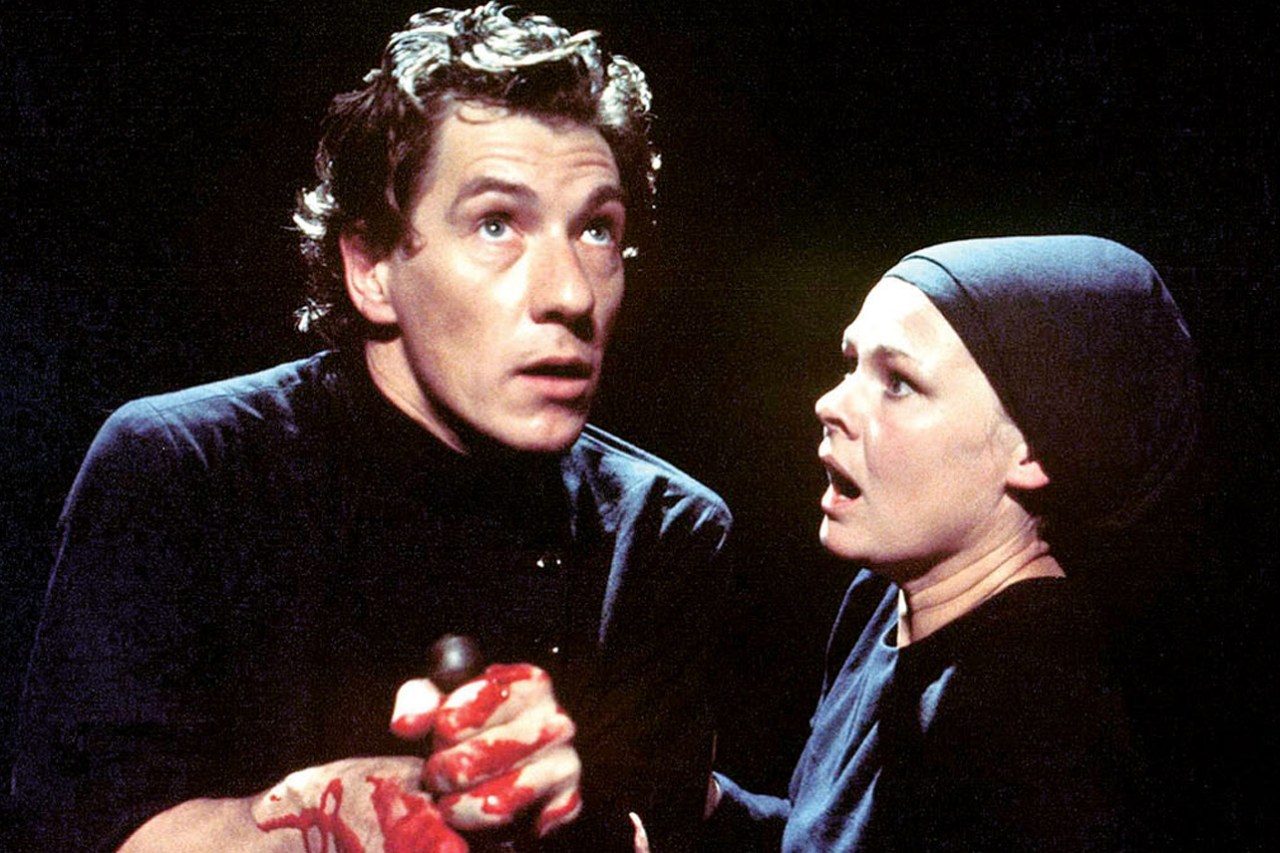
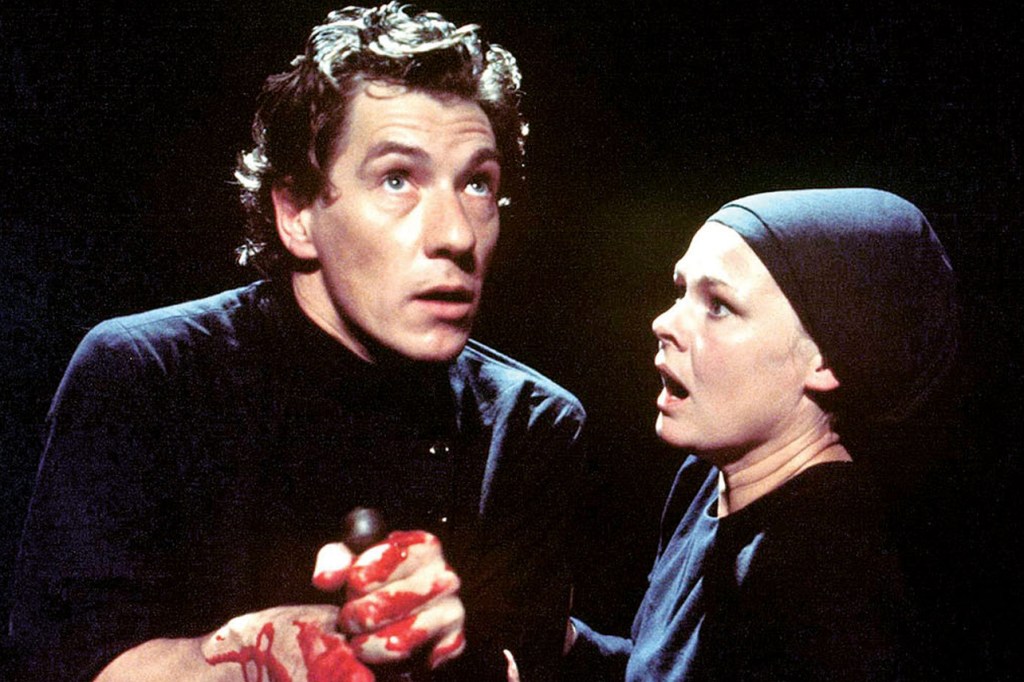
From IMDB. Ian McKellen and Judi Dench star in Trevor Nunn’s 1978 minimalist film version of Macbeth, the best film version I have seen. Mandatory Credit: Photo by REX USA (95938a) IAN MCKELLEN AND JUDI DENCH Judi Dench actress Ian McKellen in play Macbeth

Act 1

Scene 1: The play opens with three witches. They are not in the contemporary and near-contemporary sources at all. The witch-burning craze was a 16th and 17th century phenomenon. These three characters appear as nymphs or goddesses in Shakespeare’s immediate sources. But Shakespeare knew his audience (his company’s patron King James, author of a book on witches titled Demonology).

Scene 2: We get a vivid description of bloody battles. Two rebel Scots, Macdonwald of the Western Isles and the Thane of Cawdor, assisted by the Norwegians, are making war on the good king Duncan. Duncan prevails thanks to the assistance of Macbeth.

In reality, this was a war between Duncan and his cousin Thorfinn, jarl of Orkney. Duncan was defeated, and Ellis believes that Macbeth probably fought against him, and caught him and killed him in the aftermath of the battle.

Scene 3: These titles – thane of Glamis, thane of Cawdor, etc – are all wrong. Macbeth was Mormaer of Moray – which was one of the highest positions in Scotland. Banquo, meanwhile, was invented later as a mythical ancestor for the family of King James. He’s another figure who does not appear in the early sources.

The king throws around titles as rewards: Thane of Cawdor, Prince of Cumberland. In the Gaelic political system, these positions were elective. Duncan, by the way, was High King and not King.

Lady Macbeth had a name – Gruoch – and a son by her previous marriage, Lulach, whom Macbeth treated as his own heir. The evil Lady Macbeth is really Shakespeare’s own invention. So none of the evil female characters were in the original sources.

In all of Duncan’s scenes, we see him using the royal ‘we’ and being showered with all kinds of toadying and extravagant flattery. I’m sure this was how kings behaved and were treated in Shakespeare’s day. But I would guess it was not the case in Celtic Scotland.

By the way, although they were cousins, Duncan’s family and Macbeth’s were mortal enemies going back generations. Someone, probably Duncan or his allies, slaughtered Macbeth’s father when Macbeth was a child. This elaborate flattery is therefore doubly inappropriate. The relations between these men should be tense.

Duncan and Macbeth were not just individuals but representatives of rival factions, rival kingdoms even: Moray and Atholl. Or Moireabh and Fótla, Donnchadha and Mac Beathadh– as Ellis reminds us, the people of Scotland spoke Gaelic at this time and for hundreds of years after.

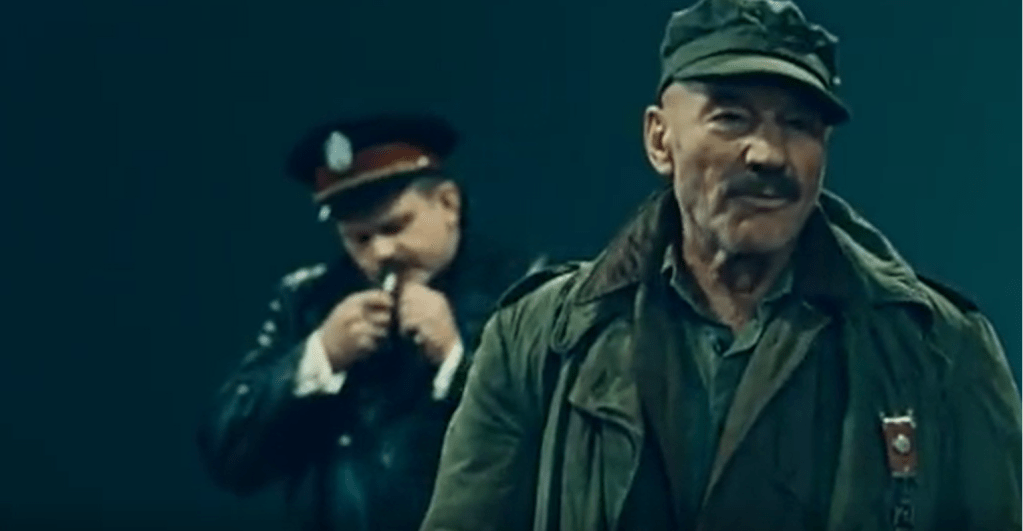
Screenshot from Macbeth (dir Rupert Goold, 2010), another film version. This one imagines Macbeth as a Stalinist dictator.

Act 2

Throughout this Act, killing Duncan is treated as a sacrilege. It is ‘A breach in nature for ruin’s wasteful entrance.’ His blood is golden. His virtues will ‘cry out like angels, trumpet-tongued, against the deep damnation’ that is his murder. He is ‘the lord’s anointed temple.’

Gaelic Scotland, according to Ellis, would not have seen in that way. They had a duty to depose and kill defective kings. And the historical Duncan was an unsuccessful warmonger.

What would have been seen as sacrilege would be the murder of a guest. Ellis says it would have been impossible. This is because the rules around hospitality were so strong in Gaelic culture.

In Shakespeare’s text, Macbeth’s real crime is not that he killed a nice man – it’s that he killed a king. The Early Modern mind reels at the unthinkable sacrilege. Yet within a few decades of the first performance of this play, the English cut their king’s head off; I think Shakespeare protests too much, and his play manages to channel some of that cultural substance which would go on to flow powerfully into the English Revolution.

At the end, there is a little hint of elective kingship. The characters remark that ‘’tis most like the Sovereignty will fall upon Macbeth.’ But this is only the tiniest hint.

Act 3

Feudal imagery continues – barren crowns, fruitless sceptres. This imagery also suggests primogeniture, which was alien to Scotland at the time.

The play implies that a short time has passed since Macbeth was crowned. The significance of the banquet scene is that Macbeth’s authority and sanity are already starting to unravel. He has had no chance to enjoy being king.

But the historical Macbeth ruled in relative peace and stability for seventeen years. His reign was far longer than those of his immediate successor and predecessor.

The banquet scene is an absolutely brilliant moment in the play. But as we have noted, Banquo was not real.

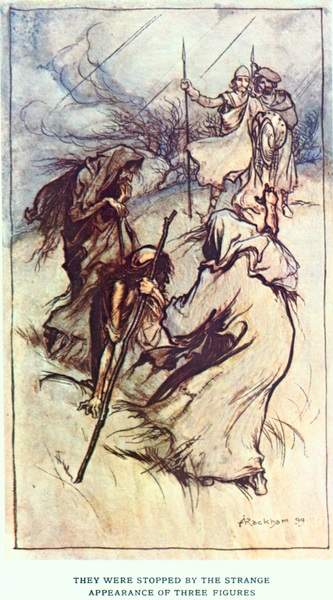
Three strange figuresː Macbeth by Arthur Rackham, 1909 (Tales from Shakespeare by Charles and Mary Lamb). Another memorable, iconic scene from the play which does not appear in the earliest sources.

Act 4

Macduff is another character who was probably invented hundreds of years later. As for the slaughter of his family, another invention.

Act 4 Scene 3 shows England as a wonderful utopia ruled by a saintly king, in contrast to Scotland where ‘new widows howl’ every morning.

In reality England at this time was torn by upheaval and conflict between Norman, Danish and Anglo-Saxon lords. Scotland only saw one internal revolt during the long years of Macbeth’s reign, and that was isolated and put down quickly. Funny, that! I thought primogeniture was supposed to bring stability.

There is a long conversation between Malcolm and Macduff, a tedious part in what is otherwise such a well-written play, where they catalogue exhaustively all the characteristics of a good monarch. As well as being slow, this is in fact a catalogue of anachronisms.

Act 5

In the final act an English army invades Scotland, supported by a universal revolt of the Scottish people ‘both high and low.’ The people have risen against Macbeth: ‘minutely revolts upbraid his faith-breach.’ Macbeth is holed up in a fort, losing his mind, lashing out in madness or in ‘valiant fury.’ The enemy army marches on his fort disguised behind the boughs of trees. He fights to the last almost alone, his own side deserting him and refusing to strike the enemy. Then he is killed and his severed head is displayed.

How accurate is all this? Let’s start with the good (I’ll have to reach a little).

The depiction of the English-Danish Earl Siward is accurate, including the detail of him losing his son in the battle and his stoic reaction. Ellis goes further into this.

It’s also interesting that Malcolm makes his thanes into ‘earls, the first that ever Scotland in such an honour named’ and also promises to ‘reckon with your several loves and make us even with you.’ The first quote reflects how Malcolm, and more so his descendants, brought many English feudal customs to Scotland. The second quote is true in that he rewarded those who had helped him, including by giving large estates in Scotland to English invaders.

But the rest is fiction. Macbeth met Malcolm and Siward in the field (yes, probably near Birnam), and while he lost he survived, and inflicted heavy casualties. His enemies were so battered they could not follow up on their victory; Macbeth ruled for another three years! That deflates the ‘Tomorrow and tomorrow and tomorrow’ speech, doesn’t it? Ellis reckons Malcolm annexed Cumberland and Macbeth remained High King of Scotland. Three years later, Malcolm resumed the struggle and this time killed Macbeth and took the title of High King. Macbeth was buried with the full honours due to a High King on the holy island of Iona. This distinction was denied to Malcolm when he died.

But Malcolm’s descendants went on to rule Scotland for centuries. The myth of the evil Macbeth had to be invented in order to improve the image of Malcolm, a beggar prince and a foreign-backed usurper.

Go to Home Page/ Archive

What if Michael Collins had survived the Irish Civil War?

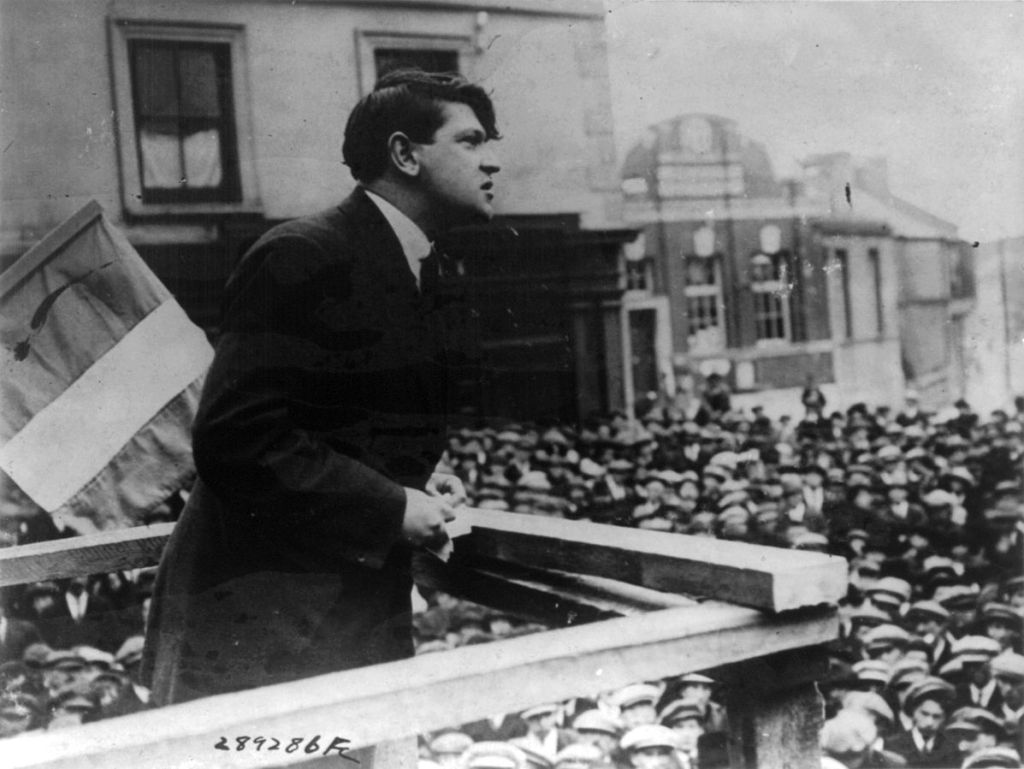
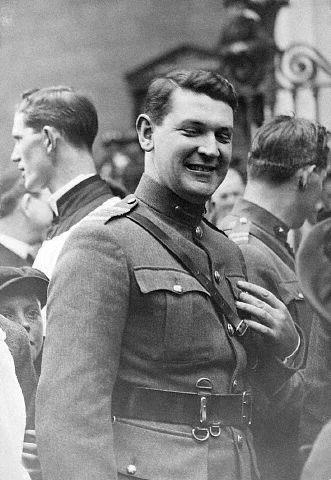
In a quiet little library in a certain small town in Ireland you can find no fewer than four biographies of Michael Collins side-by-side on the shelves, along with further titles in the children’s section. A few years ago, members of the youth wing of Fine Gael used to brandish a life-size cut-out of Michael Collins in military uniform (only half ironically). And just yesterday I saw in a bookshop window a children’s book about him titled ‘The People’s Peacemaker.’ As we approach the centenary of his death, Michael Collins is still a very big deal in Ireland.

A while ago I answered a ‘What If’ question about Collins. Would it have changed the course of Irish history if he had survived the Irish Civil War?

My reply was dismissive. I wrote that if he had lived he would have been associated with all the atrocities committed by the Free Staters. The only difference between our timeline and that alternative timeline where he survived would be that the name ‘Michael Collins’ would not be surrounded with such a halo.

But I’ve done some further reading and it’s clear to me that I was wrong. Let’s address the question again.

How could Collins have survived?

Usually it’s difficult to come up with a good explanation for how things could have turned out differently. But in this case it’s very easy. Collins’ death was the result of a whole series of accidents. Those who killed him didn’t want to kill him specifically and it’s possible they weren’t shooting to kill at all. Peter Hart blames Collins’ bravado, his combat inexperience and his possible hangover. But even with all that, the chance of that bullet killing him was tiny. He was the only fatality in twenty minutes of fighting.

My alternative scenario is simple: the bullet didn’t hit him, or else it hit him in the arm or the leg rather than the head.

Usually this is the part where we say ‘If he hadn’t died that day, there was a good chance he’d have died some other day.’ Really, there wasn’t. 1500 people died in combat in the Irish Civil War. Collins was a commander on the winning side. He was respected by his enemies, who had no motive to target him. He had a very good chance of making it out alive.

Collins the conciliator

Michael Collins and Éamon De Valera are often presented as arch-enemies who were at loggerheads from the moment the Treaty was signed. In fact they were the most conciliatory figures in their respective factions.[i] Before the Treaty was signed, the British in fact saw De Valera as the one who was willing to talk, and Collins as the ‘extremist gunman’ holding him back.[ii] Collins and De Valera worked together to get others to go into negotiations. For example Collins supported a bizarre suggestion by De Valera that the relations between Cuba and the USA under the ‘Monroe Doctrine’ would be a suitable model for Anglo-Irish relations.[iii]

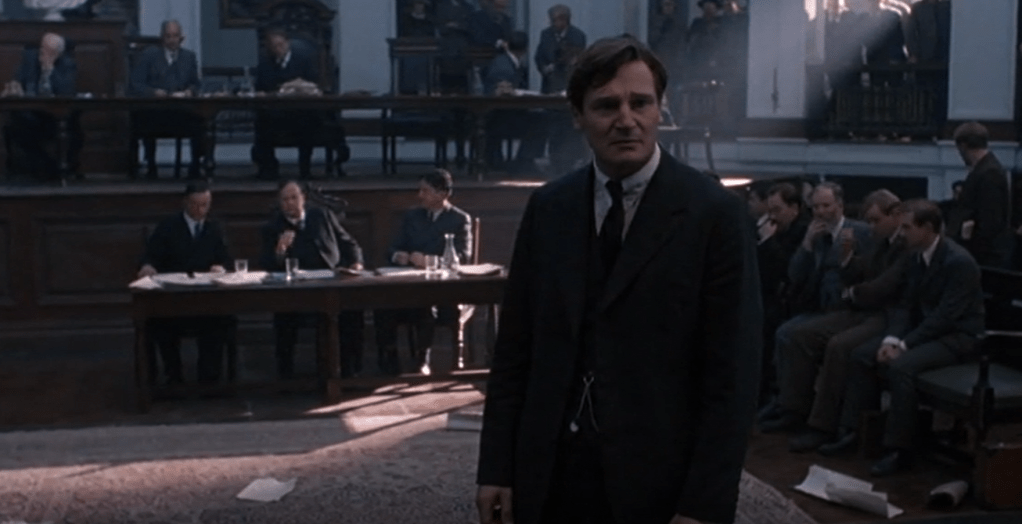
Neil Jordan’s 1996 movie Michael Collins skips over a key episode between the signing of the Treaty and the outbreak of Civil War six months later. Collins spent these six months trying to fudge the Treaty by means of the new Free State constitution. He ‘fumed’ not over the anti-Treaty side but over the British, with their ‘insolence’ and intransigence. He tried to come up with a constitution that would bridge the divide between pro-and anti-treaty factions, but Churchill and Lloyd George again and again renewed their threat of war. I would have scoffed at the title ‘People’s Peacemaker’ before – but he really did make peacemaking his number one task at a time when other Free Staters (Blythe, Griffith and O’Higgins) wanted war as a chance to wipe out the anti-Treaty forces.

Michael Collins (Neil Jordan, 1996)

Collins in the Civil War

Memos from early July 1922 (the first weeks of the Civil War) indicate that Collins was open to peace proposals: ‘We will meet them every way if only they obey the people’s will.’ He allowed open anti-Treaty political activity and opposed the punishment of civilians near ambush sites or indiscriminate firing in the direction of snipers.[iv]

This marks a contrast with how, in the months after his death, the Free State cabinet signed off on executions without trial. They passed the draconian Public Safety Act, then applied it retroactively to enemies captured before it was in force, just so that they could have an excuse to put their opponents up against a wall.

During the fighting in Dublin in the first week of the war, when Collins was still in charge, the Free State troops kept only a very loose cordon around the city. This made military and political sense. It encouraged the anti-treaty forces to slip away instead of fighting to the end.

Again, there is a profound contrast with how the war was conducted later. WT Cosgrave, the head of the Free State government, in January 1923 dismissed any attempt to make peace with the anti-treaty forces. The executions probably prolonged the war, but he didn’t mind; his goal was to wipe out the anti-treaty forces, not to end the fighting and risk ‘another Four Courts.’[v]

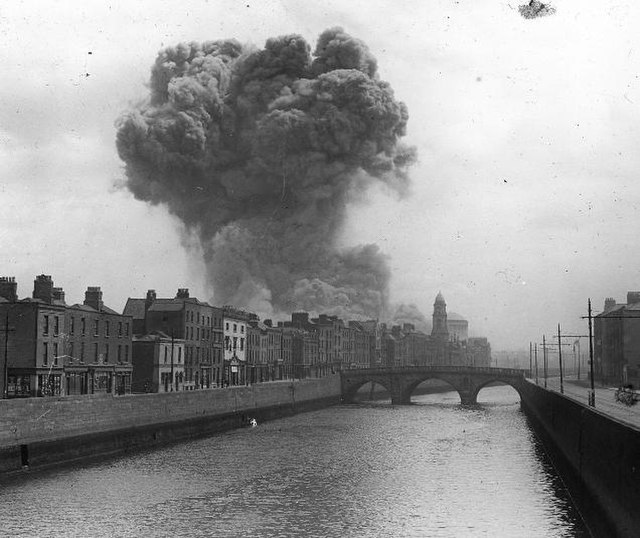
Free State forces ignite the ammunition dump of the Four Courts garrison, June 1922. This marked the end of the Four Courts occupation by anti-Treaty forces and the start of the Civil War.

There was a fundamental disagreement on strategy: Collins wanted a victory to bring an end to the fighting. The hardliners (who were mostly civilians!) wanted to exterminate their enemies.

OK, the sceptical reader might say. But that was later. You’re comparing statements from July with statements from the following January. Maybe Collins would have had a different attitude with the war dragging on.

But even in the early weeks of the war other Free State figures were waging a different war from Collins. Eoin O’Duffy (third-in-command after Collins and Mulcahy) was opposed to any peace initiatives. ‘The Labour element and Red Flaggers are at the back of all moves towards “Peace” […] if the Government can break the back of this revolt, any attempts at revolt by labour in the future will be futile.’[vi] Collins was still alive and probably read those words. He was not sympathetic to labour. But he didn’t agree with this approach.

So… What if he had lived?

I still don’t have a positive view of Michael Collins. He supported the disastrous Treaty. He broadly supported the counter-revolution which the pro-Treaty side represented, such as the suppression of the Republican popular courts system in July. His ‘Squad’ of assassins would go on to commit atrocities in Kerry during the Civil War. He was part of the guerrilla movement which wanted an independent capitalist Ireland (and was willing to settle for much less). He was emphatically not part of the mass labour movement of the time which in my view really promised a way forward and held the potential to avert Ireland from the mire of partition, Civil War and Church control.

And as a peacemaker, he failed. He acted under the British government threat of ‘terrible war,’ and allowed them to drive him into a ‘terrible war’ with his former comrades.

But I’m now convinced that he was very different from those who ruled in the new Free State – Cosgrave, O’Higgins, Blythe, O’Duffy, etc. In the Civil War itself, there are plenty of indications that he was pursuing a different strategy. In our own benighted timeline, the war dragged on until the scattered and miserable remnants of the anti-treaty forces dumped their arms and went home. There was no peace treaty. The Civil War remained an open wound. Had Collins lived, he might have used his personal authority to call for a peace process or treaty negotiations. There were plenty of voices calling for peace, and the addition of Collins’ voice would have been significant. The war might have been wound up earlier with a negotiated settlement, with less bitterness and bloodshed – crucially, with less of a total, sweeping victory for the greasy till-fumbling Irish big business class.

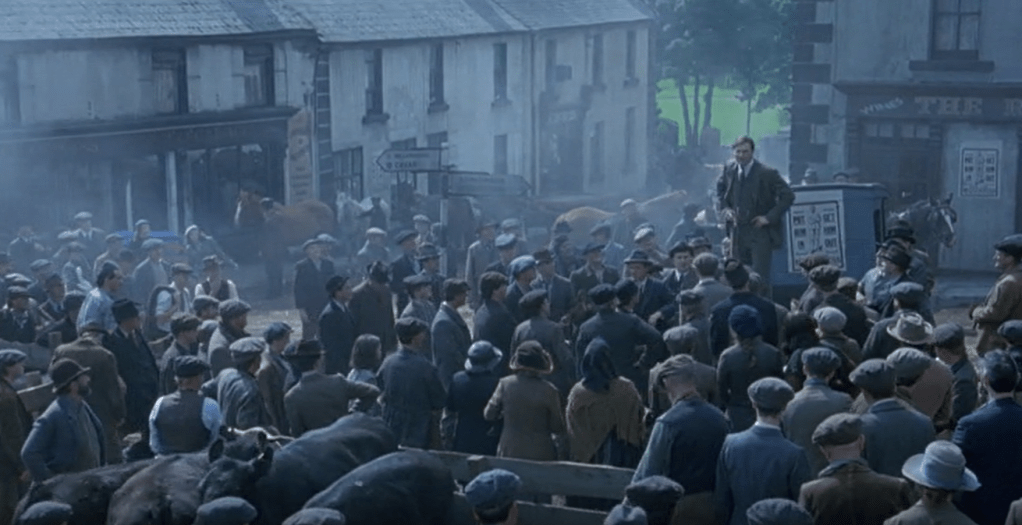
There are limits to this. Conor Kostick argues in Revolution in Ireland that Collins was a kind of Bonapartist figure: someone who has personal authority and is able to ‘rise above’ social and class conflict, or at least to appear to do so. In the case of Collins, he had the support of many armed paramilitaries and a huge section of the broader public. He leveraged this to try to bridge the divide between the pro- and anti-treaty forces.

Collins addresses a street meeting. Michael Collins (Neil Jordan, 1996)

But the thing about Bonapartist figures is that they are given power by conditions of social, economic and political stalemate. This appears as their own personal ‘greatness’ but it is not the case. These conditions of stalemate are temporary, so Bonapartes have a sell-by date. The really striking fact about Collins’ death is that it came at the exact historical moment when the Free State forces had triumphed and the stalemate had come to an end.

What does this mean concretely? Had Collins lived, his authority would have waned. The Free State would have tamed him or discarded him. He had decades more to live, and he could have lent his remaining personal authority to other causes. He becomes a blank slate and we can imagine him as a dissident, as a politician or as a military man, as a Pilsudski-type authoritarian strongman, or as a repentant Republican, or as a statesman who reconciles Fianna Fáil and Fine Gael, or who ends partition. We can imagine whatever we like. This kind of wild speculation can produce a scenario where he changes the course of Irish history. But with his waning authority, the boost he could have given to this or that cause would probably not have been decisive.  

But if he had lived, the differences between him and the hard-line Free Staters would have become more obvious. There would have been a breach so clear and vitriolic no 1990s biopic would have been able to skate over it. Those Free Staters with whom Collins would have split, from Cosgrave to O’Duffy, were the same people who went on to lead and to found Fine Gael.

But in this scenario where Collins lives and, in the short term, struggles for a peace treaty, two things are certain.

One: in this alternate timeline, if the title ‘The People’s Peacemaker’ was applied to Collins, it would have a totally different meaning, a meaning which implies criticism of the Free State government rather than support for the Anglo-Irish Treaty.

Two: Young Fine Gaelers, if such a specimen existed in this alternate timeline where Michael Collins lived, would not be seen dead carrying around an effigy of him.

Go to Home Page/ Archive


[i] Conor Kostick, Revolution in Ireland: Popular Militancy 1913-1923, Cork University Press, 1996 (2009), p 194

[ii] Peter Hart, Mick: The Real Michael Collins, Macmillan, 2005, p 268-270

[iii] Hart, 293

[iv] Hart, 399-403

[v] Diarmuid Ferriter, Between Two Hells: The Irish Civil War, Profile Books, 2021, p 95

[vi] Charles Townsend, The Republic, Penguin, 2013, p 432. You can see in this quote the embryo of the fascist leader that O’Duffy would become.

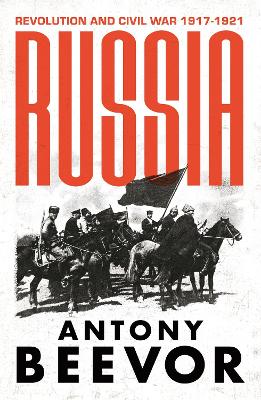
So far, Beevor’s new book is terrible

I learned a lot from Stalingrad and The Battle for Spain, so I was interested to learn that Antony Beevor was tackling the Russian Civil War in his latest book.

But judging from what I’ve read so far, Russia: Revolution and Civil War 1917-1921 is a crude offering. I’ll show what I mean by reference to a single chapter (which is more or less all I’ve read).

When I looked at the contents page, my eye was drawn to a chapter titled ‘The Infanticide of Democracy, November-December 1917.’

If you’re going to put an image of infanticide into my head, you’d better have a good reason. In this case, there is no good reason: during those two months, November and December, the Bolsheviks secured a majority in the Soviets, then received the blessing of a peasant soviet congress. They passed decrees on peace and land. They went into coalition with the Left SRs. They held the Constituent Assembly elections. The street fighting lasted only a few days, and the Whites involved were in general treated with magnanimity. Throughout, the Bolsheviks resisted the pressure to enter coalition with parties whose programme was diametrically opposed to theirs, and relied instead on the active support of millions of people.

All in all, I see this period as one during which, against challenging odds, the new soviet government lived up to its promise. But Beevor doesn’t see it that way.

Peace

He starts out talking about the war. Even though he dubs World War One ‘The Suicide of Europe’, he condemns the Soviets for trying to end the war. For him, the peace efforts were a bad thing because they encouraged rowdy and violent deserters (as if the rotten Tsarist army was not already collapsing due to mass desertion). If the Bolsheviks had broken their peace promise and forced everyone to fight on at gunpoint, no doubt Beevor would condemn that too. And he would be right!

Next in line for condemnation are the deserters themselves – because they ripped the upholstery out of first-class train carriages to wrap around their bare feet. Unmoved by the bare feet of the soldiers, Beevor is moved by the plight of the upholstery.

It must be fun for Beevor to come up with these taboo-busting chapter titles. ‘The Suicide of Europe,’ ‘The Infanticide of Democracy’… What’s next? ‘The Incest of Asia’? ‘The Opioid Addiction of Oligarchy’?

Plotting Civil War

Lenin, Beevor tells us, ‘welcomed destruction for its own sake.’ From there, he argues that Lenin wanted to start a civil war – ‘to achieve tabula rasa through violence,’ that he wanted all the horrendous destruction and inhumanity of 1918-1921 to happen so that he could ‘retain power’ and build communism on a clean slate.

So according to Beevor, Lenin’s plan was to hold power and to build communism in a context where the industries were devastated, where the areas which produced food and raw materials were occupied by enemy armies, where the urban working class – his support base! – were dying in huge numbers, where military spending made it impossible to pursue ambitious social programmes. Needless to say, this was not his plan.

By April, Lenin was happy (an unfortunately very wrong) to declare that the war was over. The idea that he wanted the Civil War at all is just as absurd as his alleged motivation.

But Beevor ‘proves’ his contention by cooking up the most negative and hostile interpretations of carefully-selected utterances by Lenin, then presenting these interpretations as fact.

You can feel Beevor’s fury and disgust every time he mentions Lenin. Whenever we see that name, it is accompanied by a bitterly hostile remark. He must have damaged his keyboard, angrily banging out L – E – N – I – N again and again. And yet to Lenin he keeps returning, as though the revolution revolved around one man.

Food

He ridicules Lenin’s claim that wealthy people were sabotaging food supplies. But this sabotage was taking place. First, there was speculation, or in other words the hoarding of food to drive up prices. Second, there was the strike of government employees, which was creating a humanitarian crisis, the sharpest edge of which was a food shortage. This strike was financed by rich people and big companies, and collapsed when they withdrew their support.

In a context of looming famine, when Lenin calls wealthy people ‘parasites’ and calls for a ‘war to the death’ against them, Beevor says this is ‘tantamount to a call to class genocide.’

The blind spots Beevor reveals are interesting. In this passage he talks about two things: 1) rich people starving poor people to death, and 2) Lenin making an inflammatory speech. If you asked me which of those two things could best be described as ‘class genocide,’ I know which one I’d pick. But for Beevor, it’s the first-class upholstery all over again. He gets upset about dangerous words and not about empty stomachs.

The food supply crisis, naturally, he blames on the Bolsheviks – even though the food crisis had been getting worse since 1915 and the Bolsheviks had been in power for all of five minutes.

Kornilov

The author turns his attention to the right-wing General Kornilov, who broke out of prison and rode across Russia to the Don Country where he met up with thousands of other officers and set up a rebel army to fight the Soviet government. His descriptions of Kornilov in this chapter make him sound like a fearless adventurer whose only fault is that maybe he’s too brave. There were ‘innumerable skirmishes.’ No doubt if it had been Lenin fighting his way across the country Beevor would pause to describe the blood and guts of his ruthlessly slaughtered victims. Instead of this, he compares the whole thing to Xenophon’s Anabasis (That’s The Warriors to you and me).

Lenin is portrayed as plotting to start a civil war. But Beevor never ventures to speculate that maybe Kornilov is plotting to start a civil war. Apparently Kornilov is fighting his way across the country and raising a rebel army for some other purpose.

Beevor’s version of Lenin can only retain power by achieving ‘tabula rasa through violence’ – as opposed to retaining power by democratic means. Meanwhile what was Kornilov doing, and why does it not come in for any scrutiny?

Lenin’s power rested on the active support of many millions of people through the Soviets, which were at this stage still a robust participatory-democratic system. Meanwhile Kornilov’s power rested on the support of several thousand men who gathered by the Don river at the end of 1917. They were united in the conviction that no elections were possible in Russia until the country was ‘purged’ and ‘cleansed’ of the soviets, along with nationalist movements and minorities.

In other words, they wanted to achieve tabula rasa through violence. But, at least in this chapter, it does not occur to Beevor to present them in this way.

Anti-Semitism

The most dishonest part of the chapter comes with Beevor’s remarks on anti-Semitism. He relates two local episodes in which soldiers and sailors attacked Jewish people. These incidents are supposed to prove that the Soviets tolerated or even encouraged anti-Semitism. We read: ‘Soviet authorities tacitly condoned violence against Jews’!

But just a few pages earlier, Beevor writes at length about the foundation of the Cheka. Somehow he fails to mention that one of the main purposes for which the Cheka was founded was to combat anti-Semitic pogroms. The very incidents he describes may have been those which the soviets responded to by setting up the Cheka.

Nor does he mention the outlawing of all racist discrimination, including anti-Semitism, by the new government.

The Cheka

The Cheka during November-December 1917 was a security organisation with only a few dozen full-time staff. But Beevor writes of it as if it were already the feared and controversial instrument of terror that it became over the year 1918. No, scratch that, he writes about it as if it were already the NKVD under Lavrentiy Beria.

For example, he quotes a poem which he says was ‘later’ published in a Cheka anthology. This is a disgusting, psychopathic little poem which celebrates killing. What Beevor doesn’t mention is that this poem was published a lot later, 1921 at the earliest. The entire Civil War took place between the point we’re at in the narrative and the date when the Cheka published this unhinged poem. Four years is an age in times of revolution and civil war. This poem was not written or published in December 1917 and could not possibly have been. The brutality it reflects was a product of the Civil War. Beevor presents it as if it were a cause of that war, part of the ‘infanticide’ of democracy, as if that mindset was there from the start, was in the DNA of the Cheka.

After the Civil War, by the way, the Cheka was radically downsized. Its role, under different names and big organisational changes, as Stalin’s executioner was yet another even later development.

By jumping around in time like this Beevor doesn’t just present a misleading account. He tells a dull story, a smooth and frictionless history of the Russian Revolution. Stalin’s totalitarian state is already there, fully-formed, in November 1917.

The Bolsheviks were initially humane and even magnanimous. Utterances from revolutionary leaders in which they speak in military metaphors can be easily found. But it is just as easy to find them expressing the hope that the Russian Revolution would be a lot less bloody than the French (so far, it had been). Krasnov was paroled after attacking Petrograd. Many Whites who fought in Moscow were let go and allowed to keep their weapons. Lunacharsky was so horrified by the fighting in Moscow he resigned as a minister. Lenin was the victim of an assassination attempt in January 1918, but it was hushed up at the time so as not to provoke reprisals. But 1918 saw Kornilov and his successors, along with foreign powers and the Right SRs, create a terrible military, political and humanitarian crisis in a bid to crush the soviets. This was the context for the development of the Cheka into what it became.

But in the monotonous world in which this chapter takes place, there is no change, no development of characters or institutions. A is always equal to A. The Cheka is always the Cheka. This way of looking at the world may pass muster in a book where, for example, Guderian’s Panzer Corps remains for a long period a dependable, solid and unchanging entity. But it is ill-suited to talking about revolutions and civil wars, in which institutions can pass through a lifetime of changes in a few months.

It’s not just that he gives a misleading, flattened account. It’s that he misses an opportunity to tell a far more interesting story.

The Left SRs

To minimise the significance of the coalition, Beevor treats the Left SRs as a bunch of ineffectual idiots and claims that the Bolsheviks always got their way. In fact, many of the key early leaders of the Red Army and Cheka were Left SRs; all Soviet institutions were shared between the two parties, for long after the coalition broke up in March 1918, and even after the Left SR Uprising of July 1918. But here Beevor treats the Left SRs just as he treats the Cheka: by jumping around in time as if context does not matter.

It’s real Doctor Manhattan territory. It is December 1917, and the Bolsheviks and Left SRs are making a coalition; it is March 1918, and they are breaking up over the Brest Treaty; it is July 1918, and they are shooting at each other in the streets of Moscow.

It gets worse. We are informed that ‘Leading Left SRs also fought for the distribution of land to the peasants, against what they now suspected was the Bolshevik plan of outright nationalisation.’

They ‘fought’, did they? Against whom?

Collectivisation, let alone ‘outright nationalisation,’ of land was not attempted, and it certainly was not an issue in the Bolshevik-Left SR split. Local experiments in state farms, and certain ultra-left policies in Ukraine and the Baltic States, are the only thing that comes close to what Beevor is suggesting. Stalin’s policy of forced complete collectivisation, meanwhile, was ten years away, and was never even contemplated by Lenin.

When Beevor writes that Lenin ‘had shamelessly copied’ Left SR policy on land, he is committing a double absurdity. First, because Lenin’s own position on the land question, consistent over twenty years or so, was broadly the same. Second, because the rules of plagiarism and copyright do not apply to policies. Adopting the policy of another party is a concession to that party.

But that wouldn’t do for Beevor. He cannot show Lenin being agreeable in any way. He insists that Lenin was like an icebreaking ship, that he was a worse autocrat than Nicholas II. Whenever Lenin’s actions contradict the extreme characterisations, Beevor cooks up a sinister motivation, rather than just reassessing his views, or admitting that politics and history are complex. The coalition with the Left SRs? A nasty trick. The Constituent Assembly elections? ‘Lip service.’ Soviet democracy? He claims it was ‘sidelined’ even though Soviet Congresses continued to meet and to decide key questions of policy well into the crisis of summer 1918.

Every narrative trick in the book is on display in this chapter. For example, Beevor describes the Left SRs getting in on the ground floor of the Cheka in a way that would leave an unattentive reader with the impression that they had been excluded. He describes up as down and black as white.

Persia

I’m disappointed. I was actually interested in reading Beevor’s account of the Civil War. I did not expect to agree with all or even most of what he said. But I thought he’d have something to say, and that it would enrich my own ongoing series on the Russian Civil War. Instead we get this monotonous, unbalanced condemnation that we’ve heard so many times before from so many sources: school, TV, and books with gushing quotes in their blurbs. The same old story is invariably described in these gushing blurbs as fresh and challenging.

Two-thirds of the way through, the chapter changes tack. It follows the critic Viktor Shklovsky as he runs off to Persia at around this time. This was horrifying reading, but at least I learned something I hadn’t already known. The Tsarist army was in occupation of a part of Persia, which was a major contributor to the fact that a third of Persia’s population died of famine and disease during the First World War. The Russian soldiers shot civilians for fun, abducted women and sold them in Crimea. Beevor notes that there was a different going rate for women who had already been raped and for those who had not.

Horrified, I read an article going deeper into this. Here – it seems by accident – the title ‘The Infanticide of Democracy’ earns its place. The Persians had a democratic revolution in 1909. Russia and Britain could not tolerate the possibility of an independent Persian Republic. They invaded, supported the reactionaries, and slaughtered thousands.

The horrors of the Tsarist occupation of Persia should give Beevor pause for thought. Was Lenin really ‘a worse autocrat than Nicholas,’ if this is what Nicholas did to Persia? These killers and slave-traffickers were many of the same officers and Cossacks who staffed the White Armies. If the Reds were fighting against such a heavy legacy of oppression, shouldn’t even a consistent liberal historian cut them some slack?

Beevor does not mention (at least in this chapter) that the Soviets renounced any Russian claim on Persian territory, and withdrew what was left of the Russian army. I had to learn that from the article linked above. But if he did mention it, no doubt he would find a way to twist it into something sinister and evil.

Conclusion

A lot of this chapter is taken up with abstract little sermons like the following: ‘This summed up the Bolsheviks’ idealised ruthlessness, elevating their cause above any humane concern such as natural justice or respect for life’ – or upholstery.

I don’t want the reader to think I have it in for Beevor just because I disagree with him. My shelf and my devices are full of titles whose authors I disagree with. Take the following remark by Laura Engelstein from her introduction to Russia in Flames: ‘there were no halcyon days of the Bolshevik Revolution. There was no primal moment of democratic purity that was later betrayed.’ I disagree with this statement, but at least there’s something there with which to disagree. It’s not a strident condemnation, let alone the third or fourth strident condemnation on a single page.

Evan Mawdsley’s book answers all kinds of fascinating questions about the Russian Civil War. It does so in a way that’s biased toward the Allies, but which leaves space for the reader to disagree, which often gives the other side the best lines, etc.

I have no problem, obviously, with polemical or agitational or partisan writing. But Beevor batters us over the head with his opinion and leaves us no space to interpret what he tells us. He writes in a ‘take it or leave it’ manner that does not invite debate. If he’s writing about 1917 and can’t find the evidence he needs to shock you into submitting to his point of view, he’ll go as far as 1921 to get it, then neglect to tell you where it came from.

I don’t know whether it’s complacency – he believes that he has a water-tight case, so he makes it with maximum force – or anxiety – he has serious doubts about what he’s writing, so he leaves no room for the reader to make up their own mind.

To sum up, the first part of the chapter was about a government that was trying to end World War One, share land with the peasants, and give power to workers’ councils. The author could hardly contain his rage and disgust. The end of the chapter was about a Tsarist army mass-murdering Persian people for eight long years. Here the author suddenly dropped the sermonising, the angry tone, the condemnations. Without his stranglehold on the narrative it was easier to read, in spite of the horrors he was describing. But the sudden shift in tone – oh man, it spoke volumes.

I have a sinking feeling that the whole book is going to be like this.

Go to Revolution Under Siege Archive

Go to Home Page/ Archive

Review: The Don Flows Home to the Sea by Mikhail Sholokhov (Premium)

‘Cossack versus Red Army . . a war of unparalleled savagery […] A story of incredible brutality, well-larded with sexual adventures […] This book makes compulsive if horrifying reading; it is on a plane of human conduct as bestial as if it had occurred in the Dark Ages.’

From the blurb to The Don Flows Home to the Sea: Part One, 1960 Four Square Books edition

Become a paying supporter to get access

Access to this article is limited to paying supporters. If you already subscribe by email, thank you. But if you want to become a paying supporter, please hit ‘Subscribe’ below.

Donate less than the price of a coffee, and you can access everything on this blog for one year.

If you don’t feel like donating, most of my posts are still 100% free, so browse away, and thanks for visiting.

Go to Revolution Under Siege Archive

Go to Home Page/ Archive

Review: Cuba Libre by Tony Perrotet

Cuba Libre! Fidel, Che and the improbable revolution that changed world history

By Tony Perrotet

This account of the Cuban Revolution is rich in character and narrative, short on analysis. I was gripped all the way through, though near the end I grunted with surprised laughter at the boldness of one particular thing Perrotet left out.

This book sketches the background of Cuban history, introduces us to the dictator Batista and the revolutionary Fidel, then takes us through the Cuban Revolution from the failed attack on the Moncada Barracks to the extraordinary triumph of the rebels.

Guerrillas in the lobby of the Havana Hilton, 1959

I have read – and watched, and listened to – a fair amount on the Cuban Revolution, Che and Fidel. But I learned something new on practically every page of Cuba Libre. For example, all I had in my head about Celia Sanchez was her name and the vague understanding that she played some role in the Revolution; Perrotet takes the time to give her a full introduction, then he shows her in action – organising the Granma landing, escaping from cops, supplying the guerrillas, organising the underground.

The Batista regime, in its few years in power on the small island of Cuba, may have killed as many as 20,000 people. This is remarkable and horrifying (though somehow Batista comes across in the book almost as a vulnerable figure). The depravity of the Batista regime really comes across in Cuba Libre in harrowing stories from the prisons and barracks. But so does the courage and cunning of the guerrillas and of the urban underground. In addition, they must have been the most magnanimous revolutionaries in all of history – treating enemy wounded, freeing prisoners, treating their hostages like honoured guests.

Fulgencio Batista in 1957

In spite of the violence and the brutality of the Batista regime, and the harrowing conditions the guerrillas had to endure in the wilderness, Cuba Libre is not a heavy or dense read. It tells its story through anecdotes and characters. The events, locations and people are easy to follow because care is taken to make them vivid and memorable. When the writer mentions a name, the reader never has to scratch their head and ask, ‘Who’s that again?’

Another thing I like about the Cuban Revolution – and it may sound stupid – is this: the guerrilla movement in its early stages was operating with tens and twenties of fighters, at times even twos and threes. I like being able to grasp and visualise the numbers involved in a narrative. Once we are into the thousands, as we usually are with military history, it all becomes very abstract. This favours the intimate way Cuba Libre is written.

But as I said, it’s short on analysis. Towards the end, explaining why the Americans turned against Castro so suddenly, Perrotet writes that land reform angered US companies. I had to laugh, because this was the first mention of land reform in the entire book. It is also the last; he quickly moves on. You would not think it was a central question.

Lively and all as the narrative is, it does not explain why the rural population supported the guerrillas – which, of course, has to do with economics, class and land reform. The central condition of the guerillas’ success – the support of the rural population – simply falls from the sky. There’s nothing wrong with a narrative-driven, character-focused account – but there are ways of talking about economics and class within that kind of writing. The characters on whom Cuba Libre focuses tend to be middle-class professionals. There is no character giving us an insight into the land question.

Camilo Cienfuegos and Fidel Castro enter Havana

Overall, Perrotet gives a very sympathetic account of the revolution. While he says Fidel had a tendency toward megalomania, his tone when writing about the guerrilla leader is usually one of mixed exasperation and awe. American public opinion, he says, liked Fidel playing the part of a glamorous revolutionary but didn’t want him to actually carry out any revolutionary measures. Perrotet lays the blame for the falling-out squarely at the feet of the US, while pointing out that thanks to the revolution Cubans have healthcare and education systems to rival anything in the advanced capitalist countries.

School Resources: The Spanish Civil War

This is not on the history course in Ireland but it’s a brilliant topic for Transition Year or for Leaving Cert projects.

I uploaded this in Irish over the last week or two. Here is the whole lot in English.

First off, a presentation going over the main events and issues of the war.

An exercise involving an element of role play. Instructions are on one of the slides in the presentation.

An extract with questions from https://www.marxists.org/archive/morrow-felix/1938/revolution-spain/

A questionnaire to give some structure to online or library research

Finally, an extract from Homage to Catalonia by George Orwell