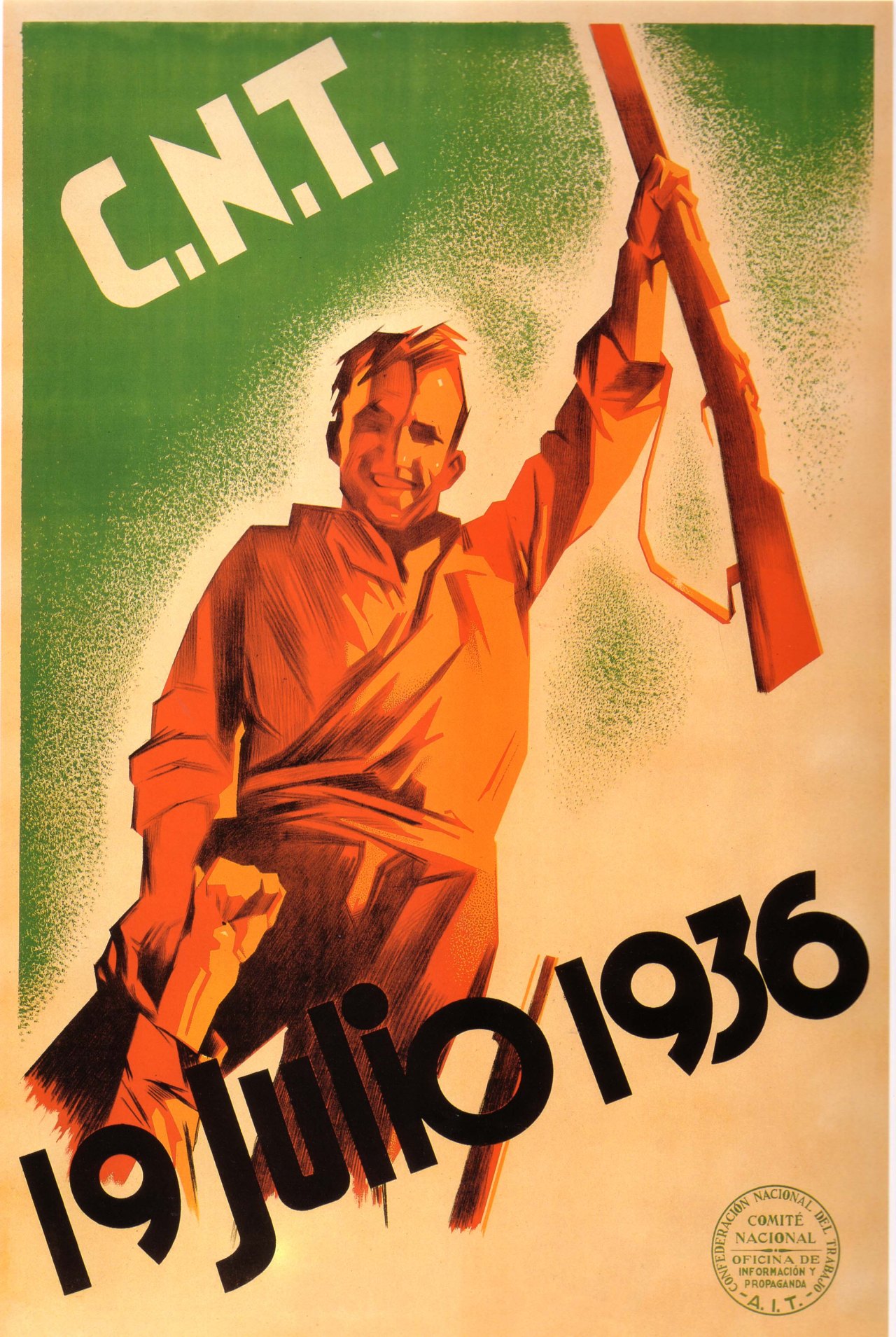
Sliocht as Revolution and Counter-Revolution in Spain le Felix Morrow – aistrithe agus curtha in eagar, le ceisteanna. Déanann sé cur síos ar éirí amach na hoibrithe i Barcelona
Building on last month’s resources on the Middle Ages, here are linked notes and presentation: Strongbow: A Story from Ireland in the Middle Ages.
The history of Strongbow and the Norman conquest of Ireland is a great case study for Junior Cycle students to get to grips with life and politics in Medieval Europe. It’s also a crucial episode in Irish history.
In January 1918, a few months after the October Revolution in Russia, a parliament called the Constituent Assembly met for one day before it was suppressed by the Soviets. This blog has dealt with the episode before. The incident suggests a ‘What if?’
In OTL (Original Timeline, ie, real life), the Soviets were willing to allow the Constituent Assembly (CA) to exist as a subordinate body. Likewise the CA was willing to let the Soviets exist as a subordinate body. But neither would tolerate the other attempting to assume state power.
But what if the Soviets were willing to bend the knee? What if the Constituent Assembly was allowed to assume control? How might the Russian Revolution and Civil War have developed from there? How might the Russian Twentieth Century have been different?
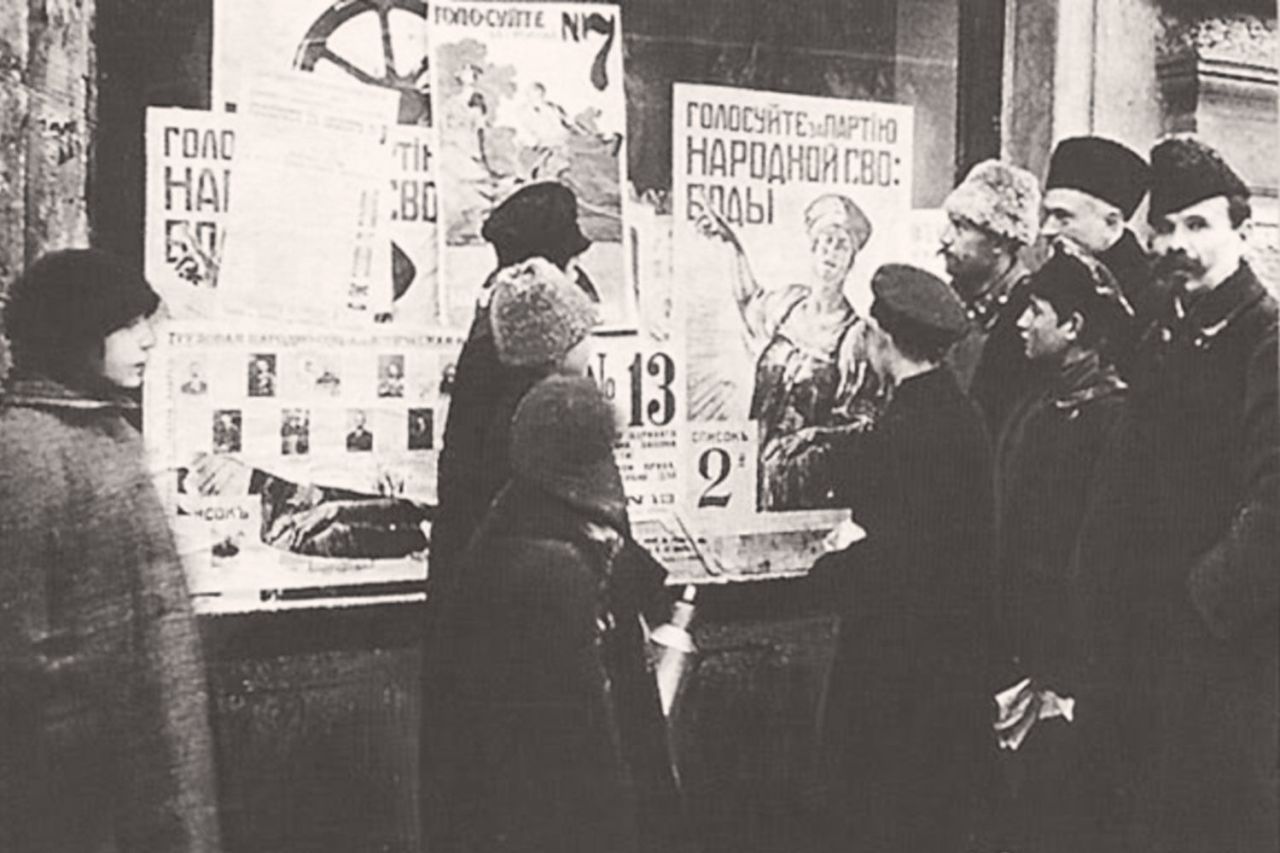
Posters for the Constituent Assembly elections
Element of Divergence
First we should explore plausible scenarios where this could take place. We should answer the question of why and how it might come about that the Soviets, having seized state power, would be willing to hand it over to the CA.
The Soviets were workers’ councils, a system of direct participatory democracy. The Bolsheviks Party had won a decisive majority in these councils in September 1917. They believed that the Soviet was a higher form of democracy than the CA. They hated the Right Social Revolutionary party (RSR), which over 1917 had made compromises to the right and enacted repression against the left. They believed that the split between the RSRs and the Left SRs rendered the election results meaningless.
In other words, the Bolsheviks (along with their allies the Left SRs) had strong reasons to suppress the CA.
In spite of these strong reasons, it is not that difficult to imagine the Soviets giving up power to the CA. In Germany and in Austria in this period, and in Spain in the 1930s, we see many examples of communists, socialists and anarchists giving up power to a bourgeois-democratic government in exactly this way. In fact, they were far more flagrant. The German Social Democrats assembled militias of far-right veterans to suppress the German Revolution. The Communists in Spain became the enthusiastic apologists of a liberal-republican government and preached that Spain was not ready for revolution. In short, the Bolsheviks are the outlier among social-democratic and even nominally communist parties in the Twentieth Century in that they were really willing to seize and hold power.
In our ATL (Alternative Timeline), the leadership of the Soviet is more in line with the mainstream of international social democracy – ie, more timid and cautious.
I do not propose a single ‘Point of Divergence’ – for example, Lenin is murdered by agents of the Provisional Government; Trotsky stays in a British concentration camp in Canada. Rather I propose an Element of Divergence, a factor which develops differently over a whole period of years and even decades. In this ATL, the Bolshevik Party as we know it simply do not develop. The more radical and militant trends within the Russian Social-Democratic and Labour Party (RSDLP) do not cohere into the Bolshevik party from 1903 to 1912; rather they remain loose and scattered and undefined. We will, for convenience, refer to them as the militant socialists.
Fighting during the German Revolution, during which the equivalent of the Soviets did hand over power to the equivalent of the Constituent Assembly.
The Alternate Timeline
Pushed by a mass upsurge of workers, soldiers, sailors and peasants, the militant socialists end up in control of the Soviet by October 1917. They proceed to seize power in some incident corresponding to the October Revolution. But by January they are afraid of their own power and uncertain what to do with it. Their own base – workers and poor peasants – feel the hesitancy from above and demoralisation begins to set in. Meanwhile the militant socialist leaders feel pressure from the Russian ‘intelligentsia’ (professional middle classes) which supports the RSRs and the CA.
Instead of shutting down the CA after a single day, they remain in it, trying to negotiate a strong position for the Soviets within a new CA-dominated political regime. In other words, they turn back the clock and accept Provisional Government Mark 2. The discredited Provisional Government, attacked from right and left then finally overthrown in the October Revolution, has returned in a new guise with many of the same personnel.
Thus begins the Chernovschina – the regime of Viktor Chernov, a firebrand within the RSRs who in OTL served for that one day as President of the Constituent Assembly.
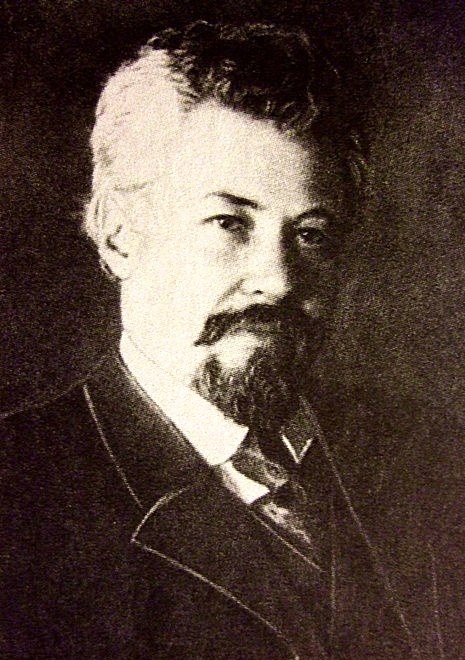
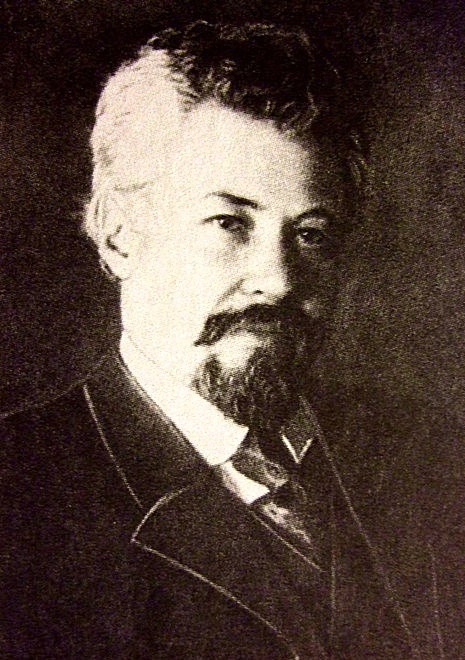
Viktor Mikhailovich Chernov, president of Russia for one day in 1918. During 1917, though a Right SR, he had been critical of the doomed policy of coalition with the right-wing parties
Chernovschina
In OTL, the RSRs set up a government at Samara during the Civil War in the name of the Constituent Assembly. This government was called Komuch. It gives us valuable insights into the main features of the all-Russian Chernovschina which develops in this ATL.
The Chernovschina, like Komuch, would have a narrow base of support: a layer of the intelligentsia, and not much beyond that. Its decisive majority vote in the CA elections may seem to indicate that it had a mandate. But for Komuch, this mandate translated into precisely nothing. It was unable to raise an army. It suppressed the Soviets on its own territory and gave back the industries to their capitalist owners; still the wealthy refused to support it.
Komuch governed a population of 12 million people on the Volga. Chernov would govern all of Russia, including the central industrial region where the factory workers in their millions are enthusiastic supporters of the Soviet. In these central provinces and great cities, the Bolsheviks actually won a majority in the CA elections. Unlike Komuch, the Chernovschina would be able to present itself as having the support of the Soviet; this and this alone, the support (really the submission) of the Soviet, explains why it is in power.
It has a tense relationship with the Soviet, with the working class, with the poor peasants. But the militant socialists are forced to act as the enforcers of the Chernovschina. They try to whip their supporters into line, because to do otherwise would be to admit their own bankruptcy.
As in OTL, famine begins, striking the cities hardest. Chernov refuses to consider the kind of expropriations which the Bolsheviks practised in OTL; thus he retains the passive support of the peasant majority, but loses the active support of the cities.
Thus the working class, its hopes raised high by the October Revolution, feels a horrendous demoralisation set in as 1918 advances. Many still hold out hope that the Chernovschina will deliver for them, or that the Soviet might yet overthrow the CA. On that basis, Chernov is still able to mobilise some support.
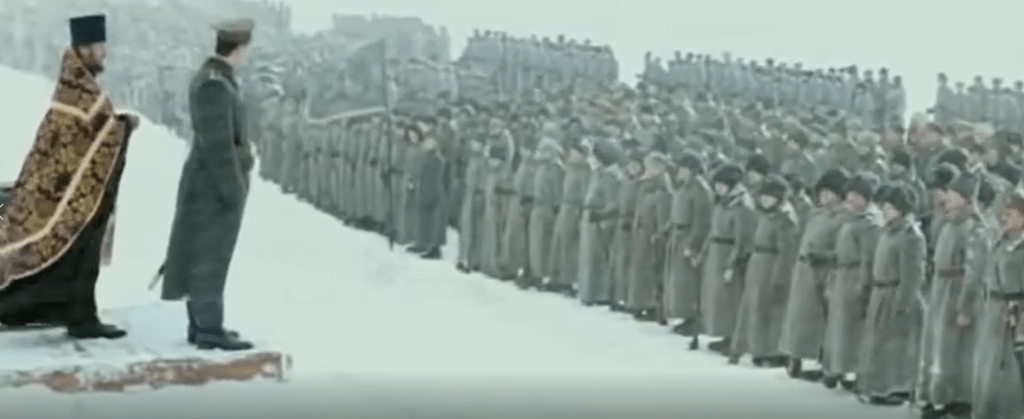
Still from the movie Admiral, dir Andrey Kravchuk, 2008. In ATL as in OTL, the White Guards, with the blessing of the church, rallies the troops for counter-revolution.
Civil War
And support he needs. The Russian armed forces, though in an advanced state of collapse, are fighting a desperate war against Germany. Meanwhile in ATL as in OTL, military officers, nobles, the bourgeoisie and the church organise counter-revolutionary armies. They see the RSRs as little better than the militant socialists; in any case, the militant-socialist bogeyman is an integral part of the Chernov coalition. Alongside the new Russian army which Chernov is trying to build, the Red Guards are the main armed force on which the CA can rely.
And Chernov himself, as in OTL, supports the seizure of noble land by peasants. The emergent White Guards have no reason to be less hostile to the RSRs than they were to the Bolsheviks in OTL.
It is frankly impossible to see how the Chernovschina can win the war against Germany, or even to hold out until Germany’s defeat in the West. But as in OTL, they are determined to continue the war. We must envisage an inexorable German advance to the gates of Moscow itself, even the fall of Petrograd, before the RSRs are forced to sign a peace treaty even more humiliating than the Treaty of Brest-Litovsk.
The Allies, meanwhile, look askance at the Chernovschina for the same reasons the Whites do: the communist bogeyman. Initially they support Chernov against Germany, but then turn against it when the peace treaty is signed.
So we end up as in OTL: White armies, backed by the Allies, fighting against the ‘Red’ (perhaps the ‘Pink’) regime of Chernov. The Allies might be less enthusiastic about intervention because the Chernov regime is more amenable to them – paying the debts and not seizing the factories. It is possible the Allies, or at least some of the Allied countries, would remain neutral. But on the other hand the Allies would not be held back by their own people. In OTL, there was deep support for the October Revolution among working-class people in the western countries, resulting in the ‘Hands off Russia’ movement and the Black Sea mutiny. These factors tied the hands of Allied intervention. It is doubtful the western working class would be as sympathetic to the Chernov government, so the Allies’ hands would not be tied in the same way.
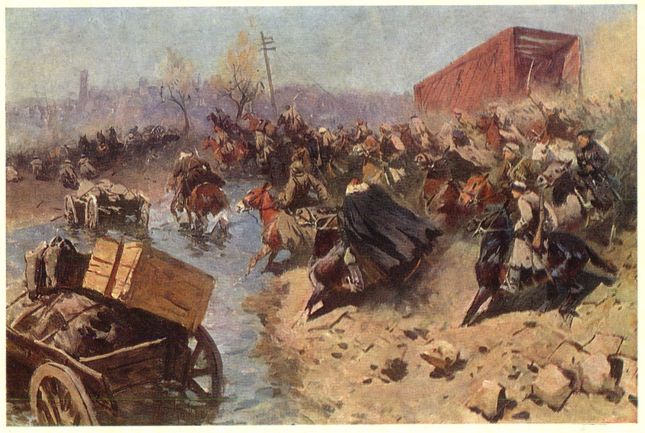
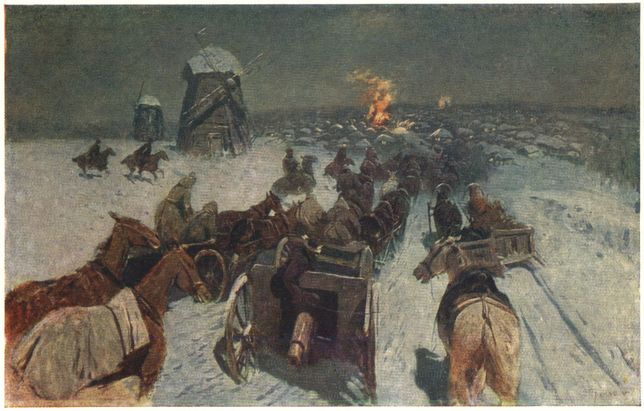
Painting on the Civil War by Mitrophan Grekov
The Fall of the Constituent Assembly
Increasing discontent in the ranks of militant socialists at some point breaks out into a mass uprising against Chernov in Moscow. Meanwhile Chernov and co have grown impatient with the Soviet; they see it as the main obstacle to Allied support. So the Chernovschina engage in the bloody suppression of the uprising of the Moscow proletariat. This results in the final liquidation of the Red Guards and the Soviets, and the final demoralisation of the working class. The Revolution is over.
The Chernovschina tries to fight on, but its people are utterly demoralised and it is beleaguered on all to sides. It succumbs to the onslaught of the White Armies. The death-blows are probably dealt in the campaigning seasons of Spring and Summer 1919.
So this ATL leads us to a White victory in the Russian Civil War. That is a ‘What If’ for another day and another post. But suffice it to say that a White military victory would only be the beginning of the violence. The White movement, in order to fulfil its aims, would terrorise the urban population into submission and seize the land back from the peasants. The scene would be set for decades of conflict as the White generals invade the newly-independent republics one after another, trying to restore their vision of ‘Russia one and indivisible.’
Conclusion
This alternate history is based on two main real-life analogues: Komuch (which I have written about here, here and here) and the Republican side during the Spanish Civil War.
For some, it is tempting to imagine that the CA might have led Russia to stable parliamentary democracy, averted civil war, etc. But an electoral majority does not invest a political party with magical powers. In terms of sheer numbers, the RSRs won an overwhelming vote. But the vote was confused and passive in character. They had a very narrow base of confident, active supporters. The CA could only have survived if the Soviets had made the terrible mistake of propping it up at their own expense – at their own very great expense.
As a general rule, if you are reading about Russian history and you come across the words ‘rare blood condition’ and ‘Rasputin,’ more times than ‘Putilov’ or ‘Smolny,’ you are reading bad, derivative pop history. At the risk of sounding like a dick, I’d say if you don’t even know why the words ‘Putilov’ and ‘Smolny’ are relevant to the Russian Revolution, then you have never read anything half-decent on the subject.
‘History’ of this kind always portrays Tsar Nicholas II as a nice bloke who was dealt a bad hand by history.
The other day a great example of this popped up, as these things often do, on Facebook. A page with 1.7 million views titled Being Liberal shared a post from Rebel History. It was one of those ‘on this day x years ago’ posts, and it was on Tsar Nicholas.
It struck all the usual notes. The Tsar, it informed us, was beleagured on all sides by military disasters, angry ‘lower classes’ and terrorism.
Here are some relevant facts which the post did not mention and which these kinds of things never mention.
First, Nicholas was a massive anti-Semite. He sponsored the infamous pogroms which killed thousands of Jews and drove millions more into emigration. You know all those impoverished Jewish people on the Lower East Side of New York in the early 20th Century? They had fled there from the Russian Empire because Nicholas and his family had Nazi-style laws against the Jews, and every so often egged on mobs to burn their houses, rape, torture and kill them.
I was about to write that ‘other groups were persecuted too.’ But that doesn’t cover it even half way. A majority of the population of the Russian Empire was non-Russian, and were legally disciminated against as a result.
A page called Being Liberal shared the post in question. This page has almost hourly posts about the war in Ukraine. Did the admins of Being Liberal think that sharing a post lamenting the fall of the Tsar would be some kind of gesture of support to Ukrainians? It was the Tsars who suppressed the Ukrainian language and enforced ‘Russification’ policies.
Tsarism witnessed the genocide against the Circassians among numerous other sanguinary massacres. In 1916 Tsar Nicholas responded to a rebellion in Central Asia with a campaign of repression that killed 88,000 people.
Every Russian, meanwhile, was assigned a ‘social estate’ which circumscribed their rights and duties. The position of women was dire beyond description, especially in the rural areas.
That page, again, is titled ‘Being Liberal.’
The post did acknowledge that ‘the Czar’s government’ suppressed the 1905 revolution with violence.
That needs some elaboration, though. Workers living in severe overcrowding and hunger organised a union (which was against the law). They marched peacefully with a humble petition to the Tsar. The Tsar’s soldiers gunned them down, killing around a thousand on that day. The Tsar went on to kill around 15,000 over the course of crushing the 1905 revolution.
It took that near-miss revolution to convince Nicholas to allow the Russian people to have a parliament. By the way, the new parliament was rigged in the Tsar’s favour and had a restricted franchise.
To clarify, before 1905, no parliament, and Nice Bloke Nick killed all those workers on Bloody Sunday 1905 because he preferred it that way.
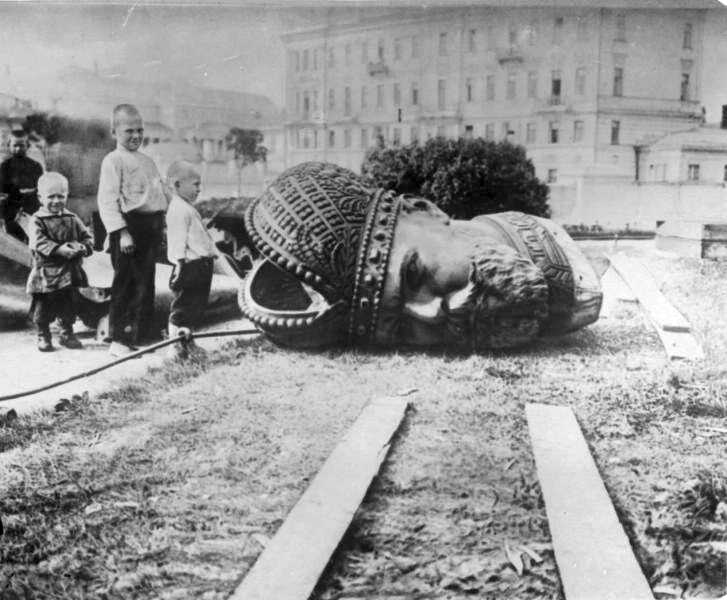
The cover image for this post shows a fragment of a Tsarist statue lying in the street after the February Revolution. I believe the Tsar in question is not Nicholas but Alexander. But the message of the photograph is clear: the kids either have the sun in their eyes, or like most Russians they were pleased to see the Tsar’s monuments beheaded.
One mistake pop history makes is to focus on individual personalities and to engage in fruitless debate over the moral responsibility of individual famous people. But around Tsar Nicholas this goes even deeper, because he had a terrible personality and he definitely had personal moral responsibility for the evils of his regime. He was stubborn and narrow-minded even for an absolute monarch.
‘By all accounts’ the post tells us, ‘Nicholas was happy to give up power and live a peaceful life in exile with his family.’
‘By all accounts’! Not by mine.
To get the Tsar to abdicate, it took five days of street fighting. It took thousands of deaths on the part of unarmed workers battling police and soldiers. It took a military mutiny and the burning of Petersburg’s police stations.
At the time, Nicholas II was dreaded and loathed across the world as a bloody dictator. Liberals celebrated his downfall, not just socialists. But liberals today, at least some of them, have had their knowledge of that history dulled. A part of it is that anti-communism makes for odd political bedfellows. This has taken the form of bad pop history. That is, decades of people hearing and repeating clichés about Rasputin and rare blood conditions.
English translation (1934) by Stephen Garry. Penguin Classics, 2016
The other day, after several textual misadventures which I will mention in a footnote below, I finished Mikhail Sholokhov’s masterpiece And Quiet Flows the Don. This review will tie in with my series on the Russian Civil War, Revolution Under Siege, as the novel throws some sidelights on the things I wrote about there.
You can read this post – and many others on this website – for just €5.
Get access to this post – and the entire archive of The 1919 Review – for €5 per year.
A presentation covering the history of Fascism in Italy, from the First World War to the fall of Mussolini. Below are three files of notes to be used alongside the presentation, along with a short quiz.
Smith, S.A. Russia in Revolution: An Empire in Crisis 1890 to 1928, Oxford University Press, 2017
Smith, S.A. The Russian Revolution and the Factories of Petrograd, February 1917 to June 1918. Unpublished dissertation, 1980. University of Birmingham Research Archive, e-theses depository.
*Taylor, A.J.P. The First World War: An Illustrated History. Penguin, 1963. (1982)
*Trapeznik, Alexander. The Revolutionary Career of Viktor Mikhailovich Chernov (1873-1952). Masters’ thesis, University of Tasmania, 1988
Hafner, Lutz, ‘The Assassination of Count Mirbach and the “July Uprising” of the Left Socialist Revolutionaries in Moscow, 1918,’ The Russian Review , Jul., 1991, Vol. 50, No. 3 (Jul., 1991), pp. 324-344
Pereira, NGO. ‘The Idea of Siberian Regionalism in late Imperial and Revolutionary Russia.’ Russian History, vol. 20, no. 1/4, Brill, 1993, pp. 163–78, http://www.jstor.org/stable/24657293.
Smirnov, M. I. “Admiral Kolchak.” The Slavonic and East European Review, vol. 11, no. 32, Modern Humanities Research Association, 1933, pp. 373–87, http://www.jstor.org/stable/4202781.
Access to this article is limited to paying supporters. If you already subscribe by email, thank you. But if you want to become a paying supporter, please hit ‘Subscribe’ below.
Donate less than the price of a coffee, and you can access everything on this blog for one year.
If you don’t feel like donating, most of my posts are still 100% free, so browse away, and thanks for visiting.
In Stephen King’s novel The Stand two new societies emerge in a post-apocalyptic USA, based on opposite sides of the Rocky Mountains. A democratic society takes shape in Boulder, Colorado. Meanwhile in Las Vegas power is seized by a supernatural madman who punishes drug users with crucifixion. Only one of these two regimes can survive.
That great, flawed horror epic comes to mind because this post is about two distinct White regimes which emerged on either side of the Ural Mountains in Russia in 1918, and how one consumed the other. As we saw in Part 5, the Czech Revolt led to dozens of White-Guard governments popping up. The Right Socialist Revolutionary (SR) party set up a regime called Komuch (the Committee of Members of the Constituent Assembly) based in the Volga town of Samara. They wanted a republican, democratic counter-revolution, with a mandate from the Constituent Assembly and all the ‘t’s crossed and the ‘i’s dotted. Meanwhile across the mountains a faction of officers and Cossacks set up the Provisional Siberian Government at Omsk, a military dictatorship with a thin Siberian Regionalist veneer.
The most important difference was that Samara was anti-landlord and Omsk was pro-landlord. They were at loggerheads on the land question.
These two regimes did not use direct violence against one another – until the very end, when the outcome was no longer in any doubt. They were supposed to be on the same side against the Reds. But relations were tense; Omsk boycotted Samara’s manufactured goods, and Samara boycotted the grain of Siberia.[i] In August the Omsk regime shut down the Siberian Regional Duma – an elected body dominated by Right SRs, of which the Omsk regime itself was an ungrateful child. Komuch was never secure even within its own territory: ‘Russian officers as well as business and middle-class circles much preferred the state-conscious anti-Communism of Omsk.’[ii] And that territory was shrinking. In a strange twist of fate, the military men of Omsk resided safely a thousand miles in the rear while the Right SRs – civilian politicians – led the regime that was actually fighting the Reds on the Volga. From early September that fight was going very badly. As we saw in Part 8, Kazan and Simbirsk had fallen, and this had thrown Komuch into crisis.
Omsk
While Komuch had grown weaker, the Provisional Siberian Government had grown stronger. The Omsk government did not rest on popular support. Its political wing consisted of junior government officials, conservative refugees from central Russia and the Siberian Regionalists. Its military wing consisted of officers and Cossacks, assisted by a battalion of British soldiers from the Middlesex Regiment. This military wing had built itself up to a force of 38,000 by September, poaching officers from Komuch instead of helping them in any serious way.
The ‘Novoselov Affair’ of September 1918 manifested something that had been obvious for some time. The Siberian Regionalists wanted to increase their presence in cabinet, and a politician named Novoselov was their chosen candidate. But he was abducted by Cossacks and murdered. It was a clear signal, Smele suggests, that anyone who tried to challenge the officers and Cossacks would be found dead some fine morning by the banks of the Irtysh River.
Members of the Provisional Siberian Government
The western Allies looked on with impatience, and demanded Komuch and Omsk get their act together and present a united front. The result was the state conference at Ufa on September 23rd 1918. Ufa is a mountain town half-way between republican Samara and military Omsk. It was as if Stephen King’s two post-apocalyptic tribes held a conference somewhere in Utah. At the Ufa (not Utah) conference a wide array of different counter-revolutionary governments came together. Intellectuals, ‘moderate socialists’ and former terrorists sat down to discuss cooperation with Black-Hundred generals, foreign agents and Cossacks.
Chernov
The centre of gravity within the SRs had swung from the Right to the Centre. This Centre was embodied in Viktor Chernov, the leading figure in the party, a stout man with a powerful presence who had served as Minister for Agriculture under Kerensky in 1917. During the few hours’ life span of the Constituent Assembly, the deputies had elected him president of Russia. Unlike most Right SRs, he had actually criticised the policy of coalition with the right during the year 1917, though like the others he had dragged his feet on land reform. In the view of his supporters, the October Revolution had vindicated his criticisms; in the view of the officers, he was largely responsible for ‘the weak and indecisive policy that led to the downfall of Mr Kerensky’s government.’[iii]
Now, along with others, he had arrived in Komuch territory arguing for the Right SRs to take a hard line at the Ufa conference. He was up against the resistance not only of officers and Cossacks but of many in his own party. The historian Radkey writes that many Right SRs had become ‘fervent patriots, partisans of the Entente, and devotees of the cult of the state.’ By 1917 ‘a large segment of the Populist intelligentsia had become [Constitutional Democrats] without admitting it.’[iv] We have already seen how the Left SRs split from the party in disgust at these developments. But the divisions ran deeper still. Even Chernov’s centre was divided into a right centre and a left centre. Chernov himself was prevented from going to Ufa by his own comrades, in case his presence upset the Omsk faction.
Viktor Chernov
The Ufa conference opened with a religious service, then talks began. The numbers of delegates heavily favoured the left, but the various factions all had veto power, tipping the balance back to the right. On the other hand, the need to keep the Czechs happy and to impress the Allies put a certain weight on the scale for the left. Countering this in turn was the real balance of forces between Samara and Omsk, which worsened for Samara every day as the Reds advanced.
One sore point was the Constituent Assembly. The Right SRs insisted that it was the only legitimate state power in Russia, sanctioned by the elections of December 1917. Omsk refused to recognise this body, ‘elected in the days of madness and made up chiefly of the anarchist element.’[v] It appears the Omsk officers believed no election could be considered valid until half the Russian working class was dead or behind barbed wire, and until a knout-wielding Cossack could be placed next to every polling station to glower at the voters. An election held in conditions where the workers were organised and confident could not be considered legitimate in their eyes.
It could be argued that Samara won this round. The Omsk government accepted the legitimacy of the Constituent Assembly in principle. But they would not allow it to assume power until January 1919 at the earliest, and even then it must assemble a quorum of 250 elected deputies. To assemble such a quorum, in the chaos of Russia in 1918, was impossible; it had taken Chernov months to make his way to Samara. So it was a hollow victory for Komuch; the generals’ ‘recognition’ was meaningless.
The Ufa Directorate
The outcome of the conference was a merger of Samara, Omsk and other statelets into a government called the Ufa Directorate. Its programme: abolish the Soviets; return lost territories to Russia; resume the war against Germany; and set up a democratic regime.[vi] The Right SRs also changed their land policy to favour the White landlords with whom they were making a deal.[vii]
On paper, the five-member Directorate had a Socialist majority – a concession to the Czechoslovak Legion, who were increasingly war-weary and cynical of the rightward trajectory in the White camp.
But this was only on paper. Just two of the five members of the Directory were SRs, and they were the two most conservative and least authoritative SRs who could be found. The other member of the Directorate with ‘Socialist’ credentials was Tchaikovsky, who was safely in the Arctic Circle at the time, performing socialist fig-leaf duty for another White government.
The Right SR Central Committee had previously voted 6:2 in favour of Chernov’s position that the SRs should fight against ‘the left-wing Red dictatorship [and] an equally despotic Right-wing White dictatorship’ that would probably emerge. ‘In order to fulfil its historic role,’ the party ‘must emerge as a Third Force and fight a determined war for democracy on two fronts.’[viii]
But the same Central Committee flew in the face of this resolution when it voted 4:3 in favour of the Ufa agreement.
Toward the climax of The Stand, that compelling and problematic 1978 horror novel, the democrats from Boulder go to confront the dictator at Las Vegas. They are armed only with their own courage and moral rectitude, along with a mandate from a supernatural higher power.
You can read the book yourself to find out how this plan works out for them. But you only need to read on another few paragraphs to find out how the same method worked out for the SRs when they entered the Ufa Directorate.
If the comparison seems far-fetched, consider these words by the Right SR Avksentiev: ‘We must put our head in the lion’s mouth. Either it will eat us, or it will choke on us.’[ix]
Life in the lion’s mouth was not comfortable. The officers resented what little influence the Right SRs had in the Directorate . In their view, Chernov was whispering in their ears urging them to set up democratic soldiers’ committees inside the White Army. In fact Chernov was not supported by a majority on his Central Committee, let alone by Avksentiev. But he was the bogeyman conjured up by the ‘Siberians’ to add colour to the implausible assertion that the Directorate was dominated by elements who were only two steps away from Bolshevism. ‘The name ‘socialist’ was for them synonymous with ‘traitor.’’[xiii]
‘I drink to dead Samara!’
Meanwhile the Reds were advancing across Komuch’s territory.
The 6,000 workers of Ivashchenko near Samara rose up against the Whites. But this rising was premature; Komuch still had enough strength to put down the rising, killing 1,500.[x] The officers of the People’s Army went from village to village conscripting the peasants. They used the old tried-and-tested Tsarist recruitment methods: public floggings and violent reprisals for deserters and their families.
But they were not so bold in early October, when the Red Armies closed in on Samara. The White volunteers were too few to defend the town. The Czechs retired without a fight. The peasant conscripts deserted to the Reds. The Cossack Dutov withheld any aid. Nobody would defend Samara, but it gets worse; no-one could be found to organise its evacuation. It was a rout, everyone for himself (Chernov included) crowding onto trains to get away.
An SR leader named Volsky was reportedly found drunk and despairing, smashing glasses and ranting: ‘I drink to dead Samara! Can’t you smell the corpse?’
Czech officers taunted Constituent Assembly deputies: ‘Where’s your Army?’ ‘Government? You the government?’
As Samara fell to the Reds, Komuch lashed out at its Red prisoners, killing 306 of them.
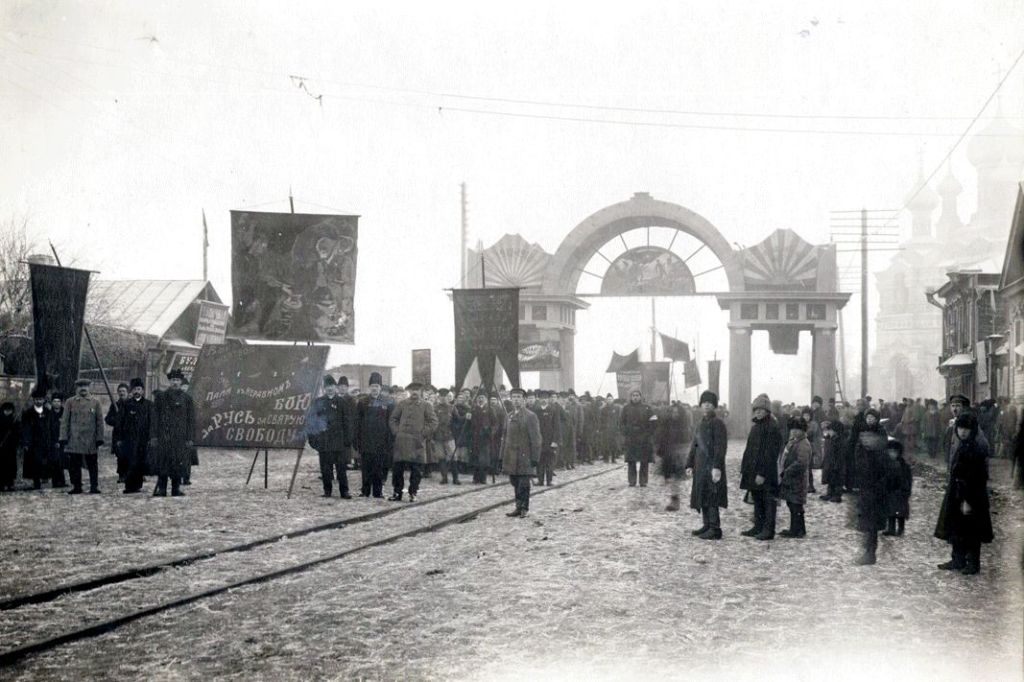
This picture appears to show a Red triumphal procession on Sadovaya Street, Samara, in late 1918 or early 1919.
In spite of its name the Ufa Directorate spent most of its existence governing from railway cars, and officially moved to Omsk in early October. The Novoselov Affair had demonstrated that no civilian politician should push their luck in Omsk, where drunken officers still sang ‘God Save the Tsar.’ The Council of Ministers which served under the Directory was dominated by people more associated with Omsk than Samara. In that city the SR politicians felt the same sense of insecurity and isolation that they had felt in Petrograd in 1917, and in the words of Serge, ‘The very same illusions fortify their spirits. The vocation of parliamentary martyr rises in their breasts.’[xi] Think of Avksentiev with his head in the lion’s mouth. I don’t know what they were thinking; that if they did everything by the book, hosts of constitutional angels would come to their aid… Or that they would get their reward in parliamentary heaven.
Why all the hostility between Samara and Omsk? One way of looking at it is that the generals were too stubborn to recognise that the Right SRs could be a useful political fig-leaf for their cause. They could have kept many Right SR leaders on side by making a few superficial concessions. Their association with the Right SRs was used at the time and is still used today to claim democratic credentials they did nothing to deserve. But the other way of looking at it is that the generals were sophisticated enough to realise that the Right SRs were of little use even as fig-leaves. The Right SRs had only a very narrow base in 1918; their most reliable supporters were the Czechoslovak Legion. Their electoral mandate, such a powerful instrument in constitutional politics, might have been expected to translate into something impressive in the language of civil war. But it simply did not translate.
The Bolsheviks were wise not to recognise the authority of the Constituent Assembly – because practically no-one else did.
Two devastating scenes remained to be played out in the tragedy of the Right SRs. Their protagonist was Admiral Alexander Kolchak.
The Council of the Supreme Ruler
Alexander Kolchak arrived in Omsk in mid-October and was given the Ministry of War and the Marine.
Kolchak was a naval officer from a well-off military family. He explored the Arctic Circle in 1903, travelling by dog-sleigh and spending 42 nights on the open sea. After the disaster of the Russo-Japanese war he approached the Duma (the rigged Tsarist parliament) with plans for naval reform. During World War One he served as an admiral first on the Baltic and then on the Black Sea. During the Revolution, he defied a sailors’ committee by throwing his sword into the sea and declaring the men unworthy of him. ‘Many organisations and newspapers with a nationalist tendency spoke of him as a future dictator.’[xiv]
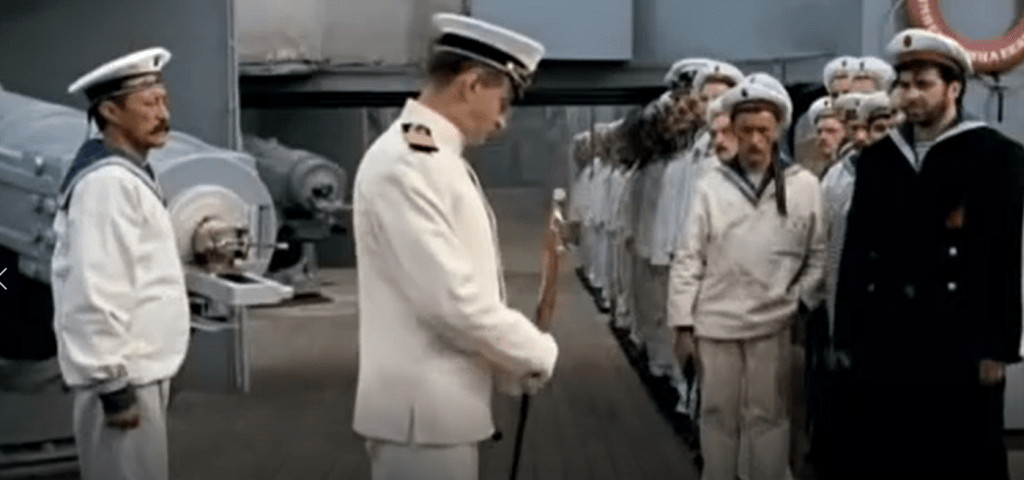
Still from the movie Admiral (2008) dir. Andrei Kravchuk. Kolchak, centre, confronted by the sailors’ committee, draws his ceremonial sword prior to throwing it overboard.
He spent a long time abroad on various wartime plans and projects with the US and other Allies which came to nought. He became an agent of the British state, and was called by London ‘the best Russian for our purposes in the Far East.’[xv] He returned to Russia with the Japanese invasion forces and tried to organise armed detachments in Manchuria and the Far East. Thence he came to Omsk.
A conspiracy coalesced around him, with or just-about-possibly without his knowledge. According to one of his comrades, he ‘had no part in the plot, but was in favour of a military dictatorship.’[xvi]
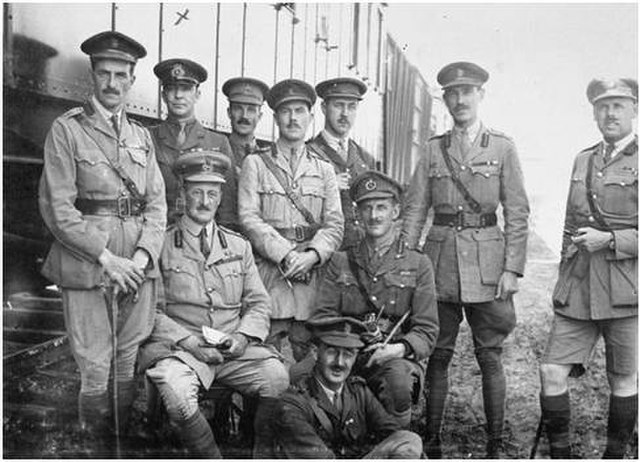
General Knox and other British officers in Siberia. Kolchak was their guy, and they supported his coup.
He had just returned from a tour of the front when it all kicked off. On the night of November 17th, a Cossack detachment arrested many Right SRs, including the two members of the Directorate. The Council of Ministers assumed power. There was a battalion of the British Middlesex Regiment stationed in Omsk at the time, and their leader General Knox knew about the coup before the event and did nothing because he hated the Directorate and was a ‘great champion’ of Kolchak.[xvii] The Omsk garrison commander was on board too. It was a clean sweep.
The Czechs were appalled; but the French and the British dissuaded them from taking any action, the French verbally and the British by physically defending the conspirators. So the coup was bloodless. A new power took over, calling itself the Council of the Supreme Ruler.
The ministers offered the vacant position of Supreme Ruler to Kolchak. He accepted the position, it appears, with a heavy heart, refusing it on the first offer.
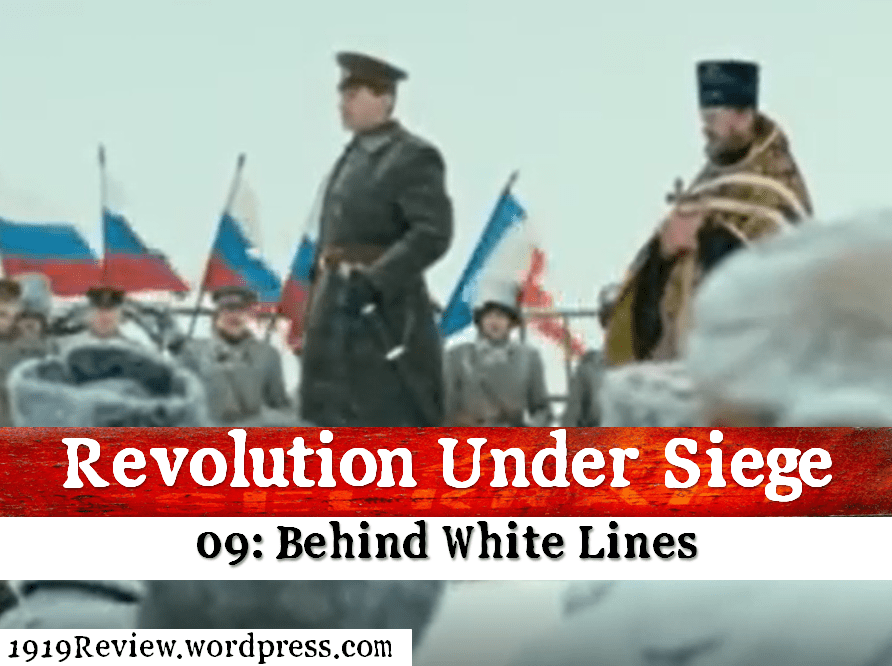
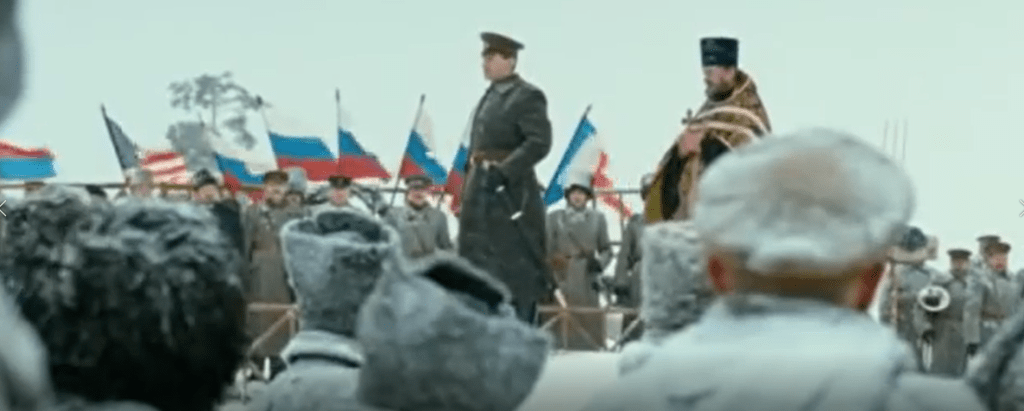
Today’s cover image, another still from Kravchuk’s Admiral. Kolchak in the centre, flanked by the church, plenty of Russian flags, the military, and the flags of Britain and France. This is a very pro-White Guard film. For example it begins with the Admiral sinking a German ship using the power of prayer.
Apologists for the coup preferred not to use the word. It was simply ‘the change;’ one regime ‘gave place’ to another; ‘the directorate ceased to function, and its place was taken by Admiral Kolchak and his ministry,’ who ‘[took] the authority… into their own hands.’ It had been necessary, because the Right SRs had prepared the ground for the Bolsheviks in October 1917, and ‘The same fate now threatened the Directorate.’[xviii]
The Komuch deputies were holding a congress in the mountain town of Yekaterinburg when news arrived of the coup – news, soon followed by armed bands of Siberian Whites who surrounded the venue and arrested them all. The Czechoslovak general Gajda saved them from being murdered by taking them into his custody. There was one last attempt to raise the banner of Komuch with yet another congress, this time in Ufa on December 2nd. It was shut down by Kolchak’s men.
Alone and on the run, Chernov decided to propose a deal to the Reds. They would have the support of the Right SRs if they would only recognise the Constituent Assembly. Still he clung to it. And why wouldn’t he? With it, he was president of Russia. Without it, he was an isolated politician alone on the run.
The Right SRs were legalised – not due to Chernov’s efforts, and needless to say the Constituent Assembly was not recognised. Chernov went to Moscow where he lived in hiding for a year or so before leaving Russia forever.
Back in Siberia, meanwhile, the Regionalist tradition was openly discarded in favour of old-fashioned Russian chauvinism.[xix]
The lion had closed its jaws and, without choking, swallowed the head of the Right SRs. Chernov blamed his own party: ‘our comrades were among those who helped Kolchak’s dictatorship to happen. They pulled down the bulwark of democracy with their own hands.’[xx]
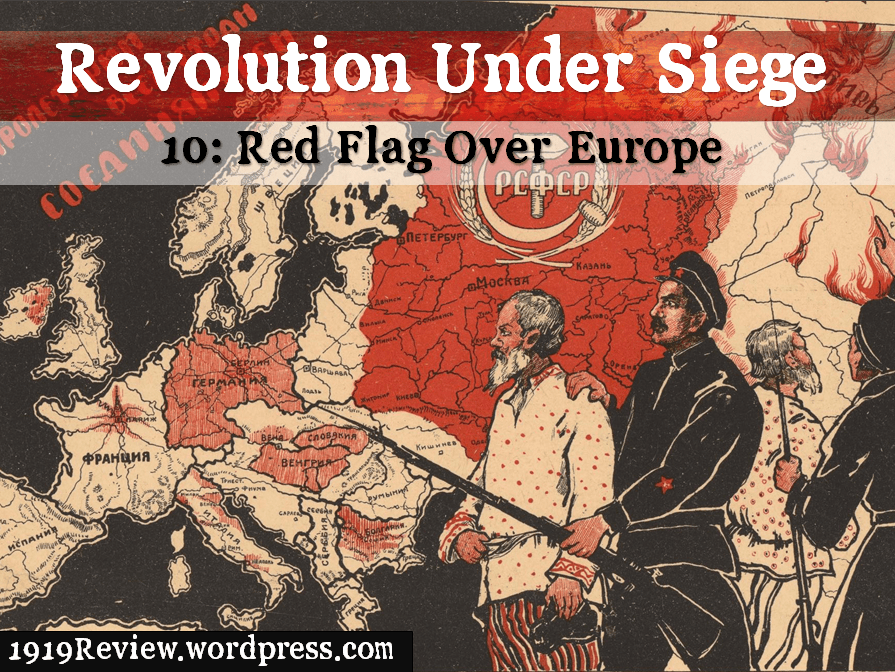
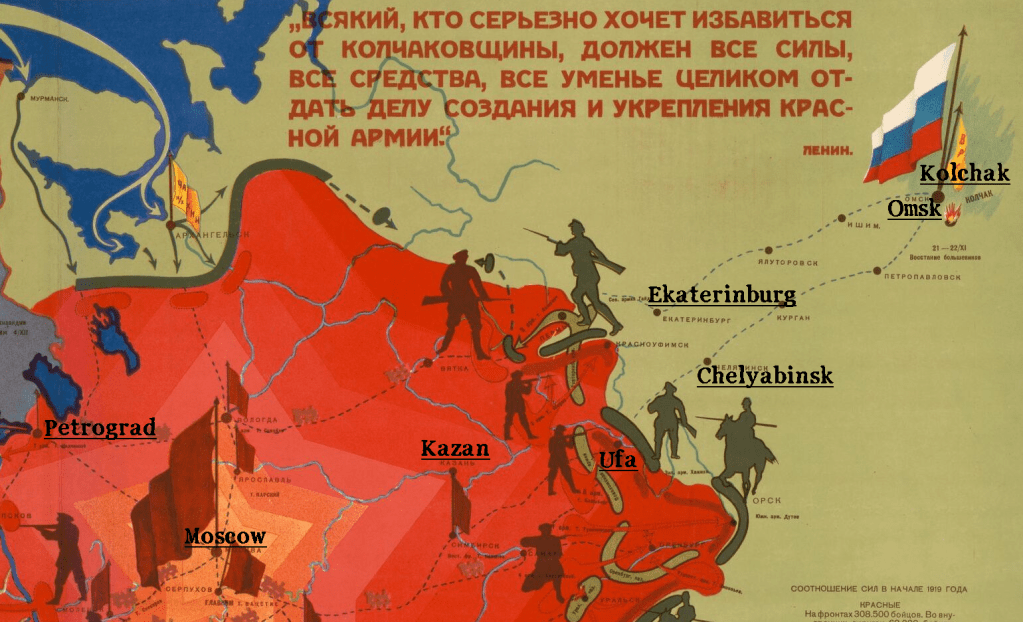
Detail from Russian Civil War pictorial wall map #4, ‘The German Revolution and Entente Intervention’ with some of the captions translated by me. Some details, such as the position of the frontline, are from a later date. The yellow flag in the NW corner represents the Ufa Directorate. The larger tricolour next to it was the flag adopted by the Council of the Supreme Leader. The little explosion is dated and marks the Omsk coup which overthrew the Directorate.
Kolchak had emerged as one of the two paramount leaders of the White cause. In Spring 1919 the Allies would recognise him as superior to Denikin. He was ‘Supreme Ruler’ and not ‘dictator,’ says Smele, ‘so as to maintain the decorum of the civic spirit.’
The note Kolchak struck in his first major address to the Russian people should be familiar to anyone acquainted with Denikin and his ‘I am not a politician, just a simple soldier’ routine:
I am not about to take the road of reaction or of disastrous party politics, but my chief aim will be the creation of a fighting army, victory over the Bolsheviki, and the establishment of justice and order so that the nation may without interference choose for itself the form of government that it desires.[xxi]
The Stand
Joshua Rossett, an aid official from the United States, gives an insight into the perspective on Kolchak held by many in the Pacific port of Vladivostok. He paints a picture of the intelligentsia, workers, peasants and well-meaning Americans all working hard to deal with humanitarian problems, united under the zemstvo, or local government. Then comes the shock of the Omsk coup. He describes Omsk, and the Ufa Directorate which preceded it, as a coup by food hoarders.
At the last local elections in Vladivostok, 35,000 votes were cast. A commissar came down from Omsk and began striking names off the voter rolls, eventually leaving only 4,000 – whom Rossett says were monarchists and speculators.
Rossett had a more visceral shock when local authorities asked a Russian cavalry officer to provide escort for 600 prisoners – men, women and children, mostly Red, some criminals. They were infected with typhus and had to be moved into quarantine. The officer at first refused, then then ‘with genuine enthusiasm’ offered to kill them all.
Very soon there was resistance to the new regime – not from civic-minded people angry at Kolchak’s disregard for the Constituent Assembly, or from appalled American aid workers, but from peasants. They deserted from the White army, refused to supply food, resisted the return of old landlords and old Tsarist officials. The hand of the Supreme Ruler came down heavy on them with hundreds of townships bombarded or burned and peasants ‘shot in dozens.’[xxii] The Red workers had long since fled from White rule in their home towns and set up guerrilla armies in the endless forests of Siberia. Now they were joined by masses of peasants.
The guerrillas composed songs about the untouched forest that sheltered them: ‘Sombre taiga, danger-ridden, Massed, impenetrable trees! Yet we rebels, safely hidden in thy glades, found rest and ease.’[xxiii]
Soon resistance flared up right at the heart of Kolchak’s power. The last scene in the tragedy of Komuch was the December revolt in Omsk. Communists based in the city led a workers’ uprising against the Supreme Ruler. It was crushed, and in response Kolchak lashed out indiscriminately to his left. Serge says that 900 were killed in the repression. Many of the remaining Right SRs and Mensheviks, who had taken no part in the uprising, were included in the massacre. Mawdsley writes: ‘Prominent SRs, including several Constituent Assembly delegates, were summarily executed.’ Of those who were lucky enough to get away, many went over to the Reds. The less lucky survivors sat huddled in cold dungeons, shoulder-to-shoulder with the Communists as 1918, the year of Komuch, withered and died.
From Admiral.
Consolidation
The Russian Civil War is so chaotic and confused that when, from time to time, a pattern emerges in the whirlwind of events, we should pause and examine it. In the White camp over the course of 1918 we can trace the following pattern:
Step 1: Foreign Intervention
On the river Don in May 1918, the Germans intervened.
On the river Volga in May 1918, the Czechs intervened.
Step 2: Local revolt with a ‘democratic’ flavour
Aided by the Germans, the Don Cossacks rose up against the Reds and established a state.
Aided by the Czechs, the Right SRs rose up against the Reds and established a state.
Step 3: In the shelter of the revolt, reactionary forces coalesce
Behind the shelter provided by the Germans and the Don Cossack state, there arose a military dictatorship of officers and Kuban Cossacks.
Behind the shelter provided by the Czechs and the Right SR state, there arose a military dictatorship of officers and Siberian Cossacks.
Step 4: Tensions between democratic and reactionary wings
Nonetheless the Don Cossacks were on unfriendly terms with the Volunteer Army, and the Right SRs were on unfriendly terms with the Omsk regime.
Step 5: Reactionary wing defeats democratic wing
The Don Cossacks spent their strength at Tsaritsyn, then their remains (as we will see in future posts) were cannibalised by the Volunteer Army.
The Right SRs spent their strength at Kazan, then their remains (as we have just seen) were cannibalised by the Omsk regime.
The parallels should be noted well because in them we can see the complex mess of factions tending to resolve itself into united and powerful White armies. Cossack autonomy, Siberian regionalism and Democratic Counter-Revolution – transitional forms, gateway drugs – fall by the wayside and everywhere the White cause takes the form of a far-right military dictatorship.
[ii] Pereira, NGO. ‘The Idea of Siberian Regionalism in late Imperial and Revolutionary Russia.’ Russian History, vol. 20, no. 1/4, Brill, 1993, pp. 163–78, http://www.jstor.org/stable/24657293.
[v] I copied and pasted this quote word-for-word from a reliable source – but I can’t remember which one! When I find it again (probably as I comb through my notes in search of something completely different six months from now), I will post a proper citation here.
[vi] Serge, Victor. Year One of the Russian Revolution, p 346
[xiii] M. I. Smirnov. “Admiral Kolchak.” The Slavonic and East European Review, vol. 11, no. 32, Modern Humanities Research Association, 1933, pp. 373–87, http://www.jstor.org/stable/4202781.




 The 1919 Review