Screen Adaptations of Dune

The new Dune is phenomenal. Two-plus years ago Dune: Part One got me out to the cinema for the first time since Covid and it was exhilerating. Part Two is reported to be even better. But Frank Herbert’s 1965 novel Dune has been adapted for the screen before, more than once. I have seen all these adaptations, because I have a strange fascination with Dune which is part nostalgia because I first read it aged 14, part a mature realisation that the things we enjoy don’t have to coincide with the things we believe in, and part, no doubt, reasons that could be best explained by Freud (sandworms), Marx (family retainers) and Edward Said (white saviour complex).
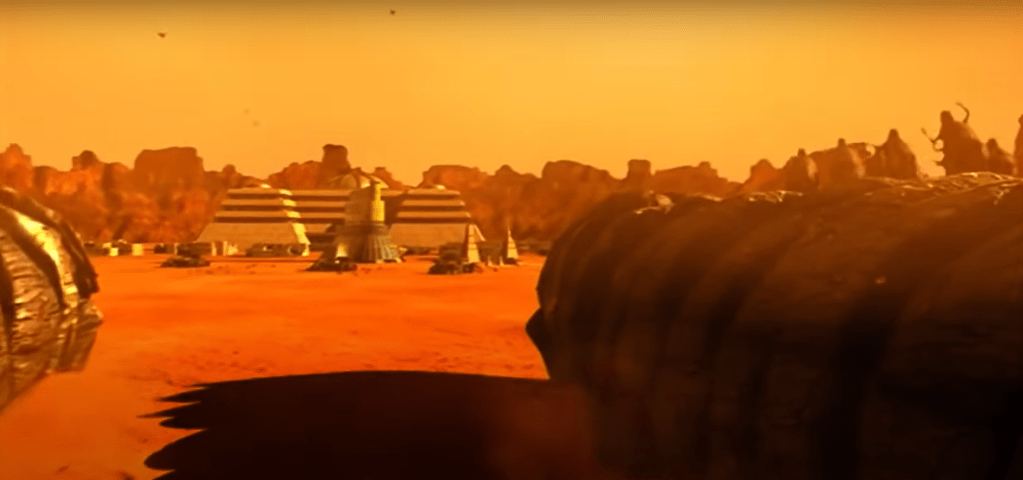
Freudian beasts, their hour come round at last, slouching toward Arrakeen. From the 2000 TV version, dir. John Harrison.

Enough deprecation. I also like this story because it’s exciting, intelligent and haunting. The author takes politics, economics and ecology seriously while telling a great story. How well has that translated to the screen?

This review will take a look at David Lynch’s 1984 movie, the Sci Fi Channel’s 2000 miniseries, and Denis Villeneuve’s 2021 adaptation of the first half of the novel.

Villeneuve is talking about adapting the Dune sequels. In a bit of a sequel to this post, we will look at the 2003 adaptation of Dune Messiah and Children of Dune.
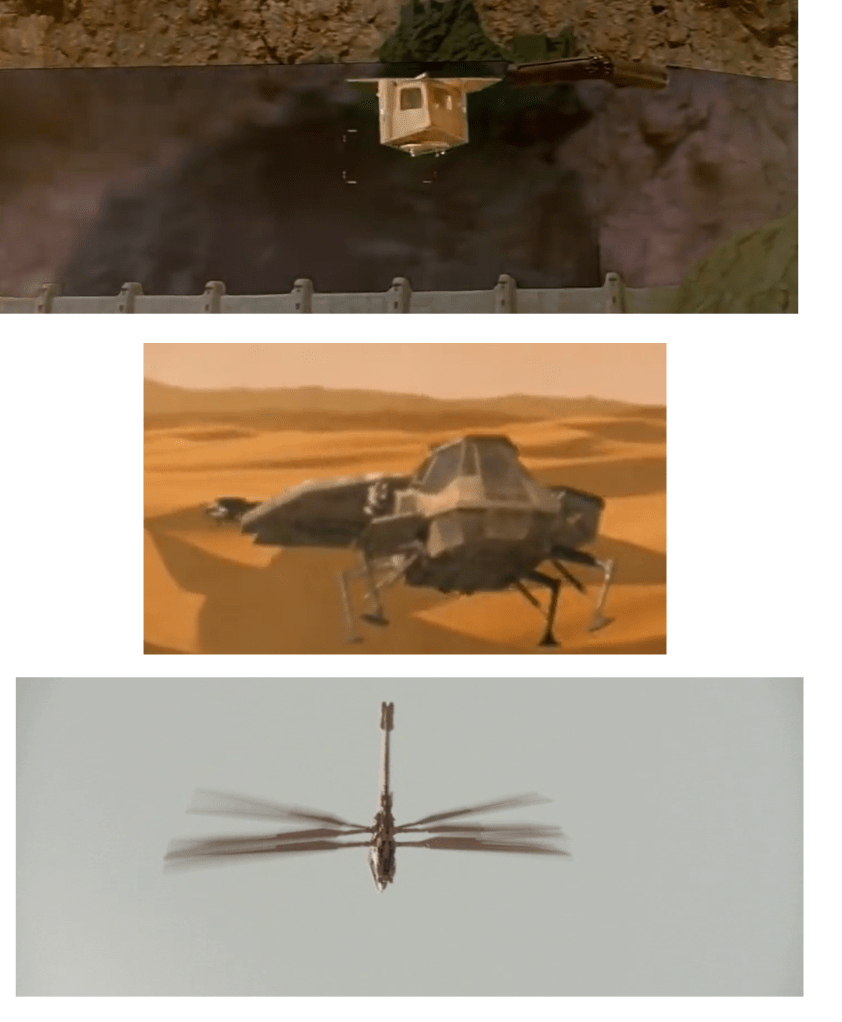
Three different versions of the ornithopter from, top to bottom, 1984, 2000 and 2021.

Harkonnen Horror Picture Show

God created 1984’s Dune to train the faithful. For every good thing I can say about it, there’s a bad thing too, and vice versa.

To begin with, something bothers me about the interiors. The Atreides live in surroundings of Victorian frumpiness, gaudy but flat, like the decor in Boris Johnson’s house; the Harkonnens in a green-lit space slaughterhouse. For all the implicit homophobia in the way the Baron is portrayed, something about the campiness of the whole set-up makes me think the whole evil cabal might jump out of their chairs and start singing ‘Time Warp’ at any moment. But other elements of the visual design are brilliant – the guild spice navigator and his cohorts, who prefigure the fascinating visual excess of Warhammer 40,000; the tonsured Bene Gesserit; the faceless rubber menace of the Harkonnen troops.

The spaceships look cool; but the visual sequence in which the guild navigator bends time is slow, unclear and not necessary.

I like the weirding modules. These are invented out of whole cloth for the movie: in short the Atreides have a special weapon that can kill with the utterance of a sharp syllable. This idea fits pretty well in the world of Dune and helps the story along. For example, it explains what’s so special about Paul from the point of view of the Fremen: he brings a powerful new weapon to the table. But the shields, personal force-fields used by combatants in the universe of Dune, look silly.
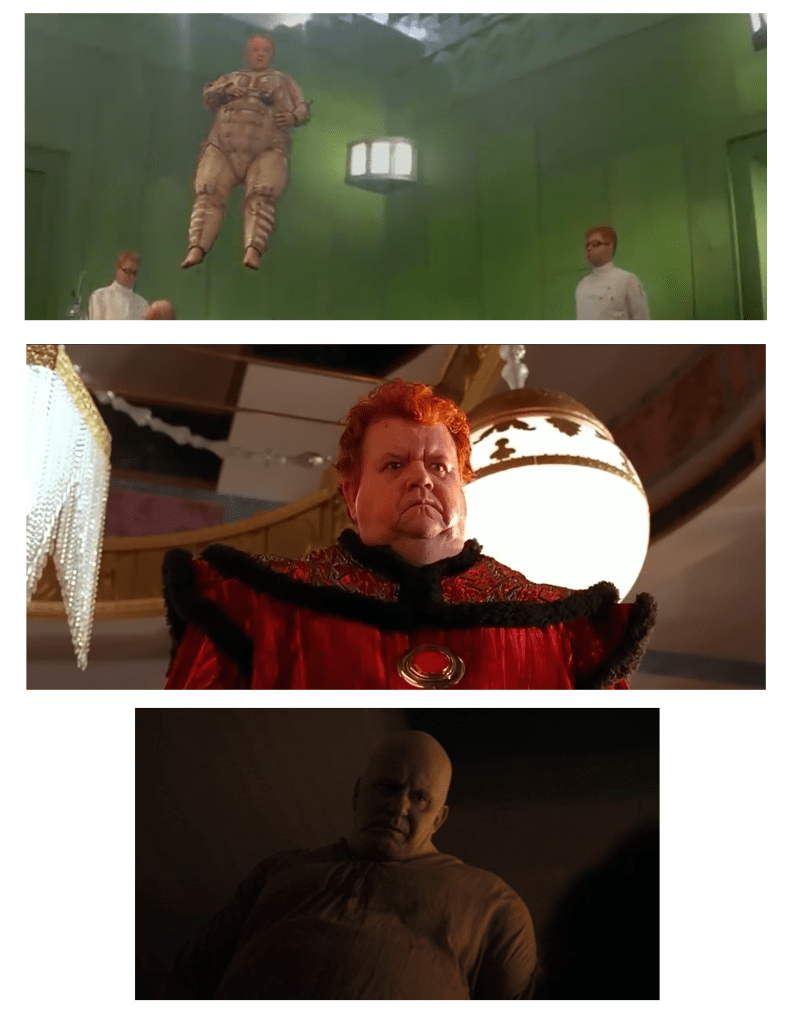
Top to bottom: Kenneth McMillan, Ian McNiece, and Stellan Skarsgard as Baron Vladimir Harkonnen. Top to bottom, the colour pallettes of a 1980s movie, a TV show from 2000 and a 2020s movie

The movie is rushed and incoherent. It might have gotten away with telling such a huge story in just over two hours, but it goes out of its way to be confusing and to trip us up on irrelevant things. It’s difficult to imagine anyone who hasn’t read the books being able to follow what’s going on. But the final half-hour strides along with a formidable momentum and plenty of cool imagery.  

At the very end of the movie it suddenly rains on Arrakis – a development that makes no sense in the logic of the world, but which is absolute magic on a simple storytelling and thematic level. I can see why they couldn’t resist.

It’s a movie I could talk about, back and forth, is it good or is it bad, for a long time.

The guild spice navigator, from the 1984 Dune, dir David Lynch

A very delicate time

The opening of 1984 Dune is problematic in ways that are thrown into sharp relief by the quality of the 2021 Dune’s opening. In 1984 Dune, we begin with Princess Irulan, a very formal narrator who stares straight into the camera and explains things, followed by a scene in the imperial throne room. In 2021 Dune we begin with Chani narrating over a striking visual sequence. 

The 2021 approach is more democratic and materialist, centring the indigenous Fremen and the key resource they control rather than the galactic aristocracy. But it is also much better from a storytelling point of view: it is rooted in real and tangible things, while narrators and the high politics of throne rooms are distant and abstract. Chani is narrating but also participating in a sequence that conveys visually the importance of the spice, the oppression of the Fremen by the Harkonnen, and the transfer of power from the Harkonnens to another noble house.

The guild spice navigator in the 1984 Dune is a top-tier movie monster. In the books we don’t see him until Dune Messiah, but here he makes his grand entrance in the opening sequence. Unfortunately that is a big problem. Although he is cool, he is one of several big things that we don’t need to know about this universe right away, or at all. But the movie goes out of its way to foreground him.

From the 2021 Dune, dir Denis Villeneuve. Murky.

Comedians of Dune

The Harkonnen scenes in the 1984 Dune leave me with a vague impression of grotesque-looking people bellowing and jabbering monstrous things at one another, punctuated with maniacal cackling. The 2021 Dune is a bit humourless by comparison. There is an early moment in which Paul and Duncan Idaho share a chuckle. But that is an oasis in a desert of dourness.

There is, to be fair, one other joke in the movie:

‘Smile, Gurney,’ says Duke Leto.

Scowling, Gurney replies: ‘I am smiling.’
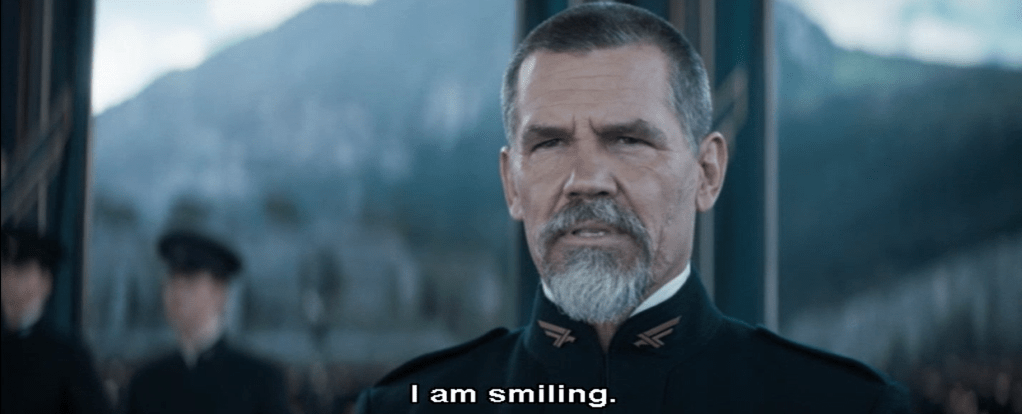
Someone has decided to make Gurney ‘the grumpy one.’ It’s a good joke, delivered well by the actors. Is the movie taking a dig at its own serious tone? Or is it opening itself up to the retort: ‘Which grumpy one?’

Still, the 2021 Dune is better in almost every way. The storytelling and worldbuilding are far more skilful, conscious, economical; the screenwriters treat words as the Fremen treat water. The visuals play with light and shade, convey weight, grit, thirst, scale. It does not lack that essential quality: weirdness, accident, quirkiness (Who thought of giving the Atreides bagpipes? Give them a medal) but it doesn’t allow that element, either, to get in the way of the story.

In any adaptation, fidelity to the original is not crucial for me. Things have to change in the move from one medium to another. A change for the better, or a change necessary for the medium, justifies itself. But for what it’s worth, the 2021 Dune is much more faithful to the original. Both other adaptations resort to arming their extras with projectile firearms. But in the book and the 2021 version, shields have rendered firearms obsolete, and combat is primarily a hand-to-hand affair.

Budgets of Dune

An even smaller point against the 2021 Dune is its portrayal of the city of Arrakeen. In a movie that cost $165 million to make, this key location appears to be nothing more than a scale model, entirely devoid of human life. The 2000 TV adaptation, working with a budget of $20 million, manages to convey a lively and bustling place. (In case you’re wondering, the 1984 Dune cost about $40 million.)
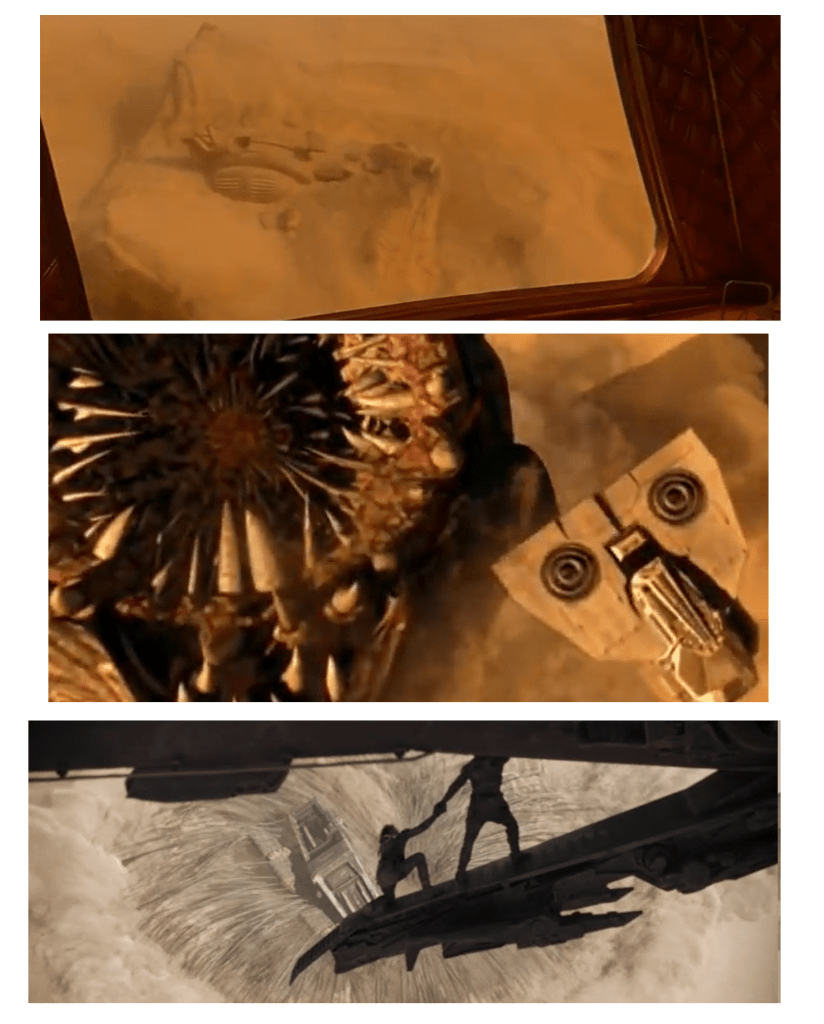
The same moment in three different versions: fleeing by ornithopter as a sandworm eats a spice factory. Top to bottom, 1984, 2000 and 2021.

Now we come to the most obscure adaptation, Frank Herbert’s Dune, a three-part miniseries for the Sci Fi Channel written and directed by John Harrison.

(It was one of three very fine miniseries released by the Sci Fi Channel around that time, along with Steven Spielberg’s UFO epic Taken and Battlestar Galactica. The latter ended up running to the proverbial six seasons. It was an underappreciated moment in the history of ‘prestige TV’.)

I’ll level with you up front: Frank Herbert’s Dune is not visually spectacular – the CGI is dated and some of the costumes look tacky.

But the actors are impressive. It is long not because it is bloated, but because it has made a conscious decision to tell the story more fully and faithfully, without unseemly haste. Everything about this adaptation is confident and assured, as if having a smaller budget gave it much more freedom.

And about that CGI: on a technical level, it would not pass muster today. (Though nostalgia or irony might induce people to deliberately copy this style in the future – stranger things have happened). The images are well-composed and are shot and edited in such a way that, interspersed with live-action footage, they tell a compelling and comprehensible story. A lot of today’s filmmakers could learn a lot from how the CGI is used here, how John Harrison does so much with relatively little. The result is that a CGI-heavy action scene, such as when the spice factory is eaten by a worm, is a genuinely tense experience.

In a fantastic scene, the ‘Beast Rabban’ gets a personal comeuppance he never gets in the novel when he is killed by a mob in the streets of Arrakeen. I guess budget dictates that some additional scenes must happen in this set, to justify the expense of building it; but budgetary needs can coincide with storytelling needs. It is satisfying to see this showdown happen in this familiar place. In the novel, by contrast, we are told in the most perfunctory Shakespearian way that ‘Rabban, too, is dead’ – offscreen somewhere.

I don’t want to over-praise something that, after all, will have dated poorly, especially measured against the new big-budget spectacle. But here’s one last piece of praise: Frank Herbert’s Dune is the only adaptation to leave in the crucial banquet scene (into which it inserts the Princess Irulan and a bodyguard of Sardaukar. It’s important later that we know who these people are, so it makes sense to feature them here).

It was shot in Czechia, and you can decide for yourself whether that (a) results in lamentable whitewashing of the Middle Eastern elements or (b) to your great relief, distances the adaptation from the wild orientalism of the novel.
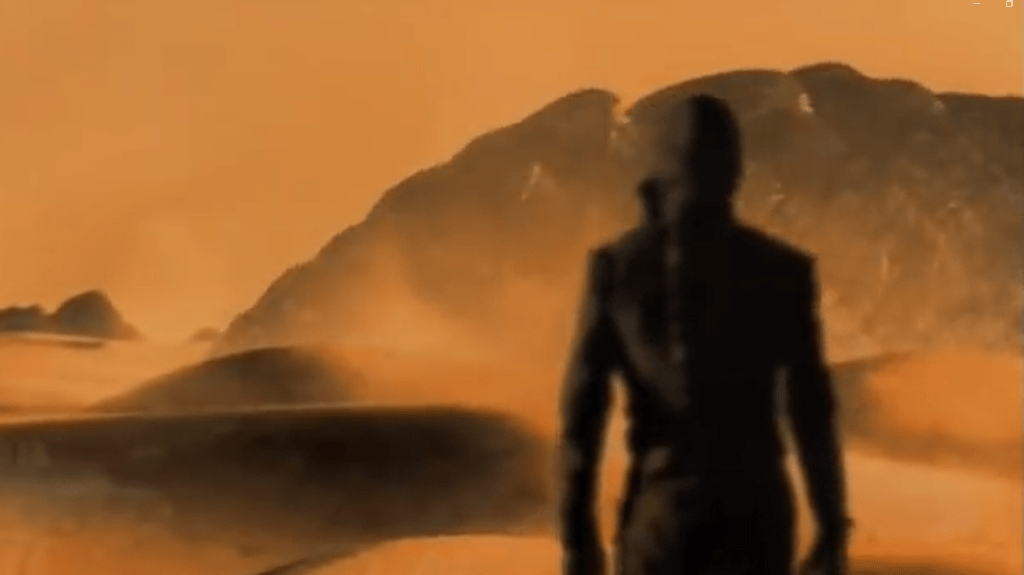
Paul in stillsuit watches a sandworm’s back cresting the sand. From the 2000 version.

Recommendations of Dune

If you want a spectacular modern science fiction epic, well-conceived and well-executed, with current stars and big budget, you should watch the Denis Villeneuve Dune.

If, like me, you are really into Dune and also interested in the process of storytelling and adaptation, these versions are all deeply intriguing.

If, like me, you are interested in things that are good but also kind of bad, you should watch David Lynch’s Dune. The highs and lows are equally bold and striking.

If you liked the 2021 Dune and want to know more, but aren’t much of a reader or can’t get into the books, the 2000 miniseries is a good place to go to delve deeper into the story. It would be a good option for someone who prefers the pacing and serial form of TV shows. It also has the great advantage that it has a direct sequel to introduce you to the later books in the series.

Next week I’ll talk about that sequel: the novels Dune Messiah and Children of Dune, along with the TV miniseries Frank Herbert’s Children of Dune (2003). Stay tuned for that if you want to hear about how a low-budget TV adaptation can be better than the source material. Until then, enjoy Dune: Part Two.
Home Page/ Archives

How Dune gets away with it

No, Rebel Moon is not really like Star Wars

‘A pound shop C-3P0!’

That was Mark Kermode’s verdict on Jimmy the robot from Rebel Moon. This sums up what Kermode and many others have said about director Zack Snyder’s new space adventure movie: that it’s a rip-off of Star Wars, that it’s staggeringly derivative.

I usually like Kermode but actually Jimmy isn’t much like 3-CP0. He’s a humanoid robot with an English accent – OK. But there have been a lot of human-shaped robots since Fritz Lang’s Metropolis. It’s pretty much the default shape for robots. And English accents are not rare; Mark Kermode has one.

Jimmy is a military robot, designed to kill, not a protocol droid who can speak 6 million languages. C-3P0 is pedantic and cowardly and pessimistic. Jimmy, on the other hand, has an interesting and messy internal life. Unlike C-3P0 he is dignified, and he is played for sympathy, not for laughs. He was programmed to defend a certain princess, and now that she’s dead he can’t fight – until something unexpected suddenly restores his capacity for violence.

This incident has placed him on an interesting trajectory. When we see him in one of the final shots of the movie, having not seen him at all for over an hour, he has undergone a strange transformation – a kind of robotic midlife crisis, resulting in new feral headgear. It’s a striking image.

I didn’t particularly want to like Rebel Moon and I didn’t see myself writing about it here, slightly pedantically defending it from a critical pile-on. Of Snyder’s precious films, 300 impressed me at 16 but in retrospect it was a crazy and fascist movie, drawn from an equally crazy and fascist comic. I haven’t seen a Snyder film since Watchmen. I know that Rebel Moon started out as a rejected pitch for a Star Wars movie. In the trailer, the action looked weightless, the characters dour. I thought it would be Star Wars without any humour or character, and with a reactionary political edge.

But honestly, contrary to what most of the critics are saying, Rebel Moon carves out its own space and is its own thing. I watch everything in 20 or 30 minute stretches these days, between changing nappies, sleeping and going to work, so the length of the movie didn’t bother me as I didn’t watch it in one sitting. But if I didn’t really like it, I wouldn’t have kept coming back.

From the start, Rebel Moon struck me as more like Warhammer 40K or Dune than Star Wars: there’s the solemn choral music and the baroque Gothic style of the bad guys. This tone promise was borne out: the whole movie is edgier than anything Lucas made. It’s not exactly Come and See but it’s more for teenage boys (of all ages and genders) than for the whole family.

The early scenes with the good guys are also very un-Star Wars. They talk about sex, joke about it, and have it barely off-screen, which is something most action-adventure films of our era are terrified to do because they want to pack all age groups into the cinema. That’s refreshing. Also, these pagan farmers appear to be having a really good time even when they aren’t riding each other. For me, all this was unexpected and endearing.

The arrival of the bad guys is really tense. This sequence follows Hitchcock’s ‘bomb under the table’ principle. Yes, thanks critics, it’s obvious they’re bad space fascists and they’re going to do bad things. But we don’t know exactly what they are going to do, or when. Hence the tension.

The imperial soldiers are not faceless stormtroopers. They’re macho bullies and rapists, apart from one decent guy; they have horrible personalities, but the point is that they have personalities. In another 40k nod, their armour spans the gap gracefully between futuristic and baroque.

Contrary to what I expected, the fight scenes actually kick arse. They have real weight and are gritty. The energy weapons have a kick to them.

There are plenty of genre tropes in the first 40 minutes. But there are few specifically Star Wars tropes until Kora and Gunnar (look! I remembered their names 3 weeks later) take in a vista of a town from a clifftop before proceeding into a cantina full of exotic and dangerous-looking figures. From there it turns away from Star Wars again and becomes a ’round up a posse’ story, drawing from Kurosawa himself, not Kurosawa filtered through George Lucas.

There are plenty of moments where the movie is a visual feast. But sometimes the environments look like stage backdrops, and even when they don’t look like it they behave like it. When our heroes meet the Bloodaxes, it might as well be happening on a theatre stage because there is no interaction with the floaty columns that loom in the background. Towards the end, which is not really an end but a lull before the next movie, the characters keep saying wooden portentous things clearly designed to get the ending to feel more ending-y. That’s clumsy. I found most of the slow motion stuff unnecessary and distracting. A slo-mo shot of seeds being sown – what is that for?

The Bloodaxes keep saying the word ‘Revolution,’ without every giving us the slightest notion of what their revolution is about. In this sense too the movie is distinct from Star Wars: it finds a way to be even more apolitical. Unfortunately Rebel Moon also goes so far as to hint that the evil empire might be redeemed by a slightly more compassionate absolute monarch, one who can heal little birdies with her bare hands.

Once again, like in Dune and Star Wars, we have space feudalism. The assumption that a lot of dukes and emperors would be able to manage interstellar travel, when our modern capitalists have such trouble even getting off the ground, is a strange one, but again it’s a genre trope and hardly unique to this movie.

The whole thing is basically limited and on the shallow end, but it’s gripping, pacy and well-executed. Take the masked priest characters who lurk in the background ominously for the whole movie, until the final scenes when we at last learn what their function is and see them at work. That’s cool. The script is pretty likeable. When a bunch of nameless good characters are killed in battle toward the end of the movie, we afterwards get a moment of tribute and mourning – something we rarely get in Star Wars, where there’s an unwritten rule that nameless characters are disposable.

It’s a shame this kind of budget isn’t going to a movie adaptation of some piece of space sci-fi by, say, Ian M Banks or Ann Leckie, or some original adventure drawing on their ideas. That’s my main problem here: there are lots of little sci-fi tropes and elements in Rebel Moon, but no big Science Fiction ideas animating the story, no consistent through-line in the worldbuilding.

I thought the Avatar sequel, Dune: Part One and Andor were all brilliant in very diferent ways. Rebel Moon is not on that level – it’s not so original or intelligent. But the critics are wrong. It hits the targets it sets out to hit. And it’s only ‘like Star Wars‘ in the sense that they both belong to the same genre. In the same way Notting Hill is like Meet the Parents in that they are both rom coms. In the way that 300 is like Gladiator. In the way that Watchmen is like an Avengers movie.

Saying that Jimmy is C-3P0 is just pointing out that they both have human shapes and English accents. It’s not demonstrating anything, except ignorance or maybe disregard for the genre. Likewise, pointing out that Rebel Moon is like Star Wars is actually saying nothing more than ‘These two films are action-adventure movies set in space.’

Home Page/Archives

What if the 1930s USA had turned Nazi?

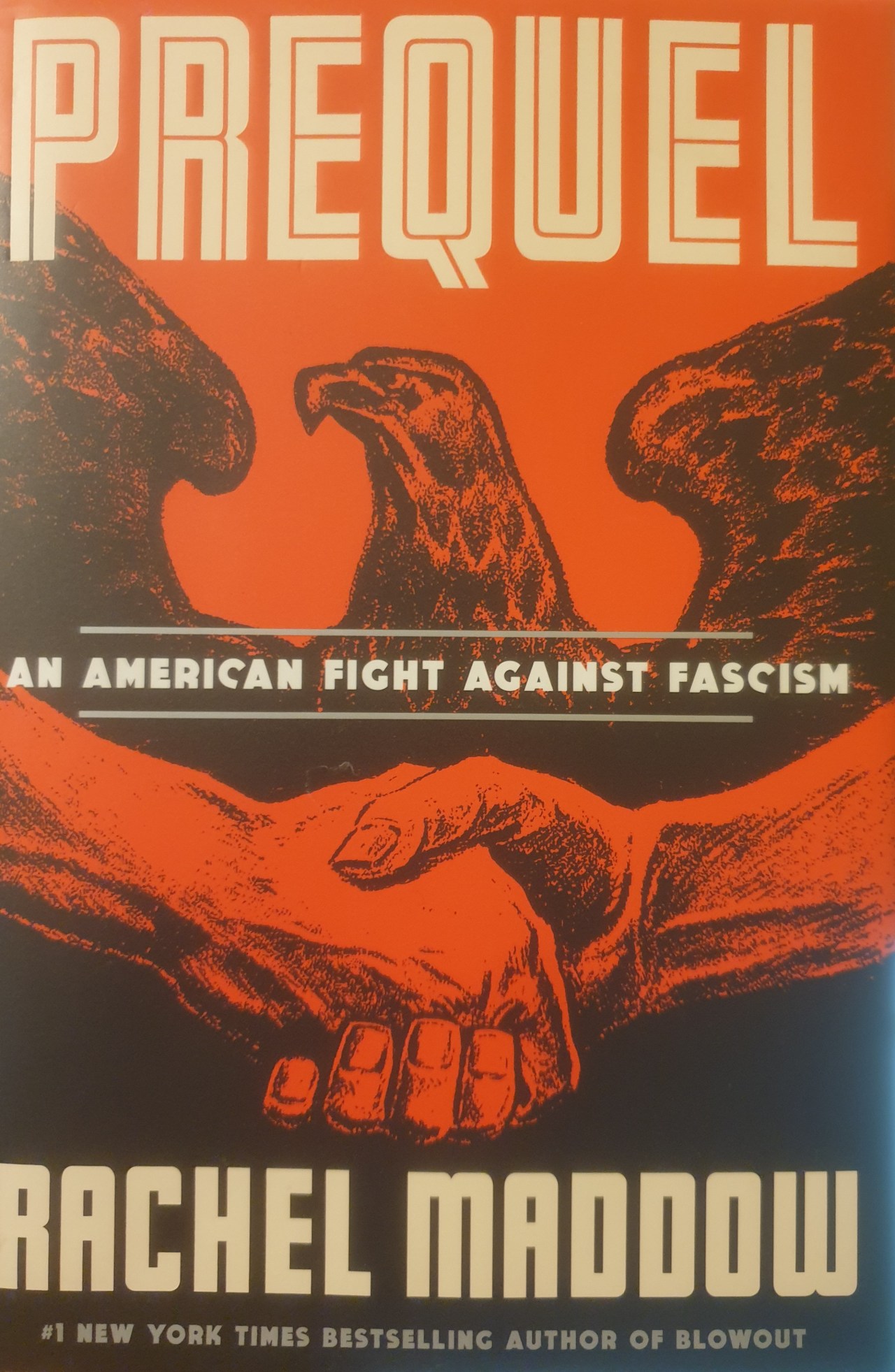
A review of Prequel: An American Fight Against Fascism by Rachel Maddow (Crown, 2023)

You may have heard of Father Coughlin, the pro-Nazi Catholic priest whose radio broadcasts went out to tens of millions of Americans in the 1930s. You may have read in Jacobin that Philip Johnson, one of the most successful architects of the 20th Century United States, spent the pre-World War Two years promoting fascism in the USA and trying to keep the country out of the war. You may have heard of the Silver Shirts, the US equivalent of Mussolini’s Blackshirts and Hitler’s Brownshirts. You may have known that the famous aviator Charles Lindbergh was pro-Hitler and led an organisation called America First.

I’d heard of the above, but most of my understanding of fascism in the pre-war US came from alternative history fiction: The Plot Against America by Philip Roth and K is for Killing by Daniel Easterman.

But Rachel Maddow’s 2023 book Prequel opened my eyes to much crazier stuff. I remember that at one point in Easterman’s novel we encounter a federal employee whose job it is to figure out legal loopholes so that mass internment and concentration camps don’t break US laws. Well, it turns out the Nazis actually sent legal experts over to the US to study how the Jim Crow laws worked, so that they could bring in similar racist laws back in Germany. It’s a reminder that the USA was already a bizarre race-obsessed oppressive dystopia.

I didn’t know that at least 24 elected members of the US Congress abused their free mail privileges to send out millions of copies of pro-Nazi speeches bearing their own signatures but written by Nazi agents. I hadn’t heard of General George Van Horn Moseley. I didn’t know that in California a coalition of fascist and far-right groups planned a mass lynching of famous Jewish people from Hollywood, to be followed by a spree of random gun and gas attacks on Jewish homes. This Helter Skelter-like plan was supposed to trigger a race war. I didn’t know that Coughlin followers in New York organised militias, armed with weapons stolen from the National Guard by sympathetic military officers.

Maddow also tells the stories of various private citizens who campaigned to expose and thwart the Nazis: the LA private investigator Leon Lewis, the assistant Attorney General O. John Rogge (After the war, he tried to reveal to the public the extent of Nazi penetration into the US; he was fired and his report quashed) and a cast of other brave individuals.

But they are merely individuals. An important episode in the fight against fascism in the US in the 1930s was the counter-protest at the America First rally in Madison Square Garden. But Maddow dismisses this protest in one passing sentence. The only mentions of the labour movement, as far as I can recall, are negative. She correctly emphasises that the US Communist Party was by no means the seditious threat it was portrayed as. But the role of communists, socialists and trade unions in opposing fascism is skated over entirely. Pelley and the Silver Shirts were based in Minneapolis – but Maddow does not look at the labour movement and the socialist left in that city, which confronted and organised against the Silver Shirts.

The focus is instead on the judicial system  journalists, Hollywood, etc. To be fair, Maddow does not neglect to show how the state, from beat cops to the Attorney General, enabled the fascist agitation.

Maddow’s style is very engaging. She brings a laugh-out-loud quality to some of the farcical scenes from the Dies Committee. She does not write coyly or piously or with any false neutrality. That gives the narrative plenty of energy but it has overheads. I’m not from the United States and I found the self-righteous nationalism a bit weird (And I’m sure there are plenty of people from the US who would find it equally weird). For example, on page 195 we are supposed to be shocked at a politician refusing to show sufficient uncritical jingoism in the context of the First World War. The First.

I know of Maddow only by reputation as a liberal national security hawk who was very into the Trump-Russia stuff. This story, as the title implies, is supposed to be taken as a parallel to more recent events. And the strange constellation of far right thugs we see here do offer many parallels to the MAGA right today.

In spite of my criticisms I read through this book quickly and with great interest. Many parts of it were truly fascinating and horrifying. Not only does it recover a hidden history, it invites us to ponder alternative – and far worse – ways things could have turned out.

It’s New Year’s Eve so I want to thank all my readers. It’s been a fantastic year for the blog and I have big plans for 2024.

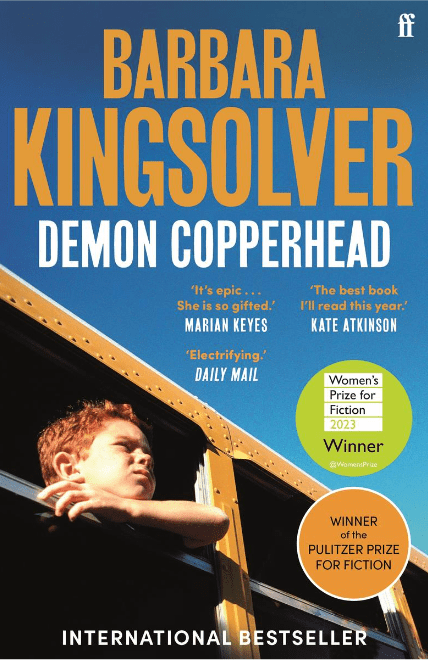
Review: Demon Copperhead by Barbara Kingsolver

Audiobook performed by Charlie Thurston

After I finished Demon Copperhead I read a couple of reviews and had a strange moment. Just for an instant, I felt surprised that this reviewer in the Guardian also knew Demon. I had approached the novel as an Award-Winning Book That People Should Read; then I started it and I was in Demon’s world, and prestigious literary awards were the last thing on my mind. When I finished it – or maybe emerged from it – a part of me was surprised to remember that it was a book after all.

Demon’s voice

The feature of the book which best explains this is there right from the start: the narrative voice.

The narrator and main character is Damon Fields, who has a nickname, like everyone on his home turf of Lee County, Virginia. He is dubbed Demon Copperhead – the echoes of David Copperfield by Charles Dickens are there if you want them, but you can enjoy this book all on its own. The book follows Demon from birth through his first two decades in this world. His community is shambling through a half-life of mass unemployment; his young single mother struggles with addiction; the opioid epidemic hits like a war when he is around 10 to 15 years old.

The great strength of this book is the gloss of humour that comes with having Demon as a narrator. When I say that it’s easy to read despite the heavy themes, maybe readers will think that means the book takes a flippant or mocking approach. But it’s compassionate and humane all the way through. When I say that Demon interrogates head-on the issue of how the media portray ‘hillbillies’ and ‘rednecks,’ you might think the narrative is weighed down with lectures. It has didactic parts, but they don’t weigh down the story at all. They drive it on. Real people lecture, and lectures can be compelling.

I don’t have personal experience of the setting or of most of the heavy themes in this book. I assume Kingsolver must know the locale and its people – it rings true. But it’s about a kid growing up at the same time as I was. From the tone of the narrative voice to the pop culture references, and even the particular flavour of juvenile humour, Barbara Kingsolver got Demon right. He seems like some kid I might have known growing up.

The literal voice of Charlie Thurston was strong in the audiobook. Again, I just can’t comment on the accuracy of the accent, but the performance was more than good enough. If I ever hear that voice on another book, or on TV, my first reaction will be, ‘Hey, that’s Demon.’

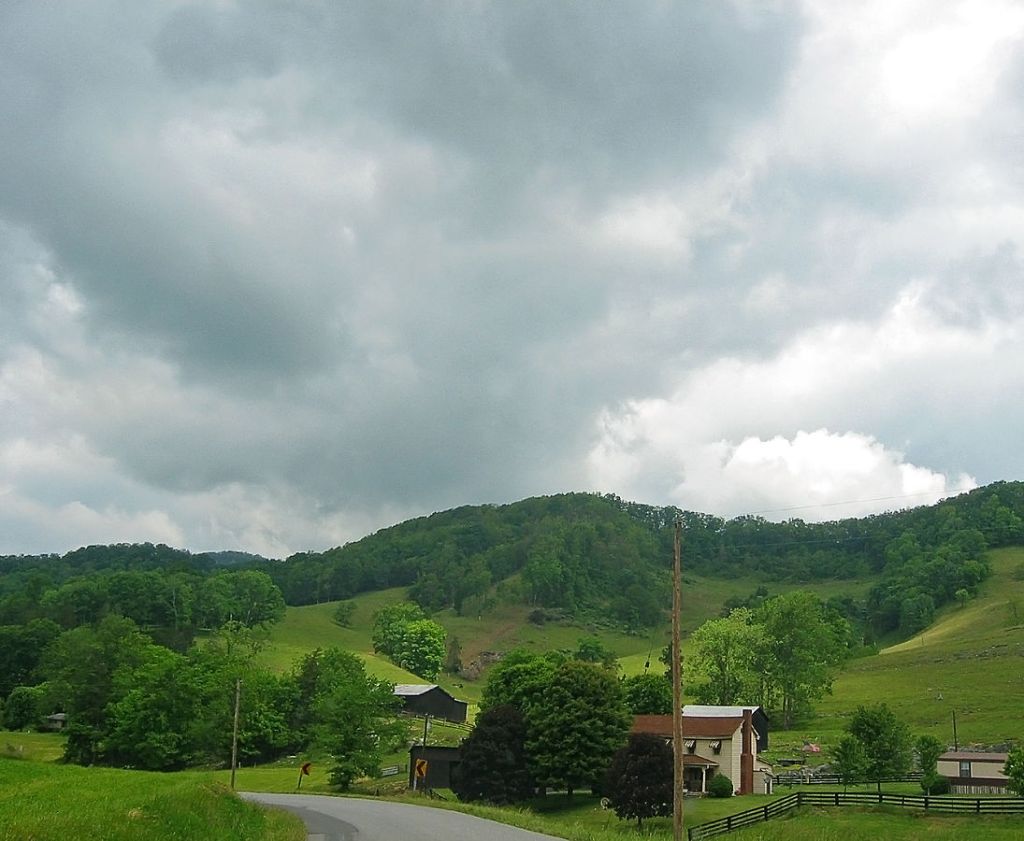
The lush landscape of Lee County, Virginia

Characters

Demon usually has at least a medium-sized list of things going on in his life, pulling him this way and that. He also has a satisfyingly large cast of characters coming and going. They are all well-developed so that I never had moments of ‘Who’s he again?’ You know you are dealing with good writing when you find yourself a little excited to see two characters together for the first time. ‘Huh,’ I said to myself, ‘so young Maggot and Swapout are doing break-ins together,’ or ‘Well, wouldn’t you know it, U-Haul and McCobb are in on the same pyramid scheme.’ On the other hand you feel genuinely relieved and pleased to see, for example, Tommy Waddles doing well in life.

In its world, ‘doing well’ is relative. When the adolescent Demon is sent to work at a dump beside a meth lab, it’s a great improvement in his fortunes because the owner of the adjacent garage lets him eat free hot dogs whenever he likes. Relief washes over you. Come to think of it, relief is the main feeling I associate with this book.

This book has great villains. It’s fair to say that U-Haul’s characterization lacks subtlety – he’s just a grotesque person. The McCobbs are a terrible foster family, in all kinds of fascinating ways, but they are not monsters. In a different and even worse foster home, Demon runs into an older boy known as Fast Forward. Fast Forward gets the younger boys to line up like soldiers for inspection each night. He shakes them down for money and snacks. He makes them take the fall for his mistakes. But he also gives them flattering nicknames, an identity, a sense of purpose and dignity in this hellhole. This is the source of his power, and that power makes him scary.

Then we have a moderate-sized pantheon of adults who just let Demon down. There’s those who, to paraphrase Demon, can’t see any more in young men like him than what can be wrung out of them by the end of the week on the battlefield, the farm field or the football field. Then there’s those who, out of misguided ‘tough love’ or in the heat of an argument, cut off support to young people just when they need them most of all. Then there’s the one who let Demon into his home, but also let in the monstrous U-Haul.

Then there are the social workers – the one who stays in the job but just doesn’t care, and the one who cares in her naïve way but quits the job as soon as she can. Demon understands why one doesn’t care, and the other quits – they get paid very poorly. Their work is a life-or-death question for him, but it is simply not valued by the state.

On the summit we have a cast of characters who are just solid gold, such as Angus/Agnes, a couple of teachers, June Peggott, and in his more limited sphere, Mr Dick.

Addiction

Kingsolver gets past the bullshit of judging addicts for their ‘personal choices’ to show why people fall into drug abuse. ‘This was done to you,’ June Peggott insists.

There is a moment early-ish in Demon Copperhead when Fast Forward throws a ‘pharm party’ for Demon and the other foster boys. They sit around on the floor eating hash brownies and taking pills. This should be an ominous moment – Demon’s first introduction to something that will later cause him a lot of suffering. But it isn’t. In this filthy and cheerless house, the boys are regarded as farm labour and nothing more. They are insulted and sometimes beaten, and not provided with clothes or proper meals. When it enters the story, the ‘pharm party’ does not present itself as something immediately dangerous. It’s a respite. The story tells us to face it: there’s nothing better on offer from their fosterer or from the Department of Social Services. Drug abuse is not the worst thing happening in this house. It doesn’t even rank in the top ten worst things.

But of course it is the beginning of something very bad. Later, when Demon is a teenager and is doing better, an injury puts him out of action and a doctor puts him on oxycontin. By now the opioid epidemic is raging. He descends into addiction – not all at once, and not putting everything else on hold. Life goes on around the addiction, but we see how it creeps in. His first experience with drugs was intimately bound up with his relationship with Fast Forward, and as he grows up relationships continue to be central to addiction. When Demon describes an incident of falling off the wagon as an act of love, and when he tells us that addiction is not for the lazy, we see what he means. We are dismayed to see him ruining his life, but his actions make sense in the situation he’s in. Sometimes his actions are even perversely admirable.

Devil’s Bathtub, in Scott County, Virginia

Dickensian

Several times, Demon descends into the depths of hell – in his lone quest to find his dad’s family; his forays to Atlanta and Richmond; and his fateful hike to the place known as Devil’s Bathtub.

But hell isn’t where Demon ends up. Plenty of other elements are in the mix: Demon’s artistic talents, plus a budding consciousness about the history of his area – the Whisky Wars, the Battle of Blair Mountain, the tension between urban and rural. As the story goes on, Demon learns how much the odds were stacked against him before he was even born. In a previous generation, his people organised in unions and took on the mining companies. Today they are cannon fodder for the drug companies. ‘This was done to you.’ These things come together organically in the final part of the novel.

Where does Charles Dickens come into it? No Dickens narrator ever talked like Demon, and I don’t think Dickens ever wrote much about sex or drugs. But like those narrators, Demon is incisive and funny, and he talks about the neglect and abuse of children, and tells stories of the lumpen adventures of orphans. He builds a world of scarcity and callousness so that the acts of generosity and friendship can stand out bright and clear. Also bright and clear is the impression that, in most essentials, nothing has changed in the intervening miles and years between David Copperfield and Demon Copperhead. The author’s decision to write the latter as a tribute to the former is not a gimmick; it carries real meaning. Capitalism means constant disorienting change but the underlying callousness stays the same, and we can recognise it in the 19th Century and in the 21st.

Review: Nova by Samuel R Delany (1968)

In the 32nd Century, a crew of misfits blasts off from an obscure corner of our solar system on a quest to the heart of an exploding star.

Delany’s prose does justice to the awesome premise. Here is the moment of take-off: ‘And the moon fell into Neptune; Neptune fell into the sun. And the sun began to fall. Night exploded before them.’ (p 41)

Much later in the quest, the crew arrive at a sun known as the Dim, Dead Sister. It is described as follows: ‘the explorer who decided to name the outermost of the Dim, Dead Sister’s planets Elysium had indulged a poor joke. With all the planoforming devices available, it was still a frozen cinder ellipsing at trans-Plutonian distances from Her ghost-light, barren and uninhabited.’ (p 181)

It is no spoiler to throw in these two lines from the climax of the novel. A ship ‘received the shuttle boat like a cannon shot in reverse.’ (p 225) A while later, I won’t say what page, ‘the star went nova. The inevitable is that unexpected.’

Humanity has spread out across many stars and worlds, forming three distinct polities. A key contradiction of capitalism has been overcome by means of a technological innovation that makes labour fulfilling rather than alienating. But at the heart of the plot is a battle between corporations for an extremely rare fuel, Illyrion – so yeah, there are plenty of contradictions left in capitalism.

From the cover of the 1st edition

By attempting to harvest a massive quantity of Illyrion from the heart of a star as it goes nova (that is, explodes catastrophically!), ship’s captain Lorq Van Ray is not only risking his life and his senses, and not only attempting to settle a feud with some powerful enemies – he is also blasting wide open the economics and politics of interstellar humanity.

For the most part the novel follows through on its promise. Along the way, there’s a lot of food for thought, particularly in the discussions between two crew members, Katin and Mouse.

This is a novel set in a new interplanetary society, where people feel rootless – like the 20th Century with its urbanization. Someone complains (p 46) that ‘We live in an age when economic, political and technological change have shattered all cultural tradition.’ This is a platitude, but it’s deliberate; Delany is well aware that people in every age have said similar things. In this age as in others, people who say such things are mostly wrong, and the novel is quietly demonstrating this to us throughout.

This is a story about a sudden, revolutionary change, and that is offset by Delany’s focus on a deep human culture thousands of years old. The story blasts off, but the setting has a certain weight and grounding. Mouse, the artist, represents a cultural continuity. Before his mission across the stars, we get page after page about his adventures on Earth – an Earth that is not so different from our own.

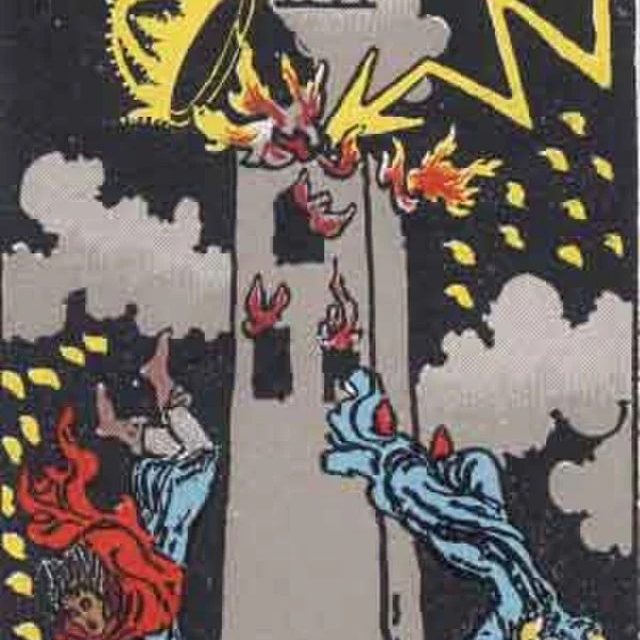
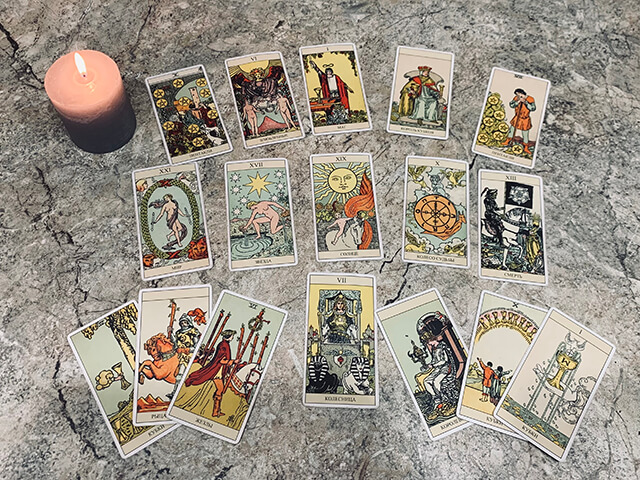
This is also where the tarot cards come in. Katin, the educated man, thinks that to be ‘skeptical about the Tarot’ is ‘a very romantic notion’, linked to ‘petrified ideas a thousand years out of date.’ (p 123) The people of this world believe in the scientific efficacy of tarot.

The flashback which explains Lorq Van Ray’s motivations is very strong. The climax of the story is exciting and really pays off. I love the syrinx, a musical instrument belonging to Mouse, an object which earns its keep in different and unexpected ways for the entire novel.

But Nova suffers from a slow middle – one of the most obvious cases I’ve seen in a while. Out of 240 pages, it meanders from about page 120 to page 200. There seems to be little purpose to the characters’ itinerary and activities. Katin’s lectures are interesting but not always relevant. My attention sagged when Delany began to dwell on the Tarot cards and picked up again when the bad guys suddenly showed up to crash the good guys’ hiding place.

I have a few other complaints. Sometimes the descriptions aren’t clear enough to do justice to an action scene – there was a fight involving nets and gas on a flight of steps which I just couldn’t visualize. On page 202 we are told, ‘a hand slapped Lorq’s sternum, slapped it again, again. The hand was inside.’ What does this phrase mean? Whose hand? It was inside his sternum? How?

Lorq, Katin and Mouse are good characters, and their rapport facilitates a lot of exposition, most of it neat. Katin seems confident and Mouse seems taciturn, shy. But Katin over-thinks and, beneath it all, he’s anxious. At one point Mouse has to reassure him, ‘Hey […] It’s all right. I like you. I was just busy, is all.’ (p 177) It’s rare for Mouse to speak, so it’s telling that when he chooses to speak his words are kind. But while the other members of the crew have their interesting quirks, they never really live up to their potential.

The slow middle didn’t put me off, and had enough interesting ideas, conversations and images to keep me reading. But it lacked that rocket fuel which powered the beginning and end. The premise, the beginning and the end are more than strong enough to compensate. In hindsight, too, there are motifs and undergirding ideas running through the structure of the story – the idea of sensory overload, and linked to it the image of a person walking into fire like a bug drawn to a light – that lend the story power and coherence.

Go to Home Page/ Archives

Review: Nine Days That Shook England by H. Fagan

‘That night must have been a night of terror for the young King and his Court. From a high turret the King looked out over the greatest city of his realm, which was now no longer his. Below him, stretching away far into the darkness of the June night, was the great rebel force, and there rose to his ears the hoarse murmurs of a vast multitude, alert and watchful. Away on the horizon was the glare of the burning mansions of his friends and counsellors, men of  the highest authority in the land, whose will and command was now as unheeded as the whimper of a puppy. To the West burned the prison and mansions in Westminster. Closer, in the fields of Clerkenwell, burned the buildings of the Knights Templar, whilst close by, almost near enough for him to stretch out his hand to touch the flames, burned the great palace of his uncle, John of Gaunt, now master of nothing but a few hundred troops on the Scottish borderlands. Yet nothing had changed, the land was still there, the river still flowed and the stars still shone.
‘All that had happened was that his people no longer obeyed his commands.’

Nine Days that Shook England by H. Fagan, P 190

Nine Days that Shook England (Victor Gollancz, Left Book Club, 1938) is ‘An Account of the English People’s Uprising in 1381.’ A vast rebellion of the peasants along with the poorer strata of clergy, knights and merchants came close to the overthrow of the English aristocracy. Pushed to the limit by exploitation, endless war, corrupt and incompetent ruling circles, and yet another poll tax, armed bands rose up to battle tax collectors, then united and marched on London and other towns. They conquered the capital with help from the masses inside the walls. But just as suddenly the ruling class dispersed them with a bold strike at their leadership, and put down the rebellion with over 7,000 executions and at least two stand-up battles.

Fagan is a very good writer, as you can see in the paragraph quoted above. Passages of comparable quality are many. The early chapters explain the socio-economic changes that laid the basis for the revolt, and do so in a way that any reader can easily understand and follow. The account is shot through with vivid and memorable moments and movements: he describes how an underground organisation called the Great Society built for the rebellion for years in advance. Wandering clergymen and outlawed peasants served as organisers for the Great Society.

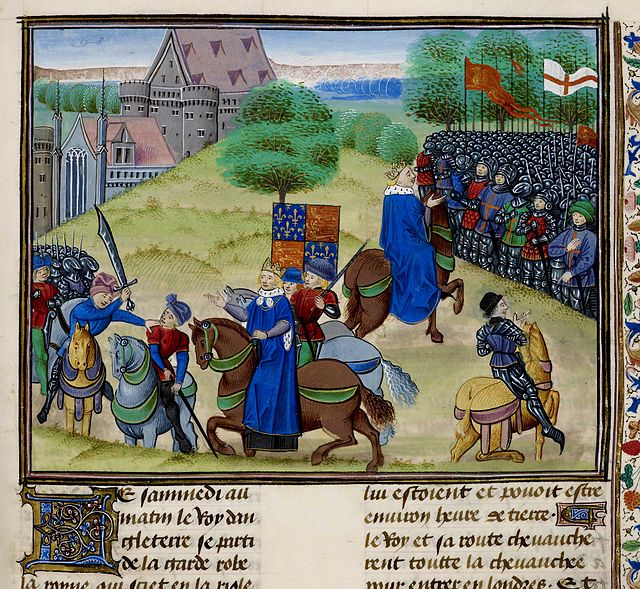
The above quote marks the high point of the revolt. Fagan then narrates the sudden turn by which the ruling class re-established control – through what must be one of the most shameful state murders in the history of England. Such a sudden and extraordinary turnaround demands a good explanation, and Fagan supplies one.

The state murder of the rebel leader Wat Tyler — from a medieval chronicle

The book is unfortunately weighed down with emotive verbiage. In itself, I have no major problem with the following passage…

‘…the indomitable spirit of the Englishman was roused. They became determined to fight for what had been given them by the King willingly and of his own accord. Soon many of them were dying heroic deaths in action against the forces of terror, for the defence of freedom and for the maintenance of their just rights.’

…but there’s too much of this kind of language. After a while, my mind became apt to spot such passages coming, and to switch into a kind of half-reading mode, not quite skimming but not quite taking it all in either.

Readers of today, or even readers of 50 years ago, will also have a problem with all the contemporary references. The references to Spain and Russia, while they were of course topical at the time, must have seemed of questionable relevance even then (There is even one approving reference to Stalin). The Great Society was not really anything like the Bolshevik Party – the comparison does a disservice to both. The comparisons are usually more skilful than that, but they are frequent and sometimes take up whole paragraphs.

I’ve never read anything else on the 1381 rebellion, so I can’t comment on accuracy or historiography. I can say that the story is compelling and coherent. My eyes were really opened to how well-organised the insurgents were, and how close they came to tearing down the English ruling class. It is impossible not to be moved by how the King betrayed the misplaced trust of the insurgents. Don’t be misled by the emotive passages: the author is unromantic and clear-eyed about the weaknesses of the insurgents’ political programme, about the unpleasant reality that English society was not yet ripe for a democratic revolution.  

Nine Days that Shook England was a take on medieval history that really was something new to me; I haven’t ever before read about a popular revolutionary movement in the Middle Ages. It is a dramatic story and there are plenty of good primary sources on it, and Fagan makes very good use of both the drama and the sources. Its problems we can file under ‘of its time.’ More than that: you will get more out of the book if you approach it both as a fascinating story from medieval history and as an intriguing artefact of the socialist movement in Britain in the 1930s. The didactic parts are not some spectacular artistic misjudgement; they are the flip side of the passion which drives the narrative.

Note:

The author, Hymie Fagan, was an interesting character in his own right. Here are some links: a few facts about his biography suffice to explain his revolutionary enthusiasm. The life story of his second wife, Marian Fagan, throws another very interesting light on things.

Home page/ archive

Review: Legacy of Violence by Caroline Elkins

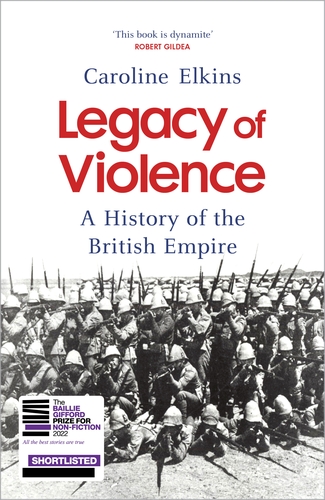
Legacy of Violence: A History of the British Empire by Caroline Elkins, Penguin, 2022

Legacy of Violence covers 200-plus years of the history of the British Empire, from the late 18th to the late 20th century, spending most of its word count in the early-to-mid 20th Century. Elkins refers positively to the anti-imperialist writings of Walter Rodney and Vladimir Lenin, but only to tell us that she will be coming at the subject from a different, though not contradictory, angle. This is primarily a book about repression and counter-insurgency in the British Empire. Economics, politics and sociology are part of the narrative but rarely to the fore.

Elkins focuses on key episodes, states of emergency and of exception, in which laws and human rights were suspended. There are far too many examples to list, but they include the revolt in Jamaica in the 1830s, the Boer War, the ‘Malaya Emergency,’ and the Troubles in Ireland. Questions of philosophy and law are traced through this diverse globe-spanning range of episodes. One thing that really impressed me was how she follows the careers of various British officials – for example, the Black and Tans who went from one brutal counter-insurgency in Ireland to an even worse one in Palestine.

The same themes and phrases keep coming up. For example, you could point to so many examples where the British military terrorised rebellious people into submission with killings, torture and bombing. From one continent and decade to the next, British officials and officers had the same pleasant phrase for this: ‘the salutary moral effect.’

What unfolds as you read through this book is a fascinating and globe-spanning story. Here are some of the things I did not know about, in vaguely chronological order:

  • The perpetrator of the infamous Amritsar Massacre in India in 1919, Brigadier-General Dyer, faced a controversy but ultimately got off the hook. But the politician who tried to make Dyer face some consequences was himself punished with the loss of his reputation and career – along with anti-Semitic abuse. Also, that Amritsar Massacre was not just a singular event – it was preceded and followed by a long reign of terror over the whole area where it took place.
  • The British prepared the ground for the Naqba, the ‘catastrophe’ in which Palestinians were ethnically cleansed from their country in 1948. Death squads of British commandos, supported by Jewish paramilitaries, suppressed Arab revolts with raids, bombings, assassinations and torture. One of the main British officers, the famous and eccentric Orde-Wingate, was motivated by vicious anti-Arab racism.
  • When these paramilitaries began an insurgency against the British Empire in the late 1940s, a wave of anti-Semitism swept Britain. Yeah, right after the Holocaust, Mosely and the British Union of Fascists made a comeback. (Though I had heard about this one in a fascinating book called The 43 Group).
  • Long before the Blitz of 1940, the British military pioneered the bombing of defenceless villages, for example in Iraq.
  • During and after World War Two, there were prisons in England and in Germany where torture of German detainees was widespread. This was the case tenfold in India, where Britain had to come up with elaborate means to re-establish control after the war.
  • After the war there were campaigns to get governments to recognise human rights laws. Britain saw that the Universal Declaration on Human Rights would be incompatible with the brutality required to maintain its empire, so it resisted for decades.
  • As Britain cleared out of India, clouds of smoke hung over the major cities; British officials were burning heaps of documents.
  • The rebellions in Malaya and Kenya in the 1950s were the most striking and educational parts of the book for me. These were popular rebellions with democratic demands and grievances, and they were put down with a variety of evil means. In Malaya we see the mass transfer of entire ethnic groups and populations. There and in Kenya we see huge torture camps. The reality is that torture was a completely normal practise in the British Empire, though the folks back home didn’t know about it and instead were fed rubbish about ‘hearts and minds.’

There is so much more I could say – if I’d taken notes, I could write in greater length and detail about all the above bullet points and as many again. That goes to show how much I learned from this rich volume. It’s really well-written, it’s obvious that a vast mass of research has gone into it, and there is a deep coherence and structure underlying the whole globe-spanning narrative. I’m grateful to have read this fascinating, disturbing and enlightening work.

Go to Home Page/ Archive

Book Review: Stalking the Atomic City by Markiyan Kamysh

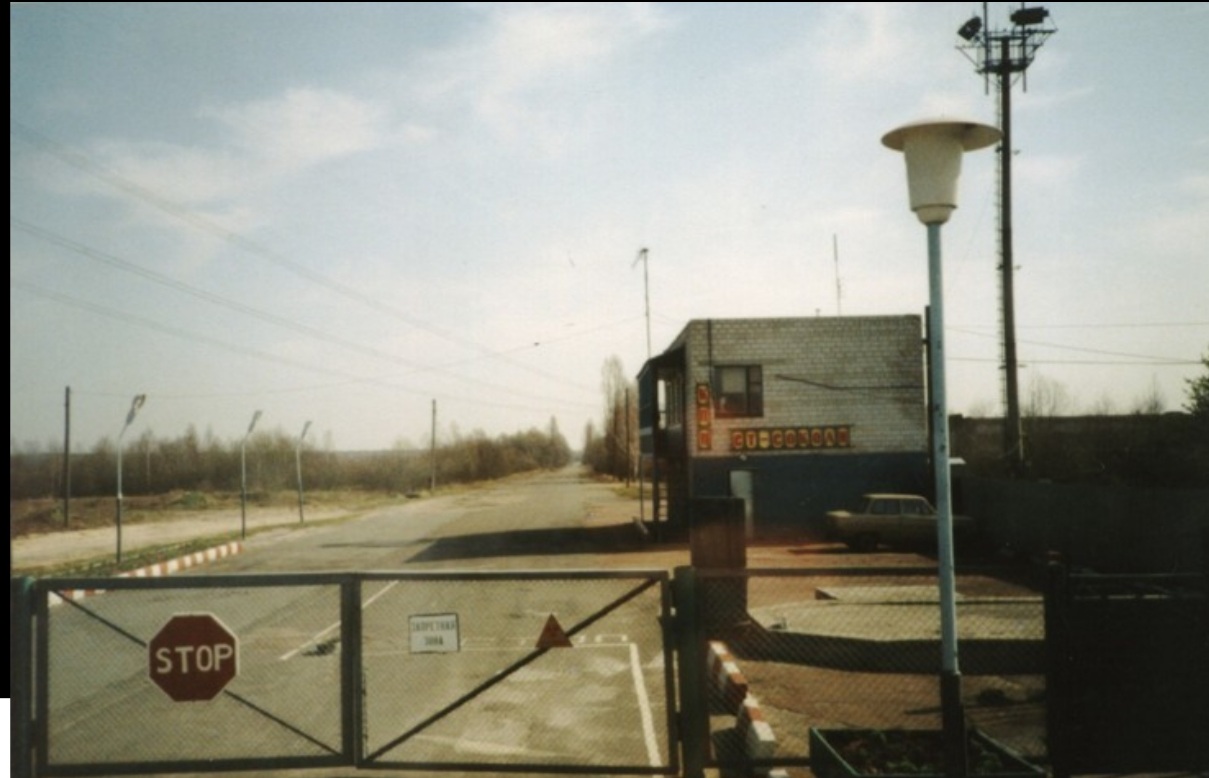
This short book is a memoir of adventures in the Chornobyl Exclusion Zone. There are various categories of people to be found in the poisoned and abandoned area of the 1986 nuclear disaster: legal visitors on guided tours, looters, and elderly people who never left the Zone. The author, Markiyan Kamysh, is part of another category entirely: a community of people who make illegal trips into the heart of the Exclusion Zone, dodging the police and scaling fences. He made over thirty trips in ten years, sometimes as a paid guide but usually with no eye to profit.

Illegal Chornobyl tourists like Kamysh are known as Stalkers, after the 1979 film Stalker which anticipated the Chornobyl disaster. Based on the 1971 novel Roadside Picnic, the film is about a ‘Stalker,’ an underworld figure who guides paying customers into the heart of a forbidden place called The Zone, where the laws of reality do not apply. In the heart of the terrible dangers of The Zone lies a place where wishes can be made to come true.

The novel is more straightforward than the film. I recommend both.

Real life is stranger than fiction. In contemporary Ukraine (before the war, that is), the real Stalkers would enter the Zone even though there was nothing valuable there, except copper wire and stuff like that, which anyway the Stalkers were not interested in.

Rather than explaining his own motivation directly, Kamysh draws us into his memories and experiences and lets them speak for themselves: hiking for days through wilderness, bathing in water that may give him cancer, getting high and drunk in abandoned tower blocks, burning fence-posts by the score to survive a winter night. It is like travelling into an alternate dimension. To go into the Zone is to escape from society and the state – without leaving behind human structures and artefacts. That means discomfort, danger.

The Zone is, in Irish terms, an area roughly the size of County Roscommon. 120,000 people lived in two industrial cities and hundreds of villages, until the area was suddenly evacuated thirty-seven years ago. It would be fascinating to visit such a place in any country in the world; in Ukraine this makes it a massive time capsule of the vanished Soviet Union. The author’s strange affection for the rusting industrial landmarks is partly that (his father was a liquidator) but it is mostly something else.

Kamysh shows an unpleasant contempt toward the legal tourists, and even toward the groups of foreigners for whom he serves as a paid guide from time to time. He does not fear the police, though they have arrested him multiple times and, on occasion, stolen his belongings. He is wary of the looters.

Kamysh barely touches on politics, but he mentions his experiences with street fighting in Kyiv during the upheavals of 2013-14. This book was published in 1019. He joined the Ukrainian military in July 2022 to resist the Russian invasion. That sheds an unexpected light on the question of motivation because obviously it is more dangerous and painful to go to war than to go into the Zone. I wonder how Pripyat and its strange communities are faring these days.

Goodbye Uhtred (Review: The Last Kingdom and Seven Kings Must Die)

The Last Kingdom has come to an end. I watched nearly all of it and enjoyed nearly all of what I watched. But by the third season I was already aware that it was a kind of modular story, constructed from parts that would show up again and again, reused in new configurations:

  • Danes invade Saxon lands
  • The Danish leader, like a James Bond villain’s henchman, has some eccentricity of costume or behaviour
  • Uhtred is tempted to join his Danish friends
  • A Saxon nobleman is scheming for his own benefit and to the detriment of the kingdom
  • The King of Wessex is being unreasonable and listening to bad advice
  • Uhtred expresses anti-clerical views, but there is a specific priest (or even several) whom he admires
  • Uhtred does something of which the Saxons disapprove
  • The King of Wessex banishes Uhtred
  • Uhtred, though an outlaw, resolves to save the Saxons
  • Uhtred convinces the King of Wessex to redeem himself
  • Uhtred, through clever tricks, wins a battle and saves the Saxons

Drop a comment if I missed any.

(Spoilers Below)

But The Last Kingdom was a good show. In between these reusable blocks there was much material that did not fit this repetitive pattern, such as Breda acting as a foil to Uhtred, diverging ever-further from him and from his Saxon friends. With each turn of the wheel her actions grew more extreme until suddenly she was up in Iceland doing throat-singing and human sacrifices.

We could make similar points about several other characters, such as Aethelfaed and Aelswith, real multi-dimensional personalities. The women characters in particular got to operate autonomously from the repeating story blocks and the elements of ‘stock character’ which this imposed on Uhtred, the King, the Scheming Nobleman, the Big Bad Dane, the Good Priest and the Bad Priest. And often the Stock Characters and modular blocks were executed so well it was difficult to be bothered by the repetition.

The Last Kingdom has come to an end with a movie, Seven Kings Must Die, in which most of these blocks of story got one last airing. I can’t deny I felt something stir in me when Uhtred finally saw Valhalla with his dying eyes. For five seasons and a movie he has been torn between Saxon and Danish worlds. He always came down on the Saxon side, but in death he finally gets to drink and boast with long-dead comrades and enemies. But of the faces laughing around the eternal mead-table, I could only definitively put a name to one (Breda, naturally).

I was struck, in Seven Kings, by the drabness of the world of this story. Maybe this is because I was watching The Last Kingdom at movie length, or maybe it’s because I recently saw the samurai epic Ran, which is awash in colour. Uhtred’s Anglo-Saxon England is all greys and browns in a murky filter. Some people on the internet who want to ‘RETVRN’ to back-breaking agricultural toil (of the feudal and not the gulag variety) think there’s a screen conspiracy to make the Middle Ages look bad by suppressing the colours. I don’t buy the conspiracy angle. Creators and audiences feel that bright colours are tacky and cheesy. Indeed, Ran is brilliant but some of the costumes do look synthetic. Organic colours and non-plasticky textures feel more authentic. Whether they are or not, I don’t know, but they are certainly a cheap and easy way to make things feel authentic. Maybe this shortcut to ‘authenticity’ has run its course culturally.

Seven Kings ended with a great battle scene, but some damage was done by the scenes immediately preceding the clash. It was not clear who was where, how many soldiers they had, or where those soldiers came from. A little more care here would have gone a long way.

The worst thing you could say about The Last Kingdom is that it was a bit boring at times, especially in the last two seasons. That’s where I skipped a few episodes. My loss of interest, I think, was due to the repetition. They filmed it all in a replica medieval village in Hungary, and it was obvious that one ‘town square’ location filled in for multiple towns. By about Season Four the viewer is too familiar with these interiors and exteriors – not the comfortable and evocative familiarity of a definite location which we know well, but the tiresome familiarity of the same kinds of places filling in for the same kinds of places. The interchangeableness of locations mirrored the interchangeableness of story elements, and both undercut the best efforts of writers, crew and cast to make each season fresh and exciting.

The first season was definitely the best – the set-up for the whole show is great, and early on the elements of repetition have not yet set in. The other seasons had great high points – the attack on Dunholm, or Uhtred’s first failed attempt to reclaim Bebbanburgh, or the time he and Breda tried to talk to their friend’s ghost. I am interested in this period because it’s not yet the Middle Ages, though you can see the outlines beginning to emerge; everything is DIY, rough and ready, down-to-earth, organic. I felt this story conveyed that sense of the period well.

The script for The Last Kingdom, like the visuals, never shone with brilliance. But it never made me groan or cringe either, and sometimes it moved me. The writing was never less than competent, and sometimes more than. I studied this historical period in college and, watching The Last Kingdom, I noticed very few of the anachronistic howlers one usually finds in these kinds of things.

There was a characteristic moment in Seven Kings: Uhtred makes a speech about how they must forge an English identity from diverse communities, and Finan pipes up ‘I don’t have to say I’m English, do I?’ It was a neat moment: the 21st-century Irish actor might be ad libbing, or the 10th-century character might be speaking from a point of view rooted in his own time. Uhtred has competently (not brilliantly) given the story a sense of theme and purpose; without undermining this, Finan has managed to cut across any danger of grandiosity or chauvinism. Somebody was paying close attention to what was being said, and I appreciated that.

1984: Conclusion (Premium)

Become a paying supporter to get access

Access to this article is limited to paying supporters. If you already subscribe by email, thank you. But if you want to become a paying supporter, please hit ‘Subscribe’ below.

Donate less than the price of a coffee, and you can access everything on this blog for one year.

If you don’t feel like donating, most of my posts are still 100% free, so browse away, and thanks for visiting.

1: Is 1984 plausible?

2: Is 1984 good?

Home Page/ Archives