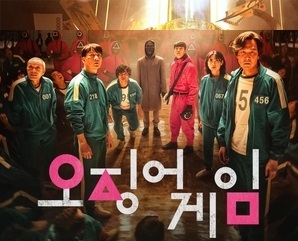
Squid Game, like capitalism, is equal and voluntary – in theory

Spoilers below.

What makes Squid Game different from Hunger Games and Battle Royale? The fight to the death in Squid Game is not just bigger and bloodier. It is voluntary. Stephen King’s Running Man also features a lethal game whose contestants are volunteers. But King’s novel, and its movie version, and Hunger Games and Battle Royale, are set in future dystopias. Squid Game is set in our world, right now.

The conditions in North Korea are so desperate that Sae-byeok risks death to escape. But when she enters the game she risks death again, this time to escape from the desperate conditions for the poor and working class in South Korea, to escape from capitalism. As someone says in Episode 2, it’s worse out there than it is in here.

The final episode of Squid Game hammers home an anti-capitalist argument that has been running through the whole story. Many have commented on this, including the writer and director Hwang Dong-hyuk. This article goes into some detail. But I want to focus on the voluntary nature of the games and how this plays into the anti-capitalist message.

In-ho’s words in the last episode make this point very clear. He says words to the effect that ‘You chose this,’ ‘You signed up for this,’ ‘Nobody forced you.’ Another villain, the psychopathic Sang-woo, insists on Gi-hun’s personal responsibility for all the killing.

Within formal logic, In-ho’s argument is unanswerable. But Gi-hun recoils against his words and against Sang-woo’s. They are wrong. Gi-hun knows it in his gut, and so do we.

It’s true that the game is voluntary. In-ho himself, undercover among the contestants, casts the deciding vote for them all to leave. But for some reason, we don’t accept their arguments.

‘You chose this,’ ‘You signed up for this,’ ‘Nobody forced you.’ That’s what we hear when we complain about our jobs, our mortgages, our car payments. We even hear a version of this in the cliché that ‘people get the government they deserve’ – ie, the people are responsible when their elected leaders betray them. In the most formal sense, it’s all true.

The game’s overseer keeps insisting on ‘equality’ as the fundamental principle of the whole operation. In theory, capitalism is fair and we’re all equal. In theory, the worker and the boss meet one another ‘in the marketplace’ (wherever that is) on a basis of complete equality. They agree to a contract which is satisfactory to both: I work for you, and you pay me. The law says these two people are completely equal. The law says this contract is voluntary.

But the reality is very different from the theory, and from what the law says. That reality is illustrated in every episode of Squid Game.

When we first see Gi-hun, we are invited to see him as a waster and a messer. Then in mid-series we hear about the auto workers’ strike Gi-hun was involved in ten years ago and about the lethal police violence. This sacking was a catastrophe from which his life has never recovered. He got into debt with failed business ventures (Isn’t that what you’re supposed to do? Isn’t that what they tell us to do? Be an entrepreneur?). His family has broken down. No wonder he’s in the situation he’s in. It could happen to you or me.

Another contestant has decades of experience as a glassmaker. We can assume he’s got a similar story to tell. And we see with our own eyes how Ali was scammed by his boss.

The final episode hammers home the point. A TV or radio playing in the background of a scene reminds us about the crisis in household debt. Early on in the series, we might think, ‘OK, these contestants are people in extreme situations – gambling addicts, refugees, gangsters.’ But the final episode insists: this situation is general.

For all its brutality, Squid Game is written with compassion and humanity. These games are not a public spectacle or a reality TV show. They are secret. The public at large do not enjoy the games. They would be sickened if they knew the games were happening. The audience, lapping up other people’s suffering for entertainment, are the handful of billionaires who bankroll the whole operation – and who got rich making everyone’s lives so desperate and precarious in the first place. The indebted and desperate Gi-hun lives on a different planet from these ‘VIPs.’ To claim they are equal is a vicious lie designed to keep Gi-hun in his place – and, perhaps, to soothe the consciences of the wealthy.

People are drawing parallels with Money Heist, another series on Netflix. Like Squid Game, it has won a colossal audience in spite of the fact that it’s not in English. This Spanish crime series is knee-deep in socialism. A miner from Asturias who calls himself ‘Moscow’ sings ‘Bella Ciao,’ talks about the 15M movement and supports his trans comrade; in a fierce battle in the ruins of the national Bank of Spain, the robbers denounce the forces of the state as fascists and draw inspiration from the Battle of Stalingrad. But what’s more important than any of these Easter eggs is what this guy said: that what makes Money Heist popular is the class rage it channels.
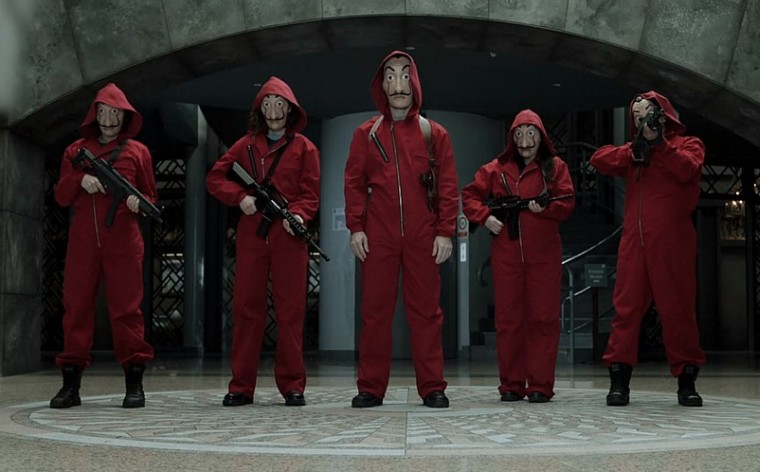
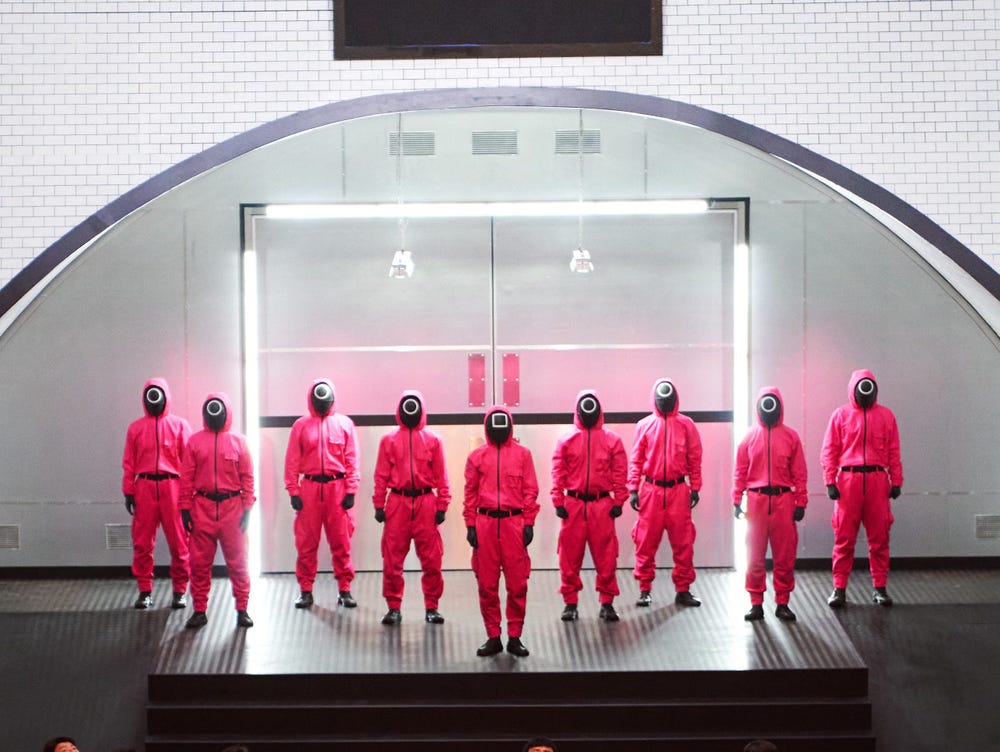
What is it about red jumpsuits and masks? Money Heist (above, image from Dress Like That) and Squid Game (Image from Insider.com).

Money Heist and Squid Game tap into our despair and anger at the brutal and unfair system we live under. Hundreds of people being gunned down in a scene that’s part Red Light, Green Light and part Amritsar Massacre – that’s not a fantasy. That’s what it feels like to live in this society. If a story can tap into such a feeling, language is not a barrier. We live under the same system and even if we speak different languages we can relate to common problems and struggles.

We live in a time of mass protest movements against the wealthy and the state on every continent (Colombia, Sudan, Lebanon, Myanmar, and the list goes on and on). It would be strange if this mood was not reflected in some way in popular culture. But it’s a sign of the times that the entertainment industry – and maybe to an extent audiences – are not ready for a story that is simply about class struggle (with surprising exceptions like Superstore). Politics is a dirty word. It has to be smuggled in, disguised in more wholesome and palatable fare, such as a story about the origin of a mass murderer, about a bank robbery, or about a game show in which four hundred people die horrible deaths. In cynical times, the earnest and compassionate stories we secretly crave can only be packaged in the trappings of cynical and pessimistic genres.

*

Thanks to all my readers. This week I took a break from Battle for Red October, my ongoing series about the Russian Civil War. The series resumes next week. If you like what you read here, leave your address in the box below and get an update whenever I post.

Review – Stalingrad: How the Red Army Triumphed by Michael K Jones

The Battle of Stalingrad was the most decisive and bloody confrontation in the Second World War. So the question which this book addresses, ‘How the Red Army Triumphed’ at Stalingrad, is important.

Many in the English-speaking world would answer that question along the following lines: that Russian officers threw masses of unarmed conscripts at enemy positions; that commissars trained machine-guns on the backs of their own soldiers and mowed down anyone who tried to retreat; in short, that this victory was gained primarily by terror. Michael K Jones provides a very different answer – one which is not only much more plausible but even inspiring.

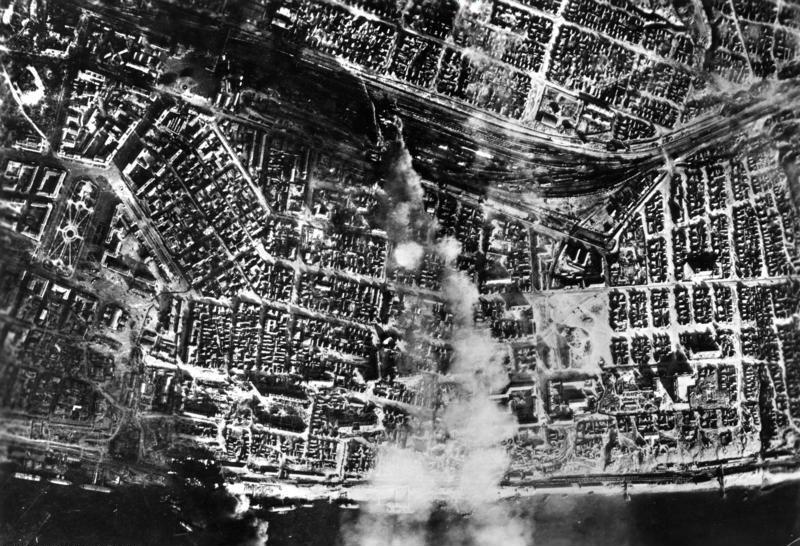
Stalingrad from the air, during the battle. At the bottom of the picture is the wide Volga river. Red Army soldiers fought with their backs to the river. Supplies and reinforcements had to cross it, and they were sitting ducks for German planes.

He focuses on the 62nd Army, the force which held the city itself. This is a narrower scope than that of, for example, Antony Beevor’s Stalingrad which describes the whole campaign, but I found this focus made it compelling.

No land beyond the Volga

One of the key insights is that on at least three occasions the outcome of the battle really hung by a thread. Only truly superhuman resistance allowed the Soviets to hold out. For example the Germans, after conquering this or that area of the city, would be unable to consolidate their gains because their new territory would be riddled with surviving Red Army soldiers carrying on the fight in tiny groups, sometimes literally two or three holding out from a house or basement or factory. They fought on to the death. There was no commissar holding a gun to their heads; they were cut off from their own army. They were motivated by determination to resist, summed up in the slogan ‘For us there is no land beyond the Volga.’

This kind of unimaginable self-sacrifice dovetailed with sound tactics. The cautious German commander Von Paulus did not allow his forces to advance until all resistance was mopped up. The heroism of those small groups which held out took full advantage of this approach. In the single hour or day gained by a knot of doomed fighters battling on to the end, fresh forces or supplies could cross the river Volga and arrive in the city.

Jones explores many other examples of clever tactical improvisation – such as the decision to keep as close to the enemy as possible to frustrate their artillery – and of the self-sacrifice which made it possible. The nuts and bolts of how the city was defended – storm groups, the ‘sniperism’ movement, the use of fortified bulwarks such as ‘Pavlov’s House’ – all emerge in this narrative as a brilliant union of morale and tactics. Just as the small groups who held up the Nazi advance for an hour or a day could buy time for reinforcements, ultimately the resistance of the 62nd Army in the city bought time for Operation Uranus, a Soviet counter-offensive which surrounded Von Paulus’ army and destroyed it.

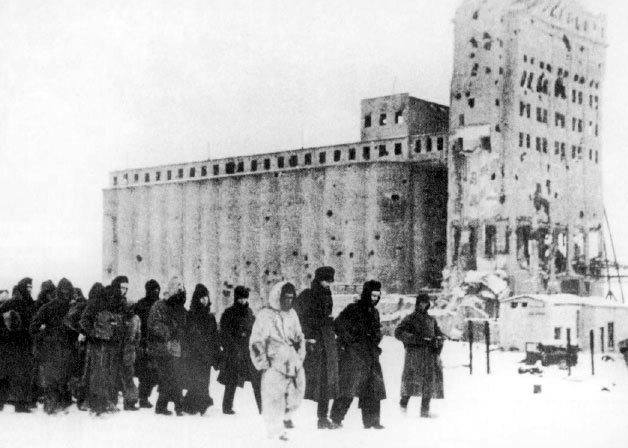
The Stalingrad grain elevator. As you can see, it was fought over with some ferocity. In September a small force held out there against the odds for two days. ‘…the grain was on fire, the water in the machine-guns evaporated, the wounded were thirsty…’ Later: ‘Explosions were shattering the concrete; the grain was in flames. We could not see each other for dust and smoke…’ (p 117-118)

Not one step backward

I recently read Beevor’s book Stalingrad in which he points out the horrifying fact that the Red Army shot 13,000 of its own soldiers during the battle. Jones does not dispute this number, but he challenges the way it’s framed (one of several digs at Beevor). 13,000 were executed across the whole Stalingrad front – which included not just the 62nd Army in the city, but a whole number of armies along the trench lines to the north and south of the city. In the city itself, around 1,000 were shot by their own side. We should put these numbers into perspective: 612 soldiers charged with desertion were shot by the Red Army in the second half of 1919 during the Russian Civil War (out of a total of 1.4 million desertions). The British Army in the First World War shot 278 out of 2,093 charged with desertion (Trudell, 2000). So 1,000 executed in the city and 13,000 across the whole front is still a really shocking number. Only someone immune to quantitative evidence would insist that there’s no difference between 1,000 and 13,000. But what we see in a movie like Enemy at the Gates is pure fiction: there were critical shortages at various times, but there was no practice of ‘every second man gets a rifle.’ There were no machine-guns trained from behind on troops without weapons advancing on entrenched positions. Even allowing for exaggeration, with such an approach the Red Army simply could not have won.

Via Youtube.com. Still from Enemy at the Gates (Dir. Jean-Jacques Annaud, 2001). A few seconds later we see these guys gunning down the rank-and-file soldiers as they try to retreat. I suppose this is a very loose interpretation of what a ‘blocking detachment’ was. Thankfully it is pure fiction.

I don’t doubt that there were terrible injustices among the thousand shot by their own side. But Jones forces us to rethink slightly by telling us the story of one of those thousand: an officer who faked an injury and tried to bully his way to the front of the queue for a hospital boat. A nurse shot him dead on the spot.

The Red Army soldiers knew they were fighting the good fight. They were not like Americans in Vietnam or Iraq, wondering what they hell they were doing there. The German armed forces were not just waging a war but carrying out genocide against Jewish and Slavic people. Meanwhile the Red Army had been retreating for over a year, surrendering thousands of miles and millions of human lives to the enemy. The famous slogan ‘Not a step backwards’ was not a threat that anyone who literally stepped back would be shot (obviously the Red Army could not have won without retreats) – it was a signal that the period of general retreat was over. This decision made Stalingrad a hostage to fortune: if the city fell, the blow to morale would be terrible. But it also gave the soldier what they wanted: an opportunity to stand and fight, knowing that the whole weight of the military apparatus was behind them, knowing that this was it.

The disregard for human life of the Stalinist regime can be seen in, to give just one example, the Great Terror of the late 1930s. But the key insight I got from How the Red Army Triumphed was that the 1937 formula of paranoia, top-down rule and mass terror was temporarily thrown out the window at Stalingrad. The battle was won through Stalinism blunting its worst excesses and allowing the troops on the ground to practise initiative and an egalitarian ethos. Thus in the 45th Division ‘the commander ate with his men, swapped jokes and even chopped wood with them. “All of us were on the same level,” remembered Mark Slavin. “The commanders mingled with the soldiers. Everyone counted.”’ (p 239) Jones has a particular soft spot for General Vasily Chuikov, the commander of the 62nd Army, who emerges as a flawed but brilliant hero of the narrative.

From the US propaganda film Why We Fight (Dir. Frank Capra, 1942) showing how much territory the German military had conquered. By August 1942 that chunk was even bigger.

The ‘old’ Red Army and the new

Jones conveys these points well, but he has blind spots.

The Soviet soldier knew that they were defending the gains of the October Revolution, of which Stalingrad itself was a symbol: the city had grown nearly tenfold in population under the social and economic transformations of the 1920s and 1930s. While Vasily Grossman’s novel Life and Fate shows how the repressed traumas of forced collectivization and the Great Terror lay just beneath the surface of wartime consciousness, the predecessor of Life and Fate, simply titled Stalingrad and recently published in English for the first time, shows with equal sincerity how the positive aspects of the revolution motivated the fight. The Stalinist political regime had made the Nazi-Soviet Pact and massacred the generals, thus walking right into the terrible disasters of 1941-2; of itself it did not inspire confidence. But the revolutionary social and economic regime had transformed tens of millions of lives for the better. It was worth defending, worth dying for.

But for Jones, ‘communism’ means simply rhetoric and hypocrisy. For him, it can’t be something genuine and inspiring. Instead he talks about how religion and Russian nationalism inspired the soldiers. Talk about missing the point!

Jones describes how an egalitarian ethos emerged in the 62nd Army during the battle. But this was a revival of an older phenomenon. Erich Wollenberg’s The Red Army shows that an ethos of initiative, equality and internationalism was key to the Red Army in the Civil War and the NEP period. While respecting their military-technical expertise, the new Red Army abolished all the pomp and prestige associated with officers and reduced them to ‘commanders’ or ‘specialists.’

During forced collectivisation and the famine that followed, the morale of the Red Army was utterly destroyed. After this, officers’ ranks and privileges were restored. National chauvinism was made the new basis of morale. Commissars were first abolished, then brought back in the form of Stalinist enforcers.

Chuikov (the general of the 62nd Army whom Jones admires) was in the Red Guards in 1918 and made his military reputation during the Civil War. He would have known the ‘old’ Red Army very well. I imagine that to him it would have been a relief to return to it.

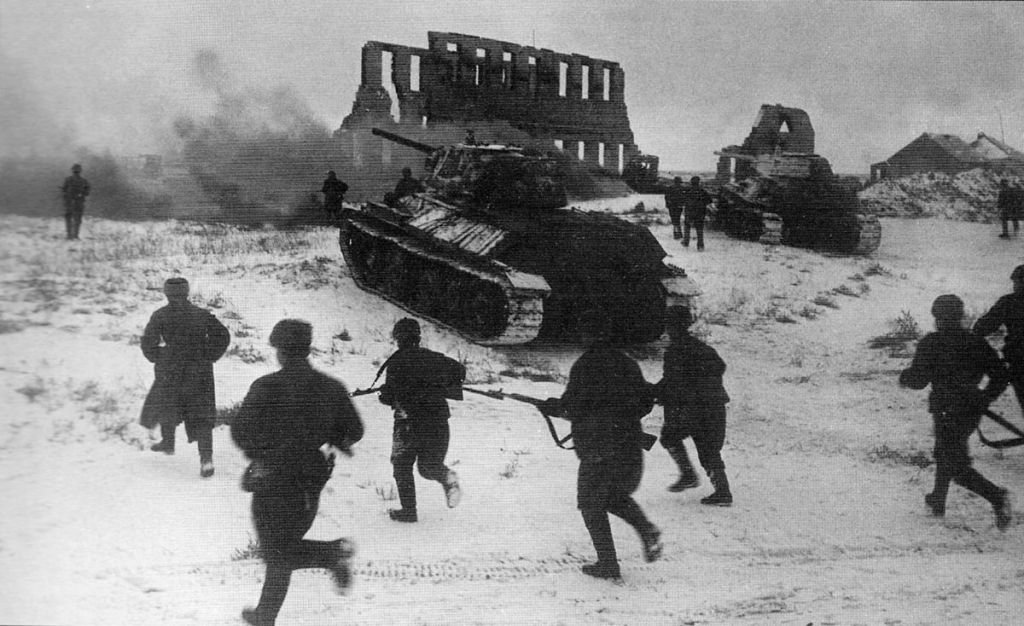
Red Army soldiers in Stalingrad

Based on what I read in How the Red Army Triumphed, it seems to me that like in Madrid six years earlier, at Stalingrad the communists had to make revolutionary concessions to the masses to inspire the will to fight. Instead of really understanding this development, Jones describes some features of it but then turns around and actually praises the way Stalinism championed national chauvinism and inequality between the ranks.

How the Steel was Tempered

The most glaring example of this blind spot in the book unfortunately comes in one of the most moving incidents.

Two nurses, Sima Merzelyakova and Olga Vlaseva, lived through the hell of the battle and sacrificed their lives to rescue a wounded officer. ‘German machine-gunners opened fire. They died sheltering him with their bodies.’ (p 240)

Later a novel was found in the kitbag of the late Sima: How the Steel was Tempered by Nikolai Ostrovsky (Jones gives an alternative translation of the tile: How Steel is Formed). The novel was one of the most popular of its time. It is about a Red Army soldier named Korchagin and his experiences of the Revolution and Civil War, and afterwards as he copes with an injury. It is an inspiring story of overcoming the most terrible conditions in the struggle for revolution and socialism. The most famous quote is:

The dearest possession of any person is life. It is given only once, and it must be lived so as to feel no torturing regrets for wasted years, never know the burning shame of a mean and petty past; so live that, dying you had a right to say: all my life, all my strength were given to the finest cause in all the world—the fight for the Liberation of Humankind.

The two nurses had underlined such key passages, passing the book back and forth between them. At the end Sima had written:

Olga and I have read this book through to the very last page. Now we feel that there are three of us – us two and Korchagin, who is helping us through these difficult times. We have decided to behave like Korchagin – and we’ll make it.

After the nurses’ deaths, their copy of How the Steel was Tempered was passed from soldier to soldier, treasured, autographed with inspiring slogans, and in the end carried by the Red Army all the way to Berlin.

This is such a moving moment in Jones’ narrative. It is a real shame that he goes out of his way to distort the true meaning of it. Jones does not mention that How the Steel was Tempered had anything to do with the Revolution, the Civil War or the struggle for socialism; he gives a bizarrely distorted summary of the book, telling us little more than that Korchagin was a construction worker who had an injury. The theme: in difficult conditions, ‘one had to draw sustenance from a higher cause. Korchagin’s was a deeply felt love for the motherland’! In other words Jones goes a long distance out of his way to take the politics out of the novel. Why does he do this? My guess is, to avoid admitting that heroes like Sima Merzelyakova and Olga Vlaseva were most likely motivated by a genuine belief in communism. This does a disservice to them.

How the Red Army Triumphed is a study of the different factors influencing the morale of the 62nd Army – so this dismissal of the role of communism is a real problem. The Russian Army in World War One had no shortage of nationalist and religious propaganda, and no shortage of tyrannical officers beating and shooting the rank-and-file. So why did it collapse in an avalanche of mutiny and desertion, while the Red Army advanced over half of Europe?  

I don’t think this distortion is due simply to anti-communism.The book draws heavily on the testimony of survivors and it appears from what the author tells us that the survivors themselves are in these latter days more inclined to talk about nationalism and religion than communism. They lived a whole lifetime under a stifling and oppressive political regime which used the genuine traditions of the revolution like a religious dogma. They experienced economic stagnation in the 1970s and 80s, and the disastrous restoration of capitalism in the 90s. All in all they received a poor reward for saving the world from fascism. Stalingrad became part of official dogma, and they are keen to get beyond the propaganda and tell a more authentic story. This is throwing the baby out with the bathwater. If in his general attitude Jones took his cues from the survivors themselves, that’s understandable. But the distortion of the incident with the novel is really bad and not justifiable.

Even with this significant defect, How the Red Army Triumphed gives a gripping and down-to-earth account of the defence of Stalingrad. It convinced me that the victory was one of morale, initiative and innovation, not of terror.

Celtic Communism? Pt 4 – Conclusion (Premium)

Become a paying supporter to get access

Access to this article is limited to paying supporters. If you already subscribe by email, thank you. But if you want to become a paying supporter, please hit ‘Subscribe’ below.

Donate less than the price of a coffee, and you can access everything on this blog for one year.

If you don’t feel like donating, most of my posts are still 100% free, so browse away, and thanks for visiting.

Home Page/ Archives

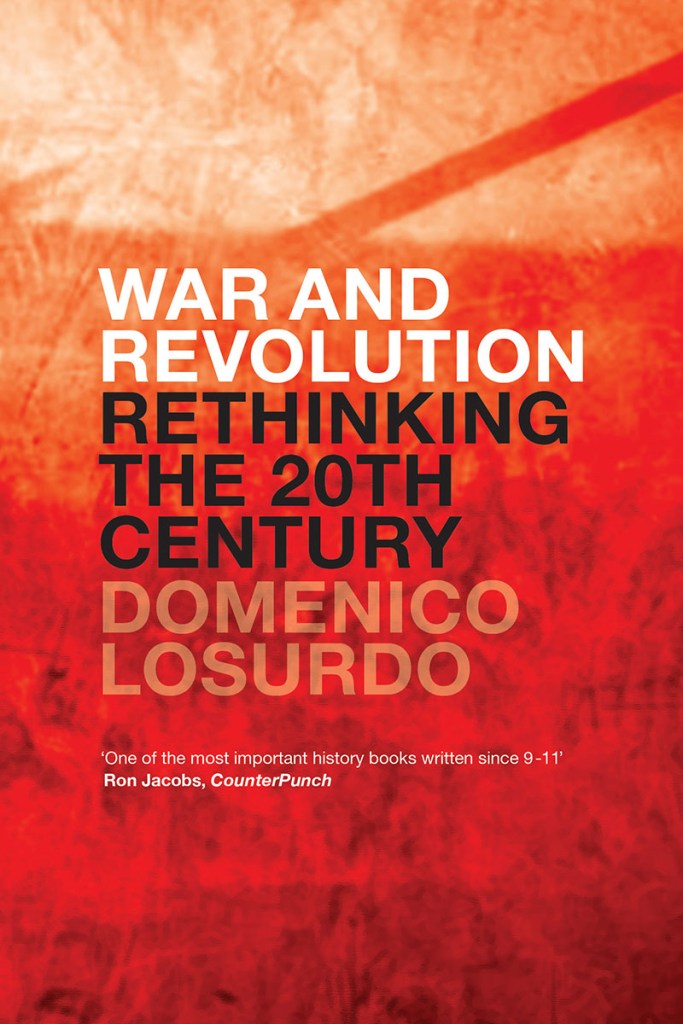
Review: War and Revolution by Domenico Losurdo

‘…the deeds and misdeed of Communism are compared not with the actual behaviour of the world it sought to challenge (about which the strictest silence reigns), but with liberalism’s declarations of principle…’

Domenico Losurdo, War and Revolution: Rethinking the 20th Century, Verso 2015, p 313

In 2013 Russell Brand made a call for revolution which gained a popular echo. For a while Russell Brand’s debate with Jeremy Paxman was a reference point for a growing anti-austerity left that later rallied around Jeremy Corbyn.

Comedian Mark Webb, ‘the other one from Peep Show,’ responded to Brand with a very patronising open letter that ended with the words: ‘We tried that [revolution] again and again, and we know that it ends in death camps, gulags, repression and murder. In brief, and I say this with the greatest respect, please read some fucking Orwell.’

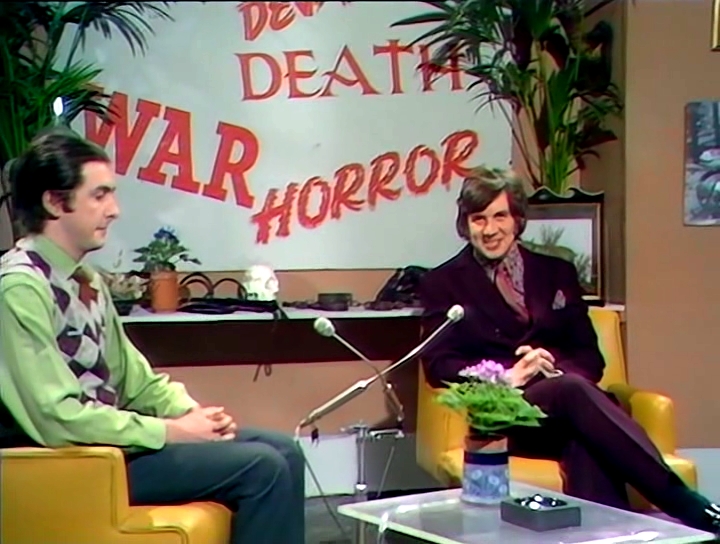
It’s funny how Webb thought that 1984 and Animal Farm were actual history books. But the most obnoxious part of the letter was the claim that revolution leads to (in the words of Monty Python) ‘blood, devastation, death, war and horror.’ This claim relies on the complete erasure of all the nasty parts of the history of capitalism and liberal democracy. It is a claim rooted in a long-standing historical tradition of tracing all the evils and horrors of the 20th century to revolution. It is precisely this claim that the late Domenico Losurdo challenged in his 2015 book War and Revolution: Rethinking the 20th Century. The author passed away in 2018. This book is a great monument to leave behind.

Imperialism

Losurdo shows how Europe’s empires were practising discrimination and mass violence long before the October Revolution. JA Hobson drew attention to the genocide of African Bushmen and Hottentots, Indigenous people in the Americas and Maoris. The Boer war saw tens of thousands die in British concentration camps; Spain’s war in Cuba and the USA’s war in the Philippines also saw the use of concentration camps. In the Belgian Congo a ‘civilising crusade’ became a merciless campaign of extermination that claimed ten million lives. In the 1904-1907 Herero rebellion German authorities shot the armed and the unarmed, men, women and children.

Losurdo, who is a historian of ideas, accompanies his account of imperial crimes with an account of the justifications that accompanied them. Ludwig Gumplowicz in Der Rassenkampf (1909) justified genocide, referring to Native Americans, Hottentots of South Africa and Australian aborigines. Theodore Roosevelt claimed that the only good Indian was a dead Indian and justified genocide ‘if any black or yellow people should really menace the whites.’ The idea of an ‘ultimate solution to the Negro problem’ was a topic of public debate in the USA before World War One. For Ludwig Von Mises, poor people and ‘savages’ are ‘dangerous animals.’

Going back further, Locke defended slavery and the genocide of ‘Irish papists’; Jefferson harped on the theme of the ‘inferiority’ of blacks, John Stuart Mill demanded ‘absolute obedience’ of ‘races’ in their ‘nonage’ and celebrated the Opium Wars.

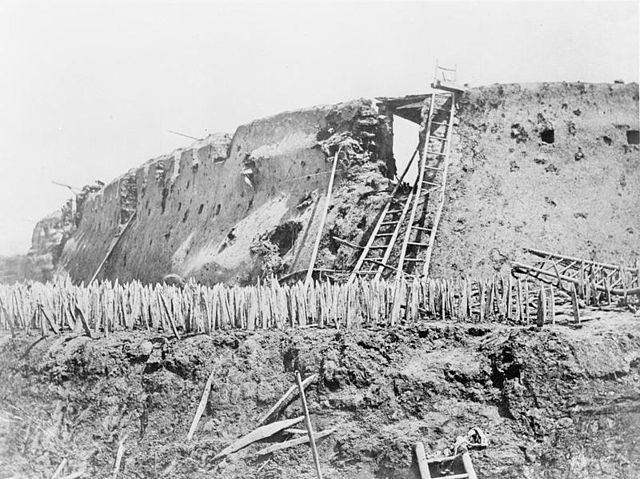
Chinese defences during the Second Opium War (1856-1860). The European powers fought this war to force the Chinese to import opium.

All this, you may have noticed, was long before the October Revolution. And it was said and done not by radicals on the left but chiefly by people on the liberal wing of the political establishment. 

Reactionary historians

Return briefly to Webb’s open letter and note that it talks about ‘death camps’ and ‘gulags’ in one breath, implying that Nazism and Communism are linked, are both the results of ‘revolution.’ This is another idea tackled by Losurdo. He traces it to right-wing historians like Furet, Nolte and Pipes, who argued that the revolutionary tradition was somehow ‘responsible’ for the rise of Nazism. For reactionary historians, the 1917 October Revolution broke previously sacred moral taboos, above all the use of violence and discrimination against particular groups in society (‘de-specification’). Attacks on rich people and aristocrats, in this schema, open the door to attacks on ethnic minorities.

But War and Revolution demonstrates with a thousand examples that the old regime (the capitalist world order, not just Tsarist Russia) had long since broken every one of these supposed taboos a thousand times and on a greater scale. Fascism and totalitarianism were not in any sense inspired by the Russian Revolution (except insofar as the victim can be said to ‘inspire’ the attempted murder); fascism had its origin in imperialist violence, in the ‘total mobilisation’ around World War One, and in traditional hierarchies.

De-specification at home and overseas

All the grisly categories and keywords of the Nazi Third Reich were invented in ‘liberal’ Britain and the US: concentration camp, untermensch, final solution, miscegenation, ‘race-hygiene’, war of extermination.

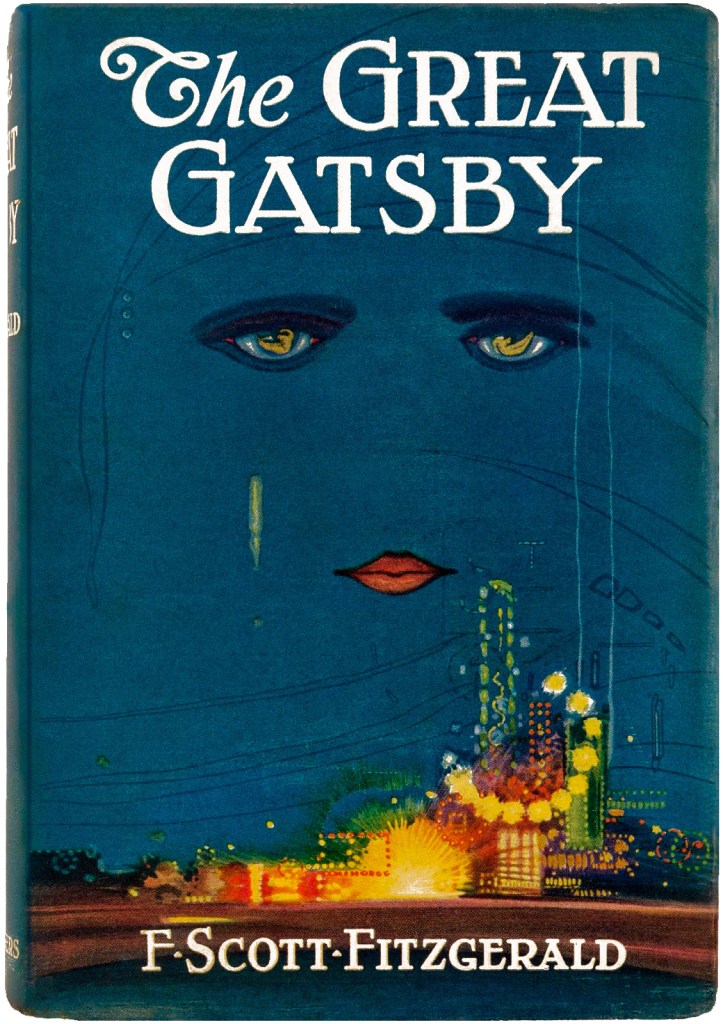
For example Lothrop Stoddard (cited as ‘this man Goddard’ by Tom Buchanan in The Great Gatsby) published The Menace of the Under Man in 1922, warning of the social and ethnic threat of ‘inferior races’ and popularising the term which became untermensch. Racial and class hatred went hand in hand: it was a widespread belief among the rich that poor people were poor because they were ‘racially inferior.’ 13 US states had laws for compulsory sterilisation before World War One.

‘Have you read ‘The Rise of the Colored Empires’ by this man Goddard?…The idea is if we don’t look out the white race will be – will be utterly submerged. It’s all scientific stuff; it’s been proved… This fellow has worked out the whole thing…’

-Tom Buchanan in The Great Gatsby, Chapter 1

The imperialist tradition was explicitly cited as an inspiration and justification for Hitler’s war in Eastern Europe and for Mussolini’s war in Abyssinia (Ethiopia). Hitler argued that Germany had every right to do to the Slavs what the USA had done to Native Americans and what the British had done to India.

The continuities between imperialism and fascism are obvious, clear and undeniable. The most we can concede to defenders of capitalist democracy is that the fascists took imperialist ideas to extremes.

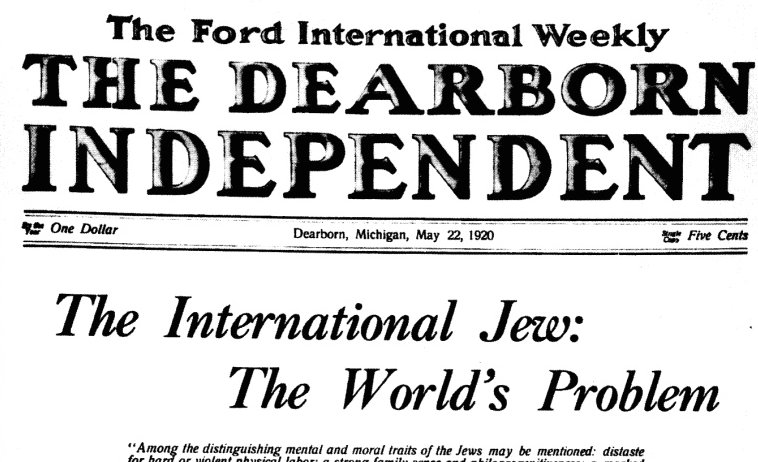
And the continuities between capitalism and fascism go further. To take just one example, arch-capitalist Henry Ford directly inspired Hitler with his anti-Semitic newspaper the Dearborn Independent.

Even if we pretend that imperialism never happened, Losurdo exposes what was in reality ‘master race democracy.’ How many of these liberal democratic states in 1910, or even in 1950, really had a ‘one person, one vote’ system? Women and those who did not own property (ie, the majority) were excluded. Assassinations and massacres of striking workers were commonplace (and still are – see Marikana and Zhanaozen in 2012).

The Challenge of October

Racial, gender and anti-worker discrimination were normal and all-powerful, backed by lethal force and explicitly defended by mainstream liberal politics in the year 1917. The October Revolution opposed all three.

The more moderate socialists, some grudgingly (like Kautsky) and some enthusiastically (like Lensch), made their peace with imperialism. Only Lenin and other ‘extremists’ like him kept up the attack on imperialism and discrimination consistently. The October Revolution appealed to colonial peoples, workers and women to revolt. It was therefore branded as an expression of the ‘barbarism’ of ‘inferior races’ and as a ‘Judeo-Bolshevik conspiracy.’ Class hatred was inseparable from race hatred. I have read news reports from the time which claimed that Lenin was Jewish and that the soldiers who supported him were ‘chiefly Letts and Chinese.’ The Nazis were fired up by these wild racial conspiracy theories into a frenzy to annihilate communists at home and abroad.

‘Far from being attributable to the October Revolution,’ says Losurdo, the key features of Nazism ‘derived from the world against which [the October Revolution] rebelled.’

World Wars

We have seen how the ‘democracy’ of the early twentieth century was in fact saturated with violence and racism. The coming of World War One brought about a ‘mutual excommunication from whiteness’ among the European powers: suddenly the ‘Slavs’ were ‘Asiatic,’ there was talk of ‘Black France,’ and Germans were ‘Huns’ and ‘Vandals.’

The world wars ushered in all the features of dictatorship and totalitarianism: collective punishment of populations, firing into crowds, the punishment of deserters’ families, propaganda and strict control of information, and ruthless persecution of groups and individuals opposed to the war. Repression came from above, brutal mob violence from below: Germans were attacked in the USA and UK. The Turkish state carried out genocide against Armenians. Tsarist Russia persecuted the Jews of occupied Galicia, then during the Civil War the counter-revolutionary White Russians murdered between 50,000 and 200,000 Jews in Ukraine. Japanese-Americans were imprisoned in concentration camps for the duration of the Second World War. Whole cities were levelled by both sides, hundreds of thousands of their occupants killed.

So we don’t have to cook up far-fetched arguments about how communists invented totalitarianism; they had no need to. Liberal democracy had already perfected it.

Losurdo debunks with great flair the Black Book of Communism, a work that made the case that ‘communism’ killed 100 million people and was worse than Nazism. He deconstructs the category of ‘man-made famine’ and the claim that a government’s political responsibility for a famine constitutes ‘genocide.’ Britain blockaded Germany in World War One, and kept up the blockade even after the armistice was signed, condemning many to death from hunger and disease. In the very same way Britain and France enforced artificial famine on the red-controlled areas of Russia during the Russian Civil War. Famine has remained in the arsenal of capitalism as a weapon of war, used against Iraq in the 1990s leading to the deaths of half a million people, most of them children. These atrocities are never recognised as ‘man-made famine.’ It appears it’s only man-made famine if it happened in Russia after 1917 or in China after 1949.

The Revolutionary Tradition

To demonstrate the hypocrisy of liberal attacks on socialism is a great achievement. A broad spectrum of socialist opinion can read Losurdo and cheer him on. But we live in a historical interregnum – after the manifest bankruptcy and collapse of the two giants of social democracy and Stalinism, and before the rise of the next great challenge to capitalism. Confusion and disagreement prevail. I read in Losurdo’s obituary some uncomfortable facts about his politics that, having read this book, I didn’t know but am not too surprised to learn.

His defence of the revolutionary tradition is more divisive than his attack on liberalism. Without spilling too much ink on it, I think he is too critical of the October Revolution and too uncritical of the Stalinist tradition. In fact, he does not acknowledge any rupture or distinction between the two. The book attacks liberal democracy on its own terms, and presents a modest defence of revolutionary socialism on the same terms. But it does not go on the offensive; it makes no case for an alternative model of participatory working-class democracy, that is Soviet democracy. This is a serious shortcoming that weakens the analysis. Absent is any analysis of what went wrong with the Soviet Union. How did a supposedly ‘socialist’ country end up presiding over the hunger and terror of the 1930s? People want a serious answer.

Conclusion

In school, they taught us the history of the early 20th century in the simple binary terms of ‘Dictatorship and Democracy.’ On the one hand there were dictatorships, and within that category there were Communist and Fascist dictatorships. The Dictatorships were opposed by the Democracies. Most of the world was excluded from this schema: old regime monarchies, conservative bourgeois dictatorships, semi-colonies and colonies apparently did not exist. Imperialism was never acknowledged. When Word War Two rolled around, it was never explained why, all of a sudden, the British were to be found fighting in Singapore and Egypt, the Americans in the Philippines, etc.

Stacked up against even a single chapter of Losurdo’s War and Revolution, the contention that ‘revolution ends in death camps, gulags, repression and murder’ is not tenable. All existed long before anyone ever revolted against capitalism. These revolts were attempts to end these horrors. The rules of liberal democracy, so pristine and perfect in the abstract, were in practise not applied to the majority of humanity or in times of war and crisis.

Not only was this a historical reality, it was explicitly defended and theorised by supporters of liberal democracy at the time. And it has not changed. This is not just in the past, but in Webb’s own present-day Britain, under Labour and Tory alike: in Iraq and Yemen; in Grenfell tower; in prisons, among the homeless and refugees; in the rigid discipline, terrifying precarity and back-breaking toil of low-paid workplaces. And all that is just attacking liberal democracy on its own terms. In the light of all this, it should be clear that to defend the status quo is to defend ‘death camps, gulags, repression and murder.’

Review: Appeasing Hitler (Or, why I gave up after 70 pages)

Appeasing Hitler (Tim Bouverie, Bodley Head, 2019)

“How bad do you think it’s gonna be?”
“Pretty goddamn bad. Probably all the other Families will line up against us… You know, you gotta stop them at the beginning. Like they should have stopped Hitler at Munich. They should never let him get away with that. They was just asking for big trouble.

Michael Corleone and Peter Clemenza in The Godfather

If there’s one thing everyone knows from history, it’s that in the 1930s when Nazi Germany was on the rise, British politicians tried to give Hitler what he wanted instead of fighting him. It’s become a cliché.

Clemenza can be forgiven since the events of The Godfather happen only a short time after the war, and what he says is not wrong, as far as it goes. But over the last 80 years, this infamous policy of appeasement has been trotted out as a morality tale again and again. The funny thing is, it is usually invoked to justify aggression (Iraq, Vietnam), not to resist it. Anyone who opposes bombing a third-world former colonial country, anyone who has a problem with killing children and blowing up hospitals, is accused of being an appeaser. And any little warmongering psycho can strut around fantasising that he’s Churchill, the only one (so the fable goes) with the moral courage to stick it to the Nazis. If Hitler was around today, he’d be accusing his opponents of wanting to appease Poland.

I reccomend this article from Spartacus Educational and Claud Cockburn’s brilliant memoir I, Claud, both of which challenge the standard narrative around appeasement. I wanted to know more so I attempted to read Appeasing Hitler by Tim Bouverie. The covers of this 2019 book are weighed down with all kinds of glowing quotations and accolades (‘fresh, challenging’) so I expected to learn something.

But I gave up after 79 pages. Here’s why.

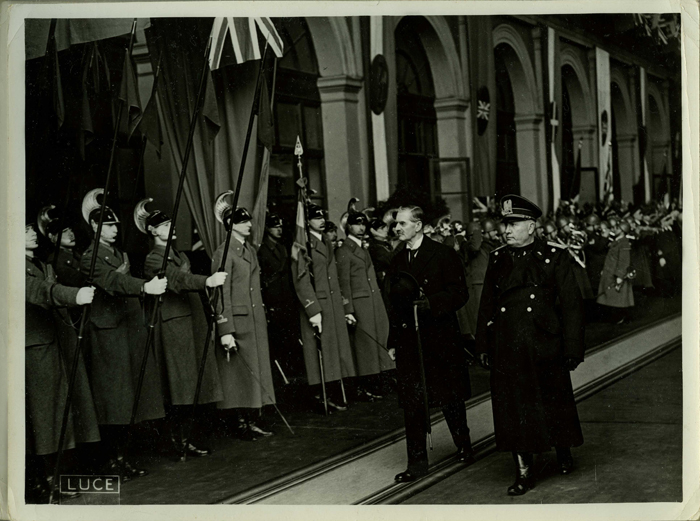
Neville Chamberlain given the red carpet treatment by Mussolini

The author Tim Bouverie gets a real kick out of writing long, loving sketches of British Tory politicians. We get one deft little character introduction after another. We are told about their histories, their personalities, their quirks. Sketches of Tories just keep piling up, going nowhere. They are not badly written, but it’s unclear why we’re supposed to care.

For some, naturally, this is a selling point. One reviewer says that the author Bouverie ‘excels at capturing the atmosphere and conveying the debates in the dining clubs, drawing rooms and society playgrounds of interwar Britain.’ Well, good for him. But I don’t really care about the atmosphere in the society playgrounds, or whatever.

‘Abyssinian Imbroglio’

I stopped reading at a chapter which described the diplomatic storm caused by Italy’s invasion of Ethiopia in 1935. The chapter was titled ‘Abyssinian Imbroglio.’

What a bizarre title.

Google tells me that an ‘imbroglio’ is ‘an utterly confused, complicated or embarrassing situation.’ So it was confusing and embarrassing when 380,000 Ethiopian civilians died under the bombs and bullets and poison gas of the fascists. It was so complicated when 20% of the population of Addis Ababa was wiped out in a terror campaign.

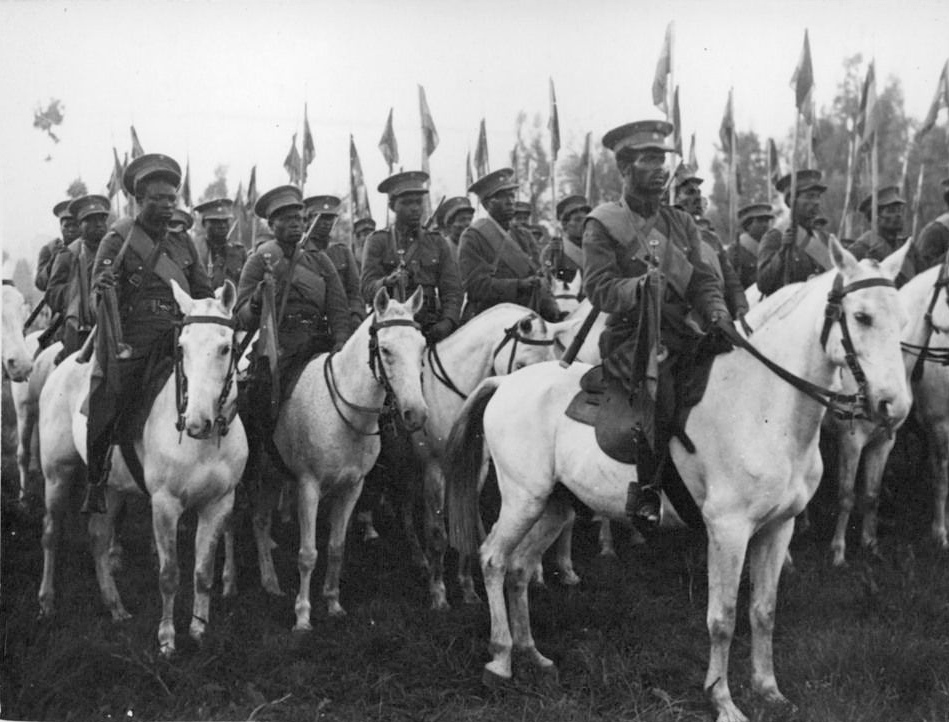
Ethiopian cavalry facing into a desperate battle for the survival of the last independent nation in Africa. I say, what a, wretched little imbroglio!

I suppose my problem is that I’m looking at things from the perspective of humanity in general. If, like Bouverie appears to do, I looked at the world solely from the point of view of male British Tories from the 1930s (and their dining clubs and society playgrounds), I would see the Italian invasion of Ethiopia simply as a complicated, embarrassing situation.

Racial Hatred

Bouverie says some… well… interesting things about anti-Semitism.

They don’t really mention this in the school history books, and it’s not talked about in polite society, but one reason why appeasement happened was that most British conservatives hated Jews.

…or so I thought, until Bouverie reassured me that it wasn’t an issue. This hatred, he tells us, was ‘broadly social and snobbish, rather than racial and extremist.’

Phew. Thank goodness for that.

Let me remind you that this book was published in 2019, year number four of Jeremy Corbyn being publicly scourged over alleged anti-Semitism. At various stages Corbyn was keel-hauled by the press for liking Charles Dickens, for praising J.A. Hobson and for mispronouncing Epstein. But two reviews of Appeasing Hitler in the Guardian make no mention of the author’s bizarre comments (The Guardian, which eviscerated Corbyn for much, much less). One review in the New York Times paraphrases the offending comments with approval. Bouverie’s obvious sympathy for the Conservative Party makes this all the more galling.

From The London Economic – Viscount Rothermere, owner of the Daily Mail, supported Hitler, as well as (less consistently) Mosley’s Blackshirts

The nuances and cross-currents of Viscount Rothermere’s Nazi sympathies are explained at great length and put into context – because of course one mustn’t be unfair to Viscount Rothermere. In this ‘fresh, challenging’ account of appeasement, Churchill is once again lionised, clever little things he said are quoted ad nauseam, every twist and turn of his policy is explained and justified. But the positions of the Labour Party are caricatured in passing, in contemptuous fragments of sentences.

Even though I was interested in the topic, there was nothing in this book for me. The camera lens was fixed exclusively on the least interesting part of the scene. So I gave up.

Conclusion

It seems to me that the British Empire is the elephant in the room in discussions of appeasement. These politicians held hundreds of millions of people in thrall in Africa and Asia and the Caribbean. It was certainly not any lack of aggression or militarism that stayed their hand when they were confronted with Hitler. They were not meek in India – contemporary training booklets advised soldiers on the best methods of burning villages. The attitude of Churchill toward non-white people was certainly ‘racial and extremist.’

From a selfish British imperialist point of view, the logic of appeasement held water. In exchange for an alliance with Britain, Hitler probably would have reserved his aggression for Eastern Europe. It seems to me that the appeasers calculated on letting Hitler loose like a wild dog on the east. They were willing to let him kill tens of millions without impediment as long as he destroyed communism in the process. Looked at this way, appeasement becomes even more disgusting. It also explains why supposed anti-appeasement politicians like Churchill in fact flip-flopped on the issue. But he eventually settled on a harder anti-Hitler position; more far-seeing British imperialist policy realised that facing a vast German empire five or ten years down the line was too big a price to pay.

Well, that’s my understanding of it based on admittedly limited reading. Maybe if I’d read past page 79 of Appeasing Hitler, I would be better-informed on the topic. Then again, maybe I’d have just learned about society playgrounds and drawing rooms. Either way, I couldn’t bear to read another deft portrait of another rich Tory whose racial hatred was only social and snobbish.

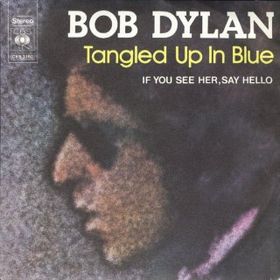
Featured Song: ‘Tangled up in Blue’

Tangled up in Blue (Bob Dylan, Blood on the Tracks, 1975)

The lyrics to this fine song get tangled up in apparent non-sequiturs, making you ask questions, making your imagination work overtime. The whole story is short on details, but we feel like the narrator has told us more than he really has. The lyrics are heavy with suggestion like branches bent under the weight of fruit. Dylan makes us work to extract the meaning, and we are grateful for it.

For example:

But he started in to dealing with slaves/ And something inside of him died/ She had to sell everything she owned and froze up inside/ And by the time the bottom fell out I became withdrawn…

What does that mean? How does one thing lead to the next? Things are skated over in vague terms, as if the narrator is wary of the legal implications, doesn’t want to open a can of worms, or just doesn’t want to think about it all.

It’s not just the usual obscurity and symbolism of Bob Dylan lyrics. It feels as if someone drunk and a little maddened by hardships, charismatic in his way, has sat down beside you on the bus and begun to tell you their history with a red-haired woman you’ve never met. Or maybe you’re overhearing one half of a stranger’s phone conversation – you missed the start, you’ll miss the end and you’re only hearing the answers, not the questions.

I read that Dylan tried, in writing this song, to dispense with any sense of time entirely. That was the first impression I got – that the timeline was all jumbled up, that there might even be multiple narrators, multiple situations connected only by theme. But by my 10th or 20th compulsive listen, it was starting to come together.

The song has a consistent thread. It tells the story of a relationship between the narrator and a woman. They get separated, but they drift back together, get separated again, but maybe they’ll be reunited… Is her nickname Blue? Does she have blue eyes? Or is it a reference to Joni Mitchell?

She was married; he ‘helped her out of a jam, I guess/ But I used a little too much force.’ The narrator probably didn’t kill the husband but he must have beat him up or something. They headed off on a journey together but ‘split up on a dark sad night, both agreeing it was best.’ The narrator is lying; he was devastated by the separation, but he doesn’t tell us that directly, or why they split up.

They meet again in Louisiana years later. She is working at a strip club and reading Italian Renaissance poetry; she lives in a basement with the narrator and another man, the one who ‘started in to dealing with slaves,’ whatever that means.

On rare moments we get detail. The ‘dark sad night’ when they split up is seared into the narrator’s memory and when he tells us about it he is not summing up and skipping over, but quoting her in real time. ‘I heard her say over my shoulder/ ‘We’ll meet again someday on the avenue.’

Then we skip ahead years and thousands of miles, until the narrator and the woman who ‘never escaped his mind’ are by chance reunited. We get verse after verse, describing the reunion almost iin real time.

He’s not an expressive or emotive guy – ‘you look like the silent type;’ ‘I muttered something underneath my breath.’ But we can tell how he’s feeling. He hints and summarises and skims over most of his life but then gets drawn into fine detail when he’s talking about her. The specifics he gives us are not the ones lawyers or cops or journalists might want to know. They are the things that matter to him.

I’ve had my ups and downs with Bob Dylan. He was as immaculately frightful as any surreal, pitiful denizen of Desolation Row when he accosted me in a pool hall impersonating Jack Kerouac and tried to sell me a Chrysler. But I’ve listened to his 2017 Nobel Prize lecture through from start to finish, multiple times. It’s a pleasure.

I think in that speech Dylan threw a sidelight on ‘Tangled up in Blue’ when he talked about Homer’s Odyssey and how he relates to it:

In a lot of ways, some of these same things have happened to you. You too have had drugs dropped into your wine. You too have shared a bed with the wrong woman. You too have been spellbound by magical voices, sweet voices with strange melodies. You too have come so far and have been so far blown back. And you’ve had close calls as well. You have angered people you should not have. And you too have rambled this country all around. And you’ve also felt that ill wind, the one that blows you no good. 

The parallel lies not at all in the specifics – but in how he can find and bring out the epic and the immortal in the mundane, how he elevates his narrator to the status of a hero.

Review: The Bloody White Baron by James Palmer

Baron Roman Ungern von Sternberg was a cavalry officer who hacked a bloody path through revolutionary Russia, drove a Chinese occupation out of Mongolia, and aimed to become a new Genghis Khan.

This biography by James Palmer gives an engaging and hair-raising account of Ungern’s life. A child of the Baltic German nobility, raised in an atmosphere of contempt for the Estonian peasantry whose labour sustained his family, he was expelled from every educational institution he set foot in, generally for violence. He only settled down to a steady life when the battlefield gave his brutality an outlet during the 1905-6 Russo-Japanese War. He joined the ranks and received rapid promotion to the officer corps in a Cossack unit. Later during World War One he displayed near-suicidal bravery, and off the battlefields he was prone to duelling and to administering drunken beatings to servants.

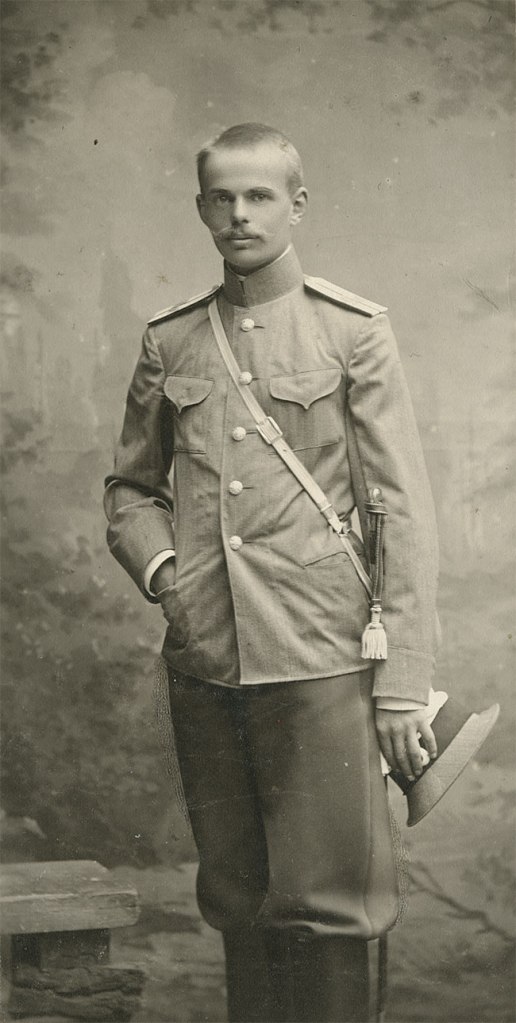
The young Ungern-Sternberg

Revolution & Civil War

As the war ground on, claiming millions of Russian lives, Ungern became part of a military scheme to recruit a unit of Buriats, a Mongolian people living within Russia. So when the Revolution and Civil War came they found Ungern on the Mongolian border commanding a large force of Buriats.

Ungern was a close collaborator of a Cossack officer named Semyonov. With the outbreak of Civil War, Semyonov became a key figure in the White Armies. He was a bandit on a large scale, a warlord whose cavalry forces dominated an area larger than many European nations, both an asset and an embarrassment to the Whites. Ungern was his right-hand man.

In 1920 when Admiral Kolchak’s White armies collapsed and the Red Army advanced across Siberia, Ungern and his thousands of fighters crossed the border into Mongolia.

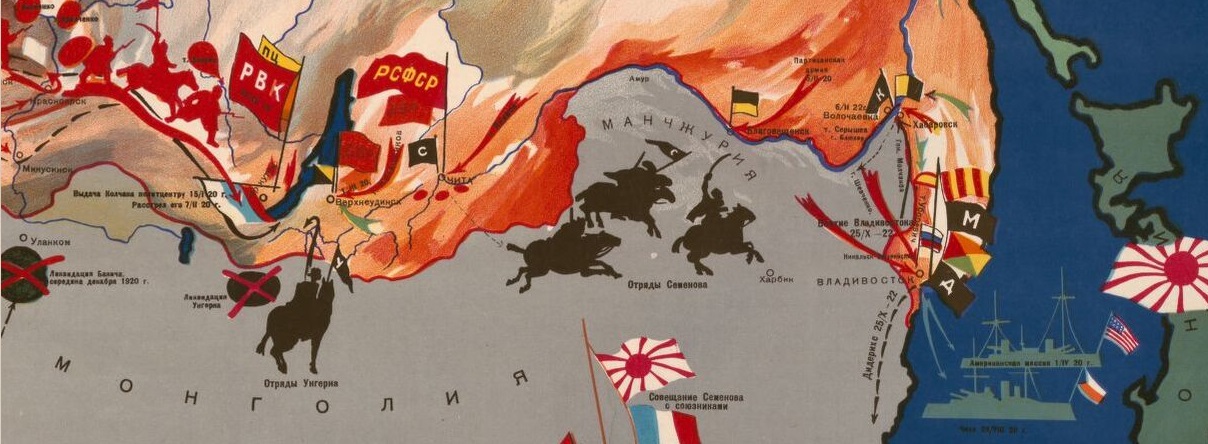
From a pictorial map of the Russian Civil War, available at Wikimedia Commons and Library of Cognress. The three dark figures on horseback represent Semyonov’s forces. The single rider to the left is captioned ‘Ungern’s Detachments.’ He has fled across the border into Mongolia.

After a harsh winter in the wilderness Ungern marched on the then-capital, Urga/ Ikh Khuree, and drove out the Chinese occupiers in early 1921. The height of his power followed: the Mongolian Buddhist church officially recognised him as the god of war and as the reincarnation of an eminent religious leader from the early 19th century. However, inside of a few months Ungern was being challenged by socialist Mongolians led by Sukhbaatar and Chaibalsan, who, with major Soviet supplies and aid, seized the border town of Kiatkha. Ungern marched north to fight them, and met with a terrible defeat. Then, as Soviet forces advanced into Mongolia, Ungern led a straggling army through desolate swamps and hills until his own soldiers, horrified by his wild plan to invade Tibet, mutinied and turned him over to the Reds. 

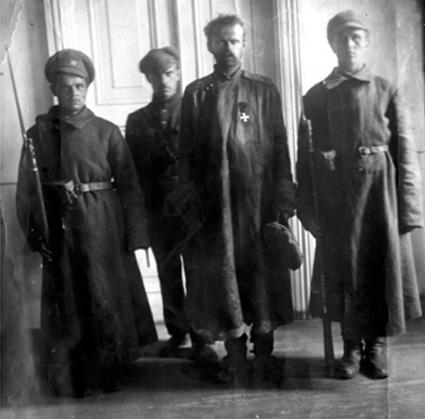
Ungern after his capture by Red forces

If you want to read more about the Russian Civil War, keep an eye out for my upcoming series, Battle for Red October. Subscribe for free to receive an update by email for my weekly post.
Violence

Throughout his career as a White leader, Ungern killed every communist he encountered, and their children too, so that nobody would be left to seek revenge. He also believed that he could sense, by staring intensely at a prisoner, whether they were secretly ‘a Jew or a commissar’, and if he divined that they were he would kill them too. Palmer details Ungern’s sadistic and disgusting methods of execution and torture, and the horrific scale on which he employed them.

During the heyday of the White Armies Ugern ruled the border town of Dauria, which became ‘The gallows of Siberia’, where the hills outside town became stained red with the blood of prisoners. These victims were sent to Ungern by other White leaders such as Kolchak who liked to pretend they didn’t know what he was doing.

Ungern had strange views about military discipline. Almost everyone close to him seems to have been on the receiving end of horrific beatings. A hundred blows to each part of the body was a standard punishment. Forcing a victim to shiver naked on a frozen lake was another. Execution and torture were normal.

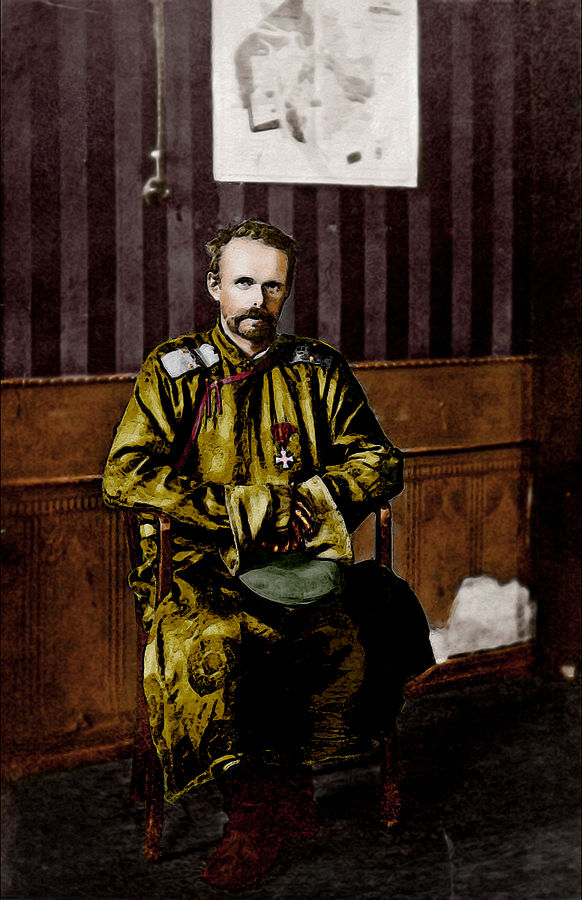
Ungern, colourised. In battle in the later part of his career he preferred to wear a bright yellow Mongolian robe.

Palmer has travelled extensively in the lands which Ungern trod, and he conveys a real sense of the setting. He is an engaging narrator, capable of capturing the imagination, very self-assured, with footnotes that delve into his own interesting anecdotes and meditations. His description of Ungern’s seizing of Ikh Khuree is very vivid and will stick in my mind for a long time. He does a great job of conveying Ungern’s character, and of explaining the complex political-religious influences that operated on him. The book is very clearly aimed at British readers; while I’m not sure he always shows sufficient respect to the Mongolian people in his remarks about them, I’ll extend him the benefit of the doubt.

In general, Palmer doesn’t pull his punches on Ungern, but towards the end of the book he seems to go a little soft on him, claiming that ‘the Soviets… made him look like an amateur’ when it came to killing. Of course, he’s talking about events over a decade later after Stalin had seized power; there was no figure remotely comparable to Ungern on the Red side during the Civil War, and on his own smaller scale he gave Yezhov and Beria a run for their money. Palmer himself notes that the early Soviet regime in Mongolia was not marked by terror or coercion. They even kept in power the corrupt, murderous and utterly selfish priest-king of Mongolia, the Bogd Khan. It’s frustrating how an author can fail to notice the profound contrast between the early years of the Soviet Union and the later Stalinist regime of terror. Instead, as is the common practise of British writers, he telescopes it all together – the idea being that Stalin and the political tradition he exterminated were fundamentally the same. Far from looking like an amateur, Ungern’s violence gives us an insight into the form of proto-fascism that would have enjoyed a bloody reign over a disintegrating Russia if the Whites had been victorious.

The final paragraphs of the book left me with a bad taste in my mouth, as Palmer decided it would be a good idea to end this long horror story by telling us about a Mongolian woman he met who praised Ungern. ‘It would have pleased him,’ Palmer concludes with complacent magnanimity.

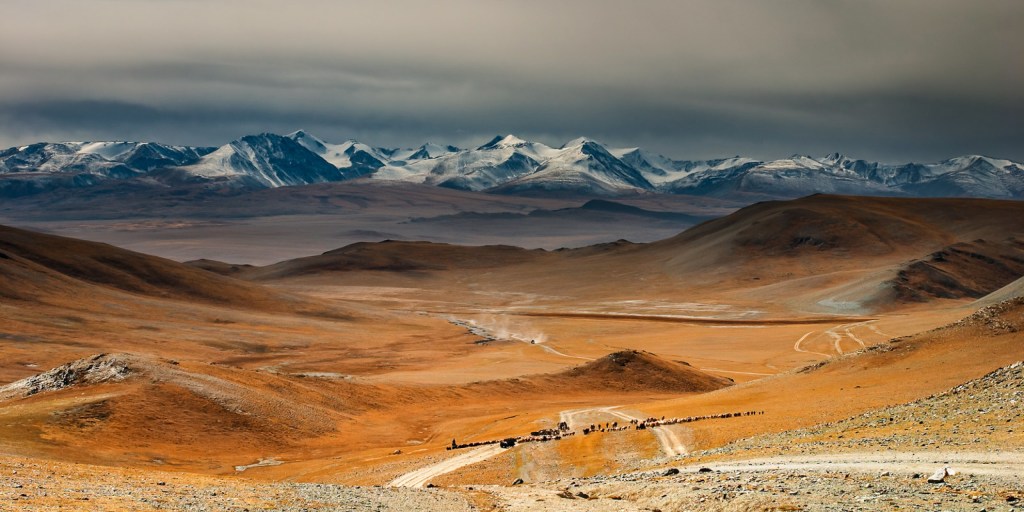
The Mongolian Steppe near Ulan Baatar.

Beliefs

While Ungern seems at first like a disturbing freak of nature, the truth emerges that he was in every respect part of broader trends, and that every facet of his weird amalgam of beliefs was connected to his lived experience and the institutions that shaped him.

To begin with, Ungern was a Baltic German aristocrat, conditioned from his earliest days toviolent, elitist and racist. To him it was obvious that ‘Slavs’ couldn’t rule themselves, and must be ruled by the firm hand of the Romanovs, or as a second preference by German nobles, if they didn’t want to be ‘led astray’ by ‘the Jews.’ But Ungern’s racism was awkward and unusual: he inverted the ‘Yellow Peril’, believing that Europeans were degenerate while ‘the peoples of the East’ were strong and warlike. His violence fell foremost on Jewish people, next on Europeans and Chinese, and least of all on Mongolians.
This bleeds over into his anti-revolutionary paranoia. He believed that the Communist Party was founded 3,000 years ago in Babylon and that it was a cosmic, satanic evil. The standard form of anti-communist bile in the 1920s was to explain that communism and revolution sprang from the ‘barbarity’ of ‘Asiatic’ Russia, but for Ungern Marxism was a product of modernity, of the degenerate ‘West’ engulfed in a ‘revolutionary storm.’ Other White leaders, who touted a constitutional monarchy or even a republic, disgusted him. For Ungern, only a new Genghis Khan could save the world. It appears that he couldn’t really tell the fundamental difference between, say, Lenin and Sun Yat-Sen: they were all evil ‘revolutionaries’ in his eyes.

Both Ungern and his collaborator Semyonov were mass-murdering sadists. But Semyonov was extraordinarily corrupt and luxurious, with a weakness for orgies and drink, while Ungern was intense and ascetic.

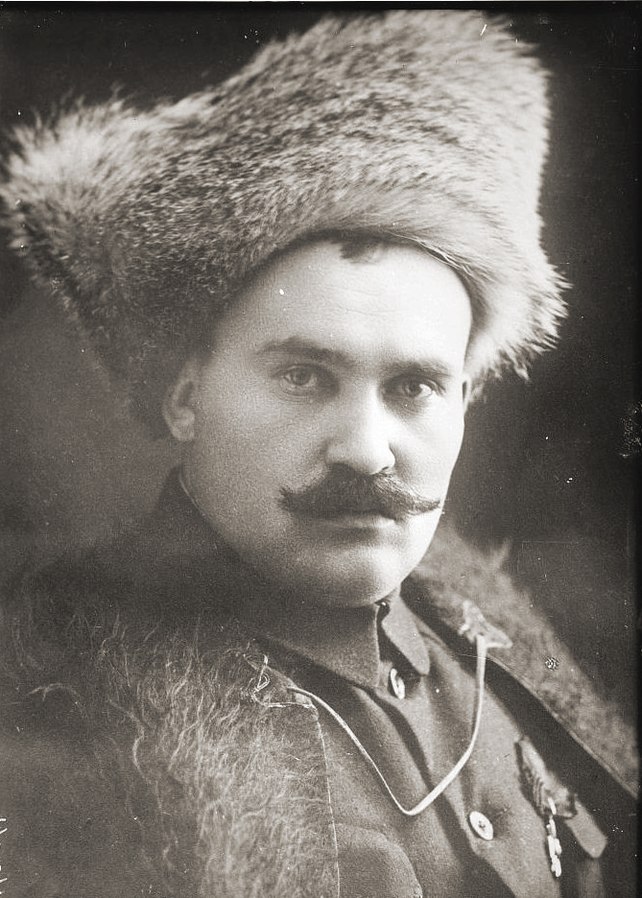
Ataman Semyonov

Ungern was a bore on the subject of how Mongolian medicine could supposedly cure diseases which ‘western’ science could not, and his religious beliefs mixed Buddhism with Lutheranism and Orthodox Christianity. The esoteric mysticism associated with Madame Blavatsky and the Theosophists also informed his religious convictions. It appears that he absorbed a whole lot of ‘occult’ and ‘magical’ readings before the war. The same basically confused, shallow ‘spiritual’ eclecticism was of course a feature of Nazi ideology, particularly in the case of Himmler.

Lastly, Ungern’s sadism and obsession with war were part of the wider tradition at the time of seeing war as something noble and ‘virile’, the antidote to a vaguely-defined ‘degeneracy’; and these attitudes were obviously further fed and fattened every day of his life by the brutality of Tsarist military discipline and by the trauma of the battlefield.

As opposed to a historical curiosity or mystery, the more I read about Ungern, the more I saw him fitting right into his historical context. His racialism and mysticism, far from being just eccentricities, were 100% of his time. His violence was the violence of counter-revolution. His orientalism was not ‘ancient wisdom’ – it was a very modern delusion, and he was an essentially modern figure, in so many ways emblematic of 20th century fascist and reactionary thought. He was on the edge of the White cause both politically and geographically – but the old regime and the White cause created him, and behind the ‘democratic’ facade carefully projected for the benefit of the Allies, beasts like Ungern lurked.
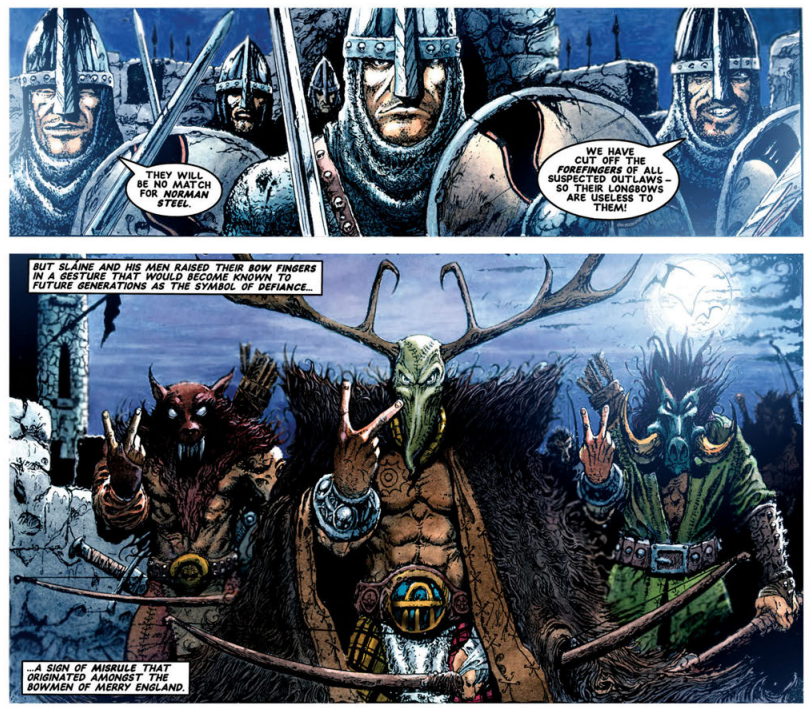
Sláine: Part Three (Premium)

Become a paying supporter to get access

Access to this article is limited to paying supporters. If you already subscribe by email, thank you. But if you want to become a paying supporter, please hit ‘Subscribe’ below.

Donate less than the price of a coffee, and you can access everything on this blog for one year.

If you don’t feel like donating, most of my posts are still 100% free, so browse away, and thanks for visiting.

Home Page/Archives

Sláine: Part Two

This is Part Two of a three-part series on 2000AD’s Sláine. You’ll find Part 1 here.

This part is going to be a live commentary as I re-read Demon Killer. I’ll be typing my responses to things as I see them. The point of this is to show how the writer Pat Mills integrated a huge amount of myth and history into these stories without sacrificing fun, pacing or clarity. Sláine is pure fantasy, even – perhaps especially – when it purports to be dealing with real people like Boudicca or William Wallace. But even as we know it’s fantasy, we know it’s not just pulled out of someone’s arse either; it feels authentic and possesses a certain integrity.

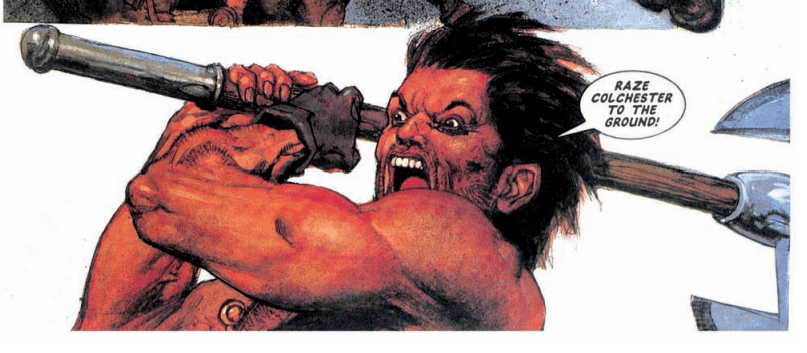
Demon Killer was written by Pat Mills and drawn by Dermot Power, Greg Staples, Glenn Fabry and David Lloyd. All images are from that.

So here goes.

  1. Right from the start we see ‘the triple death’ – Celts carried out ‘triple killings’ on their kings.
  2. As king Sláine is forbidden from fighting – in contrast to other cultures, early Irish kingship institutions placed far less emphasis on violence and more on generosity, kinship and wealth
  3. Geasa – taboos – yes, Irish kings had these taboos placed on them. Great mythical examples to be found in ‘The Burning of Derga’s Hostel’
  4. Reading animals’ entrails to see the future – a Roman practise, as far as I know
  5. Dead bodies getting up and speaking – a recurring motif in ancient Irish myths, though usually it’s a severed head
  6. Sláine is to be killed at the end of his reign – plenty of evidence that this was done in Ireland – eg the bog bodies
  7. The flashback to the battle of Clontarf – needless to say there was no warp-spasming warrior and no demon at that battle
  8. Sláine has four wives – yes, polygamy was legally recognised is the old Irish laws, and was widely practised right up to the 17th Century
  9. The magical cauldron comes from the tales of the Tuatha Dé Danann – see Gods and Fighting Men by Lady Gregory
  10. Gold thrown into sacred rivers and lakes – yes, this was done in ancient Ireland, Britain and Gaul – but it seems to have stopped by 800-600 BCE whereas Boudicca’s rebellion was in 60 or 61 CE (Alice Roberts, The Celts, p 92).
  11. This comic way overstates the ‘sacred gold’ angle – they dumped all kinds of artefacts of all substances in the rivers and lakes
  12. When Sláine rises from the pool and Ukko introduces him – Ukko’s eloquence is very typical of Irish mythology: ‘A bone-splitter, a reddener of swords, a pruner of limbs who delights in red-frothed, glorious carnage… Your lives would be prolonged for getting out of his way.’
  13. Sláine is in nothing but a loincloth, slaughtering guys in armour – this image of the wild reckless Celtic warrior is complicated by the fact that real Celtic warriors hid behind massive shields and specialised in hit-and-run attacks
  14. Explanation for how the rebellion began: for the Romans, gold is tax; for the Celts, it’s sacred – no basis in history, of course, but it’s creative and fun
  15. Boudicca says the Romans aren’t real men because they ‘bathe in warm water… anoint themselves in myrhh… and sleep on soft couches with boys… like their emperor who behaves like a woman… as is proved by the beautification of his person’ – OOF – this is the kind of ‘noble savage’/ ‘Fremen mirage’ stuff Sláine usually avoids. Based on what we know, the Celts were very proud of their appearance, adorning themselves with jewellery and dressing in bright colours. We know that the Gauls of Caesar’s time had make-up and fragrant soaps. Irish mythology is full of men describing each other as beautiful. ‘Personal adornments of bronze were abundant’ even among the prehistoric proto-Celts. (Nora Chadwick, The Celts, p 30.)And the casual 1990s homophobia is wide of the mark too – I’ve never come across evidence that the Celts looked down on gay sex or thought the Romans were somehow weird for doing it. Hmmm – and didn’t we see a gay couple in The Horned God?
  16. It is true that Roman soldiers flogged Boudicca and raped her daughters.
  17. Mona (Anglesey) was the druid stronghold but not ‘island of the witches.’ Women as well as men were druids so that detail is fair enough. The idea of them being naked in the cold of north Wales, the idea of them fighting naked, the idea of them playing with human organs, that’s what we call artistic license. But in the very same year as Boudicca’s rebellion, it is true, Suetonius Paulinus led a legion to Anglesey where he fought an arduous battle against the druids, massacred them and then for superstitious reasons set about uprooting their oak groves. Before battle the Romans were ‘paralysed with fear’ by ‘women dressed like Furies in funereal attire, their hair dishevelled, rushing about amongst the warriors…’ So there – they were dressed. In attire, no less. (The Ancient Paths by Graham Robb, p 250-257)
  18. Elfric is clearly supposed to represent the luxury and licentiousness of the Romans – the old ‘noble savage’ theme again. Enjoying yourself in any way makes you weak, you see. But this goes against the theology explained in The Horned God.
  19. Yes, Colchester was where the retired legionaries lived
  20. ‘Do not heed warriors who need to protect themselves with helmets and breastplates – such men are full of fear!’ – The Celts were brilliant metalworkers and never had any aversion to armour, though there are accounts of people who went into battle naked.
  21. The druids’ magical herbs that cause hallucinations – a recent Blindboy podcast with Manchán Magan went into this, among other things. Very interesting.
  22. Burning people alive in wicker cages – not the first time we’ve seen this in Sláine – which is apparently based on accounts by Caesar (Gallic Wars) and Strabo (Roberts, the Celts, p 182).
  23. Women as well as men appear among the Celtic troops on the battlefield. I think this is a reasonable interpretation of the evidence of grave goods, history and mythology, which suggests women as prestigious leaders on the Continent, in Britain and in Ireland. I’ve read (I can’t remember where) that in early medieval Ireland women took part in fighting, perhaps a survival of the older custom. But earlier at Colchester Boudicca made a speech that seemed entirely addressed to the men in her army, so that’s odd.
  24. ‘You heard the boss!’ – the shield-boss, that is. Brilliant little touch. Classic Sláine.
  25. So this comic, towards the latter half, goes into a bit of a warp-spasm with the killing and the slaughter. This is getting as mad as the ‘Volgan’ occupation of Britain in another Mills classic, Invasion. The craziest part is when Sláine and Boudicca build ‘the bone prison of oeth,’ a prison made of the bones of Roman soldiers. This is based on a story made up by the 18th century Welsh antiquarian Iolo Morganwg. According to Sam Lansman: ‘One of the most evocative of Iolo Morganwg’s forgeries was his description of Caer Oeth ac Anoeth as a dungeon built from the bones of slaughtered Roman legionnaires. This gruesome if impractical prison, the antiquarian claimed, was destroyed and rebuilt several times during the wars between the Romans and the Britons.’ But the 18th-century bluffer didn’t entirely make it up; it’s an interpretation of source material that is all catalogued here on Jones’ Celtic Encyclopedia.
  26. ‘The point is the Caesarian Empire provided a role model for future empires to rob and enslave native peoples… No empire ever gets away with it. … Countries built on blood cost the descendants… the injustice leaves a psychic scar… A sickness in their souls…’ You tell em, Nest. Excellent.
  27. A detail I forgot. The gruesome prison of bones is so morbid it opens a portal for Elfric to return – suggesting that all this fury and slaughter is the ultimate cause of the rebellion’s undoing
  28. All this slaughter is not just a trope of comic books. It’s also, to be fair, a trope of old Celtic legends. Read ‘The Battle of the White Strand’ – incredible numbers die left, right and centre.
  29. ‘The Omphallos – the Navel of Britain!’ – this is another motif that’s explored in Robb’s The Ancient Paths
  30. ‘Your majesty’ – hmmm… I don’t think Britons would have referred to their rather down-to-earth kings and queens by such exalted titles.
  31. The battle is amazing – a mad mixture of the sort-of plausible with pure unabashed fantasy. Tremendous fun. Nothing really to say except that there were plenty of women as well as men among the Britons, who also had loads of trumpets like we see here, which terrified the Romans. I don’t think there’s any evidence the Britons were goaded into battle in the way we see here, but Graham Robb has a theory about how Boudica chose the battle site for scientific-religious-geographical reasons (Robb, The Ancient Paths, p 263)
  32. Yes, the Britons’ retreat was impeded by their wagons; yes, even according to the Roman Tacitus the civilians were not spared. The cruel reprisals afterwards are accurate. ‘Hostile’ tribes had their lands laid waste.
  33. The lament ‘Ochone’ is real, it’s Irish
  34. The interior of the burial mound resembles real-life continental burials like that of the ‘Hochdorf prince’ – right down to the ‘bronze couch’
  35. I don’t know if this claim about a planned conquest of Ireland is based on anything, but that could be my own ignorance. I will say that Suetonius Paulinus’ maps look way too accurate – the Romans didn’t have such technique in cartography. Their maps were terrible.
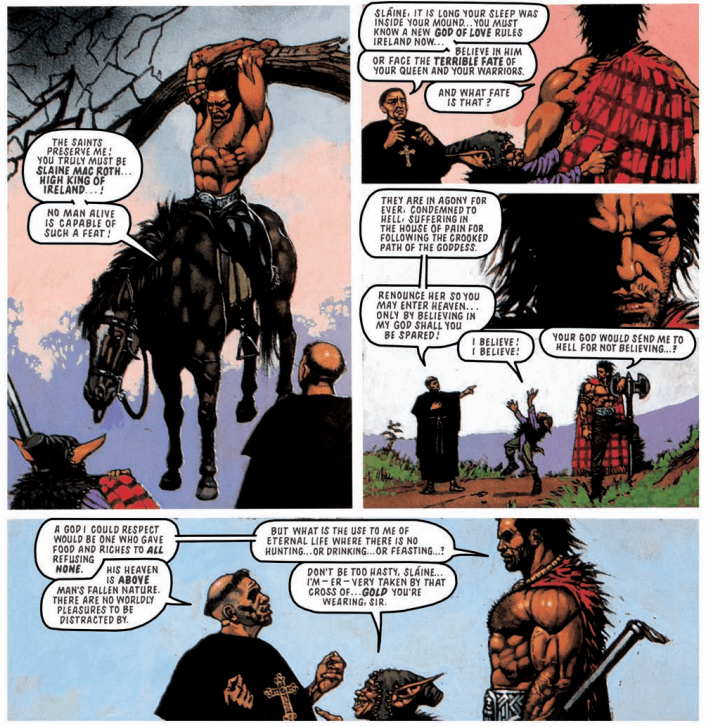
  36. There is a little epilogue where Sláine returns to Ireland to find that his whole world has vanished with the passing of the years. This is brilliant, based on the myth ‘Oisín and St Patrick’ (In Gods and Fighting Men but also online here). In this story a legendary Celtic warrior argues with a Christian saint. It’s absolutely brilliant. The debate between Sláine and the priest is a faithful and creative interpretation of such ancient stories. There’s real authenticity in this little epilogue.

I expected to find like ten bullet points, not thirty-six!

Good thing I chose Demon Killer rather than The Horned God, or I’d have been here all day. The sum of all these little details is a major part of what makes Sláine work. I think the series has lost this over the years – never entirely, but to a considerable extent. Anyway, we’ll get on to that next week with Sláine: Part 3.

Books:

  • The Celts, Nora Chadwick, Penguin, 1972
  • The Celts: Search for a Civilisation, Alice Roberts, Heron Books, 2015
  • Gods and Fighting Men, Lady Gregory, 1904 (1970, Colin Smythe Ltd)
  • The Ancient Paths, Graham Robb, Picador 2013

Sláine: Part One

Over the first year of Covid I went through the back catalogue of 2000AD’s Sláine, for the most part reading the digital graphic novels on my tablet. At first I dipped in out of curiosity, but found myself enjoying it so much that I read fifteen titles cover to cover.

And I did not think it too many.

This is the first part of a three-part commentary tracing the high points and low points of the comic over the forty years of its existence. I will comment on each title in the series. The high points are magnificent and the lows are pretty shocking. My opinions will not be popular.

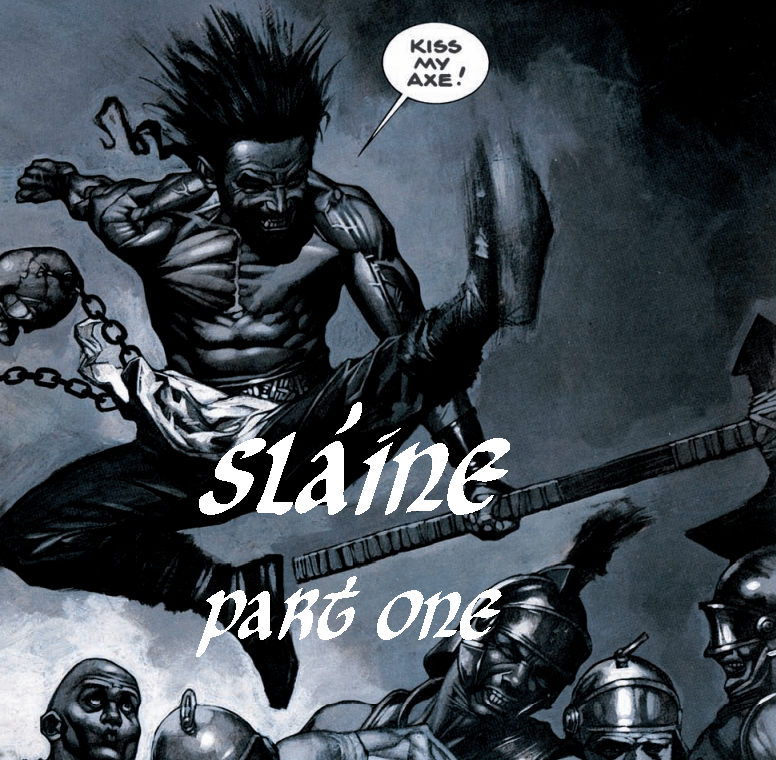
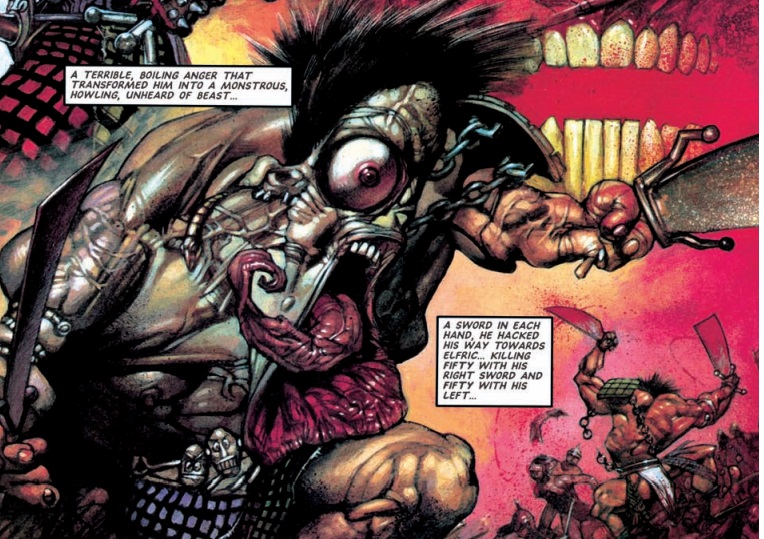
Sláine. I’d imagine most British people pronounce it as ‘Slain’ and, you know what, that’s fine. But it’s Slaw-nyah. However you say his name, he’s a character in the British comic 2000AD. He is a warrior with an axe who roams around Celtic Europe, leaping, shouting and chopping up bad guys. Roughly once per graphic novel, when chopping and shouting does not suffice, the raw power of the Earth goddess surges through him in a raging ‘warp-spasm,’ and he transforms into a grotesque and unstoppable beast.

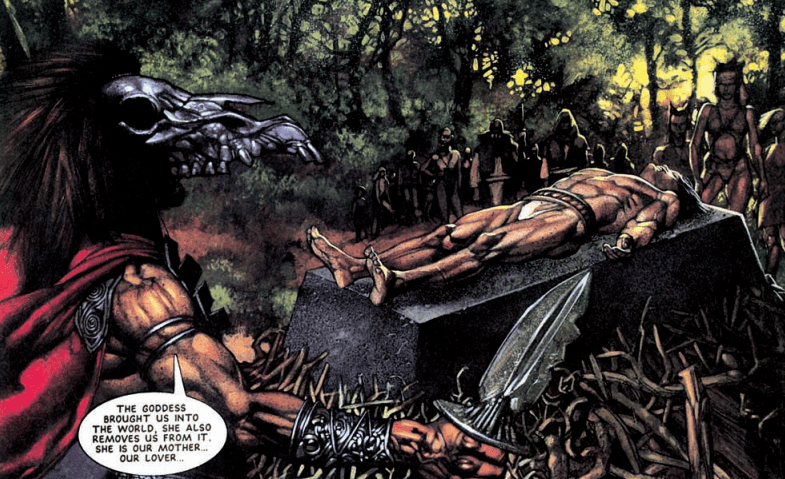
From Demon Killer, written by Pat Mills, art by Glenn Fabry, Greg Staples, Dermot Power

But (at its best) there’s a lot more to it than that. Sláine is not a Viking or a Spartan or a medieval knight; he is a Celtic warrior, and that means he doesn’t fit neatly into the macho mould you might expect. He’s difficult to pin down and he’s got a lot going on. The two sides of Sláine are captured in The Horned God, when in a flash-forward Sláine’s chroniclers debate his legacy:

Ukko: Nah… Readers aren’t interested in all that fancy stuff. What they want is plenty of hacking and slaying.

Mor Runne the Dung Collector: Yurrr… I like hacking and slaying.

Nest: But there’s always been more to Sláine than just some muscle-bound barbarian. It’s an attempt to redefine the hero. To convey the matriarchal origin of myth.

Ukko: Take a tip from an old hack, dear, and stick to Sláine chopping off brainballs!

Mor Runne the Dung Collector: Yurr! I don’t like the comp… comp… complicated bits. I only like it when he’s killing people.

There are plenty of violent battles in Sláine – with Fomorians, Skull-Swords, Trojans and all kinds of demons and monsters. But the battle between a basic barbarian action hero and a deep, obscure Celtic soul is the most interesting of all. Over the next three posts I will examine this struggle. Part 1 will look at the first twenty years or so, Part 2 will take a deep look at one particular graphic novel, and Part 3 will deal with the latter half of Sláine’s career (including the really controversial bits).

1: Warrior’s Dawn

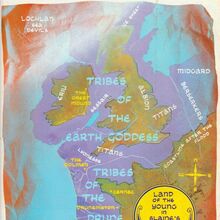
Map of the Land of the young, from Albion British Comics Database

The early stories from the 80s are collected in the graphic novel Warrior’s Dawn.

Sláine is a wandering exile in a mythical Celtic Europe called the Land of the Young – so named because few live to grow old. It’s a place as chaotic and fun as 2000AD’s Mega-City One. Flying ships powered by standing-stones ply the skyways. Dark magic corrupts the fields and forests into sourland, where prehistoric and inter-dimensional monsters roam. A stinking corpse named Slough Feg is the leader of a death-cult which burns captives in tribute to the maggot god. Sláine seeks to return to his own people, the Tribes of the Earth Goddess, a strange but relatively wholesome crowd whom Slough Feg seeks to conquer.

Writer Pat Mills does his homework when it comes to the Celts; many elements of this setting are derived from real history or myth. Not just Cuchulain’s riastradh, or warp-spasm. Whenever Sláine kills some great number of people and boasts that he ‘did not think it too many,’ he is quoting from the stories of the Fianna cycle. Part 2 will give further examples.

Sláine is not a boy scout. He is governed by obscure drives, sometimes dark or shallow, sometimes profound and selfless. His enemies – the Guledig, Slough Feg – are those who despise human pleasure, and the natural and material world which Sláine champions. He succeeds not through domination and destruction, but through submitting to the sublime chaos of the pagan world.

Sláine’s anti-authoritarian tendencies are not founded on ‘noble savage’ tropes or ‘don’t tread on me’ hypocrisy, but in an egalitarian, feminist and ecological spirit. Later in The Horned God we see that among the tribes of the Earth Goddess, marriages last for one year. The land is shared out equally and some set aside for the old and the sick. Kings (Sláine included) are sacrificed after a seven-year term so that they don’t get too big for their boots. Empires are seen as barbaric. Sláine makes no pretense that it is historical, but this depiction of Celtic society has plenty of foundation in the sources.

It is a myth of its own time. The Celts dress like punks (in later numbers more like metalheads). Ukko the dwarfish thief hates the egalitarian ways of the Celts, which he criticises in distinctly Thatcherite terms. Keep in mind that it’s the late ’80s, early ’90s, and the main bad guys, the Fomorians, are ruthless, callous tax collectors; we are duly informed that they live in a place called Tory Island (a real island off the coast of Donegal where, yes, the Fomorians of myth had their base). The hunger strike is portrayed as a venerable and ancient custom – just a few years after the 1981 hunger strikes in Ireland.

A lot of the above comes later, especially in The Horned God. But even in early Sláine, not a single episode goes by without some cool element of Irish, Welsh or Gallic myth figuring into the story somehow or other.

I like Sláine because (again with the qualifier, ‘at its best’) it chimes with what Michael Moorcock wrote about the great novels of Henry Treece. It is able

to capture the sense of raw passion of adult men and women who are not always mystically inclined yet dwell in a world of mysticism… [magic] is as much a part of life as the wild landscapes… as the stones and hills, the forests and the seas, the fortified townships and isolated villages dwarfed by the great grey skies.

Sláine is at its strongest when character and setting have room to breathe. It is at its weakest when it becomes simply a story of a man chopping up a succession of ugly monsters.

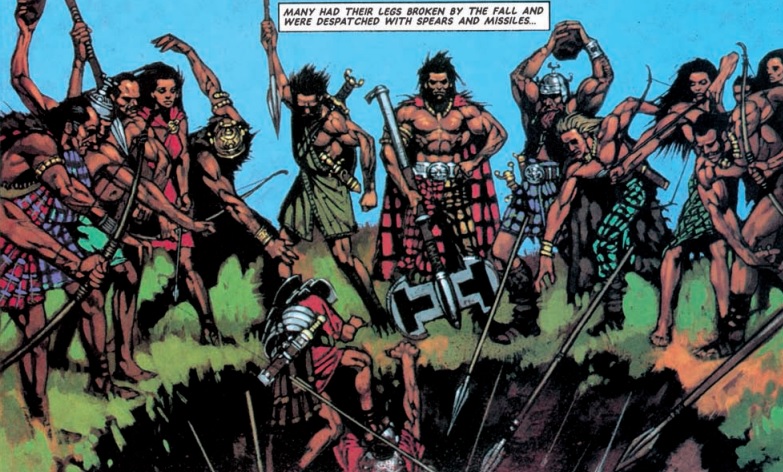
His time as king of his people is up, so he must be killed. From Demon Killer, written by Pat Mills, art by Glenn Fabry, Greg Staples, Dermot Power

2 and 3: Time Killer and The King

The stories collected in the second and third graphic novels (Time Killer and The King) see Sláine journey home and become the leader of his people, but for a while the reader is taken away on a bizarre detour. Sláine encounters the Cyth, inter-dimensional aliens who secretly control the destiny of humanity… and there’s a temple, a temple of terror or something… *yawns* … where was I? To cut a very long and jarringly episodic story short, Sláine travels through alternate dimensions, encounters strange aliens and trades his axe for a leyser gun. Yes, leyser. Like ley-lines. Get it?

It probably responded to some editorial and/or commercial need at the time, but I found the detour tiresome, a grind with no connection to the character or the setting I had become invested in.

No doubt some are reading this post to find out what are the best Sláine comics, which to start with, which ones not to bother with, etc. They might ask, ‘Should I just skip Two and Three?’

Ah, I must warn against it. The people on the business end of 2000AD have gerrymandered the graphic novels in a fiendish way. The sci-fi stuff is split fifty-fifty between the second half of Two and the first half of Three. If you pass on Two, you miss, among other great episodes, Sláine’s time-travelling intervention at the Battle of Clontarf. If you pass on Three, you miss out on Sláine’s return to the Tribes of the Earth Goddess, the story of how he becomes king of his tribe and of the first battles with the Fomorian sea demons. So the publishers have us in a bind.

Edit: see here for a very different (perhaps fairer) take on Tomb of Terror:

https://slaineranked.blogspot.com/2024/08/slaine-ranked-part-11-you-wont-find.html?m=1

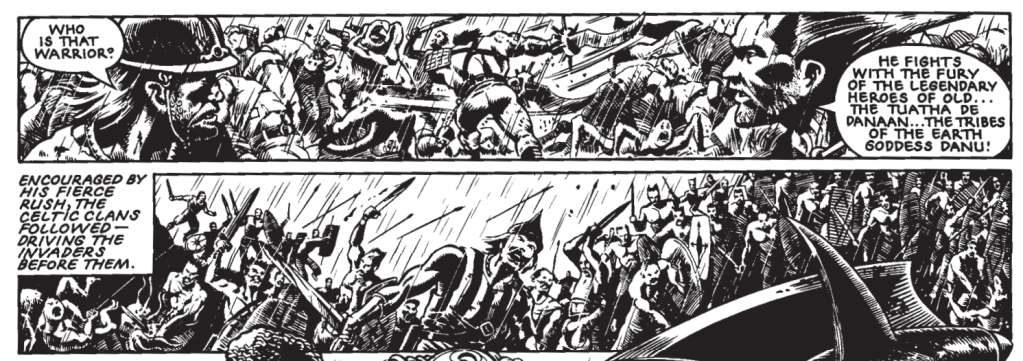
Classic 1980s black–and-white Sláine. From Time Killer, Written by Pat Mills, art by Massimo Belardinelli, Glenn Fabry, David Pugh, Bryan Talbot

4: The Horned God

This brings us to the pinnacle of the whole saga. The Horned God is the story of how Sláine unites the Tribes of the Earth Goddess to resist Slough Feg. More than that, it is a spiritual journey for Sláine as he submits to the Earth Goddess and becomes her faithful champion. Simon Bisley’s full-colour art is really beautiful.

The Horned God is deliberately slow to start, laying a solid thematic basis. Nothing in this story feels unearned. The story explores the motivations of Slough Feg and his death-cult. There’s a kind-of feminist theme as Sláine triumphs through becoming the Horned God, the champion of the Earth Goddess.

This champion ‘sees the ridiculousness of life. He never takes its pressures too seriously… Whereas the sun god is so serious… is obsessed with authority… with conquering everything… those heroes who follow his path are usually mindless and violent.’

The ingredients are in the right balance: action and spectacle combined with thematic depth and character development. There are stories within the story – such as the return of the Avanc, last survivor of an indigenous people wiped out by one of the Tribes of the Earth Goddess. Some parts are laugh-out-loud funny, but there are moments of real pathos – like when Sláine says goodbye to his son.

The Horned God is amazing.Despite some elements which have not aged well (including the male gaze stuff that I will deal with next week) it rewards reading and re-reading.

5, 6 and 7: Demon Killer, Lord of Misrule and Treasures of Britain

Pat Mills appears to be deft at pleasing his editors while also remaining true to his creations. As noted above, for some reason Sláine became an inter-dimensional battler of aliens for a while in the 80s – but rather than retconning or pretending it never happened, Mills does a graceful job of integrating the silly alien stuff into the story while keeping the focus on the themes and characters we actually care about. This enriches the stories collected in the next few graphic novels. In Demon Killer, Lord of Misrule and Treasures of Britain, Sláine travels through history and myth and time. These stories feature Boudicca, Robin Hood and King Arthur. Along the way he battles with old enemies: the Guledig and the sadistic demon Elfric.

From Demon Killer, written by Pat Mills, art by Glenn Fabry, Greg Staples, Dermot Power

Demon Killer puts the moral ambiguity of Sláine to the fore. Alongside Boudicca, he loots and razes a Roman city, killing masses of innocent people. Mills justifies this in the introduction (justifies it as an artistic choice, I hasten to add) convincingly in my view:

In many comics he would have doubtless made an excuse and left or tried to stop the massacre with some appalling hindsight speech: “No! No! Spare the women and children!” Fortunately, on 2000 AD, we don’t make such unconvincing compromises. The reality is that, as a Celtic warrior, Sláine would have participated because his people were driven to a fury after the Romans ethnically cleansed their land. And I feel this uncomfortable truth is preferable to reassuring but bullshit fiction.

(Pat Mills, from the introduction to Demon Killer)

 It is consistent with Sláine’s character and his motivations. I said he wasn’t a boy scout. He is compelling because he attracts and then alienates our sympathies. But we’ll be taking a closer look at Demon Killer next week.

Lord of Misrule contains a moment very characteristic of Mills’ writing:

From Lord of Misrule, written by Pat Mills, art by Clint Langley, Greg Staples, Jim Murray

I don’t know if this is true or just a myth, and I don’t care. I like these little asides, and how they are well-integrated into the story.

In Treasures of Britain I found the story a bit unfocused. But the artwork is the most beautiful of these three comics, and there are many astute comments on Arthurian legend.

These are fun adventures, beautifully drawn, with thematic depth and character. I heartily recommend them.

That’s it for this week. Subscribe by email to get a notification when Part Two goes up. Next week we’ll look in depth at Sláine: Demon Killer. We’re getting into darker material in Part 3: some of the dodgy shit that has made its way onto the pages of Sláine, and why I hated Book of Invasions. But we’re also going to appreciate the finest artwork of the whole saga and take a look at my recommendations for the top five Sláine comics.

Maybe you enjoy reading about Sláine, and you didn’t think that too many. You should check out this great blog where the author Alex compiles a full list and ranking of all Sláine stories: slaineranked.blogspot.com