26: Pursuit into Poland

The Red Army drives back the Polish invasion. The Soviet leadership faces a choice: whether to make peace or to carry the war into Poland. This is part 26 of Revolution Under Siege, an account of the Russian Civil War.

We are a force in the world, and you are destined for the mortuary. I despise you and hold you in contempt.’ Piłsudski, in a fit of anger, was fantasising out loud about what he would like to say to the Soviets. This was during the months before the Polish invasion of Ukraine. ‘No, no, I have not been negotiating. I have just been telling them unpleasant facts… I have ordered them to understand that with us they ought to be humble beggars.’ [1]

It was indeed in a beggarly and humbled condition that the Soviet Union found itself in a full-scale war with Poland a short while after this outburst. Still, somehow, the Soviets found ways to dig deeper. 280,000 communists joined the Red Army – that was 65% of the party’s membership. A measure of the chaos of the times, of the threadbare state of the new institutions, is the fact that 2.5 million people had deserted from the Red Army over the winter of 1919-1920 – to put that into perspective, the Soviets had over three times more deserters than the Poles had soldiers. But an indication that perhaps the Soviets were not bound for the mortuary after all is found in another statistic: 1 million – the number of deserters who returned voluntarily to the Red Army after the Poles invaded. [2] The war commissar Trotsky toured Ukraine speaking to crowds of deserters, urging them to re-enlist. 

As you are probably re-enlisting as a reader of this blog after a gap of a week or two, here is a reminder that the Polish-Soviet front was divided by the Pripet Marshes into a Northern and a Southern Sector. In the Southern Sector, Budennyi and First Cavalry broke through enemy lines and the Red Army’s South-West Front forced the Polish forces to withdraw across western Ukraine.
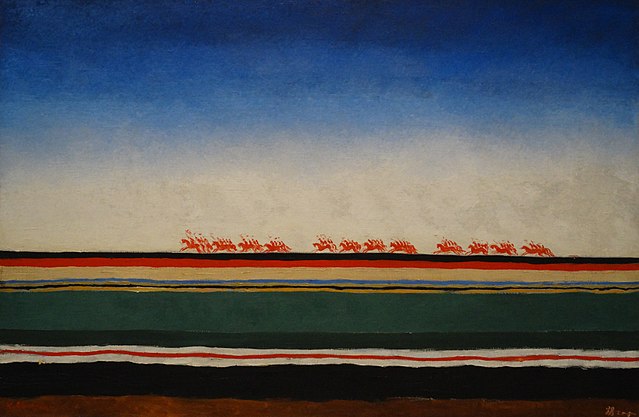
Red Cavalry. A stunning work by Kazimir Malevich, dated to some time betwen 1928 and 1932

Kaleidoscope of Chaos

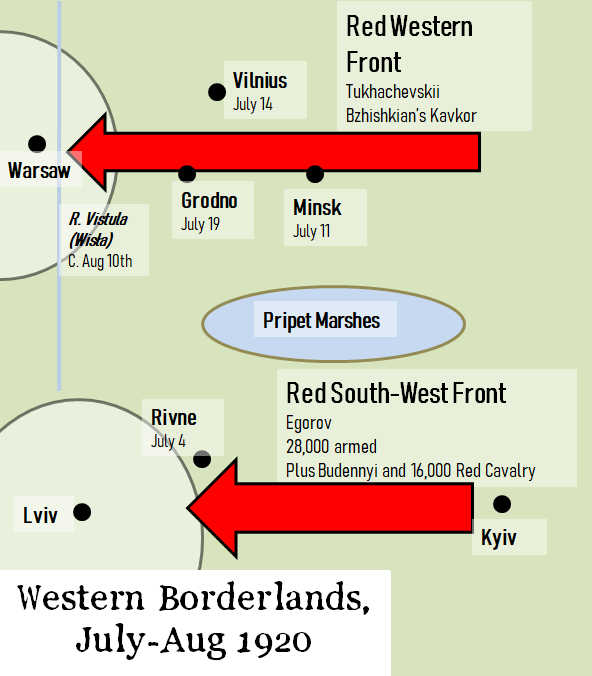
In the Northern Sector, the Red Army’s Western Front went on the offensive – with disappointing initial results in late May, followed by stunning successes in June and July. Here Third Cavalry Corps, known as Kavkor, played a key role. Kavkor was commanded by a Persian-Armenian socialist named Hayk Bzhishkian.

(This name entered the mangling process of Slavicisation then Latinisation and came out the other end, somehow, as ‘Gay,’ ‘Gaia Gai’, or worst of all ‘Guy D. Guy.’ I will call him Bzhishkian. And if I alienate any readers, I hope it’s because of my long-windedness, my blatant partisanship or my preoccupation with violence, and not because I made you pronounce an Armenian name in your head.)

Kavkor and Bzhishkian advanced on the right flank of the Western Front, where they found weak spots in the overstretched trench lines of the Poles, and broke through before reinforcements could arrive.

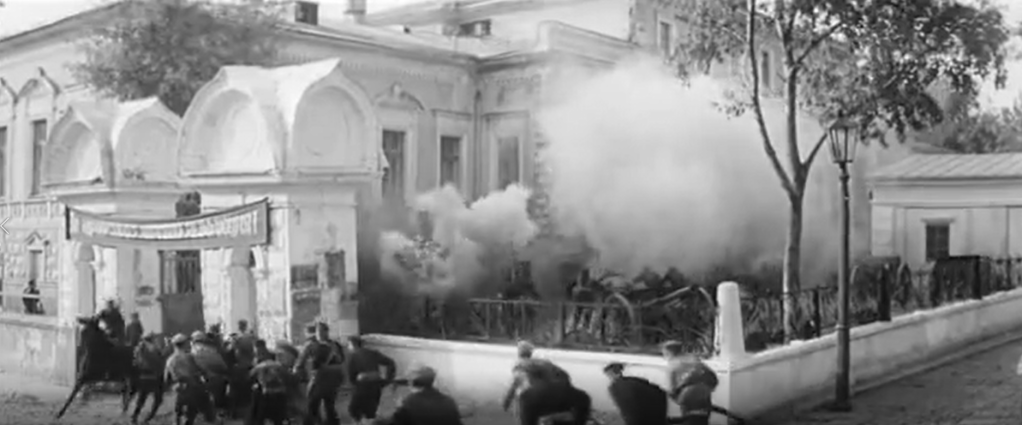
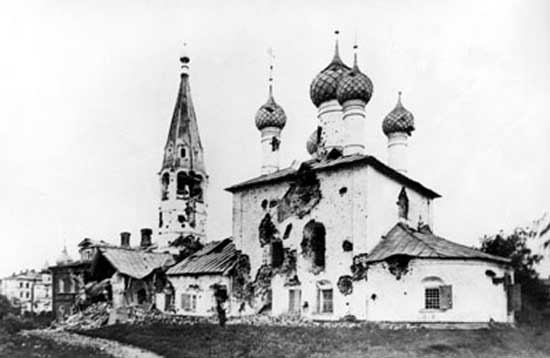
Barysaw, where the Polish side had insisted talks must take place, was soon in Soviet hands – what was left of it. The Polish army reduced it to ruins with chemical and incendiary shell-fire. [3]

Bzhishkian’s cavalry seized Vilnius. A 14-year-old scout went ahead and reported back key information. Then Kavkor attacked, aided by local communists, and the city soon fell. The Soviets handed Vilnius over to the Lithuanian government, a magnanimous gesture that ensured the Baltic States didn’t join in on Poland’s side. And at Brest-Litovsk, local Polish communists played a key role in aiding the Red Army. 

Piłsudski called the Polish retreat ‘a kaleidoscope of chaos.’ If you look at the Battle of Grodno, you can see what he meant. Here 500 Polish uhlans, an entire regiment, were swept away and drowned while trying to cross the Niemen River.

As at Petrograd and in the South, the Red Army at the Battle of Grodno had to face tanks kindly supplied by the Allies: some were mobile, some were able to fire but were stuck on their transport train.

A frightened soldier shouted to Bzhishkian: ‘Tanks, comrade corps commander! How can one sabre them when they’re made of steel?’

Another cavalryman added: ‘Bayonets are no use; in any case you can never get near them.’

But the cavalry surrounded the French Renault tanks and forced them to retreat, playing for time as the steel monsters were disabled one by one: by artillery, by collisions, by breakdowns and by lack of fuel. Only two escaped across the burning bridge over the Niemen.

‘An armoured tank is nothing to frighten a skilled cavalryman,’ wrote Bzhishkian of the experience in his 1930 memoirs. [4] He would not live to see World War Two and history’s final judgement on that question.

The Polish retreat was chaotic but, Davies points out, tenacious. The most spectacular battles were on horseback; Russian sabres were sometimes defeated by Polish lances. On one occasion a Polish cavalry division commander personally defeated and killed his Soviet counterpart during a battle which delayed the Red advance by two or three days.

Nonetheless the movement was all in one direction, and to the Polish soldier, in Piłsudski’s words, the Soviet advance was ‘like a heavy, monstrous, uncontainable cloud.’ [5]
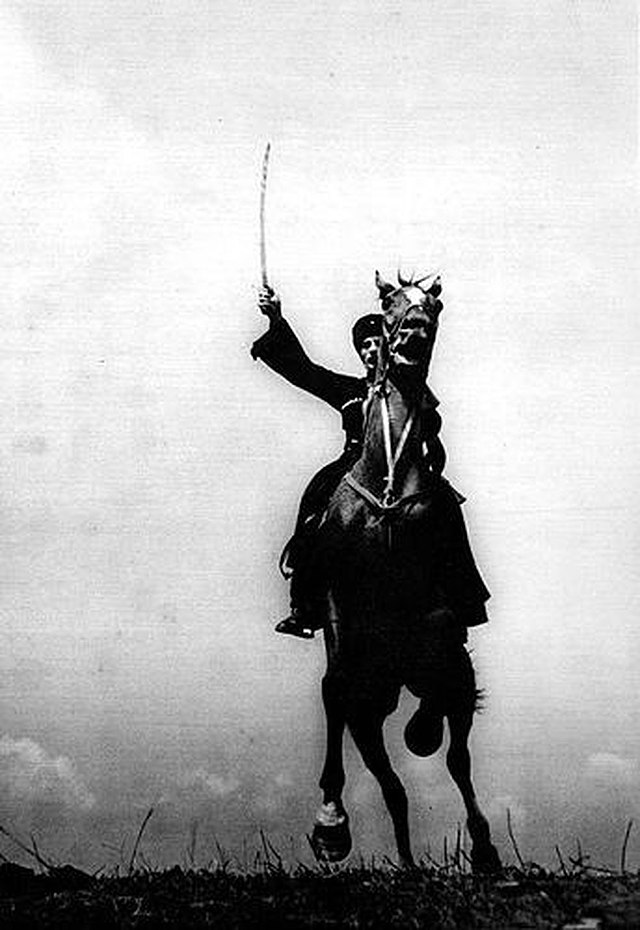
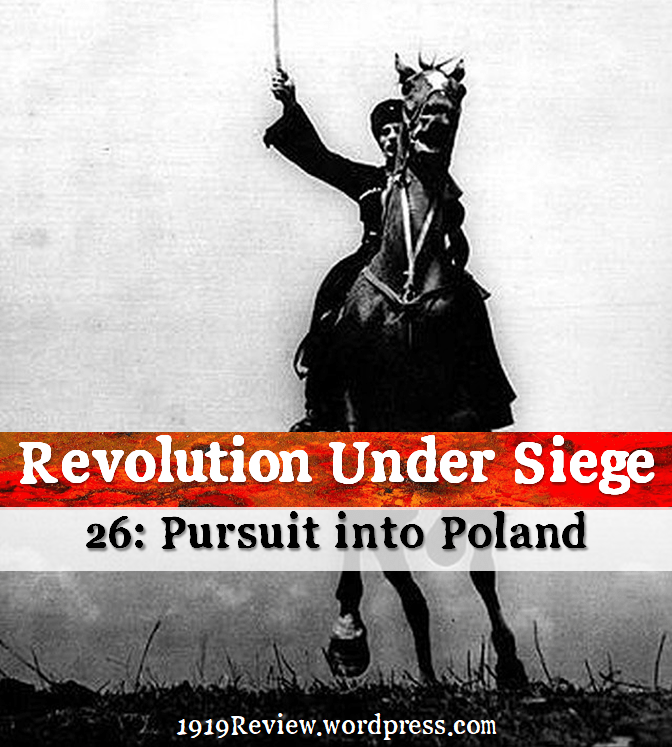
Today’s cover image. A Red Cavalry fighter, photographed in 1922

The Curzon Line

On July 11th the Allies tried to step in with a peace proposal. [6] Imagine a posh English politician gesturing at a map and saying, ‘Pans, comrades, why not draw the Soviet-Polish boundary just here.’ This here was known as the Curzon Line. It gave the Soviets a lot more territory than they had when the Poles first attacked, and also gave the Poles a lot more than what they stood to lose if Bzhishkian and Tukhachevskii kept advancing. 

The Allies proposed this border because they still believed the Soviet Union would collapse and be replaced by a conservative Russian Empire, and they were keen to establish relatively generous borders for their hypothetical future ally.
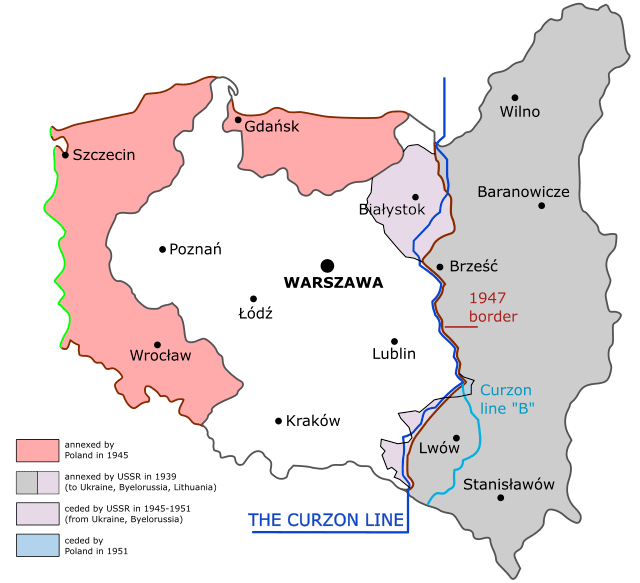
The Curzon Line, with information allowing you to compare its borders to modern-day Poland. In today’s terms, Wilno is Vilnius and Lwów is Lviv.

Whatever the motivations of the Allies, it suited the Polish government to quit before they got any further behind, and they agreed. [7]The offer was Moscow’s to take or leave – not humble beggars anymore. 

The Soviet leaders entered into a debate, dynamic as was the Bolshevik tradition but short and to the point. The question at issue was whether to launch a counter-invasion of Poland or, having repulsed the Polish invasion, to make peace. Unhelpfully, the British tacked on a provision that the Soviet Union should recognise Baron Wrangel and let him hold onto Crimea, which Moscow would never do.

On either July 16th or 17th, Trotsky on behalf of the Red Army command made the case for accepting the peace proposal – though he never accepted the point about Wrangel. Rykov, Radek, Stalin and others also opposed crossing the Curzon Line. Of Radek, Lenin later said, ‘I was very angry with him, and accused him of “defeatism”.’ [8] Lenin was in favour of advancing on Warsaw, and so were most of the Polish communists resident in Russia. 

The Debate

The broad arguments of the two sides – let’s call them the peace party and the war party – are laid out below in the form of a dialogue, in my words. Where I am directly quoting, I have indicated it using inverted commas.

War: 

We have been subjected to a full-scale invasion. We have driven back our enemy, but if we do not pursue him to his lair and finish him off, he will strike again. Just look at what happened in South Russia – how many times did we have to fight our way across the Don and the Kuban? And now Wrangel is trying to raise the Kuban in revolt yet again. Woe to he who does not carry matters to a finish! We have every right to invade and to destroy this regime of criminal military adventurers, who have brought so much suffering and destruction on the working people of Soviet Ukraine and Soviet Belarus. 
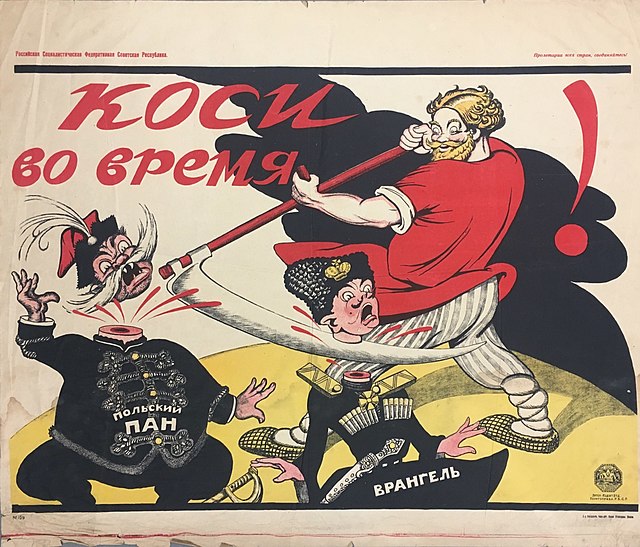
The Russian peasant uses his scythe to behead, Itchy-and-Scratchy-style, the Polish Pan (landlord) and Wrangel.

Peace:

From a military perspective, to invade Poland is insane. It is not like Denikin or Kolchak; it is not a question of fighting officers, undisciplined Cossacks and raw conscripts. We face 750,000 Polish troops. It is ‘a regular army, led by good technicians.’ Even if the Red Army takes Warsaw, its supply lines would be stretched too thin to occupy Poland for long. [9] The Soviet Union is crying out for peace. We won’t survive another winter of war. Hunger and disease will be rampant. The regime may even fall apart. 

War:

We do not assess these problems purely from a military perspective. It is not a question of conventional war or occupation. The mass of the Polish people, the working class and poor peasantry, will join us in our war against the Polish landlords and bourgeoisie. 

And we must also consider the perspective of world revolution. In Britain the ‘Hands off Russia!’ campaign is making headway; on 9th and 10th May, British dockers refused to load munitions onto a ship bound for White Poland. There is a developing revolutionary situation in Italy, with soviets in Turin and factory occupations; and in Germany we’ve seen the defeat of the Kapp Putsh by a workers’ general strike and even the organisation of a workers’ Red Army in the Ruhr. If we defeat Poland, we open the way to Germany, and may trigger revolutionary events there and elsewhere. Imagine if Budennyi or Bzhishkian arrived in Berlin just on time to prevent another massacre of communists like that of January 1919. 

We also want peace. But this latest onslaught by the Allies shows that they are hell-bent on our destruction. We cannot hope for peace except by breaking out of our isolation.

Peace: 

The Polish workers and poor peasants are unlikely to join us. By pursuing the Polish army into Poland, we will drive them into the arms of Piłsudski and his military-Bonapartist clique. It is still the honeymoon period of Polish independence. Resentment of all things Russian is still understandably strong. ‘This is the historical capital from which ‘Chief of State’ Piłsudski hopes to draw interest.’ [10]

We too see the perspective of world revolution. But if we are defeated, it will be a setback for the revolution everywhere.

War:

The key question, then, is the attitude of the Polish masses. The Polish revolution has always marched in step with the Russian; our anthem ‘Varshavianka’ refers to the Polish revolutionary tradition. In 1905 the Poles held out for longer against the Tsar than the workers of Moscow. In 1919 there were reports of Soviets in Cracow. [11] There were ‘village republics’ where the farmers took collective control of the land. On May Day this year, the demonstrations in Warsaw, Łódź and Czechostochowa were anti-war and anti-government – remarkably, a mere week after the beginning of the Polish invasion. A railway strike in Poznań, beginning the day after the invasion, turned into a week-long pitched battle between strikers and the authorities. [12]

The reports from the Belarussian Front have been most encouraging. Arrogant Polish landlords return on the coat-tails of their army and try to grab the land, and this angers the people and the rank-and-file soldiers. The Poles barely hold the frontline zone, which is traversed freely by refugees, deserters, bandits, petty traders, cocaine dealers and Polish Communist partisans. We have reports of mutinies and of harsh reprisals by Polish officers against the men – including executions. More recently, Polish soldiers returning from leave are condemning Piłsudski as the puppet of the landlords and questioning the aimlessness of the war. On July 26th an infantry unit rose from their trenches singing The Internationale and preparing to cross over to us; they were only prevented by their own side opening fire on them from behind. [13]

And we have many talented Polish communists here in Russia, who are enthusiastic to carry the revolution to their homeland; on May 3rd 90 Polish delegates met in Moscow. In Kharkov and Smolensk we have printed masses of material in the Polish language – 280,000 copies in Smolensk alone. We will guarantee the Polish worker, soldier and farmer an independent Soviet Poland. We even have a Polish brigade, 8,000-strong, on our Western Front, to form the nucleus of a Polish Red Army.
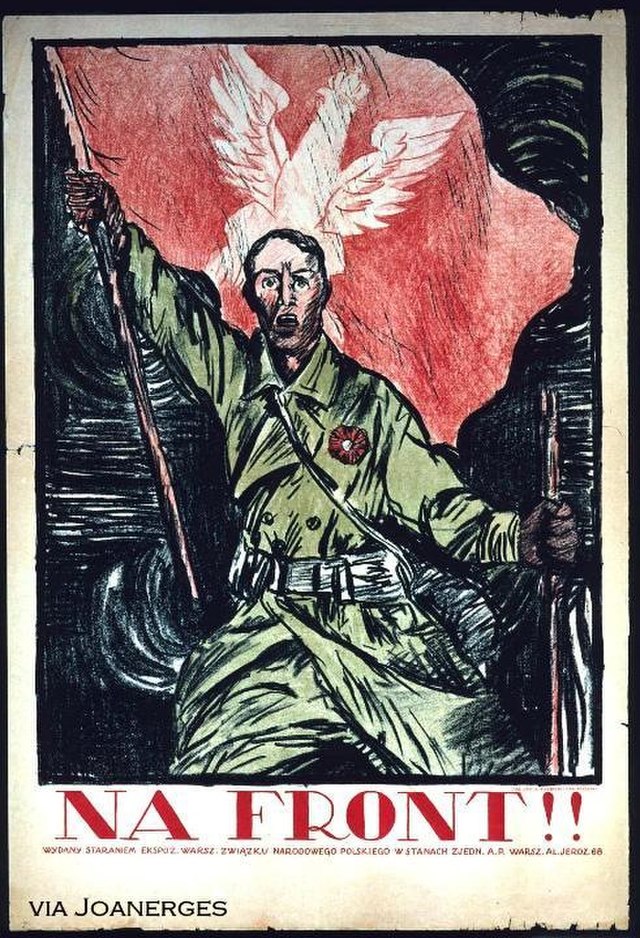
A Polish poster from the 1920 war. The struggle for national independence – ‘the historical capital from which […] Piłsudski hopes to draw interest.’

Peace: 

Taken as a whole, the indications are not nearly so favourable. The Polish Socialist Party received only 9% of the vote in January 1919. The Polish Communist Workers’ Party is illegal and has very little support in Poland.The Cracow Soviet was put down. The ‘village republics’ were suppressed with draconian severity. The Piłsudski government is Bonapartist in character; it does not simply represent the landlords or the bourgeoisie, but tries to play a balancing act. It has embarked on land reform of its own accord, which saps the agitational strength of our land programme. The Polish landlords who are trying to claw back parts of Belarus and Ukraine are supported by the Polish officers, but opposed by government agencies [14]. 

The Polish soldier on the Belarussian Front is demoralised, it is true. But the Polish soldier defending the approaches to Warsaw may prove to be a more formidable opponent. 

To invade would not hasten revolution – it would delay it. We cannot tolerate Wrangel in Crimea for a moment longer than is necessary – on that we agree. Let us then focus as much of our strength as possible on Wrangel. But let’s talk to the Allies, and agree on the Curzon Line as our border with Poland. 

The Advance to Warsaw

Intra-Bolshevik debates were often conflicts between audacity and caution. Today audacity won out. All agreed that the Soviet Union could not build socialism in isolation from the rest of the world. The key strategic imperative was to break out. Up to this point it was assumed this would happen through an indigenous revolution in another country, but this war represented another kind of opportunity. The war party won the vote, and the Red Army was ordered to sweep on into Poland.
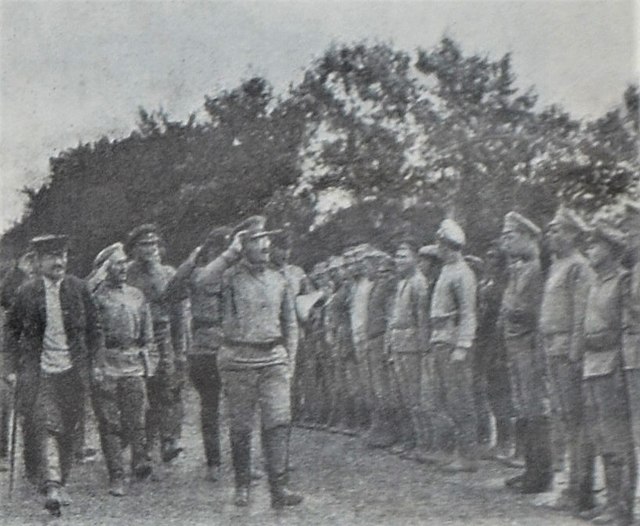
Kalinin and Trotsky review the troops. Trotsky argued against carrying the war into Poland, but according to Davies, once the vote had been taken, few took the war more seriously than Trotsky.

From July 19th to August 7th the Communist International held its Second Congress, a bigger and more impressive affair than the First Congress back in March 1919. Among the 220 delegates was Alfred Rosmer who has given us an often-quoted description of a large map of Eastern Europe that was on display outside Lenin’s office. Visitors watched as little flags were moved across it to mark the positions of the armies; in July, all the red flags were moving west. ‘The advance of the Red Army was stunning; it was developing at a pace which nonplussed professional soldiers ,as only anarmy born of revolutionary enthusiasm is able to do.’ Tukhachevksii’s Western Front took Minsk on July 11th, Vilnius on July 14th, Grodno on July 19th, crossed the Bug River on August 1st and by August 10th was closing in on Warsaw. [15] Some of Hyak Bzhishkian’s Kavkor had in fact run on ahead, west of Warsaw.
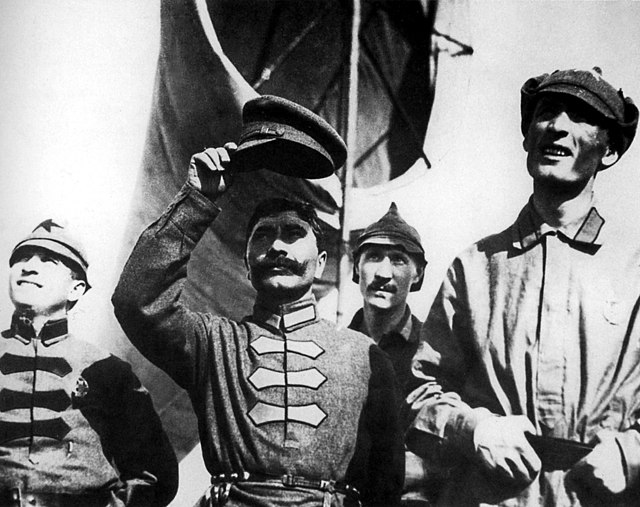
Semyon Budennyi, undated. While Tukhachevksii advanced on Warsaw, Budennyi spearheaded the advance on Lviv in the southern sector.

In the Southern Sector, the Red Army captured Rivne and Kamianets-Podilsky on July 4th. Budonnyi is reported to have said that if he had as many riders as the old Tsarist army – that is, 300,000 – ‘I would plough up the whole of Poland, and we would be clattering through the squares of Paris before the summer is out.’ For better or for worse, he had only 16,000, which along with the Red Army’s South-Western Front, aimed to capture the city of Lviv.

What struck Rosmer in a conversation with Lenin, however, was how the Soviet leader was just as interested in what he had to say about developments in the French Socialist Party as he was in Poland. For Lenin, then and always, it was all one struggle. [16]

In August 1920, the crux of that struggle lay not in the Ruhr Valley or the factories of Turin but on the Vistula River. The humble beggars had come to Piłsudski’s doorstep.

References

  • [1]Davies, p 74
  • [2] Davies, 142
  • [3] Trotsky, How the Revolution Armed, Volume 3,‘Postal Telegram No 1886-B’
  • [4] Davies, p 148
  • [5] Davies, p 148
  • [6] Smele, 156
  • [7] Mawdsley, 349
  • [8] Zetkin, Clara. Reminiscences of Lenin, January 1924. International Publishers, 1934. ‘The Polish War.’ https://www.marxists.org/archive/zetkin/1924/reminiscences-of-lenin.htm#h04
  • [9] Numbers from Smele, 165; ‘good technicians,’ Mawdsley, 255
  • [10] Trotsky, How the Revolution Armed, Volume 3,‘The war with Poland – reportMay 5th’
  • [11] Read, 111
  • [12] Davies, 113
  • [13] Davies, 78-91, 151
  • [14] Davies, 82-3
  • [15] Smele, p 156
  • [16] Rosmer, Alfred. Lenin’s Moscow, 1953, Bookmarks, 1971. P 52-53. Budennyi quote from Davies, 120
20: The Battle of Petrograd

At the climax of the Civil War, a White Army made a bold attack on Petrograd, the city whose working population and garrison had made the October Revolution almost exactly two years earlier.

The city was no longer called Saint Petersburg, and not yet Leningrad – as if to remind us that the Civil War-era Bolshevik regime was something separate not only from Tsarism but from Stalinism. But even within that era, Petrograd in 1917 and in 1919 were two different cities. Petrograd in 1917 was inhabited by over two million people; the city of 1919 had a population of 600-700,000. One was an industrial giant, the other had a skyline of idle chimneys rising into cold smokeless air. Petrograd in 1917 was already a city of bread lines and food riots; by 1919, cut off from the places that had for hundreds of years supplied it with food and fuel, it was barely surviving on public canteens, the spoils of requisitioning squads, rations, and the black market. It was a starved, brutalized and cynical city.

Two years after the Revolution, did the popular masses of Petrograd still have the ability, or even the desire, to fight for it? The answer to that question will represent a judgement on the Soviet state and the Red Army.

Iudenich

If you’ve read John Reed’s book Ten Days that Shook the World, you will know that a force of Cossacks tried to seize Petrograd in the days following the October Revolution. This was a force of just 700. The attacker in 1919 was a White Army of tens of thousands, led by the war hero General Iudenich.

Right on the doorstep of Petrograd lay the Baltic States, which, first under German occupation and then under British clientship, had served as an incubator for White armies. One White army which mustered in Estonia became known as the North-West Army, an aggregation of officers and reactionaries who swore allegiance to the Tsar. Admiral Kolchak, reigning as Supreme Leader of the White armies in distant Omsk, appointed General Iudenich to command this Baltic army in mid-1919.

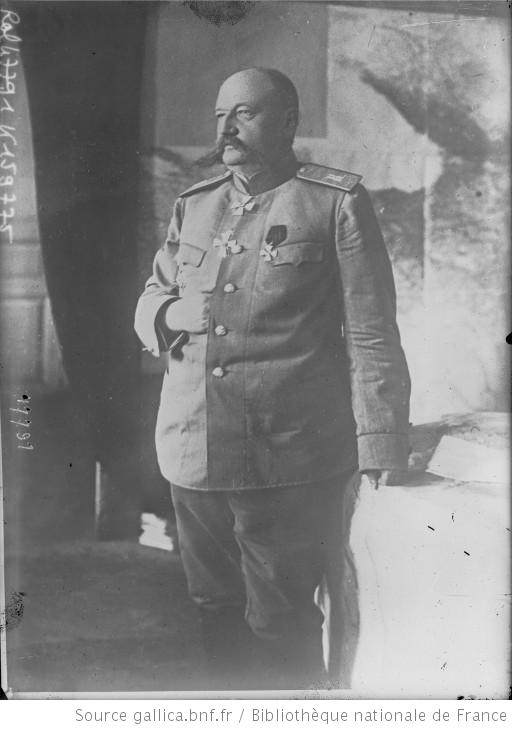
Iudenich had conquered a supposedly impregnable mountain fortress from the Turks in the First World War. He had served in the anti-Soviet underground in Petrograd; one wonders how this was feasible given his fame and distinctive appearance (he was a large man with long tusk-like moustaches). He had fled Petrograd in late 1918. Then for the first few months of his command he lived in a hotel in Helsinki with what we can charitably call a government-in-exile – the oil baron Lazonov held three different portfolios, and the ministers were more rivals than colleagues.[i]

Soon after he assumed command, in May 1919, his North-West Army made an initial assault on Soviet territory. There was a spasm of fear in Petrograd. But Iudenich contented himself, for now, with conquering Ingermanland, a sliver of the Russian-Estonian border area.

We learned very little about the Russian Civil War in school, but we did memorise the names of the three White generals – Kolchak, Denikin and Iudenich. The army under Iudenich was not in the same league as the other two – 20,000 fighters to their (roughly) 100,000 each. This was because he had no Cossacks in his neighbourhood and no large population from which to recruit. On the other hand, he had some distinct advantages. The Estonian border is only 130 kilometres from St Petersburg (Dublin to Enniskillen, or London to Coventry) – there were no vast Russian expanses between him and his objective. Of all the White armies his had the shortest lines of supply and communication with the Allies; British naval forces controlled the Baltic and could slip vessels right into Kronstadt harbour. Lastly, if he played his cards right, Iudenich might be able to bring in two neighbouring states on his side.

How to Lose Finns and Alienate Estonians

The Whites and the Finnish and Estonian governments were common enemies of the Soviet regime. Between them, Finland and Estonia could send enough soldiers into Russia to boost Iudenich’s numbers up from 20,000 to 100,000. But the national question was a massive weak spot for the White Russians. They often enraged their potential allies. In Autumn 1919 they would appoint a ‘Governor’ of the Estonian capital city – a city over which they had no control anyway. Iudenich insisted: ‘There is no Estonia. It is a piece of Russian soil, a Russian province. The Estonian government is a gang of criminals who have seized power, and I will enter into no conversations with it.’[ii]

The British mikitary tried to get them to make friends. Brigadier-General Marsh threatened Iudenich: ‘We will throw you aside. We have another commander-in-chief all ready.’

On another occasion Marsh, in person, issued an ultimatum to a gathering of White Russians. He declared that they had 40 minutes to form a democratic government which recognized Finland.[iii] Such measures usually don’t work for parents or teachers (‘I’m going to count to three! One…’) and they didn’t work for a Brigadier-General either. But they show the role which Britain took on itself.

British officers were match-makers, kingmakers, fixers, naval support, and a source of massive supplies of arms and uniforms. They operated a veritable taxi service across the Baltic for various anti-communists to meet up and try to overcome their differences. In spite of everything, Estonia ended up joining the attack on Petrograd – a degree of cooperation which surely would have been impossible without patient British intervention.

Things were no better as regards Finland. In summer 1919 the Finnish government offered the Whites an alliance in exchange for some small territory in Karelia. Iudenich’s superior Kolchak reacted with the words: ‘Fantastic. One would suppose Finland had conquered Russia.’[iv]

In late 1918 and early 1919 the Soviet government supported Estonian and Lithuanian socialists in a series of wars against the British-backed nationalist regimes. But by summer, the Reds had recognised that the potential for a Soviet Baltic was lost for the near future, and they were willing to make a deal with the governments of the Baltic States. For example, on August 8th they offered to recognize Estonia in exchange for the town of Pskov.

Operation White Sword

In summer 1919, General Denikin’s forces conquered southern Russia and swathes of Ukraine, then in the autumn surged north toward Moscow. These victories told Iudenich it was time to make his long-awaited move on Petrograd.[v]

From July British aid began to pour into the hands of Iudenich. And on October 12th, North-West Army began Operation White Sword, a two-pronged advance toward Petrograd. Meanwhile the Estonian Army attacked along the coast and laid siege to the fortress of Krasnaya Gorka. There were 50,000 soldiers in the White Army, with 700 cavalry, four armoured trains, six planes and six tanks.

White Armies always exhibit interesting disproportions, and this one was no exception: one in ten of the 18,500 combat troops were officers, and there were nearly as many generals (53) as there were artillery pieces (57).[vi]

Against this, the Reds were in disarray. Their Baltic Fleet was bottled up in Kronstadt Harbour by the British fleet. The approaches to Petrograd were held by the Red 7th Army. Its 40,000 personnel were not all armed, and had been mostly idle for months. The defeat in Estonia early in the year; the transfer of the best elements to other fronts; and the Liundqvist Affair, in which one of the top officers turned out to be a White spy, all sapped morale. With the onset of the offensive, despair and panic broke out amid the frontline soldiers and soon took hold in Petrograd. 7th Army’s soldiers ran away, dropping their weapons. An entire regiment went over to the Whites.

So great were the early failures of Red Seventh Army that leaders on both sides almost took for granted the fall of Petrograd. The newspapers in the west spent the week reporting that it was imminent. They were not delusionary: in Moscow on October 15th Lenin spoke in favour of surrendering the city. It would be a temporary concession, he argued: the city was home to countless thousands of communists, each one a potential insurgent; let the Whites rest upon it as on a bed of nails.

In early October the pressure on the Southern Front was intense. Whether to defend Petrograd or to let it fall was a decision which, in the words of the Red commander Kamenev, ‘burned in my brain.’ If reinforcements were sent to Petrograd, would there be enough to defend Moscow?

But Trotsky and Stalin both protested against the idea of surrender. Lenin relented, and Stalin took over command of the Southern Front while Trotsky and his armoured train took off for Petrograd.

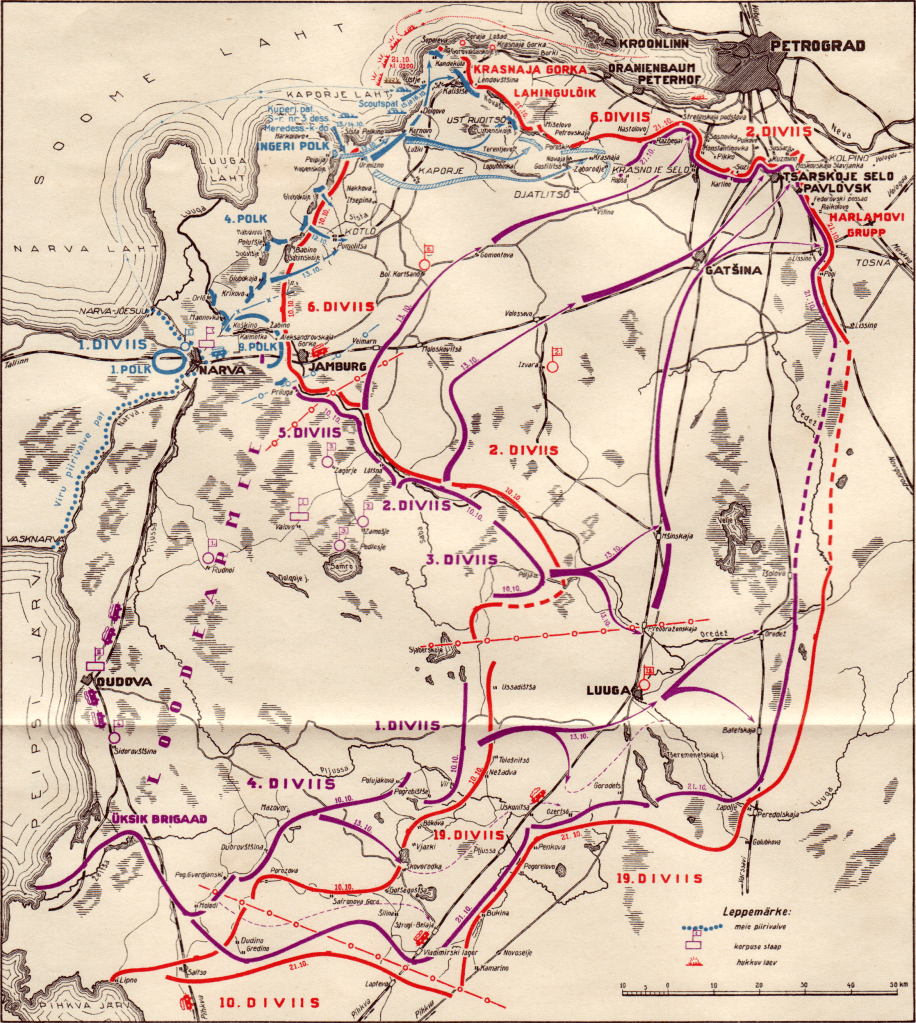
An incredibly detailed map of the whole operation in Estonian. Estonian forces are shown in blue, Whites in purple.

Trotsky’s Armoured Train

The rail line from Moscow to Petrograd was in danger of being cut off by the inland prong of Iudenich’s advance. So for Trotsky and his staff it must have been an anxious journey.

This was the same train on which the war commissar had arrived at Kazan in August 1918. In the intervening year it had been encased in armour and given three back-up locomotives. Wherever it went, even when it passed a small village, flyers and newspapers rolled off its printing press and Trotsky himself would give a speech. ‘Workers and peasants who listened to him were frequently entranced.’ By the end of 1918 the train had over 300 personnel – it was ‘a full military-political organization.’[vii] It initiated changes at the front, tied the front to the rear and delivered the ‘ideological cement’ which held together the Red Army.[viii]

By war’s end it had visited every front and covered 120,000 kilometres on 36 trips, had been in battle thirteen times and suffered 30 casualties. After the war, the train itself was awarded the Order of the Red Banner [ix] – a whimsical notion, like something out of Thomas the Tank Engine.

The Stone Labyrinth

The arrival of Trotsky in Petrograd had an electrifying effect, by all accounts (including his own). Trotsky and his staff shook up the demoralised local officials by force of argument and, where deemed necessary, by sacking and replacing people. The mood changed in the city overnight as the population saw stern measures being taken first of all at the top, while food rations were doubled.

A plan was drawn up to turn the city into a fortress. Trotsky said that it was better if the Whites were defeated outside the city because ‘Street battles do, of course, entail the risk of accidental victims and the destruction of cultural treasures.’[x] But if that should fail, he was prepared for urban warfare in a plan that anticipated Stalingrad. The army of Iudenich would be lost and ground down in the ‘stone labyrinth’ [xi] of hostile streets.  

Trotsky was able to mobilise the population to dig trenches, to barricade the streets, and to search, house by house, for White agents. His memoir captures the mood:

The workers of Petrograd looked badly then; their faces were gray from under nourishment; their clothes were in tatters; their shoes, sometimes not even mates, were gaping with holes.

“We will not give up Petrograd, comrades!”

“No.” The eyes of the women burned with especial fervor. Mothers, wives, daughters, were loath to abandon their dingy but warm nests. “No, we won’t give it up,” the high-pitched voices of the women cried in answer, and they grasped their spades like rifles. Not a few of them actually armed themselves with rifles or took their places at the machine-guns.Detachments of men and women, with trenching-tools on their shoulders, filed out of the mills and factories. The workers of Petrograd looked badly then; their faces were gray from under nourishment; their clothes were in tatters; their shoes, sometimes not even mates, were gaping with holes.

“We will not give up Petrograd, comrades!”

“No.” The eyes of the women burned with especial fervor. Mothers, wives, daughters, were loath to abandon their dingy but warm nests. “No, we won’t give it up,” the high-pitched voices of the women cried in answer, and they grasped their spades like rifles. Not a few of them actually armed themselves with rifles or took their places at the machine-guns.

The Bashkirs

Alongside these traditional supporters, Petrograd hosted new and improbable allies. The Bashkir cavalry, the Muslim nomads who had come over to the Reds back in February, happened to be on a visit to the city. We find this description in a novel written by an eyewitness:

They seemed to be happy riding through a town where the horses’ shoes never struck the soil, where all the houses were made of stone… but which was unfortunately lacking in horse troughs. And life must be sad there since there are neither beehives, nor flocks, nor horizons of plains and mountains… their sabres were bedecked with red ribbons. They punctuated their guttural singing with whistle blasts … Kirim always wore a green skullcap embroidered in gold with Arabic letters, even under his huge sheepskin hat. This man was learned in the Koran, Tibetan medicine, and the witchcraft of shamans … He also knew passages of the Communist Manifesto by heart.[xii]

According to western newspapers, pecking at crumbs of rumours in Helsinki, the Bashkirs brought with them a new strain of typhus. Not improbable; the country was riddled with it. Nor is it improbable that this was a racist myth.

A group of commanders of a Bashkir division in 1919

The Bashkirs caused a stir in Helsinki for other reasons too. Finland had 25,000 troops facing Petrograd, threatening the prospect of a second front. It must have been a tempting prospect for the White Finns: if they helped take Petrograd they could hold onto some of the territory they would grab in the process. But the White Russians alienated them, and the war hawk Mannerheim was out of power, and there was an anti-war mood among the public. Trotsky had, since September 1st, been making the most of these factors by alternating generous peace proposals with dire threats. In response to any Finnish invasion, he said, the Soviets would unleash a horde of Bashkirs to ‘exterminate’ the bourgeoisie of Finland.[xiii]

The First Soviet Tanks

The Whites made rapid progress toward the city. Early in the campaign the Reds were outnumbered. But throughout the campaign, even later when the scales shifted, the White Guards punched above their weight. They would sneak around Red positions, open fire at them from multiple directions, and set off a stampede of red-star caps and bogatyrkas in the direction of Petrograd.

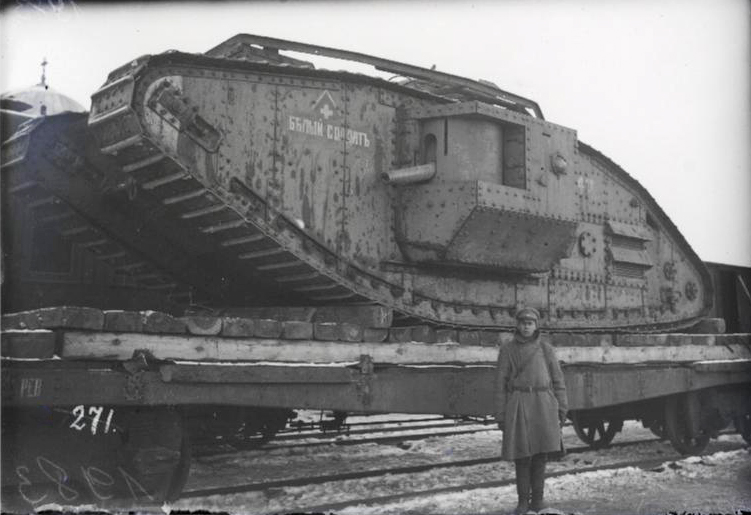
As at Tsaritsyn, the Whites had only six British tanks. In such small numbers and in this mode of warfare they were of little practical use. But the sight of the crushing treads of these bullet-proof killing machines, or even the rumour of them, terrified the Red soldiers.

In response, the steelworks of Petrograd began to produce the first Soviet tanks. These were not marvels of engineering. Different accounts describe them as almost static, or as tactically useless. But they proved to be a psychological antidote to a psychological threat. The sight of Red ‘tanks’ rolling out of the Putilov works or taking their places in the defensive lines was a source of great encouragement to the Red fighters, who made cheerful puns playing the word ‘Tanka’ and the name ‘Tanya’ against each other.

Seventh Army was heartened by all these changes. ‘The rank-and-file of the Red army got some heartier food, changed their linen and boots, listened to a speech or two, pulled themselves together, and became quite different men,’ writes Trotsky. The Mensheviks put aside their differences with the Bolsheviks and rallied to the defence of the city.

Meanwhile ‘field tribunals did their gruesome work.’[xiv] White organizations – the National Centre and the Union for the Regeneration of Russia – operated underground in the city and the Cheka worked to root them out. Notices would appear bearing lists of ‘COUNTER-REVOLUTIONARIES, SPIES, AND CRIMINALS SHOT.’[xv] The judgments of the Cheka were quick and ruthless.

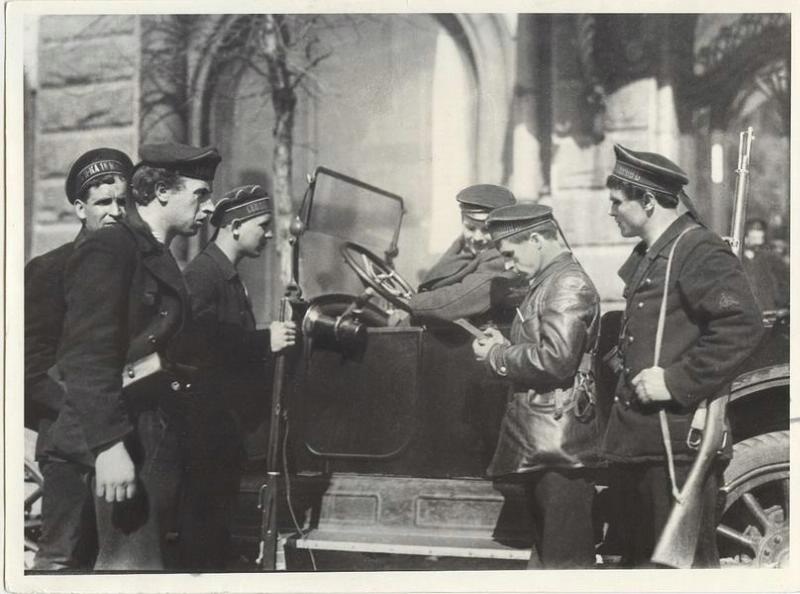
Sailors check passes in Petrograd, 1919

Could Iudenich take Petrograd?

The historian Mawdsley dismisses the threat posed by Iudenich on the basis that his army was relatively small. Trotsky agreed. In his view, even if the Whites took the city, they would not be able to hold it or to build on their success.

There  are grounds to disagree with both Mawdsley and Trotsky on this. In this war, numbers counted for less than morale. In the Caucasus, 20,000 Whites had defeated 150,000 Reds. If panic had been allowed to continue in Petrograd, even a large army would have been unable to hold it.

If Petrograd fell it would later be recaptured, all things being equal. But how could all things possibly stay equal if Petrograd fell? We must consider the moral effect on Red and White soldiers, and beyond Russia. Among the Allies it would give a tremendous boost to the hawks like Churchill. The Finnish government might open a second front, and the Estonian government might commit fully to the war. A White Petrograd would be as open to British shipping as Tallinn or Helsinki. Military and economic aid could pour in just as it had poured into Tallinn.

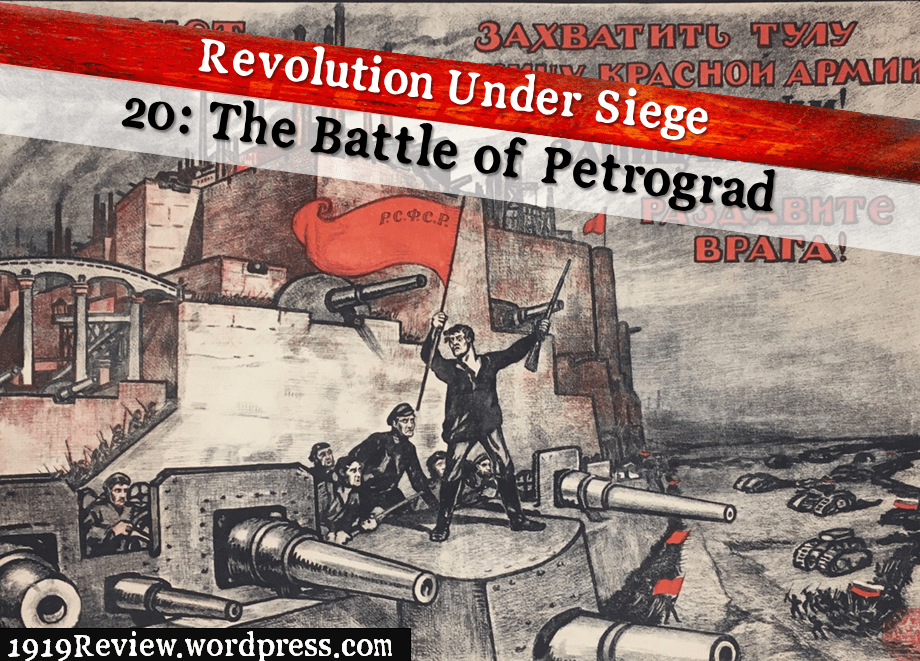
Today’s cover image: A poster from the time shows the Soviet Union as a gigantic industrial fortress under attack. This image is a fantasy, like something from Mortal Engines. It is a kind of metaphor, not an actual representation of the defences which Petrograd or Moscow enjoyed!

But the prospect of a White victory was made dimmer by discord behind the lines. In Latvia, a rival White Russian general thought this would be a great moment to try and conquer Riga, the Latvian capital. Not only did this distract the British and the Estonians; the resulting in-fighting, from October 8th, guaranteed that there would be no attack on Russia from the Latvian border, so the entire 15th Red Army, which had been stationed there, now began a slow advance north to join the battle for Petrograd.

The White commanders often let their personal pride get in the way of success. The Latvian diversion is one example; another came when a division commander ignored orders to cut the Moscow-Petrograd railway line because he wanted to be the first into Petrograd.[xvi] This allowed reinforcements from Moscow to bolster the defence.

The Commissar for War Saddles Up

The White advance continued in spite of these challenges. Away in England, Churchill was confident of success, promising a massive consignment of equipment, enough for Iudenich to equip a whole new army, and predicting that there would be ‘lamentable reprisals’ – White Terror – when the city fell.[xvii]

The Reds did not have a cordon or a trench line in front of the city. They had concentrated striking groups which, in theory, were supposed to pounce on less numerous White detachments. But the Reds were on edge. Gatchina was lost on October 17th when some Red cadets came under impressive volleys of fire, took fright, and fled. It turned out to be the work of a single enemy company hiding in the town’s park.

Just the next day Trotsky happened to be in the division headquarters at Aleksandrovsk when a mob of Red soldiers came hurrying past. Winded and panic-stricken men halted to report that an enemy force had appeared on their flank, so they had briefly opened fire then retreated ten kilometres.

The officers at division headquarters consulted their maps and informed the fleeing soldiers that the ‘enemy force’ was actually a Red column. The commander of the fleeing soldiers must have flushed with shame. His battalion had shot at their own friends then fled in terror, leaving a gap which the Whites, at this moment, would be exploiting.

Trotsky took hold of the nearest horse and mounted it in the midst of the hundreds of frightened soldiers. They were at first confused by the spectacle of the war commissar riding around issuing orders to them directly, face to face. They watched him chase down, one by one, all those soldiers who were still retreating, and with stern commands prevail on them to turn around.

A voice was yelling, ‘Courage, boys, Comrade Trotsky is leading you.’

It was Trotsky’s orderly Kozlov, an old soldier from a village in Moscow province. He was running around after Trotsky, waving a revolver in the air and repeating his commands. To a man, the battalion advanced with the war commissar mounted in their midst. After two kilometres, writes Trotsky, ‘the bullets began their sweetish, nauseating whistling, and the first wounded began to drop.’ They did not slacken their pace, but ran quick enough to break a sweat in the late October chill.

Combat was joined. The regimental commander who had taken fright at a friendly unit was, it appears, eager to redeem himself. He went fearlessly into the line of fire and was wounded in both legs. The battalion advanced the remaining eight kilometres under fire until the position it had fled from was ‘thus retaken by some brawny lads from Kaluga, where they drawl their a’s,’ and Trotsky returned to HQ on a lorry, which picked up the wounded as it went.

Serge imagines the War Commissar as, seated in the truck, he ‘wiped the sweat off his brow. Ouf! He had almost lost his pince-nez.’[xviii]

But in spite of feats like this, the frontlines closed in on the outskirts of the city. The Whites could see in the distance the sunlight on the golden dome of St Isaac’s cathedral in the middle of Petrograd, and they boasted that they would be marching down the Nevsky Prospekt in the coming days.

But as the fighting came closer and closer to Petrograd, the resistance grew tougher. At the Pulkovo Heights south of town the Red frontline at last began to hold. The British had sunk the warship Sevastopol in a raid on Kronstadt Harbour months before; somehow the Reds raised it up and restored its guns to working order. Along with all the naval artillery concentrated in Kronstadt, the guns of the Sevastopol pointed inland and let loose terrible volleys on the Whites.

Cadets from the training schools were rushed to the frontlines. The coastal fort of Krasnaya Gorka had defeated the Estonian advance along the shore, so 11,000 Kronstadt sailors were freed up to join the defense of Petrograd.[xix]

Estonian soldiers try to take Krasnaya Gorka in October 1919

Pulkovo Heights

The Whites were given an order to capture the Pulkovo Heights, a rise just south of the city, on the night of October 20th-21st. But at 11pm the Reds went on the attack, jumping the gun. High-explosive shells manufactured in Britain or France exploded over the heads of Bashkir cavalry, of young peasant conscripts in khaki, of sailors in black. The sailors and worker-volunteers ‘fought like lions.’ They charged at tanks with bayonets and revolvers.[xx] The attackers took heart when the makeshift Red tanks joined the battle: ‘The Red troops greeted with delight the appearance of the first armoured caterpillar.’[xxi]

The Whites were at the end of their supply lines and, in the words of Isaac Deutscher, the power of the Red Army was like a compressed spring ready for the recoil.[xxii] The Reds no longer had any space behind them into which to retreat. Supplies and communications, for once, ran smoothly thanks to the proximity of Petrograd and its supplies, infrastructure and volunteers. But the Whites were determined and brave, and Iudenich brought up reserves to bolster them. On October 22nd the Whites held firm in a day of terrible fighting.

The Reds now had a massive superiority in numbers. Morale was transformed from a few days before: units tried to out-perform one another. The sailors were ‘splendid’ because they knew the Whites would take no prisoners from among them.[xxiii] Trotsky’s train crew was in the thick of the fighting in these days: three were killed, six wounded, and three shell-shocked.   

On October 23rd the Reds recaptured the key suburb of Tsarskoe Selo. Meanwhile 15th Army – the army which had been freed from the Latvian border thanks to White in-fighting – was advancing slowly into the deep rear of the Whites. White soldiers began surrendering by the dozen.

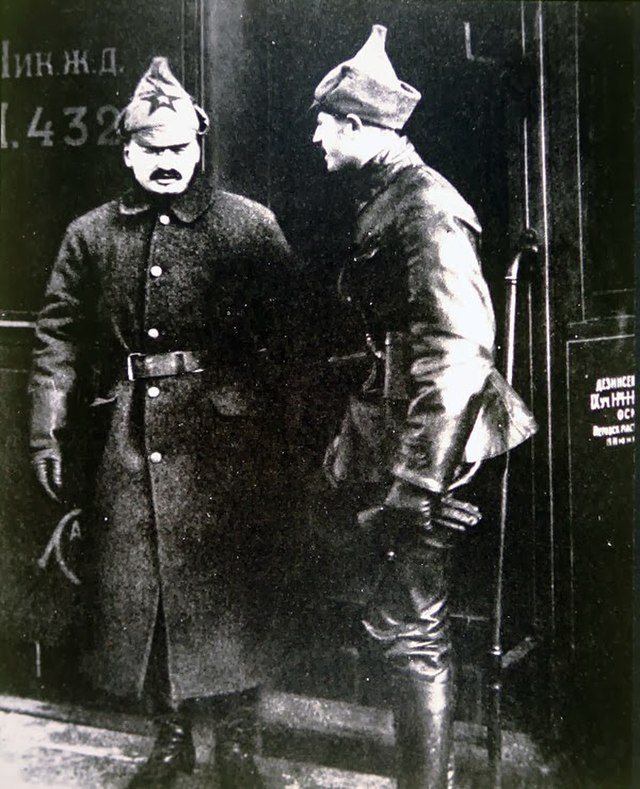
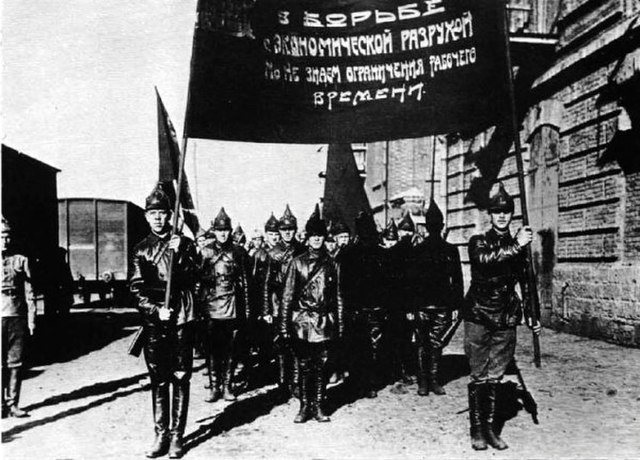
The guard of Trotsky’s train, whose distinctive leather uniform is discernible here

Red Initiative

The Whites began a fighting retreat, and the Red Army pursued.

Trotsky’s orders contained humanistic messages. Enemies who surrendered must be spared – ‘woe to the unworthy soldier’ who hurts a prisoner. ‘Only a tiny minority’ of the Whites, both officers and enlisted soldiers, are determined enemies, argued an order of October 24th. On the same day, an order urged ‘Red warriors’ to draw a distinction between the British government and the British working people.[xxiv] A later order (No 164) says that peasants conscripted by the enemy will be paid, given horses and allowed to keep their uniforms if only they hand over their rifles.

Draconian tones reassert themselves in italics in an order of October 30th (No 163), a sign that the White retreat was a controlled one and that the fighting was still formidable: anyone who tries to start a panic, calling on our men to throw down their arms and go over to the Whites, is to be killed on the spot.’

Iudenich fought hard until November 3rd, then began a general retreat toward the Estonian border. Trotsky was for sending the Red Army after them into Estonia. But Chicherin and Lenin argued against this, and prevailed.

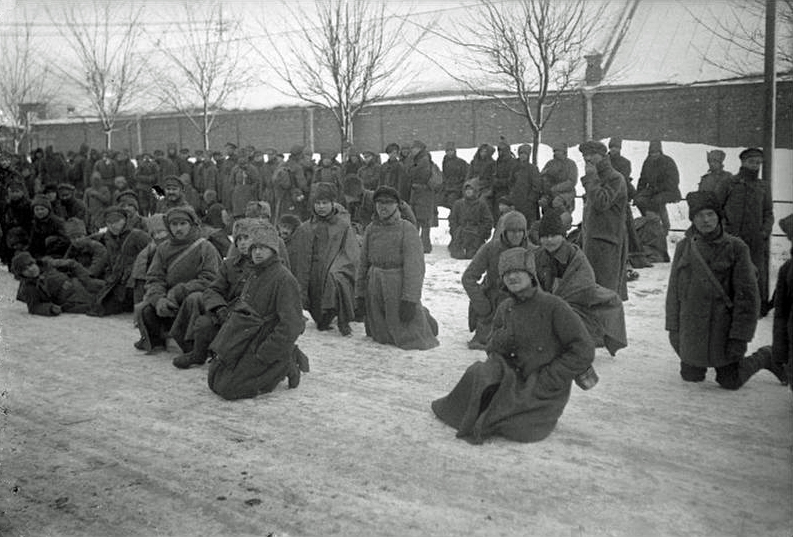
When the forces of Iudenich reached the border, the Estonians first denied them entry then let them in, disarming and imprisoning them. The White army was already afflicted by typhus, and in prison conditions it only got worse. The Estonian government fed them only on lampreys and forced them to cut down trees through the Baltic winter. It is estimated that 10,000 perished  [xxv] – if so, the Estonians killed more of them than the Reds.

Before the end of the year, Estonia and Soviet Russia had signed an armistice, and a peace treaty soon followed. Over the next year the Soviet Union sealed peace treaties with Latvia and Lithuania as well.

The Battle of Petrograd was a judgment on two years of Soviet power. Looking at the depressed and almost lifeless city in autumn 1919, you’d be forgiven for thinking that there was nothing left of the spirit of revolution. But thousands of the city’s workers fought or participated in the battle. Early on, the Red Army was prone to humiliating attacks of panic – but strong leadership, tight supply lines and an urgent threat brought out its strengths in the end, and once the initiative passed to their side these strengths proved overwhelming.

In this post we have seen the working class of the young Soviet Republic and its army tested on the relatively small scale of one city. During those weeks, Central Russia went through a trial that was bigger in scale to the point where it was qualitatively different. That will be the subject of the next episode – the final chapter of this second series of Revolution Under Siege and the decisive chapter of the whole story.

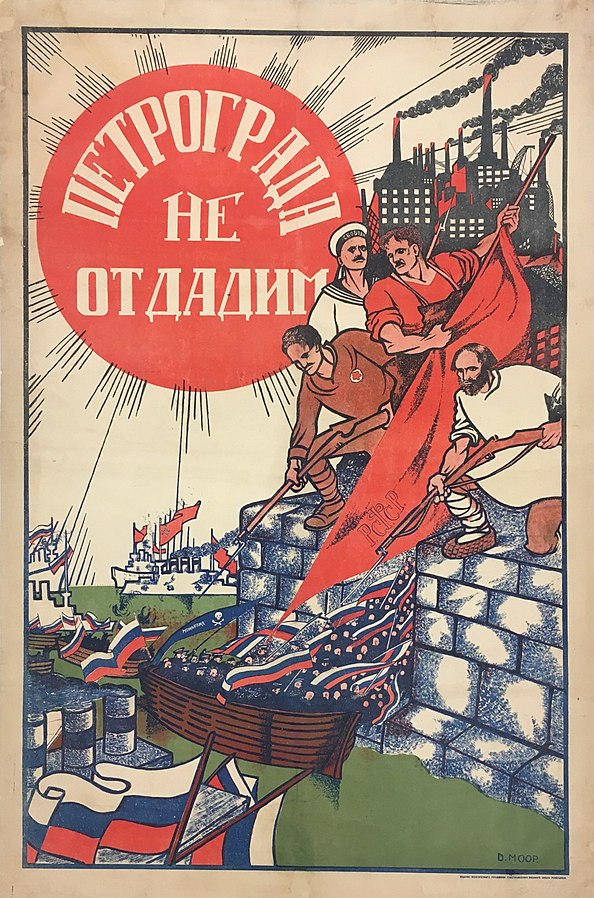
A poster from 1919 shows, strangely, a White attack by sea. But the message applies: the text reads ‘We will not give up Petrograd’

Go to Revolution Under Siege Archive

Go to Home Page/ Archive

Sources


Memoirs of Trotsky: https://www.marxists.org/archive/trotsky/1930/mylife/ch35.htm#:~:text=%E2%80%9CTo%20defend%20Petrograd%20to%20the,extinction%20if%20it%20met%20serious

[i] Smele, Jonathan, The ‘Russian’ Civil Wars, Hurst & Company, London, 2015, p 128

[ii] Kinvig, Clifford, Churchill’s Crusade, Hambledon, 2006, p 272

[iii] Kinvig, 275-6

[iv] Kinvig, 273

[v] Churchill believed that Iudenich could take Petrograd, so much so that he had moved on to second-order concerns: earlier in the year he had communicated to Iudenich his concern that the conquest of Petrograd would turn into one massive pogrom: ‘Excesses by anti-Bolsheviks if they are victorious will alienate sympathy British nation [sic] and render continuance of support most difficult’ (Kinvig, 274)

[vi] Smele, 129

[vii] Service, Robert, Trotsky, Belknap Press, 2009, p 230-231

[viii] Smele, 132

[ix] Smele, 132,3

[x] Trotsky, How the Revolution Armed, ‘Petrograd Will Defend Itself From Within As Well’ https://www.marxists.org/archive/trotsky/1919/military/ch135.htm

[xi] Mawdsley, p 276

[xii] Serge, Victor, Conquered City, 1932, trans Richard Greeman, New York Review of Books, 2011, p 169-170

[xiii] Trotsky, How the Revolution Armedhttps://www.marxists.org/archive/trotsky/1919/military/ch134.htm

[xiv] Kinvig, p 284

[xv] Serge, Conquered City, p 189

[xvi] Beevor, Antony, Russia, Orion, 2023, p 365

[xvii] Beevor, 366

[xviii] Serge, Conquered City, p 186

[xix] Serge, Conquered City, p 124

[xx] By some accounts the tanks were not present at this decisive struggle.

[xxi] Trotsky, How the Revolution Armed, ‘The Turning Point’ https://www.marxists.org/archive/trotsky/1919/military/ch141.htm

[xxii] Deutscher, The Prophet Armed, 1954, Verso Books, 2003, 365

[xxiii] Serge, Conquered City, 185-6

[xxiv] The Soviet Union had suffered thousands of deaths from the weapons of the British navy and millions of deaths from a British blockade, and was at that moment fighting against three armies in British uniforms and with British rifles, and furthermore had, on the night of October 21st, lost three destroyers with all hands to British mines; but Order No. 159 ended with the words: ‘Death to the vultures of imperialism! Long live workers’ Britain, the Britain of Labour, of the people!’ All references to Volume II of How the Revolution Armed.

[xxv] Kinvig, 286

19: ‘To Moscow!’ (Premium)

This post is about the most decisive campaign of the Russian Civil War, in which the armies of Denikin swept toward Moscow. We will be following three White Armies on a front spanning the huge distance from Crimea to the Volga.

This is a lot to wrap our heads around, so let’s start smaller: with a single combatant in these operations. British support was a key factor in the campaign we are about to describe. So let’s focus on a British officer.

The man who took Tsaritsyn

When in 1921 Major Ewen Cameron Bruce was jailed and stripped of his medals, it was the shabby end of a stunning career in the service of the British state…

Become a paying supporter to get access

Access to this article is limited to paying supporters. If you already subscribe by email, thank you. But if you want to become a paying supporter, please hit ‘Subscribe’ below.

Donate less than the price of a coffee, and you can access everything on this blog for one year.

If you don’t feel like donating, most of my posts are still 100% free, so browse away, and thanks for visiting.

Go to Revolution Under Siege Archive

Go to Home Page/ Archive

Sources

14: First Drafts of the Future

In the cities of Central Russia, hope contends with hunger. On the Eastern Front, the Red Army faces Kolchak.

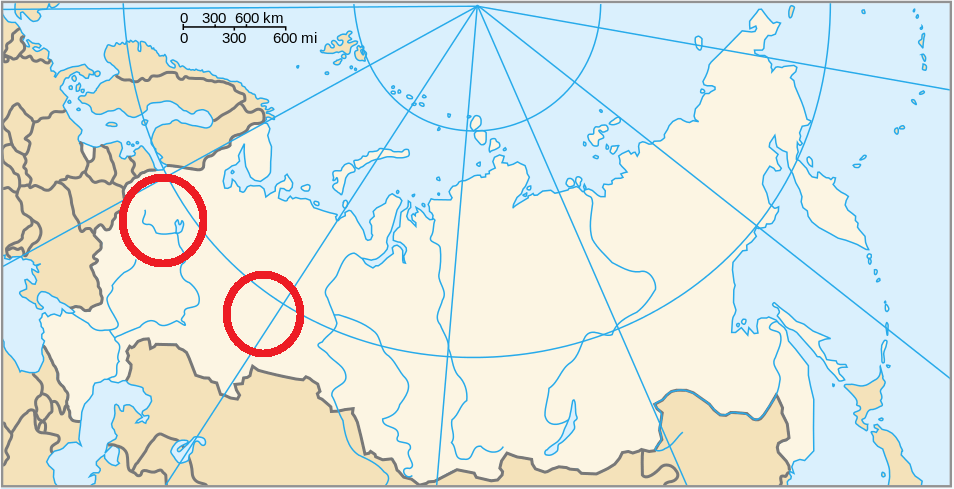
Oriyentatsiya: this post deals with events in ‘Central’ Russia and in the Ural Mountains.

Red wedge and white circle are set on a canvas. The red wedge is slicing into the white circle. Around them smaller shapes are scattered, perhaps fragments shaken loose by violence, or forces of secondary importance in the conflict. It is an abstract image, but it is suffused with energy and struggle. The red object is not larger than the white, but it has shape, momentum, direction.

El Lissitzky painted Beat the Whites with the Red Wedge in 1919, the decisive year of the Russian Civil War. It is one product of the ‘tidal wave of artistic creativity’ which followed the Revolution. This was a golden period for the Constructivist and Suprematist schools, for Malevich, Tatlin, Popova, Rodchenko and many other artists.[i]

The Promise of Revolution

The innovation and excitement on the canvas (and of course in the work of poets and writers) was a reflection of the changes the Revolution promised. Serge remembers the officials of the new state apparatus hurrying through the streets: ‘men and women alike, young or ageless, carrying over-stuffed briefcases under their arms’ filled with dossiers, decrees, mandates – ‘the precious first drafts of the future, all this traced in little Remington or Underwood characters.’[ii]

The town houses of individual bourgeois families had been transformed into communal dwellings, housing multiple families. Better than the slums and barracks – or shelled ruins – they had come from. Palaces that had once housed princes and their mistresses now housed public institutions such as the Palace of Motherhood where modern maternity care was driving a wedge into an over-medicalised and patriarchal tradition. Public canteens served up nutritious meals for free. Families availed of public laundries and crèches.

The Ural Mountains

The promise of the revolution delivered on the frontlines too. In February, before the outbreak of Kolchak’s great offensive, the Whites faced a complication in the middle of their frontline when the Bashkirs switched sides to the Reds. The Bashkirs were traditionally a nomadic people. They were one of several ethnic groups like the Tatars and Chuvash who predominated in parts of the Ural and Volga regions (Lenin’s grandfather was a Chuvash tailor from the Volga). It was the Bashkirs who had named the Ural mountains, after their legendary hero who sacrificed himself to enrich the earth.

When the 6,000 Bashkir cavalry went over to the Reds, it was as I said a complication for Kolchak, not a devastating blow. But in hindsight it matters a great deal. The Bashkirs, who lived under a near-medieval social structure, were at first disoriented by a revolution they could not understand, and followed their chiefs and Islamic clerics into the White camp. But the Whites mistreated them and refused to give them autonomy. The Reds made a better offer. It was to be an early example of the decisive importance of the Soviets’ democratic policy on the national question.

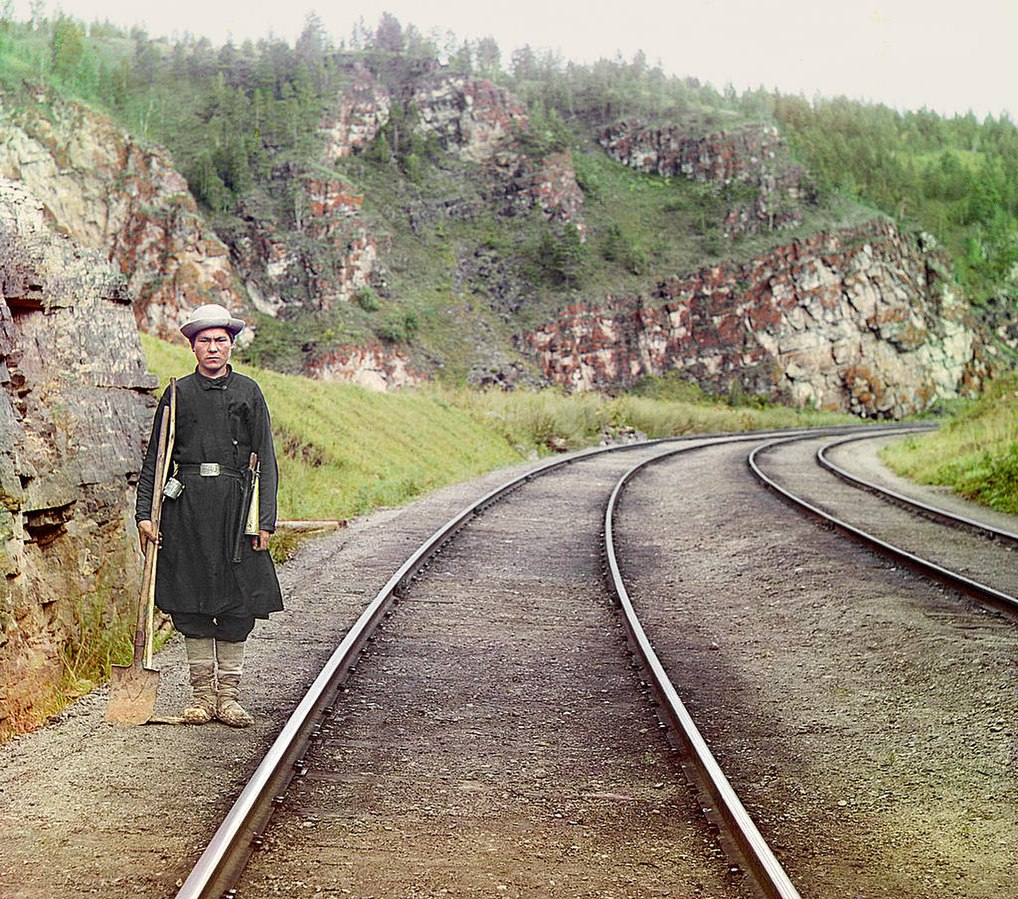
A Bashkir railway worker in the Urals, 1910

Neil Faulkner writes of ‘the explosion of creative activity unleashed by the October Revolution,’ particularly in education. The country went from six universities to sixteen, in just over a year, and courses were open to all and free of charge. ‘The workmen crowd to these courses’, reported journalist Arthur Ransome. ‘One course, for example, is attended by a thousand men, in spite of the appalling cold of the lecture rooms.’ The number of libraries had doubled in Petrograd and tripled in Moscow. ‘In one country district, there were now 73 village libraries, 35 larger libraries, and 500 hut libraries or reading-rooms.’[iii]

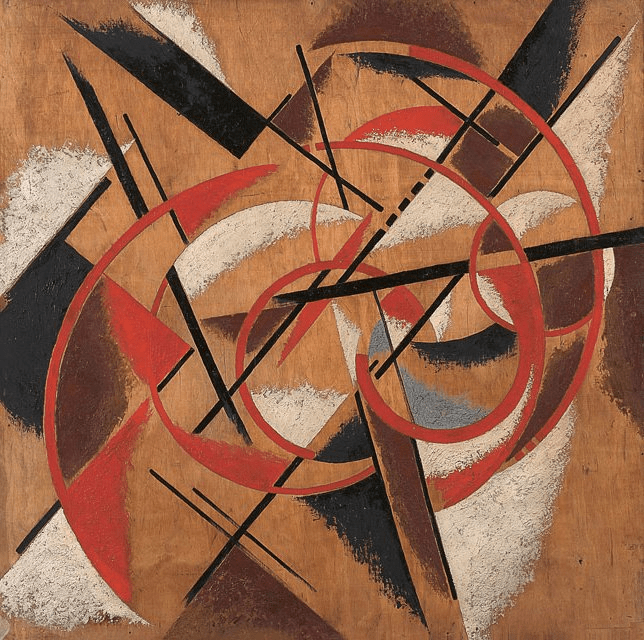
Today’s cover image: ‘Spatial Force Construction,’ Lyubov Popova, 1920
A Hungry Winter

These are only a few examples of the sweeping social changes. But the winter of 1918-19 was bleak beyond description. A wreck of an empire emerging from the most terrible war in human history into the disruption attendant upon revolution – these would have been years of hardship even in the best possible scenario. Now, on top of that, civil war had thrown transport and supplies into complete chaos. The food supply system had been broken by the Great War. In 1918 the Soviets had taken grain by force from the villages to avert starvation. Many of the peasants hadn’t bothered planting.

There was no international famine relief effort to speak of. The American Red Cross made a difference – but their activities were confined to Siberia. The Fridtjof-Nansen scheme attempted to feed civilians in both zones. It showed what might have been possible if the rulers of the world had responded with humanity and compassion rather than with an all-out crusade against the revolution. But it was the exception rather than the rule.

The Soviets had nationalised industry and given land to the peasants; for this crime tens of millions of civilians would be collectively punished with the weapon of mass hunger, like the German civilians during World War One, or the Iraqi and North Korean civilians under sanctions in more recent years.

The city and town dwellers of Russia, their immune systems weakened by hunger, became easy prey for typhus and the so-called ‘Spanish Flu’ pandemic. Factories were short of supplies, understaffed by the hungry and the sick. Things were worst of all in Petrograd – a city with no farming hinterland from which to feed itself. Kollontai, the Bolshevik minister who was behind the Palace of Motherhood and other impressive projects, joked bitterly that ‘there is a great deal of moral satisfaction in deciding whether you want thick cabbage soup or thin cabbage soup.’[iv]

The industrial workforce fell from 2.5 million in 1918 to 1.5 million in 1920.[v] Where did all the workers go after the workers’ revolution? Hundreds of thousands into the Red Army; tens of thousands into the state apparatus; millions to the countryside, where food was more plentiful.

In the novel Conquered City, we see a crowd of exhausted and angry factory workers in Petrograd. Timofei sees the sad contrast between this crowd and the same crowd just a few months ago:

This crowd is spineless. The best among them have left. Some are dead. Eight hundred mobilised [for the Red Army] in six months […] they say [Leonti] died in the Urals. Klim is fighting on the Don. Kirk is head of something. Lukin, what happened to Lukin? Timofei could still visualise these veterans standing in this very shop, three or four ranks of men, successive generations who had come up and disappeared within a year. Gone. At the head of the army, at the head of the state, dead: heads riddles with holes, lowered into graves in the Field of Mars to the sound of funeral marches. The Revolution is devouring us. And those who remain are without a voice, for they are the least courageous, the most passive…[vi]

Peace Offensive

There was cause for hope that things would improve soon. Moscow had launched a ‘peace offensive’ in late 1918. They were offering to let the Whites and their Allied backers hold onto whatever territory they held in exchange for a peace treaty. It was the same basic equation as Brest-Litovsk the year before: space for time. The Soviets had the most to gain from time and the least to gain from war.

The call reached some receptive ears in the west. The Allied leaders were not all on the same page with regard to Russia. The Whites had basically failed in 1918, and many Allied leaders were growing tired of betting on losers. Some, such as Lloyd George in Britain, worried about what might happen even if these losers were to win. The Allies would be responsible for forcing a vicious reactionary regime onto Russia against the will of its people; Lloyd George saw that this would give labour and communist parties ammunition against the establishment.

So in January 1919 a radio broadcast went out from the summit of the Eiffel Tower inviting the Red and White leaders to a peace conference at the Isles of Prinkipo near Istanbul.[vii] In early March the US official William Bullitt was in Moscow offering generous terms for a peace treaty.

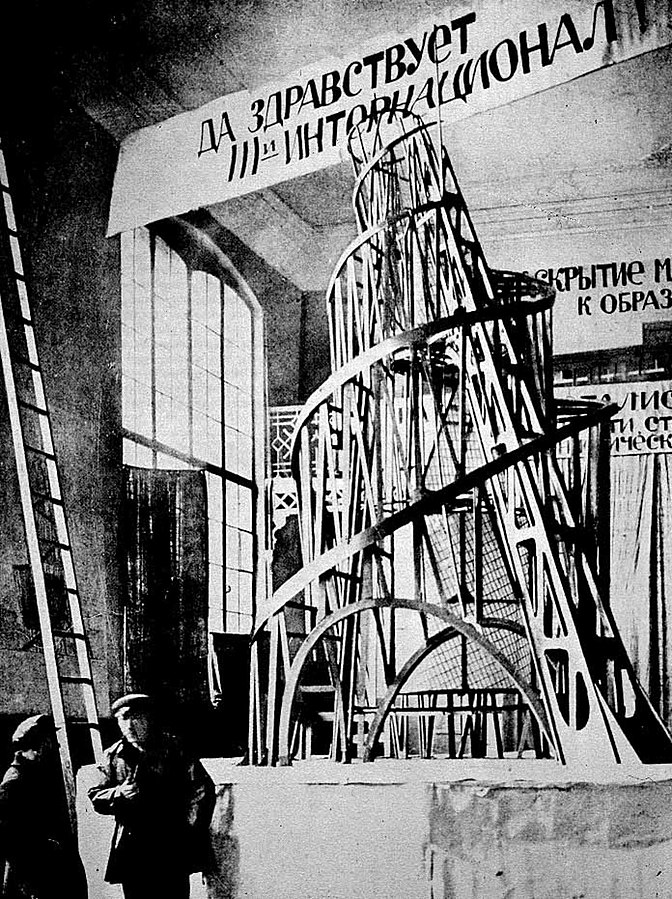
There were other promising developments. The partial bans on the Social-Revolutionaries and Mensheviks were lifted. Strict limits were placed on the power of the Cheka (a quick reminder, the Cheka was the police force which imposed harsh security measures). Central Europe was in the throes of revolution. Southern Europe appeared not to be far behind – see the factory occupations in Italy and the ‘Triennio Bolshevico’ in Spain. In March 1919 the first Comintern Congress met, founding a new communist workers’ international. The artist Tatlin designed an elaborate tower to serve as its headquarters.

But as we saw in Episode 11, in March Kolchak launched an offensive all along the Eastern Front. Kolchak had been enraged by the Eiffel Tower broadcast, and his offensive was in large part intended to cut off the possibility of a peace treaty. In this it was a complete, unqualified success. The advance through the Urals convinced the Allies that the Reds could be crushed, so they made another throw of the dice. The Istanbul conference never happened. Now the Allies were all in.

Tatlin and an assistant with a scale model of his famous tower. Like the Istanbul conference, like the promise of Soviet democracy, this tower never had its day; the steel was needed for guns and shells and rails.

‘Everything for the Front’

For civilians in the Red zone, the advance of Kolchak meant new sacrifices – of food and raw materials, of men and women, of energy and time. War production – weapons, boots, uniforms – would remain the priority over civilian production. The slogan was ‘Everything for the Front.’

But hadn’t the people already given everything? Just a few months ago it had sent a levy of thousands of communists and trade unionists into the battle for Kazan. But somehow new reserves were found. A fresh levy of thousands of activists volunteered and went from civilian life into the Red Army. It is a measure of how genuinely popular the Revolution was. It is proof of the fact that great masses of self-sacrificing activists were its lifeblood.

This blood was plentiful but still finite. Sending the best administrators and the most politically active and talented workers into the Red Army meant further impoverishing civilian life. Producing more rifles and uniforms and boots meant not producing consumer goods. Not producing consumer goods meant it was impossible to trade with the countryside. No trade meant that the seizure of foodstuffs from the village had to continue. For every victory at the front, the people were forced to pay a heavy price. For every victory at the front, the Soviet Union was forced to pawn more and more of its assets – Soviet democracy, relations with the peasants, the support of the working class – with the knowledge that they could only be redeemed at great cost, and the fear that they might never be redeemed at all.

Limits on the Cheka and decrees on legality did little or nothing to curb the terror. Contrary to what certain scholars profess,[viii] the Red Terror was not a product of any lack of regard for human rights or the rule of law. It was rather (and the same goes for the White Terror) an expression of the extreme intensity and bitterness of the conflict. The war intensified in early 1919, grew more complex, more threatening. Accordingly, terror on all sides escalated.

Who was the new Soviet state official, carrying some first draft of the future in their briefcase? Perhaps their factory’s Soviet delegate, or that of their regiment or village, or some party activist going back years, recruited to some job in the administration of the new state. They would read appeals in the papers, hear them at meetings and rallies, urging them to go to the front. They would talk the matter over with comrades and loved ones. What entered into the decision? The fear of a bloody White victory. The prospects for revolution in Germany. Maybe lower motives, like a desire to escape the squalor of the city, or to make a name for oneself as a military hero.

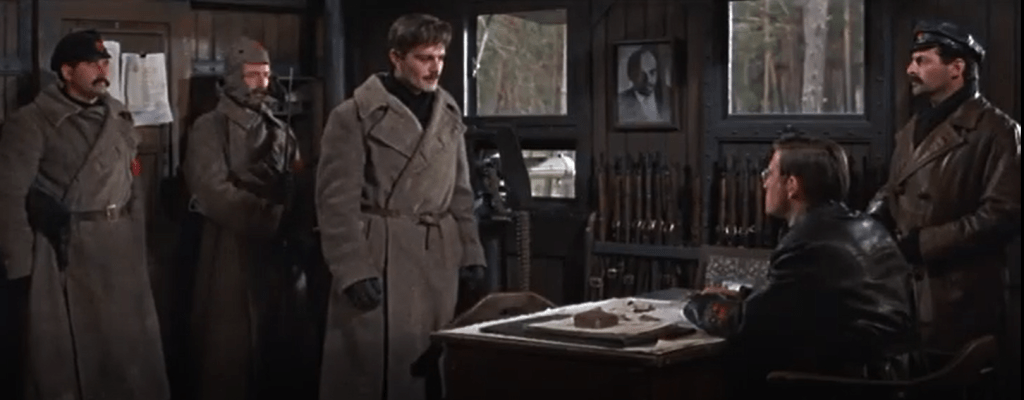
From Dr Zhivago, dir David Lean, 1965. This part of the movie (if my reading of the novel’s ambiguous timeline is correct) is set during the Spring 1919 fighting around Perm. Yuri is interrogated aboard an armoured train. It is accurate that the uniforms are not exactly, well, uniform. But one of the sentries has the new bogatyrka hat, which was entering circulation at this time.

They would decide to take up a rifle and go to the Urals. They might take a day or a week to settle their affairs, then they would go out on the railways across a countryside that was rife with discontent. Entering the Iaroslavl, Ural or Volga military districts, they would take their place in the rear. Here were 147,000 Red Army soldiers, only 18,000 armed – one in seven. The other six would be on transport, supplies, logistics, policing. This was an army without training centres or supply depots. New recruits were simply rushed to their units and there (usually) trained and (sometimes) equipped. This was anything but a streamlined red wedge.
In one of these rear military districts, the Middle Volga, there was a peasant guerrilla campaign against the Red Army. It fought under the confused slogan ‘Long live the Bolsheviks, Down with the Communists!’ How to explain this? The Bolsheviks had given the land to the peasants, and then under the new name of ‘Communist Party’ had come back a few months later to seize their grain. An Extraordinary Tax imposed in November 1918 had proved desperately unpopular, and the civilian Soviet administration was guilty of ‘manifest malpractises.’ Of course it was, if the best people had been poached by the Red Army.

Having passed through the rear areas, the volunteer would arrive at the eastern front.

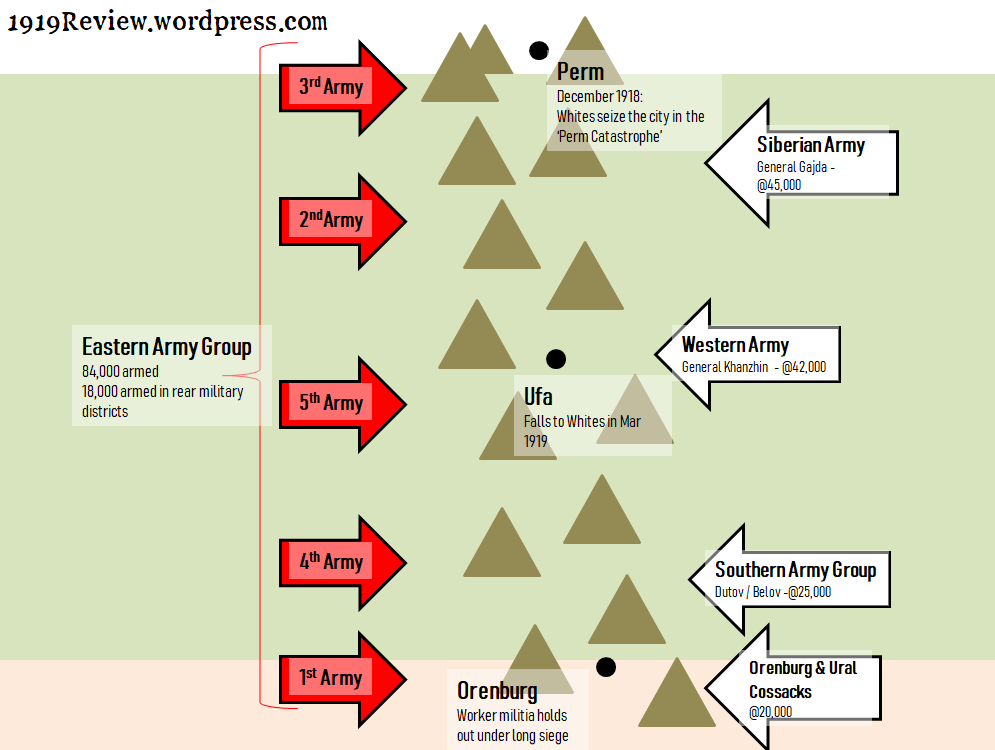
The front against Kolchak was huge and complex (though in scale it did not even approach the frontlines of the First World War). From Perm in the north to Ufa in the centre and on to Orenburg in the south is a distance of over 700 kilometres. While they stretch a long way north to south, from snow to sand, the Ural Mountains are nowhere near as tall as the Andes or the Himalayas. Nonetheless, they represent a barrier with dense forests and steep, rough ground.

Five Red Armies were distributed across this front, billeted in the villages or in the mining and factory towns. Each Red Army numbered between 10 and 30,000, to a total of 120,000. Here 84,000, two in three, were armed. It was not a case of ‘every second man gets a rifle’ or anything so absurd. The unarmed were driving wagons, carrying stretchers or cooking dinner.

Now let’s look at the other side of the frontline, once again surveying the situation from north to south. There was a White army of 45,000 around Perm and another, 48,000-strong, at Ufa in the middle. In the south were two loose armies of White Guards, Cossacks and others, one numbering 20,000 and another numbering 25,000, who had been fighting against Red Guard militias around Orenburg on-and-off for over a year.

Eastern Front, Spring 1919

I have remarked that Kolchak was a landlocked admiral, but the irony is spoiled by the fact that Russia is a land of massive waterways and on this eastern front there was a naval struggle between Red and White flotillas on the Volga and Kama rivers. Here the Reds had the advantage thanks to the sailors of the Baltic fleet. This advantage on the water meant they could outflank Gajda on the land. The Czech officer had covered himself with ostentatious honours after his victory at Perm, but now he was on the back foot.

Back on the Red lines, the newcomer would have found the Red Army in a state of internal struggle and rapid change. In early 1919 a new culture of discipline still contended with the Red Guard and guerrilla mentality. In March the 8th PartyCongress thrashed out the arguments even as Kolchak was advancing. In a political victory for Trotsky, the delegates came down on the side of the centralised, disciplined, professional army. A congress decision is instant, but the implementation of the decision in the real live Red Army would be a more difficult matter.

The Whites Falter

Having conquered an area the size of Britain, the Whites dug in from April into May as the spring floodsmade the roads impassable. But challenges emerged in the new territories. In Siberia, the land question was not the burning issue it was in Central Russia. So the regressive land policy of the Kolchak regime was not a huge liability. But the further west they advanced, the more of a liability it became.

In March the White vanguard had distributed leaflets proclaiming ‘Bread is coming!’ from Siberia. But, like all the contending forces in the Russian Civil War and in every war in Russian history to that point, the soldiers distributing these fliers were taking bread from the people.

In short, the people of the conquered territories had no reason to welcome the Whites.

Even at the high point of their advance, one anonymous White officer was pessimistic: ‘Don’t think that our successful advances are a result of military prowess. For it is much simpler than that – when they run away we advance; when we run away they will advance.’[ix] Here is a cynical but not entirely wrong view of the Civil War: retreat and attack as a function of inertia, not élan on the one hand or disintegration on the other.

In Mid-April Kolchak was at his height. But on the southern end of his front the worker militia at Orenburg still held out, a wedge sticking into his lines and forcing him to widen his front. A fresh attack by two divisions of his Fourth Corps ended in disaster on April 27th, when they were almost annihilated on a river bank near Orenburg.

A brewery in Orenburg, some time before 1918. This picture is here so that you notice the camels and register that Orenburg is very much in Central Asia.

Desertion was becoming a serious problem. An order to Red Army units from May 1st gives a vivid sense of what this meant:

Deserters from the enemy are to be received in a friendly way, as comrades who have freed themselves from under Kolchak’s lash, or as repentant adversaries. This applies not only to soldiers but also to officers. […] Enemies who have surrendered or who have been taken prisoner are in no case to be shot. Arbitrary shooting of men who come over from the enemy, as also of prisoners of war, will be punished ruthlessly in accordance with military law.[x]

This indicates that trigger-happy Red soldiers were still a problem. It also indicates that by May desertion from the ranks of Kolchak was occurring on a considerable scale. Finally this order shows us how, reinforced by the Congress decision of March, a new level of discipline was emerging in Eastern Army Group.

Red Advance

The Spring floods receded. In a few months, Eastern Army Group had tripled in numbers, from 120,000 to 361,000. The resistance at Orenburg made a concentration of forces possible, and on May 4th a mobile group went on the offensive. Soon the five Red Armies were on the move eastward again. The White Western Army, which had seized the town of Ufa in March, was driven back to the Belaia River. More Whites deserted. Red prisoners-of-war incorporated into the White ranks changed sides again at the first opportunity. The White force around Ufa had numbered 62,000. It soon withered to 15,000.

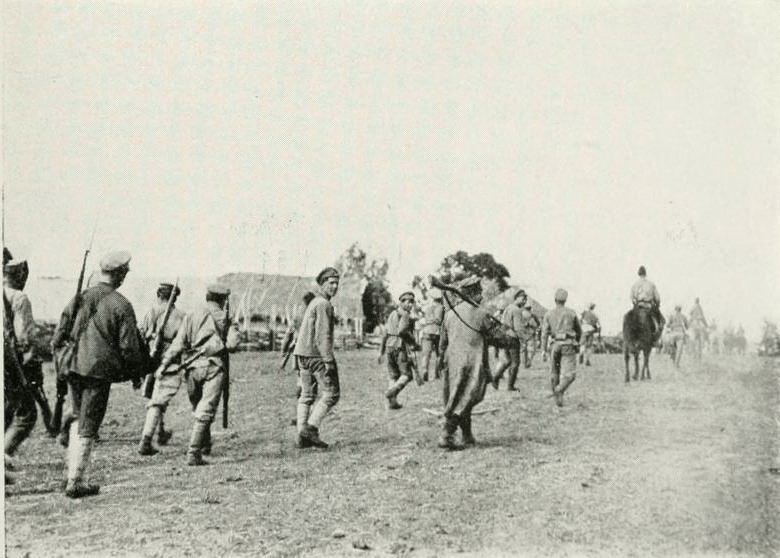
White soldiers in retreat near Ufa

The fresh communist volunteer in the ranks of the Red Eastern Army Group would have encountered people like Vasily Chapaev, an NCO in the Tsarist army turned Red commander. In the 1934 war film Chapaev he is a truly magnetic character, played by Boris Babochkin. He is depicted as being in conflict with himself: he is very much the Red Guard leader, rakish and untidy, thundering around on a cart gesturing furiously. He only learned to read in 1917 and is not what a communist would call politically developed; he is not sure whether it’s the first, second or third international that he is supposed to support. But his bluster shows that these are deficiencies he is deeply ashamed of.

His commissar, a newcomer to the unit, has some of the men arrested for looting. Chapaev’s first instinct is to stick up for his men and to tell his commissar to go to hell, but once his initial rage has passed he submits in a dignified way to his commissar, and has the criminals punished. After this, he and the commissar work as a team; he dresses more sharply; he demands more of the soldiers.  

For the purposes of the point I’m making, I don’t care whether these details are accurate in relation to Chapaev himself. Nor am I concerned with the realism of this or that battle scene. My point is that the key conflict in Chapaev captures in an authentic way the development within the Red Army at this moment. It was a decisive advance, not only geographically but in terms of organisation.

Meanwhile the real Chapaev was playing a key role in the advance of Eastern Army Group. On June 9th he led his 25th Division in a sudden strike across the Belaia River and seized Ufa. There they found huge reserves of food and grain.[xi]

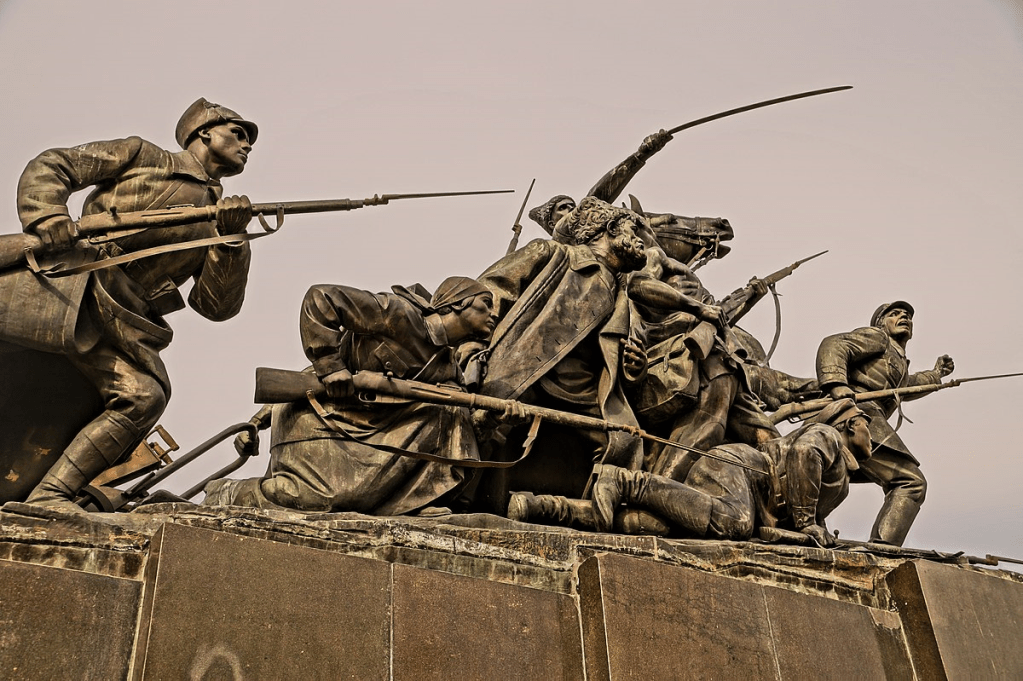
A monument to Chapaev in Samara

Even the Third Red Army, much maligned after it was devastated in the ‘Perm Catastrophe’ of December 1918, recovered its fighting spirit and, on July 1st, recovered Perm itself.

On May 29th Lenin had said, ‘If before winter we do not take the Urals, I consider that the defeat of the revolution will be inevitable.’[xii] Perhaps he feared Kolchak consolidating his hold over the Urals, developing war industries there, with Allied aid pouring in all the while. He need not have worried. Never mind winter – by August, the White Guards had been cleared out of the Ural Mountains. The red wedge was cutting deep into the sphere of the Whites.

To finish where we began, the Bashkir cavalry had picked the winning side before it was clear who would win. But by late summer they would have been confident that their choice had been the right one, at least as far as the Eastern Front was concerned. They were the first of many minority peoples to come over to the Reds, really their first successful advance beyond ‘Great Russia’ since the outbreak of full-scale war in spring 1918.

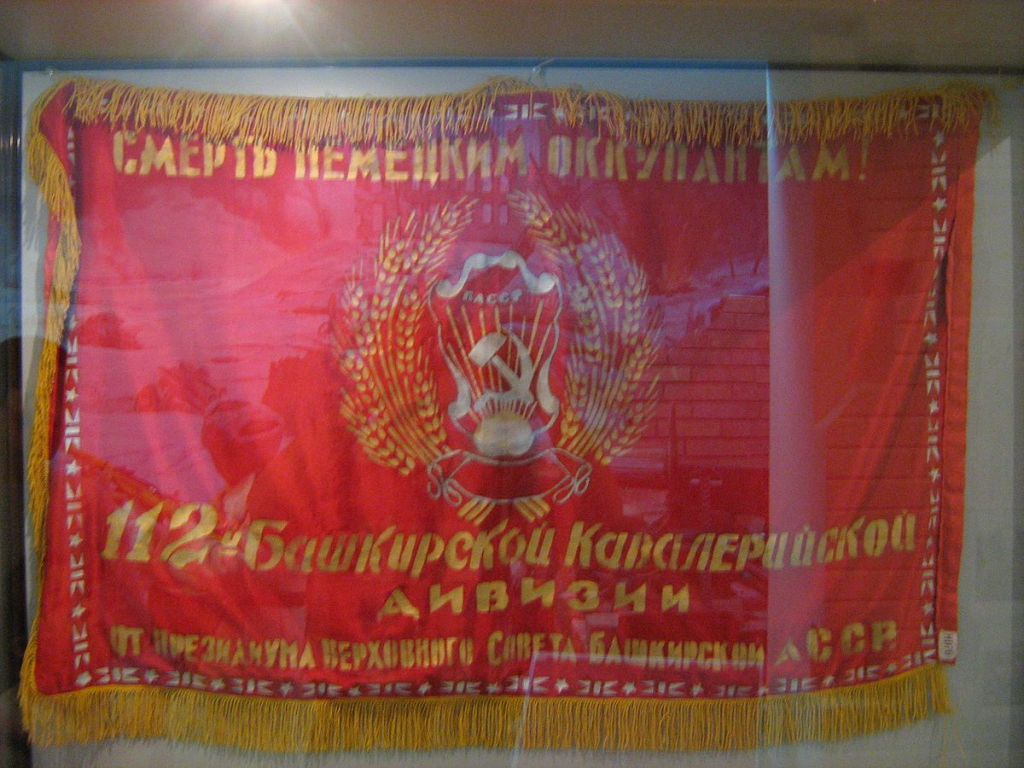
Banner of the Bashkir Division – I think this is from World War Two.

The Revolution had won over the Bashkirs with the promise of autonomy and respect for their culture. Today the Autonomous Republic of Bashkortostan lives on as a direct descendant of the first Autonomous Soviet Socialist Republic. It has four million inhabitants, most of them Bashkirs and Tatars, and its capital is Ufa. This territory was wrested from the hands of ‘Great-Russian’ chauvinists by the advance of the Red Army in spring 1919.

Go to Revolution Under Siege Archive

Go to Home Page/ Archive

Sources


[i] Conor Burke, ‘How revolution unleashed a tidal wave of creativity,’ Socialist Alternative journal, Winter 2017, pp 11-14

[ii] Serge, Victor, Conquered City, trans Richard Greeman, New York Review of Books, 1932 (2011), p 14

[iii] Neil Faulkner, A People’s History of the Russian Revolution, Chapter 9, World Revolution. Stable URL: https://www.jstor.org/stable/j.ctt1k85dnw.16

[iv] Ibid

[v] Ibid

[vi] Serge, Conquered City, p 65

[vii] Smele, p 110. It was to Prinkipo that tens of thousands of Whites later fled. There, too, Trotsky was exiled from the Soviet Union years later. 

[viii] Smith: ‘The Bolsheviks simply did not believe in abstract rights, and one consequence was that it left Soviet citizens bereft of a language in which they could seek redress against the arbitrary actions of the state.’ Russia in Revolution (p. 386). OUP Oxford. Kindle Edition. See also the essay ‘Red Tsaritsyn’ by Robert Argenbright

[ix] Smele, p 114

[x] Trotsky, How the Revolution Armed, Volume 2, Order 92, May 1st 1919

[xi] This episode is absent from the film. Beevor’s account (p 298) is a little unclear but he seems to suggest Chapaev was dead by February 1919 in which case his most significant military feat could not have happened. Either that or Beevor jumped forward a year, or it was a typo. As a brief update on my ongoing assessment of Beevor’s contribution, I am still getting good concrete details out of this book. He knows when to slow the narrative down to real-time and when to focus on an interesting character. His anti-communist bias is still obvious but generally not as intrusive as in the chapter I reviewed in detail. He hasn’t mentioned Lenin much in a while, so I haven’t been forced to visualise the veins standing out purple on his forehead. But there is something about his preoccupation with squalor and gore that nearly repels me. I think it’s a question of theme. What is he trying to say with this book? That Russia is a land of squalor and gore?

On the Chapaev film and on the commmoration of the Civil War more generally, this is fascinating: https://iro.uiowa.edu/esploro/outputs/doctoral/Children-of-Chapaev-the-Russian-Civil/9983777197702771

[xii] Mawdsley, p 203

Short Post: Baltic Revolution

A British officer named Gough, before being sent out to the Baltic to join the ‘crusade’ against the Russian Revolution, spoke with Winston Churchill in London:

Pacing about his room and constantly referring to a map of Russia on the wall, Churchill optimistically explained to Gough how the various invasions then under way against the Bolsheviks – Kolchak from the east, Denikin from the south and the British from the north, together with the one proposed by General Iudenich from the Baltic – would encircle and crush the Reds. ‘He seemed to overlook the scale of the map,’ Gough noted, ‘and that these four movements, separated by immense distances, were handicapped by very inferior numbers and equipment […]’

Churchill dismissed these arguments: ‘Bolshevik morale was low and the resolute advance of even small armies would cause their organisation to disintegrate.’[i]

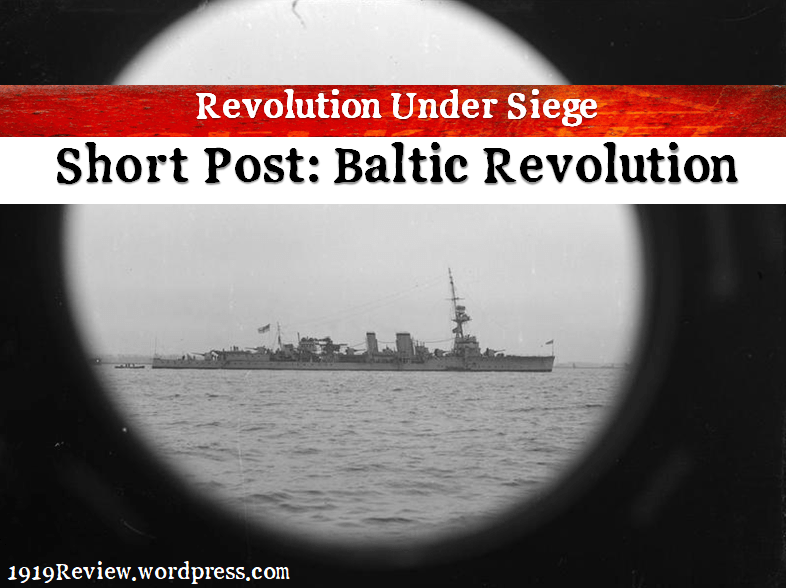
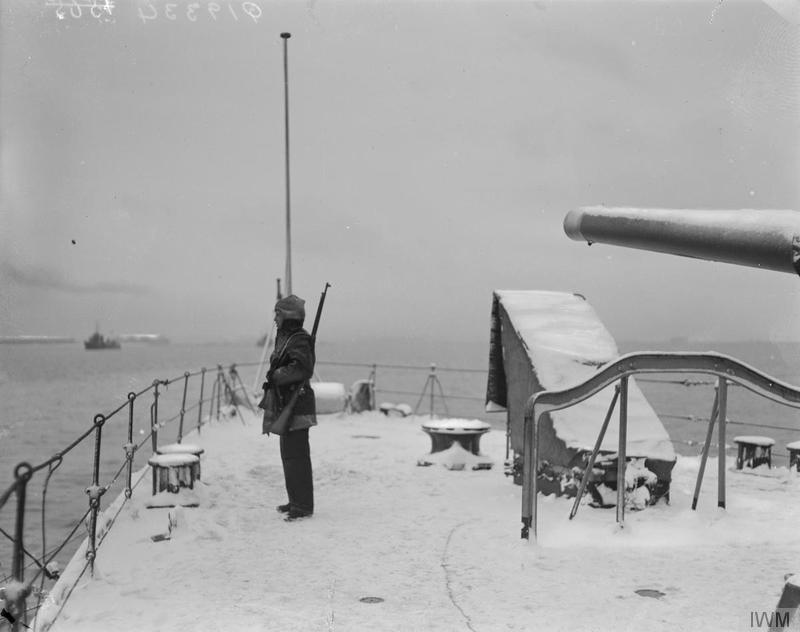
Like our cover image, this photo shows British ships and personnel operating in the Baltic in late 1918. The ship in the periscope sight, incidentally, was later sunk by one of the 60,000 mines left in the Baltic during the Great War.

This is a short post in Revolution Under Siege, a series about the Russian Civil War. There are theatres of the war which I have neglected in the main narrative. I have never been quite so crazy as to think I can write this series as a comprehensive history of the war. In this short post we will deal with one of these neglected areas: the Baltic, specifically Estonia and Latvia.

Estonia and Latvia

Estonia and Latvia, proudly independent states today, were until 1917 mere provinces of the Russian Empire – though like Poland they were more industrially and commercially developed than Russia itself.

The main landowners were all to be found among the ‘Balts,’ a privileged German minority of 10% or so. These Baltic barons were more German than the Germans (like the Nazi Alfred Rosenberg) and more Russian than the Russians (Like Budberg and Ungern-Sternberg) but dismissive of the language and culture of the majority. Their wealth and titles rested on the labour of Estonian-speaking and Latvian-speaking farmers. In the cities lived the cultural melting pot that was the working class – Estonian, Latvian, Lithuanian, Polish, Jewish, Russian, German and Belorussian. Among the middle classes and professionals, here as in many European countries in the era, national pride was awakening.

In 1917, Estonia and Latvia were Bolshevik. This will not be a surprise to readers who recall the key role of the Latvian Rifles in 1918.

For reasons we have discussed before, the Constituent Assembly elections of December 1917 gave a massive and unfair advantage to the Right SRs. Even so, the Bolsheviks won 40% of the popular vote in Estonia – as against 32% for the Estonian Nationalists. In Latvia, the result was 72% for the Bolsheviks, 23% for the nationalists, the highest Bolshevik vote of any electoral district in the whole of the former Russian Empire.

Tallinn (Capital of Estonia, then called Reval) had its own October Revolution a day before the events in Petrograd, when Jan Aanvelt declared a Soviet Republic. In the first week of November, every major city in Estonia declared for the Soviet power.

‘The Doom of Soviet Latvia’

But already by mid-1917 the German military had conquered Riga (Capital of Latvia). In February 1918 the Germans renewed the offensive, conquering Estonia. Part of their casus belli was that they wanted to ‘protect’ the Baltic German barons from having their lands taken off them.

On February 22nd the Soviet government debated whether to accept the Brest-Litovsk Treaty, which would effectively hand over Latvia and Estonia to the German Empire.

Stupochenko, who took part in the debate, described its conclusion: ‘The fraction decided by a majority to sign the treaty, making voting compulsory for all Bolshevists [sic] except the Latvian comrades, who were permitted to leave the room before it took place, since they could not be expected to take responsibility for the doom of Soviet Latvia.’[ii]

The offensive and the treaty destroyed the revolution in the Baltic States. These were grim days for the working class. German occupiers put the Baltic German barons back in charge and destroyed the Soviets. My Anglophone sources are silent on how the occupiers treated the Bolsheviks and other socialist parties, but they tell me that the liberal nationalist politicians were scorned by the occupiers, now and then locked up; but that in general the period of German occupation was favourable to them.

Evan Mawdsley phrases this in a curious way. Nine months of ‘relative stability’ gave a chance for ‘national consolidation.’ I would word it differently: nine months of military occupation destroyed the workers’ revolution and gave the wealthier classes a breathing space to rebuild their hegemony. Under the protection of the Germans, Russian White Guards began building armies in Estonia and Latvia. The Baltic States began serving as ‘a kennel for the guard-dogs of the counter-revolution.’[iii]

Revolution

Estonian nationalists celebrate their independence in Tallinn, February 1919

At the start of November 1918, with revolution and surrender in Germany, everything changed. In Estonia and Latvia a new, dynamic, complex situation emerged. New states, foreign intervention, revolutionaries and counter-revolutionaries were all in the mix.

British historians (see Kinvig and Mawdsley) tend to take the British ruling class at its word. It goes without saying, for them, that the Germans and the Soviets were up to no good but that the British armed forces intervened in the Baltic area to defend small nations and democracy.[iv] The Estonian and Latvian nationalists who eventually won are treated, in a teleological scheme, as the only legitimate local forces.

These parties and institutions are referred to by the name of their respective country – so it’s ‘Estonia’ against ‘the Bolsheviks,’ treating the former as the very embodiment of an entire nation and downgrading the latter to a wretched bunch of interlopers.[v] They will acknowledge that Estonia and Latvia had ‘significant groups of Bolshevik sympathisers among their population,’ but also say that they were ‘invaded by the Bolsheviks… under the guise of creating a federation.’ The British, meanwhile, wish to ‘come quickly to the aid of the new states.’ No ‘guises’ here.[vi]

Estonian machine-gunners, early 1919

I think we should start from a different perspective.

Civil War took place across the Baltic States, spilling over national boundaries. It was a class war with national cross-currents. As far as I can make out (reading between the lines of sources which are not interested in such questions), the main class forces were as follows:

  • The old landowners (Baltic Germans), eager to restore their privileges – supported by the German military.
  • Professionals and business owners, rallying a part of the workers and peasants under the banner of national freedom – supported by the British Empire.
  • Workers (of a range of nationalities) seeking to combine national freedom with socialist revolution – supported by the Soviet Union.
  • …and there were White Russians in the mix, allying variously with Germans, Allies and nationalists, but always against the Soviets.

Let’s flesh out this simple schema by introducing some of the concrete forces and events involved.

Germans, British and Whites

First, meet General Ruediger Von Der Goltz.[vii] Right when the Allies were cooking up the Versailles Treaty with the aim of trampling Germany into the ground, they were allowing thousands of German soldiers to represent German imperialism in Latvia. Against the Reds, any ally was a worthy ally.

By 1918 the German occupation force in the Baltic was ‘demoralised, mutinous and frankly Bolshevik’[viii] but help was on the way. Von Der Goltz arrived in February 1919 and took over an area around Libau, Latvia. He had a powerful base of support in the form of the wealthy Baltic Germans, plus German volunteers who had fought under him in the Finnish Civil War. Then came the ‘Freikorps,’ those military veterans turned paramilitaries who had crushed the Spartacus Uprising of January 1919.

Finnish volunteers arrive in Estonia. Fresh from the bloody Finnish Civil War. The Finns would return home in Feb-Mar 1919 after suffering 150 fatalities.

Within days of the Estonian and Latvian nationalists declaring independence in November 1918, the British navy was knocking on their doors and dumping thousands of weapons on their doorsteps. A little way into 1919, the armies of the Latvian and Estonian nationalists were kitted out from head to toe in British uniforms. The British fleet dominated the Baltic Sea and soon the Gulf of Finland, too. They sank Soviet ships in brief and one-sided naval battles, laid siege to the island fortress of Kronstadt, made daring raids into its harbour, ran agents in and out of Petrograd by boat, and lobbed shells at any Red Army unit that strayed into range near the coast. When the Red troops at the coastal fort of Krasnaya Gorka rose in a mutiny against the Soviets, the British supported them with artillery fire.

They also operated a kind of taxi service across the Baltic, ferrying White Russians, nationalists and Germans around to engage in talks; the British sometimes lost their patience in their attempts to get these mutually hostile forces to work together. They were the fixers. Without them the component parts of this anti-Soviet alliance would have been at each other’s throats.

The counter-revolutionary Russians who gathered their forces in Estonia constituted perhaps the most openly reactionary of the White Guard armies. There was none of the ‘keeping up democratic appearances’ that we get with Kolchak and Denikin; their recruits took the oath of loyalty to the Tsar.

But Estonia was exactly where a little bit of moderation would have gone a long way; the Whites and the Estonian nationalists fought side-by-side against the Reds, but their refusal to even consider granting self-determination meant the Estonians were not exactly ready to follow them to the gates of hell (or even, as it happened, Petrograd).

Rise and Fall

A Soviet Latvian banknote from 1919

Early in 1919, the Latvian Soviet Republic made great gains, took Riga, and looked fairly secure. Meanwhile the Estonian Workers’ Commune established itself in the east of Estonia and took on the nationalists. The Workers’ Commune was supported by the Seventh Red Army, and soon it was 40 miles from Tallinn.

But by summer this had all melted into air. Finnish, White Russian and British aid for the Estonian nationalists secured a military victory. The Red Estonians (and there were many) were defeated and driven into Russia.

British naval guns were used to ‘help put down a mutiny among the Latvian [nationalist] troops’ and then to support the Germans in an assault on the Red-held town of Windau.

So far, so much foreign intervention. But there was a political side to these defeats. The Latvian Communists were ultra-left, like their Ukrainian comrades. They engaged in ambitious economic experiments and refused to give the nobles’ land to the peasants. This was in stark contrast to the Estonian nationalists, who carried out an ambitious land reform programme and gained popularity. This is barely remarked upon by my sources but it must have been of decisive importance.

Late in spring, things had turned so sour for the Soviets that the White Russians were able to make an attack from Estonia onto Russian soil. This attack was defeated, but it seems it was only a probing attack; the real onslaught came in October.

Iron Division

Meanwhile Von Der Goltz had risen up against the Latvian nationalists. In April forces semi-connected to him took Libau and arrested the Latvian government, denouncing them as Bolshevik sympathisers. A few weeks later, he invaded Estonia.

His ‘Iron Division’ took Riga in May and 3,000 people lost their lives during ‘a veritable reign of terror’ in the occupied city. His ambition appears to have been to carve out a Baltic German state.

Trailer for Defenders of Riga, dir Aigars Grauba, 2007

In June the Latvian and Estonian armies ganged up and defeated Von Der Goltz and his army. The British, ever with their eyes on the prize (smashing communism), brokered a peace deal which involved clearing the Germans out of Latvia.

With the Germans defeated and the new independent republics consolidated, the situation by the end of the summer was not quite so complex: there were now two small anti-communist states consolidated just to the east of Petrograd, armed to the teeth with British rifles… And playing host to thousands of armed and trained White Russians who would rather see them dead than independent.

And the British had a task for these White Russians.

Towards Petrograd

In late summer, a celebrated Russian general named Iudenich arrived in Helsinki. He had made his name inflicting heavy defeats on the Turkish army during the World War, and now he had been appointed commander of the White Guards in Estonia by Admiral Kolchak. British supplies began flooding in: 40,000 uniforms in August and September 1919 alone.[ix] Iudenich set out to take Petrograd, and by early October he was in the suburbs of the city.

But that’s a story for another post; this short post can at most serve as a prologue to that drama.

Let’s finish with a strange image that Kinvig gives us.[x] After the defeat of Von Der Goltz, the Baltic German force known as the Landwehr were not disarmed. Instead Harold Alexander, a Lieutenant-Colonel of the Irish Guards who was somehow still in his 20s, took command of 2,000 of them and led them to the front against the Reds. He campaigned ‘dressed in his Irish Guards uniform, but wearing Russian highboots and a grey astrakhan Cossack-type hat.’ I think this image sums up the strange features of revolution and counter-revolution on the Baltic.

Local women dig trenches, somewhere on the southern front (that is, the south of Estonia, not of Russia). I don’t know are these women Russian or Estonian, or what side they are toiling on behalf of. A stark reminder that all this military stuff comes at the expense of the civilian population

Note:

By way of an appendix, I am getting a lot out of Clifford Kinvig’s book Churchill’s Crusade. It is heavily critical of British intervention – of course it is, since it is based on the testimony of the British officers who saw the fiasco first-hand. It’s a great book.

But one tic of Kinvig’s really annoys me: he relentlessly refers to the Red Army as ‘the Bolsheviks.’ The party was renamed in March 1918 to ‘Communist Party’ – and anyway, we are talking about the army, not the party. There were SRs and non-party individuals in high positions in the Red Army throughout the Civil War period. It’s true that 5-10% of the army were party members by late 1919. But obviously 90%+ were not!

By using the term in the way that he does, Kinvig is telling us how he sees the revolution: as the accidental triumph of a bunch of cranks. I hope this series has demonstrated that nothing could be further from the truth.

The non-party Red Army soldier and Red commander had various and complicated motivations; national defence, a desire to beat the landlords, a genuine ‘non-political’ ethos of service, state compulsion, etc. They would not have been surprised to be sneered at as a ‘Bolshevik’ by their conservative uncle or their kulak neighbour, they might be surprised that a historian is still using the term decades later.

Go to Revolution Under Siege Archive

Go to Home Page/ Archive


[i] Clifford Kinvig, Churchill’s Crusade, 142

[ii] Erich Wollenberg, The Red Army, chapter 1. https://www.marxists.org/history/ussr/government/red-army/1937/wollenberg-red-army/ch01.htm

[iii] LD Trotsky, How the Revolution Armed, Volume 2: ‘Petrograd, be on your guard!’ – December 22nd 1919

[iv] It is accepted, after all, by a majority of people the world over that one’s own nation (whichever nation that might happen to be) is the only benevolent force in a dangerous world.

[v] Exercising hindsight in this way is not necessarily outrageous. But the contrast between the treatment of Estonia [applause] and Soviet Russia [Boo! Hiss!] is striking. Even the most enthusiastic Irish Nationalist historians do not refer to the underground Dáil Éireann of 1919 as ‘Ireland.’

[vi] Kinvig, 135

[vii] ‘Ataman Goltsev’ to the People’s Commissar for Nicknames, Trotsky

[viii] Kinvig, 136

[ix] Khvostov and Karachtchouk, White Armies, 12

[x] Kinvig, 143

10: Red Flag over Europe (Premium)

Become a paying supporter to get access

Access to this article is limited to paying supporters. If you already subscribe by email, thank you. But if you want to become a paying supporter, please hit ‘Subscribe’ below.

Donate less than the price of a coffee, and you can access everything on this blog for one year.

If you don’t feel like donating, most of my posts are still 100% free, so browse away, and thanks for visiting.

Home Page/ Archives

07: How Tsaritsyn became Stalingrad (Premium)

Become a paying supporter to get access

Access to this article is limited to paying supporters. If you already subscribe by email, thank you. But if you want to become a paying supporter, please hit ‘Subscribe’ below.

Donate less than the price of a coffee, and you can access everything on this blog for one year.

If you don’t feel like donating, most of my posts are still 100% free, so browse away, and thanks for visiting.

Home Page/ Archives

Controversies: Foreign Intervention (1)

Indulge me for a minute and imagine the Russian Civil War superimposed on the United States of America. For the sake of a thought experiment whose purpose will be clear by the end of this post, let’s brush aside the obvious objections and perform whatever mental gymnastics are required. This is the first of several “Controversies” posts on the theme of foreign intervention in the Russian Civil War. I’ll return to the main narrative of the war next week but at some point I’ll follow up on Foreign Intervention.

Let’s get the mental gymnastics out of the way first. Maybe it’s 1968 in an alternate history in which the US has emerged as one of several losers in a nuclear war. Maybe it’s 2038 and the US has been defeated in, we’ll say, Taiwan. The defeat is devastating. The vast US military is in a state of collapse. An alliance of South and Central American states (we’ll call them ASCAS) is invading the south-west.

In this defeated country, a rebellion takes place, led by the military top brass and law enforcement. We can leave aside politics for the purposes of this experiment. If you are a liberal, you can assume the rebels are a cabal of right-wingers with ties to foreign powers. If you are a conservative, you can assume they are deep-state liberal coastal elites. If like me you are a socialist, you can assume that a US revolution has taken place and that the rebels represent the last-ditch resistance of capital and the old state machinery.

Still from the intro video to Red Alert 2, dev Westwood Studios, 2000

Let’s run through a timeline of the first year and a half of this Second US Civil War.

Year One

  • March: US is forced to sign a peace treaty with the ASCAS, handing over control of Texas, New Mexico, Arizona and California.
  • May: The states of Louisiana, Mississippi and Arkansas secede from the union. They are in an uneasy alliance with the neighbouring ASCAS occupation forces.
  • A rogue army made up of officers and led by General Smith takes control over Alabama and Georgia.  Smith claims to be the head of the legitimate US government.
  • North Korean forces land in Alaska, and begin taking over the whole state.
  • An army of Kurdish fighters has been serving in the US military in exchange for the promise of an independent Kurdish state. They are currently in transit across the Midwestern United States. They are approached by Iranian intelligence. The Iranian government promises support for an independent Kurdistan if the Kurdish Corps will rise in revolt against the US federal government. Tens of thousands of Kurdish fighters seize control over St Louis, Kansas City and Omaha.
  • June: thousands of Russian soldiers land in Maine and set up a puppet government there. Thousands of Chinese soldiers land in California and Oregon. Iranian forces take control of Seattle.
  • Half-a-dozen new governments seize control in various parts of the United States, some declaring independence, others claiming that they are the legitimate government of the US.
  • Warlords cross the border from Canada and seize control over Montana and North Dakota.
  • July: A series of armed revolts erupt in cities within Federal Government territory, including Washington DC. All are defeated due to lack of popular support but cause destruction and suffering. Foreign intelligence agencies are linked to most of the revolts.
  • Chicago falls to the rebels.
  • By this time, the following states are still fully controlled by the US federal government: Michigan, Ohio, Pennsylvania, the Virginias, North Carolina, Maryland, Delaware, New York, Rhode Island, Connecticut and Massachusetts. All other states are controlled, in whole or in part, by rebels or by foreign armies. The East Coast is under a blockade by the Russian and Chinese navies.
  • September: the federal government seizes back control over Chicago.
  • September-November: the rebel governments in the Midwest are consolidated in a series of coups. Admiral Garcia, in control of the Midwest and the Rocky Mountains, declares himself supreme ruler of the United States.
  • November: revolution sweeps Latin Anerica. The ASCAS is no longer a factor. The occupation of California, Texas, New Mexico and Arizona ends. For the next two years, rebels and the federal government will vie for control of these states in a series of bloody conventional and guerrilla wars. Dallas, Texas will by the end of Year Three have changed hands nine times in three years.

Year Two

  • The various rebel forces go on the offensive.
  • General Smith, having spent many months crushing the resistance of federal forces in the south-eastern United States and taking control over rival rebel factions, now controls more or less the old territory of the 1860s Confederacy. His armies march on Washington DC. They reach as far as Norfolk, Virginia, roughly 400 kilometres from the capital.
  • General Anderson, in control of Maine, Vermont and New Hampshire, advances on New York City. They reach the outskirts of the city proper, supported by the Russian Navy.
  • The rebel forces in the Midwest, led by Admiral Garcia, invade the Rust Belt.
  • 14 foreign governments at this point have troops on US soil, controlling key port cities and securing the rebels’ rear. In places, they fight directly against US federal troops. Their total forces may add up to as many as 300,000 pairs of boots on the ground, including 70,000 North Korean troops in Alaska battling a pro-Federal guerilla movement and the 30,000-70,000 Kurdish fighters in the Midwest.
  • The offensives of Williams, Anderson and Garcia are bankrolled by the foreign powers. The three rebel leaders receive weapons and ammunition adding up to the total output of munitions for that year in the areas still controlled by Washington DC.
  • General Anderson’s forces in New England literally wear Russian uniforms, and every bullet fired from the rifles of Admiral Garcia is of Chinese manufacture. Russian, Chinese, Iranian and Korean officers and agents are a ubiquitous presence in the rebel zones. In short, this offensive would be impossible without their support.

We have now reached the most intense point of the Second US Civil War. It is unnecessary for our purposes to pursue these imagined events any further, though readers are free to do so in the comments below. Readers are also free to tease out all the various improbabilities in the above scenario. I’m well aware of them but they may be interesting to discuss.

(Of course, the US entertainment industry has imagined such scenarios many times: off the top of my head I can think of Red Dawn, Homefront, Red Alert 2 and 3, the Call of Duty franchise and Chuck Norris’ Invasion USA. The US has never suffered such an onslaught in reality. But it is a fascinating case of projection. The US has inflicted such onslaughts against other countries too many times to count, often right down to the specific tactics depicted, without irony, in movies and games.)

Still from the intro video to Red Alert 2, dev Westwood Studios, 2000. I’m not from the US and I don’t live there. But I am familiar with its geography, politics and culture. That’s why I picked the US and not, say, China, India or Brazil, for this thought experiment.

We have not touched on the horrible human suffering that this war would entail. How would a military-law enforcement alliance in control of the Deep South treat minorities in the areas it controlled? What kind of humanitarian disasters would unfold in a war-torn and blockaded United States? What kind of severe police state would exist in the territories of all the contending forces, including that of the Federal Government?

I’ll ask you to imagine one more thing: that one hundred years after the events just described, Chinese, Russian and Iranian historians are busy ignoring, denying, downplaying and minimizing the significance of foreign intervention during the Second US Civil War.

06: A Murder in Moscow

‘The revolution is a big and serious machine. What today is a difference of opinion, a perplexity, will tomorrow be transformed into a civil war.’

Trotsky, July 1918

Two Chekists

Moscow, on the afternoon of July 6th 1918. Two Chekists are approaching the German legation on Denezhny Lane. One, Yakov Blumkin, carries a briefcase in which a Browning pistol is hidden. Both carry hand grenades.

A Chekist is a member of the security organ of the Soviet, the Special Commission known by its acronym, Cheka. In later years it will develop into the GPU, the NKVD, the KGB: names synonymous with the brutal enforcement of the one-party state. But in summer 1918 the Cheka is only a few months old, and does not have that reputation. These two Chekists, Blumkin and his companion Andreyev, are not even members of the ruling Communist Party. Like many Chekists, they are Left Socialist Revolutionaries.

The ‘haughty profile’ of Blumkin, played by Vyacheslav Shalevich in the 1968 Mosfilm movie The Sixth of July, dir. Yuli Karasik

It would be difficult to mistake Blumkin for a Bolshevik. Bolsheviks prefer tea to alcohol, but Blumkin is known to get drunk in cafés listening to the poetry of revolutionary and reactionary writers with equal rapture. He is ‘poised and virile… his face solid and smooth-shaven,’ with a ‘haughty profile.’[i] He is not above, on occasion, drunkenly brandishing a pistol in public.

Blumkin and Andreyev show their credentials at the door of the German legation. Their letters of introduction bear the signature of the Cheka head, Felix Dzerzhinsky. They ask to see the German ambassador, Count Wilhem von Mirbach-Harff. Count Mirbach’s son, a lieutenant in the German army, is missing, and Blumkin and Andreyev claim to have news of him. But their letter of introduction is phony, as is their stated reason for being here. They have come here to kill a man and to start a war. 

Count Mirbach meets with the two Chekists in a downstairs room. An interpreter and a member of the legation staff are present.

Blumkin opens his briefcase, saying ‘Look here, I have…’

He pulls out the Browning pistol and opens fire at the German ambassador.

The Terrorist Tradition

When Yakov Blumkin drew that pistol, he was acting in a verable tradition of Russian terrorism.

Throughout the 19th Century the Russian liberals, known as Populists, tried to shake the Tsarist autocracy using the weapon of assassination. The older brother of Lenin and the older brother of the Polish nationalist leader Józef Pilsudski were both hanged for their roles in the same assassination plot. Maria Spiridonova, as mentioned in Chapter 1, killed a police chief in 1906 and suffered vicious treatment in prison. Her party, the SRs, descended directly from the terrorist tradition.

1881: Tsar Alexander II assassinated

From the 1880s a new revolutionary tradition grew up in the Russian Empire, one that rejected this tactic of ‘individual terror.’ The Marxists believed that it was necessary to destroy the system itself, not individual human figureheads who could be easily replaced.

The Bolshevik Party came from this tradition, rejecting terror. They were oriented to the working class and to its open, democratic methods of struggle, such as strikes and mass demonstrations, though since they operated under a police state they were often confined to the illegal underground.

Meanwhile, as we have seen, the Right SRs had grown closer to the Constitutional Democrats, while the Left SRs appeared to move closer to the Bolsheviks. But neither Left nor Right SRs ever gave up on the bullet or the bomb. ‘Individual terrorism’ would rear its head in 1918, in events that set the course of the Russian Civil War.

The split between the Bolsheviks and the Left SRs

That morning, as Blumkin and Andreyev went to kill the German ambassador, Soviet Russia was still a multi-party Soviet democracy.

In workplaces, in the fleets, in the Red Guard units, in the Cheka and in the Soviet, Bolsheviks and Left SRs worked side-by-side. As we have seen, in January the Bolsheviks were pleased to vote for Maria Spiridonova, now leader of the Left SRs, as their candidate for president of the Constituent Assembly.

The Bolsheviks and the Left SRs had even formed a coalition Soviet government in December 1917, a coalition which lasted for four months. There was mutual admiration as well as mutual distrust. The Bolsheviks had authority because they had made the October Revolution. The Left SRs had a far higher profile among the rural toilers. But to the Left SRs the Bolsheviks seemed to embody a contradictory mixture of dogmatism and unscrupulousness. For their part, the Bolsheviks saw the Left SRs as muddleheads, terrible at picking their battles. They were always wavering on the most fundamental principles, but proving stubborn on secondary matters.

The slogan ‘Peace, Bread and Land’ united the Bolsheviks and the Left SRs. The land question was the basis of the alliance.

A political meeting in a Russian village, from Tsar to Lenin, dir Herman Axelbank

In power, the Bolsheviks delivered immediately on the land question, passing a decree that took over the land of the former nobility and the church and gave it to tens of millions of peasants. This was a great victory for the peasants: over the next few years the number of farming households rose from 18 to 24 million and the average size of a farm increased. Young couples escaped from overcrowded multi-generational households to start their own farms and homes. In late 1917 and well into 1918 the mass of peasants supported the revolution with enthusiasm. The coalition between the worker-based Bolsheviks and the Left SRs, who had a more rural support base, reflected this fact.

The rupture came over the other two-thirds of the slogan: peace and bread.

Peace

The Brest-Litovsk Treaty making peace with Germany was deeply controversial among the Bolsheviks. But the Left SRs were completely opposed to this ‘obscene peace.’ They were determined to fight German imperialism to the end, even if they were driven out of the cities and up into the Ural Mountains. In March 1918 they walked out of the Soviet coalition government over this question. After walking out they still held many high positions in the Soviet, the Red Army and the Cheka. It was a one-party government (like most British and all US administrations) but by no means a one-party state.

It’s important to appreciate the full and terrible cost of the Brest-Litovsk peace. Finland gained independence from Russia thanks to the Revolution. In free Finland as in Russia, socialists took power with the mass support of workers. But a Finnish White Army, aided by German volunteers and weapons, rebelled, seized power and crushed the revolution. It was all over before May 1918. Tens of thousands of Red supporters were shot. More were starved to death in prison camps. The scale of the bloodshed would have been terrible anywhere, but in a country of only three million people it was staggering. By way of comparison, years of revolution and civil war in Ireland, a country with a population of similar size, claimed the lives of around six thousand people.[ii] Counter-revolution in Finland exceeded that toll many times over in just a few months. The Reds longed to intervene and help their Finnish comrades, but their hands were tied by the peace treaty. Workers in Russia could only stand by in horror while massacres unfolded just a couple of railway stops from Red Petrograd.

They knew that if the White Guards won in Russia, they would suffer the same fate.

From a museum in Finland – uniforms of the Finnish Red Guards

Another consequence of the treaty was that the German army occupied Ukraine and the Baltic States. They began seizing food and executing people. Not just in Finland but in Ukraine, Latvia and Estonia, revolutions were being crushed right on the doorstep of Soviet Russia. Thanks to the treaty there was nothing to be done.

Bread

Even after they resigned from government, the Left SRs still cooperated with the Bolsheviks. But the gulf between the two parties widened further over the question of bread.

‘Suspend the offensive against capital,’ was Lenin’s slogan in early 1918. In the socio-economic as in the military sphere, he judged that the country needed a breathing space. Early on, the Communist Party favoured slow and measured changes in the economy: the nationalisation of the banks and major industries, and gradual intrusions into the rest of the economy. The ‘Left Communists’ argued for faster nationalisation and more state control of markets, but they were soundly defeated in an internal party debate.

But by early summer, the Communist Party as a whole had been forced, by war and by a campaign of sabotage in the factories and mines, to resort to the measures proposed by the Left Communists. According to the Communist Rykov, ‘Nationalisation was a reprisal, not an economic policy.’[iii]

The food crisis which had begun in 1914 was still getting worse. The revolt of White armies led to a breakdown in transport, and the Treaty of Brest-Litovsk cut off Russia from food-producing areas. But the most significant cause of the food crisis was the breakdown of industrial production. There was no shortage of food in the countryside, but the peasants would not trade it for paper money when there was no production and so nothing to buy.

Therefore, according to the dictates of the market, the cities would starve to death. But the Communists were not inclined to accept the dictates of the market or the prospect of their supporters starving to death.

By summer 1918 food detachments were descending on the villages, seizing any surplus grain to feed the cities. There were important continuities between this ‘food dictatorship’ and the food policies of the Provisional Government and even those of the Tsar adopted since 1914.[iv] But this went further. Peasants, especially the wealthier layers, saw the food detachments as an attack on their right to trade. The reaction was furious. Of 70,000 workers who joined food detachments, 7,000 of them were killed by angry peasants in 1918 alone. Kulaks would wait in ambush, sawn-off rifles hidden in the folds of their shirts. Communists would be found dead, their stomachs slit open and stuffed with grain.

The Left SRs’ desire to restart the war with Germany was not popular in the countryside. But they spoke for many peasants when they condemned the food dictatorship. The Bolsheviks, meanwhile, as if to mark the end of the honeymoon, had moved the seat of government from Petrograd to Moscow and had changed their name officially from the Social-Democratic and Labour Party (Bolshevik) to the Communist Party. People who did not follow the news carefully – and it was difficult, in those days, to follow the news – would remark that they supported the Bolsheviks, but hated these new Communists; or would claim that the Bolsheviks were led by Trotsky and the Communists by Lenin, or vice versa, and that they were fighting one another.

July 1918

The conflict came to a head at the beginning of July.

This was a moment of dire military crisis for the Soviets. To the east, the Czechs had revolted and, along with the Whites, were seizing town after town. To the west, the Germans occupied a vast stretch of territory. To the south, the Cossacks and the Volunteers were making steady gains. To the north, British forces landed at Murmansk on July 1st. On the 2nd and 3rd, key cities fell to the Czechs. Throughout these days Count Mirbach, the German ambassador, would sit in the Bolshoi Theatre observing sessions of the Soviet and would relay ever-escalating demands from Berlin. Meanwhile the Left SRs were active on the western border, shooting and bombing and agitating, trying to trigger a war between Germany and the Soviets.

These were the political developments that placed Blumkin and Andreyev in the legation on the afternoon of July 6th, face-to-face with Count Mirbach, the hated representative of German imperialism. By shooting him, they believed they would trigger a response from Germany, beginning a spiral into war.

The Congress of Soviets. From The Sixth of July

*

Blumkin pulls the trigger. Count Mirbach flees into another room while the two members of staff dive under the table. Andreyev throws a grenade after Mirbach, but misses. Blumkin darts forward, grabs the grenade before it can explode, and throws it again. It’s on target. The explosion kills the Count and throws Blumkin out the window and into the street. He and Andreyev flee in a getaway car to the Cheka Barracks on Pokrovsky Boulevard. This barracks is controlled by a Cheka unit under a Left SR named Popov. Popov is in on the conspiracy, and the barracks is a safe house for the assassins.[v]

The grenade that, in a matter of seconds, will kill Mirbach. From The Sixth of July

*

Word of the assassination spreads quickly. At first everyone assumes that the murder is the work of White Guards or Anarchists. Felix Dzerzhinsky, leader of the Cheka, takes on the murder investigation personally.

Stories about Sherlock Holmes are immensely popular in Russia at this time. Dzerzhinsky inspects the crime scene personally in a moment reminiscent of Arthur Conan Doyle. But the Polish Communist’s severe face and sunken toothless mouth, a souvenir of torture and trauma in Tsarist prisons, don’t really fit.

He is quick to find the forged credentials at the murder scene bearing his own signature. Who would have access to such credentials? Not the Anarchists or the White Guards. For the first time, he begins to suspect Left SR involvement. He goes straight to the Pokrovsky Boulevard, to ask his Chekist subordinate Popov to clarify the situation.

He probably assumes it is safe. The initial reaction of Trotsky was to say, ‘It must be individual madmen and criminals who have committed this terroristic act, for it is impossible that the Central Committee of the Left SR Party can be mixed up in it.’ Dzerzhinsky’s attitude is probably similar at this point.

He and his personnel arrive at the Pokrovsky Barracks and begin to search the place. But before they can find the assassins, they open a door to find the Central Committee of the Left SR party in session.

If Dzerzhinsky is shocked he doesn’t let it show. He demands that they surrender the assassins.

Dzerzhinsky confronts the Left SR Central Committee. Played by Vasily Lanovoy in The Sixth of July

The Left SR leaders respond that they take full responsibility for the killing of Mirbach.

Dzerzhinsky, though far outnumbered, declares the lot of them under arrest. He is immediately disarmed and captured.

*

Thirty minutes’ walk away the Fifth Congress of the Soviets is in session in the Bolshoi Theatre. Word has not yet arrived about the murder of Mirbach. It is a fractious meeting. Roughly two thirds of the delegates are Bolsheviks, one third Left SRs, plus anarchists and others. Of the Left SRs, one third are workers, one third peasants and one third intelligentsia.

Another of my crude but simple maps. The Congress of Soviets met in the Bolshoi. The Left SR stronghold was on the Pokrovsky Boulevard.

The delegates have been debating for hours. The Commissar for War Trotsky condemns the Left SRs for agitating on the frontlines, for trying to kill German soldiers and trigger a conflict.

The delegates heckle him, branding him with the name of the disgraced leader of the Provisional Government: ‘Kerensky!’

A Left SR speaker lays out their position: it is impossible ‘to tolerate the German marauders and hangmen, to be accomplices of those villains and plunderers.’[vii]

It is Maria Spiridonova who, around 4pm, arrives at the Bolshoi Theatre bearing the news that Mirbach has been murdered. Spiridonova was in on the plan, but most of the Left SR delegates in the Bolshoi are blindsided. Meanwhile one or two thousand Left SR fighters have gathered around Trekhsvyatitelsky Lane. They attempt to seize key buildings, and they arrest Communist and non-party Red Guards and Chekists.

Troops loyal to the Left SRs gather. From The Sixth of July

The Communists immediately lock down the Bolshoi and imprison the Left SR delegates.

The Soviet government ministers meet and, Trotsky will later write, ‘from a building in the Kremlin, we saw shells – fortunately, only a few – landing in the courtyard.’

During the night the Left SRs seize the post office and send out a telegram to the provinces:

Count Mirbach, torturer of the Russian toilers, friend and favorite of [Kaiser] Wilhelm, has been killed by the avenging hand of a revolutionary in accordance with the resolution of the Central Committee of the Left SR Party. German spies and traitors demand the death of the Left SRs. The ruling group of Bolsheviks, fearing undesirable consequences for themselves, continue to obey the orders of German hangmen.[viii]

An order to the telegraph workers, signed by an SR Maximalist, goes further: ‘…all cables with Lenin’s, Trotsky’s and Sverdlov’s signatures as well as all cables from counterrevolutionaries which are dangerous to Soviet power in general and the Left SR Party currently in power in particular are to be withheld.’

Maybe this order comes from the Left SR leaders, or maybe the SR Maximalist who signed it is basically going rogue. Either way, word has gone out from Moscow that armed insurgents have seized key parts of the city with the intention of overthrowing the Communist government.

*

In the dead of night Vacietis, the leader of the Latvian Rifles, is summoned to the Kremlin.

‘Comrade,’ says Lenin, ‘can we hold out until morning?’

Even to the formidable Vacietis, things must look bad. The Left SR forces are considerable: their own combat units, plus 600 Chekists under the command of Popov, plus a few anarchists and Black Sea sailors. Most of the fledgling Red Army is on the front facing the German threat; whoever else can be spared is either in the east or in the south, fighting the Whites. At that moment Vacietis has only four Latvian Rifle regiments and a force of Hungarian communists, former prisoners-of-war led by Bela Kun.

*

Insurrection is dangerous. You don’t know who is going to rally to your side until after you’ve stuck your neck out. Then it’s too late to call it off; if you back down, your plans will be discovered and you’ll face the consequences anyway. Insurrections therefore often hedge themselves in a ‘defensive’ political cover. Even the October Revolution employed such cover. The Left SR uprising of July 1918 attempts to do the same. The order to the telegraph workers referring to the Left SRs as ‘currently in power’ is unusually bold. The resolution of the Left SR central committee is more cautious and more typical of its communications during the revolt:

We regard our policy as an attack on the present policy of the Soviet government, not as an attack on the Bolsheviks themselves. As it is possible that the latter may take aggressive counteraction against our party, we are determined, if necessary, to defend the position we have taken with force of arms.

In October the defensive cover deceived and demoralised the government. But in July 1918 the defensive cover deceives and demoralises the insurgents. The Left SR fighters don’t know what they’re doing. They fight without energy or initiative; after the initial gains, there are no further advances. There are high-ranking Left SR Red Army officers in the vicinity of Moscow with large forces at their command. But they do not join the revolt. Vacietis himself is not a member of the Communist Party (According to some sources he is even a Left SR).[ix]

Street fighting in Moscow. From The Sixth of July

The next morning there is heavy fighting in the central Kitai-Gorod area of Moscow. Left SR fighters are chased out of Trekhsvyatitelsky Lane and pursued to the Kursk railway station. They abandon armoured cars and weapons as they flee. The Latvians manage to get a 152mm howitzer up close to the Left SR headquarters and they open fire at point-blank range. By noon the Left SRs are defeated and Dzerzhinsky has emerged from the shell-scarred building.

Three hundred are arrested and thirteen, all Left SR members of the Cheka, are executed. One of them is a young man called Alexandrovitch, deputy head of the Cheka. Dzerzhinsky respected Alexandrovitch and is disturbed by his execution.

The poet-terrorist Blumkin, who threw the fatal grenade, has meanwhile fled to Ukraine, where he works in the guerrilla underground against the German occupation.

The Left SR headquarters are bombarded. From The Sixth of July

Muraviev

In the aftermath of the uprising the Left SR party is destroyed – but not by executions or arrests.

Trotsky describes the Left SR leaders as isolated intellectuals surrounded by a ‘yawning void’, and claims they were egged on by ‘bourgeois public opinion.’ But he also declares that ninety-eight percent of Left SRs are blameless. Any Left SR who renounces the actions of their central committee faces no sanction. Those who openly support the uprising and the murder of Mirbach are not arrested, though any employed by the Soviet state lose their jobs.

The party splits. Many join the Communist Party. Others attempt to rebuild the Left SRs as a party of legal opposition, but make little headway. Others still go underground to continue the armed struggle.

Months later the SR central committee are put on trial. Maria Spiridonova and her comrade Sablin are each sentenced to a year in prison. The other committee members are all on the run; they get three-year sentences except for the Chekist Popov, who is condemned to death. But he joins the Anarchist Nestor Makhno. From time to time as the civil war rages on such ex-Left SR groups and individuals will rise briefly to prominence in one faction or another.

*

In the days immediately after the rising, anxiety hung over the Kremlin. Colonel Muraviev, ‘effectively the commander-in-chief of the Red Army,’[x] was a Left SR. He was at Kazan on the Volga, facing the Czechs. Lenin’s worries were soothed after a friendly exchange of telegrams; Muraviev renounced his Left SR membership, and Lenin publicly declared complete confidence in him. This was the same soldier who had defended Petrograd from a Cossack onslaught in November 1917; the same officer who won the battle of Kyiv in January 1918.

But everything changed in a matter of hours. On July 9th Muraviev rose in revolt against the Bolsheviks and sailed down the Volga with a thousand soldiers, declaring himself ‘the Garibaldi of the Russian people.’ He called on the Red Army and the Czechoslovaks to join forces in a crusade against Germany. His thousand men disembarked and seized the town of Simbirsk. ‘On the night of the 10 July Communist rule on the Volga, and perhaps ultimately in all of Russia, hung by a thread.’[xi] But a young Bolshevik worker and Soviet official, a Lithuanian named Vareikis, set an ambush for Muraviev. The commander’s body was left with five bullet holes and several bayonet wounds. The revolt collapsed.

But the damage was done. Two weeks later Vareikis and his comrades were chased out of Simbirsk by a force of just 1,500 Czechs and Whites.

In the days following the Moscow rising there was a series of failed revolts in provincial towns – the work of White officers with Allied backing. The most serious was at Iaroslavl’, a town of 100,000 on the Volga and on the railway line between Moscow and Archangel’sk. The insurgents got away with their coup because the local Red regiment declared neutrality. The local Mensheviks did the same (no doubt they were embittered by a recent dispute in which the local Bolsheviks had gone to the lengths of shutting down the Soviet and arresting the Menshevik delegates [xii]).

The Allies had promised help from their base at Archangel’sk, but it did not come, and the local workers and peasants gave no aid to the Iaroslavl’ insurgents. The Red Army closed in and bombarded the town with artillery for twelve days, one of the few examples during the Civil War of such a heavy bombardment of a town. The Whites surrendered on July 20th, after which the Reds shot around 400 of them. ‘It was the first serious episode of the Terror,’ notes Victor Serge. 40,000 of the population of Iaroslavl’ were left homeless due to the destruction caused by the battle.

The Tragedy of Soviet Democracy

The Left SR uprising was a milestone in the slow death of Soviet democracy, though that was not obvious or inevitable at the time. Here we have to get ahead of ourselves to draw out the significance of what had happened.

The Communist Party had never called for a one-party state and never formally instituted one. On the contrary, the writings of Lenin and Trotsky show that the plan was for a multi-party Soviet democracy. [xiii] In the early period of the Revolution the Communists tolerated any party that did not take up arms against them, and even some that did take up arms. But after the Left SR Uprising, the Soviets were dominated by a single party. It was a one-party system de facto, not de jure. There were several causes for this.

The SRs and Mensheviks were kicked out of the higher Soviet bodies from June 1918 because they had thrown their lot in with armed counter-revolution (The SRs to a greater extent than the Mensheviks). They still operated freely in local Soviets and congresses, and later the bans were lifted. The Left SRs were never banned, but discredited by their own actions in the July uprising. ‘Bound in shallows and in miseries’ in the years after their failed insurrection, they must have cursed themselves. Instead of preserving the possibility of a multi-party Soviet system, they had risen up in arms. On top of that, they had chosen the wrong hill to die on. They might have gained some traction if they had risen up on behalf of the peasants, with a programme of opposition to Bolshevik food policy. But they rose up for the sake of the war, which the peasants did not want.

To sum up, those who supported armed counter-revolution were (sometimes) kicked out of the Soviets, and ‘loyal opposition’ groups failed to win mass support.

The Fate of Blumkin

What happened to Yakov Blumkin, the warrior-poet and assassin of Count Mirbach?

By April 1919 the Civil War was raging in its full fury, and Ukraine was a front of its own. Blumkin was arrested there by the Reds. Trotsky spoke at length with him. Maybe their interview was a fierce debate on the key questions of the Russian Revolution: peace, bread, land, freedom. Or maybe the end of the World War had narrowed the political distance between the Bolshevik and the Left SR. Whatever was said, we know that Trotsky convinced Blumkin, won him over to the Communist point of view. Not only was Blumkin amnestied, he joined the Cheka and became an intrepid Communist agent in Persia, Mongolia and elsewhere.

His former comrades in the Left SR party tried to kill him as a traitor. While he was recovering in hospital from the attempt, they tried again, throwing a grenade in the window. Blumkin repeated the trick he claimed to have pulled in the German legation in 1918: he picked up the grenade before it could detonate, and threw it back out the window.

When the tide of revolution went out and Stalinist counter-revolution took hold, Blumkin was an early victim. In 1919 he was forgiven for taking part in an armed uprising and for trying to drag Russia into a war at a time when it barely had an army. But by 1931 a lot of things had changed. Trotsky had been in exile for several years. Blumkin, while on an official trip abroad, paid his old comrade a visit. For this crime, Blumkin was arrested and executed on his return to the Soviet Union.[xiv]

< Back to Contents


I’ve used a lot of stills from the 1968 Soviet film The Sixth of July. Neither my Russian nor the automatic subtitles were good enough for me to do more than follow the general outlines of the story. But it is remarkable that they felt it necessary, as late as 1968, to erase Trotsky entirely! It’s completely crazy.

[i] This description comes from Victor Serge, Memoirs of a Revolutionary. https://www.marxists.org/archive/serge/1945/memoirs/ch01a.htm

[ii] In Ireland, a country with a similar population to Finland, the struggle for independence claimed 2,850 lives (Pádraig Óg Ó Ruairc, review of The Dead Of the Irish Revolution in History Ireland, March/April 2021). The fatalities of the Irish Civil War (1922-23) add up to a similar number.

[iii] Serge, Victor. Year One of the Russian Revolution, 1930 (Haymarket, 2015)

255

[iv] Traditionally, rural society was divided into poor peasants, middle peasants and kulaks.

[v] That’s the way Blumkin told the story to Victor Serge years later. For some reason, Serge got the impression that this all happened at the dead of night, not on a summer afternoon. According to other accounts Andreyev, not Blumkin, fired the fatal shots.

[vi] The words of Trotsky, after the event, speaking of the initial reaction of himself and others. From Trotsky, How the Revolution Armed: Volume I, ‘The Revolt of the Left SRs’ https://www.marxists.org/archive/trotsky/1918/military/ch34.htm

[vii] Hafner, Lutz, ‘The Assassination of Count Mirbach and the “July Uprising” of the Left Socialist Revolutionaries in Moscow, 1918,’ The Russian Review , Jul., 1991, Vol. 50, No. 3 (Jul., 1991), pp. 324-344

[viii] Hafner

[ix] Lutz Hafner interprets the defensive posture of the Left SRs as evidence that there was, in fact, no ‘Left SR Uprising’ and that the whole thing was cynically hyped up by the Bolsheviks for their own ends. But in my reading, information in Hafner’s own article disproves this conspiracy theory.

[x] Mawdsley, Evan. The Russian Civil War, 1982 (Birlinn, 2017)

[xi] Mawdsley, 77

[xii] Smith,  Russia in Revolution: An Empire in Crisis 1890 to 1928, Oxford University Press, 2017, 160

[xiii] LeBlanc, Paul. Lenin and the Revolutionary Party, Haymarket Books, 1993, 260-269.

[xiv] Deutscher, Isaac, The Prophet Outcast, Oxford University Press, 1963p 84-86

When did the Russian Civil War begin and end? (Premium)

Become a paying supporter to get access

Access to this article is limited to paying supporters. If you already subscribe by email, thank you. But if you want to become a paying supporter, please hit ‘Subscribe’ below.

Donate less than the price of a coffee, and you can access everything on this blog for one year.

If you don’t feel like donating, most of my posts are still 100% free, so browse away, and thanks for visiting.

Home Page/ Archives