05: Czech Revolt in the East

If you look up a map of the Russian Civil War, you will see that the Reds were reduced to a small part of Russia. How did that happen? Mostly due to the Czech Revolt.

This post will tell the story of how the Eastern Front of the Russian Civil War blazed up in Spring 1918. The major players were the Allied powers, the Right SRs, the officers and the Cossacks. The biggest part of the heavy lifting, however, was done by an outfit called the Czechoslovak Legion, an improbable but enormously significant presence in Russia in 1918.

THE ALLIES

The first piece of context here is the implacable hatred with which the October Revolution was greeted by the wealthy and powerful in the Allied countries.

All over the world there were many who sympathised with the Revolution – from the IWW in the United States to followers of the late James Connolly in Ireland.

But in politics and media it was a different story. Newspapers reported that all women over the age of eighteen had been made public property; that Lenin, ‘alias Zederblaum’[i] was secretly Jewish, and that he and Trotsky were busy murdering one another in drunken brawls over gambling debts; that Red Guards, who were ‘chiefly Letts [Latvians] and Chinese’, had spent the spring of 1918 gunning down crowds of people in the cities.

The viewpoint of the Allied leaders was distorted; they saw the revolution only through the prism of the war. With the Russians out of the war, they believed, the Germans would soon be in Paris and the Turks on the  borders of India. The Russian revolutionaries were referred to as ‘Germano-Bolsheviks.’ Count Mirbach, the German ambassador, was described by the US ambassador as ‘the real dictator of Russia.’ It was taken as a fact that the Bolsheviks were funded by German intelligence and that the Red Guards were led and trained by German officers. The Allied leaders seriously imagined that from the POW camps of Russia would be recruited a new German army, millions strong, armed and equipped from the Allies’ own bloated supply depots in Vladivostok and Murmansk.

Anti-Semitic conspiracy theories were expounded by, among many others, Winston Churchill (to whom the Reds were a ‘strange band of Jewish adventurers’) and the London Times (they were ‘adventurers of German-Jewish blood in German pay’).
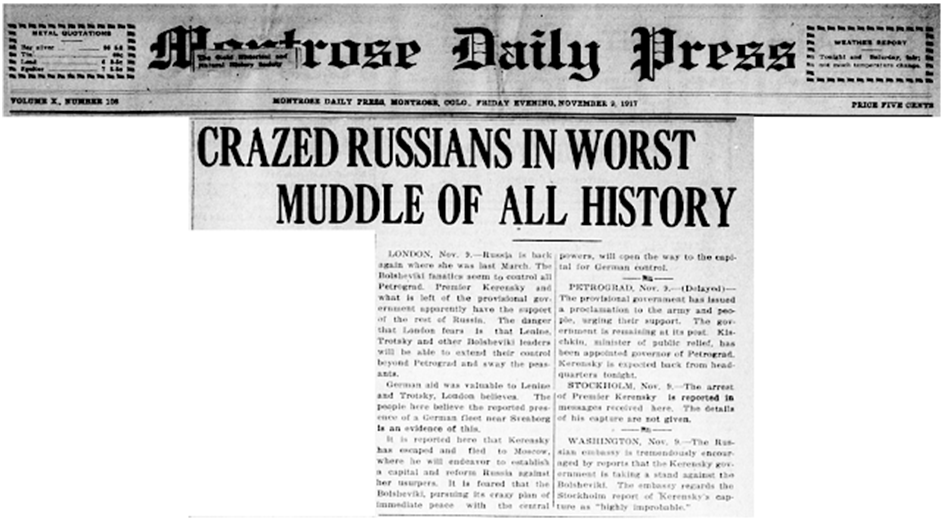
Nov 9th 1917. From https://www.germansfromrussiasettlementlocations.org/2017/11/the-bolshevik-revolution-beginning-of.html

Western journalists knew so little about the Bolsheviks that they confused them, perhaps through a clumsy translation, with the SR Maximalists. The Bolsheviks were an open mass party which rejected terrorism and had hundreds of thousands of members; the Maximalists were a conspiratorial terrorist outfit with a membership of one thousand. But even without the translation problems, many in the Allied camp probably would not have known the difference. They behaved as if a few hundred bohemian bomb-throwers had stumbled into power.

Some were, in hindsight, more sensible: the Tory Arthur Balfour reasoned that hostility to the Soviets would push them into the arms of the Germans, while a pragmatic accommodation with the Soviets might deny the Germans resources and the opportunity to redeploy their armies to the west.[i]

But they were up against others whose grasp on reality was less firm: to Lord Robert Cecil the Soviet regime was ‘outside the pale of civilised Europe’ – and it was treated as such: western diplomacy boycotted Moscow.
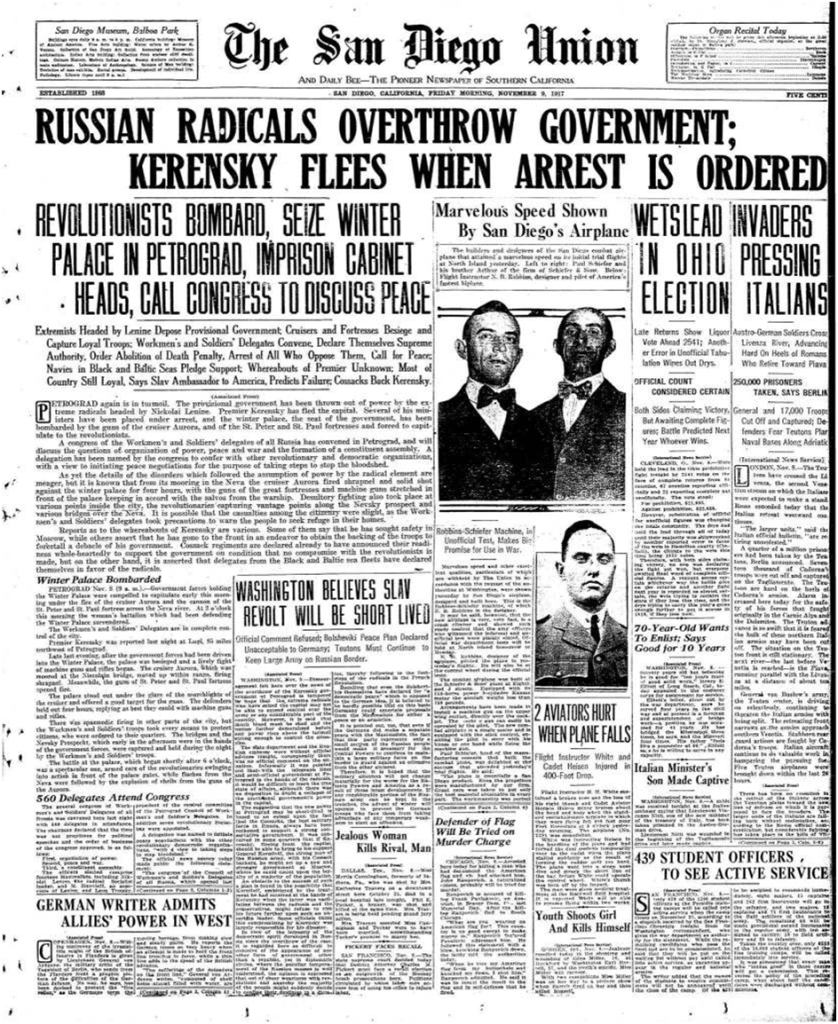
“Revolt will be short lived”!

Journalists who were actually in Russia in the first half of 1918 tried to convey the reality. Louise Bryant from the US bore witness to a revolution that was remarkable for its clemency and tolerance, that had mass support and that had already made drastic improvements to the lives of workers, women and peasants. On Stockholm on her way out of Russia in early summer, she met ‘a correspondent from one of our biggest press agencies,’ who immediately described the Bolsheviks as ‘scum.’

I felt myself forced to ask one more question. ‘If you had to choose between the Bolsheviki and the Germans, which would you prefer?’

Without hesitating he replied, ‘The Germans.’

‘Have you ever been in Russia?’

‘No.’[iii]

Why were they so hostile? We can dismiss any notion that their hostility was based on a prophetic fear of Stalinist totalitarianism. On the contrary, they denounced ‘anarchy,’ ‘chaos,’ ‘adventurers,’ etc. The picture of Bolshevism in their heads was quite the opposite of the totalitarian caricature. The real reasons were as follows:

  • Because the Bolsheviks had pulled Russia out of the war and published the secret treaties between Russia and the Allies. This became especially urgent from Spring 1918, as German forces, reinforced by divisions redeployed from the quiet eastern front, made a devastating offensive, and later Turkey seized Baku.
  • Because the revolution had renounced Russia’s debts to the Allied countries and had nationalised foreign-owned industries.
  • Because the Bolsheviks had made a socialist revolution, which might inspire the workers to take power in other parts of the world.

THE ALLIES

From the very start, Allied powers supported the White Guards. On December 2nd the British cabinet voted to give money to the counter-revolutionary armies of Alexeev and Kaledin.[ii] On December 23rd, Britain and France did a ‘carve-up’ of their respective spheres of influence in Russia: Britain’s ‘sphere’ corresponded suspiciously to British money invested in the oil of the Caucasus, France’s to French money in Ukrainian coal and iron.

Early on, the Soviets tried to come to an understanding with the Allies. With the ever-present threat of the German military, even after the signing of the Brest-Litovsk treaty, a pragmatic orientation to the Allies made sense. There was cooperation early on, for example in relation to Murmansk – where a British battleship fired a salute to the Red Flag, and an Allied train went to the aid of Red Finns against White Finns.

Some Bolsheviks opposed this cooperation on principle, but Lenin spoke for most when he said, ‘We will accept guns and potatoes from the Anglo-French imperialist bandits.’

The Americans were reluctant to intervene at first. President Wilson believed his democratic peace plan, known as the Fourteen Points, would induce the Russians to rejoin the war, and I read that 30,000 copies of it were pasted up by American agents all over the walls of Petrograd.[iii]

Early on, the Soviet regime planned to have a mass civilian militia instead of a standing army. It was in response to the threat of the German military that the Soviet regime shelved this idea and began, from February, to build the Red Army. The Red Army’s first battles at Pskov and Narva, commemorated annually in Russia and beyond even to the present day, were not against the Whites or the Allies but against the German invasion of late February.

Meanwhile in Ukraine the Red Army fought alongside an Allied force against the Germans. This force was the Czechoslovak Corps or Legion.

A Red commander paid tribute to the Czechs’ fight against the German advance: ‘The revolutionary armies of South Russia [sic] will never forget the brotherly aid which was granted by the Czech Corps in the struggle of the toiling people against the hordes of base imperialism.’[iv]

The Germans were ‘the hordes of base imperialism’! Germano-Bolsheviks indeed.

But the World War was the all-consuming priority. Allied representatives promised aid, if only the Soviets would force their own people back into the trenches. They would not. Allied attitudes hardened.

Russia was meanwhile crawling with Allied military missions, officials and agents, a legacy of the war. By May 1918 this apparatus was busy making links and distributing funds. AJP Taylor writes, ‘they imagined that somewhere in Russia was to be found some group of people who wanted to continue the war.’[iv] 

The wealthy, the officers and the professional classes did want to continue the war. They felt humiliated and threatened by the revolution, believed that the fatherland and/or civilisation were about to perish, and still possessed enough wealth, connections, self-confidence and skills to fight back. These people formed leagues, networks, councils, and linked up with foreign powers. Funds were transferred, plans laid, promises made.

At this point the intelligentsia were deeply conflicted about the revolution, symbolised in the split within the SRs. Looking at where the two sides stood in May 1918, it is difficult to imagine that they had ever been in the one party. The Left SRs held high positions in the Soviets, the fledgling Red Army and the Cheka, while the Right SRs were in the various leagues and councils of the underground counter-revolution, shoulder-to-shoulder with Black Hundreds and Tsarist generals.[v] In that milieu they nursed their grudges over the Constituent Assembly and waited for a chance to strike back.

Thus the Allies saw the Soviets as an enemy, and possessed the assets on the ground to wage a struggle against them.

The original purpose of intervention was to rebuild a front against the Germans in Russia, either with the Reds or over their dead bodies.

It is often denied that the Allies wanted, at this stage, to overthrow the Reds. But this second aim of intervention, the overthrow of the Soviet regime, was neatly encapsulated in the first aim from the very beginning.

If the destruction of the Soviet power was only of secondary concern at this point, that is only because the Allies had contempt for that regime. They believed that the Tooting Popular Front had seized power by accident in a temporary episode. They believed the Soviet regime would collapse sooner or later, with or without their intervention.

The first aim was foremost while the war continued; the second aim became obvious when intervention not only continued but deepened after the war’s end.

But counter-revolution would not have assumed the explosive form it did without the Czech Legion. The time has come to explain what this force was doing in Russia.

CZECH LEGION

On Russian soil in 1918 there were tens of thousands of Czech and Slovakian soldiers. Czechia and Slovakia were oppressed by the Austro-Hungarian Empire. A Czechoslovak Legion was initially recruited from among immigrants in Russia, then from among prisoners of war. They were induced to fight with the promise of an independent state after the war. By 1917 the Czechs made up a whole Corps, numbering 30,000-70,000 and fighting on the Eastern Front against the Germans and Austrians, under Russian officers and with liaisons and attachés from the Allied powers.
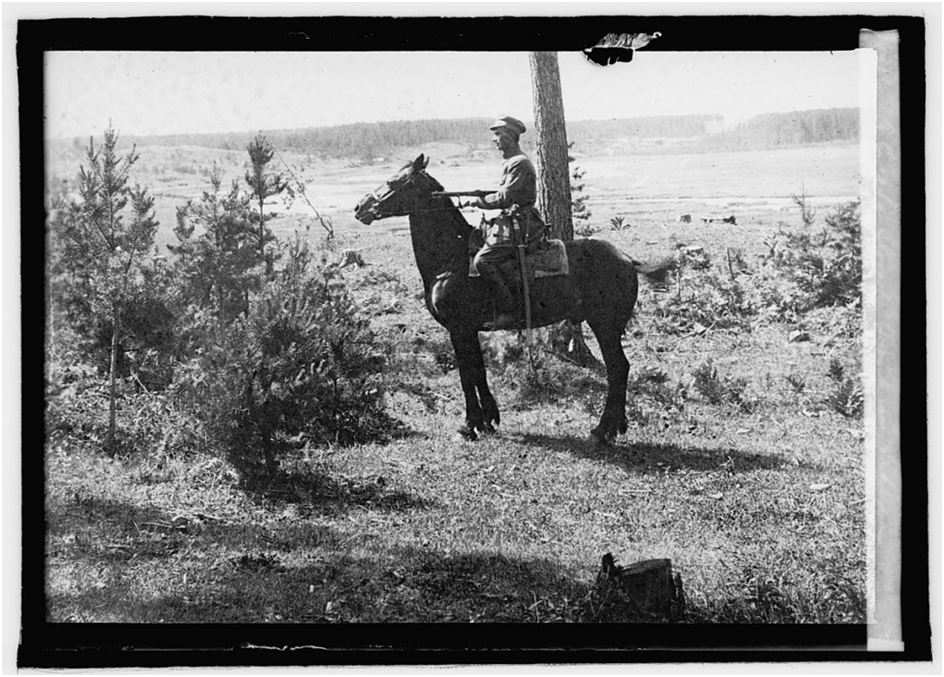
A Czechoslovak scout

The Czechs[vi] did not join in the Russian Revolution. While the Russian army disintegrated, the Czechoslovak Legion remained cohesive. The Russian soldier deserted and went home to his land. The Czech had no home. He was fighting against Germany and Austria to secure one, and he was determined to carry on the fight.  

Virtually all other military forces, both White and Red, were either in the final stages of collapse or just coming into being. In the Legion, then, the Allies possessed a unique asset that could really test the strength of Soviet power: a military force that was large, cohesive and present.

Various telegrams and other communications between British agents on the ground and their superiors in London are referred to in the postscript which Peter Sedgwick has added to Victor Serge’s book Year One of the Russian Revolution, published by Haymarket Books, 2015. Taken together they show the outlines of the Allied plans, which had four main elements:

  • A revolt of the Czech Legion against Soviet power, possibly linking up with the White warlord Semyonov, who was raiding across the border from China.[v]
  • Several central Russian towns to be seized by officers, Black Hundreds, Right SRs etc, designed to encircle Moscow.
  • These Czechs and White Guards to link up with the British, French and US forces at Archangel’sk, in the far north of Russia.
  • Another element of the plan was outlined by Balfour, previously a critic of intervention: the Czechs could be used to trigger a conflict, drawing in Japan and the US who had been reluctant up to that point. ‘If we act, the Japanese will; if the Japanese do, the United States will.’[vi]

General Lavergne of the French mission in Russia, after explaining this plan to a colleague, added, ‘But I shall feel guilty because, if our plan succeeds, the famine in Russia will be terrible.’ The plan did not succeed entirely, but as we will see the resulting famine was indeed terrible, probably beyond Lavergne’s ability to comprehend.

The French had a second misgiving about the plan: they would rather have the Czechs on the Western Front. But these were misgivings, reservations, not opposition. Simply put, Allied agents ‘had been plotting for [a Czechoslovak revolt] since… late 1917.’[vii]

The Czechs themselves, for the most part, wanted to get out of Russia and to fight on the Western Front. Both the Tsar and Kerensky had refused to let them go. The Reds, however, made a sincere effort to grant this wish. At first there was no ill-feeling between the Reds and the Czechs; the Czech rank-and-file were mostly republican or social-democratic in their sympathies. Czech leader Masaryk had ignored appeals from Alexeev to join the White Guards. The Reds allowed them to travel with 168 rifles and one machine-gun per carriage – this shows trust, not draconian suspicion (and on top of this, the Czechs had concealed weapons).

But the Soviets were bedevilled by the challenges of transporting tens of thousands of soldiers out of a vast, hungry, war-torn territory. First it was decided – by the Reds and the Allies – that the Czechs were to circumnavigate the globe via North America to get from the Eastern Front to the Western Front. So the Soviets began to move the Czechs from European Russia to the Pacific Ocean. But on April 4th Japan (a member of the Allies) made a first tentative landing at Vladivostok in the far east, which was the Czechs’ destination. Later in the year the Japanese would occupy eastern Siberia with an army of tens of thousands, so Moscow’s fear that the landing was part of a full-scale invasion was reasonable. This fear meant that the Czechs were left stranded for a week, strung out in detachments all along the Trans-Siberian Railway from the Volga to Vladivostok. Tension was rising: on April 14th a Czech congress demanded more weapons, plus control over their locomotives. 
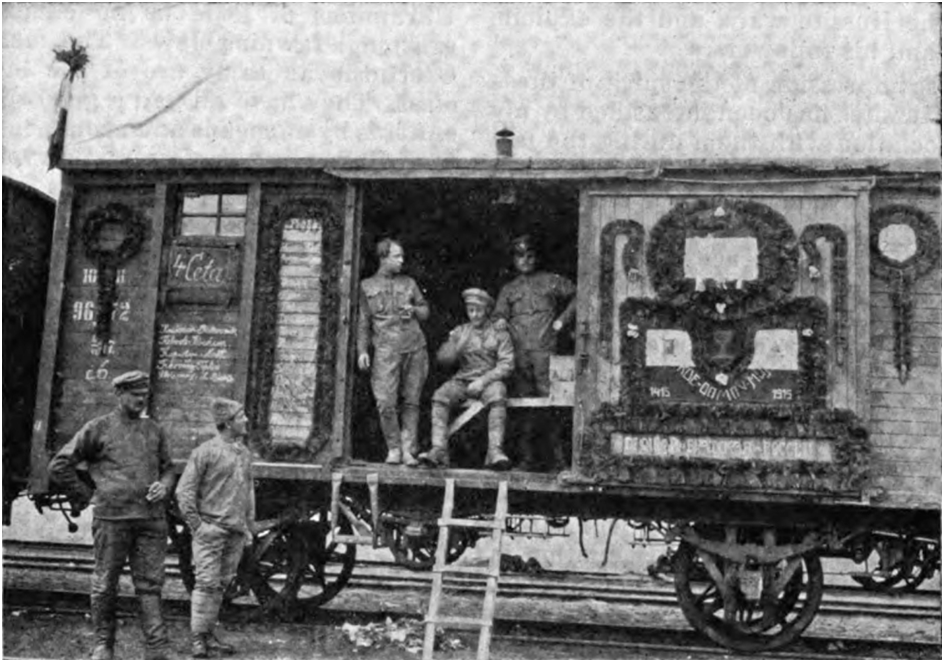
Czechs on the railways

Meanwhile it was far from pleasant for the Czechs to be high and dry at railway stations spread across the whole breadth of revolutionary Russia. Raids by White warlords caused further delays, and these delays bred distrust. Local soviets were sometimes truculent, even hostile. The Czechs, egged on by SRs and Allied agents, suspected that the Soviets were working hand-in-hand with the Germans and were somehow plotting to hand them over. The Soviets, on their side, suspected that the Czechs might join the White-Allied cause.

Czech fears were delusional in that there were no German soldiers within thousands of kilometres of even the westernmost of the Czech detachments. But millions of people were moving across Russia at that moment in the opposite direction to the Czechs, prisoners of war from the German, Austro-Hungarian and Turkish empires, released and being borne home (Among them was Josip Broz who would later be known as Tito, Bela Kun who would lead the Hungarian Soviet Republic, and the writer Jaroslav Hašek). The Czechs identified these former POWs as proxy Germans, as a threat. Even if they weren’t a threat, they were still a nuisance to the Czechs, burdening the railway system and causing further delays. The tragedy is that they were mostly subject peoples of Austria, like the Czechs, and like the Czechs all they wanted to do was go home – and, no doubt, like the Czechs they were frustrated with the state of the railways and the often-squalid and chaotic conditions in Russia.

In short, there was a massive armed-to-the-teeth traffic jam on the railways, and no solution in sight. An alternative plan to move half of the Czechs north and ship them out of Archangel’sk was agreed by the Allies and the Soviets. But the Czechs were angered by this plan, and further frustrated by another week-long delay caused by White attacks.

On May 14th, Czechs going east and Hungarians going west met at a railway station in the Ural town of Chelyabinsk. In that same town at that moment a Czech congress was taking place, discussing how to get out of Russia.

At first the Czechs and Hungarians were friendly enough; the Czechs shared rations. Then an argument broke out, and a Hungarian threw a scrap of iron at a group of Czechs. Someone fell – scholars are not sure if it was a fatality or an injury. Czechs lynched the Hungarian.

The Chelyabinsk town soviet investigated the murder and arrested several Czechs for questioning. The Czechs were furious. They sent two battalions into town, disarmed the Red Guards, seized the arsenal and freed their comrades.

The situation in Chelyabinsk was actually settled by negotiations. But by then word of it had got out, and there was no going back. ‘To the Bolsheviks,’ says Silverlight, ‘the Chelyabinsk incident must have looked like unprovoked aggression.’ Trotsky, the Commissar for War, ordered the arrest and disarming of the entire Czechoslovak Corps.

I’ve mentioned that there was a conference going on in Chelyabinsk during all this drama. Allied agents met with the leaders of the Czech Legion at this conference and on May 23rd the Czechs agreed to join an all-out armed struggle against the Soviets. Two days later, on May 25th, Trotsky ordered that the Czechs not just be disarmed, but that any armed Czechs be shot on the spot.

In some accounts I’ve read, all the above is summarised very quickly, and the impression is given that Trotsky’s second, more severe order to disarm the Czechs was the inciting incident.

While Trotsky issued his orders, violence was flaring up in half a dozen places along the Trans-Siberian Railway. In town after town, the Czechs drove out Soviet power. There were 15,000 Czechs in Vladivostok – who were still there because the Allies had, through negligence or design, failed to provide ships to get them out. On June 25th these Czechs seized the town and linked up with the Allied naval forces which had been gradually massing in the harbour all year. By this stage they were fully committed to all-out war.

Silverlight attributes this all to a string of misunderstandings. This is a common trope. I am less charitable. It seems clear to me, beneath the usual plausible deniability, that the British and French governments each played a role in using the Czechs to trigger a war. French policy was more reluctant (they wanted the Czechs on French soil to defend Paris, on which the Germans were advancing) but they were also more active in funding Russian counter-revolutionary groups. It’s difficult to see how things could have gone down the way they did without the Allies’ utterly deluded project of rebuilding a front against Germany.

The Czechs’ perspective seems to have been that the Bolshevik adventure would collapse and a new Eastern Front for World War One would take shape in Russia. What they ended up doing was setting up a new Eastern Front within the Russian Civil War. Their tragedy is that all they wanted to do was get the hell out, but in their impatience they triggered a war from which they would struggle to extricate themselves for two more years.

The plans of Britain and France were partly frustrated. Their forces in the Arctic would have been too little, too late to help the Czechs or the Whites. That would be if the Czechs had consented to march north, which they did not. The plan for White-Guard risings fell short by a long way, as we will see in the next post. In short, the French and British conspiracy came off about as well as any plan of such ambition and scale could be expected to, in the confusion and vast distances of revolutionary Russia. Also, they spectacularly underestimated the stability and social base of the Soviet regime.

But that last point was not at all obvious in the Spring and Summer of 1918. The result of all these plans was an earthquake under the feet of Soviet power. The Czech Revolt presented an opportunity for all the organisations of counter-revolutionaries and many of the Cossack hosts to rise up. ‘Revolt flared along the powder trail of the [Czech Legion’s] scattered elements, stretching over 4900 miles of the Trans-Siberian Railway.’[viii]Moscow was cut off from a vast and rich territory, from tens of millions of workers and peasants.

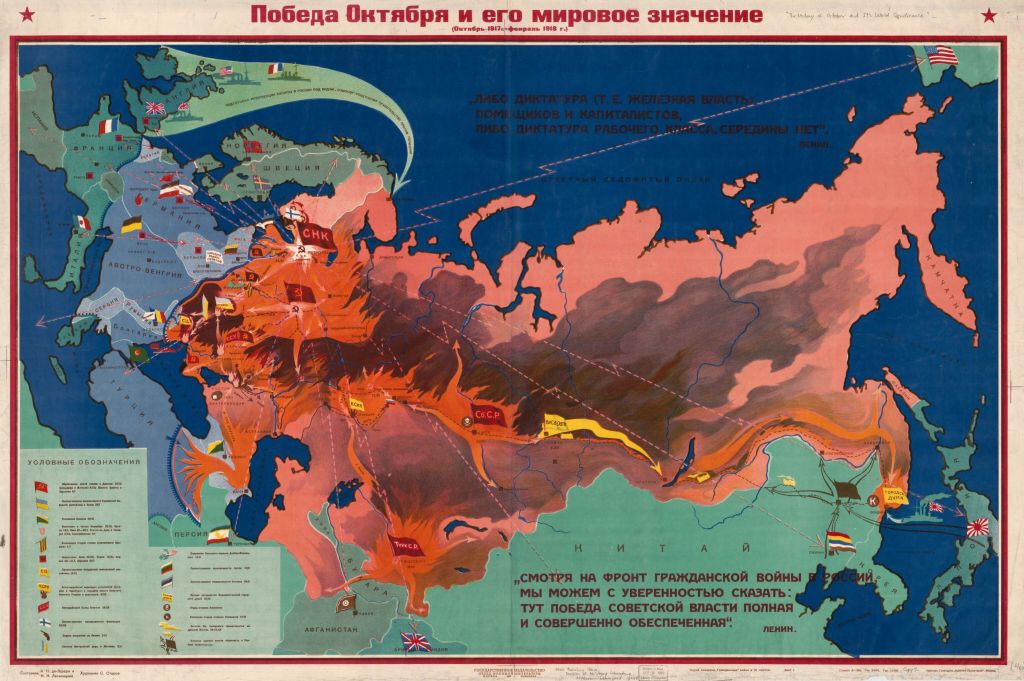
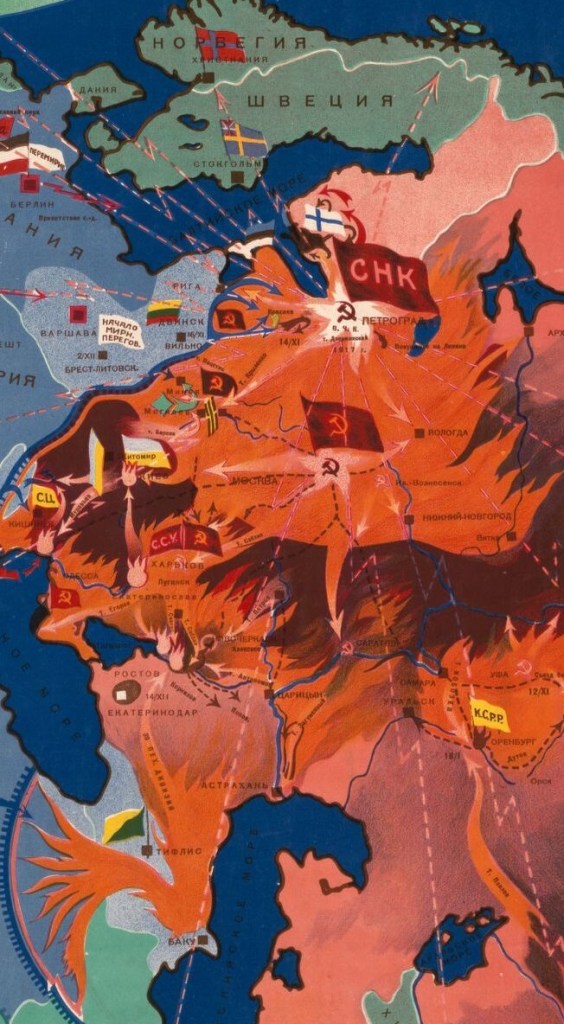
Another detail from Map 3 of the series. Moscow and Soviet territory are in the north-west corner. Note what a vast expanse of territory they don’t hold. The Green men represent Allied-oriented soldiers – Czechoslovaks, for the most part, stretched out across the Trans-Siberian from The Middle Volga all the way to Lake Baikal. The French flag represents the French officers who staffed the Legion – they were formally part of the French Army. The yellow flag surrounded by outward-thrusting yellow arrows is marked ‘Komuch’. The sinuous red arrow may represent the workers of Ekaterinburg, Troitsk and Verkhne-Uralsk in their heroic march under Blyukher (I’m not sure if the geography is right so it might represent something else). The execution of the royal family is marked by an X over the crown. See the green-and-white Siberian flag raised at Omsk. All the yellow pockets represent the Right SRs – the ones in the far east are marked “SR detachment” and “People’s Army.”

KOMUCH

Under the wing of the Czechs, new White governments sprouted like mushrooms after rain. They expanded, shrank, absorbed one another peacefully or at gunpoint.

The most interesting of the new governments was led by the Right SRs. In early June Czechs were passing through Samara on the Volga on their way east. Local Right SR party members convinced the Czechs to stay and to help them seize power. The Czechs agreed. On June 9th at dawn they overthrew Soviet power in Samara. That evening the Committee of Members of the Constituent Assembly was set up. The name, abbreviated as Komuch, claimed the dubious electoral mandate which we looked at in Part 3.

Komuch was later referred to by Soviet historians as part of the Democratic Counter-Revolution. It is tempting to put scare quotes around the word ‘Democratic’ there; in the formal sense of being elected, the rule of law, democratic freedoms, etc, Komuch was no more ‘democratic’ than any other force operating in the war-torn Russia of 1918. The Constituent Assembly was in its name, but it never got a quorum of deputies together in one place. According to a report from a Komuch organ, ‘At Simbirsk, most of the Red Army soldiers captured in the town were shot. There was a real epidemic of lynchings.’ In August Komuch set up its own repressive police organ to parallel Moscow’s Cheka.

But the term ‘Democratic Counter-Revolution’ does not refer to democratic forms. It refers to property. Komuch was bourgeois-democratic in the classical sense that it was anti-landlord but pro-capitalist. It did not attempt to give the landlords back their land, but it ended workers’ power in the factories and brought back the private owners.
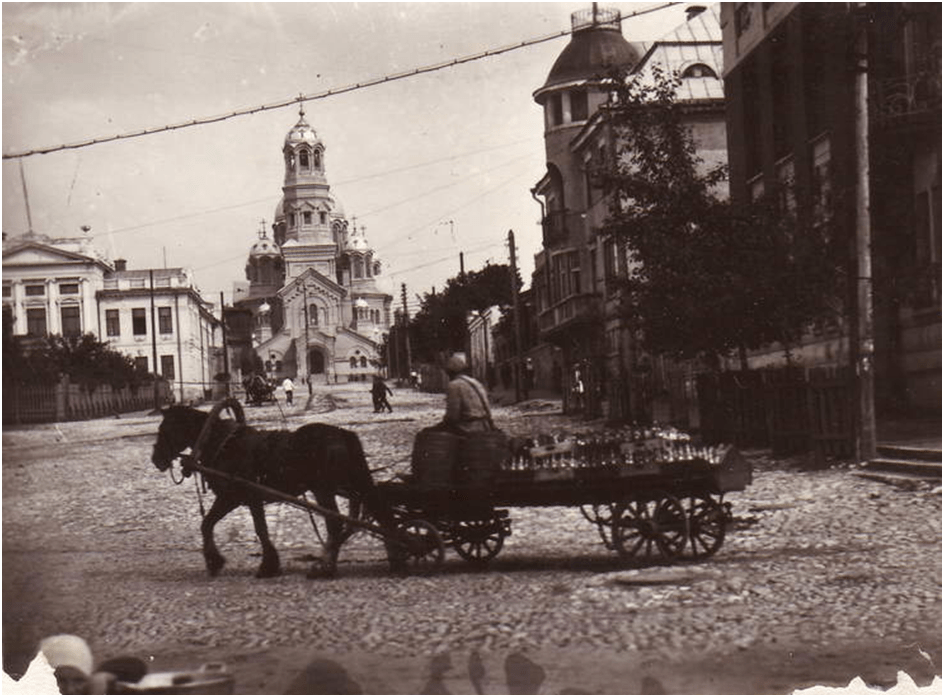
Cathedral in Samara, some time around 1918

FAILURES OF THE RED ARMY

How was the new Red Army coping with all this?

When the Czechoslovak Legion revolted in the east, the Red Army was a thousand-plus miles away and facing in the other direction. As Mawdsley says, ‘the new army was pointed backwards.’[ix] Along with the simultaneous Cossack Revolt in the South, the Czech Revolt marked the real start of the Civil War. It should be obvious how little the Red side expected or prepared for, much less planned or wanted, that war. The Red Army had designated the Volga and the Urals as ‘Internal’ not ‘Border’ regions. So little did the Soviet government anticipate civil war in the east that their contingency plan in the event of German invasion, as we have mentioned, was to retreat east and form an ‘Uralo-Kuznets Republic’ in the Urals and Siberia. That was obviously off the agenda now.

Meanwhile in the Urals and along the middle third of the great arc of the Volga, local Soviets surrendered or fled without a fight. Where the Red Guards tried to fight back, they suffered humiliating defeats. Trotsky held out hope, manifested in alternating dire threats and magnanimous appeals, carrots and sticks, right up until November, that the Czechs could be split along class lines like the Don Cossacks in January 1918. It was not to be.
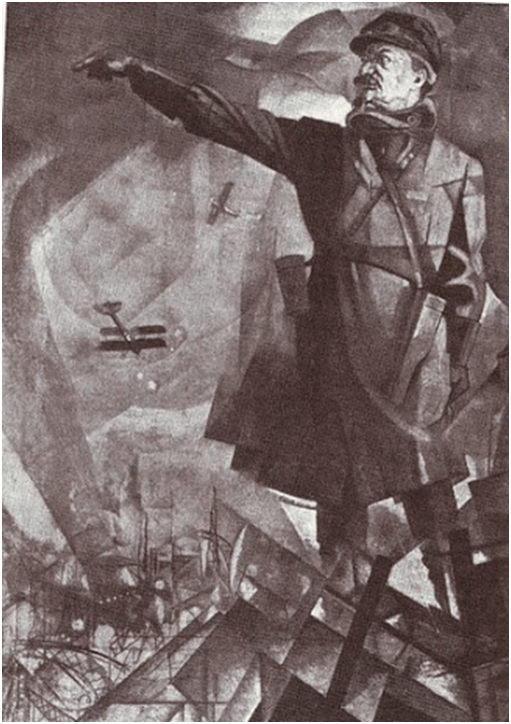
Trotsky, Commissar for Military and Naval Affairs

Irregular ‘detachments’ of workers, thrown together from whatever volunteers presented themselves, had been sufficient in the early months after the October Revolution. But now full-scale civil war had broken out. To win, the Reds needed a real army. This was something they did not have. Facing the Czechs near Chelyabinsk, for example, was a force of 1,000 armed Red Guards, made up of thirteen local detachments numbering from nine members to 570, each with its own commander, each pretending it was autonomous.

By the river Kyshtyma, Red Guards heard a rumour that the enemy were approaching their home villages; whole units deserted the frontline to defend their own homes.

Nearby, the Seventh Ural Regiment was absent from its positions. The commander reported: ‘The men wanted to get themselves dry and have a sleep; they decided to go off only for half an hour but are still sleeping; I can’t do any more.’[x]

KOMUCH IN POWER

Faced with this kind of feeble resistance, or even sometimes no resistance at all, the Czechs took over the Middle Volga region. Komuch would set up shop in each locality before the dust had settled. French officers would start to appear in great numbers. Students and Russian officers would go on a reign of terror against local workers, and Komuch would make half-hearted and impotent appeals for the killing to stop.

According to the Czechoslovak nationalist leader Beneš, ‘The Czechoslovak army on principle shoot every Czech found fighting with the Red Guards and captured by them, for instance at Penza, Samara, Omsk etc (200 at Samara).’[xi]
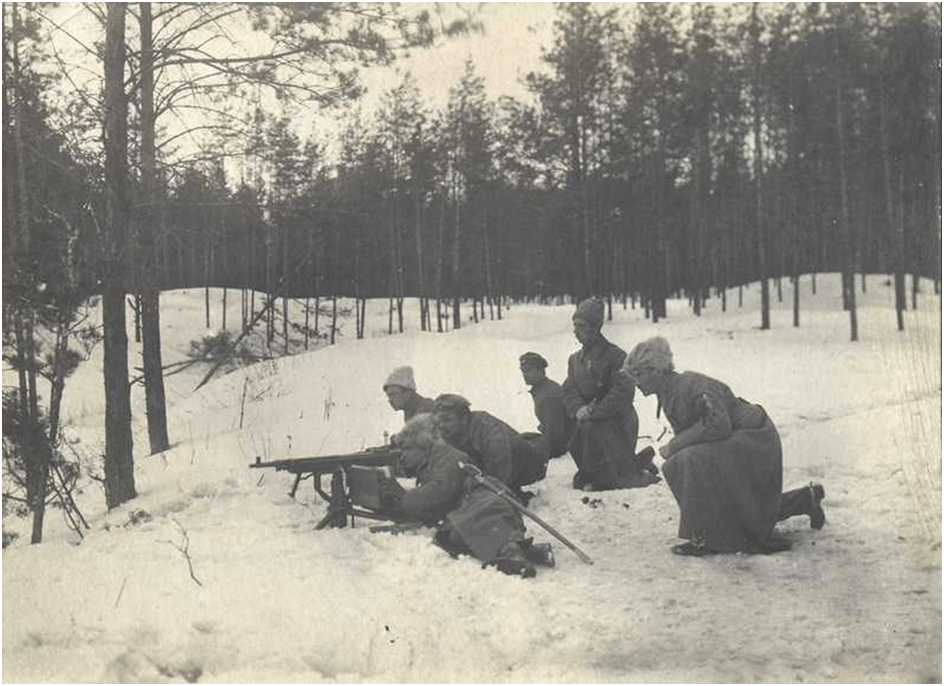
Czech Legion members, later in 1918

Komuch would restore the bosses to their factories and end fixed grain prices. On the other hand it would confirm the peasants in the ownership of the land. It flew red flags over public buildings and held peasants’ conferences. It formed a military force called the People’s Army. It even attempted to set up a Soviet – which was hastily disbanded after it passed a Bolshevik resolution!

At its height, this state had twelve million people in its territory. It held rich land, key transport links and important cities such as the capital, Samara. It included at its furthest reaches the factory town of Izhevsk. The munitions workers there, who were loyal to the Right SRs, rose on their own initiative to join Komuch – a unique episode of an armed workers’ revolt against rather than for the Soviets. ‘The Samara Komuch never paid much attention to distant Izhevsk.’[xii] But the Izhevsk workers formed a cohesive unit in successive White armies.[xiii]

Mawdsley asks, ‘Did the [Izhevsk] rising foreshadow what would have happened had the People’s Army succeeded in striking west?’ There are good reasons to doubt it. It is striking that in a territory embracing 12 million people, there was only one Izhevsk.

The wealthy classes owed a lot to Komuch, but they did not repay it with loyalty. The well-off citizens were happy to carry out terror in the rear, but in general did not deign to go anywhere near the frontline. One business owner summed up the attitude of the wealthy to the struggle between Komuch and the Reds: ‘When two dogs are fighting, a third shouldn’t join in.’ In the eyes of the bourgeoisie, the Right SRswere on the same canine level as the Bolsheviks.

Recall Lenin’s anxious remark as he contemplated the Komuch territory on a map: ‘I know the Volga countryside well. There are some tough kulaks there.’ He was born and raised in Simbirsk, which fell to Komuch on July 22nd. We can safely assume that the Middle Volga kulaks (the relatively rich peasants) were happy to be out of the grip of Soviet power; now they could sell their grain at whatever price they liked, or indeed not sell it at all. But the poor and middle peasants showed no enthusiasm for the new regime. The Right SRs had received a very impressive vote in this region in the Constituent Assembly elections, but in the end that didn’t translate to very much.

Komuch attempted to recruit 50,000 soldiers from the rural population, but only managed 10,000-15,000. After this failure 30,000 were conscripted. There was no time to train them up, and arms were in short supply, so a large part of the People’s Army was shut up in barracks. There were small, capable detachments under a talented and popular commander, a Russian officer of the Czech Legion named VO Kappel. With considerable Czech assistance, these detachments took town after town. But they were always on an exhausting itinerary, being shuttled up and down the Volga fighting the Reds in one place after another.

In general, as we have seen, workers were hostile to Komuch. For every Izhevsk, there were several stories of heroism on the part of Red-aligned workers. The people of Ekaterinburg, Verkhne-Uralsk and Troitsk, miners and factory workers, formed a partisan army to oppose the Czechs. This army consisted of 10,000 fighters, followed by civilians in carts with their samovars and household linen. Surrounded, they had to fight their way over mountain ridges and across rivers, covering 1,000 miles in fifty days. Arms were scarce; many fought with pikes and clubs and even old weapons from museums. They manufactured their own bullets wherever they could find equipment. At around the same time, a similar Anabasis was taking place in the South, where the Taman Red Army escaped from the Kuban Cossacks.

Vasily Blyukher, leader of the 10,000-strong partisan army of Ekaterinburg, Troitsk and Verkhne-Uralsk

Heroism by itself was not sufficient to win this war. But it mattered. When Service writes that the October Revolution was basically a matter of Trotsky firing up a bunch of ‘disgruntled’ soldiers, and when Ulam claims that the Bolsheviks deliberately fomented chaos in order to step into a power vacuum, and when a documentary on the Russian Revolution gives no reason for its success except ‘the skilful use of black propaganda,’[xiv] they are wide of the mark. The revolution was not some trick played behind the backs of the people. It would not have survived without the sincere enthusiasm of millions. The heroic marches in the Urals and the Kuban were of minor military significance in themselves. But they were evidence of that enthusiasm and spirit of self-sacrifice, which would prove decisive over the next few years.

SAMARA AND OMSK

While Komuch fought with the Reds to the west, it was waging a peaceful but bitter struggle with a rival White government that had sprung up to its east: the Provisional Siberian Government.

The vast expanse of Siberia was populated by Russian settlers and a wide range of indigenous peoples. Class distinctions were not so stark here as elsewhere, and the Communist Party had received only 10% of the Constituent Assembly votes – as against 25% nationally. Three-quarters of Siberian votes had gone to the SRs. Since then, ‘hamfisted’ attacks on the farmers’ co-operatives had damaged the popularity of the Soviets. There were solid Red Guard units in Siberia – but they were away beyond Lake Baikal far to the east, battling the warlords Semyonov and Ungern. Meanwhile there were several Cossack hosts ready to kick off rebellion at any moment – the Siberian Host alone numbered 170,000 – and an underground White network of 8,000 officers, one-third of them concentrated in the city of Omsk.

When the Czech revolt took place, all this dry kindling went up in flames. The Cossacks and the officers rose up. Here as on the Volga, Czech assistance was key; there was only one city (Tomsk) which the Siberian Whites captured without their assistance. But Soviet power was wiped off the map of Siberia. Workers took to the forests and formed the nuclei that would later become Red partisan armies.

From the chaos emerged a new power, centred on the city of Omsk: the Provisional Siberian Government, founded at the end of May.[xv] This government flew a white-and-green Siberian flag – white for snow and green for the coniferous trees of the taiga. This was a nod to a tradition of Siberian regionalism, which The Provisional Siberian Government (henceforth ‘Omsk’ for short) managed to bring on board, albeit in a way that was only ‘skin-deep.’[xvi] It was a stern conservative regime which represented the rifles and sabres of Tsarist military remnants rather than any popular mandate, even a contrived one.
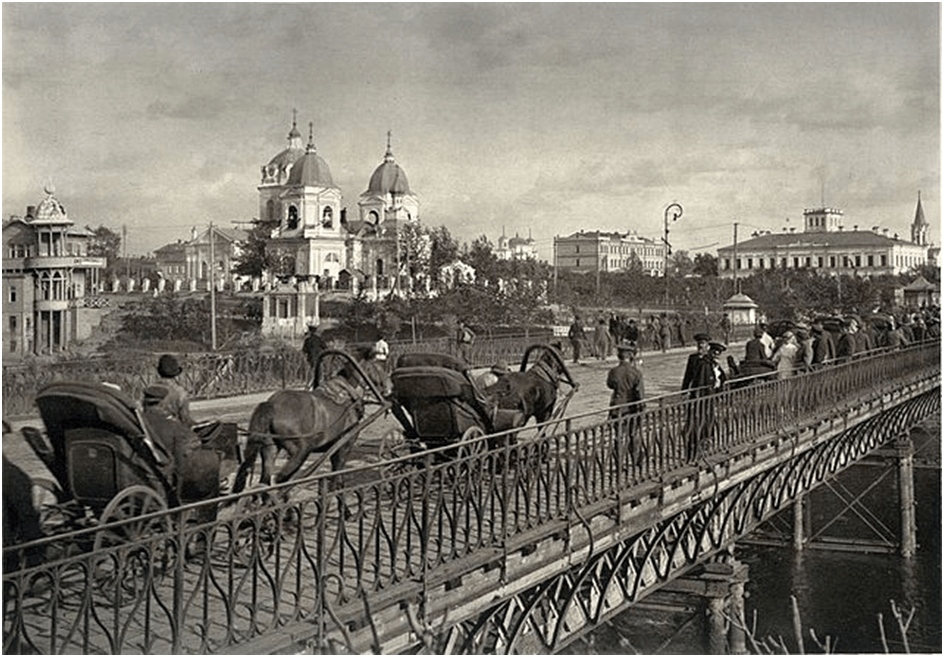
The Iron Bridge, Omsk

In Siberia the SRs were even more popular than on the Volga. But in Siberia, even more so than on the Volga, this support base punched below its weight. This proved how passive and confused that vote was. There was an elected Siberian Regional Duma, which Komuch and the SRs attempted to convene, but the Omsk Government shut it down. This was one of many significant clashes between Komuch and Omsk.  

Komuch was not the only example of the Democratic Counter-Revolution. At this point it’s worth getting ahead of ourselves chronologically to look at the trajectory of some of the other governments in a similar mould to Komuch. The British in Persia linked up after the fact with an uprising in the Transcaspian region on 11-12 July. The Reds were chased out, and a Transcaspian Provisional Government led by SRs and Mensheviks ruled there until January when it was replaced by the ‘far more conservative’ Committee of Social Salvation. In July 1919 this government merged with the White regime of General Denikin in the south of Russia. In short, this Central Asian equivalent of Komuch was cannibalised by the reactionary generals.

The snows of North Russia saw the same political developments as the sands of Central Asia, only at a faster pace. On August 2nd the British forces landed at Archangel’sk. On the same day, the Archangel’sk Soviet was overthrown in a military coup, and the Supreme Administration of North Russia came to power. This was staffed by Right SRs and led by Chaikovskii of the Popular Socialist party. On September 6th the local military forces, supported by the Allies, overthrew this ‘moderate socialist’ government. Chaikovskii was first deposed, then brought tentatively back into the fold, then exiled.

Smele writes:

On the day of Chaikovskii’s departure, 1 January 1919, there duly arrived at Archangel’sk General EK Miller, who was to become military governor of the region for the remainder of the Civil War in the North. They must have passed each other in the harbour; socialist democracy was leaving Russia as White militarism disembarked.[xvii]

The ‘Democratic Counter-Revolution’ had suffered the same fate in Central Asia and in the Arctic Circle: a government of ‘moderate socialists’ had come to power with the help of right-wing authoritarian officers and Allied interventionists, only to realise sooner or later that it existed on their sufferance, that it had no social base of its own, that in the polarised conditions of civil war the fate of ‘moderates’ could not be a happy one.

Would things turn out the same way for Komuch?

Later we will trace a similar conflict between ‘moderate socialists’ and militarism in the relationship between Komuch and Omsk. But at the height of the revolt in Siberia, in July, seismic events occurred behind Red lines, and these will be the focus of the next post.


Sorry the footnotes are a mess. I’ll sort them out when I get a chance. Though they are in two different formats, it should still be possible to follow up any quotes or facts.

[i] Robert Silverlight, The Victors’ Dilemma: Allied Intervention in the Russian Civil War, p 8-9

[ii]Silverlight, 10

[iii]Silverlight, 19

[iv]Silverlight, p 33

[v]Silverlight, p 35

[vi]Silverlight, p 36

[i] Tsederbaum (not Zederblaum) was actually the name of Lenin’s former comrade, now opponent, Julius Martov of the Menshevik-Internationalist faction.

[ii] Ransome, Arthur. The Truth About Russia. 1918. https://www.marxists.org/history/archive/ransome/1918/truth-russia.htm

[iii] Bryant, Louise, Six Red Months…, Chapter XXXI. https://www.marxists.org/archive/bryant/works/russia/ch31.htm

[iv] Taylor, AJP. The First World War…, p 205

[v] Dr Zhivago imagines that, at the fictional battle of Yuriatin, the Red and White commanders are former neighbours and revolutionary comrades from Moscow. While I have questions about the novel’s timeline, I think this detail is plausible enough.

[vi] It is fair to refer to them as Czechs since only around one in ten were Slovaks.

[vii] Smele, The ‘Russian’ Civil Wars, 68

[viii] Mawdsley, The Russian Civil War, 64

[ix] Mawdsley, 82

[x] Serge, Year One, 311

[xi] Serge, 496

[xii] Mawdsley, 90

[xiii] Khvostov, The Russian Civil War – The White Guards, p 46. They addressed one another as ‘comrade’ and attacked to the music of accordions. They maintained their cohesion right to the end of 1920, after which many settled on farms in Manchuria.

[xiv] See (or don’t!) Service, Robert, Trotsky: A Biography, Belknap Press, 2009, Ulam, Adam B, Lenin and the Bolsheviks, 1965, The Russian Revolution (documentary film), Dir. Cal Seville, 2017

[xv] For the first month of its life it bore the name ‘Western Siberian Commissariat’

[xvi] Smele, 70

[xvii] Smele, 72
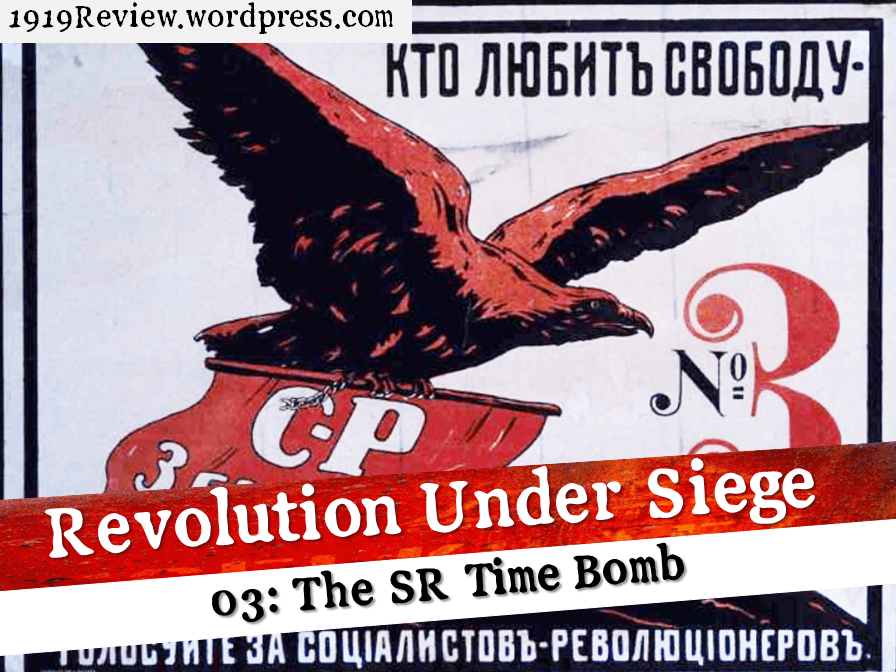
03: The SR Time Bomb

Listen to this post on Youtube or in podcast form

In May 1918 the simmering civil war in Russia went suddenly to boiling point. The working class was looking west to the danger of German imperialism, not south to the Cossacks or east to Siberia. But in May twin explosions of revolt occurred in the South and in the East. In a few months, the Soviets lost control over two-thirds of the territory of Russia.

These revolts were brought about by three major forces. The first is familiar to us, their motivations obvious: the officers and the Cossacks, who were involved both in the south and in the east. The second is the foreign interventionists; German invasion in the south triggered the revolt there, and Allied intervention played a key role in the explosion in the east. The third, active in the east but not in the south, was the Socialist Revolutionary Party. This surprising new addition to the White cast of characters will receive the most attention from us in the coming episodes.

But to understand the motivation of the SRs, we have to back-track to a profound humiliation they suffered in January of 1918.

Down at the Depot

At this moment, in the early days of the year, the calendar had not yet been changed and the struggles in Kyiv and on the Don were not yet concluded.

By a quiet canalside in Petrograd stood a naval depot, and inside the sailor Raskolnikov was arguing until he was hoarse. His real name was Ilyin – his alias ‘Raskolnikov’ suggests the Russian word for ‘heretic’ and is also the name of the killer in Dostoevsky’s Crime and Punishment. Raskolnikov was in his late 20s, an ‘Old Bolshevik’ by the standards of his comrades. He had known the inside of Tsarist prisons, and was a respected leader among the Kronstadt sailors. 

The scene inside the depot club was one familiar to those who had lived through the revolutions of 1917: a mass meeting of sailors in the dim light of electric lamps, orators on the low platform inciting them to revolt against the government. But the speakers on the platform were not Bolsheviks. They were leaders of the Socialist Revolutionary party.

A parliament called the Constituent Assembly was due to open in a few days’ time, and in that assembly would sit a decisive majority of right SR deputies. They planned to wrest control from the Bolsheviks and from the Soviets, and they would need a few thousand armed sailors and soldiers to give physical force to whatever moral force their parliamentary majority could command.

‘You Bolsheviks have blood on your hands,’ an SR speaker growled from the platform of the sailors’ club, shaking his finger.

But Raskolnikov was there to answer their arguments. His memoirs do not record what exactly he said, but it worked. The SRs were defeated in the depot, as they were in every unit of the garrison.

They settled for calling a street demonstration on January 4th, the day the Constituent Assembly was due to meet. Also, they still had their majority in the Constituent Assembly. How had they managed to win this majority in the first place?

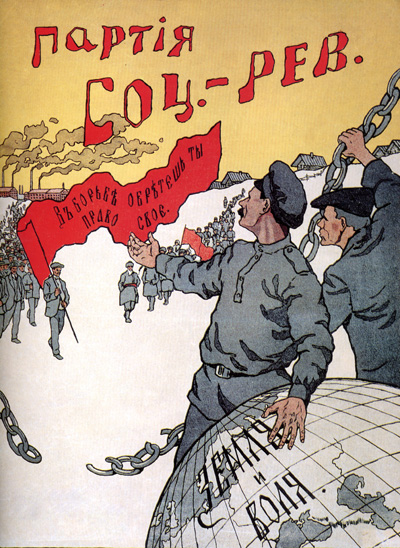
The cover image is an election poster for the SR party

THE SOCIALIST REVOLUTIONARY PARTY

Before 1917, the Socialist Revolutionary party were a presence in the revolutionary milieu. Their members took pride in their roots in the terrorist movement which had claimed the lives of Tsars and ministers. But the party was changing. In 1904 the SR Maximalists, a group of around a thousand members, split away. They were dissatisfied that the party was becoming moderate, respectable, middle-of-the-road. But as we will see, the SR tradition never really let go of terrorism.

During the year 1917, the Socialist Revolutionaries were a key force in the Provisional Government. Along with the Mensheviks, they were the ‘moderate socialists’ who continued the war, dragged their feet on the land question, insisted on coalition with the right, and presided over an economic crisis that threatened the cities with mass unemployment and famine.

There was trouble in the ranks of the party. In the words of Smith, ‘From May [1917] left-wingers in the SRs began to crystallize as an embryonic party, by virtue of their support for the peasants’ seizure of landowners’ estates, their hostility to the ‘imperialist’ war, and their backing for a pan-socialist government.’ The party now had 700,000 members, and ‘by autumn most party organizations in the provinces had come out in favour of power to the soviets.’[i]

The leader of the Left SRs was Maria Spiridonova whom we met in Part 1, whose brutal treatment in prison had shocked the world.

Bryant writes: ‘An All-Russian Peasants’ Conference was held in Petrograd shortly after the [October Revolution]. The majority of the delegates came right Socialist Revolutionists–in three days they had joined the left wing; had elected Spirodonova president and gone over to the Soviets, marching in a body to [the Soviet headquarters]. There were two All-Russian Peasants’ assemblies–both did the same thing.’[ii]

A peasants’ congress in 1917

Unlike Lenin and the Bolsheviks, the SRs had a severe aversion to splits. As late as the October Revolution itself, the Left and Right SRs were still formally in one party, even though they were on opposite sides of the barricades. Kerensky, the last leader of the Provisional Government, was a Right SR; he sent Krasnov and his Cossacks to attack Petrograd a few days after the October Revolution. An officer named Murav’ev defeated the Cossacks and captured Krasnov – and this Murav’ev was a Left SR. The Left and Right SRs were literally shooting each other in the streets. But they were doing so under the same banner and with the same party membership card in their pockets. The split did not happen until December 1917.

ELECTIONS

Elections to the Constituent Assembly were held in the weeks after the October Revolution. The Constituent Assembly Elections were yet another thing the Provisional Government had promised but had kept delaying, and which the Bolsheviks delivered a few weeks after taking power. The irony was that Bolsheviks believed that the Soviets were a superior form of democracy to any parliament.

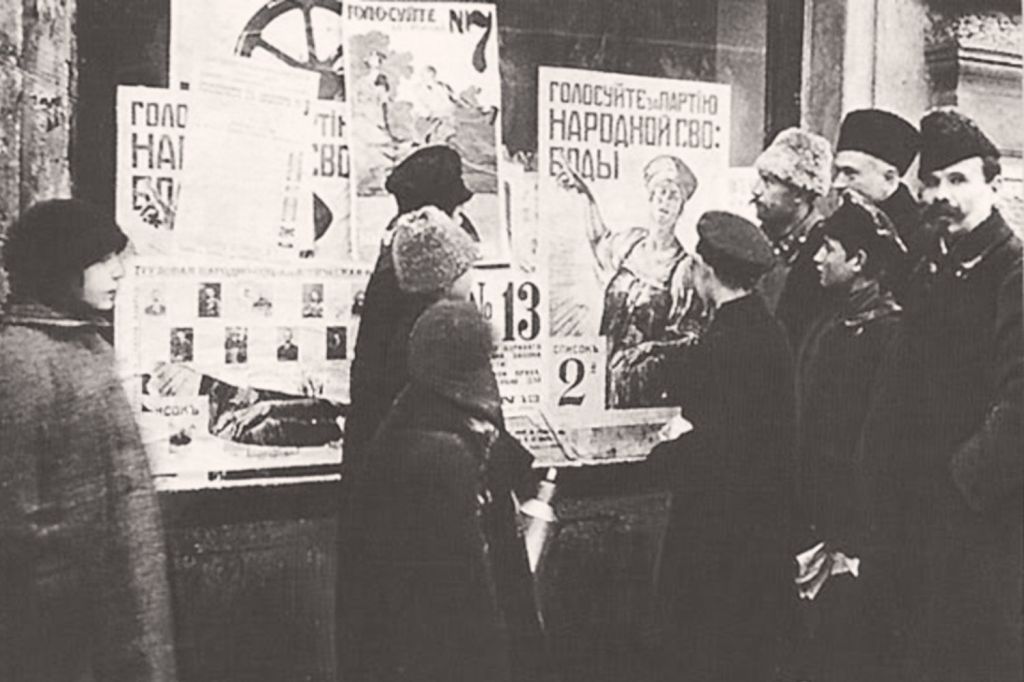
Voters in Petrograd consider the election posters – far more artistic and political than, for example, modern Irish election posters

They won a very impressive vote in the cities and the armies. But the SRs were the hands-down winners of the election. Here are the results by percentage of votes cast.

  • SRs: 39.5 per cent
  • Bolsheviks: 22.5 per cent
  • Constitutional Democrats: 4.5 per cent
  • Mensheviks: 3.2 per cent
  • Minority nationalist parties (including Ukrainian SRs & Ukrainian social democrats): 3.3 per cent[iii]

The SRs had by now finally split into Left and Right. But in a time of poor literacy and terrible communications – there was a shortage of paper for ballots, never mind leaflets – the split was not widely understood. Even those electors who fully understood it faced a head-scratching question of who to vote for, because in the vast majority of electoral districts the Left and Right SRs, who were shooting each other in the streets, were still on the same electoral list!

The system of voting for a party list as opposed to an individual candidate operates today in many countries, such as Sweden. It places the emphasis on programme rather than individuals (Note the appeal to vote for “list 3” on the SR election poster above). But because the Left SRs had been so reluctant to split, they had walked into a terrible trap. The electoral lists had been drawn up by the leadership of the SRs back in September, and favoured candidates of the right.

If the Left SRs had split much earlier and had time to develop their profile as an independent party, they might have won the Constituent Assembly election. In the few areas they did stand independently they performed badly. The SR party had a reputation as fighters for the peasantry, a reputation mostly earned by Left SRs. As it was, votes cast for the Left SRs’ programme and record went to elect people diametrically opposed to them.

The Right SRs’ majority did not impress the Bolsheviks or the Left SRs They saw the whole thing as basically a re-run of the Provisional Government, the same tired bankrupts seizing the chance to impose themselves on the country all over again. The farce of the electoral lists was an additional proof of the superiority of Soviet democracy.

 ‘THE GUARD IS TIRED’

On the day when the Constituent Assembly met, deputies from left and right alike arrived with pistols in their pockets. The Right SRs dominated the proceedings numerically. There were 230-240 on the right of the Assembly, against 130-140 on the left – a hundred or so Bolsheviks, and only 40 Left SRs.

It was an ugly day, marked by booing and heckling and tense manoeuvres. The Bolsheviks and Left SRs initiated ‘Whistling, uproar, shouts of ‘Get down!’, rattling and banging of desks… a fearful, inhuman roar and din […] a frenzied racket and loud, piercing whistles.’[iv]

Meanwhile a demonstration organised by the Right SRs filled the streets outside. During the day tensions would mount, and at one point sailors opened fire on the crowd, killing several. The crowd melted away.

The left put forward Spiridonova as their candidate for president, but she was easily defeated by the candidate of the right, Viktor Chernov, former agriculture minister.

Next the Bolsheviks proposed their position: that the Constituent Assembly could assume some authority on the condition that it recognised the supremacy of the Soviet. This was the mirror image of the Right SR position: that the Soviet could assume some authority as long as it recognised the supremacy of the Constituent Assembly.

The Bolsheviks’ proposal was defeated by a wide margin, and they and the Left SRs walked out. 

The meeting went on without the left. For a few hours, the Right SR deputies in the hall could fantasise that they were governing and shaping the new Russia, laying the foundations for an orderly constitutional capitalist republic. They elected as president Viktor Chernov who was a Right SR, but who had a ‘left-ish’ profile because he had criticised coalition during 1917.

But as 5am approached a sailor walked up to the podium and asked them to close the meeting, ‘Because the guard is tired.’

On the surface the remark seemed trivial, but it was rich in possible meanings. The Right SRs for their part took it as a veiled threat (it probably was) and quit the building without uttering a word of protest.

The Constituent Assembly never met again. It sank like a stone into murky water and the ripples appeared to settle at once. Workers, peasants, soldiers and sailors – those who, throughout 1917, had answered any undemocratic moves with mass resistance – did not lift a finger. They did not give a damn about the Constituent Assembly, did not accept its right to rule. If it demanded they choose between it and the Soviet, it was no contest. Tens of millions had voted for a party with ‘socialism’ and ‘revolution’ in the name, and socialist revolution it would be.

But the Right SRs and their supporters never forgot the humiliation of that day. Parliamentary democracy had been brushed aside with contempt by Soviet democracy, which got on with its work as if the Constituent Assembly elections had never taken place.

The chaos that began in May 1918 would give the Right SRs an opportunity to take revenge for this humiliation, and to make another bid for power. In this, the aid of the western Allies would prove to be of more practical use than their dubious parliamentary majority. But as we will see, the name of the Constituent Assembly would be quite literally inscribed on their banners.

<Back to Contents


[i] Smith, S. A. Russia in Revolution, p. 110

[ii] Bryant, Louise, Six Red Months in Revolutionary Russiahttps://www.marxists.org/archive/bryant/works/russia/ch09.htm

[iii] Smith, 155

[iv] Raskolnikov, FF, Tales of Sub-Lieutenant Ilyin, https://www.marxists.org/history/ussr/government/red-army/1918/raskolnikov/ilyin/ch01.htm

02: White Guards

‘My heart is heavy. My feelings seem to be split in two: I hate and despise the savage, cruel, senseless mob, but still I feel the old pity for the soldier: an ignorant, illiterate man, who has been led astray, and is capable both of abominable crimes and of lofty sacrifices!’

Anton Denikin, The Russian Turmoil; Memoirs: Military, Social and Political, 1920, Chapter xxxii

January 1918. Four thousand armed men had gathered by the Don River to begin a counter-revolution that would shake Russia for years to come. This week we’re going to take a closer look at the White Guards, those who rose up in arms against the October Revolution. Then we will examine how things went down when they had to face the Red Guards for the first time.

Anton Denikin first met Lavr Kornilov on the plains of Galicia at the start of the World War. The two Tsarist generals served side-by-side on the same front in what Denikin called ‘incessant, glorious and heavy battles’ as their thousands of soldiers fought their way over the Carpathian Mountains and down into Hungary. Denikin was impressed by Kornilov’s ability to train up ‘second-rate’ units into ‘excellent’ condition, by his scrupulousness and by his personal prowess. Later in the war Kornilov became a celebrity after he broke out of an Austrian prison.Denikin was big and avuncular and Kornilov thin and severe, but both came from humble backgrounds and both were utterly dedicated to the army as an institution, and these facts helped them to see eye-to-eye.

Military officers saw themselves as a caste removed and above society. Around 1898 a cavalry lieutenant had explained his perspective on the world: at the centre, highest in his regard, were his own regiment. Next came other cavalry units, then the rest of the army. Beyond – the ‘wretched’ civilians. First came the relatively ‘decent’ civilians, then ‘the Jews’, then ‘the lower classes’ and last of all the socialists, communists and revolutionaries. In regard to the last group, ‘Why these exist nobody knows, and the emperor really is too kind. One ought to be able to shoot them on sight.’ A lieutenant in 1898 might be a colonel or general by 1918.

Back in the old days, Russian military officers were generally noble or at least bourgeois in origin. Each generation of officers dated the ‘good old days’ to a decade or two earlier, but already by the 1870s a third of officers hadn’t even finished primary school.

But in these latter days, according to Denikin, the gates of the officer training schools had been flung open to ‘people of low extraction,’ with the result that the officer corps had ‘completely lost its character as a class and as a caste.’[1] (Denikin apparently subscribed to the principle of Groucho Marx: ‘I don’t want to be part of any club that would have me as a member.’) The old bonds that had held the army together – the church, the monarchy – grew weak. What was to blame for this weakening – the decay of the moral fabric of society? The corrupting influence of city life? Workers were now motivated by base material desires rather than spiritual riches; the ikon in the corner of the workshop no longer satisfied them.

Russian soldiers in World War One

The war with Japan in 1905 and its attendant revolution were disasters for the prestige of the Russian state. It appeared few lessons were learned for the Great War. In 1914-15 the old army – what was left of it ‘as a class and as a caste’ – was broken under the German, Austrian and Turkish guns. There were crippling shortages of rifles, uniforms and shells. Over two million soldiers of the Russian army perished in the war. The civilian deaths, the wounded, prisoners of war – each of these categories also numbered in the millions.

Many officers fought with great courage. But they saw their gains thrown away through incompetence, corruption, stupidity and shortages. They grew angry with the government.

According to General Denikin, ‘It is hardly necessary to prove that the enormous majority of the Commanding Officers were thoroughly loyal to the monarchist idea and to the Tsar himself.’[2] Accordingly, they blamed the Tsar’s German wife, and they obsessed about Rasputin, blamed everything on his ‘corrupting influence.’

General Denikin (the guy in the middle with the beard) during World War One.

Mutiny

The February Revolution came. The high-ranking officers, blindsided, suffered a tumult of emotions. They were disappointed in themselves – they should have engineered a ‘palace coup’ in order to head off this movement. They were angry at the moderate politicians who had stepped into the void – these scoundrels had abolished the monarchy. They were mortally afraid of the tidal wave of workers and of the mutinies in army and navy. The peoples of Finland, Ukraine, Poland, the Baltic states, Central Asia and the Caucusus were ‘Russian in spirit and in blood’[3] – but now, for some reason, they wanted self-determination. This amounted, in the eyes of the officers, to the dismemberment of holy Russia.

Something good might yet come out of the Revolution, and it was no use in any case trying to swim against the stream. It could perhaps be guided into safer channels. Denikin would carefully distinguish between ‘the real Democracy,’ by which he meant ‘the bourgeoisie and the civil service’ and the ‘Revolutionary Democracy’ – the socialist parties, whose supporters were ‘semi-cultured’ and ‘illiterate.’ If the ‘real Democracy’ could get the upper hand over the ‘Revolutionary Democracy,’ things might yet be salvaged.

But the portents were not good. Chapter VII of Denikin’s memoirs describes his reunion with his old comrade-in-arms Kornilov at a dinner in the house of the War Minister in late March. Denikin found him tired, morose and pessimistic. The condition of the Petrograd garrison was beyond comprehension to Kornilov: they were holding political meetings, engaging in petty trade, hiring themselves out as private guards. He spoke of ‘the inevitability of a fierce cleansing of Petrograd.’ Already the highest-ranking officers were contemplating coups and civil war. During the street demonstrations of April, Kornilov proposed to disperse the crowds with artillery and cavalry – and even though the government rejected this idea, he made practical preparations to do so.[4]

Soon, thanks to a Soviet decree, officers had to answer to elected committees of the rank-and-file. This was an incredible humiliation for men born and raised and trained to value rigid hierarchy. The death penalty was abolished; the officer no longer held power of life and death over the men. The men, it appeared, now held that power over the officers. This was confirmed when sailors massacred over forty officers in one incident.

The officer corps hated the new Provisional Government for pandering to the Soviet, and they loathed the Soviet itself. The soldiers’ delegates were, they complained, a bunch of clerks and shiftless rear garrison men. The proceedings of the Soviet were a display of ignorance and coarseness that embarrassed Russia before the whole world. 

And there were too many ‘foreigners.’ Pointedly, Denikin in his memoirs listed by nationality the personnel of the Presidium of the Soviet Central Committee:

1 Georgian

5 Jews

1 Armenian

1 Pole

1 Russian (if his name was not an assumed one)

To him, this was proof that the Soviet was dominated by an ‘alien element, foreign to the Russian national idea.’[5]

This quote from Denikin gives us a good insight into how the White Guard officer saw the world. When members of the minority groups held high office, they were suddenly no longer ‘Russian in spirit in blood,’ but ‘foreign,’ ‘alien.’

When the officers spoke of the socialist leader Trotsky, they always called him ‘Bronstein’ or ‘Bronstein-Trotsky,’ as if they were thereby making an important point.

Kornilov

The Constitutional Democrat party was a bastion of Denikin’s ‘real Democracy:’ it was a party of business-owners and bureaucrats. After the July Days, a near-revolution in Petrograd, the Constitutional Democrats and the top brass of the military deepened their collaboration.

The figurehead of this movement was General Lavr Kornilov. At a conference in August 1917 the Constitutional Democrats carried him on their shoulders and cheered him to the rafters.

General Lavr Kornilov

General Kornilov made his move in August. But the attempted coup was not just a failure; it backfired and strengthened the Bolsheviks (China Miéville’sOctober, published by Verso Books in 2017, contains a lively account of this episode).

Denikin was one of Kornilov’s co-conspirators. After the failed coup, Denikin ended up in a cell seven foot square. In early mornings, soldiers would cling to the bars of the window to curse and threaten him:

Wanted to open the Front […]’

‘[…] sold himself to the Germans […]’

‘[…] wanted to deprive us of land and freedom.’

‘You have drunk our blood, ordered us about, kept us stewing in prison; now we are free and you can sit behind the bars yourself. You pampered yourself, drove about in motor-cars; now you can try what lying on a wooden bench is, you ——. You have not much time left. We shan’t wait till you run away—we will strangle you with our own hands.

Denikin covered himself with his cloak. In that moment all he could think was: ‘What have I done to deserve this?’

He thought back over his life – humble origins, promotion on his own merits, valour in combat. By the standards of the institution he served, he had always been relatively kind to the men under his command, in that he declined to beat them up.

As he thought over it all, his rage mounted. He rose, throwing aside his cloak.

‘You lie, soldier! It is not your own words that you are speaking. If you are not a coward, hiding in the rear, if you have been in action, you have seen how your officers could die.’

His tormentors, awed by his words and unable to contradict them, retreated.

Not all the soldiers were hostile. ‘On the first cold night, when we had none of our things, a guard brought [General] Markov, who had forgotten his overcoat, a soldier’s overcoat, but half an hour later—whether he had grown ashamed of his good action, or whether his comrades had shamed him—he took it back.’

But Kornilov was not daunted. The attempted coup and its aftermath represent the germinating seeds of the White Armies. He and all his co-conspirators ended up imprisoned at Bykhov monastery. Bykhov was just down the road from the general staff HQ. There Generals Alexeev and Dukhonin kept in close contact with him. So Kornilov, through proxies, was able to carry on his work and to build an underground league of officers and cadets. Another co-conspirator, the Don Cossack General Kaledin, was along with Alexeev preparing a base for counter-revolution in the Don Country in the South.

Kornilov and friends. Still from the documentary Tsar to Lenin.
Red Guards rally to resist the Kornilov coup. Still from the documentary Tsar to Lenin.

The Politics of the Kornilov Movement

Kornilov and his supporters opposed the Soviet, but what was their own vision for the future of Russia and its Empire? They were in favour of a military dictatorship, but it would not remain in power forever. Its task would be to ‘restore order.’ Once order was restored – in other words, once all the working-class leaders were dead or imprisoned and their parties crushed, once the Soviet was liquidated and all weapons taken out of the hands of workers, once the soldiers had been forced back into the trenches, and all the national minorities induced to temper their demands – then, and not until then, the power would be handed to a legitimate government. Perhaps it would be led by another absolute monarch like Nicholas. But some of the officers were for a constitutional monarchy, and some even for a republic. There could be elections once order was restored. As soon as the masses were put back in their place and there was no chance of the socialists winning, it would be safe to have an election.

It is sometimes said that the White movement embraced the full spectrum of political opinion from monarchist to social-democrat. There were in reality no leftists among the Kornilovite officers; the entry of ‘moderate socialists’ into the White camp was a later (and a brief and unhappy) development, which we will deal with in later chapters.

But the White officers themselves placed very little stock in all these political questions. They uttered the ‘p’ word with the distaste they otherwise reserved for ‘Bronstein.’ The political questions could be settled after order was restored. They were mere soldiers and not politicians – thank God! They had neither the right nor the desire to pre-determine the results of some future election.

From Denikin’s memoirs, the reader can see that what really mattered was not the form of government that was to follow; what mattered was the ‘fierce cleansing.’

But these plans were left bobbing in the wake of history. The October Revolution struck. The Provisional Government and its few defenders were, as we have seen, hapless. The Kornilov movement took belated action.

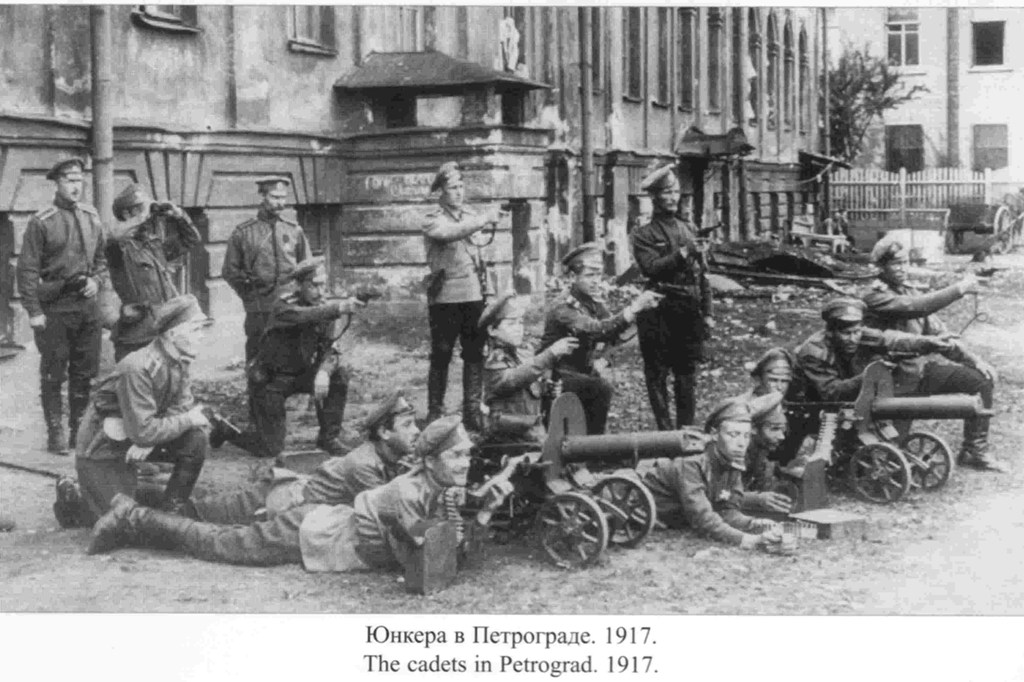
The cadets, officers and Cossacks rose up in Moscow and in Petrograd in a bloody series of episodes over several days. It was in Moscow that the counter-revolutionaries first received the nickname ‘White Guards’ from their enemies. It was a reference to the French Revolution; white was the colour of the Bourbon monarchy. If it was supposed to be an insult, it backfired. The White Guards wore the name with pride. But in both cities they were defeated. In Petrograd their leader, General Krasnov, was released on parole. In Moscow the surrendered White Guards were all allowed to walk away, some still carrying their arms. Even Antony Beevor, whose book Russia: Revolution and Civil War paints an ugly picture of the revolutionaries, acknowledges the magnanimity of the Reds on this occasion.

After defeat in the two great cities, Generals Kornilov and Alexeev decided to play a longer game. They gave the order to rendezvous in the far south of Russia by the river Don, where they had reportedly stockpiled 22,000 rifles.[6]

Thousands of individual officers began the journey south. Peasants and soldiers did not show the same clemency as the authorities in Petrograd and Moscow. ‘The fugitive officer en route for the south became an outlaw figure for the soldiers, to be killed on sight.’[7] But they persevered. Many survived the journey by throwing aside the red shoulder-boards that marked them out as officers. Others disposed of their uniforms entirely, and went on to fight in civilian clothes.

Kornilov simply rode out of his prison and set off for the Don. His ‘guards’ had joined him. They fought their way across the land. When Kornilov reached Novocherkassk by the Don he found General Alexeev and four hundred volunteers already mustered. The weeks passed and four hundred grew to four thousand as more officers, cadets and students arrived.

THE COSSACKS

These southern lands, north of the Caucusus mountains and between the Black Sea and the Caspian, had in living memory borne witness to a war more fierce and total than the Civil War. In the Nineteenth Century the Russian Empire had massacred and exiled the Muslim Circassian people. The Cossacks settled on rich black soil stolen from the Circassians. They adopted the style of the vanquished: long narrow-waisted coats and silver-inlaid daggers. Non-Cossack immigrants flooded in later, and they were despised by the Cossacks and called ‘aliens.’

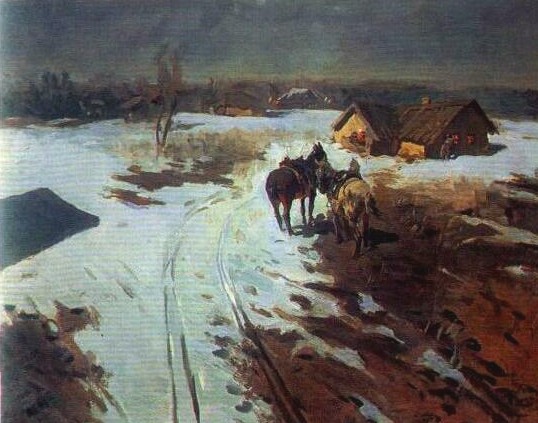
Painting by Mitrophan Grekov. A lone rider, probably a Cossack, returns to his homestead in winter.

The Cossacks fought on horseback with swords and lances and carbines. Again and again the state had sent them in to crush protests. Now, true to form, the Don Cossack leaders had given a safe haven to the Volunteer Army.

But the Cossack lands were not a single conservative block. For many the supposed privileges were a burden. One-third of the Cossacks were poor, and equipping themselves for war put them in permanent debt. The Cossacks were outnumbered by their poor tenants – the so-called aliens – and oppressed by the big landlords. In the cities and towns there were artisans and workers influenced by the left-wing parties.

For the young Cossacks, the experience of the World War was shattering. For three years, ‘Russian soldiers were sent into battle without rifles or were deliberately shelled by their own when, in their trenches, they were understandably reluctant to go over the top.’[8] The young Cossacks witnessed all this, and they shared trenches and bivouacs with town folk who talked of revolution. By 1917 the refrain of the young Cossacks was: ‘We must saddle our horses and go to the Don; the war is pointless.’[9]

So they made the long journey home through lands teeming with revolution. At the frontlines, officers had kept order by beating and killing the rank-and-file soldiers. Now, as an army of nine million men collapsed, many an officer was shot by the railway stations and roadsides. When the Cossacks came riding back into their villages, the old men called them cowards and traitors, and said they had been bought off by the Reds or by ‘the Jews.’ But the young Cossacks had met and talked with these Reds, these Bolsheviks. The Revolution promised them an end to this war and to the military obligations, and a settlement of the land question. The young frontline veterans, the frontoviki, were uneasy at the presence of the Volunteer Army, at the sight of officers in their distinctive shoulder-boards mustering in the Don country for counter-revolution.

THE STRUGGLES ON THE DON AND KUBAN

Even before the October Revolution, local Soviets had taken power in eighty different towns. After October, the dam burst. Workers and peasants rose up in town after town, village after village, and bands of Red Guards took to the railways to spread Soviet power to wherever the old regime held on.

There were workers’ uprisings in Rostov and Taganrog, two towns by the Don. Counter-revolution soon followed: Volunteers and Cossacks crushed the risings ‘and [shot] the captured Bolshevist members of the Rostov Soviet.’[10]

The leader of the Don Cossacks was Ataman Kaledin, a cavalry general who had commanded an entire army in the Great War. He had been part of Kornilov’s coup attempt, though the Provisional Government had never dared to come after him for fear of kicking the Cossack beehive.

In spite of their common struggles and their successes in Rostov and Taganrog, Kornilov found Kaledin less than welcoming. The Volunteers were forbidden to carry arms in the Cossack capital Novocherkassk. Kaledin must have known that his Cossacks were not all of one mind, and that too open an allegiance to the White Guards could provoke a reaction. He declined to deepen the collaboration, and the Volunteer Army were packed off to the nearby town of Rostov.

Kaledin and Kornilov faced a favourable situation. To the east the Orenburg Cossacks had risen up. To the west a Rada or parliament had taken power in Ukraine. This was a nationalist movement which opposed the Bolsheviks. The Volunteer Army would make uneasy bedfellows with Ukrainian nationalists, whose claims to autonomy they rejected, but the Rada had given the officers free passage over their territory while arresting Red Guards. The task, therefore, was to strike out over Ukraine and link up with the Rada in Kyiv and form a solid front of counter-revolution in the south.

Kaledin led his Cossacks in an invasion of the Donbass region of Ukraine. This was, as we mentioned in Part One, the area where Kliment Voroshilov had worked as a miner, farm labourer, shepherd and metalworker before his sixteenth birthday.

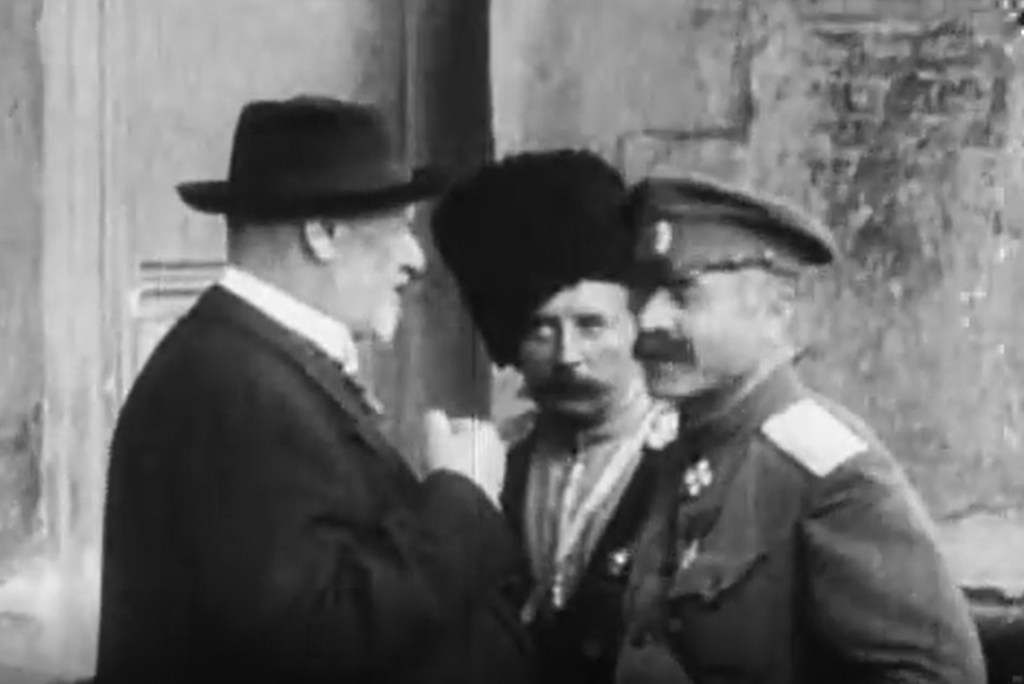
Rodzianko, a representative of the ‘real [bourgeois] Democracy’, with Kaledin and Kornilov. Still from the documentary Tsar to Lenin.

Now workers like Voroshilov took up arms and barred the path of the Cossacks. There was no shortage of arms: rifles and machine-guns poured into the region from Moscow and Petrograd, and in every mining and factory town Red Guard units sprang up – here a few hundred fighters, there a few thousand. Armoured trains thundered in bearing Siberians, Latvians, sailors and Red Guards from the big cities. The Cossacks fled back to the Don.

We have now reached the moment at which we began, with thousands of Red Guards taking the railways south to the Don Country as 1917 turned to 1918. When they reached the Donbass, the Reds divided their forces. Most rolled on to Kyiv to overthrow the Rada, led by a former Tsarist officer named Muraviev who had reinvented himself as a revolutionary and was most likely an adventurer. The battle in Kyiv was bloody, with atrocities on both sides and Muraviev indulging in an early excess of terror, driven by ugly prejudices against Ukrainians.

Meanwhile about 16,000 went south to the Don to face Kornilov and the Volunteer Army.

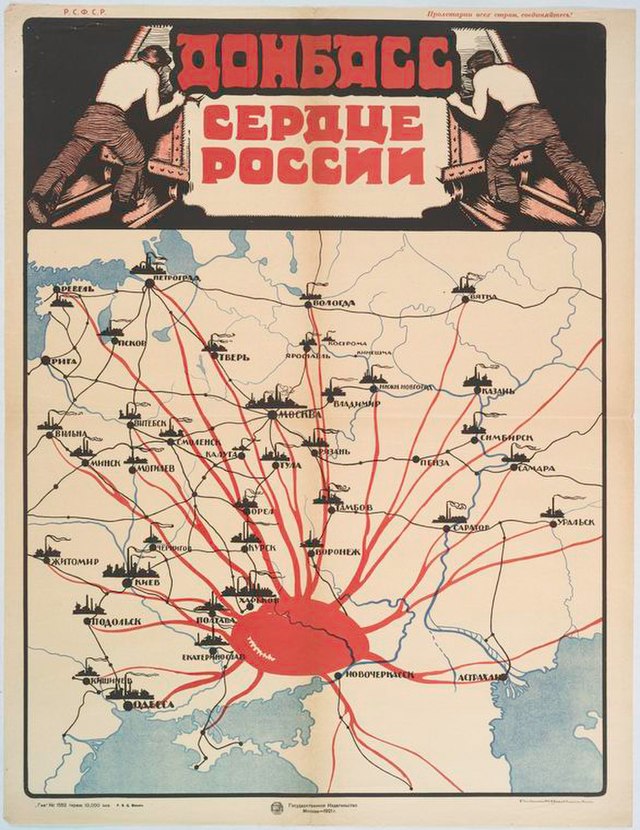
A 1920s poster showing the economic importance of the Donbass region, in red. I think it says ‘Donbass: Heart of Russia’ – which would obviously be a controversial, even chauvinistic thing to say today

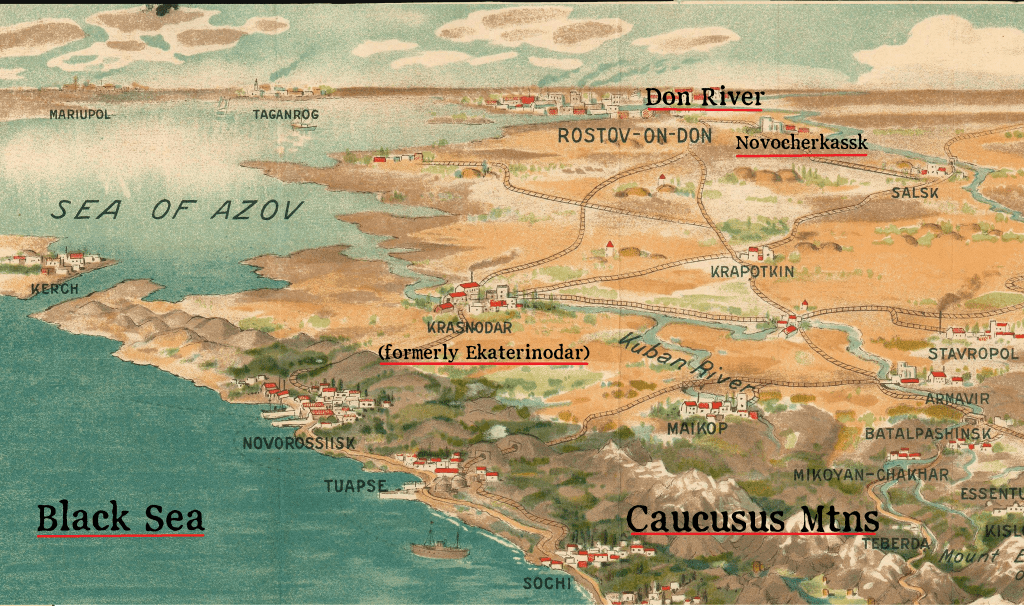
Detail from a pictoral map of the Caucusus issued by a USSR tourism agency in the 1930s. The names I have added ae underlined in red. Places to note here are the Don and Kuban rivers, Taganrog, Rostov and Novocherkassk, and finally Ekaterinodar.

The Cossacks decide

In a movie or a videogame, the Red Guards would no doubt have met the White Guards in a field somewhere and fought a single decisive clear-cut battle. In that situation the Whites would have won. The four thousand Volunteers knew how to fight, and the Cossacks were numerous and fierce. The Reds were far from home, poorly-organised and barely trained.

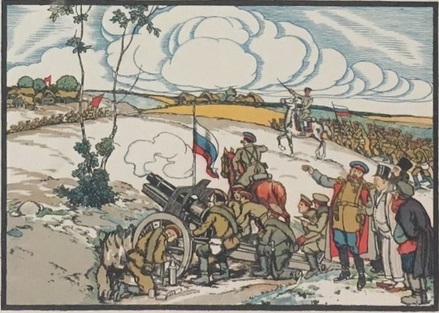
White Guards (as depicted by a Red artist)

But there was no straight fight. These were not extras or NPCs, but human beings with doubts and fears. Each side met the other in a halting, hesitating way, one small detachment blundering into another; one outflanking and the other retreating, each unsure of the ground it stood on politically and tactically, with frequent ceasefires and negotiations. The fight would jump back and forth from one railway junction or small town to the next.

The Red Guards were more in their element behind enemy lines. Small numbers were sent ahead into the Cossack lands armed not with rifles but with documents such as the Soviet government’s December 1917 appeal to toiling Cossacks, promising a settlement of the land question but guaranteeing that they would not touch ‘simple soldier Cossacks,’ and declaring them free of the old military obligations that had put the poorest into permanent debt.[xi]

All this work paid off. On January 10th a Congress of Cossacks met at Kamenskaya. It was the birth of a movement of Red Cossacks. Enraged, Ataman Kaledin sent troops to arrest the delegates. But these troops went over to the Soviets. From this point on, Kaledin lost more and more soldiers every day – not to shells or bullets but to political arguments. The Don Cossacks had suffered a decisive split between rich and poor, old and young, village and frontline.

The Volunteer Army was still superior in discipline and training. On January 15th near Matveyev Kurgan, the burial mound of a legendary outlaw, a Red force of 10,000 suffered a bad defeat. But Matveyev Kurgan is a few hours’ walk from the town of Taganrog. The workers there had risen up before and been crushed by Volunteers and Cossacks. Now they struck again as soon as they heard the Reds were nearby. There followed two days of street fighting that ended on January 19th when the Whites were chased out. Reportedly, fifty captured cadets were brutally massacred by the workers. The revolution had returned to Taganrog, a day’s march from Rostov. Meanwhile a second Red force of 6,000 was advancing on Novocherkassk. Kaledin’s loyalists were not numerous enough to stop them. All they could do was retreat, burning railway stations and tearing up tracks as they went.

Reds triumph over Whites (from the same poster as above)

Kornilov could see that the game was up for Ataman Kaledin and his Don Cossacks. On paper, the Don Host numbered tens of thousands. But politics had intruded into military calculations. Many had gone over to the Reds, and of those who had not, most would not answer when Kaledin called.

But to the south across the steppe was the country of the Kuban Cossacks. The Whites hoped that the Kuban Cossacks might prove more solid. Kornilov and his Volunteer Army packed their bags, shouldered their rifles and marched out onto the steppe. The Don Cossacks were incensed at this betrayal. There were shots fired at the White Guards as they fled the Don Country.

The Volunteers had escaped out of the reach of the Red Guards from Moscow and Petrograd. But, as we will see below, wherever they went the revolution was close behind, or even lying in wait.

Ice March

Kornilov could see that the game was up for Ataman Kaledin and his Don Cossacks. On paper, the Don Host numbered tens of thousands. But politics had intruded into military calculations. Many had gone over to the Reds, and of those who had not, most would not answer when Kaledin called.

But to the south across the steppe was the country of the Kuban Cossacks. The Whites hoped that the Kuban Cossacks might prove more solid. Kornilov and his Volunteer Army packed their bags, shouldered their rifles and marched out onto the steppe. The Don Cossacks were incensed at this betrayal. There were shots fired at the White Guards as they fled the Don Country.

The Volunteers had escaped out of the reach of the Red Guards from Moscow and Petrograd. But, as we will see below, wherever they went the revolution was close behind, or even lying in wait.

ICE MARCH

The time was out of joint. In February, the Soviet government changed the calendar so that it was in step with the rest of the world. Overnight Russia leapt ahead by two weeks. In South Russia, time was passing quickly in more ways than one. Ataman Kaledin, who had commanded a whole army under the Tsars, could now call on only 100-140 men.

He blamed Kornilov.

‘How can one find words for this shameful disaster?’ he said in a speech before the Cossack assembly. ‘We have been betrayed by the vilest kind of egotism. Instead of defending their native soil against the enemy, Russia’s best sons, its officers, flee shamefully before a handful of usurpers. There is no more sense of honour or love of country, or even simple morality.’[xii]

After this speech, Kaledin retired to his rooms in the Ataman’s Palace and shot himself in the heart.

By the end of February Novocherkassk and Rostov had fallen to the Reds. A Don Soviet Republic was founded, with an SR Cossack named Podtelkov as its president. The last supporters of the late Kaledin galloped out into the wilderness, praying for better days.

General Kornilov and his Volunteer Army, meanwhile, had marched out onto the Kuban Steppe, several thousand officers and civilians burdened with heavy artillery and carts full of the sick and wounded. Their journey went down in history as the First Ice March.

…a long column of soldiers wound its way out of Rostov, marching heavily over the half-melted snow. The majority were wearing officers’ uniforms […] Behind the numerous wagons of the baggage train came crowds of refugees: elderly, well-dressed men in overcoats and galoshes, and women wearing high-heeled shoes. […]

‘Have you anything to smoke?’ a lieutenant asked Listnitsky. The man took the cigarette Eugene offered, thanked him, and blew his nose on his hand soldier-fashion, afterwards wiping his fingers on his coat.

‘You’re acquiring democratic habits, lieutenant,’ a lieutenant-colonel smiled sarcastically.

‘One has to, willy-nilly. What do you do? Have you managed to salvage a dozen handkerchiefs?’

The lieutenant-colonel made no reply. Tiny green icicles were clinging to his reddish-grey moustache.

From And Quiet Flows the Don, Mikhail Sholokhov, 1929; trans Stephen Garry 1934, Penguin Classics 2016, pp 495-496

The officers were facing this bleak expedition in the hope that they could link up with the Kuban Cossack Host.

But the Revolution made its way to the banks of the Kuban river while the Volunteers were still toiling over the steppe. When they reached the Kuban Cossacks, they found the same thing they had left behind: a Cossack host that had mostly gone over to the Reds. And beyond lay the Caucusus Front, where hundreds of thousands of veterans had mutinied and were coming north to join the revolution.

February turned to March and spring did not come. Rain gave way to snow and cold winds, and the Volunteers’ clothes were crusted with ice. Under pursuit, forced to avoid railways and settlements, they fought forty battles in fifty days.

‘Take no prisoners. The greater the terror, the greater will be our victory.’[xiii] To judge by these words of Kornilov, the suffering only made them more determined.

In April their fortunes seemed to turn. They joined up with a force of White Kuban Cossacks, bringing their total fighting strength to 6,000 and adding two more generals to their already impressive collection. They decided to march on the Kuban capital, Ekaterinodar (now Krasnodar), a city of 100,000 people.

They had escaped from the Red Guards of Petrograd and Moscow. They needed the resources of a city; but where there were cities there were workers, and where there were workers there were Red Guards.  

From April 10th to 13th the Volunteer Army attacked Ekaterinodar. But 18,000 Red Guards were waiting for them. The vast numbers of people who flooded into the Red Guards whenever the Whites raised their head was a sign of the popularity of the Revolution. The fact that the Whites could at first only muster a few thousand is a reflection of their narrow – though very determined – support base.

Hundreds of Whites were killed the fighting. Kornilov had made his HQ in a farmhouse on the edge of town; on the morning of the 13th a shell scored a direct hit on the roof. Kornilov was killed. The Volunteer Army gave up the fight and once again fled out onto the steppe.

The End of the First Wave of Civil War

Another one of those pictorial maps showing the flame of revolution spreading outward from the central cities.
In finer detail. Clockwise from top: The Finnish Civil War begins. The Yellow flag shows the rising of Dutov at Orenburg. The blue line shows the front with Turkey and the soldiers returning radicalised from that front. The Green and Yellow flag is planted in T’blisi and probably represents the Georgian independence movement. Lots of pointy arrows, flames and contrasting dark and fiery colours around Ekaterinodar and Rostov. Flames too in the Donbass and further into Ukraine. The Green arrow is the rising of the Polish Corps. The blue arrows represent German attacks – of which more next week.

On April 23rd the Soviet leader Lenin declared victory: ‘It can be said with certainty that, in the main, the civil war has ended… on the internal front reaction has been irretrievably smashed by the efforts of the insurgent people.’

Even before the Volunteer Army’s defeat at Ekaterinodar, Lenin had sounded a similar note: ‘A wave of civil war swept over all of Russia, and everywhere we won victory with extraordinary ease.’[xiv]

There had been serious fighting on every point of the compass. A Tsarist army corps made up of Polish soldiers revolted in Belarus. A street battle erupted in Irkutsk in Siberia. A warlord named Semyonov raided and rampaged beyond Lake Baikal. Cossacks in the south of the Ural Mountains rose up and seized Orenburg.

Everywhere the result was the same. In response to these challenges, local workers and poor peasants volunteered for Red Guard units, usually in their thousands or tens of thousands. There was no Red Army yet. This was the time of the otryad, the informal ‘detachment’, some formed on local initiative, others sent out from Moscow or Petrograd; numbering anything from a few dozen to thousands; armed with anything from a few rifles to an armoured train (or even, in the case of Irkutsk, bows and arrows[xv]). Just like on the Don, everywhere political appeals were decisive. The Red Guards knew how to disarm the enemy with class politics. When that failed, they had their rifles.

Victor Serge, a communist who later criticised his own side for excessive use of violence, wrote that this wave of struggle was won ‘with neither excesses nor terror.’[xvi] It’s clear that he means terror directed and sanctioned by the Soviets; elsewhere he makes no secret of the fact that rogue bands of sailors and soldiers were killing officers and carrying out massacres like in Sebastopol. Important outliers in Kyiv and Kokand, both in February 1918, should be noted. But when two right-wing figures were murdered in their hospital beds by sailors in January 1918, the Soviet press condemned this atrocity. In general the noises from key Bolshevik leaders indicated that they believed the Russian revolution, unlike the French, could avoid terror and mass executions.

At this point the Soviet regime was still a democratic one. The government was a coalition between the Bolsheviks and the Left SRs. The Third Congress of Soviets met on January 15th, around the time the Don Cossacks split. At this congress we see not just Bolsheviks and Left SRs but also Right SRs, Menshevik-Internationalists and Anarchists. It’s striking that the Right SRs were tolerated even though they had taken part in the uprisings in Moscow and Petrograd.

This was how things stood in the military situation and the political regime in early Spring 1918. The violence appeared to be over.

That spring, a renewal of the war with Germany seemed far more likely than a new wave of civil war. At the end of April the forces of the White Guards consisted of several thousand men, encircled and leaderless, on a blasted steppe on the very edge of Russia. At that moment the first Red army units had been formed, but they did not face the Don or the Volga; they faced the German armies to the west.

But with hindsight we know that the real Civil War had not even begun. Starting in May, a chain of catastrophes would fan the dying embers of armed struggle to an inferno that would not die down until the end of 1920, and that would still be blazing in parts of Russia as late as 1923. What the Red Guards had just endured was nothing compared to what was coming down the line. A bloody summer lay in wait. The war of irregular ‘detachments’ that had triumphed by the Don and Kuban rivers would fall far short of the challenges. To survive, the Soviet republic would need to build a regular professional army.

< Back to Contents

Back to Home Page

The cover image for this post is by A. Kokorin, one of the very fine illustrations from The Iron Flood by Alexander Serafimovich, 1973 edition.

Transitions, sound effects, music and dialogue on the video and audio versions of these podcasts are not my property but are included under fair use. Credits for the audio version of this post are as follows:

Music from Alexander Nevsky by Sergei Prokofiev.

Intro from Anastasia (1997, dir Don Bluth and Gary Goldman)

Dialogue from Fall of Eagles, Episode 12 (1974, Elliot & Burge, BBC)

Transitions from Battlefield 1: In the Name of the Tsar (2017, Dev. Dice)

[1] https://www.gutenberg.org/files/43680/43680-h/43680-h.htm Chapter VII


[1] Denikin, Anton. The Russian Turmoil. Memoirs: Military, Social, and Political, 1920. Project Gutenberg. https://www.gutenberg.org/files/43680/43680-h/43680-h.htm. p 17

The cavalry lieutenant is quoted in Reese, Roger, Red Commanders, Press of the University of Kansas (2015), p 15 and the detail about primary school completion among officers in the 1870s comes from the same source.

In addition to the sources listed here as direct citations, I have constructed the narrative drawing heavily from Smele (The ‘Russian’ Civil Wars), Mawdsley (The Russian Civil War), Smith (Russia in Revolution) and Serge (Year One of the Russian Revolution).

[2] Denikin, p 16

[3] Denikin, p 21

[4] Trotsky, LD, History of the Russian Revolution, Volume I, Gollancz, 1932, Chapter XVII, p 353-358

[5] Denikin, 91

[6] Kirienko Yu. K. KrachKaledinshchyna. Accessed and translated at Leninism.su. Another document from the same website to which I have referred is AM Konev, Red Guard on the Defense of October [sic; Google translate] https://leninism.su/revolution-and-civil-war/4142-krasnaya-gvardiya-na-zashhite-oktyabrya50.html. The documents on this site are extracts from works by Soviet scholars, but they are abridged and edited in suspicious ways – ellipses cover the defeat at Matveyev Kurgan, for example. Accordingly I have relied on these documents only for secondary matters, for the odd detail or quote, not for major questions.

[7] Serge, Victor. Year One of the Russian Revolution, p 123

[8] Carleton, Gregory. Russia: The Story of War, Harvard University Press, 2017, p 146

[9] Kirienko

[10] Serge says the Cossacks refused to take part, but Kirienko names the Cossack leader Nazarov as the one who crushed the Rostov uprising. The detail about the Rostov Soviet members being shot comes from a timeline at the end of Wollenberg’s book The Red Armyhttps://www.marxists.org/history/ussr/government/red-army/1937/wollenberg-red-army/append02.htm

[xi] Carr, EH. The Bolshevik Revolution Volume 1, Pelican Books, 1950. p 300-301

[xii] Serge, 125

[xiii] SA Smith, Russia in Revolution, ‘Violence and Terror,’ beginning p 196

[xiv] Mawdlsey, The Russian Civil War, (Birlinn, 1982, 2017) p 29, 38

[xv] According to AM Konev, the Reds took out White machine-gunners using ‘well-aimed arrows from among the indigenous Siberian hunters’.

[xvi] Serge, Victor. From Lenin to Stalin, Pioneer Publishers, trans Ralph Manheim, 1937. https://www.marxists.org/archive/serge/1937/FromLeninToStalin-BW-T144.pdf.&nbsp; p 28.

Sláine: Part Three (Premium)

Become a paying supporter to get access

Access to this article is limited to paying supporters. If you already subscribe by email, thank you. But if you want to become a paying supporter, please hit ‘Subscribe’ below.

Donate less than the price of a coffee, and you can access everything on this blog for one year.

If you don’t feel like donating, most of my posts are still 100% free, so browse away, and thanks for visiting.

Home Page/Archives

Sláine: Part Two

This is Part Two of a three-part series on 2000AD’s Sláine. You’ll find Part 1 here.

This part is going to be a live commentary as I re-read Demon Killer. I’ll be typing my responses to things as I see them. The point of this is to show how the writer Pat Mills integrated a huge amount of myth and history into these stories without sacrificing fun, pacing or clarity. Sláine is pure fantasy, even – perhaps especially – when it purports to be dealing with real people like Boudicca or William Wallace. But even as we know it’s fantasy, we know it’s not just pulled out of someone’s arse either; it feels authentic and possesses a certain integrity.

Demon Killer was written by Pat Mills and drawn by Dermot Power, Greg Staples, Glenn Fabry and David Lloyd. All images are from that.

So here goes.

  1. Right from the start we see ‘the triple death’ – Celts carried out ‘triple killings’ on their kings.
  2. As king Sláine is forbidden from fighting – in contrast to other cultures, early Irish kingship institutions placed far less emphasis on violence and more on generosity, kinship and wealth
  3. Geasa – taboos – yes, Irish kings had these taboos placed on them. Great mythical examples to be found in ‘The Burning of Derga’s Hostel’
  4. Reading animals’ entrails to see the future – a Roman practise, as far as I know
  5. Dead bodies getting up and speaking – a recurring motif in ancient Irish myths, though usually it’s a severed head
  6. Sláine is to be killed at the end of his reign – plenty of evidence that this was done in Ireland – eg the bog bodies
  7. The flashback to the battle of Clontarf – needless to say there was no warp-spasming warrior and no demon at that battle
  8. Sláine has four wives – yes, polygamy was legally recognised is the old Irish laws, and was widely practised right up to the 17th Century
  9. The magical cauldron comes from the tales of the Tuatha Dé Danann – see Gods and Fighting Men by Lady Gregory
  10. Gold thrown into sacred rivers and lakes – yes, this was done in ancient Ireland, Britain and Gaul – but it seems to have stopped by 800-600 BCE whereas Boudicca’s rebellion was in 60 or 61 CE (Alice Roberts, The Celts, p 92).
  11. This comic way overstates the ‘sacred gold’ angle – they dumped all kinds of artefacts of all substances in the rivers and lakes
  12. When Sláine rises from the pool and Ukko introduces him – Ukko’s eloquence is very typical of Irish mythology: ‘A bone-splitter, a reddener of swords, a pruner of limbs who delights in red-frothed, glorious carnage… Your lives would be prolonged for getting out of his way.’
  13. Sláine is in nothing but a loincloth, slaughtering guys in armour – this image of the wild reckless Celtic warrior is complicated by the fact that real Celtic warriors hid behind massive shields and specialised in hit-and-run attacks
  14. Explanation for how the rebellion began: for the Romans, gold is tax; for the Celts, it’s sacred – no basis in history, of course, but it’s creative and fun
  15. Boudicca says the Romans aren’t real men because they ‘bathe in warm water… anoint themselves in myrhh… and sleep on soft couches with boys… like their emperor who behaves like a woman… as is proved by the beautification of his person’ – OOF – this is the kind of ‘noble savage’/ ‘Fremen mirage’ stuff Sláine usually avoids. Based on what we know, the Celts were very proud of their appearance, adorning themselves with jewellery and dressing in bright colours. We know that the Gauls of Caesar’s time had make-up and fragrant soaps. Irish mythology is full of men describing each other as beautiful. ‘Personal adornments of bronze were abundant’ even among the prehistoric proto-Celts. (Nora Chadwick, The Celts, p 30.)And the casual 1990s homophobia is wide of the mark too – I’ve never come across evidence that the Celts looked down on gay sex or thought the Romans were somehow weird for doing it. Hmmm – and didn’t we see a gay couple in The Horned God?
  16. It is true that Roman soldiers flogged Boudicca and raped her daughters.
  17. Mona (Anglesey) was the druid stronghold but not ‘island of the witches.’ Women as well as men were druids so that detail is fair enough. The idea of them being naked in the cold of north Wales, the idea of them fighting naked, the idea of them playing with human organs, that’s what we call artistic license. But in the very same year as Boudicca’s rebellion, it is true, Suetonius Paulinus led a legion to Anglesey where he fought an arduous battle against the druids, massacred them and then for superstitious reasons set about uprooting their oak groves. Before battle the Romans were ‘paralysed with fear’ by ‘women dressed like Furies in funereal attire, their hair dishevelled, rushing about amongst the warriors…’ So there – they were dressed. In attire, no less. (The Ancient Paths by Graham Robb, p 250-257)
  18. Elfric is clearly supposed to represent the luxury and licentiousness of the Romans – the old ‘noble savage’ theme again. Enjoying yourself in any way makes you weak, you see. But this goes against the theology explained in The Horned God.
  19. Yes, Colchester was where the retired legionaries lived
  20. ‘Do not heed warriors who need to protect themselves with helmets and breastplates – such men are full of fear!’ – The Celts were brilliant metalworkers and never had any aversion to armour, though there are accounts of people who went into battle naked.
  21. The druids’ magical herbs that cause hallucinations – a recent Blindboy podcast with Manchán Magan went into this, among other things. Very interesting.
  22. Burning people alive in wicker cages – not the first time we’ve seen this in Sláine – which is apparently based on accounts by Caesar (Gallic Wars) and Strabo (Roberts, the Celts, p 182).
  23. Women as well as men appear among the Celtic troops on the battlefield. I think this is a reasonable interpretation of the evidence of grave goods, history and mythology, which suggests women as prestigious leaders on the Continent, in Britain and in Ireland. I’ve read (I can’t remember where) that in early medieval Ireland women took part in fighting, perhaps a survival of the older custom. But earlier at Colchester Boudicca made a speech that seemed entirely addressed to the men in her army, so that’s odd.
  24. ‘You heard the boss!’ – the shield-boss, that is. Brilliant little touch. Classic Sláine.
  25. So this comic, towards the latter half, goes into a bit of a warp-spasm with the killing and the slaughter. This is getting as mad as the ‘Volgan’ occupation of Britain in another Mills classic, Invasion. The craziest part is when Sláine and Boudicca build ‘the bone prison of oeth,’ a prison made of the bones of Roman soldiers. This is based on a story made up by the 18th century Welsh antiquarian Iolo Morganwg. According to Sam Lansman: ‘One of the most evocative of Iolo Morganwg’s forgeries was his description of Caer Oeth ac Anoeth as a dungeon built from the bones of slaughtered Roman legionnaires. This gruesome if impractical prison, the antiquarian claimed, was destroyed and rebuilt several times during the wars between the Romans and the Britons.’ But the 18th-century bluffer didn’t entirely make it up; it’s an interpretation of source material that is all catalogued here on Jones’ Celtic Encyclopedia.
  26. ‘The point is the Caesarian Empire provided a role model for future empires to rob and enslave native peoples… No empire ever gets away with it. … Countries built on blood cost the descendants… the injustice leaves a psychic scar… A sickness in their souls…’ You tell em, Nest. Excellent.
  27. A detail I forgot. The gruesome prison of bones is so morbid it opens a portal for Elfric to return – suggesting that all this fury and slaughter is the ultimate cause of the rebellion’s undoing
  28. All this slaughter is not just a trope of comic books. It’s also, to be fair, a trope of old Celtic legends. Read ‘The Battle of the White Strand’ – incredible numbers die left, right and centre.
  29. ‘The Omphallos – the Navel of Britain!’ – this is another motif that’s explored in Robb’s The Ancient Paths
  30. ‘Your majesty’ – hmmm… I don’t think Britons would have referred to their rather down-to-earth kings and queens by such exalted titles.
  31. The battle is amazing – a mad mixture of the sort-of plausible with pure unabashed fantasy. Tremendous fun. Nothing really to say except that there were plenty of women as well as men among the Britons, who also had loads of trumpets like we see here, which terrified the Romans. I don’t think there’s any evidence the Britons were goaded into battle in the way we see here, but Graham Robb has a theory about how Boudica chose the battle site for scientific-religious-geographical reasons (Robb, The Ancient Paths, p 263)
  32. Yes, the Britons’ retreat was impeded by their wagons; yes, even according to the Roman Tacitus the civilians were not spared. The cruel reprisals afterwards are accurate. ‘Hostile’ tribes had their lands laid waste.
  33. The lament ‘Ochone’ is real, it’s Irish
  34. The interior of the burial mound resembles real-life continental burials like that of the ‘Hochdorf prince’ – right down to the ‘bronze couch’
  35. I don’t know if this claim about a planned conquest of Ireland is based on anything, but that could be my own ignorance. I will say that Suetonius Paulinus’ maps look way too accurate – the Romans didn’t have such technique in cartography. Their maps were terrible.
  36. There is a little epilogue where Sláine returns to Ireland to find that his whole world has vanished with the passing of the years. This is brilliant, based on the myth ‘Oisín and St Patrick’ (In Gods and Fighting Men but also online here). In this story a legendary Celtic warrior argues with a Christian saint. It’s absolutely brilliant. The debate between Sláine and the priest is a faithful and creative interpretation of such ancient stories. There’s real authenticity in this little epilogue.

I expected to find like ten bullet points, not thirty-six!

Good thing I chose Demon Killer rather than The Horned God, or I’d have been here all day. The sum of all these little details is a major part of what makes Sláine work. I think the series has lost this over the years – never entirely, but to a considerable extent. Anyway, we’ll get on to that next week with Sláine: Part 3.

Books:

  • The Celts, Nora Chadwick, Penguin, 1972
  • The Celts: Search for a Civilisation, Alice Roberts, Heron Books, 2015
  • Gods and Fighting Men, Lady Gregory, 1904 (1970, Colin Smythe Ltd)
  • The Ancient Paths, Graham Robb, Picador 2013

Sláine: Part One

Over the first year of Covid I went through the back catalogue of 2000AD’s Sláine, for the most part reading the digital graphic novels on my tablet. At first I dipped in out of curiosity, but found myself enjoying it so much that I read fifteen titles cover to cover.

And I did not think it too many.

This is the first part of a three-part commentary tracing the high points and low points of the comic over the forty years of its existence. I will comment on each title in the series. The high points are magnificent and the lows are pretty shocking. My opinions will not be popular.

Sláine. I’d imagine most British people pronounce it as ‘Slain’ and, you know what, that’s fine. But it’s Slaw-nyah. However you say his name, he’s a character in the British comic 2000AD. He is a warrior with an axe who roams around Celtic Europe, leaping, shouting and chopping up bad guys. Roughly once per graphic novel, when chopping and shouting does not suffice, the raw power of the Earth goddess surges through him in a raging ‘warp-spasm,’ and he transforms into a grotesque and unstoppable beast.

From Demon Killer, written by Pat Mills, art by Glenn Fabry, Greg Staples, Dermot Power

But (at its best) there’s a lot more to it than that. Sláine is not a Viking or a Spartan or a medieval knight; he is a Celtic warrior, and that means he doesn’t fit neatly into the macho mould you might expect. He’s difficult to pin down and he’s got a lot going on. The two sides of Sláine are captured in The Horned God, when in a flash-forward Sláine’s chroniclers debate his legacy:

Ukko: Nah… Readers aren’t interested in all that fancy stuff. What they want is plenty of hacking and slaying.

Mor Runne the Dung Collector: Yurrr… I like hacking and slaying.

Nest: But there’s always been more to Sláine than just some muscle-bound barbarian. It’s an attempt to redefine the hero. To convey the matriarchal origin of myth.

Ukko: Take a tip from an old hack, dear, and stick to Sláine chopping off brainballs!

Mor Runne the Dung Collector: Yurr! I don’t like the comp… comp… complicated bits. I only like it when he’s killing people.

There are plenty of violent battles in Sláine – with Fomorians, Skull-Swords, Trojans and all kinds of demons and monsters. But the battle between a basic barbarian action hero and a deep, obscure Celtic soul is the most interesting of all. Over the next three posts I will examine this struggle. Part 1 will look at the first twenty years or so, Part 2 will take a deep look at one particular graphic novel, and Part 3 will deal with the latter half of Sláine’s career (including the really controversial bits).

1: Warrior’s Dawn

Map of the Land of the young, from Albion British Comics Database

The early stories from the 80s are collected in the graphic novel Warrior’s Dawn.

Sláine is a wandering exile in a mythical Celtic Europe called the Land of the Young – so named because few live to grow old. It’s a place as chaotic and fun as 2000AD’s Mega-City One. Flying ships powered by standing-stones ply the skyways. Dark magic corrupts the fields and forests into sourland, where prehistoric and inter-dimensional monsters roam. A stinking corpse named Slough Feg is the leader of a death-cult which burns captives in tribute to the maggot god. Sláine seeks to return to his own people, the Tribes of the Earth Goddess, a strange but relatively wholesome crowd whom Slough Feg seeks to conquer.

Writer Pat Mills does his homework when it comes to the Celts; many elements of this setting are derived from real history or myth. Not just Cuchulain’s riastradh, or warp-spasm. Whenever Sláine kills some great number of people and boasts that he ‘did not think it too many,’ he is quoting from the stories of the Fianna cycle. Part 2 will give further examples.

Sláine is not a boy scout. He is governed by obscure drives, sometimes dark or shallow, sometimes profound and selfless. His enemies – the Guledig, Slough Feg – are those who despise human pleasure, and the natural and material world which Sláine champions. He succeeds not through domination and destruction, but through submitting to the sublime chaos of the pagan world.

Sláine’s anti-authoritarian tendencies are not founded on ‘noble savage’ tropes or ‘don’t tread on me’ hypocrisy, but in an egalitarian, feminist and ecological spirit. Later in The Horned God we see that among the tribes of the Earth Goddess, marriages last for one year. The land is shared out equally and some set aside for the old and the sick. Kings (Sláine included) are sacrificed after a seven-year term so that they don’t get too big for their boots. Empires are seen as barbaric. Sláine makes no pretense that it is historical, but this depiction of Celtic society has plenty of foundation in the sources.

It is a myth of its own time. The Celts dress like punks (in later numbers more like metalheads). Ukko the dwarfish thief hates the egalitarian ways of the Celts, which he criticises in distinctly Thatcherite terms. Keep in mind that it’s the late ’80s, early ’90s, and the main bad guys, the Fomorians, are ruthless, callous tax collectors; we are duly informed that they live in a place called Tory Island (a real island off the coast of Donegal where, yes, the Fomorians of myth had their base). The hunger strike is portrayed as a venerable and ancient custom – just a few years after the 1981 hunger strikes in Ireland.

A lot of the above comes later, especially in The Horned God. But even in early Sláine, not a single episode goes by without some cool element of Irish, Welsh or Gallic myth figuring into the story somehow or other.

I like Sláine because (again with the qualifier, ‘at its best’) it chimes with what Michael Moorcock wrote about the great novels of Henry Treece. It is able

to capture the sense of raw passion of adult men and women who are not always mystically inclined yet dwell in a world of mysticism… [magic] is as much a part of life as the wild landscapes… as the stones and hills, the forests and the seas, the fortified townships and isolated villages dwarfed by the great grey skies.

Sláine is at its strongest when character and setting have room to breathe. It is at its weakest when it becomes simply a story of a man chopping up a succession of ugly monsters.

His time as king of his people is up, so he must be killed. From Demon Killer, written by Pat Mills, art by Glenn Fabry, Greg Staples, Dermot Power

2 and 3: Time Killer and The King

The stories collected in the second and third graphic novels (Time Killer and The King) see Sláine journey home and become the leader of his people, but for a while the reader is taken away on a bizarre detour. Sláine encounters the Cyth, inter-dimensional aliens who secretly control the destiny of humanity… and there’s a temple, a temple of terror or something… *yawns* … where was I? To cut a very long and jarringly episodic story short, Sláine travels through alternate dimensions, encounters strange aliens and trades his axe for a leyser gun. Yes, leyser. Like ley-lines. Get it?

It probably responded to some editorial and/or commercial need at the time, but I found the detour tiresome, a grind with no connection to the character or the setting I had become invested in.

No doubt some are reading this post to find out what are the best Sláine comics, which to start with, which ones not to bother with, etc. They might ask, ‘Should I just skip Two and Three?’

Ah, I must warn against it. The people on the business end of 2000AD have gerrymandered the graphic novels in a fiendish way. The sci-fi stuff is split fifty-fifty between the second half of Two and the first half of Three. If you pass on Two, you miss, among other great episodes, Sláine’s time-travelling intervention at the Battle of Clontarf. If you pass on Three, you miss out on Sláine’s return to the Tribes of the Earth Goddess, the story of how he becomes king of his tribe and of the first battles with the Fomorian sea demons. So the publishers have us in a bind.

Edit: see here for a very different (perhaps fairer) take on Tomb of Terror:

https://slaineranked.blogspot.com/2024/08/slaine-ranked-part-11-you-wont-find.html?m=1

Classic 1980s black–and-white Sláine. From Time Killer, Written by Pat Mills, art by Massimo Belardinelli, Glenn Fabry, David Pugh, Bryan Talbot

4: The Horned God

This brings us to the pinnacle of the whole saga. The Horned God is the story of how Sláine unites the Tribes of the Earth Goddess to resist Slough Feg. More than that, it is a spiritual journey for Sláine as he submits to the Earth Goddess and becomes her faithful champion. Simon Bisley’s full-colour art is really beautiful.

The Horned God is deliberately slow to start, laying a solid thematic basis. Nothing in this story feels unearned. The story explores the motivations of Slough Feg and his death-cult. There’s a kind-of feminist theme as Sláine triumphs through becoming the Horned God, the champion of the Earth Goddess.

This champion ‘sees the ridiculousness of life. He never takes its pressures too seriously… Whereas the sun god is so serious… is obsessed with authority… with conquering everything… those heroes who follow his path are usually mindless and violent.’

The ingredients are in the right balance: action and spectacle combined with thematic depth and character development. There are stories within the story – such as the return of the Avanc, last survivor of an indigenous people wiped out by one of the Tribes of the Earth Goddess. Some parts are laugh-out-loud funny, but there are moments of real pathos – like when Sláine says goodbye to his son.

The Horned God is amazing.Despite some elements which have not aged well (including the male gaze stuff that I will deal with next week) it rewards reading and re-reading.

5, 6 and 7: Demon Killer, Lord of Misrule and Treasures of Britain

Pat Mills appears to be deft at pleasing his editors while also remaining true to his creations. As noted above, for some reason Sláine became an inter-dimensional battler of aliens for a while in the 80s – but rather than retconning or pretending it never happened, Mills does a graceful job of integrating the silly alien stuff into the story while keeping the focus on the themes and characters we actually care about. This enriches the stories collected in the next few graphic novels. In Demon Killer, Lord of Misrule and Treasures of Britain, Sláine travels through history and myth and time. These stories feature Boudicca, Robin Hood and King Arthur. Along the way he battles with old enemies: the Guledig and the sadistic demon Elfric.

From Demon Killer, written by Pat Mills, art by Glenn Fabry, Greg Staples, Dermot Power

Demon Killer puts the moral ambiguity of Sláine to the fore. Alongside Boudicca, he loots and razes a Roman city, killing masses of innocent people. Mills justifies this in the introduction (justifies it as an artistic choice, I hasten to add) convincingly in my view:

In many comics he would have doubtless made an excuse and left or tried to stop the massacre with some appalling hindsight speech: “No! No! Spare the women and children!” Fortunately, on 2000 AD, we don’t make such unconvincing compromises. The reality is that, as a Celtic warrior, Sláine would have participated because his people were driven to a fury after the Romans ethnically cleansed their land. And I feel this uncomfortable truth is preferable to reassuring but bullshit fiction.

(Pat Mills, from the introduction to Demon Killer)

 It is consistent with Sláine’s character and his motivations. I said he wasn’t a boy scout. He is compelling because he attracts and then alienates our sympathies. But we’ll be taking a closer look at Demon Killer next week.

Lord of Misrule contains a moment very characteristic of Mills’ writing:

From Lord of Misrule, written by Pat Mills, art by Clint Langley, Greg Staples, Jim Murray

I don’t know if this is true or just a myth, and I don’t care. I like these little asides, and how they are well-integrated into the story.

In Treasures of Britain I found the story a bit unfocused. But the artwork is the most beautiful of these three comics, and there are many astute comments on Arthurian legend.

These are fun adventures, beautifully drawn, with thematic depth and character. I heartily recommend them.

That’s it for this week. Subscribe by email to get a notification when Part Two goes up. Next week we’ll look in depth at Sláine: Demon Killer. We’re getting into darker material in Part 3: some of the dodgy shit that has made its way onto the pages of Sláine, and why I hated Book of Invasions. But we’re also going to appreciate the finest artwork of the whole saga and take a look at my recommendations for the top five Sláine comics.

Maybe you enjoy reading about Sláine, and you didn’t think that too many. You should check out this great blog where the author Alex compiles a full list and ranking of all Sláine stories: slaineranked.blogspot.com

Coming Soon… Revolution Under Siege: Civil War in & Beyond Russia, 1918-1920

I’m preparing a series on a subject that has fascinated me for a long time: a revolutionary struggle that shook the world and that we call, for want of a better name, the Russian Civil War.

At issue was the destiny of an empire covering one-sixth of the land surface of the earth. The world’s first socialist revolution had triumphed in the October Revolution of 1917 when workers’ councils, known as Soviets, seized power under the leadership of the Bolshevik Party.

The Reds were not fighting for a totalitarian one-party state, but for a participatory democracy of workers and peasants. Rising from their factories and slums, they saw themselves as the spearhead of an international working-class revolution that would build a new and better world based on reason, equality and humanity. The Whites were fighting to smother the ‘barbarism and anarchy’ of the Soviet democracy; they wanted to restore tradition and hierarchy, the empire, law and order.

What makes this struggle so fascinating also makes it daunting. The human suffering was terrible. Famine and disease killed a far greater number than bullets and shells. At times, great cities lay semi-deserted. Both sides used the grisly weapon of terror. The scope of the war was epic: in the north, the armies were supplied by sleds across the ice, in the south by camel caravans. It was fought with weapons that don’t seem to belong in the twentieth century: cavalry with swords and lances, armoured trains, horse-drawn carts with machine-guns bolted onto them. But less conventional weapons were even more decisive: a political appeal could make an army melt away overnight, or win a battle without a shot being fired. It was sincere political commitment that welded a ragged and untrained workers’ militia into an army unlike anything ever seen before.

I’m currently preparing this series and I expect to air the first few parts weekly over August-September 2021. So get on the subscriber list and keep an eye on those emails.