300 with Boltguns – no thanks; Or, How Warhammer could be a good TV show

Warhammer 40,000 has surged in popularity in the 2020s. It has broken into the United States, and there has been a new proliferation of videogame adaptations. A couple of years ago Amazon bought the rights to make a TV show set in the grim, dark future in which this tabletop wargame is set, which has led to speculation and discussion about what such a show would look like. I decided to share my thoughts, and they ended up being a meditation on the unique appeal of this hobby and setting.

Don’t make it about the Space Marines…

We do not know if the Warhammer 40,000 TV series will actually be made. But I have a dreadful premonition that if it is made it will turn out to be mostly lads in power armour doing stilted dialogue in front of  fuzzy CGI landscapes.

The Space Marines are good for miniature wargaming: chunky, iconic and with cool abilities. But I can’t imagine them making up a good cast of characters on TV. If the camera has to linger on them for longer than a few minutes they will get really boring, really fast.

By definition they are all ultra-zealous supersoldiers, and I don’t see much dramatic potential there without really stretching the bounds of the setting.  I fear the screenwriters will stretch it and break it, resorting to the war movie clichés, and there will be a streetwise city Space Marine and a naive farm-boy Space Marine, a Space Marine who is a petty thief and pedlar, a fat clumsy Space Marine, a nerd Space Marine, a Space Marine who shows people a picture of his girlfriend back home, etc. There might be room, maybe, for one religious Space Marine. Stock characters are not necessarily a bad thing in general, but they won’t work as Space Marines.
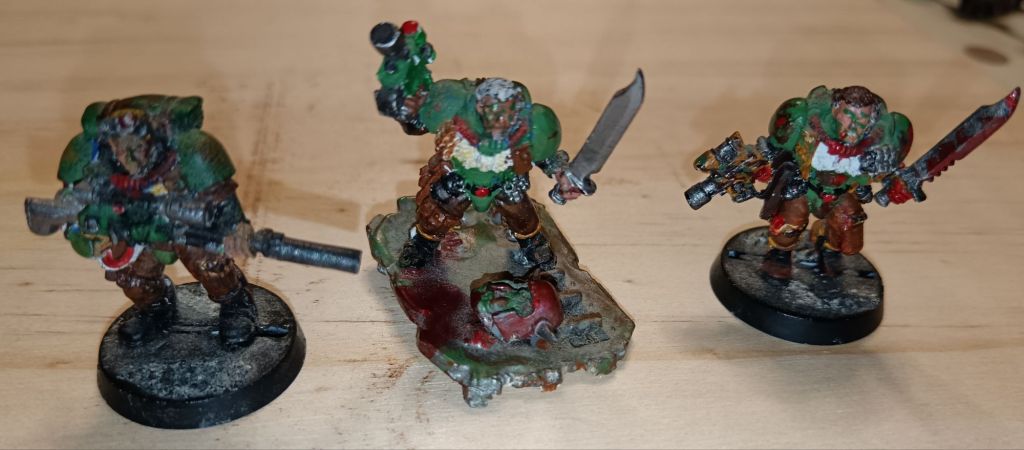
Three Space Marine scouts. These are metal miniatures from the 2000s painted by yours truly back in those days.

The other problem with the Adeptus Astartes is that they would cost an absolute bomb to put on the screen. How are they going to lumber around on set with any comfort or dignity in all that massive armour? If it’s light enough for them to wear, the weight of it won’t sit right, won’t look good; if it’s heavy enough to look convincing the actors just won’t be able to do it. CGI will have a lot of sins to cover up, and there goes your budget.

So who should the TV show be about? Easy: the Astra Militarum, aka Imperial Guard, because they are relatable and human but exist on a sliding scale of weirdness. They can be stock war movie characters, or they can be the Death Korps of Krieg, or anything in between. The writers have more freedom. Costumes and kit would be much cheaper: extras could be army reservists from whatever country they film in, maybe even, if we are really short of funds, wearing their actual uniforms, decorated of course with plenty of skulls and aquilas. They are canonically multi-racial and multi-gendered, so you could cast these characters pretty much any way.

The Tau would be another faction that could be interesting to show.  Avatar shows that it can work when you base a story around blue and heavily made-up and CGI’d aliens who are still humanoid and relatively sympathetic. Some similar points apply to the Aeldari. But the Astra Militarum would be so much more straightforward.

…but have Space Marines in it

But the Adeptus Astartes are iconic. They have to be in the show, or people will feel cheated. Here’s an easy solution: include them. Have a squad or a company of them, and make them secondary characters. We see them for 5-10 minutes in each episode, and in the finale they stomp in and help turn the tide. The less we see of them, the cooler they will be. Also, if they are not the main characters, you can make them as weird and fanatical as they should be. You can also spend plenty of money to get them right, because you would make savings based on their limited screen time.

Tell a (relatively) small story

Warhammer 40,000 is a famously baroque and extravagant setting. Aside from half a dozen human factions, we have Chaos, Aeldari, Drukhari, Orks, Tau, Necrons, Tyranids and Leagues of Votann. At that, I’ve probably missed a few. Each faction has its strengths and weaknesses and its aesthetic. Then within each faction, we have numerous sub-factions (Goffs, Bad Moons, etc for the Orks; Aeldari Craftworlds, cults of Chaos). And each sub-faction has its strengths and weaknesses, aesthetic, etc too. Even after all that, there are more than enough lacunas in the lore for players to make up their own craftworld, Space Marines chapter, Astra Militarum regiment, etc. Each faction has dozens of troop and vehicle types, each with its own set of stats and rules and its own intricate resin miniature; the hobbyist glues each miniature together from parts and then paints it according to their own creative vision.

Another of my old miniatures that I was able to find. An Imperial soldier has just hijacked a bike from an Ork. This hobby is all too expensive and time-consuming for me now, so I haven’t painted an Ork for nearly 20 years. I still buy the odd copy of White Dwarf magazine and read Black Library novels. And I still appreciate the continuum from the smallest resin hip-flask to the galaxy-spanning civilisation.

I think it’s the medium of the tabletop wargame that gives it the freedom to get so weird and wide-ranging. Novels have to be focused on character and plot, TV shows more so, movies most of all. You might see elaborate worldbuilding in, say, a very long series consisting of very long books (George RR Martin), an open-world videogame (Fallout: New Vegas) or in a sprawling comic that runs for decades (Marvel, DC). But a tabletop wargame is even more freed from the constraints of character, plot and narrative focus.

A novelist has to think about how to work in some backstory or try to make the exposition more interesting. Warhammer hobbyists are happy to buy army books in which (alongside rules, tips, artwork, etc) platefuls of backstory and exposition are served up without any attempt at “working them in subtly.” It’s open-ended; it’s better if it doesn’t go anywhere. No hero is going to come along and fix this horrifying future. The point is that the setting is suitable to have a battle in.

What does all this mean for a TV show? Pitfalls. The writers will have to convey a sense of that breadth and depth while also telling a cohesive story. A lot of Black Library material is sprawling and epic in a way that would not translate to the small screen. There are over fifty books in the Horus Heresy series! So I hope they don’t try to tell *the* story of Warhammer 40k, with the Emperor and the primarchs as characters. The fall of Cadia would be another dangerous one to try. These kinds of stories would cost too much, and be too solemn and gargantuan to give new audiences a point of entry. 
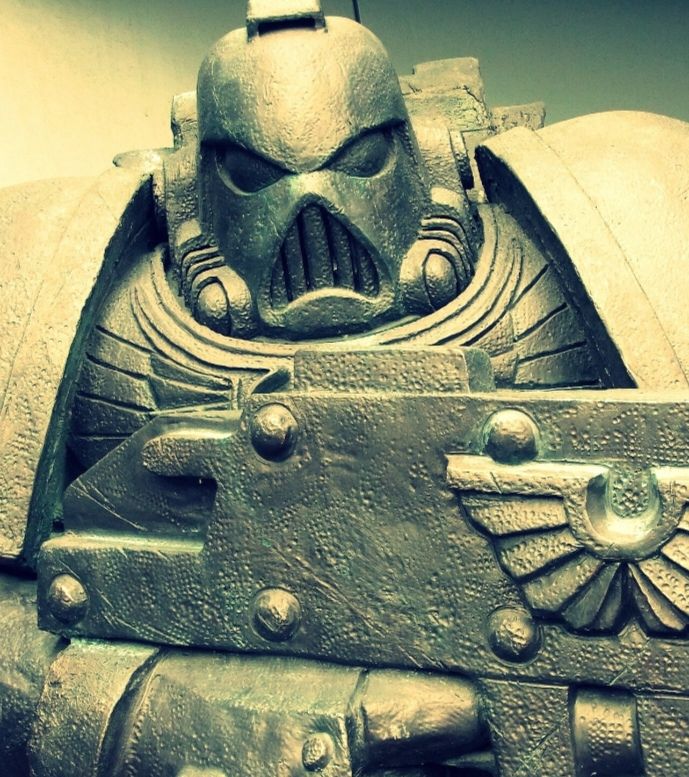
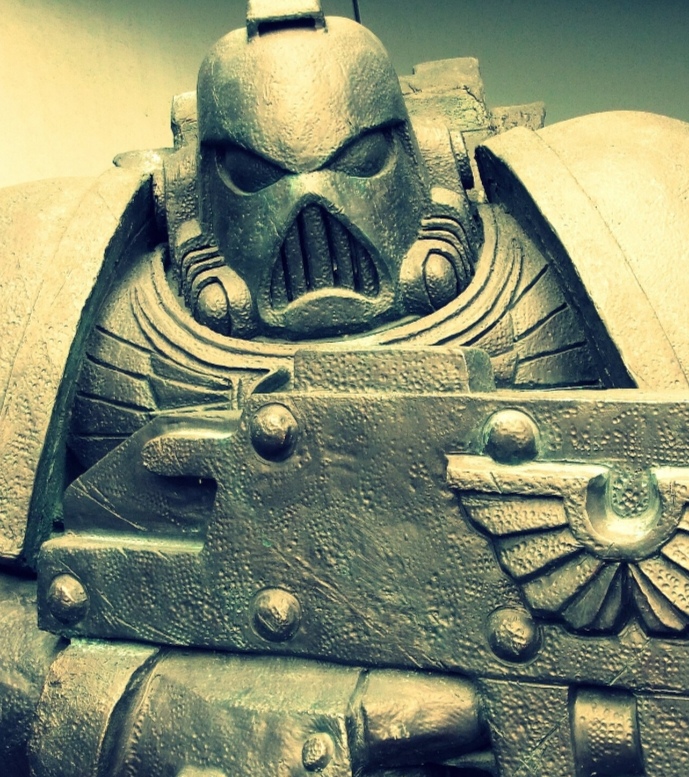
The featured image is an equally solemn and gargantuan statue of a Space Marine at Warhammer World. By Julie Gibbons, via Wikipedia Commons

Think smaller. Stick to one planet, or even one city or one battlefield. ‘Thinking small’ in the context of 40k could still encompass a gigantic city with lots of ecclesiastical mega-architecture, or an arsenal-moon with a gun cannon bigger than Australia. A hive city would allow for a good mix of studio interiors and miniature or CGI exteriors.
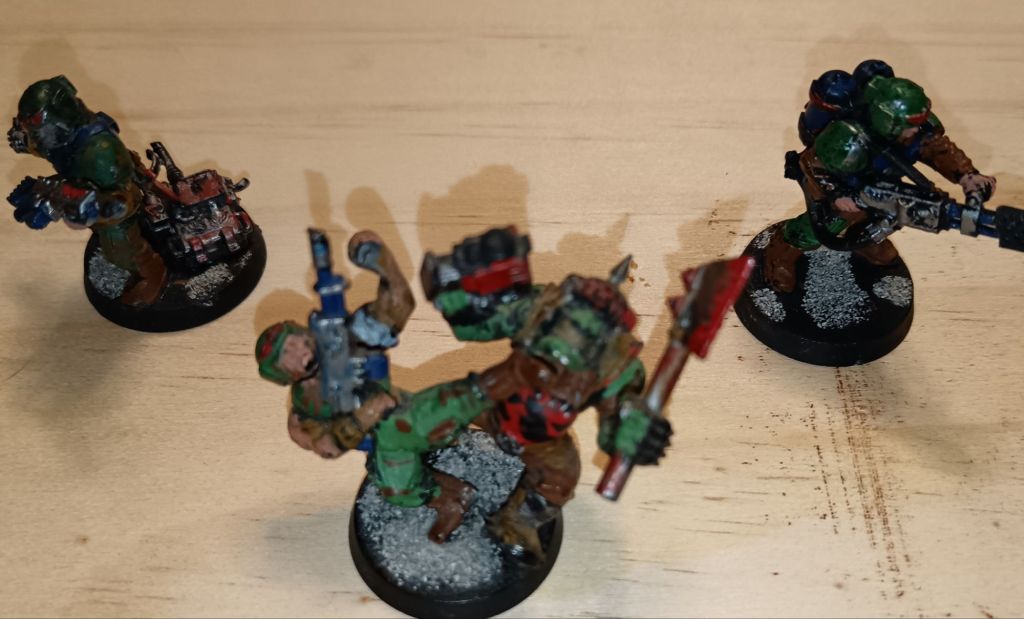
I was not a great painter, and as a commander I had a terrible habit of getting all my soldiers killed. But what I really loved was converting, ie, gluing miniatures together in interesting ways that, while lore-friendly, were not anticipated by the designers.

Here are ideas of the kind I think could work:

Inquisitors investigate a Genestealer cult. A full-scale Genestealer rebellion breaks out later in the season. After the Imperium forces win in the final episode, we strike a fatalistic note with the discovery of an approaching Tyranid hive fleet, of which our Genestealer cult was just a forward outpost.

A group of civilians and assorted imperial soldiers are trapped behind enemy lines by a sudden enemy advance and fight a partisan war.

Imperium and Eldar/ Tau/ Votann forces are forced to bury the hatchet and ally against a Chaos onslaught that threatens them all. The grim, dark, fatalistic note could sound when it ends with the trial and execution of our main character on charges of working too closely with xenos.

Use what you’ve got

A simple story set in a limited location allows for the more full building of a world. In a film like Children of Men, the most important things accumulate in the background or in brief glimpses. The visual and auditory richness of that movie shows what could be possible in a 40k series.

It is already such a visually rich world. A TV show would have an absolute wealth of material to draw on. No need to reinvent the wheel in terms of costumes, decor, set design, etc. Give us half-robotic flying cherubs and guys with pipes sticking out of their faces. Give us flying buttresses and computer terminals set into ornate pulpits, and skulls everywhere.

Get it right

I talked earlier about how 40K is open-ended, that there’s no real need for narrative focus as far as the tabletop wargame is concerned. But it would be a big mistake to think this means it’s shapeless or meaningless. What 40K does have is a distinct aesthetic and tone (maximalist, gothic, totalitarian, grotesque, with a hint of satire), plus rules that are (of necessity) pedantically exact. This provides a backbone to the sprawling lore. Its not that there’s ‘no point’ to the lore or backstory or that it ‘goes nowhere.’ If I’m building an army of Chaos Marines who worship the plague god Nurgle, I’m going to assemble them so as they look diseased and paint them in sickly greens. If I have an army of Orks I know they are very poor shots with ranged weapons but strong in hand-to-hand; my tactical challenge is to get them to close in on the enemy fast. Good thing I have some Stormboyz, ie, Orks with rockets on their backs.

So the lore is not arbitrary or pointless. It gives purpose to the hobbyist and clear rules to the gamer.
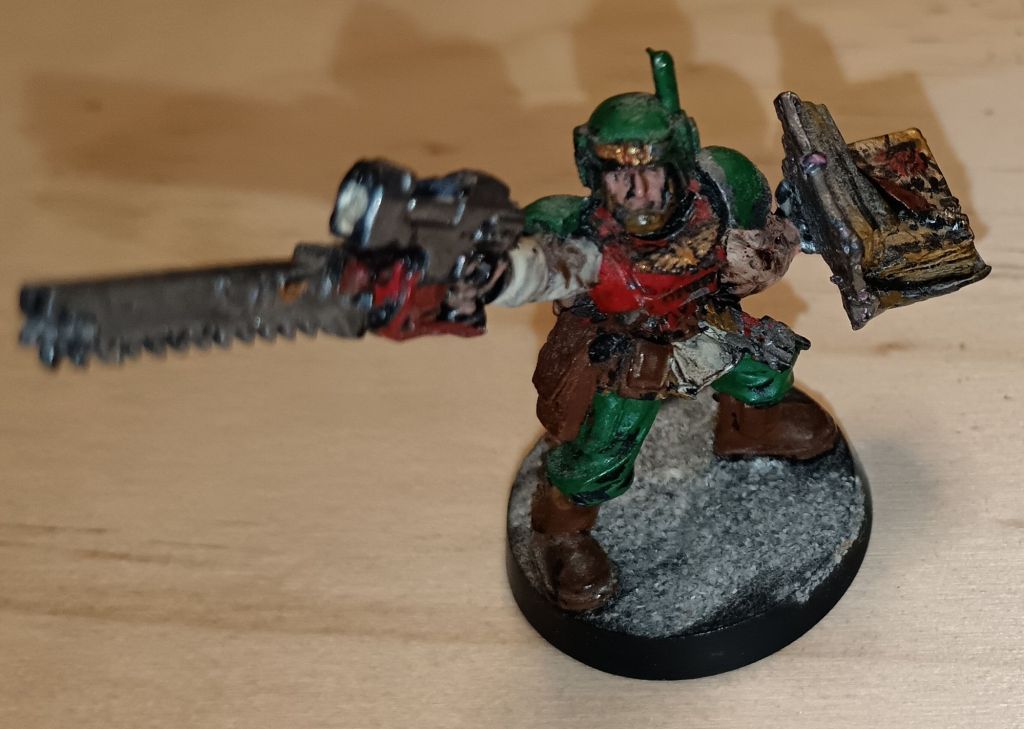
My Imperial Guard officer holds a holy book which I think I borrowed from an Inquisitor kit. Back then they were Imperial Guard, now they are called Astra Militarum. Most of my knowledge is from that earlier iteration of the game.

A TV show would have to get such details right. There is room for great variation in the 40k Galaxy, but if we see Orks who are crap at close quarters combat, or Nurgle Marines with a general air of good health, that will be a problem.

Imperial Guard sniper, adapted from plastic Cadian kit and metal Catachan heavy weapon loader, if memory serves

Another pitfall would be if the story and setting are played straight. The Imperium of man is a monstrous society, combining the 17th Century wars of religion with the height of Stalinism. Please understand before you begin that a Space Marine is not a US Marine in space. He is what it would look like if Buzz Lightyear joined ISIS.

We identify with the Imperium because we see in it something of ourselves, even though that something is a savage caricature of human history’s most repressive and fanatical tendencies.

And in turn, isn’t Chaos just a caricature of the Imperium? Maybe if imperial citizens weren’t primed and traumatized their whole lives by the grotesque imperial cults, they wouldn’t find the Chaos gods so appealing. If life wasn’t so miserable in the Imperium, maybe its people wouldn’t regularly see guys who look like Mad Max villains crossed with actual maggots and say, “Where do I sign up?”

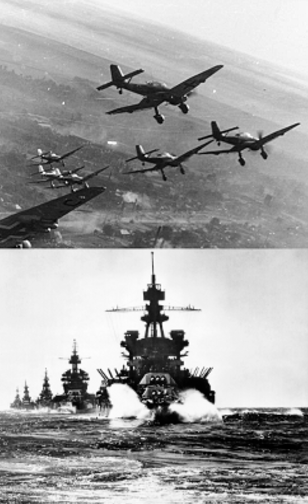
A vein of fatalistic humour should run through this grim, dark story. For tone, think along the lines of Paul Verhoeven, Mortal Engines, Judge Dredd and Fallout (well, West Coast Fallout, not East Coast Fallout, which is an instructive example of inappropriately playing it straight). It’s not Star Wars. And on the other extreme, we don’t want ten hours of 300 with boltguns.
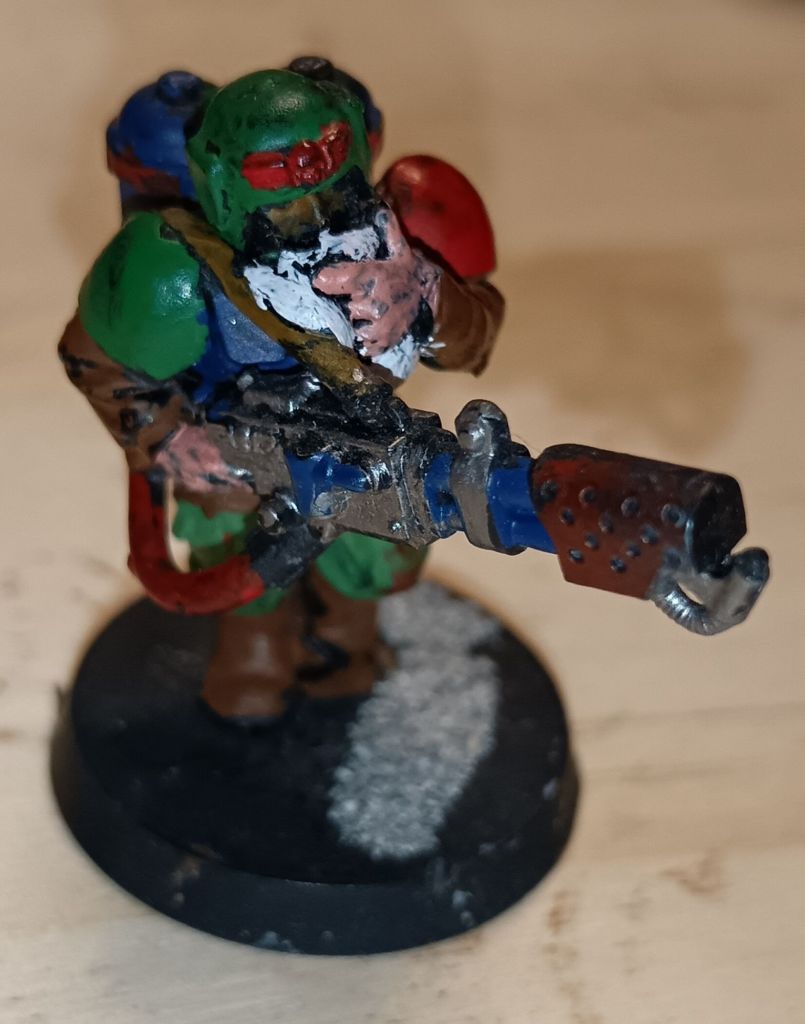
Another small conversion. An Imperial Guard soldier covers his airways while purging heretics with flamer.

A related idea: what if the series was a straight adaptation of an existing Black Library novel? I actually have a specific one in mind. But I’ll leave that for another post. Stay tuned. Meanwhile share your own thoughts in the comments. What faction should a TV show focus on? Is there any book you’d like to see adapted? Can you see a way small-screen Space Marines could work?
Games that warped my young mind: Tiberian Sun (2) Cutscenes and Gameplay

A thing I’ve come to realise from writing this blog is that it’s not so easy to write about things that are really good. I wrote brief things on Andor and the new Dune movies because brilliance speaks for itself and I don’t go in for gushing. It’s much easier to write about something you hate. Look how much I wrote on Antony Beevor’s Russia. It’s easier, and often it’s right and proper, but it’s negative and unhealthy.

The best thing is to talk about something of ambiguous quality. Something lots of people love, that you have big problems with, or something nobody gives a damn about but that you really like.

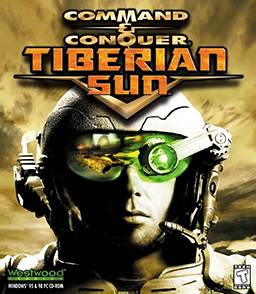
For example, Command & Conquer: Tiberian Sun.

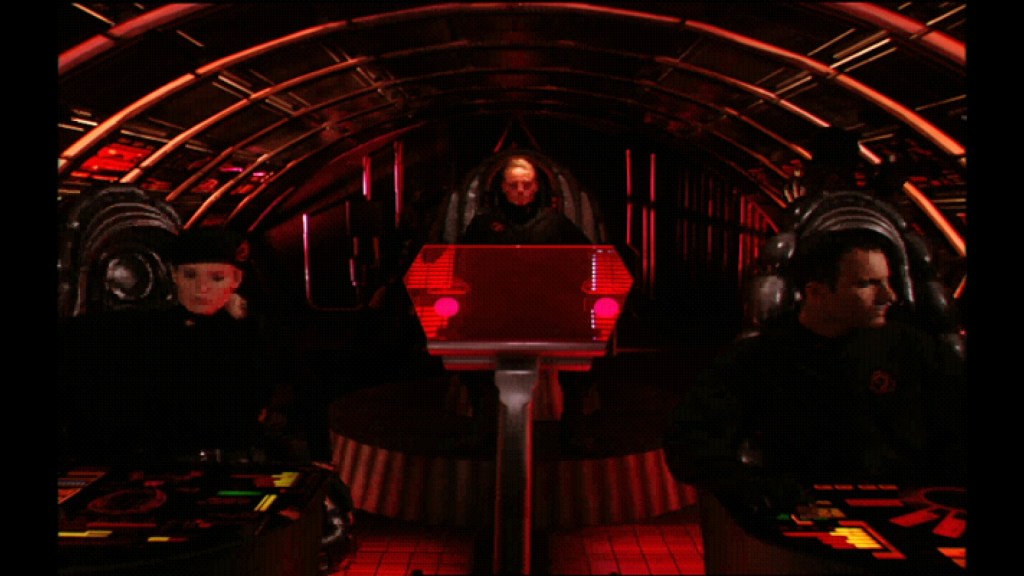
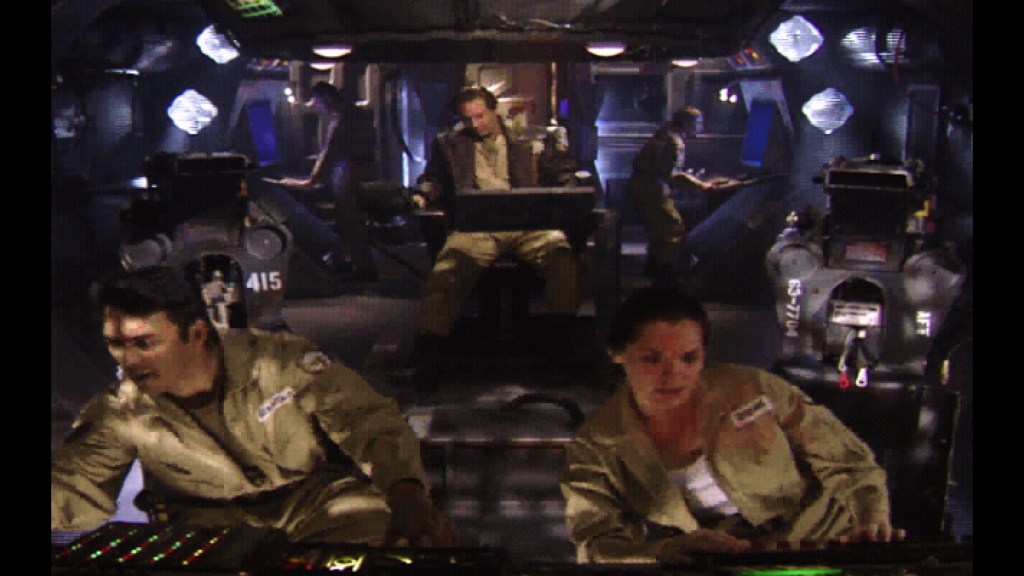
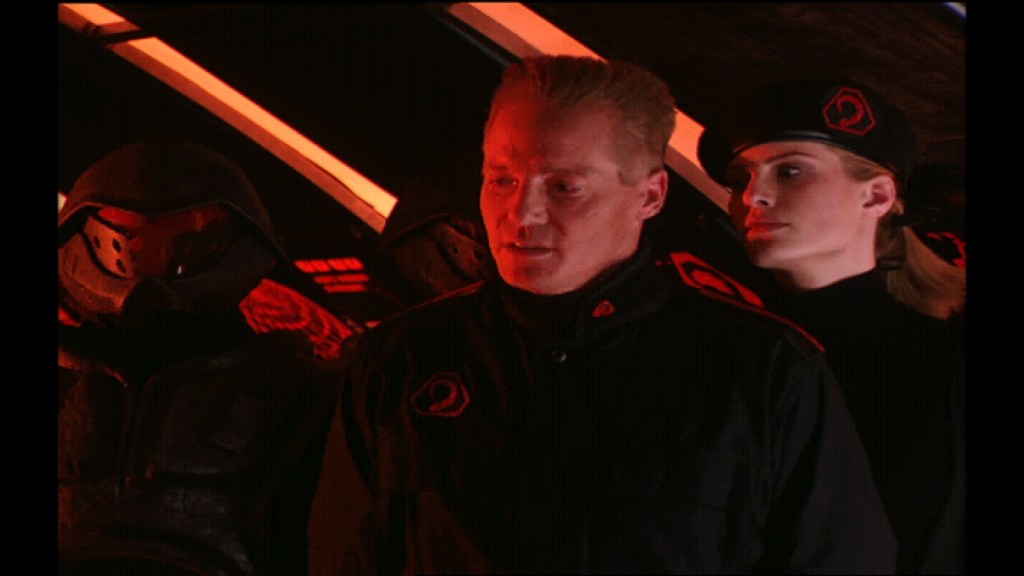
In Part 1 I talked about the themes of Tiberian Sun (TS): its semi-accidental relevance in terms of ecology, and the dead-end politics of its very literal “end of history”. But on its face it is a story about a struggle between two magnetic characters, Anton Slavik (Frank Zagarino) and Michael McNeil (Michael Biehn).

Slavik and McNeil

Most people find that playing as the villain leaves a bad taste in the mouth. TS gets around this in clever ways. Anton Slavik is a high-ranking officer in the service of a ruthless totalitarian cult. But when we first see him, he is about to be executed as a traitor. So when we first see him, he’s a victim, he’s vulnerable, and we side with him instinctually.

Our identification with Slavik deepens as the story gets into gear. He escapes in a tense action scene, and soon we realise that his accuser, General Hassan, is the real traitor. It doesn’t matter a damn that Nod are evil; we root for real Nod over fake Nod. Our instinct for lesser evilism runs that deep. And when we see a genuine injustice being done on a complete prick, we extend the prick a partial forgiveness.

RIP James Earl Jones

Slavik continues to command our respect, though not our affection, as his story unfolds. His overlord, the Nod prophet Kane (Joseph David Kucan), is a gloating and showboating kind of villain, video-calling his enemies just to mock them and quote Shakespeare at them before he blows things up. Slavik, by contrast, has a restrained and ultra-disciplined kind of fanaticism. He is ruthless, decisive, humourless.

Slavik and Oksana

His second-in-command is Oksana (Monika Schnarre). This is strictly a story for adolescents, and any intimate relationship between the two remains implicit. Oksana herself is a true believer, but allows her personal prejudice against “shiners” (mutants, AKA The Forgotten) to get her worked up. She serves as a foil to Slavik: in her light we can see more clearly that he does what Kane commands but without special rancour. This is not from lack of enthusiasm, but because such loss of control would be unbecoming. He only betrays emotion when we see in his eyes, to quote Liam O’Flaherty, “the cold gleam of the fanatic.”

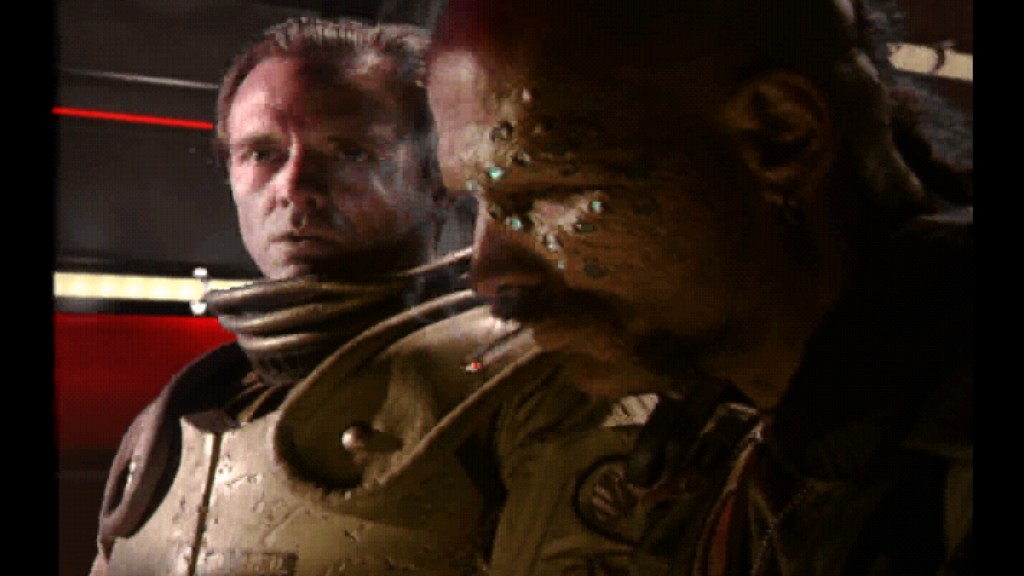
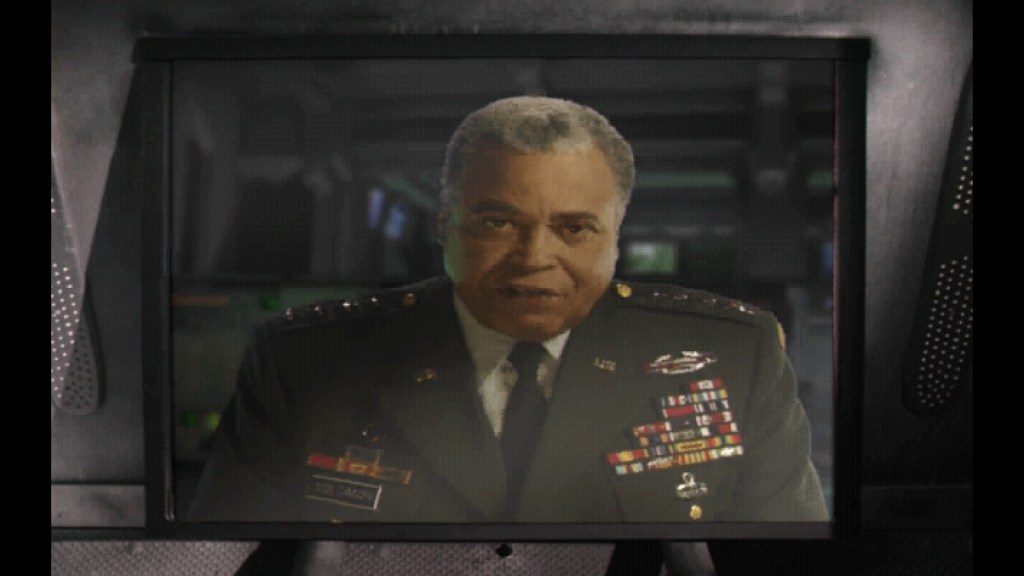
Slavik’s GDI counterpart McNeil is more of a standard game character. He’s cocky but easy to like in spite of this. He has enough humility that later he learns a grudging respect for the mutants. An embrace is as far as him and the mutant commando Umagon get with each other on screen. Umagon and co even get McNeil to entertain doubts about his superior officer General Solomon (the late and celebrated James Earl Jones), who also harbours prejudices against ‘shiners.’

McNeil learns a grudging respect for the mutants. This unnamed mutant commando has just helped him blow up a bunch of crucial Nod power plants.

Why am I going on about Slavik and McNeil? Because TS is different from every other C&C game in this respect: it actually has protagonists.

How every other C&C title works is, in between each mission, some great actor like Michael Ironside or Grace Park turns to the camera and explains the plot with a straight face. Like: “Well done, commander. Roderick Spode and his Blackshorts are on the run. But we’ve just received some troubling news. The Anarcho-Aztecs have launched a full-scale invasion of Andorra. Thankfully, we have a new prototype anti-gravity device that should prove useful. Come on through to the lab, commander. Allow me to introduce you to Sir Isaac Newton…”

(Incidentally, my phone autocorrected Michael Biehn’s surname to ‘Biden.’ Jesus wept. Imagine him giving you a C&C mission briefing: “Let me tell you something, Mack… You did a good job with the uh, the Presinald Trunt, on the little battle fella…”)

Out of all of C&C, only in TS is “the commander” of each faction given a name and a face. Now that’s a risky choice because in trying to make a movie rather than a set of briefings, TS’s developers risk being ‘cringe.’ It is visibly low-budget and Bowfinger-esque in places, but all in all it turns out much better. The player is a third-person observer of a drama. There are human stakes to the missions. TS doesn’t have an Oscar-winning screenplay by any means (I think it accidentally stole the line ‘Get me McNeil’ from a parody movie featured in The Simpsons) but it engaged me in the story far better than any other game in the series. That is because the expensive professional actors were talking to each other, not to me. Sparks fly when Kane and Jones’ General Solomon confront one another on video calls.

No other C&C title, before or since, did this. So once again, TS stands out. Before I actually replayed it, I had the vague impression that TS was guilty of ‘taking itself too seriously.’ Not a bit of it.

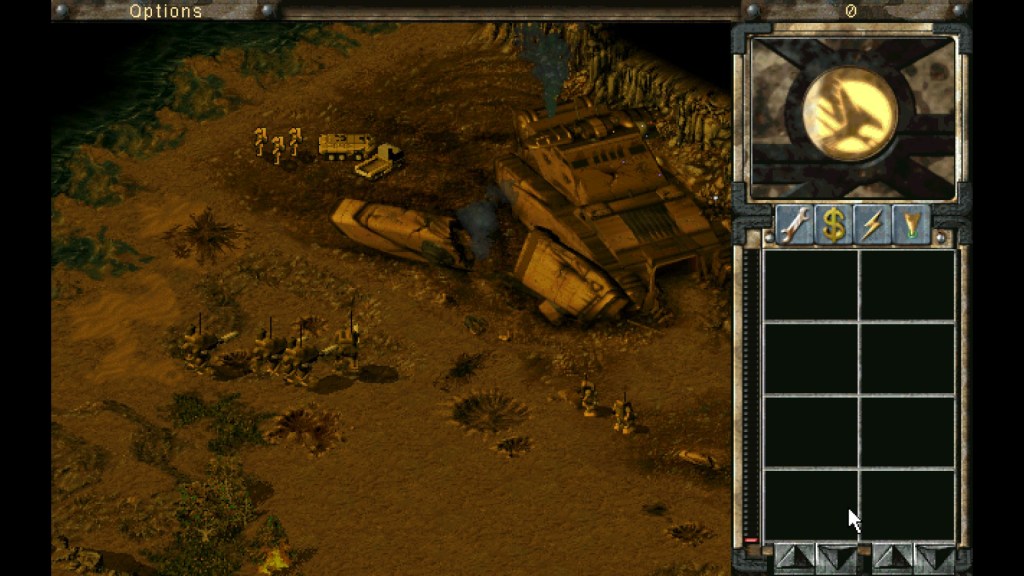
Nod troopers in a computer-animated cutscene

The story is told through three media:

  • Live action (or full motion) video – the bits with Michael Biehn and James Earl Jones, which we’ve just talked about.
  • Computer-animated videos, not in the game engine, showing 3d clips of the various weapons and unit types in action in the game world; victory and defeat cinematics.
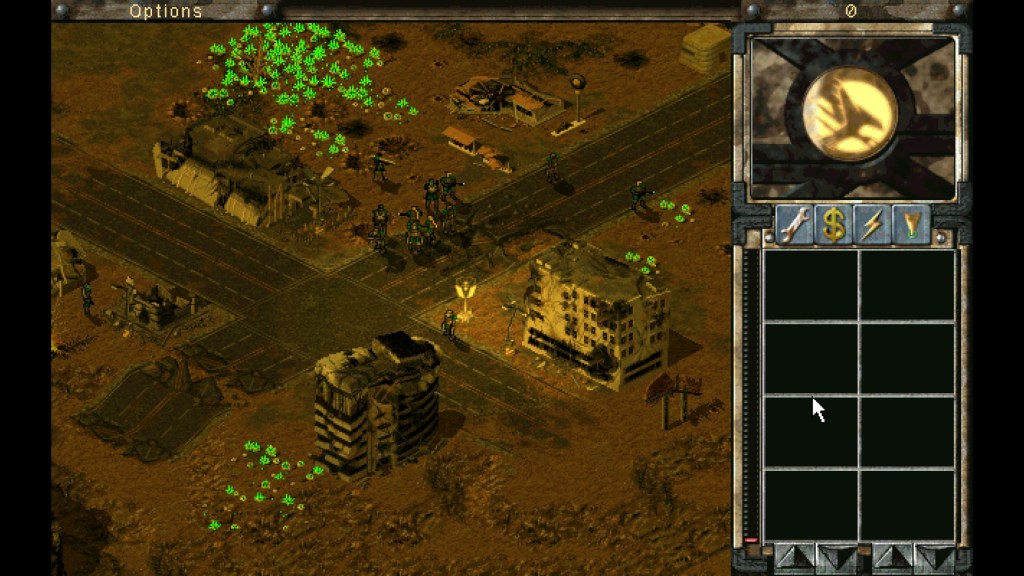
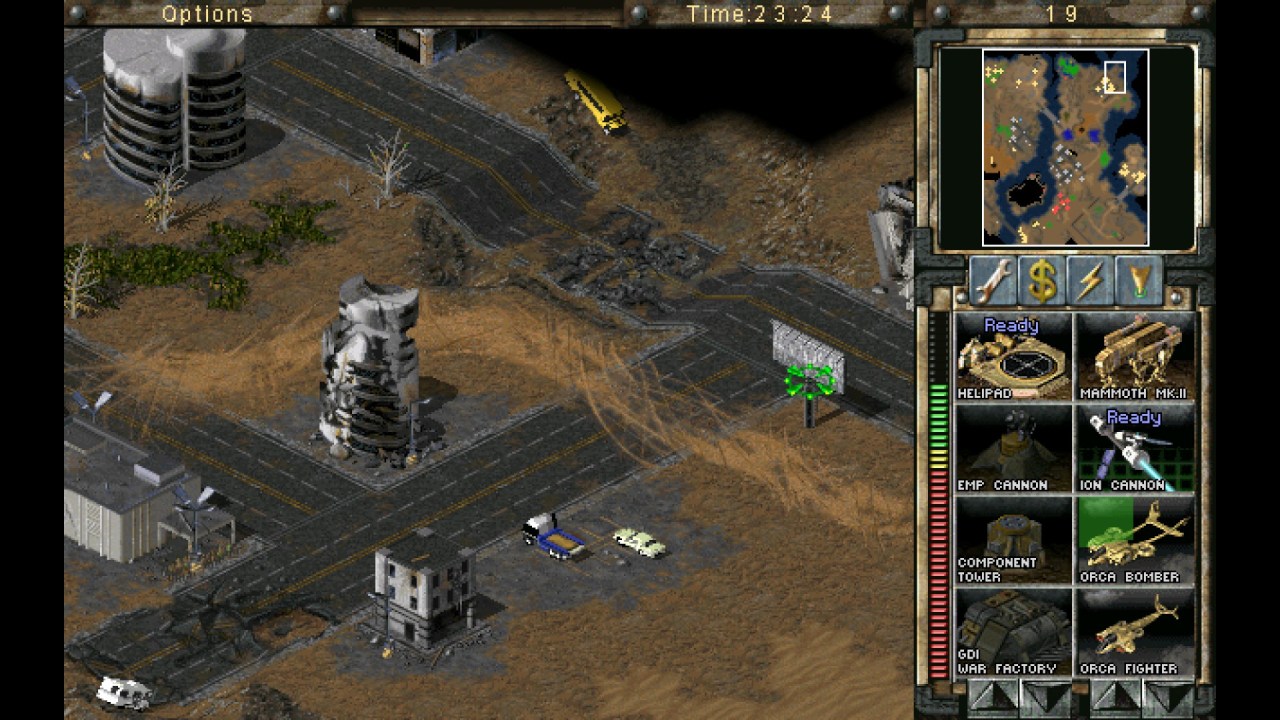
  • The game itself – little guys moving around a 2d isometric map studded with structures and canyons and Tiberium fields, and lots and lots of motorway overpasses. This is where we see the environmental storytelling we talked about last week.

These three levels tie in together really well. The 2d isometric world, we understand, is only a representation of the real world. We’re at one remove. The action and dialogue clips supply a taste of what it ‘really’ all looks like, how it feels to be in this world, and our imagination does the rest.

Tiberium Wars and Kane’s Wrath have better graphics. They look great. But they lose this power of suggestion, the way these three levels of storytelling stimulate the imagination in TS. We don’t just play on the screen. We play in our imaginations, in the gap between the game’s now-primitive graphics and what this world would really look like.

Gameplay: This land was not made for you and me

We haven’t talked about the experience of actually playing TS. Well, if you’ve played one C&C title you have a pretty good idea what all the others are like. But here as elsewhere this game just feels subtly different.

Tiberium Wars and Red Alert 3 are fast-paced games. Each map feels like an arena, even the bigger ones. Turtling is usually punished; momentum and initiative are key. If you spend five minutes exploring, if you take an eye off your production queues, then before you know it some tank is going to be smashing in the garage door of your con yard.

Fast-paced is what they were going for, and it’s well-executed. But TS has something else, which I like better. It has empty space.

It has deserted plains and desolate canyons that lead nowhere. It has space, free uncertain space that might or might not have enemies in, and you won’t know until you send in a couple of buggies. There are no bright objective markers on the map; you’d better just figure out where those enemy SAM sites are the old-fashioned way, by sending out some guys who might get killed. This land was, emphatically, not made for you and me, which underlines the theme of the environment being indifferent to humanity. It makes the factions and the war they are fighting seem small in the grand scheme of things. This is in harmony with the game’s general vibe of being less gung-ho and more reflective than the average run of C&C.

(Going back to the cutscenes for a moment, the Nod ones start with a horribly realistic-looking shot of a dead Nod soldier, his helmet and the face under it both smashed. See what I mean? Less gung-ho, more reflective.)

And what is more, it slows the game right down. Other C&C games have an element of frenzied button-mashing and horrible meat-grinder combat where you produce wave after wave and send them out to be slaughtered. In TS, defence systems are solid and turtling is as good a strategy as any. While you hold the line, you explore, probe, experiment with different unit types, advance through trial and error, and by degrees refine your strategy, which may be very different from someone else’s.  The final Nod mission, which involves setting up three massive missile launchers in enemy territory, is a fine example. There are several approaches to the main enemy base. I went in a roundabout way, battering through with rocket motorbikes, flattening a quarter of the base and bypassing the rest. I could have done it in a range of other ways, but I felt proud of the plan which I figured out and executed. Another good example would be the GDI mission where the enemy is launching poison gas missiles at you every five minutes. You have to choose wisely where to set up your base – it has to be somewhere you can spread it out, or each missile strike will be devastating. The challenge is usually not to fight a meat-grinder war of attrition, but to crack some seemingly impregnable fortress. What develops is an engrossing game of twelve-dimensional rock, paper, scissors as you figure out just the right moment and location to send in your armour, your air force, your artillery, your infantry.

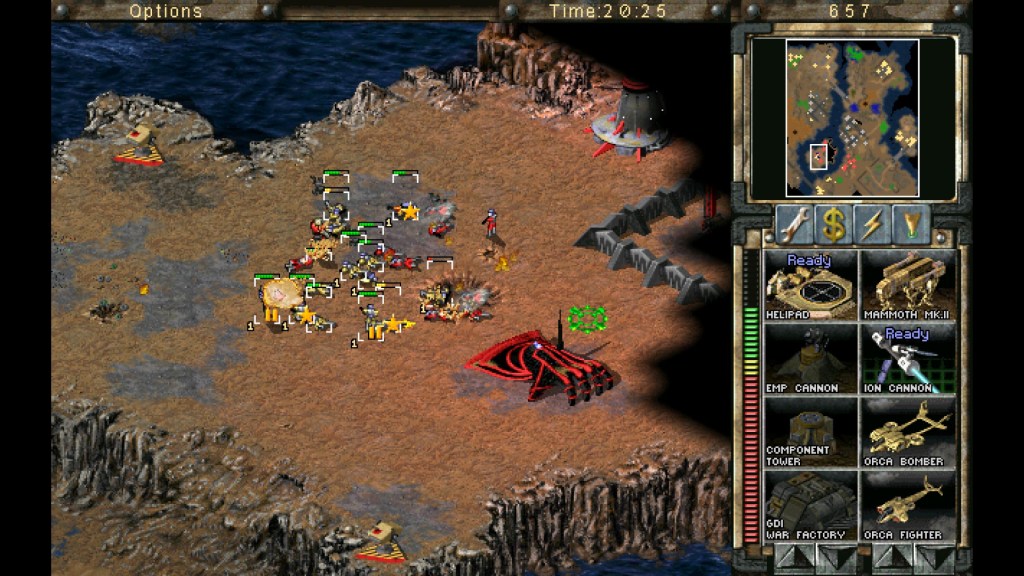
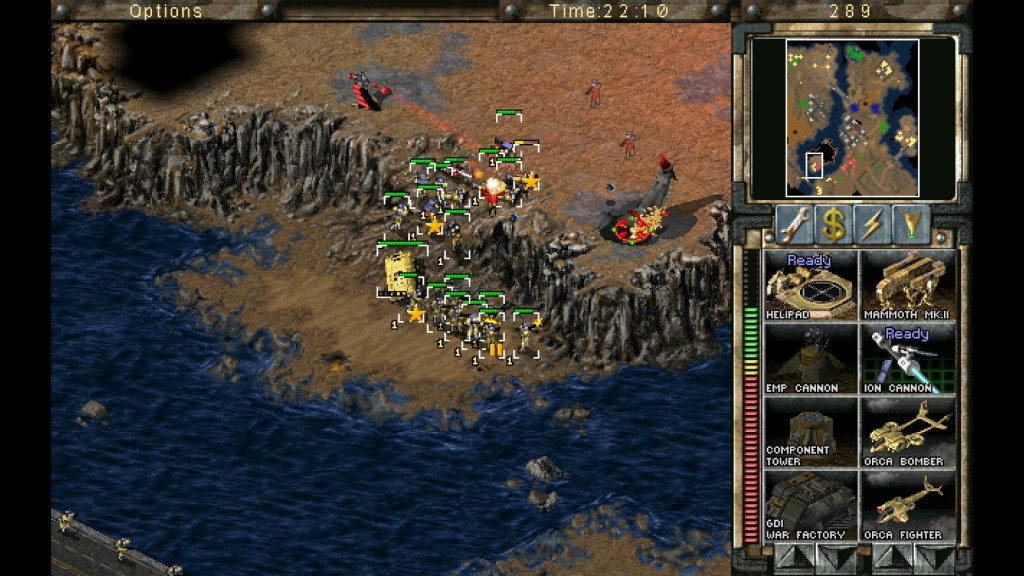
The final GDI mission requires you to land infantry on an island, without air or armoured support, to finish off the final Nod base

There are other neat little things. If you fight in woodland, the trees catch fire and the fire spreads and hurts nearby units. The Nod artillery makes craters that are actually depressions in the landscape, not just cosmetic scars. Careful where you put your flame tanks; they will incinerate your own guys if they are standing in the wrong place. These neat little things were abandoned in subsequent C&C titles.

It is annoying, of course, to be limited to a production queue of just five units. Until it isn’t. You get used to it, and you realize that it has freed you up to really think about what you’re building. Armies stick to a manageable size and you have an incentive to preserve them. The five-units thing is a limitation which in effect frees you up.

Conclusion

What I like best is writing about something that you both love and hate – or that you simply feel others have overpraised or over-criticised. It’s satisfying to identify where the good and bad sides of a thing fit together like yin and yang, when the great and the gammy mutually constitute each other, when you couldn’t have the one without the other. It’s equally satisfying to talk about excesses and excrescences, unforced errors and unexpected flashes of brilliance. Best of all when the thing you’re talking about is not ‘high culture’ by any definition, but a vulgar-arsed text that was consumed by tens of millions of people even as it went completely unnoticed in newspapers and academia.

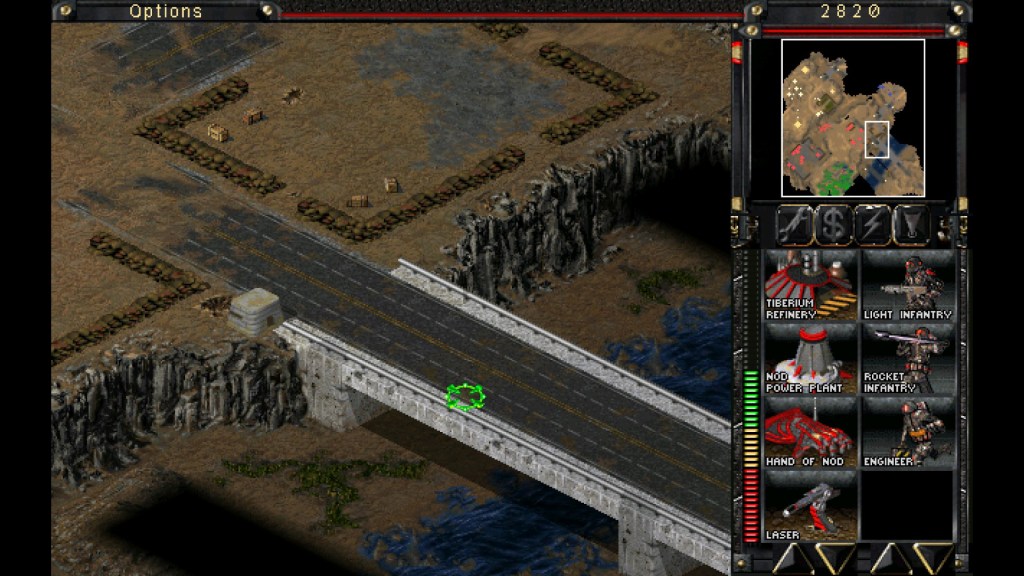
I haven’t done justice to the fact that TS is full of destructible bridges and overpasses. It was a new feature that they were excited about, and they milked it.

Such a text is Tiberian Sun. I wouldn’t be surprised to learn that it was experienced by more people in its day than many earnestly and widely reviewed Oscar-nominated movies of the same era. The kids playing it then, aged in or around thirteen, are in their thirties and forties now, voting and operating forklifts, approving loans and being approved for loans, or not, and having kids and colonoscopies. Grown-up stuff, far away from the visceroids and Tiberium fields. These posts on Tiberian Sun are for those people, and I hope it has given them the satisfaction of excavating long-neglected recesses of their own minds.

Games that warped my young mind: Tiberian Sun (1: Setting and Story)

When I was 11 or 12 – or maybe it was some older and more embarrassing age – there was a field near my house that me and my friend called the Tiberium Field. You had to dash across it in twenty seconds flat, otherwise Tiberium poisoning would kill you and turn your body into a visceroid, an aggressive and indestructible blob of human tissues. In our heads, we were in Command and Conquer: Tiberian Sun.

So far, so nostalgic. This is a post where I talk about a 1999 strategy game, maybe to recapture the remembered leisure and innocence of the childhood that surrounded it.

But I never got past a few missions of Tiberian Sun, never owned my own copy, and I like it a lot more now than I did back then. If we’re talking nostalgia, I was always more of a Red Alert guy (who could have guessed?). At the time I thought Tiberian Sun was, in comparison to Red Alert 2, drab and self-serious, with a clumsy interface and confusing missions. Earlier this year when I bought the whole Command and Conquer back catalogue for a tenner, I didn’t expect that this would be the game I spent the most time on, the one where I actually finished both campaigns, the one that would haunt my imagination.

So this is not all nostalgia. Something else is going on here, and I’m going to try and find out what. And even within the nostaglia, there’s the question of how this game worked its way into my imagination in such a way as to turn the grass of that neighbourhood field into an expanse of deadly and valuable green crystals.

So how did this game warp my young (and not-so-young) mind?

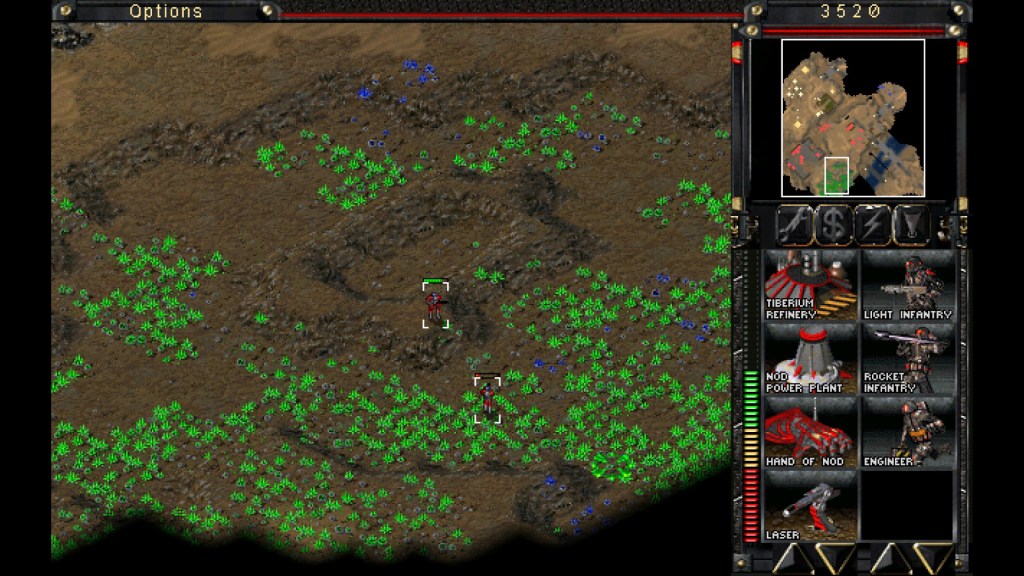
This screenshot is from the expansion pack, Firestorm

The Tiberium-haunted world

The first point in favour of Tiberian Sun (henceforth TS) is its setting. The world of the original Command and Conquer was sort of improvised. The developers said, let’s have something like the spice from Dune 2 – it works so well as a resource-gathering feature – but transplanted to another setting. The result is Tiberium, a strange green crystal native to some alien world which has begun to spread over Earth’s surface. There are two factions: the Global Defence Initiative (GDI), a one-world military defending the status quo, and the Brotherhood of Nod, which is part-Tesla, part-ISIS, part Comintern, and obsessed with using the Tiberium for obscure ends. My impression, having played only a little of the original C&C, is that whatever worldbuilding there is starts to peter out around there. The setting is just an excuse to have a war game on the Dune 2 formula. (I’ve talked about the Red Alert spin-off elsewhere.)

Tiberian Sun takes the worldbuilding more seriously. A couple of decades after the first game, the Tiberium infestation has advanced, and Planet Earth is now terminally sick. GDI and Nod are still fighting over ruined cities and land choked with alien crystals and alien weeds, skies torn by ion storms, poisoned air, mutated genetics. For more on the setting and its applicability as a prophecy for our times, I recommend this article from Eurogamer by Robert Whitaker.

Tiberian Sun captured that late-1990s sense of some vague impending doom. But in 2024 it offers a strange kind of relief. You can retreat into the barren comfort of a world that is already destroyed, where there is little to save. There are unexpected inheritances from Dune: like in Herbert’s book, the ground beneath your feet is more than a setting, it’s an actor with powers of life and death over the fragile humans and machines crawling on its surface.

The applicability to climate change and global warming (which we all absolutely knew about in the 1990s even though those in power did nothing) are obvious. It’s a metaphor for our times in another way too. GDI are coded as “good” but we never see them actually doing, or even promising, anything good. They never help anybody or change anything, until the Forgotten twist their arms. We side with GDI only because Nod are obviously and extravagantly worse. Yes, GDI is Harris and Nod is Trump. Neither side offers a way out of war and ecological destruction. But Nod at least offers its supporters the shallow pantomime of its rituals and chanting and bloody spectacles.

Mutants, ruins and the glow of Tiberium. It’s a vibe

The setting itself tells a story: when we move our little men across the map, we see ruined high-rise buildings, contrasted with space-age-looking new settlements with solar panels and bunkers and greenhouses: the civilian world has retrenched into smaller and more resilient communities. Meanwhile war has advanced as a science. It’s all laser guns and visored helmets, giant walking battle mechs, cyborgs, explosive throwing discs, orbiting battle stations. Humanity is spending and innovating to fight more effectively, even as we have less and less to fight for. While the Red Alert setting just pits an evil faction against a good faction, Tiberian Sun (TS) takes place in a world that is messier and more ambiguous. In Red Alert, we don’t know why the Soviets are attacking the status quo. In TS, we don’t know why GDI are defending it.

Videogames then were violent, militaristic, imperialist – not in a the conscious and blatant way that Call of Duty is now, but as it were by default, by reflex. C&C is no exception. The GDI versus Nod struggle is at base the same old Imperialism versus Third World struggle, with the legitimate struggles of the global majority (“disenfranchised nations” seduced by Nod) packaged as evil fanaticism. In TS it is less explicit, filtered through layers of deniability in the worldbuilding, but we get signals, such as that the villains in Tiberian Sun have names that are Arabic, Latin and Slavic (he’s literally called ‘Slavik’). The Latino baddie is a drug smuggler who menaces the southwestern United States, playing into racist tropes. We see one South Asian guy in the ‘Global’ Defence Initiative, but the rest of the goodies are Americans.

The Forgotten

The music is not as conspicuously brilliant as that of Red Alert 2 but it has a greater range. There are moments of foreboding (‘Valves’) and loss (‘Approach’). If Red Alert 2 is a violent cartoon, Tib is a 1980s-90s action sci-fi movie – the vibe, to me, is sort of like Terminator 2, Aliens and Paul Verhoeven.

The melancholy themes probably belong to the third faction in Tib – unplayable and lightly sketched, but essential to the story (I suppose if GDI is Harris and Nod is Trump, they are Jill Stein or Cornel West). This is a loose confederation of clans who call themselves The Forgotten. They are people mutated by Tiberium exposure – insulted and belittled as ‘shiners’ by GDI and Nod alike, distrustful of GDI due to past atrocities, persecuted and imprisoned by Nod. They are few but they are pretty lethal in a fight.

The Forgotten are the conscience of this story. In the GDI campaign, it is only by overcoming prejudices and working with the mutants that GDI can defeat Nod. In the Nod campaign, you prevent any possibility of an alliance between GDI and mutants through a nasty trick. There’s more going on here than is usually the case in this series.

An actual Tiberium field

Tiberium Wars

In Part Two of this review I’m going to be looking at two other strengths of Tiberian Sun – the cutscenes (you heard me) and the gameplay. But before I move on I want to comment on the 2007 sequel, Tiberium Wars and its expansion Kane’s Wrath (I haven’t played Tiberium Twilight). What I have to say about Tiberium Wars (TW) underlines what I’ve just said about TS.

I’ve played a lot of TW and enjoyed it, but it doesn’t have the same grip on me as its 1999 predecessor. And I don’t think it’s just nostalgia.

The graphics and the smoother interface are a huge upgrade on TS, marking a rapid development in just 8 years. The story is solid, far less silly, and it’s all in all a lot of fun to play. But the setting doesn’t feel as real to me, and I think I know why.

Tiberium Wars leans with dispiriting heaviness into a ‘Global War on Terror’ framing. Magazine ads for the game talked about fighting terrorism. Technologically, GDI has been downgraded – no more stomping robots. This is explained in-game as being due to budget cutbacks, but the effect of it (and probably the intention) is to make everything look a few-score degrees more like Iraq or Afghanistan, or some near-future 9/11. The expansion Kane’s Wrath thankfully leans back the other way, and was clearly crafted by people who loved TS.

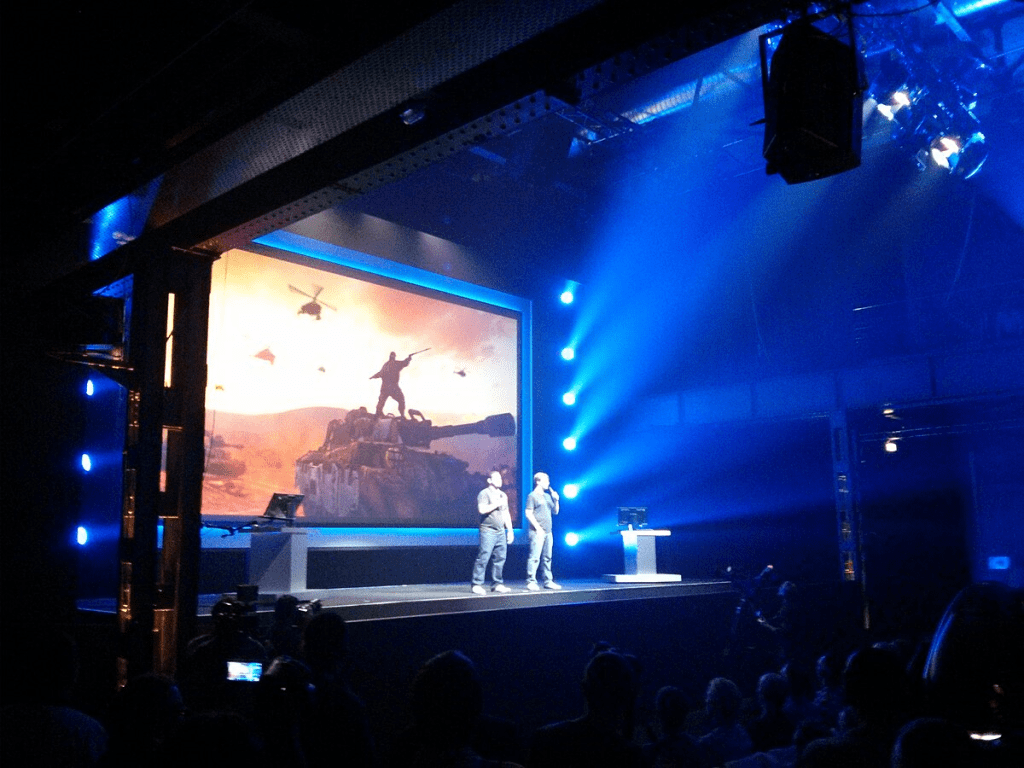
From a 2013 EA press conference about a new C&C title. If you have eyes, you can see the vibe they’re going for. And it’s not ‘morally dubious 1990s action sci-fi movie’

TW’s setting is retconned so that the Tiberium-infested world is divided up into uninhabitable Red Zones, Yellow Zones which are in a state of social collapse, and Blue Zones which are stable and prosperous. This is a marked contrast to Tiberian Sun, in which everywhere – Egypt, the USA, Norway, Germany, Britain, Mexico – was one of two things: a Yellow Zone or a snowy Yellow Zone. In TW, the Blue Zones we see are all either in the USA or in Germany. We always see them menaced and under assault. The first few missions are a bizarrely close remake of Red Alert 2, with the baddies invading hallowed American landmarks like the White House and the Pentagon (No! Please don’t destroy the White House or the Pentagon! Anything but them!). The Imperialism vs Third World framing is much more obvious and open. It’s no accident that the Forgotten are left out of the story of TW – they appear only as an Easter egg and they talk like super mutants from Fallout.

At base the reasons I don’t like it as much are political; I think it’s a shitty way to portray the majority of the human race, as if they have nothing better to be doing than besieging and menacing whatever dull place you live. But you don’t have to agree with that to see that these are two very different types of story and setting. Tiberium Wars is the same old C&C story about protecting the status quo. Tiberian Sun has more depth and ambition.

Home Page/ Archives

To receive an email when Part 2 of this article goes live, type in your email below:

Nine things that inspired Star Wars

This week I’m taking a break from Miseducation Misadventures to let you in on what runs through my head when I watch Star Wars. Re-watching it as an adult, I notice little things that I can trace back to their source – like the scattered mentions of spice mines and spice freighters in the first movie. Any guesses which SF novel that’s a nod to?

Here are nine sources from which Star Wars drew key ideas. If I’ve missed any interesting ones, chime in down in the comments.

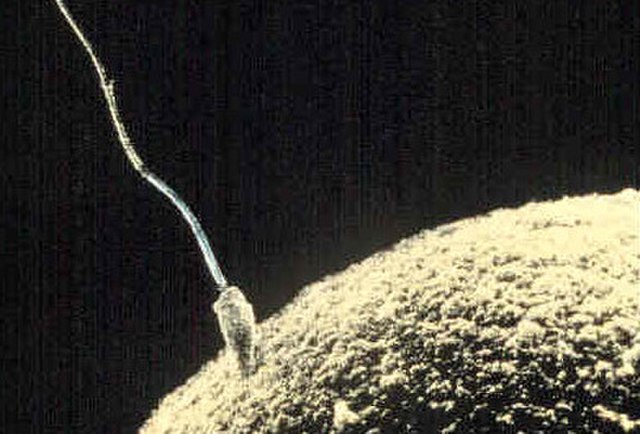
1: Reproductive Biology (2,000 million BCE)

The final battle in 1977’s Star Wars involves a swarm of small starfighters approaching and seeking to penetrate the much larger orb of the Death Star. This looks a hell of a lot like a load of sperm trying to fertilise an egg, with zero-gravity space standing in for the liquid medium through which the little swimmers propel themselves. This was probably not deliberate – the imagery probably bubbled up from the filmmakers’ subconscious. It stands out all the more starkly against this pre-adolescent and mostly sexless galaxy.

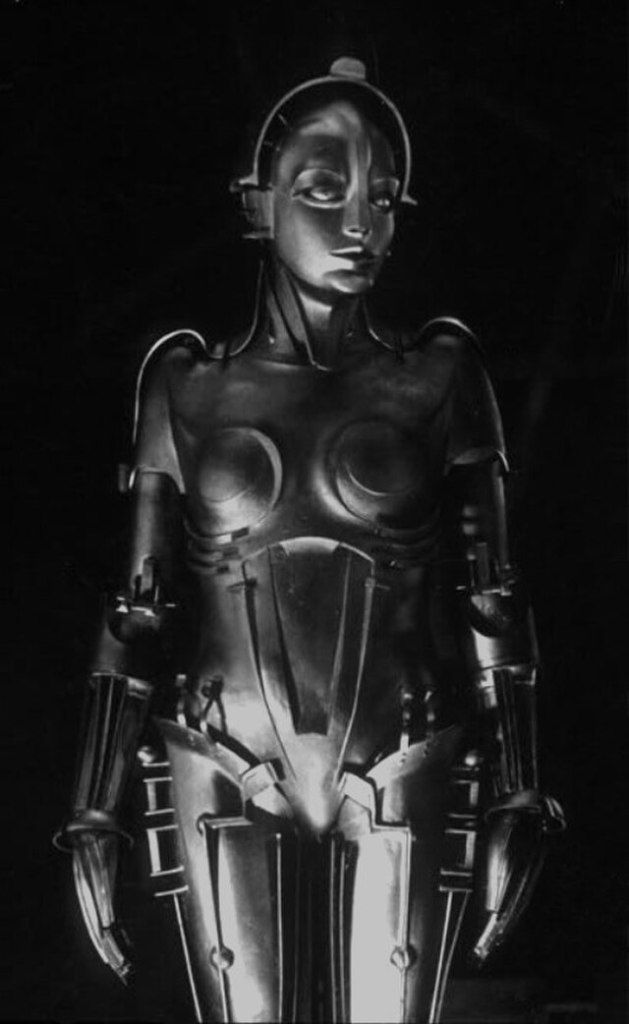
2: Metropolis (1927)

And here we have a female version of C-3PO, in an experimental silent film from Weimar Germany.

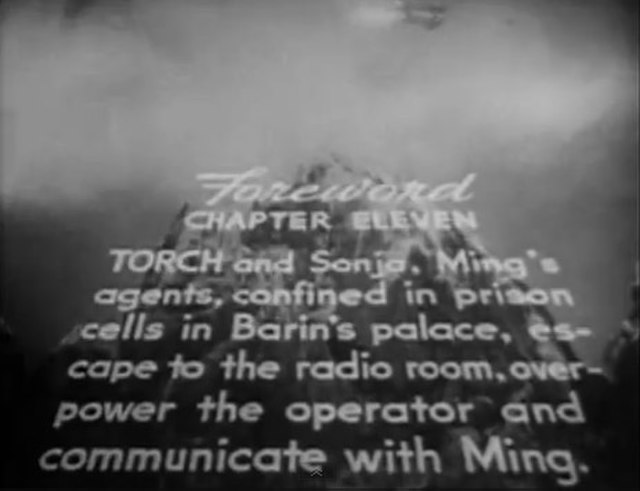
3: Flash Gordon (Comic and movies, 1930s)

Star Wars took a few cues from Flash Gordon – most obviously the opening text crawl but also the general idea of a series about fun adventures in space.

4: World War Two (1939-1945)

In 1977 when Star Wars came out, World War Two was as recent as the collapse of the Soviet Union, or the first episode of The Simpsons, is to us.

And the movie helps the audience to grasp what is happening in space by using a visual language familiar to them: it has World War Two-era fighter planes in space. The Empire’s star destroyers resemble the warships of the mid-century. The Imperial officers dress like Nazis.

On the other hand, weirdly enough, Star Wars references the Nazi propaganda film Triumph of the Will. The final scene where the rebels have a rally and the human characters all get medals (a weird enough scene in itself) follows part of this notorious film very closely. An odd choice, having the good guys mimic the visuals of a genocidal regime, especially when the bad guys are clearly based on them.

5: Casablanca (1942)

In a colourful jazz bar full of diverse people, in a town full of thieves and refugees, in a desert land where an evil empire is tightening its grip, we meet a cynical smuggler who is secretly an idealist. Will he find it in himself to help the two desperate fugitives who are seeking passage to safety? Of all the cantinas in all the systems in all the galaxy…

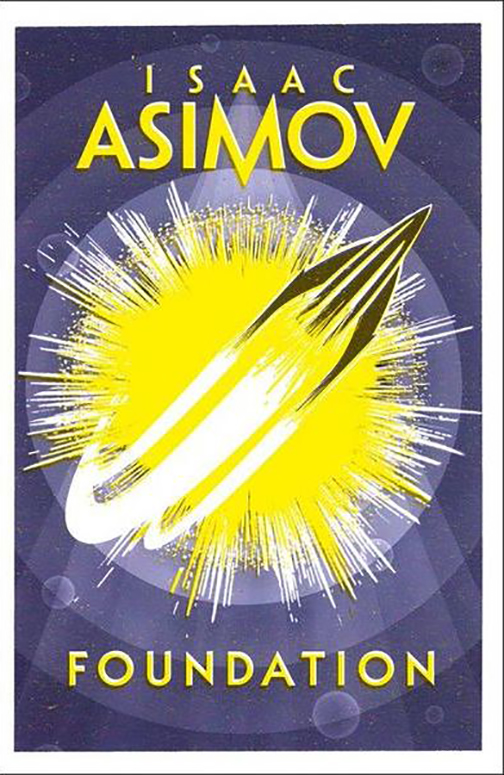
6: Foundation by Isaac Asimov (1940s-1950s)

The story and themes of Star Wars and Foundation don’t resemble each other at all. But there are many little things which Asimov seeded in the science fiction genre which pop up in Star Wars:

  • Hyperspace travel
  • Weapons called blasters (much more lethal in Asimov)
  • A galactic empire
  • Space feudalism
  • A city which covers an entire planet (Trantor/Coruscant)
  • The wild outer rim of the galaxy
  • It goes right down to random names: Asimov’s Korellian Republic is echoed in the Corellian shipyards
  • Roguish traders who do the right thing in the end (Foundation has several Han Solos in it, who say things like ‘Never let your sense of morals prevent you from doing what is right.’)

But for Asimov, empires are fundamentally good, the roguish trader is an advertisement for a doctrine of enlightened self-interest, and mysticism is nothing but a charade. All this is at odds with the anti-authoritarianism and sincerity of Star Wars.

7: Akira Kurosawa (1930s-1980s, especially 1950s)

Japan’s most well-known film director had a huge influence on George Lucas and Star Wars. I haven’t seen The Hidden Fortress (1958) but apparently it involves two peasants who escape from a battle (like C-3P0 and R2D2) and meet a princess; there are sword fights, and in the end a bad warlord changes sides. But I’ve seen a few others, like Throne of Blood, Ran and Seven Samurai. Any of these great samurai films show themselves to be ancestors of Star Wars. There are the sword fights and the robes and Darth Vader’s helmet. In a western ear, names like Obi-Wan Kenobi have a Japanese ring to them, and the Jedi resemble an idealised version of the Samurai.

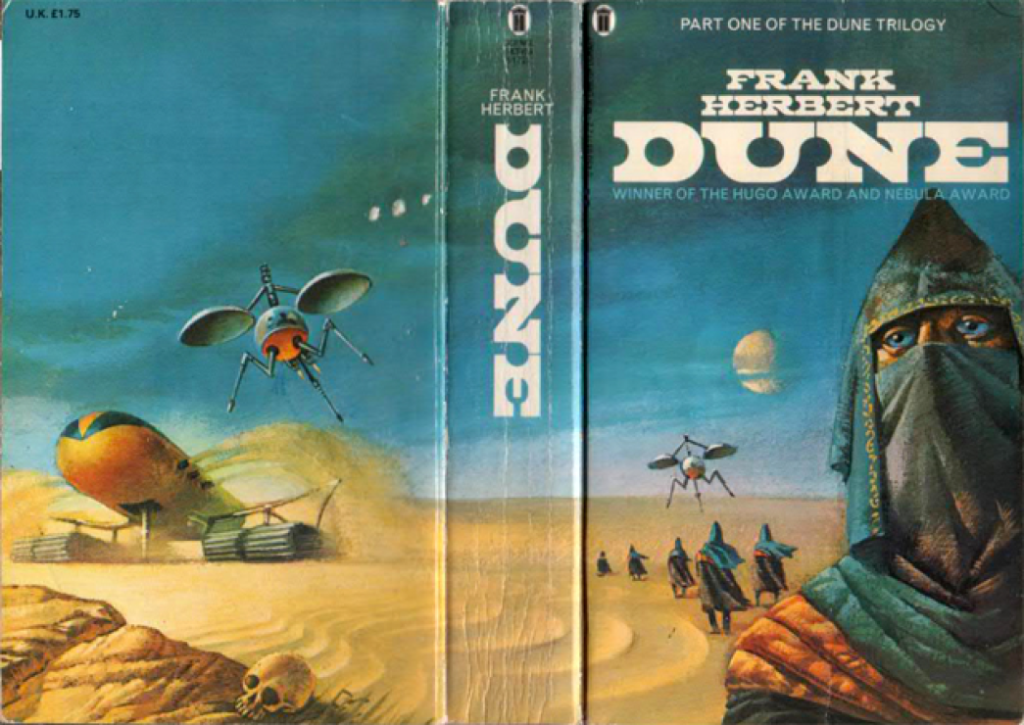
8: Dune (1965)

Frank Herbert’s Dune is riding high after Denis Villeneuve’s great film adaptation and I’ve written about it a few times before. Like Foundation, it provided a lot of ideas for Star Wars to pick up.

  • Dune is closer than Foundation to the themes of Star Wars. It is a text that was obviously written at the height of the anti-colonial struggles of the 1960s; it is pretty negative about empire; it is deeply sincere about religion and mysticism (even in charade form!).
  • The Jedi look like samurai, but they owe much to Dune‘s Bene Gesserit, an order of women who cultivate superhuman powers.
  • Both texts feature a harsh desert planet (Arrakis/Tatooine)
  • And giant worms,
  • robed nomad raiders,
  • smugglers,
  • and moisture-harvesting technology.
  • As noted above, scattered references to spice in the first Star Wars movie are another nod to Dune.
  • And once again we have space feudalism.

Foundation and Dune are the best examples I can think of, but they are stand-ins for a whole rich genre of mid-century science fiction without which Star Wars would not have existed.

9: The US War in Vietnam (1965-1973)

A few years ago Star Wars creator George Lucas confirmed in this interview that his story was fundamentally anti-colonial, that his heroic rebels were based in part on the Vietcong and that the evil empire was based on the United States – along with other past empires and freedom fighters throughout history.

Vietnam has featured just as heavily in other radically different readings of Star Wars, which is unsurprising as the war ended just a couple of years before the movie came out. I can’t remember who exactly wrote this, but the idea is that Star Wars was an infantilising nostalgic escape for a US public keen to avoid thinking about their country’s military and moral defeat in Vietnam. White people with American accents got to be the guerrilla heroes – though from the costumes to the names and decor, it is one of the strengths of Star Wars that it has never looked or felt ‘western’ (unless you mean spaghetti western, as there’s more than a hint of ersatz Mexico and Sergio Leone in there).

A last word…

The point of this is not to be like ‘Star Wars is a rip-off’ but to remind everyone that it’s just a movie, a cultural text rooted in its time. Today we have the corporate cynics for whom nostalgia is a currency and the toxic fandom for whom nostalgia and innovation are just different kinds of betrayal. The worst excesses of the fandom, I suspect, are boosted and incentivised by social media, and the back-and-forth whining and apologetics are increasingly astroturfed online by accounts which have harvested awesome volumes of engagement in the past from people bickering about fun movies, and who see the next big controversy as a payday. In all of it, Star Wars is reified, taken out of culture and history, put on a pedestal. One would think it feel from the sky. Actually the movie is a brilliant synthesis, and if Lucas had the precious and pious attitude on display in so much of the online commentary, it never would have been made at all.

Home Page/ Archives

Want to read more like this? Become a subscriber here:

Games that warped my young mind: Red Alert 2

When I was ten, eleven, twelve years old, a lot of adults were worried that games like Grand Theft Auto 3 would warp our young minds and turn us violent. But for me, while GTA was fun, the violence was so obviously out-there, so outrageous, I didn’t have any trouble distinguishing between it and reality.

GTA was set on normal city streets. The props were cars and pedestrians and buildings. But you were stealing a car, running people over and shooting down police helicopters. The familiar and normal environment acted as a foil to the crazy violence. You could walk home from your friend’s house after playing GTA and you knew that this was the real world in front of you, and that it didn’t operate by the same rules. There’s a car; but you can’t run up to it, press Triangle to break in and hotwire it, and accelerate.

What about a game with a more exotic setting? What about a game set in an alternate-history version of the Cold War? You’re young. You haven’t covered this in school, or read any books about it. Command and Conquer: Red Alert 2 is your first encounter with the Soviet Union. You know it’s a videogame, it’s at least to some extent fantasy, but you have no real-life counterpart to measure it up against.

Looking back after having read a lot and written a bit, I have a new perspective on Red Alert 2 (like a few months back when I revisited Orwell, except that in my age group, Red Alert probably had more influence than 1984). If we’re going to talk about warping minds, forget GTA. Here is a game that planted deep in my brain a funhouse-mirror perspective on history and geopolitics. Red Alert 2 is just extraordinary.

On the face of it, this might seem to be a finicky post where I nit-pick a fun game and lecture everyone about history. But really I have a secret agenda here. I’m writing this so that I have an excuse to talk length about a game from the early ‘000s about which I am incurably nostalgic to this day.

Sidebar: For those who don’t know, Command & Conquer: Red Alert 2 was a strategy game released in 2000 by Westwood Studios. The story, implausible at literally every turn, revolves around the Cold War, time travel and alternate histories. And it starts with the classic alternate history: in 1996’s Red Alert, Einstein invents time travel and goes back to the 1920s to kill Hitler. But he returns to a present where Stalin is conquering Europe in Hitler’s place (yes, an implicit endorsement of Hitler. And no, they never address this). In 2000’s Red Alert 2, the Soviets have another go at world conquest, launching a sudden surprise attack on the US. In Red Alert 3, the once-again defeated Soviets make their own time machine, but by defeating America they inadvertently end up creating a timeline where Japan is challenging them for world domination. In terms of tone, Red Alert tries to keep a straight face, and Red Alert 3 fully takes the piss. 2 is in the middle, ie, tongue-in-cheek.

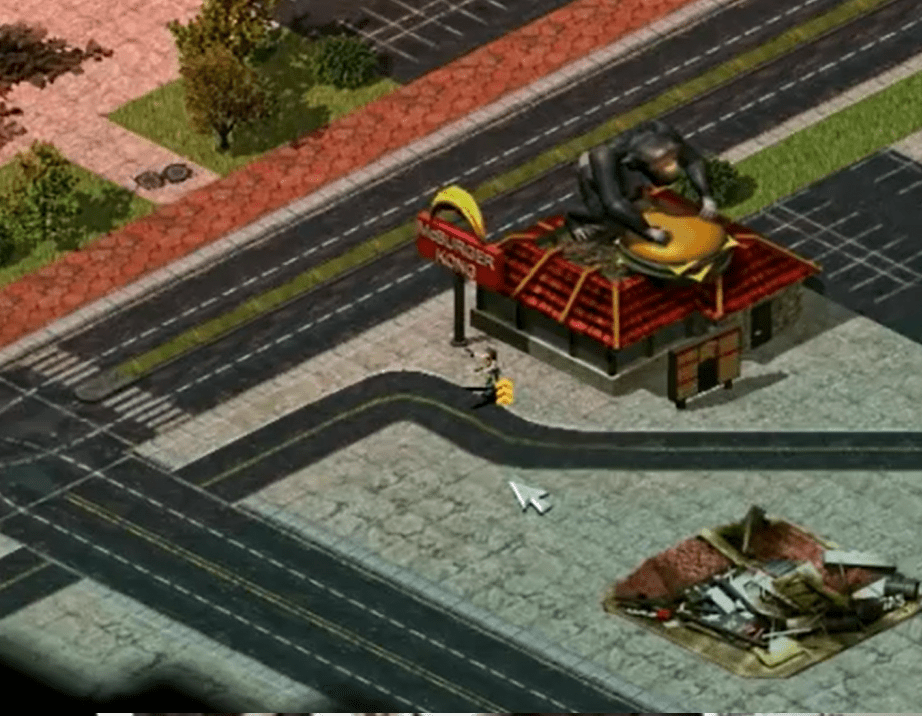
Red Alert 2 is a good game, for its time. It’s easy to pick up and play, but there is a certain versatility and depth in the range of units. The fact that the environments are just slightly interactive – put guys in buildings, blow up bridges – goes a long way. The colours are bright, the unit models visually distinct and full of character. The fast food restaurant is called ‘McBurger Kong.’ The campaigns hold up well for variety, challenge and playability. The score, composed by Frank Klepacki, is part industrial, part funk, part Red Army Choir, all brilliant.

But the real strength of this game is its attitude. Unlike its predecessor Tiberian Sun, which is on paper a very similar game, Red Alert 2 doesn’t take itself seriously. To everything bad I’m going to say about it here, Red Alert 2 can mostly get away with shrugging its shoulders, grinning and claiming that it was only joking.  

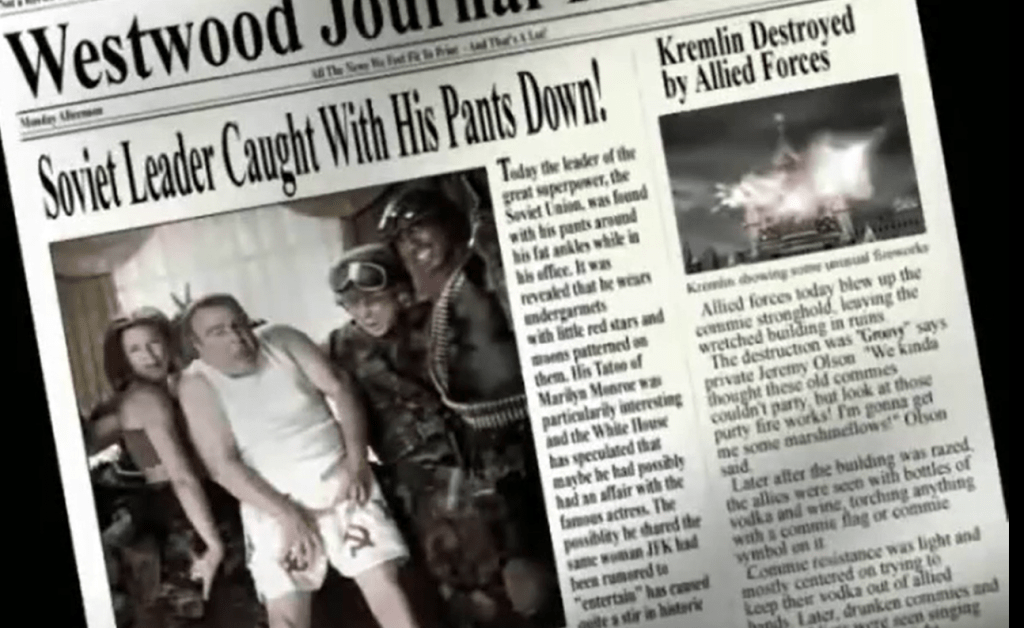
The sexism in the live-action cut-scenes – all that creepy pandering to 13-year-old boys – was obvious to me even at the time, and I don’t think there’s much to dissect. It’s right there.

Instead, let’s talk about Iraqi desolators, Libyan demolition trucks and Cuban terrorists.

The Allies. Reagan, Thatcher and… De Gaulle?

There goes the neighbourhood!

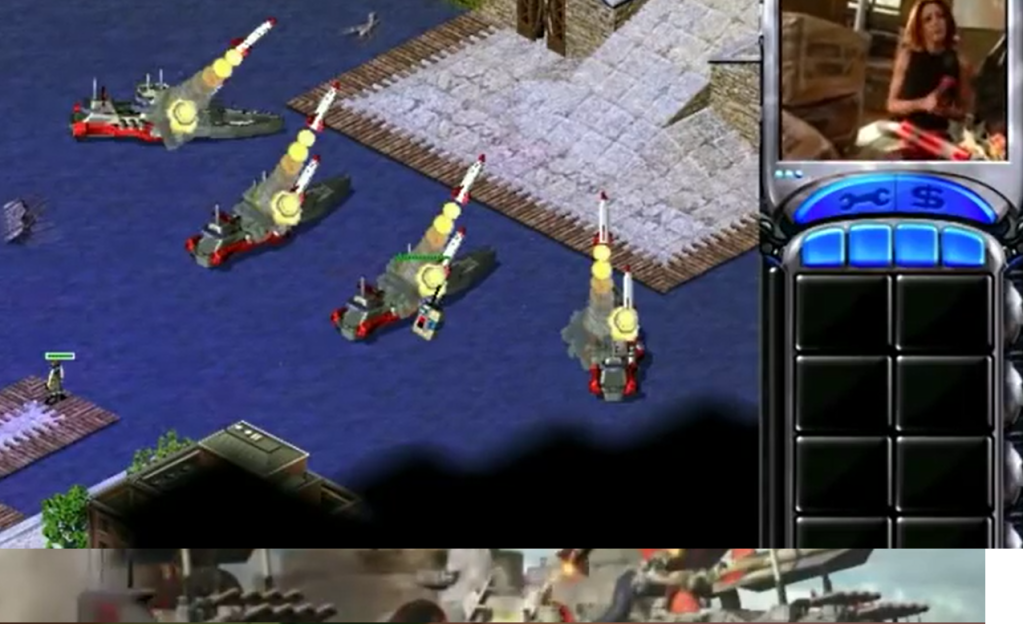
In the game’s skirmish mode, the player can choose from a list of countries. One of the playable countries in the Soviet bloc is Iraq. Sure – Iraq is communist. Why not. The Iraqi soldiers are identical to the Soviet soldiers, right down to the cartoon Slavic accent. The only difference is that each country gets a special unit; in the case of Iraq, you get the Desolator. This charming little fellow shoots a green beam of radiation at people, zapping them instantly into writhing emerald goo. He also has a special move, where he contaminates a massive area around him, turning it green and killing everyone on it.

Years later I would learn that it was the United States which used depleted uranium munitions in Iraq (before and after this game was released) leading to cancers and birth defects. A few years after this game was made, the US would invade Iraq based on the lie that the country had chemical and nuclear weapons. When the Desolator shouts his cheeky catchphrase before turning the land around him a lethal green, it’s a little cultural artefact of this big lie, a lie which in real life covered a whole country in that green shroud and caused incalculable suffering for the Iraqi people. In real life, the US unleashed desolation on Iraq. In this game, it’s the other way around.

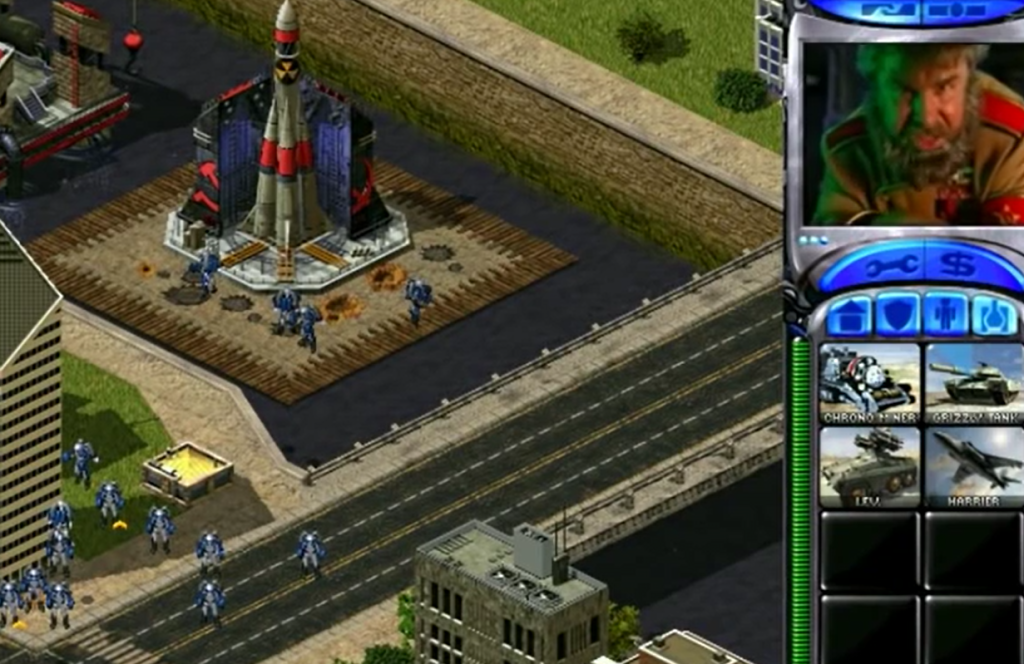
Allied jet pack troopers, Soviet nuclear missile

Vamos, Muchachos!

The various countries in the Soviet Bloc have one thing in common: they are all countries that were at odds with the United States in the late 1990s. So we’ve got Libya and Cuba in there as well. The Libyans have a Demolition Truck – ‘One way trip!’ – which blows itself up in a small nuclear explosion; the Cubans have a little guy called a Terrorist – ‘Vamos, muchachos!’ – who blows himself up along with anyone near him.

But it was Cuba that was targeted by terrorists funded and encouraged by the United States, not the other way around. Cuban suicide bombing is not and has never been a thing.

The Libya thing, in hindsight, just makes me sad, especially with the most recent disaster. Unlike with Iraq, I don’t even have anything slightly clever to say. Libya was once the country with the highest standard of living in all of Africa. Then came the US-backed overthrow of Gaddafi in 2011. They dragged him out of a ditch and killed him in a most brutal manner, and the remarks made for the occasion by then-Secretary of State Hilary Clinton (‘we came, we saw, he died’) make the bombastically cruel Soviet leaders in this videogame seem like sensitive souls by comparison. Since then Libya has been transformed into a conflict-ridden country. The EU gives them tons of money to lock up refugees in desperate conditions, just to appease the racists back home.

The Desolator and the Terrorist have one important thing in common: they are tiny cultural artefacts of imperial projection. What do I mean by projection? I’ll put it this way: if Westwood had decided to include Vietnam as a playable country, they would have been depicted burning down American homesteads with napalm, or withering the forests with Agent Orange. In the pop culture of the imperialist aggressor, its own historic crimes are pinned on its victims.

9/11

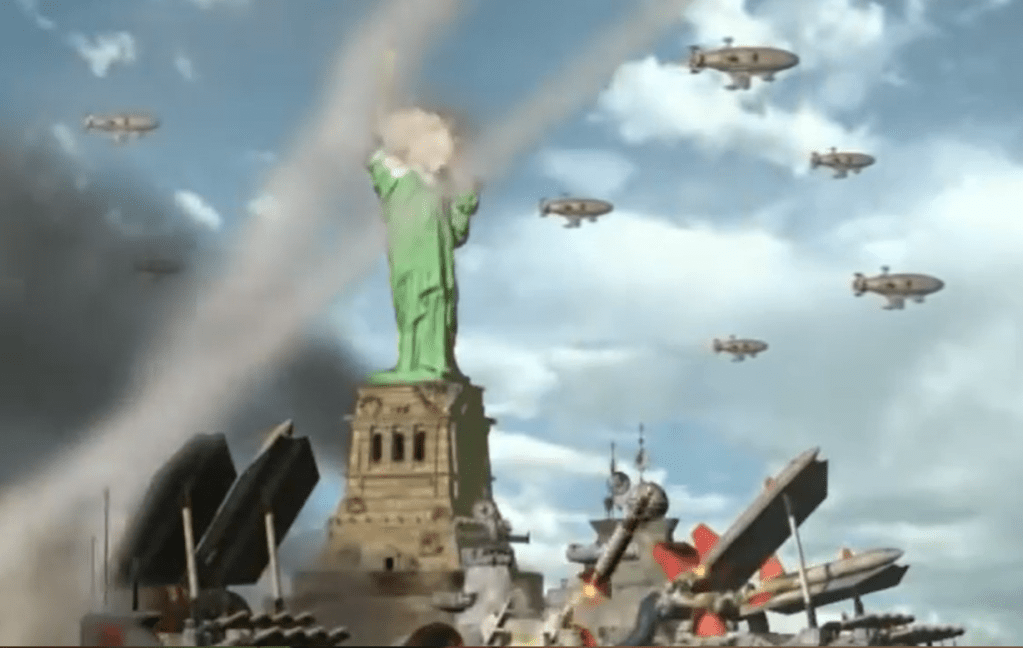
Adam Curtis’ documentary HyperNormalisation (01:39:35-01:43:00) includes a remarkable montage of scenes from movies that look exactly like footage from 9/11 – only these movies were all made before 9/11. Someone tell Adam Curtis about Red Alert 2. Released just a year before 9/11, the game’s advertising featured the twin towers prominently, meanced by, among other things, aeroplanes. The first mission in the Soviet campaign involves destroying the Pentagon, and a couple of missions later you are in New York, where you can occupy or destroy the World Trade Centre. The zeitgeist which Curtis identifies in HyperNormalisation is perfectly captured in Red Alert 2.

‘Oooooh… dream baby dream… dream baby dream…’

Coalition of the Willing V Axis of Evil

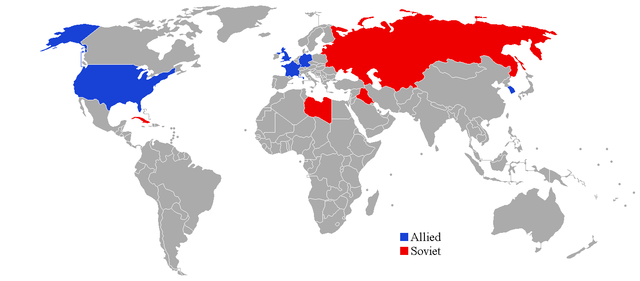
The USSR’s three playable allies are Iraq, Cuba and Libya, while the USA’s equivalent are Korea, Britain, Germany and France (see the map below from Wikimedia Commons). With the exception of Korea (reunified offscreen), this world war sees Africa, the Middle East and Latin America take on Europe and North America. It’s the former colonies against the colonisers (a massive piece of historical context which was missing from my 11-year-old head). It’s a fantasy where what really happened is reversed, ie, the masses of Africa, Asia and Latin America commit atrocities in the USA, a contrived scenario to justify the colonisers getting to slaughter the peoples of the colonies all over again.

Simply reversing the projection, of course, wouldn’t accurately reflect the Cold War. Why not include the Afghan Mujahideen among the ‘Allies’? What would their special unit be? Where is Nelson Mandela in the pro-USSR coalition?

Your command is my wish

This imperial projection is most obvious with an unforgettable character named Yuri (The Soviets are a surprisingly informal bunch. Top brass are simply addressed as Yuri, Vladimir and Natasha – no surnames, no patronymics). Yuri employs psychic powers and elaborate machines to control people’s minds. This is a developed part of the world and story, with mind-controlled communist giant squids terrorising the high seas and a US president taken over by a psychic beacon. Yuri’s acolytes are developed into a colourful and horrifying faction in their own right in the expansion, Yuri’s Revenge, which takes the irony up a few notches and gets the Allies and Soviets to join forces and have a joint moon landing.

Ten thousand volts, coming up!

Tesla, now the name of a company which is a bastion of US capitalism, features in Red Alert 2 as an alternative energy source favoured by the Soviets. We see the Soviets weaponise Tesla energy through ‘Tesla Coils’ and ‘Tesla Troopers’ who electrocute people and even turn the Eiffel Tower into a kind of pylon.

All this hits you differently after you’ve read about MKUltra, or The Shock Doctrine by Naomi Klein. Mind control experiments were actually the preserve of the United States. The fact that US prisoners in Korea were subjected to lectures aimed at recruiting them to the communist cause was interpreted by a hysterical US media and political class as ‘mind control.’ But the interest of US state forces such as the CIA was piqued; they experimented with electric shock therapy and LSD. These experiments failed to produce mind control, but left people dead or severely brain damaged.

In this game, the Soviets have nukes; the Americans do not. The Soviet nuclear reactor is a nod to the Chernobyl disaster – here we’re dealing with something from actual history, so okay. The Soviets had nuclear weapons, and tested them in very harmful and irresponsible ways. But the Allies did those things too, and also killed a quarter of a million innocent people in Hiroshima and Nagasaki. More projection.

Sometimes the cold war stereotyping is so obvious and crass it goes beyond offensive, and sometimes it flies under the radar because it’s larded in a protective wrapping of irony. Other times it is just bigoted, plain and simple. For example, there is another colourful unit type called Crazy Ivan, who cackles maniacally as he plants bombs on things. You don’t have to be a raving tankie to see the problem with this.

Jusht give me a plan

But it’s satire, right? Surely they make just as much fun of the Americans? No, not at all. General Carville has a bit of a hillbilly affect (‘his forces are rompin’ through the country like an angry bull at a Texas rodeo’). The Spy talks like a caricature of Sean Connery. But that’s as far as it goes.

The contrast is clear even if you never watch the cutscenes. The Soviets use nuclear and chemical weapons, electric shocks, cartoon dynamite, human cloning and mind control – evil, in other words. Meanwhile the Allies use high technology: weather control, time travel, jetpacks, and tanks that can disguise themselves as trees. The Soviets have things that are excessive, ugly and brutal, while the Allies have things that are ingenious, streamlined and attractive. In short: the Soviets have giant squids and the Allies have dolphins.

General Carville. The Americans, for the most part, have surnames

Mind forg’d manacles

Maybe this is the only blog on the internet where you’ll find references to Milton and Blake employed to analyse Westwood Studios and Red Alert 2. But here goes: in a note in The Marriage of Heaven and Hell (1793), William Blake made a famous observation about John Milton’s biblical epic Paradise Lost (1667): “The reason Milton wrote in fetters when he wrote of Angels and God, and at liberty when of Devils and Hell, is because he was a true poet and of the Devils’ party without knowing it.” The Soviets in Red Alert 2 (2000) are clearly “the Devils’ party.” But they are so much more interesting and fun than the Allies. The developers and the players are of their party without knowing it.

Part of this is that the audience in Western Europe and North America has some sympathy for the ‘devil.’ As the losers of the Cold War and as a vanished social system, they hold some fascination; it’s obvious even to an 11 year old who knows no history that they are being caricatured and demonised, which excites some grudging sympathy; meanwhile, they are yesterday’s enemy, not threatening today.  

The other part is projection. Yes, we’re back to projection. The audience in Western Europe and North America identifies with the ‘evil’ side because it knows, deep down, that neither side in the Cold War had a monopoly on evil. All the napalm and all the massacres, the coups and torture sites, the mountains bombed into valleys and the cities wiped off the map, the psychotic warlords and fascist dictators with American weapons in their hands – these things rarely feature in popular culture. But they are the means by which capitalism won the Cold War. Our governments and corporations inflicted unspeakable horrors on Africa, Asia and Latin America in the recent past. In Red Alert 2, we assign all that evil to the other side of the Cold War. And the West European or North American player delights in the extravagant, cartoon evil of the Soviets because, subconsciously, he sees in them the state and social system with which he identifies.

But the most remarkable thing about Red Alert 2 is not how it looked back at the Cold War, but how it looked forward, with what I can only describe as prescient hypocrisy, to the so-called ‘War on Terror.’ It was part of a chorus of pop culture texts fantasizing about an attack on Manhattan just before it happened; and it singled out Iraq and Libya, whom the US would soon target for ‘regime change,’ doing far more damage to those countries than the imaginary Soviet assault does on the United States.

So, do videogames warp young minds?

When you learn something new, you fit it in with what you already knew. And for my generation ‘what we already knew’ about the Cold War consisted of stuff like James Bond and Red Alert 2: crude pop culture propaganda.

But is it even propaganda at this point?

As opposed to an intentional propaganda message, Red Alert 2 is a text in which there are assumptions baked in which transmit propaganda messages. But the game’s pure silliness defuses the propaganda, ridicules what it is transmitting, takes most of the sting out of it. If this game really did warp my mind, it was not that difficult to un-warp it again. In its anticommunism and Russophobia it was no worse than a lot of the books on the market, and a lot of the messaging in schools, at the time or today. This underlines another point about warped minds: it takes a whole culture, not just a single text, to change the way a person sees the world. In contrast to the broader culture, Red Alert 2 has this redeeming feature: that it is well aware of its own silliness.

Back to Home Page / Archives