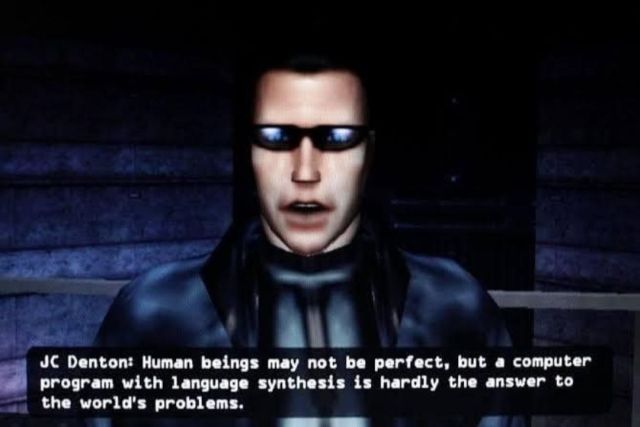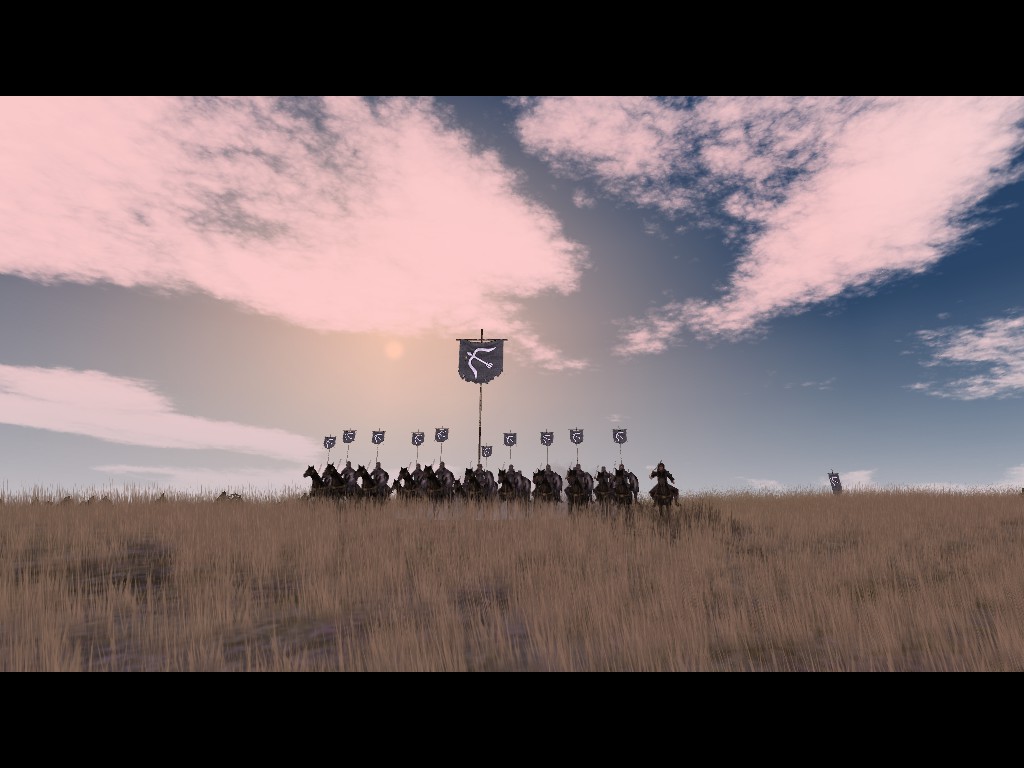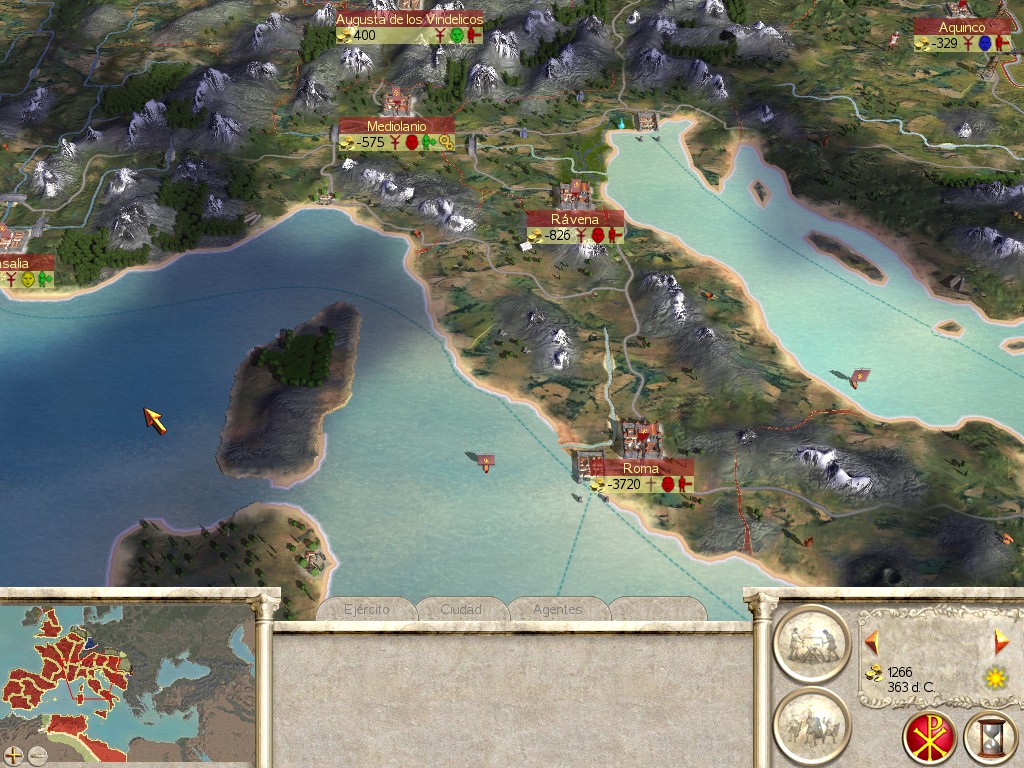
Games that warped my young mind: Tiberian Sun (1: Setting and Story)

When I was 11 or 12 – or maybe it was some older and more embarrassing age – there was a field near my house that me and my friend called the Tiberium Field. You had to dash across it in twenty seconds flat, otherwise Tiberium poisoning would kill you and turn your body into a visceroid, an aggressive and indestructible blob of human tissues. In our heads, we were in Command and Conquer: Tiberian Sun.

So far, so nostalgic. This is a post where I talk about a 1999 strategy game, maybe to recapture the remembered leisure and innocence of the childhood that surrounded it.

But I never got past a few missions of Tiberian Sun, never owned my own copy, and I like it a lot more now than I did back then. If we’re talking nostalgia, I was always more of a Red Alert guy (who could have guessed?). At the time I thought Tiberian Sun was, in comparison to Red Alert 2, drab and self-serious, with a clumsy interface and confusing missions. Earlier this year when I bought the whole Command and Conquer back catalogue for a tenner, I didn’t expect that this would be the game I spent the most time on, the one where I actually finished both campaigns, the one that would haunt my imagination.

So this is not all nostalgia. Something else is going on here, and I’m going to try and find out what. And even within the nostaglia, there’s the question of how this game worked its way into my imagination in such a way as to turn the grass of that neighbourhood field into an expanse of deadly and valuable green crystals.

So how did this game warp my young (and not-so-young) mind?

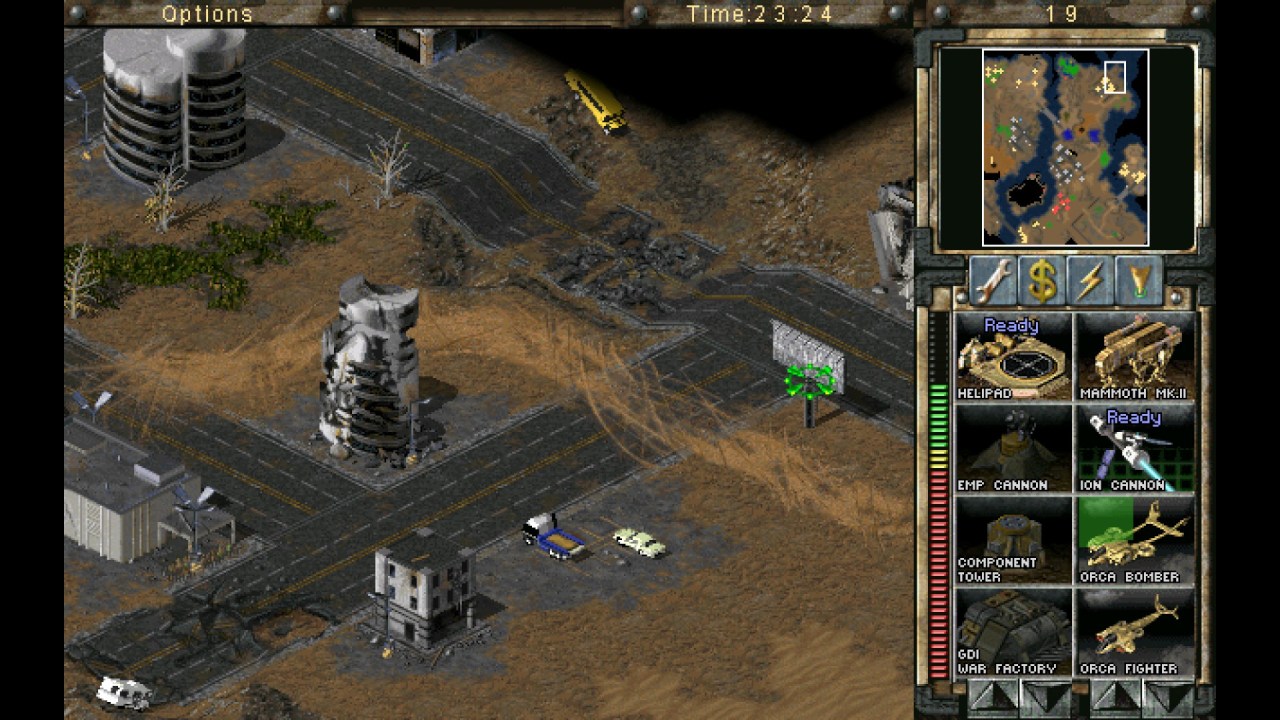
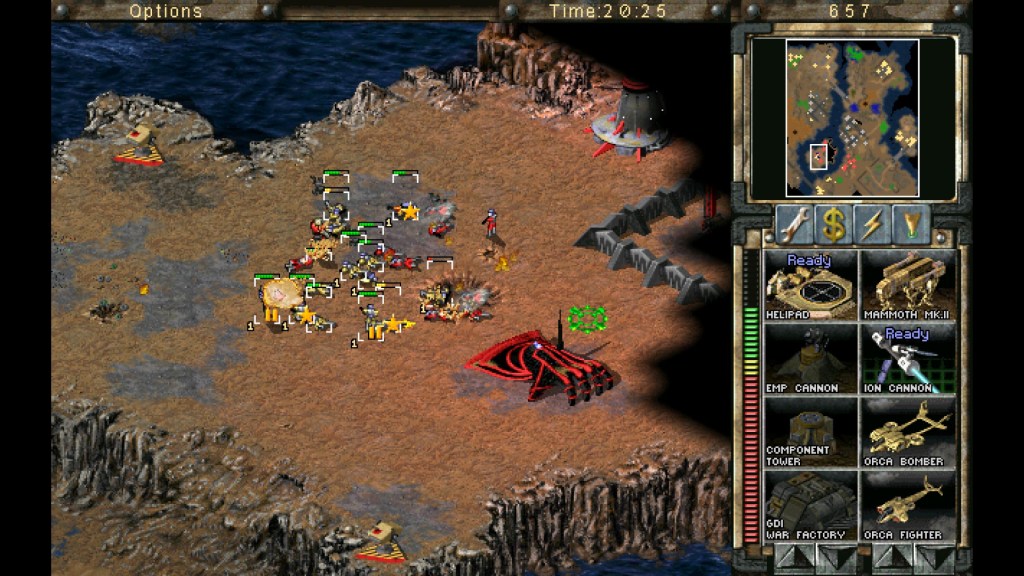
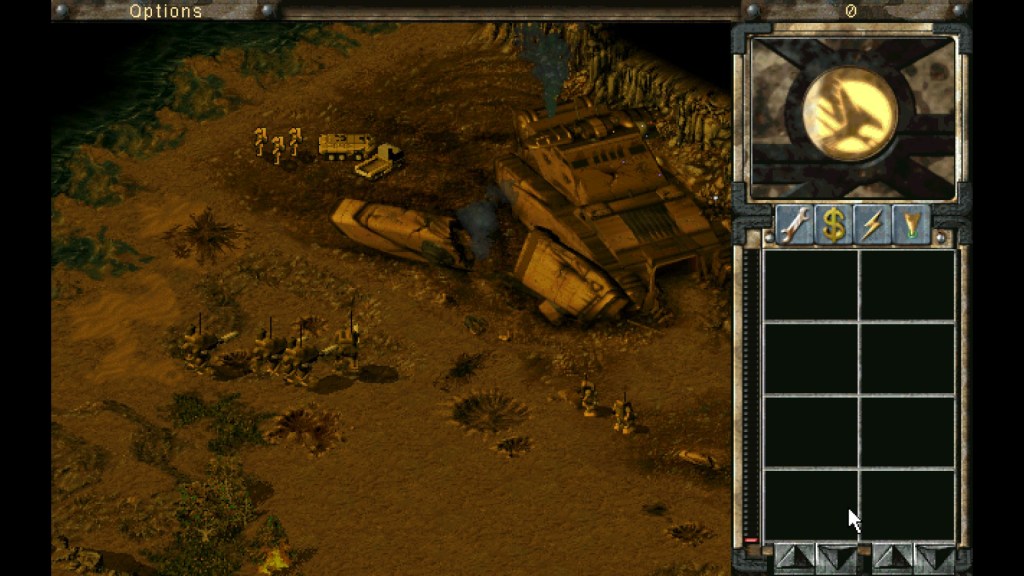
This screenshot is from the expansion pack, Firestorm

The Tiberium-haunted world

The first point in favour of Tiberian Sun (henceforth TS) is its setting. The world of the original Command and Conquer was sort of improvised. The developers said, let’s have something like the spice from Dune 2 – it works so well as a resource-gathering feature – but transplanted to another setting. The result is Tiberium, a strange green crystal native to some alien world which has begun to spread over Earth’s surface. There are two factions: the Global Defence Initiative (GDI), a one-world military defending the status quo, and the Brotherhood of Nod, which is part-Tesla, part-ISIS, part Comintern, and obsessed with using the Tiberium for obscure ends. My impression, having played only a little of the original C&C, is that whatever worldbuilding there is starts to peter out around there. The setting is just an excuse to have a war game on the Dune 2 formula. (I’ve talked about the Red Alert spin-off elsewhere.)

Tiberian Sun takes the worldbuilding more seriously. A couple of decades after the first game, the Tiberium infestation has advanced, and Planet Earth is now terminally sick. GDI and Nod are still fighting over ruined cities and land choked with alien crystals and alien weeds, skies torn by ion storms, poisoned air, mutated genetics. For more on the setting and its applicability as a prophecy for our times, I recommend this article from Eurogamer by Robert Whitaker.

Tiberian Sun captured that late-1990s sense of some vague impending doom. But in 2024 it offers a strange kind of relief. You can retreat into the barren comfort of a world that is already destroyed, where there is little to save. There are unexpected inheritances from Dune: like in Herbert’s book, the ground beneath your feet is more than a setting, it’s an actor with powers of life and death over the fragile humans and machines crawling on its surface.

The applicability to climate change and global warming (which we all absolutely knew about in the 1990s even though those in power did nothing) are obvious. It’s a metaphor for our times in another way too. GDI are coded as “good” but we never see them actually doing, or even promising, anything good. They never help anybody or change anything, until the Forgotten twist their arms. We side with GDI only because Nod are obviously and extravagantly worse. Yes, GDI is Harris and Nod is Trump. Neither side offers a way out of war and ecological destruction. But Nod at least offers its supporters the shallow pantomime of its rituals and chanting and bloody spectacles.
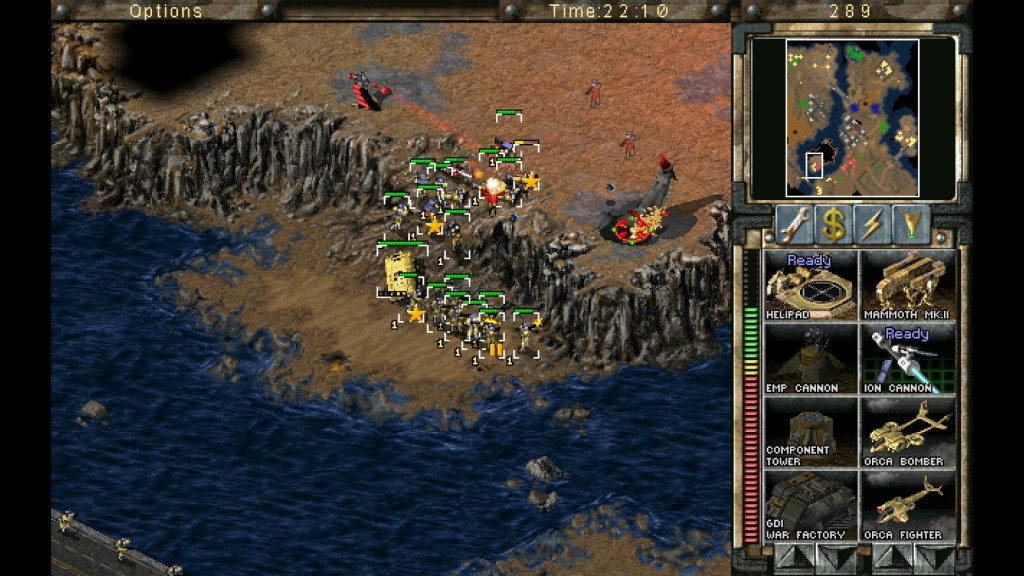
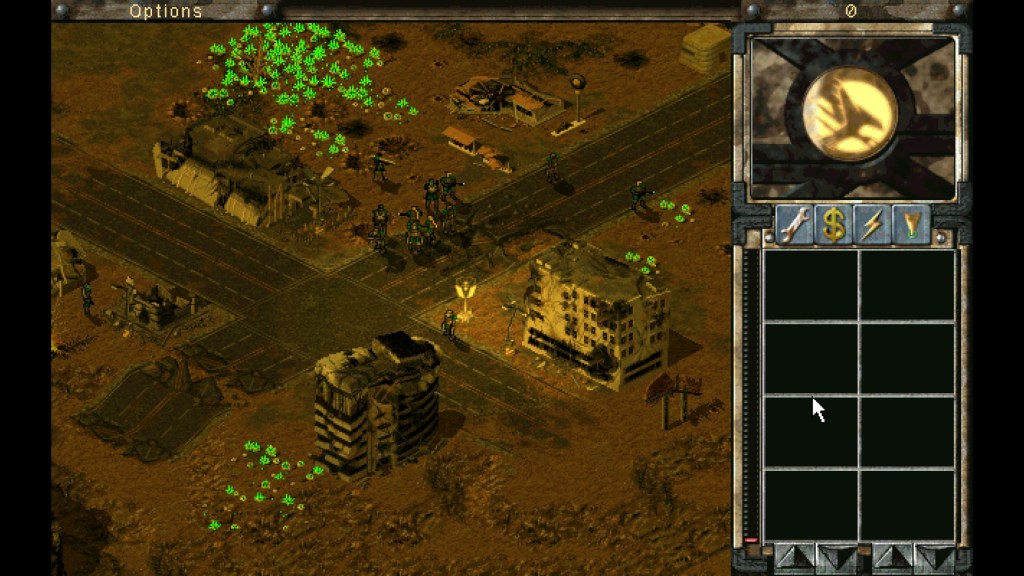
Mutants, ruins and the glow of Tiberium. It’s a vibe

The setting itself tells a story: when we move our little men across the map, we see ruined high-rise buildings, contrasted with space-age-looking new settlements with solar panels and bunkers and greenhouses: the civilian world has retrenched into smaller and more resilient communities. Meanwhile war has advanced as a science. It’s all laser guns and visored helmets, giant walking battle mechs, cyborgs, explosive throwing discs, orbiting battle stations. Humanity is spending and innovating to fight more effectively, even as we have less and less to fight for. While the Red Alert setting just pits an evil faction against a good faction, Tiberian Sun (TS) takes place in a world that is messier and more ambiguous. In Red Alert, we don’t know why the Soviets are attacking the status quo. In TS, we don’t know why GDI are defending it.

Videogames then were violent, militaristic, imperialist – not in a the conscious and blatant way that Call of Duty is now, but as it were by default, by reflex. C&C is no exception. The GDI versus Nod struggle is at base the same old Imperialism versus Third World struggle, with the legitimate struggles of the global majority (“disenfranchised nations” seduced by Nod) packaged as evil fanaticism. In TS it is less explicit, filtered through layers of deniability in the worldbuilding, but we get signals, such as that the villains in Tiberian Sun have names that are Arabic, Latin and Slavic (he’s literally called ‘Slavik’). The Latino baddie is a drug smuggler who menaces the southwestern United States, playing into racist tropes. We see one South Asian guy in the ‘Global’ Defence Initiative, but the rest of the goodies are Americans.

The Forgotten

The music is not as conspicuously brilliant as that of Red Alert 2 but it has a greater range. There are moments of foreboding (‘Valves’) and loss (‘Approach’). If Red Alert 2 is a violent cartoon, Tib is a 1980s-90s action sci-fi movie – the vibe, to me, is sort of like Terminator 2, Aliens and Paul Verhoeven.

The melancholy themes probably belong to the third faction in Tib – unplayable and lightly sketched, but essential to the story (I suppose if GDI is Harris and Nod is Trump, they are Jill Stein or Cornel West). This is a loose confederation of clans who call themselves The Forgotten. They are people mutated by Tiberium exposure – insulted and belittled as ‘shiners’ by GDI and Nod alike, distrustful of GDI due to past atrocities, persecuted and imprisoned by Nod. They are few but they are pretty lethal in a fight.

The Forgotten are the conscience of this story. In the GDI campaign, it is only by overcoming prejudices and working with the mutants that GDI can defeat Nod. In the Nod campaign, you prevent any possibility of an alliance between GDI and mutants through a nasty trick. There’s more going on here than is usually the case in this series.
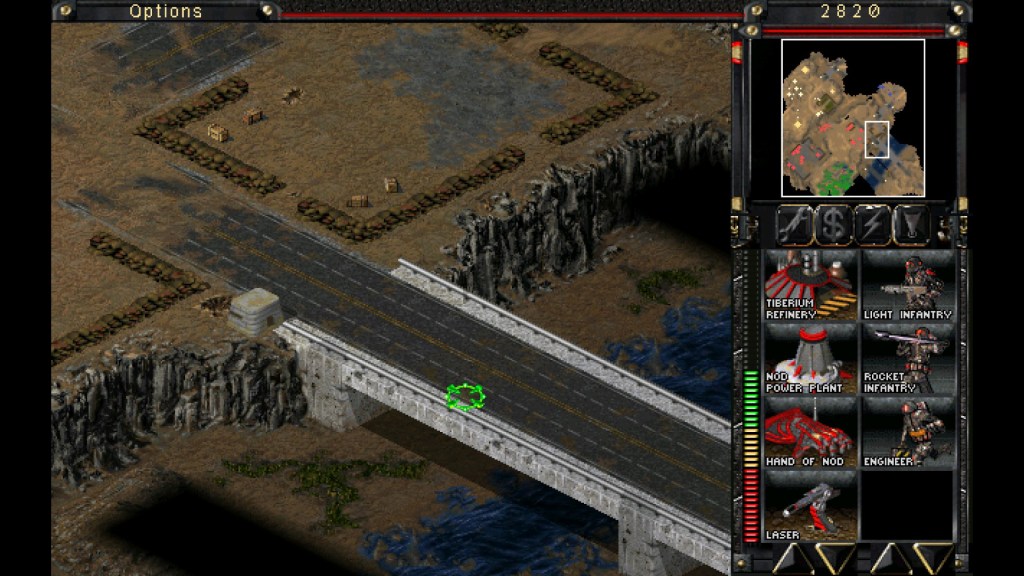
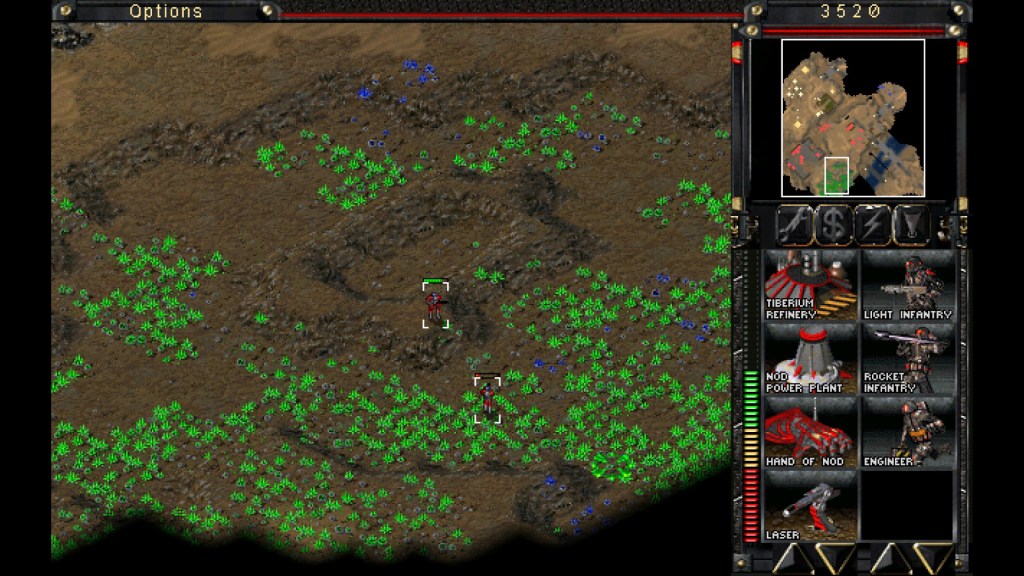
An actual Tiberium field

Tiberium Wars

In Part Two of this review I’m going to be looking at two other strengths of Tiberian Sun – the cutscenes (you heard me) and the gameplay. But before I move on I want to comment on the 2007 sequel, Tiberium Wars and its expansion Kane’s Wrath (I haven’t played Tiberium Twilight). What I have to say about Tiberium Wars (TW) underlines what I’ve just said about TS.

I’ve played a lot of TW and enjoyed it, but it doesn’t have the same grip on me as its 1999 predecessor. And I don’t think it’s just nostalgia.

The graphics and the smoother interface are a huge upgrade on TS, marking a rapid development in just 8 years. The story is solid, far less silly, and it’s all in all a lot of fun to play. But the setting doesn’t feel as real to me, and I think I know why.

Tiberium Wars leans with dispiriting heaviness into a ‘Global War on Terror’ framing. Magazine ads for the game talked about fighting terrorism. Technologically, GDI has been downgraded – no more stomping robots. This is explained in-game as being due to budget cutbacks, but the effect of it (and probably the intention) is to make everything look a few-score degrees more like Iraq or Afghanistan, or some near-future 9/11. The expansion Kane’s Wrath thankfully leans back the other way, and was clearly crafted by people who loved TS.

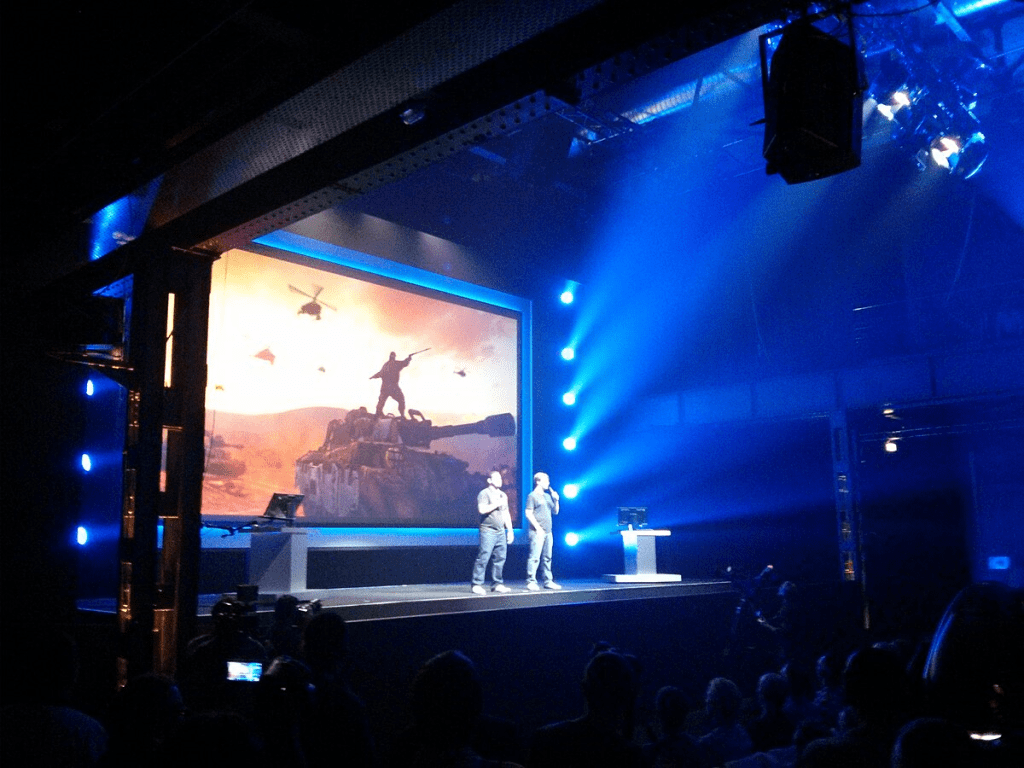
From a 2013 EA press conference about a new C&C title. If you have eyes, you can see the vibe they’re going for. And it’s not ‘morally dubious 1990s action sci-fi movie’

TW’s setting is retconned so that the Tiberium-infested world is divided up into uninhabitable Red Zones, Yellow Zones which are in a state of social collapse, and Blue Zones which are stable and prosperous. This is a marked contrast to Tiberian Sun, in which everywhere – Egypt, the USA, Norway, Germany, Britain, Mexico – was one of two things: a Yellow Zone or a snowy Yellow Zone. In TW, the Blue Zones we see are all either in the USA or in Germany. We always see them menaced and under assault. The first few missions are a bizarrely close remake of Red Alert 2, with the baddies invading hallowed American landmarks like the White House and the Pentagon (No! Please don’t destroy the White House or the Pentagon! Anything but them!). The Imperialism vs Third World framing is much more obvious and open. It’s no accident that the Forgotten are left out of the story of TW – they appear only as an Easter egg and they talk like super mutants from Fallout.

At base the reasons I don’t like it as much are political; I think it’s a shitty way to portray the majority of the human race, as if they have nothing better to be doing than besieging and menacing whatever dull place you live. But you don’t have to agree with that to see that these are two very different types of story and setting. Tiberium Wars is the same old C&C story about protecting the status quo. Tiberian Sun has more depth and ambition.

Home Page/ Archives

To receive an email when Part 2 of this article goes live, type in your email below:

Before the Fall (5) Notes on The Dawn of Everything

The point that this book has been hammering home is that hunter-gatherers were not ‘innocent’ or just roaming bands. Not only did foragers of the Stone Age have complex social structures and build great monuments, they were politically self-conscious and sophisticated.

Building on this, Chapter 5, ‘Many Seasons Ago,’ describes two very different cultures which lived along the Pacific coast of North America, drawing a series of fascinating comparisons and contrasts between the two. But the arguments and conclusions, this time, I found far less convincing than in previous chapters.

The argument is in essence: look at how radically different these two societies were, even though they had the same mode of production. So, isn’t the idea of a mode of production a bit useless?

The two North American ‘culture regions’ Graeber & Wengrow outline are the Californian Region and the North-West Coast Region. These were not pre-agricultural societies, the authors argue, but anti-agricultural – ie, they knew about farming but chose not to practise it.

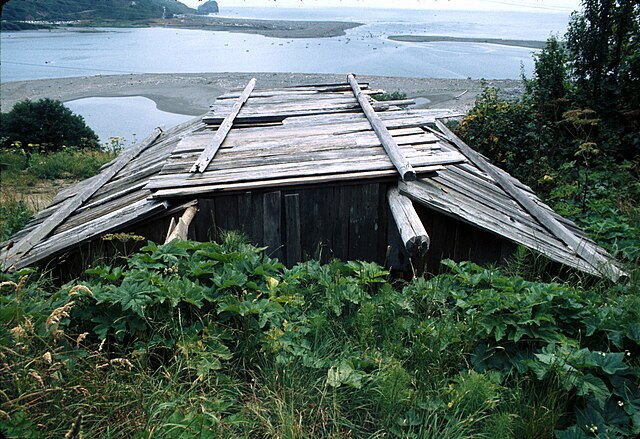
Reconstruction of a Californian Yurok plank house

Within this, as the most striking examples of the two regional cultures, they zoom in particularly on the Yurok (California) and the Kwakiutl (North-West).

Let’s try to sum up what Graeber and Wengrow put forward here.

  • They say that idea of a ‘culture region’ is not perfect but makes more sense than ranking and sorting societies based on ‘mode of production.’ In other words, let’s group different societies based on what games, foods, clothing and values they share, not on whether they are foragers, farmers or industrial workers.
  • They say that societies (or at least these societies) are ‘ultimately’ shaped by political and cultural dynamics, by human agency, and not by ecology or economics. Concretely, the Kwakiutl ate salmon and the Yurok ate nuts and acorns, but that had nothing to do with their respective social structures.
  • Societies define themselves against their neighbours – ‘dynamically interconnected [and] reciprocally constituted’ (Marshall Sahlins.) People traveled a lot in the Stone Age and were aware of neighbours’ customs and tech. What they consciously chose not to borrow is what defines each group: we are the people who don’t go in for slavery, who prefer a spartan aesthetic, etc.
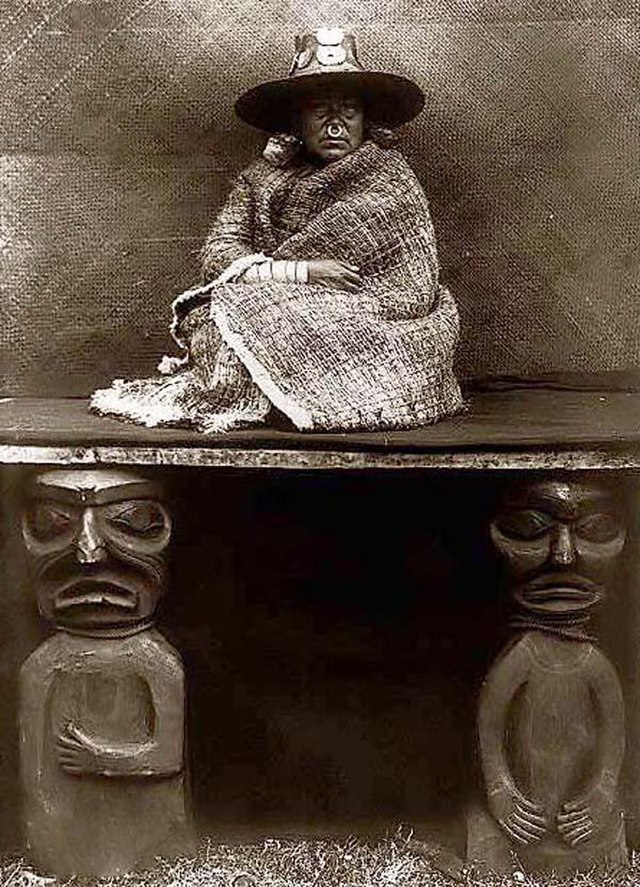
A Kwakiutl woman

So what do I think of all that?

I come to this without much prior knowledge, but it seems to me that the Yurok and Kwakiutl are bad examples for what the authors are trying to argue. Their means of subsistence could be crudely grouped together as ‘forager’ but were radically different. Culture and politics are weird and wonderful, so I’d agree that you can’t say that X climatic-economic input produces Y political-cultural result; if I say that the Kwakiutl eat fish, therefore they make colourful masks and enslave people, clearly there’s a missing link in the argument. But even though we can’t trace the causal relationship, I intuit strongly that there is one. It’s no coincidence that the people who lived on a diet of fatty, oily creatures made a virtue of amassing fat in their possession and in their own bodies. The people who hunted fish also hunted people. The people who ate dry, hard, austere nuts preferred not to hunt people, and themselves valued austere simplicity, hard work and physical thinness.

Between input X (the means of subsistence) and its many, practically untraceable outputs there is plenty of room for randomness and invention, and for the unique historical experiences of a given community, to interfere. It’s delightfully complicated.

Graeber and Wengrow’s thesis is appealing because it assigns the lion’s share of explanatory power to the political initiative of the people themselves. And it’s probably true that western Eurocentric writers are too keen to talk about their own history as a matter of political decisions, leadership, values and principles, while jumping to the most smug, glib, reductive, deterministic explanation they can think of when it comes to someone else’s history.

An idealistic, voluntarist philosophy lends itself well to judging certain communities for conditions forced upon them. But if we make our own choices, we make them from the set of choices available to us. Some people have more and better choices than others. This obvious enough to the authors that at one point they attempt to say, in essence, ‘No, not like that.’ Also, the limits of a given mode of production intrude when the authors acknowledge in passing that the population sizes in these communities were tiny. Neither fish nor nuts could support as large a population as settled agriculture. It’s fair to talk about ‘advance’ or ‘progress’ in relation to productivity of labour.

So they haven’t convinced me that there is a serious ‘problem with modes of production.’ But in the course of their argument they talk about a whole lot of great and interesting stuff. Once again, the journey is such a pleasure that you don’t mind if you never reached the promised destination.

Before the Fall (4): Notes on the Dawn of Everything

This is part 4 of my on-the-spot reactions to The Dawn of Everything by David Graber and David Wengrow. Here are the first three parts:

1

2

3

Stoned in the Stone Age

If there’s one thing to take away from this book, it’s that the Stone Age was way richer and more interesting than most of us would have thought. Moving from the Paleolithic (Old Stone Age) to the Mesolithic (Middle Stone Age, from about 12,000 BCE), us humans have not started working metal and a lot of us aren’t farming yet. Nonetheless even those who have not settled down to agriculture are still very busy:

1930s aerial photograph of the Poverty Point site.
  • At Poverty Point, Louisiana, US, there are massive earthworks dating from 1200BCE and larger than the contemporary cities of Eurasia. Analysis of artefacts and of the apparent systems of measurement used by the builders links this site all the way up the Mississippi and to the Great Lakes, and down to the Gulf of Mexico and even Peru. The builders were hunters, fishers and foragers.
  • In Japan, we have a wealth of archaeological data showing a rich and complex social life passing through cycles of nucleated settlement and dispersal from 14,000-300 BCE. My notes get a bit scattershot here: OK, they had acorn-based economies, they stored a surplus, they smoked weed, and they left no evidence of aristocracy or a ruling elite.
  • In Finland around 2,000-3,000 BCE we have ‘Giant’s Churches,’ massive structures built by the collective labour of hunter-gatherers.
Drawing of a Finnish ‘Giants’ Church’

This makes intuitive sense to me. We have seen that hunter-gatherer life could involve seasonal or local superabundance. This allowed for specialisation (people to do the maths and the crafts, the planning, overseeing and mobilising) and collective projects, such as monument building. But since the superabundance was temporary, local or conditional, so was the specialisation, and so was the mobilisation of the people in collective goals. That’s why kings, hierarchies, inequalities tended not to arise. The way I’d see it, agriculture, on the other hand, creates the basis for a permanent surplus, and so a lot more societies start to turn hierarchical, and these hierarchies grow more permanent.

As with previous chapters, we then turn to anthropology, that is, to modern and early modern hunter-gatherers, and see a few examples of where they have had kings (returning to Louisiana and Florida). ‘The economic base of at least some foraging societies,’ the authors conclude, could sustain priests, royal courts and standing armies.

Swallows and summers

The authors make repeated claims that they are overturning conventional wisdom and rewriting history. In this chapter they are arguing that there is no causal link between the widespread adoption of agriculture and the widespread turn to hierarchy, inequality and subjugation, or if there is a link it’s too broad to have any meaning. The evidence they present in this chapter consists of the amazing social and physical structures that hunter-gatherers built – all without agriculture. But are ‘at least some foraging societies’ enough to prove such a big argument? I am very impressed, but not yet convinced. If the stale old ‘conventional wisdom’ still seems to hold for all but ‘at least some,’ then it holds. A dam designed to let through a trickle of water still holds back a massive volume in the reservoir.

Usually the tone is good-humoured, but sometimes it’s nearly a Hancocky tone of denouncing ‘traditional’ and ‘conventional’ scholars. The thing is, it’s not clear to me that this book contains a conceptual revolution, as opposed to merely synthesising, collating, bringing into relief, making informed and imaginative suggestions. So far, more the latter. The authors make bold claims and hedge them, or fail to carry through fully with the evidence. For example they scold us for assuming that pre-agricultural societies were all equal, and regularly caricature that position. Saying that pre-agricultural societies were generally more equal is apparently the same as saying they were childlike and innocent, all one identical blob, or animalistic – except when Graeber and Wengrow say it, as when they acknowledge ‘the flexibility and freedom that once characterised our social arrangements.’ (p140)

To be clear, the project of synthesising, bringing into relief, etc. is more than enough of a reason to read this book. I’m really enjoying it. And often its denunciations of ‘conventional wisdom’ are on point, for example when they describe the idea of writing off 7,000 years of American history as ‘the Archaic Period’ as ‘a chronological slap in the face.’ You don’t have to agree with everything these guys say to appreciate and enjoy the close-up tour of the messy interface between social systems in our deep past.

A reference to Marx surprised me. I assumed that the authors were squishing Marxism and its theory of primitive communism into their general critique of the Rousseau ideological tradition, and I criticised them for not mentioning it. But here they describe primitive communism as the collective ownership and control of the surplus, clearly distinguishing it from more romantic or pessimistic views where communism is only possible with no surplus at all.

‘Conventional Wisdom’

But I’m not done with ‘conventional wisdom’ yet. A lot of the things that are set up and scoffed at as ‘conventional wisdom’ are not really that. Here are a few of them as laid out on page 127:

  • ‘…Rousseau’s argument that it was only the invention of agriculture that introduced genuine inequality…’
  • ‘It’s also assumed that without productive assets […] and stockpiled surpluses […] made possible by farming, there was no real material basis for anyone to lord it over anyone else.’
  • ‘Once a surplus arises, craft specialists, priests and warriors will arise to lay claim to it.’

Reading the above, you’d expect the authors to set about disproving these claims. They do nothing of the kind, at least in this chapter. As we’ve seen, they demonstrate that there are ‘at least some’ examples to the contrary. The built environment from the pre-agricultural age is impressive in absolute terms. As the reader, I have no way of judging whether this is a trickle or a torrent. OK, it’s useful to note that Poverty Point (more pictures below) has a bigger footprint than Uruk – but do all the sites built by foragers in that period have a bigger footprint than all the sites built by farmers?

‘The idea of ranking human societies according to their means of subsistence’ is described as a bad and weird idea that some eighteenth-century freaks thought up and that we have all accepted without question until now. I don’t believe in ‘ranking’ different societies, unless in relation to some specific and measurable quality. But I think that the way people put food in their bellies is actually foundational to how they organise their society. Those hunter-gatherers who changed their political structures every year? They did that because there were changes in how they could get food. It’s true that we look at prehistoric societies more than others through the lens of how they filled their bellies. But that’s entirely justified – because we know next-to-nothing about their politics or culture.

What is more, I’ve never had the above ideas presented to me as ‘conventional wisdom.’ Throughout my own formal education I never got an earful about the primacy of economics. At university we looked at Marxism as one topic of a dozen in Critical Theory, and one topic of a dozen in Historiography, plus Bloch and the Annales school. That’s it.

To be fair, I didn’t study Archaeology as such, or Anthropology – maybe it’s different in those fields. But in the broad public understanding of these fields, none of these claims in my experience constitute ‘conventional wisdom.’ On the contrary, the primacy of politics and warfare is asserted throughout popular history. In school, in the media and in popular culture, we compare societies not by their economic base but by their cultural and political ornamentation, through the prism of personalities and events. Economics gets only an indirect look-in, via inventors. Popular discourse evaluates societies according to the most arbitrary criteria (where for example Sparta somehow represents ‘democracy’) or with the aid of idiotic aphorisms like ‘Strong men create good times [etc]’ or even through the mostly-meaningless and deeply problematic lens of race. That’s where we’re at. We’re really not suffering from an excess of economic determinism.

An armed band of Aranda in early-20th Century Australia

Work and leisure

There’s a lot more in the chapter. There’s the trope about how people in past ages had more free time than modern office or factory workers, which the authors take as read and don’t attempt to prove. As they note, it holds true for the !Kung people, but not for other foraging societies – the ones in what is now Canada appear to have been workaholics. One thing about the !Kung that I would definitely think is universal, though, is that they know about agriculture, could do it if they needed to, but have no pressing incentive to turn to it.

There’s some intriguing stuff about how the only thing close to private property or hierarchy in many forager societies was (is?) the concept of the sacred. The Aranda people in Australia treated their children with kindness but initiation into adulthood involved painful rituals; subjugation and violence was only present in a sacred context. Sites like Poverty Point were probably ‘sacred,’ the only place in the social life of the community where demands for absolute obedience were made.

Linked to this, the authors note about ‘kings’ of the Mesolithic: ‘It is possible for explicit hierarchies to arise, but to nonetheless remain largely theatrical, or to confine themselves to very limited aspects of social life.’ (P 131) This is food for thought for scholars of Gaelic Ireland who are struck by the pedantry of the seating and portioning arrangements which our sources prescribe for a feast. I have a feeling this is building toward a theory of where private property came from, a theory that relegates agriculture to background noise.

But this chapter has not, in my brain anyway, broken the causal link between agriculture and inequality. But the assumption that towns, specialisation, crafts and science are impossible without agriculture is completely wrong. Graeber & Wengrow have proved this hands-down. They have given us a fascinating picture of the real social and political lives of foraging societies and the monuments and social structures they can sustain.

Another powerful point here is that colonisers routinely claim that the land they are seizing is somehow fair game because the people who live there are not working it ‘properly,’ ie they are hunting and gathering rather than farming (And of course, even when they are farming, as in the case of Palestine, the colonisers still have the nerve to pretend they ‘made the desert bloom’). So the idea of foraging as not being a valid economic activity, of not being able to sustain ‘civilisation,’ however you define that, has a blood-soaked and disgusting legacy. This part is conventional (though it was never wisdom) and we can’t dispense with it quickly enough.

Home Page/ Archives

Leave your email below to subscribe…

Or…

Before the Fall (3): Notes on The Dawn of Everything

How was life in the Stone Age? Was it all people shooting arrows at one another and falling into glaciers, or was it one big hippy commune? In this chapter Graeber and Wengrow leave behind the Enlightenment and start a chronological study of the earliest human societies, focusing on society in the Upper Paleolithic period. That’s the final part of the early Stone Age.

The first thing I learned here was pretty surprising: that humans lived spread out all over Africa for hundreds of thousands of years, with strong regional variations that meant they would have resembled giants, elves or hobbits to one another.

Then homo sapiens formed from a composite of all these very different sub-species, moved north into Eurasia, met the Denisovans and Neanderthals, and in time absorbed them.

The authors then perform the by-now familiar shuffle: thesis, antithesis, forget-about-either-thesis. Hobbes was wrong, Rousseau was wrong, here’s a better explanation.

A monument at Gobekli Tepe, Turkiye. On which, more below…

Princely Burials

What about the Upper Paleolithic ‘princely burials’ in Europe? Are these richly-endowed graves (countless person-hours of labour would have gone into them) not evidence of a rigid social hierarchy like what Hobbes said?

Reading about ‘princely burials’ myself in other contexts, I’ve always been annoyed at the assumption that they necessarily indicate social hierarchy, aristocracy, etc. An individual might be honored in death for all kinds of reasons – for heroism in battle or skill in crafts, for being an inventor, for saving lives, for poetry, for metallurgy, for mystical visions. They might be honored for being great leaders, but this doesn’t  mean they were aristocratic ones.

Graeber and Wengrow make an argument along similar lines to my guesses – that these were eccentric and visionary outsiders-turned-leaders, who were buried in riches (at a time when no-one was buried in death, with or without riches) as much to contain their potentially dangerous magic as to honour them. They construct a whole argument which takes in anthropology and archaeology, and which I found convincing.

So far they are at least living up to one promise: their version of history is interesting and rich. Our heads are full of capitalist and feudal assumptions, so we have to remember that just as objects which travel a long distance do not always indicate mere ‘trade’, elaborate burials do not always indicate ‘ruling class.’ The past is so much broader than the scopes of capitalism and feudalism through which we view it.

Monuments

We see the same pattern with the other type of artefact from the Stone Age which, like ‘princely burials’, are often taken up as proof of hierarchies and kings: grand, monumental buildings.

I’ve come across the fantasies of Graham Hancock and Ancient Apocalypse, in which Göbekli Tepe is evidence not just of kings but of an entire ancient empire which was more advanced than us and which left cryptic celestial warnings, and which colonized the world ‘teaching’ people how to do agriculture and masonry. A lot of the narrative hinges on the idea that Stone Age hunter-gatherers could not have built great stone monuments.

Even though they are so florid and fantastical, such arguments have always struck me as paradoxically boring. There is a more-than-open attitude to the possibility of Atlantis, aliens and giants, but dull pedantry when it comes to ancient societies. In unimaginably long stretches of time, tens of millennia, Graham Hancock cannot see any possibility that hunter-gatherers could have established a society which was, even temporarily, capable of building something like Göbekli Tepe.

Like with the burials, here Graeber and Wengrow give us a bit of archaeology (Stonehenge, Göbekli Tepe, Russian mammoth houses) and a bit of anthropology (such as the Inuits, the Nambikwara in Brazil and the Plains Indians in the United States) and paint a picture that is colourful and informative. I mean colourful not like atlanteans came along one day to teach us about seeds and the principle of the lever, but more like nomads and hunter-gatherers vary their social systems from season to season, sometimes gathering for great coordinated collective labour, sometimes dispersing to hunt and gather.

A small part of the Gobekli Tepe site from around 9000 BCE

It’s satisfying to get a clearer idea of how these monuments were built. But the best part is the idea that these societies changed their whole social system regularly to meet their needs. In one part of the year, the modern Nambikwara roamed in small bands, all these bands being under the strict control of one chief. For the other part, they gathered in hilltop villages, became democratic and communist, and had chiefs who functioned more like a social welfare department than a monarchy. But across all the other examples, no single pattern prevails: among one people, there is a settled season of strict hierarchy and a roaming season of relative informality. Among another, police functions are strictly seasonal and rotate between clans on an annual basis.

The anthropological stuff gives an insight into how Stone Age peoples might have lived: gathering after a great hunt with a superabundance of food and other goods, feasting, processing materials, building great structures, then dispersing again when the seasons turn.

A reconstruction of a house built from mammoth bones, Japan, 2013

What’s the upshot of all this?

Prehistoric society was not a realm of innocence or animal instinct – our ancestors were politically sophisticated.

Prehistoric society was not all one thing. A grading of one political system alongside each economic mode (for example, claiming that hunter-gatherers live in ‘bands’, horticulturalists under ‘chiefdoms’) is too pedantic even as a general guideline.

And here I kind of get the ‘plague on both your houses’ approach to Rousseau and Hobbes, because it’s ultimately from Rousseau that we get the idea that people pre-state and pre-class were simple and innocent.

However, this wouldn’t have been my understanding, and I’m broadly in the Rousseau ideological legacy. So they’re only throwing out bathwater here. Fine by me.

They haven’t succeeded in turning me off the idea of an economic basis corresponding to a political regime. Hunter-gatherers never seem to get around to parliamentary democracy, fascism, Stalinism, the Paris Commune or the Petrograd Soviet – not because they were/are too innocent to think of them, but because these systems do not correspond to their needs or means. The above are political systems proper to our age. There is a wide range of them, and which one you end up with depends on the last analysis on the outcome of a political struggle. But a certain type of economy, one where things like factories and railways are central, is a necessary prerequisite.

Though it seems political systems are more broad and fluid the further back you go. Even what we file under ‘feudalism’ is by definition immensely varied and full of local peculiarities. And when I looked at Gaelic Ireland, I realised that under its legal constitution many different de facto regimes could exist, depending on hard factors like population and resources and soft factors like politics and culture.

But even that phrase ‘the further back you go’ is weighted with an assumption, isn’t it? An assumption about progress, development, advance. That economies actually do develop through stages, and do not slip backwards as easily as political systems do; it’s never actually happened that a country has been ‘bombed back to the Stone Age.’ I admit thermonuclear weapons do raise the possibility.

I guess Graeber and Wengrow wouldn’t agree, but it is possible to speak of progress and development and economic stages without being racist or reductive.

Our industrialized world has global warming, endemic and stark inequality, addiction, shanty towns, systematic cruelty to migrants, homelessness for the sole purpose of enriching landlords, debt bondage as a precondition for housing, widespread precarity,long hours and low pay, universal exploitation, and hysterical bigotry against anyone who’s different. It also has vaccines, washing machines, incubators, clean running water, and a super-abundant supply of manufactured goods. I think that second collection of things are more than mere creature comforts or mod cons – yes, even the manufactured goods that clutter my house and ‘do not spark joy’ – and what’s more I don’t see that they are predicated on the first set of things, the bad things, or dependent on them in any way.

The Marxist criterion at work here, as I’ve mentioned before, is the productivity of labour. In relation to that, we can speak of our society as being advanced or developed in relation to a society that lacks these things.

But the bad things listed above, and their absence in prehistoric societies, are a reminder that our society is still at an absolutely pitiful and contemptible level of development. The idle person who thinks it’s OK for him to be thousands of times wealthier than a nurse or cleaner, just because a piece of paper says that he owns this or that, is a victim of the greatest superstition that has ever held sway over the human mind. The 16th-century German had more reason when he bought indulgences off Johann Tetzel, and the Aztec priest had more practical common sense when he ripped the hearts out of war-captives to keep the sun in the sky.

The most valuable insight from this chapter – and it is a refutation of Rousseau whatever way you slice it – is that hierarchy is not a necessary overhead of (a) social complexity or (b) large population or (c) collective projects or (d) coordination over long distances. Sure, hierarchy is one way to do it, and indeed one way that it appears to have been done even in some pre-class societies. But this chapter tells a story of political sophistication and huge monuments, apparently without hereditary rulers or coercion.

I grew up with Gary Larson images of people living in caves and even coexisting with dinosaurs (Yabba dabba doo!). But even as a more well-read adult I still would have thought that before agriculture, people lived in small roaming groups of a few dozen people. This chapter has challenged this idea, but in a way that is actually very encouraging. These pre-agriculture, pre-state, pre-class societies could be large, complex and at least seasonally settled. Probably they had a wide variety of social structures, including hierarchies and castes, but these were not the rule.

Home Page/ Archives

Before the Fall (2): Notes on The Dawn of Everything

Hi, this is Part Two of my run-down on The Dawn of Everything, a book that asks how unequal, hierarchical and class-ridden societies first arose. Here is Part One.

In this chapter Graeber and Wengrow ask:

  • What did indigenous Americans in the 17th Century think about Europeans?
  • To what extent did the Enlightenment draw on sources outside Europe?
  • What does ‘egalitarian’ even mean?

And they emphasize the urgency of these questions: ‘A very small percentage of [the world’s] population do control the fates of almost everyone else, and they are doing it in an increasingly disastrous fashion.’ (p 76) If we want a free society that is not careering toward ecological and social catastrophe, we need to figure out how it came to be that a small minority ended up in control.

Before starting their story of humanity from the beginning, the authors detain us for one chapter to argue that a lot of our ideas about that epic story are wrong to begin with, and to give an account of why. This involves rewriting the history of the Enlightenment. So that’s the fairly ambitious idea of the part we’re looking at today:

Chapter 2: The Indigenous Critique

Along the way, the book delivers a lot of what I expected and wanted. For example, we get a sketch of several indigenous American societies before their destruction by European settlers.

The Wendat (Huron) grew crops around inland fortified towns. They had formal political officers and a caste of war-captives with limited rights, whom the European observers assumed were slaves. Other tribes such as the Mi’qmak and Montagnais-Naskapi, meanwhile, were bands of hunter-gatherers.

The Europeans saw these people as eloquent and very good at reasoned debate, skills honed in near-daily discussions of communal affairs. The Europeans also noticed that they possessed individual liberty, and wholeheartedly disapproved. Laws were not enforced, fathers did not control children, captains had to rely on their own persuasive power to get people to fight.

Jesuit missionaries were shocked to observe the ‘equality of the sexes’ – women had sexual freedom and the right to divorce. But there was a gendered division of labour, with women owning and working the fields while men hunted and fought. This reminds me of Engels’ explanation of how gender inequality came about. His vision of the prior state of equality does not preclude a gendered division of labour.

Looking at the Wendat, I feel like I’m re-playing the greatest hits from Celtic Communism? In an exact parallel with Gaelic Ireland, the Wendat practised communal compensation rather than punishment. There were wealthy people among the Wendat – but, and we saw elements of this in Gaelic Ireland too, the main incentive in hoarding material things was to give them away and thus boost one’s own prestige.

Graeber and Wengrow say lots of clever and interesting things – such as, in relation to the Wendat, ‘insofar as we can speak of communism, it existed not in opposition to but in support of individual freedom’ (p 48) – but they miss one obvious point. The 17th-Century Wendat (I specify 17th Century because, as far as I know, they are still around) had richer and poorer individuals, and individuals who held political office (on the sufferance of those who did not). What they did not appear to have had was distinct classes in conflict with one another. Again, here we see some parallels with Ireland. The Wendat were equal and egalitarian and communist in the sense that they all belonged to a single class. Like with my previous Celtic ruminations, here we are troubled out of complacent identification with the people of the past by the spectre of the un-free, the layer or caste who existed within the community but with curtailed rights. But the authors here don’t seem at all interested in class, and are visibly aggrieved when the Enlightenment salons turn from discussions of political institutions to discussions of economics.

Indigenous people roasting Europeans

What’s equally fascinating is the low opinion these Indigenous people had of Europeans when the latter arrived in the sixteenth, seventeenth and eighteenth centuries. For some reason I tend to forget that European colonisers and indigenous people lived in proximity for centuries, had developed opinions and analyses about each other, and left records of same. What is more, these records were a very popular type of book in early modern Europe.

The Mi’kmaq, around 1608, saw their (overwhelmingly male) French neighbours as envious, slandering, lying, quarrelling, covetous and ungenerous. ‘They are saying these and the like things continually,’ writes the Jesuit missionary who recorded these opinions. To the missionary it was obvious that while the French had more material goods, the Mi’kmaq had more ease, comfort and time.

Twenty years later a missionary among the Wendat recorded that they had no lawsuits and were not covetous. There were no beggars ‘in their towns and villages’ (I admit, embarrassed, that I didn’t know they even had towns and villages before I read this). As for beggars the Wendat heard of existing in France, they ‘blamed us [the French] for it severely.’ While the Wendat had daily community gatherings and discussions, the French interrupted one another, quarrelled, competed to hog the limelight, and often resorted to weak arguments.

This chapter does great service to history by promoting knowledge of a Wendat political leader named Kondiaronk who actually visited France as a diplomat and, in lengthy salon discussions with Frenchmen back on his home turf, voiced a powerful critique of European society.

‘The whole apparatus of trying to force people to behave well would be unnecessary if France did not also maintain a contrary apparatus that encourages people to behave badly,’ declared Kondiaronk – that ‘contrary apparatus’ consisted of money, property rights and profit. If you want to learn more about Kondiaronk, I really recommend you read this book.

Stages

This brings us to the main focus of the chapter. The authors basically give an alternative history of the Enlightenment, arguing that this indigenous critique was of key importance. The idea of societies developing through stages is attributed to the economist Turgot, who developed the idea as a defence mechanism against the indigenous critique: in short, the indigenous people say that Europeans are un-free and miserable, but it doesn’t matter what they say, because they are on a lower level. Their freedom is ‘lower’ than our slavery.

Rousseau’s famous essay on the origin of social inequality appears here as a strange synthesis of the indigenous critique and of the ideas developed to counter it.

I have mixed feelings on this. Texts such as the main one cited here, Curious dialogues with a savage of good sense who has travelled (1703), are fascinating and valuable and it’s a shame they were dismissed so lightly as fabrications. And this narrative of the Enlightenment as a period when Europeans encountered and opened up to ideas from other parts of the world was fresh and interesting. It’s an ambitious argument, though, and the fact that it’s so much at odds with other accounts of the Enlightenment that I’ve read would give me at least pause for thought. Doesn’t the receptiveness of European minds to the indigenous critique say something about how developments within Europe were also driving the Enlightenment?

Whatever Turgot’s agenda was, the idea of societies ascending through stages of economic development is, in itself, a good one. Married to arbitrary criteria, or none at all, (sorry, Age of Empires), this idea leads to bad places. But you can attach it to valuable criteria (such as the productivity of labour) and thereby give some meaning to the concept of progress underlying it. I predict the authors are setting things up for an attack on Marxism in future chapters. They are emphasizing the conservative pedigree of the idea of stages of economic development as part of lining up those dominoes. We’ll see how that goes in the coming chapters.

I enjoyed this chapter in spite of reservations. I hope Kondiaronk and his opinions on early modern European society become a staple of school history courses.

Home Page/Archive

Nick Bano on Landlord Abolition

Against Landlords: How to Solve the Housing Crisis by Nick Bano

Verso, 2024

So that headline about ‘landlord abolition’ caught your attention. Maybe you’re wondering, is it just a sensational name for a moderate reform policy, like when people talk about ‘prison abolition’? No, landlord Abolition, as laid out by Nick Bano in this eye-opening and well-written book, is the real deal.

Consider the following:

  • Renters in Britain in 1957 spent 6.5% of their income on rent (now think, how much do you spend on housing?).
  • Before 1951, any increase in land value created by planning decisions was taxed at 100%.
  • In the late ’70s, private rental was a dwindling sector and ‘the death of the landlord’ was widely predicted.
  • Landlords were eager to sell, councils willing to buy. Social housing stock grew massively without anyone having to lay one brick on top of another.

The private rental sector was saved by concerted government intervention during the Thatcher years. Housing stock was in poor repair. How to fix it? Give grants to local authorities to renovate their stock? No! Get private capital to pump money into housing! What could possibly go wrong?

Fast-forward thirty years: terraced houses built by local authorities a century ago are being sold for half a million.

We could fix our housing crisis today by increasing social housing stock. Rent controls are not only fair; they would drive landlords to sell to councils. The more social housing stock there is, the less desperate people will be for housing, the less landlords will be able to get away with charging. It would be a virtuous cycle culminating in the private rental sector shrinking away to occupy an insignificant margin of society.

House prices are tied to rental yields; when you buy a house, you are actually paying for the right to receive rents from it for the rest of your life, even if you never have any intention of renting it out. Reducing the private rental sector to insignificance would benefit home buyers and make mortgage lenders cry bitter, salty tears at all the money we get to keep in our pockets instead of giving them.

Bano is under no illusions that the collapse of the housing market, while it seems necessary and desirable, would be an economic catastrophe for Britain whose governments have bet the country’s shirt on the impossible dream of eternally rising housing costs. And under capitalism, the poor would pay first and steepest for any economic disaster.

The housing market is not a bubble – people are actually realizing profits. But it has to hit the limit of a crisis of affordability, unless British renters can be convinced to live in tiny cubicles or ever-worsening Dickensian squalor – which Bano, to be clear, does not rule out.

The main clarifying point for me was that this is not a crisis of housing supply, but a crisis of housing costs. The imperative to “build more houses”, unless they are all public, social housing, will actually continue to drive up costs (and also destroy the environment).

There is a lot in this short book. There is historical material, for example, about an amazing rent strike in 1915 and the role of housing in the lead-up to the Battle of Cable Street. There is incisive commentary on Grenfell. There is a chapter on race. There are plenty of concrete examples of the squalor, injustice and absurdity of housing in Britain today. There is an overview of how landlords changed from social pariahs to celebrated entrepreneurs in one generation.

My only reservation was wondering how much this analysis applies to Ireland, which is my neck of the woods. Here investment funds seem to be playing more of a role than in Britain, but the mom and pop landlord seems to be very much a social phenomenon here as well.

In 2022 £63 billion was paid in rent in the UK – of which £23.4 billion was Housing Benefit. All that public money – gone, just to reward landlords for charging unaffordable rents. Meanwhile they are incentivised to keep on hiking the rents. Ireland’s Housing Assistance Payment (HAP) is the same, and I bet similar numbers apply.

Miseducation Misadventures: 8 great things about teaching

This series has been very negative so far. But teaching can be a great job for a range of different kinds of people. I didn’t ultimately have the energy or patience to stick with it, but here are some things I loved about teaching.

(1) Knowing loads of people

Teaching is one of the most sociable jobs you can do. In every school you’re going to meet hundreds of kids and dozens of staff. I still meet former students regularly, sometimes after a gap of nearly a decade. It’s extraordinary, seeing them grown into adulthood but still seeing the 12 year old underneath.

The teaching profession is a great reservoir of personality and eccentricity. Some colleagues can be immensely likeable and admirable, others… not so much, but at least they’re interesting.

(2) Getting to know people who are not like you

As a teacher you get to pick up dialect, including rude dismissals (like the Midlands phrase, “go ‘way from around me”); get some insights into the current youth lore, in-jokes and vulgarity (eg, “chungus” c 2018); and learn about different cultures (for example, that twins from some parts of Nigeria have a special pair of names, or how gender works in Lithuanian surnames).

(3) Appreciation

I’ve gotten cards and emails from former students telling me how much they benefited from my teaching. Other times I’ve just run into students randomly and they have told me the same. Naturally this produces a great feeling, even years after I stopped teaching.

(4) My subjects

I loved teaching English and History. Personally I got a lot out of approaching a poem or a novel from a new angle, from the perspective of trying to figure out how best to introduce a diverse group of young people to it. You see new things in old favourites, or explore entirely new stories.

(5) Elaborate games

Sometimes this meant coming up with far-fetched but fun ways to teach. I was teaching a 2nd year group about World War Two and that involved funny hats, role playing and moving different-coloured pins around on a map of the world. Probably sounds chaotic. Actually I prepared well so it went smoothly.

(6) Planning and preparation

When I had time to do it properly, which was rarely, planning and preparing lessons could be a lot of fun. I enjoyed making up my own resources and figuring out how a lesson plan could approach a subject from several angles at once: verbal, visual, interactive, etc. This creative aspect is something no chatbot can do – and even if they could, it’s fun, so let’s make sure it remains our job and not theirs.

(7) Reading

With a fairly chill and well-behaved class group, reading through a novel or play together can be really enjoyable. I had one fifth year who read for Macbeth for the entire year. He spoke with gravitas and in rich tones and knew how to skim over words he couldn’t pronounce. He liked to speak but was not big-headed. The Shadow of a Gunman, suitably abridged, was a very fun one to act out in class in a more physical way, with props and swaggering, threatening soldiers.

(8) Being the centre of attention

Some people get scared of talking in front of groups, or leading activities with a room full of people. I can relate to shyness but when it’s expected of me that I will run the whole show, I don’t have that. It’s enjoyable to have it all on my shoulders and to deliver. There’s messing, but most of the time it works out fine. Everyone’s different, but for me, when it’s going half-way well, and when the inherent problems in the system are not grinding you down, it is great fun and very satisfying.

Miseducation Misadventures: How to deal with messing (Premium)

Become a paying supporter to get access

Access to this article is limited to paying supporters. If you already subscribe by email, thank you. But if you want to become a paying supporter, please hit ‘Subscribe’ below.

Donate less than the price of a coffee, and you can access everything on this blog for one year.

If you don’t feel like donating, most of my posts are still 100% free, so browse away, and thanks for visiting.

Home Page/ Archives

Nine things that inspired Star Wars

This week I’m taking a break from Miseducation Misadventures to let you in on what runs through my head when I watch Star Wars. Re-watching it as an adult, I notice little things that I can trace back to their source – like the scattered mentions of spice mines and spice freighters in the first movie. Any guesses which SF novel that’s a nod to?

Here are nine sources from which Star Wars drew key ideas. If I’ve missed any interesting ones, chime in down in the comments.

1: Reproductive Biology (2,000 million BCE)

The final battle in 1977’s Star Wars involves a swarm of small starfighters approaching and seeking to penetrate the much larger orb of the Death Star. This looks a hell of a lot like a load of sperm trying to fertilise an egg, with zero-gravity space standing in for the liquid medium through which the little swimmers propel themselves. This was probably not deliberate – the imagery probably bubbled up from the filmmakers’ subconscious. It stands out all the more starkly against this pre-adolescent and mostly sexless galaxy.

2: Metropolis (1927)

And here we have a female version of C-3PO, in an experimental silent film from Weimar Germany.

3: Flash Gordon (Comic and movies, 1930s)

Star Wars took a few cues from Flash Gordon – most obviously the opening text crawl but also the general idea of a series about fun adventures in space.

4: World War Two (1939-1945)

In 1977 when Star Wars came out, World War Two was as recent as the collapse of the Soviet Union, or the first episode of The Simpsons, is to us.

And the movie helps the audience to grasp what is happening in space by using a visual language familiar to them: it has World War Two-era fighter planes in space. The Empire’s star destroyers resemble the warships of the mid-century. The Imperial officers dress like Nazis.

On the other hand, weirdly enough, Star Wars references the Nazi propaganda film Triumph of the Will. The final scene where the rebels have a rally and the human characters all get medals (a weird enough scene in itself) follows part of this notorious film very closely. An odd choice, having the good guys mimic the visuals of a genocidal regime, especially when the bad guys are clearly based on them.

5: Casablanca (1942)

In a colourful jazz bar full of diverse people, in a town full of thieves and refugees, in a desert land where an evil empire is tightening its grip, we meet a cynical smuggler who is secretly an idealist. Will he find it in himself to help the two desperate fugitives who are seeking passage to safety? Of all the cantinas in all the systems in all the galaxy…

6: Foundation by Isaac Asimov (1940s-1950s)

The story and themes of Star Wars and Foundation don’t resemble each other at all. But there are many little things which Asimov seeded in the science fiction genre which pop up in Star Wars:

  • Hyperspace travel
  • Weapons called blasters (much more lethal in Asimov)
  • A galactic empire
  • Space feudalism
  • A city which covers an entire planet (Trantor/Coruscant)
  • The wild outer rim of the galaxy
  • It goes right down to random names: Asimov’s Korellian Republic is echoed in the Corellian shipyards
  • Roguish traders who do the right thing in the end (Foundation has several Han Solos in it, who say things like ‘Never let your sense of morals prevent you from doing what is right.’)

But for Asimov, empires are fundamentally good, the roguish trader is an advertisement for a doctrine of enlightened self-interest, and mysticism is nothing but a charade. All this is at odds with the anti-authoritarianism and sincerity of Star Wars.

7: Akira Kurosawa (1930s-1980s, especially 1950s)

Japan’s most well-known film director had a huge influence on George Lucas and Star Wars. I haven’t seen The Hidden Fortress (1958) but apparently it involves two peasants who escape from a battle (like C-3P0 and R2D2) and meet a princess; there are sword fights, and in the end a bad warlord changes sides. But I’ve seen a few others, like Throne of Blood, Ran and Seven Samurai. Any of these great samurai films show themselves to be ancestors of Star Wars. There are the sword fights and the robes and Darth Vader’s helmet. In a western ear, names like Obi-Wan Kenobi have a Japanese ring to them, and the Jedi resemble an idealised version of the Samurai.

8: Dune (1965)

Frank Herbert’s Dune is riding high after Denis Villeneuve’s great film adaptation and I’ve written about it a few times before. Like Foundation, it provided a lot of ideas for Star Wars to pick up.

  • Dune is closer than Foundation to the themes of Star Wars. It is a text that was obviously written at the height of the anti-colonial struggles of the 1960s; it is pretty negative about empire; it is deeply sincere about religion and mysticism (even in charade form!).
  • The Jedi look like samurai, but they owe much to Dune‘s Bene Gesserit, an order of women who cultivate superhuman powers.
  • Both texts feature a harsh desert planet (Arrakis/Tatooine)
  • And giant worms,
  • robed nomad raiders,
  • smugglers,
  • and moisture-harvesting technology.
  • As noted above, scattered references to spice in the first Star Wars movie are another nod to Dune.
  • And once again we have space feudalism.

Foundation and Dune are the best examples I can think of, but they are stand-ins for a whole rich genre of mid-century science fiction without which Star Wars would not have existed.

9: The US War in Vietnam (1965-1973)

A few years ago Star Wars creator George Lucas confirmed in this interview that his story was fundamentally anti-colonial, that his heroic rebels were based in part on the Vietcong and that the evil empire was based on the United States – along with other past empires and freedom fighters throughout history.

Vietnam has featured just as heavily in other radically different readings of Star Wars, which is unsurprising as the war ended just a couple of years before the movie came out. I can’t remember who exactly wrote this, but the idea is that Star Wars was an infantilising nostalgic escape for a US public keen to avoid thinking about their country’s military and moral defeat in Vietnam. White people with American accents got to be the guerrilla heroes – though from the costumes to the names and decor, it is one of the strengths of Star Wars that it has never looked or felt ‘western’ (unless you mean spaghetti western, as there’s more than a hint of ersatz Mexico and Sergio Leone in there).

A last word…

The point of this is not to be like ‘Star Wars is a rip-off’ but to remind everyone that it’s just a movie, a cultural text rooted in its time. Today we have the corporate cynics for whom nostalgia is a currency and the toxic fandom for whom nostalgia and innovation are just different kinds of betrayal. The worst excesses of the fandom, I suspect, are boosted and incentivised by social media, and the back-and-forth whining and apologetics are increasingly astroturfed online by accounts which have harvested awesome volumes of engagement in the past from people bickering about fun movies, and who see the next big controversy as a payday. In all of it, Star Wars is reified, taken out of culture and history, put on a pedestal. One would think it feel from the sky. Actually the movie is a brilliant synthesis, and if Lucas had the precious and pious attitude on display in so much of the online commentary, it never would have been made at all.

Home Page/ Archives

Want to read more like this? Become a subscriber here:

Miseducation Misadventures: A Guide to Messing

You lose them in Second Year, around age 14-15.

At 12 or 13 they enter secondary school, where the older students look like adults to them; where far more of the teachers are men than in the primary school; where things seem at once more serious (the sackful of back-breaking textbooks, the timetable) and wilder (the smells of sweat and aftershave, the mass and velocity of the older kids when they mock-fight, the graffiti, the grossness of the graffiti, and the semi-secret places where smoking and vaping happen) and for a while the seriousness and the wildness hold the first year student in awe.

By the time they get into Second Year, the awe is mostly gone. What was serious is now a dull routine and what used to seem wild is now mostly normal. The kids have grown into this new world, have a sense of the pleasures and miseries it offers, what the rules are and which ones they can break. There has always been messing. Now it spreads, quickens.

Next post I’ll talk about what teachers can do to deal with messing. But for now, I’ll mention one of the least effective ways. I’ve caught myself responding to this messing with the same words my own teachers once said to me: ‘You’d better pay attention, because this will be on your Junior Cert.’

There is no appeal more meaningless to a second-year student. Junior Cert? If the second-year even has a clear idea of what that is, they know it’s nearly two years away. Their body will have changed by then. Their social life. Their brain chemistry. All their fantasies will surely have come true by then, elevating them to a state of happiness so perfect that they will not care about exams; or all their worst fears will have come true by then, and the exams will be the least of their worries. A year for a thirteen-year-old feels like a decade for a thirty-year-old.

(I think Classroom-Based Assessments are good, though I only overlapped with them for a few years. They don’t carry much weight in grades, but they do give kids something closer and more palpable to work towards than an exam.)

Second half of Third Year, maybe, you start to see the kids coming back around to you. A few get serious around exams, or just get more mature, or establish a rapport with at least some of their teachers. Through Transition Year, 5th Year and 6th Year, things tend to get better at an accelerating pace. I never had a sixth year class group that I didn’t enjoy teaching.

The most challenging type of student to have in front of you is a TY or a fifth-year who has only matured in the sense that they have gotten more sly, who has only been socialised into the school community in the sense that they know what they can get away with, who has only developed a relationship with teachers in the sense that they have developed a repertoire, an armoury, a tactical doctrine of doing shitty things and dodging the consequences.

Or they have gained immunity from prosecution (I suspect) due to being on a sports team, or (I was told by another staff member) due to secretly being a narc to management.

What is messing?

Let’s walk through some of the repertoire. Some of this is almost innocent and some of it is vile. I’ve thrown it all together to give you an idea of the range of the crap that comes flying at teachers.

Let’s start with second-year stuff: shouting, hooting, laughing weirdly loud; not working; singing; making sex noises; lying down on a row of chairs then ‘accidentally’ falling off; ignoring instructions; making repeated noises with a bottle, chair or pen; asking seven times ‘can we do a Kahoot?’; repeatedly dropping a book on the ground.

Then there’s what John Steinbeck described in Of Mice and Men as the ‘elaborate pantomime of innocence.’ Not content with doing an annoying thing, if the teacher tells the kid to knock it off the latter looks back with wide eyes – ‘Who? Me?’ – and tries to turn the class into a courtroom drama.

Let’s move on to stuff that some second-years will do, but which I associate more with older messers:

Using a watch to reflect a glare into someone’s eyes; saying the ‘F’ slur three times in one period; interrupting and making annoying noises; arriving 25 minutes late and waxing indignant at being asked why; chatting; messing with a phone; or messing with an empty phone cover to wind the teacher up into thinking there’s a phone.

That’s not all of it, I’m just pausing to breathe.

Giving a kid the finger, calling someone an asshole or a fat c*** (or that Polish word that everyone knows, or if you’re a Spanish Lad, hijo de p***); going to sleep or maybe passing out; throwing books; throwing water bottles; throwing a peach; damaging a computer mouse; saying ‘wank’ quietly, then louder, louder, louder; making eye contact with the teacher and silently miming oral sex; doing a racist imitation of another student; calling another student a ‘stupid foreigner’ twice in one class period; knocking over a table; standing up and shouting in the teacher’s face ‘I’ll break the head of ya’; speculating very loudly that a senior staff member is Jewish because of his facial features.

Then there are the various tag team routines – one kid loudly accusing, another loudly protesting innocence; one kid antagonising, another overreacting; sometimes both are in on it, usually only one is.

And there are the routines that come packaged in two halves, set-up and punchline: that one kid who ruins any fun activity you try to do with the class, then complains that the class is too boring; a kid who never does any work, but complains that the teacher is standing in front of the whiteboard (and has been standing there for all of three seconds); the kid who never pays any attention when the teacher introduces the class, then 20 minutes later demands in the most obnoxious tone, ‘what’s the point of this?’; the kid who takes a ‘toilet break’ and disappears for twenty minutes; next week he demands another ‘toilet break’ and when it is denied he thinks he’s Alexei Navalny; the kid who is constantly chatting, and complains that someone else is chatting, and demands that you punish them.

This is all stuff I’ve seen with my own eyes in TY and fifth-year classes. And some teachers will tell you ‘that’s nothing.’ But if you want to do something fun, you can selectively quote the above list, mentioning only the most trivial stuff, and make out teachers are whingers, etc.

The thing about some of the more trivial stuff is, the teacher doesn’t have to take any stern measures when it’s the odd isolated innocent thing. But there are students who will throw this stuff at you relentlessly. Most kids? Absolutely not. But enough that, I’d say in most classrooms, the atmosphere can be spoiled if the teacher isn’t working hard to counter it.

I have another fun suggestion for you: you can fantasise about the amazing, perfect and macho way you would have ‘put manners on those kids,’ implicitly judging me (and teachers generally) for ‘allowing’ any of this crap to happen in the first place. But what I did, and what worked and what didn’t, is a topic for the next post.  

Why do kids mess?

Why do some students disrupt classes and start rows with teachers?

A good place to start: why did you mess in school? Everyone did. I messed badly in the last year of primary school – not sure what that was all about, in hindsight – probably hormones. In secondary school, I messed in Maths class – not working, drawing pictures, chatting – because I was terrible at the subject. I messed when those around me were messing. I chatted and joked when the kid sitting beside me wanted to chat and joke – I didn’t want to be a dick to teachers, but it would be rude to blank your friend. I mitched a bit towards the end of Third Year, through a lot of TY, and towards the end of Sixth year, because I had a sense that I wasn’t hurting anyone and wouldn’t be caught.

Moving on to what I’ve observed as a teacher. Why do kids mess?

A working-class or poor student sometimes resents the teacher as a representative of a state they instinctively (and correctly) feel is the property of the rich. They might have a fundamental lack of trust in state institutions, and schools in particular, because of their own or their parents’ experiences.

And the school is not just the state. It’s also the church. Of the seven or eight schools I taught in, only two were secular. The rest all had elaborately Catholic names, statues of Mary, crucifixes on the walls, school masses. This wouldn’t be too shocking to Spanish Lads or to Polish or Lithuanian students. But for others, it’s got to be strange and alienating.

[As an aside, I’m pure disgusted with Enoch Burke, a worse messer than the most challenging kids I ever taught. I’m an atheist since age 20, but I went to school masses and paused lessons for prayers over the intercom. I didn’t confront school principals, loosing spittle in their faces as I ranted about the ways the school mass or the picture of Jesus at the back of every classroom troubled my conscience. I can be a secularist while picking my battles, respecting other people’s religion and not making everything all about me. And Burke can nurse his conspiracy theories about ‘gender ideology’ without turning a child’s personal journey and a school community into a circus.]

That was how I understood things at first – that students are alienated from education for very good reasons. There’s plenty of truth in that. But I haven’t observed that non-Catholic students are more prone to messing. Likewise it would be extremely unfair to working-class students to say they are behind more than their share of the messing.

On the contrary, I have encountered kids who picked up from their parents a feeling of superiority to mere civil servants. There are kids who view their teacher as a person of humble origins who has landed a cushy job, and who deserves to be tormented on that account.

‘Imagine being paid less than a binman,’ a kid of sixteen or seventeen once said in my class. He obviously intended me to hear. ‘Starting-out teachers get paid less than a binman.’ I don’t know if that’s true and I’ve never checked because I don’t care. If it’s true, good for the bin collectors. But that remark gives an insight into that kid’s disgusting attitudes, and helps explain why he was one of the most obnoxious students I’ve ever encountered.

Gender is another angle. I won’t comment on the sexism that (no doubt) women experience in teaching, because I want to stick to my own experiences.

I did come up against macho bullshit rooted in ‘traditional gender roles.’ There are boys who appear to believe that if they follow instructions from another male it’s basically a public humiliation. I have absolutely no interest in being the ‘alpha male’ or whatever . But when everything you do is interpreted through a worldview that reduces everything to dominance hierarchies, learning is the last thing on the agenda. 

Sometimes this helps produce kids who are on a hair-trigger. I imagine most of them end up expelled. But often it’s milder, taking the form of a skirmish with the male teacher. Let’s say the result is a draw. Honour is satisfied. The boy, having made it clear he can push back if he wants to, chooses now to co-operate. The teacher, who just wants to get on with the class, forgives even if he doesn’t forget.

Students who rebel against teachers are not all products of toxic masculinity. Sometimes teachers behave in unfair and cruel ways, and the kids are not wrong to push back. Sometimes a kid’s strong sense of justice can explain their behaviour.

I’m not qualified to say much about neuro divergence. But it appears to me that with some kids, their brains scream at them to seek attention, to move and make noise, to seek the dopamine rush triggered by transgression and conflict. Often kids are not diagnosed, or even if they have a diagnosis their teachers are not always told. You often find out about a diagnosis, whether it’s ASD, ADHD or a Learning Difficulty, randomly in staff room chat. 

Kids with a diagnosis do usually get resource hours and SNAs. In the classroom the teacher might have prior experience, but does not always have basic information and usually doesn’t have any training with regards to particular conditions. It goes without saying that the teacher doesn’t get any extra time or resources. No wonder so many kids, even plenty who don’t have any specific condition, fall behind.

Social problems from outside school invade it all the time. Crime, drug abuse, domestic violence. Some students have terrible lives outside school, and they come in and use their teachers as emotional punching bags.

Some students will annoy you one day, and be your best friend the next. Sometimes it’s pure manipulation. Usually it isn’t. This is because human beings are funny, and being a teenager is very difficult.

Kids mess because they are bored or resentful. This can be the teacher’s fault for preparing dull lessons, or not preparing at all. But it’s a vicious cycle sometimes. You have a class whose behaviour is very challenging, so you don’t try to do anything fun or easy-going. You know there are five or six kids who will take advantage and just plunge the whole classroom into chaos. This leads to more boredom, more alienation. But I don’t know what else one can do.

Likewise, kids mess if they feel their teacher is arbitrary and unfair. But when you’re dealing with a very challenging class group, you might come across as arbitrary and unfair without meaning to. The cycle continues.

A teacher feels vulnerable writing about this stuff, leaving themselves open to being judged for not ‘controlling the class,’ whatever that’s supposed to mean. But it’s a massive issue in secondary education.

The system largely creates ‘messing.’ Education has come a long way since the early 20th Century. But even though progressive ideas have been layered on top, the foundation is the same: there is an expectation that the teacher can make twenty-five young people behave in a strictly regimented way. The problem is the ridiculous idea that two dozen fifteen-year-olds can be made to not mess by a single adult who does not possess superpowers and who is – thankfully – not allowed to assault kids anymore. The basic set-up pits kids and teachers against each other right from the start.

So, confronted with behaviour that makes it very difficult to do our jobs, teachers have few good options. Next time we’ll look at what teachers can do under the status quo, and explore how things could be different and better.

Go to Home Page/ Archives

Did you enjoy this post? Please subscribe to get email updates: