The social media algorithms, in their infinite wisdom, have been pushing posts from ‘trad’ groups at me lately. Where I come from, a trad group means fiddles and bodhráns in the corner of a firelit pub. But on the internet, various pages with names like Trad West have hijacked the word as short for something vague called ‘traditionalism.’
One of their slogans is ‘Reject Modernity – Embrace Tradition.’ But these page’s authors don’t seem to have any clear idea of what they mean by ‘modernity’ and ‘tradition.’
Tradition is a moving target. Sometimes it’s ancient Rome, sometimes the Renaissance, sometimes the 18th Century, sometimes the Victorian period, sometimes the mid-20th century. Now and then it is even the 2000s. If you think you are beginning to grasp what they mean by ‘tradition,’ suddenly they drop a phrase like ‘Men used to hunt mammoths,’ and you realise that ‘tradition’ is also supposed to include the Stone Age.
Might it be that ‘tradition’ is the sum of all the positive contributions of previous generations? But that’s without substance. That’s just ‘tradition is stuff I like from the past, but also from now, and not the stuff I don’t like from the past. Or from now.’ It can’t be that shallow and stupid, can it? They must have thought it through a bit better than that.
Modernity is just as hard to pin down. I have gathered that it is a phenomenon which includes, but is not limited to, vaping, pornography and photos of ugly mid-century buildings.
Modernity is Enlightenment ideas. But Tradition is Enlightenment architecture.
Modernity is buildings from the middle of the 20th century. But Tradition is men wearing suits in the middle of the 20th century.
Modernity and tradition, for these people, are not actual definable historical phenomena. They are like the Byzantium imagined by WB Yeats. They are a vibe. They are playdough objects that live entirely in the imagination
Buildings
A lot of the posts are about buildings. My favourite one was a post which compared a Victorian painting of Ancient Rome with a photograph of a run-down tower block in a modern city. Buildings used to look like this, and now they look like this! Do they really believe that every person in the whole Roman Empire lived in a palace or a temple? Ancient Rome had squalid tower blocks – they were called insulae (I learned that when I was 12, ffs).
There’s a lack of self-awareness in the choice of images. The admins assume we agree that certain types of buildings were just objectively beautiful. They assume we, like them, get all sweaty and excited at the sight of a couple of doric columns and a cupola. Because liking a particular type of building means you are a more virtuous and more cultured person.
Anatomy of a post
The same basic post, found by a quick Google Search
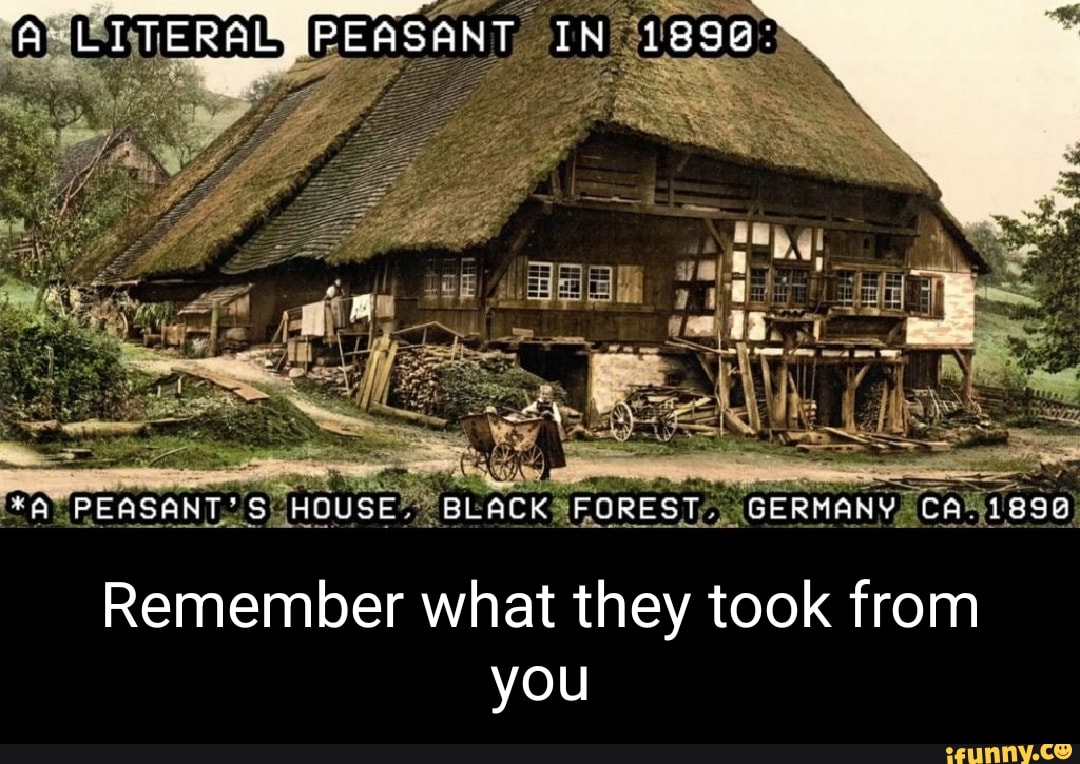
Let’s take a moment to look at one particular building-related post. It’s a colour photograph of a large thatched building. The caption claims that this is a ‘literal peasant’s house’ from 1890s Germany. It is contrasted with an image of miserable commuters on a subway. The implication is that German peasants back in traditional times (whenever they were) had it better than modern people.
There are so many things wrong with this, it’s easiest to respond in bullet points.
The 1890s were known as the fin-de-siécle, famously a time when a lot of people were anxious about modernity, worried that civilisation and technological advance were leading to ‘decadence.’ The 1890s were modern.
The Industrial Revolution had long since taken place by the 1890s. In fact, the Second Industrial Revolution had taken place. There were trains, telegraphs, trams, motor cars, power plants… and, obviously, photography.
And Germany was one of the foremost industrial powers in the world. It had a parliament, a colonial empire and cutting-edge technology and industry.
So, taking the caption at face value, this is not a ‘traditional’ house. It is a house from an advanced capitalist country in modern times.
Peasant classes are extremely heterogeneous. It is to be expected, even if this were the Middle Ages or the classical period (not the heart of modern Europe), that a minority of peasants would have large houses.
That house – how do I put this politely? – it doesn’t exactly correspond to the trad taste in architecture.
I guess they see this photograph and think that most peasants for most of medieval history lived in massive houses. Thanks to traditionalism (which is to say, thanks to god, but also the Romans, and also the men who hunted mammoths).
I hate to break it to you, but that house doesn’t have Wifi. It might not even have an indoor toilet. And you don’t know how to do farming. You have lived in a suburb your entire life and work in an office. You would absolutely hate it if you got dropped into the 1890s, or a neolithic mammoth hunt (apparently those two things belong in the same category).
An intelligent trad might make a legitimate reply along the following lines: ‘I would be ill-equipped to live in, say, Ancient Rome. But that is because modernity has ruined me. That’s why I hate modernity and am trying to get away from it.’
I too am alienated from and critical of today’s capitalist civilisation. But any kernel of sympathy I might have for these guys evaporates whenever they utter anything. They want to move backwards, to a miserable and oppressive past where they imagine they would be top dogs.
To finish up, I want to give the reader a flavour of what it’s like to scroll through these pages, as best I can sum it up with the written word.
That Nordic Chad meme guy puts in an appearance in about 90% of all posts. These trad memesmiths don’t realise there are diminishing returns on this. Nordic Chad has become a sock puppet for whatever the trads want to say.
There’s posts about how women should stay at home and not get jobs, and how your wife should come to live on your farm in financial dependence and isolation. If the Nordic Chad meme guy mistreats his isolated and dependent wife, don’t worry – he will pray to God for forgiveness and improve himself by pretending to read Meditations by Marcus Aurelius (You know Marcus Aurelius is traditional and based because his name has a lot of ‘us’es in it).
Next, a picture of Nordic Chad explaining traditionalism over the histrionic objections of a crying soy-face pink-haired opponent (A lot of the memes are just drawings of people flying into a rage at the trads, unable to handle how based they are).
Next, a picture with the caption, ‘Why do buildings look like this now? [picture of some tasteless modern building] when they used to look like this?’ [picture of an equally tasteless Victorian building]
Or worse, that meme above, only instead of a tasteless Victorian building, it’s a not-real painting of a fictional building.
Next, an ad for merch. Naturally there’s a store. Because nothing says traditionalism and stoicism like the words ‘Half price while stocks last! Link in bio.’ Glad they have the merch, just in case the isolated family homestead thing falls through. Which, as a historical phenomenon, it did.
I just ran ‘link in bio’ through Google Translate into Latin to see how it would have sounded if Marcus Aurelius had written it at the end of every chapter of Meditations. If you change ‘bio’ to ‘biography’, it actually sounds good: Vinculum in Vita. The trads can have that one for free, as a motto that accurately sums up their whole deal.
Stalin served as chief political commissar for the Soviets’ South-West Front, commanded by Egorov. During the decisive weeks of the war, the Red Army’s commander-in-chief Kamenev ordered Egorov and Stalin to move their forces north; instead of concentrating on Lviv, they were to help Tukhachevskii take Warsaw. Stalin and Egorov ignored these orders and carried on with the failed attack on Lviv. For this, Stalin was removed from his post and he was never again let anywhere near frontline command. There were commanders during the Civil War who were shot for less.
The appearance of the Red Cavalry somewhere to the south of Warsaw would have prevented the Polish striking force from driving into Tukhachevskii’s left flank. Davies elaborates: ‘The real puzzle is why Stalin ordered the [Red Cavalry] to besiege [Lviv] on 12th August, knowing full well that it was due to be transferred to [Tukhachevskii’s front].’ Perhaps Stalin wanted to foil these plans for regroupment by presenting them with a fait accompli.’ ‘Look- we’re already attacking Lviv. Can’t pull back now! What a shame!’ Trotsky would later allege that Stalin wanted to take Lviv to enhance his own prestige. If Tukhachevskii would soon conquer Warsaw, Stalin thought hedeserved to conquer Lviv. Davies asks, ‘Was it to spite Tukhachevsky, as Trotksy said?’
So far, so damning.
Stalin’s ally, Budennyi
But Lviv and Warsaw are over 300 kilometres apart. It is not certain that anything Stalin or Egorov could have done would have made a difference at Warsaw; on top of the irresponsibility of abandoning the Galician campaign, it is doubtful Budennyi, for all his ability, could have even covered the ground with sufficient speed. It was too late in the game. The key strategic mistakes – crossing the Curzon Line, advancing full-speed on Warsaw – had been made long before, and they had been made by people other than Stalin.
[Davies, 216-218]
But if you read Wollenberg (and you should), you will find an argument, backed up by copious reference to Pilsudski’s and Tukhachevksii’s memoirs, that had Stalin and co acted differently it would have made a huge difference. The Red Cavalry didn’t have to gallop all the way to Warsaw, only advance far enough into Poland so as to threaten Pilsudski’s right flank. Then the hammer-blow of the counter-offensive might have had to stall before breaking the Red Army, or might have not fallen at all.
I think Stalin’s actions did contribute to the defeat. But that is not to say they prevented a certain victory. Had the Red Cavalry gone to the aid of Tukhachevskii, they would have prevented Pilsudski’s counter-offensive but they would not have fixed the extremely challenging strategic situation in which the Red Army found itself in August 1920.
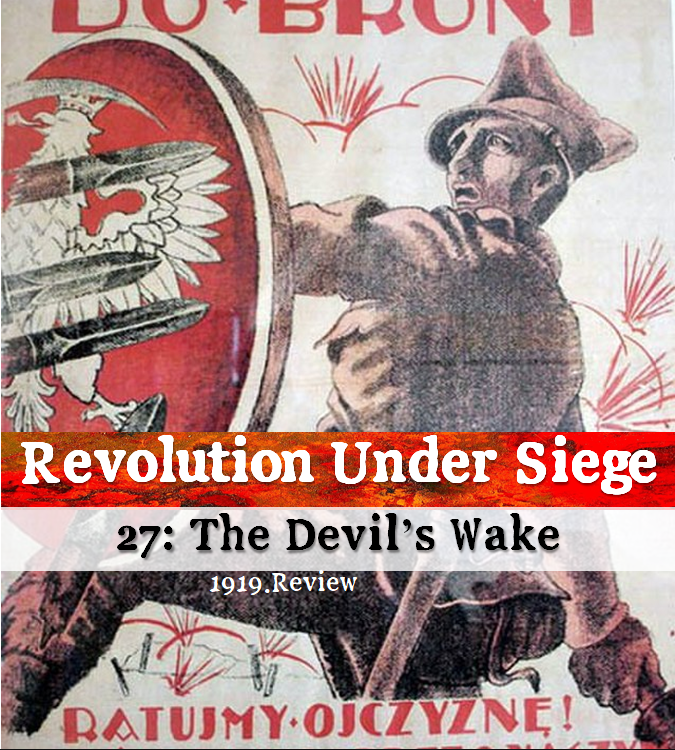
This is Episode 27 of Revolution Under Siege, an account of the Russian Civil War, and the third and final episode dealing with the Polish-Soviet War. Here are the first and second parts.
Become a paying supporter to get access
Access to this article is limited to paying supporters. If you already subscribe by email, thank you. But if you want to become a paying supporter, please hit ‘Subscribe’ below.
Give me less than the price of a coffee, and you can access everything on this blog for one year.
Full-scale war breaks out between the young Polish Republic and the young Soviet Union. This is Episode 25 of Revolution Under Siege, an account of the Russian Civil War. We are approaching the half-way point in the fourth and final series.
The Bloodless Front
Readers will remember the young Red Cossack Vasily Timofeich Kurdyukov, whose father was a White Guard but who himself joined the Reds along with his brothers. Vasily – I hope Isaac Babel, who recorded this story, changed the names, but let’s call him Vasily – was a witness to the murder of one brother by the father. Is this ringing a bell yet? He was there too when, after the defeat of Denikin, he and his brothers tracked down their father in Maikop and killed him in retaliation despite the protests of the ‘Yids’, by which Kurdyukov meant the Soviet officials.[1]
April 1920 found VasilyKurdyukov on the move. Denikin was, along with Timofei Kurdyukov, vanquished. So Vasily, his older brother Semyon, and 16,000 other members of Budennyi’s First Red Cavalry Army had left South Russia, going from Maikop through Hulyaipole. They were making their way across Ukraine to take part in another campaign, covering 1200 kilometres in 30 days. Compared to the epic struggle against counter-revolution that was behind them, nothing too serious or historic appeared to lie ahead. The war was over, bar the fighting in parts of Siberia, the Caucasus and Central Asia. The political regime seemed to be opening up, loosening up. The Allies lifted the blockade in January. The death penalty had been abolished. The leaders in the Kremlin were discussing post-war reconstruction, not the starting of new wars. Back east in the Urals, Third Army had laid down their rifles and turned to chopping down wood as the first Labour Army. 7th Army, after routing Iudenich near Petrograd, began digging peat. ‘Communiques from the bloodless front’ announced the rebuilding of this bridge or that railway line, the numbers of locomotives repaired, etc. And throughout the Red Army, literacy classes were a day-to-day reality, with thousands of mobile libraries in operation. As Kurdyukov rode, he would have been able to read educational letter-boards on the backs of the riders in front of him. [2]
For most Red Cossacks and for the large minority of worker-volunteers in the Red Cavalry, we can assume that peace couldn’t come soon enough. The fields of the Don and Kuban had been tended largely by the women and the old men since 1914. But we can easily imagine that for some Cossacks who had been at war for six years, life in the saddle with a sabre was the only life they had known as adults.
The First Red Cavalry Army was going west to join up with the Red South-Western Front under Egorov. They would then grab a few Ukrainian towns from the Polish Army, so that when the Soviets and Poland finally got around to signing their peace treaty, the line on the map would be a little further west and the Ukrainian Soviet Republic that bit bigger.
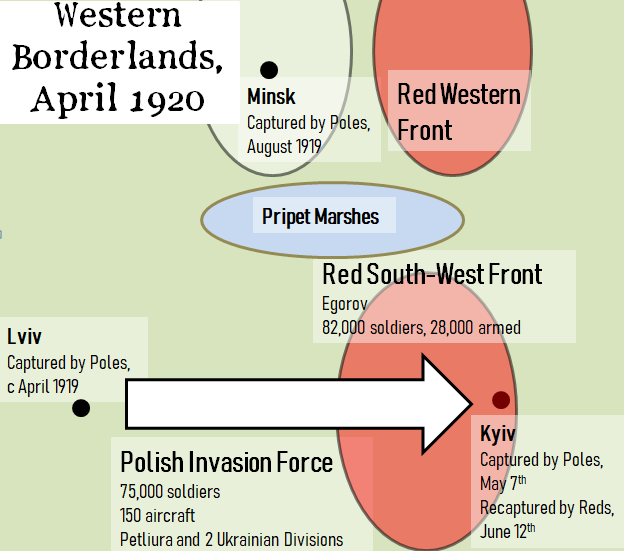
So far, the Poles had been having their own way – defeating the Ukrainian Nationalists in Galicia and seizing from them the city of L’viv (which they called Lwów and the Russians called L’vov, and which is today part of Ukraine); and to the north, beyond the Pripet marshes, the Polish forces had been chipping away at the Soviet border for a year, seizing one Belarussian town after another. But now that Denikin and Kolchak were finished, it was time to hit back. In a few weeks or a month – if peace with Poland hadn’t been signed by then – the Red Army would be ready to launch an offensive, to hammer that border into a more agreeable shape.
But on April 24th 75,000 Polish soldiers invaded Soviet Ukraine. 11,000 fighters lately incorporated into the Red Army mutinied, led by their commanders, and went over to the Poles. The Polish government had signed a treaty with Petliura, the leader of the late Rada, and he and two divisions of Ukrainian soldiers were aiding the invasion. To make matters worse, Makhno chose this moment to strike the Reds: on 25 April his guerrillas massacred a regiment of the Ukrainian Labour Army at Marinka on the Donets. They also blew up bridges around the Kyiv area, crippling transport.
The Polish invasion made swift progress. This was no border skirmish. They were well-armed. Motor trucks infiltrated Red lines on small country roads. 150 planes supported them from the air with devastating attacks on armoured trains and on flotillas on the Dnipro river. There were 82,847 Red Army personnel on the whole South-West Front – but only 28,568 of them had weapons, and they were in disarray. Egorov pulled back his troops rapidly. The Poles gained 240 kilometres in two weeks. On May 7th they took Kyiv, and soon they had bridgeheads east of the Dnipro River. Since April 24th they had suffered only 150 fatalities.
Less than one month later, the White Guards who had found refuge in Crimea began an assault on Ukraine’s mainland. Wrangel’s 35,000-strong ‘Russian Army,’ which contained many of the same officers and Cossacks who had been fighting Soviet power since 1917, had rejoined the fray. Two new fronts had opened up, and the prospect of peace had receded to the very distant horizon.
Petliura (left) and Pilsudski on April 9th, not long before the invasion
At War Again
We can imagine the dismay and fear now felt by people in the Soviet Union, from the Kurdyukov brothers in Budennyi’s ranks to their mother back in South Russia. Just when the country was escaping, at long last, from the realm of war, here was another massive foreign intervention. It would set off the dreadfully familiar cycles of confusion, fear, revolt, hunger, disease, red and white terror. The death penalty was soon restored. The railways were militarised.
In the words of John Reed:
The cities would have been provisioned and provided with wood for the winter, the transport situation would have been better than ever before, the harvest would have filled the granaries of Russia to bursting – if only the Poles and Wrangel, backed by the Allies, had not suddenly hurled their armies once more against Russia, necessitating the cessation of all rebuilding of economic life – […] the concentration once again of all the forces of the exhausted country upon the front.
In the words of Trotsky: ‘Ahead of us lie months of hard struggle… before we can cease to weigh the bread-ration on a pharmacist’s scales.'[3]
This time there was also a strong element of patriotic indignation. A repeat of the Polish invasion of 1612 was widely feared. The famous tsarist General Brusilov came out of hiding and volunteered his services as an advisor to the Red Army.
Communists, from the Politburo in the Kremlin down to the volunteer in the trenches, found themselves trying to rein in patriotism whenever it threatened to spill over into the familiar Tsarist channels of imperialistic contempt for the Polish people. Trotsky and Lenin were scrupulous about never speaking of ‘The Poles’ or ‘Poland’ but only ‘The White Poles’ or the ‘Polish landlords.’ ‘Do not fall into chauvinism,’ urged Lenin. One Red Army paper, Voyennoye Dyelo, got into big trouble. Officers were sacked from the editorial board and the paper was suspended over the use of the phrase ‘the innate jesuitry of the Polacks.’
Trotsky affirmed that ‘defeat of the Polish White Guards, who have attacked us will not change in the slightest our attitude concerning the independence of Poland.’
Ukrainian communists, too, made appeals for the defense of Ukraine as a nation. A common charge was that Petliura was the chosen caretaker of the Polish landlords, to mind the Ukrainian estate which they had their eyes on. [4]
The rest of this post will explore the background to the invasion from the perspective of the Polish Republic, then describe the initial Soviet response.
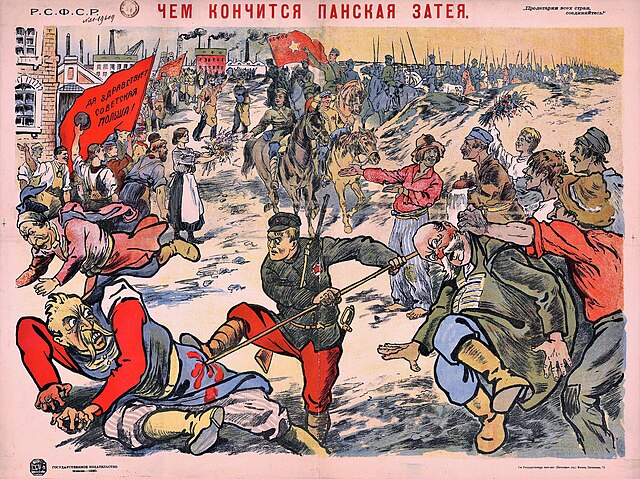
A Soviet poster from this time. The caption says, ‘This is how the Polish lords’ invasion will end up.’
Intermarium
With the defeat of Germany in November 1918, a strong Polish military force emerged. Four of the combatant empires had large Polish units in their armies – not least a 35,000-strong Polish unit that had been raised in France and was now sent back into Poland. Also important was the Polish unit in the Austrian military, which was led by a man named Józef Piłsudski. The strength of the Polish military is probably what led to the emergence of a bourgeois capitalist Poland instead of a proletarian socialist Poland (though we will look next week at how close Poland came to a socialist revolution).
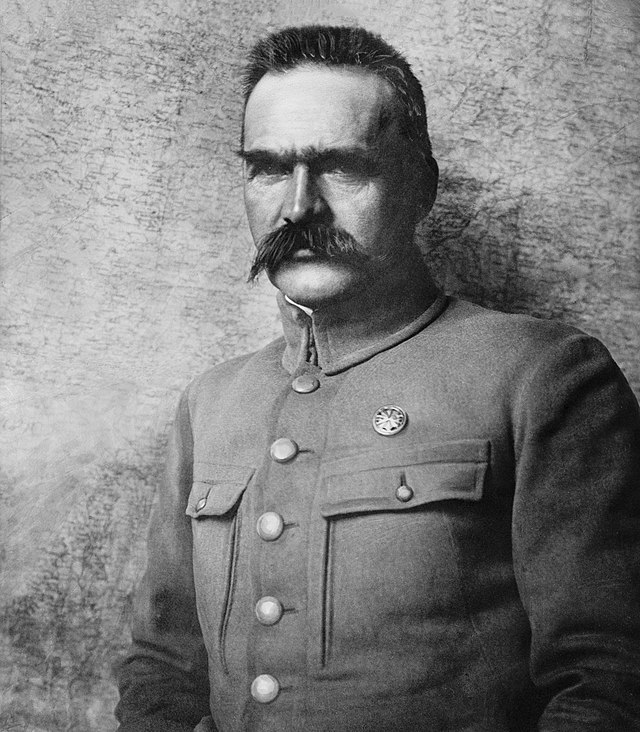
Let’s dwell for a minute on Józef Piłsudski. A Pole from Eastern Lithuania, he grew up under the heavy hand of Tsarist oppression, became a socialist but in his own words he dismounted from ‘the socialist tramcar at the stop called independence.’ He was not a leader of masses but a back-room conspirator and bank robber. [5] Service as an officer in the Polish unit in the Austrian military during World War One promoted him to the front rank of national leaders. In 1920 he was head of state and commander-in-chief of the armed forces. His huge moustache belonged to the flamboyant 19th Century, but his glowering eyebrows and cropped hair gave an impression of urgency and severity.
Józef Piłsudski
Piłsudski had a vision of what he called Międzymorze, ‘Between the Seas,’ also known as the Intermarium. Without understanding Międzymorze we can’t understand the Polish-Soviet War. The idea was that Poland should lead a federation of countries stretching from the Black Sea to the Baltic – which meant taking over, or at least installing pliable governments in, Ukraine and Lithuania. This idea harked back to the Polish-Lithuanian Commonwealth of centuries past.
But in Poland as in Russia and Ukraine, grand plans had to be put on hold, as famine gripped the countryside and there were years of misery and want. Poland was not torn apart by war as Russia and Ukraine were, but the new Polish state battled with Germans, Czechs and, as we have seen, Ukrainians. Unlike in the Soviet Union, vast amounts of American aid alleviated the situation – in 1919-1920 the American Relief Administration fed and cared for 4 million Poles. By the end of 1919 a strong Polish state was in existence with a population of around 20 million and armed forces numbering 750,000. [6]
The time was ripe for Międzymorze. And the territories of the new Polish empire would be wrestled from the small Lithuanian republic and from the war-weary and ragged Soviet regime.
The communists, as imagined in a Polish wartime poster
Toward War
The revolutionary tradition, and most especially those trends around Lenin, had long supported Polish independence, and the Soviet government never made any territorial claim over Poland. An independent capitalist Poland, like Finland, Estonia, Latvia and Lithuania, would be accepted by Moscow.
Of course, the Soviet Union was in favour of world revolution. But this amounted to supporting communist revolutions and parties in other countries. Military intervention, even in the form of support for indigenous movements, was controversial. As the Brest-Litovsk episode showed, the Bolsheviks’ confidence in world revolution could in the right circumstances make them more amenable to signing a peace treaty, not less, because future revolutionary events would render an unfavourable treaty void.
The issue was where to draw the Soviet-Polish border – where, in the ‘300-mile band of polyglot territory between indisputably ethnic Poland and indisputably ethnic Russia,’ [7] would one state end and the other begin? This question had not been on the agenda since the 18th Century, and there was no recognised border. While Soviet Russia was busy fighting against the White Armies in 1919, Poland was settling this question at the point of a bayonet, making steady gains in a small-scale but one-sided war. Galicia was theirs by July 1919.
So the Polish and Soviet armies had been skirmishing for a year before the Polish invasion in 1920. Since the first clashes between Polish and Red troops took place as early as February 1919, the historian Norman Davies accuses other historians of ‘ignoring’ the ‘first year’ of the Polish-Soviet War. [8] It is Davies who here ignores the qualitative difference between the low-level conflict of that ‘first year,’ and the all-out war which began in April 1920 (This is a flaw in his generally great book).
The borderlands between Poland and the Soviet Union can be divided roughly into a northern area around Belarus and Lithuania, and a southern area, Galicia and Ukraine. The Pripet marshes lay in between the northern and southern areas. Polish, Russian and Jewish people lived in both, Belarussian and Lithuanian farmers in the north, Ukrainian farmers in the south.
The possibility of a peace settlement was there. The Soviets had no shortage of competent Polish supporters, some of whom they sent to Poland to try to negotiate peace from late 1918 right up to the eve of the invasion. One typical offer was of territory and plebiscites in exchange for peace. These got off to a bad start when a joint delegation of Soviet diplomats and Red Cross officials visited the Polish Republic soon after its foundation. They were immediately arrested and deported. During their deportation, Polish police dragged them out into the woods and shot them, killing three and leaving one who survived by playing dead. Nonetheless the Soviets kept up their peace efforts through 1919 and into 1920.
Frustration and alarm gripped Soviet diplomats and politicians in early 1920. They were still at the ‘talks about talks’ stage, and the Polish negotiators were stubborn and demanding. They would only agree to meet for peace talks in Barysaw (Borisov), a town recently captured by the Poles. It was not acceptable to the Reds as it was in a zone of active military operations. The Soviets proposed Warsaw, Estonia, Moscow, or Petrograd, all of which the Polish side rejected. Meanwhile Soviet leaders had accepted six out of seven conditions presented by the Poles as a basis for talks, but balked at the seventh – it demanded that they never attack the Ukrainian Nationalist leader Petliura. [9] When Moscow pushed back, Piłsudski broke off talks.
Beevor characterises all this as Piłsudski ‘playing for time.’ The time, from the first Soviet peace mission, was nearly 18 months. Piłsudski ‘s stubbornness is explained by the fact that he did not seek to make peace, but sought a pretext to invade.
‘When diplomatic moves failed,’ writes Robert Jackson, ‘the Reds launched a series of small attacks along their western front; the Poles beat them off and held their positions.’ [10]
The Soviet leaders were not naive, so they understood that a Polish attack was likely. They developed their own plans for a strategic offensive as far as Brest – hence Kurdyukov and 16,000 other riders hurrying over from South Russia. The limit of the Red Army’s ambition was to seize a few more towns before the signing of a peace treaty, and to foil any plans the Poles might have of doing the same.
Unfortunately, some writers highlight a few facts out of context – a troop build-up here, a local offensive there – and paint a picture of a savage communist horde massing to trample and enslave Poland. Piłsudski’s grandiose imperial ambitions, his deliberate wrecking of peace talks, and his very ambitious and large-scale invasion of Ukraine feature only as minor details, if at all. [11]
The Allies
The Soviet leaders were convinced that the Polish invasion was the work of the Allies. It was characterised as ‘The Third Campaign of the Entente’ in an article written by Stalin in Pravda on May 25, 1920. We can say with hindsight that this impression was wrong.
The Allies did not egg on the Poles to attack the Soviet Union. In fact they were shocked and dismayed by the attack. The Allied leaders had learned that the Soviets were not to be trifled with, and they were getting cold feet on the question of intervention. On the more liberal end, Lloyd George thought the Poles had ‘gone rather mad’ and were behaving as ‘a menace to the peace of Europe.’ [12]
The Allies had rejected schemes proposed by Polish leaders which involved the Allies bankrolling a Polish march on Moscow. In addition to their growing wariness toward the Red Army, the Allies still held out hope that the Soviet regime would collapse, and they didn’t want to big up the Poles too much in case it offended a future conservative regime in Russia. Ideally, they wanted Poland to act as a ‘cordon sanitaire’ protecting Germany from the influence of revolutionary Russia – much as Stalin would use it later as a defensive glacis against the west. To that end the Allies began arming Poland in earnest from January 1920: rifles captured from the Austrians, planes and pilots, 5,000 French officers to train them. It was not much compared to the total resources of the Allies. But for a Polish army severely overstretched by its recent conquests, it was a game-changer [13].
In that very important sense, the Soviets were right. The Allies had backed (and still backed) the Reds’ opponents up to this point, and although they did not push Poland into war, in the months and years leading up to the war they backed Poland, armed its soldiers, gave equipment, lent advisors – in short, made the war possible. People on the Soviet side could not have known the ins and outs of Allied policy, and would have been innocent to believe any verbal reassurances along the lines of, Yes, we are bankrolling the army that’s invading you, and we got some other people to invade you a few months ago, but we didn’t actually want this army to invade you right now.
So the Soviets treated it as a seamless continuation of the Civil War. But the fact remains that their strategic understanding of the situation was wrong on a fundamental point. The initiative had come from Piłsudski, not from the Allies.
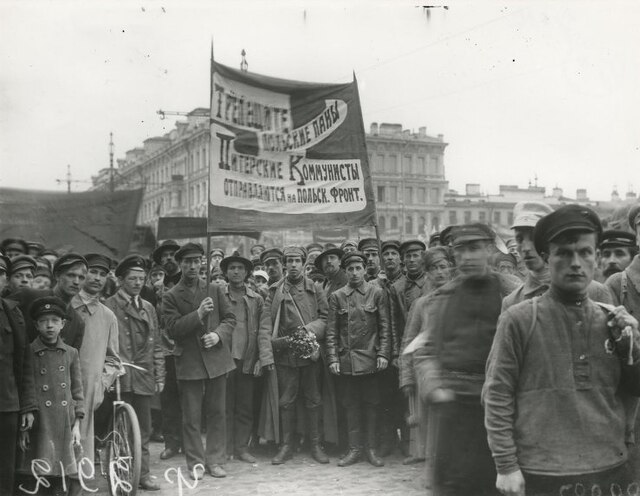
Moscow: volunteers for the Red Army during the Polish-Soviet War
The Soviets Rally
This was one of several mistaken ideas with which the Soviets were burdened as this war began. But it would take time for these mistakes to have their fatal effects.
The Poles had made their own strategic mistakes in counting on Petliura and the Rada. After a month in Kyiv, things were not going well. Their ally (or ‘caretaker’) Petliura could not rally the Ukrainian people to his cause. It did not help that the price of the alliance was for the Rada to sign away Lviv and West Ukraine to Poland, which demoralised many Ukrainian Nationalists. This was on top of the basic point that Petliura was acting as an ally to the Polish landlords and business owners who had oppressed and exploited Ukrainians.
On May 25th the Reds began their general counter-offensive. At first, the Red Cavalry tried advancing directly on Polish trenches. They rapidly discovered that wild Cossack charges would not work as well as they had against Denikin, and the first few days of the offensive saw little progress. The Poles were experienced at trench warfare, and it was futile to attack them head-on. The Red Cavalry commanders refined their tactics. They would dismount close to the enemy, use artillery, use small striking forces to take strong points; or find gaps in the enemy line, turn enemy flanks, wreak havoc in the rear.
This Budennyi did personally on June 5th. He spent a sleepless night worrying about the following day’s attack, and rose to bad news about one of his divisions being forced to retreat during the night. He personally joined 1st Brigade of 14th Division and led the unit into marshy ground shrouded in early morning mist. They ran into some Polish cavalry, known as uhlans, and gave chase. One uhlan fired at Budennyi and missed. Budennyi caught up to him, knocked him from his horse. The dismounted uhlan fired again, and the bullet whined past Budennyi. The Red Cavalry commander used the flat of his sabre to disarm the uhlan, and brought him in for questioning. This encounter bore fruit: Budennyi learned of an ideal place to cross the Polish trench lines, and even found good places to fire directly down the trenches. The brigade passed through into the Polish rear.
This cavalry infiltration tactic saw widespread success. The area was too large for Great War-style trenches to cover it fully. Zhitomir, far behind Polish lines, was recaptured by the Reds on June 8th. On June 10th the Poles, threatened with being surrounded, evacuated Kyiv. Two or three days later the Reds marched in – this was, Mawdsley points out (p 348) the sixteenth time that the city had changed hands during the Civil War. Fortunately for the residents of the city it was also the last time.
Egorov’s South-West Front had been evacuated quickly enough that they did not suffer major losses during the Polish advance. It showed lessons learned from 1919: let the enemy advance run out of steam, then hit back hard. A Polish veteran summed it up bluntly: ‘We ran all the way to Kiev, and we ran all the way back.’ [14]
As the South-West Front covered the distance between Kyiv and Lviv, the Reds felt the wind at their backs. The insolent invaders were on the run. They might run all the way back to Warsaw. The Polish army appeared to be weak.
Mikhail Kalinin, president of the Soviets, predicted that the defeat of the Polish Army by the Red would deal the first blow to the Polish bourgeoisie, but that the Polish people themselves would deal the second and fatal blow. Likewise Trotsky ‘assumed that Poland would be liberated by her own people… His only recognisable war aim was to survive.'[15]
The Polish defeat, like the Tsar’s, might lead to revolution at home. A fraternal Soviet Poland might help alleviate the horrible suffering in the Soviet Union, might push Germany into revolution, might ignite Europe. The Reds had entered into the conflict with a notion of a struggle over the borderlands. Now they were being tempted by the idea, to use a modern phrase, of regime change.
[3] On the numbers on South-West Front, Makhno, and mutiny of East Galicians, see Davies, p 108. Quote from Reed, ‘Soviet Russia Now.’ Quote from Trotsky, ‘Speech at a meeting in the Murom railway workshops,’ June 21st 1920. In How the Revolution Armed, Volume 3
[4] Davies, p 115, Smele, p 357, Trotsky quote from ‘The Polish Front and Our Tasks’ in How the Revolution Armed, Volume 3
[5] Davies, p 63
[6] Davies, p 93; Smele, p 153-154
[7] Smele, p 153
[8] Davies, p 22
[9] Davies, p 71-73
[10] Jackson, Robert. At War with the Bolsheviks, Tom Stacey, 1972, p 229.p 230
[11] See Beevor, The Russian Civil War, Chapter 36; and Read, The World on Fire, p 110-111. Trotsky in May 1920 said: ‘[T]the most double-dyed demagogues and charlatans of the international yellow press will be quite unable to present to the working masses the irruption of the Polish White Guards into the Ukraine as an attack by the Bolshevik ‘oppressors’ on peaceful Poland’ How wrong he turned out to be. ‘The Polish Front: Talk with a representative of the Soviet press.’ How the Revolution Armed, Volume 3
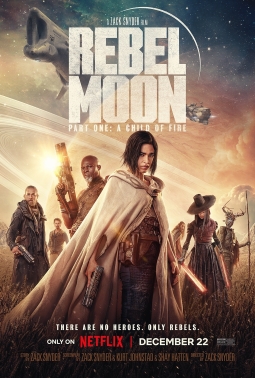
That was Mark Kermode’s verdict on Jimmy the robot from Rebel Moon. This sums up what Kermode and many others have said about director Zack Snyder’s new space adventure movie: that it’s a rip-off of Star Wars, that it’s staggeringly derivative.
I usually like Kermode but actually Jimmy isn’t much like 3-CP0. He’s a humanoid robot with an English accent – OK. But there have been a lot of human-shaped robots since Fritz Lang’s Metropolis. It’s pretty much the default shape for robots. And English accents are not rare; Mark Kermode has one.
Jimmy is a military robot, designed to kill, not a protocol droid who can speak 6 million languages. C-3P0 is pedantic and cowardly and pessimistic. Jimmy, on the other hand, has an interesting and messy internal life. Unlike C-3P0 he is dignified, and he is played for sympathy, not for laughs. He was programmed to defend a certain princess, and now that she’s dead he can’t fight – until something unexpected suddenly restores his capacity for violence.
This incident has placed him on an interesting trajectory. When we see him in one of the final shots of the movie, having not seen him at all for over an hour, he has undergone a strange transformation – a kind of robotic midlife crisis, resulting in new feral headgear. It’s a striking image.
I didn’t particularly want to like Rebel Moon and I didn’t see myself writing about it here, slightly pedantically defending it from a critical pile-on. Of Snyder’s precious films, 300 impressed me at 16 but in retrospect it was a crazy and fascist movie, drawn from an equally crazy and fascist comic. I haven’t seen a Snyder film since Watchmen. I know that Rebel Moon started out as a rejected pitch for a Star Wars movie. In the trailer, the action looked weightless, the characters dour. I thought it would be Star Wars without any humour or character, and with a reactionary political edge.
But honestly, contrary to what most of the critics are saying, Rebel Moon carves out its own space and is its own thing. I watch everything in 20 or 30 minute stretches these days, between changing nappies, sleeping and going to work, so the length of the movie didn’t bother me as I didn’t watch it in one sitting. But if I didn’t really like it, I wouldn’t have kept coming back.
From the start, Rebel Moon struck me as more like Warhammer 40K or Dune than Star Wars: there’s the solemn choral music and the baroque Gothic style of the bad guys. This tone promise was borne out: the whole movie is edgier than anything Lucas made. It’s not exactly Come and See but it’s more for teenage boys (of all ages and genders) than for the whole family.
The early scenes with the good guys are also very un-Star Wars. They talk about sex, joke about it, and have it barely off-screen, which is something most action-adventure films of our era are terrified to do because they want to pack all age groups into the cinema. That’s refreshing. Also, these pagan farmers appear to be having a really good time even when they aren’t riding each other. For me, all this was unexpected and endearing.
The arrival of the bad guys is really tense. This sequence follows Hitchcock’s ‘bomb under the table’ principle. Yes, thanks critics, it’s obvious they’re bad space fascists and they’re going to do bad things. But we don’t know exactly what they are going to do, or when. Hence the tension.
The imperial soldiers are not faceless stormtroopers. They’re macho bullies and rapists, apart from one decent guy; they have horrible personalities, but the point is that they have personalities. In another 40k nod, their armour spans the gap gracefully between futuristic and baroque.
Contrary to what I expected, the fight scenes actually kick arse. They have real weight and are gritty. The energy weapons have a kick to them.
There are plenty of genre tropes in the first 40 minutes. But there are few specifically Star Wars tropes until Kora and Gunnar (look! I remembered their names 3 weeks later) take in a vista of a town from a clifftop before proceeding into a cantina full of exotic and dangerous-looking figures. From there it turns away from Star Wars again and becomes a ’round up a posse’ story, drawing from Kurosawa himself, not Kurosawa filtered through George Lucas.
There are plenty of moments where the movie is a visual feast. But sometimes the environments look like stage backdrops, and even when they don’t look like it they behave like it. When our heroes meet the Bloodaxes, it might as well be happening on a theatre stage because there is no interaction with the floaty columns that loom in the background. Towards the end, which is not really an end but a lull before the next movie, the characters keep saying wooden portentous things clearly designed to get the ending to feel more ending-y. That’s clumsy. I found most of the slow motion stuff unnecessary and distracting. A slo-mo shot of seeds being sown – what is that for?
The Bloodaxes keep saying the word ‘Revolution,’ without every giving us the slightest notion of what their revolution is about. In this sense too the movie is distinct from Star Wars: it finds a way to be evenmore apolitical. Unfortunately Rebel Moon also goes so far as to hint that the evil empire might be redeemed by a slightly more compassionate absolute monarch, one who can heal little birdies with her bare hands.
Once again, like in Dune and Star Wars, we have space feudalism. The assumption that a lot of dukes and emperors would be able to manage interstellar travel, when our modern capitalists have such trouble even getting off the ground, is a strange one, but again it’s a genre trope and hardly unique to this movie.
The whole thing is basically limited and on the shallow end, but it’s gripping, pacy and well-executed. Take the masked priest characters who lurk in the background ominously for the whole movie, until the final scenes when we at last learn what their function is and see them at work. That’s cool. The script is pretty likeable. When a bunch of nameless good characters are killed in battle toward the end of the movie, we afterwards get a moment of tribute and mourning – something we rarely get in Star Wars, where there’s an unwritten rule that nameless characters are disposable.
It’s a shame this kind of budget isn’t going to a movie adaptation of some piece of space sci-fi by, say, Ian M Banks or Ann Leckie, or some original adventure drawing on their ideas. That’s my main problem here: there are lots of little sci-fi tropes and elements in Rebel Moon, but no big Science Fiction ideas animating the story, no consistent through-line in the worldbuilding.
I thought the Avatar sequel, Dune: Part One and Andor were all brilliant in very diferent ways. Rebel Moon is not on that level – it’s not so original or intelligent. But the critics are wrong. It hits the targets it sets out to hit. And it’s only ‘like Star Wars‘ in the sense that they both belong to the same genre. In the same way Notting Hill is like Meet the Parents in that they are both rom coms. In the way that 300 is like Gladiator. In the way that Watchmen is like an Avengers movie.
Saying that Jimmy is C-3P0 is just pointing out that they both have human shapes and English accents. It’s not demonstrating anything, except ignorance or maybe disregard for the genre. Likewise, pointing out that Rebel Moon is like Star Wars is actually saying nothing more than ‘These two films are action-adventure movies set in space.’
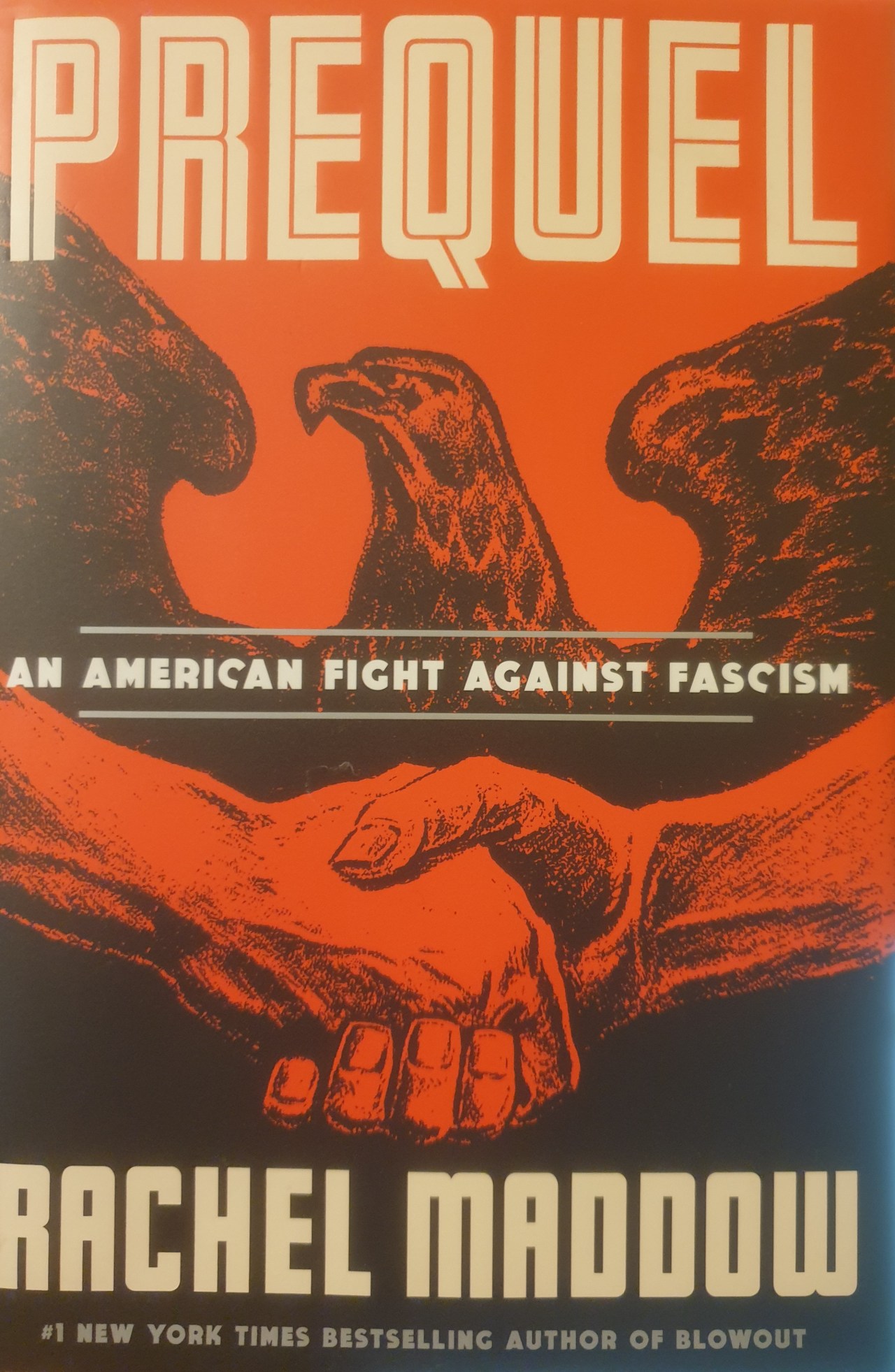
A review of Prequel: An American Fight Against Fascism by Rachel Maddow (Crown, 2023)
You may have heard of Father Coughlin, the pro-Nazi Catholic priest whose radio broadcasts went out to tens of millions of Americans in the 1930s. You may have read in Jacobin that Philip Johnson, one of the most successful architects of the 20th Century United States, spent the pre-World War Two years promoting fascism in the USA and trying to keep the country out of the war. You may have heard of the Silver Shirts, the US equivalent of Mussolini’s Blackshirts and Hitler’s Brownshirts. You may have known that the famous aviator Charles Lindbergh was pro-Hitler and led an organisation called America First.
I’d heard of the above, but most of my understanding of fascism in the pre-war US came from alternative history fiction: The Plot Against America by Philip Roth and K is for Killing by Daniel Easterman.
But Rachel Maddow’s 2023 book Prequel opened my eyes to much crazier stuff. I remember that at one point in Easterman’s novel we encounter a federal employee whose job it is to figure out legal loopholes so that mass internment and concentration camps don’t break US laws. Well, it turns out the Nazis actually sent legal experts over to the US to study how the Jim Crow laws worked, so that they could bring in similar racist laws back in Germany. It’s a reminder that the USA was already a bizarre race-obsessed oppressive dystopia.
I didn’t know that at least 24 elected members of the US Congress abused their free mail privileges to send out millions of copies of pro-Nazi speeches bearing their own signatures but written by Nazi agents. I hadn’t heard of General George Van Horn Moseley. I didn’t know that in California a coalition of fascist and far-right groups planned a mass lynching of famous Jewish people from Hollywood, to be followed by a spree of random gun and gas attacks on Jewish homes. This Helter Skelter-like plan was supposed to trigger a race war. I didn’t know that Coughlin followers in New York organised militias, armed with weapons stolen from the National Guard by sympathetic military officers.
Maddow also tells the stories of various private citizens who campaigned to expose and thwart the Nazis: the LA private investigator Leon Lewis, the assistant Attorney General O. John Rogge (After the war, he tried to reveal to the public the extent of Nazi penetration into the US; he was fired and his report quashed) and a cast of other brave individuals.
But they are merely individuals. An important episode in the fight against fascism in the US in the 1930s was the counter-protest at the America First rally in Madison Square Garden. But Maddow dismisses this protest in one passing sentence. The only mentions of the labour movement, as far as I can recall, are negative. She correctly emphasises that the US Communist Party was by no means the seditious threat it was portrayed as. But the role of communists, socialists and trade unions in opposing fascism is skated over entirely. Pelley and the Silver Shirts were based in Minneapolis – but Maddow does not look at the labour movement and the socialist left in that city, which confronted and organised against the Silver Shirts.
The focus is instead on the judicial system journalists, Hollywood, etc. To be fair, Maddow does not neglect to show how the state, from beat cops to the Attorney General, enabled the fascist agitation.
Maddow’s style is very engaging. She brings a laugh-out-loud quality to some of the farcical scenes from the Dies Committee. She does not write coyly or piously or with any false neutrality. That gives the narrative plenty of energy but it has overheads. I’m not from the United States and I found the self-righteous nationalism a bit weird (And I’m sure there are plenty of people from the US who would find it equally weird). For example, on page 195 we are supposed to be shocked at a politician refusing to show sufficient uncritical jingoism in the context of the First World War. The First.
I know of Maddow only by reputation as a liberal national security hawk who was very into the Trump-Russia stuff. This story, as the title implies, is supposed to be taken as a parallel to more recent events. And the strange constellation of far right thugs we see here do offer many parallels to the MAGA right today.
In spite of my criticisms I read through this book quickly and with great interest. Many parts of it were truly fascinating and horrifying. Not only does it recover a hidden history, it invites us to ponder alternative – and far worse – ways things could have turned out.
It’s New Year’s Eve so I want to thank all my readers. It’s been a fantastic year for the blog and I have big plans for 2024.
Happy holidays/Christmas and new year to my readers. In terms of views and visitors, 2023 was a big jump from the previous two years. Here were the five most popular posts of the year.
Coming in at first place is Mikhail Sholokhov’s epic novel of Cossacks, romance and revolution. Somebody somewhere must have shared this prominently, because even though I wrote it a good year or two ago it keeps coming in as the most popular post, week on week, month on month. One of these readers contacted me; he is the namesake of one of the characters and some of his ancestors were involved in the Russian Revolution.
Sticking with the Russian and Soviet themes, Trotsky takes second place. I originally wrote this post long before I started the 1919 Review so it’s gratifying to see it still gets a lot of attention. Russian state TV made a ridiculous TV drama series about Trotsky to mark the centenary of the Russian Revolution. Here I break down the follies of the first episode.
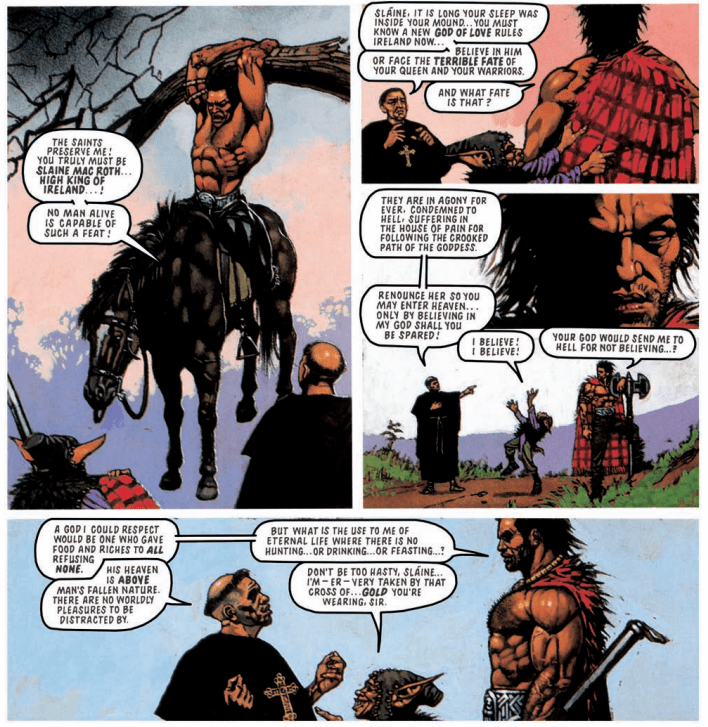
Cover art from From Sláine: Demon Killer, written by Pat Mills and drawn by Dermot Power, Greg Staples, Glenn Fabry and David Lloyd.
Taking the bronze medal, something a bit less serious and not Soviet-related. At once musclebound and middle-brow, Sláine from 2000AD comics is something rich and strange. Sláine is an axe-wielding adventurer who hails from a fictional past, a setting which draws heavily on Irish and Celtic myth and history. He has gone through many incarnations since his creation in at the dawn of the heavy metal and punk eras. I shared these in 2000AD fan pages on social media, and I get a regular stream of referrals from a Polish comic books forum.
I’m glad this one made the top five, as it’s the one I put the most work into. Here the views are distributed between many posts (25 and counting) so it’s difficult to get a full picture. But the main archive page on its own got enough hits to make the cut. Two individual posts (‘The Pogroms of 1919‘ and ‘Red Cavalry‘) did make the top ten.
It was fascinating to re-read this book having, since my last reading of it, actually studied the history on which it is based. In this four-part series I did a close and critical reading of this grim and fascinating novel, starting with the assertion that no, contrary to the widespread claim, Nineteen Eighty-Four has not happened anywhere, ever.
Thanks to all my readers. Thanks especially to those who have spread the word. Here’s to an even bigger and better 2024.
This is a review of the 2023 Netflix movie Leave the World Behind (dir. Sam Esmail). Rather than review it myself, I have delegated the job to a time-traveler from the early Soviet Union. If he does a good job, I will delegate other reviews in the future to other time travelers – 7th-century monks figuring out crime thrillers, eighteenth-century rakes getting teary-eyed over Pixar cartoons, 24th-century asteroid-croppers watching rom coms...
I have spent only a few days in the 21st Century. I have barely ventured outside, as I find this world disorienting and distressing. My host suggested watching a film set in this current century to help orientate me. So I watched the most prominently-advertised film on his home cinema screen: Leave the World Behind.
In this film a family of the intelligentsia leaves the capital for a few days to rent a dacha in the countryside. But their social order begins collapsing around their ears. First, communications and transport are cut. Next, the country is flooded with disorienting enemy propaganda. Last, civil war breaks out. The same thing happened to us in 1918 only, as with everything in Russia, it took longer. They are under attack from an unknown enemy – and speaking from my own bitter experience, it’s probably the Czechoslovak Legion in league with the Cossacks, backed by the Anglo-French imperialist bandits.
The owner of the dacha flees from a calamity in the city along with his daughter, and they arrive at the dacha seeking shelter. He is bourgeois, and he is the owner of the house, but he is also a member of an oppressed nationality. So the mother of the intelligentsia family treats him with chauvinistic suspicion and contempt.
So far, the film presents a situation I can easily comprehend. The characters, too, were familiar types to me.
The father has a fine head of greying hair and a small beard. He is professor, and he looks not unlike some of my own old professors. I recognised him at once as a Narodnik, as he is generous and feckless, democratic in his opinions but not always democratic in his instincts. As the film went on I was again and again confirmed in my impression.
They have a young daughter who is obsessed with fictional works composed several decades before she was born. Naturally, I am unfamiliar with the works in question (Friends and The West Wing), but I felt sympathy with this character as I spent much of my youth engrossed in Turgenev and Tolstoy.
The intellectual family also have a son, a worthless fellow who is cruel to his sister. Late in the film, his teeth fall out of his head. It appears to be a side-effect of some epidemic – again, this to me is very familiar. So the boy and the two men go to a local kulak, who has been hoarding medical supplies. But in this crisis the rural population has turned inward, and the wealthier peasants are solely concerned with individual property and family. The kulak refuses to accept their worthless paper money, and threatens them with a rifle. I could have warned them this would happen.
The bourgeois draws a pistol, intending to expropriate the kulak’s medical supplies by force, but the intellectual becomes histrionic, bares his chest to both firearms, and throws himself on the kulak’s mercy.
The wily peasant relents and accepts the paper money, saying that a ‘barter system’ is acceptable to him.
There was much I did not understand in this film, but I gave a hearty and appreciative laugh when the intellectual salvaged a little of his dignity by correcting the kulak: ‘Well, I gave you money, so it’s not really barter.’
Stripped of their collectivity, these individuals and family groups still respond to their class instincts but lack any actual power. They flounder and tread water. They are saved only by a happy accident; the local landlord has abandoned his mansion, taking his family and all his servants with him, leaving a well-appointed cellar stocked with supplies and cultural riches, which the intelligent young girl finds. The only danger is that the adults will find the nobleman’s wine cellar and drink themselves into oblivion.
They will take refuge from the coming civil war in a nobleman’s cellar. Well and good for them. But what about the fate of their nation and people? To this they appear completely indifferent.
To myself, a man out of time, much was strange, much was familiar. These people of 2023 have screens instead of newspapers; that much is easy enough to grasp. The only printed material in the film is a leaflet in Arabic dropped by some Basmachi aviator. People still smoke, but their pipes are made of metal. With regard to motor cars, it appears the rabid anti-Semite and union-buster Ford has been long since put out of business by Monsieur Tesla’s company.
My host expected me to be awed by the technology. But I expected more from the 21st Century than handheld screens and motor cars which drive themselves (very poorly). At one point wee see that there is a tattered-looking American flag on the moon. That’s it! Only a flag. The relations between men and women appear to be less unequal than in my own time, but aside from that I was, I confess, disappointed by how readily I felt I could comprehend the social relations on screen.
This post tells how the White Guards fled South Russia in a state of complete chaos, but survived and established a new base in Crimea. This is Series 4, part 3 of Revolution Under Siege, an account of the Russian Civil War.
A Red soldier named Eduard Dune was captured during Denikin’s advance on Moscow. Among other terrible ordeals in captivity, he succumbed to typhus. Thirst and headaches gave way to two long comas; the second time, he woke up in the war-scarred city of Tsaritsyn, far away from where he’d passed out, and was soon loaded on a train bound for Novorossiysk. There he slowly recovered in an infirmary near the Black Sea port city, and as his faculties returned, he got active in underground work.
There were partisans in the hills near town, and he stole medical supplies from the infirmary and passed them to these ‘Green’ guerrillas. This close to the port of Novorossiysk, the supplies sent by the British government were piled up.
There was so much in storage that food supplies were lying under the open sky, and still the English continued to send more in ship after ship. Now that the White Army had their backs to the sea, the English had begun to supply all that had been promised when the army had stood near Moscow. The prisoners’ infirmary now enjoyed bed linens and other English hospital linen. In our storeroom lay trunks packed with English food products, including cocoa and dried vegetables. There was more than our cook could cope with.
There was a sand spit within sight of the infirmary where the Whites regularly took people for executions. The patients kept watch on this spot, collected intel and helped escapees. Dune and his fellow captive invalids stole papers from comatose typhus-inflicted Whites and supplied them to Red and Green agents in the city. They had a workshop on hospital grounds where they turned out false documents.
Novorossisyk had already been the site of things so strange and terrible they are difficult to visualise; way back in the fourth episode of this series, we followed the Bolshevik sailor Raskolnikov on his mission to scuttle the Black Sea Fleet. Very soon after that, the port fell to the Whites. Now, less than two years later, it was to witness one of the most surreal and pitiful scenes of the war.
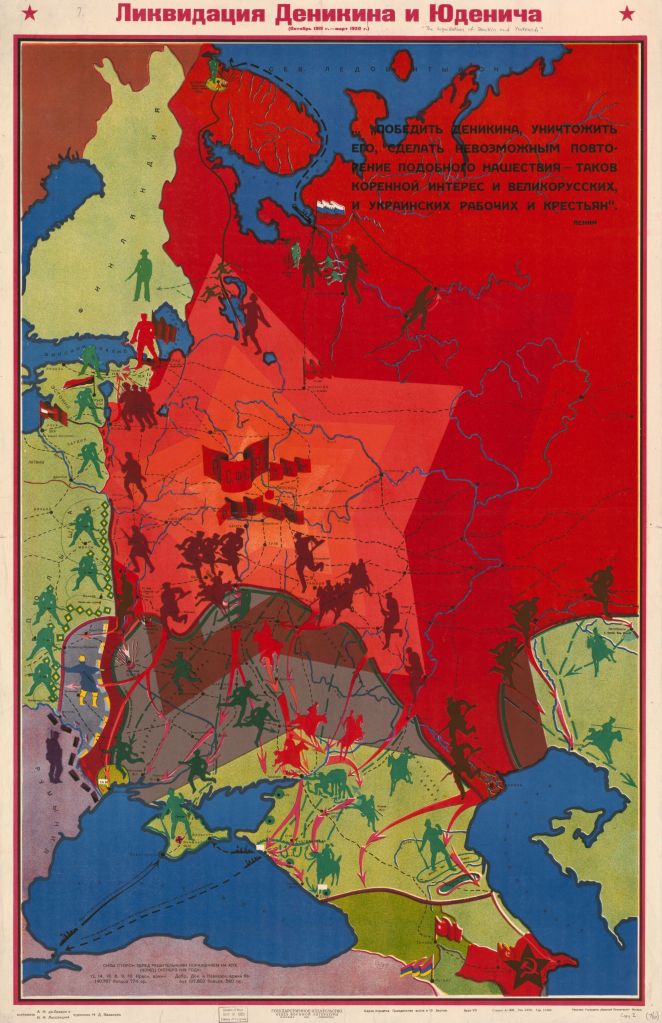
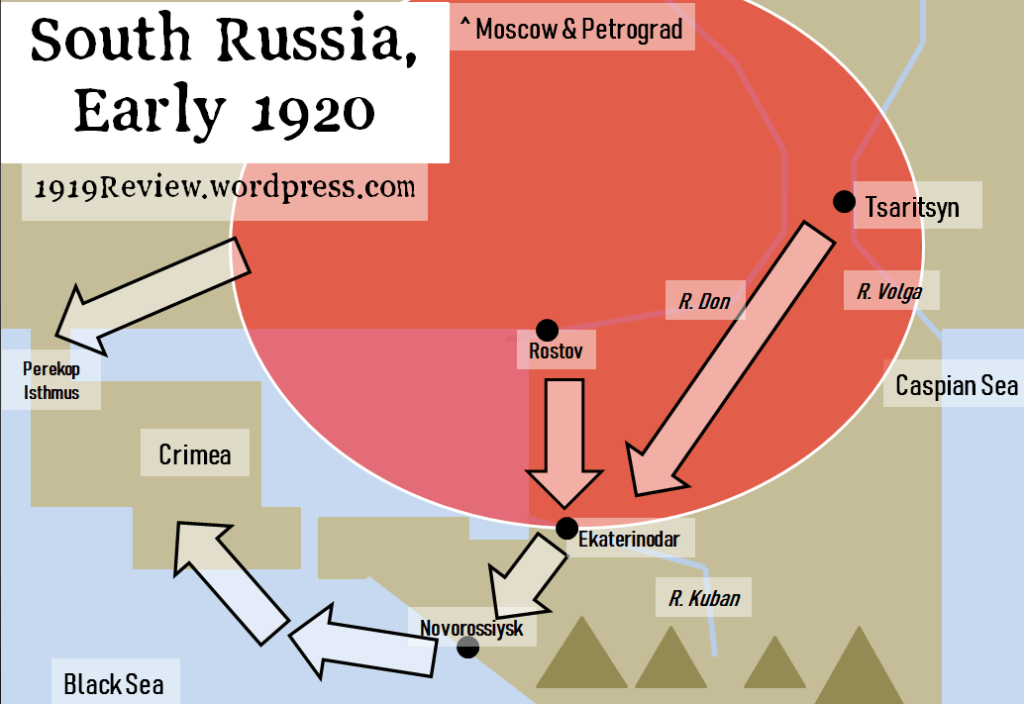
Russian Civil War pictorial map number 7, ‘Liquidation of Iudenich and Denikin.’ The White Guards (coloured green) are pursued southward. Trace the Red arrows across the Don River, over the Kuban steppe, and down the Black Sea coast. Note also in the map two things we’re not going to deal with in much detail here: the final victory in North Russia and the rise of Soviet power around Baku, Azerbaijan.
Rostov
Meanwhile the war was raging on, the Whites falling back, the Reds surging southward: in January Tsaritsyn (later Stalingrad, now Volgograd) saw its last battle of the Civil War when it fell to the Reds. But when the Whites reached their old base area of the Don and Kuban Countries, they rallied. The river Don, as if it was in sympathy, froze to let the Whites retreat across it, then thawed before the Reds could. Alongside this military recovery, the White civilian government, such as it was, promised reforms and tried to juice up some popular support. The Red Army hit the moat of the Don in disarray from its long advance, overstretched and agitated with internal disputes.
The Whites recaptured Rostov-on-Don on February 20th. But the Reds were by this time over the worst of their confusion, and it was the Whites’ turn to have some internal disputes. Denikin had made concessions to the Kuban Cossacks – not enough to stop them deserting, but enough to enrage the White officers. ‘What are we?’ they demanded. ‘Cannon fodder for the defence of the hated separatists?’
The First Red Cavalry Army (which by this time boasted 16,000 riders, 238 machine-guns, nineteen artillery pieces and eight armoured trains) crossed the Don and threatened the rear of Rostov; there was nothing for it but to abandon the town and fall back to Ekaterinodar (the city outside which a shell had killed the Whites’ chief inspirer Kornilov two years earlier) and then, after a short hopeless struggle, on to Novorossiysk.[1]
One of many grim chapters in Beevor’s recent book deals with the entry of the Reds into Ekaterinodar. He describes the summary murder of men falsely identified as officers, Kalmyks being massacred for no apparent reason, and dead White Guards being mounted on a locomotive as trophies. Beevor appears to be repeating contemporary rumours which his source’s author heard second-hand, which is consistent with some of my criticisms of the book. [2] But even allowing for exaggeration and rumour-mongering, such excesses probably did form a part of the picture of the Red Army’s advance in some areas.
1st Red Cavalry Army
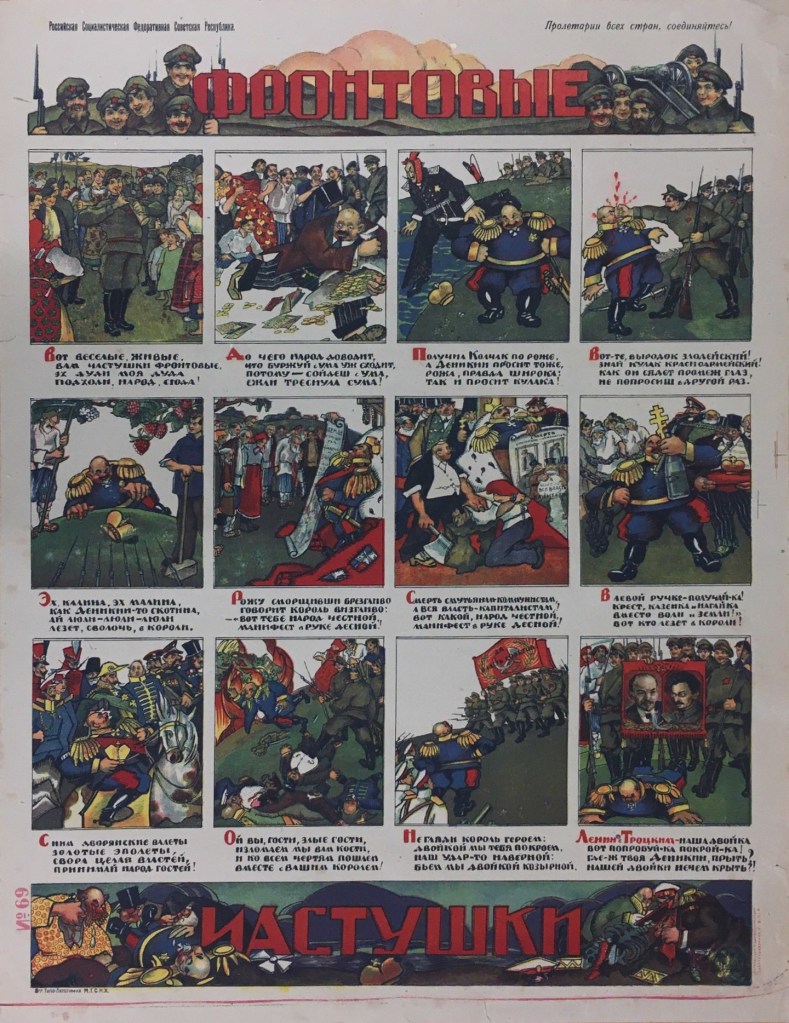
The cover image is a detail from this 1921 Soviet poster. Of the text, all I can tell you is that the heading means a frontline soldier. Thankfully the images are self-explanatory.
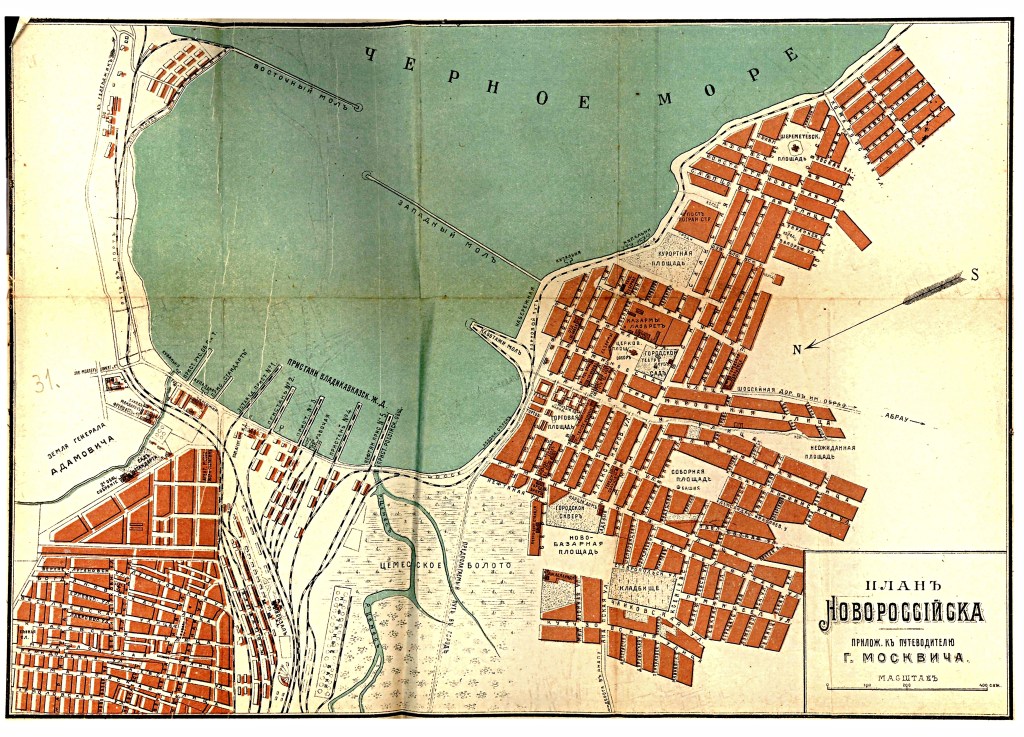
Novorossisk
The resumption of Red advance translated into rumours heard by Dune in the Novorossiysk infirmary: ‘The Whites had won victories with the aid of their cavalry, but ever since Trotsky had said, “Proletarians, to horse!” we too fielded a cavalry, and ours beat the Cossacks all hollow. The Red cavalry had captured all the English tanks.’
This was confirmed by what Dune could see with his own eyes; White Guard Russia was visibly shrinking and contracting around him. First, discipline grew lax, and he could get out into the city on errands. Once there he saw the streets fill up with a strange juxtaposition of affluence and squalor: cartloads of expensive household goods, and huge numbers of typhus-stricken refugees. White officers began taking entire battalions to join the Greens. Back at the infirmary, White Army supplies were stolen wholesale now instead of retail.
Moving away and up the chain of command from the humble soldier Dune, the British General Bridges was disgusted: ‘the whole affair was a degrading spectacle of unnecessary panic and disorder, and I urged the government by cable to dissociate themselves from the White Russians who had no prospects and little fight left in them.’ But Winston Churchill, Secretary of State for War and Air, overruled him. So the British remained and took responsibility for the evacuation of White officers and their wives and children. [3]
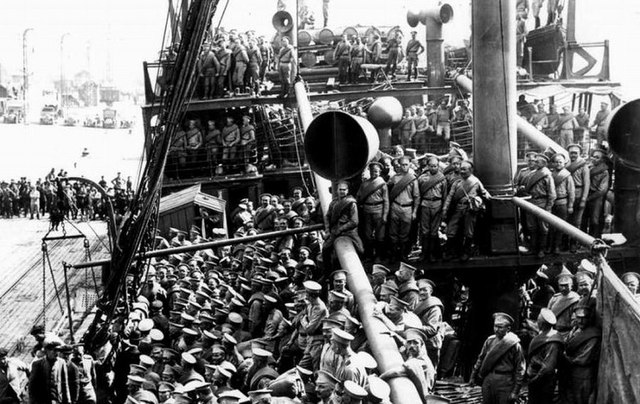
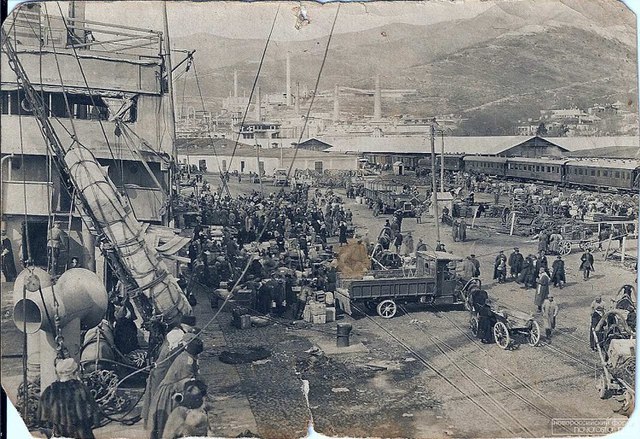
Suddenly the British project of pumping in great quantities of supplies and war materiel had to go into reverse: now the British were evacuating White officers and their families, and anyone else who could be crammed on board. At the quays, crowds pressed against the British Army cordon and the ships heaved with people. A tank drove slowly over a row of thirteen British aeroplanes, turning them to matchwood so that the Reds couldn’t use them. Then, of course, the tank itself was abandoned. Other engines of war littered the sea floor where they had been dumped. Tearful Cossacks shot their horses.
The other White naval evacuations were disasters, but Novorossiysk was the worst. [4] It was so bad, Denikin resolved to resign as soon as it was all over. The misery, destruction and desperation were extraordinary:
…the waterfront was black with people, begging to be allowed on board the ships… Conditions were appalling. The refugees were still starving and the sick and the dead lay where they had collapsed. Masses of them even tried to rush the evacuation office and British troops had to disperse them at bayonet point. Women were offering jewels, everything they possessed – even themselves – for the chance of a passage. But they hadn’t the ghost of a chance. The rule was only the White troops, their dependants and the families of men who had worked with the British were allowed on board. [5]
Above: the chaos at Novorossiysk.
The 2nd Royal Scots Fusiliers acted as a rear guard, supported by a naval bombardment (one of the ships firing was the Waldeck-Rousseau, which had mutinied the year before). On March 27th the Red Army arrived, lobbing shells after the fleeing ships. By then, 34,000 had been evacuated (A disproportionate number were Volunteers, which suggests the Don Cossacks got shafted).
The Reds found on the quays an indescribable landscape of dead horses and destroyed equipment – but also heaps of intact supplies, such as one million pairs of socks. General Bridges had not been permitted to abandon the Whites, but he had left food and clothing to try to alleviate the suffering of ordinary people in war-torn South Russia. The Reds captured 22,000 White Guards in the town, and 60,000 later surrendered further down the coast at Sochi.
Other Whites fled into the Kuban steppe, where they waged a guerrilla war. As for the Green armies, at the moment of victory they suffered a split between the pro-Communist elements and the various other forces who were in the mix, and soon dissolved. [6]
London
Meanwhile in London, time of death was called on the White cause. Field Marshal Henry Wilson wrote in his diary: ‘so ends in practical disaster another of Winston’s attempts. Antwerp, Dardannelles, Denikin. His judgement is always at fault.’
Several days later he wrote: ‘cabinet at 6pm. We decided, Curzon leading, finally to tell Denikin to wind up affairs and come to terms with the Soviet government. Great joy. Winston fortunately absent.’ [7]
It was neither the first nor the last time the British had decided to withdraw from the Russian Civil War. They were sick of being on the sidelines of the bloody mess, acting as referee and sponsor, and occasionally stepping onto the pitch to play midfield, only to be frustrated again and again by the unexpected strength of the opposition and the shocking failures of their own side. In spite of all this, British intervention continued while the Whites made another throw of the dice. The fact that some tens of thousands of White Guards had escaped in one piece, plus an accident of geography and miitary fortune, gave the Whites an opportunity.
During the chaotic White retreat across Ukraine, one White officer had fought his way through Makhno’s anarchists to reach Crimea. There he held the Perekop Isthmus, the narrow strip of land connecting Crimea to the mainland. This officer, who had entered Ukraine as one of Shkuro’s notorious ‘White Wolves,’ bore the evocative name Slashchev.
Because of Slashchev’s feat the Whites held onto Crimea, an area 27,000 square kilometres in size, or one-third the size of Ireland. The Reds had no fleet on the Black Sea and the Allies had, so Crimea was a natural fortress as well as a base area of manageable size and with a population of over a million. That’s where the British fleet obligingly left those 35,000 evacuated White Guards. We have the strange picture of masses of hardened veterans disembarking at seaside resort towns.
Crimea
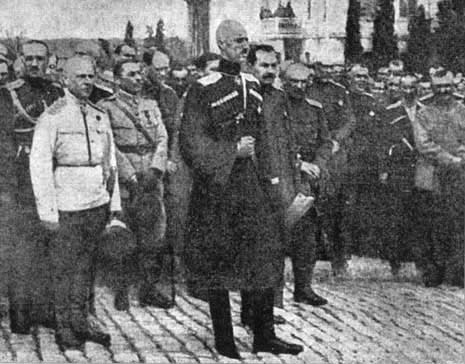
The first item on the agenda was leadership. At a Council of War in April, power passed from Denikin to his rival and critic, the ‘Black Baron’ Wrangel. The military chieftains objected on principle to electing Wrangel. To be clear, they did not object to Wrangel himself, only to the idea of electing a leader. So they insisted Denikin appoint him. After the galling experience of handing power to his rival, Denikin had nothing left to do but depart for Constantinople on a British destroyer, never to return. [8]
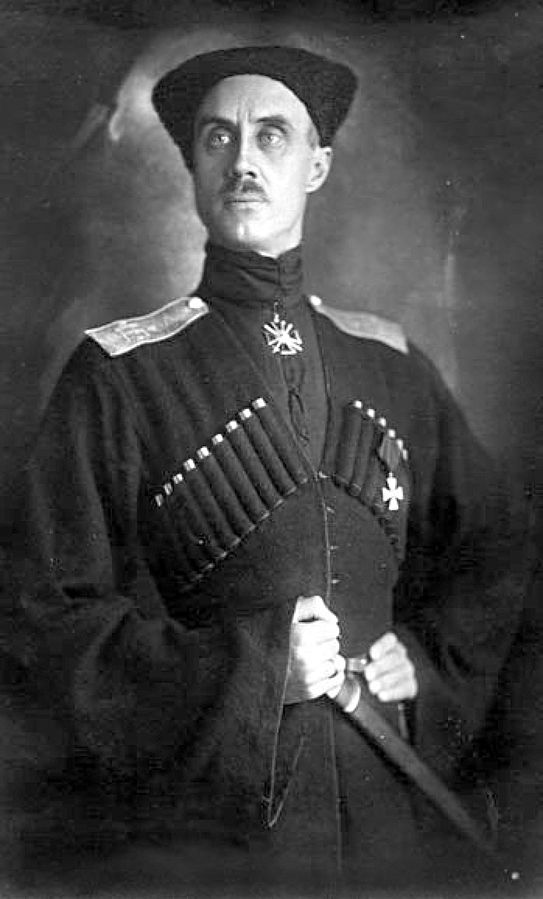
Above: photographs and a poster depicting Wrangel
Wrangel was not a graduate of Bykhov prison-monastery or a survivor of the Kuban Ice March, not at all one of the original Kornilov club. But with his height and striking features, he looked the part more than any other major White leader; Soviet cartoons and posters got great mileage out of him.
But there was still a line of continuity going all the way back to those origins as ‘the saga of the Volunteer Army continued in the Crimea.’ The elite ‘colourful units’ that were named after Markov, Alexeev, Kornilov and the others still existed as I Corps. [9] Like his predecessors, Wrangel called himself ‘Ruler’ and his army the ‘Russian Army.’
One of the themes that keeps popping up in this series is the role of the individual in history. Wrangel is a striking case study, because under him a new and distinct White Guard regime emerged in Crimea. Whereas Denikin’s regime was overstretched, ragged and undisciplined, Wrangel’s was every bit as lean and severe as he was.
In contrast to the previous White regimes, there was a functioning government and strict discipline. Reds who deserted were given a fair hearing. Looters were shot. Wrangel’s government would even pass a law redistributing landlords’ holdings to peasants – yes, the Whites were finally ready to cut their losses on that one, and the irony is that Wrangel, unlike Denikin, was actually of the land-owning nobility. His regime also made overtures to Tatars and Ukrainians, and cooperated with the Poles.
(L) Wrangel inspecting White pilots, and (R) his functioning government
Was this all down to Wrangel’s personality?
Perhaps not so much. Actually, the Baron had been a champion of the conservatives within the White movement against the more ‘liberal’ Denikin. Wrangel spoke of the need ‘to make leftist policies with rightist hands’ and pronounced a policy of ‘With the Devil, but for Russia and against the Bolsheviks.’ [10] Every living White Guard, one assumes, had learned extremely harsh lessons in 1919. Popular opinion and practical common sense would have favoured this new approach.
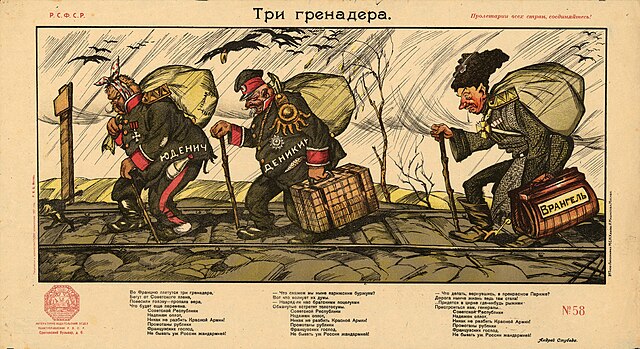
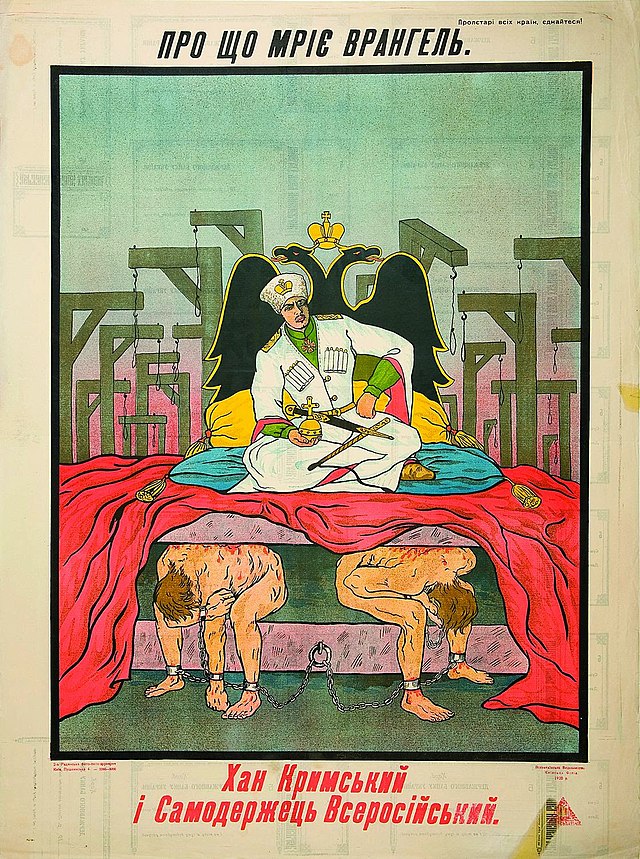
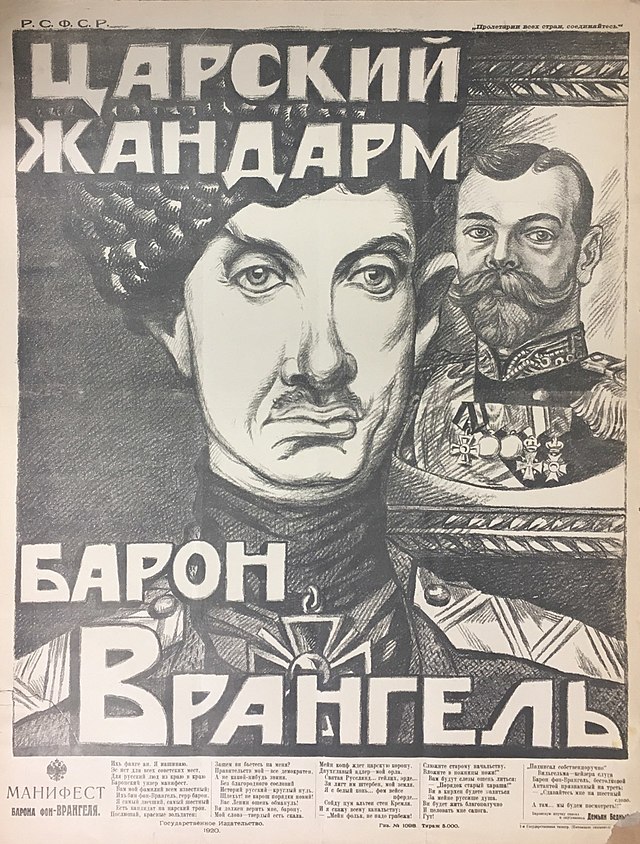
Above, images of Wrangel from the Soviet point of view. ‘Three grenadiers’ labelled Iudenich, Denikin and Wrangel; Wrangel as Khan of the Crimea; and ‘The Tsarist gendarme, Baron Wrangel’
What made this approach possible was the fact that an overwhelming mass of White Guards were now concentrated in a stable, small, self-contained base area. Just as one example of how Crimea insulated the Whites from the chaos that had messed things up before, the Cossacks could no longer do the old loot-and-desert routine. They didn’t have horses anymore, let alone horses that could swim across the Black Sea. The character of the new regime had more to do with the new base than with any other factor. But it is one of those interesting moments when so many things, right down to the physical appearance of the leader, produce the same impression: this was a White army, but leaner and smarter, confronting Moscow with a new type of challenge.
[1] Mawdsley, pp 302-309. Special thanks are due to Mawdsley, on whose book I relied heavily for this post. Dune, 180-198
[2] Beevor, pp 431-2
[3] Kinvig, p 311
[4] Smele,p 140
[5] Kinvig, p 309
[6] Smele, p 140. Dune, p 211. On the Greens, see the notes from Diane Koenker and SE Smith in Dune’s memoirs, p 187
[7] Kinvig, p 312
[8] Mawdsley, p 309
[9] Mawdsley, p 364
[10] Ibid, p 363
The new texture behind the ‘Revolution Under Siege’ text is from the Wikimedia Commons image ‘Rust and dirt’ by Roger McLassus. Not that anyone is eagle-eyed enough to notice, but it is important to credit people
This short post expands on ‘The Pogroms of 1919,‘ making a few points about the relevance to modern politics. Because, as Immortal Technique said, ‘the past refuses to rest in its shallow grave.’
Avenger Street, which bears the name of Shalom Schwartzbard, is less than 35 kilometres from the Gaza Strip, and a short car journey from Ofakim, site of a battle during the October 7th 2023 Hamas raid. It’s remarkable that two significant places in Schwartzbard’s story, Ukraine and Palestine, are sites of conflict at the time of writing. But it has been the Israeli military response, its mass killing of tens of thousands of civilians, its bloody violation of hospitals, schools, ambulances, border crossings and refugee camps, that most reminded me of the genocide of 1919. I thought of Schwartzbard and his fifteen murdered relatives when I read of Abdel Kareem Rayan, a young man in Jabalia refugee camp in Gaza who showed journalists a list of 15 family members who were killed in Israeli airstrikes, and Dana Abuqamar, a student activist in Manchester who says 15 of her relatives were killed when a missile hit their residential building. Unfortunately there are many more such examples.
In September 2023 the Canadian parliament gave two standing ovations for Yaroslav Hunka, a Ukrainian by birth described by the Canadian house speaker as a ‘war hero’ who fought against Russia during World War Two. The 98-year-old Hunka was indeed a veteran – of the Waffen-SS, a notorious military organisation which fought Hitler’s genocidal war. There was an apology and even a resignation, but any adult should have known who fought against ‘Russia’ in World War Two.
The incident in the Canadian parliament reflects a thorny problem for ideological supporters of the United States, NATO, Israel and their allies in Eastern Europe. Ideologues must compose a historical narrative which is acceptable to Jewish Israelis but also to people in Eastern Europe and the Baltic States who, for whatever reason, want to rehabilitate collaborators and pogromists as ‘national heroes.’
In discussions about the several thousand collaborators the Nazis managed to recruit in Ukraine, we see scant mention of the far greater number of Ukrainians who fought in the Red Army against the Nazis.
Also ignored are the pogroms of 1918-1919. There is at least some critical discussion about the prevalence of Nazi iconography in the Ukrainian military. Invocations of the Rada and Petliura in modern Ukraine come in for less discussion in the West because very few people know who they were.
The pogroms serve as a reminder that until recently western leaders did not give a damn about either Ukrainians or Jews. For example, in the Russian Civil War, they kept on funding and supporting pogromists who called Ukraine ‘Little Russia’ long after it became obvious they were a lost cause.
Modern Russia, too, has consigned the pogroms of 1919 to oblivion. Putin spoke to a crowd of thousands at the re-interment of General Denikin in a place of honour in Moscow in 2005.
In 1919 and in the 1940s, the Jews were an unarmed captive population. In 1919 armed gangs would come to town and reign supreme for days or longer. In the 1940s the German military machine was bent on mass extermination. In the Middle East today, the Palestinians are the ones who are captive and vulnerable to unrestrained violence, in this case of settler pogromists and the Israeli army, armed to the teeth by the US. The Palestinians are the ones subjected to dehumanising language and narratives, caricatured, confined, treated with contempt and paranoia.
If you ask me, the 21st-century pogromists are the settlers who have killed hundreds in the West Bank since October 7th. The anti-Semitic threat comes from the growing far right in Europe and North America – not from supporters of basic human rights of Palestinians. Another worrying conclusion you can draw from the points above is that NATO interests now cut against a sincere reckoning with the history of anti-Semitism in Eastern Europe, and provide an opening for attempts to rewrite history, to trivialise the Holocaust, to blame the victims.
The killing and abduction of hundreds of Israeli civilians on October 7th was both cruel and strategically irresponsible. But here again we run into the double standards that are deployed to justify pogroms and genocide. For my arguments in favour of the dignity and humanity of Palestinians to receive a fair hearing, I am expected to include a caveat and a condemnation. But the ‘right to self-defence’ of Israel is invoked by world leaders without any conditionality whatsoever. The humanity of Israelis is – rightly – taken as read. The authoritarian and genocidal character of the government they elected does not diminish their humanity. The thousand atrocities committed by their military does not make civilians fair game. If the humanity of Palestinians were taken as read in the same way, the war would end tomorrow. And I don’t just mean the current onslaught on Gaza, I mean the whole ethnic cleansing project going back to the Nakba.
Those who have read a bit of history, for example on the pogroms of 1919, who have gotten a sense of how people are dehumanised as part of the groundwork for horrific atrocities, should have seen clearly years ago what was being done to the Palestinians, how the whole world was being primed for the slaughter that is now taking place.












 The 1919 Review