17: Anarchy in the Ukraine

This episode tells how the warlord Grigoriev in Ukraine led a bloody revolt against the Soviet power. The episode will then describe his fatal showdown with the anarchist Nestor Makhno.

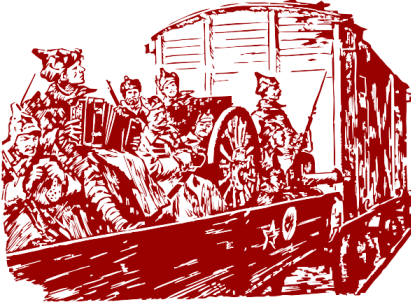
‘Anarchy’ means ‘without rulers,’ not ‘without order’ or ‘without laws.’ Still the word is often used to signify chaos. Here we can sidestep the controversy, because the word applies in both senses to Ukraine in 1919. The title of this post refers to the Anarchist army which operated in Ukraine at this time, ‘a singing army which moved in carts – a machine-gun and an accordion in each cart – under black banners.’[i] But it also refers to the state of chaos and violence which prevailed in many parts of the country and under flags of all colours – not just black. By May, ‘villages turned in on themselves’ for protection, ‘while armed bands roamed the countryside, led by warlords.’[ii]
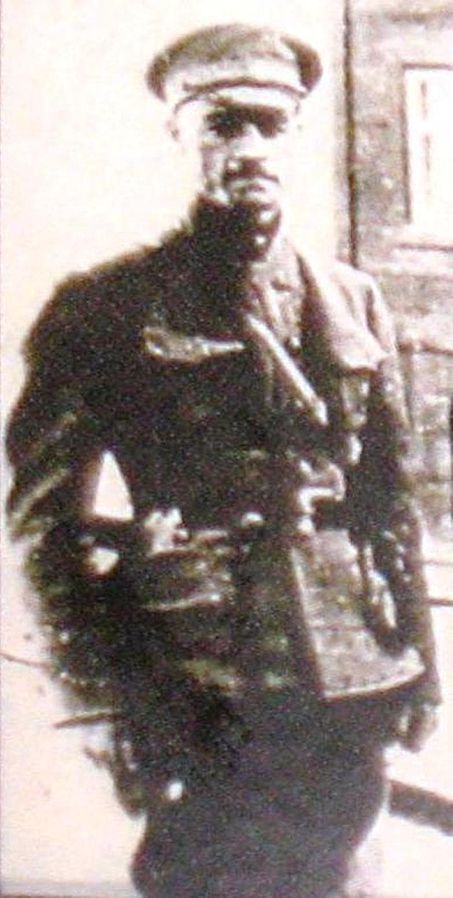
Nikolai Grigoriev, aka Nikifor Hrihoriiv, aka Nychypir Servetnyk. His identities were as unstable as his loyalties.

Grigoriev in Odesa

When last this series covered events in the great port city of Odesa, it was in a state of utter chaos with the evacuation of Allied interventionists. Reds were already marching in.

A Red commander reported to Moscow that the city had been taken ‘exclusively’ by the forces of the charismatic partisan leader Nikifor Grigoriev. These fighters had shown ‘revolutionary stamina’ and Grigoriev had led from the front: he had two horses shot from under him, and bullet holes in his uniform. But on the day before the fall of Odesa he was taking a well-earned break: he spent the day drinking from a bucket of wine and listening to the regimental band.[iii]

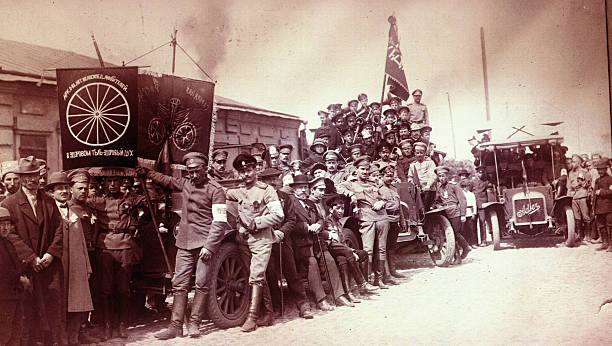
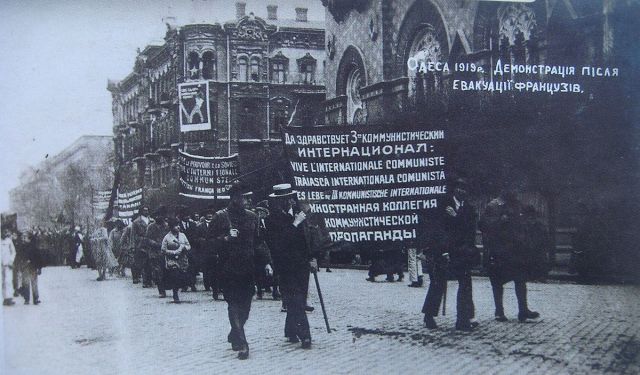
A Red demonstration in Odesa, April 1919

Odesa was a wealthy city, and in 1919 its warehouses were bursting with the goods and equipment which the Allies had left behind in the chaos of their evacuation. Grigoriev made himself a kingly giver of gifts in relation to all this loot – for example, 30,000 rifles were apparently sent to the villages of the Kherson region. There is also a story that he looted hundreds of kilograms of gold from the Odesa State Bank.[iv]

The local Communists – those who had fraternised with the French in the cafés – celebrated the liberation. But very soon the city’s revolutionary committee was addressing complaints to the warlord about his claiming of the loot.

‘… I occupied Odessa,’ he later told Makhno, ‘from where the Jewish Revolutionary Committee appeared. They came to my headquarters … They began to demand that [I obey them], that the lads stop beating the Jews. And you know, people on the campaign were torn, worn out, and there are a lot of Jewish speculators in the city […] I took the city, therefore, it is mine, and then the Revolutionary Committee crawled out of the underground and stood in my way, talking about submission. When I attacked, there wasn’t a single member of the Revolutionary Committee with me, but now, you see, they decided to be the boss.’

He was just boasting. But the eyes of the Soviet government were not blind to the problems Grigoriev might present. He had switched sides three times already. He gave lip-service to communism but anti-Semitic slogans were current among his supporters. Yet he had driven the Allied interventionists right out of Ukraine. The Soviet government awarded him the Order of the Red Banner for this triumph. 

After ten days in Odesa, local communists were already demanding that Grigoriev be arrested. A bloody clash appeared inevitable. But Grigoriev and his forces withdrew to the villages near Kropvynitsi (then known as Elizavetgrad). To give you a sense of the distance, today that’s a five-hour drive inland.

Grigoriev in Budapest? 

As summer approached, the Soviet laid plans to have Grigoriev carry the banner of the October Revolution to the very heart of Europe. The Hungarian Soviet Republic was isolated and under attack. Grigoriev’s force was, on paper, a short distance from Hungary: just charge right through Transnistria and Romania (Or through Poland and Slovakia), and boom, there you are. But the problems are so obvious that one is forced to wonder what the hell the Soviet leaders were thinking. Grigoriev was not exactly the ideal ambassador for communism, and once he’d seized Budapest he might well change sides again. He was a partisan leader, not a rounded-out military genius, and such an ambitious attack was likely beyond his capabilities. Maybe the Soviet government was desperate (We have to help the Hungarian comrades, no matter the cost or the risks!) or maybe they were cynical (this might keep Grigoriev out of trouble – and with any luck he won’t come back alive) or maybe some mixture of the two was at work. At the very least Grigoriev might divert Romanian forces and take the pressure off Soviet Hungary. 

Note Soviet Hungary, and the dark arrow linking west Ukraine to it.

For better or for worse, probably for better, it never happened. Grigoriev switched sides again. He had turned from Rada to Hetman and back again, before turning to the Reds. Now he struck out on his own, backed by tens of thousands of armed soldiers and by a large part of the Ukrainian farming classes. 

Grigoriev in Revolt

When is an ataman officially in revolt? When does he cross the line? He always has plausible deniability, because he is not fully in control of his forces. Many Communists, such as Antonov-Ovseenko, were in denial about his revolt at first.

By his own account, his revolt developed organically as a response to overbearing communists: ‘My troops could not stand it and began to beat the [Cheka] themselves and chase the commissars. All my statements to Rakovsky and Antonov ended only with the dispatch of commissars. [Eventually] I just kicked them out the door.’ 

From the communists’ perspective, Grigoriev had been operating as a law unto himself for too long. Soviet government officials were allowed no authority on his territory, and many communists were quietly murdered. One commissar ordered to go to strike a deal with Grigoriev refused, citing poor health. But it is obvious the commissar was in fear for his life, with good reason.

On May 1st a Grigoriev armoured train celebrated International Workers’ Day by firing explosive shells into Kropvynitsi. Over the next week, anti-Jewish and anti-communist pogroms swept through the local area. On May 7th a Red commander threatened to attack Grigoriev if the pogroms did not stop. On the same day several Chekists boarded Grigoriev’s armoured train and tried to arrest him. They were themselves captured and later shot.

On May 8th (one month after literally riding into Odesa on a white horse), Grigoriev published a manifesto titled the ‘First Universal.’ It was no longer possible to doubt his intentions. 

It was a forceful appeal to the Ukrainian farmer. It began by recounting the horrors of the Great War and German occupation before moving on to those of the Civil War. It blames the ‘Muscovites’ and those ‘from the land where Christ was crucified.’

‘Those who promise you a bright future exploit you! They fight you with weapons in their hands, take your bread, requisition your cattle and assure you that all this is for the benefit of the people. Hard-working, holy man of God! Look at your calloused hands, look: all around – untruth, lies and insults […] You are the Feeder of the World, but you are a slave.’

He called for soviets but without communists, along with representative bodies where the majority of seats would be reserved for Ukrainians. He demanded that the Ukrainian Soviet government ‘leave us’ and summoned each village to send fighters to Kyiv and to Kharkiv – with weapons, and if there were no weapons to hand, with pitchforks.

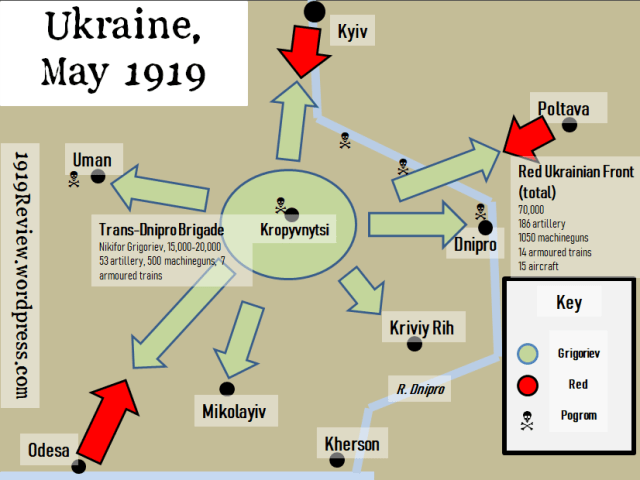
By May 10th there was no longer any pretense or hesitation. Grigoriev’s army, which was between 16,000 and 20,000-strong, had risen up against Soviet Ukraine, with armed columns speeding out in all directions from Kropyvnitsi.

What did this revolt look like? A Grigorievite column would ride into town by horse or by train, or a Red garrison would declare for Grigoriev; usually a combination of the two – for example at Kremenchug, Chigirin, Zolotonosha and Cherkasy. In Pavlograd the Red Army soldiers revolted of their own accord. In Dnipro anarchists and sailors went over to Grigoriev and handed him the city. In all, about 8,000 Red Army soldiers went over to Grigoriev.

Soviet officials would be shot. Jews would be robbed, violated, killed. Prisons would be opened. In Kropyvnitsi, epicentre of the revolt, we see all of the above on May 15th: a pogrom which killed 3-4,000 Jews and several hundred Russians. Some of the murderers were those who had deserted from the Red Army. In other towns and villages, we see hundreds killed here, thousands killed there. According to Savchenko: ‘The commanders of the Grigorievites in Cherkassy urged each insurgent to kill at least 15 Jews. An eyewitness writes: “There is no street in Cherkassy where families have not been killed. Russians and Jews were dying… indiscriminately.”’

Dnipro was briefly recaptured by the Reds, and they executed one out of every ten ten of the captured Grigorievites. But in short order the other nine out of ten revolted in prison, and again took over the city.

What was the scope of the revolt? The Dnipro River runs through the heart of Ukraine, and within two weeks the Grigorievites had taken over the middle third of that river. Roughly speaking, their power stretched 100-200km wide to the west side of the river and 50-100km to the east, in places much further. At their furthest advance, they came within 80km of Kyiv and 20 of Poltava.

There was a considerable crossover between Grigoriev’s base and Makhno’s, and as we have seen some anarchists joined the revolt. But Makhno resisted any pressure to join Grigoriev, and stayed with the Red Army, though he denounced the latter as ‘political charlatans’ and condemned the ‘feud for power’ between the two.

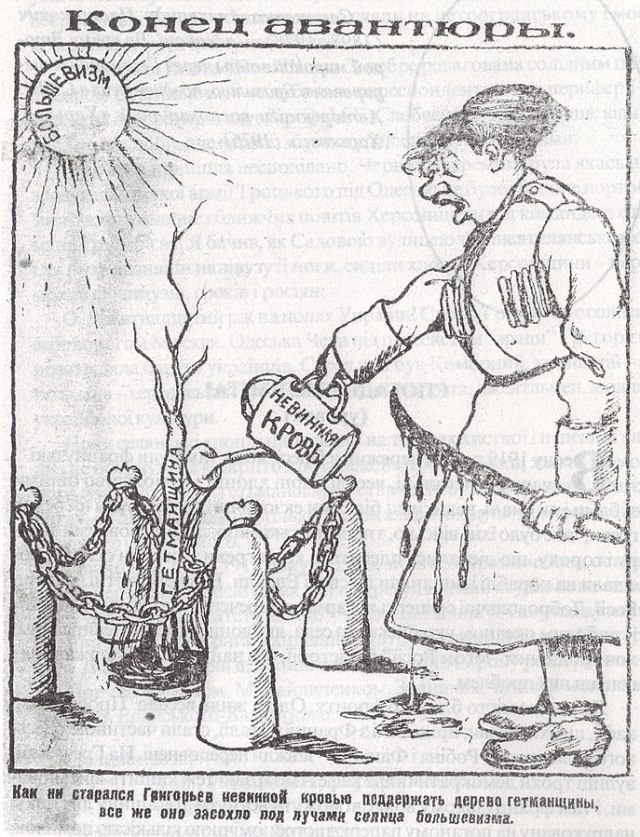
Titled ‘The End of the Adventure,’ this cartoon shows Grigoriev watering ‘Hetmanism’ (Warlordism) with ‘Innocent Blood’

The Ukrainian Soviet Government

The Ukrainian Soviet government under Yuri Pyatakov, and even its more moderate successor under Christian Rakovsky, had in many ways sown the seeds of the Grigoriev revolt. There were trigger-happy Chekists gunning down innocent people, Red Army units looting villages, and there was the same grain requisitioning that had angered the Russian peasants. Pushing Ukraine over the edge were the same ultra-left policies on the land and the national question which had done so much damage in Latvia. The ‘First Universal’ complained about land nationalisation directly, with a complaint about the farmers being forced into a ‘commune.’

In an aside, it is customary at this point to lob a casual accusation that the Communists refused to cooperate with other parties, specifically the Borotbisti, who were the Ukrainian Left SRs. But Grigoriev himself was a Borotbist. His membership in the party was symptomatic of the unstable streak that was part of the Left SR DNA. It’s hardly fair to criticise the Communists for cooperating with a Borotbist and in the same breath to criticise them for not cooperating with the Borotbisti.[v]

It is tempting to present Grigoriev as a monster and to invite ridicule of his changing loyalties. Yes, as Golynkov says, he was politically illiterate and unprincipled.[vi] But a more nuanced interpretation comes from Timkov: that Grigoriev was a ‘hostage’ to his large and varied support base. ‘[I]n order to preserve his power, the chieftain had to wade into the chaos of the opinions and wishes of the peasant masses. You can say that he became their hostage.’[vii] He was, says Smele, ‘a complex and possibly unbalanced character’ and an ‘outrageous freebooter,’ but on the other hand he was ‘genuinely popular.’[viii]

His vacillations are more understandable as the vacillations of a large mass of people, not of one individual. And the wild character of these twists and turns – the turn from Rada to Hetman and back again, from Rada to Reds, from Reds to vicious pogroms – can be better understood as the throes of a mass of people in severe pain.

And we can’t blame all this pain on the mistakes of Soviet Ukraine. The Allies, the Whites, the Germans, the Rada and the Poles had all played their part as well. Further, regardless of specific mistakes or crimes by this or that force, the Grigoriev revolt was an outbreak of rage against the intolerable burdens which the Civil War had placed on rural communities in Ukraine. Partisan armies would have revolted against whoever was in charge, and later did revolt en masse against the Whites.

The Grigoriev revolt was a severe trial for the Ukrainian Red Army. As we have seen, this army was in a shambolic state. But a force of about 20,000 Ukrainians and 10,000 Russians was quickly assembled. Officials, communist youth members and members of the Jewish Socialist Bund all volunteered.

The revolt had spread like flames on petrol, but within a few weeks it had burned itself out. On May 14th large Red forces set out from Odesa, Kyiv and Poltava. Grigoriev’s all-out advance in all directions, meanwhile, was faltering. It seemed early on that his columns were advancing and conquering at lightning speed. In fact they were dispersing in all directions and disintegrating in the vast spaces of Ukraine. One by one the Red Army re-conquered the cities Grigoriev had taken, and in a series of battles in late May he lost 8,000 killed and wounded.

Grigoriev’s army disintegrated. The 3,000 who remained loyal switched to guerrilla warfare west of the Dnipro. While the Reds could declare complete victory, other local warlords had risen up in other parts of Ukraine, and Grigoriev could still raid towns, hold up trains, destroy railways.

A poster warning peasants not to shelter partisans in their villages

The Whites Attack

Meanwhile the Whites had been well-positioned in the Donbass region, and in late May they had seized their moment. The White general Mai-Maevsky himself had warned his men not to underestimate Makhno’s Revolutionary Insurgent Army of Ukraine, the army on carts under the black flag of anarchism. Their partisan tactics had run rings around the Germans and the Whites. But in late May Mai-Maevsky’s forces struck deep into Ukraine. The Whites simply cut through the Anarchists. The Black Army fled, like Grigoriev, to the western fringes of Ukraine. They had been reduced to 4,000 fighters.

Arshinov, an anarchist writing in 1923, presents this move as a stubborn fighting retreat.[ix] He claims that the Reds, by contrast, gave up Ukraine to the Whites without any fight-back at all. The first claim is probably an exaggeration, and the second is completely untrue. Trotsky’s armoured train rolled into the Mikolayiv-Kherson region (Trotsky’s own home turf where his dad still had a farm) and there tried to make a stand; Kharkiv was turned into a fortress; Iona Yakir led several divisions on one of those ‘Long Marches’ which so characterized the Civil War – a 300-mile fighting retreat which succeeded in preserving large forces from destruction.

The failure of Makhno’s Revolutionary Insurgent Army of Ukraine requires explanation. The Black Army was a partisan army, its military doctrine an extension of its political philosophy. There was no contradiction between Mai-Maevsky’s appreciation of its strengths and the ease with which the same general scattered it. Its strength lay in raids and mobility; it was utterly incapable of holding a line against a determined advance. At the very least this defeat represented a political and military failure for the Anarchists. For Moscow, it was nothing less than treachery, and Makhno was outlawed.

Warlords in Exile

West Ukraine was getting crowded with the remnants of defeated armies. The Anarchists were pursued there by the General Shkuro, a cunning and merciless Kuban Cossack whose personal bodyguard were known as the ‘Wolf Hundred.’

To survive the onslaught of the White Wolves, the Anarchists made a tactical alliance with the Rada forces of Semyon Petlyura who, like themselves and Grigoriev, had ended up west of the Dnipro. The alliance was short-lived. Arshinov says the Ukrainian Nationalists soon betrayed them, a development which all parties had anticipated.

Next Grigoriev came knocking on Makhno’s door. Though Makhno had previously condemned Grigoriev and his pogroms, he agreed to cooperate pending an investigation. They fought side-by-side for three weeks against the Reds.

Grigoriev, Makhno and other Ukrainian partisans – reportedly 20,000 in all[x] – gathered for a great congress on July 27th in a village near Oleksandriya. The supposed aim of this peasant congress was to unite an anti-Bolshevik army.

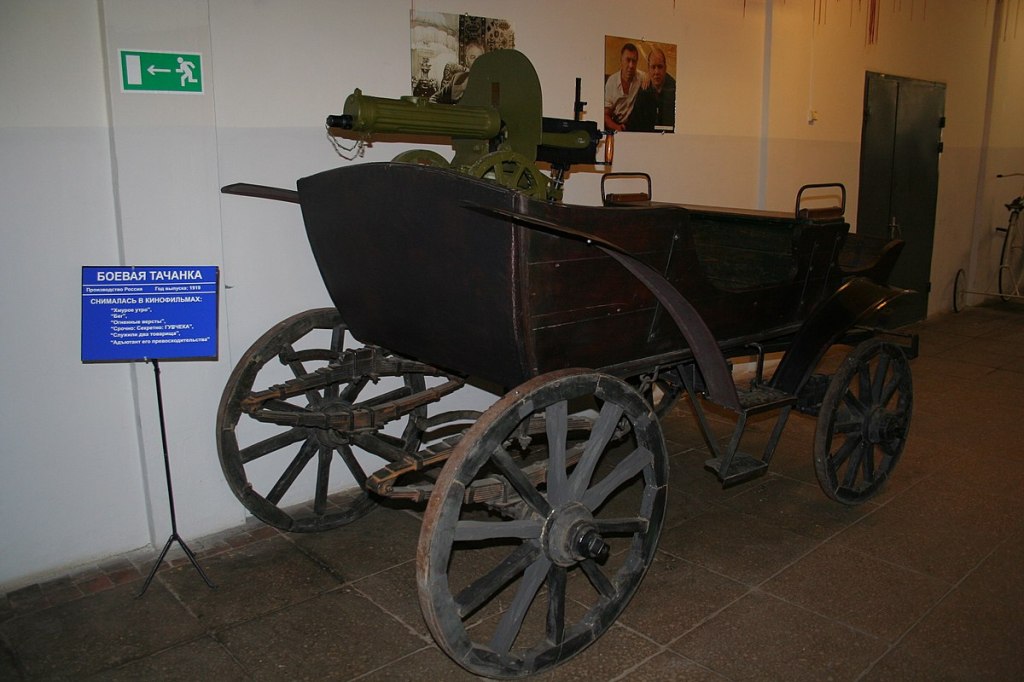
A tachanka (machinegun cart) in a Moscow museum. Today’s cover image shows a Soviet-era monument in the shape of a tachanka

There are different versions of what happened next, which you can follow up and tease out in the sources. Here is my composite sketch:

The Grigoriev forces were camped outside the village, but the village itself was occupied by Makhno’s forces, the lanes dominated by his tachankas, machine-gun carts.

At the congress, the Makhnovist Chubenko stood up at the podium and denounced Grigoriev as a murderer of Jews and a hireling of the Whites. Grigoriev denied the charges and reached for one of his Mauser semi-automatic pistols. But he realized he was surrounded by armed anarchists. He placed the Mauser in the back of his boot and fled from the scene, intending to make an appeal to the village council. But he found Makhno and his lieutenants waiting for him at the house ofthe village council. Chubenko arrived and a heated argument began.  

Some days before, the anarchists had captured some White officers who had letters addressed to Grigoriev. It was obvious from the letters that the ataman was planning to join with Denikin. Remember I mentioned Iona Yakir and his fighting retreat across Ukraine? It appears Shkuro and Grigoriev were planning together to catch and destroy the retreating Reds. The anarchists shot the captured White officers and kept this intel to themselves, for the time being. Now, at the congress of July 27th, they revealed it before 20,000 partisans.

Chubenko told the Soviet security forces later:

‘Grigoryev began to deny it, and I answered him: “And who and to whom did the officers whom Makhno shot come?”

‘As soon as I said this, Grigoriev grabbed the revolver, but I, being ready, shot point-blank at him.’

Grigoriev called to Makhno by his nickname: “Oh, father, father!”

‘Makhno shouted: “Beat the ataman!”

‘Grigoriev ran out of the room, and I followed him and shot him in the back all the time. He jumped out into the yard and fell. That’s when I finished him off.’

By other accounts, such chaos ensued when Grigoriev fled, with people running in all directions, that it was impossible to see who fired the fatal shot.

Makhno and his men shot down Grigoriev’s bodyguard, then went around the village to kill the ataman’s head honchos.

‘That was the sort of treatment I always reserved,’ Makhno later wrote, ‘for those who had carried out pogroms or were in the throes of preparing them.’

But why did the Anarchists ever collaborate with these pogromists in the first place? Arshinov explains that many of the mass following Grigoriev were genuine revolutionaries, who must be won over. The July 27th congress was in fact an elaborate trap for Grigoriev. It is even rumoured that someone had secretly emptied the bullets out of the ataman’s Mauser.

The Anarchists got what they wanted: the leadership of Grigoriev’s band was wiped out, but the rank-and-file joined the Black Army.

Another rumour has it that the gold reserves of the Odesa State Bank had been in Grigoriev’s train, and that Makhno’s men immediately rode out to seize it, then buried the gold a month later. The place where they are supposed to have buried the gold is near Kherson, not far from the frontline in the current war at the time of writing. If there is any gold around there, it’s under water as well as earth. Since the 1950s the area has been flooded by the Khakovsky reservoir. Maybe someone reading this will go on a mission to the heart of a warzone to look for Makhno’s Gold.

The Fall of Soviet Ukraine

That summer, Soviet Ukraine collapsed. In August, two weeks after Trotsky recorded that half of Red Army soldiers in Ukraine had no boots or underwear, Kyiv fell to the Whites.[xi] A number of factors which we have dealt with in the last few episodescame together to produce this collapse. The Don Cossack revolt in neighbouring South Russia, the pressure from Kolchak’s Spring Offensive, the Grigoriev revolt and the flight of the Anarchists all weakened the Red southern and Ukraine fronts. This set the stage for the defining campaign of the whole Civil War: Denikin’s march on Moscow.

Go to Revolution Under Siege Archive

Go to Home Page/ Archive

Sources


[i] Serge, Conquered City, p 99

[ii] SA Smith, Russia in Revolution, p 186

[iii] Savchenko, ‘Ataman of Pogroms Grigoriev’, http://militera.lib.ru/bio/savchenko/04.html/index.html. Most of my information comes from this long and remarkable essay. That, unless otherwise stated, is generally the source for whatever detail or quote you may want to follow up.

[iv] From a source quoted on the blog of Alexandria Cossacks: https://kozactvo-jimdofree-com.translate.goog/%D1%83%D0%B2%D1%96%D1%87%D0%BD%D0%B8%D0%BC%D0%BE-%D0%BF%D0%B0%D0%BC-%D1%8F%D1%82%D1%8C-%D0%BE%D1%82%D0%B0%D0%BC%D0%B0%D0%BD%D0%B0/?_x_tr_sl=auto&_x_tr_tl=en&_x_tr_hl=en&_x_tr_pto=wapp

[v] On the Borotbisti more generally, my sources offer a sliding scale of sweeping statements. Supposedly the Communists merged with the Borotbisti, but also they banned them; they also, it seems, cooperated with them, all the while completely refusing to cooperate with them. I can only throw my hands up. Of course historians are supposed to summarise, employing their own interpretations. But in this case the same set of data produces completely contradictory interpretations. See EH Carr and SA Smith.

[vi] David Golynkov, quoted in https://kozactvo-jimdofree-com.translate.goog/%D1%83%D0%B2%D1%96%D1%87%D0%BD%D0%B8%D0%BC%D0%BE-%D0%BF%D0%B0%D0%BC-%D1%8F%D1%82%D1%8C-%D0%BE%D1%82%D0%B0%D0%BC%D0%B0%D0%BD%D0%B0/?_x_tr_sl=auto&_x_tr_tl=en&_x_tr_hl=en&_x_tr_pto=wapp

[vii] Oleg Timkov, ‘Ataman Grigoriev: Truth and Fiction.’ https://kozactvo-jimdofree-com.translate.goog/%D1%83%D0%B2%D1%96%D1%87%D0%BD%D0%B8%D0%BC%D0%BE-%D0%BF%D0%B0%D0%BC-%D1%8F%D1%82%D1%8C-%D0%BE%D1%82%D0%B0%D0%BC%D0%B0%D0%BD%D0%B0/?_x_tr_sl=auto&_x_tr_tl=en&_x_tr_hl=en&_x_tr_pto=wapp

[viii] Smele, 98, 102

[ix] Arshinov, https://libcom.org/library/chapter-07-long-retreat-makhnovists-their-victory-execution-grigorev-battle-peregonovka-

[x] Arshinov

[xi] Deutscher, p 364

Race in Middle Earth

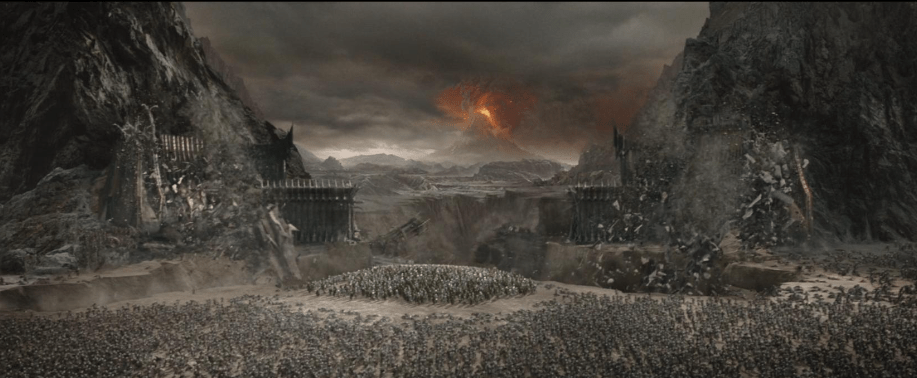
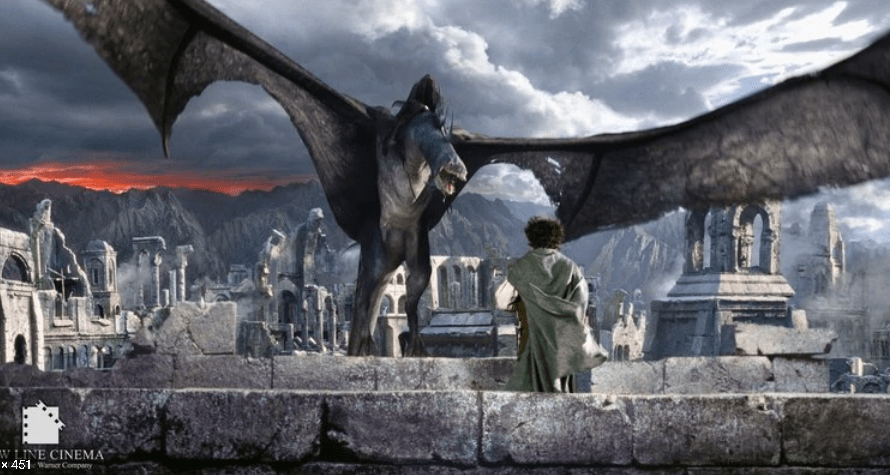
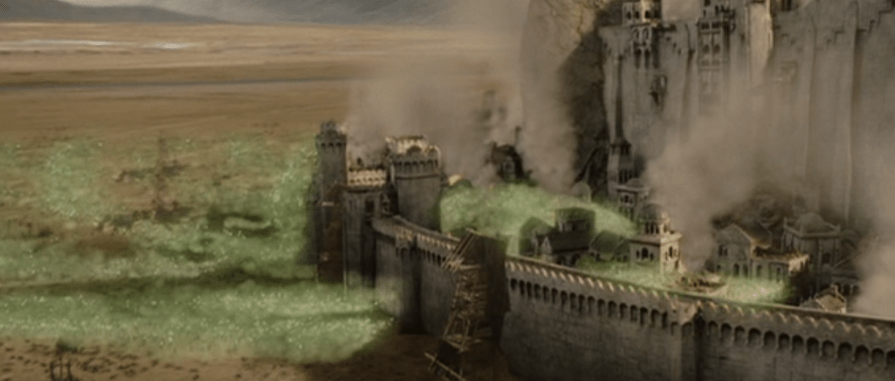
This bit wasn’t in the books.

Neither was this.

Or this, or this, or this.

Or Legolas being a ninja, or jokes about ‘dwarf-tossing.’

In the books, there’s an incident where an evil oak tree eats several hobbits. They left that bit out. They cut Tom Bombadil, Goldberry, the Old Forest and the Barrow-Wights. Twenty years pass between the birthday and the big quest. Frodo is 50. They compressed all that just a little.

They cut the hobbits singing in the bath. In fact they cut nearly all the songs, and most of the twee hobbit banter.

They dramatically simplified the big battles, and dramatically expanded the smaller-scale fights. They added little side-adventures and contrived arguments.

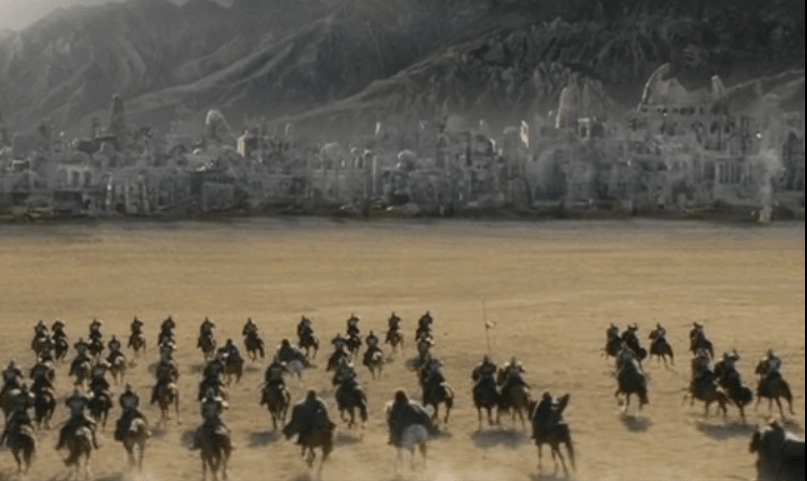
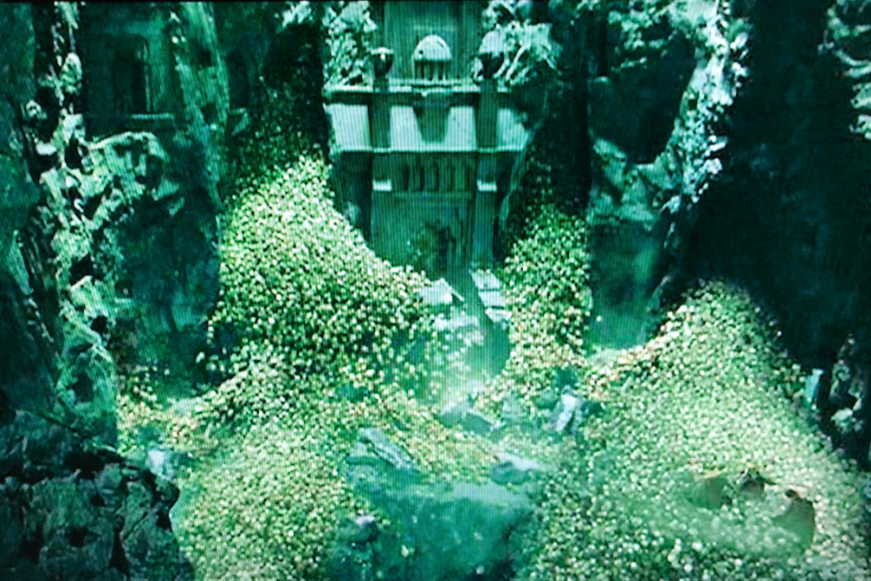
They turned ‘the fellowship ran down a flight of stairs’ into this.

And nobody really minded. It was mostly great.

Now,

Take a deep breath.

Because in 2022, in the TV show Rings of Power,

They gave speaking parts to 3 or 4 black actors,

…and suddenly a lot of people on the internet were very worried about ‘staying true to Tolkien’s vision.’

Funny how that was the deal-breaker!

Not this,

or this,

or this,

or this.

A screen adaptation that was ‘true to the spirit of Tolkien’ would have a lot more sing-songs in the bath, chipper hiking dialogue and obscure melancholy poems. The camera would linger for hours on trees and shrubs.

There’s every reason to have a diverse cast in Middle Earth. Tolkien described characters as ‘dark’ or ‘ swarthy’ in almost every chapter (good guys are usually dark, bad guys are swarthy. And yes, they’re all guys).

And if, just for the sake of argument, he did write, ‘by the way, categorically, none of these people were black’, why should we care 70 years later? Why would you care about skin pigment, if you don’t care about the scouring of the shire, the Dúnadain, Elladan and Elrohir, Prince Imrahil, Ioreth, Erkenbrand, Ghan-Buri-Ghan, the Dunlendings..?

By the way, Tolkien was sometimes racially insensitive in his writing. There are a few features and examples you can point to. There is a preoccupation with heredity, and there is a vile phrase in Book V Chapter VI. Yes: I’m sure you’re shocked to learn that an aging English Catholic professor who was born in South Africa and wrote in the 1930s to the 1950s was sometimes racially insensitive. Though at times he was surprisingly OK.

(Those Peter Jackson movies are actually dodgier on race for their time than Tolkien was for his time).

But that is not really a ‘gotcha’ for either side in these online debates.

Because when you adapt something, you make a choice about what to focus on. With Tolkien, there are themes like compassion, redemption, comradeship, self-sacrifice in struggle, and humble people rising up to change the world; and features like invented languages and histories, melancholy hints of a deep past, tense chases and battles, fantastical creatures and places.

Then there’s the ring, which poses the question of whether you would really have the integrity to destroy some great source of evil.

The movies nailed a few of those things, and that is why nobody really minded about the skull avalanche.

You could focus on some of those things, or you could make a fetish of skin colour, as if the Lord of the Rings was just a more upmarket version of 300. Then you would be putting a minor and unattractive feature of Tolkien’s writing up on a pedestal. You shouldn’t worship Tolkien, but if you insist on it, don’t be worshipping his backside.

And don’t be a racist, but if you insist on it, you’re not fooling anyone by pretending it’s about pious respect for a mid-century Oxford academic. If he could see us, or any of the screen adaptations, he’d tell us all where to get off.

Go to Home Page/ Archive

How Dune gets away with it

When it was briefly mentioned on The Mindy Project, it was described as (something like) ‘That book that every guy loves for some reason.’ I read Dune at age 15. The years passed and I forgot some of the details of the story, but it held on in some remote sietch in the back of my mind, from which echoed phrases like Gom Jabbar, Muad’Dib, Kwisatz Haderach; mantras like ‘Fear is the mind-killer’ and ‘Who controls the spice controls the universe.’ The recent film captured some of that hypnotic power, and gave me an urge to visit that strange place again.

Re-reading it was a trip. Here are some things that struck me. In each case I was left wondering, ‘How does the novel get away with that?’

There is no scene of space travel in Dune. A chapter on planet Caladan ends; the next chapter begins with the characters literally unpacking their bags on planet Arrakis. The author Frank Herbert tells us that the Guild of Navigators have a monopoly on space travel, but he is not interested in exploring the technical details. He is more interested in the Guild as a political force. Therefore, unlike both of the movie versions, the space travel happens off-screen. It’s a bold move but it works. It brings focus to the story.

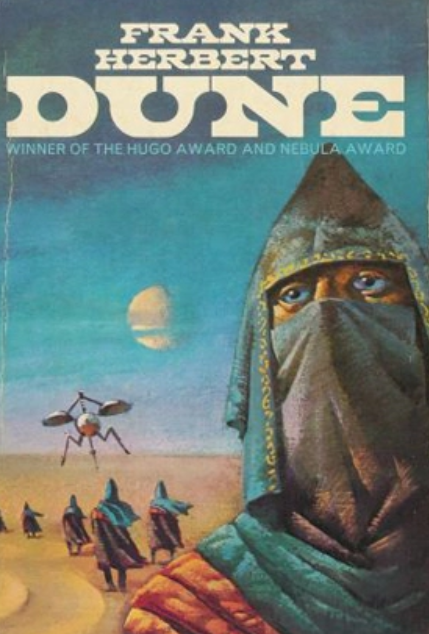
Below, a spice harvester. Above, one of many attempts to portray an ornithopter. From fontsinuse.com, as is the cover image.

Dune’s rich and strange world

In the early pages we are immersed in a kind of Renaissance space feudalism. It’s all nobles having conversations in palaces; it really shouldn’t be so interesting. I don’t think space capitalism, let alone space feudalism, is plausible. There are books I’ve abandoned because there were too many nobles, too many palaces. But somehow Dune gets away with it. It confronts us with a world that runs on its own rules, and doesn’t care what we think of it. Its people are medieval in outlook, and they don’t make any effort to relate to us on our terms. Not only do these people all do drugs, drugs are at the very the centre of their society. They have slaves, they hold entire planets as fiefs and some of them have psychic powers.

In short, Herbert doesn’t try to meet us half-way. We must either dismount from the great sandworm that is this book, and watch it slither away into the distance wondering to what fascinating places it might be going, or else cling to it stubbornly in spite of its efforts to shake us off.

By the way, I was converted to the idea of space feudalism being plausible. Humanity expanded across the stars, but suffered some kind of social and cultural catastrophe as a result. Their machines advanced to the point of being dangerous, so they waged war on the machines in the Butlerian Jihad. Feudalism didn’t bring humanity to the stars; humanity, having reached the stars through some advanced social system, reverted to feudalism, a feudalism modified with the remnants of the technology built up in ancient times.

Foreshadowing

But I wouldn’t have read on for long enough to care about the Butlerian Jihad unless the foreshadowing was laid on thick. The switches between different characters and their points of view, the dense undergrowth of exposition – these are not fashionable in sci-fi/ fantasy writing today. But  anyone who notices these unfashionable features and concludes that they are dealing with a clumsily-written book is mistaken.

When we ‘observe the plans within plans within plans’ we begin to wonder how these plans (within plans within plans) will work out. The story does not go from A to Z, from safety to danger. It goes from Y to Z, from less extreme danger to more extreme danger. We know the Harkonnens are going to attack. The Atreides know it. If they didn’t, the book and its sympathetic characters would be very irritating. We know Yueh is a traitor; if we didn’t, the revelation would be a pretty limp and predictable twist. We are not waiting to see if this Jenga tower will come down. We are waiting to see how.

While we are waiting for the Harkonnens to strike, we get sucked into the Duke’s administrative and political problems in a way that lulls and distracts us.

The writing and worldbuilding are open to criticism in places. I didn’t like how squeaky-clean and wholesome the Atreides were. ‘Good nobles’ vs ‘ bad nobles’ – come on. They’re an unelected ruling class who think they’re better than us. They’re all degrees of bad.

There’s a whole double-bluff intrigue where the Duke is pretending to be suspicious of Jessica. This is a tedious sub-plot, totally far-fetched. It’s just conflict for the sake of conflict. The book would be better without it. The mentat Thufeir Hawat is closely connected with this plot, but all in all I don’t see what he brings to the table. I think the book would pack a heavier punch if this sub-plot was gone and this character stripped back 90% or so.

Phallic sandworms

Paul is 15 but completely devoid of horniness or sexual neuroses; in the banquet scene, an attempt to seduce him falls flat. This is no doubt because of his Bene Gesserit training. But the repressed sexuality is central to the story. It’s more obvious to my grown-up mind that the sandworms are basically big dicks. And to paraphrase the book, who controls the big dicks controls the big dick energy. After Paul learns to harness and steer the big dicks, the climax of the story soon follows. Sorry for saying climax.

How does Frank Herbert get away with this insane sexual imagery? It’s even more obvious than King Solomon’s Mines. But it works because the sandworms work on their own terms. Arrakis without them wouldn’t be the same. Herbert doesn’t give a damn about space travel, but he cares about ecology. He reveals how this ecosystem works, and it is not a lecture we endure but a story mystery that is very satisfying to engage with and to solve.

Dune’s rich and strange hero

Speaking of Paul, even as a young reader I never quite liked him, and I never thought he was a good person. I rooted for him, and was invested in him. But I didn’t like him. He wrestles with his ‘terrible purpose’ and his visions of jihad for most of the story. As we read on, it becomes clear that is the story about the rise of a vast and terrible historical figure. It’s visible from the start, but the shock of the Harkonnen coup shakes something loose in him. As readers we come to respect the Fremen, but Paul is deceiving and manipulating them. Near the end (page 504) Gurney reproaches him when he reveals that he doesn’t really care about those killed in the final battle. He doesn’t care much about his murdered son either. And around the same time he finally embraces his ‘terrible purpose’ of galaxy-wide jihad; in his view there is no other way to cleanse the stagnant social order. The upheaval of the jihad will put a mixing spoon into the galactic gene pool and give it an almighty stir. This is the way he sees the world.

The unsettling presence of Paul’s little sister Alia is significant; he is only a little bit less weird than she is.

I haven’t read the sequels; I have been discouraged by some who have. What’s more, I consider the story complete and self-contained. It’s obvious to me that Paul is on track to become a genocidal god-emperor. There are no narrative questions left to answer.

The book suggests that Herbert does hold some beliefs that are repugnant to me: in the efficacy of eugenics, and in deep, inherent differences between men and women (‘takers’ and ‘givers’). He is cynical about humanity and believes that we will always be in thrall to religions and monarchs. But it seems clear enough that Frank Herbert doesn’t approve of Paul’s ‘terrible purpose’ or of the Bene Gesserit and their biological intrigues.

Atreides of Arabia

The ‘white saviour’ stuff is pretty blatant; Paul joins the Fremen and two years later has risen to be their messiah. This clearly takes inspiration from Lawrence of Arabia, and went on to inform Jon and the Wildlings, Dany and the Dothraki, etc.

With the Fremen, the Muslim coding is not just heavy but overwhelming. I didn’t see any problem with this when I was 15. But there was something more positive that I didn’t see either: that this is a text about the anti-colonial revolutions of the 1950s and 1960s. The Muslim stuff could be read as a tribute (perhaps a clumsy one) to the anti-colonial struggles of the Arabs, the Algerians, the Libyans. In fact the wikipedia page tells me it was also inspired by struggles of Caucasian Muslims against Tsarist Russia (hence, no doubt, the presence of a baddie named Baron Vladimir). The new film version appears to be leaning into this reading.

Conclusion

As an experiment, try to describe Dune in bald terms. It’s about a teenager who vanquishes his enemies and becomes emperor of the galaxy by convincing native people that he’s their god and by harnessing the power of huge phallic monsters.

When you put it like that, it actually sounds embarrassing.

What rescues Dune from being ‘That book that every guy loves for some reason?’ What raises Dune above the level of a basic power fantasy?

First, the world and the hero are so strange. Neither invites you in. You are forced to approach as a stranger. Paul is not the avatar for your fantasies; you end up walking many miles in his stillsuit, but you are never at all comfortable in it.  

Second, it’s primarily a story about ecology and religion, not violence. It’s a story that forces us to pay attention to things we take for granted in life, such as water and faith. The indigenous people, taken for granted above all others, turn out to be the key not just to Arrakis but to the universe. It’s a book that humbles the reader, that confronts the reader with vast superhuman forces.

Last, it forces to reader to consider the cost of power. The more Paul masters these forces, the more alienated we are from him as a character. The Fremen are liberated, so it’s a satisfying ending. The ‘plans within plans within plans’ produce the most terrible blowback – for the Emperor, for the Harkonnens, for the Bene Gesserit. But Paul has reached a place where he is both all-powerful and inhuman. The worst blowback might be for the billions of innocents who will die in his jihad.

Everything feels earned. It feels earned because the desert exacts a terrible price for every blessing it gives, and there are no happy endings in this social order.

Go to Home Page/ Archive

Appendix:

A note on Dune and videogames.

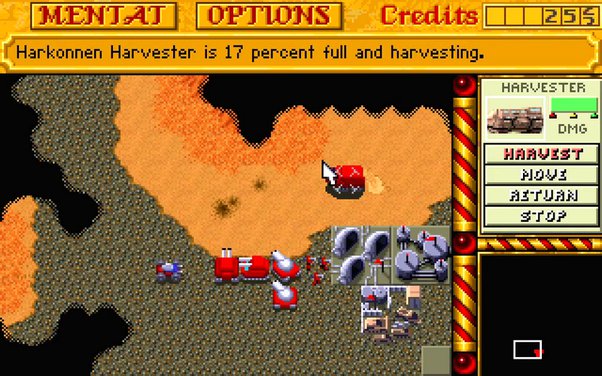
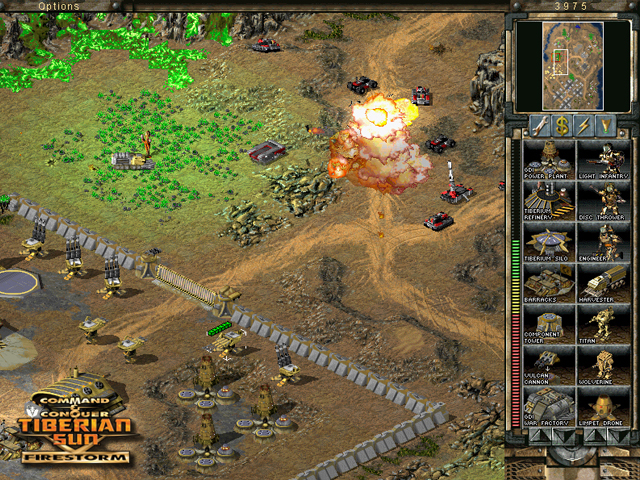
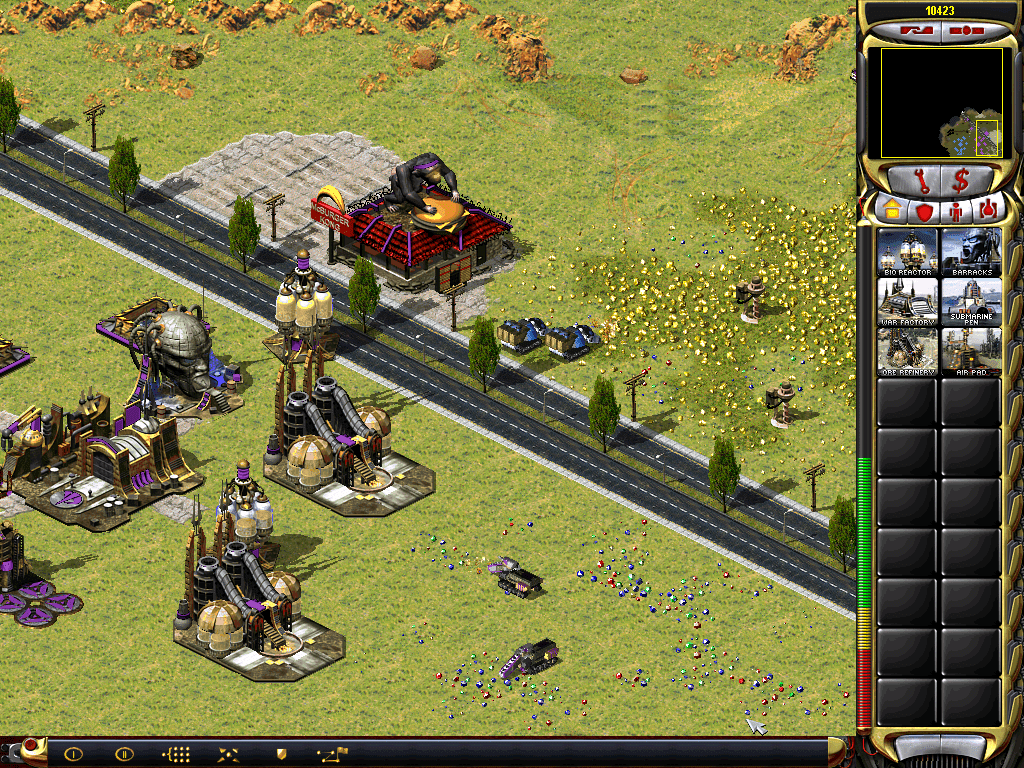
Dune 2 was the first strategy game, and it adapted straight from the novel a model of resource-collection that went on to exert a huge influence. There is a single resource, the spice, which lies on the surface of the ground. It is collected by huge harvesting vehicles. In Command and Conquer, the spice became tiberium, which has its own interesting back-story but is functionally identical, with the big harvesting vehicles and all. In the Red Alert spin-off, the spice appears in an alternate-history Cold War setting as Ore, a single one-stop-shop resource. Armies supply themselves by mining this resource on the battlefield. Helpfully, it is spread in pockets evenly across the surface of the earth from Manhattan to the Siberian taiga. 

So when Frank Herbert wrote about spice-harvesting in the early 1960s, he was creating a model which videogame developers would still be using in the 21st century. It was such a useful model for gaming that the plausibility of the game world of Red Alert was stretched to the limit just to accommodate it.

Bono’s Terrible Poem: An Autopsy

On March 17th Bono wrote a poem about the Ukraine war. Without even proofreading it, he sent it to a top US politician, and she read it out at a public gathering. Then he decided to post it on Twitter,

‘It wasn’t written to be published, but since it’s out, here it is,’ he tweeted. No, he didn’t want it to be out. He just sent it to a luncheon involving top political elites in the most powerful country in the world.

The poem was so bad it was a shock to the senses. But now that a few weeks have passed we should take a closer look. What are the specific features that make it so bad?

It’s on the nose

Usually poems weave in symbols and imagery and metaphors. For example, a poem about a vicious invasion might use snake imagery to signify evil. It might weave the metaphor into various vivid images.

Instead of doing that, Bono simply tells us what his poem’s symbol is: ‘For the snake symbolises/ An evil that rises…’

From this we can surmise that if Bono had written ‘The Road Not Taken’ he would have begun, ‘A fork in the road symbolises a major life choice…’

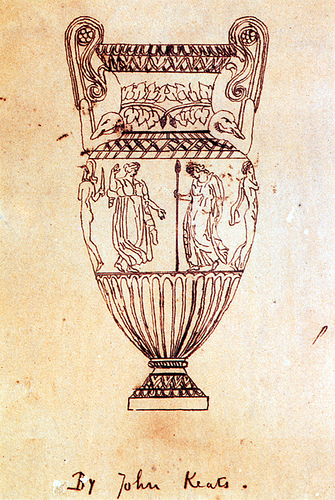
But that’s not quite it. We need more comparisons to really do it justice. If Bono had written ‘Ode on a Grecian Urn’ he would have begun, ‘This Greek vase is a symbol of stuff not getting old.’

Or ‘This Greek vase is like a wife who you’ve married but haven’t had sex with yet.’

It’s a textbook case of Irish narcissism

How are we to read the line ‘Ireland’s sorrow and pain/ Is now the Ukraine’? It seems that he’s saying Ireland had sorrow and pain in the past, and now Ukraine is getting a taste. As if Ukraine was some kind of bucolic hobbit village during the twentieth century – as opposed to a land ravaged by two world wars, famine, terror, the Nazi Holocaust, nuclear disaster and looting by oligarchs.

In this poem, Bono responds to the horror in Ukraine by talking about Ireland. There are grounds for empathy in our shared history of national oppression. But can’t Irish people engage with global events with a bit of taste, without making it all about us?

It’s largely babble

Let’s repeat that phrase; ‘Ireland’s sorrow and pain/ Is now the Ukraine.’ Sometimes in long complex sentences, we mistakenly switch between the singular and the plural. But what excuse does Bono have here, in a phrase eight words long?

Even if he had written ‘Ireland’s sorrow and pain/ ARE now the Ukraine,’ what would that phrase even mean? I struggle to put it into words. Our emotions have been transferred to another country? …have been transformed into another country?

An updated version of the poem reads ‘Ireland’s sorrow and pain/ Is now in Ukraine.’ Did we put our sorrow and pain on a container ship and send it over to the port of Odesa?

‘And they [saints] struggle for us to be free/ From the psycho in this human family.’ Us? But Bono is already free from Putin! Putin doesn’t control any territory in which Bono or his offshore money reside.

‘For the snake symbolises/ an evil that rises/ and hides in your heart/ as it breaks.’ What does this line mean? You, Nancy Pelosi and a bunch of US politicians, have got evil hiding in your heart. I’m not entirely sure that’s what Bono meant to say. And what’s this about hearts breaking?

All these musings are a waste of time, because later we are told that ‘the evil has risen my friends [sic, no comma] / From the darkness that lives in some men.’ All of a sudden, the evil is not something that rises in the hearts of Bono’s heartbroken friends in the US political elite. It is an outside force that threatens us. From context we can guess that it is Putin.

More examples of this incoherence are nailed down here.

It’s banal

When the poem is coherent, it is usually not saying anything worth saying.

What does itactually say about the war in Ukraine? Only that from time to time ‘sorrow and fear’ come along, because of evil. In this poem, evil is a category which includes (presumably amongst other things), paganism in Fifth Century Ireland and the Russian invasion of Ukraine. But evil no longer hides in Nancy Pelosi’s broken heart. The source of the evil is now ‘the darkness that lives in some men.’

How unfortunate that darkness lives in the hearts of some men. If only it had taken up lodgings in some more convenient place. Then this war wouldn’t have happened.

It’s absurd

When the poem is coherent and not banal, it’s absurd.

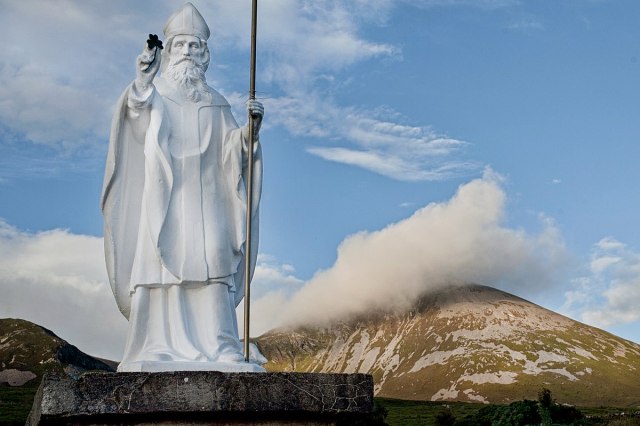
It is entirely possible to write a poem paying tribute to the armed resistance of the Ukrainian people and to the resilience of civilians and aid workers under the bombs. But Bono does not go down that route; instead he singles out the politician who happens to be in charge of Ukraine at this time, Volodymyr Zelenskyy. And not only does Bono praise this politician, and not only does Bono compare him to St Patrick. No, at the end of his poem Bono says that Zelenskyy is Saint Patrick.

Because this is the image that comes to mind whenever I hear the name ‘Volodymyr Zelenskyy.’

So St Patrick was personally brave. And yes, it appears Zelenskyy is also personally brave. But there the similarity ends, because (A) St Patrick was never an actor. And (B) he didn’t have a Neo-Nazi paramilitary group on his payroll.

But even if the comparison fit… So Putin is a snake and Zelenskyy is Saint Patrick. Zelenskyy is banishing Putin. But… why? Why say this?

It’s tasteless

In his tweet Bono explains that every year he sends a funny limerick to US politicians for their St Patrick’s Day luncheon. As you do.

This year, he explains, instead of sending a cheeky little rhyme, he felt compelled to send a serious and heavy limerick. Yes, a heavy limerick. Because this year things are different. There’s a war on. People are dying.

Not like all those other years, when there was no war on and nobody was dying. And if there were any wars happening, the US politicians who chuckled at Bono’s funny Irish limericks certainly had nothing to do with any of those wars.

But even leaving all that aside, maybe you shouldn’t write a limerick about a war. Maybe you shouldn’t try to discuss the nature of evil in a limerick. You see, the limerick genre has certain limits.

But as Bono admits, it’s an ‘irregular’ limerick. You can say that again. Limericks are disciplined, with a tight rhyming scheme and rhythm.

For example, ‘There once was a singer from Dublin/ Whose tax situation was troubling…’ etc.

Limericks have to scan well, or else they sound contrived. And they are short, like five lines.

It’s not a limerick

When I first read Bono’s poem, it scanned so poorly I didn’t even realise it was a limerick. There were words that I didn’t realise were supposed to rhyme with other words. I only learned that it was a limerick because Bono said so. Then I went back and read it in the sing-song jokey rhythm of a limerick. It sounded so much more tasteless and bizarre. In other words, it’s not an irregular limerick, it’s an atrocious limerick.

If Bono had written something like the following, it wouldn’t have been quite as bad:

A snakey old psycho named Putin

Escalated the bombing and shooting

But Zelensky had tactics

Because he is St Patrick

And so for Ukraine I am rooting.

It’s absurd, offensive, tasteless, baffling. But it’s brief, and it’s actually a limerick.

And it says everything Bono takes fifteen lines to say. That’s it. All the essential points are there. But to create the impression that he’s saying something deep and heartfelt, he ties the poem up in knots with vague phrases that mean nothing. He does not succeed in covering up his poem’s essential banality and absurdity, only in adding a layer of incoherence.

Advice for Bloggers

March 26th will mark one year since i launched The 1919 Review. I want to mark the occasion by offering some advice for beginner bloggers.

1. Blogs Snowball

I had an old blog which I approached with zero plan or consistency, but on which I threw a lot of varied stuff over 5+ years. I have not posted on it since 2015. Somehow in spite of this complete neglect its View Count and Visotor Count coasted along with a combined 6,000 visitors in 2016, 2017 and 2018. It took years for engagement to fall away. Even now it’s a rare week the old blog doesn’t get 20+ views. For a lot of last year, the old blog was doing better than The 1919 Review!

There’s some good stuff on that blog and I’m happy people are still reading it. But my point is this: blogs snowball. Through some mysterious process, they develop a momentum of their own.

So…

2. Keep at it and be consistent

I launched The 1919 Review with a budget of zero but with a bit more planning and determination than I had put into previous projects.

For months, it got practically no views or visitors unless I shared something on social media. The base line default was zero.

One year on, the blog has organic reach. Social media shares generate a spike of views and visitors, of course, but now I have a steady base line of engagement between shares.

It might be the subscribers I’ve built up. It might be that, having built up a certain volume of posts, I’m casting the net wider on search engines. Unless it’s just some inscrutable trick of the algorithm that governs the WordPress Reader feed, it must come down to this: the blog has organic reach because I posted religiously once per week for a year.

3. Use social media

For me, this means Facebook; I don’t really use the others. I’m not a big fan of Facebook, for all the usual reasons, but I still use it every day, again, for all the usual reasons.

One good development over the last few years has been the culture of well-moderated and pleasant public and private groups. It is through sharing posts in such groups that I got some of my biggest spikes in engagement.

Be a member of the group for a while before posting your own stuff, and meanwhile contribute in other ways. Give more than you take. Before you self-promote, read the room and take a look at the rules.

4. Make a podcast

I linked in with Anchor and Youtube to make a very basic, rough-and-ready audio version of my series Revolution Under Siege. It’s not somewhere I expected to go, and it hasn’t brought massive traffic, but it was a lot of fun and it has potential.

5. Savour the little victories

Cut your cloth to measure. With no promotion budget and with many other commitments in my life, it was out of the question that I would be marking big victories and breakthroughs in the first year of The 1919 Review. But I hit every target I set myself, and that feels good. Celtic Communism and Sláine were the biggest hits of year one.

Rather than my usual rule of once per week, I’ve posted three times in the last few days. This is because I’ll be away from tomorrow until April.

Until then, thanks to all my readers, subscribers and sharers.

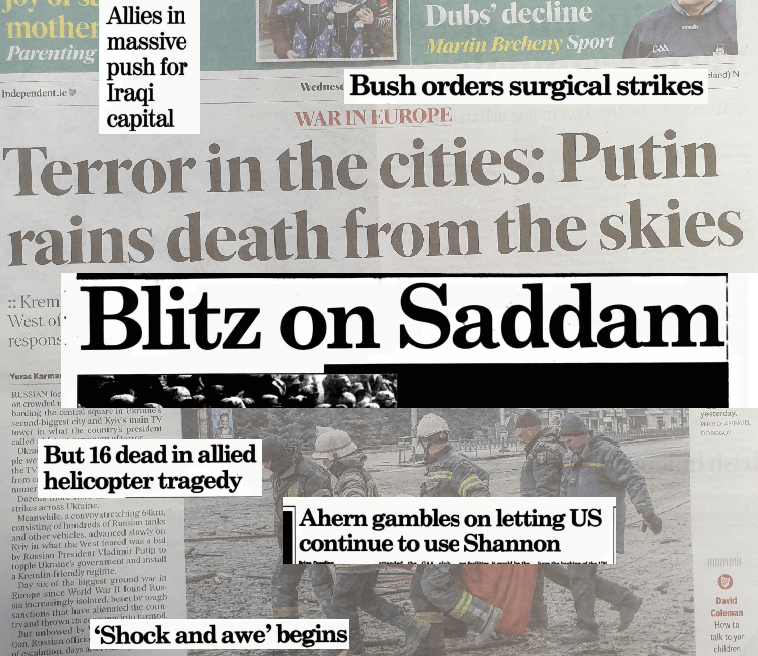
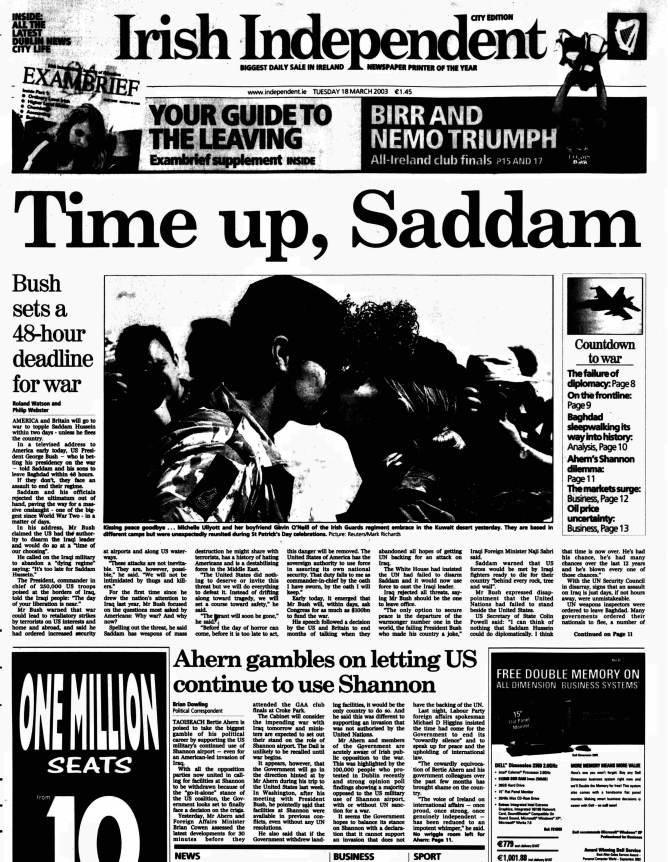
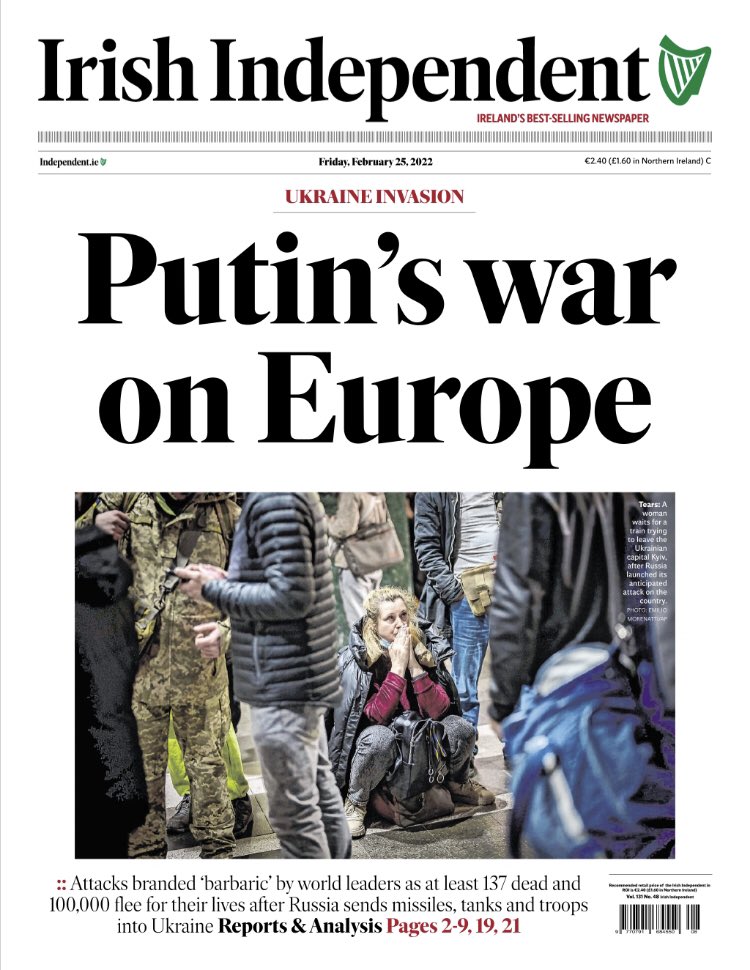
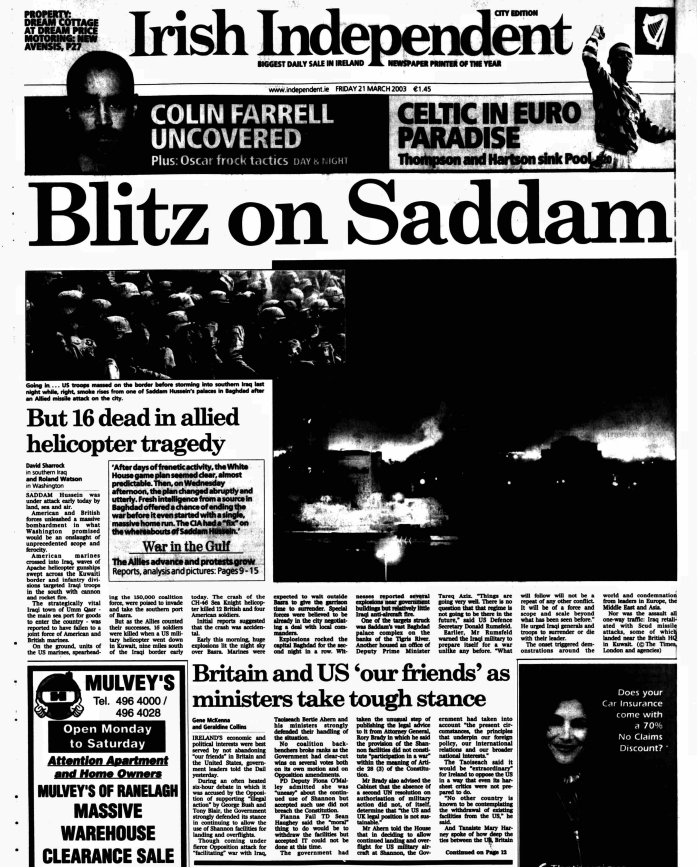
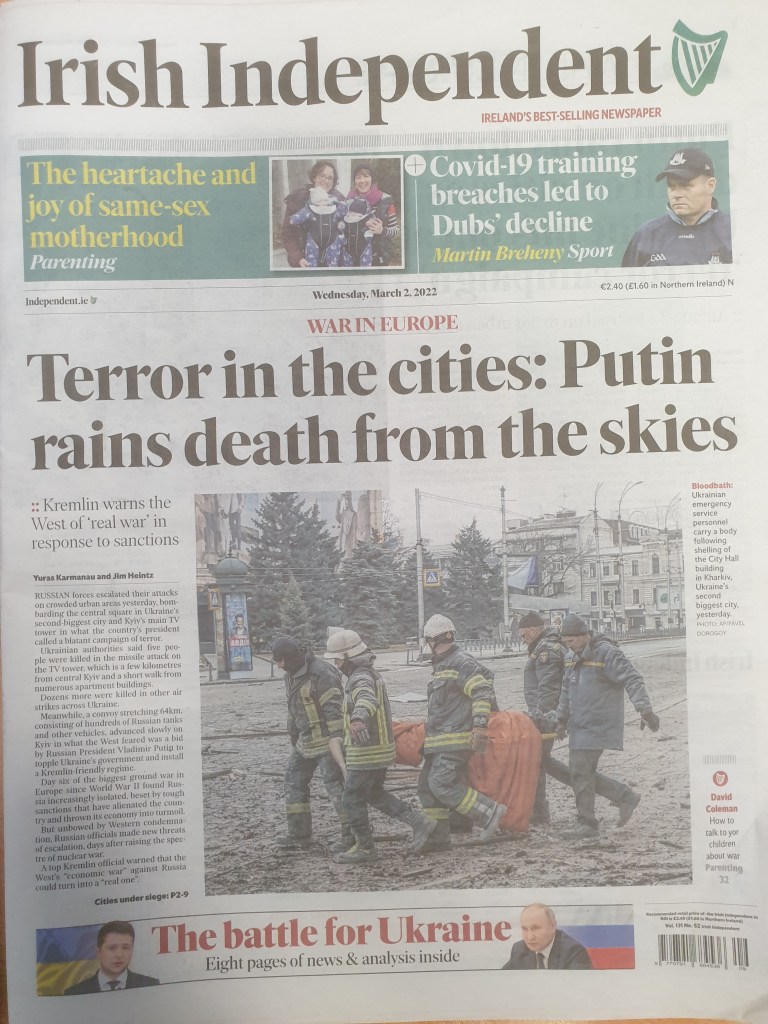
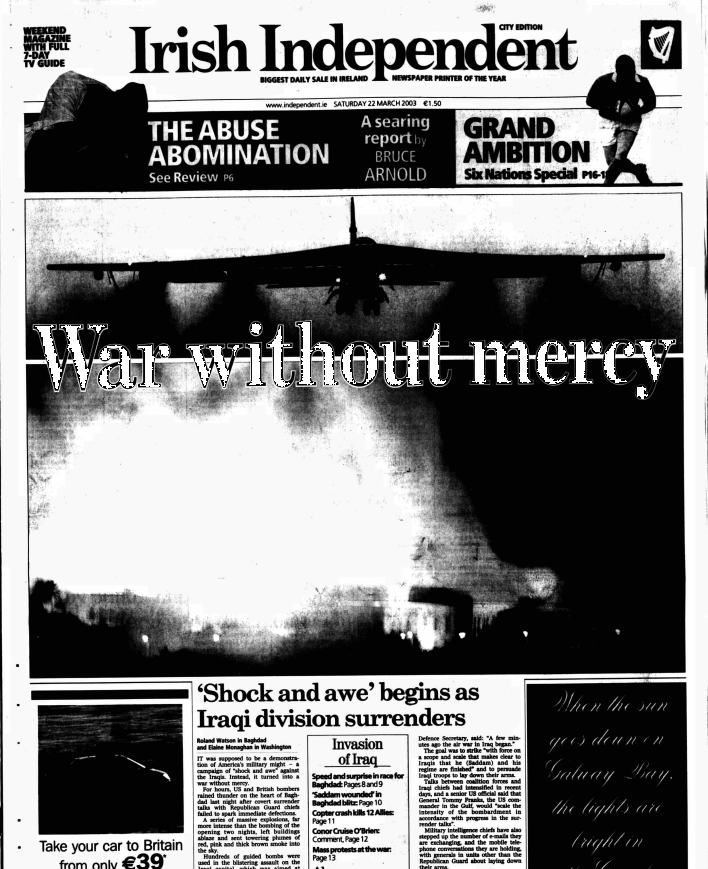
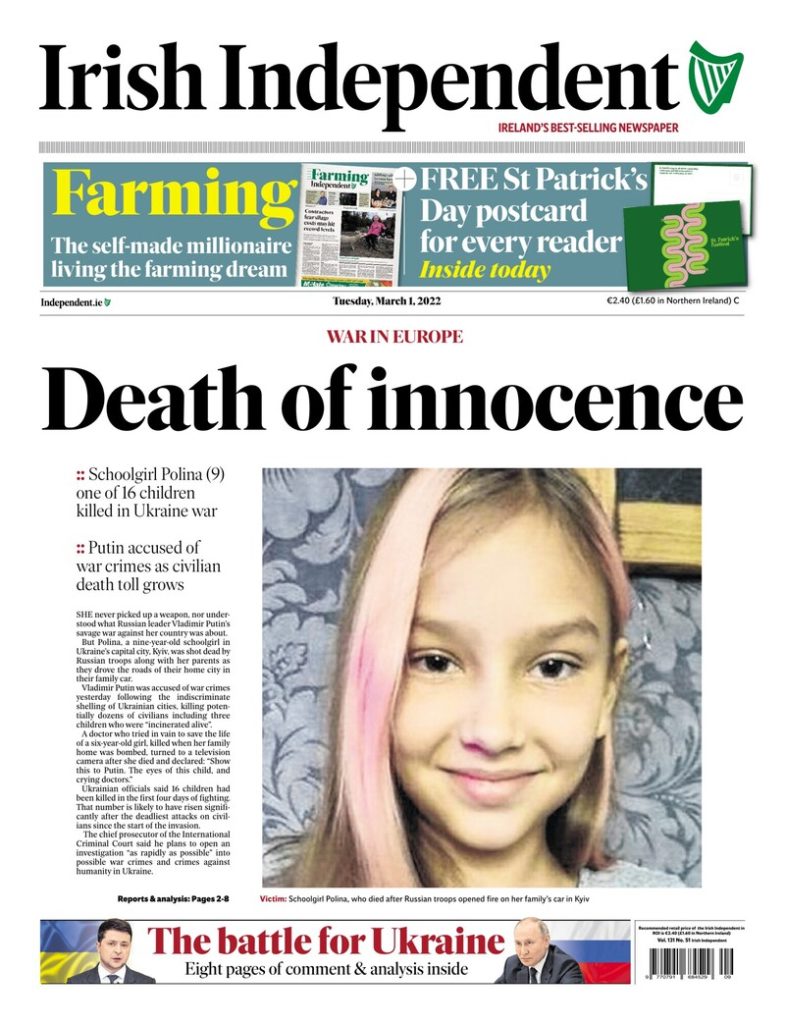
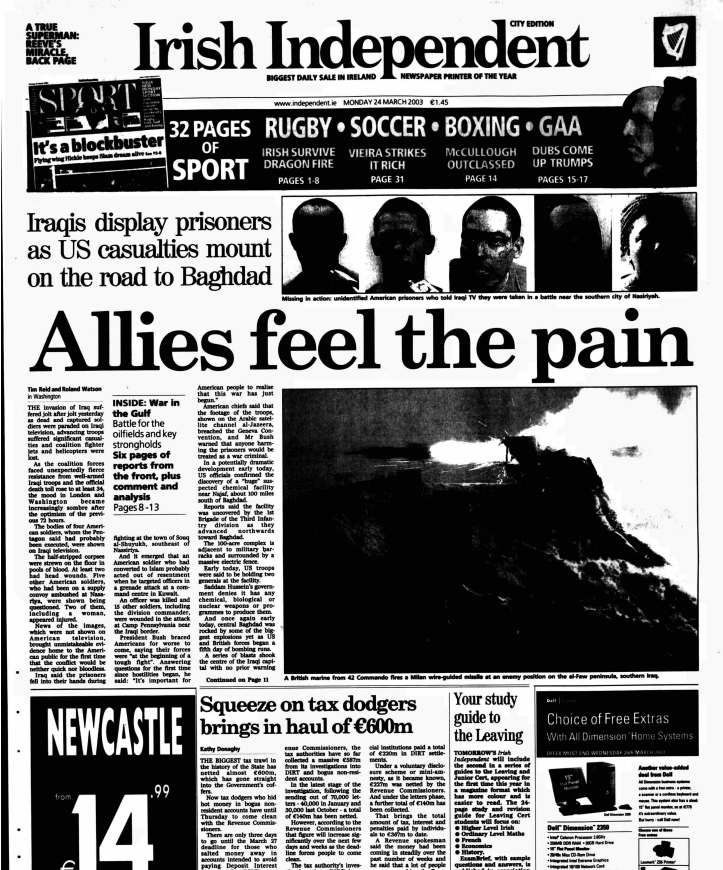
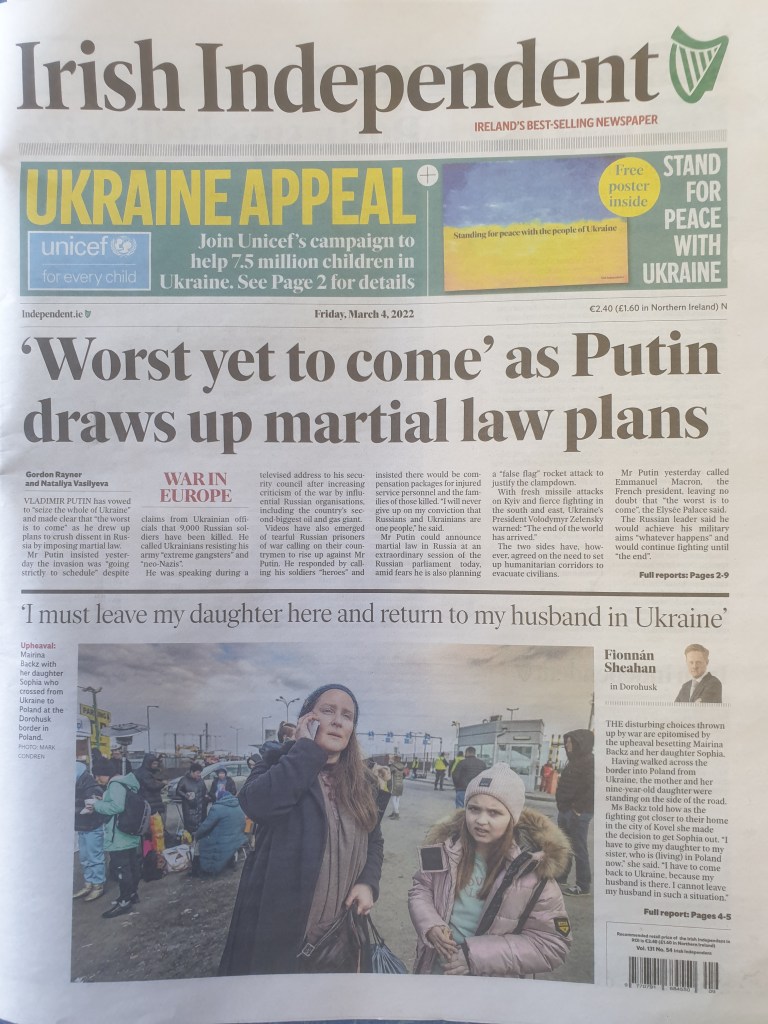
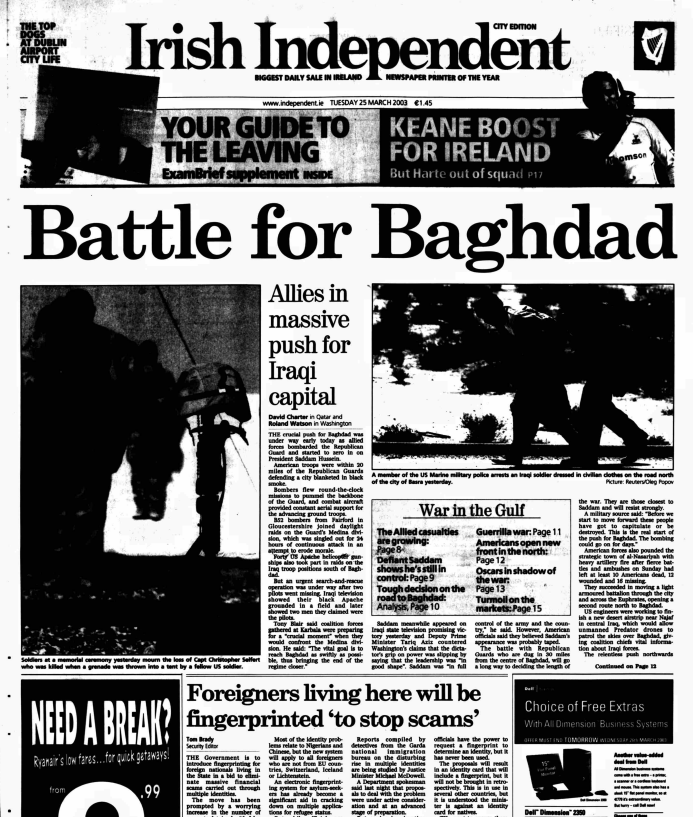
Iraq 2003 v Ukraine 2022: The Headlines, Side by Side

In 2003 the United States government and its allies invaded Iraq in a war of aggression. Within 3 weeks, over 3,000 civilians had died under the bombs, and twenty years later Iraq has not recovered and no US official has been held accountable.

In 2022 the Russian government invaded Ukraine in a war of aggression. Currently the war is assuming the form of terrible sieges of Ukraine’s major cities. The death toll so far is unknown but around 1 million have already fled the country.

But newspapers did not cover the two events in quite the same way. That’s putting it mildly. I live in Ireland, so here are the headlines I’m seeing from our biggest newspaper. Here are five front pages each from the first week or so of the Iraq War (March 2003) and of the Ukraine War (Feb-March 2022). No further comment from me. The bias speaks for itself.

Appendix: “…who was later killed by Stalin…”

This is an Appendix post to Revolution Under Siege, my series on the Russian Civil War.

This post started life as a (terrible) idea for a drinking game. Read or listen to my blog and drink any time you come across

a)      A White leader whose name starts with K

b)     A Red leader who was later killed by Stalin

When you’re reading any account of the Civil War, the phrase “…who was later killed by Stalin…” is a repeating motif. On rare occasions, like the case of Semyonov, this refers to a White leader. But nearly all the time it refers to a Red.

Hence the title.

But instead of inventing the least funny drinking game ever, I went back through all the posts from Series 1 (covering 1918) and made a list of every named individual who supported the Red side. Some are people I spent a whole chapter talking about, others accidental mentions in the captions of photos, others still the authors of sources.

For each one I asked, ‘What happened to them? How did they die?’

This graph was the result.

The graph is based on 39 people. It counts all Red supporters mentioned during Season 1 – so, Reds who were prominent during the year 1918, plus a scattering of accidental figures. There will be omissions, but it is broadly representative. I have in no sense deliberately weighted this sample so as to make Stalinism look bad. I could have weighted it far further in that direction without stretching credibility. For example, I have included Adolf Joffe under ‘Natural Causes or Illness’ even though his suicide was triggered by the persecution of the Left Opposition by the Stalin group.

So that you can see for yourself, here is the full list.

Natural Causes or Illness

1.      Alexander Serafimovich (Author, The Iron Flood) – Natural causes, 1949

2.      Kliment Voroshilov (Red commander in Southern Army Group in 1918) – Natural Causes, 1969

3.      Klavdia Nikoaevna (Editor of Kommunistka) – Killed in a German bombing raid, 1944

4.      Vasily Chuikov (Red Guard, later commander at Stalingrad in 1942-43) – Natural causes, 1982

5.      Vladimir Lenin (Leading figure in Bolshevik Party) – Illness, 1924

6.      Nikolai Andreyev (Assassin of Count Mirbach) – Illness (Typhus), 1919

7.      Felix Dzerzhinsky (Founder and leader of the Cheka) – Illness (Heart attack), 1926

8.      Yakov Sverdlov (Leading figure in Bolshevik Party) – Illness (Spanish Flu?), 1919

9.      Larissa Reissner (Red Army soldier and writer) – Illness (Typhus), 1926

10.   Josef Stalin (Leading figure in Bolshevik Party) – Illness, 1953

11.   Adolf Joffe, (Leading figure in Bolshevik Party) – Suicide, 1927

Killed in Civil War

12.   Mikhail Muraviev (Former Tsarist officer and Left SR) – killed by Reds, 1918

13.   Dmitry Popov (Chekist, Left SR, Anarchist) – killed by Reds, 1921

14.   Commissar Panteleev (Involved in mutiny at Sviyazhsk) – killed by Reds, 1918

15.   Fyodor Podtelkov (Leader of Red Cossacks, SR) – killed by White Cossacks, 1918

16.   V. Volodarsky (Bolshevik) – killed by SR assassin, 1918

17.   Moisei Uritsky (Bolshevik) – killed by SR assassin, 1918

18.   Nikolai  Markin (Bolshevik sailor) – killed in battle, 1918

Unknown

(‘Unknown’ means ‘I was unable to find out.’ I’d appreciate further info anyone has).

19.   Vakhrameyev

20.   Makhrovskii (Communist imprisoned at Tsaritsin)

21.   Slavin (Unable to identify with certainty the identity of this individual)

22.   Mitorfan Grekov (Civil War painter) – died in 1934

Killed on the orders of Stalin

23.   Maria Spiridonova (SR leader) – executed, 1941

24.   Alexander Shlyapnikov (Bolshevik leader) – executed, 1937

25.   Lev Trotsky (Bolshevik leader) – assassinated, 1940

26.   Feodor Raskolnikov (Bolshevik sailor) – probably assassinated, 1938

27.   Lev Kamenev (Bolshevik leader) – executed, 1937

28.   Vasily Blyukher (Red officer) – executed, 1938

29.   Yakov Blumkin (assassin of Count Mirbach, Chekist) – executed, 1929

30.   Jukums Vacietis (commander of Latvian Rifles) – executed, 1938

31.   Bela Kun (leader of Hungarian Communists) – executed, 1938

32.   Yuri Sablin (left SR and Red officer) – executed, 1937

33.   IM Vareikis (Bolshevik, assassin of Muraviev) – executed, 1938

34.   Andrei Snesarev (Former Tsarist officer) – died in prison, 1934

35.   Pavel Sytin (Former Tsarist Officer) – executed, 1938

36.   Nikolai Bukharin (Bolshevik leader) – executed, 1938

37.   Martin Latsis (Either a Left SR or a Bolshevik; accounts vary) – executed, 1938

38.   Mikhail Tukhachevsky (Red Army commander) – executed, 1937

39.   Konstantin Akashev (Red aviator, anarchist) – executed, 1931