
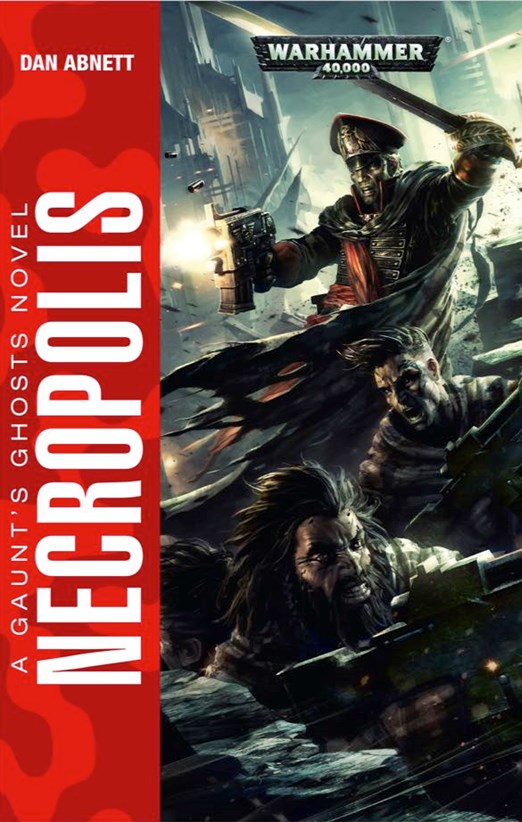
Dan Abnett, Necropolis, Black Library, 2000
In a vast hive-city on a distant world, an alarm sounds. It blares all throughout the city, and we see in rapid succession the reactions of a miner beneath the alien soil, a housewife at a market, a soldier on the walls, a factory foreman, a ruthless trader and a young noblewoman. In this way, the first few pages of Necropolis by Dan Abnett give us a sweeping but economical cross-section of the city of Vervunhive in the moment when its tens of millions of inhabitants receive the first sign of the unimaginable destruction that is coming.
A vast Chaos-corrupted army descends on Vervunhive, and over the following days and weeks the poor souls we’ve just been introduced to are put through hell. One is killed in the first savage bombardment; another develops from his pre-war existence to heroic status as a resistance fighter; another endangers the defense of the city in the interests of war profiteering. Meanwhile all around them, the city collapses by degrees into a ruin and, as the novel’s title suggests, there is a whole lot of mortality.
Gaunt’s Ghosts
Friendly forces arrive from offworld to help defend the city, including the Tanith First Regiment led by the heroic Colonel-Commissar Ibram Gaunt. This is the third novel starring Gaunt and his Ghosts, a regiment of scrappy light infantry fighters from a world lost to Chaos. First and Only and Ghostmaker flesh out the regiment’s characters in a way that Necropolis is too busy to do. But Necropolis is still bigger and better, and it can be read on its own. And, like most Black Library novels, it can be enjoyed as a military sci-fi epic, without any knowledge of the tabletop wargame hobby on which it is based.
Still, it has some of the familiar features of those other stories: Gaunt’s most difficult battles are against cynical, cruel and complacent people on his own side; the Tanith Ghosts are underestimated by snobbish other regiments recruited from wealthier and, well, not-dead planets; in spite of all this, Gaunt and the Ghosts save the day and win their internal and external battles. If more high-ranking servants of the Imperium of Man were like Comissar Gaunt, maybe it wouldn’t be such a dystopian nightmare of a society – which makes it kind of tragic that he serves it.
Unlike the previous novels, Necropolis has a fairly reasonable gender balance, because of the focus on various women from Vervunhive and the role they play in the resistance, often in the face of condescension from some of the less sympathetic Tanith Ghosts. Another departure from its predecessors is that it focuses on a single momentous battle, the Stalingrad of the Sabbat Worlds crusade, and tells the story from start to finish. For the first time, we see Gaunt commanding at a strategic level. Himself and Dan Abnett both are working with a bigger canvas, after finding their feet with two simpler novels, and that’s awesome.
We see refugees overrunning the police cordons that stand between them and safety, occupying factories and warehouses without permission, and organizing themselves into work teams. We see miners and women from textile mills, many of them permanently deafened from shellfire, forming guerrilla units behind enemy lines on their own initiative. These sub-plots are compassionate stories about the most downtrodden imperial subjects claiming some agency in terrible conditions. These stories also give an impression of Vervunhive as a place with lots of people and moving parts. It is a living, breathing place – for now.
Toby Longworth is great
I listened to this novel as an audiobook. I rarely re-read a book and it is rarer still with audiobooks; there are only two I’ve ever taken the time to give a re-listen, and Necropolis is one of them. Toby Longworth reads all the Gaunt’s Ghosts audiobooks, and he is just fantastic to listen to. He gets the tone of the ‘grim, dark future’ just right. I usually hate it when readers put on lots of elaborate accents, but Longworth gets away with it. Like the dwarves in Peter Jackson’s Hobbit movies, the Tanith Ghosts have an array of regional British and Irish accents, suggesting that their world of agriculture and forestry was home to a range of cultures, but not a particularly wide or exotic one. In Ghostmaker and Honour Guard, Longworth does a perfect impression of Alec Guinness for a couple of senior characters in Gaunt’s flashbacks. The officer class, you see. The regiment’s chief medical officer Dorden has a dreadful Irish accent, but somehow Longworth’s performance is still good, and I still believe him as a character. The very likeable Colonel Corbec has an Irish accent too, and his one is much better.
Why did I like this book, and who would not like it?
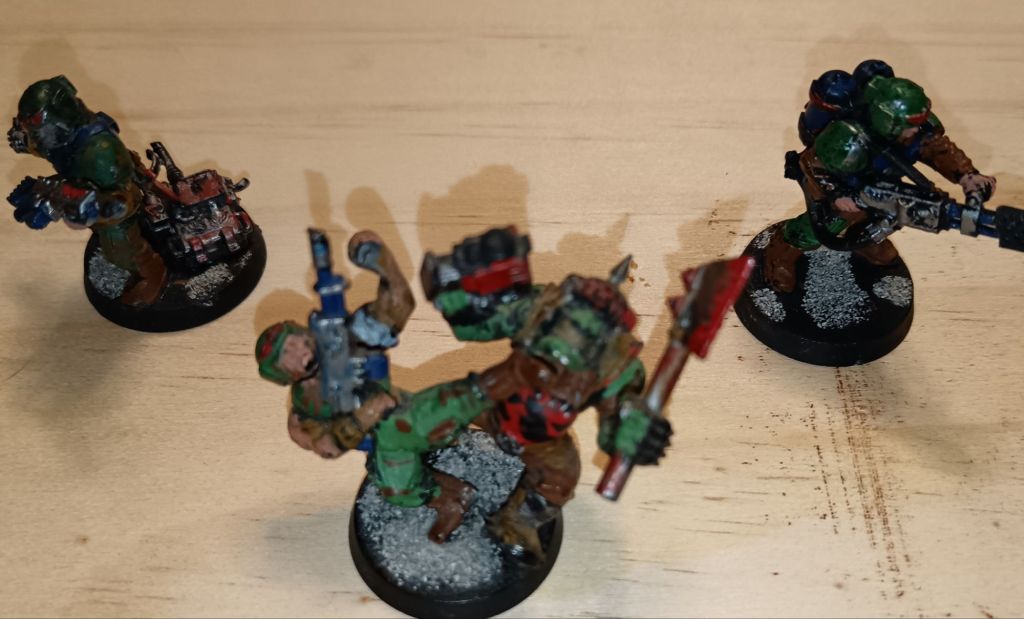
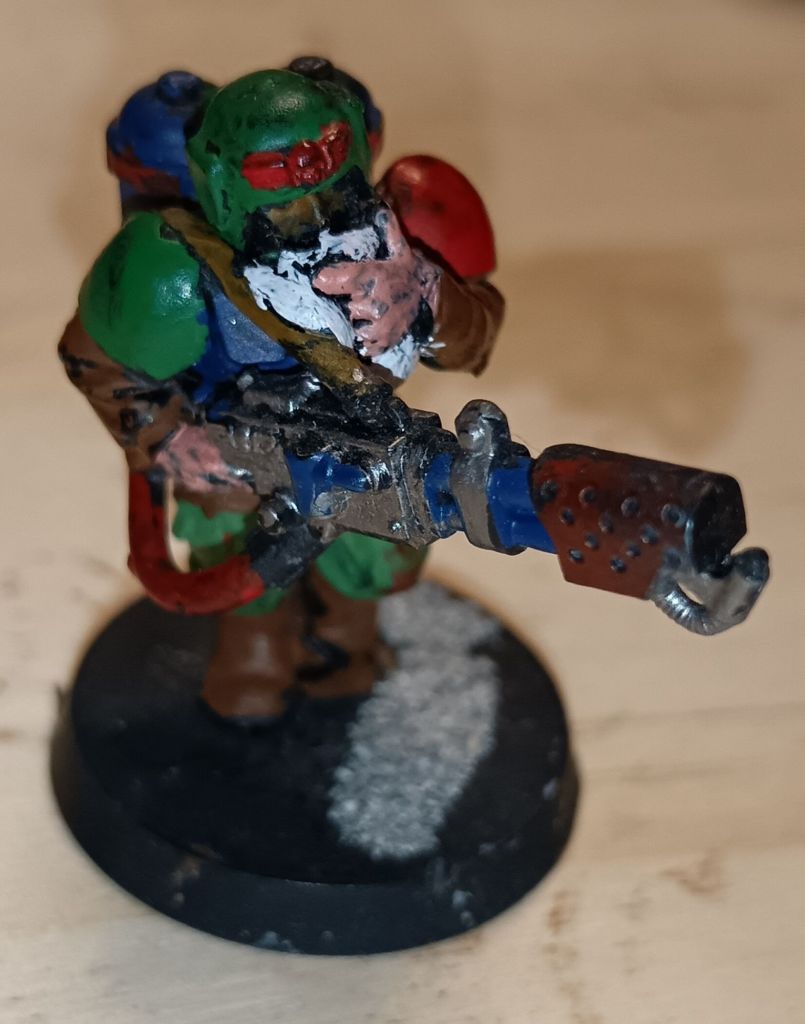
I was a Warhammer hobbyist for a few years around age 11-16, and Imperial Guard were my second choice after Orks. Hence the appeal of this book to me, even twenty years removed from the life of drybrushing, gluing and rolling meteor showers of dice. I’ve also always had a fascination with all things military, and with alien worlds and future civilisations, and with various episodes of human history that resonate in the visuals and language of Warhammer. But it’s not just the future or the past. For me, horror is catharsis. Appalling death and destruction, at a safely fantastical or science-fictional remove, and contained within the frame of a story, eases the mental pain one feels at the real horrors of the world.
There are parallels, there is applicability – but there is also the safe distance of several hundred lightyears and thirty-eight millennia. Without getting too dramatic (here I wisely deleted 500 words where I got too dramatic), fiction, including genre fiction based on an elaborate game involving toy soldiers, gives us a space to feel things safely. There is, however, the overhead cost that we risk fetishizing death and destruction. In our culture and in individual people, it becomes hard to tell where this search for catharsis ends and the simple glorification of war begins.
Abnett is prolific, and he might not even remember writing this quarter-century-old novel. But I hope he knows he did a skillful and spirited job here of depicting war: gore-splattered, dynamic, technical, kinetic, but at the same time sensitive to human suffering.
But to people who do not like to read about gore, cathartic destruction, war stuff, intense human suffering on an epic scale, or fantastical future settings, I’ll level with you: Necropolis is probably not your cup of tea.
Necropolis should be on TV
I wrote in my most recent post that I was going to suggest a Black Library novel that ‘they’ should base the planned Warhammer 40K TV series on. ‘They’ being, I suppose, Henry Cavill and Amazon. Since these personages are not to my knowledge regular readers of The 1919 Review, it should be clear to the reader that the thoughts I am sharing are just a fun exercise. The corporate entertainment industry are gonna do what they’re gonna do. That’s bleak, but the alternative, that they would try to triangulate between posters, vloggers and maybe even bloggers and make a pathetic effort to please the most hyper-engaged people on the internet, would be pretty bad as well. So let us write and read this free of any illusion that we have any control over the outcome. This is not intense fandom. This is just fun and chill.
These caveats made, here’s why ‘they’ should make a Warhammer TV series based on Necropolis. Even though, to be clear, they will probably make eight dismal hours of 300 with boltguns.
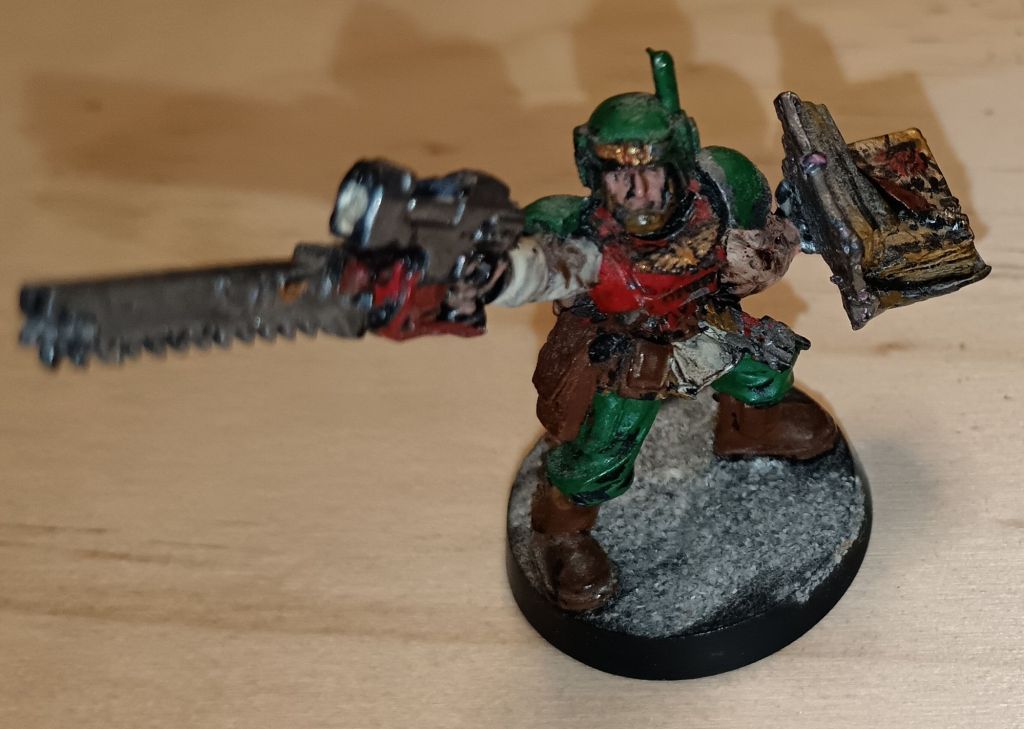
Gaunt is the archetypal TV male lead character: stern, compassionate, imperfect but always fundamentally right, beset by challenges from people of lesser stature. He is Coach Taylor from Friday Night Lights, but instead of American Football it’s purging the heretic. He’s Edward James Olmos in Battlestar Galactica, only younger and more athletic: from time to time he revs up his chainsword and wades into a melée, chopping off limbs right and left. Walter White, Tony Soprano, forget about your petty rackets: the dubious cause which Gaunt serves makes him a classic TV antihero.
I noted above that Necropolis has a fair balance of men and women as characters, which would be a big advantage over a lot of other Black Library novels.
(Honourable mention here for Sandy Mitchell’s Ciaphas Cain novels, which have some ingredients of a good TV show – except that Commissar Cain’s narrative voice is so crucial to the irony at the heart of these stories.)
I also remarked that Necropolis is focused on a single location, which allows not just for savings on sets, props, costumes and effects, but for the kind of rich and dense environmental storytelling and set design that this kind of project absolutely needs. Necropolis gives us a cross-section of Imperial society, as opposed to a glimpse of the frontlines in various warzones. What better introduction to the grim darkness of the far future?
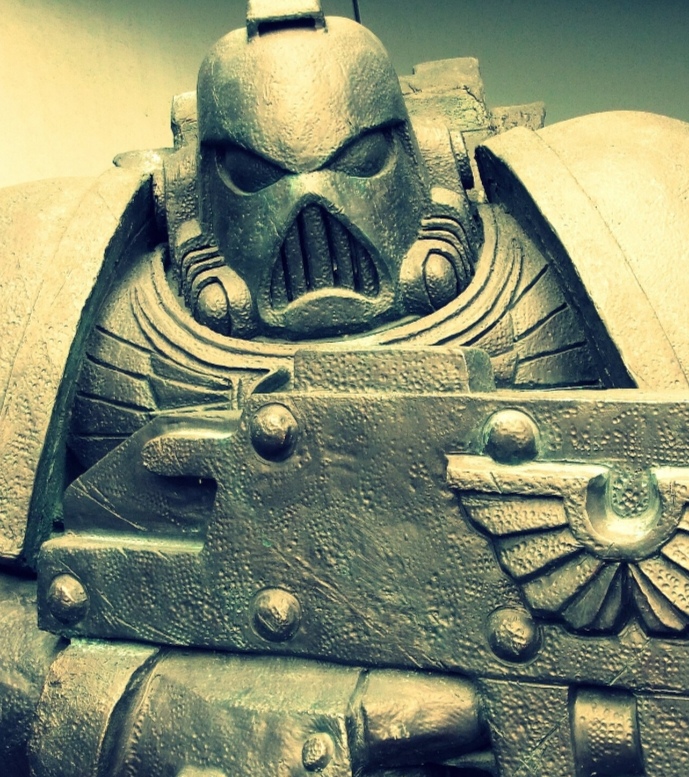
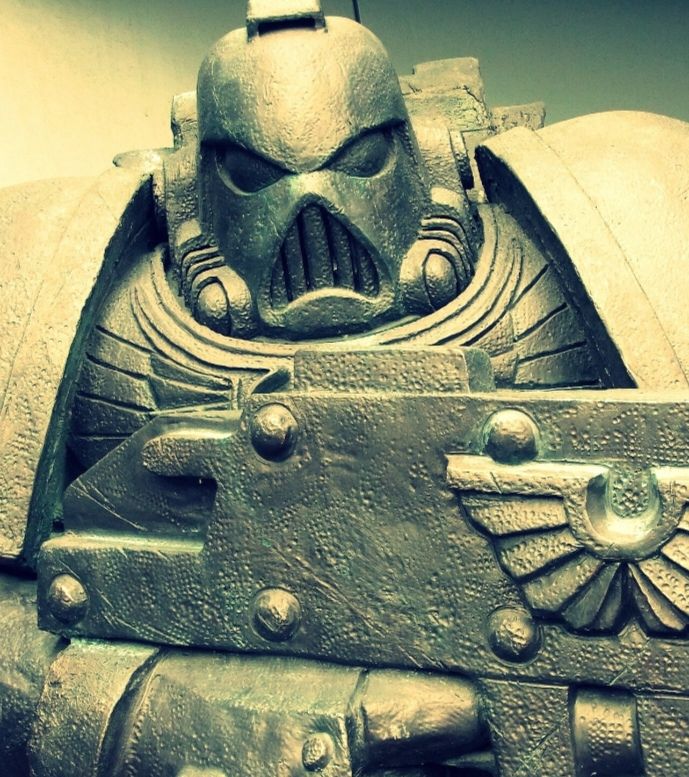
In Necropolis the Tanith are backed up by a heavy tank regiment, the Narmenians, who storm in to save the day at a crucial moment. For TV, I say, replace these guys with a hundred Space Marines. First, because the audience wants to see Space Marines. There can, and must, be Adeptus Astartes. Second, because they would serve the same purpose – as the heavy forces which wade in and make a right mess of the enemy. They would make a heavier visual impact than tanks, while probably being cheaper to put on the screen.
All in all, Necropolis is just a cracking good story, a simple situation and idea brilliantly executed. For a TV audience it would be a fantastic introduction to the 41st millennium.


 The 1919 Review
