
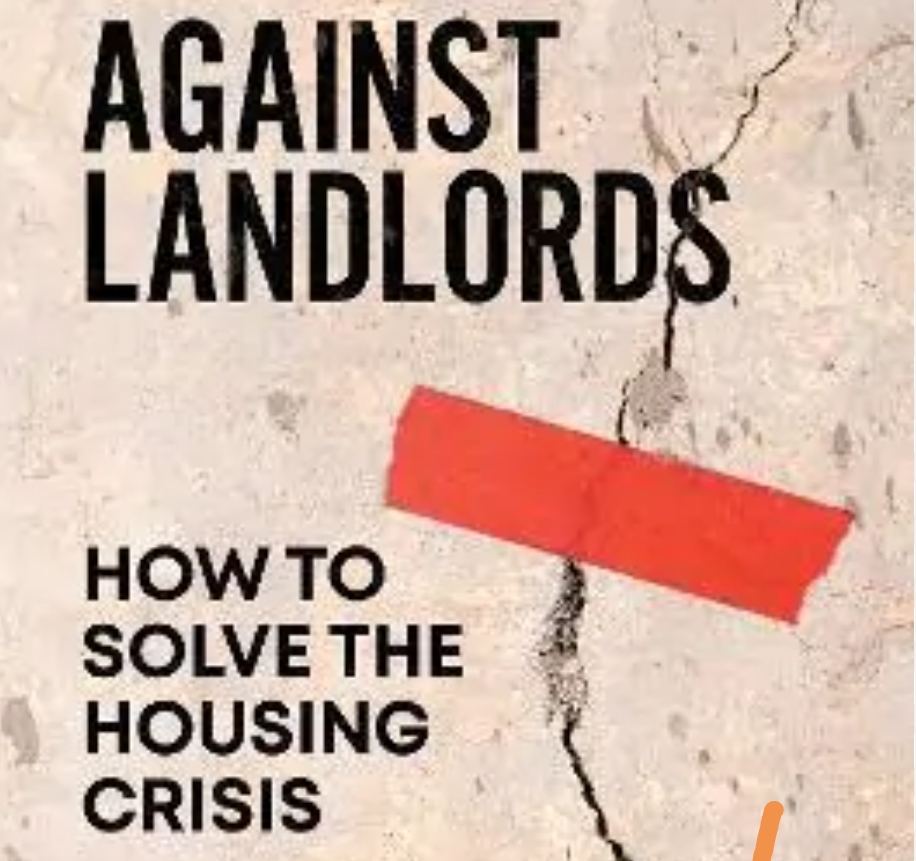
Against Landlords: How to Solve the Housing Crisis by Nick Bano
Verso, 2024
So that headline about ‘landlord abolition’ caught your attention. Maybe you’re wondering, is it just a sensational name for a moderate reform policy, like when people talk about ‘prison abolition’? No, landlord Abolition, as laid out by Nick Bano in this eye-opening and well-written book, is the real deal.
Consider the following:
- Renters in Britain in 1957 spent 6.5% of their income on rent (now think, how much do you spend on housing?).
- Before 1951, any increase in land value created by planning decisions was taxed at 100%.
- In the late ’70s, private rental was a dwindling sector and ‘the death of the landlord’ was widely predicted.
- Landlords were eager to sell, councils willing to buy. Social housing stock grew massively without anyone having to lay one brick on top of another.
The private rental sector was saved by concerted government intervention during the Thatcher years. Housing stock was in poor repair. How to fix it? Give grants to local authorities to renovate their stock? No! Get private capital to pump money into housing! What could possibly go wrong?
Fast-forward thirty years: terraced houses built by local authorities a century ago are being sold for half a million.
We could fix our housing crisis today by increasing social housing stock. Rent controls are not only fair; they would drive landlords to sell to councils. The more social housing stock there is, the less desperate people will be for housing, the less landlords will be able to get away with charging. It would be a virtuous cycle culminating in the private rental sector shrinking away to occupy an insignificant margin of society.
House prices are tied to rental yields; when you buy a house, you are actually paying for the right to receive rents from it for the rest of your life, even if you never have any intention of renting it out. Reducing the private rental sector to insignificance would benefit home buyers and make mortgage lenders cry bitter, salty tears at all the money we get to keep in our pockets instead of giving them.
Bano is under no illusions that the collapse of the housing market, while it seems necessary and desirable, would be an economic catastrophe for Britain whose governments have bet the country’s shirt on the impossible dream of eternally rising housing costs. And under capitalism, the poor would pay first and steepest for any economic disaster.
The housing market is not a bubble – people are actually realizing profits. But it has to hit the limit of a crisis of affordability, unless British renters can be convinced to live in tiny cubicles or ever-worsening Dickensian squalor – which Bano, to be clear, does not rule out.
The main clarifying point for me was that this is not a crisis of housing supply, but a crisis of housing costs. The imperative to “build more houses”, unless they are all public, social housing, will actually continue to drive up costs (and also destroy the environment).
There is a lot in this short book. There is historical material, for example, about an amazing rent strike in 1915 and the role of housing in the lead-up to the Battle of Cable Street. There is incisive commentary on Grenfell. There is a chapter on race. There are plenty of concrete examples of the squalor, injustice and absurdity of housing in Britain today. There is an overview of how landlords changed from social pariahs to celebrated entrepreneurs in one generation.
My only reservation was wondering how much this analysis applies to Ireland, which is my neck of the woods. Here investment funds seem to be playing more of a role than in Britain, but the mom and pop landlord seems to be very much a social phenomenon here as well.
In 2022 £63 billion was paid in rent in the UK – of which £23.4 billion was Housing Benefit. All that public money – gone, just to reward landlords for charging unaffordable rents. Meanwhile they are incentivised to keep on hiking the rents. Ireland’s Housing Assistance Payment (HAP) is the same, and I bet similar numbers apply.
 The 1919 Review