Star Wars: Andor (2022), cr Tony Gilroy. Spoilers Below!
I was not fully sold on the first episode of Andor. It’s basically cyberpunk, I thought: cool and tech-savvy lumpen-proletarians ducking and diving, out for their own profit, defying authority. Nothing wrong with that genre but I’ve seen it before.
Recently I watched some of Rebels and became convinced that the whole Star Wars thing works best as 20-minute cartoons aimed at kids. Adults can watch it, sure, I thought, but our big mistake has been to treat it as anything other than a story and world for children and adolescents. It’s very good as that, but it’s nothing more than that.
Well, Andor has reeled me back in, which is another way of saying I was wrong. Here, in no particular order, are a few of the things that convinced me that Andor is different.
Ferrix
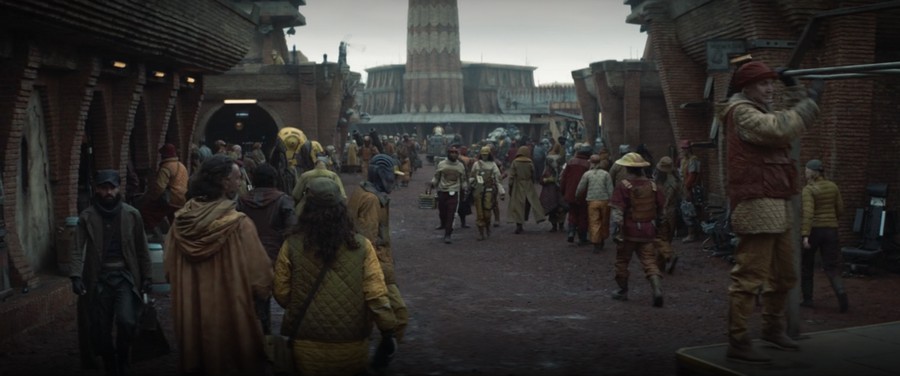
Ferrix is the planet that serves as the primary setting for Andor. It is cold and dusty, with salvage yards and vast cranes and a warren of shops and homes. They have a kind of anvil-angelus, where a guy on top of a tower hammers out ringing peals to the whole town. This feels right for this artisan-industrial place. When the authorities come in uniform, the people bang pots and pans to frustrate any attempt at surprise. There are rats and snitches, but overall it’s a place of plebeian solidarity. But Ferrix really comes into its own in the final episode, when we see how its people do funerals and riots. The funeral tune is haunting. When Bix (Adria Arjona) hears it, she goes to the window of her prison and experiences a moment of spiritual escape. These are her people.
No stormtroopers or TIE fighters
The authorities on Ferrix are not stormtroopers but private corporate security. It’s refreshing that for the first few episodes we don’t see a single stormtrooper or TIE fighter. There are no lightsabers or Boba Fett masks, Star Destroyers or X-wings, few cameos from familiar characters. The creators of Andor trust that we don’t need to have nostalgic artefacts pushed into our faces every few scenes.
Revolution
In Andor, for the first time in a Star Wars story, revolution is not about a band of wisecracking misfits doing heists. It’s about the masses – 5,000 slaves breaking out of a high-tech factory-prison, or a working-class community turning a funeral into a mass act of political resistance. Brasso (Joplin Sibtain) embodies this. It’s about manifestos – such as that of Nemik (Alex Lawther) which combines with Cassian’s own experiences to politicise him.
Morals
We see secret underground work, clandestine agents one step ahead of the Empire’s political police. The revolutionaries are not magically exempt from having to do bad things. In fact, their precarious position means that few methods are open to them aside from those methods which eat away at their souls and compromise their principles.
At the same time, there’s no shabby ‘both sides’-ism or ‘grimdark’ tropes. The means pursued by the Empire and the rebels are suited to their ends and circumstances. Pluck and compassion on one side, cackling villainy and martinets on the other – that’s fine for cartoons, but it’s not what we see here.
Evil Empire
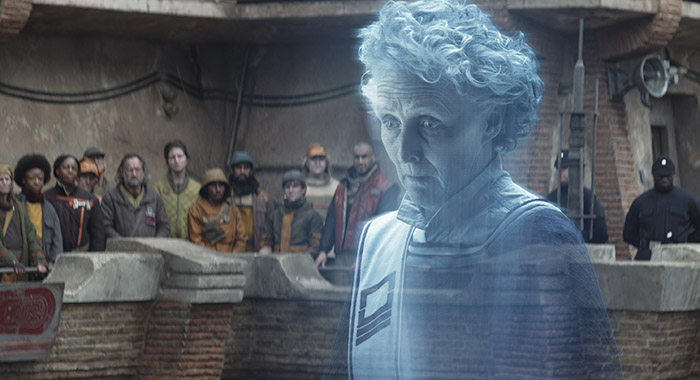
There’s plenty of other things I could talk about – the compassion and hint of humour with which the script deals with the unsympathetic Syril (Kyle Soller), a corporate security officer on Andor’s trail; the intriguing side-story on Coruscant starring Mon Mothma (Genevieve O’Reilly); the rise to power of Dedra Meero (Denise Gough), the Empire’s answer to J Edgar Hoover.
A cynical part of me didn’t want to write this. What am I doing, providing free publicity for Disney, who certainly don’t need any help from me?! Looked at coldly, what have we got here? The corporate entertainment machine has gotten tired of stimulating the nostalgia centres of our brain and is trying to expand its cultural reach by stimulating the political and intellectual zones for a while instead. And while Andor may contain traces of political sophistication, it’s not exactly a Ken Loach film.
Anyway, if you enjoy it you enjoy it, no need for hand-wringing. But it’s a show that provokes interesting thoughts about the nature of pop culture today.
This is the nature of pop culture under the vast monopolies of late capitalism: the big budgets go to pre-existing worlds and stories.
(A side-note: It’s frankly weird and pathological that so many people refer to stories and imaginary worlds as ‘franchises’ and ‘properties.’ Can we all stop doing that, please?)
Where was I? Yes, pop culture today. For example, the Taxi Driver of the 2010s had to be filtered through comic-book superhero stories in order to get made: that was the Joker movie (I know that’s DC and not Marvel/ Disney but the same point applies).
If popular culture is a galaxy then Disney is the evil empire that is trying to dominate it. Sure. But don’t forget what Nemik said in his manifesto in the final episode. This homogenisation of culture goes against the grain of the natural creativity of humanity. So insurrection is inherent even in the fabric of the empire itself. Hence Andor.
 The 1919 Review