Beevor’s Russia, Part 3: The Myth of Exceptional Violence (Premium)

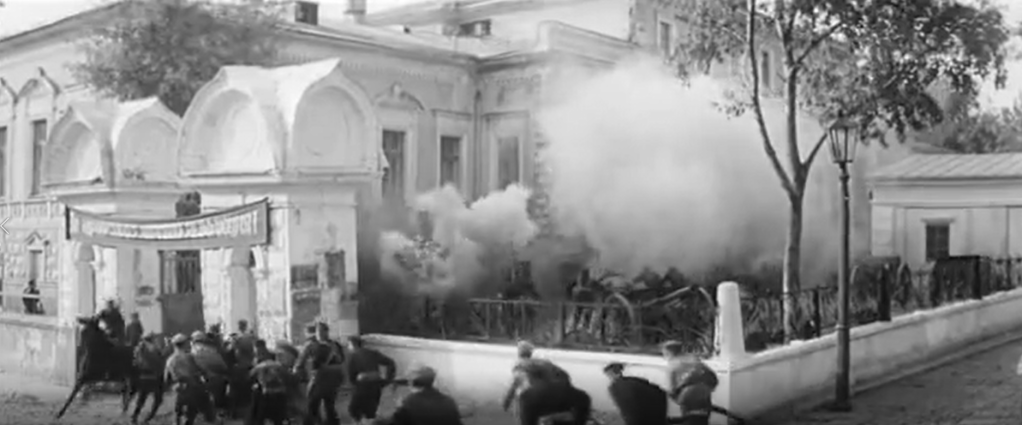
Street fighting during the Civil War. From the Mosfilm movie The Sixth of July, dir Yuli Karasik, 1968

Become a paying supporter to get access

Access to this article is limited to paying supporters. If you already subscribe by email, thank you. But if you want to become a paying supporter, please hit ‘Subscribe’ below.

Donate less than the price of a coffee, and you can access everything on this blog for one year.

If you don’t feel like donating, most of my posts are still 100% free, so browse away, and thanks for visiting.

Go to Revolution Under Siege Archive

Go to Home Page/ Archive

Sources

Beevor’s Russia, Part 2: Back-dating Terror

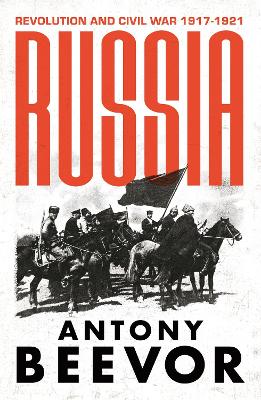
Review: Russia: Revolution and Civil War, 1917-1921 by Antony Beevor

Welcome to Part Two of my review of Russia: Revolution and Civil War, 1917-1921 by Antony Beevor. The previous post looked at some of the distortions and mistakes in the book. It also acknowledged some of the book’s good points. This post will set out to deconstruct the book’s overall narrative. We will expose how it shuffles around timelines and how it assumes, with zero evidence, that the events of the Civil War unfolded according to some master plan created by Lenin.

Before we begin, for the sake of balance I want to say that I don’t think the author is a liar or an idiot. My guess is that this book was produced (1) with a complacent attitude, without the author challenging the assumptions he held at the start of the project and (2) too quickly.

Back-dating famine and terror

First, let’s take a look at how the book juggles with the timeline, and what effect this has on the reader’s understanding of events.

Last week we saw how selectively Beevor quotes the writer Maxim Gorky. Likewise, he quotes Victor Serge without giving a fair indication that Serge was actually a Communist.

Beevor uses quotes from Serge to give a very bleak description of St Petersburg in January 1918 ‘after just a couple of months of Soviet power’ (Page 156). It was indeed bleak at that time. And it had been before the October Revolution too, and even before the war, working-class districts had unpaved and unlit streets. The problem is this: Beevor is quoting from Victor Serge’s novel Conquered City, and that novel is set between early 1919 and early 1920. Serge was not in Russia in January 1918. He was describing the city a year-plus later, after six to eighteen months of full-scale Civil War – not after ‘a couple of months of Soviet power.’

Beevor is back-dating the social and economic collapse of Petrograd in order to mix up cause and effect. He wants to blame economic collapse on the Revolution, not on Civil War.

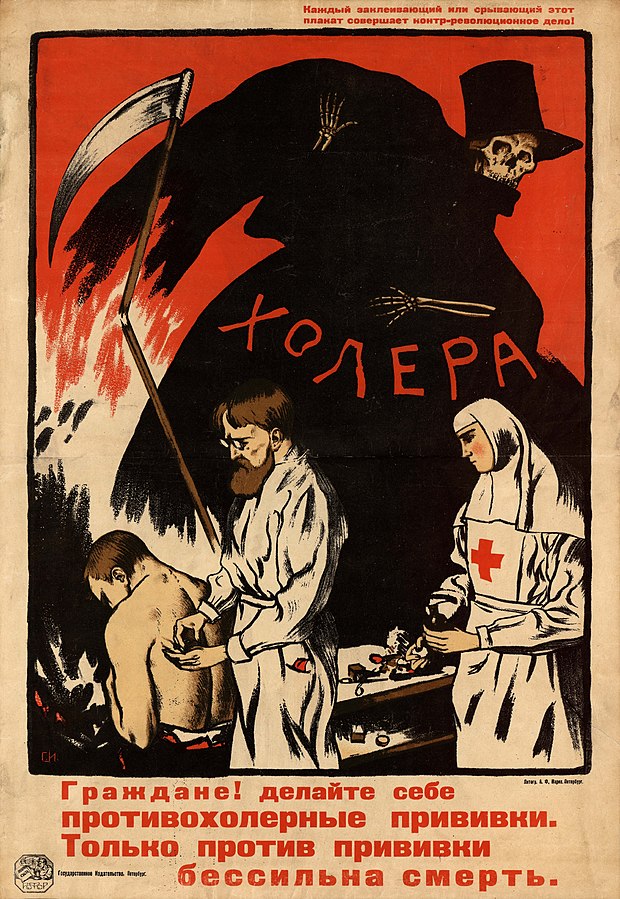
A Soviet poster from the Civil War era shows a looming menace labelled ‘Cholera’

We see the same pattern with the question of terror.

Red Terror did not begin until months into full-scale Civil War.[i] There were important outliers – the killing of officers in Kyiv (which Beevor describes[ii]) and the massacre by Russian settlers in Kokand, modern-day Uzbekistan (which he does not mention), which both occurred in February 1918. But in general, Red Terror escalated over the summer as the military and economic crisis deepened, then hit full-force at the start of September 1918.

There is state terror and then there is mob violence. Russia: Revolution and Civil War tries to blur the line between the two. Tsarist Russia was an empire of 150 million people with a threadbare state apparatus even before the Revolution,[iii] in which twelve million had been given rifles and boots and sent into a war whose traumatizing horror Beevor acknowledges. Unsurprisingly, there was mob violence and crime, and there would have been, revolution or no revolution.

He quotes an account by a bourgeois observer as evidence that the Soviets were conducting an onslaught of terror against the more affluent people: ‘They stir up the population and incite them to take part in raids and riots. This is not going to end well. There are robberies in the streets. They take people’s hats, coats and even clothes. Citizens are forced to stay at home after dark’ (Page 97-98).

Here is the note I left in my ebook:

like clearly this is a scared bourgeois conflating crime and ‘bolshevism’, not an accurate account of bolshevik activities [sic]

Did the Soviets encourage criminal gangs and robberies? No. In fact, the draconian security measures brought in by the Soviets were partly directed against such criminal activity.

Page 137: ‘Echoes of the atrocities in the south soon reached Moscow’ in early 1918 – reading this sentence I thought, ‘That’s just another way of saying you’re about to report some unconfirmed rumours you found in diaries and letters.’ Sure enough, that’s what he does, and even accepting everything at face value, you can see that this is the violence of mobs and of local self-appointed revolutionary leaders.

In the last post I mentioned Beevor’s class bias – how he tends to credit sources written by wealthy and middle-class people, and to dismiss or ignore sources written by workers. We see it at work in the example above. It is with this one-sided approach to his sources that he invents a whole new wave of Red Terror that supposedly began instantly following the Revolution. He gathers an imposing collection of anecdotes about violent acts, giving the impression that the Soviets organized it all. The number of anecdotes makes a certain impression, but no attempt is made to quantify this phenomenon.

Why does this matter? Because having back-dated the economic collapse, he is now back-dating the Red Terror. He is telling a story in which, within a few weeks of the October Revolution, Terror is in full swing and Saint Petersburg has regressed to the Stone Age.

Is this really what Russia was like mere weeks after the October Revolution? No, this is what Russia was like a year after three-quarters of its territory was seized by insurgent officers, Cossack hosts and invading foreign armies.

Cover image: a White Army poster. A worker is being convinced to sign up for Denikin’s army

Blind taste test

To illustrate further why this matters, I’m going to invite you to play a game, a kind of historical blind taste test. I’m going to give a brief account of two governments in two different parts of the world, decades apart. Let’s call them Govt A and Govt B. One is the Soviet Union. See if you can guess which one.

Govt A came to power in a coup in October 19__. It immediately set out on a nationwide purge of political opponents. By summer, somewhere between half a million and two million unarmed people had been killed by Govt A. Peaceful opposition parties and organisations with mass membership were not just banned but destroyed by terror, all within a few months of that October coup. Ten years later, a million peaceful oppositionists were still imprisoned in a vast network of concentration camps.[iv]

Govt B came to power in October 19__. By April of the following year Govt B had been threatened by a series of armed revolts led by military officers, but it remained a multi-party regime. In May a civil war began when most of the country’s territory was seized by insurgent forces and foreign armies. Even months into this war, congresses whose delegates were elected from field and factory still met. But eleven months after coming to power, Govt B began a campaign of terror which lasted three years and claimed somewhere between 50,000 and 280,000 lives.[v] Ten years later, the entire prison population was around 192,700.[vi]

So take your guesses. Scroll down for the answer.

.

.

.

.

.

.

.

.

Govt A is the Suharto regime in Indonesia (1965). Govt B is the Soviet regime in Russia (1917).

Suharto killed far more people in a far shorter span of time. The murder of a handful of generals by a conspiracy of junior officers was used as a pretext for massive violence against groups who had no connection to that inciting incident. On coming to power, Suharto immediately exterminated the unarmed Communist Party of Indonesia, the feminist organization Gerwani, and the trade unions. There were no exacerbating circumstances. There was no tragic upward spiral of violence. There was not the slightest element of self-defence.

It’s a very different story with the Soviet regime, which had enthusiastic popular support in the cities and at least acceptance elsewhere, and which resorted to repression only in the context of all-out war on its territory. To what extent repression was justified is a question that is not relevant to this book review. Right now all we’re doing is clarifying the context and what actually happened.

Because in essence, Beevor’s goal in the first half of Russia: Revolution and Civil War is to convince the reader that Govt B was Govt A, that Lenin was Suharto. He wishes to tell a story in which the Soviet regime, like the bloody right-wing military coups in Indonesia (1965), Chile (1973) or Spain (1936), seized power then immediately murdered the opposition. But this is simply not what happened in the Russian Revolution.

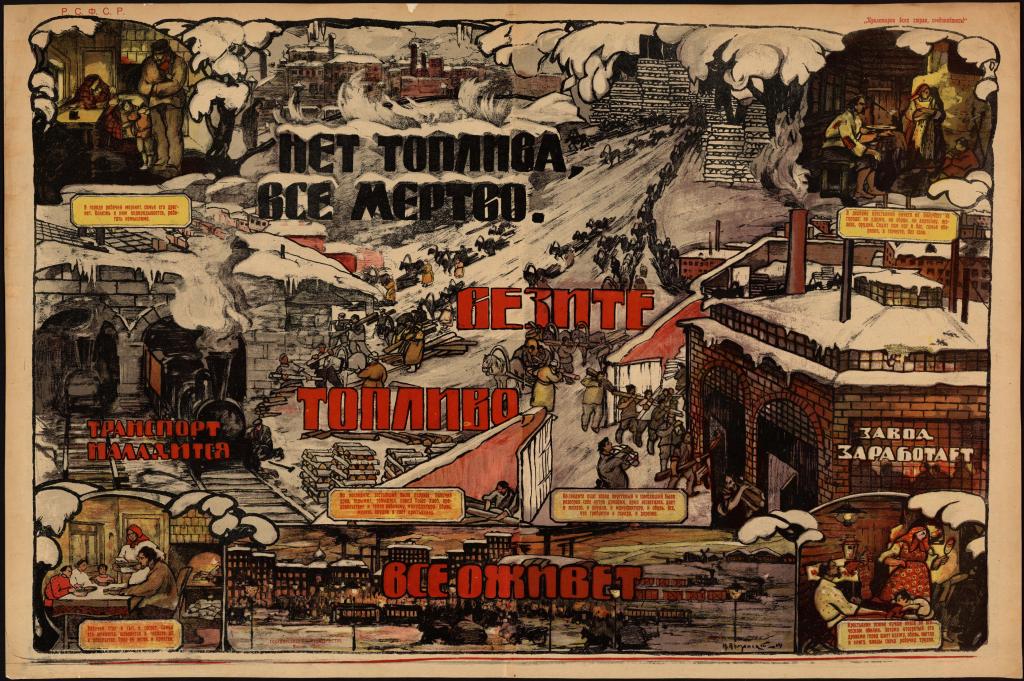
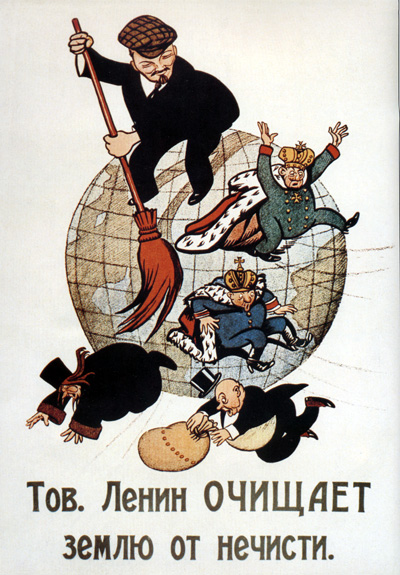
This Civil War-era Soviet poster gives a panorama of life during that time.

The Master Plan

A more nuanced criticism of the Bolsheviks is that they were utopian and irresponsible, that the October insurrection triggered a chain of events that forced them to adopt terror and dictatorship, and later to degenerate into Stalinism. I don’t agree with this view; I blame invasion, insurgency and blockade for the Civil War and the mass mortality which attended it.

But whichever of those two arguments you accept, Beevor’s argument stands off to one side with a demented look in its eyes. He believes that Lenin planned it all in advance – the Civil War, the confiscation of grain, terror, the suppression of opponents, one-party rule. Of course, there is absolutely no evidence that Lenin had such a plan. But for Beevor, the lack of evidence shows only that Lenin was dishonest and hid his real intentions! Childish stuff.

Just in case you think I am caricaturing Beevor’s position, here is what he says:

  • Grain requisitioning was in fact an emergency response to famine; but for Beevor, it was an act of malice long premeditated in the mind of Lenin. ‘The peasants were encouraged to believe that the land would be theirs to own and work as they saw fit. There was no mention of the need for grain seizures to feed the cities or the forced collectivisation of farms.’ (Page 50) Grain seizures were not foreseen, though Fitzpatrick comments that the Bolsheviks themselves were probably more surprised by it than the peasants, from whom contending armies had seized supplies since time immemorial. And it was fair enough not to mention forced collectivisation, right? Seeing as, well, in Russia in these years, it wasn’t Communist policy and in fact it actually didn’t happen..?
  • The withering of Soviet democracy was an effect of Civil War, famine and polarisation; but in this account, it was the fulfilment of a secret blueprint for a one-party state. ‘In his determination to achieve total power for the Bolsheviks, Lenin did not make the mistake of revealing what Communist society would be like. All state power and private property, he claimed, would be transferred into the hands of the Soviets – or councils of workers – as if they were to be independent bodies and not merely the puppets of the Bolshevik leadership.’ (p 50) ‘And because he knew very well that his plan of complete state ownership was not popular, he simply paid lip service to the idea of handing the land over to the peasants and factories to the workers.’ (Page 62) The casual reader, for whom this is the first thing they ever read on the Russian Revolution, would not suspect that such documents as ‘The State and Revolution’ or ‘The impending catastrophe and how to combat it’ ever existed. They would assume that what Beevor is saying is based on some document or other written by Lenin where he reveals his secret plans. There is no such document. The casual reader (and maybe even Antony Beevor) would be surprised to learn that four Soviet congresses met in 1918 and that by the end of the war there were still large numbers of factories democratically run by their workers.
  • The other elements of the master plan, the Cheka and Lenin’s supposed plan to deliberately start a Civil war, are dealt with here.

We can say categorically that there is no evidence that such a master plan ever existed. If you look at what the revolutionaries actually wrote, said and did, it is clear that they favoured a gradual socialisation of the economy, the sharing-out of land rather than collectivisation (collectivisation was to be a gradual and voluntary process lasting decades), and multi-party democracy in the Soviets.

Later, some Communists made a virtue of necessity. But still, more than traces of the original plan are visible down through the years. In early 1919 the Soviets were willing to surrender most of the territory of Russia to the Whites, just to end the war – hardly consistent with the supposed master plan. Right after the abrupt ending of Beevor’s narrative, millions were demobilised from the Red Army, the Cheka was radically downsized and curtailed, and the New Economic Policy (NEP), which favoured the peasants, was brought in.[vii]

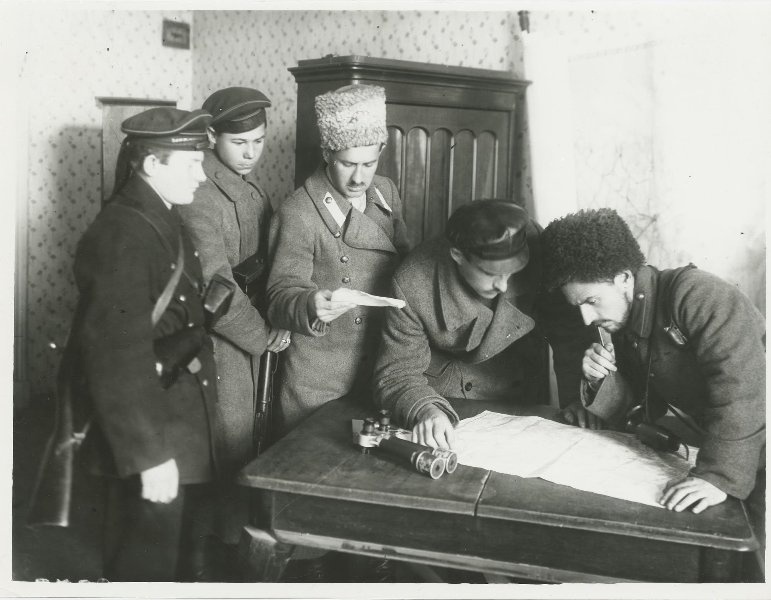
Headquarters of naval cadets near Narva, September or October 1919. What are they reading? Lenin’s master plan?

This point applies to the back-dating which I described earlier. Why does it matter if a writer shuffles things around by a few months? Isn’t this a justified simplification for the sake of clarity? In his point of view it probably is. But months, weeks and even days can matter a great deal. Torture, invasions and the USA Patriot Act were not brought in before September 11th 2001. Likewise events before May 1918 and after May 1918 must be judged by different criteria. For example, a radical economic plan from the Left Communists was actually rejected by the Party in March 1918. But in the context of the extreme military and economic emergency that very quickly emerged, most aspects of it were adopted out of necessity and became known as ‘war communism.’

I don’t accept Beevor’s narrative. I believe that the forced seizure of grain was an emergency response to famine, not an act of senseless vandalism born under the malicious cranium of Lenin.

The reasonable debate you can have here is whether they were effectice or fair reaponses. But because Beevor has set out to tell a certain story, we never get that far.

The crises which led to terror, requisitioning, dictatorship etc are treated as if they were results of terror, requisitioning, dictatorship etc. Beevor leaves the uninformed reader with the impression that the officers and Cossacks rose up in arms because they were outraged by a situation which did not arise until months later – and which arose due to their insurrection! In this way, Russia makes an absolute mess of cause and effect.

Blame on both sides of the equation

In passing, note how no opportunity is missed to condemn the Reds. The ‘Bolsheviks’ are blamed for supposedly failing to cooperate with others, but they are also blamed whenever someone with whom they cooperate does something bad (Muraviev); they are blamed for crime, and also for the draconian security measures which were partly directed against crime; they are blamed for the mistreatment of civilians by the Red Guards, and also for the harsh discipline which put an end to this behaviour. Further explanation is required, surely, when blame is placed on both sides of the see-saw.

Conclusion

This is a vigorous but crude book because, for all its grisly detail, it dispenses with nuance. The author has decided to convince us that Lenin is like Suharto, even like Hitler (more on that next post!). He’s not the first but it’s a bold move. This all-out ‘take-no-prisoners’ approach gives the writing some vigour, but it goes against the grain of reality, compelling the author to back-date key developments and, furthermore, to insist that these developments were the fulfilment of a secret master plan. What emerges is something compelling but not convincing.

A more skilful demonisation of the Reds would emphasise that ‘the road to hell is paved with good intentions,’ etc, etc, would use the bright colours as well as the dark, would not neglect to use the elements of tragedy which so obviously present themselves. Most accounts, from every side of the political spectrum, do this to some extent. But Beevor has taken a gamble, and gone for something bolder. He has fallen short, because reality does not correspond to the story he is trying to tell.

So Russia: Revolution and Civil War lands with some force, but it does not stick. Even those who are stunned into an uncritical acceptance of Beevor’s narrative will be able to see clear daylight through the gaps in the narrative, and may later reconsider, especially if they end up reading a few other bits and pieces on the same topic.

Go to Revolution Under Siege Archive

Go to Home Page/ Archive
Sources

My previous post on Russia: Revolution and Civil War


[i] This is not just my contention. Here is just one example which I have to hand as I write, from an account not sympathetic to the Soviets: Silverlight, The Victors’ Dilemma, Page 15: ‘real oppression did not start until the Terror, several months later.’

[ii] This massacre of officers cannot be justified with reference to existential threats. Estimates of the death toll range from the low hundreds to the thousands. But important parts of the context are missing from Beevor’s account: the suppression of the Kyiv Arsenal revolt by the Rada, the killing of prisoners by the Rada, and the fact that the Red Guard force which carried out the massacre was a notably undisciplined one led by the adventurer Muraviev, an officer who had recently joined the SRs. Needless to say, the broader context (his account of the conflict between Rada and Soviet) is one-sided.

[iii] ‘in 1900 an individual constable in the countryside, assisted by a few low-ranking officers, might find himself responsible for up to 4,700 square kilometres and anywhere between 50,000 and 100,000 inhabitants.’ Smith, Russia in Revolution (p. 19)

[iv] See The Jakarta Method by VIncent Bevins, PublicAffairs, 2020

[v] The lower figure comes from Faulkner, ‘The Revolution Besieged’ in A People’s History of the Russian Revolution and the higher figure from Smith, Russia in Revolution: ‘One scholar estimates that between October 1917 and February 1922, 280,000 were killed either by the Cheka or the Internal Security Troops, about half of them in the course of operations to suppress peasant uprisings.’ (p. 199)

[vi]  Peter H Solomon Jr, Soviet Penal Policy, 1917-1934: A Reinterpretation 

[vii] None of this is secret lore. On the land question, see the collection The Land Question and the Fight for Freedom. On the rejection of the Left Communists’ proto-war communist plans, see Year One of the Russian Revolution by (none other than) Victor Serge. On the Soviets’ peace plan, see any history of the Civil War. On the downsizing of the Cheka, see Smith: ‘At the end of 1921 there were 90,000 employees on the official payroll of the Cheka, but by end of 1923 only 32,152 worked in OGPU.’ (Russia in Revolution, p. 296).

Beevor’s Russia, Part 1: A Crude Demonology

Review: Russia: Revolution and Civil War, 1917-1921 by Antony Beevor

I’m writing a series about the Russian Civil War, so I’ve read up on it. I was in a position, so, to notice the blind spots, omissions and distortions in Antony Beevor’s book Russia: Revolution and Civil War which came out last year. Soon after starting the book, I wrote a brief review of just one chapter. I thought I might leave it at that.

That was, until I Googled a few of the mainstream media reviews. Apparently it’s ‘a masterpiece,’ ‘grimly magnificent‘ and ‘a fugue in many tongues.’ Since the moment I was exposed to this gushing, I have felt an urge to point out that the emperor has no clothes. Judged as a work of popular history, Russia is deeply flawed. Judged as a work of anti-communist demonology, it’s spirited but crude. The fact that it demonises the Red side would be a selling point for some, but many have failed to notice what a clumsy demonisation it is.

So I’ll be reviewing the book in a short series of posts. This first post will deal with the things I liked about the book, and then go into some serious criticisms of its one-sidedness, its bias toward the rich, its credulity and its general sloppiness.

Positives

Fortunately, the whole book is not as bad as that one chapter I looked at before. That chapter is merely on the bad side of average. Overall, the book has some strong features which manage to shine through.

  • First, it is a detailed narrative history of the Russian Civil War, a rare thing in the English language, which gives the book a certain value in itself.
  • Second, Beevor had the help of researchers in Eastern Europe, so there is a wealth of new material here that I haven’t come across elsewhere.
  • Third, when it is in narrative mode and not moral judgement mode, the book is well-written. For example, the section on the year 1919 is mostly good, and if I was reviewing only that one-fourth of the book I wouldn’t have much bad to say.
  • Fourth: the book deals with White Terror as well as Red. I was honestly surprised because most western accounts pass over anti-communist atrocities in tactful silence. However, even in this treatment of White Terror there are big problems, which I’ll point to below. Another thing to stick a pin in and come back to later: here as elsewhere, Beevor’s own evidence makes a joke of his conclusions.  

Not every element of the book is crude. The narrative is strong at times. In short, for its style it is readable, and for its content it is a useful resource. Per-Ake Westerlund has written a useful review in that spirit.

Now, on to the bad points.

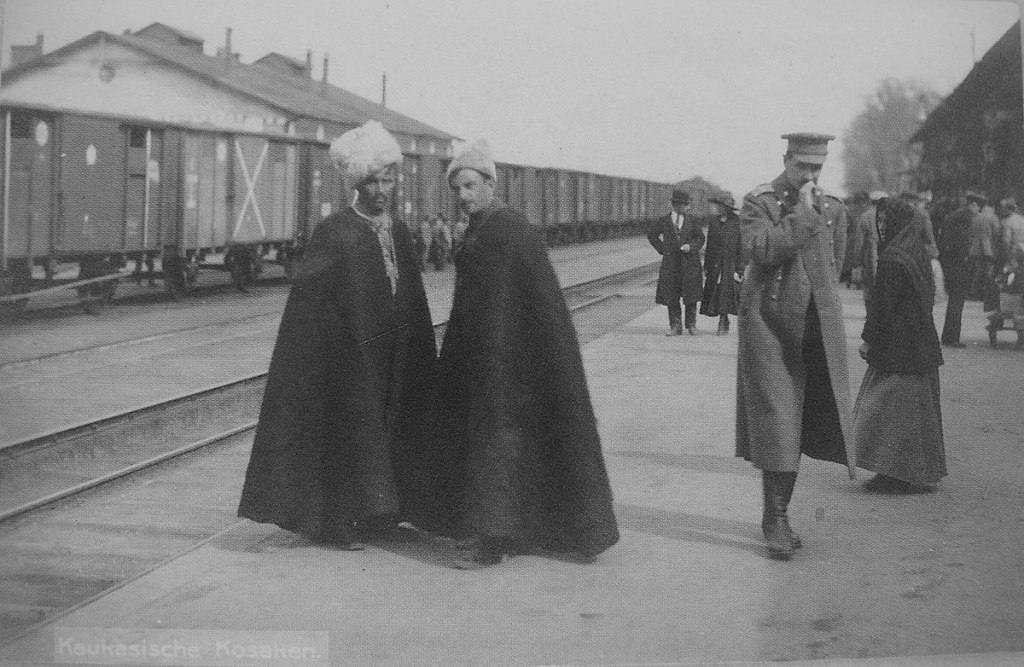
Cossacks and a White officer in Odessa railway station, 1919

What were they fighting about?

In its review the Wall Street Journal asks: ‘If the American Civil War ended slavery, and the English Civil War restrained the monarchy, what did the Russian Civil War achieve?’

If this book was the only thing you ever read about the Russian Revolution, you could be forgiven for asking such a question. The most striking feature of Russia: Revolution and Civil War is its complete inability to see anything positive in the revolution. It’s such a one-sided book, you would probably be appalled to find out there are well-read people (such as me) who regard the Revolution as a great event in world history. If you uncritically accept everything Beevor says, you could only regard me as a dangerous lunatic for holding such a belief.

I suppose it is true that the seizure of the land of the nobility by the peasants was not an enjoyable experience for the nobles. But what about the point of view of the peasants themselves? Weren’t they happy to get more land? And weren’t they a hundred times more numerous than the nobles? Beevor doesn’t even ask the question. But when the peasants began ‘to seize their landlords’ implements, mow their meadows, occupy their uncultivated land, fell their timber and help themselves to the seed-grain,’ he describes it as ‘violence’! (p 50-51)

Was there nothing inspiring in the fact that millions of poor people organized themselves and exercised power through workers’ councils? Apparently not; Beevor dismisses Soviet democracy in a few lines.

The author acknowledges how bad the Great War was, so how can there be nothing positive or even viscerally satisfying for him in the revolt of the soldiers? Was the liberation of women really such a trifling matter that it can pass without any mention at all in 500 pages? How about free healthcare? The world’s first planned economy, which provided healthcare, education and housing to 200 million people and turned a semi-feudal country into the world’s second industrial power?

Isn’t it at least interesting for a military historian that, in the Red Army, formal ranks were abolished and a regime of relative egalitarianism prevailed between commanders and soldiers? That sergeants, ensigns, steelworkers and journalists found themselves commanding divisions and armies, and won? 3/4 of the way through this post I wrote you will find a bullet-point list of similar points.

What, indeed, did the Russian Revolution achieve? Nothing at all – unless we count the achievements.

By failing to deal with these points, the book is neglecting to tell us what the Reds were fighting for, or what the Whites were fighting against. The whole thing becomes a leaden nightmare. People in funny hats are dying of typhus and hacking each other to pieces with sabers for no apparent reason.

Every writer on history makes decisions about what to include and what to leave out. Beevor left in all the bits about dismemberment and torture chambers and rats gnawing at the soft parts of people, and left out all of the above. That’s his prerogative. But isn’t it manipulative? Isn’t it morbid? If you are that reader who has never read anything else on the subject, don’t you have a right to feel cheated?

Baking the evidence

The first half of the book, especially, exhibits all the features I outlined in my previous post.

Whenever Beevor comes across a quote from a communist that can be interpreted in a negative way, he proceeds to bake it, to over-interpret it until it is twisted beyond recognition. I imagine him sitting at his keyboard and muttering ‘Gotcha,’ before he ascends to the pulpit with a scowl on his face to deliver a sermon whose theme is the wickedness of the Bolsheviks. 

One example: in June 1917 a Menshevik stated that no political party in Russia was prepared to take power by itself. Lenin responded that his party was ‘ready at any moment to take over the government.’ The meaning of this statement is blindingly obvious: they were ready to form a single-party government if necessary, though still open to a coalition government. But Beevor ascends to the pulpit. Apparently it was a ‘startling revelation’ which ‘proved that Lenin cynically despised the slogan “All power to the Soviets”’ and sought ‘absolute control.’ A large part of the texture of the book consists of moments like this.

At other times he caricatures wildly, or presents his own very strange interpretations as if they were factual statements. A street protest in April 1917 is described as a ‘tentative coup’ and a ‘little insurrection’ – ‘tentative’ and ‘little’ are doing a lot of heavy lifting. Any kind of peaceful, democratic Bolshevik political activity – visiting soldiers and talking to them; winning a Soviet election – is invariably described as ‘infiltration.’

Lenin, who Beevor loves to hate

Credulity

In addition, Beevor gives credence to dodgy sources. One example: it has been generally accepted for 100 years that the October Revolution in Petrograd was almost bloodless. Or so communist propaganda would have us believe!

Beevor quotes the memoirs of one Boyarchikov, describing a clash at the telephone exchange during the fateful first night of the Revolution. There is a fierce gun battle in which loads of people are killed. After the fight, the pro-Soviet Latvian Riflemen pick up all the dead and the wounded, the enemy’s and their own, and throw them out of an upper-storey window! Next they throw the dead and dying into the river, presumably to hide the evidence (Page 99-100).

This account is obviously absurd. A slaughter such as the one described would have had many, perhaps hundreds, of participants and witnesses, and the press would not have been shy about spreading the news. Why would the Latvians throw their own comrades out of a window and then into a river? For that matter, why would they even do that to the enemy?

You might wonder why someone would make up such a Ralph Wiggum-like story. The answer is that the October events in Saint Petersburg triggered a veritable fever dream of fabricated atrocity stories. The detail about the bodies being dumped in the river was probably invented to explain the lack of corroborating evidence, ie, a massive pile of dead bodies, or a politicised mass funeral.

Beevor repeats some of the discredited rumours from the time: that the Women’s Battalion were ill-treated, and that the Bolshevik Party was funded by ‘German gold.’ In both cases he admits that there’s no evidence, but this doesn’t stop him from bringing it up in the first place, or from writing words to the effect of shrugging his shoulders and saying ‘I guess we’ll never know.’ It’s the old ‘shouted claim, mumbled retraction’ trick.  

Russian and Finnish Red Guards, 1918. CC-BY Tampere 1918, kuvat Vapriikin kuva-arkisto. Finnish Civil War 1918 Photo: Museum Centre Vapriikki Photo Archives.

Only trust the affluent

In addition, he describes too much of the story from the point of view of officials who were trying to suppress the revolution, or members of the intelligentsia and bourgeois who were observing it with detachment at best, or horror at worst. Rarely does he condescend to show what a worker, peasant or rank-and-file soldier experienced or thought. As individuals, working class people enter the narrative only as sadistic persecutors. As a mass, they enter the narrative only as a ‘blindly’ destructive force which ‘the Bolsheviks’ exploit for their own ends.

This is because Beevor only trusts bourgeois and middle-class testimony. Second-hand rumours recorded in officers’ letters or bourgeois diaries are gospel. Later in the book he remarks, surprised, that the Red Army was magnanimous and fair after its conquest of Omsk. He accepts this about Omsk only because he has a first-hand account from a solid bourgeois citizen confirming that it was the case. Instances where the Reds were magnanimous to poor people are not relevant.

When Beevor spent a few pages writing about a failed attempt to get Tsar Nicholas’ brother to assume the throne, I left the following note in my ebook (Here it is with the original typos, because they’re funny):

jesus christ, this is a historian in the 21st century, obsessing about dynastic minutiae while ignlring the sociology and street politics where historyis really beimg decided [sic]

This book must be confusing for the casual reader. How did the Bolsheviks take power? Did they convince everyone to support them with a flashy German-funded ‘press empire’ (Page 76) or was it by prevailing upon a bunch of simpletons to ‘repeat slogans’ until they were blue in the face? (Page 93) In theory both could be true, I suppose, but it doesn’t really explain why a tiny party grew so rapidly to the point where it was able to lead the Soviet in a popular insurrection.

Eyewitness accounts of the February Revolution which described soldiers firing machine-guns at demonstrators were ‘repeated constantly’, he says, but it is ‘impossible to tell’ if these accounts are true, even though he admits that there were machine-guns trained on them and that rifles were fired at them (Page 34). What contempt for the working-class authors of these eyewitness accounts.

His default ‘point of view’ in the narrative is that of the affluent person ruined by the Revolution, or even just inconvenienced. For example he bemoans the lack of ‘privacy’ for wealthy people who had to share their large homes with multiple poor families. Not a word about the lack of privacy suffered for decades by working-class people who lived in slums (often three to a room, often sharing beds) or in company barracks. He laments the fact that formerly wealthy families had to sell their goods in the streets. No hint of sympathy for the vast majority of families, who never got to own such goods at all until after the revolution.

‘Revolution could also reveal that the downtrodden harboured some terrifying prejudices,’ he says, and then tells us an anecdote about a stall holder who made an anti-Semitic comment. Of course, the not-so-downtrodden (Tsar Nicholas, and all those generals and ministers who Beevor loves to quote, and the entire Orthodox Church, and the entire White movement) held the exact same prejudices, but in their case it is apparently not terrifying.

Early on, he briefly acknowledges how squalid and difficult life was for 90% of people under the old regime. But he does so in a way that’s not meant to evoke sympathy or understanding; it’s just more icky details to make the book even more ‘grimly magnificent.’ The effect is to humiliate and dehumanise the poor. And he goes on to humiliate and dehumanise them with a sweeping, derogatory remark here and a prejudiced quote there in every other chapter. Usually through the safe remove of quotation marks, but with insistent repetition, Beevor describes workers, peasants and Russian people generally with phrases like ‘Asiatic savagery,’ ‘children run wild,’ ‘ignorant,’ ‘blind,’ ‘dark mass,’ ‘grey mass,’ ‘anarchic Russia.’

But as we noted, when Lenin calls rich people parasites, Beevor charges him with incitement to genocide!

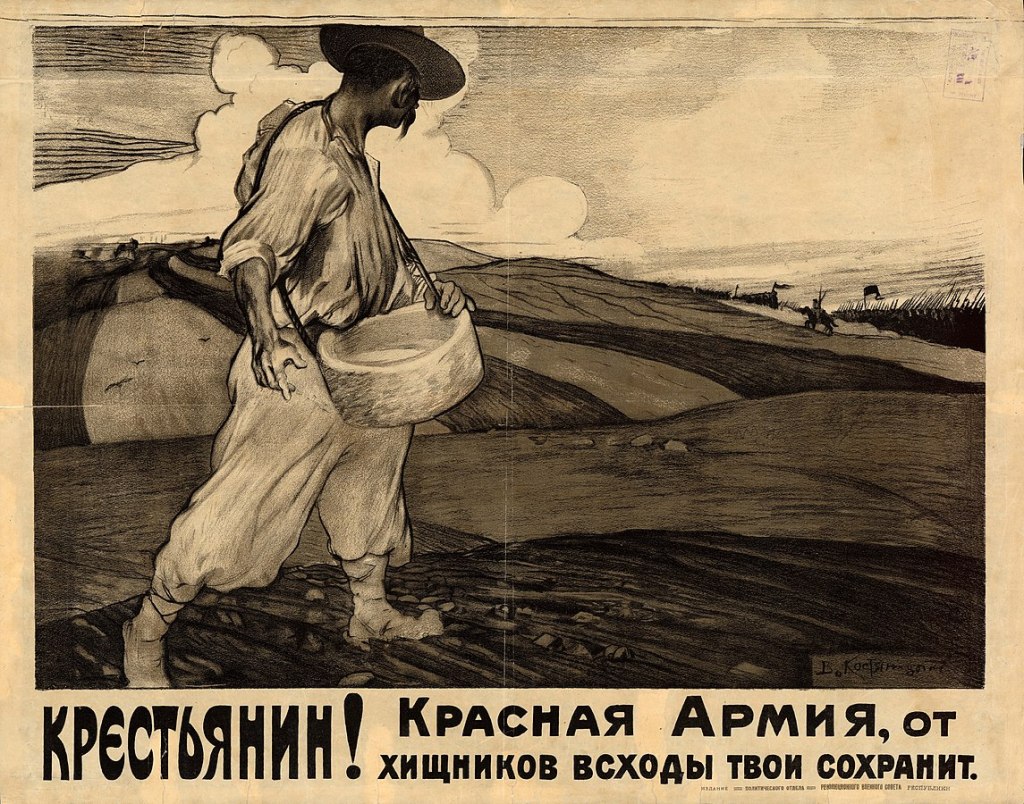
A Russian peasant, depicted in a Red Army poster

Stalinism

One reviewer writes that Beevor ‘comments occasionally on the ways events foreshadow (‘give a foretaste,’ he calls it) of horrors to come.’

(As an aside, imagine being so impressed by the phrase ‘Give a foretaste’ that you would note it in your gushing review. Has she never read a book before?)

Russia: Revolution and Civil War actually makes no mention of Stalinism, of the later development of a bureaucratic tyranny that was responsible for such crimes as the Great Terror of 1936-39, the catastrophe of forced collectivisation and the mass deportation of minorities. This is probably because the book is too busy alternating between narrative and moralising to bother with analysis, but it is actually refreshing. Beevor does, however, set things up so that his star-struck reviewers can easily kick the ball into the net: they repeat in chorus, like the sheep from Animal Farm, that this book proves Lenin was just as evil as Stalin.

The reviewers don’t show any understanding that the violence and suffering of the Civil War was completely different in scale, in context and in character from the atrocities of Stalinism. Nor do they appear to suspect that anyone apart from the Bolsheviks might have been responsible for the Civil War and for the violence and suffering that ensued. More on that in future posts.

Sloppiness

Russia: Revolution and Civil War is often sloppy. Beevor repeats several times that Lenin was cowardly, but provides only one example (he went into hiding when the government wanted to arrest him, which seems pretty reasonable). Then he goes on to provide several examples of the Bolshevik leader being personally brave. Each time he remarks on it as a strange exception! Similarly, he says that Lenin is intolerant, but goes on to note one ‘exception’ after another. He doesn’t modify his characterizations, just lets them stand even when they’re full of holes.

Lenin is a key character in the first half of the book, but disappears in the second half – which suggests the heretical idea that maybe he didn’t have complete totalitarian control over events. The atamans of Siberia are introduced – then never followed up on. The narrative ends with Kronstadt, as if the author simply got tired; but at this point the Whites were still in Vladivostok. The introduction and conclusion are insubstantial, especially in comparison to the leaden weight of the book. They are like the wings of a fly growing out of the flanks of an elephant.

Another confusing point: Beevor notes in passing, half-way through the book, that Lenin was good friends with the writer Maxim Gorky. Up to this point Beevor has frequently quoted Gorky, always cherry-picking his most extreme criticisms of the Bolsheviks, never giving a more balanced impression of Gorky’s politics. The reader will wonder how Gorky could possibly stand to be in the same room as Lenin, and how for his part the ‘intolerant’ Lenin could be friends with Gorky. If reality corresponded to Beevor’s unbalanced account of the Revolution, then Gorky would have lasted about six weeks before being shot by the Cheka. As opposed to having a park in Moscow named after him!

As I noted before, much is made of the Cheka in December 1917 – all twenty of them. The development of this institution is not described in the rest of the book either; the Cheka just enters stage left and immediately starts slaughtering people. More on that next week.

In the chapter I reviewed before, Beevor was simply too strident and excitable to give an inch on anything. In the examples above he’s more conscientious, mentioning facts that are inconvenient to the case he’s making. But in failing to reconcile his characterizations with the evidence, he is making a bit of a mess that will leave readers scratching their heads.

And there I will leave you, perhaps scratching your own head; if you read the book and thought Beevor was courageously bearing moral witness to some hitherto-undiscovered chapter of history unsurpassed in horror and squalor, I hope I’ve given you something to think about.

Please subscribe and keep an eye out for Part 2 of this review.

Go to Revolution Under Siege Archive

Go to Home Page/ Archive
Sources

My previous post on Russia: Revolution and Civil War

So far, Beevor’s new book is terrible

I learned a lot from Stalingrad and The Battle for Spain, so I was interested to learn that Antony Beevor was tackling the Russian Civil War in his latest book.

But judging from what I’ve read so far, Russia: Revolution and Civil War 1917-1921 is a crude offering. I’ll show what I mean by reference to a single chapter (which is more or less all I’ve read).

When I looked at the contents page, my eye was drawn to a chapter titled ‘The Infanticide of Democracy, November-December 1917.’

If you’re going to put an image of infanticide into my head, you’d better have a good reason. In this case, there is no good reason: during those two months, November and December, the Bolsheviks secured a majority in the Soviets, then received the blessing of a peasant soviet congress. They passed decrees on peace and land. They went into coalition with the Left SRs. They held the Constituent Assembly elections. The street fighting lasted only a few days, and the Whites involved were in general treated with magnanimity. Throughout, the Bolsheviks resisted the pressure to enter coalition with parties whose programme was diametrically opposed to theirs, and relied instead on the active support of millions of people.

All in all, I see this period as one during which, against challenging odds, the new soviet government lived up to its promise. But Beevor doesn’t see it that way.

Peace

He starts out talking about the war. Even though he dubs World War One ‘The Suicide of Europe’, he condemns the Soviets for trying to end the war. For him, the peace efforts were a bad thing because they encouraged rowdy and violent deserters (as if the rotten Tsarist army was not already collapsing due to mass desertion). If the Bolsheviks had broken their peace promise and forced everyone to fight on at gunpoint, no doubt Beevor would condemn that too. And he would be right!

Next in line for condemnation are the deserters themselves – because they ripped the upholstery out of first-class train carriages to wrap around their bare feet. Unmoved by the bare feet of the soldiers, Beevor is moved by the plight of the upholstery.

It must be fun for Beevor to come up with these taboo-busting chapter titles. ‘The Suicide of Europe,’ ‘The Infanticide of Democracy’… What’s next? ‘The Incest of Asia’? ‘The Opioid Addiction of Oligarchy’?

Plotting Civil War

Lenin, Beevor tells us, ‘welcomed destruction for its own sake.’ From there, he argues that Lenin wanted to start a civil war – ‘to achieve tabula rasa through violence,’ that he wanted all the horrendous destruction and inhumanity of 1918-1921 to happen so that he could ‘retain power’ and build communism on a clean slate.

So according to Beevor, Lenin’s plan was to hold power and to build communism in a context where the industries were devastated, where the areas which produced food and raw materials were occupied by enemy armies, where the urban working class – his support base! – were dying in huge numbers, where military spending made it impossible to pursue ambitious social programmes. Needless to say, this was not his plan.

By April, Lenin was happy (an unfortunately very wrong) to declare that the war was over. The idea that he wanted the Civil War at all is just as absurd as his alleged motivation.

But Beevor ‘proves’ his contention by cooking up the most negative and hostile interpretations of carefully-selected utterances by Lenin, then presenting these interpretations as fact.

You can feel Beevor’s fury and disgust every time he mentions Lenin. Whenever we see that name, it is accompanied by a bitterly hostile remark. He must have damaged his keyboard, angrily banging out L – E – N – I – N again and again. And yet to Lenin he keeps returning, as though the revolution revolved around one man.

Food

He ridicules Lenin’s claim that wealthy people were sabotaging food supplies. But this sabotage was taking place. First, there was speculation, or in other words the hoarding of food to drive up prices. Second, there was the strike of government employees, which was creating a humanitarian crisis, the sharpest edge of which was a food shortage. This strike was financed by rich people and big companies, and collapsed when they withdrew their support.

In a context of looming famine, when Lenin calls wealthy people ‘parasites’ and calls for a ‘war to the death’ against them, Beevor says this is ‘tantamount to a call to class genocide.’

The blind spots Beevor reveals are interesting. In this passage he talks about two things: 1) rich people starving poor people to death, and 2) Lenin making an inflammatory speech. If you asked me which of those two things could best be described as ‘class genocide,’ I know which one I’d pick. But for Beevor, it’s the first-class upholstery all over again. He gets upset about dangerous words and not about empty stomachs.

The food supply crisis, naturally, he blames on the Bolsheviks – even though the food crisis had been getting worse since 1915 and the Bolsheviks had been in power for all of five minutes.

Kornilov

The author turns his attention to the right-wing General Kornilov, who broke out of prison and rode across Russia to the Don Country where he met up with thousands of other officers and set up a rebel army to fight the Soviet government. His descriptions of Kornilov in this chapter make him sound like a fearless adventurer whose only fault is that maybe he’s too brave. There were ‘innumerable skirmishes.’ No doubt if it had been Lenin fighting his way across the country Beevor would pause to describe the blood and guts of his ruthlessly slaughtered victims. Instead of this, he compares the whole thing to Xenophon’s Anabasis (That’s The Warriors to you and me).

Lenin is portrayed as plotting to start a civil war. But Beevor never ventures to speculate that maybe Kornilov is plotting to start a civil war. Apparently Kornilov is fighting his way across the country and raising a rebel army for some other purpose.

Beevor’s version of Lenin can only retain power by achieving ‘tabula rasa through violence’ – as opposed to retaining power by democratic means. Meanwhile what was Kornilov doing, and why does it not come in for any scrutiny?

Lenin’s power rested on the active support of many millions of people through the Soviets, which were at this stage still a robust participatory-democratic system. Meanwhile Kornilov’s power rested on the support of several thousand men who gathered by the Don river at the end of 1917. They were united in the conviction that no elections were possible in Russia until the country was ‘purged’ and ‘cleansed’ of the soviets, along with nationalist movements and minorities.

In other words, they wanted to achieve tabula rasa through violence. But, at least in this chapter, it does not occur to Beevor to present them in this way.

Anti-Semitism

The most dishonest part of the chapter comes with Beevor’s remarks on anti-Semitism. He relates two local episodes in which soldiers and sailors attacked Jewish people. These incidents are supposed to prove that the Soviets tolerated or even encouraged anti-Semitism. We read: ‘Soviet authorities tacitly condoned violence against Jews’!

But just a few pages earlier, Beevor writes at length about the foundation of the Cheka. Somehow he fails to mention that one of the main purposes for which the Cheka was founded was to combat anti-Semitic pogroms. The very incidents he describes may have been those which the soviets responded to by setting up the Cheka.

Nor does he mention the outlawing of all racist discrimination, including anti-Semitism, by the new government.

The Cheka

The Cheka during November-December 1917 was a security organisation with only a few dozen full-time staff. But Beevor writes of it as if it were already the feared and controversial instrument of terror that it became over the year 1918. No, scratch that, he writes about it as if it were already the NKVD under Lavrentiy Beria.

For example, he quotes a poem which he says was ‘later’ published in a Cheka anthology. This is a disgusting, psychopathic little poem which celebrates killing. What Beevor doesn’t mention is that this poem was published a lot later, 1921 at the earliest. The entire Civil War took place between the point we’re at in the narrative and the date when the Cheka published this unhinged poem. Four years is an age in times of revolution and civil war. This poem was not written or published in December 1917 and could not possibly have been. The brutality it reflects was a product of the Civil War. Beevor presents it as if it were a cause of that war, part of the ‘infanticide’ of democracy, as if that mindset was there from the start, was in the DNA of the Cheka.

After the Civil War, by the way, the Cheka was radically downsized. Its role, under different names and big organisational changes, as Stalin’s executioner was yet another even later development.

By jumping around in time like this Beevor doesn’t just present a misleading account. He tells a dull story, a smooth and frictionless history of the Russian Revolution. Stalin’s totalitarian state is already there, fully-formed, in November 1917.

The Bolsheviks were initially humane and even magnanimous. Utterances from revolutionary leaders in which they speak in military metaphors can be easily found. But it is just as easy to find them expressing the hope that the Russian Revolution would be a lot less bloody than the French (so far, it had been). Krasnov was paroled after attacking Petrograd. Many Whites who fought in Moscow were let go and allowed to keep their weapons. Lunacharsky was so horrified by the fighting in Moscow he resigned as a minister. Lenin was the victim of an assassination attempt in January 1918, but it was hushed up at the time so as not to provoke reprisals. But 1918 saw Kornilov and his successors, along with foreign powers and the Right SRs, create a terrible military, political and humanitarian crisis in a bid to crush the soviets. This was the context for the development of the Cheka into what it became.

But in the monotonous world in which this chapter takes place, there is no change, no development of characters or institutions. A is always equal to A. The Cheka is always the Cheka. This way of looking at the world may pass muster in a book where, for example, Guderian’s Panzer Corps remains for a long period a dependable, solid and unchanging entity. But it is ill-suited to talking about revolutions and civil wars, in which institutions can pass through a lifetime of changes in a few months.

It’s not just that he gives a misleading, flattened account. It’s that he misses an opportunity to tell a far more interesting story.

The Left SRs

To minimise the significance of the coalition, Beevor treats the Left SRs as a bunch of ineffectual idiots and claims that the Bolsheviks always got their way. In fact, many of the key early leaders of the Red Army and Cheka were Left SRs; all Soviet institutions were shared between the two parties, for long after the coalition broke up in March 1918, and even after the Left SR Uprising of July 1918. But here Beevor treats the Left SRs just as he treats the Cheka: by jumping around in time as if context does not matter.

It’s real Doctor Manhattan territory. It is December 1917, and the Bolsheviks and Left SRs are making a coalition; it is March 1918, and they are breaking up over the Brest Treaty; it is July 1918, and they are shooting at each other in the streets of Moscow.

It gets worse. We are informed that ‘Leading Left SRs also fought for the distribution of land to the peasants, against what they now suspected was the Bolshevik plan of outright nationalisation.’

They ‘fought’, did they? Against whom?

Collectivisation, let alone ‘outright nationalisation,’ of land was not attempted, and it certainly was not an issue in the Bolshevik-Left SR split. Local experiments in state farms, and certain ultra-left policies in Ukraine and the Baltic States, are the only thing that comes close to what Beevor is suggesting. Stalin’s policy of forced complete collectivisation, meanwhile, was ten years away, and was never even contemplated by Lenin.

When Beevor writes that Lenin ‘had shamelessly copied’ Left SR policy on land, he is committing a double absurdity. First, because Lenin’s own position on the land question, consistent over twenty years or so, was broadly the same. Second, because the rules of plagiarism and copyright do not apply to policies. Adopting the policy of another party is a concession to that party.

But that wouldn’t do for Beevor. He cannot show Lenin being agreeable in any way. He insists that Lenin was like an icebreaking ship, that he was a worse autocrat than Nicholas II. Whenever Lenin’s actions contradict the extreme characterisations, Beevor cooks up a sinister motivation, rather than just reassessing his views, or admitting that politics and history are complex. The coalition with the Left SRs? A nasty trick. The Constituent Assembly elections? ‘Lip service.’ Soviet democracy? He claims it was ‘sidelined’ even though Soviet Congresses continued to meet and to decide key questions of policy well into the crisis of summer 1918.

Every narrative trick in the book is on display in this chapter. For example, Beevor describes the Left SRs getting in on the ground floor of the Cheka in a way that would leave an unattentive reader with the impression that they had been excluded. He describes up as down and black as white.

Persia

I’m disappointed. I was actually interested in reading Beevor’s account of the Civil War. I did not expect to agree with all or even most of what he said. But I thought he’d have something to say, and that it would enrich my own ongoing series on the Russian Civil War. Instead we get this monotonous, unbalanced condemnation that we’ve heard so many times before from so many sources: school, TV, and books with gushing quotes in their blurbs. The same old story is invariably described in these gushing blurbs as fresh and challenging.

Two-thirds of the way through, the chapter changes tack. It follows the critic Viktor Shklovsky as he runs off to Persia at around this time. This was horrifying reading, but at least I learned something I hadn’t already known. The Tsarist army was in occupation of a part of Persia, which was a major contributor to the fact that a third of Persia’s population died of famine and disease during the First World War. The Russian soldiers shot civilians for fun, abducted women and sold them in Crimea. Beevor notes that there was a different going rate for women who had already been raped and for those who had not.

Horrified, I read an article going deeper into this. Here – it seems by accident – the title ‘The Infanticide of Democracy’ earns its place. The Persians had a democratic revolution in 1909. Russia and Britain could not tolerate the possibility of an independent Persian Republic. They invaded, supported the reactionaries, and slaughtered thousands.

The horrors of the Tsarist occupation of Persia should give Beevor pause for thought. Was Lenin really ‘a worse autocrat than Nicholas,’ if this is what Nicholas did to Persia? These killers and slave-traffickers were many of the same officers and Cossacks who staffed the White Armies. If the Reds were fighting against such a heavy legacy of oppression, shouldn’t even a consistent liberal historian cut them some slack?

Beevor does not mention (at least in this chapter) that the Soviets renounced any Russian claim on Persian territory, and withdrew what was left of the Russian army. I had to learn that from the article linked above. But if he did mention it, no doubt he would find a way to twist it into something sinister and evil.

Conclusion

A lot of this chapter is taken up with abstract little sermons like the following: ‘This summed up the Bolsheviks’ idealised ruthlessness, elevating their cause above any humane concern such as natural justice or respect for life’ – or upholstery.

I don’t want the reader to think I have it in for Beevor just because I disagree with him. My shelf and my devices are full of titles whose authors I disagree with. Take the following remark by Laura Engelstein from her introduction to Russia in Flames: ‘there were no halcyon days of the Bolshevik Revolution. There was no primal moment of democratic purity that was later betrayed.’ I disagree with this statement, but at least there’s something there with which to disagree. It’s not a strident condemnation, let alone the third or fourth strident condemnation on a single page.

Evan Mawdsley’s book answers all kinds of fascinating questions about the Russian Civil War. It does so in a way that’s biased toward the Allies, but which leaves space for the reader to disagree, which often gives the other side the best lines, etc.

I have no problem, obviously, with polemical or agitational or partisan writing. But Beevor batters us over the head with his opinion and leaves us no space to interpret what he tells us. He writes in a ‘take it or leave it’ manner that does not invite debate. If he’s writing about 1917 and can’t find the evidence he needs to shock you into submitting to his point of view, he’ll go as far as 1921 to get it, then neglect to tell you where it came from.

I don’t know whether it’s complacency – he believes that he has a water-tight case, so he makes it with maximum force – or anxiety – he has serious doubts about what he’s writing, so he leaves no room for the reader to make up their own mind.

To sum up, the first part of the chapter was about a government that was trying to end World War One, share land with the peasants, and give power to workers’ councils. The author could hardly contain his rage and disgust. The end of the chapter was about a Tsarist army mass-murdering Persian people for eight long years. Here the author suddenly dropped the sermonising, the angry tone, the condemnations. Without his stranglehold on the narrative it was easier to read, in spite of the horrors he was describing. But the sudden shift in tone – oh man, it spoke volumes.

I have a sinking feeling that the whole book is going to be like this.

Go to Revolution Under Siege Archive

Go to Home Page/ Archive