24: Escape to Crimea

This post tells how the White Guards fled South Russia in a state of complete chaos, but survived and established a new base in Crimea. This is Series 4, part 3 of Revolution Under Siege, an account of the Russian Civil War.

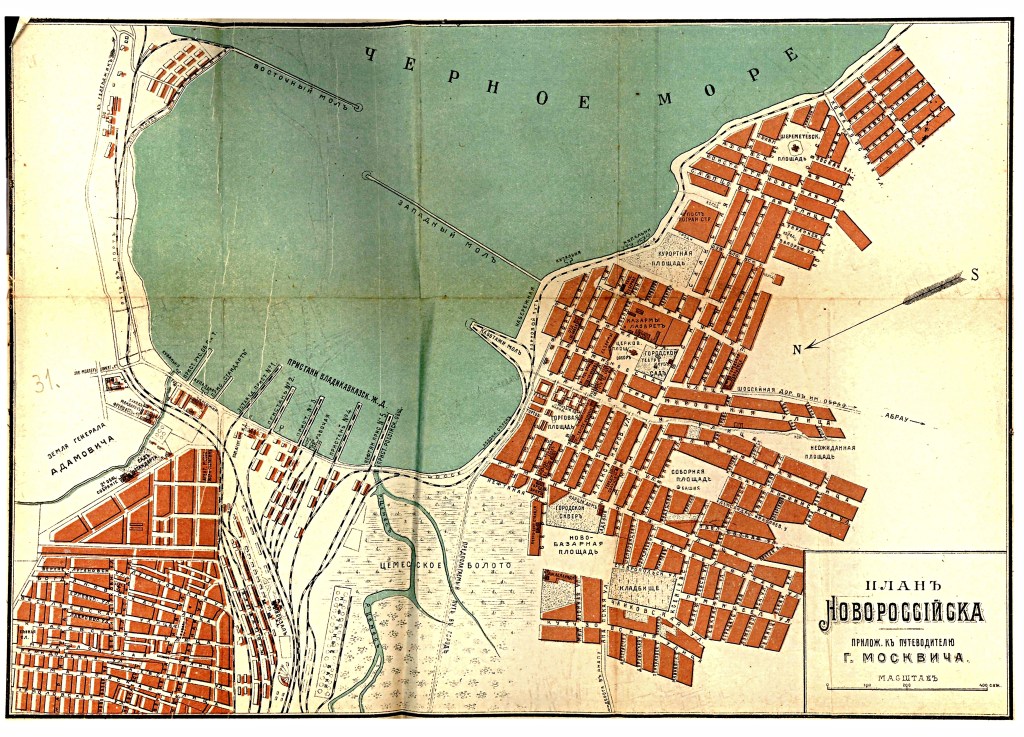
A Red soldier named Eduard Dune was captured during Denikin’s advance on Moscow. Among other terrible ordeals in captivity, he succumbed to typhus. Thirst and headaches gave way to two long comas; the second time, he woke up in the war-scarred city of Tsaritsyn, far away from where he’d passed out, and was soon loaded on a train bound for Novorossiysk. There he slowly recovered in an infirmary near the Black Sea port city, and as his faculties returned, he got active in underground work.

There were partisans in the hills near town, and he stole medical supplies from the infirmary and passed them to these ‘Green’ guerrillas. This close to the port of Novorossiysk, the supplies sent by the British government were piled up.

There was so much in storage that food supplies were lying under the open sky, and still the English continued to send more in ship after ship. Now that the White Army had their backs to the sea, the English had begun to supply all that had been promised when the army had stood near Moscow. The prisoners’ infirmary now enjoyed bed linens and other English hospital linen. In our storeroom lay trunks packed with English food products, including cocoa and dried vegetables. There was more than our cook could cope with.

There was a sand spit within sight of the infirmary where the Whites regularly took people for executions. The patients kept watch on this spot, collected intel and helped escapees. Dune and his fellow captive invalids stole papers from comatose typhus-inflicted Whites and supplied them to Red and Green agents in the city. They had a workshop on hospital grounds where they turned out false documents.

Novorossisyk had already been the site of things so strange and terrible they are difficult to visualise; way back in the fourth episode of this series, we followed the Bolshevik sailor Raskolnikov on his mission to scuttle the Black Sea Fleet. Very soon after that, the port fell to the Whites. Now, less than two years later, it was to witness one of the most surreal and pitiful scenes of the war.
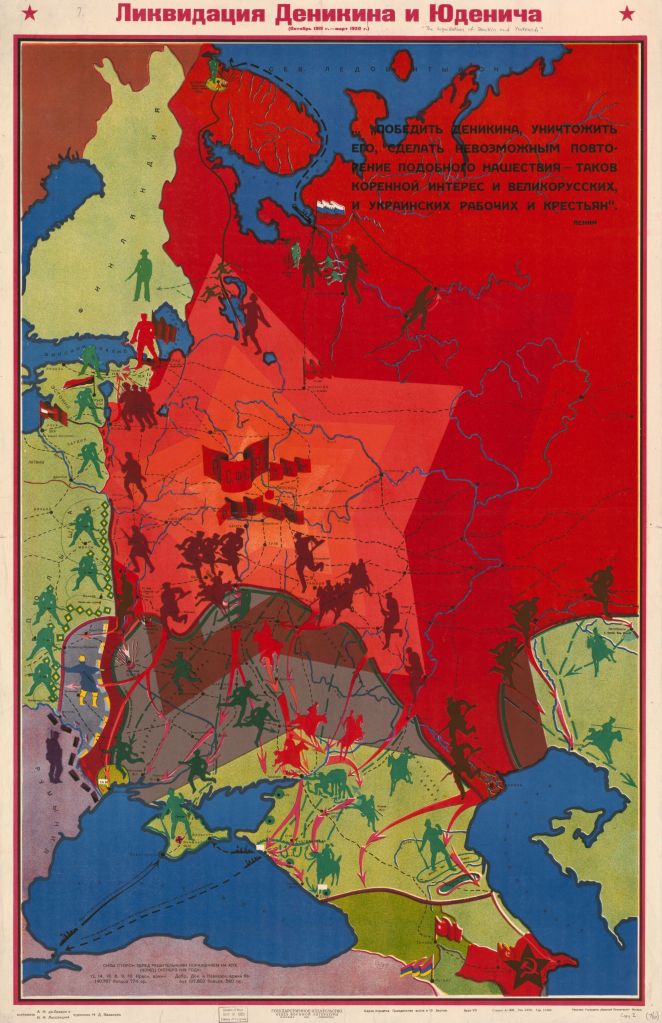
Russian Civil War pictorial map number 7, ‘Liquidation of Iudenich and Denikin.’ The White Guards (coloured green) are pursued southward. Trace the Red arrows across the Don River, over the Kuban steppe, and down the Black Sea coast. Note also in the map two things we’re not going to deal with in much detail here: the final victory in North Russia and the rise of Soviet power around Baku, Azerbaijan.

Rostov

Meanwhile the war was raging on, the Whites falling back, the Reds surging southward: in January Tsaritsyn (later Stalingrad, now Volgograd) saw its last battle of the Civil War when it fell to the Reds. But when the Whites reached their old base area of the Don and Kuban Countries, they rallied. The river Don, as if it was in sympathy, froze to let the Whites retreat across it, then thawed before the Reds could. Alongside this military recovery, the White civilian government, such as it was, promised reforms and tried to juice up some popular support. The Red Army hit the moat of the Don in disarray from its long advance, overstretched and agitated with internal disputes.

The Whites recaptured Rostov-on-Don on February 20th. But the Reds were by this time over the worst of their confusion, and it was the Whites’ turn to have some internal disputes. Denikin had made concessions to the Kuban Cossacks – not enough to stop them deserting, but enough to enrage the White officers. ‘What are we?’ they demanded. ‘Cannon fodder for the defence of the hated separatists?’

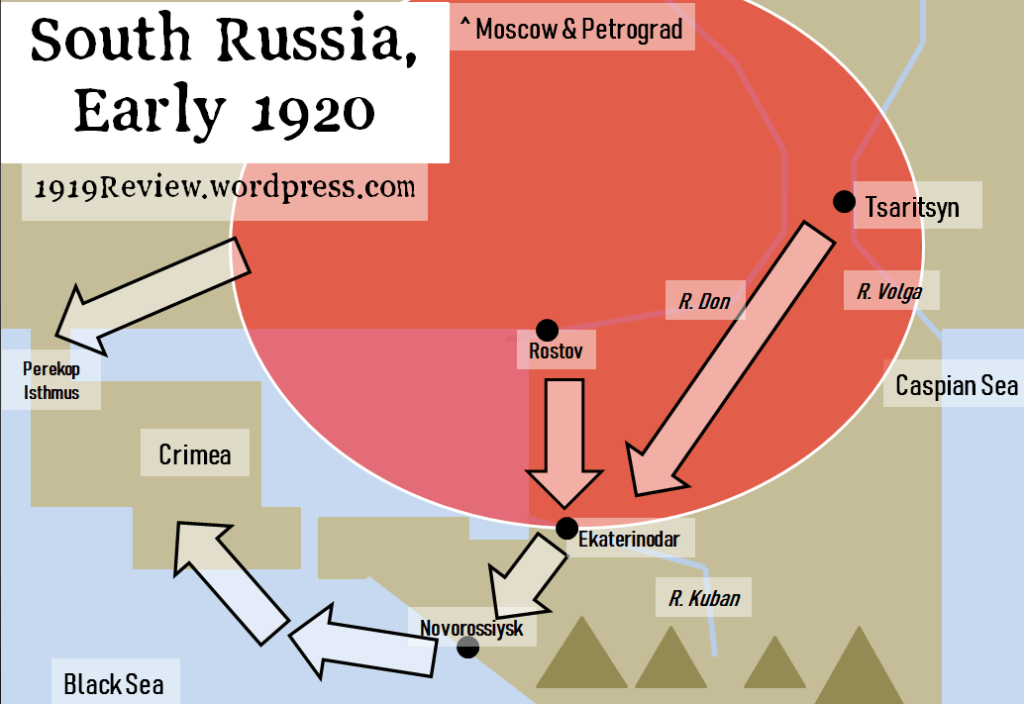
The First Red Cavalry Army (which by this time boasted 16,000 riders, 238 machine-guns, nineteen artillery pieces and eight armoured trains) crossed the Don and threatened the rear of Rostov; there was nothing for it but to abandon the town and fall back to Ekaterinodar (the city outside which a shell had killed the Whites’ chief inspirer Kornilov two years earlier) and then, after a short hopeless struggle, on to Novorossiysk.[1]

One of many grim chapters in Beevor’s recent book deals with the entry of the Reds into Ekaterinodar. He describes the summary murder of men falsely identified as officers, Kalmyks being massacred for no apparent reason, and dead White Guards being mounted on a locomotive as trophies. Beevor appears to be repeating contemporary rumours which his source’s author heard second-hand, which is consistent with some of my criticisms of the book. [2] But even allowing for exaggeration and rumour-mongering, such excesses probably did form a part of the picture of the Red Army’s advance in some areas.

1st Red Cavalry Army
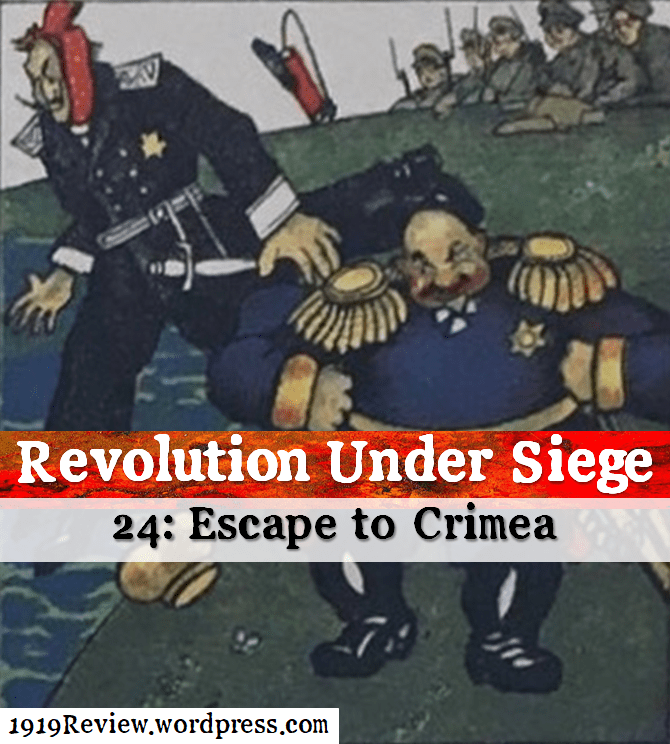
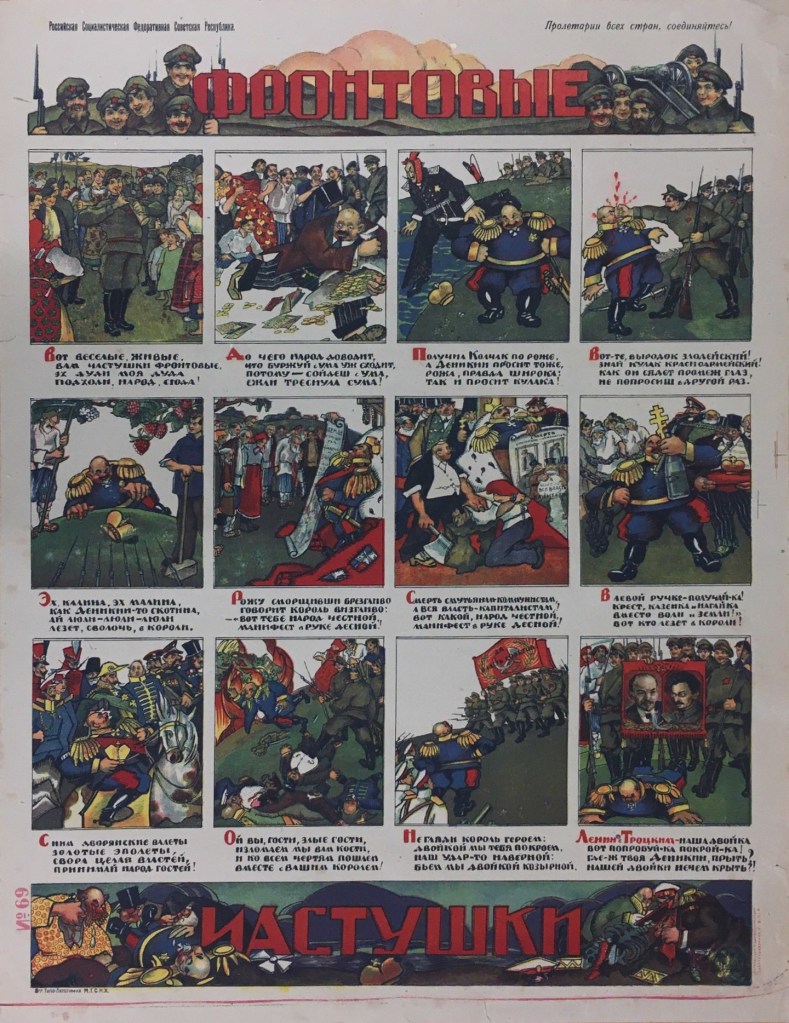
The cover image is a detail from this 1921 Soviet poster. Of the text, all I can tell you is that the heading means a frontline soldier. Thankfully the images are self-explanatory.

Novorossisk

The resumption of Red advance translated into rumours heard by Dune in the Novorossiysk infirmary: ‘The Whites had won victories with the aid of their cavalry, but ever since Trotsky had said, “Proletarians, to horse!” we too fielded a cavalry, and ours beat the Cossacks all hollow. The Red cavalry had captured all the English tanks.’

This was confirmed by what Dune could see with his own eyes; White Guard Russia was visibly shrinking and contracting around him. First, discipline grew lax, and he could get out into the city on errands. Once there he saw the streets fill up with a strange juxtaposition of affluence and squalor: cartloads of expensive household goods, and huge numbers of typhus-stricken refugees. White officers began taking entire battalions to join the Greens. Back at the infirmary, White Army supplies were stolen wholesale now instead of retail.

Moving away and up the chain of command from the humble soldier Dune, the British General Bridges was disgusted: ‘the whole affair was a degrading spectacle of unnecessary panic and disorder, and I urged the government by cable to dissociate themselves from the White Russians who had no prospects and little fight left in them.’ But Winston Churchill, Secretary of State for War and Air, overruled him. So the British remained and took responsibility for the evacuation of White officers and their wives and children. [3]

Suddenly the British project of pumping in great quantities of supplies and war materiel had to go into reverse: now the British were evacuating White officers and their families, and anyone else who could be crammed on board. At the quays, crowds pressed against the British Army cordon and the ships heaved with people. A tank drove slowly over a row of thirteen British aeroplanes, turning them to matchwood so that the Reds couldn’t use them. Then, of course, the tank itself was abandoned. Other engines of war littered the sea floor where they had been dumped. Tearful Cossacks shot their horses.

The other White naval evacuations were disasters, but Novorossiysk was the worst. [4] It was so bad, Denikin resolved to resign as soon as it was all over. The misery, destruction and desperation were extraordinary:

…the waterfront was black with people, begging to be allowed on board the ships… Conditions were appalling. The refugees were still starving and the sick and the dead lay where they had collapsed. Masses of them even tried to rush the evacuation office and British troops had to disperse them at bayonet point. Women were offering jewels, everything they possessed – even themselves – for the chance of a passage. But they hadn’t the ghost of a chance. The rule was only the White troops, their dependants and the families of men who had worked with the British were allowed on board. [5]
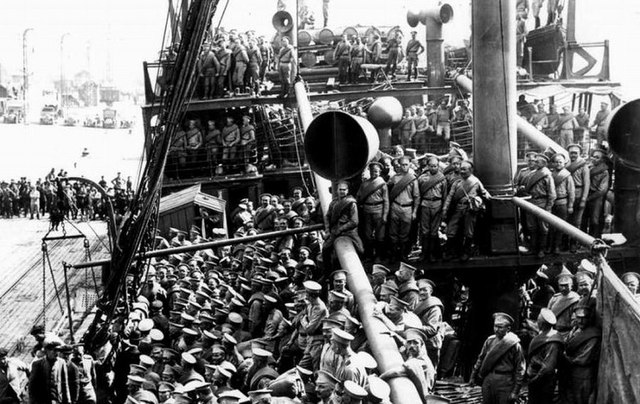
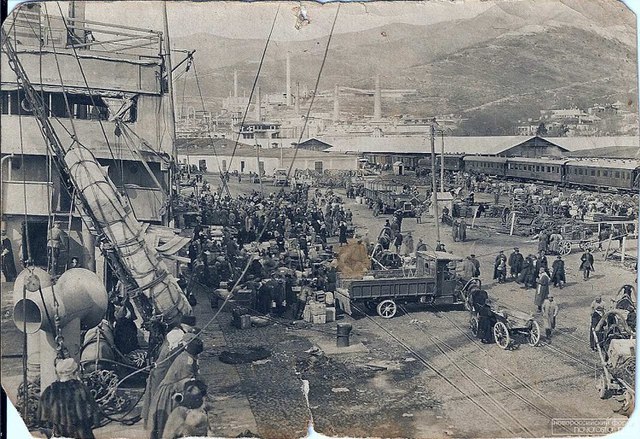
Above: the chaos at Novorossiysk.

The 2nd Royal Scots Fusiliers acted as a rear guard, supported by a naval bombardment (one of the ships firing was the Waldeck-Rousseau, which had mutinied the year before). On March 27th the Red Army arrived, lobbing shells after the fleeing ships. By then, 34,000 had been evacuated (A disproportionate number were Volunteers, which suggests the Don Cossacks got shafted).

The Reds found on the quays an indescribable landscape of dead horses and destroyed equipment – but also heaps of intact supplies, such as one million pairs of socks. General Bridges had not been permitted to abandon the Whites, but he had left food and clothing to try to alleviate the suffering of ordinary people in war-torn South Russia. The Reds captured 22,000 White Guards in the town, and 60,000 later surrendered further down the coast at Sochi.

Other Whites fled into the Kuban steppe, where they waged a guerrilla war. As for the Green armies, at the moment of victory they suffered a split between the pro-Communist elements and the various other forces who were in the mix, and soon dissolved. [6]
London

Meanwhile in London, time of death was called on the White cause. Field Marshal Henry Wilson wrote in his diary: ‘so ends in practical disaster another of Winston’s attempts. Antwerp, Dardannelles, Denikin. His judgement is always at fault.’

Several days later he wrote: ‘cabinet at 6pm. We decided, Curzon leading, finally to tell Denikin to wind up affairs and come to terms with the Soviet government. Great joy. Winston fortunately absent.’ [7]

It was neither the first nor the last time the British had decided to withdraw from the Russian Civil War. They were sick of being on the sidelines of the bloody mess, acting as referee and sponsor, and occasionally stepping onto the pitch to play midfield, only to be frustrated again and again by the unexpected strength of the opposition and the shocking failures of their own side. In spite of all this, British intervention continued while the Whites made another throw of the dice. The fact that some tens of thousands of White Guards had escaped in one piece, plus an accident of geography and miitary fortune, gave the Whites an opportunity.  

During the chaotic White retreat across Ukraine, one White officer had fought his way through Makhno’s anarchists to reach Crimea. There he held the Perekop Isthmus, the narrow strip of land connecting Crimea to the mainland. This officer, who had entered Ukraine as one of Shkuro’s notorious ‘White Wolves,’ bore the evocative name Slashchev.

Because of Slashchev’s feat the Whites held onto Crimea, an area 27,000 square kilometres in size, or one-third the size of Ireland. The Reds had no fleet on the Black Sea and the Allies had, so Crimea was a natural fortress as well as a base area of manageable size and with a population of over a million. That’s where the British fleet obligingly left those 35,000 evacuated White Guards. We have the strange picture of masses of hardened veterans disembarking at seaside resort towns.

Crimea

The first item on the agenda was leadership. At a Council of War in April, power passed from Denikin to his rival and critic, the ‘Black Baron’ Wrangel. The military chieftains objected on principle to electing Wrangel. To be clear, they did not object to Wrangel himself, only to the idea of electing a leader. So they insisted Denikin appoint him. After the galling experience of handing power to his rival, Denikin had nothing left to do but depart for Constantinople on a British destroyer, never to return. [8]
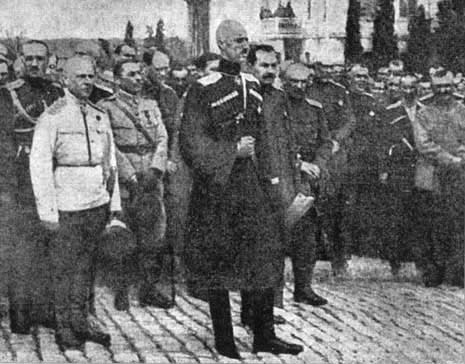
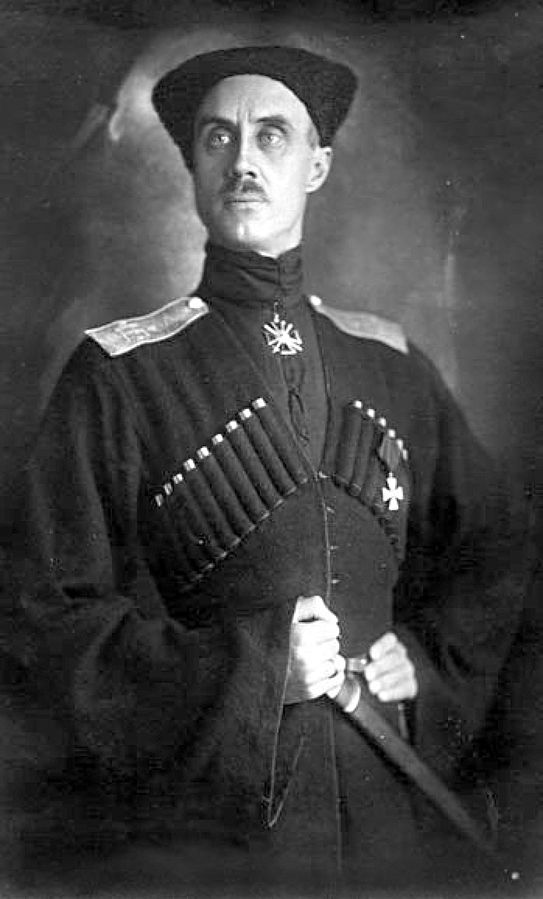
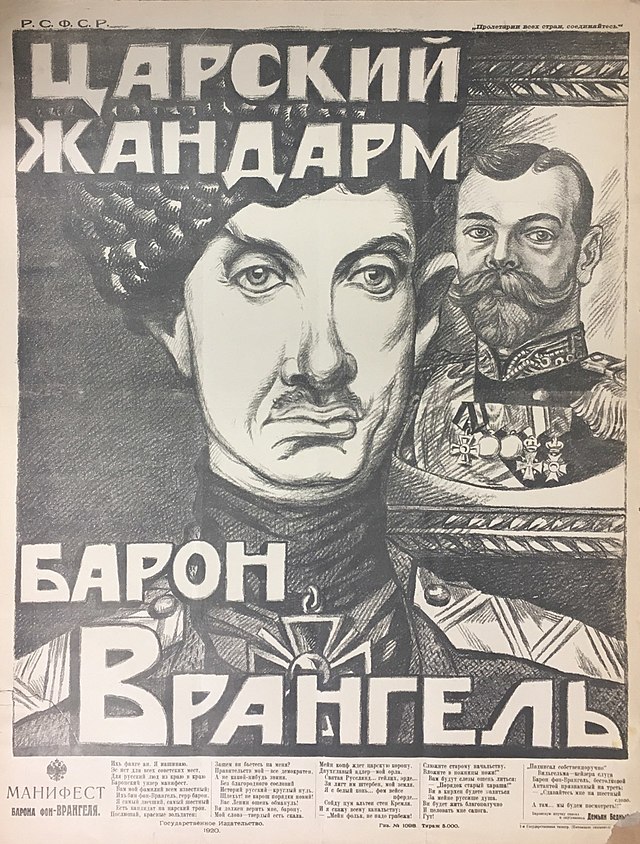
Above: photographs and a poster depicting Wrangel

Wrangel was not a graduate of Bykhov prison-monastery or a survivor of the Kuban Ice March, not at all one of the original Kornilov club. But with his height and striking features, he looked the part more than any other major White leader; Soviet cartoons and posters got great mileage out of him.

But there was still a line of continuity going all the way back to those origins as ‘the saga of the Volunteer Army continued in the Crimea.’ The elite ‘colourful units’ that were named after Markov, Alexeev, Kornilov and the others still existed as I Corps. [9] Like his predecessors, Wrangel called himself ‘Ruler’ and his army the ‘Russian Army.’

One of the themes that keeps popping up in this series is the role of the individual in history. Wrangel is a striking case study, because under him a new and distinct White Guard regime emerged in Crimea. Whereas Denikin’s regime was overstretched, ragged and undisciplined, Wrangel’s was every bit as lean and severe as he was.

In contrast to the previous White regimes, there was a functioning government and strict discipline. Reds who deserted were given a fair hearing. Looters were shot. Wrangel’s government would even pass a law redistributing landlords’ holdings to peasants – yes, the Whites were finally ready to cut their losses on that one, and the irony is that Wrangel, unlike Denikin, was actually of the land-owning nobility. His regime also made overtures to Tatars and Ukrainians, and cooperated with the Poles.

(L) Wrangel inspecting White pilots, and (R) his functioning government

Was this all down to Wrangel’s personality?

Perhaps not so much. Actually, the Baron had been a champion of the conservatives within the White movement against the more ‘liberal’ Denikin. Wrangel spoke of the need ‘to make leftist policies with rightist hands’ and pronounced a policy of ‘With the Devil, but for Russia and against the Bolsheviks.’ [10] Every living White Guard, one assumes, had learned extremely harsh lessons in 1919. Popular opinion and practical common sense would have favoured this new approach.
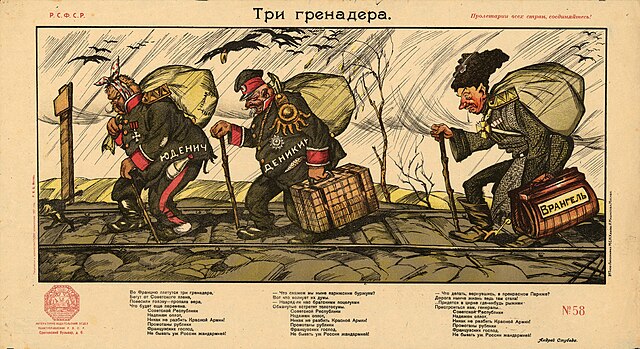
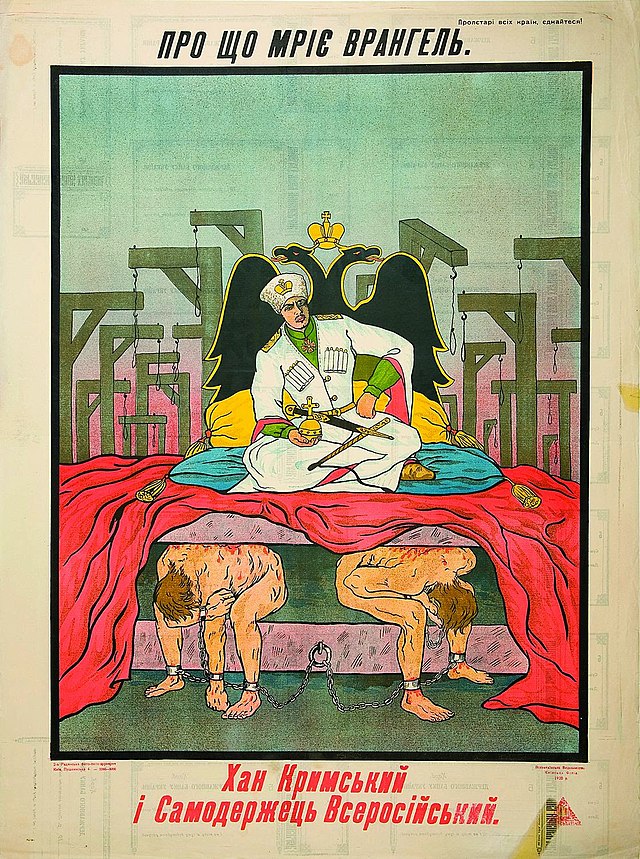
Above, images of Wrangel from the Soviet point of view. ‘Three grenadiers’ labelled Iudenich, Denikin and Wrangel; Wrangel as Khan of the Crimea; and ‘The Tsarist gendarme, Baron Wrangel’

What made this approach possible was the fact that an overwhelming mass of White Guards were now concentrated in a stable, small, self-contained base area. Just as one example of how Crimea insulated the Whites from the chaos that had messed things up before, the Cossacks could no longer do the old loot-and-desert routine. They didn’t have horses anymore, let alone horses that could swim across the Black Sea. The character of the new regime had more to do with the new base than with any other factor. But it is one of those interesting moments when so many things, right down to the physical appearance of the leader, produce the same impression: this was a White army, but leaner and smarter, confronting Moscow with a new type of challenge.  

Home Page/Archives

Revolution Under Siege Archive

References

[1] Mawdsley, pp 302-309. Special thanks are due to Mawdsley, on whose book I relied heavily for this post. Dune, 180-198

[2] Beevor, pp 431-2

[3] Kinvig, p 311

[4] Smele,p 140

[5] Kinvig, p 309

[6] Smele, p 140. Dune, p 211. On the Greens, see the notes from Diane Koenker and SE Smith in Dune’s memoirs, p 187

[7] Kinvig, p 312

[8] Mawdsley, p 309

[9] Mawdsley, p 364

[10] Ibid, p 363

The new texture behind the ‘Revolution Under Siege’ text is from the Wikimedia Commons image ‘Rust and dirt’ by Roger McLassus. Not that anyone is eagle-eyed enough to notice, but it is important to credit people
There’s no such thing as ‘too many people’

[This article/book review from 2014 is another reprint from the old blog. I like how I straight-up vandalised the book and posted images of it. The article has dated well, anticipating the student climate strikes of 2019. Thankfully, “overpopulation” ideas along the lines of those which I criticise here were not prominent in that movement. If we fail to move toward an eco-socialist transformation of society, however, it is inevitable that such ideas, and worse, will emerge.]

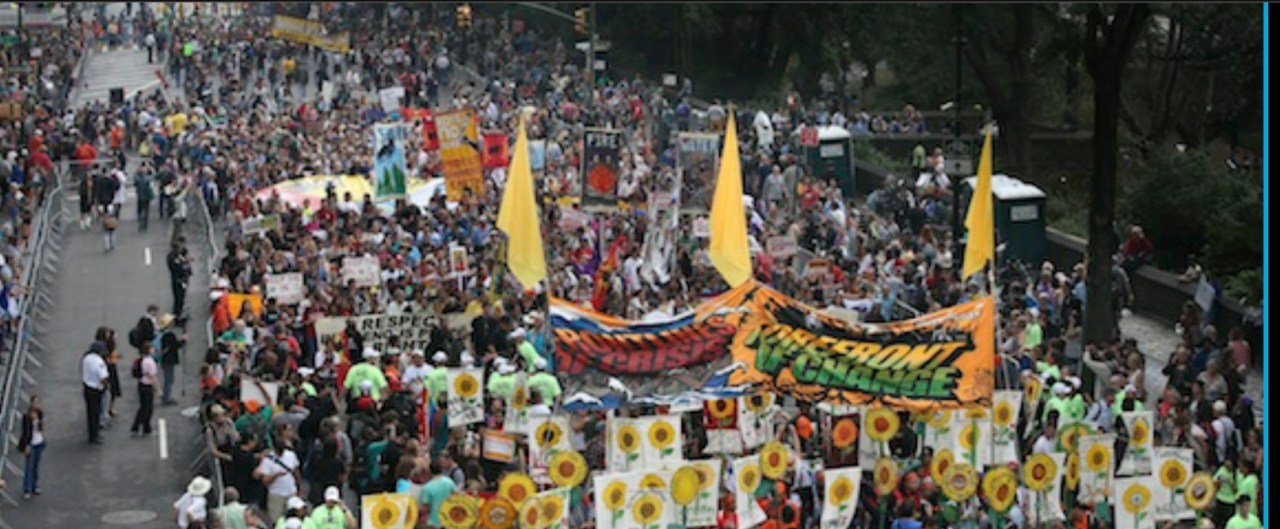
With over 400,000 people hitting the streets of New York and marching for climate justice, with resistance to the Keystone XL pipeline, with Naomi Klein’s book This Changes Everything hitting the shelves, with this blogger finally getting a free Sunday morning away from the assembly line, it’s a good time me to write an article that I’ve wanted to write for some time, a furious review of a terrible book. It’s also the first long-ish article I’ve written in a long time, so put on the kettle, sit back and relax.

People's Climate March New York

The book is 10 Billion by Stephen Emmott (Penguin 2013). It is basically a long essay that manages to take up a whole book by having a strange format that leaves a lot of blank space on each page. It also makes what Emmott is saying seem more vehement, clear and serious. Like this:

DSCF0773

Another benefit of this strange format revealed itself to me as I read.

Though if you care to read it, the above page might seem innocent and informative, the book as a whole is absolutely infuriating. Emmott, a computational scientist who knows a lot about the climate and the economy, leads a lab at Cambridge, etc, has huge and astonishing blind spots. As I read on and on I found I couldn’t stand it; I couldn’t leave his stupid statements unanswered anymore, and I started reading it with a pen in my hand, scribbling furiously in the wide, empty spaces of the book. Like this:

DSCF0779

First, the good points of the book. It contains a large amount of information that makes it abundantly clear how unsustainable human society is right now. Emmott doesn’t just talk about climate change or greenhouse gases, though he does deal with these in some detail. He talks about the unsustainability of land use, food production and water supplies, of a world economy in which hundreds of millions of shipping containers travel around the world zig-zagging between cheap labour and rich consumers, polluting the earth, the skies and the seas. It also contains powerful pictures, like this:

DSCF0775

It looks like hell in some old painting, but it’s actually a burning tyre yard like the one in The Simpsons.

The negative aspect of the book, the one that makes it toxic, offensive and anti-human, is suggested by the title. Stephen Emmott believes that there are far too many people in the world. Far too many people, who consume too much land, energy, food and water. He sees absolutely no solution to the problems the Earth faces. The only advice he gives, on the last pages of the book (we are down to one or two sentences per page by now) is as follows: teach your children how to use firearms.

He has made it clear what he means by this: when society collapses and food riots erupt, your children will need to protect themselves from the seething, violent mass of humanity.

He makes it clear that in the book he is only addressing “rich people (like us)”. That is an actual quote. We get to page 185 of a 200-page book before Emmott lets us in on the fact that when he’s been talking about “us” and “we” for the entire book, he’s been talking not about the human race but about “the people who live in the north and west of the globe”. The rest, in his eyes, either don’t read, or don’t count.

queue_21938a
A welfare line in the USA: “Rich people” who live in “the north and west of the globe” who need to “radically” cut their consumption.

An infuriating blind spot: his assumption that everyone in Europe and North America (not to mention Australia and New Zealand) is a “rich person” (like Stephen Emmott). The homeless, the unemployed, the working poor, the low and middle-income workers, in short, the majority of people in “the north and west of the globe” are walking evidence that Emmott in some very important ways doesn’t have a clue what he’s talking about.

Blaming Humanity

He blames the sustainability crisis clearly and squarely on humanity itself: “our cleverness, our inventiveness and our activities are now the drivers of every global problem we face.” In actual fact, the problems he outlines throughout the book are very obviously problems created by private ownership of wealth, by corporations, by neo-liberal governments, not by humanity itself. He doesn’t mention such facts as the following: since the industrial revolution, just 90 companies have been responsible for two-thirds of human-made global warming emissions.

But far more criminally, he points out many facts that are just as interesting, that are just as much a condemnation of the capitalist system and of private corporations; and having pointed these facts out, he then draws the conclusion that humanity is to blame, that our “cleverness” and “ingenuity” are responsible.

Water Use

Let’s start with a small example from page 74. “It takes something like four litres of water to produce a one-litre plastic bottle of water. Last year, in the UK alone, we bought, drank and threw away nine billion plastic water bottles. That is 36 billion litres of water, used completely unnecessarily.”

bottle thumb

How to save these 36 billion litres of water? First you have to grasp the absurdity of private companies selling us bottles of water in the first place. Next think about how we replaced plastic shopping bags with big, sturdy, re-usable shopping bags. Everyone should have a re-usable canteen of water, like the filter-headed Bobble bottles you can buy, which you can replenish at a clean public fountain on every street, or a free tap in every shop or bar or restaurant. [They have something like this in Paris now – ML, 2023]

This is a small example of how re-orienting services along collectivist, socialised lines immediately cuts out waste. Of course, it also cuts out a huge slice of private profits for Volvic, Evian, etc. But what’s more important, private profits or maintaining access to water for the human race?

Never once in the book does Emmott consider the possibility of stepping on the toes of corporations, of getting in the way of private profits. Emmott contemplates the collapse of society, he imagines billions of people rioting as they starve to death. He imagines teaching his son how to kill others in order to stay alive. But never once does he even begin to contemplate socialising resources or nationalising industries to cut out waste and re-orientate to sustainable goals.

Let’s move on to a bigger example.

Greenhouse Gases

Emmott is rightly worried about the use of fossil fuels, which as we know contribute to global warming. He laments that Exxon Mobil has just signed a deal with the Russian government worth $500 million for oil and gas exploration in the Kara Sea. He says the British government has issued 197 licenses to drill for oil and gas in the North Sea. He quotes then UK energy minister John Hayes as saying that “The government is taking the right action to offer certainty and confidence to investors.”

offshore-drilling-4

Exxon Mobil and Putin sign a deal to wreck the environment for private profits; a British minister defends a similar move in the North Sea by saying that private corporations need to have “certainty” and “confidence” about their future profits. Corporations and ministers, driven by the private profit motive and the subservience of governments to the rich, all ignoring the scientific certainty that greenhouse gases will wreck the planet, all for a short-term increase in the wealth of a tiny number of people who are already far too rich. Has there ever been a clearer illustration of how capitalism is responsible for the destruction of the environment?

Emmott doesn’t think so. The connection never even seems to occur to him. He never once uses the word “capitalism” in the whole book. The fault, he makes clear many times, lies with us stupid, stupid humans.

3.5 billion under capitalism or 20 billion under socialism

Another massive problem is Emmott’s hang-up about the number of humans who live in the world. He has this really basic, stupid, doltish conception of things that crudely says that (1) more humans equals more consumption, and (2) more consumption equals more destruction.

But it’s obvious that this isn’t true. A community of a hundred people who are well-organised, cooperative and efficient will consume less than a community of fifty that is segregated into different economic units, that is inefficient, that duplicates labour and that does not re-use or recycle. The progress of human history has been in a large part the story of collective and social production methods overcoming petty, wasteful individual economic units.

I scribbled a note on page 117 that wasn’t intended to sound as alarming as it does: “The number of humans is secondary. How these humans are organised and relate to one another is primary. Even if we killed half the human race and enforced a draconian one-child policy, the destruction of the environment would continue if those 3.5 billion people were organised in a capitalist mode of production.”

And of course, on the other side of the same equation, even if there were 20 billion people on the planet, if they were organised in a reasonably harmonious, collective, efficient manner, with a maximum of democracy and a minimum of large-scale private wealth, these 20 billions could live in peace and relative prosperity.

(In such a society, of course, it would be unlikely that the population would reach 20 billion. Greater opportunities for economic advancement would lead to lower birth-rates.)

Emmott devotes some pages to casting about for a technological fix to these crises. He doesn’t entertain the possibility, not for one minute, that the problem is social and economic, and therefore that the solution must be social and economic.

Revolution

Tunisian Revolution, 2010-2011. Sparked largely by high food prices.

The food riots of 2010-2011 he simply describes as “violence and unrest”, more signs of the end times. The fact that this “violence and unrest” led to massive political revolutions is not of interest to Emmott. Our unsustainable economy is already pushing people onto the streets, sparking revolutions and uprisings. Those who took part in the march in New York were largely people from communities effected by climate change and pollution. Tunisian Revolution, 2010-2011. Sparked largely by high food prices.These billions of people, these multitudes of humanity, who Emmott sees as the problem, are in fact the solution. Faced with these massive ecological and economic problems, people are not just going to knuckle under and starve. They’re going to seek for an alternative, a democratic, ecological socialist society. Unless Emmott’s children shoot them first.

Tragedy of the commons?

Emmott claims that the destruction of the environment is a “tragedy of the commons”. Paraphrasing The Economist, he says that climate change “is a textbook case of the commons-despoiling tragedy.”

What he means by this is that the environment is like a field owned in common between a bunch of farmers. All of the farmers profit from the field but none wants to fork out money and time to maintain it, each hoping someone else does it. So the field degrades over time and in the end there’s no more field and no more profit.

Does this comparison work? Are the world’s resources owned in common by all the people of the world? No. They are owned primarily by private companies, or sometimes by state-owned companies that operate exactly like private companies. They are motivated in the final analysis by the profit motive, and all destruction of the environment, all damage to the sustainability of human life, is an externality that doesn’t show up on the balance sheet.

Garret Hardin’s theory of the tragedy of the commons is a criticism of the profit motive, and an argument that “rational” self-interest works against the interests of the collective good. The climate crisis is the tragedy of private ownership, the tragedy of the profit motive. It is applicable to the climate crisis in this sense. But not entirely. I see the tragedy, but where are the commons? We are not all farmers exploiting a field on an equal basis. Most of the human race are workers without large-scale property, who have no control over resources or means of production. How can we despoil what we don’t have access to?

Claiming that we’re all “despoiling the commons” places the blame on the species. But our incredibly creative and brilliant species is more than capable of reorganising society to overcome these problems. The will is there and the technology is there. But the means of making this a reality are held in the hands of private individuals, and directed toward private profit.

Capitalism has had twenty-five years to implement the Kyoto protocols, to make some kind of a dent in carbon emissions. But the only dents capitalism has made in carbon emissions have come about accidentally, because of massive economic crises and collapses.

At the same time, the Stalinist countries, the USSR, Eastern Europe etc, had a terrible record in terms of the environment. Maybe this is one of the ways Emmott and those like him justify the fact that they do not even begin to contemplate socialism, or any kind of system change, as a way of guaranteeing sustainability. But this argument doesn’t stand up; the economy in these countries was not managed democratically by the working class, but by a small isolated layer of privileged bureaucrats.

But in the early years after the Russian Revolution, and during other events such as the Spanish Civil War, power has been wielded by elected councils of workers. Industries were run and cities managed in the most democratic – and robustly effective – systems ever devised. This raises the idea of a future in which the economy is run not by profit-hungry capitalists or distant bureaucrats but by the people themselves. Answering not to shareholders but to the people, there would be no “externalities” for these delegates. Discussing problems reasonably and sanely, not each trying to wrestle against everyone else for private profit, issues of sustainability and the environment will become technical, not political, problems.

How do you re-orientate the whole of the economy toward sustainability and eco-friendly production without creating mass unemployment and economic chaos? Under capitalism, we’ve had 25 years since the Kyoto protocols, and the most capitalism has allowed are carbon-trading schemes that became just another financial con-trick. Under socialism, re-training workers and re-equipping workplaces would be just ABC stuff.Talk of “too many people” and the “tragedy of the commons” is nonsense. Humanity is not in control of the resources of the world. A tiny percentage of humanity is, the capitalist class, those who own and manage large amounts of wealth. When they exploit and damage people in order to maximise profits, there’s a clear comparison to be made with the way they exploit and damage the environment. This means that humanity and the environment are not enemies. They are natural allies against the 1%, against an obsolete and destructive system.

Go to Home Page/Archives

Squid Game, like capitalism, is equal and voluntary – in theory

Spoilers below.

What makes Squid Game different from Hunger Games and Battle Royale? The fight to the death in Squid Game is not just bigger and bloodier. It is voluntary. Stephen King’s Running Man also features a lethal game whose contestants are volunteers. But King’s novel, and its movie version, and Hunger Games and Battle Royale, are set in future dystopias. Squid Game is set in our world, right now.

The conditions in North Korea are so desperate that Sae-byeok risks death to escape. But when she enters the game she risks death again, this time to escape from the desperate conditions for the poor and working class in South Korea, to escape from capitalism. As someone says in Episode 2, it’s worse out there than it is in here.

The final episode of Squid Game hammers home an anti-capitalist argument that has been running through the whole story. Many have commented on this, including the writer and director Hwang Dong-hyuk. This article goes into some detail. But I want to focus on the voluntary nature of the games and how this plays into the anti-capitalist message.

In-ho’s words in the last episode make this point very clear. He says words to the effect that ‘You chose this,’ ‘You signed up for this,’ ‘Nobody forced you.’ Another villain, the psychopathic Sang-woo, insists on Gi-hun’s personal responsibility for all the killing.

Within formal logic, In-ho’s argument is unanswerable. But Gi-hun recoils against his words and against Sang-woo’s. They are wrong. Gi-hun knows it in his gut, and so do we.

It’s true that the game is voluntary. In-ho himself, undercover among the contestants, casts the deciding vote for them all to leave. But for some reason, we don’t accept their arguments.

‘You chose this,’ ‘You signed up for this,’ ‘Nobody forced you.’ That’s what we hear when we complain about our jobs, our mortgages, our car payments. We even hear a version of this in the cliché that ‘people get the government they deserve’ – ie, the people are responsible when their elected leaders betray them. In the most formal sense, it’s all true.

The game’s overseer keeps insisting on ‘equality’ as the fundamental principle of the whole operation. In theory, capitalism is fair and we’re all equal. In theory, the worker and the boss meet one another ‘in the marketplace’ (wherever that is) on a basis of complete equality. They agree to a contract which is satisfactory to both: I work for you, and you pay me. The law says these two people are completely equal. The law says this contract is voluntary.

But the reality is very different from the theory, and from what the law says. That reality is illustrated in every episode of Squid Game.

When we first see Gi-hun, we are invited to see him as a waster and a messer. Then in mid-series we hear about the auto workers’ strike Gi-hun was involved in ten years ago and about the lethal police violence. This sacking was a catastrophe from which his life has never recovered. He got into debt with failed business ventures (Isn’t that what you’re supposed to do? Isn’t that what they tell us to do? Be an entrepreneur?). His family has broken down. No wonder he’s in the situation he’s in. It could happen to you or me.

Another contestant has decades of experience as a glassmaker. We can assume he’s got a similar story to tell. And we see with our own eyes how Ali was scammed by his boss.

The final episode hammers home the point. A TV or radio playing in the background of a scene reminds us about the crisis in household debt. Early on in the series, we might think, ‘OK, these contestants are people in extreme situations – gambling addicts, refugees, gangsters.’ But the final episode insists: this situation is general.

For all its brutality, Squid Game is written with compassion and humanity. These games are not a public spectacle or a reality TV show. They are secret. The public at large do not enjoy the games. They would be sickened if they knew the games were happening. The audience, lapping up other people’s suffering for entertainment, are the handful of billionaires who bankroll the whole operation – and who got rich making everyone’s lives so desperate and precarious in the first place. The indebted and desperate Gi-hun lives on a different planet from these ‘VIPs.’ To claim they are equal is a vicious lie designed to keep Gi-hun in his place – and, perhaps, to soothe the consciences of the wealthy.

People are drawing parallels with Money Heist, another series on Netflix. Like Squid Game, it has won a colossal audience in spite of the fact that it’s not in English. This Spanish crime series is knee-deep in socialism. A miner from Asturias who calls himself ‘Moscow’ sings ‘Bella Ciao,’ talks about the 15M movement and supports his trans comrade; in a fierce battle in the ruins of the national Bank of Spain, the robbers denounce the forces of the state as fascists and draw inspiration from the Battle of Stalingrad. But what’s more important than any of these Easter eggs is what this guy said: that what makes Money Heist popular is the class rage it channels.

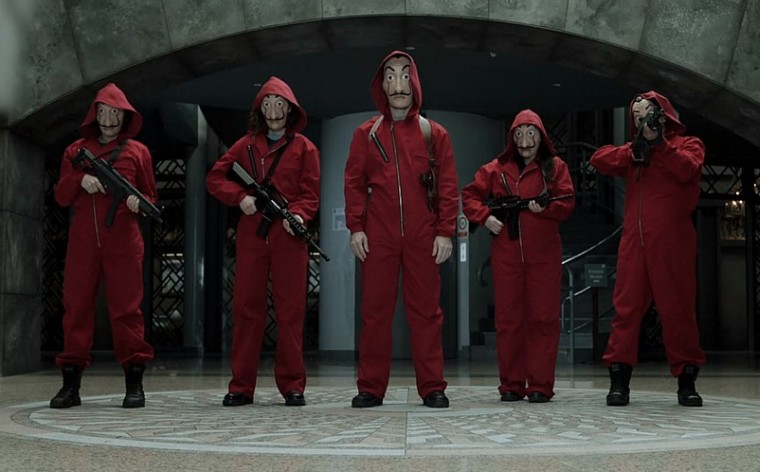
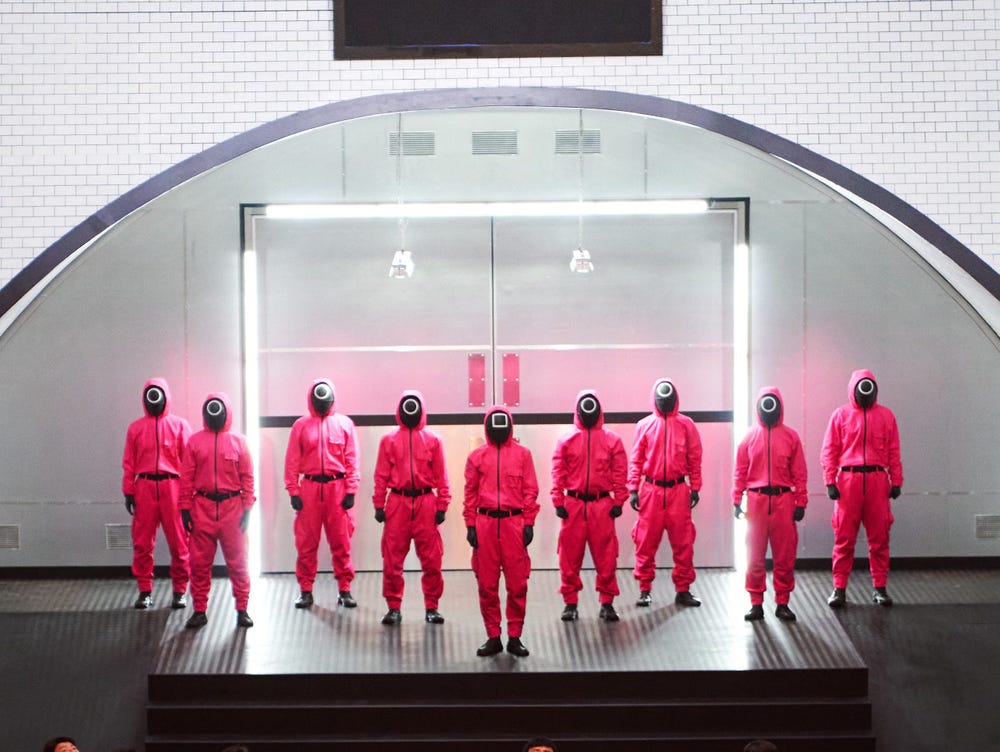
What is it about red jumpsuits and masks? Money Heist (above, image from Dress Like That) and Squid Game (Image from Insider.com).

Money Heist and Squid Game tap into our despair and anger at the brutal and unfair system we live under. Hundreds of people being gunned down in a scene that’s part Red Light, Green Light and part Amritsar Massacre – that’s not a fantasy. That’s what it feels like to live in this society. If a story can tap into such a feeling, language is not a barrier. We live under the same system and even if we speak different languages we can relate to common problems and struggles.

We live in a time of mass protest movements against the wealthy and the state on every continent (Colombia, Sudan, Lebanon, Myanmar, and the list goes on and on). It would be strange if this mood was not reflected in some way in popular culture. But it’s a sign of the times that the entertainment industry – and maybe to an extent audiences – are not ready for a story that is simply about class struggle (with surprising exceptions like Superstore). Politics is a dirty word. It has to be smuggled in, disguised in more wholesome and palatable fare, such as a story about the origin of a mass murderer, about a bank robbery, or about a game show in which four hundred people die horrible deaths. In cynical times, the earnest and compassionate stories we secretly crave can only be packaged in the trappings of cynical and pessimistic genres.

*

Thanks to all my readers. This week I took a break from Battle for Red October, my ongoing series about the Russian Civil War. The series resumes next week. If you like what you read here, leave your address in the box below and get an update whenever I post.