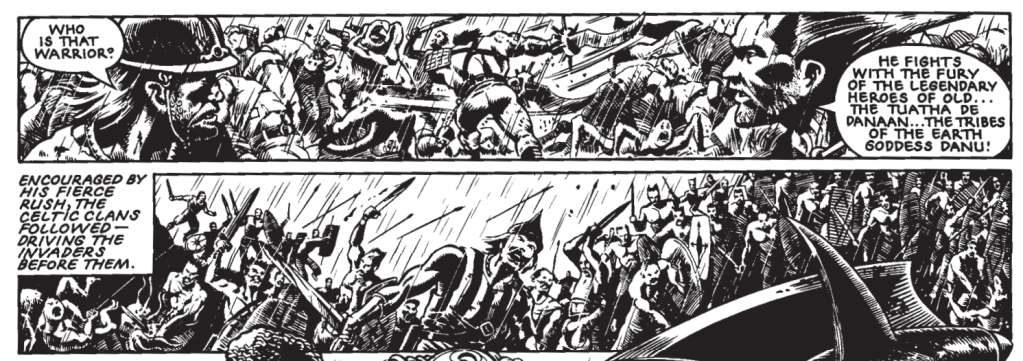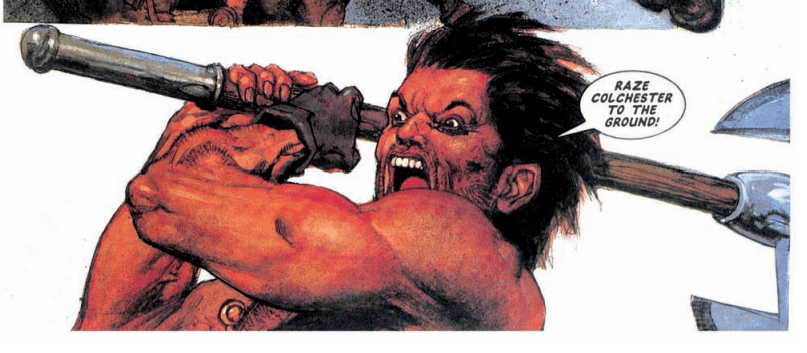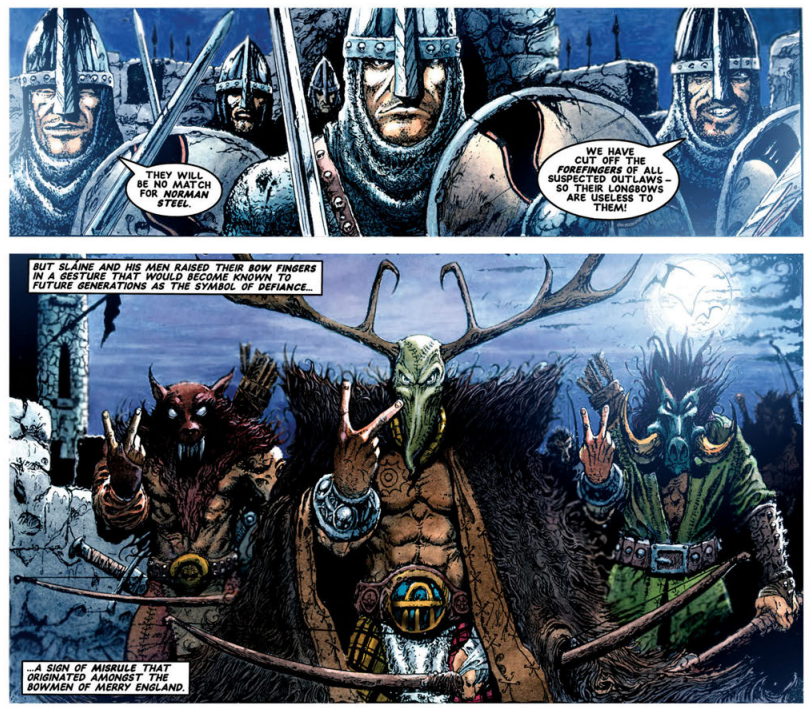
The Real Macbeth

Based on Macbeth: High King of Scotland 1040-57 AD by Peter Berresford Ellis, Frederick Muller Limited, 1980

Peter Berresford Ellis’ Macbeth is a short biography that debunks the version of the medieval Scottish king that we see in the famous Shakespeare play.

But Ellis defends Shakespeare himself, making it clear that the great playwright based his work on the only sources which were available to him in 17th-century London. It is mainly these sources which are to blame, not Shakespeare himself.

Ellis’ book goes right back to the earliest primary sources, the sagas and chronicles of the Gaels of Ireland and Scotland, of the Anglo-Saxons and Vikings. Macbeth’s age, the mid-11th Century, was a fascinating time, obscured by a scarcity of sources, and it’s worth reading this book just to get a sense of the period.

Shakespeare does make an effort to populate his play with kerns and gallowglasses and other medieval Celtic trappings. But ‘cannons overcharged with double cracks’ intrude into an otherwise brilliant depiction of an early medieval battle (Act 1, Scene 2). Again and again (as we will see below) 17th-Century pathologies rear their heads.

This is one of the great things about Shakespeare. His flagrant anachronisms place his stories in, as Ellis says, a ‘never-never-world’ which makes it easy to apply them, to adapt them, to reset them in new contexts.

School textbooks today will all point out that the play is historically inaccurate. But they don’t go into much detail. Let’s go through it, act by act. By the way, this book was written over 40 years ago and I haven’t read much on Scottish history aside from this. This is all based on what I’ve read in this book and my previous readings on Celtic society. Many of the points below will tie in with Celtic Communism? a series I wrote last year.
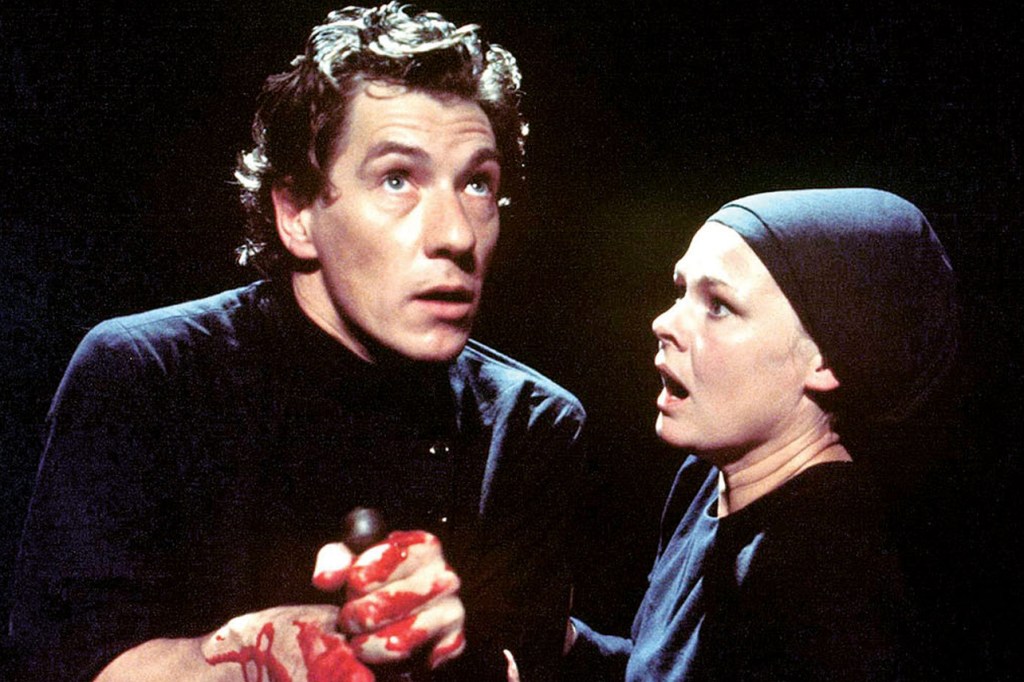
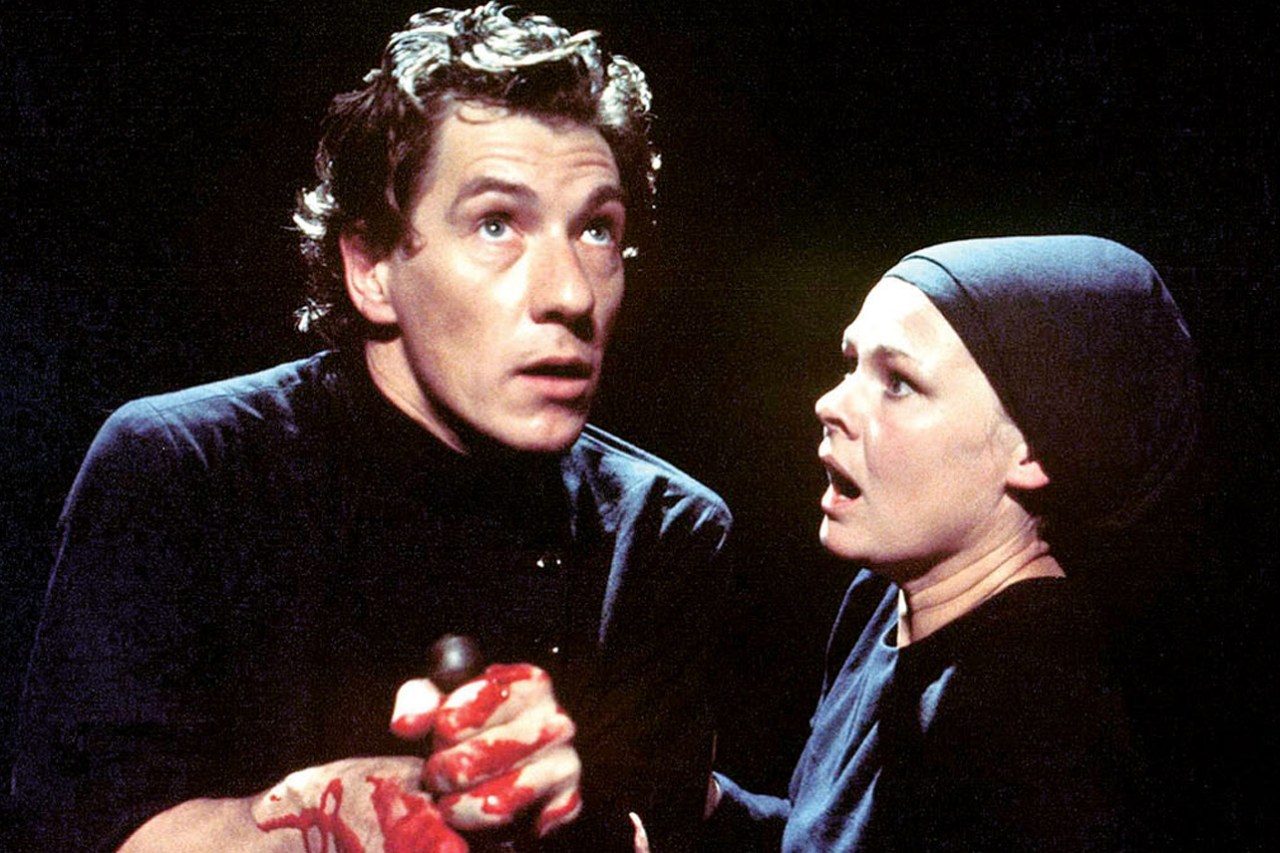
From IMDB. Ian McKellen and Judi Dench star in Trevor Nunn’s 1978 minimalist film version of Macbeth, the best film version I have seen. Mandatory Credit: Photo by REX USA (95938a) IAN MCKELLEN AND JUDI DENCH Judi Dench actress Ian McKellen in play Macbeth

Act 1

Scene 1: The play opens with three witches. They are not in the contemporary and near-contemporary sources at all. The witch-burning craze was a 16th and 17th century phenomenon. These three characters appear as nymphs or goddesses in Shakespeare’s immediate sources. But Shakespeare knew his audience (his company’s patron King James, author of a book on witches titled Demonology).

Scene 2: We get a vivid description of bloody battles. Two rebel Scots, Macdonwald of the Western Isles and the Thane of Cawdor, assisted by the Norwegians, are making war on the good king Duncan. Duncan prevails thanks to the assistance of Macbeth.

In reality, this was a war between Duncan and his cousin Thorfinn, jarl of Orkney. Duncan was defeated, and Ellis believes that Macbeth probably fought against him, and caught him and killed him in the aftermath of the battle.

Scene 3: These titles – thane of Glamis, thane of Cawdor, etc – are all wrong. Macbeth was Mormaer of Moray – which was one of the highest positions in Scotland. Banquo, meanwhile, was invented later as a mythical ancestor for the family of King James. He’s another figure who does not appear in the early sources.

The king throws around titles as rewards: Thane of Cawdor, Prince of Cumberland. In the Gaelic political system, these positions were elective. Duncan, by the way, was High King and not King.

Lady Macbeth had a name – Gruoch – and a son by her previous marriage, Lulach, whom Macbeth treated as his own heir. The evil Lady Macbeth is really Shakespeare’s own invention. So none of the evil female characters were in the original sources.

In all of Duncan’s scenes, we see him using the royal ‘we’ and being showered with all kinds of toadying and extravagant flattery. I’m sure this was how kings behaved and were treated in Shakespeare’s day. But I would guess it was not the case in Celtic Scotland.

By the way, although they were cousins, Duncan’s family and Macbeth’s were mortal enemies going back generations. Someone, probably Duncan or his allies, slaughtered Macbeth’s father when Macbeth was a child. This elaborate flattery is therefore doubly inappropriate. The relations between these men should be tense.

Duncan and Macbeth were not just individuals but representatives of rival factions, rival kingdoms even: Moray and Atholl. Or Moireabh and Fótla, Donnchadha and Mac Beathadh– as Ellis reminds us, the people of Scotland spoke Gaelic at this time and for hundreds of years after.
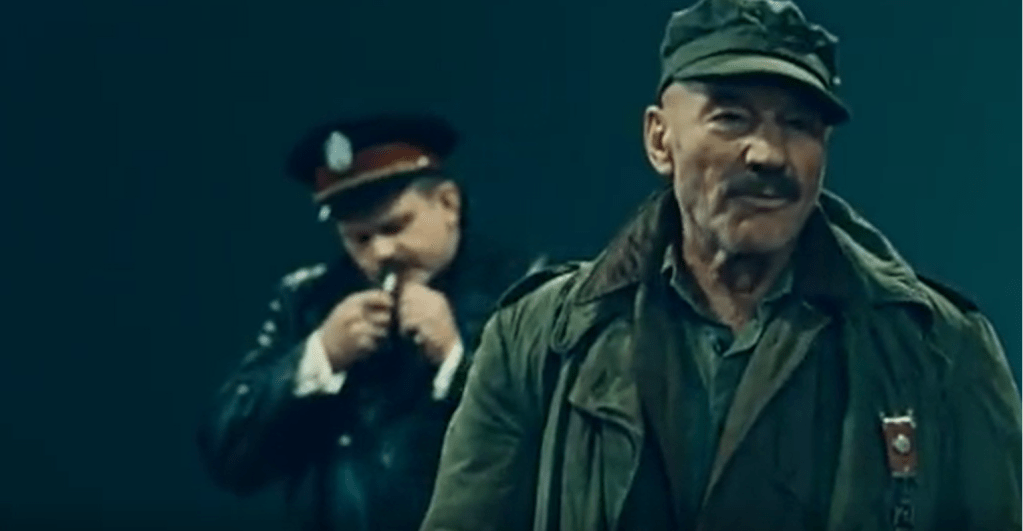
Screenshot from Macbeth (dir Rupert Goold, 2010), another film version. This one imagines Macbeth as a Stalinist dictator.

Act 2

Throughout this Act, killing Duncan is treated as a sacrilege. It is ‘A breach in nature for ruin’s wasteful entrance.’ His blood is golden. His virtues will ‘cry out like angels, trumpet-tongued, against the deep damnation’ that is his murder. He is ‘the lord’s anointed temple.’

Gaelic Scotland, according to Ellis, would not have seen in that way. They had a duty to depose and kill defective kings. And the historical Duncan was an unsuccessful warmonger.

What would have been seen as sacrilege would be the murder of a guest. Ellis says it would have been impossible. This is because the rules around hospitality were so strong in Gaelic culture.

In Shakespeare’s text, Macbeth’s real crime is not that he killed a nice man – it’s that he killed a king. The Early Modern mind reels at the unthinkable sacrilege. Yet within a few decades of the first performance of this play, the English cut their king’s head off; I think Shakespeare protests too much, and his play manages to channel some of that cultural substance which would go on to flow powerfully into the English Revolution.

At the end, there is a little hint of elective kingship. The characters remark that ‘’tis most like the Sovereignty will fall upon Macbeth.’ But this is only the tiniest hint.

Act 3

Feudal imagery continues – barren crowns, fruitless sceptres. This imagery also suggests primogeniture, which was alien to Scotland at the time.

The play implies that a short time has passed since Macbeth was crowned. The significance of the banquet scene is that Macbeth’s authority and sanity are already starting to unravel. He has had no chance to enjoy being king.

But the historical Macbeth ruled in relative peace and stability for seventeen years. His reign was far longer than those of his immediate successor and predecessor.

The banquet scene is an absolutely brilliant moment in the play. But as we have noted, Banquo was not real.
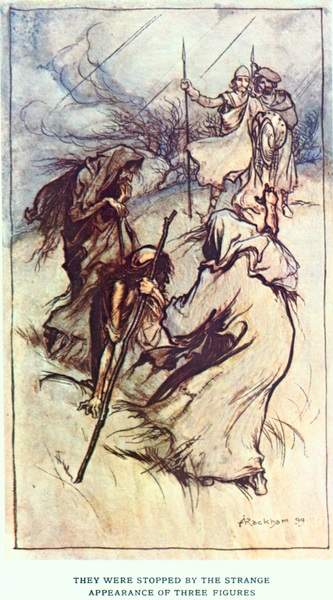
Three strange figuresː Macbeth by Arthur Rackham, 1909 (Tales from Shakespeare by Charles and Mary Lamb). Another memorable, iconic scene from the play which does not appear in the earliest sources.

Act 4

Macduff is another character who was probably invented hundreds of years later. As for the slaughter of his family, another invention.

Act 4 Scene 3 shows England as a wonderful utopia ruled by a saintly king, in contrast to Scotland where ‘new widows howl’ every morning.

In reality England at this time was torn by upheaval and conflict between Norman, Danish and Anglo-Saxon lords. Scotland only saw one internal revolt during the long years of Macbeth’s reign, and that was isolated and put down quickly. Funny, that! I thought primogeniture was supposed to bring stability.

There is a long conversation between Malcolm and Macduff, a tedious part in what is otherwise such a well-written play, where they catalogue exhaustively all the characteristics of a good monarch. As well as being slow, this is in fact a catalogue of anachronisms.

Act 5

In the final act an English army invades Scotland, supported by a universal revolt of the Scottish people ‘both high and low.’ The people have risen against Macbeth: ‘minutely revolts upbraid his faith-breach.’ Macbeth is holed up in a fort, losing his mind, lashing out in madness or in ‘valiant fury.’ The enemy army marches on his fort disguised behind the boughs of trees. He fights to the last almost alone, his own side deserting him and refusing to strike the enemy. Then he is killed and his severed head is displayed.

How accurate is all this? Let’s start with the good (I’ll have to reach a little).

The depiction of the English-Danish Earl Siward is accurate, including the detail of him losing his son in the battle and his stoic reaction. Ellis goes further into this.

It’s also interesting that Malcolm makes his thanes into ‘earls, the first that ever Scotland in such an honour named’ and also promises to ‘reckon with your several loves and make us even with you.’ The first quote reflects how Malcolm, and more so his descendants, brought many English feudal customs to Scotland. The second quote is true in that he rewarded those who had helped him, including by giving large estates in Scotland to English invaders.

But the rest is fiction. Macbeth met Malcolm and Siward in the field (yes, probably near Birnam), and while he lost he survived, and inflicted heavy casualties. His enemies were so battered they could not follow up on their victory; Macbeth ruled for another three years! That deflates the ‘Tomorrow and tomorrow and tomorrow’ speech, doesn’t it? Ellis reckons Malcolm annexed Cumberland and Macbeth remained High King of Scotland. Three years later, Malcolm resumed the struggle and this time killed Macbeth and took the title of High King. Macbeth was buried with the full honours due to a High King on the holy island of Iona. This distinction was denied to Malcolm when he died.

But Malcolm’s descendants went on to rule Scotland for centuries. The myth of the evil Macbeth had to be invented in order to improve the image of Malcolm, a beggar prince and a foreign-backed usurper.

Go to Home Page/ Archive

Celtic Communism? Appendix 1: James Connolly

At the start of our four-part series ‘Celtic Communism?’ we asked whether the claims of James Connolly with regard to Gaelic Ireland were ‘just one of those unfortunate examples of Connolly giving ground to romantic nationalism.’ It’s time to answer that question.

In the late 19th century in Ireland there was a revival of old Irish sports, language, history, music and legends. This movement rose up in defiance of British imperialism and fed into the 1916 Rising and War of Independence in the early 20th Century.

Most of the prominent Irish nationalists were bourgeois figures, including ruthless strike-breaking bosses like William Martin Murphy. There were Irish nationalists who felt aggrieved that poor old Ireland did not have any colonies in Africa. The first party which bore the name ‘Sinn Féin,’ founded in 1905, had the exceptionally cranky idea of ‘dual monarchy’ at the heart of its programme.

There were authors on both sides of the Irish Sea who read Anglo-Irish history as a struggle between “Saxon and Celt” – the Saxon coldly logical, the Celt emotional (An idea brutally satirised by Shaw in his play John Bull’s Other Island). To Connolly’s endless chagrin, certain authors liked to claim that one of the essential, eternal features of the ‘Celtic race’ was ‘veneration for aristocracy.’ 

The masses of Ireland wanted to fight British imperialism, and that aspiration was bound up with a desire not only to champion their suppressed culture but to seize the land, to end poverty, to unionise and struggle for a ‘Workers’ Republic.’ There was a gap, to put it mildly, between this and the programme of the bourgeois nationalists. This gap was papered over with nationalist and religious phrases that dripped with sentimentality and chauvinism.

In this context James Connolly was a breath of fresh air:

Ireland as distinct from her people, is nothing to me: and the man who is bubbling over with love and enthusiasm for Ireland, and can yet pass unmoved through our streets and witness all the wrong and the suffering, the shame and the degradation brought upon the people of Ireland – aye, brought by Irishmen upon Irishmen and women, without burning to end it, is in my opinion, a fraud and a liar in his heart, no matter how he loves that combination of chemical elements he is pleased to call Ireland.

It’s unfair that he’s remembered by many as a garden variety Irish nationalist when in fact he spent most of his life skewering bourgeois nationalism without mercy.

It would be unfortunate but not incredible if in these struggles Connolly succumbed from time to time to some of the ideas and assumptions of his opponents.

What is romantic nationalism?

The Gaelic cultural revival was part of a global phenomenon in the 19th Century. In any country in Europe a cadre of town intellectuals could be found trying to convince several million peasants and industrial workers that they were all united in a common imagined community, intimately related down to the very fibre of their being with this or that 8th century steppe nomad people or Iron Age confederation of clans. A lot of our ‘knowledge’ of history even today is influenced by these assumptions and agendas.

In many cases this represented, as in Ireland, an oppressed people asserting themselves after centuries of oppression. But it was abused to give the poor a spurious common cause with the rich – and against the poor of other countries. The 19th Century obsession with race came from a desire to justify slavery and imperialism. But it found many other evil uses in the hands of the wealthy: it provided a convenient way to divert people from the fight against wealth inequality or for women’s rights. 

James Connolly’s agenda was the opposite. He wanted to combine the struggle for liberation with the struggle for socialism. He always insisted that socio-economic and class conflicts were the true driving force behind uprisings for Irish freedom.

His key point about Gaelic Ireland was that it possessed a social order incompatible with feudalism and capitalism. The English conquest of Ireland was foremost a social struggle, not a racial one.

However he went too far and made claims that he didn’t need to make in order to prove this point. The language and tone were too strong and have aged poorly. See if you can read this without cringing: ‘It is a system evolved through centuries of development out of the genius of the Irish race, safeguarded by the swords of Irishmen, and treasured in the domestic affections of Irish women.’

Those who read Connolly often got the wrong impression about Gaelic Ireland. Aodh De Blácam was a fascinating and eclectic writer of the time who, in his book Towards the Republic, combined Bolshevism with Catholicism and the most romantic Irish nationalism imaginable. He appears to have taken Connolly at his word and believed that Gaelic Ireland was communist, no ifs or buts. I think De Blácam got the opposite impression to what Connolly intended – instead of providing an argument for seeing the Anglo-Irish question as a social rather than a racial one, Connolly had inadvertently provided the ingredients for an eclectic synthesis.

But De Blácam’s synthesis was a short-lived piece of accidental cultural wildlife. It could not have really come into being or thrived outside the years 1917-1923 or so, when ‘Soviet’ was a word to conjure with in Ireland. Just as you can’t hold Connolly responsible for those who obtusely read him as a Catholic and nationalist or as merely a left-leaning Republican, you can’t blame him for everyone who gives him a one-sided reading.

There is nuance and specificity in Connolly’s treatment of the Gaelic Irish. In The Re-Conquest of Ireland he writes of them

shaping their castes and conventions to permit of the closest approximation to their ideals of justice […] all were members having their definite place, and in which the highest could not infringe upon the rights of the lowest – those rights being as firmly fixed and assured as the powers of the highest, and fixed and assured by the same legal code and social convention.

Here Connolly acknowledges the existence of inequality – of people of ‘high’ and ‘low’ status with fixed rights. He even uses the term ‘caste.’ When he writes of ‘their ideals of justice’ he hints at the fact that ‘their’ ideals and ‘ours’ are not the same. This is a gesture of recognition toward the strange and alien nature of Gaelic Ireland to modern eyes.

He includes important qualifiers in Erin’s Hope:

They did not, indeed, regard all forms of productive property as rightfully belonging to the community; but when we remember that the land alone was at that time of importance, all other forms of property being insignificant by comparison […]

The chief, as Mill has justly observed, was but the managing member of the tribal association, although in the stress of constant warfare they usually limited their choice to the members of one or two families […]

In Labour in Irish History, regarding the destruction of the Irish social order by Cromwell and co, he says:

Such an event was, of course, inevitable in any case. Communal ownership of land would undoubtedly have given way to the privately owned system of capitalist-landlordism, even if Ireland had remained an independent country, but coming as it did in obedience to the pressure of armed force from without, instead of by the operation of economic forces within, the change has been bitterly and justly resented by the vast mass of the Irish people, many of whom still mix with their dreams of liberty [with] longings for a return to the ancient system of land tenure – now organically impossible.

That hard-headed passage is very far from national romanticism.

So Connolly was not surrendering to romantic nationalism. He’s not giving them ground. He’s giving them hell. He’s taking Gaelic Ireland away from them and saying, in effect, ‘You don’t get to make political hay from this. You don’t get to laud ancient Ireland in one breath and condemn socialism in the next.’ Or to use his own memorable phrase: Capitalism is the most foreign thing in Ireland.

Overall, many of his comments don’t really stand up to scrutiny. For example, it was not warfare which limited the pool of candidates in Gaelic Ireland, but the laws themselves. It was de jure not de facto. The essential political point he’s making is entirely correct, but he goes too far.

In the sense of ‘Battle not with monsters lest ye become a monster,’ ie, in the sense that romantic nationalism may have rubbed off on Connolly in the course of his struggles against it, you could say that he gave ground to it. If we return to the question with which we began, we come to a different answer. Overall, this is not an example of Connolly surrendering to nationalism but of Connolly fighting nationalism on its home turf and, against the odds, coming out of the scrap with his honour intact.

Celtic Communism? Pt 4 – Conclusion (Premium)

Become a paying supporter to get access

Access to this article is limited to paying supporters. If you already subscribe by email, thank you. But if you want to become a paying supporter, please hit ‘Subscribe’ below.

Donate less than the price of a coffee, and you can access everything on this blog for one year.

If you don’t feel like donating, most of my posts are still 100% free, so browse away, and thanks for visiting.

Home Page/ Archives

Celtic Communism? Pt 3: The Un-Free (Premium)

Un-free – premium – see what I did there?

I’ll get my coat…

We started this series by looking at what James Connolly had to say about early Irish history and asking, ‘Was Gaelic Irish society in any meaningful sense socialist? Or was this just one of those unfortunate examples of Connolly giving ground to romantic nationalism?’

In parts 1 and 2 we looked mostly at customs around kingship in the years 800-1200 CE, drawing out examples of the democratic and egalitarian features of Gaelic Ireland. As one of my readers summed it up:

Become a paying supporter to get access

Access to this article is limited to paying supporters. If you already subscribe by email, thank you. But if you want to become a paying supporter, please hit ‘Subscribe’ below.

Donate less than the price of a coffee, and you can access everything on this blog for one year.

If you don’t feel like donating, most of my posts are still 100% free, so browse away, and thanks for visiting.

Celtic Communism? Pt 2: Make Beer Not War

In Part One we began a critical look at James Connolly’s claim that Gaelic Irish society was basically socialist. We focused on the period from about 800 to the late 12th Century, and in particular on the question of kingship.

We have seen that Irish kings were elected from a wide pool of candidates and by a wide electorate; that they were neither sacred nor above the law, and that the people were their clients and electors, not their subjects. In short, they don’t look much like our traditional idea of kings and appear more like elected officials or public servants.

Today we’re going to look at warfare and hospitality, two very different subjects that both tell us a lot about kingship and Irish society in the early Middle Ages.

So far, so wholesome. But before we begin….

A word of warning

We are not here to romanticise Gaelic Ireland. I have little patience for ‘noble savage’ or ‘Fremen mirage’ tropes. No pre-modern society presents us with a tradition which modern people can or should attempt to copy. I’m also impatient with claims that the way X or Y people lived two hundred or even two thousand years ago was a more ‘authentic’ or ‘organic’ way of life than modernity. A lot of commentators like to put nationalities or religions (or even points of the compass like ‘The West’) in separate boxes, as if they were or factions in a videogame. For centuries every scholar pretended that there was some essential continuity between the Germans of Tacitus and modern German people.

Sometimes this kind of thing is flattering and romanticising. Other times it’s meant as an insult. Either way it’s annoying. A few years ago an Irish journalist said that the French president was only unpopular because French people have something written into their culture that makes them want to cut the heads off authority figures. Or the whole trope of saying that there’s some line of continuity from 7th century Irish monks writing their manuscripts all the way to James Joyce. I don’t like this kind of thing – broad national stereotypes projected into periods where they don’t even apply.

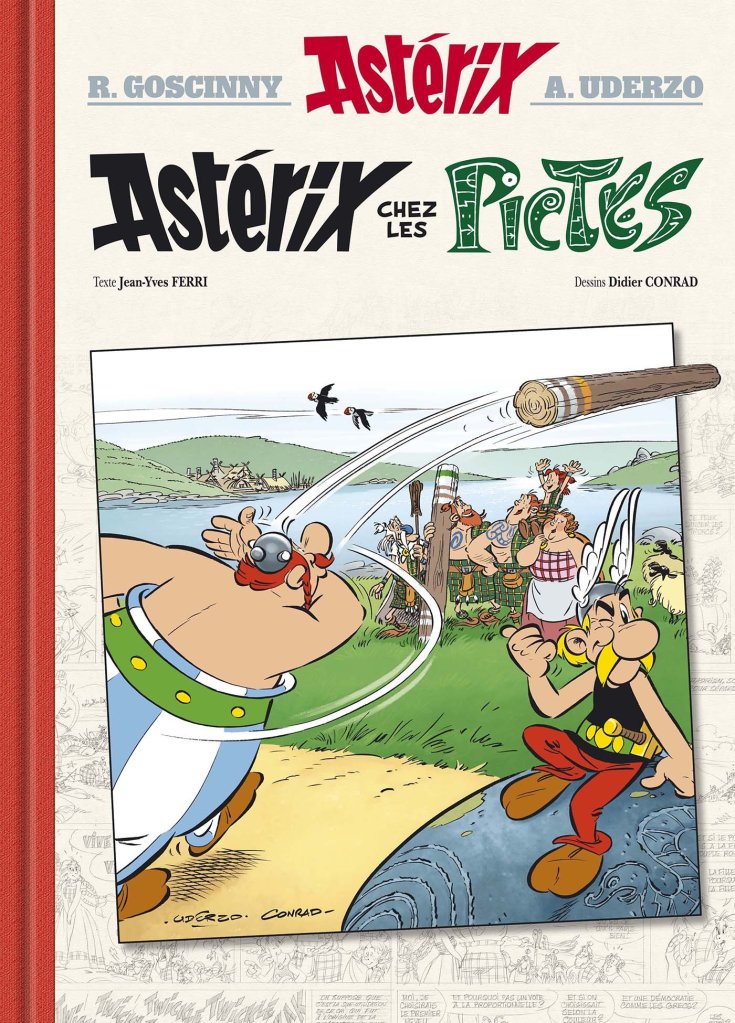
Except when it’s done as a joke in a children’s comic… in fact, I like this trope when it’s just a joke

So let’s not come at Gaelic Ireland from that kind of angle.

In most countries, go back even three hundred years and 90%+ of the folks you’d meet would be illiterate toiling people confined to small rural communities. In their daily lives, ambitions and morality they would be very different from any modern person. If the past is another country, then the pre-industrial, pre-Enlightenment past is another planet.

Even if, somehow, there existed some utopia in amid all the scarcity and violence and narrow horizons of the pre-industrial past, we couldn’t bring it back. And if modern people could dismantle modernity and return to that past, they would find they don’t like having to make every stitch of clothing by hand, or sleeping in a dim close hall with ten other people and a few cows and dogs, able to hear every fart and snore; or toiling away at crops and livestock for your entire life, never more than a few steps away from ruin.

It’s important to start with these sobering thoughts, because last week and again this week the focus is on the more egalitarian features of Gaelic Ireland. A lot of people, me included, find this stuff appealing. But as we touched on last week, Gaelic Irish society also had features that modern eyes would find hideous – features which challenge Connolly’s assertion that this society was ‘as Socialistic as the industrial development of their time required.’ Part 3 will deal with this sinister stuff more fully, and draw some conclusions from it.  

If you want to get an email update when Part 3 goes up, subscribe – drop your email into the box below.

‘Those who make war’

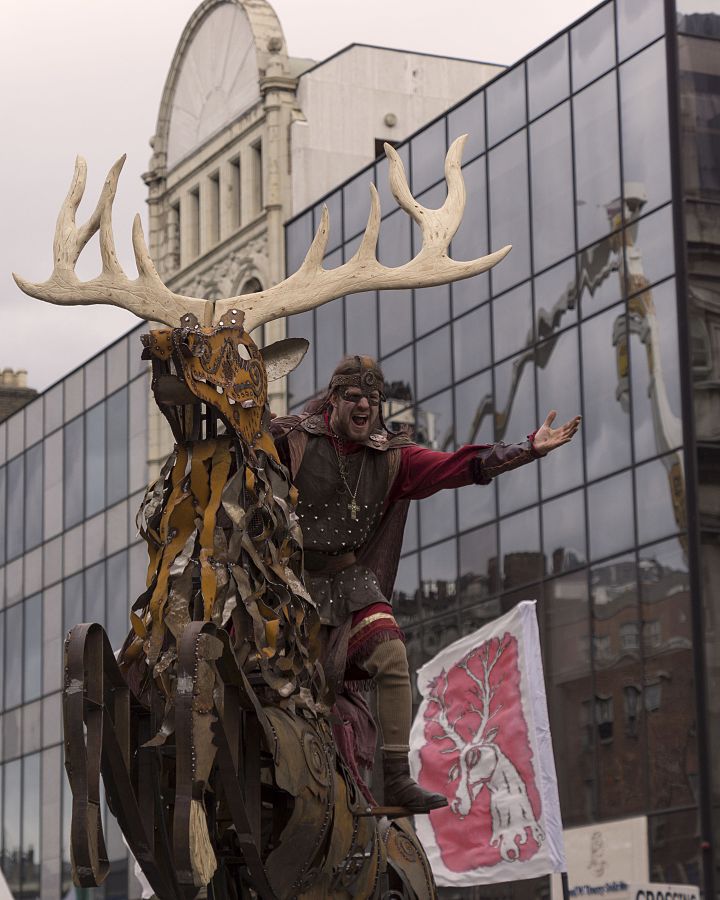
From a St Patrick’s Day parade in Dublin, 2014, part of an imaginative depiction of the Battle of Clontarf 1000 years before. No, the medieval Irish did not ride on stags, but it’s a cool image

Warfare was generally of a low intensity in Gaelic Ireland – raids, skirmishes, cattle theft. There was no warrior class and there were no housecarles or king’s bodyguards. There was no fyrd or militia, no custom of holding land in exchange for military service and no landless professional warriors.[i] A king did not have the means to maintain armed forces at his own expense, and billeting them on his people or on allies was politically fraught; he could do it, but it was a great way to lose friends and resources.[ii]

The only armed forces he could call upon were his electors. It was the duty of all free and able members of the tuath (people, territory or petty kingdom) to carry arms, and they assembled and fought only for limited periods.[iii]

By contrast, the nobles of medieval Europe had war at the heart of their identity. Knights were a special class elevated above the others. They held their land in exchange for an oath that they would fight. When contemporary writers chose just one word to describe the nobility, bellatores was the word they used – ‘those who make war.’[iv] But the Irish flaith (nobles/officials) were not a warrior class. In fact, I’m not sure they were even a class full stop.

The Irish king had no armed force loyal to himself. His armed forces were the same people who had a duty to depose him if he should fail in his duties. Military leadership was only one criterion, and not the foremost, on which contemporary sources judged kings; it was more important that they be wise, generous, cheerful, sound judges of disputes, etc.

War… War actually does change

Like a lot of things, this changed later in the period under discussion.

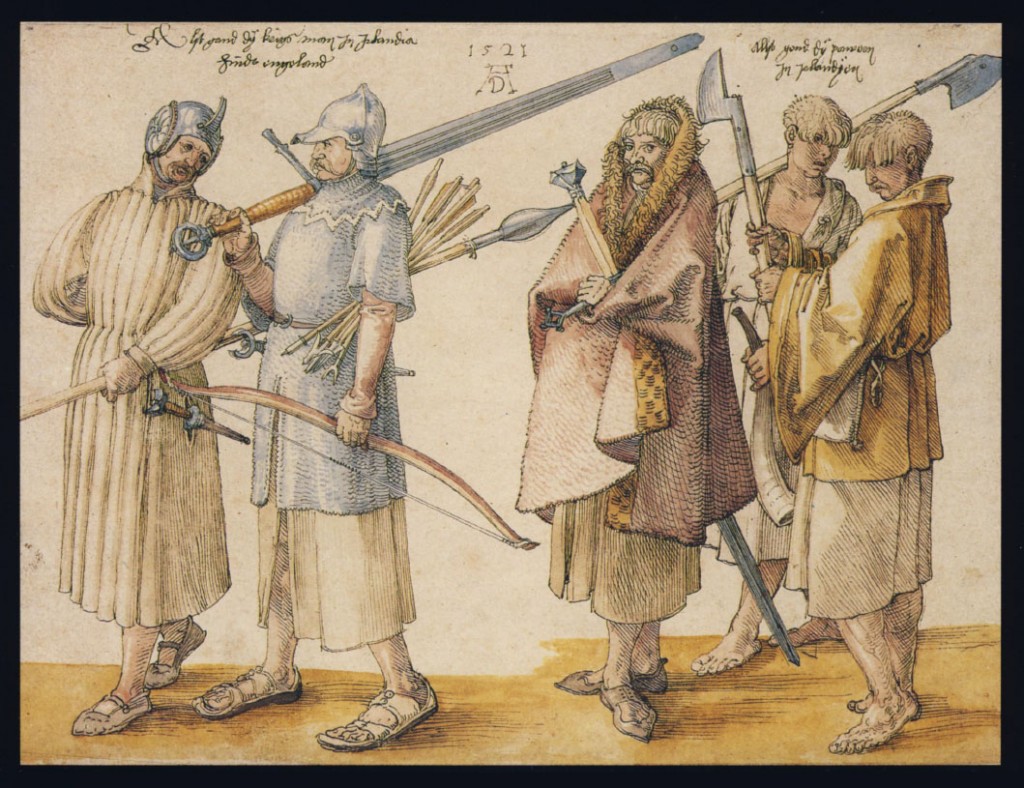
The Normans arrived from 1169 or so, with their ruthless hierarchies of knights and lords and their castles and their armies of knights and archers. Then came the gallóglaigh (foreign soldiers, often anglicised as ‘gallowglasses’), heavy infantry fighters from the Isles of Scotland who came to Ireland from the 13th Century on and revolutionised warfare.

Gallóglaigh and peasants in a 16th Century image by Albrecht Durer

From this point on Gaelic Irish kings tended to become more like lords and less like elected chiefs. As Simms writes in From Kings to Warlords: ‘A leader whose military strength was based on a professional army rather than on a hosting of his own free subjects had little need to consult the wishes of those subjects, except the half-dozen or so chief vassals who, like himself, controlled hired troops.’ Elections became a formality.[v]

This is why I chose the late 12th Century as a cut-off point. From here on Ireland is a country under conquest. Those natives who do not bend the knee adapt to the presence of the conquerors.

But even before the Normans and gallóglaigh, things were changing. My intuitive guess would be that the gallóglaigh came as a response to changes in Ireland; suddenly there was a market for mercenaries in Ireland. Why? Because from around 1000, beginning with Brian Boru, provincial kings arrogated more power from the rí tuaithe to themselves. As we noted last week, they fielded greater armies for longer periods, built fleets and fortresses, and placed heavier burdens on the people to pay for it all. They enjoyed the revenues of Scandinavian ports like Dublin and Limerick (which means they made a mint on the slave trade – of which, more next week). They billeted troops on their ‘allies,’ who no longer dared to resist or to complain. From around this time, people tended to start calling the rí tuath (petty king) a taoiseach (chief), reflecting a loss of status and sovereignty.

The social order in Ireland was changing even before the conquest. The kings and flaiths were developing into an unaccountable ruling class with a monopoly on violence. But they were still a long way off. These changes had not yet added up to a total transformation.

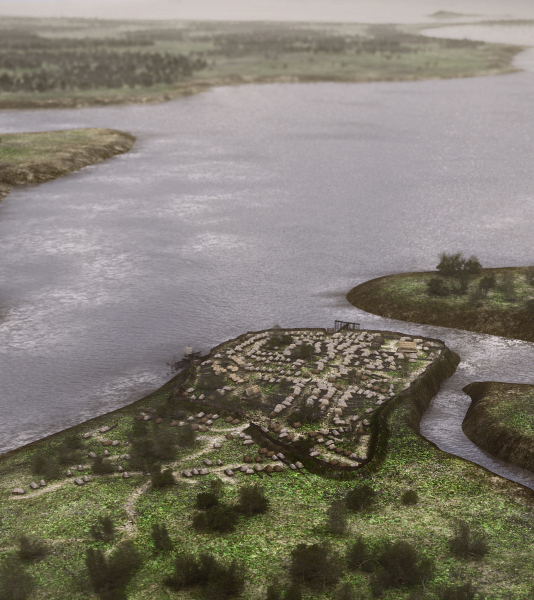
From Noho.ie – the Viking port of Dublin (The area occupied today by the space between Dame Street and Hawkins Street, I think). A slave trading centre which shaped Irish development – more on that next week.

Hospitality

O’Sullivan’s Hospitality in Medieval Ireland is a fascinating read. All pre-modern societies placed an emphasis on hospitality but Gaelic Ireland went further. Every ‘free law-abiding Irishman’ was entitled to entertainment and a night’s lodging.[vi] Everyone above the rank of ócaire (a humble farmer) was obliged to host. ‘Expulsion’ or ‘Refusal’ of a guest was a civil crime. To provide uncomfortable lodgings or bad food left the host open to the dreaded satire of the poets. Generosity was a solemn precondition for kingship: ‘the Old Irish gnomic text Tecosca Cormac maintains that the most shameful thing a king could do was give a banquet without brewing beer.’[vii]

I believe this custom was an extension of the king’s obligation to redistribute wealth. Each farmer or artisan having their own specialisation and limited means of exchange, the role of the king or flaith, the reason such official positions existed, was to receive and redistribute the various products.[viii]

Receiving and redistributing could take many forms, including tributes, gifts and the king’s many obligations to his tuath: maintenance of roads, bridges, ferries, common mills and common fishing-nets; and the cumal senorba, the portion of the common property that was set aside for the elderly, the disabled and the sick.

Remains of a fortified household or rath. These dot the landscape in Ireland

One of the key signs that kings and chiefs were getting more arrogant later in this period, and more decisively after the Norman conquest, is that their demands in terms of billeting and the annual ‘coshering circuit’ grew heavy – less of the redistribution, more of the extraction. These demands were necessary to keep up the kind of relentless military campaigns, year after year, that the 11th and 12th century provincial kings engaged in.

Hospitality was a natural extension of a king’s obligations. A satire on an inhospitable king was not simply a condemnation of his personal stinginess. It was a political attack; the king in question had neglected his duties as surely as if he had fled from battle or allowed a bridge to fall into disrepair.

Brett Devereux’s blog explains the role of nobles or ‘big men’ in agrarian societies the world over and how they helped to redistribute the surplus (although on terms that benefited themselves more than anyone else). So this is by no means confined to Ireland. But my argument is that the Irish king did a hell of a lot more of the redistributing and a lot less of the fighting compared to nobles in England and further afield. Redistribution was so central to the role of Irish kings that flaithiúl, ‘lordly,’ remains the modern Irish word for ‘generous’ – which is a long way from bellatores.

Gods without notions

To round off this week’s post, let’s look at two Irish legends that were popular around this period and that shed some more light on the question of hospitality. Of course, these are fictional stories told in a culture that took delight in the most extravagant exaggeration. But these are the stories that the people (or more cynically, the powerful patrons of culture) wanted to hear. They tell us a lot about people’s expectations and values.

Dagda was a god; people sometimes say that he was the Irish equivalent of Zeus or Odin but I don’t buy that (for reasons I’ll touch on below).

Cridenbel, ‘an idle blind man,’ used to ask for part of Dagda’s food every day:

‘For the sake of your good name let the three best bits of your share be given to me.’

It would have been dishonourable for Dagda to refuse, so every day he parted with most of his dinner. At this time Dagda was working at digging ditches and building raths (fortified households) so he had quite an appetite. Deprived of one-third of his food every day, he began to starve. But there was no way out of this sticky situation; it was better to starve than to refuse a request. At last Dagda’s son Angus Óg came up with a clever plan. Dagda put three pieces of gold on his plate and, when Cridenbel asked for the ‘three best bits’ of the meal, Dagda gave him the pieces of gold to eat. ‘And no sooner had Cridenbel swallowed down the gold than he died.’[ix]

Another story, related in O’Sullivan’s book, told of a kind one-eyed king who would never refuse anyone anything. A poet who was his guest decided to test his kindness. He asked the king to give him his eye for a gift. The king had no choice but to hand it over, leaving the poet with three eyes and himself with a total of none.

These stories reflect social mores. In them, hospitality is an obligation, not a gift. It is less dishonourable for Dagda to murder Cridenbel (!) than to refuse any request he might make.

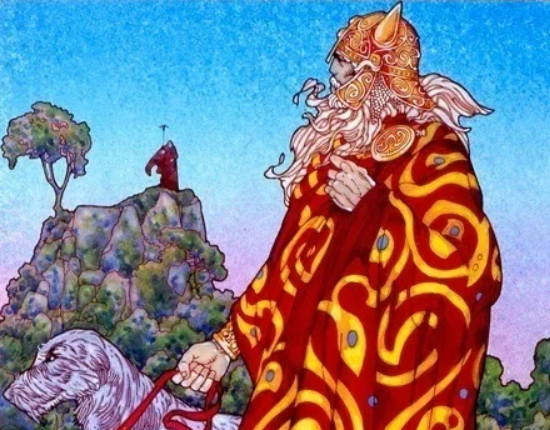
In a call-back to points in Part 1 about how Irish kings could be deposed, note that the incident with Cridenbel and Dagda occurs in a context of austerity, brought about by the stinginess of King Bres. Though Bres is not without merit as a king (he is easy on the eyes), his lack of generosity is not long tolerated; the people overthrow him and drive him out of Ireland.

Bres imagined by, once again, the great Jim Fitzpatrick. Detail from Breas.Cú Brea

(While we’re at it, let’s take a slightly closer look at Dagda. In other stories we see him unable to restrain his appetites: eating and drinking until he vomits and passes out; going on an important mission only to be seduced by two different women; falling on his bare arse and staggering about with his ‘enormous penis’ trailing on the ground.[x] He’s more of a pintsman than a patriarch of Olympus. Irish kings were less exalted than kings elsewhere, and the same goes for Irish gods.)

Until next time…

Again, so far so wholesome, apart from the blinding, murder and binge drinking. When we look at the period between 800 and 1200, there’s actually a lot of evidence for the claim that an Irish king was something like a public servant.

However, we have only established that the king was a public servant in relation to the free heads of household – presumably men – of the tuath. What about women? What about the unfree, the slaves? Next week’s post will address these questions, adding plenty of darker shades to our picture of Gaelic society.

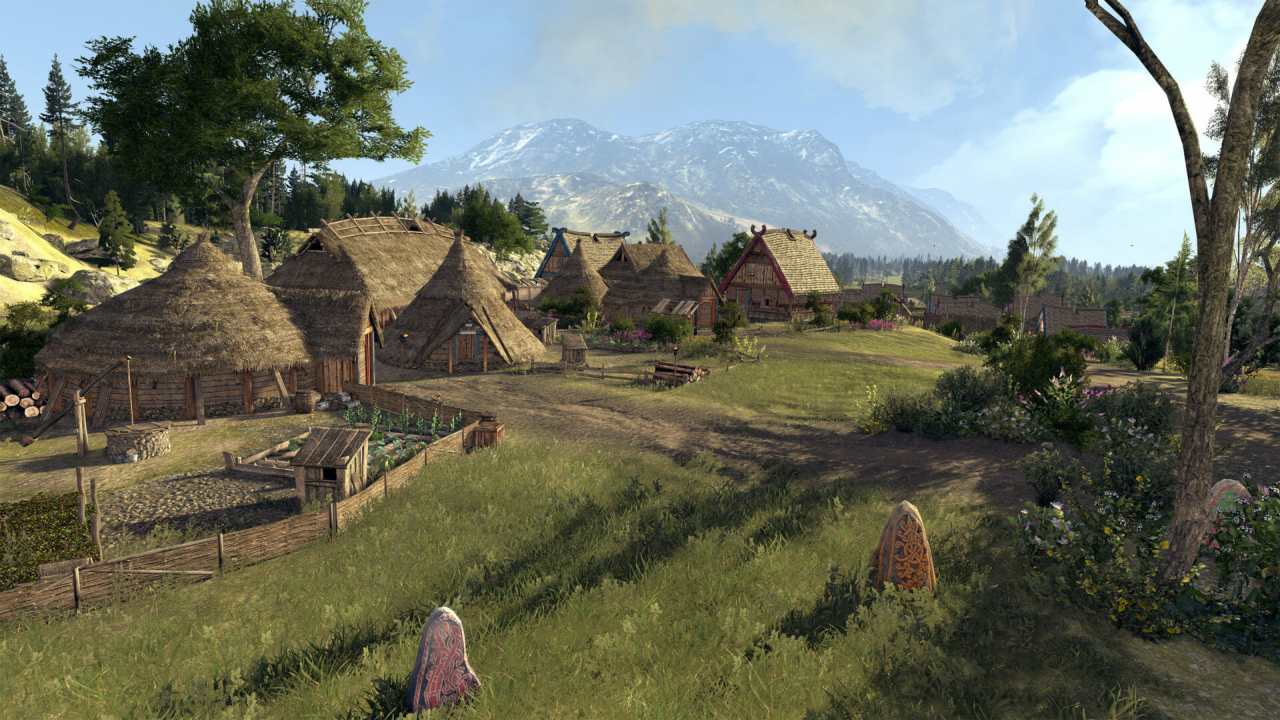
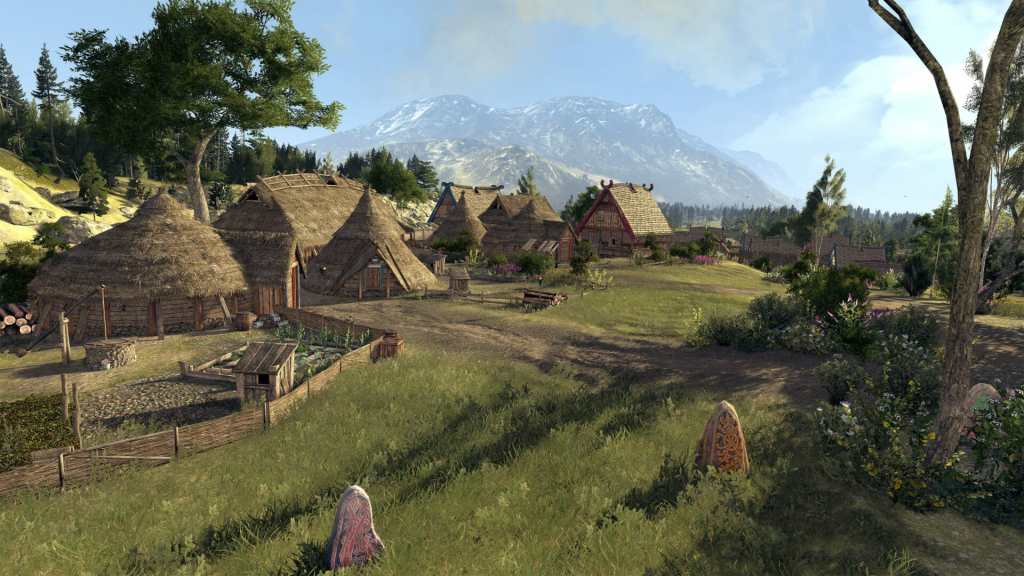
A 9th-Century settlement somewhere in Britain or Ireland – as imagined in the great Total War Saga: Thrones of Britannia

[i] Hayes-McCoy, GA. Irish Battles: A  Military History of Ireland, Gill & Macmillan 1969 (1980), p 48

[ii] O’Sullivan, Catherine Marie. Hospitality in Medieval Ireland 900-1500, Four Courts Press, 2004,  p 50-51

[iii] Jaski, Bart. Early Irish Kingship and Succession, Four Courts Press, 2000. p 99

[iv] Bishop Adalbero of Laon famously summed up the nobility, clergy and peasants as bellatores, oratores et laboratores -those who fight, those who pray and those who work. ‘Adelbero Ascelin’ in World Heritage Encyclopedia, Project Gutenberg, http://self.gutenberg.org/articles/Adalbero_Ascelin, accessed 17 May 2021

[v] Simms, Katharine, From Kings to Warlords, The Boydell Press, 1987 (2000), pp 19-20

[vi] O’Sullivan, p 31

[vii] O’Sullivan, 32, 87

[viii] Woolf sums this up as ‘the practise of redistributive chieftaincy that characterised the Irish political system.’ Woolf, Alex. ‘The Scandinavian Intervention’ in Smyth, Brendan (ed), The Cambridge History of Ireland, Cambridge University Press, 2018, p. 117.

[ix] Gregory, Augusta. Gods and Fighting Men, Colin Smythe Limited, 1904 (1970), 32-33

[x] The detail about Dagda’s member comes from The Silver Arm (Butler Sims (1981, 1983) written and illustrated by Jim Fitzpatrick, Ed. Pat Vincent. P 65. I don’t recall coming across that particular detail in Gregory’s book.

Celtic Communism? Pt 1: James Connolly’s Celts

James Connolly is widely remembered for his heroic death in the 1916 Rising. Less well-known, tragically, is his main life’s work: the struggle for international socialism. More than once in his writings he argued that Gaelic Ireland before the English conquest was essentially a communist society.

The Irish rose in rebellion again and again throughout history because to them English rule represented

the system of feudalism and private ownership of land, as opposed to the Celtic system of clan or common ownership, which they regarded, and, I think, rightly, as the pledge at once of their political and social liberty […] The Irish system was thus on a par with those conceptions of social rights and duties which we find the ruling classes to-day denouncing so fiercely as “Socialistic.”

(Erin’s Hope, 1897)

This is a conception of ‘liberty’ which the 21st-Century world should take note of – liberty based on democratic common ownership of wealth, rather than the ‘liberty’ of rich people to pollute, exploit and destroy without hindrance.

According to Connolly, Gaelic Ireland right up to its destruction by Cromwell in the 17th Century was

…a country in which the people of the island were owners of the land upon which they lived, masters of their own lives and liberties, freely electing their rulers, and shaping their castes and conventions […] the highest could not infringe upon the rights of the lowest – those rights being as firmly fixed and assured as the powers of the highest, and fixed and assured by the same legal code and social convention.

(The Re-Conquest of Ireland, 1915)

Connolly drew on the concept of primitive communism advanced by Friedrich Engels (who also, by the way, wrote a history of Ireland and learned Irish):

Recent scientific research by such eminent sociologists as Letourneau, Lewis Morgan, Sir Henry Maine, and others, has amply demonstrated the fact that common ownership of land formed the basis of primitive society in almost every country. But, whereas, in the majority of countries now called civilised, such primitive Communism had almost entirely disappeared before the dawn of history […] In Ireland the system formed part of the well defined social organisations of a nation of scholars and students […]

(Erin’s Hope, 1897)

These historical points were part of Connolly’s political mission: to champion the movement for Irish independence, but to take it further, to fight for social as well as political liberty. This was his contribution to debates around the Gaelic cultural revival.

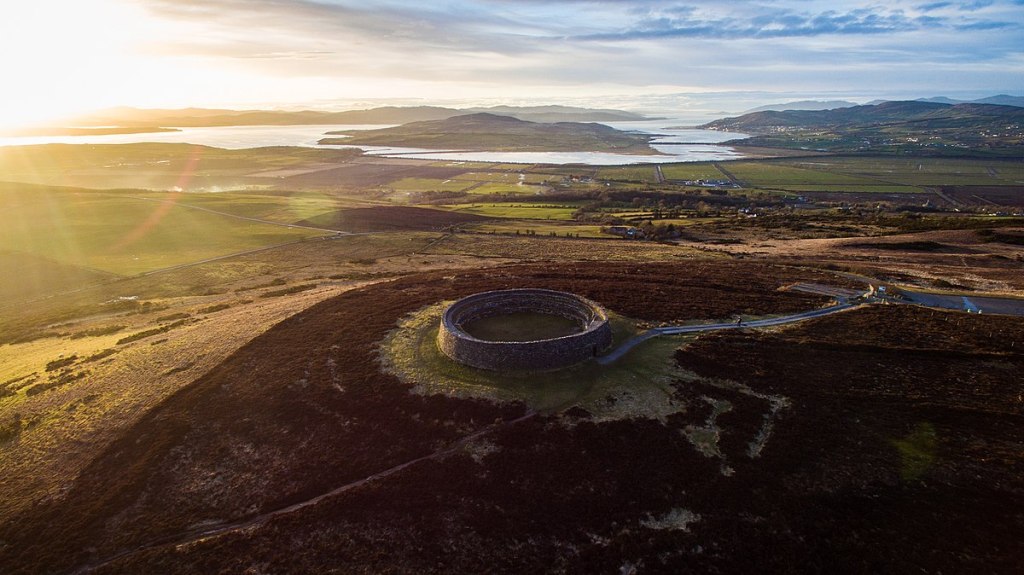
The Gaelic Irish fortress of Grianan Aileach, Co Donegal

But is it true?

Was Gaelic Irish society in any meaningful sense socialist? Or was this just one of those unfortunate examples of Connolly giving ground to romantic nationalism?

I want to test his claim against a range of historical sources. This is part 1 of a series that will be on-and-off; I will post three or four instalments over the next few weeks.

Want to get updates to your email address when I drop those posts? Subscribe here:

If Gaelic Ireland really was communist, it throws a new sidelight on the whole Celtic world.[i] It’s also very significant for those interested in the theory of primitive communism.

Connolly was not alone in believing that Gaelic Irish society possessed a democratic and communal social order. ‘Before the conquest the Irish people knew nothing of absolute property in land,’ wrote John Stuart Mill in 1868. ‘The land virtually belonged to the entire sept, the Chief was little more than the managing member of the association. The feudal idea which came in with the conquest was associated with foreign dominion, and has never to this day been recognised by the moral sentiment of the people.’[ii] Lawrence Ginnell in his impressive 1894 study of Brehon Law said that ‘the flaith [usually translated as ‘lord’ or ‘noble’] was properly an official, and the land he held official land, and not his private property at all.’[iii] In 1970 Peter Beresford Ellis painted a similar picture in the opening chapter of his History of the Irish Working Class.[iv]

By contrast, in much current writing on Gaelic Ireland we see heavy use of terms like ‘Lord and Subject,’ ‘Elite and Commoners’ ‘aristocracy’ and ‘hierarchy.’ This is an expression of a conflicting view, also of long standing, that ‘Irish society was rigidly stratified’[v] in the early medieval period. The same irreconcilable difference of opinion existed in Connolly’s day.

Gaelic Irish kings: Royalty or public servants?

In the first few posts of this series we’re going to take a look at one particular issue: the specific claim that a Gaelic Irish chief or king was ‘little more than the managing member of the association,’ ‘an official.’ If this is true he would be accountable and obliged to his people, relatively modest in status, something more akin to a public servant than to a member of a hereditary ruling warrior class.

For perspective, we should take a look at Ireland’s contemporary neighbours. An 11th-century Anglo-Saxon cleric remarked, ‘the people have the choice to choose as king the one who pleases them: but after he is consecrated as king, he then has power over the people, and they are not able to shake his yoke from their necks.’[vi] They could elect their kings; this could also be applied to Ireland at the time. But by contrast Irish people, if they thought their king was not doing a good job, were required by law to ‘to shake his yoke from their necks.’ The English King Alfred was seen as sacred and could not be deposed by his own people. He could appoint reeves (officials), muster a fyrd (an army) and levy burdensome taxes, unlike his Irish counterparts. This gap only widened later in the Anglo-Saxon period, and that is to say nothing of Norman customs like primogeniture and knight service.[vii]

Chronology

In this series, we will deal with Irish kingship in the period between the Eighth Century and the Norman conquest of the late Twelfth Century. This span of time encompasses thousands of kings who ruled over hundreds of diverse tuaithe (peoples or petty kingdoms, singular tuath). Within that period, profound changes occurred: lesser kings became known as dux or taoiseach (leader or chief) and the over-kings and provincial kings extended their powers and prestige, fielded larger armies for longer periods further afield,[viii] and began to levy a form of taxation.[ix] Any attempt to describe the Gaelic Irish social order must begin by stressing this diversity and by acknowledging this general pattern of change – in general, towards more centralised kingship, and away from customs we might see as democratic or communistic.

Under English conquest from the 12th Century on things changed – unevenly and see-sawing, but they definitely changed – in the direction of feudal institutions along the lines of what we see in England. Norman lords had inspired greedy Irish kings to copy them – to turn tributes into rents, to turn clients into tenants. Jaski bears out this general point: from the twelfth century on, ‘free clients’ grew closer in status to ‘base clients,’ and the position of base clients worsened as the power of kings and flaiths grew.

On the other hand, Gaelic Irish custom remained strong even after centuries under conquest. English observers like Spenser and Davies in the 16th Century describe elective kingship, tanistry, etc. When we talk of how the Normans became ‘more Irish than the Irish themselves’ it’s not just that they started playing hurling and stealing cattle and speaking Irish. It’s a commentary on how they were assimilated into the Gaelic Irish system of common land ownership. But it was a two-way street. The legal superstructure of Irish society didn’t change much between the Normans and Cromwell but he society underlying it changed a great deal. The old ways were not finally broken, however, until the Sixteenth and Seventeenth Centuries, when we see the Plantations – waves of violence that exterminated around a quarter of the people and overthrew the social order.[xii]

Feudal relations could grow up inside the framework of the communal, democratic system of the Gaelic Irish – but could only go so far, until the final shattering of that framework in the 17th century.

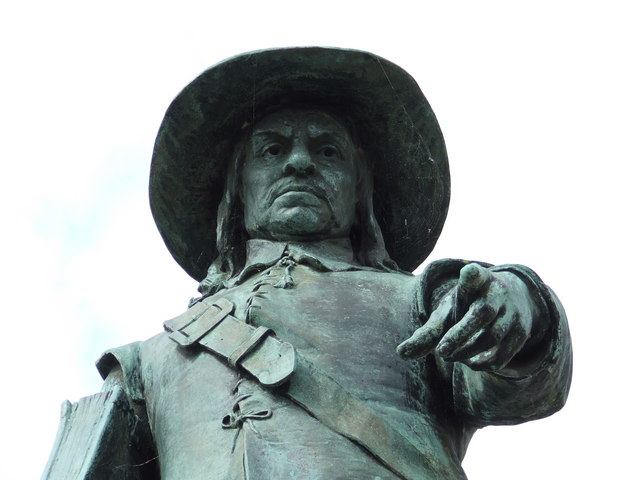
Oliver Cromwell, champion of the campaign of ‘primitive accumulation’ that destroyed what remained of Gaelic Ireland

Connolly lumped in all of pre-Cromwell Ireland into one description. But the further on we go in his chronology, the less Gaelic Irish society resembles what he describes. In his defense, this is political and not historical writing. He is making a political point – that common ownership of land prevailed until the Cromwellian rupture, that not just two nations but two social systems confronted one another in Ireland up to that point. This is true. But in the way he makes the point he drives a steamroller over Gaelic Ireland and flattens it out.

Everyone has to read Connolly. He’s brilliant. But don’t read him for a detailed and accurate history of Gaelic Ireland (or at least don’t begin and end with Connolly). He doesn’t offer one and, in fairness, he never pretended to.

Succession

How did a person get to be a king? In Norman England, kingship passed from father to eldest son. Gaelic Irish kings, on the other hand, were not born to rule but elected. Even the tánaiste (king’s deputy) was heir-apparent but not heir-designate. The electorate was narrow for the loftier kings but relatively broad for petty kings: provincial kings were elected by the titled persons of a province, while the king of a tuath was elected by all heads of households.[xiii]

Who could be a candidate? Family descent mattered a great deal, with scribes ‘pursuing endless genealogies to improbable beginnings’[xiv] in the interests of propaganda. ‘A non-kinsman does not take possession to the detriment of a kinsman,’ declared one law tract, to which a footnote by another legal scholar clarified that a candidate was entitled ‘if he be someone of the family [and] if he be right for the lordship.’[xv]

But hereditary claims were emphasised (even fabricated) by candidates precisely because succession could be contentious. The pool of candidates could be very wide; everyone who had the same great-grandfather. In addition, there was provision in the laws for illegitimate children and even non-relatives to contest the election. That a candidate must be ‘right for the lordship’ meant that it was at least as important for a candidate to possess febas (excellence or personal qualities).[xvi] Youth, old age, disability, incapacity or physical blemishes usually disqualified a candidate.[xvii]

(One legend tells of a king who had a lime-calcified brain thrown at him so that it stuck in his face. Because he was a really capable king, his people gave him a dispensation and let him rule.)

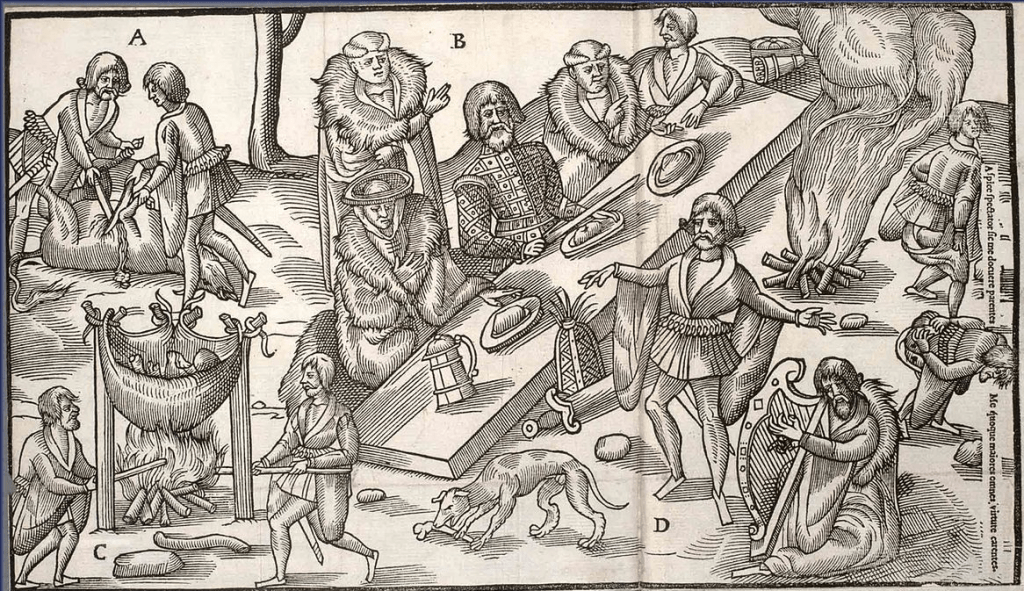
A woodcut by John Derricke from 1581, part of The Image of Irelande

People in a contractual relationship with a flaith were divided into free clients and base clients, the former enjoying better terms than the latter. Base clients, even those related to the king, were singled out for disqualification. This suggests three interesting conclusions:

  • that descent was secondary to social grade;
  • that a free client could be king;
  • and that it was known for a king to have base clients among his close male relatives.

These points challenge notions of a ‘rigidly stratified society’ and the last point suggests that we are dealing not with lofty family oligarchies but with broad kinship groups whose members were woven into the fabric of (often very small) tuaithe. The tuath was essentially a very big, broad family. Predictably enough, only a member could be the head of the family.

(As an aside, Fraser’s The Golden Bough mentions societies such as the Picts where the exact opposite custom held: the king of a community had to be an outsider.)

Inheritance did exist. Land and other property was divided between a king’s sons on his death. But that portion of his land which he only possessed through his title passed back to the community, to be given to whoever was next elected.

Heredity was a decisive advantage. But a candidate for kingship, whoever his ancestors were, had to demonstrate his own personal worth before the critical eyes of his peers.

Status

The free member of the tuath was not a subject of any king or lord. Even an individual in a contractual relationship with a king was not a subject or a vassal but a ile, a word which carries connotations of ‘partner’ or ‘companion’ and is usually translated as ‘client.’ All in all, Irish kings did not enjoy the exalted status of their contemporaries in Anglo-Saxon or Norman England. They were neither sacred nor above the law. According to the Old Testament, a king could not be deposed. But in Ireland the people had a duty to depose a ‘defective’ king, or else calamities would befall them.[xviii] A defective king was one who failed to repair infrastructure, who was stingy, who ripped off his own people, or who got his wounds on his back in battle (unless, the laws stipulate, he got those wounds on his back by running through the enemy lines).

Irish law had no sense of sublime majesty. Different categories of king were divided up into grades and their ‘honour price’ set down in bald numbers. Some professions, such as poet, judge or hostel-keeper, could attain the same honour price as a king.[xix]

Here we enter more disturbing territory, because honour price was measured in a unit of value called the cumal. The same word was used for a female slave. We need to let the dehumanising implications of that fact sink in, and then think about the general question of slavery. Connolly doesn’t mention it. Ginnell and Ellis deal with the issue, in my opinion not satisfactorily. This is a serious challenge to the idea of Gaelic Irish society as an equal, democratic, communistic society. We will deal with this question more fully in a future post.

You will have noticed a lot of ‘he’ and a lot of ‘his’ in the above points; that is because women could not hold political office. This suggests another topic for a future post: the position of women in Gaelic society, which was in some respects better than their position in other contemporary societies, but still bad. We need to consider this also in our judgement on Gaelic Irish society.

Next week in Part 2 we’ll continue our focus on the strange nature of Irish kingship. We’ll look at Irish kings at war; at the crazy array of social grades into which Irish society was divided; and at the question of wealth redistribution.

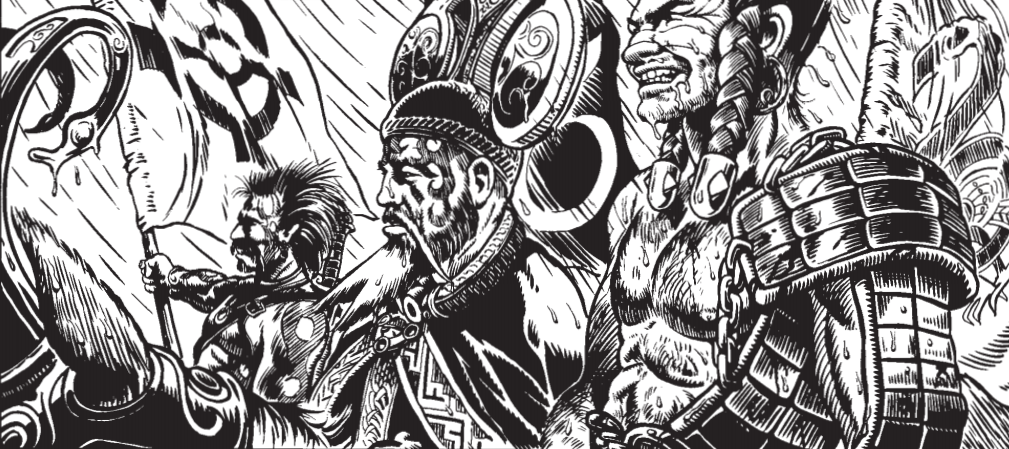
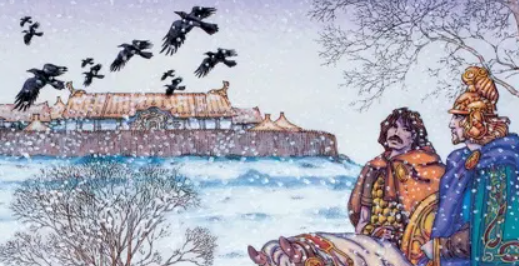
The cover image above is from Sláine: Time Killer, (Mills, Belardinelli, Fabry, Pugh, Talbot.) I’m a fan of of Sláine – read my review here. The image shows an Irish army preparing for battle in 1014.


[i] It is bold, to say the least, to draw conclusions about the Gauls in 100 BCE based on what some Irish monk wrote in 1000 CE, but people still do it; Ireland occupies a special place in Celtic studies because the Irish were the only Celtic people to produce a large amount of writing about themselves, as opposed to being written about by people like Julius Caesar when he could find time in between slaughtering them.

[ii] Mill, John Stuart. England and Ireland, Longman, Green, Read and Dyer, 1868, p 12

[iii] Ginnell, Lawrence. The Brehon Laws: A Legal Handbook, 1894. https://libraryireland.com/Brehon-Laws/Contents.php, ‘Section IV: Flaiths’

[iv] Connolly, James. Erin’s Hope, 1897, 1909, https://www.marxists.org/archive/connolly/1909/hope/erinhope.htm. See also Labour in Irish History (1910) and The Reconquest of Ireland (1915). https://www.teanglann.ie/en/fgb/flaith; P Berresford Ellis, A History of the Irish Working Class, Pluto Classics, 1972, 1996, p 14

[v] Frame, Robin. ‘Contexts, Divisions and Unities: Perspectives from the Later Middle Ages,’ and Ní Maonaigh, Máire. ‘Perception and Reality: Ireland c. 980-1229’ both in Smyth, Brendan (ed), The Cambridge History of Ireland, Cambridge University Press, 2018, pp. 535, 150, 153. Byrne, FJ, ‘Early Irish Society,’ in TW Moody and FX Martin (eds). The Course of Irish History 1967 (2011), p 45

[vi] Quoted in Godden, MR. ‘Ælfric and Anglo-Saxon Kingship.’ The English Historical Review, Vol 102, No. 405 (Oct, 1987), pp. 911-915. JSTOR, http://www.jstor.org/stable/572001. Accessed 10 May 2021

[vii] Rosenthal, Joel T. ‘A Historiographical Survey: Anglo-Saxon Kings and Kingship since World War II.’ Journal of British Studies, vol. 24, no. 1, 1985, pp. 72–93. JSTOR, http://www.jstor.org/stable/175445. Accessed 10 May 2021.

[viii] Simms, Katharine. From Kings to Warlords, The Boydell Press, 1987 (2000), p 11

[ix] Ní Maonaigh. p 150

[xii] Jaski. pp. 271-3

[xiii] Ginnell, ‘Section II: Irish Kings.’ ‘The king of a tuath was elected by the flaiths, aires and probably all heads of families in the tuath.’

[xiv] Hayes-McCoy, GA. Irish Battles: A  Military History of Ireland, Gill & Macmillan 1969 (1980), p 16

[xv] Jaski. p 156

[xvi] Ibid. pp. 157-162

[xvii] Ibid. pp. 82-87

[xviii] Ibid. p 62

[xix] O’Sullivan, Catherine Marie. Hospitality in Medieval Ireland 900-1500, Four Courts Press, 2004, p 128. See also Jaski, p 174

Sláine: Part Two

This is Part Two of a three-part series on 2000AD’s Sláine. You’ll find Part 1 here.

This part is going to be a live commentary as I re-read Demon Killer. I’ll be typing my responses to things as I see them. The point of this is to show how the writer Pat Mills integrated a huge amount of myth and history into these stories without sacrificing fun, pacing or clarity. Sláine is pure fantasy, even – perhaps especially – when it purports to be dealing with real people like Boudicca or William Wallace. But even as we know it’s fantasy, we know it’s not just pulled out of someone’s arse either; it feels authentic and possesses a certain integrity.

Demon Killer was written by Pat Mills and drawn by Dermot Power, Greg Staples, Glenn Fabry and David Lloyd. All images are from that.

So here goes.

  1. Right from the start we see ‘the triple death’ – Celts carried out ‘triple killings’ on their kings.
  2. As king Sláine is forbidden from fighting – in contrast to other cultures, early Irish kingship institutions placed far less emphasis on violence and more on generosity, kinship and wealth
  3. Geasa – taboos – yes, Irish kings had these taboos placed on them. Great mythical examples to be found in ‘The Burning of Derga’s Hostel’
  4. Reading animals’ entrails to see the future – a Roman practise, as far as I know
  5. Dead bodies getting up and speaking – a recurring motif in ancient Irish myths, though usually it’s a severed head
  6. Sláine is to be killed at the end of his reign – plenty of evidence that this was done in Ireland – eg the bog bodies
  7. The flashback to the battle of Clontarf – needless to say there was no warp-spasming warrior and no demon at that battle
  8. Sláine has four wives – yes, polygamy was legally recognised is the old Irish laws, and was widely practised right up to the 17th Century
  9. The magical cauldron comes from the tales of the Tuatha Dé Danann – see Gods and Fighting Men by Lady Gregory
  10. Gold thrown into sacred rivers and lakes – yes, this was done in ancient Ireland, Britain and Gaul – but it seems to have stopped by 800-600 BCE whereas Boudicca’s rebellion was in 60 or 61 CE (Alice Roberts, The Celts, p 92).
  11. This comic way overstates the ‘sacred gold’ angle – they dumped all kinds of artefacts of all substances in the rivers and lakes
  12. When Sláine rises from the pool and Ukko introduces him – Ukko’s eloquence is very typical of Irish mythology: ‘A bone-splitter, a reddener of swords, a pruner of limbs who delights in red-frothed, glorious carnage… Your lives would be prolonged for getting out of his way.’
  13. Sláine is in nothing but a loincloth, slaughtering guys in armour – this image of the wild reckless Celtic warrior is complicated by the fact that real Celtic warriors hid behind massive shields and specialised in hit-and-run attacks
  14. Explanation for how the rebellion began: for the Romans, gold is tax; for the Celts, it’s sacred – no basis in history, of course, but it’s creative and fun
  15. Boudicca says the Romans aren’t real men because they ‘bathe in warm water… anoint themselves in myrhh… and sleep on soft couches with boys… like their emperor who behaves like a woman… as is proved by the beautification of his person’ – OOF – this is the kind of ‘noble savage’/ ‘Fremen mirage’ stuff Sláine usually avoids. Based on what we know, the Celts were very proud of their appearance, adorning themselves with jewellery and dressing in bright colours. We know that the Gauls of Caesar’s time had make-up and fragrant soaps. Irish mythology is full of men describing each other as beautiful. ‘Personal adornments of bronze were abundant’ even among the prehistoric proto-Celts. (Nora Chadwick, The Celts, p 30.)And the casual 1990s homophobia is wide of the mark too – I’ve never come across evidence that the Celts looked down on gay sex or thought the Romans were somehow weird for doing it. Hmmm – and didn’t we see a gay couple in The Horned God?
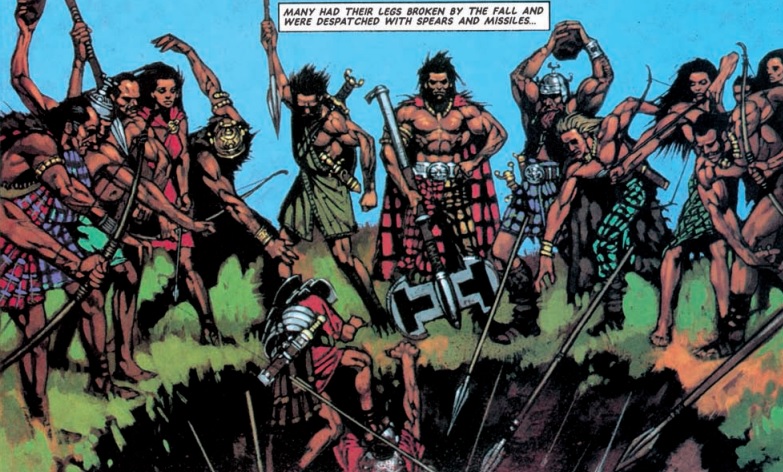
  16. It is true that Roman soldiers flogged Boudicca and raped her daughters.
  17. Mona (Anglesey) was the druid stronghold but not ‘island of the witches.’ Women as well as men were druids so that detail is fair enough. The idea of them being naked in the cold of north Wales, the idea of them fighting naked, the idea of them playing with human organs, that’s what we call artistic license. But in the very same year as Boudicca’s rebellion, it is true, Suetonius Paulinus led a legion to Anglesey where he fought an arduous battle against the druids, massacred them and then for superstitious reasons set about uprooting their oak groves. Before battle the Romans were ‘paralysed with fear’ by ‘women dressed like Furies in funereal attire, their hair dishevelled, rushing about amongst the warriors…’ So there – they were dressed. In attire, no less. (The Ancient Paths by Graham Robb, p 250-257)
  18. Elfric is clearly supposed to represent the luxury and licentiousness of the Romans – the old ‘noble savage’ theme again. Enjoying yourself in any way makes you weak, you see. But this goes against the theology explained in The Horned God.
  19. Yes, Colchester was where the retired legionaries lived
  20. ‘Do not heed warriors who need to protect themselves with helmets and breastplates – such men are full of fear!’ – The Celts were brilliant metalworkers and never had any aversion to armour, though there are accounts of people who went into battle naked.
  21. The druids’ magical herbs that cause hallucinations – a recent Blindboy podcast with Manchán Magan went into this, among other things. Very interesting.
  22. Burning people alive in wicker cages – not the first time we’ve seen this in Sláine – which is apparently based on accounts by Caesar (Gallic Wars) and Strabo (Roberts, the Celts, p 182).
  23. Women as well as men appear among the Celtic troops on the battlefield. I think this is a reasonable interpretation of the evidence of grave goods, history and mythology, which suggests women as prestigious leaders on the Continent, in Britain and in Ireland. I’ve read (I can’t remember where) that in early medieval Ireland women took part in fighting, perhaps a survival of the older custom. But earlier at Colchester Boudicca made a speech that seemed entirely addressed to the men in her army, so that’s odd.
  24. ‘You heard the boss!’ – the shield-boss, that is. Brilliant little touch. Classic Sláine.
  25. So this comic, towards the latter half, goes into a bit of a warp-spasm with the killing and the slaughter. This is getting as mad as the ‘Volgan’ occupation of Britain in another Mills classic, Invasion. The craziest part is when Sláine and Boudicca build ‘the bone prison of oeth,’ a prison made of the bones of Roman soldiers. This is based on a story made up by the 18th century Welsh antiquarian Iolo Morganwg. According to Sam Lansman: ‘One of the most evocative of Iolo Morganwg’s forgeries was his description of Caer Oeth ac Anoeth as a dungeon built from the bones of slaughtered Roman legionnaires. This gruesome if impractical prison, the antiquarian claimed, was destroyed and rebuilt several times during the wars between the Romans and the Britons.’ But the 18th-century bluffer didn’t entirely make it up; it’s an interpretation of source material that is all catalogued here on Jones’ Celtic Encyclopedia.
  26. ‘The point is the Caesarian Empire provided a role model for future empires to rob and enslave native peoples… No empire ever gets away with it. … Countries built on blood cost the descendants… the injustice leaves a psychic scar… A sickness in their souls…’ You tell em, Nest. Excellent.
  27. A detail I forgot. The gruesome prison of bones is so morbid it opens a portal for Elfric to return – suggesting that all this fury and slaughter is the ultimate cause of the rebellion’s undoing
  28. All this slaughter is not just a trope of comic books. It’s also, to be fair, a trope of old Celtic legends. Read ‘The Battle of the White Strand’ – incredible numbers die left, right and centre.
  29. ‘The Omphallos – the Navel of Britain!’ – this is another motif that’s explored in Robb’s The Ancient Paths
  30. ‘Your majesty’ – hmmm… I don’t think Britons would have referred to their rather down-to-earth kings and queens by such exalted titles.
  31. The battle is amazing – a mad mixture of the sort-of plausible with pure unabashed fantasy. Tremendous fun. Nothing really to say except that there were plenty of women as well as men among the Britons, who also had loads of trumpets like we see here, which terrified the Romans. I don’t think there’s any evidence the Britons were goaded into battle in the way we see here, but Graham Robb has a theory about how Boudica chose the battle site for scientific-religious-geographical reasons (Robb, The Ancient Paths, p 263)
  32. Yes, the Britons’ retreat was impeded by their wagons; yes, even according to the Roman Tacitus the civilians were not spared. The cruel reprisals afterwards are accurate. ‘Hostile’ tribes had their lands laid waste.
  33. The lament ‘Ochone’ is real, it’s Irish
  34. The interior of the burial mound resembles real-life continental burials like that of the ‘Hochdorf prince’ – right down to the ‘bronze couch’
  35. I don’t know if this claim about a planned conquest of Ireland is based on anything, but that could be my own ignorance. I will say that Suetonius Paulinus’ maps look way too accurate – the Romans didn’t have such technique in cartography. Their maps were terrible.
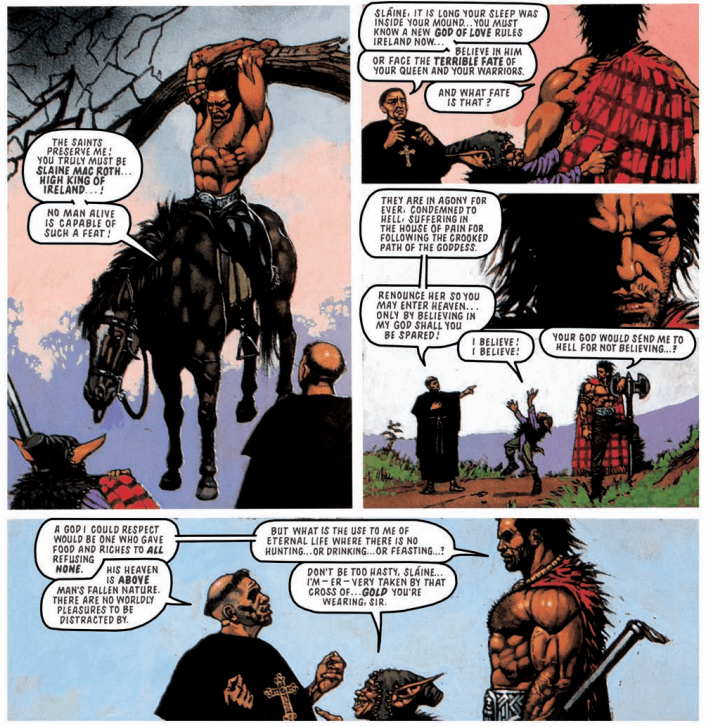
  36. There is a little epilogue where Sláine returns to Ireland to find that his whole world has vanished with the passing of the years. This is brilliant, based on the myth ‘Oisín and St Patrick’ (In Gods and Fighting Men but also online here). In this story a legendary Celtic warrior argues with a Christian saint. It’s absolutely brilliant. The debate between Sláine and the priest is a faithful and creative interpretation of such ancient stories. There’s real authenticity in this little epilogue.

I expected to find like ten bullet points, not thirty-six!

Good thing I chose Demon Killer rather than The Horned God, or I’d have been here all day. The sum of all these little details is a major part of what makes Sláine work. I think the series has lost this over the years – never entirely, but to a considerable extent. Anyway, we’ll get on to that next week with Sláine: Part 3.

Books:

  • The Celts, Nora Chadwick, Penguin, 1972
  • The Celts: Search for a Civilisation, Alice Roberts, Heron Books, 2015
  • Gods and Fighting Men, Lady Gregory, 1904 (1970, Colin Smythe Ltd)
  • The Ancient Paths, Graham Robb, Picador 2013

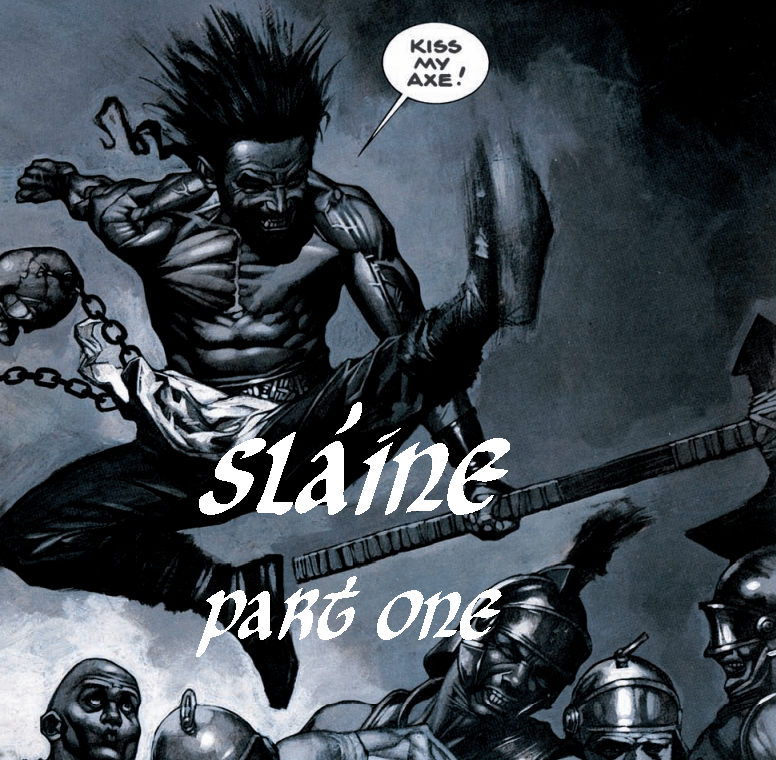
Sláine: Part One

Over the first year of Covid I went through the back catalogue of 2000AD’s Sláine, for the most part reading the digital graphic novels on my tablet. At first I dipped in out of curiosity, but found myself enjoying it so much that I read fifteen titles cover to cover.

And I did not think it too many.

This is the first part of a three-part commentary tracing the high points and low points of the comic over the forty years of its existence. I will comment on each title in the series. The high points are magnificent and the lows are pretty shocking. My opinions will not be popular.

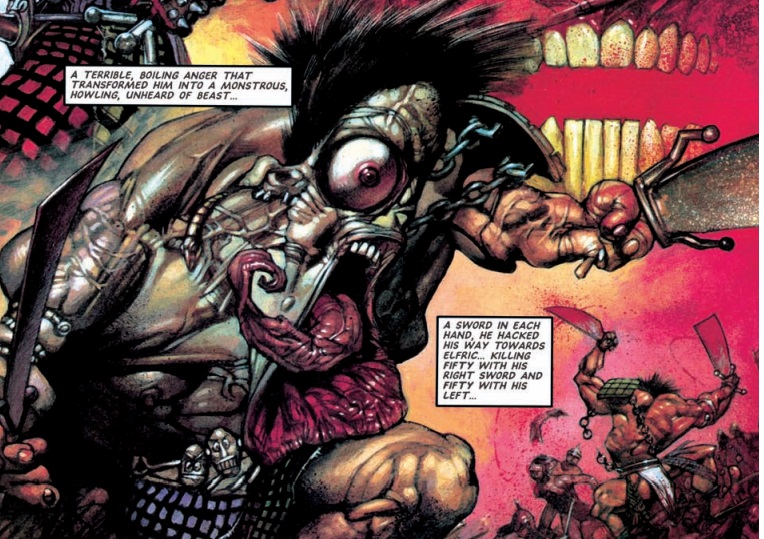
Sláine. I’d imagine most British people pronounce it as ‘Slain’ and, you know what, that’s fine. But it’s Slaw-nyah. However you say his name, he’s a character in the British comic 2000AD. He is a warrior with an axe who roams around Celtic Europe, leaping, shouting and chopping up bad guys. Roughly once per graphic novel, when chopping and shouting does not suffice, the raw power of the Earth goddess surges through him in a raging ‘warp-spasm,’ and he transforms into a grotesque and unstoppable beast.

From Demon Killer, written by Pat Mills, art by Glenn Fabry, Greg Staples, Dermot Power

But (at its best) there’s a lot more to it than that. Sláine is not a Viking or a Spartan or a medieval knight; he is a Celtic warrior, and that means he doesn’t fit neatly into the macho mould you might expect. He’s difficult to pin down and he’s got a lot going on. The two sides of Sláine are captured in The Horned God, when in a flash-forward Sláine’s chroniclers debate his legacy:

Ukko: Nah… Readers aren’t interested in all that fancy stuff. What they want is plenty of hacking and slaying.

Mor Runne the Dung Collector: Yurrr… I like hacking and slaying.

Nest: But there’s always been more to Sláine than just some muscle-bound barbarian. It’s an attempt to redefine the hero. To convey the matriarchal origin of myth.

Ukko: Take a tip from an old hack, dear, and stick to Sláine chopping off brainballs!

Mor Runne the Dung Collector: Yurr! I don’t like the comp… comp… complicated bits. I only like it when he’s killing people.

There are plenty of violent battles in Sláine – with Fomorians, Skull-Swords, Trojans and all kinds of demons and monsters. But the battle between a basic barbarian action hero and a deep, obscure Celtic soul is the most interesting of all. Over the next three posts I will examine this struggle. Part 1 will look at the first twenty years or so, Part 2 will take a deep look at one particular graphic novel, and Part 3 will deal with the latter half of Sláine’s career (including the really controversial bits).

1: Warrior’s Dawn

Map of the Land of the young, from Albion British Comics Database

The early stories from the 80s are collected in the graphic novel Warrior’s Dawn.

Sláine is a wandering exile in a mythical Celtic Europe called the Land of the Young – so named because few live to grow old. It’s a place as chaotic and fun as 2000AD’s Mega-City One. Flying ships powered by standing-stones ply the skyways. Dark magic corrupts the fields and forests into sourland, where prehistoric and inter-dimensional monsters roam. A stinking corpse named Slough Feg is the leader of a death-cult which burns captives in tribute to the maggot god. Sláine seeks to return to his own people, the Tribes of the Earth Goddess, a strange but relatively wholesome crowd whom Slough Feg seeks to conquer.

Writer Pat Mills does his homework when it comes to the Celts; many elements of this setting are derived from real history or myth. Not just Cuchulain’s riastradh, or warp-spasm. Whenever Sláine kills some great number of people and boasts that he ‘did not think it too many,’ he is quoting from the stories of the Fianna cycle. Part 2 will give further examples.

Sláine is not a boy scout. He is governed by obscure drives, sometimes dark or shallow, sometimes profound and selfless. His enemies – the Guledig, Slough Feg – are those who despise human pleasure, and the natural and material world which Sláine champions. He succeeds not through domination and destruction, but through submitting to the sublime chaos of the pagan world.

Sláine’s anti-authoritarian tendencies are not founded on ‘noble savage’ tropes or ‘don’t tread on me’ hypocrisy, but in an egalitarian, feminist and ecological spirit. Later in The Horned God we see that among the tribes of the Earth Goddess, marriages last for one year. The land is shared out equally and some set aside for the old and the sick. Kings (Sláine included) are sacrificed after a seven-year term so that they don’t get too big for their boots. Empires are seen as barbaric. Sláine makes no pretense that it is historical, but this depiction of Celtic society has plenty of foundation in the sources.

It is a myth of its own time. The Celts dress like punks (in later numbers more like metalheads). Ukko the dwarfish thief hates the egalitarian ways of the Celts, which he criticises in distinctly Thatcherite terms. Keep in mind that it’s the late ’80s, early ’90s, and the main bad guys, the Fomorians, are ruthless, callous tax collectors; we are duly informed that they live in a place called Tory Island (a real island off the coast of Donegal where, yes, the Fomorians of myth had their base). The hunger strike is portrayed as a venerable and ancient custom – just a few years after the 1981 hunger strikes in Ireland.

A lot of the above comes later, especially in The Horned God. But even in early Sláine, not a single episode goes by without some cool element of Irish, Welsh or Gallic myth figuring into the story somehow or other.

I like Sláine because (again with the qualifier, ‘at its best’) it chimes with what Michael Moorcock wrote about the great novels of Henry Treece. It is able

to capture the sense of raw passion of adult men and women who are not always mystically inclined yet dwell in a world of mysticism… [magic] is as much a part of life as the wild landscapes… as the stones and hills, the forests and the seas, the fortified townships and isolated villages dwarfed by the great grey skies.

Sláine is at its strongest when character and setting have room to breathe. It is at its weakest when it becomes simply a story of a man chopping up a succession of ugly monsters.

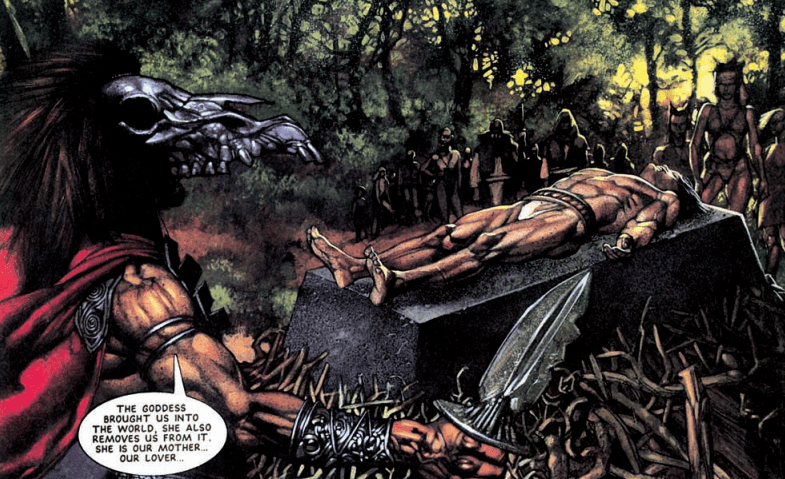
His time as king of his people is up, so he must be killed. From Demon Killer, written by Pat Mills, art by Glenn Fabry, Greg Staples, Dermot Power

2 and 3: Time Killer and The King

The stories collected in the second and third graphic novels (Time Killer and The King) see Sláine journey home and become the leader of his people, but for a while the reader is taken away on a bizarre detour. Sláine encounters the Cyth, inter-dimensional aliens who secretly control the destiny of humanity… and there’s a temple, a temple of terror or something… *yawns* … where was I? To cut a very long and jarringly episodic story short, Sláine travels through alternate dimensions, encounters strange aliens and trades his axe for a leyser gun. Yes, leyser. Like ley-lines. Get it?

It probably responded to some editorial and/or commercial need at the time, but I found the detour tiresome, a grind with no connection to the character or the setting I had become invested in.

No doubt some are reading this post to find out what are the best Sláine comics, which to start with, which ones not to bother with, etc. They might ask, ‘Should I just skip Two and Three?’

Ah, I must warn against it. The people on the business end of 2000AD have gerrymandered the graphic novels in a fiendish way. The sci-fi stuff is split fifty-fifty between the second half of Two and the first half of Three. If you pass on Two, you miss, among other great episodes, Sláine’s time-travelling intervention at the Battle of Clontarf. If you pass on Three, you miss out on Sláine’s return to the Tribes of the Earth Goddess, the story of how he becomes king of his tribe and of the first battles with the Fomorian sea demons. So the publishers have us in a bind.

Edit: see here for a very different (perhaps fairer) take on Tomb of Terror:

https://slaineranked.blogspot.com/2024/08/slaine-ranked-part-11-you-wont-find.html?m=1

Classic 1980s black–and-white Sláine. From Time Killer, Written by Pat Mills, art by Massimo Belardinelli, Glenn Fabry, David Pugh, Bryan Talbot

4: The Horned God

This brings us to the pinnacle of the whole saga. The Horned God is the story of how Sláine unites the Tribes of the Earth Goddess to resist Slough Feg. More than that, it is a spiritual journey for Sláine as he submits to the Earth Goddess and becomes her faithful champion. Simon Bisley’s full-colour art is really beautiful.

The Horned God is deliberately slow to start, laying a solid thematic basis. Nothing in this story feels unearned. The story explores the motivations of Slough Feg and his death-cult. There’s a kind-of feminist theme as Sláine triumphs through becoming the Horned God, the champion of the Earth Goddess.

This champion ‘sees the ridiculousness of life. He never takes its pressures too seriously… Whereas the sun god is so serious… is obsessed with authority… with conquering everything… those heroes who follow his path are usually mindless and violent.’

The ingredients are in the right balance: action and spectacle combined with thematic depth and character development. There are stories within the story – such as the return of the Avanc, last survivor of an indigenous people wiped out by one of the Tribes of the Earth Goddess. Some parts are laugh-out-loud funny, but there are moments of real pathos – like when Sláine says goodbye to his son.

The Horned God is amazing.Despite some elements which have not aged well (including the male gaze stuff that I will deal with next week) it rewards reading and re-reading.

5, 6 and 7: Demon Killer, Lord of Misrule and Treasures of Britain

Pat Mills appears to be deft at pleasing his editors while also remaining true to his creations. As noted above, for some reason Sláine became an inter-dimensional battler of aliens for a while in the 80s – but rather than retconning or pretending it never happened, Mills does a graceful job of integrating the silly alien stuff into the story while keeping the focus on the themes and characters we actually care about. This enriches the stories collected in the next few graphic novels. In Demon Killer, Lord of Misrule and Treasures of Britain, Sláine travels through history and myth and time. These stories feature Boudicca, Robin Hood and King Arthur. Along the way he battles with old enemies: the Guledig and the sadistic demon Elfric.

From Demon Killer, written by Pat Mills, art by Glenn Fabry, Greg Staples, Dermot Power

Demon Killer puts the moral ambiguity of Sláine to the fore. Alongside Boudicca, he loots and razes a Roman city, killing masses of innocent people. Mills justifies this in the introduction (justifies it as an artistic choice, I hasten to add) convincingly in my view:

In many comics he would have doubtless made an excuse and left or tried to stop the massacre with some appalling hindsight speech: “No! No! Spare the women and children!” Fortunately, on 2000 AD, we don’t make such unconvincing compromises. The reality is that, as a Celtic warrior, Sláine would have participated because his people were driven to a fury after the Romans ethnically cleansed their land. And I feel this uncomfortable truth is preferable to reassuring but bullshit fiction.

(Pat Mills, from the introduction to Demon Killer)

 It is consistent with Sláine’s character and his motivations. I said he wasn’t a boy scout. He is compelling because he attracts and then alienates our sympathies. But we’ll be taking a closer look at Demon Killer next week.

Lord of Misrule contains a moment very characteristic of Mills’ writing:

From Lord of Misrule, written by Pat Mills, art by Clint Langley, Greg Staples, Jim Murray

I don’t know if this is true or just a myth, and I don’t care. I like these little asides, and how they are well-integrated into the story.

In Treasures of Britain I found the story a bit unfocused. But the artwork is the most beautiful of these three comics, and there are many astute comments on Arthurian legend.

These are fun adventures, beautifully drawn, with thematic depth and character. I heartily recommend them.

That’s it for this week. Subscribe by email to get a notification when Part Two goes up. Next week we’ll look in depth at Sláine: Demon Killer. We’re getting into darker material in Part 3: some of the dodgy shit that has made its way onto the pages of Sláine, and why I hated Book of Invasions. But we’re also going to appreciate the finest artwork of the whole saga and take a look at my recommendations for the top five Sláine comics.

Maybe you enjoy reading about Sláine, and you didn’t think that too many. You should check out this great blog where the author Alex compiles a full list and ranking of all Sláine stories: slaineranked.blogspot.com